

oSIST prEN 13236:2026
(Main)Safety requirements for superabrasive products
- Abstract
This document applies to superabrasive products containing natural or synthetic diamond or cBN (cubic boron nitride). It includes precision grinding and cutting-off wheels, non-precision cutting-off wheels, diamond wires, mounted points and other superabrasive products for non-precision grinding. It also applies to reconditioned superabrasive cutting-off wheels.
This document specifies requirements and/or measures for the removal or reduction of hazards resulting from the design and application of the superabrasive products.
This document contains also procedures and tests for verification of the compliance with the requirements as well as safety information for use, which will be made available to the user by the manufacturer.
This document does not apply to bonded abrasive products, coated abrasive products, rotating dressing tools, truers or any non-rotating superabrasive products.
- Status
- Not Published
- Public Enquiry End Date
- 30-Jul-2026
- Technical Committee
- VSN - Safety of machinery
- Current Stage
- 4020 - Public enquire (PE) (Adopted Project)
- Start Date
- 10-Jun-2026
- Due Date
- 28-Oct-2026
- Completion Date
- 15-Sep-2026

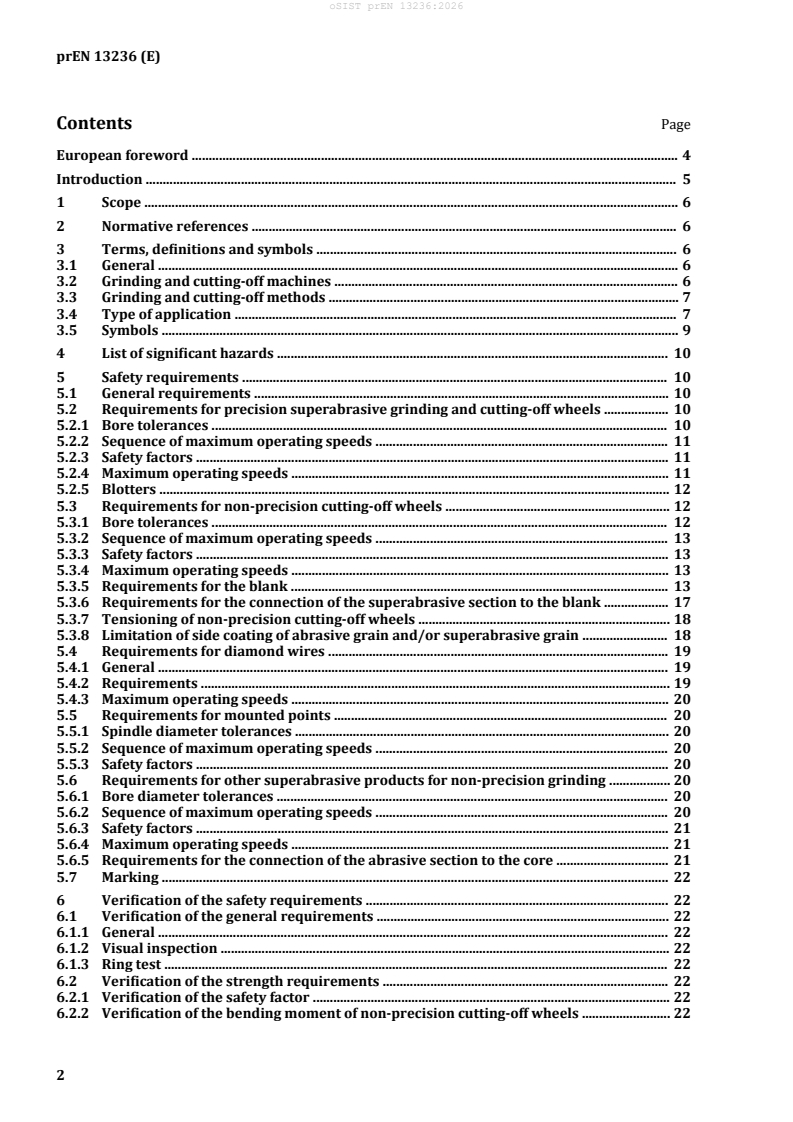
oSIST prEN 13236:2026 is the Slovenian draft version of CEN prEN 13236, published by SIST. It specifies safety requirements for superabrasive products containing natural or synthetic diamond or cBN (cubic boron nitride), including how they are designed, marked, verified and accompanied by safety information. The document is aimed at designers, manufacturers, suppliers, importers and reconditioners who need to reduce risks from grinding and cutting-off products.
What does oSIST prEN 13236:2026 specify?
oSIST prEN 13236:2026 sets safety requirements for superabrasive products and explains how compliance is checked. It covers the product families, the hazards they create, the tests used to verify safety, and the information that has to reach the user.
The scope includes precision grinding and cutting-off wheels, non-precision cutting-off wheels, diamond wires, mounted points and other superabrasive products for non-precision grinding. It also applies to reconditioned superabrasive cutting-off wheels.
The document is organized into:
- Clause 1 to 7, covering scope, references, terms, hazards, requirements, verification and information for use
- Annex A, marking
- Annex B, mounted points
- Annex C, reconditioning of cutting-off wheels
- Annex D, speed conversion table
| Annex | What it covers |
|---|---|
| Annex A | Marking content, execution, restrictions to use and safety signs |
| Annex B | Mounted points and example calculations for permissible speed of rotation |
| Annex C | Reconditioning conditions and extra marking for cutting-off wheels |
| Annex D | Speed conversion values for marking abrasive products |
What are the key requirements of oSIST prEN 13236:2026?
oSIST prEN 13236:2026 requires superabrasive products to be designed and manufactured so they withstand the forces expected in intended use and show no visible defects that affect safety. That matters because the standard is mainly about preventing breakage, kickback, vibration and other hazards before the product reaches a machine.
Product design, speed classes and tolerances
Clause 5 separates requirements by product type. Precision wheels, non-precision cutting-off wheels, diamond wires, mounted points and other non-precision grinding products each have their own tolerance class, speed sequence and safety factor. In practice, this means the maker must choose the right construction and mark the product for the machine and application it is meant for.
For precision grinding and cutting-off wheels, Clause 5.2 ties bore tolerances to ISO 22917 and limits the maximum operating speed by bond type and core construction. For non-precision cutting-off wheels, Clause 5.3 uses H9 bore tolerance from EN ISO 286-2:2010 and adds separate limits for blanks, segment attachment and use on hand-held, mobile and stationary machines.
Strength against bursting and deflection
Clauses 5.2.3, 5.3.3, 5.5.3 and 5.6.3 require the products to meet specified safety factors against bursting due to centrifugal force. Mounted points also need a safety factor against spindle deflection. This matters because the permitted speed depends not only on the wheel or wire, but also on the machine type and how the product is supported.
Clause 5.5 also requires mounted points to be designed with spindle diameter tolerances from ISO 22917 and to be accompanied by a permissible speed of rotation that depends on the overhang and clamping length. Annex B explains the calculation method used for that value.
Non-precision cutting-off wheels
Clause 5.3 adds the most detailed construction rules. It covers blank thickness, material, surface finish, openings, slot geometry, heat treatment, the connection between the superabrasive section and the blank, tensioning, and side coating limits. For a buyer or engineer, this is the part that tells you whether a wheel is meant for dry or wet cutting, hand-held or stationary use, and whether the blank design is acceptable for safety.
Clause 5.3.6 also sets strength requirements for segmented wheels and wheels with continuous cutting rims, and Clause 5.3.6.4 allows reconditioning only under the conditions given in Annex C. That is important for repair and reuse decisions, because a reconditioned wheel must still meet the same safety expectations as an unused one.
Diamond wires
Clause 5.4 limits diamond wires to wire sawing machines and excludes hand-held machines. It sets requirements for the support cable, abrasive beads, spring-mounted constructions, wire couplings and press rings, and it caps the maximum operating speed at 40 m/s.
In practice, this means the wire must be selected and assembled as a system, not just as a cutting element. The cable strength, bead fit and coupling strength all have to support safe sawing under load.
Marking and information for use
Clause 5.7 sends all product marking to Annex A, and Clause 7 requires the manufacturer, supplier or importer to provide safe-application information and safety recommendations. Annex A covers identification, dimensions, maximum speed, direction of rotation or run, conformity marking, restrictions to use, traceability and safety signs.
For users, this matters because the label and instructions are part of the safety system. They tell the operator how to mount the product, which machine it may be used on, what conditions to avoid and which protective measures to follow.
Verification
Clause 6 defines how conformity is checked. It uses visual inspection, ring testing for certain vitrified wheels, centrifugal burst testing, bending and shear tests, diamond wire tests, marking checks, blotter checks and a tensioning check for certain non-precision cutting-off wheels. These are the tests a manufacturer or test lab would use to show that the design and marking claims are credible.
What terms does oSIST prEN 13236:2026 define?
- Superabrasive product - an abrasive product containing natural or synthetic diamond or cubic boron nitride in a bond.
- Stationary machine - a machine fixed in position during operation, including transportable machines that are fixed while in use.
- Mobile machine - a machine not fixed in position during operation, such as a manually guided floor grinding machine.
- Hand-held machine - a machine held in the hand during operation, including machines with flexible drives.
- Peripheral grinding - grinding with the periphery of the wheel, with no or only limited side loads.
- Maximum operating speed (nmax) - the maximum permissible speed of rotation for a new abrasive product.
- Safety factor against bursting due to centrifugal force (Sbr) - the factor used to compare bursting speed with maximum operating speed.
Who uses oSIST prEN 13236:2026?
oSIST prEN 13236:2026 is used by designers, manufacturers and suppliers of superabrasive products, and by companies that recondition superabrasive cutting-off wheels. It is also relevant to designers, manufacturers and suppliers of grinding machines because the document explains which product types fit which machine and application.
Quality and production teams use it to set design limits, choose tolerances, define marking, and plan verification tests. Buyers and technical reviewers use it to check whether a wheel, wire or mounted point is intended for hand-held, mobile or stationary use, and whether any restrictions to use apply.
What changed in oSIST prEN 13236:2026 from the previous edition?
oSIST prEN 13236:2026 will supersede EN 13236:2019. The foreword lists these technical changes:
- Formula (2) was replaced by Table 12 with minimum bending moments in 5.3.6.3
- The centrifugal force test in 6.2.1 was changed
- The shear strength test in 6.2.3.1 was changed
- A new Figure 8 was added in 6.2.3.1
- A flangé diameter for tensioning was added in 6.5
Which standards are used with oSIST prEN 13236:2026?
The document uses EN ISO 286-2:2010 for H9 tolerances on bores for non-precision cutting-off wheels. It also cites ISO 22917 for tolerance classes on precision superabrasives and mounted points.
Annex A refers to EN ISO 7010 and ISO 3864-2 for safety signs and safety colours. The bibliography also names EN ISO 16089, EN ISO 11148-7, EN ISO 11148-9, EN 60745-2-3 and EN ISO 19432 as related machine and tool safety documents used in the definitions and examples.
What does the oSIST prEN 13236:2026 document contain?
The document contains requirement clauses, verification methods, annexes and tables that support safe product design and use. Its tables cover speed sequences, safety factors, blank dimensions, marking content and speed conversion values.
It also contains procedures for visual inspection, ring tests, centrifugal burst tests, bending tests, shear tests and tensioning measurement. Those procedures are used for design validation, factory verification, and conformity checking of wheels, wires and mounted points.
Annex B adds worked examples for mounted points, including how permissible speed of rotation changes with overhang. Annex C sets the conditions for reconditioning cutting-off wheels and the extra marking needed after reconditioning.
Relations
- Effective Date
- 25-Jun-2025
Get Certified
Connect with accredited certification bodies for this standard

DVS-ZERT GmbH
German welding certification society.

CARES (UK Certification Authority for Reinforcing Steels)
UK certification for reinforcing steels and construction.

EWF/IIW (European/International Welding Federation)
International welding personnel certification.
Sponsored listings
Frequently Asked Questions
oSIST prEN 13236:2026 is a draft published by the Slovenian Institute for Standardization (SIST). Its full title is "Safety requirements for superabrasive products". This standard covers: This document applies to superabrasive products containing natural or synthetic diamond or cBN (cubic boron nitride). It includes precision grinding and cutting-off wheels, non-precision cutting-off wheels, diamond wires, mounted points and other superabrasive products for non-precision grinding. It also applies to reconditioned superabrasive cutting-off wheels. This document specifies requirements and/or measures for the removal or reduction of hazards resulting from the design and application of the superabrasive products. This document contains also procedures and tests for verification of the compliance with the requirements as well as safety information for use, which will be made available to the user by the manufacturer. This document does not apply to bonded abrasive products, coated abrasive products, rotating dressing tools, truers or any non-rotating superabrasive products.
This document applies to superabrasive products containing natural or synthetic diamond or cBN (cubic boron nitride). It includes precision grinding and cutting-off wheels, non-precision cutting-off wheels, diamond wires, mounted points and other superabrasive products for non-precision grinding. It also applies to reconditioned superabrasive cutting-off wheels. This document specifies requirements and/or measures for the removal or reduction of hazards resulting from the design and application of the superabrasive products. This document contains also procedures and tests for verification of the compliance with the requirements as well as safety information for use, which will be made available to the user by the manufacturer. This document does not apply to bonded abrasive products, coated abrasive products, rotating dressing tools, truers or any non-rotating superabrasive products.
oSIST prEN 13236:2026 is classified under the following ICS (International Classification for Standards) categories: 25.100.70 - Abrasives. The ICS classification helps identify the subject area and facilitates finding related standards.
oSIST prEN 13236:2026 has the following relationships with other standards: It is inter standard links to SIST EN 13236:2019. Understanding these relationships helps ensure you are using the most current and applicable version of the standard.
oSIST prEN 13236:2026 is available in PDF format for immediate download after purchase. The document can be added to your cart and obtained through the secure checkout process. Digital delivery ensures instant access to the complete standard document.
Standards Content (Sample)
Contents
- Introduction
- 1 Scope
- 2 Normative references
- 3 Terms, definitions and symbols
- 3.1 General
- 3.1.1 superabrasive product
- 3.2 Grinding and cutting-off machines
- 3.2.1 stationary machine
- 3.2.2 stationary machine with totally enclosed working area
- 3.2.3 mobile machine
- 3.2.4 hand-held machine
- 3.3 Grinding and cutting-off methods
- 3.3.1 peripheral grinding
- 3.3.2 face grinding
- 3.3.3 cutting-off
- 3.4 Type of application
- 3.4.1 mechanically guided grinding and cutting-off
- 3.4.2 manually guided grinding and cutting-off
- 3.4.3 hand-held grinding and cutting-off
- 3.5 Symbols
- 4 List of significant hazards
- 5 Safety requirements
- 5.1 General requirements
- 5.2 Requirements for precision superabrasive grinding and cutting-off wheels
- 5.3 Requirements for non-precision cutting-off wheels
- 5.4 Requirements for diamond wires
- 5.5 Requirements for mounted points
- 5.6 Requirements for other superabrasive products for non-precision grinding
- 5.7 Marking
- 6 Verification of the safety requirements
- 6.1 Verification of the general requirements
- 6.2 Verification of the strength requirements
- 3 Blank
- 4 Segment
- 6.3 Verification of marking
- 6.4 Verification of the requirements for blotters
- 6.5 Verification of the tensioning of non-precision cutting-off wheels
- 7 Information for use
- Annex A
- Annex B
- 3 I (B.3)
- 3 T S
- Annex C
- Annex D
- Bibliography
Introduction
This document has been prepared to provide one means of conforming with essential safety requirements, e.g. of the General Product Safety Directive and associated EFTA regulations. This document is addressed to designers, manufacturers and suppliers of the superabrasive products described in the scope as well as to those who are reconditioning superabrasive cutting-off wheels. In addition, it helps designers, manufacturers and suppliers of grinding machines in the selection of superabrasive products, in order to reduce the risks and achieve conformity of the respective machinery with the essential health and safety requirements of the Machinery Directive. The extent to which hazards are covered is indicated in the scope of this document.
oSIST prEN 13236:2026 prEN 13236 (E)
1 Scope
This document applies to superabrasive products containing natural or synthetic diamond or cBN (cubic boron nitride). It includes precision grinding and cutting-off wheels, non-precision cutting-off wheels, diamond wires, mounted points and other superabrasive products for non-precision grinding. It also applies to reconditioned superabrasive cutting-off wheels.
This document spécifiés requirements and/or measures for the removal or reduction of hazards resulting from the design and application of the superabrasive products. This document contains also procedures and tests for vérification of the compliance with the requirements as well as safety information for use, which will be made available to the user by the manufacturer.
This document does not apply to bonded abrasive products, coated abrasive products, rotating dressing tools, truers or any non-rotating superabrasive products.
2 Normative references
The following documents are referred to in the text in such a way that some or all of their content constitutes requirements of this document. For dated references, only the edition cited applies. For undated references, the latest edition of the referenced document (including any amendments) applies. EN ISO 286-2:2010, Geometrical product specifications (GPS) - ISO code system for tolerances on linear sizes - Part 2: Tables of standard tolerance classes and limit deviations for holes and shafts (ISO 286-2:2010)
3 Terms, definitions and symbols
For the purposes of this document, the following terms and définitions apply/ the terms and définitions given in... and the following apply.
- ISO Online browsing platform: available at http://www.iso.org/obp
- IEC Electropedia: available at http://www.electropedia.org/
3.1 General
3.1.1 superabrasive product
abrasive product containing natural or synthetic diamond or cubic boron nitride in a bond
3.2 Grinding and cutting-off machines
3.2.1 stationary machine
machine being fixéd in position during operation Note 1 to entry: See, for example, EN ISO 16089 [1].
Note 2 to entry: Included are fixéd swing frame machines and mobile machines clamped firmly in position during use.
Note 3 to entry: Transportable machines are fixéd in position during operation and therefore considered to be stationary machines.
oSIST prEN 13236:2026 prEN 13236 (E)
3.2.2 stationary machine with totally enclosed working area
stationary machine being protected by separating guards in such a way that machining processes including loading and unloading of workpieces are carried out inside them and persons are protected against hazards generated by bursting of an abrasive product
3.2.3 mobile machine
machine not being fixéd in position during operation Note 1 to entry: Mobile machines are manually guided (but not hand-held) by the operator during use, e.g. floor grinding machines.
3.2.4 hand-held machine
machine being held in the hand during operation Note 1 to entry: Included are machines with fléxiblé drives.
Note 2 to entry: See for example EN ISO 11148-7 [2] , EN ISO 11148-9 [3], EN 60745-2-3 [4] and EN ISO 19432 [5].
3.3 Grinding and cutting-off methods
3.3.1 peripheral grinding
grinding with the periphery of the wheel with no or limited side loads
3.3.2 face grinding
grinding with the face of the wheel
3.3.3 cutting-off
cutting-off or slotting with the periphery of the cutting-off wheel
3.4 Type of application
Table 1 — Type of application Examples for Grinding Type of Superabrasive Type of machine Workpiece application/ method application product machines Surface grinding, centreless grinding, creep mechanically feed grinding, fixéd guided bevel grinding on stationary mechanically glass (glass grinding grinding guided grinding bevelling machines machine) Profilé grinding mechanically fixéd of stone and guided concrete
oSIST prEN 13236:2026 prEN 13236 (E) Examples for Grinding Type of Superabrasive Type of machine Workpiece application/ method application product machines Internal grinding, external, plunge and traverse grinding, jig grinding, mechanically mechanically decorative stone guided guided milling and polishing, pencil edging of glass (automotive glass) Roughing and polishing of stone manually guided fixéd floors (carriagé/ floor grinding stationary and machine) manually guided mobile grinding grinding Tool grinding machines (bench grinding fixéd manually guided machine), decorative glass grinding Stone and hand-held concrete milling hand-held grinding manually guided fixéd and polishing grinding machines (angle/straight grinder) Cutting-off of mechanically fixéd bricks and tiles guided (table saw) Cutting-off of stationary mechanically stone and cutting-off guided cutting- mechanically concrete (bridgefixéd machines off guided type saw, floor and wall saw, wire saw) mechanically mechanically Cutting-off of guided guided semi-conductors cutting-off Cutting-off of stone and manually guided fixéd stationary and concrete (table manually guided mobile cuttingsaw, floor saw) cutting-off off machines Cutting-off of fixéd manually guided bricks (table saw) Cutting-off of stone and hand-held hand-held concrete (angle cutting-off manually guided fixéd cutting-off grinder, handmachines held cutting-off machine)
3.4.1 mechanically guided grinding and cutting-off
process with feed movements of the abrasive product and/or workpiece guided by mechanical means Note 1 to entry: See Table 1 .
oSIST prEN 13236:2026 prEN 13236 (E)
3.4.2 manually guided grinding and cutting-off
process with feed movements of the abrasive product and/or the workpiece manually guided by the operator Note 1 to entry: See Table 1 .
3.4.3 hand-held grinding and cutting-off
process with the machine entirely guided by the operator Note 1 to entry: See Table 1 .
3.5 Symbols
For the purposes of this document, the symbols listed in Table 2 and Table 3 apply. Table 2 — Symbols Symbol Designation Definition Unit Bursting speed divided by maximum operating fbr burst speed factor — speed:
Revolutions per minute at which the spindle of défléction speed of nab mounted points is 1/min mounted points déflécting under centrifugal force Revolutions per minute of maximum permissible nmax a new abrasive product at 1/min speed of rotation maximum operating speed Défléction speed divided safety factor against by maximum permissible Sab spindle défléction for — speed of rotation:
mounted points Bursting speed divided by safety factor against maximum operating speed, Sbr bursting due to centrifugal — all squared:
force Maximum permissible vs maximum operating speedperipheral speed of a m/s rotating abrasive product Peripheral speed at which vbr bursting speed an abrasive product breaks m/s due to centrifugal force Peripheral speed which an abrasive product at least vbr,min minimum bursting speed m/s reaches without bursting due to centrifugal force Table 3 — Other symbols Symbol Designation Unit F force N FA shearing force N LF lever arm mm Mb bending moment Nm
oSIST prEN 13236:2026 prEN 13236 (E)
σb bending strength N/mm
τS shear strength N/mm
4 List of significant hazards
The significant hazards are listed in Table 4.
Table 4 — List of significant hazards Hazard designation Hazardous situations Relevant clauses in this standard (Examples) Ejection of parts 1. Abrasive product breakage — caused by:
- improper design 5.1, 5.2, 5.3, 5.4, 5.5, 5.6, 5.7, Annex B and Annex C
- manufacturing defects 5.1
- wrong selection Clause 7, Annex A
- improper handling and storage Clause 7
- improper use (mounting and Clause 7 grinding process) 2. Grinding debris Clause 7 Vibration Hand arm vibration on hand-held — machines caused by:
- improper use Clause 7
- incorrect mounting Clause 7 Kickback Kickback effect of cutting-off — wheels on hand-held machines caused by:
- improper use Clause 7
- wobbling of cutting-off wheels 5.3.7 due to wrong tensioning
- side coating of cutting-off wheels 5.3.8
5 Safety requirements
5.1 General requirements
Superabrasive products shall be designed and manufactured in such a way that they resist the forces and loads that are to be expected when used as intended. They shall not present visible defects affecting safety and shall comply with the requirements listed in the following clauses.
5.2 Requirements for precision superabrasive grinding and cutting-off wheels
5.2.1 Bore tolerances
The tolerance class for bores on precision superabrasive grinding and cutting-off wheels is given in ISO 22917 [6].
oSIST prEN 13236:2026 prEN 13236 (E)
5.2.2 Sequence of maximum operating speeds
Precision superabrasive grinding and cutting-off wheels shall be manufactured for maximum operating speeds according to the following sequence:
< 16 — 20 — 25 — 32 — 35 — 40 — 45 — 50 — 63 — 80 — 100 — 125 — 140 — 160 — 180 — 200 - 225 — 250 — 280 — 320 in m/s.
Intermediate maximum operating speeds should only be used where the application requirements demand it.
NOTE For conversion of peripheral speeds into speeds of rotation for different outside diameters D of the abrasive product, see Annex D.
5.2.3 Safety factors
Precision superabrasive grinding and cutting-off wheels shall have a safety factor against bursting due to centrifugal forces at their maximum operating speed as given in Table 5. Table 5 — Safety factors for precision superabrasive grinding and cutting-off wheels Maximum Type of machine Type of application Safety factor Burst speed factor operating speed vs Sbr fbr m/s mechanically guided grinding and cutting- ≤ 80 3,0 1,73 off mechanically guided stationary machines grinding and cuttingoff with totally ≤ 320 1,75 1,32 enclosed working area manually guided ≤ 63 3,0 1,73 stationary and grinding and cuttingmobile machines 80 3,5 1,87 off
5.2.4 Maximum operating speeds
Precision superabrasive grinding and cutting-off wheels shall comply with the classification of the sequence of maximum operating speeds in 5.2.2 up to the maximum values given in Table 6. In the totally enclosed working area, the maximum operating speeds given in Table 6 may be exceeded, if the safety factor required in Table 5 is complied with.
oSIST prEN 13236:2026 prEN 13236 (E) Table 6 — Maximum operating speeds as a function of the bond type Maximum operating speed vs m/s Abrasive Core Single layer:
section electroplated Vitrified Resinoid Metal and vacuum brazed V B M G Manufactured on core, e.g. sintered — 100 100 200 or electroplated Connected to Metal core, e.g.
cemented, 180 80 100 — screwed, clamped, brazed or welded Manufactured on
core, e.g. pressed Connected to Resinoid core, e.g.
cemented, 80 80 80 80 screwed, clamped Manufactured on
core, e.g. pressed Connected to Vitrifiéd core, e.g.
cemented, 80 80 80 — screwed, clamped
5.2.5 Blotters
Blotters shall be supplied by the manufacturer, supplier or importer where these are required for a safe mounting and use of the superabrasive product.
Blotters shall be made of suitable compressible material. Shape, dimensions and material shall be adapted to application and intended use. When water-based coolants are used the blotter material shall not be affected in the way that it loses its compressibility and physical function. Blotters can serve as a label for the marking provided the marking requirements of this standard are met and the blotter is firmly attached to the wheel.
5.3 Requirements for non-precision cutting-off wheels
5.3.1 Bore tolerances
The tolerance class for bores for non-precision cutting-off wheels shall be H9 as per EN ISO 286-2:2010.
oSIST prEN 13236:2026 prEN 13236 (E)
5.3.2 Sequence of maximum operating speeds
Non-precision cutting-off wheels shall be manufactured for maximum operating speeds conforming to the following sequence:
20 — 25 — 32 — 35 — 40 — 45 — 50 — 63 — 80 — 100 in m/s.
Intermediate maximum operating speeds should only be used where the application requirements demand it.
NOTE For conversion of peripheral speeds into speeds of rotation for different outside diameters D of the abrasive product, see Annex D.
5.3.3 Safety factors
Non-precision cutting-off wheels shall have a safety factor against bursting due to centrifugal forces at their maximum operating speed as given in Table 7.
Table 7 — Safety factors for non-precision cutting-off wheels Maximum Safety factor Burst speed factor operating speed Type of machine Type of application v S f s br br m/s mechanically guided ≤ 100 2,0 1,41 cutting-off stationary mechanically guided cutting‑off machines cutting-off with ≤ 100 1,75 1,32 totally enclosed working area stationary and manually guided mobile cutting-off ≤ 100 3,5 1,87 cutting-off machines hand-held cutting‑off hand-held cutting‑off ≤ 100 3,5 1,87 machines
5.3.4 Maximum operating speeds
Non-precision cutting-off wheels shall comply with the sequence of maximum operating speeds in 5.3.2 up to the maximum values given in Table 8.
Table 8 — Maximum operating speeds as a function of the bond type Maximum operating speed v m/s s Cutting rim (abrasive Single layer:
Type of application section) Metal electroplated and vacuum brazed M G mechanically and manually continuous 100 100 guided cutting-off mechanically and manually segmented 100 100 guided cutting-off continuous or segmented hand-held cutting-off 100 100
5.3.5 Requirements for the blank
oSIST prEN 13236:2026 prEN 13236 (E)
5.3.5.1 Requirements for the blank of cutting-off wheels for dry cutting-off
5.3.5.1.1 Dimensions Dimensions of blanks of non-precision cutting-off wheels for dry cutting-off, see Table 9. Table 9 — Dimensions of blanks for dry cutting-off Outside diameter of the blank Blank thickness Type of machine D E
mm mm D ≤ 115 ≥ 0,7
Hand-held cutting-off machines 115 < D ≤ 200 ≥ 0,9
200 < D ≤ 230 ≥ 1,2
230 < D ≤ 300 ≥ 1,2
Hand-held and stationary cuttingoff machines 300 < D ≤ 400 ≥ 1,6
350 < D ≤ 400 ≥ 1,6
400 < D ≤ 500 ≥ 2,0
Stationary and mobile cutting-off 500 < D ≤ 600 ≥ 2,5
machines 600 < D ≤ 900 ≥ 3,0
900 < D ≤ 1 600 ≥ 3,5
5.3.5.1.2 Material and hardness of blanks for laser welded cutting-off wheels The material used for the blank shall be steel which shall have the necessary properties enabling it to produce adequate joint strength when welding it to the segments. For example, alloyed cold worked steels having a maximum carbon content of 0,27 % are suitable. Blanks shall have a minimum hardness of 20 HRC for outside diameter D ≤ 230 mm and a minimum
hardness of 24 HRC for outside diameter D > 230 mm.
5.3.5.1.3 Material and hardness of blanks for sintered and direct melted cutting-off wheels The material used for the blank shall be tool steel.
5.3.5.1.4 Surface finish of the entire slot area Cutting-off wheels shall be manufactured in such a way that the surface finish in the area of the slots does not cause crack formation.
5.3.5.1.5 Other requirements Blanks shall be free from visible defects.
5.3.5.2 Requirements for the blank of cutting-off wheels for wet cutting-off
5.3.5.2.1 Dimensions Dimensions of blanks for non-precision cutting-off wheels for wet cutting-off, see Table 10.
oSIST prEN 13236:2026 prEN 13236 (E) Table 10 — Dimensions of blanks for wet cutting-off Outside diameter of the blank Blank thickness Type of machine D E
mm mm D ≤ 300 ≥ 1,2
300 < D ≤ 400 ≥ 1,6
400 < D ≤ 500 ≥ 2,0
500 < D ≤ 600 ≥ 2,5
stationary and mobile cutting-off machines 600 < D ≤ 900 ≥ 2,8
900 < D ≤ 2 500 ≥ 3,5
2 500 < D ≤ 3 500 ≥ 7,0
3 500 < D ≤ 5 000 ≥ 9,0
D ≤ 230 ≥ 0,006 D 1 1 hand-held cutting-off machines 230 < D ≤ 400 ≥ 0,005 D 1 1 5.3.5.2.2 Material The material used for the blank shall be tool steel.
5.3.5.2.3 Surface finish of the entire slot area See 5.3.5.1.4.
5.3.5.2.4 Other requirements See 5.3.5.1.5.
5.3.5.3 Design and position of openings in the blank of cutting-off wheels for hand-held
applications 5.3.5.3.1 General A distinction is made between different types of openings in the blank regarding crack propagation. The different types are:
a) Cuts: A cut is an opening with a width of less than 0,8 mm; b) Circular and elliptical openings with a ratio of large to small radius ≤ (2:1); c) “Other openings”: All openings other than types 1) and 2).
Circular and elliptical openings minimize crack propagation whereas “other openings” and cuts might support it due to a higher notch effect (stress concentration). Therefore, circular and elliptical openings are treated in a different way compared to “other openings” and cuts. Openings in blanks of cutting-off wheels for hand-held applications designed for any reasons such as noise dampening shall comply with the following limitations:
a) The total area of openings in blanks excluding the bore shall be ≤ 20 % of the area of the blank; b) Openings outside the flangé area shall end at a distance x ≥ 0,25 D/2 outside of the diameter of the bore, where D is the outside diameter of the cut-off wheel. See also Figure 1;
oSIST prEN 13236:2026 prEN 13236 (E) c) Openings outside the flangé area other than circular and elliptical openings shall end at a distance of ≥ 15 % of the blank radius D /2 away from the closest slot or outside diameter of the blank. See also
Figure 1; d) Inside the flangé area no openings other than drive pin holes or holes for fixing of functional elements are allowed. No more than 2 drive pin holes and 8 fixing holes are allowed. Maximum hole diameter for fixing holes is 8 mm. See also Figure 1.
Peripheral slots with or without holes at their ends and the bore shall not be considered as openings according to this subclause.
Key restricted area, see limitations b) and c) above D outside diameter D outside diameter of the blank
Figure 1 — Position of openings in blanks 5.3.5.3.2 Dimensions and distribution of cuts a) Cuts outside the flangé area shall have a dimension in radial direction of ≤ 40 % of the blank radius D /2.
b) The minimum distance between cuts outside the flangé area at any point of the cut shall be ≥ 15 % of the radius D/2 of the cutting-off wheel.
c) Cuts shall start and end with a spiral.
5.3.5.3.3 Dimensions and distribution of “other openings” “Other openings” in blanks shall have a dimension in radial direction of ≤ 15 % of the radius D/2 of the cutting-off wheel with an opening angle of 15° at maximum, see Figure 2 as an example.
oSIST prEN 13236:2026 prEN 13236 (E) Key 1 flangé area Figure 2 — Example of “other openings”
5.3.5.4 Heat treatment of all blanks
If slots or openings are produced by laser cutting, the blank shall be annealed if the micro hardness is > 500 HV in the heat affected zone, in order to achieve a hardness of ≤ 500 HV.
5.3.6 Requirements for the connection of the superabrasive section to the blank
5.3.6.1 Connection of segments to the blank
The segments for hand-held cutting-off wheels for dry cutting-off shall be connected to the blank by welding, sintering, direct melting or infiltration attachment processes.
...