

SIST EN 1991-1-6:2026/oprA1:2026
(Amendment)Eurocode 1 - Actions on structures - Part 1-6: Actions during execution
- Abstract
1.1 Scope of prEN 1991-1-6
(1) prEN 1991-1-6 provides guidance and general rules on the determination of actions relevant for the design of buildings and civil engineering works, including geotechnical structures, for their execution stage.
NOTE Actions for design during execution include those that only arise from execution activities and act during execution, termed construction actions (for example personnel and hand tools, auxiliary structures, equipment and elements used during execution), and others that are present during the service life of the completed structure (for example self-weight, wind, etc.) but which can act differently and/or have different values during execution.
(2) prEN 1991-1-6 provides guidance and general rules for the determination of actions for the design of auxiliary structures, elements and equipment used during execution in case they are designed to the Eurocodes and not to other European Standards.
NOTE Other European Standards (e.g. EN 12810, EN 12811, EN 12812) provide specific rules for certain types of auxiliary structures, equipment and elements used during execution.
(3) prEN 1991-1-6 gives rules for buildings and bridges during execution to supplement the provisions in EN 1990.
NOTE For combination rules for execution, see EN 1990.
1.2 Assumptions
(1) The general assumptions given in EN 1990 apply.
(2) The application of this document follows the limit state principle and is based on the partial factor method, unless explicitly prescribed differently.
(3) The verification of buildings and civil engineering structures in transient design situations is undertaken in accordance with the Eurocodes, accounting for the interaction with any auxiliary structures, elements and/or equipment.
(4) When using European product standards covering auxiliary structures, equipment and elements used during execution, it is assumed that the design basis, design requirements and, if provided, the safety and operational design limits specified in these product standards are taken into account.
(5) Adequate planning, documentation, communication, control and supervision are provided during execution, involving all relevant parties.
NOTE Execution of a structure can involve interaction between several parties from diverse engineering fields, responsible for the design, fabrication, transportation and execution of different subsystems used during the execution of a structure.
- Status
- Not Published
- Public Enquiry End Date
- 27-Sep-2026
- Technical Committee
- KON - Structures
- Current Stage
- 4020 - Public enquire (PE) (Adopted Project)
- Start Date
- 29-Jul-2026
- Due Date
- 16-Dec-2026

SIST EN 1991-1-6:2026/oprA1:2026 is the Slovenian draft amendment that mirrors CEN EN 1991-1-6:2026/prA1:2026. It updates Eurocode 1 - Actions on structures - Part 1-6: Actions during execution, the part used for determining actions that matter while a structure is being built. The document is aimed at designers and execution teams working on buildings, civil engineering works, and related auxiliary structures, elements and equipment.
What does SIST EN 1991-1-6:2026/oprA1:2026 specify?
SIST EN 1991-1-6:2026/oprA1:2026 is a draft amendment to the Eurocode part on actions during execution. It revises the underlying standard’s guidance for the execution stage, including buildings, bridges, civil engineering works and geotechnical structures, and it updates references and explanatory notes in selected clauses.
The underlying document says that actions during execution include both:
- actions that arise only from execution activities, such as personnel, hand tools, auxiliary structures, equipment and elements used during execution
- actions that also exist in the finished structure, such as self-weight and wind, when they act differently or with different values during execution
The document is organized as modifications to the whole text and to the Introduction, Scope, Normative References, Design situations, and Additional considerations on actions during execution. The foreword also states that the draft is submitted for CEN enquiry and that it will modify EN 1991-1-6:2026 if approved.
What are the key requirements of SIST EN 1991-1-6:2026/oprA1:2026?
SIST EN 1991-1-6:2026/oprA1:2026 keeps the core Eurocode approach: execution-stage actions are assessed using the Eurocodes, with the general assumptions of EN 1990. In practice, this means the designer must treat the construction phase as a real design situation, not just a temporary afterthought.
The document applies the limit state principle and the partial factor method, unless a different rule is explicitly given. That matters because actions, combinations and verification checks are handled in the same structured way as other Eurocode design situations.
Main points the amendment highlights
- Actions during execution cover both construction-only actions and permanent actions that behave differently during execution. This matters when load paths change during erection, lifting or temporary support removal.
- Auxiliary structures, elements and equipment used during execution are included when they are designed to the Eurocodes rather than to other European Standards. This affects temporary works, scaffolding-like systems and other execution equipment.
- Buildings and bridges during execution are covered to supplement EN 1990. For combination rules during execution, the document points to EN 1990-1 and, in one note, to EN 1990-2.
- Transient design situations must be checked with interaction between the permanent structure and any auxiliary structures, elements or equipment. Practically, teams need coordinated checks across temporary and permanent works.
- Planning, documentation, communication, control and supervision are assumed to be adequate during execution. This means the design basis must be matched by site control and coordination between the parties involved.
- Instantaneous application of actions can be significant when temporary supports are removed or when bridge spans are lifted or slid into place. That is important for deciding whether short-lived but high load effects govern the design.
- The amendment updates the wind-related reference for resonance wind action effects to EN 1991-1-4:2026, Annex F, Annex G and Annex H.
- It also aligns seismic wording with EN 1998. For execution-stage design, this keeps the relationship between Eurocode 1 and seismic provisions clear.
What terms does SIST EN 1991-1-6:2026/oprA1:2026 define?
The document uses several key terms in its scope and assumptions.
- Actions during execution - loads and influences that affect the structure while it is being built.
- Construction actions - actions that arise only because of execution activities, such as personnel, hand tools and temporary equipment.
- Auxiliary structures - temporary or supporting structures used during execution and considered in the design checks where relevant.
- Transient design situations - design conditions that apply for a limited time, such as the construction phase.
- Limit state principle - the design approach that checks whether a structure meets safety and serviceability conditions.
- Partial factor method - the Eurocode method that applies factors to actions and resistances in verification.
- National Annexes - national choices that set values related to regulatory safety matters at country level.
Who uses SIST EN 1991-1-6:2026/oprA1:2026?
SIST EN 1991-1-6:2026/oprA1:2026 is used by structural engineers, geotechnical engineers and bridge designers who need to verify the structure during erection or other execution stages. It is also relevant to designers of auxiliary structures and temporary works when those items are designed to the Eurocodes.
Contractors, execution planners, site supervisors, quality managers and project coordinators use it to organize load checks, temporary support arrangements, lifting stages, documentation and supervision. It also helps teams that coordinate design, fabrication, transport and execution across several specialties.
What changed in SIST EN 1991-1-6:2026/oprA1:2026 from the previous edition?
This draft amendment is prepared to modify EN 1991-1-6:2026 and, if approved, will supersede it. The stated changes are:
- replacement of references from EN 1990:2023 to EN 1990-1:2023+A1:2026
- replacement of EN 1990 with EN 1990-1 in most places
- replacement of references to EN 1991-1-1:2025, EN 1992-1-1:2023 and EN 1998-2:2025 with their +prA1:2026 versions
- addition of a note pointing to EN 1990-2
- clarification of the seismic wording in the Introduction
- clarification in Design situations that removing temporary supports or moving full spans into place can create instantaneous load effects
- update of the wind resonance reference to EN 1991-1-4:2026, Annex F, Annex G and Annex H
- update of the note in clause 7.3 to EN 1990-1:2023+A1:2026, 7.1.3
Which standards are used with SIST EN 1991-1-6:2026/oprA1:2026?
The amendment names these connected standards and parts:
- EN 1990-1:2023+A1:2026 - the basis of structural and geotechnical design for new structures, used for general design rules and combinations
- EN 1990-2 - cited for combination rules for execution where additional or amended provisions may be needed
- EN 1991-1-4:2026, Annex F, Annex G and Annex H - used for resonance wind action effects
- EN 1998 (all parts) - used for seismic design or assessment provisions that complement EN 1991
- EN 1991-1-1:2025+prA1:2026 - updated cross-reference within the Eurocode actions series
- EN 1992-1-1:2023+prA1:2026 - updated cross-reference for concrete design
- EN 1998-2:2025+prA1:2026 - updated cross-reference within the seismic Eurocode series
What does the SIST EN 1991-1-6:2026/oprA1:2026 document contain?
SIST EN 1991-1-6:2026/oprA1:2026 mainly contains amendment instructions rather than full design text. The contents list six modification groups: changes throughout the whole document, to the Introduction, to Scope, to Normative References, to Design situations, and to Additional considerations on actions during execution.
The foreword identifies the draft as a CEN/TC 250 document under enquiry and explains that it is part of the second generation of Eurocodes. The body of the amendment then gives targeted wording changes that update references, clarify execution-phase load effects, and align the document with related Eurocode parts.
Relations
- Amends
kSIST FprEN 1991-1-6:2025 - Eurocode 1 - Actions on structures - Part 1-6: Actions during execution - Effective Date
- 29-Apr-2026
Get Certified
Connect with accredited certification bodies for this standard

DIBt (Deutsches Institut für Bautechnik)
German Institute for Building Technology.
DIN CERTCO
DIN Group product certification.

Aboma Certification B.V.
Specialized in construction, metal, and transport sectors.
Sponsored listings
Frequently Asked Questions
SIST EN 1991-1-6:2026/oprA1:2026 is a draft published by the Slovenian Institute for Standardization (SIST). Its full title is "Eurocode 1 - Actions on structures - Part 1-6: Actions during execution". This standard covers: 1.1 Scope of prEN 1991-1-6 (1) prEN 1991-1-6 provides guidance and general rules on the determination of actions relevant for the design of buildings and civil engineering works, including geotechnical structures, for their execution stage. NOTE Actions for design during execution include those that only arise from execution activities and act during execution, termed construction actions (for example personnel and hand tools, auxiliary structures, equipment and elements used during execution), and others that are present during the service life of the completed structure (for example self-weight, wind, etc.) but which can act differently and/or have different values during execution. (2) prEN 1991-1-6 provides guidance and general rules for the determination of actions for the design of auxiliary structures, elements and equipment used during execution in case they are designed to the Eurocodes and not to other European Standards. NOTE Other European Standards (e.g. EN 12810, EN 12811, EN 12812) provide specific rules for certain types of auxiliary structures, equipment and elements used during execution. (3) prEN 1991-1-6 gives rules for buildings and bridges during execution to supplement the provisions in EN 1990. NOTE For combination rules for execution, see EN 1990. 1.2 Assumptions (1) The general assumptions given in EN 1990 apply. (2) The application of this document follows the limit state principle and is based on the partial factor method, unless explicitly prescribed differently. (3) The verification of buildings and civil engineering structures in transient design situations is undertaken in accordance with the Eurocodes, accounting for the interaction with any auxiliary structures, elements and/or equipment. (4) When using European product standards covering auxiliary structures, equipment and elements used during execution, it is assumed that the design basis, design requirements and, if provided, the safety and operational design limits specified in these product standards are taken into account. (5) Adequate planning, documentation, communication, control and supervision are provided during execution, involving all relevant parties. NOTE Execution of a structure can involve interaction between several parties from diverse engineering fields, responsible for the design, fabrication, transportation and execution of different subsystems used during the execution of a structure.
1.1 Scope of prEN 1991-1-6 (1) prEN 1991-1-6 provides guidance and general rules on the determination of actions relevant for the design of buildings and civil engineering works, including geotechnical structures, for their execution stage. NOTE Actions for design during execution include those that only arise from execution activities and act during execution, termed construction actions (for example personnel and hand tools, auxiliary structures, equipment and elements used during execution), and others that are present during the service life of the completed structure (for example self-weight, wind, etc.) but which can act differently and/or have different values during execution. (2) prEN 1991-1-6 provides guidance and general rules for the determination of actions for the design of auxiliary structures, elements and equipment used during execution in case they are designed to the Eurocodes and not to other European Standards. NOTE Other European Standards (e.g. EN 12810, EN 12811, EN 12812) provide specific rules for certain types of auxiliary structures, equipment and elements used during execution. (3) prEN 1991-1-6 gives rules for buildings and bridges during execution to supplement the provisions in EN 1990. NOTE For combination rules for execution, see EN 1990. 1.2 Assumptions (1) The general assumptions given in EN 1990 apply. (2) The application of this document follows the limit state principle and is based on the partial factor method, unless explicitly prescribed differently. (3) The verification of buildings and civil engineering structures in transient design situations is undertaken in accordance with the Eurocodes, accounting for the interaction with any auxiliary structures, elements and/or equipment. (4) When using European product standards covering auxiliary structures, equipment and elements used during execution, it is assumed that the design basis, design requirements and, if provided, the safety and operational design limits specified in these product standards are taken into account. (5) Adequate planning, documentation, communication, control and supervision are provided during execution, involving all relevant parties. NOTE Execution of a structure can involve interaction between several parties from diverse engineering fields, responsible for the design, fabrication, transportation and execution of different subsystems used during the execution of a structure.
SIST EN 1991-1-6:2026/oprA1:2026 is classified under the following ICS (International Classification for Standards) categories: 91.010.30 - Technical aspects. The ICS classification helps identify the subject area and facilitates finding related standards.
SIST EN 1991-1-6:2026/oprA1:2026 has the following relationships with other standards: It is inter standard links to kSIST FprEN 1991-1-6:2025. Understanding these relationships helps ensure you are using the most current and applicable version of the standard.
SIST EN 1991-1-6:2026/oprA1:2026 is available in PDF format for immediate download after purchase. The document can be added to your cart and obtained through the secure checkout process. Digital delivery ensures instant access to the complete standard document.
Standards Content (Sample)
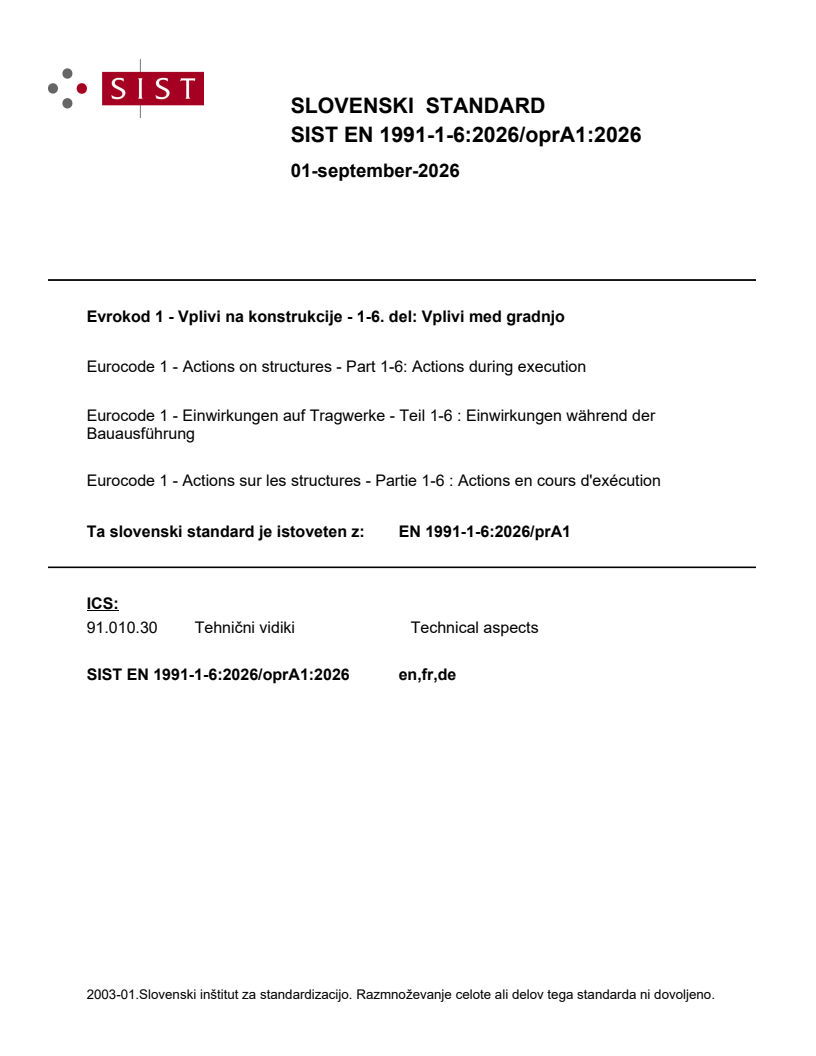
SLOVENSKI STANDARD
01-september-2026
Evrokod 1 - Vplivi na konstrukcije - 1-6. del: Vplivi med gradnjo
Eurocode 1 - Actions on structures - Part 1-6: Actions during execution
Eurocode 1 - Einwirkungen auf Tragwerke - Teil 1-6 : Einwirkungen während der
Bauausführung
Eurocode 1 - Actions sur les structures - Partie 1-6 : Actions en cours d'exécution
Ta slovenski standard je istoveten z: EN 1991-1-6:2026/prA1
ICS:
91.010.30 Tehnični vidiki Technical aspects
2003-01.Slovenski inštitut za standardizacijo. Razmnoževanje celote ali delov tega standarda ni dovoljeno.
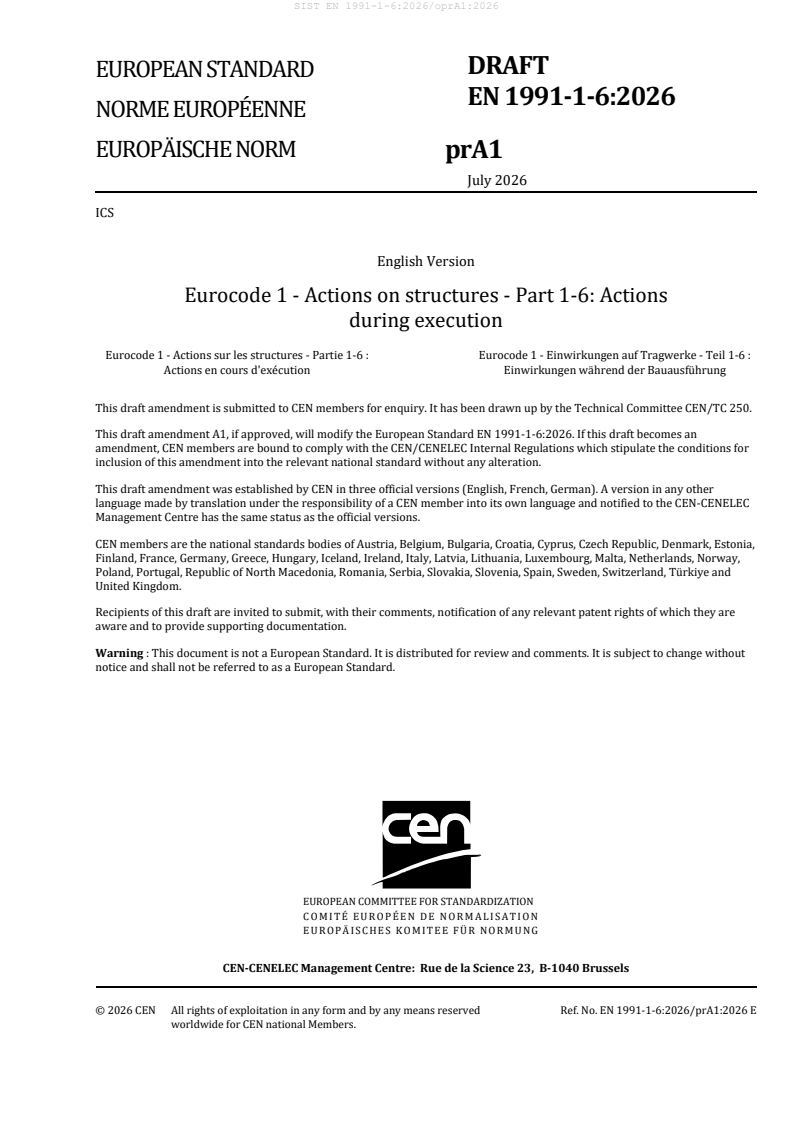
DRAFT
EUROPEAN STANDARD
EN 1991-1-6:2026
NORME EUROPÉENNE
EUROPÄISCHE NORM
prA1
July 2026
ICS
English Version
Eurocode 1 - Actions on structures - Part 1-6: Actions
during execution
Eurocode 1 - Actions sur les structures - Partie 1-6 : Eurocode 1 - Einwirkungen auf Tragwerke - Teil 1-6 :
Actions en cours d'exécution Einwirkungen während der Bauausführung
This draft amendment is submitted to CEN members for enquiry. It has been drawn up by the Technical Committee CEN/TC 250.
This draft amendment A1, if approved, will modify the European Standard EN 1991-1-6:2026. If this draft becomes an
amendment, CEN members are bound to comply with the CEN/CENELEC Internal Regulations which stipulate the conditions for
inclusion of this amendment into the relevant national standard without any alteration.
This draft amendment was established by CEN in three official versions (English, French, German). A version in any other
language made by translation under the responsibility of a CEN member into its own language and notified to the CEN-CENELEC
Management Centre has the same status as the official versions.
CEN members are the national standards bodies of Austria, Belgium, Bulgaria, Croatia, Cyprus, Czech Republic, Denmark, Estonia,
Finland, France, Germany, Greece, Hungary, Iceland, Ireland, Italy, Latvia, Lithuania, Luxembourg, Malta, Netherlands, Norway,
Poland, Portugal, Republic of North Macedonia, Romania, Serbia, Slovakia, Slovenia, Spain, Sweden, Switzerland, Türkiye and
United Kingdom.
Recipients of this draft are invited to submit, with their comments, notification of any relevant patent rights of which they are
aware and to provide supporting documentation.
Warning : This document is not a European Standard. It is distributed for review and comments. It is subject to change without
notice and shall not be referred to as a European Standard.
EUROPEAN COMMITTEE FOR STANDARDIZATION
COMITÉ EUROPÉEN DE NORMALISATION
EUROPÄISCHES KOMITEE FÜR NORMUNG
CEN-CENELEC Management Centre: Rue de la Science 23, B-1040 Brussels
© 2026 CEN All rights of exploitation in any form and by any means reserved Ref. No. EN 1991-1-6:2026/prA1:2026 E
worldwide for CEN national Members.
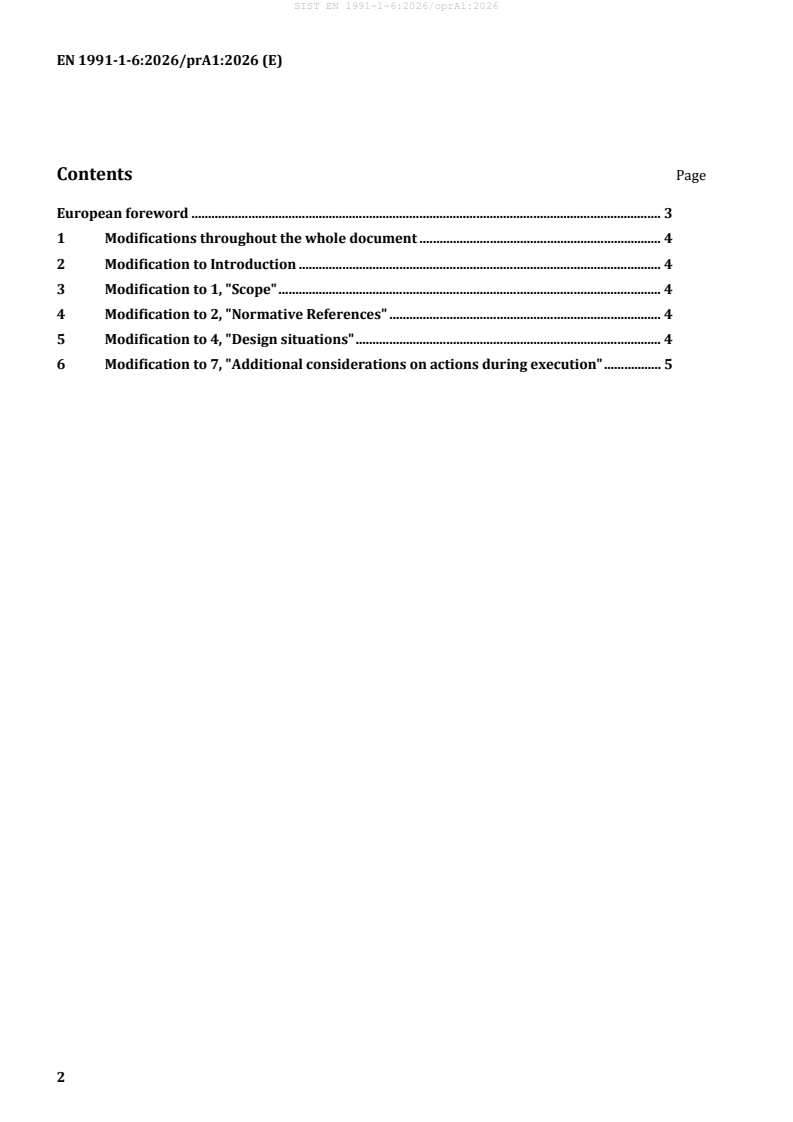
Contents Page
European foreword . 3
1 Modifications throughout the whole document . 4
2 Modification to Introduction . 4
3 Modification to 1, "Scope" . 4
4 Modification to 2, "Normative References" . 4
5 Modification to 4, "Design situations" . 4
6 Modification to 7, "Additional considerations on actions during execution" . 5
European foreword
This document (EN 1991-1-6:2026/prA1:2026) has been prepared by
...