


SIST EN 16807:2016
(Main)Liquid petroleum products - Bio-lubricants - Criteria and requirements of bio-lubricants and bio-based lubricants
Liquid petroleum products - Bio-lubricants - Criteria and requirements of bio-lubricants and bio-based lubricants
This European Standard specifies the term bio-lubricant and minimum requirements for all kinds of bio-lubricants and bio-based lubricants, while e.g. the EEL [4] refers to specific bio-lubricant families.
This European Standard also briefly describes relevant test method needs with respect to the characterization of bio-lubricants. It presents recommendation for related standards in the field of biodegradability, product functionality and the amount of different renewable raw materials and/or different bio-based contents used during manufacturing of such bio-lubricants forming one product group.
WARNING — Not all potential risks for the environment can be addressed by this standard.
Flüssige Mineralöl-Erzeugnisse - Bio-Schmierstoffe - Kriterien und Anforderungen an Bio-Schmierstoffe und bio-basierte Schmierstoffe
Diese Europäische Norm legt den Begriff Bio-Schmierstoff und Mindestanforderungen an alle Arten von Bio Schmierstoffen und biobasierten Schmierstoffen fest, während sich z. B. die EEL [4] auf bestimmte Familien von Bio-Schmierstoffen bezieht.
Diese Europäische Norm beschreibt darüber hinaus kurz die benötigten wesentlichen Prüfverfahren in Zusammenhang mit der Charakterisierung von Bio-Schmierstoffen. Sie enthält Empfehlungen für zugehörige Normen im Bereich der biologischen Abbaubarkeit, der Funktionalität des Produktes und der Menge unterschiedlicher nachwachsender Rohstoffe bzw. unterschiedlicher biobasierter Gehälter, die bei der Herstellung derartiger Bio-Schmierstoffe verwendet werden, die eine Produktgruppe bilden.
WARNUNG - In dieser Norm können nicht sämtliche potentiellen Risiken für die Umwelt behandelt werden.
Produits pétroliers liquides - Bio-lubrifiants - Critere et exigences de bio-lubrifiants et lubrifiant en basse biologique
La présente Norme européenne définit le terme bio-lubrifiant ainsi que les exigences minimales applicables à tous les types de bio-lubrifiants et lubrifiants d'origine biologique, tandis que d'autres documents, tels que l'EEL[4] par exemple, se rapportent à des familles bien précises de bio-lubrifiants.
La présente Norme européenne décrit également brièvement les besoins relatifs à la méthode d'essai pertinente pour ce qui concerne la caractérisation des bio-lubrifiants. Elle propose des recommandations pour les normes connexes dans le domaine de la biodégradabilité, la fonctionnalité du produit ainsi que la quantité de matières premières renouvelables différentes et/ou de différents composants d'origine biologique utilisés pendant la fabrication des bio-lubrifiants formant un groupe de produits.
AVERTISSEMENT: Tous les risques potentiels pour l'environnement ne peuvent être traités dans cette norme.
Tekoči naftni proizvodi - Biomaziva - Kriteriji in zahteve za biomaziva in maziva na biološki osnovi
Ta evropski standard določa izraz biomazivo ter minimalne zahteve za vse vrste biomaziv in maziv na biološki osnovi, medtem ko se npr. znak EEL [1] nanaša na določene družine biomaziv. Poleg tega ta evropski standard na kratko opisuje ustrezne potrebe preskusnih metod v zvezi s karakterizacijo biomaziv. Podaja priporočilo za z njim povezane standarde na področju biorazgradljivosti, funkcionalnost proizvoda ter količino različnih obnovljivih surovin in/ali različnih snovi na biološki osnovi, ki se uporabljajo pri proizvodnji takih biomaziv, ki sestavljajo eno skupino proizvodov.
General Information
- Status
- Published
- Public Enquiry End Date
- 11-Jan-2015
- Publication Date
- 07-Nov-2016
- Technical Committee
- NAD - Petroleum products, lubricants and related products
- Current Stage
- 6060 - National Implementation/Publication (Adopted Project)
- Start Date
- 20-Oct-2016
- Due Date
- 25-Dec-2016
- Completion Date
- 08-Nov-2016
Overview
EN 16807:2016 - Liquid petroleum products: Bio-lubricants is a European Standard published by CEN that defines the term bio-lubricant / bio-based lubricant and sets minimum, horizontally‑applicable requirements for all kinds of bio-lubricants. The standard clarifies expectations for biodegradability, bio-based content and aquatic toxicity, and outlines relevant test method needs and related standards. It is intended to reduce market confusion around the “bio-” prefix and to support consistent, measurable claims about environmental performance.
Key topics and technical requirements
- Terminology and scope
- Establishes a clear definition of bio-lubricant / bio-based lubricant applicable across lubricant families.
- Minimum criteria
- Specifies requirements relating to bio-based content, biodegradability, ecotoxicity (aquatic toxicity) and fit-for-purpose performance for final formulated products.
- Test methods & characterization
- Recommends testing approaches for:
- Biodegradation (e.g., OECD/ISO style CO2 or O2 respirometry tests)
- Ecotoxicity (algae, daphnia, fish acute tests such as EN ISO 8692, 6341, 7346-1)
- Bio‑based carbon content (radiocarbon 14C method per CEN/TS 16640)
- Includes Annex A (informative) on 14C content methods and Annex B (normative) on lubricant application groups.
- Recommends testing approaches for:
- Sampling and mixture testing
- Emphasises testing of final formulations (mixtures), reflecting the end-user perspective, while noting this complements chemical-level assessments in regulatory frameworks.
- Limitations
- Warns that EN 16807:2016 cannot address all potential environmental risks and is positioned as minimum horizontal requirements (Ecolabels or product-specific standards may set stricter criteria).
Practical applications and users
Who uses EN 16807:2016:
- Lubricant manufacturers developing and marketing bio-lubricants or hybrid bio-based products.
- Test laboratories implementing recommended biodegradability, ecotoxicity and 14C methods.
- Procurement teams / public purchasers specifying environmentally preferable lubricants.
- OEMs and end users (hydraulics, turbines, gearboxes, greases, metalworking, engine oils, machine-tool lubricants) requiring validated environmental claims.
- Regulators and ecolabel schemes aligning product definitions and consumer information.
Benefits:
- Provides consistent language for eco-friendly lubricant claims, aids compliance, and improves market transparency for sustainable and bio-based lubricants.
Related standards
EN 16807:2016 references and complements standards such as:
- CEN/TS 16640 (radiocarbon method for bio-based carbon)
- EN ISO 9408 / 9439 / 14593 (biodegradability tests)
- EN ISO 6341, 8692, 7346-1 (aquatic toxicity tests)
- ISO/EN lubricant family standards (hydraulics, greases, turbines, engine oils)
Keywords: EN 16807:2016, bio-lubricants, bio-based lubricants, biodegradability, aquatic toxicity, bio-based content, CEN, lubricant test methods, eco-friendly lubricants, renewable raw materials.



Frequently Asked Questions
SIST EN 16807:2016 is a standard published by the Slovenian Institute for Standardization (SIST). Its full title is "Liquid petroleum products - Bio-lubricants - Criteria and requirements of bio-lubricants and bio-based lubricants". This standard covers: This European Standard specifies the term bio-lubricant and minimum requirements for all kinds of bio-lubricants and bio-based lubricants, while e.g. the EEL [4] refers to specific bio-lubricant families. This European Standard also briefly describes relevant test method needs with respect to the characterization of bio-lubricants. It presents recommendation for related standards in the field of biodegradability, product functionality and the amount of different renewable raw materials and/or different bio-based contents used during manufacturing of such bio-lubricants forming one product group. WARNING — Not all potential risks for the environment can be addressed by this standard.
This European Standard specifies the term bio-lubricant and minimum requirements for all kinds of bio-lubricants and bio-based lubricants, while e.g. the EEL [4] refers to specific bio-lubricant families. This European Standard also briefly describes relevant test method needs with respect to the characterization of bio-lubricants. It presents recommendation for related standards in the field of biodegradability, product functionality and the amount of different renewable raw materials and/or different bio-based contents used during manufacturing of such bio-lubricants forming one product group. WARNING — Not all potential risks for the environment can be addressed by this standard.
SIST EN 16807:2016 is classified under the following ICS (International Classification for Standards) categories: 27.190 - Biological sources and alternative sources of energy; 75.100 - Lubricants, industrial oils and related products. The ICS classification helps identify the subject area and facilitates finding related standards.
SIST EN 16807:2016 is associated with the following European legislation: Standardization Mandates: M/430. When a standard is cited in the Official Journal of the European Union, products manufactured in conformity with it benefit from a presumption of conformity with the essential requirements of the corresponding EU directive or regulation.
SIST EN 16807:2016 is available in PDF format for immediate download after purchase. The document can be added to your cart and obtained through the secure checkout process. Digital delivery ensures instant access to the complete standard document.
Standards Content (Sample)
2003-01.Slovenski inštitut za standardizacijo. Razmnoževanje celote ali delov tega standarda ni dovoljeno.Flüssige Mineralöl-Erzeugnisse - Bio-Schmierstoffe - Kriterien und Anforderungen an Bio-Schmierstoffe und bio-basierte SchmierstoffeProduits pétroliers liquides - Bio-lubrifiants - Critere et exigences de bio-lubrifiants et lubrifiant en basse biologiqueLiquid petroleum products - Bio-lubricants - Criteria and requirements of bio-lubricants and bio-based lubricants75.100MazivaLubricants, industrial oils and related products27.190Biološki viri in drugi alternativni viri energijeBiological sources and alternative sources of energyICS:Ta slovenski standard je istoveten z:EN 16807:2016SIST EN 16807:2016en,de01-december-2016SIST EN 16807:2016SLOVENSKI
STANDARD
EUROPEAN STANDARD NORME EUROPÉENNE EUROPÄISCHE NORM
EN 16807
October
t r s x ICS
y wä s r r English Version
Liquid petroleum products æ Bioælubricants æ Criteria and requirements of bioælubricants and bioæbased lubricants Produits pétroliers liquides æ Bioælubrifiants æ Critères et exigences sur les bioælubrifiants et lubrifiants d 5origines biologiques
Flüssige MineralölæErzeugnisse æ BioæSchmierstoffe æ Kriterien und Anforderungen für BioæSchmierstoffe und bioæbasierte Schmierstoffe This European Standard was approved by CEN on
t x May
t r s xä
egulations which stipulate the conditions for giving this European Standard the status of a national standard without any alterationä Upætoædate lists and bibliographical references concerning such national standards may be obtained on application to the CENæCENELEC Management Centre or to any CEN memberä
translation under the responsibility of a CEN member into its own language and notified to the CENæCENELEC Management Centre has the same status as the official versionsä
CEN members are the national standards bodies of Austriaá Belgiumá Bulgariaá Croatiaá Cyprusá Czech Republicá Denmarká Estoniaá Finlandá Former Yugoslav Republic of Macedoniaá Franceá Germanyá Greeceá Hungaryá Icelandá Irelandá Italyá Latviaá Lithuaniaá Luxembourgá Maltaá Netherlandsá Norwayá Polandá Portugalá Romaniaá Slovakiaá Sloveniaá Spainá Swedená Switzerlandá Turkey and United Kingdomä
EUROPEAN COMMITTEE FOR STANDARDIZATION COMITÉ EUROPÉEN DE NORMALISATION EUROPÄISCHES KOMITEE FÜR NORMUNG
CEN-CENELEC Management Centre:
Avenue Marnix 17,
B-1000 Brussels
t r s x CEN All rights of exploitation in any form and by any means reserved worldwide for CEN national Membersä Refä Noä EN
s x z r yã t r s x ESIST EN 16807:2016
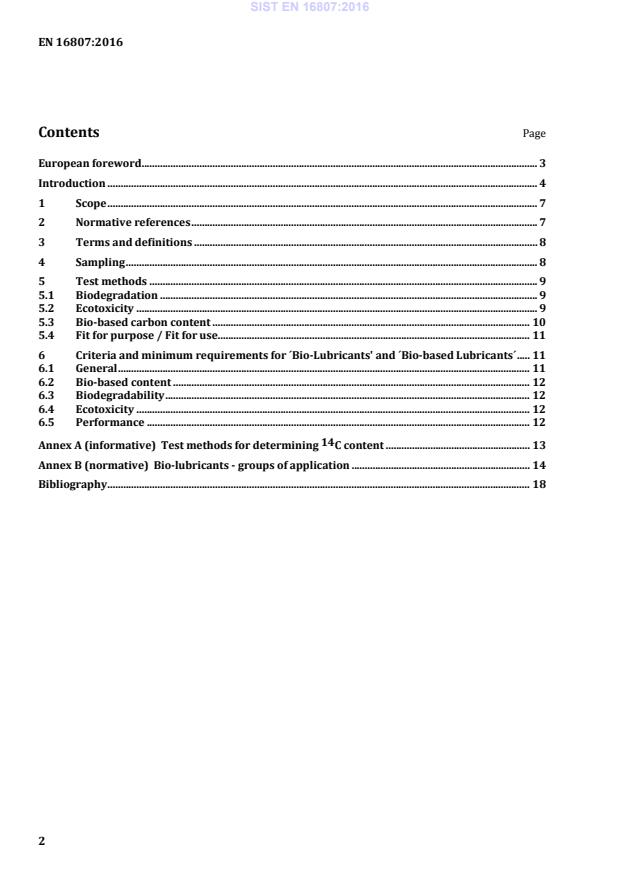
Test methods for determining 14C content . 13 Annex B (normative)
Bio-lubricants - groups of application . 14 Bibliography . 18
April 2017. Attention is drawn to the possibility that some of the elements of this document may be the subject of patent rights. CEN shall not be held responsible for identifying any or all such patent rights. This document has been prepared under a mandate given to CEN by the European Commission and the European Free Trade Association. Mandate M/430 covers the development of European standards for bio-lubricants in relation to bio-based product aspects. It has been prepared by CEN/TC 19/WG 33 “Bio-Lubricants”, the secretariat of which is held by DIN. According to the CEN-CENELEC Internal Regulations, the national standards organisations of the following countries are bound to implement this European Standard: Austria, Belgium, Bulgaria, Croatia, Cyprus, Czech Republic, Denmark, Estonia, Finland, Former Yugoslav Republic of Macedonia, France, Germany, Greece, Hungary, Iceland, Ireland, Italy, Latvia, Lithuania, Luxembourg, Malta, Netherlands, Norway, Poland, Portugal, Romania, Slovakia, Slovenia, Spain, Sweden, Switzerland, Turkey and the United Kingdom. SIST EN 16807:2016
Tri-methylol-propane-trioleate (TMP-O) Biodegradablea and
bio-basedb Non-renewable Biodegradablea Di-isotridecyl-adipate (DITA) Biodegradablea Renewable Inherently or
non biodegradable Hydrocarbons from process
“Biomass-to-Liquid” (BtL) Bio-basedb Non-renewable Non biodegradable White oil for foodgrade lubricants Biocompatible a According to OECD 301[5]. b According to EN 16575. NOTE In addition, consideration of soil dwelling organisms could be reflected in a future edition. Even if in a more general approach “environmentally compatible lubricants” can be seen under additional aspects, up to a comprehensive Life Cycle Assessment (LCA), this European Standard focuses on the term bio-lubricant, which comprises requirements regarding biodegradability, aquatic toxicity, content of biomass and performance. SIST EN 16807:2016
...
Questions, Comments and Discussion
Ask us and Technical Secretary will try to provide an answer. You can facilitate discussion about the standard in here.
Loading comments...