

SIST EN 1504-2:2004
(Main)Products and systems for the protection and repair of concrete structures - Definitions, requirements, quality control and evaluation of conformity - Part 2: Surface protection systems for concrete
General Information
- Abstract
This Part of prEN 1504 specifies requirements for the identification, performance (including durability aspects), safety and evaluation of conformity of products and systems to be used for surface protection of concrete, to increase the durability of concrete and reinforced concrete structures, as well as for new concrete and for maintenance and repair work.
The surface protective methods covered by this standard are the following:
- hydrophobic impregnation;
- impregnation;
- coating.
Flooring systems in buildings which are not intended to protect or reinstate the integrity of a concrete structure are standardised in EN 13813.
When products and systems complying with this standard are used in flooring applications that involve substantial mechanical loading , they should also satisfy the requirements of EN 13813.
- Status
- Published
- Publication Date
- 30-Nov-2004
- Technical Committee
- BBB - Concrete, reinforced concrete and prestressed concrete
- Current Stage
- 6060 - National Implementation/Publication (Adopted Project)
- Start Date
- 01-Dec-2004
- Due Date
- 01-Dec-2004
- Completion Date
- 01-Dec-2004
- Directive
- 305/2011 - Regulation (eu) No 305/2011 of the European Parliament and of the Council of 9 march 2011 laying down harmonised conditions for the marketing of construction products and repealing council directive 89/106/eecOJ Ref: C 259 OJ Date: 08-Aug-2014
89/106/EEC - Construction productsOJ Ref: C 139 OJ Date: 08-Jun-2005

Overview
EN 1504-2:2004 is a CEN European standard for surface protection systems for concrete. It defines identification, performance (including durability), safety and conformity assessment requirements for products and systems used to protect and extend the service life of concrete and reinforced concrete - for new work, maintenance and repair. The standard covers three surface-protection methods: hydrophobic impregnation, impregnation and coating. It also clarifies the interface with flooring standards (EN 13813) when substantial mechanical loading is involved.
Key topics and technical requirements
- Scope and definitions - terminology and intended use of surface protection methods as part of the EN 1504 family.
- Performance characteristics - durability-related properties and selection criteria for uses such as protection against ingress, moisture control, chemical resistance and surface improvement.
- Identification and labelling - information manufacturers must provide to allow correct selection and application.
- Safety and hazardous substances - requirements on release of dangerous substances and relevant documentation (see informative Annex C).
- Reaction to fire - classification and testing requirements for reaction-to-fire performance.
- Testing and test methods - references to associated test standards (e.g., EN 1062 series for coatings, EN 13579 / EN 13580 series for hydrophobic impregnation tests, EN 13687 thermal compatibility tests, EN 1542 pull-off bond test).
- Conformity assessment - procedures for sampling, initial type testing, factory production control (FPC), assessment, surveillance and certification. Annex ZA addresses relationship with EU Construction Products Directive and CE marking.
- Quality control frequency - guidance on minimum testing frequency for FPC (informative Annex A).
Applications and users
EN 1504-2:2004 is intended for:
- Manufacturers of concrete coatings, impregnations and hydrophobic treatments to demonstrate declared performance and to prepare technical data sheets.
- Specifiers and designers selecting protective systems for bridges, tunnels, car parks, marine structures and other concrete assets.
- Contractors and applicators for correct product identification, application conditions and quality control on site.
- Testing laboratories, certification bodies and asset owners needing a harmonised conformity framework and performance benchmarks. Use cases include protection against chloride ingress, moisture management, chemical resistance and surface wear mitigation (note: flooring systems under heavy mechanical loads should also meet EN 13813).
Related standards
- EN 1504 series (Parts 1, 3–10) - family covering definitions, repair methods, bonding, injection, corrosion protection, quality control and site application.
- EN 1062 series (coatings test methods), EN 13687 (thermal compatibility), EN 13579 / EN 13580 (hydrophobic impregnation tests), EN 1542 (bond strength).
- EN 13813 - flooring systems for mechanically loaded applications.
Keywords: EN 1504-2:2004, surface protection systems for concrete, hydrophobic impregnation, concrete coatings, impregnation, conformity assessment, durability, CEN standard.
Relations
- Effective Date
- 10-Jun-2026
- Effective Date
- 11-Mar-2026
- Effective Date
- 28-Jan-2026
- Effective Date
- 28-Jan-2026
- Effective Date
- 28-Jan-2026
- Effective Date
- 28-Jan-2026
- Effective Date
- 28-Jan-2026
- Effective Date
- 28-Jan-2026
- Effective Date
- 28-Jan-2026
- Effective Date
- 28-Jan-2026
- Effective Date
- 28-Jan-2026
- Effective Date
- 28-Jan-2026
- Effective Date
- 28-Jan-2026
- Effective Date
- 28-Jan-2026
- Effective Date
- 28-Jan-2026
Get Certified
Connect with accredited certification bodies for this standard

DIBt (Deutsches Institut für Bautechnik)
German Institute for Building Technology.
DIN CERTCO
DIN Group product certification.

Aboma Certification B.V.
Specialized in construction, metal, and transport sectors.
Sponsored listings
Frequently Asked Questions
SIST EN 1504-2:2004 is a standard published by the Slovenian Institute for Standardization (SIST). Its full title is "Products and systems for the protection and repair of concrete structures - Definitions, requirements, quality control and evaluation of conformity - Part 2: Surface protection systems for concrete". This standard covers: This Part of prEN 1504 specifies requirements for the identification, performance (including durability aspects), safety and evaluation of conformity of products and systems to be used for surface protection of concrete, to increase the durability of concrete and reinforced concrete structures, as well as for new concrete and for maintenance and repair work. The surface protective methods covered by this standard are the following: - hydrophobic impregnation; - impregnation; - coating. Flooring systems in buildings which are not intended to protect or reinstate the integrity of a concrete structure are standardised in EN 13813. When products and systems complying with this standard are used in flooring applications that involve substantial mechanical loading , they should also satisfy the requirements of EN 13813.
This Part of prEN 1504 specifies requirements for the identification, performance (including durability aspects), safety and evaluation of conformity of products and systems to be used for surface protection of concrete, to increase the durability of concrete and reinforced concrete structures, as well as for new concrete and for maintenance and repair work. The surface protective methods covered by this standard are the following: - hydrophobic impregnation; - impregnation; - coating. Flooring systems in buildings which are not intended to protect or reinstate the integrity of a concrete structure are standardised in EN 13813. When products and systems complying with this standard are used in flooring applications that involve substantial mechanical loading , they should also satisfy the requirements of EN 13813.
SIST EN 1504-2:2004 is classified under the following ICS (International Classification for Standards) categories: 01.040.91 - Construction materials and building (Vocabularies); 91.080.40 - Concrete structures. The ICS classification helps identify the subject area and facilitates finding related standards.
SIST EN 1504-2:2004 has the following relationships with other standards: It is inter standard links to SIST EN ISO 3451-1:2026, SIST EN 206-2:2026, SIST EN 13395-2:2002, SIST EN 12192-1:2002, SIST EN ISO 868:2003, SIST EN ISO 3451-1:2019, SIST EN ISO 2811-1:2023, SIST EN 1015-7:1999, SIST EN ISO 2815:2003, SIST EN ISO 11358-1:2022, SIST EN ISO 2811-2:2011, SIST EN 1242:2013, SIST EN 13578:2004, SIST EN 1015-6:1999, SIST EN 1062-6:2003. Understanding these relationships helps ensure you are using the most current and applicable version of the standard.
SIST EN 1504-2:2004 is associated with the following European legislation: EU Directives/Regulations: 305/2011, 89/106/EEC, EUR-PUB; Standardization Mandates: M/128. When a standard is cited in the Official Journal of the European Union, products manufactured in conformity with it benefit from a presumption of conformity with the essential requirements of the corresponding EU directive or regulation.
SIST EN 1504-2:2004 is available in PDF format for immediate download after purchase. The document can be added to your cart and obtained through the secure checkout process. Digital delivery ensures instant access to the complete standard document.
Standards Content (Sample)
2003-01.Slovenski inštitut za standardizacijo. Razmnoževanje celote ali delov tega standarda ni dovoljeno.Products and systems for the protection and repair of concrete structures - Definitions, requirements, quality control and evaluation of conformity - Part 2: Surface protection systems for concreteProduits et systemes pour la protection et la réparation de structures en béton - Définitions, prescriptions, maîtrise de la qualité et évaluation de la conformité - Partie 2: Systemes de protection de surface pour bétonProdukte und Systeme für den Schutz und die Instandsetzung von Betontragwerken - Definitionen, Anforderungen, Qualitätsüberwachung und Beurteilung der Konformität - Teil 2: Oberflächenschutzsysteme für Beton91.080.40Betonske konstrukcijeConcrete structures01.040.91Gradbeni materiali in gradnja (Slovarji)Construction materials and building (Vocabularies)ICS:SIST EN 1504-2:2004enTa slovenski standard je istoveten z:EN 1504-2:200401-december-2004SIST EN 1504-2:2004SLOVENSKI
STANDARD
EUROPEAN STANDARDNORME EUROPÉENNEEUROPÄISCHE NORMEN 1504-2October 2004ICS 01.040.91; 91.080.40English versionProducts and systems for the protection and repair of concretestructures - Definitions, requirements, quality control andevaluation of conformity - Part 2: Surface protection systems forconcreteProduits et systèmes pour la protection et la réparation destructures en béton - Définitions, prescriptions, maîtrise dela qualité et évaluation de la conformité - Partie 2:Systèmes de protection de surface pour bétonProdukte und Systeme für den Schutz und dieInstandsetzung von Betontragwerken - Definitionen,Anforderungen, Qualitätsüberwachung und Beurteilung derKonformität - Teil 2: Oberflächenschutzsysteme für BetonThis European Standard was approved by CEN on 30 July 2004.CEN members are bound to comply with the CEN/CENELEC Internal Regulations which stipulate the conditions for giving this EuropeanStandard the status of a national standard without any alteration. Up-to-date lists and bibliographical references concerning such nationalstandards may be obtained on application to the Central Secretariat or to any CEN member.This European Standard exists in three official versions (English, French, German). A version in any other language made by translationunder the responsibility of a CEN member into its own language and notified to the Central Secretariat has the same status as the officialversions.CEN members are the national standards bodies of Austria, Belgium, Cyprus, Czech Republic, Denmark, Estonia, Finland, France,Germany, Greece, Hungary, Iceland, Ireland, Italy, Latvia, Lithuania, Luxembourg, Malta, Netherlands, Norway, Poland, Portugal, Slovakia,Slovenia, Spain, Sweden, Switzerland and United Kingdom.EUROPEAN COMMITTEE FOR STANDARDIZATIONCOMITÉ EUROPÉEN DE NORMALISATIONEUROPÄISCHES KOMITEE FÜR NORMUNGManagement Centre: rue de Stassart, 36
B-1050 Brussels© 2004 CENAll rights of exploitation in any form and by any means reservedworldwide for CEN national Members.Ref. No. EN 1504-2:2004: E
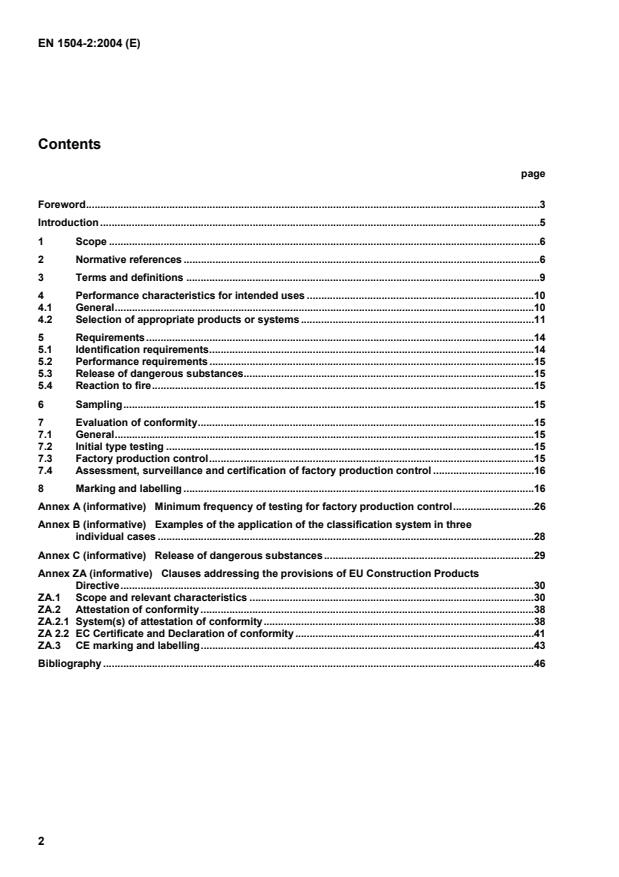
Minimum frequency of testing for factory production control.26 Annex B (informative)
Examples of the application of the classification system in three individual cases.28 Annex C (informative)
Release of dangerous substances.29 Annex ZA (informative)
Clauses addressing the provisions of EU Construction Products Directive.30 ZA.1 Scope and relevant characteristics.30 ZA.2 Attestation of conformity.38 ZA.2.1 System(s) of attestation of conformity.38 ZA 2.2 EC Certificate and Declaration of conformity.41 ZA.3 CE marking and labelling.43 Bibliography.46
1) To be published. 2) ENV 1504-9 will have to be modified when adopted as EN according to finalisation of this standard.
hydrophobic impregnation (H) 1.2 impregnation (I) 1.3 coating (C) for Principle 2 (MC): Moisture Control 2.1 hydrophobic impregnation (H) 2.2 coating (C) for Principle 5 (PR) Physical Resistance/Surface Improvement 5.1 coating (C) 5.2 impregnation (I) for Principle 6 (RC): Resistance to Chemicals 6.1 coating (C) for Principle 8 (IR): Increasing Resistivity by Limiting moisture content: 8.1 hydrophobic impregnation (H): 8.2 coating (C)
grout or mortar. EN 13501-1, Fire classification of construction products and building elements — Part 1: Classification using test data from reaction to fire tests. EN 13529, Products and systems for the protection and repair of concrete structures — Test methods — Resistance to severe chemical attack. EN 13578, Products and systems for the protection and repair of concrete structures — Test method — Compatibility on wet concrete. EN 13579, Products and systems for the protection and repair of concrete structures — Test methods — Drying test for hydrophobic impregnation. EN 13580, Products and systems for the protection and repair of concrete structures — Test methods — Water absorption and resistance to alkali for hydrophobic impregnation.
Figure 1 — Schematic drawing of a typical hydrophobic impregnation 3.2 impregnation treatment of concrete to reduce the surface porosity and to strengthen the surface. The pores and capillaries are partially or totally filled NOTE 1 This treatment usually leads to a discontinuous, thin film on the concrete surface. NOTE 2 Binders may be, for example, organic polymers.
Figure 2 — Schematic drawing of a typical impregnation 3.3 coating treatment to produce a continuous protective layer on the surface of concrete NOTE 1 Thickness is typically of 0,1 mm to 5,0 mm. Particular applications may require a thickness greater than 5 mm. NOTE 2 Binders may be, for example, organic polymers, organic polymers with cement as a filler or hydraulic cement modified with polymer dispersion.
Figure 3 — Schematic drawing of a typical coating 3.4 layer thickness dry film thickness defined in EN ISO 2808:1999, Clause 4. It should be determined according to EN ISO 2808. For the purposes of this standard: the mean dry film thickness is defined in EN ISO 2808:1999, 4.8; the minimum dry film thickness (dmin) is to be taken as the lower 5 % fractile of the gaussian distribution of the thickness measurements; the absolute minimum dry film thickness that may be achieved on application is at least 0,7 dmin 4 Performance characteristics for intended uses 4.1 General Table 1 lists the performance characteristics of surface protection products and systems which are required for “all intended uses” or “certain intended uses” according to the “principles” and “methods” defined in ENV 1504-9. Performance characteristics which are required for “all intended uses” are marked with „. All other performance characteristics which are marked with † may be required for “certain intended uses”. Performance characteristics and requirements for each method are given in 5.2.
Principles 1. Ingress protection 2. Moisture control 5. Physical Resistance 6. Chemical Resistance8. Increasing resistivity No. Test methods defined in Performance Characteristics Methods 1.1 (H) 1.2 (I) 1.3 (C)2.1 (H) 2.2 (C)5.1(C) 5.2(I) 6.1 (C) 8.1 (H) 8.2 (C) 1 2 3 4 5 6 7 8 9 10 11 12 13 1 EN 12617-1 Linear shrinkage
†
† †
†
† 2 EN 12190 Compressive strength
†
†
3 EN 1770 Coefficient of thermal expansion
†
† †
†
† 4 EN ISO 5470-1 Abrasion resistance
„ „
5 EN ISO 2409 Adhesion by cross-cut test a
†
† †
†
† 6 EN 1062-6 Permeability to CO2
„
7 EN ISO 7783-1EN ISO 7783-2 Permeability to water vapour
† „
„
„ 8 EN 1062-3 Capillary absorption and permeability to water
„ „
„ „ „ †
„
Adhesion after thermal compatibility
EN 13687-1 Freeze-thaw cycling with de-icing salt immersion
† †
† † † †
† EN 13687-2 Thunder-shower cycling (thermal shock)
† †
† † † †
† EN 13687-3 Thermal cycling without de-icing salt impact
† †
† † † †
† 9 EN 1062-11:2002 4.1: Aging: 7 days at 70 °C
† †
† † † †
† 10 EN 13687-5 Resistance to thermal shock
†
†
†
11 EN ISO 2812-1 Chemical resistance
† †
12 EN 13529 Resistance to severe chemical attack
„
13 EN 1062-7 Crack bridging ability
†
† †
†
† 14 EN ISO 6272-1 Impact resistance
„ „
15 EN 1542 Adhesion strength by pull-off test
† „
„ „ „ „
„ 16 EN 13501-1 Fire classification of construction products and building elements — Part 1: Classification using test data from reaction to fire test
† †
† † † †
† 17 EN 13581 Resistance against freeze-thaw salt stress of impregnated hydrophobic concrete (Determination of loss of mass) †
†
†
18 EN 13036-4 Slip/skid resistance
† †
† † † †
† 19 see Table 3 Depth of penetration „ „
„
„
„
20 EN 1062-11:2002 4.2: Behaviour after artificial weathering
†
† †
†
† 21 EN 1081 Antistatic behaviour
†
† †
†
†
Principles 1. Ingress protection 2. Moisture control 5. Physical Resistance 6. Chemical Resistance8. Increasing resistivity No. Test methods defined in Performance Characteristics Methods 1.1 (H) 1.2 (I) 1.3 (C)2.1 (H) 2.2 (C)5.1(C) 5.2(I) 6.1 (C) 8.1 (H) 8.2 (C) 1 2 3 4 5 6 7 8 9 10 11 12 13 22 EN 13578 Adhesion on wet concrete
†
† †
†
23 EN 13580 Water absorption and resistance to alkali test for hydrophobic impregnation „
„
„
24 EN 13579 Drying rate for hydrophobic impregnation „
„
„
25 subject to national standards and national regulations Diffusion of chloride ions † † †
H Hydrophobic impregnation I Impregnation C Coating „ characteristic for all intended uses † characteristic for certain intended uses within the scope of ENV 1504-9:1997 (see also Tables 3, 4, 5) a This test is for comparison to the pull-off test see note to item 5 in Table 5
General appearance and colour Visual Uniform and similar to the description provided by the manufacturer Density
— Pyknometer method or EN ISO 2811-1 ±3 % — Immersed body method EN ISO 2811-2 ±3% Infrared spectrum EN 1767 The positions and relative intensities of the main absorption bands shall match those of the reference spectrum Epoxy equivalent EN 1877-1 ±5 % Amine functions EN 1877-2 ±6 % Hydroxyl value EN 1240 ±10 % Isocyanate content EN 1242 ±10 % Volatile and non-volatile matter EN ISO 3251 ±5 % Ash content EN ISO 3451-1
±5 % Thermogravimetry EN ISO 11358 Confirmed by comparison and: ±5 % with respect to loss of mass at 600 °C Flow time EN ISO 2431 ±15 % Viscosity EN ISO 3219 ±20 % Particle size distribution of dry components EN 12192-1 >2 mm: ±6 % abs. 0,063 mm – 2 mm: ±4 % abs. <0,063 mm: ±2 % abs. Identification of the fresh mixture
Surface- dry – glass beads method EN ISO 1517 ±10 % Pot-life EN ISO 9514 ±15 % Progress in shore A or D hardness after 1, 3 and 7 days EN ISO 868 ±3 units shore A or D after 7 days
Consistence EN 1015-3 ±15 % or 20 mm Air content EN 1015-7 ±2 % (abs.) Bulk density EN 12190 and EN 1015-6 ±5 % Workability — flow of mortar EN 13395-2 ±15 % Stiffening time EN 13294 ±20 % a Deviation from the manufacturer’s documented value.
a When the capillary absorption to water is < 0,01 kg/m2 ⋅ h0,5 the diffusion of chloride ions is not to be expected.
For outside application with de-icing salt influence:
Freeze-thaw cycling with de-icing salt immersion (20 ×) and EN 13687-1 Thunder shower cycling (thermal shock) (10 ×) EN 13687-2 For outside application without de-icing salt influence:
9 Thermal cycling without de-icing salt impact (20 ×) EN 13687-3 Thermal cycling acc. to EN 13687-1 and EN 13687-2 is carried out on the same sample, starting with the thunder shower cycling. After thermal cycling a) no bubbles, cracks and delamination b) Pull-off-test Application/Load Average [N/mm2] vertical ≥0,8 (0,5)b horizontal without mechanical load ≥1,0 (0,7)b horizontal with mechanical load ≥1,5 (1,0)b 11 Chemical resistance (absorbent media method) EN ISO 2812-1 Resistance against influence of the relevant environments shall be as defined in EN 206-1 after 30 days exposure; no visual defects 14 Impact resistance measured on coated concrete samples MC (0,40) according to EN 1766 NOTE The thickness and expected impact load influence the choice of the class. EN ISO 6272-1 After loading no cracks and delamination Class I: ≥4 Nm Class II: ≥10 Nm Class III: ≥20 Nm
C (0,45) as given in EN 13579). After 28 days of curing according to EN 1766, the samples shall be stored according to the dry procedure given in EN 1766. The treatment with impregnation shall be in accordance to the manufacturer’s instruction The depth of penetration is defined with an exact-ness of 0,5 mm by break-ing open the treated specimen and spraying the fracture surface with water (using the phenol-phthalein test method with water instead of phenolphthalein) accord-ing to prEN 14630. The depth of the dry zone is taken as the effective depth of impregnation. ≥5 mm. 25 Diffusion of chloride ions a subject to national stan-dards and national regu-lations
a When the capillary absorption to water is <0,01 kg/m2 ⋅ h0,5 the diffusion of chloride ions is not to be expected. b The value in brackets is the lowest accepted value of any reading.
6 Permeability to CO2 EN 1062-6 (Conditioning of the samples before testing should be in accordance with prEN 1062-11:2002,4.3) Permeability to CO2 sD > 50 m 7 Permeability to water vapour EN ISO 7783-1 EN ISO 7783-2 class I sD < 5 m (permeable to water vapour) class II 5 m ≤ sD ≤ 50 m class III sD >50 m (not permeable to water vapour) 8 Capillary absorption and permeability to water EN 1062-3 w < 0,1 kg/m² ⋅ h0,5
For outside application with de-icing salt influence:
Freeze salt cycling with de-icing salt immersion (50 ×) and EN 13687-1 Thunder shower cycling (thermal shock) (10 ×) EN 13687-2 For outside application without de-icing salt influence:
Thermal cycling without de-icing salt impact (20 ×) EN 13687-3 For inside application
9 Ageing: 7 days at 70 °C EN 1062-11 10 Resistance to thermal shock (1 ×) EN 13687-5 Thermal cycling acc. to EN 13687-1 and EN 13687-2 is carried out on the same sample, starting with the thunder shower cycling. After thermal cycling a) no bubbles, cracks and delamination b) Pull-off-test
Average [N/mm2]
Crack-bridging or Rigid systems c
flexible systems without trafficking: ≥ 0,8 (0,5)b ≥1,0 (0,7)b with trafficking: ≥ 1,5 (1,0)b ≥2,0 (1,5)b 11 Chemical resistance (absorbent media method) EN ISO 2812-1 Resistance against influence of the relevant environments shall be as defined in EN 206-1 after 30 days exposure; no visual defects 12 Resistance to severe chemical attack Class I:
3 d without pressure Class II: 28 d without pressure Class III: 28 d with pressure It is recommended to use testing liquids from the 20 classes given in EN 13529 covering all types of common chemicals. Other testing liquids can be agreed between the interested parties. EN 13529 Reduction in hardness of less than 50% when measured according to Buchholz method, EN ISO 2815, or Shore method EN ISO 868 24 h after the coating is removed from immersion in the test liquid. 13 Crack bridging ability After conditioning in according to EN 1062-11:2002,
4.1 – 7 days at 70 °C for reactive resin systems 4.2 – UV radiation and humidity for dispersion systems EN 1062-7 The required classes and the test conditions are given in Tables 6 and 7. The required crack bridging ability shall be selected by the designer with respect to local conditions (climate, crack widths and crack movement). After testing the required class no failures may occur. 14 Impact resistance measured on coated concrete samples
MC (0,40) according to EN 1766 NOTE The thickness and expected impact load influence the choice of the class. EN ISO 6272-1 After loading no cracks and delamination Class I: ≥4 Nm Class II: ≥10 Nm Class III: ≥20 Nm
Average [N/mm²]
Crack-bridging or/ Rigid systemsc
flexible systems without trafficking: ≥0,8 (0,5)b ≥1,0 (0,7)b with trafficking: ≥1,5 (1,0)b ≥2,0 (1,5)b 16 Reaction to fire after application EN 13501-1 Euroclasses 18 Slip/skid resistance EN 13036-4 Class I: >40 units wet tested (inside wet surfaces), Class II: >40 units dry tested (inside dry surfaces), Class III: >55 units wet tested (outside) Or acc. to national regulations 20 Artificial weathering according to EN 1062-11:2002, 4.2 (UV-radiation and humidity) only for outside application It shall be tested only white and RAL 7030. EN 1062-11 After 2 000 h of artificial weathering: no blistering according to EN ISO 4628-2 no cracking according to EN ISO 4628-4 no flaking according to EN ISO 4628-5 Slight colour change, loss of gloss and chalking may be accept Table, but shall be described. 21 Antistatic behaviour EN 1081 Class I: >104 and <106 Ω (Explosives) Class II: >106 and <108 Ω (Explosion hazardous substances) 22 Adhesion on wet concrete (Substrate: MC (0,40) EN 13578 After loading: a) no blistering according to EN ISO 4628-2 no cracking according to EN ISO 4628-4 no flaking according to EN ISO 4628-5 b) Pull-off-strength ≥1,5 N/mm2, the failure shall occur >50 % as concrete rupture This test is relevant for coatings intended to be applied on fresh concrete or concretes with a high moisture content
a When the capillary absorption to water is <0,01 kg/m2 ⋅ h0,5 the diffusion of chloride ions is not to be expected. b The value in brackets is the lowest accepted value of any reading. c R
...