

SIST EN 303 213-1 V1.3.1:2012
(Main)Advanced Surface Movement Guidance and Control System (A-SMGCS) - Part 1: Community Specification for application under the Single European Sky Interoperability Regulation EC 552/2004 for A-SMGCS Level 1 including external interfaces
- Abstract
Scope of work to be undertaken: Update the European Standard for A-SMGCS System Level 1 considering updated Reference material from EUROCONTORL, new ETSI drafting rules and editorial changes. Other regulations have to be considered.
- Status
- Published
- Publication Date
- 15-May-2012
- Technical Committee
- MOC - Mobile Communications
- Current Stage
- 6060 - National Implementation/Publication (Adopted Project)
- Start Date
- 08-May-2012
- Due Date
- 13-Jul-2012
- Completion Date
- 16-May-2012
- Mandate
- M/390
Buy Documents
en_30321301v010300o - Advanced Surface Movement Guidance and Control System (A-SMGCS); Part 1: Community Specification for application under the Single European Sky Interoperability Regulation EC 552/2004 for A-SMGCS Level 1 including external interfaces
en_30321301v010301p - Advanced Surface Movement Guidance and Control System (A-SMGCS); Part 1: Community Specification for application under the Single European Sky Interoperability Regulation EC 552/2004 for A-SMGCS Level 1 including external interfaces



SIST EN 303 213-1 V1.3.1:2012 is the Slovenian adoption of ETSI EN 303 213-1 V1.3.1 for Advanced Surface Movement Guidance and Control System (A-SMGCS) Level 1. It specifies the system, interface, design, acceptance testing, and operational requirements used by Air Navigation Service Providers and related suppliers when demonstrating compliance with the Single European Sky Interoperability Regulation EC 552/2004 for A-SMGCS Level 1, including external interfaces.
What does SIST EN 303 213-1 V1.3.1:2012 specify?
SIST EN 303 213-1 V1.3.1:2012 specifies a Community Specification for A-SMGCS Level 1, focused on enhanced surface surveillance and controller display functions for the whole movement area. It also sets the traceability framework used to relate the document to the Essential Requirements of the Interoperability Regulation.
The document is organized into scope, references, definitions and abbreviations, requirements, and testing, followed by normative and informative annexes.
| Annex | What it covers |
|---|---|
| SA | Traceability between this document and the Essential Requirements of the Single European Sky Interoperability Regulation |
| A | Checklist and keyword-based traceability against the Essential Requirements |
| B | Void |
| C | Bibliography |
The scope excludes software elements related to the software assurance level and does not give presumption of conformity for maintenance requirements, environmental constraints, procedure level, harmful interference, or civil/military coordination.
What are the key requirements of SIST EN 303 213-1 V1.3.1:2012?
SIST EN 303 213-1 V1.3.1:2012 focuses on system composition, interface control, design integrity, safety, capacity, and acceptance testing. In practice, it tells a project team what the A-SMGCS Level 1 system must contain, how its major parts must behave, and what evidence is needed before operation.
- System constituents - Clause 4.1 requires at least Surface Movement Radar (SMR) and Local Area Multilateration (LAM). Data fusion and Human Machine Interface (HMI) are part of the system, and the HMI interface must exchange data with the data fusion processor. This matters because system integration cannot be treated as optional.
- Constituent interfaces - The SMR, LAM, and data fusion interfaces shall comply with the requirements of EUROCAE ED-87B, and SMR and LAM are also linked to companion parts of the series. This gives a common interface basis for procurement and integration.
- System design - Clause 4.2.1 covers modularity, integrity, availability and continuity of service, identification, position registration accuracy, logical architecture, safety, capacity and quality, and evolution. These points matter because they define what the system must deliver as a whole, not just component by component.
- Safety and human factors - The system must limit the safety impact of erroneous constituent data, meet reliability requirements, provide a safety assessment, and keep human capabilities compatible with the task. In practice, this drives hazard analysis and controller workload review.
- Capacity and quality - The system design must account for airport-specific traffic volume and aerodrome complexity, and must provide sufficient capacity with spare margin for safe operation and future growth. Accuracy, resolution, update rate, coverage volume, and classification are all tied to the operational concept.
- Acceptance testing - Clause 4.3 requires build tests at system level, including tests for modularity and interchangeability, plus build tests for data fusion and HMI. SMR and LAM build requirements are covered in the companion parts.
- Operation - Clause 4.5 requires defined operational responsibility, and the user must be informed if system performance falls below specified minima. This means the document links technical performance to operational action.
What terms does SIST EN 303 213-1 V1.3.1:2012 define?
- A-SMGCS Level 1 - An A-SMGCS with a comprehensive surveillance element that can locate and classify all aircraft and vehicles in the area of interest and identify cooperative aircraft and vehicles.
- A-SMGCS Level 2 - An A-SMGCS that includes Level 1 capabilities and uses comprehensive surveillance data to monitor the situation against rules and alert the user to hazardous situations.
- Advanced Surface Movement Guidance and Control System (A-SMGCS) - A system providing routing, guidance, and surveillance for controlling aircraft and vehicles while maintaining movement rate under local weather conditions within AVOL and the required safety level.
- Surface Movement Radar (SMR) - The radar constituent used for surface surveillance in an A-SMGCS.
- Local Area Multilateration (LAM) - The cooperative sensor constituent used in an A-SMGCS.
- Human Machine Interface (HMI) - The controller interface through which the system presents information and receives data.
- Aerodrome Visibility Operational Level (AVOL) - The visibility operating level used in the document’s A-SMGCS definition.
Who uses SIST EN 303 213-1 V1.3.1:2012?
SIST EN 303 213-1 V1.3.1:2012 is used by Air Navigation Service Providers, airport ATM system designers, integrators, and test teams. It is also relevant to buyers and compliance staff who need to specify, verify, or declare conformity for A-SMGCS Level 1 systems and external interfaces.
The document is aimed at projects where surface surveillance, controller display, acceptance testing, and operational responsibility must be defined against the Single European Sky framework.
What changed in SIST EN 303 213-1 V1.3.1:2012 from the previous edition?
SIST EN 303 213-1 V1.3.1:2012 is a revision of earlier versions in the same series. The update takes into account revised reference material from EUROCONTROL, new ETSI drafting rules, and editorial changes.
Which standards are used with SIST EN 303 213-1 V1.3.1:2012?
- EUROCAE ED-87B - The main technical baseline for A-SMGCS Levels 1 and 2; it supplies many of the design and test requirements referenced in clause 4.
- EUROCONTROL 10/07/15-70 - The operational concept and requirements for A-SMGCS Implementation Level 1; it supplies operational performance and responsibility requirements.
- ETSI EN 303 213-2 - The Level 2 companion part for A-SMGCS.
- ETSI EN 303 213-3 - The companion part for deployed cooperative sensor interfaces.
- ETSI EN 303 213-4-1 and ETSI EN 303 213-4-2 - The companion parts for deployed non-cooperative sensor requirements, including SMR-specific requirements.
What does the SIST EN 303 213-1 V1.3.1:2012 document contain?
SIST EN 303 213-1 V1.3.1:2012 contains a full requirement set for A-SMGCS Level 1, plus traceability material for interoperability conformity. Clause 4 groups the technical requirements by system, constituent, acceptance testing, maintenance, and operation.
Annex SA and Annex A are the main evidence tools: they map clauses to the Essential Requirements of Regulation (EC) No 552/2004 and organize the checklist by requirement keywords. The annexes are therefore useful for design reviews, verification, and conformity assessment rather than for operational use at the aerodrome.
Buy Documents
en_30321301v010300o - Advanced Surface Movement Guidance and Control System (A-SMGCS); Part 1: Community Specification for application under the Single European Sky Interoperability Regulation EC 552/2004 for A-SMGCS Level 1 including external interfaces
en_30321301v010301p - Advanced Surface Movement Guidance and Control System (A-SMGCS); Part 1: Community Specification for application under the Single European Sky Interoperability Regulation EC 552/2004 for A-SMGCS Level 1 including external interfaces
Get Certified
Connect with accredited certification bodies for this standard

BUREAU VERITAS Certification Germany
Bureau Veritas certification in Germany.

Element Materials Technology
Materials testing and product certification.

AQMS Ltd.
AQMS provides ISO certification to SMEs across the UK.
Sponsored listings
Frequently Asked Questions
SIST EN 303 213-1 V1.3.1:2012 is a standard published by the Slovenian Institute for Standardization (SIST). Its full title is "Advanced Surface Movement Guidance and Control System (A-SMGCS) - Part 1: Community Specification for application under the Single European Sky Interoperability Regulation EC 552/2004 for A-SMGCS Level 1 including external interfaces". This standard covers: Scope of work to be undertaken: Update the European Standard for A-SMGCS System Level 1 considering updated Reference material from EUROCONTORL, new ETSI drafting rules and editorial changes. Other regulations have to be considered.
Scope of work to be undertaken: Update the European Standard for A-SMGCS System Level 1 considering updated Reference material from EUROCONTORL, new ETSI drafting rules and editorial changes. Other regulations have to be considered.
SIST EN 303 213-1 V1.3.1:2012 is classified under the following ICS (International Classification for Standards) categories: 03.220.50 - Air transport; 49.090 - On-board equipment and instruments. The ICS classification helps identify the subject area and facilitates finding related standards.
SIST EN 303 213-1 V1.3.1:2012 is associated with the following European legislation: EU Directives/Regulations: 552/2004; Standardization Mandates: M/390. When a standard is cited in the Official Journal of the European Union, products manufactured in conformity with it benefit from a presumption of conformity with the essential requirements of the corresponding EU directive or regulation.
SIST EN 303 213-1 V1.3.1:2012 is available in PDF format for immediate download after purchase. The document can be added to your cart and obtained through the secure checkout process. Digital delivery ensures instant access to the complete standard document.
Standards Content (Sample)
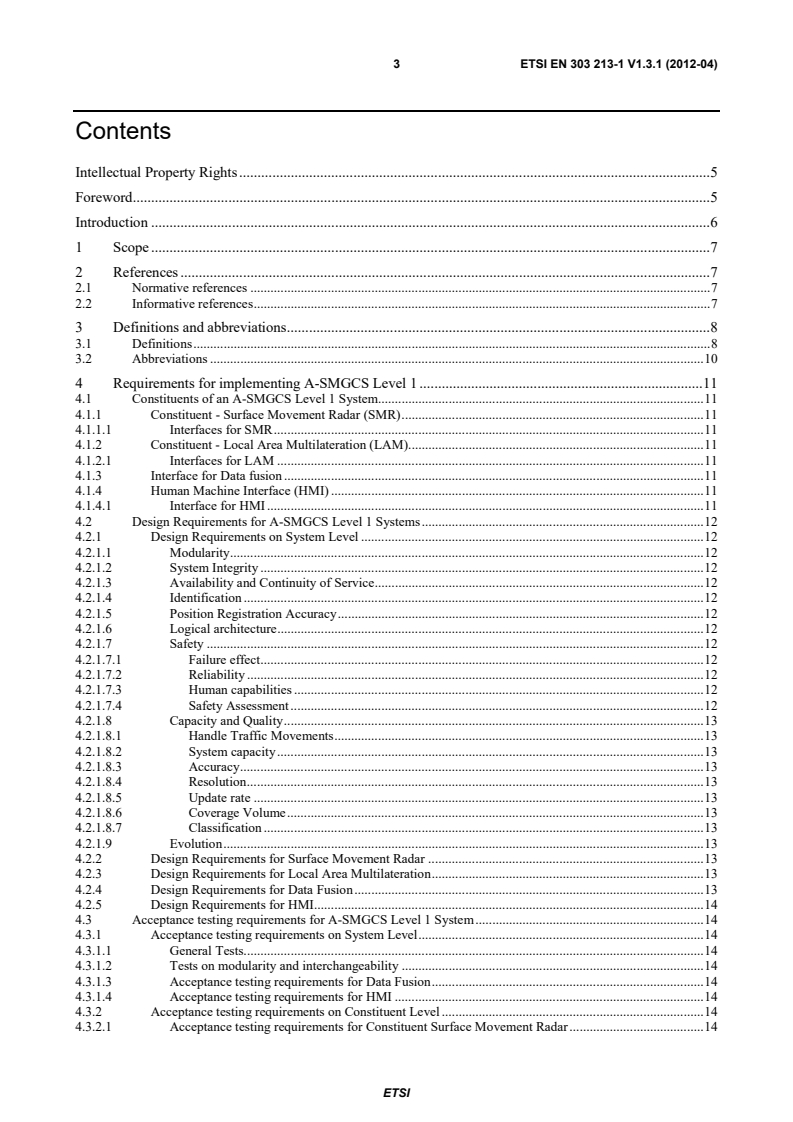
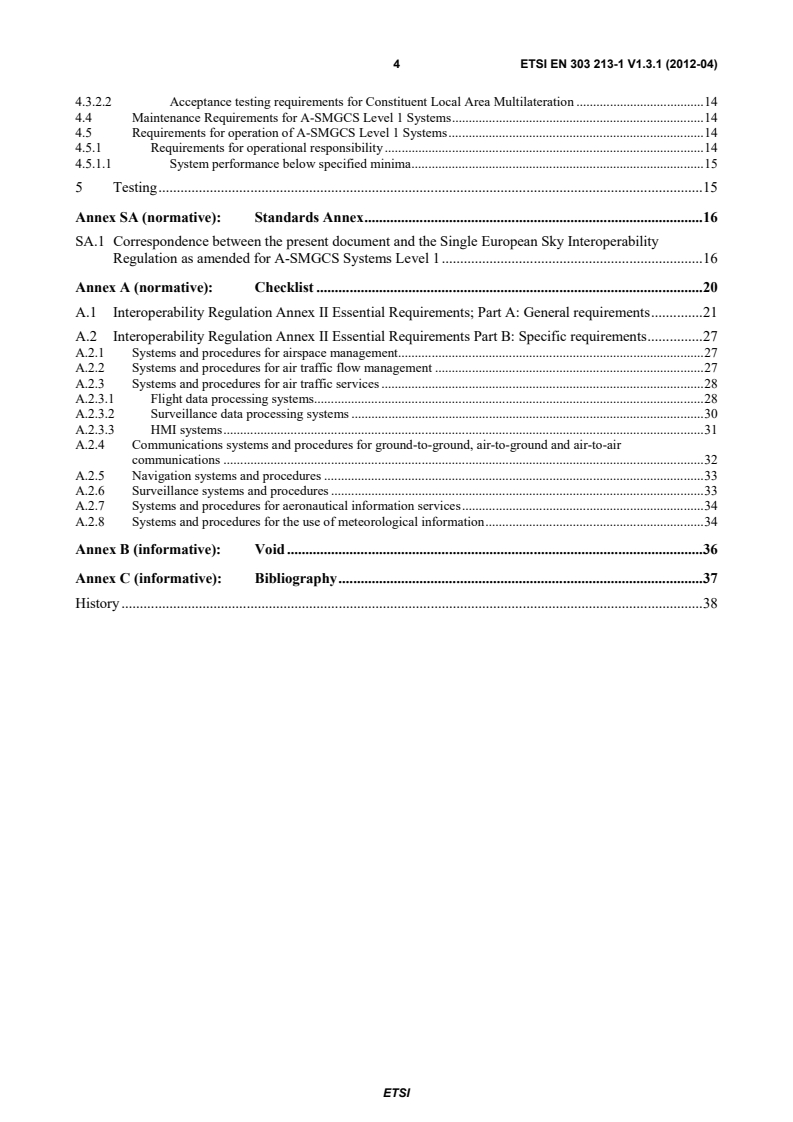
Contents
- Introduction
- 7 Final draft ETSI EN 303 213-1 V1.3.0 (2011-12)
- 1 Scope
- 2 References
- 2.1 Normative references
- 2.2 Informative references
- 8 Final draft ETSI EN 303 213-1 V1.3.0 (2011-12)
- 3 Definitions and abbreviations
- 3.1 Definitions
- 9 Final draft ETSI EN 303 213-1 V1.3.0 (2011-12)
- 10 Final draft ETSI EN 303 213-1 V1.3.0 (2011-12)
- 3.2 Abbreviations
- 11 Final draft ETSI EN 303 213-1 V1.3.0 (2011-12)
- 4.1 Constituents of an A-SMGCS Level 1 System
- 12 Final draft ETSI EN 303 213-1 V1.3.0 (2011-12)
- 4.2 Design Requirements for A-SMGCS Level 1 Systems
- 13 Final draft ETSI EN 303 213-1 V1.3.0 (2011-12)
- 14 Final draft ETSI EN 303 213-1 V1.3.0 (2011-12)
- 4.4 Maintenance Requirements for A-SMGCS Level 1 Systems
- 4.5 Requirements for operation of A-SMGCS Level 1 Systems
- 15 Final draft ETSI EN 303 213-1 V1.3.0 (2011-12)
- 5 Testing
- 16 Final draft ETSI EN 303 213-1 V1.3.0 (2011-12)
- 17 Final draft ETSI EN 303 213-1 V1.3.0 (2011-12)
- 18 Final draft ETSI EN 303 213-1 V1.3.0 (2011-12)
- 19 Final draft ETSI EN 303 213-1 V1.3.0 (2011-12)
- 20 Final draft ETSI EN 303 213-1 V1.3.0 (2011-12)
- 21 Final draft ETSI EN 303 213-1 V1.3.0 (2011-12)
- 1 ER 1 seamless operation
- 1.1 Designed n/a
- 1.2 Built n/a
- 22 Final draft ETSI EN 303 213-1 V1.3.0 (2011-12)
- 1 ER 1 seamless operation
- 1.5 Information sharing n/a
- 23 Final draft ETSI EN 303 213-1 V1.3.0 (2011-12)
- 24 Final draft ETSI EN 303 213-1 V1.3.0 (2011-12)
- 3.1 Design n/a
- 3.3 Maintenance n/a n/a
- 3.4 Operation n/a The user shall be informed and appropriate
- 3.5 Human capabilities n/a
- 3.6 Harmful interference n/a n/a
- 25 Final draft ETSI EN 303 213-1 V1.3.0 (2011-12)
- 6 ER 6 Principles governing the logical architecture of systems
- 26 Final draft ETSI EN 303 213-1 V1.3.0 (2011-12)
- 27 Final draft ETSI EN 303 213-1 V1.3.0 (2011-12)
- 1.1 ER 1.1 Seamless operation
- 28 Final draft ETSI EN 303 213-1 V1.3.0 (2011-12)
- 29 Final draft ETSI EN 303 213-1 V1.3.0 (2011-12)
- 3.1.2.2 built
- 3.1.2.3 maintained
- 3.1.2.4 operated
- 3.1.2.5 design
- 3.1.2.7 maintained
- 3.1.2.8 operated
- 30 Final draft ETSI EN 303 213-1 V1.3.0 (2011-12)
- 31 Final draft ETSI EN 303 213-1 V1.3.0 (2011-12)
- 32 Final draft ETSI EN 303 213-1 V1.3.0 (2011-12)
- 4.1 ER 4.1 Seamless operation
- 4.2 ER 4.2 Support for new concepts of operation
- 33 Final draft ETSI EN 303 213-1 V1.3.0 (2011-12)
- 5.1 ER 5.1 Seamless operation
- 6.1 ER 6.1 Seamless operation
- 34 Final draft ETSI EN 303 213-1 V1.3.0 (2011-12)
- 7.1 ER 7.1 Seamless operation
- 7.2 ER 7.2 Support for new concepts of operation
- 8.1 ER 8.1 Seamless operation
- 35 Final draft ETSI EN 303 213-1 V1.3.0 (2011-12)
- 36 Final draft ETSI EN 303 213-1 V1.3.0 (2011-12)
- 37 Final draft ETSI EN 303 213-1 V1.3.0 (2011-12)
- Bibliography
- 38 Final draft ETSI EN 303 213-1 V1.3.0 (2011-12)
Introduction
The European Union launched the Legislation "Single European Sky" (SES) in 2002 which was adopted in 2004 and amended by Regulation (EC) No 1070/2009 [i.12].
The SES legislation is based on a framework of 4 regulations, which includes the Interoperability Regulation [i.1]. The objective of the Interoperability Regulation is to ensure interoperability of the European Air Traffic Management Network (EATMN) consistent with air navigation services. Under this regulation, the use of a European Standard referenced in the Official Journal of the European Union as Community Specification (CS) is a means of compliance to the essential requirements of the Regulation and/or the relevant implementing rules for interoperability. The present document takes into account the Council Decision 2009/320/EC endorsing the European Air Traffic Management Master Plan of the Single European Sky ATM Research (SESAR) project [i.8]. This revised version takes into account the updated referenced documents from EUROCONTROL. ETSI
7 Final draft ETSI EN 303 213-1 V1.3.0 (2011-12)
1 Scope
The present document is applicable to Advanced Surface Movement Guidance and Control System (A-SMGCS) Level 1. This system provides enhanced surveillance functionalities, as well as a display to controllers with accurate and unambiguous identity and position information on the entire manoeuvring and movement area. The present document provides a European Standard for Air Navigation Service Providers, who have to demonstrate and declare compliance of their systems and procedures to the IOP regulation. Any software elements related to the software assurance level of an A-SMGCS are outside of the scope of the present document. As such the essential requirements of the Interoperability Regulation are not considered for software elements within the present document.
The present document does not give presumption of conformity related to the maintenance requirements, environmental constraints, procedure level, effect of harmful interference and civil/military coordination. NOTE: For these ERs, please refer to the Air Navigation Service Provider procedures. Requirements in the present document which refer to "should" statements or recommendations in the normatively referenced material (clause 2.1) are to be interpreted as fully normative ("shall") for the purpose of compliance with the present document.
Currently there are no relevant Implementing Rules for A-SMGCS. The present document does not give presumption of conformity to any current interoperability Implementing Rules.
2 References
References are either specific (identified by date of publication and/or edition number or version number) or non-specific. For specific references, only the cited version applies. For non-specific references, the latest version of the reference document (including any amendments) applies.
Referenced documents which are not found to be publicly available in the expected location might be found at http://docbox.etsi.org/Reference.
NOTE: While any hyperlinks included in this clause were valid at the time of publication ETSI cannot guarantee their long term validity.
2.1 Normative references
The following referenced documents are necessary for the application of the present document. [1] EUROCAE ED-87B (January 2008, including Amendment No 1 - January 2009): "MASPS for Advanced Surface Movement Guidance and Control Systems (A-SMGCS) - Levels 1 and 2". [2] EUROCONTROL 10/07/15-70 (V2.1: 30/06/2010): "Operational Concept and Requirements for A-SMGCS Implementation Level 1".
2.2 Informative references
The following referenced documents are not necessary for the application of the present document but they assist the user with regard to a particular subject area.
[i.1] Regulation (EC) No 552/2004 of the European Parliament and of the Council of 10 March 2004 on the interoperability of the European Air Traffic Management network (interoperability Regulation), OJ L 96, 31.03.2004, p. 26 as amended by Regulation (EC) No 1070/2009, OJ L 300, 14.11.2009, p. 34.
ETSI
8 Final draft ETSI EN 303 213-1 V1.3.0 (2011-12)
[i.2] ETSI EN 303 213-3: "Advanced Surface Movement Guidance and Control System (A-SMGCS) Part 3: Community Specification for application under the Single European Sky Interoperability Regulation EC 552/2004 for a deployed cooperative sensor including its interfaces". [i.3] ETSI EN 303 213-4-1: "Advanced Surface Movement Guidance and Control System (A-SMGCS); Part 4: Community Specification for application under the Single European Sky Interoperability Regulation EC 552/2004 for a deployed non-cooperative sensor including its interfaces; Sub-part 1: Generic requirements for non-cooperative sensor".
[i.4] ETSI EN 303 213-4-2: "Advanced Surface Movement Guidance and Control System (A-SMGCS); Part 4: Community Specification for application under the Single European Sky Interoperability Regulation EC 552/2004 for a deployed non-cooperative sensor including its interfaces; Sub-part 2: Specific requirements for a deployed Surface Movement Radar sensor". [i.5] Regulation (EC) No 549/2004 of the European Parliament and of the Council of 10 March 2004 laying down the framework for the creation of the single European sky (the framework Regulation), OJ L 96, 31.03.2004, p. 1 as amended by Regulation (EC) No 1070/2009, OJ L 300, 14.11.2009, p. 34.
[i.6] EUROCAE ED-128 (08/2007): "Guidelines for surveillance data fusion in advanced surface movement guidance and control systems (A-SMGCS) levels 1 and 2". [i.7] ICAO Document 9830, AN/452: "Advanced Surface Movement Guidance and Control Systems (A-SMGCS) Manual", First Edition, 2004.
[i.8] Council Decision 2009/320/EC endorsing the European Air Traffic Management Master Plan of the Single European Sky ATM Research (SESAR) project, 30.03.2009. [i.9] ETSI EN 303 213-2: "Advanced Surface Movement Guidance and Control System (A-SMGCS); Part 2: Community Specification for application under the Single European Sky Interoperability Regulation EC 552/2004 for A-SMGCS Level 2 including external interfaces". [i.10] EUROCONTROL 10/07/15-71 (V2.1: 30/06/2010): "A-SMGCS Levels 1 & 2 Preliminary Safety Case".
[i.11] Directive 98/34/EC of the European Parliament and of the Council of 22 June 1998 laying down a procedure for the provision of information in the field of technical standards and regulations. [i.12] Regulation (EC) No 1070/2009 of the European Parliament and of the Council of 21 October 2009 amending Regulations (EC) No 549/2004, (EC) No 550/2004, (EC) No 551/2004 and (EC) No 552/2004 in order to improve the performance and sustainability of the European aviation system, OJ L 300, 14.11.2009.
3 Definitions and abbreviations
3.1 Definitions
For the purposes of the present document, the following terms and definitions apply:
A-SMGCS Level 1: A-SMGCS including a comprehensive Surveillance element capable of the location and classification of all aircraft and vehicles within the area of interest and the identification of cooperative aircraft and vehicles ETSI
9 Final draft ETSI EN 303 213-1 V1.3.0 (2011-12)
Figure 1: A-SMGCS Level 1 Functional Configuration A-SMGCS Level 2: A-SMGCS including the capabilities of A-SMGCS Level 1 and uses the comprehensive surveillance data available to monitor the situation in the area of interest against a set of rules which will enable the system to alert the user to hazardous situations
Figure 2: A-SMGCS Level 2 Functional Configuration Advanced Surface Movement Guidance and Control System: systems providing routing, guidance, surveillance for the control to aircraft and vehicles in order to maintain movement rate under all local weather conditions within the Aerodrome Visibility Operational Level (AVOL) whilst maintaining the required level of safety NOTE: This definition is derived from the ICAO Document 9830 [i.7]. aerodrome: defined area on land or water (including any buildings, installations, and equipment) intended to be used either wholly or in part for arrival, departure and surface movement of aircraft NOTE: This definition is derived from the ICAO Document 9830 [i.7]. apron: defined area on an aerodrome, intended to accommodate aircraft for purposes of loading or unloading passengers, mail or cargo, fuelling, parking or maintenance NOTE 1: This definition is derived from the ICAO Document 9830 [i.7]. NOTE 2: De-icing platforms, including remote de-icing areas, are considered as apron areas. availability: probability that a system or an item is in a functioning state at a given point in time classification: function which groups targets into various types (e.g. large, medium, small) ETSI
10 Final draft ETSI EN 303 213-1 V1.3.0 (2011-12)
constituents: tangible objects such as hardware and intangible objects such as software upon which the interoperability of the EATMN depends NOTE: This is the legally binding definition in the context of Single European Sky [i.5]. manoeuvring area: part of an aerodrome to be used for take-off, landing and taxiing of aircraft, excluding aprons NOTE: This definition is derived from the ICAO Document 9830 [i.7]. movement area: part of an aerodrome to be used for take-off, landing and taxiing of aircraft, consisting of the manoeuvring area and apron(s) NOTE: This definition is derived from the ICAO Document 9830 [i.7]. procedure: standard method for either the technical or operational use of the system, in the context of agreed and validated concepts of operation requiring uniform implementation throughout the EATMN NOTE: This is the legally binding definition in the context of Single European Sky [i.5]. system: aggregation of airborne and ground based constituents, as well as space-based equipment, that provides support for air navigation services for all phases of flight NOTE: This is the legally binding definition in the context of Single European Sky [i.5]. target: aircraft, vehicle or obstacle that is displayed on a surveillance display NOTE: This definition is derived from the ICAO Document 9830 [i.7]. test targets: form of either fixed reflectors or active devices transponders, mounted at fixed positions within the Coverage Volume update: renewal of target reports relating to all targets under surveillance
3.2 Abbreviations
For the purposes of the present document, the following abbreviations apply:
A-SMGCS Advanced Surface Movement Guidance and Control Systems ATC Air Traffic Control ATM Air Traffic Management ATS Air Traffic Service AVOL Aerodrome Visibility Operational Level CS Community Specification DFP Data Fusion Processor doa date of announcement dow date of withdrawal EATMN European Air Traffic Management Network EC European Communities EN European Norm - (standard) ER Essential Requirement EUROCAE EUROpean organization for Civil Aviation Equipment EUROCONTROL EUROpean organization for the safety of air navigation HMI Human Machine Interface ICAO International Civil Aviation Organization IOP Regulation InterOPerability Regulation LAM Local Area Multilateration MASPS Minimum Aviation Systems Performance Specification PRA Position Registration Accuracy SES Single European Sky SMR Surface Movement Radar TMA Terminal Manoeuvring Area ETSI
11 Final draft ETSI EN 303 213-1 V1.3.0 (2011-12)
4 Requirements for implementing A-SMGCS Level 1 An A-SMGCS Level 1 System shall consist of the following constituents as a minimum for the implementation, operation and maintenance:
1) Surface Movement Radar.
2) Local Area Multilateration (LAM).
Data Fusion and HMI are considered as part of the System but are not at this time defined as constituents. NOTE 1: Guidance for the Data Fusion can be found in ED-128 [i.6]. NOTE 2: The Data fusion could be part of a larger data fusion processor providing other ATS functions. NOTE 3: The Data fusion may be a separate part of the CS in the future.
4.1 Constituents of an A-SMGCS Level 1 System
The following clauses identify the constituents of an A-SMGCS. NOTE: Data Fusion and HMI are currently defined at System level, however they have been included here, since they may become constituents in the future.
4.1.1 Constituent - Surface Movement Radar (SMR)
The SMR constituent of an A-SMGCS is covered in EN 303 213-4-1 [i.3] (Generic requirements) and EN 303 213-4-2 [i.4] (Specific requirements).
4.1.1.1 Interfaces for SMR
The interfaces for SMR constituents shall comply with the requirements as defined in ED-87B [1], clause 2.5.1.1.
4.1.2 Constituent - Local Area Multilateration (LAM)
The LAM constituent of an A-SMGCS is covered in EN 303 213-3 [i.2] (cooperative sensors).
4.1.2.1 Interfaces for LAM
The interfaces for LAM constituents shall comply with the requirements as defined in ED-87B [1], clause 2.5.1.1.
4.1.3 Interface for Data fusion
The interfaces for the data fusion in an A-SMGCS shall comply with the requirements as defined in ED-87B [1], clause 2.5.1.1.
NOTE: Guidance for the Data Fusion can be found in ED-128 [i.6].
4.1.4 Human Machine Interface (HMI)
The requirements for the HMI are further described in clauses 4.2.5 and 4.3.1.4 of the present document. NOTE 1: The HMI could be part of a larger HMI, providing other ATS functions. NOTE 2: The HMI could be a separate part of the CS in the future.
4.1.4.1 Interface for HMI
The interface for the HMI shall be capable to exchange data with the data fusion processor. ETSI
12 Final draft ETSI EN 303 213-1 V1.3.0 (2011-12)
4.2 Design Requirements for A-SMGCS Level 1 Systems
4.2.1 Design Requirements on System Level
4.2.1.1 Modularity
The System shall comply with the design requirements as defined in ED-87B [1], clause 1.8.2.
4.2.1.2 System Integrity
The System integrity shall comply with the design requirements as defined in ED-87B [1], clause 3.1.1.1, second and fifth paragraphs.
4.2.1.3 Availability and Continuity of Service
The Availability and continuity of service for A-SMGCS shall comply with the requirements as defined in ED-87B [1], clause 3.1.1.2 and Operational Concept and Requirements for A-SMGCS Implementation Level 1 [2], Op_Perf-10-Availability and Op_Perf-12-Continuity of Service 1.
4.2.1.4 Identification
The functional requirement for identification shall comply with the requirements as defined in ED-87B [1], clause 3.2.2.1.
4.2.1.5 Position Registration Accuracy
The functional requirement for position registration accuracy shall comply with the requirements as defined in ED-87B [1], clause 3.4.1.2.
4.2.1.6 Logical architecture
The logical architecture of the system shall comply with the requirements as defined in ED-87B [1], clause 2.3.
4.2.1.7 Safety
4.2.1.7.1 Failure effect An A-SMGCS Level 1 system shall be designed in such a way, that erroneous data from any constituent would have an acceptable impact on safety.
NOTE: This requirement is derived from clause 7.2.3 Requirement Op_Ds-7-Failure effect "d" [2]. 4.2.1.7.2 Reliability The reliability of the system shall comply with the requirements as defined in Operational Concept and Requirements for A-SMGCS Implementation Level 1 [2], Op_Ds-5-Self-checking system, Op_Ds-8-Self-restartable, and Op_Env-4-Adverse effects.
4.2.1.7.3 Human capabilities An A-SMGCS Level 1 system shall be designed in such a way, that the human capabilities shall be compatible with the principals described in ED-87B [1], clause 2.5.2.
4.2.1.7.4 Safety Assessment A safety assessment for A-SMGCS Level 1 system shall be provided. The safety objectives shall comply with the requirements as defined in Operational Concept and Requirements for A-SMGCS Implementation Level 1 [2], clause 2.1.
ETSI
13 Final draft ETSI EN 303 213-1 V1.3.0 (2011-12)
NOTE: The safety assessment may follow the methodology from A-SMGCS Levels 1&2 Preliminary Safety Case [i.10].
4.2.1.8 Capacity and Quality
4.2.1.8.1 Handle Traffic Movements The handling of traffic movements shall comply with the requirements as defined in Operational Concept and Requirements for A-SMGCS Implementation Level 1 [2], clause 7.2.3, Op_Range-2-Capacity, Op_Range-1-Visibility conditions, Op_Range-3-Mobile types, Op_Range-4-Mobile types, Op_Range-5-Speeds and Orientation, Op_Range-6-Velocity.
4.2.1.8.2 System capacity The system design shall take into account that capacity requirements will vary considerably from airport to airport depending on the volume of traffic and the aerodrome complexity. As a minimum, System Capacity shall be sufficient to meet the number of expected targets for the aerodrome with a specified margin of spare capacity to permit safe operation and future growth.
NOTE: This requirement is taken from ED-87B [1], clause 3.1.2. 4.2.1.8.3 Accuracy The accuracy shall comply with the requirements as defined in ED-87B [1], clause 3.2.2.3. 4.2.1.8.4 Resolution The resolution shall comply with the requirements as defined in ED-87B [1], clause 3.3.2.2. 4.2.1.8.5 Update rate The update rate shall comply with the requirements as defined in ED-87B [1], clause 3.2.2.5. 4.2.1.8.6 Coverage Volume The coverage volume shall comply with the requirements as defined in ED-87B [1], clause 3.2.1. 4.2.1.8.7 Classification The classification shall comply with the requirements as defined in ED-87B [1], clause 3.2.2.2.
4.2.1.9 Evolution
The evolution shall comply with the requirements as defined in ED-87B [1], clause 1.8.3.
4.2.2 Design Requirements for Surface Movement Radar
The design requirements for Surface Movement Radar as part of an A-SMGCS are covered in EN 303 213-4-1 [i.3].
4.2.3 Design Requirements for Local Area Multilateration
The design requirements for Local Area Multilateration as part of an A-SMGCS are covered in EN 303 213-3 [i.2].
4.2.4 Design Requirements for Data Fusion
No design requirements for Data Fusion are currently available. NOTE 1: Guidance for the Data Fusion can be found in ED-128 [i.6]. ETSI
14 Final draft ETSI EN 303 213-1 V1.3.0 (2011-12)
NOTE 2: The Data fusion could be part of a larger data fusion processor providing other ATS functions. NOTE 3: The Data fusion may be a separate part of the CS in the future.
4.2.5 Design Requirements for HMI
The general requirements for the HMI shall comply with the requirements as defined in ED-87B [1], clause 2.5.2. 4.3 Acceptance testing requirements for A-SMGCS Level 1 System
4.3.1 Acceptance testing requirements on System Level
4.3.1.1 General Tests
The system shall perform the build tests as defined in ED-87B [1], clause 4.5.
4.3.1.2 Tests on modularity and interchangeability
The system shall perform the build tests as defined in ED-87B [1], clause 4.6.
4.3.1.3 Acceptance testing requirements for Data Fusion
The Data Fusion shall perform the build tests as defined in ED-87B [1], clause 4.6.
4.3.1.4 Acceptance testing requirements for HMI
The HMI shall perform the build tests as defined in ED-87B [1], clause 4.8.
4.3.2 Acceptance testing requirements on Constituent Level
4.3.2.1 Acceptance testing requirements for Constituent Surface Movement Radar
The build requirements for Surface Movement Radar as part of an A-SMGCS are covered in EN 303 213-4-1 [i.3] and EN 303 213-4-2 [i.4].
4.3.2.2 Acceptance testing requirements for Constituent Local Area Multilateration
The build requirements for Local Area Multilateration as part of an A-SMGCS are covered in EN 303 213-3 [i.2].
4.4 Maintenance Requirements for A-SMGCS Level 1 Systems
The present document does not give presumption of conformity related to the maintenance requirements.
...
Contents
- Introduction
- 7 ETSI EN 303 213-1 V1.3.1 (2012-04)
- 1 Scope
- 2 References
- 2.1 Normative references
- 2.2 Informative references
- 8 ETSI EN 303 213-1 V1.3.1 (2012-04)
- 3 Definitions and abbreviations
- 3.1 Definitions
- 9 ETSI EN 303 213-1 V1.3.1 (2012-04)
- 10 ETSI EN 303 213-1 V1.3.1 (2012-04)
- 3.2 Abbreviations
- 11 ETSI EN 303 213-1 V1.3.1 (2012-04)
- 4.1 Constituents of an A-SMGCS Level 1 System
- 12 ETSI EN 303 213-1 V1.3.1 (2012-04)
- 4.2 Design Requirements for A-SMGCS Level 1 Systems
- 13 ETSI EN 303 213-1 V1.3.1 (2012-04)
- 14 ETSI EN 303 213-1 V1.3.1 (2012-04)
- 4.4 Maintenance Requirements for A-SMGCS Level 1 Systems
- 4.5 Requirements for operation of A-SMGCS Level 1 Systems
- 15 ETSI EN 303 213-1 V1.3.1 (2012-04)
- 5 Testing
- 16 ETSI EN 303 213-1 V1.3.1 (2012-04)
- 17 ETSI EN 303 213-1 V1.3.1 (2012-04)
- 18 ETSI EN 303 213-1 V1.3.1 (2012-04)
- 19 ETSI EN 303 213-1 V1.3.1 (2012-04)
- 20 ETSI EN 303 213-1 V1.3.1 (2012-04)
- 21 ETSI EN 303 213-1 V1.3.1 (2012-04)
- 1 ER 1 seamless operation
- 1.1 Designed n/a
- 1.2 Built n/a
- 22 ETSI EN 303 213-1 V1.3.1 (2012-04)
- 1 ER 1 seamless operation
- 1.5 Information sharing n/a
- 23 ETSI EN 303 213-1 V1.3.1 (2012-04)
- 24 ETSI EN 303 213-1 V1.3.1 (2012-04)
- 3.1 Design n/a
- 3.3 Maintenance n/a n/a
- 3.4 Operation n/a The user shall be informed and appropriate
- 3.5 Human capabilities n/a
- 3.6 Harmful interference n/a n/a
- 25 ETSI EN 303 213-1 V1.3.1 (2012-04)
- 6 ER 6 Principles governing the logical architecture of systems
- 26 ETSI EN 303 213-1 V1.3.1 (2012-04)
- 27 ETSI EN 303 213-1 V1.3.1 (2012-04)
- 1.1 ER 1.1 Seamless operation
- 28 ETSI EN 303 213-1 V1.3.1 (2012-04)
- 29 ETSI EN 303 213-1 V1.3.1 (2012-04)
- 3.1.2.2 built
- 3.1.2.3 maintained
- 3.1.2.4 operated
- 3.1.2.5 design
- 3.1.2.7 maintained
- 3.1.2.8 operated
- 30 ETSI EN 303 213-1 V1.3.1 (2012-04)
- 31 ETSI EN 303 213-1 V1.3.1 (2012-04)
- 32 ETSI EN 303 213-1 V1.3.1 (2012-04)
- 4.1 ER 4.1 Seamless operation
- 4.2 ER 4.2 Support for new concepts of operation
- 33 ETSI EN 303 213-1 V1.3.1 (2012-04)
- 5.1 ER 5.1 Seamless operation
- 6.1 ER 6.1 Seamless operation
- 34 ETSI EN 303 213-1 V1.3.1 (2012-04)
- 7.1 ER 7.1 Seamless operation
- 7.2 ER 7.2 Support for new concepts of operation
- 8.1 ER 8.1 Seamless operation
- 35 ETSI EN 303 213-1 V1.3.1 (2012-04)
- 36 ETSI EN 303 213-1 V1.3.1 (2012-04)
- 37 ETSI EN 303 213-1 V1.3.1 (2012-04)
- Bibliography
- 38 ETSI EN 303 213-1 V1.3.1 (2012-04)
Introduction
The European Union launched the Legislation "Single European Sky" (SES) in 2002 which was adopted in 2004 and amended by Regulation (EC) No 1070/2009 [i.12].
The SES legislation is based on a framework of 4 regulations, which includes the Interoperability Regulation [i.1]. The objective of the Interoperability Regulation is to ensure interoperability of the European Air Traffic Management Network (EATMN) consistent with air navigation services. Under this regulation, the use of a European Standard referenced in the Official Journal of the European Union as Community Specification (CS) is a means of compliance to the essential requirements of the Regulation and/or the relevant implementing rules for interoperability. The present document takes into account the Council Decision 2009/320/EC endorsing the European Air Traffic Management Master Plan of the Single European Sky ATM Research (SESAR) project [i.8]. This revised version takes into account the updated referenced documents from EUROCONTROL. ETSI
7 ETSI EN 303 213-1 V1.3.1 (2012-04)
1 Scope
The present document is applicable to Advanced Surface Movement Guidance and Control System (A-SMGCS) Level 1. This system provides enhanced surveillance functionalities, as well as a display to controllers with accurate and unambiguous identity and position information on the entire manoeuvring and movement area. The present document provides a European Standard for Air Navigation Service Providers, who have to demonstrate and declare compliance of their systems and procedures to the IOP regulation. Any software elements related to the software assurance level of an A-SMGCS are outside of the scope of the present document. As such the essential requirements of the Interoperability Regulation are not considered for software elements within the present document.
The present document does not give presumption of conformity related to the maintenance requirements, environmental constraints, procedure level, effect of harmful interference and civil/military coordination. NOTE: For these ERs, please refer to the Air Navigation Service Provider procedures. Requirements in the present document which refer to "should" statements or recommendations in the normatively referenced material (clause 2.1) are to be interpreted as fully normative ("shall") for the purpose of compliance with the present document.
Currently there are no relevant Implementing Rules for A-SMGCS. The present document does not give presumption of conformity to any current interoperability Implementing Rules.
2 References
References are either specific (identified by date of publication and/or edition number or version number) or non-specific. For specific references, only the cited version applies. For non-specific references, the latest version of the reference document (including any amendments) applies.
Referenced documents which are not found to be publicly available in the expected location might be found at http://docbox.etsi.org/Reference.
NOTE: While any hyperlinks included in this clause were valid at the time of publication ETSI cannot guarantee their long term validity.
2.1 Normative references
The following referenced documents are necessary for the application of the present document. [1] EUROCAE ED-87B (January 2008, including Amendment No 1 - January 2009): "MASPS for Advanced Surface Movement Guidance and Control Systems (A-SMGCS) - Levels 1 and 2". [2] EUROCONTROL 10/07/15-70 (V2.1: 30/06/2010): "Operational Concept and Requirements for A-SMGCS Implementation Level 1".
2.2 Informative references
The following referenced documents are not necessary for the application of the present document but they assist the user with regard to a particular subject area.
[i.1] Regulation (EC) No 552/2004 of the European Parliament and of the Council of 10 March 2004 on the interoperability of the European Air Traffic Management network (interoperability Regulation), OJ L 96, 31.03.2004, p. 26 as amended by Regulation (EC) No 1070/2009, OJ L 300, 14.11.2009, p. 34.
ETSI
8 ETSI EN 303 213-1 V1.3.1 (2012-04)
[i.2] ETSI EN 303 213-3: "Advanced Surface Movement Guidance and Control System (A-SMGCS) Part 3: Community Specification for application under the Single European Sky Interoperability Regulation EC 552/2004 for a deployed cooperative sensor including its interfaces". [i.3] ETSI EN 303 213-4-1: "Advanced Surface Movement Guidance and Control System (A-SMGCS); Part 4: Community Specification for application under the Single European Sky Interoperability Regulation EC 552/2004 for a deployed non-cooperative sensor including its interfaces; Sub-part 1: Generic requirements for non-cooperative sensor".
[i.4] ETSI EN 303 213-4-2: "Advanced Surface Movement Guidance and Control System (A-SMGCS); Part 4: Community Specification for application under the Single European Sky Interoperability Regulation EC 552/2004 for a deployed non-cooperative sensor including its interfaces; Sub-part 2: Specific requirements for a deployed Surface Movement Radar sensor". [i.5] Regulation (EC) No 549/2004 of the European Parliament and of the Council of 10 March 2004 laying down the framework for the creation of the single European sky (the framework Regulation), OJ L 96, 31.03.2004, p. 1 as amended by Regulation (EC) No 1070/2009, OJ L 300, 14.11.2009, p. 34.
[i.6] EUROCAE ED-128 (08/2007): "Guidelines for surveillance data fusion in advanced surface movement guidance and control systems (A-SMGCS) levels 1 and 2". [i.7] ICAO Document 9830, AN/452: "Advanced Surface Movement Guidance and Control Systems (A-SMGCS) Manual", First Edition, 2004.
[i.8] Council Decision 2009/320/EC endorsing the European Air Traffic Management Master Plan of the Single European Sky ATM Research (SESAR) project, 30.03.2009. [i.9] ETSI EN 303 213-2: "Advanced Surface Movement Guidance and Control System (A-SMGCS); Part 2: Community Specification for application under the Single European Sky Interoperability Regulation EC 552/2004 for A-SMGCS Level 2 including external interfaces". [i.10] EUROCONTROL 10/07/15-71 (V2.1: 30/06/2010): "A-SMGCS Levels 1 & 2 Preliminary Safety Case".
[i.11] Directive 98/34/EC of the European Parliament and of the Council of 22 June 1998 laying down a procedure for the provision of information in the field of technical standards and regulations. [i.12] Regulation (EC) No 1070/2009 of the European Parliament and of the Council of 21 October 2009 amending Regulations (EC) No 549/2004, (EC) No 550/2004, (EC) No 551/2004 and (EC) No 552/2004 in order to improve the performance and sustainability of the European aviation system, OJ L 300, 14.11.2009.
3 Definitions and abbreviations
3.1 Definitions
For the purposes of the present document, the following terms and definitions apply:
A-SMGCS Level 1: A-SMGCS including a comprehensive Surveillance element capable of the location and classification of all aircraft and vehicles within the area of interest and the identification of cooperative aircraft and vehicles ETSI
9 ETSI EN 303 213-1 V1.3.1 (2012-04)
Figure 1: A-SMGCS Level 1 Functional Configuration A-SMGCS Level 2: A-SMGCS including the capabilities of A-SMGCS Level 1 and uses the comprehensive surveillance data available to monitor the situation in the area of interest against a set of rules which will enable the system to alert the user to hazardous situations
Figure 2: A-SMGCS Level 2 Functional Configuration Advanced Surface Movement Guidance and Control System: systems providing routing, guidance, surveillance for the control to aircraft and vehicles in order to maintain movement rate under all local weather conditions within the Aerodrome Visibility Operational Level (AVOL) whilst maintaining the required level of safety NOTE: This definition is derived from the ICAO Document 9830 [i.7]. aerodrome: defined area on land or water (including any buildings, installations, and equipment) intended to be used either wholly or in part for arrival, departure and surface movement of aircraft NOTE: This definition is derived from the ICAO Document 9830 [i.7]. apron: defined area on an aerodrome, intended to accommodate aircraft for purposes of loading or unloading passengers, mail or cargo, fuelling, parking or maintenance NOTE 1: This definition is derived from the ICAO Document 9830 [i.7]. NOTE 2: De-icing platforms, including remote de-icing areas, are considered as apron areas. availability: probability that a system or an item is in a functioning state at a given point in time classification: function which groups targets into various types (e.g. large, medium, small) ETSI
10 ETSI EN 303 213-1 V1.3.1 (2012-04)
constituents: tangible objects such as hardware and intangible objects such as software upon which the interoperability of the EATMN depends NOTE: This is the legally binding definition in the context of Single European Sky [i.5]. manoeuvring area: part of an aerodrome to be used for take-off, landing and taxiing of aircraft, excluding aprons NOTE: This definition is derived from the ICAO Document 9830 [i.7]. movement area: part of an aerodrome to be used for take-off, landing and taxiing of aircraft, consisting of the manoeuvring area and apron(s) NOTE: This definition is derived from the ICAO Document 9830 [i.7]. procedure: standard method for either the technical or operational use of the system, in the context of agreed and validated concepts of operation requiring uniform implementation throughout the EATMN NOTE: This is the legally binding definition in the context of Single European Sky [i.5]. system: aggregation of airborne and ground based constituents, as well as space-based equipment, that provides support for air navigation services for all phases of flight NOTE: This is the legally binding definition in the context of Single European Sky [i.5]. target: aircraft, vehicle or obstacle that is displayed on a surveillance display NOTE: This definition is derived from the ICAO Document 9830 [i.7]. test targets: form of either fixed reflectors or active devices transponders, mounted at fixed positions within the Coverage Volume update: renewal of target reports relating to all targets under surveillance
3.2 Abbreviations
For the purposes of the present document, the following abbreviations apply:
A-SMGCS Advanced Surface Movement Guidance and Control Systems ATC Air Traffic Control ATM Air Traffic Management ATS Air Traffic Service AVOL Aerodrome Visibility Operational Level CS Community Specification DFP Data Fusion Processor doa date of announcement dow date of withdrawal EATMN European Air Traffic Management Network EC European Communities EN European Norm - (standard) ER Essential Requirement EUROCAE EUROpean organization for Civil Aviation Equipment EUROCONTROL EUROpean organization for the safety of air navigation HMI Human Machine Interface ICAO International Civil Aviation Organization IOP Regulation InterOPerability Regulation LAM Local Area Multilateration MASPS Minimum Aviation Systems Performance Specification PRA Position Registration Accuracy SES Single European Sky SMR Surface Movement Radar TMA Terminal Manoeuvring Area ETSI
11 ETSI EN 303 213-1 V1.3.1 (2012-04)
4 Requirements for implementing A-SMGCS Level 1 An A-SMGCS Level 1 System shall consist of the following constituents as a minimum for the implementation, operation and maintenance:
1) Surface Movement Radar.
2) Local Area Multilateration (LAM).
Data Fusion and HMI are considered as part of the System but are not at this time defined as constituents. NOTE 1: Guidance for the Data Fusion can be found in ED-128 [i.6]. NOTE 2: The Data fusion could be part of a larger data fusion processor providing other ATS functions. NOTE 3: The Data fusion may be a separate part of the CS in the future.
4.1 Constituents of an A-SMGCS Level 1 System
The following clauses identify the constituents of an A-SMGCS. NOTE: Data Fusion and HMI are currently defined at System level, however they have been included here, since they may become constituents in the future.
4.1.1 Constituent - Surface Movement Radar (SMR)
The SMR constituent of an A-SMGCS is covered in EN 303 213-4-1 [i.3] (Generic requirements) and EN 303 213-4-2 [i.4] (Specific requirements).
4.1.1.1 Interfaces for SMR
The interfaces for SMR constituents shall comply with the requirements as defined in ED-87B [1], clause 2.5.1.1.
4.1.2 Constituent - Local Area Multilateration (LAM)
The LAM constituent of an A-SMGCS is covered in EN 303 213-3 [i.2] (cooperative sensors).
4.1.2.1 Interfaces for LAM
The interfaces for LAM constituents shall comply with the requirements as defined in ED-87B [1], clause 2.5.1.1.
4.1.3 Interface for Data fusion
The interfaces for the data fusion in an A-SMGCS shall comply with the requirements as defined in ED-87B [1], clause 2.5.1.1.
NOTE: Guidance for the Data Fusion can be found in ED-128 [i.6].
4.1.4 Human Machine Interface (HMI)
The requirements for the HMI are further described in clauses 4.2.5 and 4.3.1.4 of the present document. NOTE 1: The HMI could be part of a larger HMI, providing other ATS functions. NOTE 2: The HMI could be a separate part of the CS in the future.
4.1.4.1 Interface for HMI
The interface for the HMI shall be capable to exchange data with the data fusion processor. ETSI
12 ETSI EN 303 213-1 V1.3.1 (2012-04)
4.2 Design Requirements for A-SMGCS Level 1 Systems
4.2.1 Design Requirements on System Level
4.2.1.1 Modularity
The System shall comply with the design requirements as defined in ED-87B [1], clause 1.8.2.
4.2.1.2 System Integrity
The System integrity shall comply with the design requirements as defined in ED-87B [1], clause 3.1.1.1, second and fifth paragraphs.
4.2.1.3 Availability and Continuity of Service
The Availability and continuity of service for A-SMGCS shall comply with the requirements as defined in ED-87B [1], clause 3.1.1.2 and Operational Concept and Requirements for A-SMGCS Implementation Level 1 [2], Op_Perf-10-Availability and Op_Perf-12-Continuity of Service 1.
4.2.1.4 Identification
The functional requirement for identification shall comply with the requirements as defined in ED-87B [1], clause 3.2.2.1.
4.2.1.5 Position Registration Accuracy
The functional requirement for position registration accuracy shall comply with the requirements as defined in ED-87B [1], clause 3.4.1.2.
4.2.1.6 Logical architecture
The logical architecture of the system shall comply with the requirements as defined in ED-87B [1], clause 2.3.
4.2.1.7 Safety
4.2.1.7.1 Failure effect An A-SMGCS Level 1 system shall be designed in such a way, that erroneous data from any constituent would have an acceptable impact on safety.
NOTE: This requirement is derived from clause 7.2.3 Requirement Op_Ds-7-Failure effect "d" [2]. 4.2.1.7.2 Reliability The reliability of the system shall comply with the requirements as defined in Operational Concept and Requirements for A-SMGCS Implementation Level 1 [2], Op_Ds-5-Self-checking system, Op_Ds-8-Self-restartable, and Op_Env-4-Adverse effects.
4.2.1.7.3 Human capabilities An A-SMGCS Level 1 system shall be designed in such a way, that the human capabilities shall be compatible with the principals described in ED-87B [1], clause 2.5.2.
4.2.1.7.4 Safety Assessment A safety assessment for A-SMGCS Level 1 system shall be provided. The safety objectives shall comply with the requirements as defined in Operational Concept and Requirements for A-SMGCS Implementation Level 1 [2], clause 2.1.
ETSI
13 ETSI EN 303 213-1 V1.3.1 (2012-04)
NOTE: The safety assessment may follow the methodology from A-SMGCS Levels 1&2 Preliminary Safety Case [i.10].
4.2.1.8 Capacity and Quality
4.2.1.8.1 Handle Traffic Movements The handling of traffic movements shall comply with the requirements as defined in Operational Concept and Requirements for A-SMGCS Implementation Level 1 [2], clause 7.2.3, Op_Range-2-Capacity, Op_Range-1-Visibility conditions, Op_Range-3-Mobile types, Op_Range-4-Mobile types, Op_Range-5-Speeds and Orientation, Op_Range-6-Velocity.
4.2.1.8.2 System capacity The system design shall take into account that capacity requirements will vary considerably from airport to airport depending on the volume of traffic and the aerodrome complexity. As a minimum, System Capacity shall be sufficient to meet the number of expected targets for the aerodrome with a specified margin of spare capacity to permit safe operation and future growth.
NOTE: This requirement is taken from ED-87B [1], clause 3.1.2. 4.2.1.8.3 Accuracy The accuracy shall comply with the requirements as defined in ED-87B [1], clause 3.2.2.3. 4.2.1.8.4 Resolution The resolution shall comply with the requirements as defined in ED-87B [1], clause 3.3.2.2. 4.2.1.8.5 Update rate The update rate shall comply with the requirements as defined in ED-87B [1], clause 3.2.2.5. 4.2.1.8.6 Coverage Volume The coverage volume shall comply with the requirements as defined in ED-87B [1], clause 3.2.1. 4.2.1.8.7 Classification The classification shall comply with the requirements as defined in ED-87B [1], clause 3.2.2.2.
4.2.1.9 Evolution
The evolution shall comply with the requirements as defined in ED-87B [1], clause 1.8.3.
4.2.2 Design Requirements for Surface Movement Radar
The design requirements for Surface Movement Radar as part of an A-SMGCS are covered in EN 303 213-4-1 [i.3].
4.2.3 Design Requirements for Local Area Multilateration
The design requirements for Local Area Multilateration as part of an A-SMGCS are covered in EN 303 213-3 [i.2].
4.2.4 Design Requirements for Data Fusion
No design requirements for Data Fusion are currently available. NOTE 1: Guidance for the Data Fusion can be found in ED-128 [i.6]. ETSI
14 ETSI EN 303 213-1 V1.3.1 (2012-04)
NOTE 2: The Data fusion could be part of a larger data fusion processor providing other ATS functions. NOTE 3: The Data fusion may be a separate part of the CS in the future.
4.2.5 Design Requirements for HMI
The general requirements for the HMI shall comply with the requirements as defined in ED-87B [1], clause 2.5.2. 4.3 Acceptance testing requirements for A-SMGCS Level 1 System
4.3.1 Acceptance testing requirements on System Level
4.3.1.1 General Tests
The system shall perform the build tests as defined in ED-87B [1], clause 4.5.
4.3.1.2 Tests on modularity and interchangeability
The system shall perform the build tests as defined in ED-87B [1], clause 4.6.
4.3.1.3 Acceptance testing requirements for Data Fusion
The Data Fusion shall perform the build tests as defined in ED-87B [1], clause 4.6.
4.3.1.4 Acceptance testing requirements for HMI
The HMI shall perform the build tests as defined in ED-87B [1], clause 4.8.
4.3.2 Acceptance testing requirements on Constituent Level
4.3.2.1 Acceptance testing requirements for Constituent Surface Movement Radar
The build requirements for Surface Movement Radar as part of an A-SMGCS are covered in EN 303 213-4-1 [i.3] and EN 303 213-4-2 [i.4].
4.3.2.2 Acceptance testing requirements for Constituent Local Area Multilateration
The build requirements for Local Area Multilateration as part of an A-SMGCS are covered in EN 303 213-3 [i.2].
4.4 Maintenance Requirements for A-SMGCS Level 1 Systems
The present document does not give presumption of conformity related to the maintenance requirements.
4.5 Requirements for operation of A-SMGCS Level 1 Systems
4.5.1 Requirements for operational responsibility
The operational responsibility shall be as defined in Operational Concept and Requirements for A-SMGCS Implementation Level 1 [2], clause 7.2.3, Op_Resp-1-Users, Op_Resp-2-Assignment, Op_Resp-3-A-SMGCS category. ETSI
...
2003-01.Slovenski inštitut za standardizacijo. Razmnoževanje celote ali delov tega standarda ni dovoljeno.Advanced Surface Movement Guidance and Control System (A-SMGCS) - Part 1: Community Specification for application under the Single European Sky Interoperability Regulation EC 552/2004 for A-SMGCS Level 1 including external interfaces49.090On-board equipment and instruments03.220.50Air transportICS:Ta slovenski standard je istoveten z:EN 303 213-1 Version 1.3.1SIST EN 303 213-1 V1.3.1:2012en01-junij-2012SIST EN 303 213-1 V1.3.1:2012SLOVENSKI
STANDARD
European Standard SIST EN 303 213-1 V1.3.1:2012
ETSI ETSI EN 303 213-1 V1.3.1 (2012-04) 2
Reference REN/AERO-00011 Keywords aeronautical, air traffic management, interoperability ETSI 650 Route des Lucioles F-06921 Sophia Antipolis Cedex - FRANCE
Tel.: +33 4 92 94 42 00
Fax: +33 4 93 65 47 16
Siret N° 348 623 562 00017 - NAF 742 C Association à but non lucratif enregistrée à la Sous-Préfecture de Grasse (06) N° 7803/88
Important notice Individual copies of the present document can be downloaded from: http://www.etsi.org The present document may be made available in more than one electronic version or in print. In any case of existing or perceived difference in contents between such versions, the reference version is the Portable Document Format (PDF). In case of dispute, the reference shall be the printing on ETSI printers of the PDF version kept on a specific network drive within ETSI Secretariat. Users of the present document should be aware that the document may be subject to revision or change of status. Information on the current status of this and other ETSI documents is available at http://portal.etsi.org/tb/status/status.asp If you find errors in the present document, please send your comment to one of the following services: http://portal.etsi.org/chaircor/ETSI_support.asp Copyright Notification No part may be reproduced except as authorized by written permission. The copyright and the foregoing restriction extend to reproduction in all media.
© European Telecommunications Standards Institute 2012. All rights reserved.
DECTTM, PLUGTESTSTM, UMTSTM and the ETSI logo are Trade Marks of ETSI registered for the benefit of its Members. 3GPPTM and LTE™ are Trade Marks of ETSI registered for the benefit of its Members and of the 3GPP Organizational Partners. GSM® and the GSM logo are Trade Marks registered and owned by the GSM Association. SIST EN 303 213-1 V1.3.1:2012
ETSI ETSI EN 303 213-1 V1.3.1 (2012-04) 3 Contents Intellectual Property Rights . 5 Foreword . 5 Introduction . 6 1 Scope . 7 2 References . 7 2.1 Normative references . 7 2.2 Informative references . 7 3 Definitions and abbreviations . 8 3.1 Definitions . 8 3.2 Abbreviations . 10 4 Requirements for implementing A-SMGCS Level 1 . 11 4.1 Constituents of an A-SMGCS Level 1 System. 11 4.1.1 Constituent - Surface Movement Radar (SMR) . 11 4.1.1.1 Interfaces for SMR . 11 4.1.2 Constituent - Local Area Multilateration (LAM) . 11 4.1.2.1 Interfaces for LAM . 11 4.1.3 Interface for Data fusion . 11 4.1.4 Human Machine Interface (HMI) . 11 4.1.4.1 Interface for HMI . 11 4.2 Design Requirements for A-SMGCS Level 1 Systems . 12 4.2.1 Design Requirements on System Level . 12 4.2.1.1 Modularity . 12 4.2.1.2 System Integrity . 12 4.2.1.3 Availability and Continuity of Service . 12 4.2.1.4 Identification . 12 4.2.1.5 Position Registration Accuracy . 12 4.2.1.6 Logical architecture . 12 4.2.1.7 Safety . 12 4.2.1.7.1 Failure effect . 12 4.2.1.7.2 Reliability . 12 4.2.1.7.3 Human capabilities . 12 4.2.1.7.4 Safety Assessment . 12 4.2.1.8 Capacity and Quality . 13 4.2.1.8.1 Handle Traffic Movements . 13 4.2.1.8.2 System capacity . 13 4.2.1.8.3 Accuracy . 13 4.2.1.8.4 Resolution . 13 4.2.1.8.5 Update rate . 13 4.2.1.8.6 Coverage Volume . 13 4.2.1.8.7 Classification . 13 4.2.1.9 Evolution . 13 4.2.2 Design Requirements for Surface Movement Radar . 13 4.2.3 Design Requirements for Local Area Multilateration . 13 4.2.4 Design Requirements for Data Fusion . 13 4.2.5 Design Requirements for HMI. 14 4.3 Acceptance testing requirements for A-SMGCS Level 1 System . 14 4.3.1 Acceptance testing requirements on System Level . 14 4.3.1.1 General Tests . 14 4.3.1.2 Tests on modularity and interchangeability . 14 4.3.1.3 Acceptance testing requirements for Data Fusion . 14 4.3.1.4 Acceptance testing requirements for HMI . 14 4.3.2 Acceptance testing requirements on Constituent Level . 14 4.3.2.1 Acceptance testing requirements for Constituent Surface Movement Radar . 14 SIST EN 303 213-1 V1.3.1:2012
ETSI ETSI EN 303 213-1 V1.3.1 (2012-04) 4 4.3.2.2 Acceptance testing requirements for Constituent Local Area Multilateration . 14 4.4 Maintenance Requirements for A-SMGCS Level 1 Systems . 14 4.5 Requirements for operation of A-SMGCS Level 1 Systems . 14 4.5.1 Requirements for operational responsibility . 14 4.5.1.1 System performance below specified minima . 15 5 Testing . 15 Annex SA (normative): Standards Annex . 16 SA.1 Correspondence between the present document and the Single European Sky Interoperability Regulation as amended for A-SMGCS Systems Level 1 . 16 Annex A (normative): Checklist . 20 A.1 Interoperability Regulation Annex II Essential Requirements; Part A: General requirements . 21 A.2 Interoperability Regulation Annex II Essential Requirements Part B: Specific requirements . 27 A.2.1 Systems and procedures for airspace management. 27 A.2.2 Systems and procedures for air traffic flow management . 27 A.2.3 Systems and procedures for air traffic services . 28 A.2.3.1 Flight data processing systems. 28 A.2.3.2 Surveillance data processing systems . 30 A.2.3.3 HMI systems . 31 A.2.4 Communications systems and procedures for ground-to-ground, air-to-ground and air-to-air communications . 32 A.2.5 Navigation systems and procedures . 33 A.2.6 Surveillance systems and procedures . 33 A.2.7 Systems and procedures for aeronautical information services . 34 A.2.8 Systems and procedures for the use of meteorological information . 34 Annex B (informative): Void . 36 Annex C (informative): Bibliography . 37 History . 38
ETSI ETSI EN 303 213-1 V1.3.1 (2012-04) 5 Intellectual Property Rights IPRs essential or potentially essential to the present document may have been declared to ETSI. The information pertaining to these essential IPRs, if any, is publicly available for ETSI members and non-members, and can be found in ETSI SR 000 314: "Intellectual Property Rights (IPRs); Essential, or potentially Essential, IPRs notified to ETSI in respect of ETSI standards", which is available from the ETSI Secretariat. Latest updates are available on the ETSI Web server (http://ipr.etsi.org). Pursuant to the ETSI IPR Policy, no investigation, including IPR searches, has been carried out by ETSI. No guarantee can be given as to the existence of other IPRs not referenced in ETSI SR 000 314 (or the updates on the ETSI Web server) which are, or may be, or may become, essential to the present document. Foreword This European Standard (EN) has been produced by ETSI Technical Committee Aeronautics (AERO). The present document has been revised by ETSI Technical Committee on Aeronautics (AERO). The present document has been produced by ETSI in response to mandate M/390 from the European Commission issued under Council Directive 98/34/EC [i.11] (as amended) laying down a procedure for the provision of information in the field of technical standards and regulations. The present document has been developed in cooperation with EUROCAE to support Essential Requirements of the Single European Sky Interoperability Regulation 552/2004 [i.1] and/or requirements given in implementing rules for interoperability based on the Single European Interoperability Regulation. The presumption of conformity which is linked to the full application of EN 303 213 (parts 1 to 4) can only be claimed after EN 303 213 (parts 1 to 4) has been listed in the Official Journal of the European Union as Community Specification. General and specific requirements for presumption of conformity to SES Interoperability Regulation 552/2004 [i.1] as amended by Regulation 1070/2009 [i.12] are given in the normative annexes of the present document. NOTE: Other requirements and other EU Regulations and/or Directives may be applicable to the product(s) falling within the scope of the present document. The present document is part 1 of a multi-part deliverable covering Advanced Surface Movement Guidance and Control System (A-SMGCS), as identified below: Part 1: "Community Specification for application under the Single European Sky Interoperability Regulation EC 552/2004 for A-SMGCS Level 1 including external interfaces"; Part 2: "Community Specification for application under the Single European Sky Interoperability Regulation EC 552/2004 for A-SMGCS Level 2 including external interfaces"; Part 3: "Community Specification for application under the Single European Sky Interoperability Regulation EC 552/2004 for a deployed cooperative sensor including its interfaces"; Part 4:
"Community Specification for application under the Single European Sky Interoperability Regulation EC 552/2004 for a deployed non-cooperative sensor including its interfaces"; Part 5: Harmonized EN covering the essential requirements of article 3.2 of the R&TTE Directive for multilateration equipment;" Part 6: Harmonized EN covering the essential requirements of article 3.2 of the R&TTE Directive for deployed surface movement radar sensors."
ETSI ETSI EN 303 213-1 V1.3.1 (2012-04) 6 National transposition dates Date of adoption of this EN: 4 April 2012 Date of latest announcement of this EN (doa): 31 July 2012 Date of latest publication of new National Standard or endorsement of this EN (dop/e):
31 January 2013 Date of withdrawal of any conflicting National Standard (dow): 31 January 2014
Introduction The European Union launched the Legislation "Single European Sky" (SES) in 2002 which was adopted in 2004 and amended by Regulation (EC) No 1070/2009 [i.12]. The SES legislation is based on a framework of 4 regulations, which includes the Interoperability Regulation [i.1]. The objective of the Interoperability Regulation is to ensure interoperability of the European Air Traffic Management Network (EATMN) consistent with air navigation services. Under this regulation, the use of a European Standard referenced in the Official Journal of the European Union as Community Specification (CS) is a means of compliance to the essential requirements of the Regulation and/or the relevant implementing rules for interoperability. The present document takes into account the Council Decision 2009/320/EC endorsing the European Air Traffic Management Master Plan of the Single European Sky ATM Research (SESAR) project [i.8]. This revised version takes into account the updated referenced documents from EUROCONTROL.
...