


oSIST prEN 14564:2025
(Main)Tanks for transport of dangerous goods - Terminology
General Information
- Abstract
This document provides additional terms and definitions to those written in the Agreement Concerning the International Carriage of Dangerous Goods by Road (ADR) or the Regulation concerning the International Carriage of Dangerous Goods by Rail (RID), appearing as Appendix C to the Convention concerning International Carriage by Rail (COTIF).
This document forms part of series of documents prepared by CEN/TC 296 regarding the transport of dangerous goods. The series supports the proper application of the ADR and RID.
This document is applicable to tanks used for the transport of dangerous goods. This document does not apply to carriage in bulk of dangerous goods.
For convenience, Annex A (informative) repeats some horizontal definitions taken from ADR and RID 2025 chapter 1.2, and Annex B (informative) repeats some definitions from ADR and RID 2025 chapter 6.7, specific to portable tanks.
NOTE The ADR and RID are updated on a regular basis, therefore Annexes A and B might become out of date. For outdated definitions, the RID/ADR take precedence.
Annexes C, D and E (informative) provide alphabetical trilingual indexes of terms in English, French and German where the key is English, French and German respectively.
Annex F (normative) is a schematic diagram of tank openings and closures according to the tank code.
- Status
- Not Published
- Public Enquiry End Date
- 02-Dec-2025
- Technical Committee
- TLP - Pressure vessels
- Current Stage
- 4020 - Public enquire (PE) (Adopted Project)
- Start Date
- 08-Oct-2025
- Due Date
- 25-Feb-2026
- Completion Date
- 15-Dec-2025

Overview
oSIST prEN 14564:2025 is a European standard developed by CEN/TC 296 that establishes precise terminology for tanks used in the transport of dangerous goods. Serving as a companion to major international agreements such as the ADR (European Agreement concerning the International Carriage of Dangerous Goods by Road) and RID (Regulation concerning the International Carriage of Dangerous Goods by Rail), this standard provides additional terms and definitions that ensure a harmonized understanding across the industry. oSIST prEN 14564:2025 is part of a broader series supporting correct application of regulatory requirements for the safe conveyance of hazardous materials in tank equipment.
The standard applies specifically to tanks designed for transporting dangerous goods, but not to the carriage in bulk or unpackaged forms.
Key Topics
- Terminology for Dangerous Goods Transport: oSIST prEN 14564:2025 compiles and clarifies technical terms related to tanks, their components, processes, and types as used within the context of regulated dangerous goods transport.
- Alignment with International Regulations: The terms supplement those found in ADR and RID, ensuring users have access to the most current definitions, including any additions or clarifications relevant to European practice.
- Multilingual Reference: Annexes provide alphabetical trilingual indexes (English, French, German) to support international operations, training, and documentation.
- Technical Definitions: Covered terms range from "shell," "service equipment," and "structural equipment" to process-related definitions such as "type approval," "repair," and "conformity assessment."
- Schematic Guidance: Annex F includes a schematic diagram on tank openings and closures based on tank code, supporting clearer technical communication and compliance.
Applications
- Tank Manufacturing and Certification: Manufacturers and inspection bodies use oSIST prEN 14564:2025 to ensure that technical documentation, manufacturing processes, and communication are standardized and in line with European and international regulations.
- Regulatory Compliance: Operators, logistics companies, and safety personnel reference these definitions to achieve compliance with ADR/RID rules and to facilitate inspections and type approvals.
- Training and Documentation: The standard serves as an essential resource for training staff involved in dangerous goods logistics, helping to prevent misunderstandings that could lead to non-conformance or safety issues.
- International Coordination: By providing a uniform set of terms and definitions, oSIST prEN 14564:2025 supports smooth cooperation across borders and languages, benefiting multinational transport operations and regulatory authorities.
- Technical Communication: Engineers, designers, and technical writers rely on the standardized glossary to describe tank systems, maintenance protocols, and inspection procedures unambiguously.
Related Standards
- ADR (European Agreement concerning the International Carriage of Dangerous Goods by Road): The fundamental regulatory document for road transport of hazardous materials in Europe.
- RID (Regulation concerning the International Carriage of Dangerous Goods by Rail): The parallel regulation for rail transport, incorporated within COTIF.
- EN 14564:2019: The previous version of this standard, which oSIST prEN 14564:2025 is intended to supersede.
- Other CEN/TC 296 Standards: Including various product and process standards for the construction, inspection, and use of tanks for dangerous goods transport.
- ISO and IEC Terminology Databases: For additional international reference, the ISO Online Browsing Platform and IEC Electropedia provide further standardized vocabularies.
By facilitating a clear and consistent vocabulary, oSIST prEN 14564:2025 strengthens safety, efficiency, and regulatory coherence in the European transport of dangerous goods by tank, supporting all stakeholders from manufacturers to regulators and operators.
Relations
- Effective Date
- 10-Jul-2024
Get Certified
Connect with accredited certification bodies for this standard

CIS Institut d.o.o.
Personal Protective Equipment (PPE) certification body. Notified Body NB-2890 for EU Regulation 2016/425 PPE.
Institut za varilstvo d.o.o. (Welding Institute)
Slovenia's leading welding institute since 1952. ISO 3834, EN 1090, pressure equipment certification, NDT personnel, welder qualification. Only IIW Au

Kiwa BDA Testing
Building and construction product certification.
Sponsored listings
Frequently Asked Questions
oSIST prEN 14564:2025 is a draft published by the Slovenian Institute for Standardization (SIST). Its full title is "Tanks for transport of dangerous goods - Terminology". This standard covers: This document provides additional terms and definitions to those written in the Agreement Concerning the International Carriage of Dangerous Goods by Road (ADR) or the Regulation concerning the International Carriage of Dangerous Goods by Rail (RID), appearing as Appendix C to the Convention concerning International Carriage by Rail (COTIF). This document forms part of series of documents prepared by CEN/TC 296 regarding the transport of dangerous goods. The series supports the proper application of the ADR and RID. This document is applicable to tanks used for the transport of dangerous goods. This document does not apply to carriage in bulk of dangerous goods. For convenience, Annex A (informative) repeats some horizontal definitions taken from ADR and RID 2025 chapter 1.2, and Annex B (informative) repeats some definitions from ADR and RID 2025 chapter 6.7, specific to portable tanks. NOTE The ADR and RID are updated on a regular basis, therefore Annexes A and B might become out of date. For outdated definitions, the RID/ADR take precedence. Annexes C, D and E (informative) provide alphabetical trilingual indexes of terms in English, French and German where the key is English, French and German respectively. Annex F (normative) is a schematic diagram of tank openings and closures according to the tank code.
This document provides additional terms and definitions to those written in the Agreement Concerning the International Carriage of Dangerous Goods by Road (ADR) or the Regulation concerning the International Carriage of Dangerous Goods by Rail (RID), appearing as Appendix C to the Convention concerning International Carriage by Rail (COTIF). This document forms part of series of documents prepared by CEN/TC 296 regarding the transport of dangerous goods. The series supports the proper application of the ADR and RID. This document is applicable to tanks used for the transport of dangerous goods. This document does not apply to carriage in bulk of dangerous goods. For convenience, Annex A (informative) repeats some horizontal definitions taken from ADR and RID 2025 chapter 1.2, and Annex B (informative) repeats some definitions from ADR and RID 2025 chapter 6.7, specific to portable tanks. NOTE The ADR and RID are updated on a regular basis, therefore Annexes A and B might become out of date. For outdated definitions, the RID/ADR take precedence. Annexes C, D and E (informative) provide alphabetical trilingual indexes of terms in English, French and German where the key is English, French and German respectively. Annex F (normative) is a schematic diagram of tank openings and closures according to the tank code.
oSIST prEN 14564:2025 is classified under the following ICS (International Classification for Standards) categories: 01.040.13 - Environment. Health protection. Safety (Vocabularies); 01.040.23 - Fluid systems and components for general use (Vocabularies); 13.300 - Protection against dangerous goods; 23.020.20 - Vessels and containers mounted on vehicles. The ICS classification helps identify the subject area and facilitates finding related standards.
oSIST prEN 14564:2025 has the following relationships with other standards: It is inter standard links to SIST EN 14564:2019. Understanding these relationships helps ensure you are using the most current and applicable version of the standard.
oSIST prEN 14564:2025 is associated with the following European legislation: EU Directives/Regulations: 2008/68/EC; Standardization Mandates: M/TDG. When a standard is cited in the Official Journal of the European Union, products manufactured in conformity with it benefit from a presumption of conformity with the essential requirements of the corresponding EU directive or regulation.
oSIST prEN 14564:2025 is available in PDF format for immediate download after purchase. The document can be added to your cart and obtained through the secure checkout process. Digital delivery ensures instant access to the complete standard document.
Standards Content (Sample)
SLOVENSKI STANDARD
01-november-2025
Cisterne za prevoz nevarnega blaga - Terminologija
Tanks for transport of dangerous goods - Terminology
Tanks für die Beförderung gefährlicher Güter - Begriffe
Citernes pour le transport de matières dangereuses - Terminologie
Ta slovenski standard je istoveten z: prEN 14564
ICS:
01.040.13 Okolje. Varovanje zdravja. Environment. Health
Varnost (Slovarji) protection. Safety
(Vocabularies)
01.040.23 Tekočinski sistemi in sestavni Fluid systems and
deli za splošno rabo (Slovarji) components for general use
(Vocabularies)
13.300 Varstvo pred nevarnimi Protection against dangerous
izdelki goods
23.020.20 Posode in vsebniki, montirani Vessels and containers
na vozila mounted on vehicles
2003-01.Slovenski inštitut za standardizacijo. Razmnoževanje celote ali delov tega standarda ni dovoljeno.
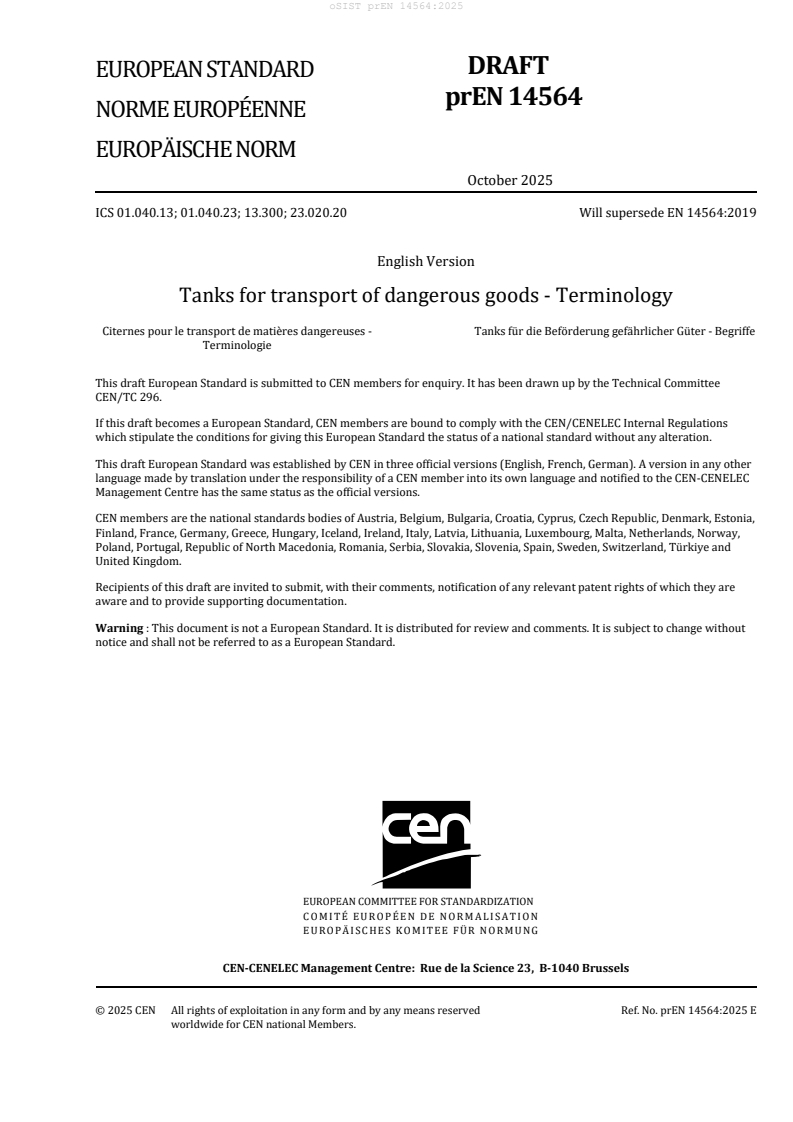
DRAFT
EUROPEAN STANDARD
prEN 14564
NORME EUROPÉENNE
EUROPÄISCHE NORM
October 2025
ICS 01.040.13; 01.040.23; 13.300; 23.020.20 Will supersede EN 14564:2019
English Version
Tanks for transport of dangerous goods - Terminology
Citernes pour le transport de matières dangereuses - Tanks für die Beförderung gefährlicher Güter - Begriffe
Terminologie
This draft European Standard is submitted to CEN members for enquiry. It has been drawn up by the Technical Committee
CEN/TC 296.
If this draft becomes a European Standard, CEN members are bound to comply with the CEN/CENELEC Internal Regulations
which stipulate the conditions for giving this European Standard the status of a national standard without any alteration.
This draft European Standard was established by CEN in three official versions (English, French, German). A version in any other
language made by translation under the responsibility of a CEN member into its own language and notified to the CEN-CENELEC
Management Centre has the same status as the official versions.
CEN members are the national standards bodies of Austria, Belgium, Bulgaria, Croatia, Cyprus, Czech Republic, Denmark, Estonia,
Finland, France, Germany, Greece, Hungary, Iceland, Ireland, Italy, Latvia, Lithuania, Luxembourg, Malta, Netherlands, Norway,
Poland, Portugal, Republic of North Macedonia, Romania, Serbia, Slovakia, Slovenia, Spain, Sweden, Switzerland, Türkiye and
United Kingdom.
Recipients of this draft are invited to submit, with their comments, notification of any relevant patent rights of which they are
aware and to provide supporting documentation.
Warning : This document is not a European Standard. It is distributed for review and comments. It is subject to change without
notice and shall not be referred to as a European Standard.
EUROPEAN COMMITTEE FOR STANDARDIZATION
COMITÉ EUROPÉEN DE NORMALISATION
EUROPÄISCHES KOMITEE FÜR NORMUNG
CEN-CENELEC Management Centre: Rue de la Science 23, B-1040 Brussels
© 2025 CEN All rights of exploitation in any form and by any means reserved Ref. No. prEN 14564:2025 E
worldwide for CEN national Members.
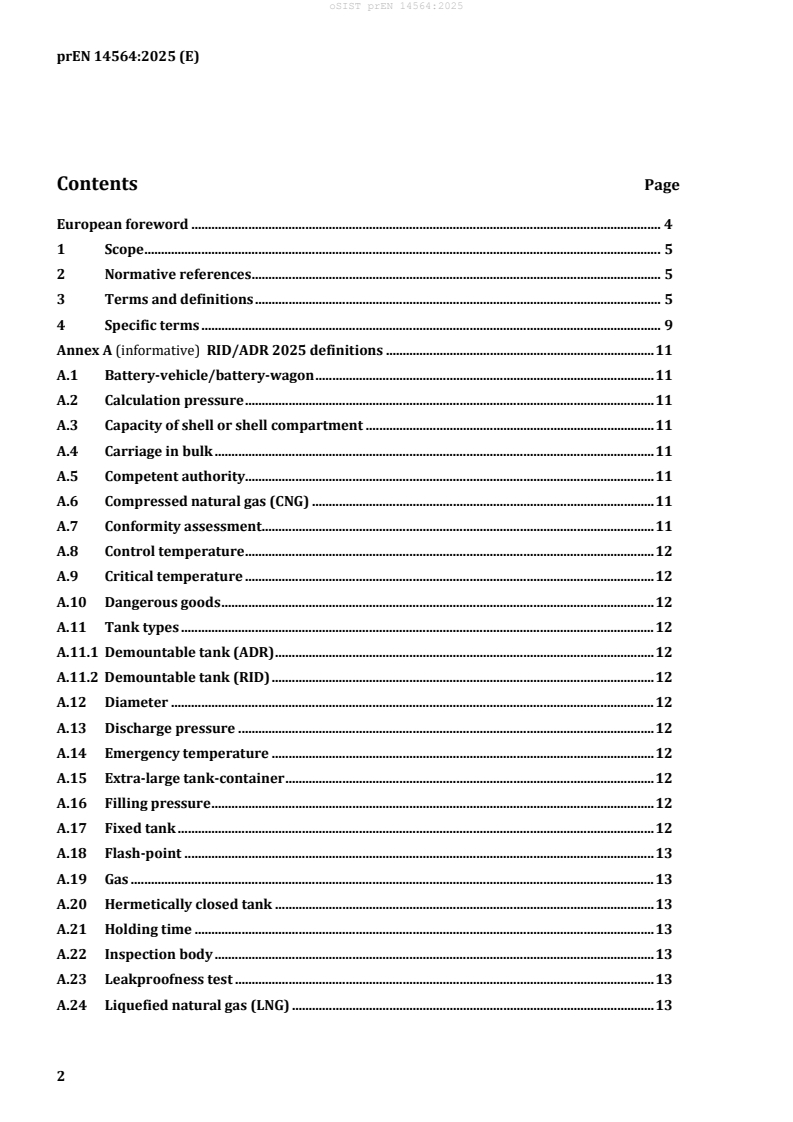
prEN 14564:2025 (E)
Contents Page
European foreword . 4
1 Scope . 5
2 Normative references . 5
3 Terms and definitions . 5
4 Specific terms . 9
Annex A (informative) RID/ADR 2025 definitions . 11
A.1 Battery-vehicle/battery-wagon . 11
A.2 Calculation pressure . 11
A.3 Capacity of shell or shell compartment . 11
A.4 Carriage in bulk . 11
A.5 Competent authority. 11
A.6 Compressed natural gas (CNG) . 11
A.7 Conformity assessment . 11
A.8 Control temperature . 12
A.9 Critical temperature . 12
A.10 Dangerous goods . 12
A.11 Tank types . 12
A.11.1 Demountable tank (ADR) . 12
A.11.2 Demountable tank (RID) . 12
A.12 Diameter . 12
A.13 Discharge pressure . 12
A.14 Emergency temperature . 12
A.15 Extra-large tank-container . 12
A.16 Filling pressure . 12
A.17 Fixed tank . 12
A.18 Flash-point . 13
A.19 Gas . 13
A.20 Hermetically closed tank . 13
A.21 Holding time . 13
A.22 Inspection body . 13
A.23 Leakproofness test . 13
A.24 Liquefied natural gas (LNG) . 13
prEN 14564:2025 (E)
A.25 Liquefied petroleum gas (LPG) . 14
A.26 Liquid . 14
A.27 Maximum permissible gross mass . 14
A.28 Maximum working pressure (gauge pressure) . 14
A.29 Mild steel. 14
A.30 Multiple-element gas container (MEGC) . 15
A.31 Portable tank . 15
A.32 Protective lining . 15
A.33 Reference steel . 15
A.34 Safety valve . 15
A.35 Service equipment . 15
A.36 Shell . 15
A.37 Solid . 15
A.38 Structural equipment . 16
A.39 Tank . 16
A.40 Tank-container . 16
A.41 Tank record . 16
A.42 Tank swap body . 16
A.43 Tank-vehicle . 16
A.44 Tank wagon . 16
A.45 Test pressure. 16
A.46 UN number . 17
A.47 Vacuum-operated waste tank . 17
A.48 Vacuum valve . 17
Annex B (informative) RID/ADR 2025 definitions – portable tanks (chapter 6.7) . 18
Annex C (informative) Alphabetical index for English terms . 28
Annex D (informative) Alphabetical index for French terms . 32
Annex E (informative) Alphabetical index for German terms . 36
Annex F (normative) Schematic tank openings and closures according to the tank code . 40
Bibliography . 45
prEN 14564:2025 (E)
European foreword
This document (prEN 14564:2025) has been prepared by Technical Committee CEN/TC 296 “Tanks for
the transport of dangerous goods”, the secretariat of which is held by AFNOR.
This document is currently submitted to the CEN Enquiry.
This document will supersede EN 14564:2019.
This document provides uniform terminology for technical terms, which require definition in addition to
regulatory definitions based in RID/ADR, and specific terms defined in other standards on tanks for
transport of dangerous goods, prepared by CEN/TC 296.
Clause 3 defines general terms and Clause 4 defines specific terms.
prEN 14564:2025 (E)
1 Scope
This document provides additional terms and definitions to those written in the Agreement Concerning
the International Carriage of Dangerous Goods by Road (ADR) or the Regulations concerning the
International Carriage of Dangerous Goods by Rail (RID), appearing as Appendix C to the Convention
concerning International Carriage by Rail (COTIF).
This document forms part of series of documents prepared by CEN/TC 296 regarding the transport of
dangerous goods. The series supports the proper application of the ADR and RID.
This document is applicable to tanks used for the transport of dangerous goods. This document does not
apply to carriage in bulk of dangerous goods.
For convenience, Annex A (informative) repeats some horizontal definitions taken from ADR and RID
2025 chapter 1.2, and Annex B (informative) repeats some definitions from ADR and RID 2025 chapter
6.7, specific to portable tanks.
NOTE The ADR and RID are updated on a regular basis, therefore Annexes A and B might become out of date.
For outdated definitions, the RID/ADR take precedence.
Annexes C, D and E (informative) provide alphabetical trilingual indexes of terms in English, French and
German where the key is English, French and German respectively.
Annex F (normative) is a schematic diagram of tank openings and closures according to the tank code.
2 Normative references
There are no normative references in this document.
3 Terms and definitions
For the purposes of this document, the following terms and definitions apply.
ISO and IEC maintain terminology databases for use in standardization at the following addresses:
— ISO Online browsing platform: available at http://www.iso.org/obp
— IEC Electropedia: available at https://www.electropedia.org/
3.1
accessory
equipment mounted to the tank which is not part of the shell or service equipment or structural
equipment
3.2
adaptor
closure with a particular connection profile
3.3
alteration
work on an existing tank with a valid, or expired, or withdrawn type approval leaving the tank inside the
scope of the type approval provided the original type approval is in conformity with the relevant
regulation on the transport of dangerous goods at the time of the work
prEN 14564:2025 (E)
3.4
baffle
non-hermetically sealed structure other than a surge plate, intended to inhibit the movement of the shell
contents
3.5
breathing
automatic and normal function to control pressure and vacuum between the inside and the outside of the
shell
3.6
closure
device that closes an opening of a tank
Note 1 to entry: For position of closures see Figures F.1 to F.7 of Annex F.
3.7
cold forming
forming at temperatures not less than 25 °C below the maximum permissible temperature for stress
relieving, in accordance with the applicable material specifications
3.8
cover plate
closure of an opening of the shell that is not service equipment
3.9
design stress
stress value used for calculation
3.10
design temperature
temperature chosen for the design of each part of the tank
3.11
elliptical cross section
cross section that respects the following criteria:
— the cross section of the shape is contained into a circle;
— the elliptical cross section has the same width as the circle;
— the minimum radius of curvature is not less than 250 mm;
— the maximum width of the circle is 2 550 mm;
— the maximum width of the elliptical cross section is no more than the maximum allowed width of the
vehicle;
— the maximum radius of curvature is no more than 2 000 mm;
— the cross section is convex
prEN 14564:2025 (E)
3.12
end
head
part of the shell shutting off the longitudinal section
3.13
fastenings
structural equipment used for fixing the tank on the chassis, frame or auxiliary frame
3.14
fine-grained steel
steel designated in material standards such as in EN 13445-2 for fine-grained steel or CEN ISO/TR 15608
group 1.3, 2.1, 2.2
3.15
flame arrester
flame trap
device fitted to the opening of an enclosure or to the connecting pipework of a system of enclosures and
whose intended function is to allow the flow of gaseous substances but prevent the transmission of flame
or spark
3.16
hydraulic pressure test
strength test carried out with liquid (generally water)
3.17
in-house inspection service (IS)
for service equipment that has been separately type approved, the manufacturer's quality control
organisation applying 1.8.7.3 and 1.8.7.4 of RID/ADR, under the surveillance of an inspection body
3.18
inspector
individual of an inspection body approved by the competent authority to perform regulatory inspections
3.19
leak proof
able to contain the fluid
Note 1 to entry: As specified in EN 12266-1:2012, Table A.5, Rate A.
3.20
maximum operating pressure
maximum working pressure, or maximum allowable working pressure of a piece of service equipment
3.21
modification
work on an existing tank with a valid, expired, or withdrawn type approval, which causes a non-
conformity with the type approval mentioned above
3.22
moment of inertia
second moment of area of a structure (and, if applicable, the associated shell) about its neutral axis
divided by the maximum distance from said axis to the extreme dimension of the section used in the
calculation
prEN 14564:2025 (E)
3.23
nominal capacity
maximum volume intended to be carried
3.24
partition
hermetically sealed dividing wall between adjacent compartments in compartmented tanks
3.25
pressure balanced
equilibrium of substance pressure on both sides of the internal stop valve
3.26
pressure tank
tank as defined in the international regulations for the transport of dangerous goods by road or rail
having a maximum working pressure exceeding 50 kPa (0,5 bar)
3.27
product sensor
device, which detects the presence of product in liquid phase, and whose output signal can be used to
display whether liquid is present
3.28
repair
correction of a defect that could have impaired the safety of the tank or where equipment that communes
directly with the content of the shell or safety device is replaced
Note 1 to entry: It does not include normal service and maintenance operations of the shell or service equipment
or replacement of gaskets or service equipment to the same specification.
3.29
run off pipe
pipe connecting a footvalve to the associated external closure
Note 1 to entry: The pipework capacity from the primary closure to the secondary closure is not considered to form
part of the inner volume of the shell according to A.3.
3.30
self-actuating adaptor
adaptor capable of being opened by built-in and external means
3.31
self-closing (valve)
valve held in the closed position by means of stored energy (such as a spring), which opens only by
application of external force, and which closes when the external force is removed
3.32
strengthening element
structural component permanently attached to the circumference of the shell, that may conform to either
3.18, 3.26 or any other types of reinforcement, stiffeners, members or rings
prEN 14564:2025 (E)
3.33
supervision of manufacture
procedure to verify the manufacturing process complies with the applicable regulatory and normative
provisions, including the approved type
3.34
surge plate
non-hermetically sealed wall in tanks or compartments of shells intended to reduce the effect of surge,
mounted at right angles to the direction of travel, having an area of at least 70 % of the cross-sectional
area of the shells where the surge plate is located
3.35
test
technical operation that consists of the determination of one or more characteristics of a given tank
and/or service equipment, process or service according to a specified procedure
3.36
type approval
approval authorizing the manufacture of products of a defined range within its validity period
3.37
type examination
procedure to verify the conformity of a type of product, including an examination of the technical
documentation, presentation of prototype(s), and performance of type tests
3.38
venting
function allowing passage of gas during filling and emptying
3.39
weld joint factor
stress reduction factor applied because of the welding manufacturing process
4 Specific terms
4.1
bottom loading
filling of a tank through the tank's piping system that enables substances to enter the tank compartments
from the bottom
4.2
demountable
part of service equipment that is not permanently attached (welded) or demountable with a special tool
4.3
fill hole
opening in a tank or in a manhole cover assembly to allow top filling of a tank compartment
4.4
fill hole cover
operating device on top of a tank or part of manhole cover to enable top loading and closing the fill hole
prEN 14564:2025 (E)
4.5
interlock
device which can be used to permit or prevent an action
4.6
load plan
plan that identifies the different substances and volumes to be loaded into each tank compartment
4.7
manhole
opening in a tank to allow internal inspection by a person passing through
4.8
manhole cover plate
plate covering the manhole which may include auxiliary equipment such as fill hole cover assembly,
vapour transfer valve, sensors, etc.
4.9
neck ring
ring joined to the shell that provides the attachment for a cover plate
4.10
overfill prevention system
sensor or sensor circuits, interface plug/socket, overfill prevention controller and all connecting wiring
and cables
4.11
plug and ball valve
valve in which the obturator rotates about an axis at right angle to the direction of flow and, in the open
position, the flow passes through the obturator
4.12
relief pressure
pressure at which the safety valve starts to open
4.13
vapour collection manifold
piping system into which each vapour transfer valve from each compartment is connected and which
connects to the vapour recovery adaptor
prEN 14564:2025 (E)
Annex A
(informative)
RID/ADR 2025 definitions
A.1 Battery-vehicle/battery-wagon
Vehicle/wagon containing elements which are linked to each other by a manifold and permanently fixed
to this vehicle/wagon.
The following elements are considered to be elements of a battery-vehicle/wagon: cylinders, tubes,
bundles of cylinders (also known as frames), pressure drums as well as tanks destined for the carriage of
gases as defined in 2.2.2.1.1 of RID/ADR with a capacity of more than 450 litres.
A.2 Calculation pressure
Theoretical pressure at least equal to the test pressure which, according to the degree of danger exhibited
by the substance being carried, may to a greater or lesser degree exceed the working pressure.
It is used solely to determine the thickness of the walls of the shell, independently of any external or
internal reinforcing device.
A.3 Capacity of shell or shell compartment
For tanks, total inner volume of the shell or shell compartments expressed in litres or cubic metres. When
it is impossible to completely fill the shell or the shell compartment because of its shape or construction,
this reduced capacity shall be used for the determination of the degree of filling and for the marking of
the tank.
A.4 Carriage in bulk
Carriage of unpackaged solids or articles in vehicles/wagons, containers or bulk containers. The term
does not apply to packaged goods nor to substances carried in tanks.
A.5 Competent authority
Authority or authorities or any other body or bodies designated as such in each State and in each specific
case in accordance with domestic law.
A.6 Compressed natural gas (CNG)
Compressed gas composed of natural gas with a high methane content assigned to UN No. 1971.
A.7 Conformity assessment
Process of verifying the conformity of a product according to the provisions of sections 1.8.6 and 1.8.7 (of
RID/ADR) related to type examination, supervision of manufacture and initial inspection and testing.
prEN 14564:2025 (E)
A.8 Control temperature
Maximum temperature at which the organic peroxide, the self-reactive substance or the polymerizing
substance can be safely carried.
A.9 Critical temperature
Temperature above which the substance cannot exist in the liquid state.
A.10 Dangerous goods
Those substances and articles, the carriage of which is prohibited by RID/ADR, or authorized only under
the conditions prescribed therein.
A.11 Tank types
A.11.1 Demountable tank (ADR)
Tank, other than a fixed tank, a portable tank, a tank-container or an element of a battery-vehicle or a
MEGC which has a capacity of more than 450 litres, is not designed for the carriage of goods without
breakage of load, and normally can only be handled when it is empty.
A.11.2 Demountable tank (RID)
Tank designed to fit the special apparatus of the wagon but which can only be removed from it after
dismantling their means of attachment.
A.12 Diameter
Internal diameter of the shell.
A.13 Discharge pressure
Maximum pressure actually built up in the tank when it is being discharged under pressure.
A.14 Emergency temperature
Temperature at which emergency procedures shall be implemented in the event of loss of temperature
control.
A.15 Extra-large tank-container
Tank-container with a capacity of more than 40 000 litres.
A.16 Filling pressure
Maximum pressure actually built up in the tank when it is being filled under pressure.
A.17 Fixed tank
Tank having a capacity of more than 1 000 litres which is permanently attached to a vehicle or a wagon
(which then becomes a tank-vehicle/tank wagon) or is an integral part of the frame of such vehicle or
wagon.
prEN 14564:2025 (E)
A.18 Flash-point
Lowest temperature of a liquid at which its vapours form a flammable mixture with air.
A.19 Gas
Substance which:
a) at 50 °C has a vapour pressure greater than 300 kPa (3 bar); or
b) is completely gaseous at 20 °C under standard pressure of 101,3 kPa.
A.20 Hermetically closed tank
Tank that:
— is not equipped with safety valves, bursting discs, other similar safety devices or vacuum valves or
self-operating ventilation valves; or
— is equipped with safety valves preceded by a bursting disc according to 6.8.2.2.10 of RID/ADR but is
not equipped with vacuum valves or self-operating ventilation valves.
A tank intended for the carriage of liquid substances with a calculation pressure of at least 4 bar or
intended for the carriage of solid substances (powdery or granular) regardless of its calculation pressure
is also considered hermetically closed if it:
— is equipped with safety valves preceded by a bursting disc according to 6.8.2.2.10 of RID/ADR and
vacuum valve;
— is or self-operating ventilation valves, in accordance with the requirements of 6.8.2.2.3 of RID/ADR;
— is not equipped with safety valves, bursting discs or other similar safety devices, but is equipped with
vacuum valves or self-operating ventilation valves, in accordance with the requirements of 6.8.2.2.3
of RID/ADR.
A.21 Holding time
Time that will elapse from the establishment of the initial filling condition until the pressure has risen
due to heat influx to the lowest set pressure of the pressure limiting devices of tanks intended for the
carriage of refrigerated liquefied gases.
A.22 Inspection body
Independent inspection and testing body approved by the competent authority.
A.23 Leakproofness test
Test to determine the leakproofness of a tank and of the equipment and closure devices.
A.24 Liquefied natural gas (LNG)
Refrigerated liquefied gas composed of natural gas with a high methane content assigned to UN No. 1972.
prEN 14564:2025 (E)
A.25 Liquefied petroleum gas (LPG)
Low pressure liquefied gas composed of one or more light hydrocarbons which are assigned to UN Nos.
1011, 1075, 1965,1969 or 1978 only and which consists mainly of propane, propene, butane, butane
isomers, butene with traces of other hydrocarbon gases.
A.26 Liquid
Substance which at 50 °C has a vapour pressure of not more than 300 kPa (3 bar), which is not completely
gaseous at 20 °C and 101,3 kPa, and which:
a) has a melting point or initial melting point of 20 °C or less at a pressure of 101,3 kPa; or
b) is liquid according to the ASTM D 4359-90 test method; or
c) is not pasty according to the criteria applicable to the test for determining fluidity (penetrometer
test) described in 2.3.4 of RID/ADR.
NOTE “Carriage in the liquid state”, for the purpose of tank requirements, means:
— carriage of liquids according to the above definition; or
— solids handed over for carriage in the molten state.
A.27 Maximum permissible gross mass
Tare of the tank and the heaviest load authorized for carriage.
A.28 Maximum working pressure (gauge pressure)
Highest of the following three pressures that may occur at the top of the tank in the operating position:
a) highest effective pressure allowed in the tank during filling (maximum filling pressure allowed);
b) highest effective pressure allowed in the tank during discharge (maximum discharge pressure
allowed); and
c) effective gauge pressure to which the tank is subjected by its contents (including such extraneous
gases as it may contain) at the maximum working temperature.
Unless the special requirements prescribed in Chapter 4.3 of RID/ADR provide otherwise, the numerical
value of this working pressure (gauge pressure) shall not be lower than the vapour pressure (absolute
pressure) of the filling substance at 50 °C.
For tanks equipped with safety valves (with or without bursting disc) other than tanks for the carriage of
compressed, liquefied or dissolved gases of Class 2, the maximum working pressure (gauge pressure)
shall however be equal to the prescribed opening pressure of such safety valves.
NOTE Maximum working pressure is not applicable to gravity-discharge tanks according 6.8.2.1.14 (a)
of RID/ADR.
A.29 Mild steel
2 2
Steel having a minimum tensile strength between 360 N/mm and 440 N/mm .
prEN 14564:2025 (E)
A.30 Multiple-element gas container (MEGC)
Unit containing elements which are linked to each other by a manifold and mounted on a frame.
The following elements are considered to be elements of a multiple-element gas container: cylinders,
tubes, pressure drums and bundles of cylinders as well as tanks for the carriage of gases as defined
in 2.2.2.1.1 of RID/ADR having a capacity of more than 450 litres.
A.31 Portable tank
Multimodal tank having, when used for the carriage of gases as defined in 2.2.2.1.1 of RID/ADR, a capacity
of more than 450 litres in accordance with the definitions in Chapter 6.7 of RID/ADR or the IMDG Code
and indicated by a portable tank instruction (T-Code) in Column (10) of Table A of Chapter 3.2 of
RID/ADR or the IMDG code.
A.32 Protective lining
Lining or coating protecting the metallic tank material against the substance to be carried.
NOTE This definition does not apply to a lining or coating used only to protect the substance to be carried.
A.33 Reference steel
Steel with a tensile strength of 370 N/mm2 and an elongation at fracture of 27 %.
A.34 Safety valve
Spring-loaded device which is activated automatically by pressure the purpose of which is to protect the
tank against unacceptable excess internal pressure.
A.35 Service equipment
a) Of the tank: filling and discharge, breather, safety, heating, heat insulating and additive devices and
measuring instruments;
b) of the elements of a battery-vehicle/battery-wagon or of a MEGC: filling and discharge devices,
including the manifold, safety devices and measuring instruments.
A.36 Shell
Part of the tank which retains the substance intended for carriage including openings and their closures,
but does not include service equipment or external structural equipment.
A.37 Solid
a) Substance with a melting point or initial melting point of more than 20 °C at a pressure of 101,3 kPa;
or
b) substance which is not liquid according to the ASTM D 4359-90 test method or which is pasty
according to the criteria applicable to the test for determining fluidity (penetrometer test) described
in 2.3.4 of RID/ADR.
prEN 14564:2025 (E)
A.38 Structural equipment
a) For tanks of a tank-vehicle/tank wagon or demountable tank: external or internal reinforcing,
fastening, protective or stabilizing members of the shell;
b) for tanks of a tank-container: external or internal reinforcing, fastening, protective or stabilizing
members of the shell;
c) for elements of a battery-vehicle/battery-wagon or an MEGC: external or internal, reinforcing,
fastening, protective or stabilizing members of the shell or receptacle.
A.39 Tank
Shell, including its service and structural equipment. When used alone, the term tank means a tank
container, portable tank, demountable tank or fixed tank/tank-wagon as defined in the standard,
including tanks forming element of battery-vehicles/wagons or MEGCs.
A.40 Tank-container
Article of transport equipment meeting the definition of a container, and comprising a shell and items of
equipment, including the equipment to facilitate movement of the tank-container without significant
change of attitude, used for the carriage of gases, liquid, powdery or granular substances and when used
for the carriage of gases as defined in 2.2.2.1.1 of RID/ADR, having a capacity of more than 0,45 m3 (450
litres).
A.41 Tank record
File containing all the important technical information concerning a tank, a battery-vehicle/wagon or a
MEGC, such as certificates referred to in 6.8.2.3, 6.8.2.4 and 6.8.3.4 of RID/ADR.
A.42 Tank swap body
A tank swap body is considered to be a tank-container.
A.43 Tank-vehicle
Vehicle built to carry liquids, gases or powdery or granular substances and comprising one or more fixed
tanks. In addition to the vehicle proper, or the units of running gear used in its stead, a tank- vehicle
comprises one or more shells, their items of equipment and the fittings for attaching them to the vehicle
or to the running-gear units.
A.44 Tank wagon
Wagon intended for the carriage of liquids, gases, powdery or granular substances, comprising a
superstructure, consisting of one or more shells, and an underframe fitted with its own items of
equipment (running gear, suspension, buffing, traction, braking gear and inscriptions).
NOTE Tank wagon also includes wagons with demountable tank.
A.45 Test pressure
Required pressure applied during a pressure test for initial or periodic inspection.
prEN 14564:2025 (E)
A.46 UN number
Four-figure identification number of the substance or article taken from the UN Model Regulations.
A.47 Vacuum-operated waste tank
Fixed tank, demountable tank, tank-container or tank swap body primarily used for the carriage of
dangerous wastes, with special constructional features and/or equipment to facilitate the loading and
unloading of wastes as specified in Chapter 6.10 of RID/ADR. A tank which fully complies with the
requirement of Chapter 6.7 or 6.8 of RID/ADR is not considered to be a vacuum-operated waste tank.
A.48 Vacuum valve
Spring-loaded device which is activated automatically by pressure the purpose of which is to protect the
tank against unacceptable negative internal pressure.
prEN 14564:2025 (E)
Annex B
(informative)
RID/ADR 2025 definitions – portable tanks (chapter 6.7)
Table B.1 — Definitions for portable tanks
No. Term 6.7.2 of RID/ADR and IMDG 6.7.3 of RID/ADR and IMDG 6.7.4 of RID/ADR and IMDG 6.7.5 of RID/ADR and
IMDG
B.1 Alternative An approval granted by the competent authority for a portable tank or MEGC that has been designed, constructed or tested
arrangement to technical requirements or testing methods other than those specified in this Chapter:
B.2 Elements Elements are cylinders,
tubes or bundles of
cylinders;
B.3 Portable tank A multimodal tank used for A multimodal tank having a A thermally insulated
the carriage of substances of capacity of more than 450 l multimodal tank having a
Class 1 and Classes 3 to9. The used for the carriage of non- capacity of more than 450 l
portable tank includes a shell refrigerated liquefied gases of fitted with service equipment
fitted with service equipment Class 2. and structural equipment
and structural equipment necessary for the carriage of
necessary for the carriage of refrigerated liquefied gases.
dangerous substances.
The portable tank shall be capable of being filled and discharged without the removal of its
structural equipment. It shall possess stabilizing members external to the shell, and shall be
capable of being lifted when full. It shall be designed primarily to be loaded onto a vehicle,
wagon or sea-going or inland navigation vessel and shall be equipped with skids, mountings or
accessories to facilitate mechanical handling. Tank vehicles, tank-wagons, non- metallic tanks
and intermediate bulk containers (IBCs) are not considered to fall within the definition for
portable tanks.
prEN 14564:2025 (E)
No. Term 6.7.2 of RID/ADR and IMDG 6.7.3 of RID/ADR and IMDG 6.7.4 of RID/ADR and IMDG 6.7.5 of RID/ADR and
IMDG
B.4 Shell The part of the portable tank The part of the portable tank The part of the portable tank
which retains the substance which retains the non-which retains the
intended refrigerated liquefied gas refrigerated liquefied gas
intended intended
for carriage, including openings and their closures, but does not include service equipment or
external structural equipment;
B.5 Tank A construction which
normally consists of either:
(a) A jacket and one or more
inner shells where the space
between the shell(s) and the
jacket is exhausted of air
(vacuum insulation) and may
incorporate a thermal
insulation system; or
(b) A jacket and an inner
shell with an intermediate
layer of solid thermally
insulating material (e.g. solid
foam);
B.6 Jacket The outer insulation cover or
cladding which may be part of
the insulation system;
B.7 Service equipment measuring instruments and measuring instruments and measuring instruments and measuring instruments
filling, discharge, venting, filling, discharge, venting, filling, discharge, venting, and filling, discharge,
safety, heating, cooling and safety and insulating devices; safety, pressurizing, cooling venting and safety
insulating devices; and thermal insulation devices;
devices;
prEN 14564:2025 (E)
No. Term 6.7.2 of RID/ADR and IMDG 6.7.3 of RID/ADR and IMDG 6.7.4 of RID/ADR and IMDG 6.7.5 of RID/ADR and
IMDG
B.8 Structural the reinforcing, fastening, protective and stabilizing members external to the shell;
equipment
B.9 Maximum A pressure that shall be not A pressure that shall be not less The maximum effective
allowable less than the highest of the than the highest of the gauge pressure permissible
working following pressures following pressures measured at the top of the shell of a
pressure measured at the top of the at the top of the shell while in loaded portable tank in its
shell while in operating operating position, but in no operating position including
position: case less than 7 bar: the highest effective pressure
during filling and discharge
(a) The maximum effective (a) The maximum effective
gauge pressure allowed in gauge pressure allowed in
the shell during filling or the shell during filling or
discharge; or discharge; or
(b) The maximum effective (b) The maximum effective
gauge pressure to which the gauge pressure to which
shell is designed which shall the shell is designed, which
be not less than the sum of: shall be:
(i) the absolute vapour (i) for a non-refrigerated
pressure (in bar) of the liquefied gas listed in the
substance at 65 °C, minus portable tank instruction
1 bar; and T50 in 4.2.5.2.6 of RID/ADR
and IMDG, the MAWP (in
(ii) the partial pressure (in
bar) given in T50 portable
bar) of air or other gases in
tank instruction for that
the ullage space being
gas;
determined by a maximum
ullage temperature of 65 °C (ii) for other non-refrigerated
and a liquid expansion due to liquefied gases, not less
an increase in mean bulk than the sum of:
temperature of tr – tf (tf =
- the absolute vapour
filling temperature, usually
pressure (in bar) of the
15 °C; tr = maximum mean
non-refrigerated liquefied
bulk temperature, 50 °C);
gas at the design reference
prEN 14564:2025 (E)
No. Term 6.7.2 of RID/ADR and IMDG 6.7.3 of RID/ADR and IMDG 6.7.4 of RID/ADR and IMDG 6.7.5 of RID/ADR and
IMDG
temperature minus 1 bar;
and
- the partial pressure (in
bar) of air or other gases in
the ullage space being
determined by the design
reference temperature and
the liquid phase expansion
due to an increase of the
mean bulk temperature of
tr – tf (tf = filling
temperature, usually 15 °C,
tr = maximum mean bulk
temperature, 50 °C);
(iii) for chemicals under
pressure, the MAWP (in
bar) given in T50 portable
tank instruction for the
liquefied gas portion of the
propellants listed in T50 in
4.2.5.2.6 of RID/ADR and
IMDG
B.10 Design pressure The pressure to be used in The pressure to be used in
calculations required by a calculations required by a
recognized pressure vessel recognized pressure vessel
code. The design pressure code. The design pressure shall
shall be not less than the be not less than the highest of
highest of the following the following pressures:
pressures:
(a) The maximum effective
(a) The maximum effective gauge pressure allowed in the
gauge pressure allowed in the shell during filling or
shell during filling or discharge; or
prEN 14564:2025 (E)
No. Term 6.7.2 of RID/ADR and IMDG 6.7.3 of RID/ADR and IMDG 6.7.4 of RID/ADR and IMDG 6.7.5 of RID/ADR and
IMDG
discharge; or (b) The sum of:
(b) The sum of: (i) the maximum effective
gauge pressure to which the
(i) the absolute vapour
shell is designed as defined in
pressure (in bar) of the
(b) of the MAWP definiti
...