

SIST ISO 6107-3:1996
(Main)Water quality -- Vocabulary
General Information
- Abstract
Defines, in the English alphabetic order, a third list of 95 terms in English, French, Russian, German used in certain fields of water quality characterization. Alphabetical indexes in French, Russian and German are given. However, only the terms and definitions in the official languages (English, French and Russian) can be considered as ISO terms and definitions.
- Status
- Withdrawn
- Publication Date
- 31-Aug-1996
- Withdrawal Date
- 22-Jul-2026
- Technical Committee
- KAV - Water quality
- Current Stage
- 9900 - Withdrawal (Adopted Project)
- Start Date
- 03-Feb-2026
- Due Date
- 26-Feb-2026
- Completion Date
- 23-Jul-2026



Overview
SIST ISO 6107-3:1996 – Water Quality Vocabulary, Part 3 is an international standard published by SIST, adopting ISO 6107-3:1993. This document defines an additional set of 95 terms related to water quality characterization, organized alphabetically in English. Equivalent terms and definitions are provided in French, Russian, and German, but only English, French, and Russian versions are recognized as ISO official terminology. This vocabulary supports standardized communication in water quality assessment, management, and reporting worldwide.
Key Topics
- Terminology Standardization: The document consolidates essential terms used in diverse fields of water quality. Clear definitions facilitate unified understanding among professionals working with water monitoring, treatment, or environmental reporting.
- Multilingual Reference: Vocabulary is supplied in four languages-English, French, Russian, and German-supporting international cooperation and cross-border projects in water management.
- Scope of Terms: Covers a wide array of concepts, including physical, chemical, biological, and hydrological aspects of water quality. Terms range from general (e.g., aquifer, ecology) to specialized (e.g., activated carbon treatment, biofilm, hydrometry).
- Updated Content: This edition includes revised definitions for several terms from the earlier version, ensuring that the vocabulary reflects advancements in water quality science and practice.
Applications
- Water Quality Assessment: Laboratories, environmental agencies, and water utilities use these standardized terms to ensure accuracy in testing, sampling, and reporting water quality data.
- Environmental Regulation and Compliance: Legal and regulatory frameworks for water management often reference this vocabulary, ensuring that regulatory documents are interpreted uniformly.
- International Reporting: Facilitates consistent participation in transnational projects, such as cross-border watershed management, by providing universally accepted terminology.
- Technical Documentation and Training: Engineers, technicians, and students benefit from a common language for describing water properties, processes, and measurement methods.
- Scientific Research and Communication: Researchers in hydrology, limnology, and environmental chemistry rely on standardized vocabulary for publishing and peer-review.
Related Standards
- ISO 6107-1 & ISO 6107-2: Earlier parts in the ISO 6107 series, which introduce the foundational water quality vocabulary referenced in Part 3.
- ISO 7887: Water quality – Examination and determination of color, referenced for standardized color units within the vocabulary.
- Other ISO/TC 147 Standards: Many analytical, sampling, and methodology standards for water quality are maintained by ISO Technical Committee 147, complementing the vocabulary for comprehensive water analysis and control.
Practical Value
Adopting the SIST ISO 6107-3:1996 vocabulary ensures:
- Clarity: Reduces misinterpretation of technical terms in water quality reporting and decision-making.
- Efficiency: Streamlines training, procurement, and international project coordination.
- Consistency: Enables accurate benchmarking and comparison of water quality data across regions and institutions.
Keywords: water quality vocabulary, water quality standards, water terminology, ISO 6107-3, water assessment, environmental standards, water management lexicon, international water quality, SIST ISO standards.
Relations
- Effective Date
- 01-Oct-2026
- Effective Date
- 25-Aug-2026
- Effective Date
- 25-Aug-2026
- Effective Date
- 25-Aug-2026
- Effective Date
- 06-Jun-2022
- Effective Date
- 12-May-2008
- Effective Date
- 12-May-2008
Get Certified
Connect with accredited certification bodies for this standard

CIS Institut d.o.o.
Personal Protective Equipment (PPE) certification body. Notified Body NB-2890 for EU Regulation 2016/425 PPE.

Kiwa BDA Testing
Building and construction product certification.
Kmetijski inštitut Slovenije
Agricultural Institute of Slovenia. Soil testing, plant health, agricultural product analysis.
Sponsored listings
Frequently Asked Questions
SIST ISO 6107-3:1996 is a standard published by the Slovenian Institute for Standardization (SIST). Its full title is "Water quality -- Vocabulary". This standard covers: Defines, in the English alphabetic order, a third list of 95 terms in English, French, Russian, German used in certain fields of water quality characterization. Alphabetical indexes in French, Russian and German are given. However, only the terms and definitions in the official languages (English, French and Russian) can be considered as ISO terms and definitions.
Defines, in the English alphabetic order, a third list of 95 terms in English, French, Russian, German used in certain fields of water quality characterization. Alphabetical indexes in French, Russian and German are given. However, only the terms and definitions in the official languages (English, French and Russian) can be considered as ISO terms and definitions.
SIST ISO 6107-3:1996 is classified under the following ICS (International Classification for Standards) categories: 01.040.13 - Environment. Health protection. Safety (Vocabularies); 13.060.01 - Water quality in general. The ICS classification helps identify the subject area and facilitates finding related standards.
SIST ISO 6107-3:1996 has the following relationships with other standards: It is inter standard links to SIST ISO 6107:2026, SIST EN ISO 21253-1:2020, SIST EN ISO 5667-13:2012, SIST EN ISO 5667-19:2004, SIST ISO 6107-3:1996/A1:2004; is excused to SIST ISO 6107-3:1996/A1:2004, ISO 6107-3:1993/Amd 1:2001. Understanding these relationships helps ensure you are using the most current and applicable version of the standard.
SIST ISO 6107-3:1996 is available in PDF format for immediate download after purchase. The document can be added to your cart and obtained through the secure checkout process. Digital delivery ensures instant access to the complete standard document.
Standards Content (Sample)
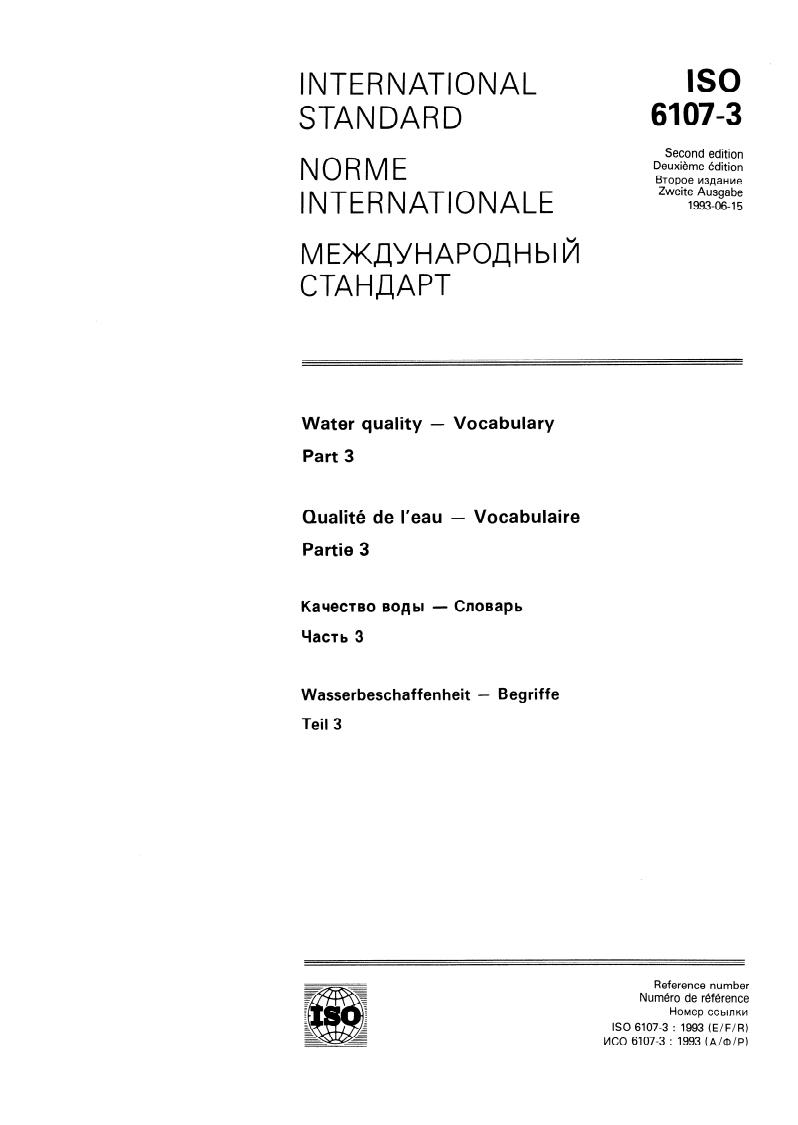
ISO
INTERNATIONAL
6107-3
STANDARD
Second edition
Deuxihme Edition
NORME
BTopoe ti3flaHMe
Zweite Ausgabe
1993-06-15
INTERNATIONALE
MEXAYHAPOAHbI1?1
CTAHAAPT
Water quality - Vocabulary
Part 3
Qualite de I’eau - Vocabulaire
Partie 3
KareCTBO BOnbl - CJlOBapb
%CTb 3
Wasserbeschaffenheit - Begriffe
Teil 3
Reference number
Numero de rhference
I-ioMep CCblJlKVl
ISO 6107-3 : 1993 (E/F/R)
HC0 6107-3 : 1993 (A/@/P)
ISO 6107-3 : 1993 (E/F/R)
MC0 6107-3 : 1993 (A/@/P)
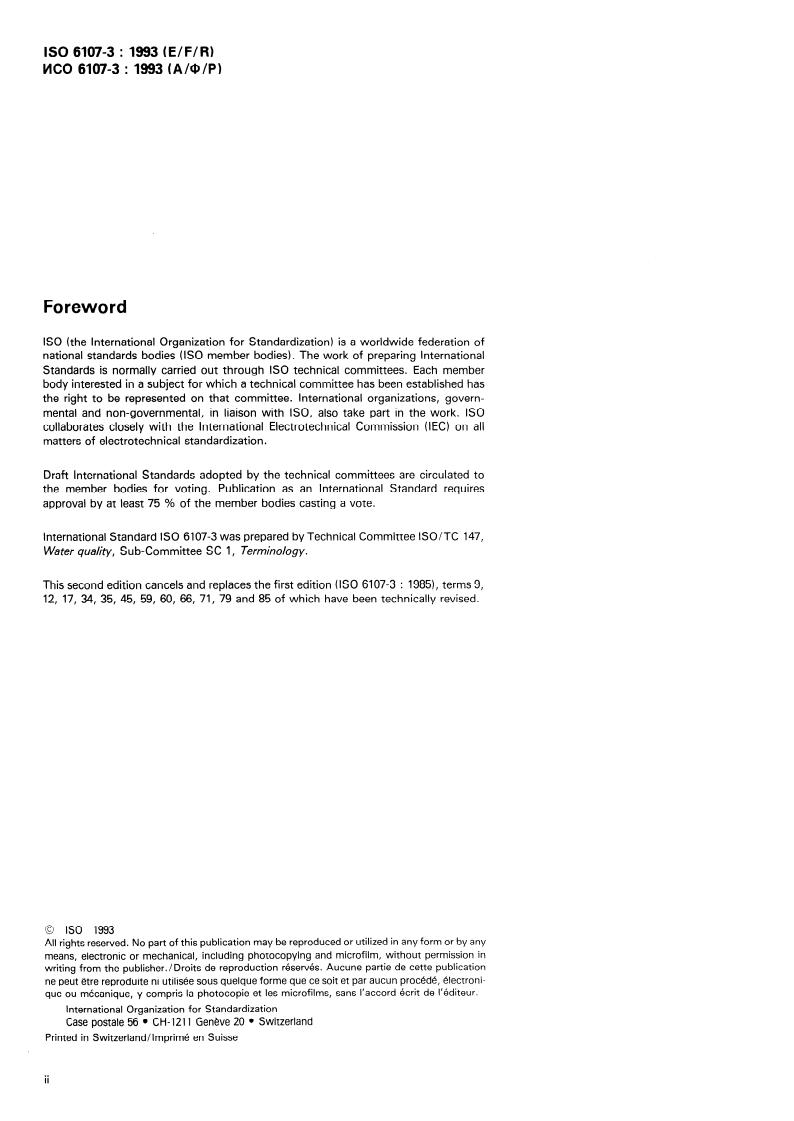
Foreword
ISO (the International Organization for Standardization) is a worldwide federation of
national Standards bodies (ISO member bedies). The work of preparing International
Standards is normally carried out through ISO technical committees. Esch member
body interested in a subject for which a technical committee has been established has
the right to be represented on that committee. International organizations, govern-
mental and non-governmental, in liaison with ISO, also take part in the work. ISO
collaborates closely with the International Electrotechnical Commission (IEC) on all
matters of electrotechnical standardization.
Draft International Standards adopted by the technical committees are circulated to
the member bodies for voting. Publication as an International Standard requires
approval by at least 75 % of the member bodies casting a vote.
International Standard ISO 6107-3 was prepared by Technical Committee ISO/TC 147,
Water quality, Sub-Committee SC 1, Terminology.
This second edition cancels and replaces the first edition (ISO 6107-3 : 19851, terms 9,
12, 17, 34, 35, 45, 59, 60, 66, 71, 79 and 85 of which have been technically revised.
0 ISO 1993
All rights reserved. No part of this publication may be reproduced or utilized in any form or by any
means, electronie or mechanical, including photocopying and microfilm, without Permission in
writing from the publisher. /Droits de reproduction reserves. Aucune Partie de cette publication
ne peut etre reproduite ni utilisee sous quelque forme que ce soit et par aucun procede, electroni-
que ou mecanique, y compris Ia photocopie et les microfilms, sans I’accord ecrit de I’editeur.
International Organization for Standardization
Case postale 56 l CH-121 1 Geneve 20 l Switzerland
Printed in Switzerland/ Imprime en Suisse
ISO 6107-3 : 1993 (E/F/R)
UICO 6107-3 : 1993 (A/@/P)
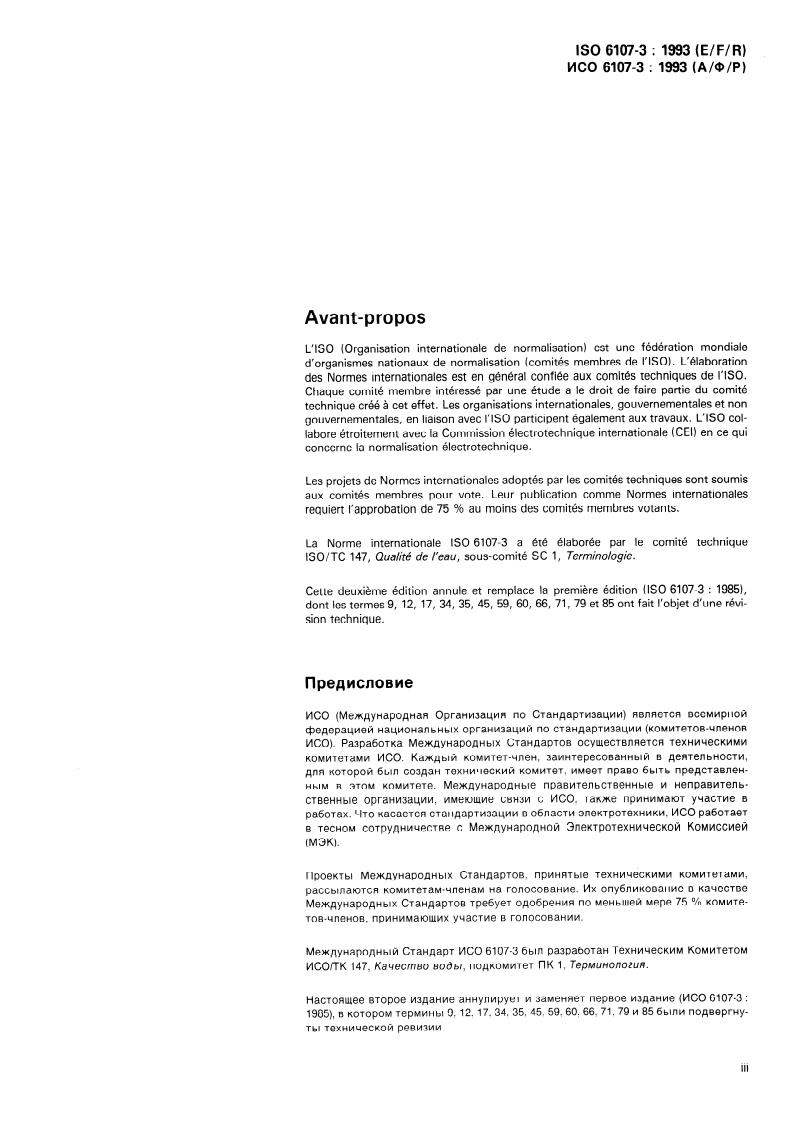
Avant-propos
L’ISO (Organisation internationale de normalisation) est une federation mondiale
d’organismes nationaux de normalisation (comites membres de I’ISO). L’elaboration
des Normes internationales est en general confiee aux comites techniques de I’ISO.
Chaque comite membre interesse par une etude a Ie droit de faire Partie du comite
technique cr% ZI cet effet. Les organisations internationales, gouvernementales et non
gouvernementales, en liaison avec I’ISO participent egalement aux travaux. L’ISO col-
labore etroitement avec Ia Commission electrotechnique internationale (GEI) en ce qui
concerne Ia normalisation electrotechnique.
Les projets de Normes internationales adoptes par les comites techniques sont soumis
aux comites membres pour vote. Leur publication comme Normes internationales
requiert I’approbation de 75 % au moins des comites membres votants.
La Norme internationale ISO 6107-3 a etc elaboree par Ie comite technique
ISO/TC 147, Qualitk de l’eau, sous-comite SC 1, Terminologie.
Cette deuxieme Edition annule et remplace Ia Premiere edition (ISO 6107-3 : 19851,
dont les termes 9, 17, 34, 45,
12, 35, 59, 60, 66, 71, 79 et 85 ont fait I’objet d’une revi-
sion technique.
L/1co (Me>KJJyHapOplHaR OpraHVl3alJVlFl l-IO CTElH/japTl43a~W) RBJlfIeTCFl BCeML’lpHOti
C@?~epalJVlefi HaqPlOHafl bHblX OpraHlA3a~Vlfi I-IO CTaH~apTlA3a~lNl (KOMVlTeTOB-WEHOB
MCO). Pa3pa6OTKa h&?x~yHapOplH blX CTaHAapTOB OCyllRCTBJlFleTC~ TeXHL’lqeCKMMM
KOMMTeTaMPl 1/1co. Kaxp,biti KOMlATeT-WEH, 3ZWlHTE?peCOBaHHbllil B AeflTWlbHOCTlA,
,4JlFl KOTOPOti 6bin CO3naH TeXHMWCKMfi KOMlATeT: l4MeeT llpaB0 6blTb npeACTaBJleH-
HblM B 3TOM KOMMTeTe. h&?>t
CTBeHHble OpraHL’i3Ei4Wl, i4MetOllll4e CBfI3Vl C tico: TaKxe IlPMHMMatOT YWCTvie B
pa6oTax. YTO Kacae-KR CTaHflapTVI3ayVWI B 06naCTM 3JleKTPOTeXHMKM, MC0 pa60TaeT
B TeCHOM COTpy~HlAWCTBe C MWKflytiapO~HOti 3JleKTpOTeXHlWeCKOti KoMMCCMel/l
(M3K).
nPOeKTbl MWK~yHapOplHblX CTaHAapTOB: I-lPlAHRTble TeXHWl&KlAMVl KOMMTeTaMM,
paCCbIJ=latOTCFl KOMl’lTeTaM-qJleHaM Ha TOJ-lOCOBaHMe. tiX Olly6JlVlKOBaHl’le B KaLleCTBe
Mex~yHapOflHblX CTaHAapTOB Tpe6yeT O/JO6peHlAR l-l0 MeHbll.ler/r Mepe 75 % KOMMTe-
TOB-WeHOB, IlpviHlAMiNOlWX y%CTme B TOJlOCOBaHMM.
pa3pa6orat-I TextiwdeCK MM KOMVITeTOM
Me>KgyHa .pOflH bl ti CTaHnapT Mc0 6107-3 6bl
VlCOITK 1 47, KSfeCI77ßO f3Odb/, IlOAKOMMTeT K 1, ?-epMUHOl7OtUf7.
tiac-rofiqee Bropoe wflar-iue ar-itiynrnpye-r VI 3aMeHFleT nepeoe WfiatiMe (MC0 6107-3 :
1985), B KOTOPOM -rephnw-ibi 9: 12: 17,3$ 35: 45. 59,60,66,71.79 M 85 6binIA nogsepwy-
Tbl TeXHlNeCKOti peBl43lAld
. . .
Ill
ISO 6107-3 : 1993 (E/F/R)
MC0 6107-3 : 1993 (A/@/P)
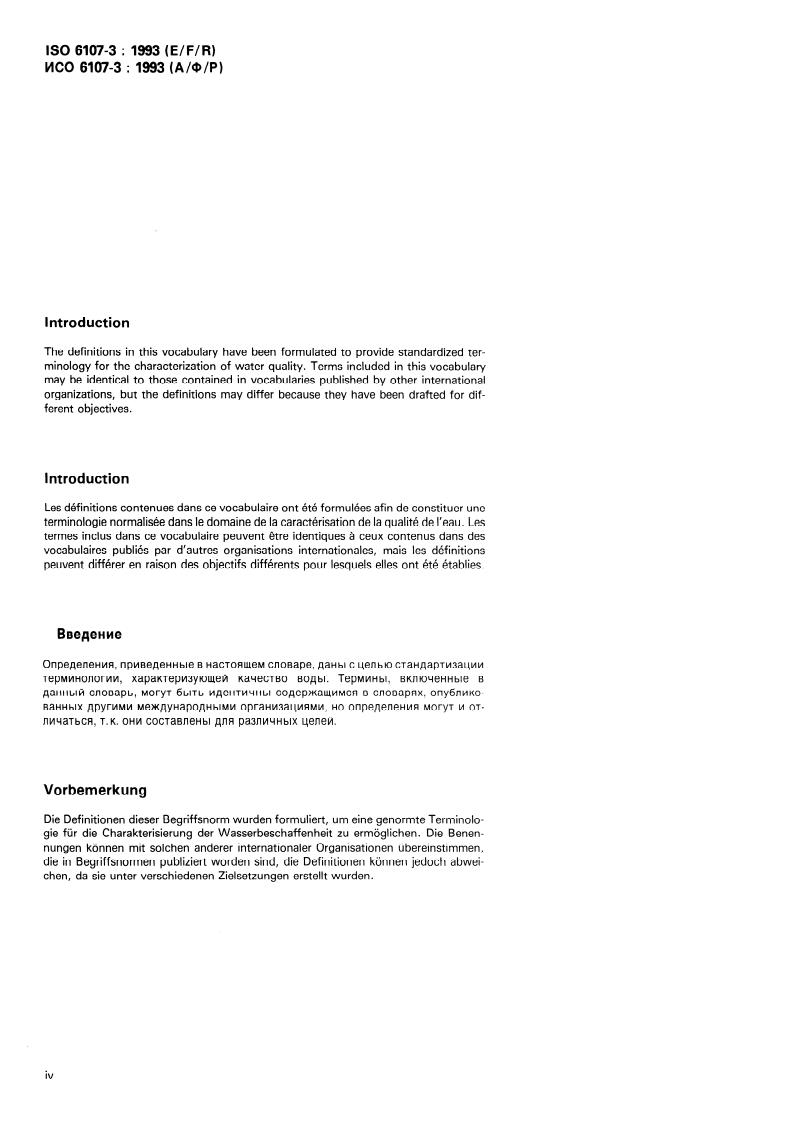
Introduction
The definitions in this vocabulary have been formulated to provide standardized ter-
minology for the characterization of water quality. Terms included in this vocabulary
may be identical to those contained in vocabularies published by other international
organizations, but the definitions may differ because they have been drafted for dif-
ferent objectives.
Introduction
Les definitions contenues dans ce vocabulaire ont etc formulees afin de constituer une
terminologie normalisee dans Ie domaine de Ia caracterisation de Ia qualite de I’eau. Les
termes inclus dans ce vocabulaire peuvent etre identiques a ceux contenus dans des
vocabulaires publies par d’autres organisations internationales, mais les definitions
peuvent differer en raison des objectifs differents pour Iesquels elles ont etc etablies.
BBeneHb4e
OnpefleneHVlfl, npVlBe/JeHHble B HaCTOflUeM CnOBape, AaHbl C UenblO CTaHflapTPl3a~Wl
TepMMHOnOrMM, XapaKTepkl3ylOUer;r KaqeCTBO BOAbl. TepMMHbl, BKnKIYeHHble B
AaHHblti CnOBapb, MOryT 6blTb VlAeHTVlilHbl CO~ep~all&lMC~ B CnOBapFiX, ony6mKo-
BaHHbIX ApyrVlMVl Me>KAyHapOplHblMVl OpraHM3a~MFlMM, HO Ollpe#5leHVW MOryT Pl OT-
JlWlaTbCFi, T.K. OHVl COCTaBneHbl AnFl pa3nWHblX yenelk
Vorbemerkung
Die Definitionen dieser Begriffsnorm wurden formuliert, um eine genormte Terminolo-
gie für die Charakterisierung der Wasserbeschaffenheit zu ermöglichen. Die Benen-
nungen können mit solchen anderer internationaler Organisationen übereinstimmen,
die in Begriffsnormen publiziert worden sind, die Definitionen können jedoch abwei-
chen, da sie unter verschiedenen Zielsetzungen erstellt wurden.
iv
INTERNATIONAL STANDARD
ISO 6107-3 : 1993 (E/F/R)
NORME INTERNATIONALE
MC0 6107-3 : 1993 (A/@/P)
MEXflYHAPOflHblül CTAHBAPT
Water quality - Vocabulary - Part 3
Qualitb de I’eau - Vocabulaire - Partie 3
KarecTBO BOAbl - CJlOBapb - qaCTb 3
Wasserbeschaffenheit - Begriffe - Teil 3
ISO 6107-3 : 1993 (E/F/W
MC0 6107-3 : 1993 (A/@/P)
Water quality - Qualite de I’eau -
Vocabulary - Part 3 Vocabulaire - Partie 3
Domaine d’application
Scope
La prbsente Partie de I’ISO 6107 dbfinit une troiskme liste de
This part of ISO 6107 defines a third list of terms used in certain
fields of water quality characterization. termes employb dans certains domaines de Ia caractkrisation
de Ia qualite de I’eau.
NOTE - In addition to the terms and definitions in the three official
ISO languages (English, French and Russian), this part of ISO 6107 -
NOTE - En Supplement aux termes et definitions donnes dans les trois
gives the equivalent terms and their definitions in the German langues officielles de I’ISO (anglais, francais et russe), Ia presente par-
language; these have been included at the request of ISO Technical
tie de I’ISO 6107 donne les termes equivalents et leurs definitions en
Committee ISO/TC 147 and are published under the responsibility of allemand; ils ont etc inclus 5 Ia demande du comite technique
the member bodies of the Germany (DIN), Austria (ON) and
ISO/TC 147, et sont publik sous Ia responsabilite des comites mem-
Switzerland (SNVL However, only the terms and definitions in the of- bres de I’Allemagne (DIN), d’Autriche (ON) et de Suisse (SNV). Toute-
ficial languages tan be considered as ISO terms and definitions. fois, seuls les termes et definitions donnh dans les langues officielles
peuvent etre considhes comme termes et definitions ISO.
ISO 6107-3 : 1993 (E/F/R)
MC0 6107-3 : 1993 (A/@/P)
KarecTBo BOAbl - CJlOBapb - Wasserbeschaffenheit -
%CTb 3 Begriffe - Teil 3
06naCTb IlpklMeHeHBlFi Anwendungsbereich
tiacToR~aF1 LlaCTb MC0 6107 c0~epxrn-r TpeTVlti Cl-lMCOK TepMW Dieser Teil der ISO 6107 stellt eine Liste von Begriffen mit ihren
Definitionen auf, die in bestimmten Gebieten für die Charakteri-
HOB, MCnOflb3yeMblX B HeKOTOPblX 06flaCTfAx, XapaKTepPl3ytO
sierung der Wasserbeschaffenheit benutzt werden.
ULIX KaLleCTBO BOabl.
rlPMME’-iAHLlE - B AOnOJlHeHkle K TepMklHaM Ha Oct,M~PlaJlbHbIX Fl3bl- ANMERKUNG - Zusätzlich zu den Begriffen und Definitionen in den
drei offiziellen Sprachen der ISO (Englisch, Französisch und Russisch),
KaX MC0 (EiHUlMlilCKOM, C@PaHqY3CKOM M PYCCKOM) HaCTORlllMI/1 !‘VkxflyHa-
POfiHblti CTaHJJapT flaeT 3KBL’lBNleHTHble TePMi’lHbl Ha HeMeqKOM enthält die vorliegende Internationale Norm die entsprechenden Begrif-
fe und Definitionen in deutscher Sprache; diese wurden zur Informa-
F13blKe; 3TM TePMMHbl BBefieHbl l-l0 npocb6e TeXHkl’deCKOrO KOHkITeTa
VICOI TK 147 kl ny6nMKyioTCR l-lOJJ OTBeTCTBeHHOCTb KOMklTeTOB-qJ-leHOB tion auf Wunsch des Technischen Komitees ISO/TC 147 aufgenom-
men. Ihre Übereinstimmung wurde von den Mitgliedskörperschaften
repMaHI4I (PLIH), ABCTPMM (OH) M thetiqapm (CHB). OflHatto mwb
TePMMHbl M Ol-lpE!~efleHWl Ha O@klu,PlaJlbHbIX R3blKZI.X Mol-YT paCCMaTpi’l- Deutschlands (DIN), Österreichs (ON) und der Schweiz (SNV) geprüft.
Es können jedoch nur die in den offiziellen Sprachen angegebenen Be-
BaTbCF1 KaK TePMMHbl M Ollpf?#?J’E?HVlFi tico.
griffe und Definitionen als ISO-Begriffe und ISO-Definitionen angese-
hen werden.
ISO 6107-3 : 1993 (E/F/R)
MC0 6107-3 : 1993 (A/@/P)
1 abstracti at-r : The removal of water from any Source, either captage : Extraction continue ou tempo raire, de I’eau de
permanently or temporarily, so that it n’importe quelle origi n e de facon quelle
ceases to be part of the resources of that area, or ne fasse plus Partie des ressources d’une region, ou
a) a)
is transferred to another Source within the area. soit transferee vers une autre Source a I’interieur
b) meme
de Ia region.
2 activated carbon treatment: A process intended for the traitement par charbon actif : Procede d’elimination de subs-
removal sf dissolved and colloidal organic substances from tances organiques dissoutes ou colloi’dales des eaux et des
water and waste water by adsorption on activated carbon; for eaux residuaires par adsorption sur du charbon actif, ayant
example for the amelioration of taste, odour or colour. pour objectif par exemple I’amelioration du gout, de I’odeur ou
de Ia couleur.
3 agglomeration : The coalescence of flocs or particles of agglomeration; agregation : Coalescence de flocs ou de par-
suspended matter to form larger flocs or particles which settle ticules de matieres en Suspension pour former des flocs ou des
or may be caused to float more readily. particules plus gros qui sedimenteront ou pourront flotter plus
facilement.
4 alpha factor: In an activated sludge plant, the ratio of the
facteur alpha: Pour une Station par boues activees, rapport
Oxygen transfer coefficient in mixed liquor to the Oxygen du coefficient de transfert d’oxygene dans Ia liqueur mixte au
transfer coefficient in clean water.
coefficient de transfert d’oxygene dans de I’eau propre.
5 ammonia stripping : A method of removing ammoniacal Strippage de I’ammoniaque : Methode d’elimination des
composes ammoniacaux des eaux par alcalinisation, puis aera-
compounds from water by making it alkaline, and aerating.
tion.
aquifere: Formation contenant de I’eau (lit ou strate), consti-
6 aquifer: Water-bearing formation (bed or stratum) of
permeable rock, Sand, or gravel capable of yielding significant tuee de roches permeables, de sable ou de gravier, et capable
de ceder des quantites importantes d’eau.
quantities of water.
7 autotrophic bacteria; chemolithotrophic bacteria: bacteries autotrophes; bacteries chimiolithotrophes:
Bacteria which are able to multiply by using inorganic matter as Bacteries capables de se multiplier en utilisant Ia matiere mine-
the only Source of carbon and nitrogen. rale comme unique Source de carbone et d’azote.
lavage 5 contre-courant: Operation de lavage d’un filtre 21
8 backwashing : The Operation of cleaning a filter with water
by reversing the direction of flow. This is often aided by scour- I’eau par inversion du sens du courant. Elle est souvent comple-
tee par un lavage a I’air.
ing with air.
9 beta factor: In an activated sludge plant, the ratio of the facteur beta: Dans une Station par boues activees, rapport de
Oxygen Saturation value in mixed liquor to the Oxygen satu- Ia Valeur de Saturation en oxygene dans Ia liqueur mixte a Ia
ration value in clean water at the same temperature and at- Valeur de Saturation en oxygene dans I’eau propre a tempera-
mospheric pressure. ture et sous Pression atmospherique identiques.
10 biodegradation : Molecular degradation of organic mat- biodegradation : Degradation moleculaire d’une matiere orga-
ter resulting from the complex actions of living organisms, or- nique, en milieu generalement aqueux, resultant des actions
dinarily in an aqueous medium. complexes d’organismes vivants.
11 biofilm (of a sand filter) : The film, consisting of living, film biologique Id’un filtre de sable) : Film compose d’organis-
dead or moribund organisms, that forms on the surfaces of the mes vivants, morts ou moribonds, qui se forme en surface du
medium in a slow sand filter or other biological filter. (See also suppot-t dans les filtres de sable a filtration lente ou autres filtres
90, zoogloeal film.) biologiques. (Voir aussi 90, film de zooglee.)
12 biom ass : The total mass of living biomasse : Masse totale de matiere vivante dans une masse
material in a given body
water. d’eau donnee.
of
ISO6107-3:1993 (E/F/R)
MC0 6107-3:1993(A/@/P)
1 llO@TOFIH- Entnahme : Zeitweilige oder permanente Herausnahme
OT6OP : 0~60~ I-I po6 BOAbl VS3 MCTOY Hl4Ka m60 von
m60 B peMeHH0, TaKMM 06p a30M clT0 Bona Wasser aus irgendeinem Wasservorkommen, so daß es
HO,
nepec-raea 6blTb YaCTbtO PeCypCOB plaHHOti aKBaTo- a) nicht mehr Teil des Wasservorkommens in dem ent-
a)
, MJIM sprechended Gebiet ist, oder
PMM
nepe6paCbiBaeT CFI B ,lJpyrOti MCTO~4HMK B npeRenax b) einem anderen Vorkommen in diesem Gebiet zugeführt
6)
3T0 ti aKBaTOpW4. wird.
2 06pa6oTKa aKTHBHpoBaHHblM gtsne~! : npOqeCC, npenHa- Aktivkohlebehandlung : Verfahren zur Entfernung von orga-
nischen Stoffen (gelost oder kolloidal) aus Wasser oder Abwas-
3HaqeHblti Aflfl yAaneHVlf7 OpraHWleCKklX BetUeCTB (PaCTBOpeH-
ser mittels Adsorption an Aktivkohle, z.B. zur Verbesserung
HblX MJlVI KOnnOVl~HblX) M3 BOlqbl IlyTeM aAcsp6um Ha aKTMBVl-
poBaHHoM yrne, HanpMMep, Anfi ynyweHm BKyca, sanaxa vm des Geschmacks, Geruchs oder der Farbe.
qile-ra.
Agglomeration; Aggregation: Die Vereinigung von Flocken
3 arnoMepaqr4s: CoeRi4HeHtie xnonbes im4 racTi4u, B3Be-
UleHHblX Bel.UeCTB, B pe3ynbTaTe qer0 06pa3yiOTCfl 6OnbWIe oder Teilchen suspendierter Stoffe zu größeren Flocken oder
xnonbfl m-w clacTMubi, KOTOpble OCa~~alOTCFl HaMHOrO 6bl- Partikeln, die sich schneller absetzen oder aufschwimmen.
cTpee.
Alpha-Faktor: Verhältnis des Sauerstoffübergangskoeffizien-
4 anbc@a-cpaKTOp : OTHOUleHlAe KO3@@Vl~VleHTa nepeHOCa
ten im Belebtschlamm-Abwasser-Gemisch zu dem in reinem
KmnopoAa B wlosolil chnecvl K KO3C@@l~MeHTy nepeHoca KMC-
nopoRaB YMCTOti Bo~eHaCTaHywl aapaqm. Wasser unter sonst gleichen Bedingungen.
5 OTrOHKa aMMb4aKa: MeTog yAaneHm aMMMaYHblX coelqw Ammoniakaustreibung : Verfahren zur Entfernung von Am-
moniumverbindungen aus Wasser durch Alkalisieren und Be-
HeHW 143 ~04 nyTeM noflt4enawBaHvw M nocneAytOuer0
lüften.
npoAyBaHm qepes H~X BosAyxa.
Grundwasserraum; Aquifer: Wasserführende Formation
6 BOfJOHOCH bl h CnOi : IlpoHMqaeMblM cnoW rpyHTa, necKa,
COflepIKallWlti 3Ha’dMTenbHble KOnMqe- (Schicht oder Bett) von durchlässigem Gestein, Sand oder
nopoRbl mt4 rpasm,
Kies, aus der bedeutende Mengen Wasser gewonnen werden
CTBa BOAbI.
können.
autotrophe Bakterien; chemolithotrophe Bakterien: Bak-
7 aBTOTpO@H ble 6aKTePbM; XeMOTpO@H ble 6aKTepbIM :
terien, die sich vermehren können, indem sie nur anorganische
E;aKTepMm, KOTOpble cnOCO6Hbl pa3MHOxaTbCFI, klCllOnb3yfl
Stoffe als Kohlenstoff- und Stickstoffquelle verwenden.
HeopraHwecKi4e BeuecTBa, KaK eAMHCTBeHHbll8 VlCTOqHLlK
yrnepofla M a30Ta.
Rückspülung; Gegenstromspülung : Verfahren zur Reini-
8 06paTHan IlpOMblBKa : i-@O~eCC OYMCTKM C@nbTpa BO-
gung eines Filters mit Wasser in der dem Filtrationsvorgang
AOIA, nyTeM t43MeHeHm HanpaBneHm noToKa. YacTo conpo-
entgegengesetzten Strömungsrichtung. Wird oft durch Reini-
BONtAaeTCfI 0WlCTKOl;i B03flyXOM.
gung mit Luft ergänzt.
relative Sauerstoffsättigung; Beta-Faktor: Verhältnis der
Ha CTaH~Wl a3paLJWl OTHOUleHVle IlOKa-
9 6eTa-@aKTOp :
Sauerstoffsättigungskonzentration im Belebtschlamm-Wasser-
3aTenfi HaCblllleHMfl KVlCnOpO~OM B WlOBOGl CMeCvl K noKa3aTe-
Gemisch zu dem in reinem Wasser bei gleicher Temperatur und
IllO HaCblllJeHklfl KVlCnOpOflOM B WlCTOti BOAe npt’l O/JVlHaKOBOlil
Druck erhaltenen Wert.
TeMnepaType M aTMoc@epHoM nasneHr4M.
biologischer Abbau: Molekularer Abbau organischer Sub-
10 6itIonorbwecKoe pasnoxeHue : MoneKympHoe pasno-
stanz durch lebende Organismen, normaierweise im wäßrigen
Xerir4e opraritiqecKr4x Beqec-rs B pe3ynbTaTe msHeAefiTenb-
HOCTM OpraHVl3MOB B BOAHOM Cpefle. Medium.
Filterhaut; Schmutzdecke; Biofilm (auf Sandfilter) : Aus le-
11 6HonneriKa (necuaHor0 @mbTpa): IlneHKa, cocTofuaflM3
benden, toten oder sterbenden Organismen bestehende Haut
WABblX, MepTBblX VlnvI yMklpalOlJ.WX OpraHVl3MOB Ha nOBepX-
an der benetzten Oberfläche eines Langsamfilters oder eines
HOCTU cpegbl B MeRneHHoM necqaHoM @mbTpe vInvI flpyroM
anderen biologischen Filters. (Siehe auch 90, Zoogloenfih.)
6iiIOC#Mn bTpe. (CM. TaKXe 90,3oOZneÜHafl nneHKa.)
12 6HoMacca: 06qan Macca NwIBOrO BeqecTsa B AaHHOM Biomasse : Die gesamte lebende Masse in einem
vorgegebe-
BoAoeMe. nen Wasserkörper.
ISO 6107-3 : 1993 (E/F/R)
MC0 6107-3 : 1993 (A/@/P)
13 biota: The living components of an aquatic System. biote : Ensemble des organismes vivants de tout Systeme aqua-
tique.
14 biotic index: A numerical value used to describe the biota indice biotique : Valeur numerique utilisee pour decrire Ie
of a water body, serving to indicate its biological quality. biote d’une masse d’eau, et utilisee pour en indiquer Ia qualite
biologique.
15 catchment area; catchment basin: The area draining bassin rec epteur Bassin drain ant naturellement vers un
naturally to a water course or to a given Point. cours d’eau droit donne.
ou un
16 Chemical tracer: A Chemical substance added to, or traceur chimique: Produit chimique, ajoute a un cours d’eau
ou une masse d’eau, ou s’y trouvant naturellement, qui permet
naturally present in a stream or body of water, that allows the
flow of water to be followed. d’en suivre I’itineraire.
17 chemolithotrophic bacteria : See auto trophic bacteries chimiolithotrophes : Voir 7, bactkries autotrophes.
7,
bacteria.
18 connate water: lnterstitial water of the same geological eau connee : Eau intersticielle du meme age geologique que Ia
reche ou Ie lit environnants, souvent de qualite mediocre et
age as the surrounding rock or bed, often of poor quality and
unfit for normal use (for example potable purposes, industrial impropre a une utilisation normale (par exemple utilisation
and agricultural use). comme eau potable ou a des fins industrielles ou agricoles).
19 Cross connection: A connection between pipes which jonction fautive; jonction : Raccordement entre des canalisa-
may Cause the transfer of polluted water into a potable water tions qui peut etre Ia Cause du passage d’une eau polluee dans
supply with consequent hazard to public health. un reseau d’alimentation en eau potable et qui a pour conse-
quence un risque pour Ia sante publique.
This term is also used to describe a legitimate connection be-
tween different distribution Systems. Ce terme est aussi utilise pour decrire un raccordement normal
entre differents systemes de distribution.
20 decantation: The withdrawal of the supernatant liquor decantation: Retrait de Ia liqueur surnageante apres sedimen-
tation des matieres solides en Suspension ou apres Separation
after settlement of suspended solids, or after Separation from a
d’un liquide de plus forte densite.
liquid of higher density.
21 detention time: See 64, retention period. duree de retention : Voir 64.
22 drainage area : The area draining to one or more Points, zone de drainage: Zone drainant un ou plusieurs Points et
the boundaries of which are specified by a duly appointed dont les limites sont fixees par une autorite dument designee.
authority.
23 dynamic toxicity test : See 83.1. essai dynamique de toxicite : Voir 83.1.
eau dystrophi que: Eaux pauv res en substances nutritives et
24 dystrophic water: Water which is poor in nut rients and
de
contenant une grande quantite substances humiques.
con tains a high concentration of humic substances.
ecologie : Etude des in terr elations entre les organi smes vivants
25 ecology : The study of the interrelation of living organisms
et leur environnement.
and their environment.
ISO 6107-3 : 1993 (E/F/R)
MC0 6107-3:1993(A/@/P)
13 Lebensgemeinschaft; Biota; Biozön
6HOTa: MPlBble KOMl-lOHeHTbl BO&HOti CMCTeMbl. ose: Die I ebenden Be-
standteile eines aquatischen Systems.
14 6HOTHWCKHii CdH~eKC: %lCneHHWl fisenwwHa, KOTOpSI bistischer Index: Numerischer Wert zur Beschreibung der Le-
ticnonbsyeucfl ~nflonMcaHMfi 6snoTbi BofloeMa, xapaKTepti3y0- bensgemeinschaft in einem Wasserkörper, der dessen biologi-
qafl ee 6MonorMqecKoe Kaqec-rBo. sehe Qualität anzeigt.
15 Boaoc60pHafl nnou(aab; ~ojqoc6op~b~iA 6acceaiH: IIno- Einzugsgebiet : Gebiet, in dem Wasser oder Abwasser einem
qa,4b eCTeCTBeHHOr0 BOfiOCTOKa AO BOAOTOKa VInvI flaHHOti bestimmten Wasserlauf oder einem bestimmten Punkt mit na-
er0 TOqKM. türlichem Gefälle zugeführt wird.
16 xmmwecwii
MH~b’lK8TOp: XvsMwecKoe BeqeCTBO, chemischer arkierungsstoff : Dem Wasserlauf oder Was-
flo6asnfleMoe im4 eCTeCTBeHH0 i-IpL4CyTCTBylOqee B BORO- serkörper zugesetzte oder in ihm bereits vorhandene chemische
-rotte tinM f3oAoeMe M no38onfitoqee cneg4Tb 3a TeqeHueM Substanz, die es gestattet, den Wasserfluß zu verfolgen.
BORbl.
17 XeMOTpOC#IH ble 6aKTepHH: CM. 7, aß mompoqbkib~e QaK- chemolithotrophe Bakterien : Siehe 7, autotrophe Bakte-
mepuu. rien .
18 penb4KTOBble BOflbl : floposafl BoAa TaKoro Ne reonorw juveniles Wasser; Porenwasser: Porenwasser gleichen geo-
logischen Alters wie das umgebende Gestein, häufig von gerin-
qecKor0 BospacTa, KaK VI 0KpyXatoqafl nopofia I/tnM nnacT,
qaCT0 HM3KOrO KaLleCTBa VI HenpVlrOAHafl RnR 06blWiOr0 VIC- ger Qualität und daher für den normalen Gebrauch (z.B. als
nonb30BaHm (HanptiMep, gnfl nt4Tbfi, npoMblqneHHor0 ti cenb- Trinkwasser, Industriewasser oder Wasser für landwirtschaftli-
CKOX03Fl~CTBeHHOrO MCf-lOn b3OBaHl’lFI). ehe Zwecke) nicht geeignet.
19 TpaHCfl03H4Hfl: COeRlAHeHVIe Mexfly Tpy6aMI4, KOTOpOe Querverbindung : Rohrleitungsverbindungen, die das Eindrin-
gen von verunreinigtem Wasser in Trinkwasseverteilungsleitun-
MOxeT Bbl3BaTb IlOnaflaHMe 3arpfl3HeHHOti BOP(bl B llVlTbeByt0,
qT0 MOxeT HaHeCTVl BpeR 3ROpOBbK) HaCeneHVlfI. gen ermöglichen und dadurch eine Gesundheitsgefährdung
herbeiführen können.
3TOT TepMVlH TaKIKe npl4MeHfIeTCFl RnR OflVlCaHMR l-lpaBWlbHO-
ro coeAMHeHm MexAy pa3nwHblMti cmTeMaMi4 pacnpeflene- Die Bezeichnung wird auch für zulässige Verbindungen zwi-
sehen verschiedenen Verteilersystemen gebraucht.
HUR.
20 geKaHTaqwl: OTAeneHme cnon Bofibi nocne oca>tcRe- Dekantation : Die Entnahme der überstehenden Flüssigkeit,
HMFI B3BeUleHHblX TBepnblX C(aCTMu VlnvI nOCne OTAeneHMfl OT
nachdem sich suspendierte Feststoffe oder eine Flüssigkeit hö-
Wil~KOCTM C 6onbqeti nnOTHOCTbt0. herer Dichte abgesetzt haben.
21 BpeMfi sanepxi4saHHfl. = 6~. 64, nepuod sadepxugawli. Behandlungszeit: Siehe 64, Aufenthaltszeit.
22 nnou(aa b Bofioc6opa : i%iOqa~b BO~OC6Opa ~0 o#Ioro Entwässerungsgebiet : Gebiet, das zu einem oder mehreren
im4 6onee nyHKToB, rpaHviqbl KOTO~OI/~ cneqv@wHbl B npeAe- Punkten entwässert, und dessen Grenzen durch eine Fachbe-
nax yKa3aHHbix AeneHmA. hörde festgelegt werden.
dynamischer Toxizitätstest : Siehe 83.1.
23 ~HHaMWieCKHii TOKCHKOnOrWieCKHii TeCT: CM. 83.1.
dystrophes Wasser:
24 nWCTpOC#JH blli BOnOeM : BoAoeM, BOAbl KoTopOrO 6eA- Nährstoffarmes Wasser mit einem ho-
Hbl fll4TaTenbHblML’l BeqeCTBaMVl VI CO/IJepxaT BblCOKMe KOH- hen Gehalt an Huminstoffen.
~eHTpa~L’ll4 ryMyCOBblX BeqeCTB.
25 Ökologie: Die Lehre von der Wechselbezi ehung zwischen le-
3Konorm : HayKa 06 iinyqet-ww B3al/lMOOTHOlJJeHMl/l MVl-
benden Organismen und ihrer
BblX OpraHvl3M OB c oKpy>c
ISO 6107-3 : 1993 (E/F/R)
MC0 6107-3 : 1993 (A/@/P)
kosysteme : Systeme dans lequel il existe des 6changes cycli-
26 ecosystem : A System in which, by the interaction of the
different organisms present and their environment, there is a ques de matieres et d’energie dus aux interactions entre les dif-
cyclic interchange of materials and energy. ferents organismes presents et leur environnement.
27 effluent polishing : See 82.1. polissage des effluents : Voir 82.1.
28 elutriation: A conditioning process by which sludge is lessivage; lixiviation : Proc6d6 de conditionnement au cours
washed with either fresh water or plant efftuent to reduce the duquel Ia boue est lav6e soit avec de I’eau douce soit avec
alkalinity of the sludge, particularly by removing ammoniacal I’effluent de Ia Station et destine 5 reduire I’alcalinite de Ia boue,
compounds, thereby reducing the amount of coagulant re- particuli&ement par elimination des composes ammoniacaux,
quired. ce qui permet de reduire Ia quantite de coagulant necessaire.
29 euphotic zone: The upper layer of a body of water where zone euphotique : Couche superieure d’une masse d’eau OU Ia
light Penetration is sufficient to support effective photosyn- p&Gtration de Ia lumiere est suffisante pour permettre Ie ph&
thesis. nornene de photosynthese.
30 flow-through toxicity test : See 83.1. essai de toxicite avec renouvellement continu : Voir 83.1.
31 fresh water: Naturally occurring water having a low con- eau douce: Eau ayant naturellement une faible concentration
centration of salts, or generally accepted as suitable for en sels ou consideree g6rGralement comme apte au captage et
abstraction and treatment to produce potable water. au traitement destin6 5 Ia production d’eau potable.
halocline : Couche d une masse d’ eau stratifiee dans laquelle
32 halocl ine: A layer i n a stratified body of water in which
the salinity gradient is at a maximum. Ie gradient de salinite est maximal.
nombre Hazen : Nombre utilise pour indiquer I’intensite de
33 Hazen number: A number used to indicate the intensity
coloration de I’eau, I’unite Etalon 6tant Ia couleur produite par
of colour of water, the Standard unit being the colour produced
une Solution contenant 1 mg par litre de Platine [saus Ia forme
by a Solution containing 1 mg of platinum per litre [in the form
d’hydrog~nohexachloroplatinate(IW1 en presence de 2 mg par
of hydrogen hexachloroplatinate(IV)l, in the presence of 2 mg
litre de chlorure de cobalt(ll) hexahydrate.
of cobalt(ll) chloride hexahydrate per litre.
NOTE 1 Voir egalement unitk etalon (de couleur) definie dans
NOTE 1 See also standard UM (of colour), defined in
I’ISO 7887 : 1985, Qualit6 de l’eau - Examen et dktermination de Ia
ISO 7887 : 1985, Water quality - Examination and determinatisn of
co uleur.
colour.
boue humique: Film microbien provenant d’un filtre biologi-
34 humus sludge: The microbial film that sloughs off from a
biological filter and is normally separated from the effluent in a que et normalement 6limir-G dans un bassin de Sedimentation
final settling tank. finale.
hydrographie: Science appliquee qui traite de I’etude et des
35 hydrography : The applied science concerned with the
study and measurement of seas, lakes, rivers and other waters. mesures relatives aux mers, aux lacs, aux rivieres et aux autres
cours d’eau.
NOTE 2 In some countries, this term is synonymous with physical
and chemical oceanography.
NOTE 2 Dans certains pays, ce terme est synonyme du terme ocea-
nographie physique et chimique.
36 hydrology : The applied science concerned with the water hydrologie : Science appliquee au cycle de I’eau, des precipita-
cycle of precipitation, run-off or infiltration and storage, tions, de I’ecoulement ou de I’infiltration et des reserves en eau,
de I’6vaporation et de Ia reprecipitation.
evaporation and re-precipitation.
ISO6107-3:1993(E/F/R)
MC0 6107-3:1993(A/WP)
System, in dem durch Wechselwirkung zwi-
26 3KoCHcTeMa : B3avmoCB~3aHHafl CVlCTeMa XMBblX opra- Ökosystem :
schen den verschiedenen Organismen und ihrer Umwelt ein
HM3MOB M OKpy>rtaKUeti LAX Cpeflbl, B KOTOpOn;r l-lpOlACXOfilAT
lJ~KJlM4eCKVlti B3aMMOO6MeH Bel4eCTB M 3HeprlNl. kreislaufartiger Austausch von Materie und Energie besteht.
Ablaufschönung : Siehe 82.1.
27 ~OOWICTKa CTOrlHblX BOA : CM. 82.1.
Auswaschung : Monditionierungsvorgang, bei dem Schlamm
28 3nIOaqHF1: npOLJeCC o6pa6ouKbI VIna llyTeM er0 hpOMblB-
Kl4 ~-1~460 qMCTOti BOAOl& ~160 llpOMblUJfleHHblMM claCTMqH0 entweder mit Frischwasser oder mit gereinigtem Abwasser aus-
gewaschen wird, um die Basizität des Schlamms herabzuset-
OclL’lUeHHblMl4 CTOqHblMM BOAaMM, AnFl CHM~eHMfl l4eJlO~HOCTVl
Mna, OCO6eHHO rlpL’l yAaJleHlAr/r aMMMac(HblX COe#4HeHVlti, YeM zen, besonders durch Entfernung der Ammoniumverbindun-
gen. Dadurch wird die Menge des benötigten Flockungsmittels
CHPlmaeTCR KOJlMYeCTBO Tpe6yeMblx KOaryflRHTOB.
herabgesetzt.
euphotische Zone : Die obere Schicht eines Wasserkörpers,
29 3y~oTwecKaFi 3oHa : 6epXHUti CJlOti BOAbl BOAOeMa,
KyAa iapOHl4KaeT AOCTaTOYHO CBeTa Arm 3@C@eKTlABHOrO @O- in der die Lichtdurchlässigkeit für eine wirksame Photosynthese
TOCMHTe3a. ausreichend ist.
Durchflul3test : Siehe 83.1.
30 TOKCHKOnOrWieCKHti TeCT flOCpeflCTBOM CTOYHblX BOR:
CM. 83.1.
Rohwasser; natürlich reines Wasser; Frischwasser: Na-
31 IlpeCHafl BOfla: BoAa BOAHblX 06beKTOB, MMetOqaFl HL43-
KyK) KOHueHTpauMtO COneti VlJlM VlCllOflb3yeMafl IlOCne 3a6opa M türlich vorkommendes Wasser mit einer geringen Salzkonzen-
tration, das generell für die Entnahme und Aufbereitung als
06pa6oTKvi Ana rlMTbR.
Trinkwasser geeignet ist.
Halokli ne: Schicht
32 ranOKJlHH : Cnoti BOAbl B CTpaTlN@luVlpOBaHHO M BOP(O- in einem geschichteten Wasserkörper, in
C MaKCMMa ,nbHblM rpaAi4eH TOM COneHOCTM. der der Salzgradient sein Maximum besitzt.
eMe
33 wcno XeWseHa: Wcno, xapatuepM3ytoqee w-metickw- Hazen-Zahl : Zahlenwert zur Kennzeichnung der Farbeninten-
HOCTb uBeTa BOAbl, CTaHAapTHan eAMHl4qa KOTOpOrO COOTBeT- sität von Wasser. Als Standardwert gilt die Farbe, die von einer
c-rsye-r UseTy pac-rsopa, coflepXaqer0 1 Mrln nnaTr4Hbl Lösung von 1 mg/1 Platin [in Form von Hexachloroplatinat
[B @opMe reKcaxnopnnaTr4HaTa (lV) BoAopoAal npm tianw (IV)-Ionen1 in Gegenwart von 2 mg/l Cobalt(ll)-chloridhexa-
~VII~ 2 Mrln xnopmfla reKcarrqqpaTa KoGanbTa Ul). hydrat erzeugt wird.
nPMMEqAHME 1
cM. TaKN? TepMMH Cf772fifdi?p~3~ m0-U.@ (UBeTa), ANMERKUNG 1 Siehe auch Standardwert (einer Farbe), definiert in
OnpeAeneHHbiW B VlCO 7887 : 1985, KaYecmso BOOM - Mcnbmawe ISO 7887 : 1985, Wasserbeschaffenheit - Prüfung und Bestimmung
u onpeaenekiue ysema. der Farbe.
34 OCanOK H3 BTOpWHOrO OTCTOtiHHKa OqHCTHblX COOpy- Tropfkörperschlamm; Filterschlamm : Der mikrobiologi-
XeHHii C 6HOCt)HnbTpOM : Mr4Kpo6ManbHafI IlneHKa, CMblBae- sche Rasen, der sich im Tropfkörper ablöst und normalerweise
in einem Nachklärbecken abgesondert wird.
Man C 6r4O@lilnbTpa M 06blilHO OTAenneMaFl B KOHecdHOM OT-
CTOI;CIHVlKe OqMCTHbIX COOpy~eHMti.
Hydrographie: Die Wissenschaft, die sich mit dem Studium
35 rb4~porpaQHfi: IlptiKnaAHafl HayKa, 3aHHMatoqancn
und der quantitativen Untersuchung vonMeeren, Seen, Flüs-
Vl3yqeHVleM M OueHKOti pa3MepOB MOpel& 03ep, peK M ApyrVlX
sen und anderen Gewässern befaßt.
BOAOeMOB:
I-lPMMEqAHVlE io 6 HeKOTOP blX CTpaHaX 3TOT TePMMH RBJlReTCR CMHO- ANMERKUNG 2 In gewissen Ländern wird dieser Begriff als Syno-
nym des Begriffs physische und chemische Ozeanographie betrachtet.
HMMOM TepMPlHa c;bU3UWCKaH UX uwvefxafl oKeatfozpa@ufl.
Hydrologie; Gewässerkunde : Die Wissenschaft, die sich mit
36 rb4~ponorhm : llpMKnap,Han HayKa, 3aH~Matoqancn r43y-
dem Wasserkreislauf von Niederschlag, Ablauf, Einsickern so-
cleHVleM rMAponorr4recKoro uvrKna, OCaAKOB, CTOKOB Mrtr4 IAH-
wie Speicherung, Verdunstung und erneutem Niederschlag be-
@4nbTpautir4 r4 HaKonneHtq ticnapeHr4n r4 noBTopHor0 Bblna-
schäftigt.
AeHMfl OCaAKOB.
ISO 6107-3 : 1993 (E/F/R)
MC0 6107=3:1993(A/@/P)
hydrometrie: Wiesure et analyse du flux de I’eau.
37 hydro metry : The measu rement and analysis of the flow
of water.
cone d’lmhoff : Recipient conique transparent d’une capacite
38 Imhoff cone: Conical transparent vessel, usually of
capacity 1 litre and graduated near its apex, used for determin- de 1 litre en general et gradue pres de son sommet, utilise pour
Ia determination du volume des matieres decantables dans les
ing the volume of settleable matter in waters.
eaux.
39 lethal concentration (bC50): The concentration of a concentration letale (CL501 : Concentration d’une substance
toxic substance which kills one half of a group of test organ- toxique qui tue Ia moitie du lot d’organismes d’essai. Generale-
isms. Usually the exposure to the substance is continuous and ment, I’exposition de Ia substance est realisee de facon conti-
the LC50 is defined by reference to a specified exposure nue et Ia CL50 se definit par reference a une Periode d’exposi-
period. tion donnee.
NOTE 3 The term median lethal concentration is used in some NOTE 3 Le terme concentration letale mediane est utilisb dans
countries. certains pays.
Zone littorale: Zone marginale peu profonde d’une masse
40 littoral Zone: The shallow marginal zone of a body of
d’eau ou Ia lumiere penetre jusqu’au fond; en general colonisee
water where light penetrates to the bottom; usually colonized
par des vegetaux a racines.
by rooted Vegetation.
41 macrophytes : Large water plants. macrophytes : Grandes plantes aquatiques.
bilan massique : Relation entre l’entree et Ia sortie d’une subs-
42 mass balance: The relationship between input and out-
tance donnee dans un Systeme defini, par exemple dans un lac,
put of a specified substance in a defined System, for example in
une riviere ou une Station de traitement d’eaux usees, qui prend
a lake, river or sewage treatment works, taking into account the
en campte Ia formation ou Ia decomposition de cette substance
formation or decomposition of that substance in the System.
dans Ie Systeme.
bassin de maturation : Grand bassin peu profond, utilise pour
43 maturation Pond: A large shallow basin used for the fur-
ther treatment of sewage which has already received biological Ie traitement complementaire des eaux usees ayant deja subi un
traitement biologique et dont les matieres solides formees lors
treatment and from which the solids formed in biological treat-
du traitement biologique ont etc eliminees.
ment have been removed.
digestion mesophile : Digestion anaerobie des boues s’effec-
44 mesophilic digestion : Anaerobic digestion of sludge at a
tuant a temperature comprise entre 20 OC et 40 OC et favorisant
temperature of from 20 OC to 40 OC, thereby encouraging the
donc Ia croissance des micro-organismes dont Ia multiplication
growth of micro-organisms that grow best in this temperature
range, that is to say mesophilic micro-organisms. est optimale a ces temperatures, c’est-a-dire les micro-
organismes mesophiles.
45 mesotrophic water: A water of intermediate nutrient mesotrophie; eau mesotrophe: Eau dans un etat nutritif
Status, naturally occurring or due to nutrient enrichment, be- intermediaire, apparaissant naturellement ou du a un enrichis-
sement nutritif, entre les etats Mgotrophe et eutrophe. Noir
tween o@otrophic and eutrophic states. (See ISC 6107-1 and
ISO 6107-2.) IS0 6107-1 et ISO 6107-2.)
46 mineralization : The breakdown of organic matter to car- mineralisation : Degradation de Ia matiere organique sous
forme de gaz carbonique, d’eau, d’hydrures, d’oxydes ou de
bon dioxide, water and the hydrides, oxides or mineral salts of
any other elements present. sels mineraux de tous les autres elements presents.
47 mixed liquor: A mixture of sewage and activated sludge liqueur mixte: Melange d’eaux usees et de boues activees qui
subit un recyclage et une aeration dans Ie bassin ou Ie canal
undergoing circulation and aeration in the aeration tank or
d’aeration d’un ouvrage de traitement par boues activees.
channel of an activated-sludge plant.
ISO6lW3:1993(E/F/R)
MC0 6107-3:1993(A/@/P)
37 rkqqpoMeTpw: Vl3MepeHHe IA aHanr43 ToKa 5oAbl. Hydrometrie: Die Messung und Analyse des Wasserflusses.
38 BOpOHKa h’lXOct>a: ~OHML(eCKVlfi CTeKJlfiHHbIti COCy& lmhoff-Trichter : Konisches, transparentes Gefäß, normaler-
weise mit einem Nennvolumen von 1 I und einer Skala an der
06blilHO eMKOCTbt0 OAVlH fWlTp, rpaAyl4pOBaHHblti BBepXy, MC-
nonb3yeMblM AJlf4 0npeAeneHMfr 06-beMa OCax/JeHHbIX B 6oAe Spitze, das für die Bestimmung der absetzbaren Stoffe im
Bell.lecTB. Wasser benutzt wird.
= IleTaJlbHaFI KOH4eHTpa4Wl (LCm): KOH~eHTpa~WI TOK- lethale Konzentration (LC50) : Die statistisch ermittelte Kon-
Zentration einer Substanz, die die Hälfte einer Gruppe von Test-
clrlqecKr4x BeqecT6, y6MBatOuafI nonosMHy rpynn Hccnejqye-
MblX OpraHM3MOB. hlOCKOnbKy npvi 3TOM BblflepWABaHl4e Be- organismen tötet. Normalerweise werden die Testorganismen
der Substanz kontinuierlich ausgesetzt und der hC50-Wert wird
lUecTBa HenpepblBHoe, Lc!% Ol-lpe~eJl~eTCfI OTHOCMTeJl bH0
in Bezug zu einer bestimmten Aussetzungszeit definiert.
onpeAeneHHor0 npoMexyTKa BpeMeHM.
IlPM- ANMERKUNG 3 in gewissen
l7PMMEYAHME 3 TepMw cpedww nemanwaR #onyenmpayuH Läridern wird der Begriff rnii-dere Ie tha-
MeHReTCR B HeKOTOPblX CTpaHaX. Ie Konzentration verwendet.
dt) IWlTOpaJlbHafl 30Ha: MenKafl npM6pemHafl 3oHa ~olqo- Litoralzone; Uferzone: Die flache Randzone eines Gewäs-
sers, in der Licht bis zum Boden vordringt und die normalerwei-
eMa, rAe CBeT ~OCTIN-aeT AHa; 06blWO nOKpblTa KOpHeBOlil pa-
se mit bodenwurzelnden Pflanzen bewachsen ist.
CTMTeJlbHOCTblO.
41 MaKpOC#MTbI: KpynHble BOflHble paCTeHVlR. Makrophyten : Höhere Wasserpflanzen.
42 6anaHc Nsacc: B3aMMOCBFI3b MexBy nocTynneHr4eM Ll Massenbilanz: Das Verhältnis zwischen der zugeführten und
der abgeführten Masse eines bestimmten Stoffs, z.B. in einem
pacxoAoM onpegeneHHor0 BeulecTBa B 0rpaHMreHHorA cucTe-
Me, HanptiMep, B osepe, peKe r4nvI Xe B Bo~ooYticTHblx coopy- See, Fluß oder einer Kläranlage, unter Berücksichtigung der
~eHWJx, C yYeTOM 06pa30saHMR VIJlvI pacnana 3TOrO BelUeCTBa Bildung oder Zersetzung des betreffenden Stoffs in diesem Sy-
B CMCTeMe. Stern.
Schönungsteich: Großes, flaches Becken, das für die weitere
43 npyn-YCpe~HLlTeJl b : 6OJlblllOti MenKOBOp,Hblti BOnOeM,
MCnOnb3yeMblti AJIfl AaJ-IbHeilU.Ieti 06pa6OTKw CTOqHblX BO& KO- Behandlung von bereits biologisch vorbehandeltem Abwasser
dient; die bei der biologischen Vorbehandlung des Abwassers
TOpble nOfiBeprHyTbl 6MonorMqecKoti OqMCTKe VI Ll3 KOTOpblX
yAaneHbl Tsepnble BeqecTBa, o6pasoBaBui~ec~ B npoqecce entstandenen Feststoffe sind bereits abgetrennt.
6~OnOrWIeCKOti 06pa6oTKU.
mesophile Faulung : Anaerober Abbau von Schlamm bei
44 Me3oC#MnbHOe gqHrepMpoBaHMe : AHa3pO6HOe ,qW-epr/t-
Temperaturen zwischen 20 OC und 40 OC, durch den das
poBaHr4e Mna npvi TeMnepaType OT 20 OC Ao 40 OC, conposo-
Wachstum von Mikroorganismen, die sich bei diesen Tempera-
>i
turen am besten vermehren, d.h. von mesophilen Mikroorga-
Bcero B 3~0~ GManasoHe TeMnepaTyp, T-e. Me30@4nbHblx
nismen, begünstigt wird.
MMKpOOpraHM3MOB.
4-5 RnesoTpoct,Han soRa : Boga, coqep>c
HblX BeUeCTB B KOTOpOr;i HaXO~MTCfl Me>icAy Q~UZoI?7/.IOC&-/b/Aß U zwischen o/;gotroph und eutroph, wobei die Nährstoffkonzen-
eßmpo@HbrM COGTORHMRMM (CM. HC0 6107-1 IA MC0 6107-2.) tration entweder natürlich bedingt oder die Folge von
Nährstoffeintrag ist. (Siehe ISO 6107-1 und ISO 6107-2.)
Mineralisierung : Der Abbau organischer Materie zu Kohlen-
fwwepaa.nIrl3aqblfl: Pacnap, opraHMqecKor0 BeqecTBa ~0
06pa3OBaH~n ABY~KVICM yrnepoAa, Bojqbl M rMpipviAo6, 0KMceti dioxid und Wasser sowie den Hydriden, Oxiden oder Mineral-
MJlM MMHepaJlbHblX COIleil nto6bix ApyrVlX npWCyTCTBytOUl4X salzen anderer Elemente.
3JleMeHTOB.
47 Gemisch von belebtem Schlamm und Abwasser;
HnOBaFI CMeCb: CMeCb CTOclHblX BOA l4 aKTI/IBMpOBaHHO-
Belebtschlamm-Abwassergemisch: Mischung von Abwas-
ro rnna, nonBep>KeHHaB utipKynr4poBaHtito t4 a3paquti B a3po-
ser und Belebtschlamm, die durch Durchmischen und Belüften
TeHKe MnM B KaHane cTaHyur4 a=ipaqtirn.
im Belüftungsbecken oder -graben einer Schlammbelebung-
sanlage bewegt wird.
ISO 6107-3: 1993(E/F/R)
MCO6107-3:1993(A/@/P)
matieres solides en suspension deins Ia liqueur mixte:
48 mixed liquor suspended solids; MLSS: The concentra-
Concentration des matieres solides dans Ia liqueur mixte, expri-
tisn sf solids, expressed in a specified dried form, in the mixed
mee en matiere Seche determinee dans des conditions definies.
liquor.
bilan azote: Voir 42, bilan massique.
da9 nitrogen balance: See 42, mass balance.
processus par lesqueis l’azote et
50 nitrogen cycle : The cycle of processes by which nitrogen cycle de l’azote: Cycle des
ses composes sont utilises et transformes dans Ia nature.
and its compounds are utilized and transformed in nature.
elimination des nutriments : Procedes biologiques, physi-
51 nutrient removal: Biological, physical and Chemical pro-
cesses used in water and waste-water treatment specifically for ques et chimiques utilises dans les traitements des eaux et des
eaux residuaires, en particulier pour I’elimination des composes
the removal of compounds of nitrogen and phosphorus.
azotes ou phosphores.
52 Oxidation ditch (channel) : A System for treating crude chenal d’oxydation; fosse d’oxydation : Systeme de traite-
or settled sewage, often taking the form of parallel channels ment des eaux d’egout brutes ou decantees, souvent sous
joined at the ends to form a closed circuit and equipped with forme de canaux paralleles qui se rejoignent a chaque extremite
aeration rotors. pour former un circuit ferme et qui sont equipes de rotors
d’aeration.
bilan en oxygene: Voir 42, bilan massique.
53 Oxygen balance: See 42, mass balance.
54 Oxygen deficit: The differente between the actual deficit en oxygene: Differente entre Ia concentration en oxy-
dissolved Oxygen concentration of an aqueous System and its gene dissous reelle et Ia Valeur de Saturation en oxygene dans
Oxygen Saturation value. un milieu aqueux.
Valeur de Saturation en oxygene : Concentration en oxygene
55 Oxygen Saturation value: The concentration of di
...
SLOVENSKI STANDARD
01-september-1996
Kakovost vode - Slovar - 3. del
Water quality -- Vocabulary
Qualité de l'eau -- Vocabulaire
Ta slovenski standard je istoveten z: ISO 6107-3:1993
ICS:
01.040.13 Varstvo okolja in zdravja. Environment and health
Varnost (Slovarji) protection. Safety
(Vocabularies)
13.060.01 Kakovost vode na splošno Water quality in general
2003-01.Slovenski inštitut za standardizacijo. Razmnoževanje celote ali delov tega standarda ni dovoljeno.
ISO
INTERNATIONAL
6107-3
STANDARD
Second edition
Deuxihme Edition
NORME
BTopoe ti3flaHMe
Zweite Ausgabe
1993-06-15
INTERNATIONALE
MEXAYHAPOAHbI1?1
CTAHAAPT
Water quality - Vocabulary
Part 3
Qualite de I’eau - Vocabulaire
Partie 3
KareCTBO BOnbl - CJlOBapb
%CTb 3
Wasserbeschaffenheit - Begriffe
Teil 3
Reference number
Numero de rhference
I-ioMep CCblJlKVl
ISO 6107-3 : 1993 (E/F/R)
HC0 6107-3 : 1993 (A/@/P)
ISO 6107-3 : 1993 (E/F/R)
MC0 6107-3 : 1993 (A/@/P)
Foreword
ISO (the International Organization for Standardization) is a worldwide federation of
national Standards bodies (ISO member bedies). The work of preparing International
Standards is normally carried out through ISO technical committees. Esch member
body interested in a subject for which a technical committee has been established has
the right to be represented on that committee. International organizations, govern-
mental and non-governmental, in liaison with ISO, also take part in the work. ISO
collaborates closely with the International Electrotechnical Commission (IEC) on all
matters of electrotechnical standardization.
Draft International Standards adopted by the technical committees are circulated to
the member bodies for voting. Publication as an International Standard requires
approval by at least 75 % of the member bodies casting a vote.
International Standard ISO 6107-3 was prepared by Technical Committee ISO/TC 147,
Water quality, Sub-Committee SC 1, Terminology.
This second edition cancels and replaces the first edition (ISO 6107-3 : 19851, terms 9,
12, 17, 34, 35, 45, 59, 60, 66, 71, 79 and 85 of which have been technically revised.
0 ISO 1993
All rights reserved. No part of this publication may be reproduced or utilized in any form or by any
means, electronie or mechanical, including photocopying and microfilm, without Permission in
writing from the publisher. /Droits de reproduction reserves. Aucune Partie de cette publication
ne peut etre reproduite ni utilisee sous quelque forme que ce soit et par aucun procede, electroni-
que ou mecanique, y compris Ia photocopie et les microfilms, sans I’accord ecrit de I’editeur.
International Organization for Standardization
Case postale 56 l CH-121 1 Geneve 20 l Switzerland
Printed in Switzerland/ Imprime en Suisse
ISO 6107-3 : 1993 (E/F/R)
UICO 6107-3 : 1993 (A/@/P)
Avant-propos
L’ISO (Organisation internationale de normalisation) est une federation mondiale
d’organismes nationaux de normalisation (comites membres de I’ISO). L’elaboration
des Normes internationales est en general confiee aux comites techniques de I’ISO.
Chaque comite membre interesse par une etude a Ie droit de faire Partie du comite
technique cr% ZI cet effet. Les organisations internationales, gouvernementales et non
gouvernementales, en liaison avec I’ISO participent egalement aux travaux. L’ISO col-
labore etroitement avec Ia Commission electrotechnique internationale (GEI) en ce qui
concerne Ia normalisation electrotechnique.
Les projets de Normes internationales adoptes par les comites techniques sont soumis
aux comites membres pour vote. Leur publication comme Normes internationales
requiert I’approbation de 75 % au moins des comites membres votants.
La Norme internationale ISO 6107-3 a etc elaboree par Ie comite technique
ISO/TC 147, Qualitk de l’eau, sous-comite SC 1, Terminologie.
Cette deuxieme Edition annule et remplace Ia Premiere edition (ISO 6107-3 : 19851,
dont les termes 9, 17, 34, 45,
12, 35, 59, 60, 66, 71, 79 et 85 ont fait I’objet d’une revi-
sion technique.
L/1co (Me>KJJyHapOplHaR OpraHVl3alJVlFl l-IO CTElH/japTl43a~W) RBJlfIeTCFl BCeML’lpHOti
C@?~epalJVlefi HaqPlOHafl bHblX OpraHlA3a~Vlfi I-IO CTaH~apTlA3a~lNl (KOMVlTeTOB-WEHOB
MCO). Pa3pa6OTKa h&?x~yHapOplH blX CTaHAapTOB OCyllRCTBJlFleTC~ TeXHL’lqeCKMMM
KOMMTeTaMPl 1/1co. Kaxp,biti KOMlATeT-WEH, 3ZWlHTE?peCOBaHHbllil B AeflTWlbHOCTlA,
,4JlFl KOTOPOti 6bin CO3naH TeXHMWCKMfi KOMlATeT: l4MeeT llpaB0 6blTb npeACTaBJleH-
HblM B 3TOM KOMMTeTe. h&?>t
CTBeHHble OpraHL’i3Ei4Wl, i4MetOllll4e CBfI3Vl C tico: TaKxe IlPMHMMatOT YWCTvie B
pa6oTax. YTO Kacae-KR CTaHflapTVI3ayVWI B 06naCTM 3JleKTPOTeXHMKM, MC0 pa60TaeT
B TeCHOM COTpy~HlAWCTBe C MWKflytiapO~HOti 3JleKTpOTeXHlWeCKOti KoMMCCMel/l
(M3K).
nPOeKTbl MWK~yHapOplHblX CTaHAapTOB: I-lPlAHRTble TeXHWl&KlAMVl KOMMTeTaMM,
paCCbIJ=latOTCFl KOMl’lTeTaM-qJleHaM Ha TOJ-lOCOBaHMe. tiX Olly6JlVlKOBaHl’le B KaLleCTBe
Mex~yHapOflHblX CTaHAapTOB Tpe6yeT O/JO6peHlAR l-l0 MeHbll.ler/r Mepe 75 % KOMMTe-
TOB-WeHOB, IlpviHlAMiNOlWX y%CTme B TOJlOCOBaHMM.
pa3pa6orat-I TextiwdeCK MM KOMVITeTOM
Me>KgyHa .pOflH bl ti CTaHnapT Mc0 6107-3 6bl
VlCOITK 1 47, KSfeCI77ßO f3Odb/, IlOAKOMMTeT K 1, ?-epMUHOl7OtUf7.
tiac-rofiqee Bropoe wflar-iue ar-itiynrnpye-r VI 3aMeHFleT nepeoe WfiatiMe (MC0 6107-3 :
1985), B KOTOPOM -rephnw-ibi 9: 12: 17,3$ 35: 45. 59,60,66,71.79 M 85 6binIA nogsepwy-
Tbl TeXHlNeCKOti peBl43lAld
. . .
Ill
ISO 6107-3 : 1993 (E/F/R)
MC0 6107-3 : 1993 (A/@/P)
Introduction
The definitions in this vocabulary have been formulated to provide standardized ter-
minology for the characterization of water quality. Terms included in this vocabulary
may be identical to those contained in vocabularies published by other international
organizations, but the definitions may differ because they have been drafted for dif-
ferent objectives.
Introduction
Les definitions contenues dans ce vocabulaire ont etc formulees afin de constituer une
terminologie normalisee dans Ie domaine de Ia caracterisation de Ia qualite de I’eau. Les
termes inclus dans ce vocabulaire peuvent etre identiques a ceux contenus dans des
vocabulaires publies par d’autres organisations internationales, mais les definitions
peuvent differer en raison des objectifs differents pour Iesquels elles ont etc etablies.
BBeneHb4e
OnpefleneHVlfl, npVlBe/JeHHble B HaCTOflUeM CnOBape, AaHbl C UenblO CTaHflapTPl3a~Wl
TepMMHOnOrMM, XapaKTepkl3ylOUer;r KaqeCTBO BOAbl. TepMMHbl, BKnKIYeHHble B
AaHHblti CnOBapb, MOryT 6blTb VlAeHTVlilHbl CO~ep~all&lMC~ B CnOBapFiX, ony6mKo-
BaHHbIX ApyrVlMVl Me>KAyHapOplHblMVl OpraHM3a~MFlMM, HO Ollpe#5leHVW MOryT Pl OT-
JlWlaTbCFi, T.K. OHVl COCTaBneHbl AnFl pa3nWHblX yenelk
Vorbemerkung
Die Definitionen dieser Begriffsnorm wurden formuliert, um eine genormte Terminolo-
gie für die Charakterisierung der Wasserbeschaffenheit zu ermöglichen. Die Benen-
nungen können mit solchen anderer internationaler Organisationen übereinstimmen,
die in Begriffsnormen publiziert worden sind, die Definitionen können jedoch abwei-
chen, da sie unter verschiedenen Zielsetzungen erstellt wurden.
iv
INTERNATIONAL STANDARD
ISO 6107-3 : 1993 (E/F/R)
NORME INTERNATIONALE
MC0 6107-3 : 1993 (A/@/P)
MEXflYHAPOflHblül CTAHBAPT
Water quality - Vocabulary - Part 3
Qualitb de I’eau - Vocabulaire - Partie 3
KarecTBO BOAbl - CJlOBapb - qaCTb 3
Wasserbeschaffenheit - Begriffe - Teil 3
ISO 6107-3 : 1993 (E/F/W
MC0 6107-3 : 1993 (A/@/P)
Water quality - Qualite de I’eau -
Vocabulary - Part 3 Vocabulaire - Partie 3
Domaine d’application
Scope
La prbsente Partie de I’ISO 6107 dbfinit une troiskme liste de
This part of ISO 6107 defines a third list of terms used in certain
fields of water quality characterization. termes employb dans certains domaines de Ia caractkrisation
de Ia qualite de I’eau.
NOTE - In addition to the terms and definitions in the three official
ISO languages (English, French and Russian), this part of ISO 6107 -
NOTE - En Supplement aux termes et definitions donnes dans les trois
gives the equivalent terms and their definitions in the German langues officielles de I’ISO (anglais, francais et russe), Ia presente par-
language; these have been included at the request of ISO Technical
tie de I’ISO 6107 donne les termes equivalents et leurs definitions en
Committee ISO/TC 147 and are published under the responsibility of allemand; ils ont etc inclus 5 Ia demande du comite technique
the member bodies of the Germany (DIN), Austria (ON) and
ISO/TC 147, et sont publik sous Ia responsabilite des comites mem-
Switzerland (SNVL However, only the terms and definitions in the of- bres de I’Allemagne (DIN), d’Autriche (ON) et de Suisse (SNV). Toute-
ficial languages tan be considered as ISO terms and definitions. fois, seuls les termes et definitions donnh dans les langues officielles
peuvent etre considhes comme termes et definitions ISO.
ISO 6107-3 : 1993 (E/F/R)
MC0 6107-3 : 1993 (A/@/P)
KarecTBo BOAbl - CJlOBapb - Wasserbeschaffenheit -
%CTb 3 Begriffe - Teil 3
06naCTb IlpklMeHeHBlFi Anwendungsbereich
tiacToR~aF1 LlaCTb MC0 6107 c0~epxrn-r TpeTVlti Cl-lMCOK TepMW Dieser Teil der ISO 6107 stellt eine Liste von Begriffen mit ihren
Definitionen auf, die in bestimmten Gebieten für die Charakteri-
HOB, MCnOflb3yeMblX B HeKOTOPblX 06flaCTfAx, XapaKTepPl3ytO
sierung der Wasserbeschaffenheit benutzt werden.
ULIX KaLleCTBO BOabl.
rlPMME’-iAHLlE - B AOnOJlHeHkle K TepMklHaM Ha Oct,M~PlaJlbHbIX Fl3bl- ANMERKUNG - Zusätzlich zu den Begriffen und Definitionen in den
drei offiziellen Sprachen der ISO (Englisch, Französisch und Russisch),
KaX MC0 (EiHUlMlilCKOM, C@PaHqY3CKOM M PYCCKOM) HaCTORlllMI/1 !‘VkxflyHa-
POfiHblti CTaHJJapT flaeT 3KBL’lBNleHTHble TePMi’lHbl Ha HeMeqKOM enthält die vorliegende Internationale Norm die entsprechenden Begrif-
fe und Definitionen in deutscher Sprache; diese wurden zur Informa-
F13blKe; 3TM TePMMHbl BBefieHbl l-l0 npocb6e TeXHkl’deCKOrO KOHkITeTa
VICOI TK 147 kl ny6nMKyioTCR l-lOJJ OTBeTCTBeHHOCTb KOMklTeTOB-qJ-leHOB tion auf Wunsch des Technischen Komitees ISO/TC 147 aufgenom-
men. Ihre Übereinstimmung wurde von den Mitgliedskörperschaften
repMaHI4I (PLIH), ABCTPMM (OH) M thetiqapm (CHB). OflHatto mwb
TePMMHbl M Ol-lpE!~efleHWl Ha O@klu,PlaJlbHbIX R3blKZI.X Mol-YT paCCMaTpi’l- Deutschlands (DIN), Österreichs (ON) und der Schweiz (SNV) geprüft.
Es können jedoch nur die in den offiziellen Sprachen angegebenen Be-
BaTbCF1 KaK TePMMHbl M Ollpf?#?J’E?HVlFi tico.
griffe und Definitionen als ISO-Begriffe und ISO-Definitionen angese-
hen werden.
ISO 6107-3 : 1993 (E/F/R)
MC0 6107-3 : 1993 (A/@/P)
1 abstracti at-r : The removal of water from any Source, either captage : Extraction continue ou tempo raire, de I’eau de
permanently or temporarily, so that it n’importe quelle origi n e de facon quelle
ceases to be part of the resources of that area, or ne fasse plus Partie des ressources d’une region, ou
a) a)
is transferred to another Source within the area. soit transferee vers une autre Source a I’interieur
b) meme
de Ia region.
2 activated carbon treatment: A process intended for the traitement par charbon actif : Procede d’elimination de subs-
removal sf dissolved and colloidal organic substances from tances organiques dissoutes ou colloi’dales des eaux et des
water and waste water by adsorption on activated carbon; for eaux residuaires par adsorption sur du charbon actif, ayant
example for the amelioration of taste, odour or colour. pour objectif par exemple I’amelioration du gout, de I’odeur ou
de Ia couleur.
3 agglomeration : The coalescence of flocs or particles of agglomeration; agregation : Coalescence de flocs ou de par-
suspended matter to form larger flocs or particles which settle ticules de matieres en Suspension pour former des flocs ou des
or may be caused to float more readily. particules plus gros qui sedimenteront ou pourront flotter plus
facilement.
4 alpha factor: In an activated sludge plant, the ratio of the
facteur alpha: Pour une Station par boues activees, rapport
Oxygen transfer coefficient in mixed liquor to the Oxygen du coefficient de transfert d’oxygene dans Ia liqueur mixte au
transfer coefficient in clean water.
coefficient de transfert d’oxygene dans de I’eau propre.
5 ammonia stripping : A method of removing ammoniacal Strippage de I’ammoniaque : Methode d’elimination des
composes ammoniacaux des eaux par alcalinisation, puis aera-
compounds from water by making it alkaline, and aerating.
tion.
aquifere: Formation contenant de I’eau (lit ou strate), consti-
6 aquifer: Water-bearing formation (bed or stratum) of
permeable rock, Sand, or gravel capable of yielding significant tuee de roches permeables, de sable ou de gravier, et capable
de ceder des quantites importantes d’eau.
quantities of water.
7 autotrophic bacteria; chemolithotrophic bacteria: bacteries autotrophes; bacteries chimiolithotrophes:
Bacteria which are able to multiply by using inorganic matter as Bacteries capables de se multiplier en utilisant Ia matiere mine-
the only Source of carbon and nitrogen. rale comme unique Source de carbone et d’azote.
lavage 5 contre-courant: Operation de lavage d’un filtre 21
8 backwashing : The Operation of cleaning a filter with water
by reversing the direction of flow. This is often aided by scour- I’eau par inversion du sens du courant. Elle est souvent comple-
tee par un lavage a I’air.
ing with air.
9 beta factor: In an activated sludge plant, the ratio of the facteur beta: Dans une Station par boues activees, rapport de
Oxygen Saturation value in mixed liquor to the Oxygen satu- Ia Valeur de Saturation en oxygene dans Ia liqueur mixte a Ia
ration value in clean water at the same temperature and at- Valeur de Saturation en oxygene dans I’eau propre a tempera-
mospheric pressure. ture et sous Pression atmospherique identiques.
10 biodegradation : Molecular degradation of organic mat- biodegradation : Degradation moleculaire d’une matiere orga-
ter resulting from the complex actions of living organisms, or- nique, en milieu generalement aqueux, resultant des actions
dinarily in an aqueous medium. complexes d’organismes vivants.
11 biofilm (of a sand filter) : The film, consisting of living, film biologique Id’un filtre de sable) : Film compose d’organis-
dead or moribund organisms, that forms on the surfaces of the mes vivants, morts ou moribonds, qui se forme en surface du
medium in a slow sand filter or other biological filter. (See also suppot-t dans les filtres de sable a filtration lente ou autres filtres
90, zoogloeal film.) biologiques. (Voir aussi 90, film de zooglee.)
12 biom ass : The total mass of living biomasse : Masse totale de matiere vivante dans une masse
material in a given body
water. d’eau donnee.
of
ISO6107-3:1993 (E/F/R)
MC0 6107-3:1993(A/@/P)
1 llO@TOFIH- Entnahme : Zeitweilige oder permanente Herausnahme
OT6OP : 0~60~ I-I po6 BOAbl VS3 MCTOY Hl4Ka m60 von
m60 B peMeHH0, TaKMM 06p a30M clT0 Bona Wasser aus irgendeinem Wasservorkommen, so daß es
HO,
nepec-raea 6blTb YaCTbtO PeCypCOB plaHHOti aKBaTo- a) nicht mehr Teil des Wasservorkommens in dem ent-
a)
, MJIM sprechended Gebiet ist, oder
PMM
nepe6paCbiBaeT CFI B ,lJpyrOti MCTO~4HMK B npeRenax b) einem anderen Vorkommen in diesem Gebiet zugeführt
6)
3T0 ti aKBaTOpW4. wird.
2 06pa6oTKa aKTHBHpoBaHHblM gtsne~! : npOqeCC, npenHa- Aktivkohlebehandlung : Verfahren zur Entfernung von orga-
nischen Stoffen (gelost oder kolloidal) aus Wasser oder Abwas-
3HaqeHblti Aflfl yAaneHVlf7 OpraHWleCKklX BetUeCTB (PaCTBOpeH-
ser mittels Adsorption an Aktivkohle, z.B. zur Verbesserung
HblX MJlVI KOnnOVl~HblX) M3 BOlqbl IlyTeM aAcsp6um Ha aKTMBVl-
poBaHHoM yrne, HanpMMep, Anfi ynyweHm BKyca, sanaxa vm des Geschmacks, Geruchs oder der Farbe.
qile-ra.
Agglomeration; Aggregation: Die Vereinigung von Flocken
3 arnoMepaqr4s: CoeRi4HeHtie xnonbes im4 racTi4u, B3Be-
UleHHblX Bel.UeCTB, B pe3ynbTaTe qer0 06pa3yiOTCfl 6OnbWIe oder Teilchen suspendierter Stoffe zu größeren Flocken oder
xnonbfl m-w clacTMubi, KOTOpble OCa~~alOTCFl HaMHOrO 6bl- Partikeln, die sich schneller absetzen oder aufschwimmen.
cTpee.
Alpha-Faktor: Verhältnis des Sauerstoffübergangskoeffizien-
4 anbc@a-cpaKTOp : OTHOUleHlAe KO3@@Vl~VleHTa nepeHOCa
ten im Belebtschlamm-Abwasser-Gemisch zu dem in reinem
KmnopoAa B wlosolil chnecvl K KO3C@@l~MeHTy nepeHoca KMC-
nopoRaB YMCTOti Bo~eHaCTaHywl aapaqm. Wasser unter sonst gleichen Bedingungen.
5 OTrOHKa aMMb4aKa: MeTog yAaneHm aMMMaYHblX coelqw Ammoniakaustreibung : Verfahren zur Entfernung von Am-
moniumverbindungen aus Wasser durch Alkalisieren und Be-
HeHW 143 ~04 nyTeM noflt4enawBaHvw M nocneAytOuer0
lüften.
npoAyBaHm qepes H~X BosAyxa.
Grundwasserraum; Aquifer: Wasserführende Formation
6 BOfJOHOCH bl h CnOi : IlpoHMqaeMblM cnoW rpyHTa, necKa,
COflepIKallWlti 3Ha’dMTenbHble KOnMqe- (Schicht oder Bett) von durchlässigem Gestein, Sand oder
nopoRbl mt4 rpasm,
Kies, aus der bedeutende Mengen Wasser gewonnen werden
CTBa BOAbI.
können.
autotrophe Bakterien; chemolithotrophe Bakterien: Bak-
7 aBTOTpO@H ble 6aKTePbM; XeMOTpO@H ble 6aKTepbIM :
terien, die sich vermehren können, indem sie nur anorganische
E;aKTepMm, KOTOpble cnOCO6Hbl pa3MHOxaTbCFI, klCllOnb3yfl
Stoffe als Kohlenstoff- und Stickstoffquelle verwenden.
HeopraHwecKi4e BeuecTBa, KaK eAMHCTBeHHbll8 VlCTOqHLlK
yrnepofla M a30Ta.
Rückspülung; Gegenstromspülung : Verfahren zur Reini-
8 06paTHan IlpOMblBKa : i-@O~eCC OYMCTKM C@nbTpa BO-
gung eines Filters mit Wasser in der dem Filtrationsvorgang
AOIA, nyTeM t43MeHeHm HanpaBneHm noToKa. YacTo conpo-
entgegengesetzten Strömungsrichtung. Wird oft durch Reini-
BONtAaeTCfI 0WlCTKOl;i B03flyXOM.
gung mit Luft ergänzt.
relative Sauerstoffsättigung; Beta-Faktor: Verhältnis der
Ha CTaH~Wl a3paLJWl OTHOUleHVle IlOKa-
9 6eTa-@aKTOp :
Sauerstoffsättigungskonzentration im Belebtschlamm-Wasser-
3aTenfi HaCblllleHMfl KVlCnOpO~OM B WlOBOGl CMeCvl K noKa3aTe-
Gemisch zu dem in reinem Wasser bei gleicher Temperatur und
IllO HaCblllJeHklfl KVlCnOpOflOM B WlCTOti BOAe npt’l O/JVlHaKOBOlil
Druck erhaltenen Wert.
TeMnepaType M aTMoc@epHoM nasneHr4M.
biologischer Abbau: Molekularer Abbau organischer Sub-
10 6itIonorbwecKoe pasnoxeHue : MoneKympHoe pasno-
stanz durch lebende Organismen, normaierweise im wäßrigen
Xerir4e opraritiqecKr4x Beqec-rs B pe3ynbTaTe msHeAefiTenb-
HOCTM OpraHVl3MOB B BOAHOM Cpefle. Medium.
Filterhaut; Schmutzdecke; Biofilm (auf Sandfilter) : Aus le-
11 6HonneriKa (necuaHor0 @mbTpa): IlneHKa, cocTofuaflM3
benden, toten oder sterbenden Organismen bestehende Haut
WABblX, MepTBblX VlnvI yMklpalOlJ.WX OpraHVl3MOB Ha nOBepX-
an der benetzten Oberfläche eines Langsamfilters oder eines
HOCTU cpegbl B MeRneHHoM necqaHoM @mbTpe vInvI flpyroM
anderen biologischen Filters. (Siehe auch 90, Zoogloenfih.)
6iiIOC#Mn bTpe. (CM. TaKXe 90,3oOZneÜHafl nneHKa.)
12 6HoMacca: 06qan Macca NwIBOrO BeqecTsa B AaHHOM Biomasse : Die gesamte lebende Masse in einem
vorgegebe-
BoAoeMe. nen Wasserkörper.
ISO 6107-3 : 1993 (E/F/R)
MC0 6107-3 : 1993 (A/@/P)
13 biota: The living components of an aquatic System. biote : Ensemble des organismes vivants de tout Systeme aqua-
tique.
14 biotic index: A numerical value used to describe the biota indice biotique : Valeur numerique utilisee pour decrire Ie
of a water body, serving to indicate its biological quality. biote d’une masse d’eau, et utilisee pour en indiquer Ia qualite
biologique.
15 catchment area; catchment basin: The area draining bassin rec epteur Bassin drain ant naturellement vers un
naturally to a water course or to a given Point. cours d’eau droit donne.
ou un
16 Chemical tracer: A Chemical substance added to, or traceur chimique: Produit chimique, ajoute a un cours d’eau
ou une masse d’eau, ou s’y trouvant naturellement, qui permet
naturally present in a stream or body of water, that allows the
flow of water to be followed. d’en suivre I’itineraire.
17 chemolithotrophic bacteria : See auto trophic bacteries chimiolithotrophes : Voir 7, bactkries autotrophes.
7,
bacteria.
18 connate water: lnterstitial water of the same geological eau connee : Eau intersticielle du meme age geologique que Ia
reche ou Ie lit environnants, souvent de qualite mediocre et
age as the surrounding rock or bed, often of poor quality and
unfit for normal use (for example potable purposes, industrial impropre a une utilisation normale (par exemple utilisation
and agricultural use). comme eau potable ou a des fins industrielles ou agricoles).
19 Cross connection: A connection between pipes which jonction fautive; jonction : Raccordement entre des canalisa-
may Cause the transfer of polluted water into a potable water tions qui peut etre Ia Cause du passage d’une eau polluee dans
supply with consequent hazard to public health. un reseau d’alimentation en eau potable et qui a pour conse-
quence un risque pour Ia sante publique.
This term is also used to describe a legitimate connection be-
tween different distribution Systems. Ce terme est aussi utilise pour decrire un raccordement normal
entre differents systemes de distribution.
20 decantation: The withdrawal of the supernatant liquor decantation: Retrait de Ia liqueur surnageante apres sedimen-
tation des matieres solides en Suspension ou apres Separation
after settlement of suspended solids, or after Separation from a
d’un liquide de plus forte densite.
liquid of higher density.
21 detention time: See 64, retention period. duree de retention : Voir 64.
22 drainage area : The area draining to one or more Points, zone de drainage: Zone drainant un ou plusieurs Points et
the boundaries of which are specified by a duly appointed dont les limites sont fixees par une autorite dument designee.
authority.
23 dynamic toxicity test : See 83.1. essai dynamique de toxicite : Voir 83.1.
eau dystrophi que: Eaux pauv res en substances nutritives et
24 dystrophic water: Water which is poor in nut rients and
de
contenant une grande quantite substances humiques.
con tains a high concentration of humic substances.
ecologie : Etude des in terr elations entre les organi smes vivants
25 ecology : The study of the interrelation of living organisms
et leur environnement.
and their environment.
ISO 6107-3 : 1993 (E/F/R)
MC0 6107-3:1993(A/@/P)
13 Lebensgemeinschaft; Biota; Biozön
6HOTa: MPlBble KOMl-lOHeHTbl BO&HOti CMCTeMbl. ose: Die I ebenden Be-
standteile eines aquatischen Systems.
14 6HOTHWCKHii CdH~eKC: %lCneHHWl fisenwwHa, KOTOpSI bistischer Index: Numerischer Wert zur Beschreibung der Le-
ticnonbsyeucfl ~nflonMcaHMfi 6snoTbi BofloeMa, xapaKTepti3y0- bensgemeinschaft in einem Wasserkörper, der dessen biologi-
qafl ee 6MonorMqecKoe Kaqec-rBo. sehe Qualität anzeigt.
15 Boaoc60pHafl nnou(aab; ~ojqoc6op~b~iA 6acceaiH: IIno- Einzugsgebiet : Gebiet, in dem Wasser oder Abwasser einem
qa,4b eCTeCTBeHHOr0 BOfiOCTOKa AO BOAOTOKa VInvI flaHHOti bestimmten Wasserlauf oder einem bestimmten Punkt mit na-
er0 TOqKM. türlichem Gefälle zugeführt wird.
16 xmmwecwii
MH~b’lK8TOp: XvsMwecKoe BeqeCTBO, chemischer arkierungsstoff : Dem Wasserlauf oder Was-
flo6asnfleMoe im4 eCTeCTBeHH0 i-IpL4CyTCTBylOqee B BORO- serkörper zugesetzte oder in ihm bereits vorhandene chemische
-rotte tinM f3oAoeMe M no38onfitoqee cneg4Tb 3a TeqeHueM Substanz, die es gestattet, den Wasserfluß zu verfolgen.
BORbl.
17 XeMOTpOC#IH ble 6aKTepHH: CM. 7, aß mompoqbkib~e QaK- chemolithotrophe Bakterien : Siehe 7, autotrophe Bakte-
mepuu. rien .
18 penb4KTOBble BOflbl : floposafl BoAa TaKoro Ne reonorw juveniles Wasser; Porenwasser: Porenwasser gleichen geo-
logischen Alters wie das umgebende Gestein, häufig von gerin-
qecKor0 BospacTa, KaK VI 0KpyXatoqafl nopofia I/tnM nnacT,
qaCT0 HM3KOrO KaLleCTBa VI HenpVlrOAHafl RnR 06blWiOr0 VIC- ger Qualität und daher für den normalen Gebrauch (z.B. als
nonb30BaHm (HanptiMep, gnfl nt4Tbfi, npoMblqneHHor0 ti cenb- Trinkwasser, Industriewasser oder Wasser für landwirtschaftli-
CKOX03Fl~CTBeHHOrO MCf-lOn b3OBaHl’lFI). ehe Zwecke) nicht geeignet.
19 TpaHCfl03H4Hfl: COeRlAHeHVIe Mexfly Tpy6aMI4, KOTOpOe Querverbindung : Rohrleitungsverbindungen, die das Eindrin-
gen von verunreinigtem Wasser in Trinkwasseverteilungsleitun-
MOxeT Bbl3BaTb IlOnaflaHMe 3arpfl3HeHHOti BOP(bl B llVlTbeByt0,
qT0 MOxeT HaHeCTVl BpeR 3ROpOBbK) HaCeneHVlfI. gen ermöglichen und dadurch eine Gesundheitsgefährdung
herbeiführen können.
3TOT TepMVlH TaKIKe npl4MeHfIeTCFl RnR OflVlCaHMR l-lpaBWlbHO-
ro coeAMHeHm MexAy pa3nwHblMti cmTeMaMi4 pacnpeflene- Die Bezeichnung wird auch für zulässige Verbindungen zwi-
sehen verschiedenen Verteilersystemen gebraucht.
HUR.
20 geKaHTaqwl: OTAeneHme cnon Bofibi nocne oca>tcRe- Dekantation : Die Entnahme der überstehenden Flüssigkeit,
HMFI B3BeUleHHblX TBepnblX C(aCTMu VlnvI nOCne OTAeneHMfl OT
nachdem sich suspendierte Feststoffe oder eine Flüssigkeit hö-
Wil~KOCTM C 6onbqeti nnOTHOCTbt0. herer Dichte abgesetzt haben.
21 BpeMfi sanepxi4saHHfl. = 6~. 64, nepuod sadepxugawli. Behandlungszeit: Siehe 64, Aufenthaltszeit.
22 nnou(aa b Bofioc6opa : i%iOqa~b BO~OC6Opa ~0 o#Ioro Entwässerungsgebiet : Gebiet, das zu einem oder mehreren
im4 6onee nyHKToB, rpaHviqbl KOTO~OI/~ cneqv@wHbl B npeAe- Punkten entwässert, und dessen Grenzen durch eine Fachbe-
nax yKa3aHHbix AeneHmA. hörde festgelegt werden.
dynamischer Toxizitätstest : Siehe 83.1.
23 ~HHaMWieCKHii TOKCHKOnOrWieCKHii TeCT: CM. 83.1.
dystrophes Wasser:
24 nWCTpOC#JH blli BOnOeM : BoAoeM, BOAbl KoTopOrO 6eA- Nährstoffarmes Wasser mit einem ho-
Hbl fll4TaTenbHblML’l BeqeCTBaMVl VI CO/IJepxaT BblCOKMe KOH- hen Gehalt an Huminstoffen.
~eHTpa~L’ll4 ryMyCOBblX BeqeCTB.
25 Ökologie: Die Lehre von der Wechselbezi ehung zwischen le-
3Konorm : HayKa 06 iinyqet-ww B3al/lMOOTHOlJJeHMl/l MVl-
benden Organismen und ihrer
BblX OpraHvl3M OB c oKpy>c
ISO 6107-3 : 1993 (E/F/R)
MC0 6107-3 : 1993 (A/@/P)
kosysteme : Systeme dans lequel il existe des 6changes cycli-
26 ecosystem : A System in which, by the interaction of the
different organisms present and their environment, there is a ques de matieres et d’energie dus aux interactions entre les dif-
cyclic interchange of materials and energy. ferents organismes presents et leur environnement.
27 effluent polishing : See 82.1. polissage des effluents : Voir 82.1.
28 elutriation: A conditioning process by which sludge is lessivage; lixiviation : Proc6d6 de conditionnement au cours
washed with either fresh water or plant efftuent to reduce the duquel Ia boue est lav6e soit avec de I’eau douce soit avec
alkalinity of the sludge, particularly by removing ammoniacal I’effluent de Ia Station et destine 5 reduire I’alcalinite de Ia boue,
compounds, thereby reducing the amount of coagulant re- particuli&ement par elimination des composes ammoniacaux,
quired. ce qui permet de reduire Ia quantite de coagulant necessaire.
29 euphotic zone: The upper layer of a body of water where zone euphotique : Couche superieure d’une masse d’eau OU Ia
light Penetration is sufficient to support effective photosyn- p&Gtration de Ia lumiere est suffisante pour permettre Ie ph&
thesis. nornene de photosynthese.
30 flow-through toxicity test : See 83.1. essai de toxicite avec renouvellement continu : Voir 83.1.
31 fresh water: Naturally occurring water having a low con- eau douce: Eau ayant naturellement une faible concentration
centration of salts, or generally accepted as suitable for en sels ou consideree g6rGralement comme apte au captage et
abstraction and treatment to produce potable water. au traitement destin6 5 Ia production d’eau potable.
halocline : Couche d une masse d’ eau stratifiee dans laquelle
32 halocl ine: A layer i n a stratified body of water in which
the salinity gradient is at a maximum. Ie gradient de salinite est maximal.
nombre Hazen : Nombre utilise pour indiquer I’intensite de
33 Hazen number: A number used to indicate the intensity
coloration de I’eau, I’unite Etalon 6tant Ia couleur produite par
of colour of water, the Standard unit being the colour produced
une Solution contenant 1 mg par litre de Platine [saus Ia forme
by a Solution containing 1 mg of platinum per litre [in the form
d’hydrog~nohexachloroplatinate(IW1 en presence de 2 mg par
of hydrogen hexachloroplatinate(IV)l, in the presence of 2 mg
litre de chlorure de cobalt(ll) hexahydrate.
of cobalt(ll) chloride hexahydrate per litre.
NOTE 1 Voir egalement unitk etalon (de couleur) definie dans
NOTE 1 See also standard UM (of colour), defined in
I’ISO 7887 : 1985, Qualit6 de l’eau - Examen et dktermination de Ia
ISO 7887 : 1985, Water quality - Examination and determinatisn of
co uleur.
colour.
boue humique: Film microbien provenant d’un filtre biologi-
34 humus sludge: The microbial film that sloughs off from a
biological filter and is normally separated from the effluent in a que et normalement 6limir-G dans un bassin de Sedimentation
final settling tank. finale.
hydrographie: Science appliquee qui traite de I’etude et des
35 hydrography : The applied science concerned with the
study and measurement of seas, lakes, rivers and other waters. mesures relatives aux mers, aux lacs, aux rivieres et aux autres
cours d’eau.
NOTE 2 In some countries, this term is synonymous with physical
and chemical oceanography.
NOTE 2 Dans certains pays, ce terme est synonyme du terme ocea-
nographie physique et chimique.
36 hydrology : The applied science concerned with the water hydrologie : Science appliquee au cycle de I’eau, des precipita-
cycle of precipitation, run-off or infiltration and storage, tions, de I’ecoulement ou de I’infiltration et des reserves en eau,
de I’6vaporation et de Ia reprecipitation.
evaporation and re-precipitation.
ISO6107-3:1993(E/F/R)
MC0 6107-3:1993(A/WP)
System, in dem durch Wechselwirkung zwi-
26 3KoCHcTeMa : B3avmoCB~3aHHafl CVlCTeMa XMBblX opra- Ökosystem :
schen den verschiedenen Organismen und ihrer Umwelt ein
HM3MOB M OKpy>rtaKUeti LAX Cpeflbl, B KOTOpOn;r l-lpOlACXOfilAT
lJ~KJlM4eCKVlti B3aMMOO6MeH Bel4eCTB M 3HeprlNl. kreislaufartiger Austausch von Materie und Energie besteht.
Ablaufschönung : Siehe 82.1.
27 ~OOWICTKa CTOrlHblX BOA : CM. 82.1.
Auswaschung : Monditionierungsvorgang, bei dem Schlamm
28 3nIOaqHF1: npOLJeCC o6pa6ouKbI VIna llyTeM er0 hpOMblB-
Kl4 ~-1~460 qMCTOti BOAOl& ~160 llpOMblUJfleHHblMM claCTMqH0 entweder mit Frischwasser oder mit gereinigtem Abwasser aus-
gewaschen wird, um die Basizität des Schlamms herabzuset-
OclL’lUeHHblMl4 CTOqHblMM BOAaMM, AnFl CHM~eHMfl l4eJlO~HOCTVl
Mna, OCO6eHHO rlpL’l yAaJleHlAr/r aMMMac(HblX COe#4HeHVlti, YeM zen, besonders durch Entfernung der Ammoniumverbindun-
gen. Dadurch wird die Menge des benötigten Flockungsmittels
CHPlmaeTCR KOJlMYeCTBO Tpe6yeMblx KOaryflRHTOB.
herabgesetzt.
euphotische Zone : Die obere Schicht eines Wasserkörpers,
29 3y~oTwecKaFi 3oHa : 6epXHUti CJlOti BOAbl BOAOeMa,
KyAa iapOHl4KaeT AOCTaTOYHO CBeTa Arm 3@C@eKTlABHOrO @O- in der die Lichtdurchlässigkeit für eine wirksame Photosynthese
TOCMHTe3a. ausreichend ist.
Durchflul3test : Siehe 83.1.
30 TOKCHKOnOrWieCKHti TeCT flOCpeflCTBOM CTOYHblX BOR:
CM. 83.1.
Rohwasser; natürlich reines Wasser; Frischwasser: Na-
31 IlpeCHafl BOfla: BoAa BOAHblX 06beKTOB, MMetOqaFl HL43-
KyK) KOHueHTpauMtO COneti VlJlM VlCllOflb3yeMafl IlOCne 3a6opa M türlich vorkommendes Wasser mit einer geringen Salzkonzen-
tration, das generell für die Entnahme und Aufbereitung als
06pa6oTKvi Ana rlMTbR.
Trinkwasser geeignet ist.
Halokli ne: Schicht
32 ranOKJlHH : Cnoti BOAbl B CTpaTlN@luVlpOBaHHO M BOP(O- in einem geschichteten Wasserkörper, in
C MaKCMMa ,nbHblM rpaAi4eH TOM COneHOCTM. der der Salzgradient sein Maximum besitzt.
eMe
33 wcno XeWseHa: Wcno, xapatuepM3ytoqee w-metickw- Hazen-Zahl : Zahlenwert zur Kennzeichnung der Farbeninten-
HOCTb uBeTa BOAbl, CTaHAapTHan eAMHl4qa KOTOpOrO COOTBeT- sität von Wasser. Als Standardwert gilt die Farbe, die von einer
c-rsye-r UseTy pac-rsopa, coflepXaqer0 1 Mrln nnaTr4Hbl Lösung von 1 mg/1 Platin [in Form von Hexachloroplatinat
[B @opMe reKcaxnopnnaTr4HaTa (lV) BoAopoAal npm tianw (IV)-Ionen1 in Gegenwart von 2 mg/l Cobalt(ll)-chloridhexa-
~VII~ 2 Mrln xnopmfla reKcarrqqpaTa KoGanbTa Ul). hydrat erzeugt wird.
nPMMEqAHME 1
cM. TaKN? TepMMH Cf772fifdi?p~3~ m0-U.@ (UBeTa), ANMERKUNG 1 Siehe auch Standardwert (einer Farbe), definiert in
OnpeAeneHHbiW B VlCO 7887 : 1985, KaYecmso BOOM - Mcnbmawe ISO 7887 : 1985, Wasserbeschaffenheit - Prüfung und Bestimmung
u onpeaenekiue ysema. der Farbe.
34 OCanOK H3 BTOpWHOrO OTCTOtiHHKa OqHCTHblX COOpy- Tropfkörperschlamm; Filterschlamm : Der mikrobiologi-
XeHHii C 6HOCt)HnbTpOM : Mr4Kpo6ManbHafI IlneHKa, CMblBae- sche Rasen, der sich im Tropfkörper ablöst und normalerweise
in einem Nachklärbecken abgesondert wird.
Man C 6r4O@lilnbTpa M 06blilHO OTAenneMaFl B KOHecdHOM OT-
CTOI;CIHVlKe OqMCTHbIX COOpy~eHMti.
Hydrographie: Die Wissenschaft, die sich mit dem Studium
35 rb4~porpaQHfi: IlptiKnaAHafl HayKa, 3aHHMatoqancn
und der quantitativen Untersuchung vonMeeren, Seen, Flüs-
Vl3yqeHVleM M OueHKOti pa3MepOB MOpel& 03ep, peK M ApyrVlX
sen und anderen Gewässern befaßt.
BOAOeMOB:
I-lPMMEqAHVlE io 6 HeKOTOP blX CTpaHaX 3TOT TePMMH RBJlReTCR CMHO- ANMERKUNG 2 In gewissen Ländern wird dieser Begriff als Syno-
nym des Begriffs physische und chemische Ozeanographie betrachtet.
HMMOM TepMPlHa c;bU3UWCKaH UX uwvefxafl oKeatfozpa@ufl.
Hydrologie; Gewässerkunde : Die Wissenschaft, die sich mit
36 rb4~ponorhm : llpMKnap,Han HayKa, 3aH~Matoqancn r43y-
dem Wasserkreislauf von Niederschlag, Ablauf, Einsickern so-
cleHVleM rMAponorr4recKoro uvrKna, OCaAKOB, CTOKOB Mrtr4 IAH-
wie Speicherung, Verdunstung und erneutem Niederschlag be-
@4nbTpautir4 r4 HaKonneHtq ticnapeHr4n r4 noBTopHor0 Bblna-
schäftigt.
AeHMfl OCaAKOB.
ISO 6107-3 : 1993 (E/F/R)
MC0 6107=3:1993(A/@/P)
hydrometrie: Wiesure et analyse du flux de I’eau.
37 hydro metry : The measu rement and analysis of the flow
of water.
cone d’lmhoff : Recipient conique transparent d’une capacite
38 Imhoff cone: Conical transparent vessel, usually of
capacity 1 litre and graduated near its apex, used for determin- de 1 litre en general et gradue pres de son sommet, utilise pour
Ia determination du volume des matieres decantables dans les
ing the volume of settleable matter in waters.
eaux.
39 lethal concentration (bC50): The concentration of a concentration letale (CL501 : Concentration d’une substance
toxic substance which kills one half of a group of test organ- toxique qui tue Ia moitie du lot d’organismes d’essai. Generale-
isms. Usually the exposure to the substance is continuous and ment, I’exposition de Ia substance est realisee de facon conti-
the LC50 is defined by reference to a specified exposure nue et Ia CL50 se definit par reference a une Periode d’exposi-
period. tion donnee.
NOTE 3 The term median lethal concentration is used in some NOTE 3 Le terme concentration letale mediane est utilisb dans
countries. certains pays.
Zone littorale: Zone marginale peu profonde d’une masse
40 littoral Zone: The shallow marginal zone of a body of
d’eau ou Ia lumiere penetre jusqu’au fond; en general colonisee
water where light penetrates to the bottom; usually colonized
par des vegetaux a racines.
by rooted Vegetation.
41 macrophytes : Large water plants. macrophytes : Grandes plantes aquatiques.
bilan massique : Relation entre l’entree et Ia sortie d’une subs-
42 mass balance: The relationship between input and out-
tance donnee dans un Systeme defini, par exemple dans un lac,
put of a specified substance in a defined System, for example in
une riviere ou une Station de traitement d’eaux usees, qui prend
a lake, river or sewage treatment works, taking into account the
en campte Ia formation ou Ia decomposition de cette substance
formation or decomposition of that substance in the System.
dans Ie Systeme.
bassin de maturation : Grand bassin peu profond, utilise pour
43 maturation Pond: A large shallow basin used for the fur-
ther treatment of sewage which has already received biological Ie traitement complementaire des eaux usees ayant deja subi un
traitement biologique et dont les matieres solides formees lors
treatment and from which the solids formed in biological treat-
du traitement biologique ont etc eliminees.
ment have been removed.
digestion mesophile : Digestion anaerobie des boues s’effec-
44 mesophilic digestion : Anaerobic digestion of sludge at a
tuant a temperature comprise entre 20 OC et 40 OC et favorisant
temperature of from 20 OC to 40 OC, thereby encouraging the
donc Ia croissance des micro-organismes dont Ia multiplication
growth of micro-organisms that grow best in this temperature
range, that is to say mesophilic micro-organisms. est optimale a ces temperatures, c’est-a-dire les micro-
organismes mesophiles.
45 mesotrophic water: A water of intermediate nutrient mesotrophie; eau mesotrophe: Eau dans un etat nutritif
Status, naturally occurring or due to nutrient enrichment, be- intermediaire, apparaissant naturellement ou du a un enrichis-
sement nutritif, entre les etats Mgotrophe et eutrophe. Noir
tween o@otrophic and eutrophic states. (See ISC 6107-1 and
ISO 6107-2.) IS0 6107-1 et ISO 6107-2.)
46 mineralization : The breakdown of organic matter to car- mineralisation : Degradation de Ia matiere organique sous
forme de gaz carbonique, d’eau, d’hydrures, d’oxydes ou de
bon dioxide, water and the hydrides, oxides or mineral salts of
any other elements present. sels mineraux de tous les autres elements presents.
47 mixed liquor: A mixture of sewage and activated sludge liqueur mixte: Melange d’eaux usees et de boues activees qui
subit un recyclage et une aeration dans Ie bassin ou Ie canal
undergoing circulation and aeration in the aeration tank or
d’aeration d’un ouvrage de traitement par boues activees.
channel of an activated-sludge plant.
ISO6lW3:1993(E/F/R)
MC0 6107-3:1993(A/@/P)
37 rkqqpoMeTpw: Vl3MepeHHe IA aHanr43 ToKa 5oAbl. Hydrometrie: Die Messung und Analyse des Wasserflusses.
38 BOpOHKa h’lXOct>a: ~OHML(eCKVlfi CTeKJlfiHHbIti COCy& lmhoff-Trichter : Konisches, transparentes Gefäß, normaler-
weise mit einem Nennvolumen von 1 I und einer Skala an der
06blilHO eMKOCTbt0 OAVlH fWlTp, rpaAyl4pOBaHHblti BBepXy, MC-
nonb3yeMblM AJlf4 0npeAeneHMfr 06-beMa OCax/JeHHbIX B 6oAe Spitze, das für die Bestimmung der absetzbaren Stoffe im
Bell.lecTB. Wasser benutzt wird.
= IleTaJlbHaFI KOH4eHTpa4Wl (LCm): KOH~eHTpa~WI TOK- lethale Konzentration (LC50) : Die statistisch ermittelte Kon-
Zentration einer Substanz, die die Hälfte einer Gruppe von Test-
clrlqecKr4x BeqecT6, y6MBatOuafI nonosMHy rpynn Hccnejqye-
MblX OpraHM3MOB. hlOCKOnbKy npvi 3TOM BblflepWABaHl4e Be- organismen tötet. Normalerweise werden die Testorganismen
der Substanz kontinuierlich ausgesetzt und der hC50-Wert wird
lUecTBa HenpepblBHoe, Lc!% Ol-lpe~eJl~eTCfI OTHOCMTeJl bH0
in Bezug zu einer bestimmten Aussetzungszeit definiert.
onpeAeneHHor0 npoMexyTKa BpeMeHM.
IlPM- ANMERKUNG 3 in gewissen
l7PMMEYAHME 3 TepMw cpedww nemanwaR #onyenmpayuH Läridern wird der Begriff rnii-dere Ie tha-
MeHReTCR B HeKOTOPblX CTpaHaX. Ie Konzentration verwendet.
dt) IWlTOpaJlbHafl 30Ha: MenKafl npM6pemHafl 3oHa ~olqo- Litoralzone; Uferzone: Die flache Randzone eines Gewäs-
sers, in der Licht bis zum Boden vordringt und die normalerwei-
eMa, rAe CBeT ~OCTIN-aeT AHa; 06blWO nOKpblTa KOpHeBOlil pa-
se mit bodenwurzelnden Pflanzen bewachsen ist.
CTMTeJlbHOCTblO.
41 MaKpOC#MTbI: KpynHble BOflHble paCTeHVlR. Makrophyten : Höhere Wasserpflanzen.
42 6anaHc Nsacc: B3aMMOCBFI3b MexBy nocTynneHr4eM Ll Massenbilanz: Das Verhältnis zwischen der zugeführten und
der abgeführten Masse eines bestimmten Stoffs, z.B. in einem
pacxoAoM onpegeneHHor0 BeulecTBa B 0rpaHMreHHorA cucTe-
Me, HanptiMep, B osepe, peKe r4nvI Xe B Bo~ooYticTHblx coopy- See, Fluß oder einer Kläranlage, unter Berücksichtigung der
~eHWJx, C yYeTOM 06pa30saHMR VIJlvI pacnana 3TOrO BelUeCTBa Bildung oder Zersetzung des betreffenden Stoffs in diesem Sy-
B CMCTeMe. Stern.
Schönungsteich: Großes, flaches Becken, das für die weitere
43 npyn-YCpe~HLlTeJl b : 6OJlblllOti MenKOBOp,Hblti BOnOeM,
MCnOnb3yeMblti AJIfl AaJ-IbHeilU.Ieti 06pa6OTKw CTOqHblX BO& KO- Behandlung von bereits biologisch vorbehandeltem Abwasser
dient; die bei der biologischen Vorbehandlung des Abwassers
TOpble nOfiBeprHyTbl 6MonorMqecKoti OqMCTKe VI Ll3 KOTOpblX
yAaneHbl Tsepnble BeqecTBa, o6pasoBaBui~ec~ B npoqecce entstandenen Feststoffe sind bereits abgetrennt.
6~OnOrWIeCKOti 06pa6oTKU.
mesophile Faulung : Anaerober Abbau von Schlamm bei
44 Me3oC#MnbHOe gqHrepMpoBaHMe : AHa3pO6HOe ,qW-epr/t-
Temperaturen zwischen 20 OC und 40 OC, durch den das
poBaHr4e Mna npvi TeMnepaType OT 20 OC Ao 40 OC, conposo-
Wachstum von Mikroorganismen, die sich bei diesen Tempera-
>i
turen am besten vermehren, d.h. von mesophilen Mikroorga-
Bcero B 3~0~ GManasoHe TeMnepaTyp, T-e. Me30@4nbHblx
nismen, begünstigt wird.
MMKpOOpraHM3MOB.
4-5 RnesoTpoct,Han soRa : Boga, coqep>c
HblX BeUeCTB B KOTOpOr;i HaXO~MTCfl Me>icAy Q~UZoI?7/.IOC&-/b/Aß U zwischen o/;gotroph und eutroph, wobei die Nährstoffkonzen-
eßmpo@HbrM COGTORHMRMM (CM. HC0 6107-1 IA MC0 6107-2.) tration entweder natürlich bedingt oder die Folge von
Nährstoffeintrag ist. (Siehe ISO 6107-1 und ISO 6107-2.)
Mineralisierung : Der Abbau organischer Materie zu Kohlen-
fwwepaa.nIrl3aqblfl: Pacnap, opraHMqecKor0 BeqecTBa ~0
06pa3OBaH~n ABY~KVICM yrnepoAa, Bojqbl M rMpipviAo6, 0KMceti dioxid und Wasser sowie den Hydriden, Oxiden oder Mineral-
MJlM MMHepaJlbHblX COIleil nto6bix ApyrVlX npWCyTCTBytOUl4X salzen anderer Elemente.
3JleMeHTOB.
47 Gemisch von belebtem Schlamm und Abwasser;
HnOBaFI CMeCb: CMeCb CTOclHblX BOA l4 aKTI/IBMpOBaHHO-
Belebtschlamm-Abwassergemisch: Mischung von Abwas-
ro rnna, nonBep>KeHHaB utipKynr4poBaHtito t4 a3paquti B a3po-
ser und Belebtschlamm, die durch Durchmischen und Belüften
TeHKe MnM B KaHane cTaHyur4 a=ipaqtirn.
im Belüftungsbecken oder -graben einer Schlammbelebung-
sanlage bewegt wird.
ISO 6107-3: 1993(E/F/R)
MCO6107-3:1993(A/@/P)
matieres solides en suspension deins Ia liqueur mixte:
48 mixed liquor suspended solids; MLSS: The concentra-
Concentration des matieres solides dans Ia liqueur mixte, expri-
tisn sf solids, expressed in a specified dried form, in the mixed
mee en matiere Seche determinee dans des conditions definies.
liquor.
bilan azote: Voir 42, bilan massique.
da9 nitrogen balance: See 42, mass balance.
processus par lesqueis l’azote et
50 nitrogen cycle : The cycle of processes by which nitrogen cycle de l’azote: Cycle des
ses composes sont utilises et transformes dans Ia nature.
and its compounds are utilized and transformed in nature.
elimination des nutriments : Procedes biologiques, physi-
51 nutrient removal: Biological, physical and Chemical pro-
cesses used in water and waste-water treatment specifically for ques et chimiques utilises dans les traitements des eaux et des
eaux residuaires, en particulier pour I’elimi
...