


SIST-TP CEN/TR 18104:2024
(Main)Space - SBAS receivers performances for maritime applications - MARESS Test report
Space - SBAS receivers performances for maritime applications - MARESS Test report
The objective of this document is to present the results of the tests defined in the IEC 61108-7 draft [1] performed with a maritime receiver updated based on the SBAS maritime guidelines [2] and other GNSS SBAS receivers.
The list of test scenarios prepared, the receiver analysed, the configuration used and procedures are included in Clause 4. In Clause 5, graphical and numerical results for each of the test performed are presented, including if the tests are passed or failed. Annex A provides additional information on the test case setup.
Raumfahrt - Leistung von SBAS-Empfängern für maritime Anwendungen - MARESS-Testbericht
Espace Performances des récepteurs SBAS pour les applications maritimes Rapport d'essais MARESS
Aeronavtika - Delovanje sprejemnikov SBAS za pomorske aplikacije - poročilo o preskusu MARESS
Cilj tega dokumenta je predstaviti rezultate preskusov, opredeljenih v osnutku standarda IEC 61108-7 [1] in izvedenih s pomorskim sprejemnikom, posodobljenim na podlagi pomorskih smernic SBAS [2], in drugimi sprejemniki GNSS SBAS.
Seznam pripravljenih preskusnih scenarijev, analiziran sprejemnik, uporabljena konfiguracija in postopki so vključeni v točki 4. V točki 5 so predstavljeni grafični in številski rezultati za posamezni izveden preskus, vključno s tem, ali je bil preskus uspešen ali neuspešen. Dodatek A vsebuje dodatne informacije o pripravi primera preskusa.
General Information
- Status
- Published
- Public Enquiry End Date
- 30-Jul-2024
- Publication Date
- 14-Oct-2024
- Technical Committee
- I13 - Imaginarni 13
- Current Stage
- 6060 - National Implementation/Publication (Adopted Project)
- Start Date
- 10-Oct-2024
- Due Date
- 15-Dec-2024
- Completion Date
- 15-Oct-2024

Overview
SIST-TP CEN/TR 18104:2024 is a technical report that presents the results of performance tests conducted on Space-Based Augmentation System (SBAS) receivers for maritime applications. Developed under the MARESS project and aligned with the evolving International Electrotechnical Commission (IEC) 61108-7 draft, this document provides valuable data on the operation and reliability of GNSS SBAS receivers when used on ships and other maritime platforms. The standard offers a comprehensive approach by analyzing different receiver models, test scenarios, and configurations to support ongoing efforts in maritime navigation standardization.
Key Topics
- SBAS Receiver Performance: Evaluation of accuracy, availability, acquisition time, and processing speed of SBAS receivers in various maritime conditions.
- Test Scenarios and Procedures: Detailed descriptions of the test cases, including static, dynamic, and angular movement scenarios.
- Test Results Reporting: Numerical and graphical data for each test, with clear indicators for pass or fail status.
- Receiver Types: Analysis performed on maritime receivers updated per SBAS maritime guidelines, standard GNSS SBAS receivers, and certified aviation receivers for comparison.
- SBAS Processing Functions: Assessment of SBAS satellite selection, satellite status indication, and interoperability between different SBAS providers.
- RAIM Integrity Checks: Verification of the Receiver Autonomous Integrity Monitoring (RAIM) function, crucial for safety-related maritime navigation.
Applications
This standard provides practical insights for a range of maritime industry stakeholders:
- Maritime Equipment Manufacturers: Use the documented tests and results to enhance SBAS receiver products for compliance with emerging international maritime standards.
- Ship Operators & Integrators: Reference the report outcomes to select and implement GNSS SBAS receiver solutions optimized for vessel navigation and safety.
- Standardization Bodies: Leverage the comprehensive test methodology and findings to inform the development of future versions of IEC 61108-7 and related guidelines.
- Regulatory Agencies: Employ the documented procedures and results to assess the fitness of SBAS receivers for maritime certification and approval processes.
- Research and Development: Academic and industrial researchers can build upon tested scenarios and observed receiver behaviors for improved navigation and integrity monitoring systems.
Related Standards
- IEC 61108-7: The emerging international standard for SBAS receiver equipment in maritime navigation, directly supported by the findings of this report.
- RTCA DO-229: Minimum operational performance standards for aviation SBAS receivers, referenced for comparison and benchmarking.
- GNSS and SBAS Guidelines: Best practices and technical requirements for satellite-based augmentation, as prescribed by international and regional navigation authorities.
Practical Value
By consolidating test procedures, configurations, and results, SIST-TP CEN/TR 18104:2024 delivers actionable insights and data-driven recommendations to facilitate the safe and efficient integration of SBAS receivers in maritime navigation systems. Its relevance extends from shipboard equipment designers to regulatory inspectors, providing the foundation for harmonized standards and enhanced maritime safety. Through its support for international standardization, it ensures that SBAS-enabled navigation technology meets current and future operational demands for accuracy, robustness, and integrity on the world’s seas.
Get Certified
Connect with accredited certification bodies for this standard

DNV
DNV is an independent assurance and risk management provider.

BSI Group
BSI (British Standards Institution) is the business standards company that helps organizations make excellence a habit.

Bureau Veritas
Bureau Veritas is a world leader in laboratory testing, inspection and certification services.
Sponsored listings
Frequently Asked Questions
SIST-TP CEN/TR 18104:2024 is a technical report published by the Slovenian Institute for Standardization (SIST). Its full title is "Space - SBAS receivers performances for maritime applications - MARESS Test report". This standard covers: The objective of this document is to present the results of the tests defined in the IEC 61108-7 draft [1] performed with a maritime receiver updated based on the SBAS maritime guidelines [2] and other GNSS SBAS receivers. The list of test scenarios prepared, the receiver analysed, the configuration used and procedures are included in Clause 4. In Clause 5, graphical and numerical results for each of the test performed are presented, including if the tests are passed or failed. Annex A provides additional information on the test case setup.
The objective of this document is to present the results of the tests defined in the IEC 61108-7 draft [1] performed with a maritime receiver updated based on the SBAS maritime guidelines [2] and other GNSS SBAS receivers. The list of test scenarios prepared, the receiver analysed, the configuration used and procedures are included in Clause 4. In Clause 5, graphical and numerical results for each of the test performed are presented, including if the tests are passed or failed. Annex A provides additional information on the test case setup.
SIST-TP CEN/TR 18104:2024 is classified under the following ICS (International Classification for Standards) categories: 47.020.70 - Navigation and control equipment; 49.020 - Aircraft and space vehicles in general. The ICS classification helps identify the subject area and facilitates finding related standards.
SIST-TP CEN/TR 18104:2024 is available in PDF format for immediate download after purchase. The document can be added to your cart and obtained through the secure checkout process. Digital delivery ensures instant access to the complete standard document.
Standards Content (Sample)
SLOVENSKI STANDARD
01-december-2024
Aeronavtika - Delovanje sprejemnikov SBAS za pomorske aplikacije - poročilo o
preskusu MARESS
Space — SBAS receivers performances for maritime applications — MARESS Test
report
Raumfahrt - Leistung von SBAS-Empfängern für maritime Anwendungen - MARESS-
Testbericht
Espace Performances des récepteurs SBAS pour les applications maritimes Rapport
d'essais MARESS
Ta slovenski standard je istoveten z: CEN/TR 18104:2024
ICS:
47.020.70 Navigacijska in krmilna Navigation and control
oprema equipment
49.020 Letala in vesoljska vozila na Aircraft and space vehicles in
splošno general
2003-01.Slovenski inštitut za standardizacijo. Razmnoževanje celote ali delov tega standarda ni dovoljeno.
TECHNICAL REPORT CEN/TR 18104
RAPPORT TECHNIQUE
TECHNISCHER REPORT
September 2024
ICS 47.020.70
English version
Space - SBAS receivers performances for maritime
applications - MARESS Test report
Espace - Performances des récepteurs SBAS pour les Raumfahrt - Leistung von SBAS-Empfängern für
applications maritimes - Rapport d'essais MARESS maritime Anwendungen - MARESS-Testbericht
This Technical Report was approved by CEN on 2 September 2024. It has been drawn up by the Technical Committee
CEN/CLC/JTC 5.
CEN and CENELEC members are the national standards bodies and national electrotechnical committees of Austria, Belgium,
Bulgaria, Croatia, Cyprus, Czech Republic, Denmark, Estonia, Finland, France, Germany, Greece, Hungary, Iceland, Ireland, Italy,
Latvia, Lithuania, Luxembourg, Malta, Netherlands, Norway, Poland, Portugal, Republic of North Macedonia, Romania, Serbia,
Slovakia, Slovenia, Spain, Sweden, Switzerland, Türkiye and United Kingdom.
CEN-CENELEC Management Centre:
Rue de la Science 23, B-1040 Brussels
© 2024 CEN/CENELEC All rights of exploitation in any form and by any means Ref. No. CEN/TR 18104:2024 E
reserved worldwide for CEN national Members and for
CENELEC Members.
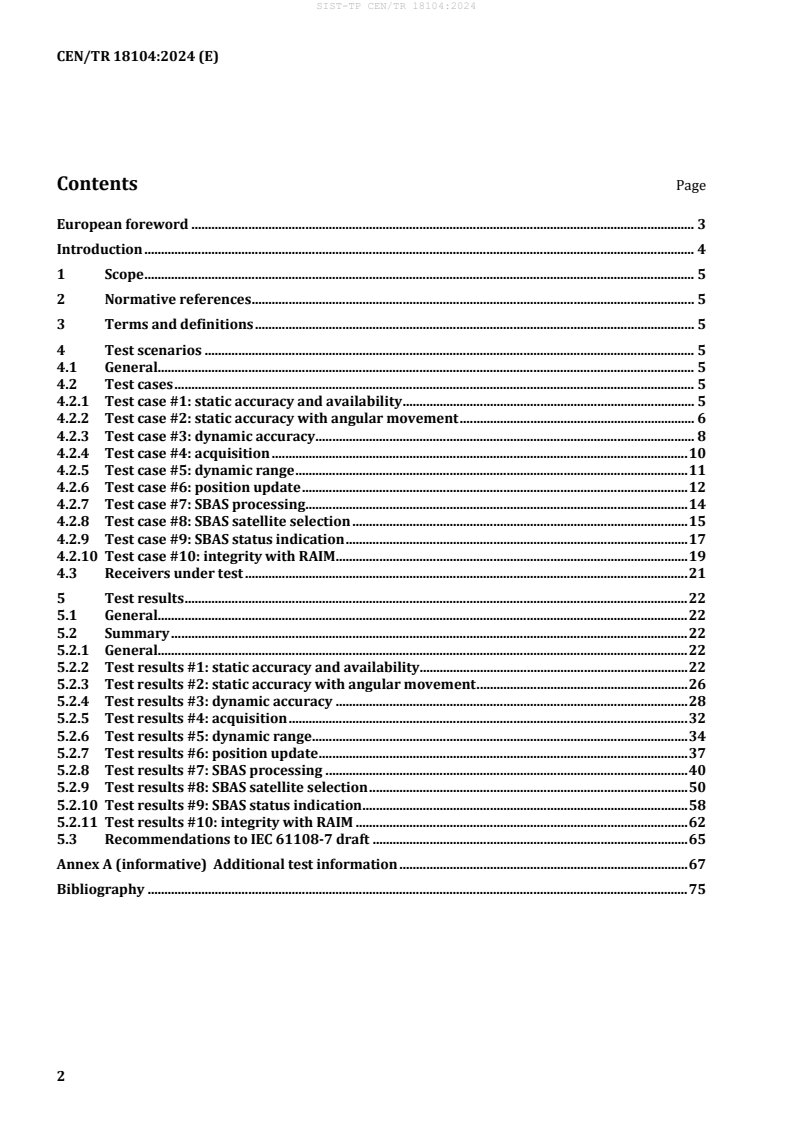
Contents Page
European foreword . 3
Introduction . 4
1 Scope . 5
2 Normative references . 5
3 Terms and definitions . 5
4 Test scenarios . 5
4.1 General. 5
4.2 Test cases . 5
4.2.1 Test case #1: static accuracy and availability . 5
4.2.2 Test case #2: static accuracy with angular movement . 6
4.2.3 Test case #3: dynamic accuracy . 8
4.2.4 Test case #4: acquisition . 10
4.2.5 Test case #5: dynamic range . 11
4.2.6 Test case #6: position update . 12
4.2.7 Test case #7: SBAS processing . 14
4.2.8 Test case #8: SBAS satellite selection . 15
4.2.9 Test case #9: SBAS status indication . 17
4.2.10 Test case #10: integrity with RAIM . 19
4.3 Receivers under test . 21
5 Test results . 22
5.1 General. 22
5.2 Summary . 22
5.2.1 General. 22
5.2.2 Test results #1: static accuracy and availability . 22
5.2.3 Test results #2: static accuracy with angular movement . 26
5.2.4 Test results #3: dynamic accuracy . 28
5.2.5 Test results #4: acquisition . 32
5.2.6 Test results #5: dynamic range . 34
5.2.7 Test results #6: position update . 37
5.2.8 Test results #7: SBAS processing . 40
5.2.9 Test results #8: SBAS satellite selection . 50
5.2.10 Test results #9: SBAS status indication . 58
5.2.11 Test results #10: integrity with RAIM . 62
5.3 Recommendations to IEC 61108-7 draft . 65
Annex A (informative) Additional test information . 67
Bibliography . 75
European foreword
This document (CEN/TR 18104:2024) has been prepared by Technical Committee CEN/JTC 5 “Space”,
the secretariat of which is held by BNAE.
Attention is drawn to the possibility that some of the elements of this document may be the subject of
patent rights. CEN shall not be held responsible for identifying any or all such patent rights.
Any feedback and questions on this document should be directed to the users’ national standards body.
A complete listing of these bodies can be found on the CEN website.
Introduction
This technical document MARESS D2.2 has been prepared by European Satellite Services Provider
(ESSP) in the scope of MARitime Receiver SBAS Standardization (MARESS) project to support
International Standard IEC 61108-7 for SBAS receiver equipment. The purpose of this document is to
present it in CEN/CENELEC JTC5/WG8 working group to support standardization process within
IEC technical committee 80: Maritime navigation and radiocommunication equipment and systems.
Note at the time of the Publication: The outcome of this report has been already considered in the
development of the IEC 61108-7 standard. This implies that these results are obsolete since in the
current version of the IEC 61108-7 some requirements and tests have been updated.
1 Scope
The objective of this document is to present the results of the tests defined in the IEC 61108-7 draft [1]
performed with a maritime receiver updated based on the SBAS maritime guidelines [2] and other GNSS
SBAS receivers.
The list of test scenarios prepared, the receiver analysed, the configuration used and procedures are
included in Clause 4. In Clause 5, graphical and numerical results for each of the test performed are
presented, including if the tests are passed or failed. Annex A provides additional information on the
test case setup.
2 Normative references
There are no normative references in this document.
3 Terms and definitions
No terms and definitions are listed in this document.
ISO and IEC maintain terminology databases for use in standardization at the following addresses:
— ISO Online browsing platform: available at https://www.iso.org/obp/
— IEC Electropedia: available at https://www.electropedia.org/
4 Test scenarios
4.1 General
The test scenarios implemented in MARESS project have been based on the MARESS deliverable D2.1
Methods of testing and required results [1].
In this Clause, all the tests performed are listed including the respective configuration used. All the tests
have been prepared to process GPS L1 and SBAS L1.
The following information can be found for each of the tests executed:
• start date: indicate the start date of the scenario under test;
• duration: indicate the duration of the test;
• signal source: specify if the receiver was connected to real signals with a GNSS antenna in ESSP roof
(Madrid) or if the GNSS simulator has been used to generate the GNSS and SBAS signals;
• data source: indicate if real data has been used as input (GPS RINEX and EGNOS EMS files); or the
data has been automatically generated by the GNSS simulator (synthetic data);
• receiver position: provides the position of the receiver (real or simulated);
• specific configuration related with the objective of the test;
• outputs to be analysed: list of parameters to be retrieved from the receiver under test to check if the
test is passed/failed.
4.2 Test cases
4.2.1 Test case #1: static accuracy and availability
The objective of this test is to check the static accuracy and availability of the receiver when providing
SBAS PVT solution.
Table 1 provides specific information on the test characteristics and configuration:
Table 1 — Test case #1 — Scenario configuration
Start date N/A (variable)
Duration > 86 400 epochs
Signal source Real RF L1 Signal
Data source Real Data
Receiver position Lat = 40.472°
Lon = −3.452°
Height = 661,1 m
Specific configuration NMEA output rate: 1 Hz
Static receiver
Outputs Epoch
PVT solution mode
Position
All the outputs from the receivers are obtained through NMEA messages.
The start date is variable since it depends on when the receiver was connected to the antenna located in
the roof of ESSP premises in Madrid.
The results of this test are included in subclause 5.2.1.
4.2.2 Test case #2: static accuracy with angular movement
The objective of this test is to check the static accuracy and availability of the receiver providing SBAS
PVT solution when the antenna is performing an angular displacement of 22.5°, simulating roll, in a
period of 8 s during the duration of the test.
Table 2 provides specific information on the test characteristics and configuration.
Table 2 — Test case #2 — Scenario configuration
Start date 02-Apr-2021 23:50:00
Duration 87 000 epochs
Signal source GNSS simulator
Data source Synthetic data
Receiver position Lat = 40.467°
Lon = −3.45°
Height = 661,28 m
Specific configuration NMEA output rate: 1 Hz
Static receiver
Antenna with angular
movement (±22.5° during
8 seconds).
Outputs Epoch
PVT solution mode
Position
Figure 1 shows a snapshot of the antenna movement configured in the GNSS simulator.
Figure 1 — Snapshot of GNSS simulator for antenna movement
Errors have not been introduced in the GPS signals and so, the position error is expected to be more
accurate compared to a real scenario. However, the objective of the test is to check that the error is not
increased when the antenna performs the angular movements in comparison with a nominal static
scenario.
All the outputs from the receivers are obtained through NMEA messages.
The results of this test are included in subclause 5.2.2.
4.2.3 Test case #3: dynamic accuracy
4.2.3.1 General
The objective of this test is to check the dynamic accuracy of the receiver providing SBAS PVT solution.
Table 3 provides specific information on the test characteristics and configuration.
Table 3 — Test case #3 — Scenario configuration
Start date 03-Apr-2021 00:00:00
Duration 86 400 epochs
Signal source GNSS simulator
Data source Synthetic data
Receiver position Dynamic position (refer to
Table 4)
Specific configuration NMEA output rate: 1 Hz
Receiver in movement (refer
to Table 4)
Outputs Epoch
PVT solution mode
Position
Truth position (from GNSS
simulator)
The minimum requirement for the receiver movement described in D2.1 [1] is:
1. A fully locked and settled EUT travelling in a straight line at 48 kn ± 2 kn for a minimum of
1,2 minutes which is reduced to 0 kn in the same straight line in 5 s.
In order to comply with this, the receiver in the GNSS simulator has been configured to perform the
following movements:
Table 4 — Test case #3 — Ship movement configuration
Ship dynamics Period of time
Start position (step 0) Lat = 41.517° N/A
Lon = 3.65°
Height = 300 m
Step 1 Ship in halt 300 s
Step 2 Ship accelerating (max speed 60 s
25 m/s)
Step 3 Ship at constant speed (25 m/s) 120 s
Step 4 Ship reduce velocity until it stops 5 s
(0 m/s)
Step 5 Ship in halt 120 s
Step 6 Repeat steps 2, 3, 4 and 5
consecutively.
It is clarified that the ship movement configured is only at horizontal level.
In addition, the latitude of the receiver position is maintained during the whole scenario, the movement
described in previous table only implies changes in the longitude.
Figure 2 shows a snapshot of the ship trajectory configured in the GNSS simulator.
Figure 2 — Snapshot of ship trajectory for dynamic movement scenario
Errors have not been introduced in the GPS signals and so, the position error is expected to be more
accurate compared to a real scenario. However, the objective of the test is to check that the receiver
follows the dynamics of the ship. Nevertheless, in order to ensure that the receiver will correctly pass
the test under a more realistic scenario. A Test case #3b was prepared (refer to subclause 4.2.3.1).
All the outputs from the receivers are obtained through NMEA messages. In this case, the GNSS
simulator has been configured to provide also the truth position (through NMEA) during the whole
scenario.
The results of this test are included in subclause 5.2.2.
4.2.3.2 Test case #3b: dynamic accuracy with input files
This test case was performed in order to check if the receiver correctly follows the ship dynamics when
GPS RINEX and EGNOS EMS real data are used as input files in the GNSS simulator.
However, during the scenario executions, a limitation was found on the GNSS simulator. If real data are
used as input, the GNSS simulator uses the GPS RINEX files for two purposes:
1. include the RINEX content into the GPS navigation messages;
2. generate the real GPS orbits.
Since the GNSS simulator uses the GPS RINEX, where the GPS messages have ephemeris/clock errors
that SBAS will correct, to generate the real GPS orbits in the simulation, the SBAS corrections are not
needed. Indeed, SBAS corrections increase the error in the position since SBAS is correcting errors that
do not exist in the simulation. The same situation it occurs with the ionosphere, since the ionosphere
generated by the simulator does not match with the ionospheric corrections delivered by SBAS.
The GNSS simulator manufacturer was contacted to correct this issue, but it is confirmed that this is a
limitation from the GNSS simulator.
In any case, this can be considered as a worst-case scenario, and so, it can be used to validate the test
under analysis.
Table 5 provides specific information on the test characteristics and configuration:
Table 5 — Test case #3b — Scenario configuration
Start date 03-Apr-2021 00:00:00
Duration 86 400 epochs
Signal source GNSS simulator
Data source Real data
Receiver position Dynamic position (refer to Table 4)
Specific configuration NMEA output rate: 1 Hz
Receiver in movement (refer to Table 4)
Outputs Epoch
PVT solution mode
Position
Truth position (from GNSS simulator)
All the outputs from the receivers are obtained through NMEA messages. In this case, the GNSS
simulator has been configured to provide also the truth position (through NMEA) during the whole
scenario.
The results of this test are included in subclause 5.2.3.1.
4.2.4 Test case #4: acquisition
The objective of this test is to check the acquisition time required by the receiver to provide SBAS PVT
solution.
Table 6 provides specific information on the test characteristics and configuration.
Table 6 — Test case #4 — Scenario configuration
Start date N/A (variable)
Duration > 86 400 epochs
Signal source Real RF L1 Signals
Data source Real data
Receiver position Lat = 40.472°
Lon = −3.452°
Height = 661,1 m
Specific configuration NMEA output rate: 1 Hz
Static receiver
Outputs Epoch
PVT solution mode
Position
Since the requirement included in D2.1 [1] refers to acquisition time when there is valid almanac, the
test has been done based on the following steps:
1. wait for the receiver to provide SBAS PVT solution;
2. remove connection to the antenna between 24 and 25 hours;
3. connect again the antenna to the receiver under test;
4. check the time required from connection to provide SBAS PVT solution.
All the outputs from the receivers are obtained through NMEA messages.
The start date is variable since it depends on when the receiver was connected to the antenna located in
the roof of ESSP premises in Madrid.
The results of this test are included in subclause 5.2.4.
4.2.5 Test case #5: dynamic range
This test is aimed at checking that the receiver is able to track the SBAS signal between the maximum
and minimum power levels indicated in D2.1 [1].
Table 7 provides specific information on the test characteristics and configuration.
Table 7 — Test case #5 — Scenario configuration
Start date 03-Apr-2021 00:00:00
Duration 1 800 epochs
Signal source GNSS simulator
Data source Synthetic data
Receiver position Lat = 40.467°
Lon = −3.45°
Height = 661,28 m
Specific configuration NMEA output rate: 1 Hz
Static receiver
2 SBAS PRNs
Signal power modified during
scenario (refer to Table 8)
Outputs Epoch
PVT solution mode
C/N
In this scenario, two SBAS PRNs have been configured: PRN 123 and PRN 136 (corresponding to EGNOS
SBAS). In order to ensure that the receiver complies with the requirement, the signal power of the SBAS
satellites has been modified during the execution. The test has been done based on the following steps:
Table 8 — Test case #5 — SBAS signal power modifications
PRN 123 PRN 136
Start – 00:00:00 −120 dBm −130 dBm
Step 1 – 00:10:00 −123 dBm −133 dBm
Step 2 – 00:12:00 −130 dBm −120 dBm
Step 3 – 00:14:00 −133 dBm −133 dBm
All the outputs from the receivers are obtained through NMEA messages.
The results of this test are included in subclause 5.2.5.
4.2.6 Test case #6: position update
4.2.6.1 General
The objective of this test is to check that receiver provides SBAS PVT solution at the required rate.
Two different sub test cases are identified to check the position update requirement, one related with
low-speed crafts and other one for high-speed crafts.
4.2.6.2 Test case #6a: low-speed crafts
Table 9 provides specific information on the test characteristics and configuration.
Table 9 — Test case #6a — Scenario configuration
Start date 03-Apr-2021 00:00:00
Duration 1 101 epochs
Signal source GNSS simulator
Data source Synthetic data
Receiver position Dynamic position (refer to
Table 10)
Specific configuration NMEA output rate: 1 Hz
Receiver in movement (refer
to Table 10)
Outputs Epoch
PVT solution mode
Position
In D2.1 [1] is required to perform the test with a receiver travelling in a straight line at 5 kn ± 1 knot. In
order to comply with this, the receiver in the GNSS simulator has been configured to perform the
following movements:
Table 10 — Test case #6a — Low ship movement
Ship dynamics Period of time
Step 1 Ship in halt 300 s
Step 2 Ship accelerating (max speed 2’5 m/s) 1 s
Step 3 Ship at constant speed (2’5 m/s) 800 s
It is clarified that the ship movement configured is only at horizontal level.
In addition, the latitude of the receiver position is maintained during the whole scenario, the movement
described in previous table only implies changes in the longitude.
All the outputs from the receivers are obtained through NMEA messages.
The results of this test are included in subclause 5.2.6.1.
4.2.6.3 Test case #6b: high-speed crafts
Table 11 provides specific information on the test characteristics and configuration.
Table 11 — Test case #6b — Scenario configuration
Start date 03-Apr-2021 00:18:21
Duration 1 101 epochs
Signal source GNSS simulator
Data source Synthetic data
Receiver position Dynamic position (refer to
Table 12)
Specific configuration NMEA output rate: 1 Hz
Receiver in movement (refer
to Table 12)
Outputs Epoch
PVT solution mode
Position
In D2.1 [1] is required to perform the test with a receiver travelling in a straight line at
50 knots ± 5 knots. In order to comply with this, the receiver in the GNSS simulator has been configured
to perform the following movements:
Table 12 — Test case #6b — High ship movement
Ship dynamics Period of time
Step 1 Ship in halt 300 s
Step 2 Ship accelerating (max speed 25 m/s) 1 s
Step 3 Ship at constant speed (25 m/s) 800 s
It is clarified that the ship movement configured is only at horizontal level.
In addition, the latitude of the receiver position is maintained during the whole scenario, the movement
described in previous table only implies changes in the longitude.
All the outputs from the receivers are obtained through NMEA messages.
The results of this test are included in subclause 5.2.6.2.
4.2.7 Test case #7: SBAS processing
The aim of this test is to check that the receiver correctly processes the SBAS data and messages
according with the requirements stated in D2.1 [1].
Table 13 provides specific information on the test characteristics and configuration.
Table 13 — Test case #7 — Scenario configuration
Start date 03-Apr-2021 00:00:00
Duration 4 500 epochs
Signal source GNSS simulator
Data source Real data
Receiver position Lat = 40.467°
Lon = −3.45°
Height = 661,28 m
Specific configuration NMEA output rate: 1 Hz
EGNOS messages modified
(refer to Table 14)
Outputs Epoch
PVT solution mode
Position
In order to follow all the steps identified in subclause 6.6.12 from D2.1 [1], the EGNOS EMS file used as
input to feed the GNSS simulator was modified. Table 14 identifies all the steps performed in the EGNOS
messages and signals transmitted by the GNSS simulator.
Table 14 — Test case #7 — Signal types configuration
Signal type Comment
Step 1 – 00:00:00 N/A GPS signals on (HDOP < 4)
Step 2 – 00:05:00 Signal A SBAS signal on
Step 3 – 00:10:01 Signal D MT0 is transmitted by SBAS
Step 4 – 00:10:22 Signal A Nominal signal
Step 5 – 00:16:27 Signal I IODP not match
Step 6 – 00:16:50 Signal A Nominal signal
Step 7 – 00:23:01 Signal L Fast Corrections set to
255’875 m
Step 8 – 00:23:18 Signal A Nominal signal
Step 9 – 00:24:59 Signal E All UDREI set to 12
Signal type Comment
Step 10 – 00:25:18 Signal A Nominal signal
Step 11 – 00:30:30 Signal J Some IOD not match
Step 12 – 00:37:11 Signal A Nominal signal
Step 13 – 00:42:42 Signal K Ship outside MT27 area
Step 14 – 00:45:58 Signal A Nominal signal
Step 15 – 00:48:02 Signal M IODI not match
Step 16 – 01:00:00 Signal A Nominal signal
Step 17 – 01:05:01 Signal N Fast Corrections Update
Interval set to 60 s
Step 18 – 01:06:00 Signal O Fast corrections update
interval set to 60 s and fast
corrections degradation factor
(ai ) set to 0
i
Step 19 – 01:07:04 Signal A Nominal signal
Step 20 – 01:12:01 Signal P MT6 messages with all UDREI
set to 14 but IODFs do not
match
For further information on the modifications performed within the EGNOS message content, including
the epochs affected, etc. Please refer to Annex A.1.
All the outputs from the maritime receivers are obtained through NMEA messages. In the case of
certified aviation receivers, the outputs are received in ARINC 429 format.
The results of this test are included in subclause 5.2.7.
4.2.8 Test case #8: SBAS satellite selection
4.2.8.1 General
This test is aimed at checking that the receiver is capable of tracking and processing two SBAS data
streams if they are available, as well as switching from one stream to another to maximize the
continuity of the service.
In order to check that the receiver can comply with the requirement, two different sub test cases are
created, one related with two SBAS satellites belonging to the same service provider and other one with
two SBAS satellites belonging to different service providers.
4.2.8.2 Test case #8a: Same service provider
Table 15 provides specific information on the test characteristics and configuration:
Table 15 — Test case #8a — Scenario configuration
Start date 03-Apr-2021 00:00:00
Duration 1 800 epochs
Signal source GNSS simulator
Data source Synthetic data
Receiver position Lat = 40.467°
Lon = −3.45°
Height = 661,28 m
Specific configuration NMEA output rate: 1 Hz
Static receiver
2 SBAS PRNs from same SP
Signal power modified during
scenario (refer to Table 16)
Outputs Epoch
PVT solution mode
C/N
In this scenario, two SBAS PRNs have been configured: PRN 123 and PRN 136, both corresponding to
EGNOS SBAS satellites. The receiver under test use in the PVT solution the PRN 136, so, in order to
ensure that the receiver complies with the requirement; the signal of the SBAS satellite with PRN 136
was removed during a specific period of time. The test has been done based on the following steps:
Table 16 — Test case #8a — SBAS signals
PRN 123 PRN 136
Start – 00:00:00 Signal On Signal On
Step 1 – 00:10:00 Signal On Signal Off
Step 2 – 00:15:00 Signal On Signal On
All the outputs from the maritime receivers are obtained through NMEA messages. In the case of
certified aviation receivers, the outputs are received in ARINC 429 format.
The results of this test are included in subclause 5.2.8.1.
4.2.8.3 Test Case #8b: Different service provider
Table 17 provides specific information on the test characteristics and configuration.
Table 17 — Test case #8b — Scenario configuration
Start date 03-Apr-2021 00:00:00
Duration 73 800 epochs
Signal source GNSS simulator
Data source Synthetic data
Receiver position Lat = 50°
Lon = 15°
Height = 41,87 m
Specific configuration NMEA output rate: 1 Hz
Static receiver
2 SBAS PRNs from different
SP
Signal power modified during
scenario (refer to Table 18)
Outputs Epoch
PVT solution mode
C/N
In this scenario, two SBAS PRNs have been configured: PRN 136 and PRN 125, corresponding to an
EGNOS satellite and a SDCM satellite respectively. It is clarified that synthetic data have been used in
this test case and so, PRN 125 is not transmitting the MT0.
The test has been performed based on the following steps:
Table 18 — Test case #8b — SBAS signals
PRN 136 PRN 125
Start – 00:00:00 Signal On Signal On
Step 1 – 12:00:00 Signal Off Signal On
Step 2 – 12:20:00 Signal On Signal On
Step 3 – 13:00:00 Signal On Signal Off
Step 4 – 13:20:00 Signal On Signal On
All the outputs from the maritime receivers are obtained through NMEA messages. In the case of
certified aviation receivers, the outputs are received in ARINC 429 format.
The results of this test are included in subclause 5.2.8.2.
4.2.9 Test case #9: SBAS status indication
This test is intended to check that SBAS status indicators are provided according with the requirements
from D2.1 [1].
Table 19 provides specific information on the test characteristics and configuration.
Table 19 — Test case #9 — Scenario configuration
Start date 03-Apr-2021 01:30:00
Duration 3 600 epochs
Signal source GNSS simulator
Data source Real data
Receiver position Lat = 40.467°
Lon = −3.45°
Height = 661,28 m
Specific configuration NMEA output rate: 1 Hz
EGNOS messages modified
(refer to Table 20)
Outputs Epoch
PVT solution mode
Position
As per the test case #7, in this test case, the EGNOS EMS file used as input to feed the GNSS simulator
was modified. Table 20 identifies all the steps performed in the EGNOS messages and signals
transmitted by the GNSS simulator (indeed, to reduce time of execution, this scenario has been used as
the continuation of test case #7 execution).
Table 20 — Test case #9 — Signal types configuration
Signal Type Comment
Step 1 – 01:30:00 Signal A Nominal signal
Step 2 – 01:59:59 Signal C Invalid CRC
Step 3 – 02:00:09 Signal A Nominal signal
Step 4 – 02:04:59 Signal D MT0
Step 5 – 02:05:05 Signal A Nominal signal
Step 6 – 02:10:00 Signal F All UDREI set to 14
Step 7 – 02:10:11 Signal A Nominal signal
Step 8 – 02:14:59 Signal G Alerts with UDREI set to 15
Step 9 – 02:15:08 Signal A Nominal signal
Step 10 – 02:19:59 Signal H All GIVEI set to 15 and vertical
delay set to 63’875 m
Step 11 – 02:20:39 Signal A Nominal signal
For further information on the modifications performed within the EGNOS message content, including
the epochs affected, etc. Please refer to Annex A.2.
All the outputs from the maritime receivers are obtained through NMEA messages. In the case of
certified aviation receivers, the outputs are received in ARINC format.
The results of this test are included in subclause 5.2.9.
4.2.10 Test case #10: integrity with RAIM
4.2.10.1 General
The objective of this test is to check if the EUT correctly performs RAIM computation providing the
corresponding integrity status.
As defined in D2.1 [1], there are three status for integrity status: Safe, Caution and Unsafe. In order to
test all the cases, two sub test cases have been prepared, one to check transitions from safe to caution
and another one to test transition from safe to unsafe.
4.2.10.2 Test case #10a: RAIM caution flag
Table 21 provides specific information on the test characteristics and configuration.
Table 21 — Test case #10a — Scenario configuration
Start date 03-Apr-2021 01:05:00
Duration 1 800 epochs
Signal source GNSS simulator
Data source Real data
Receiver position Lat = 40.467°
Lon = −3.45°
Height = 661,28 m
Specific configuration NMEA output rate: 1 Hz
Some signals from GPS are
removed (refer to Table 22)
GPS monitored by SBAS are
reduced (refer to Table 22)
Outputs Epoch
PVT solution mode
Number of SV used in PVT
RAIM status
In order to test that the EUT correctly provides the RAIM caution flag, on one side, some signals from
GPS satellites provided by the GNSS simulator are removed, on the other side, since the receiver uses
the integrity information provided by SBAS for RAIM SBAS-based position, GPS satellites monitored by
SBAS are reduced (this is done modifying the EGNOS EMS file). Table 22 provides the steps that have
been performed for this test.
Table 22 — Test case #10a — Signal types configuration
Modification
Step 1 – 01:10:00 GPS signals from all satellites
are removed but GPS PRN 2, 3,
9 and 19.
Step 2 – 01:14:00 GPS PRN 4 restarts
transmission
Modification
Step 3 – 01:14:20 GPS PRN 6 restarts
transmission
Step 4 – 01:14:40 Rest of GPS satellites restart
transmission
Step 5 – 01:20:00 GPS satellites monitored by
EGNOS are reduced to four
Step 6 – 01:25:00 GPS satellites monitored by
EGNOS are recovered to
nominal value
All the outputs from the receivers are obtained through NMEA messages.
The results of this test are included in subclause 5.2.10.1.
4.2.10.3 Test case #10b: RAIM unsafe flag
Table 23 provides specific information on the test characteristics and configuration.
Table 23 — Test case #10b — Scenario configuration
Start date 03-Apr-2021 02:30:00
Duration 5 700 epochs
Signal source GNSS simulator
Data source Real data
Receiver position Lat = 40.467°
Lon = −3.45°
Height = 661,28 m
Specific configuration NMEA output rate: 1 Hz
Accuracy level set to 10 m
Some clock errors in GPS are
introduced (refer to Table 24)
Some SBAS clock corrections
error are introduced (refer to
Table 24)
Outputs Epoch
PVT solution mode
RAIM status
Position
In order to test that the EUT correctly provides the RAIM unsafe flag, an error in the estimated position
bigger than 10 meters needs to be introduced. For that purpose, on one side, some clock errors are
introduced in the GPS satellites provided by the GNSS simulator, on the other side, since the receiver
uses the pseudo-range corrections provided by SBAS for RAIM SBAS-based position, clock correction
errors are introduced in SBAS messages (this is done modifying the EGNOS EMS file). Table 24 provides
the steps that have been performed for this test:
Table 24 — Test case #10b — Signal types configuration
Modification
Step 1 – 03:00:00 Errors in SBAS clock
corrections for GPS satellites
2, 4, 5, 6, 7 and 9 are
introduced.
Step 2 – 03:05:00 SBAS clock corrections are
back to nominal values
Step 3 – 04:00:00 GPS clock errors are
introduced in GPS navigation
messages for satellites 2, 3, 5,
7, 9, 13, 14.
All the outputs from the receivers are obtained through NMEA messages.
The results of this test are included in subclause 5.2.10.1.
4.3 Receivers under test
A NAMELESS-1 receiver (RC01) upgraded according to the SBAS guidelines [2] was agreed to be used in
MARESS project.
Unfortunately, some issues were identified in the behaviour of the NAMELESS-1 receiver that prevented
the correct test execution and validation. In order to not block the project and the test implementation,
it was decided to use, in addition to the NAMELESS-1 receiver, another maritime receiver (RC02)
capable of processing SBAS.
Considering that the other GNSS maritime receiver was not developed based on the SBAS L1 maritime
guidelines [2], some tests are expected to fail. It is clarified that having test failed do not imply that the
test is not correctly described/implemented, but that at the time of writing the standard, there were no
receivers compliant with these new requirements.
Since some SBAS tests are expected to fail with the RC02 receiver, a third receiver was used in order to
ensure that the SBAS tests were correctly defined. In this case, a certified aviation receiver (RC03) was
used. This aviation receiver is compliant with RTCA MOPS DO-229 [3]. Note that only the tests related
with the SBAS satellite selection and SBAS processing are executed for this receiver, since these are the
tests that are not expected to be passed by RC02.
Table 25 includes a summary of the GNSS receivers used in the test execution.
Table 25 — Receivers under test
RC01 RC02 RC03
Maritime receiver Maritime receiver Aviation receiver
(GPS L1 + SBAS L1) upgraded (GPS L1 + SBAS L1) not (GPS L1 + SBAS L1) compliant
based on maritime SBAS L1 updated based on maritime with RTCA MOPS DO-229
guidelines SBAS L1 guidelines
5 Test results
5.1 General
In this Clause, the results obtained during the test implementation are presented. First a summary table
with the test status is presented (PASSED/FAILED). Then, the corresponding outputs for each of the test
performed are presented and the test status is described based on results obtained.
5.2 Summary
5.2.1 General
Table 26 includes a summary of the test results for each of the test cases and receivers used.
Table 26 — Summary test results
Test case Title RC01 RC02 RC03
1 Static accuracy and Failed Passed N/A
availability
2 Static accuracy with Failed Passed N/A
angular movement
3 Dynamic accuracy Failed Passed N/A
3b Dynamic accuracy with Failed Passed N/A
input files
4 Acquisition Failed Passed N/A
5 Dynamic range Failed Passed N/A
6a Position update for Failed Passed N/A
low-speed craft
6b Position update for Failed Passed N/A
high-speed craft
7 SBAS processing Failed Failed Passed with
clarification
8a SBAS satellite selection Failed Failed Passed
with same SP
8b SBAS satellite selection Failed Failed Failed with
with diff SP clarification
9 SBAS status indication Failed Failed Passed with
clarification
10a Integrity with RAIM – Failed Passed with N/A
Caution flag clarification
10b Integrity with RAIM – Failed Passed with N/A
Unsafe flag clarification
5.2.2 Test results #1: static accuracy and availability
In this test, two outputs are gathered from the receiver in order to check if the test is passed or failed:
the estimated position compared with the true position and the availability of the PVT solution.
It is clarified that the test is not performed from the moment the receiver is connected to the antenna.
The first minutes of execution are not included in the analysis to let the receiver track the satellites and
the algorithms to converge in order to provide PVT solution.
The objective of the test is then twofold:
• the distribution of the horizontal error is within 10 m (95 %), having discarded measurements
taken in conditions of HDOP ˃ 4 and PDOP ˃ 6;
• given a scenario where all the conditions required for SBAS position (i.e. SBAS signal in space, valid
SBAS corrections, at least 4 monitored GPS satellites, etc.) are available at 100 %, the SBAS receiver
equipment continuously provides SBAS position after SBAS position acquisition time over the whole
test period.
Figure 3 and Figure 4 show the results obtained with the RC01 receiver:
Figure 3 — RC01 horizontal error test case #1
Figure 4 — RC01 PVT mode and Horizontal Position Error (HPE) test case #1
Figure 3 shows that the horizontal error at 95 percentile provided by the receiver, 1,31 meters, is below
the test threshold which is 10 meters. However, Figure 4 indicates that from 19:38:40 until 21:14:54
(GPS time) the receiver is not providing any position solution. It has not been possible to identify the
reason that makes the receiver to stop providing any type of solution (SBAS or GPS only) and so, the
test result is failed. It is noted that this type of behaviour occurs in the majority of the scenarios
executed with the RC01, the receiver manufacturer was contacted to try to fix the issue without success.
As indicated above, since the RC01 was not correctly performing, the RC02 was also used to execute the
test case #1. Figure 5 and Figure 6 show the results obtained with the RC02 receiver:
Figure 5 — RC02 horizontal error test case #1
Figure 6 — RC02 PVT mode and Horizontal Position Error (HPE) test case #1
As it can be seen in Figure 6, the PVT mode reported by the RC02 is always PVT = 2, which implies that
SBAS solution is always provided, so the availability of the SBAS PVT solution is 100 % during the whole
day under test. In addition, in Figure 5, the horizontal error is displayed where also the 95-Percentile
Horizontal Error is provided. The 95-percentile horizontal error obtained is 0.645 m, which is far below
the threshold required by the test, 10 m.
So, based on the results and analysis provided, Table 27 summarizes the test results status.
Table 27 — Test case #1 — Results
RC01 RC02 RC03
FAILED PASSED N/A
5.2.3 Test results #2: static accuracy with angular movement
The first ten minutes of execution of the test are used for tracking and convergence time, the scenario
results are based on the period between 03-Apr-2021 00:00:00 and 03-Apr-2021 23:59:59 (GPS time).
In this test, two outputs are gathered from the receiver in order to check if the test is passed or failed:
the estimated position compared with the true position and the availability of the PVT solution.
Figure 7 below shows the results obtained with the RC01 receiver:
Figure 7 — RC01 PVT mode and Horizontal Position Error (HPE) test case #2
Figure 7 shows that the RC01 was not capable of providing any type of solution during the whole
scenario execution, so the test result can be set as failed.
As indicated above, since the RC01 was not correctly performing, the RC02 was also used to execute the
test case #2. Figure 8 and Figure 9 show the results obtained with the RC02 receiver:
Figure 8 — R
...