

SIST EN 60761-3:2005
(Main)Equipment for continuous monitoring radioactivity in gaseous effluents -- Part 3: Specific requirements for radioactive noble gas monitors
General Information
- Abstract
Lays down specific standard requirements, including technical characteristics and general test conditions, and gives examples of acceptable methods for noble gas effluent monitors.
- Status
- Published
- Publication Date
- 30-Jun-2005
- Current Stage
- 6060 - National Implementation/Publication (Adopted Project)
- Start Date
- 01-Jul-2005
- Due Date
- 01-Jul-2005
- Completion Date
- 01-Jul-2005

Overview
EN 60761-3:2004 (CLC) - "Equipment for continuous monitoring radioactivity in gaseous effluents - Part 3: Specific requirements for radioactive noble gas monitors" - sets specific requirements for continuous monitoring systems that detect radioactive noble gases in gaseous effluents. Adopted from IEC 60761-3:2002 and approved by CENELEC in 2004, the standard complements the general requirements in EN 60761-1 by focusing on noble gas monitors used for stack and environmental emission monitoring.
Key Topics
The standard covers practical and technical aspects relevant to noble gas effluent monitoring, including:
- Technical characteristics of noble gas monitors (performance and design expectations)
- General test conditions for type and acceptance testing (environmental, mechanical and electromagnetic conditions)
- Examples of acceptable measurement methods and sampling approaches for radioactive noble gases (e.g., krypton, xenon)
- Performance considerations such as sensitivity, response time, calibration and detection capability (qualitative guidance)
- Operational requirements for continuous, reliable monitoring in nuclear and industrial stacks
- Normative references for testing and compatibility, including EMC and environmental test procedures
(EN 60761-3 references foundational documents such as IEC 60761-1, IEC 60068-2-27 for shock testing, IEC 61000 series for EMC and related EMC/EMI standards.)
Applications
EN 60761-3 is intended for organizations that design, supply, specify or operate continuous noble gas monitoring systems:
- Nuclear power plants and reactor facilities for stack emission control
- Fuel reprocessing and isotope production facilities where noble gas releases are monitored
- Environmental and regulatory monitoring agencies that specify acceptance criteria for effluent monitors
- Instrumentation manufacturers and test laboratories developing or certifying noble gas detectors
- Radiation protection and health physics teams responsible for monitoring and reporting gaseous releases
Practical benefits include clearer procurement specifications, harmonized test procedures for acceptance, improved comparability of detector performance, and support for regulatory compliance and reporting.
Related Standards
- EN 60761-1: General requirements for equipment for continuous monitoring radioactivity in gaseous effluents
- IEC 60761-3:2002 (original international text)
- IEC 60068-2-27: Environmental testing (shock)
- IEC 61000 series: Electromagnetic compatibility (EMC)
- EN 55022: Limits and methods of measurement of radio disturbance characteristics (historical reference)
EN 60761-3 helps ensure robust, repeatable, and compliant monitoring of radioactive noble gases in gaseous effluents, supporting safety, regulatory compliance and operational decision-making.
Relations
- Effective Date
- 03-Feb-2026
- Effective Date
- 03-Feb-2026
- Effective Date
- 03-Feb-2026
Get Certified
Connect with accredited certification bodies for this standard

BSMI (Bureau of Standards, Metrology and Inspection)
Taiwan's standards and inspection authority.
CIS Institut d.o.o.
Personal Protective Equipment (PPE) certification body. Notified Body NB-2890 for EU Regulation 2016/425 PPE.

Kiwa BDA Testing
Building and construction product certification.
Sponsored listings
Frequently Asked Questions
SIST EN 60761-3:2005 is a standard published by the Slovenian Institute for Standardization (SIST). Its full title is "Equipment for continuous monitoring radioactivity in gaseous effluents -- Part 3: Specific requirements for radioactive noble gas monitors". This standard covers: Lays down specific standard requirements, including technical characteristics and general test conditions, and gives examples of acceptable methods for noble gas effluent monitors.
Lays down specific standard requirements, including technical characteristics and general test conditions, and gives examples of acceptable methods for noble gas effluent monitors.
SIST EN 60761-3:2005 is classified under the following ICS (International Classification for Standards) categories: 13.280 - Radiation protection; 17.240 - Radiation measurements. The ICS classification helps identify the subject area and facilitates finding related standards.
SIST EN 60761-3:2005 has the following relationships with other standards: It is inter standard links to SIST EN 60761-1:2005, SIST EN 60068-2-27:2001, SIST EN IEC 62705:2026. Understanding these relationships helps ensure you are using the most current and applicable version of the standard.
SIST EN 60761-3:2005 is available in PDF format for immediate download after purchase. The document can be added to your cart and obtained through the secure checkout process. Digital delivery ensures instant access to the complete standard document.
Standards Content (Sample)
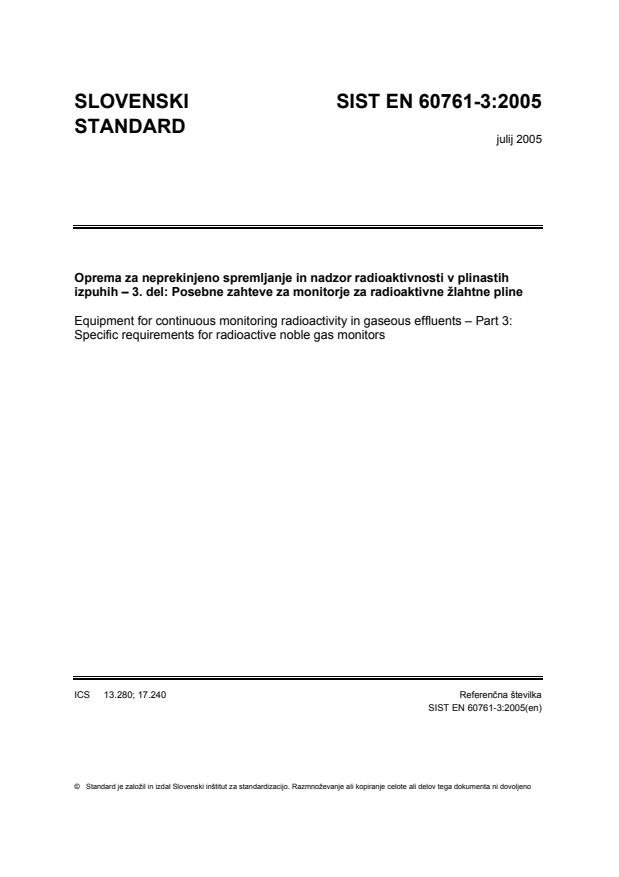
STANDARDOprema za neprekinjeno spremljanje in nadzor radioaktivnosti v plinastih izpuhih – 3. del: Posebne zahteve za monitorje za radioaktivne žlahtne plineEquipment for continuous monitoring radioactivity in gaseous effluents – Part 3: Specific requirements for radioactive noble gas monitors©
Standard je založil in izdal Slovenski inštitut za standardizacijo. Razmnoževanje ali kopiranje celote ali delov tega dokumenta ni dovoljenoReferenčna številkaSIST EN 60761-3:2005(en)ICS13.280; 17.240
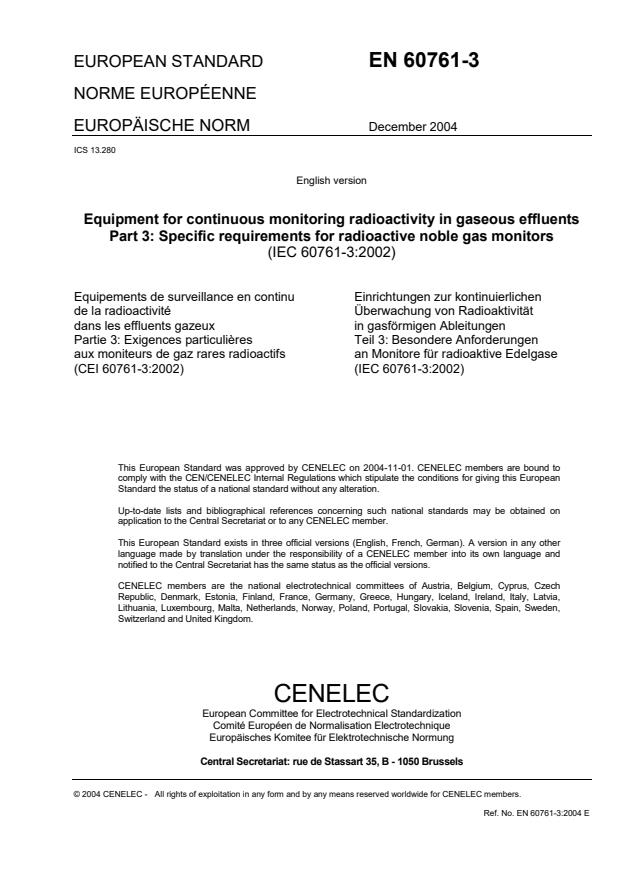
EUROPEAN STANDARD
EN 60761-3 NORME EUROPÉENNE EUROPÄISCHE NORM
December 2004 CENELEC European Committee for Electrotechnical Standardization Comité Européen de Normalisation Electrotechnique Europäisches Komitee für Elektrotechnische Normung
Central Secretariat: rue de Stassart 35, B - 1050 Brussels
© 2004 CENELEC - All rights of exploitation in any form and by any means reserved worldwide for CENELEC members.
Ref. No. EN 60761-3:2004 E
ICS 13.280
English version
Equipment for continuous monitoring radioactivity in gaseous effluents Part 3: Specific requirements for radioactive noble gas monitors (IEC 60761-3:2002)
Equipements de surveillance en continu de la radioactivité
dans les effluents gazeux Partie 3: Exigences particulières
aux moniteurs de gaz rares radioactifs (CEI 60761-3:2002)
Einrichtungen zur kontinuierlichen Überwachung von Radioaktivität
in gasförmigen Ableitungen Teil 3: Besondere Anforderungen
an Monitore für radioaktive Edelgase (IEC 60761-3:2002)
This European Standard was approved by CENELEC on 2004-11-01. CENELEC members are bound to comply with the CEN/CENELEC Internal Regulations which stipulate the conditions for giving this European Standard the status of a national standard without any alteration.
Up-to-date lists and bibliographical references concerning such national standards may be obtained on application to the Central Secretariat or to any CENELEC member.
This European Standard exists in three official versions (English, French, German). A version in any other language made by translation under the responsibility of a CENELEC member into its own language and notified to the Central Secretariat has the same status as the official versions.
CENELEC members are the national electrotechnical committees of Austria, Belgium, Cyprus, Czech Republic, Denmark, Estonia, Finland, France, Germany, Greece, Hungary, Iceland, Ireland, Italy, Latvia, Lithuania, Luxembourg, Malta, Netherlands, Norway, Poland, Portugal, Slovakia, Slovenia, Spain, Sweden, Switzerland and United Kingdom.
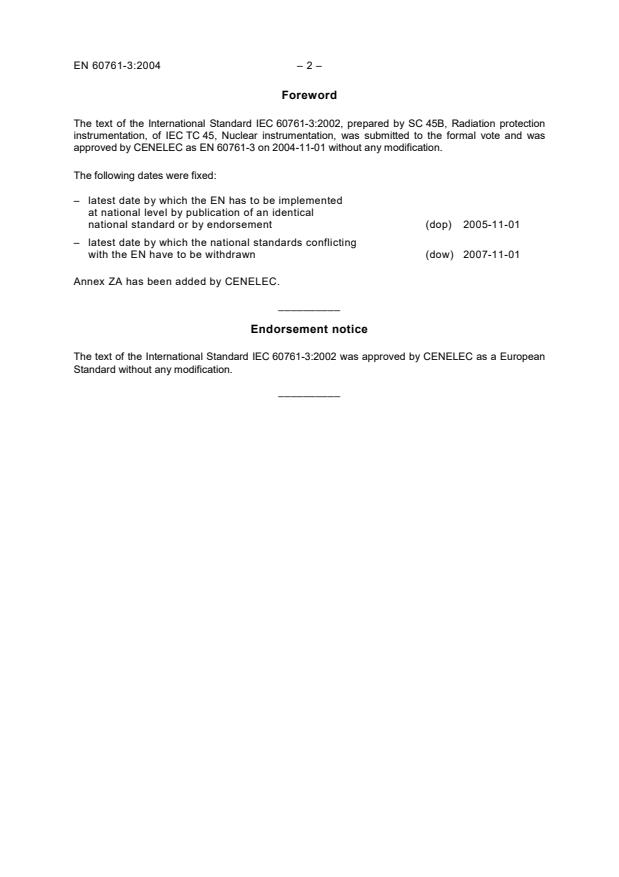
Foreword The text of the International Standard IEC 60761-3:2002, prepared by SC 45B, Radiation protection instrumentation, of IEC TC 45, Nuclear instrumentation, was submitted to the formal vote and was approved by CENELEC as EN 60761-3 on 2004-11-01 without any modification. The following dates were fixed: – latest date by which the EN has to be implemented
at national level by publication of an identical
national standard or by endorsement
(dop) 2005-11-01 – latest date by which the national standards conflicting
with the EN have to be withdrawn
(dow) 2007-11-01
Annex ZA has been added by CENELEC.
__________ Endorsement notice The text of the International Standard IEC 60761-3:2002 was approved by CENELEC as a European Standard without any modification. __________
– 3 – EN 60761-3:2004
Annex ZA
(normative)
Normative references to international publications
with their corresponding European publications The following referenced documents are indispensable for the application of this document. For dated references, only the edition cited applies. For undated references, the latest edition of the referenced document (including any amendments) applies. NOTE Where an international publication has been modified by common modifications, indicated by (mod), the relevant EN/HD applies. Publication Year Title EN/HD Year - - Limits and methods of measurement of radio disturbance characteristics of information technology equipment EN 55022 1994 1) IEC 60068-2-27 1987 Basic environmental testing procedures Part 2: Tests - Test Ea and guidance: Shock EN 60068-2-27 1993 IEC 60761-1 (mod) 2002 Equipment for continuous monitoring radioactivity in gaseous effluents Part 1: General requirements EN 60761-1 2004 IEC 61000 Series Electromagnetic compatibility (EMC) EN 61000 Series
——————— 1) EN 55022:1994 is superseded by EN 55022:1998.
!"$ !"%& !" ## ## !#©
$
%⎯$& '!# '!
%$# $(#$)
$ ""* "$# #$ + "#"+&$ #$!$ *+#,#
, -$# *!$(##&( $
.#&*
(&#&#+
!##+'$!$&'# *+/!$ / '* !$(! - ## !#0+ 1# (2%#+/. #*#345660#3#7-!/(!$388///--!
;<;0=3>0>----A$#(B--------------------------------------------------------------------------------------------------------------6 #% * --------------------------------------------------------------------------------------------------------60 #*-----------------------------------------------------------------------------------------------------5#*#* ##%('#** --------------------------------------------------;$ *# ------------------------------------------------------------------------------------------0<#$'##(&-----------------------------------------------------------------------------------0C!D -----------------------------------------------------------------------------------------------------------------A## -------------------------------------------------------------------------------------------------A$ * /!%# #*!*"#------------------------------------------------<5*!#
-----------------------------------------------------------------------------------------------------0A&$ $ # *#----------------------------------------------------------------------------------------0E* #%F9 $# #* ##%'# *
--------------------------------0#( #$-------------------------------------------------------------------------------------------------06#(>$ *
## -----------------------------------------------------<#(0>$ * /!%# #**"#---------------------------------------------6#(5>*#
--------------------------------------------------------------------------------------------------00
;<;0=3>A>!"%&F!E ## !#F#/ / '#.#* ## .#$ '### !#E##F-!(B*!$
##$ ##" '## .#! ## *-!##! #%+!$(! #### -! $ $# # !#H#&## !(B#/!#&$# $#!$ $# # &/ D- ##+'% ##'% # '#.##' '#.#-F!* # #' *!!## $ +## &#$(+# ##*$! %#(B#!!#!# $ #* # ##-0F!$ !#%!* * #*
#### $(!!* *## +!# $
'#!&# #$(&!##!#-5F
$
##*#+## #D#$$& ##-##
#$# &!#$(! ### '### -&% '(/!## #!
$'##
'### !#(# &#!# -AF!$ %# D'$
##$$ %###(
$(* #&"$# (* &/!*## -;F #/!$(&!#*!*! #### #&(!(B*$# '!-!!#(! $(* *&'#& #!$# '!-$
#+*!#5A3#
#-!## !#( #B/!;<;EF-!## $#!* $(!6C0-!#!# %-!*!## (#!* +#!*/'3?* #!%'* !#$$ %#*!## #(*! $ %'#!#(%#(-* * #&-
;<;0=3><>!!#!#!*!$(#/ #!#';-!#+!$(#/(J * HJ/! #/HJ $#(&# %+ J#-;<;*!*/'$# + !' #39# 32 # " 9# 3$* " *
##%#
' # ## 9# 03$* " *
##%('# 9# 53$* " *
##% 9# A3$* " *
;<;0=3>6>!"%&%&5!$# *;<;#$$#("$* #+#&
"## * ##%('#'#**!# '!% -#$$#( ##%('#** **!*/'*3>!# *!%#%&* ##%'#!'#**#!!# '$#%# #/!H>!##*### /!#$
%#%& #$
# # ##%&H>! #*!'##%&!# '% #'%$ #8 * #!$*# *** '#!!# '-$ * #+ #&
...