

ISO/TR 17177:2015
(Main)Petroleum and natural gas industries — Guidelines for the marine interfaces of hybrid LNG terminals
General Information
- Abstract
ISO/TR 17177:2015 provides guidance for installations, equipment and operation at the ship to terminal and ship to ship interface for hybrid floating and fixed LNG terminals that might not comply with the description of "Conventional LNG Terminal" included in ISO 28460. ISO/TR 17177:2015 is intended to be read in conjunction with ISO 28460 to ensure the safe and efficient LNG transfer operation at these marine facilities. ISO/TR 17177:2015 also addresses high pressure natural gas (HPNG) at the transfer interface at facilities where liquefaction or regasification is undertaken, but does not describe requirements for the process plant generally forming part of the terminal facility. These guidelines are based around facilities that are currently in operation or under development.
- Status
- Published
- Publication Date
- 06-Apr-2015
- Technical Committee
- ISO/TC 67/SC 9 - Liquefied natural gas installations and equipment
- Current Stage
- 9093 - International Standard confirmed
- Start Date
- 20-Sep-2021
- Completion Date
- 29-Aug-2026


Overview
ISO/TR 17177:2015 - "Petroleum and natural gas industries - Guidelines for the marine interfaces of hybrid LNG terminals" provides guidance for the ship-to-terminal and ship-to-ship marine interfaces of hybrid floating and fixed LNG terminals. It is a Technical Report intended to be read in conjunction with ISO 28460 and covers installations, equipment and operational guidance for facilities that do not match the “conventional LNG terminal” description. The report also addresses high pressure natural gas (HPNG) at the transfer interface but does not set process-plant requirements.
Key topics and technical focus
The report organizes practical guidance across the marine interface lifecycle and includes:
- Hazard identification for LNG and HPNG transfer, including leakage, fire and explosion potential
- Siting considerations: metocean, geological, environmental and socio-economic impacts
- Marine transfer systems: design and operational guidance for marine loading arms (MLAs), hose systems and HPNG-specific transfer equipment
- Marine operations: berthing, mooring, fendering, manifolds, electrical isolation and hose handling
- Communications: data and voice link requirements between ship and terminal
- Hazard management: leakage protection, firefighting, emergency response and exclusion zones
- Emergency systems: definitions and guidance for emergency shut-down (ESD), emergency release systems (ERS), emergency disconnect systems (EDS) and emergency release couplings
- Cargo transfer procedures: pre-transfer checks, transfer operations, normal disconnection and ESD/EDS operation
- Custody transfer measurement and training/competency requirements for personnel
- Informative annexes with typical ESD and configuration arrangements
Practical applications and users
ISO/TR 17177:2015 is practical guidance for organizations involved in planning, operating or regulating hybrid LNG terminals and ship-to-ship transfer operations. Typical users include:
- Terminal operators and owners (onshore, FSRU, FSU operators)
- Marine, mechanical and safety engineers designing transfer systems and MLAs
- Port authorities and marine pilots responsible for berthing and exclusion zones
- HSE, emergency response and firefighting teams planning contingency procedures
- Regulators and auditors assessing marine interface safety and compliance
- Contractors and consultants working on hybrid LNG facility layouts and operational procedures
Related standards
- ISO 28460 (Conventional LNG terminals - marine transfer)
- Other ISO/TC 67 standards covering materials, equipment and offshore structures for petroleum and natural gas industries
ISO/TR 17177:2015 is a practical, non-normative Technical Report focused on safe, efficient LNG transfer, HPNG handling and marine interface operations at hybrid terminals - a useful reference when designing procedures, emergency systems and marine transfer equipment.
Relations
- Consolidated By
ISO 11819-2:2017 - Acoustics — Measurement of the influence of road surfaces on traffic noise — Part 2: The close-proximity method - Effective Date
- 06-Jun-2022
Get Certified
Connect with accredited certification bodies for this standard

Element Materials Technology
Materials testing and product certification.

ABS Group Brazil
ABS Group certification services in Brazil.

ABS Quality Evaluations Inc.
American Bureau of Shipping quality certification.
Sponsored listings
Frequently Asked Questions
ISO/TR 17177:2015 is a technical report published by the International Organization for Standardization (ISO). Its full title is "Petroleum and natural gas industries — Guidelines for the marine interfaces of hybrid LNG terminals". This standard covers: ISO/TR 17177:2015 provides guidance for installations, equipment and operation at the ship to terminal and ship to ship interface for hybrid floating and fixed LNG terminals that might not comply with the description of "Conventional LNG Terminal" included in ISO 28460. ISO/TR 17177:2015 is intended to be read in conjunction with ISO 28460 to ensure the safe and efficient LNG transfer operation at these marine facilities. ISO/TR 17177:2015 also addresses high pressure natural gas (HPNG) at the transfer interface at facilities where liquefaction or regasification is undertaken, but does not describe requirements for the process plant generally forming part of the terminal facility. These guidelines are based around facilities that are currently in operation or under development.
ISO/TR 17177:2015 provides guidance for installations, equipment and operation at the ship to terminal and ship to ship interface for hybrid floating and fixed LNG terminals that might not comply with the description of "Conventional LNG Terminal" included in ISO 28460. ISO/TR 17177:2015 is intended to be read in conjunction with ISO 28460 to ensure the safe and efficient LNG transfer operation at these marine facilities. ISO/TR 17177:2015 also addresses high pressure natural gas (HPNG) at the transfer interface at facilities where liquefaction or regasification is undertaken, but does not describe requirements for the process plant generally forming part of the terminal facility. These guidelines are based around facilities that are currently in operation or under development.
ISO/TR 17177:2015 is classified under the following ICS (International Classification for Standards) categories: 75.200 - Petroleum products and natural gas handling equipment. The ICS classification helps identify the subject area and facilitates finding related standards.
ISO/TR 17177:2015 has the following relationships with other standards: It is inter standard links to ISO 11819-2:2017. Understanding these relationships helps ensure you are using the most current and applicable version of the standard.
ISO/TR 17177:2015 is available in PDF format for immediate download after purchase. The document can be added to your cart and obtained through the secure checkout process. Digital delivery ensures instant access to the complete standard document.
Standards Content (Sample)
TECHNICAL ISO/TR
REPORT 17177
First edition
2015-04-01
Petroleum and natural gas
industries — Guidelines for the marine
interfaces of hybrid LNG terminals
Pétrole et industries du gaz naturel — Lignes directrices pour les
interfaces de terminaux hybrides de GNL
Reference number
©
ISO 2015
© ISO 2015
All rights reserved. Unless otherwise specified, no part of this publication may be reproduced or utilized otherwise in any form
or by any means, electronic or mechanical, including photocopying, or posting on the internet or an intranet, without prior
written permission. Permission can be requested from either ISO at the address below or ISO’s member body in the country of
the requester.
ISO copyright office
Case postale 56 • CH-1211 Geneva 20
Tel. + 41 22 749 01 11
Fax + 41 22 749 09 47
E-mail copyright@iso.org
Web www.iso.org
Published in Switzerland
ii © ISO 2015 – All rights reserved
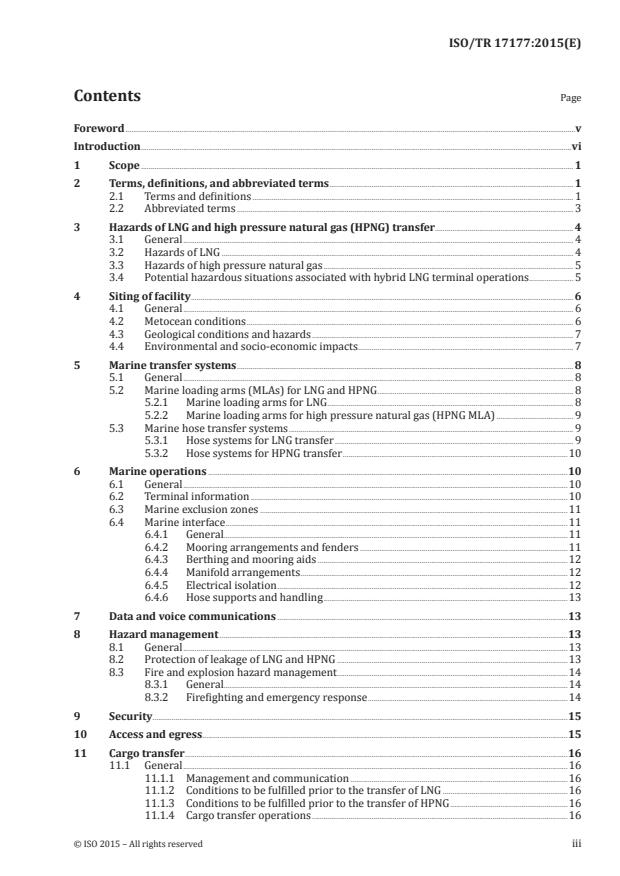
Contents Page
Foreword .v
Introduction .vi
1 Scope . 1
2 Terms, definitions, and abbreviated terms . 1
2.1 Terms and definitions . 1
2.2 Abbreviated terms . 3
3 Hazards of LNG and high pressure natural gas (HPNG) transfer . 4
3.1 General . 4
3.2 Hazards of LNG . 4
3.3 Hazards of high pressure natural gas . 5
3.4 Potential hazardous situations associated with hybrid LNG terminal operations . 5
4 Siting of facility . 6
4.1 General . 6
4.2 Metocean conditions . 6
4.3 Geological conditions and hazards . 7
4.4 Environmental and socio-economic impacts . 7
5 Marine transfer systems . 8
5.1 General . 8
5.2 Marine loading arms (MLAs) for LNG and HPNG . 8
5.2.1 Marine loading arms for LNG . 8
5.2.2 Marine loading arms for high pressure natural gas (HPNG MLA) . 9
5.3 Marine hose transfer systems . 9
5.3.1 Hose systems for LNG transfer . 9
5.3.2 Hose systems for HPNG transfer .10
6 Marine operations .10
6.1 General .10
6.2 Terminal information .10
6.3 Marine exclusion zones .11
6.4 Marine interface .11
6.4.1 General.11
6.4.2 Mooring arrangements and fenders .11
6.4.3 Berthing and mooring aids .12
6.4.4 Manifold arrangements .12
6.4.5 Electrical isolation .12
6.4.6 Hose supports and handling .13
7 Data and voice communications .13
8 Hazard management .13
8.1 General .13
8.2 Protection of leakage of LNG and HPNG .13
8.3 Fire and explosion hazard management .14
8.3.1 General.14
8.3.2 Firefighting and emergency response .14
9 Security.15
10 Access and egress .15
11 Cargo transfer .16
11.1 General .16
11.1.1 Management and communication .16
11.1.2 Conditions to be fulfilled prior to the transfer of LNG .16
11.1.3 Conditions to be fulfilled prior to the transfer of HPNG .16
11.1.4 Cargo transfer operations .16
11.1.5 Normal disconnection .16
11.2 Emergency shut-down and emergency release systems .17
11.2.1 General.17
11.2.2 Emergency shut-down and emergency release systems for LNG MLA .17
11.2.3 Emergency shut-down and emergency release systems for LNG transfer hoses .17
11.2.4 Emergency shut-down and emergency disconnect systems for HPNG MLA .17
11.2.5 Safety and maintenance of transfer systems .18
12 Custody transfer measurement system .19
13 Provision and training of staff .19
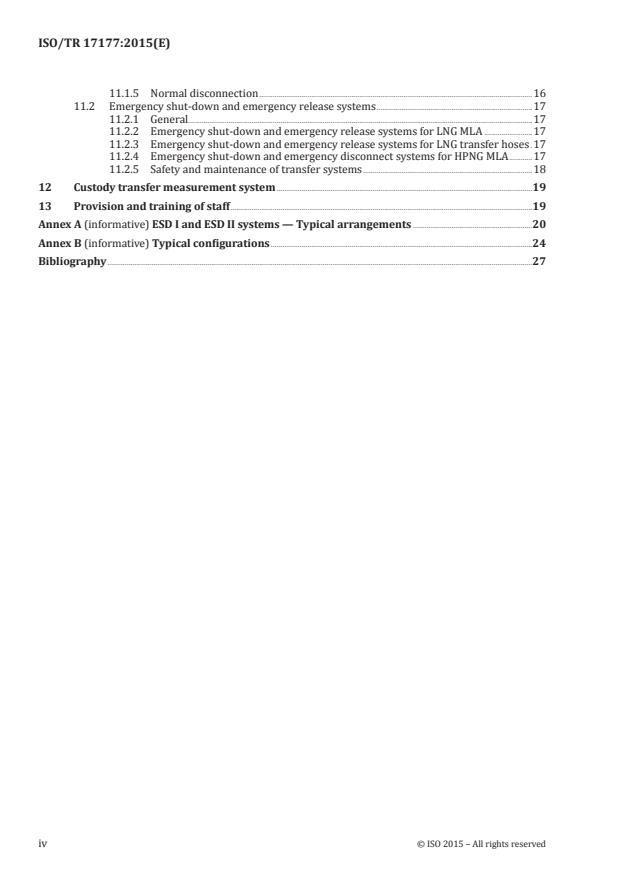
Annex A (informative) ESD I and ESD II systems — Typical arrangements .20
Annex B (informative) Typical configurations .24
Bibliography .27
iv © ISO 2015 – All rights reserved
Foreword
ISO (the International Organization for Standardization) is a worldwide federation of national standards
bodies (ISO member bodies). The work of preparing International Standards is normally carried out
through ISO technical committees. Each member body interested in a subject for which a technical
committee has been established has the right to be represented on that committee. International
organizations, governmental and non-governmental, in liaison with ISO, also take part in the work.
ISO collaborates closely with the International Electrotechnical Commission (IEC) on all matters of
electrotechnical standardization.
The procedures used to develop this document and those intended for its further maintenance are
described in the ISO/IEC Directives, Part 1. In particular the different approval criteria needed for the
different types of ISO documents should be noted. This document was drafted in accordance with the
editorial rules of the ISO/IEC Directives, Part 2 (see www.iso.org/directives).
Attention is drawn to the possibility that some of the elements of this document may be the subject of
patent rights. ISO shall not be held responsible for identifying any or all such patent rights. Details of any
patent rights identified during the development of the document will be in the Introduction and/or on
the ISO list of patent declarations received (see www.iso.org/patents).
Any trade name used in this document is information given for the convenience of users and does not
constitute an endorsement.
For an explanation on the meaning of ISO specific terms and expressions related to conformity
assessment, as well as information about ISO’s adherence to the WTO principles in the Technical Barriers
to Trade (TBT), see the following URL: Foreword — Supplementary information.
The committee responsible for this document is ISO/TC 67, Materials, equipment and offshore structures
for petroleum, petrochemical and natural gas industries.
Introduction
The recent expansion of the LNG industry has led to the development of marine LNG facilities and
transfer systems that differ from conventional LNG facility designs. These LNG transfer facilities can
require additional or alternative systems and/or operational procedures to enable their safe operation.
This Technical Report is intended to provide guidance for aspects of these facilities not covered by
current standards and guidelines.
vi © ISO 2015 – All rights reserved
TECHNICAL REPORT ISO/TR 17177:2015(E)
Petroleum and natural gas industries — Guidelines for the
marine interfaces of hybrid LNG terminals
1 Scope
This Technical Report provides guidance for installations, equipment and operation at the ship to
terminal and ship to ship interface for hybrid floating and fixed LNG terminals that might not comply
with the description of “Conventional LNG Terminal” included in ISO 28460.
This Technical Report is intended to be read in conjunction with ISO 28460 to ensure the safe and
efficient LNG transfer operation at these marine facilities.
This Technical Report also addresses high pressure natural gas (HPNG) at the transfer interface at
facilities where liquefaction or regasification is undertaken, but does not describe requirements for the
process plant generally forming part of the terminal facility.
These guidelines are based around facilities that are currently in operation or under development.
2 Terms, definitions, and abbreviated terms
2.1 Terms and definitions
For the purposes of this document, the following terms and definitions apply:
2.1.1
as low as reasonably practicable
ALARP
reducing a risk to a level that represents the point, objectively assessed, at which the time, trouble,
difficulty, and cost of further reduction becomes unreasonably disproportionate to the additional risk
reduction obtained
2.1.2
conventional onshore LNG terminal
LNG export or receiving terminal that is located on-shore and that has a marine transfer facility for the
loading or unloading of LNG carriers in a harbour or other sheltered coastal location
Note 1 to entry: A conventional onshore LNG terminal typically includes marine transfer facility comprising a
jetty equipped with loading arms or similar to enable the transfer of LNG between ship and shore.
2.1.3
double bank
to moor two vessels moored alongside each other at a terminal
Note 1 to entry: An example of double banking as part of a hybrid LNG terminal is where an LNGC moors and
transfers LNG alongside an FSRU or FSU.
2.1.4
emergency release coupling
ERC
device to provide a means of quick release of LNG transfer system when such action is required only as
an emergency measure
2.1.5
emergency release system
ERS
system that provides a positive means of quick release of LNG transfer systems and safe isolation
between ship and terminal or between units, following a predefined procedure including an emergency
shut-down (ESD)
Note 1 to entry: The operation of the emergency release system can be referred to as an “ESD II”.
2.1.6
emergency disconnect system
EDS
system that provides a positive means of quick release of HPNG transfer systems and safe isolation
between terminal units or between terminal and ship, following a predefined procedure including an
emergency shut-down (ESD)
2.1.7
emergency shut-down
ESD
method that safely and effectively stops the transfer of LNG or vapour or HPNG between terminal units
or between terminal unit and LNGC
Note 1 to entry: The operation of this system can be referred to as an “ESD I”. Ship/shore ESD systems should not
be confused with other emergency shut-down systems within the terminal or on board ship.
2.1.8
emergency disconnection coupler
EDC
coupler system that when adopted in HPNG transfer systems as part of EDS has combined routine
maintenance and operation connection functionality and emergency disconnection functionality
2.1.9
floating storage and regasification unit
FSRU
floating unit for storage and regasification of LNG and for sending out HPNG and moored for prolonged
periods as part of a hybrid LNG terminal
Note 1 to entry: FSRUs are often but not exclusively classified as sea-going vessels and can be purpose-built or be
converted from a LNGC. Although designed to be moored long term as part of a terminal, FSRUs frequently have
the capability to depart for periodic maintenance or in case of extreme weather.
2.1.10
floating storage unit
FSU
floating unit for storage of LNG and moored for prolonged periods as part of a hybrid LNG terminal
2.1.11
hybrid LNG terminal
LNG export or receiving terminal that is not wholly located onshore and has a marine transfer facility
for the loading or unloading of LNG carriers and for transfer of HPNG to shore
Note 1 to entry: A hybrid LNG terminal can be located in a protected harbour, in a naturally sheltered coastal or
near shore location, or in an unprotected near shore or offshore environment. The marine transfer facilities for
hybrid LNG terminals can include fixed units such as jetties, platforms, and mooring structures. Marine transfer
facilities can also include floating units such as FSRUs, FSUs, and LNGRVs. Transfer of LNG and/or HPNG can take
place at a number of interfaces between fixed and floating units according to the terminal configuration.
2 © ISO 2015 – All rights reserved
2.1.12
liquefied natural gas regasification vessel
LNGRV
A sea-going vessel for storage and regasification of LNG and for sending out HPNG and moored for periods as
part of a hybrid LNG terminal and also capable of operating as an LNGC supplying the hybrid LNG terminal
2.1.13
operating basis earthquake
OBE
maximum earthquake for which no damage is sustained and restart and safe operation can continue
2.1.14
safe shutdown earthquake
SSE
maximum earthquake event for which the essential terminal fail-safe functions and mechanisms are
designed to be preserved but for which permanent damage can be expected provided that there is no
loss of overall integrity and containment
2.1.15
rapid phase transition
RPT
explosive change in phase of liquid to vapour
Note 1 to entry: RPT can occur when LNG and water come into contact.
2.1.16
rollover
sudden mixing of two layers of LNG of different densities in a tank, resulting in massive vapour generation
2.1.17
spool piece
short length of pipe with flanges for matching the ship’s manifold flange to the transfer system
presentation flange
Note 1 to entry: Sometimes, reducer spool pieces are used to connect different diameters.
2.1.18
unit
discrete part of a hybrid LNG terminal which can be a fixed or floating structure
Note 1 to entry: Examples of a unit include FSRU, LNGRV, FSU or fixed platform.
2.2 Abbreviated terms
BOG Boil off gas
CDI Chemical Distribution Institute
CTMS Custody transfer measurement system
EERP Evacuation, escape, and rescue plan
EDC Emergency disconnect coupler (HPNG)
EDS Emergency disconnect system (HPNG)
ERC Emergency release coupling (LNG)
ERS Emergency release system (LNG)
ERM Emergency response manual
ESD Emergency shut-down
FES Fire and explosion strategy
FSRU Floating storage and regasification unit
FSU Floating storage unit
GBS Gravity based structures
GIIGNL International Group of Natural Gas Importers
HPNG High pressure natural gas
ICS International Chamber of Shipping
IMO International Maritime Organization
ISGOTT International Safety Guide for Oil Tankers and Terminals
LNG Liquefied natural gas
LNGC Liquefied natural gas carrier
LNGRV Liquefied natural gas regasification vessel
MLA Marine loading arms
OBE Operating basis earthquake
OCIMF Oil Companies International Marine Forum
QC/DC Quick connect/disconnect coupler
RPT Rapid phase transition
SIGTTO International Society of Gas Tanker and Terminal Operators
SSE Safe shutdown earthquake
TOM Terminal operating manual
3 Hazards of LNG and high pressure natural gas (HPNG) transfer
3.1 General
The transfer of LNG and HPNG at marine interfaces for hybrid LNG terminal operations results in a
number of potential hazards and hazardous situations in respect of
— properties of LNG and HPNG, and
— the method and conditions of transfer.
Hazard management should be as described in Clause 8.
3.2 Hazards of LNG
1)
Reference should be made to ISO 16903 for guidance on the characteristics of LNG influencing design
and material selection, including the general hazards of handling LNG.
1) To be published.
4 © ISO 2015 – All rights reserved
Potential hazards arising from the transfer of LNG for hybrid LNG terminals should be subject to risk
assessment taking into account the following:
— cryogenic temperatures, which can cause cold injury to people (frostbite), and also brittle fracture
to non-cryogenic materials such as carbon steel;
— pool fire, flash fire, explosion, or asphyxiation from leaks or spillage of LNG;
— surge pressure in LNG transfer systems;
— overpressure resulting in shock waves, caused by rapid phase transition (RPT) of LNG interacting
with water;
— overpressure due to expansion or vaporization of trapped LNG;
— mechanical damage due to thermal stresses caused by uncontrolled cool-down of piping and
transfer systems;
— rollover.
3.3 Hazards of high pressure natural gas
The potential hazards arising from the transfer of HPNG for hybrid floating and offshore LNG terminals
should be subject to risk assessment taking into account the following:
— jet fire, flash fire, or confined vapour cloud explosion;
— asphyxiation;
— stored energy in high pressures systems;
— high noise level from release of HPNG;
— temperature drop caused by the release of HPNG (Joule-Thomson effect);
— mechanical damage due to vibration from high gas velocities in piping and transfer systems.
NOTE The flammability, explosion, and asphyxiation hazards of HPNG are similar to natural gas (NG), but
the pressures used to transfer and export the HPNG result in very significant additional hazards due to the
velocity and momentum of jet releases and also due to the effects of sudden release of stored energy from a highly
pressurized system. High pressure gas release can entrain air, which if ignited, will result in a jet fire.
3.4 Potential hazardous situations associated with hybrid LNG terminal operations
In addition to the hazardous situations for conventional onshore LNG terminals set out in ISO 28460:2010,
Clause 5, the following potentially hazardous situations should be considered for operational and
contingency planning for hybrid terminals:
— LNG and HPNG transfer operations in close proximity to process equipment;
— simultaneous operations;
— venting and flaring;
— sloshing effects in partially loaded floating storage facilities;
— boil off gas (BOG) management and tank pressure control;
— flange and valve leaks for HPNG transfer systems including any failure or spurious release of the
emergency disconnection system (EDS), if fitted, on the HPNG transfer system;
— relative motions at interfaces as a result of the terminal configuration (e.g. double banking, tandem,
weather-vaning at turret or yoke mooring) and the resulting mechanical stresses and fatigue;
— metocean conditions and seismic events including:
— earthquake;
— tsunami;
— icebergs;
— extreme weather events such as tropical cyclones, tornadoes or squalls.
NOTE 1 HPNG gas transfer arms between FSRUs and fixed platforms have at some locations been fitted with
emergency disconnection system (EDS), which provide an automated function similar to that of an emergency
release coupling (ERC) for LNG transfer arms. Unlike the LNG ERC, HPNG EDS systems have typically combined
ERS and QC/DC.
NOTE 2 The motion of floating units incorporating LNG storage can be influenced by the amount of LNG inventory.
NOTE 3 Floating regasification and storage units (FSRUs) may be configured either as permanently moored
facilities, or alternatively, the FSRU can have the capability to depart for LNG supply, trading purposes, or to
depart in advance of extreme metocean conditions.
4 Siting of facility
NOTE The siting considerations for conventional onshore LNG terminals listed in ISO 28460 ought to be
taken into consideration, where applicable.
4.1 General
Site selection for the facility should be based upon a study in accordance with LNG industry best practice.
This study should include a risk assessment undertaken by a multi-discipline team with regard to
identifying and mitigating risks to acceptable levels.
The multi-discipline team should include, as a minimum, expertise and experience of the following:
— marine and port operations;
— LNG carrier and terminal operations;
— metocean conditions;
— design and engineering of marine terminal infrastructure;
— risk assessment and hazard management.
4.2 Metocean conditions
Design and operation of the facility should take into account the environmental conditions at the site.
As a minimum, the following metocean parameters should be taken into consideration:
— wave heights, periods and directions;
— tsunamis;
— current speed and direction throughout the water column;
— wind speed and directions including incidence of tropical storms and local squalls;
— sea ice, icebergs, snow, and ice accretion;
— water level including tidal variations;
6 © ISO 2015 – All rights reserved
— water temperature and quality;
— air temperature and humidity.
Environmental operating limits should be established for each operation including for approach of
LNGC, berthing, mooring, transfer of LNG and/or HPNG, unberthing and departure. Where the terminal
includes an FSRU or other floating unit, environmental operating limits should also be established for
the FSRU to remain at the facility.
If the FSRU is not capable of remaining safety moored under conditions likely to occur during the
operational life of the terminal, contingency plans and procedures should be established in order that
the FSRU can safely depart in advance of forecast weather conditions that exceed pre-determined limits.
Potential weather downtime for transfer of LNG and/or HPNG should be assessed against operational
requirements and long term observed metocean data or hindcast data for the location.
NOTE 1 Metocean parameters appropriate to design, construction, and maintenance of fixed structures are
normally defined for a range of design situations with performance requirements appropriate to the probability
of occurrence of the parameter or joint probability of combinations of a number of parameters.
NOTE 2 BS 6349–1-1 provides guidance on planning of coastal maritime infrastructure for ships, including
recommendations on environmental data gathering, and incorporation of operational and safety considerations
into design, including the requirements for consultation with operational staff at the design stage and the
incorporation of design stage information into the terminal operating manual (TOM).
NOTE 3 Where a floating unit is permanently moored in locations subject to exceptionally adverse metocean
events such as hurricanes or cyclones, it is normally required to consider specific performance requirements
for “survivability” with some degree of permissible limited damage or temporary loss of serviceability provided
there is no risk to personnel, essential safely systems remain operable, and there is no loss of containment or
release of LNG or HPNG.
NOTE 4 Tsunami hazard assessment is particularly important for FSRUs or other floating units in shallow water.
The interaction of a tsunami with a shallow coastline or harbour gives rise to very significant changes in water level.
4.3 Geological conditions and hazards
Design and operation of the facility should take into account as minimum, the following geological
conditions and hazards:
— bathymetry;
— soil conditions;
— seabed morphology and sedimentation;
— seabed instability and landslides;
— seismicity (including OBE and SSE earthquake events and any associated events).
Seismic performance criteria for each unit of the facility and transfer system should be determined by
risk assessment and in accordance with applicable local regulations and codes.
NOTE EN 1473 and NFPA 59A provide principles for determining seismic performance levels for conventional
fixed onshore terminals which can also be appropriate to define requirements for marine interfaces for FSRU
terminals. The definitions included in 2.1 are taken from EN 1473 for onshore LNG terminals which utilizes
performance criteria for OBE and SSE.
4.4 Environmental and socio-economic impacts
The environmental and social impact of development and operation of the facility at any site should be
assessed in accordance with applicable local regulations and with local authorities (port, marine, other
state organizations).
5 Marine transfer systems
5.1 General
The selection and design of the marine transfer system for hybrid LNG terminals should take into
account the following, according to the proposed operations and location of the facility:
— the transfer operation (e.g. HPNG or LNG, rate of transfer, floating-to-floating or floating–to-fixed);
— required operational availability;
— limiting operational environmental conditions;
— limiting environmental conditions for extreme events, including survivability under exceptionally
adverse metocean events;
— range of sizes of vessels to be accommodated;
— dynamic motion between the facility and LNGCs;
— emergency shut-down (ESD I) and release system (ESD II) for LNG and EDS for HPNG, if fitted;
— effect on FSRU or other floating unit structural integrity and stability in the case of installation of
transfer equipment for conversion as part of a hybrid terminal;
— transit conditions for transfer equipment installed on floating units;
— seismic performance criteria under OBE and SSE (if any).
Transfer system selection and design should take into account the need to reduce risks during operation
and maintenance “as low as reasonably practicable” (ALARP).
For novel transfer systems, technology assessment and qualification as described in EN 1474-3, Clause 5
should be implemented.
NOTE Principles of hazard management are described in Clause 8.
5.2 Marine loading arms (MLAs) for LNG and HPNG
5.2.1 Marine loading arms for LNG
2)
Design and testing of MLAs for LNG service should be in accordance with EN 1474-1 .
For MLAs installed on fixed jetty or any other fixed structure, transfer operations should be as required
by ISO 28460.
When MLAs are installed at an exposed location where dynamic motion between units and/or LNG
carriers is foreseen, the additional provisions of EN 1474-3 should be applied to take into account
dynamic loading from the motion response of the floating system under wave action. For FSRUs, in
addition to the location of initial and future deployment, dynamic loads in combination with wind loads
during transit should also be taken into account.
The MLAs may be equipped with a system to facilitate connection and disconnection of the transfer
system under the maximum expected motions between the two units.
2) EN 1474-1 will be replaced with ISO 16904.
8 © ISO 2015 – All rights reserved
When the MLAs are installed on a unit or part of the terminal classed as a ship (such as an FSRU),
the LNG MLA can be subject to additional qualification and testing arising from classification society
requirements.
2)
NOTE 1 Marine loading arms complying with EN 1474–1 have been used for the transfer of LNG at conventional
LNG terminals. Development of hybrid LNG terminals has led to the requirement for the development of alternative
transfer systems including the installation of marine loading arms on FSRUs and other floating units.
NOTE 2 Transfer systems installed on-board an FSRU/FSU or other floating unit subject to classification society
rules and requirements are not typically treated as a class item apart from support columns and any structural
modifications to the ship. However, the requirements arising from installation on a ship need to be taken into
account in design, manufacture, and testing of the transfer systems. In such circumstances, it is important for the
owner of the classed unit to define the level of testing, inspection, and certification required for the scope of the
transfer system which is not in class.
5.2.2 Marine loading arms for high pressure natural gas (HPNG MLA)
5.2.2.1 General
3)
Relevant aspects of ISO 16904 and OCIMF design and construction specification for marine loading
arms should be applied to the design and operation of MLAs for HPNG.
The design should take into account the need to safely relieve stored energy and purge gas in the
disconnection systems under both normal and emergency decoupling operations.
Isolation, depressurization, and purging should take place prior to opening of the connection and release
of the HPNG MLA.
If an HPNG emergency disconnection system (EDS) is provided, the system should provide for automatic
retraction and stowage to retract the HPNG MLA from the immediate location of the HP manifold of the
vessel, so that the manifold and arm are both clear from any damage arising from further motion or
displacement across the marine interface. Critical equipment on the facility should also be protected
against damage by the dynamic motion of the arm if it is released under abnormal conditions.
The maximum flow rate through the transfer system should be such that, no harmful vibrations or
excessive noise occur during operation. This should be assessed taking into account the arrangement of
the complete piping system.
NOTE Examples of typical arrangements for HPNG MLA isolation and relief systems are provided in Figure A.4.
Maximum operating flow rate should take into account allowable pressure drops at minimum and
maximum operating pressures of the complete HPNG piping system from regasification unit to gas
network. Current HPNG MLAs in service are of 30 cm (12 inch) diameter. Typically design temperature
ranges are within –40 °C and +80 °C.
5.3 Marine hose transfer systems
5.3.1 Hose systems for LNG transfer
Marine hose transfer systems between LNGC and FSRUs or other floating terminal units should comply
with EN 1474-2 and EN 1474-3.
The OCIMF Ship to Ship Transfer Guide provides guidance on ship to ship LNG transfer and can be
applicable to FSRUs and LNGRVs in inshore waters.
3) To be published.
5.3.2 Hose systems for HPNG transfer
Hose systems for HPNG transfer systems have been proposed at marine interfaces of some hybrid terminals.
NOTE Relevant aspects of EN 1474–3 can be applicable in developing a system design philosophy for HPNG
hoses in conjunction with ISO 13628-2 which includes provisions for flexible jumper hoses in subsea and offshore
topsides applications.
Additionally, depending on the situation, ANSI/API RP17b and ISO 14113 can be used.
6 Marine operations
6.1 General
The general recommendations of ISO 28460 for planning and conducting marine operations should be
followed where applicable including provisions for
— adoption of best industry practices including those of OCIMF, SIGTTO, and PIANC,
— ship-terminal compatibility studies prior to first-time LNGC arrival, and
— detailed passage planning including risk assessment and hazard management.
Clause 6 identifies where additional guidelines can be needed for a hybrid marine terminal.
NOTE 1 For hybrid LNG terminals, particular attention is needed for ship-shore compatibility studies prior to
first-time LNGC arrival, especially where the berthing configuration or LNG transfer system varies significantly
from conventional terminals.
NOTE 2 The PIANC report “Safety aspects affecting the berthing operations of tankers to oil and gas
terminals” provides guidance on safety aspects for gas tankers that are relevant to port and terminal planning,
design, and operations.
6.2 Terminal information
Each terminal should develop and maintain a comprehensive written terminal operating manual (TOM)
according to the principles set out in IMO/ISGOTT, 15.3 and a separate emergency response manual (ERM)
of IMO/ISGOTT, Clause 20. For a hybrid LNG terminal, the TOM, as a minimum, should include the following:
— facility description (port information and regulations);
— management structure and responsibilities;
— ship size and displacement limitations;
— ship manifold layout and strength capacity;
— safety, security, and emergency procedures;
— environmental limits on specific operations;
— emergency departure procedures;
— pilotage and tug operating requirements;
— mooring arrangement and berthing procedures;
— pre-transfer meeting and checklist requirements;
— cargo transfer procedures including maximum transfer rates.
10 © ISO 2015 – All rights reserved
Terminal information should be made available to appropriate parties, including in a format suitable
for electronic transmission, according to procedures set out in IMO/ISGOTT, 15.4. Terminal information
should be made available to the masters of visiting vessels before arrival at the facility.
NOTE According to the terminal configuration, it will be necessary to develop specific protocols on information
storage and exchange, for example, where there is a shore operating team, an FSRU operating team, and an LNGC.
6.3 Marine exclusion zones
Marine exclusion zones require for safety and security (ISPS compliance) should take into account the
particular security threats and navigation hazards associated with offshore locations.
6.4 Marine interface
6.4.1 General
In addition to the guidelines in ISO 28460, the provisions in 6.4.2 through 6.4.6 should be taken into account.
6.4.2 Mooring arrangements and fenders
Planning, design, operation, and maintenance for berthing and mooring of LNGCs and FSRUs should take
into account the requirements and characteristics of hybrid LNG terminals compared to conventional
LNG terminals with respect to
— exposed locations resulting in greater ship motions,
— double banked configurations resulting in greater relative motions across the marine interface
(such as between an FSRU and an LNGC), and
— FSRUs, FSUs, or other similar units which are moored on a long term basis giving rise to additional
requirements in respect of maintenance and inspection of moorings.
The mooring arrangement and number, size, and location of fenders should be determined by mooring
analysis and a geometrical compatibility study of vessels calling at the facility taking into account
environmental conditions and the effects of passing ships.
Fender berthing energy capacity should be determined based upon a recognized fender system
design standard.
Pneumatic fenders for ship to ship applications including double banked FSRU and LNGC usage should
be positioned in accordance with the ICS/CDI/OCIMF/SIGTTO “Ship to ship transfer guide for petroleum
chemicals and liquefied gases”. Pneumatic fenders should not be located under LNG transfer systems or
in any location that could be subject to accidental LNG splash.
The operation and management of the mooring arrangements should ensure that the LNGC, and FSRU or
other floating unit remains secure in its position relative to the transfer system envelope of all marine
interfaces with an LNG or HPNG transfer system.
Proposed mooring arrangements should be assessed using a validated calculation or simulation tool
developed for this purpose, taking into consideration maximum environmental operating limits under
which the LNGC, FSRU, or other floating unit will remain moored.
When terminal has a mooring system or systems which moors a unit for a prolonged period of time, these
mooring systems should be inspected and maintained according to an approved plan which ensures the
integrity and reliability of the mooring system.
The mooring arrangements should take into account the requirement for safe release for normal and
emergency operations and also for maintenance activities for permanently moored FSRUs and FSUs.
System failure (whether a single component failure, system failure, or loss of power supply) should not
result in the unexpected release of the mooring system and the subsequent uncontrolled drifting of an
LNGC, FSRU or other floating unit.
NOTE 1 Recognized guidelines for fender selection and specification include BS 6349–4, PIANC and ISO 17357-1.
NOTE 2 OCIMF MEG3 can be applied as applicable to hybrid LNG terminals, although geometrical constraints
and the requirements of long term or permanent mooring of FSRUs can lead to particular arrangements to be
assessed on a case by case basis.
NOTE 3 Low friction liners to Panama fairleads have been proposed for exposed locations.
6.4.3 Berthing and mooring aids
Berthing and mooring aids should be provided based on the requirements of the LNGC and any floating units
such as FSRUs and LNGRVs forming part of the terminal which will berth and unberth from time to time.
Information from metocean monitoring systems, mooring line tension monitoring, and similar information
should be communicated to appropriate locations and units (according to operating philosophy).
NOTE 1 For terminals with FSRUs or FSUs and double banking, the scope of berthing and mooring aids can
include speed of approach and mooring l
...