

ISO 20257-1:2020
(Main)Installation and equipment for liquefied natural gas — Design of floating LNG installations — Part 1: General requirements
General Information
- Abstract
This document provides requirements and guidance for the design and operation of floating liquefied natural gas (LNG) installations, including installations for the liquefaction, storage, vaporisation, transfer and handling of LNG, in order to have a safe and environmentally acceptable design and operation of floating LNG installations. This document is applicable to: — floating LNG liquefaction installations (plant) — FLNG; — floating LNG regasification installations (plant) — FSRU; — floating storage units — FSU. This document is applicable to offshore, near-shore or docked floating LNG installations. This document includes any jetty in the scope in case of docked floating LNG installations with regards to the mooring. This document briefly describes floating LNG mooring concepts. This document is applicable to both newbuilt and converted floating LNG installations, and addresses specific requirements. This document is not applicable to: — onshore LNG storage, liquefaction and/or regasification installations/plants, except for docked FSRU and/or FLNG installations; — offshore LNG plants based on non-floating structure (such as gravity based structure [GBS] principle); and — support onshore based facilities (such as support vessels, tugs, etc.). This document is not intended for design floating power generation facilities though relevant parts of this document can be used. This document is not intended to cover LNG as fuel bunkering applications.
- Status
- Published
- Publication Date
- 21-Apr-2020
- Technical Committee
- ISO/TC 67/SC 9 - Liquefied natural gas installations and equipment
- Current Stage
- 9093 - International Standard confirmed
- Start Date
- 07-Oct-2025
- Completion Date
- 29-Aug-2026
Buy Documents



ISO 20257-1:2020 - Installation and equipment for liquefied natural gas -- Design of floating LNG installations

ISO 20257-1:2020 - Installation and equipment for liquefied natural gas — Design of floating LNG installations — Part 1: General requirements/5/2020



ISO 20257-1:2020 - Installations et équipements de gaz naturel liquéfié -- Conception des installations flottantes de GNL

ISO 20257-1:2020 - Installations et équipements de gaz naturel liquéfié — Conception des installations flottantes de GNL — Partie 1: Exigences générales/16/2020
Overview - ISO 20257-1:2020 (Floating LNG design general requirements)
ISO 20257-1:2020 sets out the general requirements and guidance for the design and operation of floating liquefied natural gas (LNG) installations. It covers floating liquefaction units (FLNG), floating storage and regasification units (FSRU), and floating storage units (FSU) in offshore, near‑shore or docked conditions. The standard addresses liquefaction, storage, vaporisation, transfer and handling of LNG with the objective of safe and environmentally acceptable design and operation. It applies to both newbuild and converted floating LNG vessels and includes mooring considerations for docked installations. Exclusions include onshore LNG plants (except docked FSRU/FLNG), non‑floating offshore structures (e.g., GBS), support onshore facilities and LNG bunkering.
Key topics and technical requirements
ISO 20257-1 provides comprehensive, high‑level design guidance across major technical disciplines:
- Basis of design: site and metocean studies, seismic and location considerations, design criteria for topsides, hull, transfer systems, LNG storage and piping.
- Health, safety and environment (HSE): safety philosophies, barrier identification, environmental impact considerations, emergency response and occupational hygiene.
- Mooring & stationkeeping: permanent and temporary mooring concepts, disconnectable moorings, jetty interface and mooring requirements for open‑water and docked operations.
- Hull design: structural design philosophies, limit states, fatigue, slamming, green water and watertight integrity.
- Transfer systems & LNG handling: requirements for safe transfer, containment loads, vaporisation and cargo handling procedures.
- Human factors: ergonomics, crew accommodations, lighting, noise and support for onboard operators.
These topics are structured to support risk‑based design reviews, qualitative risk assessments (QRA) and safety certification processes.
Practical applications and users
ISO 20257-1 is intended for professionals involved in the lifecycle of floating LNG projects:
- Offshore engineers and naval architects designing FLNG, FSRU or FSU hulls and topsides
- Process and safety engineers developing liquefaction, storage, vaporisation and transfer systems
- Project managers and classification societies conducting design reviews and certification
- Owners/operators assessing conversion projects and docking/mooring arrangements
- Regulators and HSE specialists evaluating environmental and emergency response requirements
Use cases include concept and FEED stages, detailed design, conversion scope definition and safety/environmental compliance checks.
Related guidance and standards
For a complete compliance and technical basis, ISO 20257-1 should be used alongside:
- other parts of the ISO 20257 series and applicable maritime/LNG industry codes
- classification society rules and project‑specific regulatory requirements
Keywords: ISO 20257-1, floating LNG, FLNG, FSRU, FSU, floating storage, LNG transfer, mooring, hull design, LNG safety, environmental design.
Relations
- Effective Date
- 25-Aug-2026
- Effective Date
- 12-Feb-2026
- Effective Date
- 06-Jun-2022
Buy Documents
ISO 20257-1:2020 - Installation and equipment for liquefied natural gas -- Design of floating LNG installations
ISO 20257-1:2020 - Installation and equipment for liquefied natural gas — Design of floating LNG installations — Part 1: General requirements/5/2020
ISO 20257-1:2020 - Installations et équipements de gaz naturel liquéfié -- Conception des installations flottantes de GNL
ISO 20257-1:2020 - Installations et équipements de gaz naturel liquéfié — Conception des installations flottantes de GNL — Partie 1: Exigences générales/16/2020
Get Certified
Connect with accredited certification bodies for this standard

Element Materials Technology
Materials testing and product certification.

ABS Group Brazil
ABS Group certification services in Brazil.

ABS Quality Evaluations Inc.
American Bureau of Shipping quality certification.
Sponsored listings
Frequently Asked Questions
ISO 20257-1:2020 is a standard published by the International Organization for Standardization (ISO). Its full title is "Installation and equipment for liquefied natural gas — Design of floating LNG installations — Part 1: General requirements". This standard covers: This document provides requirements and guidance for the design and operation of floating liquefied natural gas (LNG) installations, including installations for the liquefaction, storage, vaporisation, transfer and handling of LNG, in order to have a safe and environmentally acceptable design and operation of floating LNG installations. This document is applicable to: — floating LNG liquefaction installations (plant) — FLNG; — floating LNG regasification installations (plant) — FSRU; — floating storage units — FSU. This document is applicable to offshore, near-shore or docked floating LNG installations. This document includes any jetty in the scope in case of docked floating LNG installations with regards to the mooring. This document briefly describes floating LNG mooring concepts. This document is applicable to both newbuilt and converted floating LNG installations, and addresses specific requirements. This document is not applicable to: — onshore LNG storage, liquefaction and/or regasification installations/plants, except for docked FSRU and/or FLNG installations; — offshore LNG plants based on non-floating structure (such as gravity based structure [GBS] principle); and — support onshore based facilities (such as support vessels, tugs, etc.). This document is not intended for design floating power generation facilities though relevant parts of this document can be used. This document is not intended to cover LNG as fuel bunkering applications.
This document provides requirements and guidance for the design and operation of floating liquefied natural gas (LNG) installations, including installations for the liquefaction, storage, vaporisation, transfer and handling of LNG, in order to have a safe and environmentally acceptable design and operation of floating LNG installations. This document is applicable to: — floating LNG liquefaction installations (plant) — FLNG; — floating LNG regasification installations (plant) — FSRU; — floating storage units — FSU. This document is applicable to offshore, near-shore or docked floating LNG installations. This document includes any jetty in the scope in case of docked floating LNG installations with regards to the mooring. This document briefly describes floating LNG mooring concepts. This document is applicable to both newbuilt and converted floating LNG installations, and addresses specific requirements. This document is not applicable to: — onshore LNG storage, liquefaction and/or regasification installations/plants, except for docked FSRU and/or FLNG installations; — offshore LNG plants based on non-floating structure (such as gravity based structure [GBS] principle); and — support onshore based facilities (such as support vessels, tugs, etc.). This document is not intended for design floating power generation facilities though relevant parts of this document can be used. This document is not intended to cover LNG as fuel bunkering applications.
ISO 20257-1:2020 is classified under the following ICS (International Classification for Standards) categories: 75.200 - Petroleum products and natural gas handling equipment. The ICS classification helps identify the subject area and facilitates finding related standards.
ISO 20257-1:2020 has the following relationships with other standards: It is inter standard links to EN ISO 20257-2:2021, EN ISO 20257-1:2020, ISO 28199-3:2021. Understanding these relationships helps ensure you are using the most current and applicable version of the standard.
ISO 20257-1:2020 is available in PDF format for immediate download after purchase. The document can be added to your cart and obtained through the secure checkout process. Digital delivery ensures instant access to the complete standard document.
Standards Content (Sample)
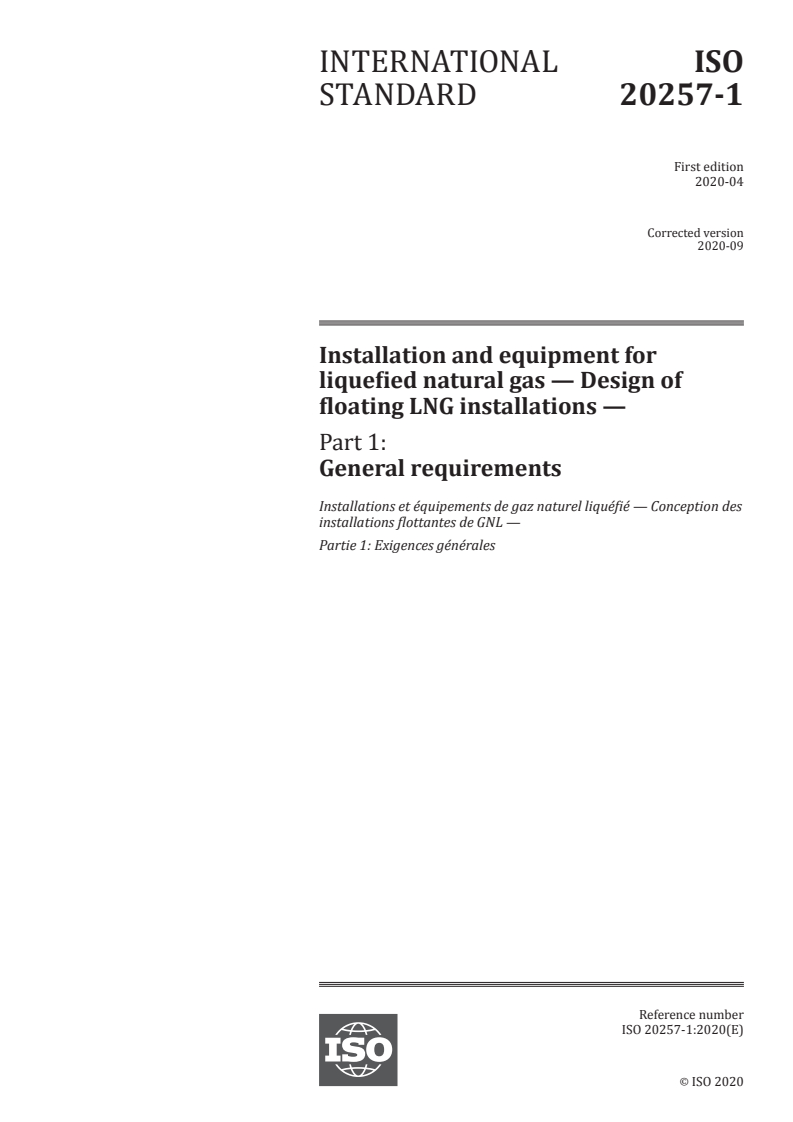
INTERNATIONAL ISO
STANDARD 20257-1
First edition
2020-04
Corrected version
2020-09
Installation and equipment for
liquefied natural gas — Design of
floating LNG installations —
Part 1:
General requirements
Installations et équipements de gaz naturel liquéfié — Conception des
installations flottantes de GNL —
Partie 1: Exigences générales
Reference number
©
ISO 2020
© ISO 2020
All rights reserved. Unless otherwise specified, or required in the context of its implementation, no part of this publication may
be reproduced or utilized otherwise in any form or by any means, electronic or mechanical, including photocopying, or posting
on the internet or an intranet, without prior written permission. Permission can be requested from either ISO at the address
below or ISO’s member body in the country of the requester.
ISO copyright office
CP 401 • Ch. de Blandonnet 8
CH-1214 Vernier, Geneva
Phone: +41 22 749 01 11
Email: copyright@iso.org
Website: www.iso.org
Published in Switzerland
ii © ISO 2020 – All rights reserved
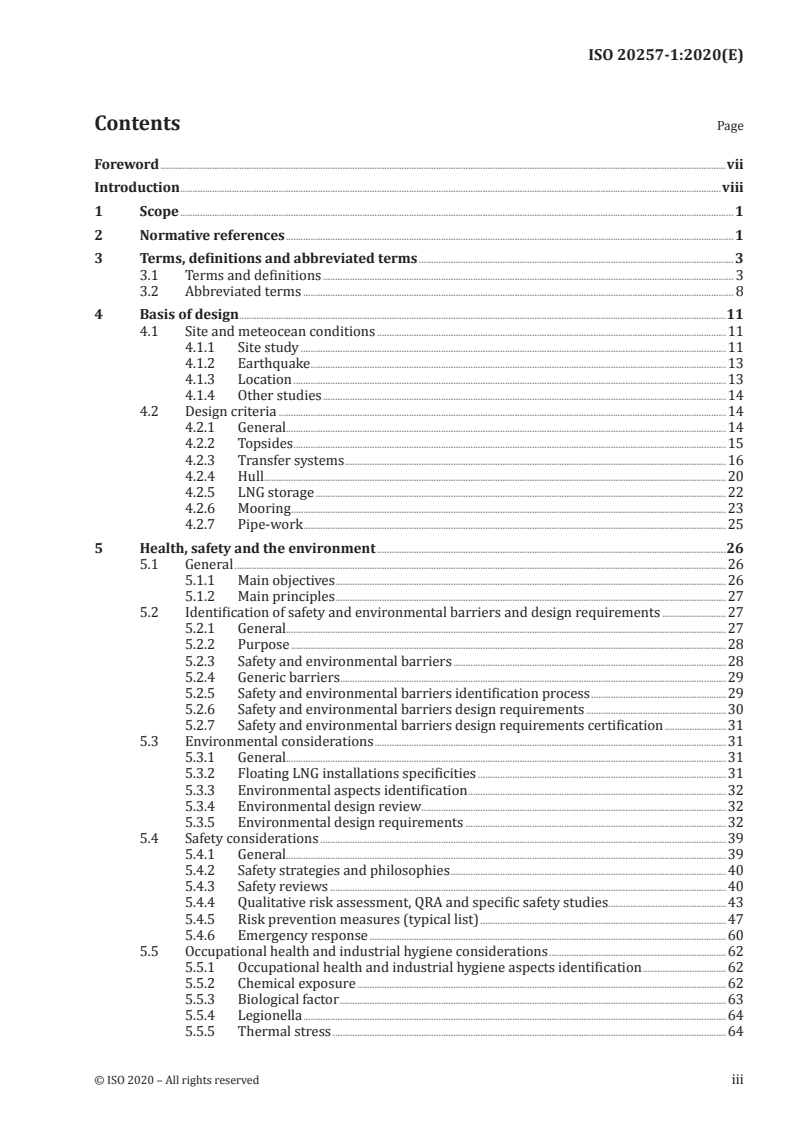
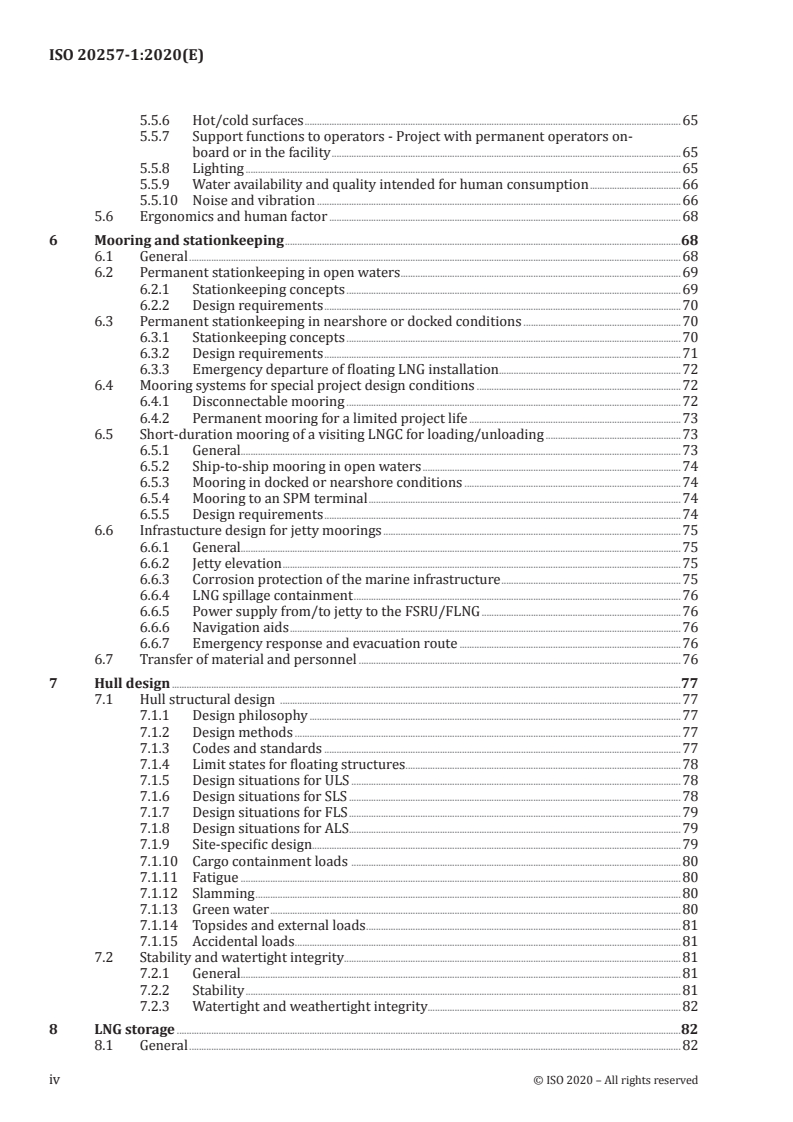
Contents Page
Foreword .vii
Introduction .viii
1 Scope . 1
2 Normative references . 1
3 Terms, definitions and abbreviated terms . 3
3.1 Terms and definitions . 3
3.2 Abbreviated terms . 8
4 Basis of design .11
4.1 Site and meteocean conditions .11
4.1.1 Site study .11
4.1.2 Earthquake .13
4.1.3 Location .13
4.1.4 Other studies .14
4.2 Design criteria .14
4.2.1 General.14
4.2.2 Topsides .15
4.2.3 Transfer systems .16
4.2.4 Hull . .20
4.2.5 LNG storage .22
4.2.6 Mooring .23
4.2.7 Pipe-work .25
5 Health, safety and the environment .26
5.1 General .26
5.1.1 Main objectives .26
5.1.2 Main principles .27
5.2 Identification of safety and environmental barriers and design requirements .27
5.2.1 General.27
5.2.2 Purpose .28
5.2.3 Safety and environmental barriers .28
5.2.4 Generic barriers .29
5.2.5 Safety and environmental barriers identification process .29
5.2.6 Safety and environmental barriers design requirements .30
5.2.7 Safety and environmental barriers design requirements certification .31
5.3 Environmental considerations .31
5.3.1 General.31
5.3.2 Floating LNG installations specificities .31
5.3.3 Environmental aspects identification .32
5.3.4 Environmental design review . .32
5.3.5 Environmental design requirements .32
5.4 Safety considerations .39
5.4.1 General.39
5.4.2 Safety strategies and philosophies .40
5.4.3 Safety reviews .40
5.4.4 Qualitative risk assessment, QRA and specific safety studies.43
5.4.5 Risk prevention measures (typical list) .47
5.4.6 Emergency response .60
5.5 Occupational health and industrial hygiene considerations .62
5.5.1 Occupational health and industrial hygiene aspects identification .62
5.5.2 Chemical exposure .62
5.5.3 Biological factor .63
5.5.4 Legionella .64
5.5.5 Thermal stress .64
5.5.6 Hot/cold surfaces .65
5.5.7 Support functions to operators - Project with permanent operators on-
board or in the facility .65
5.5.8 Lighting .65
5.5.9 Water availability and quality intended for human consumption .66
5.5.10 Noise and vibration .66
5.6 Ergonomics and human factor .68
6 Mooring and stationkeeping .68
6.1 General .68
6.2 Permanent stationkeeping in open waters .69
6.2.1 Stationkeeping concepts .69
6.2.2 Design requirements .70
6.3 Permanent stationkeeping in nearshore or docked conditions .70
6.3.1 Stationkeeping concepts .70
6.3.2 Design requirements .71
6.3.3 Emergency departure of floating LNG installation.72
6.4 Mooring systems for special project design conditions .72
6.4.1 Disconnectable mooring .72
6.4.2 Permanent mooring for a limited project life .73
6.5 Short-duration mooring of a visiting LNGC for loading/unloading .73
6.5.1 General.73
6.5.2 Ship-to-ship mooring in open waters .74
6.5.3 Mooring in docked or nearshore conditions .74
6.5.4 Mooring to an SPM terminal .74
6.5.5 Design requirements .74
6.6 Infrastucture design for jetty moorings .75
6.6.1 General.75
6.6.2 Jetty elevation .75
6.6.3 Corrosion protection of the marine infrastructure .75
6.6.4 LNG spillage containment .76
6.6.5 Power supply from/to jetty to the FSRU/FLNG .76
6.6.6 Navigation aids .76
6.6.7 Emergency response and evacuation route .76
6.7 Transfer of material and personnel .76
7 Hull design .77
7.1 Hull structural design .77
7.1.1 Design philosophy .77
7.1.2 Design methods .77
7.1.3 Codes and standards .77
7.1.4 Limit states for floating structures .78
7.1.5 Design situations for ULS .78
7.1.6 Design situations for SLS .78
7.1.7 Design situations for FLS .79
7.1.8 Design situations for ALS .79
7.1.9 Site-specific design . . .79
7.1.10 Cargo containment loads .80
7.1.11 Fatigue .80
7.1.12 Slamming .80
7.1.13 Green water .80
7.1.14 Topsides and external loads .81
7.1.15 Accidental loads .81
7.2 Stability and watertight integrity.81
7.2.1 General.81
7.2.2 Stability .81
7.2.3 Watertight and weathertight integrity.82
8 LNG storage .82
8.1 General .82
iv © ISO 2020 – All rights reserved
8.2 Sloshing loads .83
8.2.1 Intermediate filling levels: Operating conditions of FSRU/FLNG .83
8.2.2 Intermediate filling levels: Operating conditions of cargo transfers (STS) .84
8.3 Boil-off gas management .84
8.4 Rollover prevention management .84
8.4.1 Background.84
8.4.2 Detection and prevention .85
8.5 Vent systems for LNG storage.85
8.5.1 General.85
8.5.2 Pressure relief systems.85
8.5.3 Vacuum relief systems . . .86
9 LNG transfer system .87
9.1 Functional requirements .87
9.2 Design of transfer systems .88
9.2.1 Operating envelope . .88
9.2.2 Transfer system design .89
10 Boil-off gas handling and recovery .91
10.1 General .91
10.2 BOG collection system .91
10.3 System of gas return to LNGC or to FLNG facility.92
10.4 Boil-off gas recovery .92
10.5 Gas compressor .92
10.6 Flare/vent .92
11 Low temperature pipework .92
11.1 General .92
11.2 Piping components .93
11.2.1 General.93
11.3 Pipe .93
11.3.1 General.93
11.3.2 Pipe joints .93
11.3.3 Pipe supports .94
11.3.4 Compensation of contractions due to cold .94
11.3.5 Differential displacement between offshore structures .94
11.4 Valves .94
11.4.1 Relief valves .95
11.5 Thermal insulation .95
11.5.1 General.95
11.5.2 Piping insulation .96
11.5.3 Fire behaviour .96
11.5.4 Gas absorption .96
11.5.5 Moisture resistance .96
11.5.6 Differential movements .97
11.5.7 Thickness determination .97
11.6 Prevention of zinc contamination of austenitic steel .97
12 Utilities systems .97
12.1 Classification of systems .97
12.1.1 Essential services .97
12.1.2 Emergency services .98
12.2 Electrical .98
12.2.1 Design and engineering principles . .98
12.2.2 Electrical system design .99
12.2.3 Design and selection of equipment and cables .102
12.3 Instrument air system .103
12.4 Hydraulic systems .103
13 Process and safety control and monitoring systems .103
13.1 General description .103
13.2 Process control system .104
13.2.1 Principle .104
13.2.2 Process control system design .104
13.3 Marine control system .104
13.4 Interfaces floating LNG installation/onshore .104
13.5 Safety control system (safety instrumented and F&G control systems) .105
13.5.1 Principle .105
13.5.2 ESD and safety actions .105
13.5.3 System capabilities . .106
13.6 Closed circuit TV .106
13.7 Metering .106
13.7.1 Background.106
13.7.2 Cargo metering .107
13.8 Communications .107
13.9 Environmental monitoring and control .107
14 Security management .108
14.1 General .108
14.2 Offshore access .108
14.3 Onshore access .108
15 Commissioning .109
15.1 General .109
15.2 Systemization and schedule .109
15.3 Implementation .109
15.4 Safety .110
15.5 Organization .111
15.6 Handover .111
15.7 Start-up and performance test .111
16 Inspection and maintenance .111
16.1 General .111
16.2 Specific requirements for floating LNG installations .112
16.2.1 Cargo tank .112
16.2.2 Mooring .112
16.2.3 Process piping systems .112
16.2.4 Transfer systems .112
17 Preservation and corrosion protection .112
17.1 Specific requirements for non-seagoing vessels .112
17.2 Painting and coating .112
17.3 Cathodic protection.113
17.4 Impact of use of seawater as heating medium and active fire protection .113
18 Preparation for operations .113
19 Specific requirements for conversion of existing installations to floating LNG
installations .113
Annex A (informative) Risk-based analysis .115
Annex B (informative) Safety studies.119
Annex C (normative) Definition of reference flow rates for LNG boil-off calculations .126
Annex D (normative) Design basis and criteria of an LNG transfer system .130
Annex E (informative) Seismic classification .142
Annex F (informative) Assessment of novel technology.145
Annex G (informative) Environmental, occupational health and industrial hygiene aspects .148
Bibliography .153
vi © ISO 2020 – All rights reserved
Foreword
ISO (the International Organization for Standardization) is a worldwide federation of national standards
bodies (ISO member bodies). The work of preparing International Standards is normally carried out
through ISO technical committees. Each member body interested in a subject for which a technical
committee has been established has the right to be represented on that committee. International
organizations, governmental and non-governmental, in liaison with ISO, also take part in the work.
ISO collaborates closely with the International Electrotechnical Commission (IEC) on all matters of
electrotechnical standardization.
The procedures used to develop this document and those intended for its further maintenance are
described in the ISO/IEC Directives, Part 1. In particular, the different approval criteria needed for the
different types of ISO documents should be noted. This document was drafted in accordance with the
editorial rules of the ISO/IEC Directives, Part 2 (see www .iso .org/ directives).
Attention is drawn to the possibility that some of the elements of this document may be the subject of
patent rights. ISO shall not be held responsible for identifying any or all such patent rights. Details of
any patent rights identified during the development of the document will be in the Introduction and/or
on the ISO list of patent declarations received (see www .iso .org/ patents).
Any trade name used in this document is information given for the convenience of users and does not
constitute an endorsement.
For an explanation of the voluntary nature of standards, the meaning of ISO specific terms and
expressions related to conformity assessment, as well as information about ISO's adherence to the
World Trade Organization (WTO) principles in the Technical Barriers to Trade (TBT) see www .iso .org/
iso/ foreword .html.
This document was prepared by Technical Committee ISO/TC 67, Materials, equipment and offshore
structures for petroleum, petrochemical and natural gas industries, Subcommittee SC 9, Liquefied natural
gas installations and equipment, in collaboration with the European Committee for Standardization
(CEN) Technical Committee CEN/TC 282, Installation and equipment for LNG, in accordance with the
Agreement on technical cooperation between ISO and CEN (Vienna Agreement).
A list of all parts in the ISO 20257 series can be found on the ISO website.
Any feedback or questions on this document should be directed to the user’s national standards body. A
complete listing of these bodies can be found at www .iso .org/ members .html.
This corrected version of ISO 20257-1:2020 incorporates the following corrections:
- the broken links in References [50] and [51] were updated;
- the missing content in 5.1.2, 5.4.3.2.3, and 5.5.10.2 was added;
- editorial corrections in 12.2.2.2, G.1.2.1, G.2.1 and in the bibliography.
Introduction
This document provides a non-exhaustive list of potential concepts. When a novel concept is proposed,
the general principles in this document can be applied as far as applicable. Such design will result in a
concept with equivalent level of safety and environmental friendliness to those currently considered as
standard solutions. Guidance on the assessment of novel technology is provided in Annex F.
In case a part of the installation, such as hull, vessel or structure, is already covered by another
International Standard, including IMO, this document will only complement that applicable standard
where necessary in order to ensure global safety, stability and integrity of the overall floating LNG
installation.
This document assumes that a floating LNG installation is also designed to meet IMO and classification
society requirements. It is not intended to preclude the use of a 'barge' solution. This document neither
specifies the shape of the installation nor specifies the need for propulsion or an installation to fall
within a particular regulatory regime. A barge can either be subject to exactly the same considerations
as a unit designed as a non-propelled ship or not. This will depend on aspects such as whether a barge
is located offshore or at shore, how it is transported, whether it stores LNG or not, the level of manning,
the regulatory regime imposed on it. In this respect, the user of this document is expected to take hull
structure design, means of external communications, and evacuation, escape and rescue arrangements,
etc. into consideration.
Additional requirements by the Flag process, Shelf or Coastal Regulations can be applicable, that will
vary depending on the type of floating LNG installation.
LNG as fuel bunkering applications is covered in ISO 20519 and in publications by the Society for Gas as
a Marine Fuel.
viii © ISO 2020 – All rights reserved
...
INTERNATIONAL ISO
STANDARD 20257-1
First edition
2020-04
Corrected version
2020-09
Installation and equipment for
liquefied natural gas — Design of
floating LNG installations —
Part 1:
General requirements
Installations et équipements de gaz naturel liquéfié — Conception des
installations flottantes de GNL —
Partie 1: Exigences générales
Reference number
©
ISO 2020
© ISO 2020
All rights reserved. Unless otherwise specified, or required in the context of its implementation, no part of this publication may
be reproduced or utilized otherwise in any form or by any means, electronic or mechanical, including photocopying, or posting
on the internet or an intranet, without prior written permission. Permission can be requested from either ISO at the address
below or ISO’s member body in the country of the requester.
ISO copyright office
CP 401 • Ch. de Blandonnet 8
CH-1214 Vernier, Geneva
Phone: +41 22 749 01 11
Email: copyright@iso.org
Website: www.iso.org
Published in Switzerland
ii © ISO 2020 – All rights reserved
Contents Page
Foreword .vii
Introduction .viii
1 Scope . 1
2 Normative references . 1
3 Terms, definitions and abbreviated terms . 3
3.1 Terms and definitions . 3
3.2 Abbreviated terms . 8
4 Basis of design .11
4.1 Site and meteocean conditions .11
4.1.1 Site study .11
4.1.2 Earthquake .13
4.1.3 Location .13
4.1.4 Other studies .14
4.2 Design criteria .14
4.2.1 General.14
4.2.2 Topsides .15
4.2.3 Transfer systems .16
4.2.4 Hull . .20
4.2.5 LNG storage .22
4.2.6 Mooring .23
4.2.7 Pipe-work .25
5 Health, safety and the environment .26
5.1 General .26
5.1.1 Main objectives .26
5.1.2 Main principles .27
5.2 Identification of safety and environmental barriers and design requirements .27
5.2.1 General.27
5.2.2 Purpose .28
5.2.3 Safety and environmental barriers .28
5.2.4 Generic barriers .29
5.2.5 Safety and environmental barriers identification process .29
5.2.6 Safety and environmental barriers design requirements .30
5.2.7 Safety and environmental barriers design requirements certification .31
5.3 Environmental considerations .31
5.3.1 General.31
5.3.2 Floating LNG installations specificities .31
5.3.3 Environmental aspects identification .32
5.3.4 Environmental design review . .32
5.3.5 Environmental design requirements .32
5.4 Safety considerations .39
5.4.1 General.39
5.4.2 Safety strategies and philosophies .40
5.4.3 Safety reviews .40
5.4.4 Qualitative risk assessment, QRA and specific safety studies.43
5.4.5 Risk prevention measures (typical list) .47
5.4.6 Emergency response .60
5.5 Occupational health and industrial hygiene considerations .62
5.5.1 Occupational health and industrial hygiene aspects identification .62
5.5.2 Chemical exposure .62
5.5.3 Biological factor .63
5.5.4 Legionella .64
5.5.5 Thermal stress .64
5.5.6 Hot/cold surfaces .65
5.5.7 Support functions to operators - Project with permanent operators on-
board or in the facility .65
5.5.8 Lighting .65
5.5.9 Water availability and quality intended for human consumption .66
5.5.10 Noise and vibration .66
5.6 Ergonomics and human factor .68
6 Mooring and stationkeeping .68
6.1 General .68
6.2 Permanent stationkeeping in open waters .69
6.2.1 Stationkeeping concepts .69
6.2.2 Design requirements .70
6.3 Permanent stationkeeping in nearshore or docked conditions .70
6.3.1 Stationkeeping concepts .70
6.3.2 Design requirements .71
6.3.3 Emergency departure of floating LNG installation.72
6.4 Mooring systems for special project design conditions .72
6.4.1 Disconnectable mooring .72
6.4.2 Permanent mooring for a limited project life .73
6.5 Short-duration mooring of a visiting LNGC for loading/unloading .73
6.5.1 General.73
6.5.2 Ship-to-ship mooring in open waters .74
6.5.3 Mooring in docked or nearshore conditions .74
6.5.4 Mooring to an SPM terminal .74
6.5.5 Design requirements .74
6.6 Infrastucture design for jetty moorings .75
6.6.1 General.75
6.6.2 Jetty elevation .75
6.6.3 Corrosion protection of the marine infrastructure .75
6.6.4 LNG spillage containment .76
6.6.5 Power supply from/to jetty to the FSRU/FLNG .76
6.6.6 Navigation aids .76
6.6.7 Emergency response and evacuation route .76
6.7 Transfer of material and personnel .76
7 Hull design .77
7.1 Hull structural design .77
7.1.1 Design philosophy .77
7.1.2 Design methods .77
7.1.3 Codes and standards .77
7.1.4 Limit states for floating structures .78
7.1.5 Design situations for ULS .78
7.1.6 Design situations for SLS .78
7.1.7 Design situations for FLS .79
7.1.8 Design situations for ALS .79
7.1.9 Site-specific design . . .79
7.1.10 Cargo containment loads .80
7.1.11 Fatigue .80
7.1.12 Slamming .80
7.1.13 Green water .80
7.1.14 Topsides and external loads .81
7.1.15 Accidental loads .81
7.2 Stability and watertight integrity.81
7.2.1 General.81
7.2.2 Stability .81
7.2.3 Watertight and weathertight integrity.82
8 LNG storage .82
8.1 General .82
iv © ISO 2020 – All rights reserved
8.2 Sloshing loads .83
8.2.1 Intermediate filling levels: Operating conditions of FSRU/FLNG .83
8.2.2 Intermediate filling levels: Operating conditions of cargo transfers (STS) .84
8.3 Boil-off gas management .84
8.4 Rollover prevention management .84
8.4.1 Background.84
8.4.2 Detection and prevention .85
8.5 Vent systems for LNG storage.85
8.5.1 General.85
8.5.2 Pressure relief systems.85
8.5.3 Vacuum relief systems . . .86
9 LNG transfer system .87
9.1 Functional requirements .87
9.2 Design of transfer systems .88
9.2.1 Operating envelope . .88
9.2.2 Transfer system design .89
10 Boil-off gas handling and recovery .91
10.1 General .91
10.2 BOG collection system .91
10.3 System of gas return to LNGC or to FLNG facility.92
10.4 Boil-off gas recovery .92
10.5 Gas compressor .92
10.6 Flare/vent .92
11 Low temperature pipework .92
11.1 General .92
11.2 Piping components .93
11.2.1 General.93
11.3 Pipe .93
11.3.1 General.93
11.3.2 Pipe joints .93
11.3.3 Pipe supports .94
11.3.4 Compensation of contractions due to cold .94
11.3.5 Differential displacement between offshore structures .94
11.4 Valves .94
11.4.1 Relief valves .95
11.5 Thermal insulation .95
11.5.1 General.95
11.5.2 Piping insulation .96
11.5.3 Fire behaviour .96
11.5.4 Gas absorption .96
11.5.5 Moisture resistance .96
11.5.6 Differential movements .97
11.5.7 Thickness determination .97
11.6 Prevention of zinc contamination of austenitic steel .97
12 Utilities systems .97
12.1 Classification of systems .97
12.1.1 Essential services .97
12.1.2 Emergency services .98
12.2 Electrical .98
12.2.1 Design and engineering principles . .98
12.2.2 Electrical system design .99
12.2.3 Design and selection of equipment and cables .102
12.3 Instrument air system .103
12.4 Hydraulic systems .103
13 Process and safety control and monitoring systems .103
13.1 General description .103
13.2 Process control system .104
13.2.1 Principle .104
13.2.2 Process control system design .104
13.3 Marine control system .104
13.4 Interfaces floating LNG installation/onshore .104
13.5 Safety control system (safety instrumented and F&G control systems) .105
13.5.1 Principle .105
13.5.2 ESD and safety actions .105
13.5.3 System capabilities . .106
13.6 Closed circuit TV .106
13.7 Metering .106
13.7.1 Background.106
13.7.2 Cargo metering .107
13.8 Communications .107
13.9 Environmental monitoring and control .107
14 Security management .108
14.1 General .108
14.2 Offshore access .108
14.3 Onshore access .108
15 Commissioning .109
15.1 General .109
15.2 Systemization and schedule .109
15.3 Implementation .109
15.4 Safety .110
15.5 Organization .111
15.6 Handover .111
15.7 Start-up and performance test .111
16 Inspection and maintenance .111
16.1 General .111
16.2 Specific requirements for floating LNG installations .112
16.2.1 Cargo tank .112
16.2.2 Mooring .112
16.2.3 Process piping systems .112
16.2.4 Transfer systems .112
17 Preservation and corrosion protection .112
17.1 Specific requirements for non-seagoing vessels .112
17.2 Painting and coating .112
17.3 Cathodic protection.113
17.4 Impact of use of seawater as heating medium and active fire protection .113
18 Preparation for operations .113
19 Specific requirements for conversion of existing installations to floating LNG
installations .113
Annex A (informative) Risk-based analysis .115
Annex B (informative) Safety studies.119
Annex C (normative) Definition of reference flow rates for LNG boil-off calculations .126
Annex D (normative) Design basis and criteria of an LNG transfer system .130
Annex E (informative) Seismic classification .142
Annex F (informative) Assessment of novel technology.145
Annex G (informative) Environmental, occupational health and industrial hygiene aspects .148
Bibliography .153
vi © ISO 2020 – All rights reserved
Foreword
ISO (the International Organization for Standardization) is a worldwide federation of national standards
bodies (ISO member bodies). The work of preparing International Standards is normally carried out
through ISO technical committees. Each member body interested in a subject for which a technical
committee has been established has the right to be represented on that committee. International
organizations, governmental and non-governmental, in liaison with ISO, also take part in the work.
ISO collaborates closely with the International Electrotechnical Commission (IEC) on all matters of
electrotechnical standardization.
The procedures used to develop this document and those intended for its further maintenance are
described in the ISO/IEC Directives, Part 1. In particular, the different approval criteria needed for the
different types of ISO documents should be noted. This document was drafted in accordance with the
editorial rules of the ISO/IEC Directives, Part 2 (see www .iso .org/ directives).
Attention is drawn to the possibility that some of the elements of this document may be the subject of
patent rights. ISO shall not be held responsible for identifying any or all such patent rights. Details of
any patent rights identified during the development of the document will be in the Introduction and/or
on the ISO list of patent declarations received (see www .iso .org/ patents).
Any trade name used in this document is information given for the convenience of users and does not
constitute an endorsement.
For an explanation of the voluntary nature of standards, the meaning of ISO specific terms and
expressions related to conformity assessment, as well as information about ISO's adherence to the
World Trade Organization (WTO) principles in the Technical Barriers to Trade (TBT) see www .iso .org/
iso/ foreword .html.
This document was prepared by Technical Committee ISO/TC 67, Materials, equipment and offshore
structures for petroleum, petrochemical and natural gas industries, Subcommittee SC 9, Liquefied natural
gas installations and equipment, in collaboration with the European Committee for Standardization
(CEN) Technical Committee CEN/TC 282, Installation and equipment for LNG, in accordance with the
Agreement on technical cooperation between ISO and CEN (Vienna Agreement).
A list of all parts in the ISO 20257 series can be found on the ISO website.
Any feedback or questions on this document should be directed to the user’s national standards body. A
complete listing of these bodies can be found at www .iso .org/ members .html.
This corrected version of ISO 20257-1:2020 incorporates the following corrections:
- the broken links in References [50] and [51] were updated;
- the missing content in 5.1.2, 5.4.3.2.3, and 5.5.10.2 was added;
- editorial corrections in 12.2.2.2, G.1.2.1, G.2.1 and in the bibliography.
Introduction
This document provides a non-exhaustive list of potential concepts. When a novel concept is proposed,
the general principles in this document can be applied as far as applicable. Such design will result in a
concept with equivalent level of safety and environmental friendliness to those currently considered as
standard solutions. Guidance on the assessment of novel technology is provided in Annex F.
In case a part of the installation, such as hull, vessel or structure, is already covered by another
International Standard, including IMO, this document will only complement that applicable standard
where necessary in order to ensure global safety, stability and integrity of the overall floating LNG
installation.
This document assumes that a floating LNG installation is also designed to meet IMO and classification
society requirements. It is not intended to preclude the use of a 'barge' solution. This document neither
specifies the shape of the installation nor specifies the need for propulsion or an installation to fall
within a particular regulatory regime. A barge can either be subject to exactly the same considerations
as a unit designed as a non-propelled ship or not. This will depend on aspects such as whether a barge
is located offshore or at shore, how it is transported, whether it stores LNG or not, the level of manning,
the regulatory regime imposed on it. In this respect, the user of this document is expected to take hull
structure design, means of external communications, and evacuation, escape and rescue arrangements,
etc. into consideration.
Additional requirements by the Flag process, Shelf or Coastal Regulations can be applicable, that will
vary depending on the type of floating LNG installation.
LNG as fuel bunkering applications is covered in ISO 20519 and in publications by the Society for Gas as
a Marine Fuel.
viii © ISO 2020 – All rights reserved
...
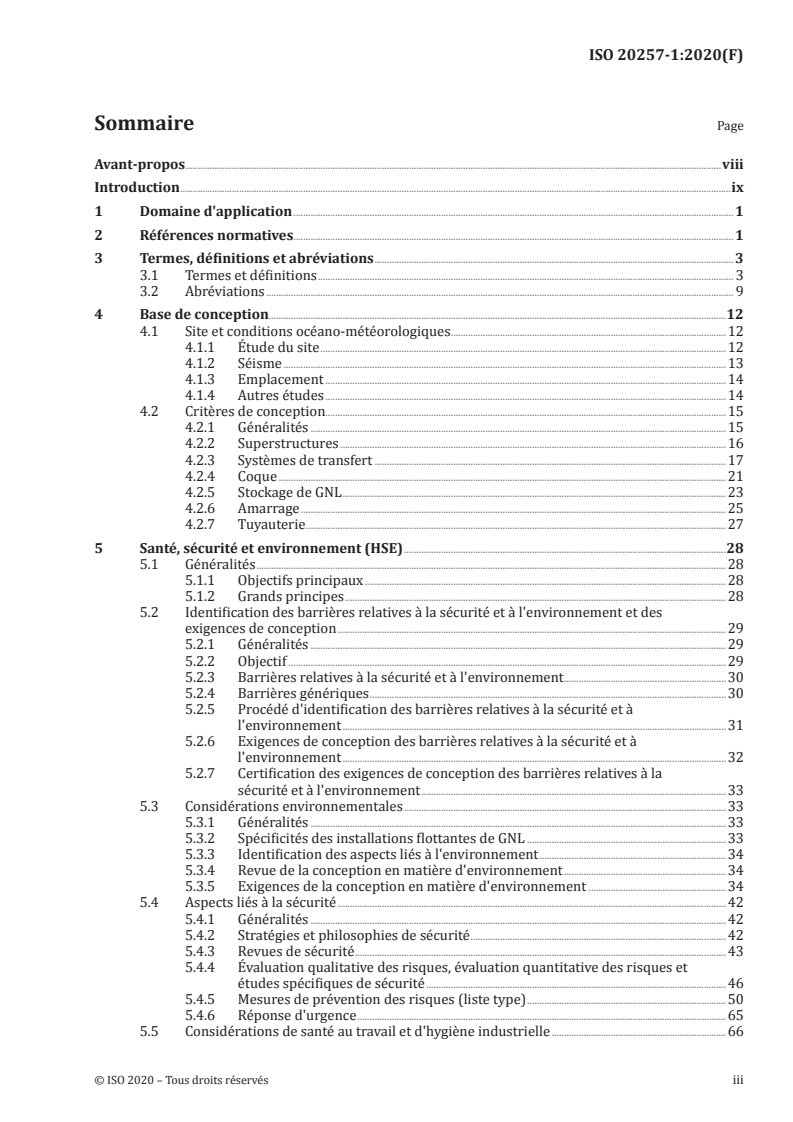
NORME ISO
INTERNATIONALE 20257-1
Première édition
2020-04
Installations et équipements de gaz
naturel liquéfié — Conception des
installations flottantes de GNL —
Partie 1:
Exigences générales
Installation and equipment for liquefied natural gas — Design of
floating LNG installations —
Part 1: General requirements
Numéro de référence
©
ISO 2020
DOCUMENT PROTÉGÉ PAR COPYRIGHT
© ISO 2020
Tous droits réservés. Sauf prescription différente ou nécessité dans le contexte de sa mise en œuvre, aucune partie de cette
publication ne peut être reproduite ni utilisée sous quelque forme que ce soit et par aucun procédé, électronique ou mécanique,
y compris la photocopie, ou la diffusion sur l’internet ou sur un intranet, sans autorisation écrite préalable. Une autorisation peut
être demandée à l’ISO à l’adresse ci-après ou au comité membre de l’ISO dans le pays du demandeur.
ISO copyright office
Case postale 401 • Ch. de Blandonnet 8
CH-1214 Vernier, Genève
Tél.: +41 22 749 01 11
E-mail: copyright@iso.org
Web: www.iso.org
Publié en Suisse
ii © ISO 2020 – Tous droits réservés
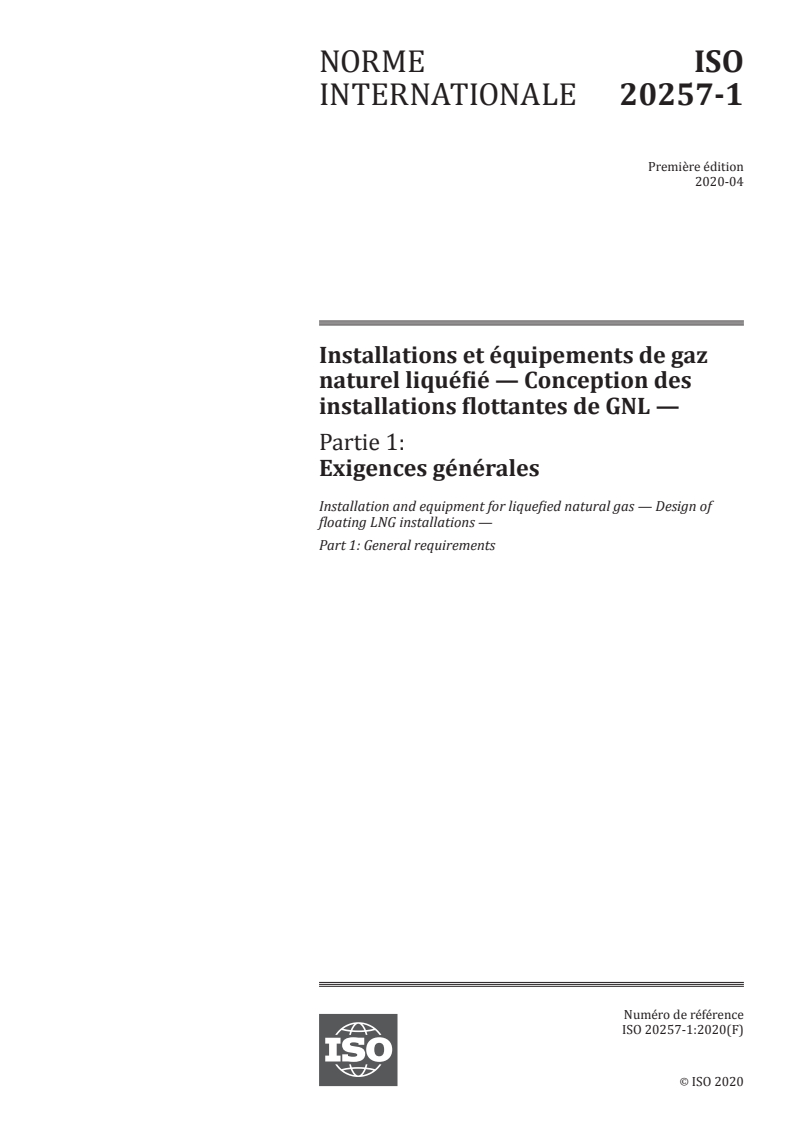
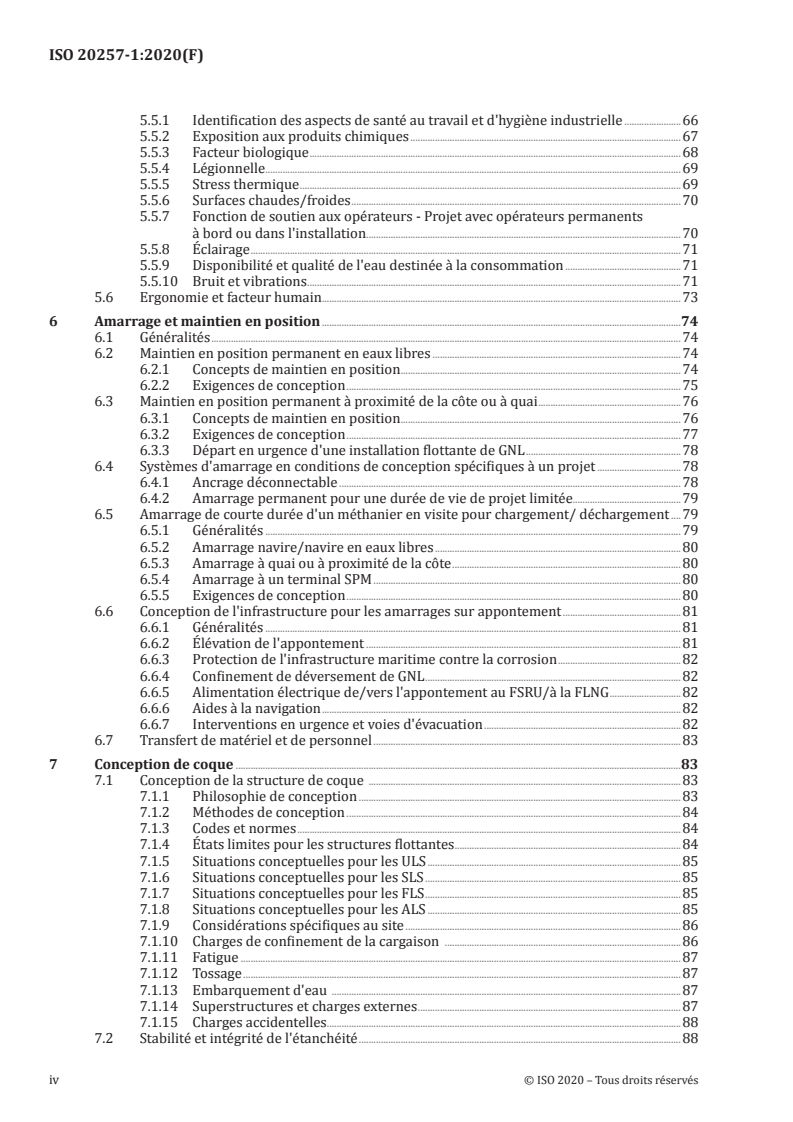
Sommaire Page
Avant-propos .viii
Introduction .ix
1 Domaine d'application . 1
2 Références normatives . 1
3 Termes, définitions et abréviations . 3
3.1 Termes et définitions . 3
3.2 Abréviations . 9
4 Base de conception.12
4.1 Site et conditions océano-météorologiques .12
4.1.1 Étude du site .12
4.1.2 Séisme .13
4.1.3 Emplacement .14
4.1.4 Autres études .14
4.2 Critères de conception.15
4.2.1 Généralités .15
4.2.2 Superstructures .16
4.2.3 Systèmes de transfert .17
4.2.4 Coque .21
4.2.5 Stockage de GNL .23
4.2.6 Amarrage .25
4.2.7 Tuyauterie .27
5 Santé, sécurité et environnement (HSE) .28
5.1 Généralités .28
5.1.1 Objectifs principaux .28
5.1.2 Grands principes .28
5.2 Identification des barrières relatives à la sécurité et à l'environnement et des
exigences de conception .29
5.2.1 Généralités .29
5.2.2 Objectif .29
5.2.3 Barrières relatives à la sécurité et à l'environnement .30
5.2.4 Barrières génériques .30
5.2.5 Procédé d'identification des barrières relatives à la sécurité et à
l'environnement .31
5.2.6 Exigences de conception des barrières relatives à la sécurité et à
l'environnement .32
5.2.7 Certification des exigences de conception des barrières relatives à la
sécurité et à l'environnement .33
5.3 Considérations environnementales .33
5.3.1 Généralités .33
5.3.2 Spécificités des installations flottantes de GNL .33
5.3.3 Identification des aspects liés à l'environnement .34
5.3.4 Revue de la conception en matière d'environnement .34
5.3.5 Exigences de la conception en matière d'environnement .34
5.4 Aspects liés à la sécurité .42
5.4.1 Généralités .42
5.4.2 Stratégies et philosophies de sécurité .42
5.4.3 Revues de sécurité .43
5.4.4 Évaluation qualitative des risques, évaluation quantitative des risques et
études spécifiques de sécurité .46
5.4.5 Mesures de prévention des risques (liste type) .50
5.4.6 Réponse d'urgence .65
5.5 Considérations de santé au travail et d'hygiène industrielle .66
5.5.1 Identification des aspects de santé au travail et d'hygiène industrielle .66
5.5.2 Exposition aux produits chimiques .67
5.5.3 Facteur biologique .68
5.5.4 Légionnelle .69
5.5.5 Stress thermique .69
5.5.6 Surfaces chaudes/froides .70
5.5.7 Fonction de soutien aux opérateurs - Projet avec opérateurs permanents
à bord ou dans l'installation . .70
5.5.8 Éclairage .71
5.5.9 Disponibilité et qualité de l'eau destinée à la consommation .71
5.5.10 Bruit et vibrations .71
5.6 Ergonomie et facteur humain.73
6 Amarrage et maintien en position .74
6.1 Généralités .74
6.2 Maintien en position permanent en eaux libres .74
6.2.1 Concepts de maintien en position .74
6.2.2 Exigences de conception .75
6.3 Maintien en position permanent à proximité de la côte ou à quai .76
6.3.1 Concepts de maintien en position .76
6.3.2 Exigences de conception .77
6.3.3 Départ en urgence d'une installation flottante de GNL .78
6.4 Systèmes d'amarrage en conditions de conception spécifiques à un projet .78
6.4.1 Ancrage déconnectable .78
6.4.2 Amarrage permanent pour une durée de vie de projet limitée.79
6.5 Amarrage de courte durée d'un méthanier en visite pour chargement/ déchargement .79
6.5.1 Généralités .79
6.5.2 Amarrage navire/navire en eaux libres .80
6.5.3 Amarrage à quai ou à proximité de la côte .80
6.5.4 Amarrage à un terminal SPM .80
6.5.5 Exigences de conception .80
6.6 Conception de l'infrastructure pour les amarrages sur appontement .81
6.6.1 Généralités .81
6.6.2 Élévation de l'appontement .81
6.6.3 Protection de l'infrastructure maritime contre la corrosion .82
6.6.4 Confinement de déversement de GNL .82
6.6.5 Alimentation électrique de/vers l'appontement au FSRU/à la FLNG .82
6.6.6 Aides à la navigation .82
6.6.7 Interventions en urgence et voies d'évacuation .82
6.7 Transfert de matériel et de personnel .83
7 Conception de coque .83
7.1 Conception de la structure de coque .83
7.1.1 Philosophie de conception .83
7.1.2 Méthodes de conception .84
7.1.3 Codes et normes .84
7.1.4 États limites pour les structures flottantes .84
7.1.5 Situations conceptuelles pour les ULS .85
7.1.6 Situations conceptuelles pour les SLS .85
7.1.7 Situations conceptuelles pour les FLS .85
7.1.8 Situations conceptuelles pour les ALS .85
7.1.9 Considérations spécifiques au site .86
7.1.10 Charges de confinement de la cargaison .86
7.1.11 Fatigue .87
7.1.12 Tossage .87
7.1.13 Embarquement d'eau .87
7.1.14 Superstructures et charges externes .87
7.1.15 Charges accidentelles . . .88
7.2 Stabilité et intégrité de l'étanchéité .88
iv © ISO 2020 – Tous droits réservés
7.2.1 Généralités .88
7.2.2 Stabilité .88
7.2.3 Intégrité de l'étanchéité à l'eau et aux intempéries.89
8 Stockage de GNL .90
8.1 Généralités .90
8.2 Charges de ballottement (sloshing) .90
8.2.1 Niveaux intermédiaires de remplissage : conditions d'exploitation des
FSRU/FLNG . .90
8.2.2 Niveaux intermédiaires de remplissage : conditions d'exploitation des
transferts de cargaison (navire/navire (STS)) .91
8.3 Gestion des gaz d'évaporation (BOG) .92
8.4 Gestion de la prévention de roll-over .92
8.4.1 Contexte .92
8.4.2 Détection et prévention .92
8.5 Réseaux d'évents pour le stockage du GNL .93
8.5.1 Généralités .93
8.5.2 Systèmes de décharge de pression .93
8.5.3 Systèmes de surpression.94
9 Système de transfert de GNL .94
9.1 Exigences fonctionnelles particulières .94
9.2 Conception des systèmes de transfert .95
9.2.1 Enveloppe de fonctionnement .95
9.2.2 Conception du système de transfert .96
10 Manipulation et récupération des gaz d'évaporation .98
10.1 Généralités .98
10.2 Système de collecte des BOG .99
10.3 Retour gaz vers le méthanier ou vers l'installation flottante de GNL .100
10.4 Récupération des gaz d'évaporation .100
10.5 Compresseur de gaz .100
10.6 Torches/évents .100
11 Tuyauterie basse température .101
11.1 Généralités .101
11.2 Composants de tuyauteries .101
11.2.1 Généralités .101
11.3 Tuyauterie .101
11.3.1 Généralités .101
11.3.2 Raccordements de tuyauteries .102
11.3.3 Supports de tuyauterie .102
11.3.4 Compensation des contractions dues au froid .102
11.3.5 Déplacements différentiels entre structures en mer .102
11.4 Robinetterie .103
11.4.1 Soupapes de décharge .103
11.5 Isolation thermique .104
11.5.1 Généralités .104
11.5.2 Isolation des tuyauteries .104
11.5.3 Comportement au feu .105
11.5.4 Absorption de gaz .105
11.5.5 Résistance à l'humidité.105
11.5.6 Mouvements différentiels .105
11.5.7 Détermination de l'épaisseur . .105
11.6 Prévention de la contamination de l'acier austénitique par le zinc .106
12 Réseaux de commodités .106
12.1 Classification des systèmes .106
12.1.1 Services essentiels .106
12.1.2 Services d'urgence .107
12.2 Électricité .107
12.2.1 Conception et principes généraux .107
12.2.2 Conception du système électrique .108
12.2.3 Conception et sélection des équipements et des câbles .111
12.3 Système d'air d'instrumentation .112
12.4 Systèmes hydrauliques.112
13 Systèmes de contrôle et de surveillance de procédé et de sécurité .112
13.1 Description générale .112
13.2 Système de contrôle du procédé .113
13.2.1 Principe .113
13.2.2 Conception du système de contrôle du procédé.113
13.3 Système de contrôle maritime .113
13.4 Interfaces installation flottante de GNL/terre .114
13.5 Système de contrôle de la sécurité (systèmes instrumentés de sécurité et de
contrôle F&G) .114
13.5.1 Principe .114
13.5.2 Arrêt d'urgence de sécurité (ESD) et actions de sécurité .114
13.5.3 Capacités du système .115
13.6 Système de télévision en circuit fermé (CCTV) .115
13.7 Comptage .116
13.7.1 Contexte .116
13.7.2 Comptage de la cargaison .116
13.8 Communication .116
13.9 Surveillance et maîtrise environnementale .117
14 Gestion de la sécurité.117
14.1 Généralités .117
14.2 Accès par la mer .117
14.3 Accès par la terre.118
15 Mise en service .118
15.1 Généralités .118
15.2 Systématisation et calendrier .118
15.3 Mise en œuvre.118
15.4 Sécurité .120
15.5 Organisation .120
15.6 Mise à disposition .120
15.7 Essais de démarrage et de performance .121
16 Contrôles et maintenance .121
16.1 Généralités .121
16.2 Exigences spécifiques pour les installations flottantes de GNL .121
16.2.1 Réservoir de stockage . .121
16.2.2 Amarrage .122
16.2.3 Systèmes de tuyauteries du procédé .122
16.2.4 Systèmes de transfert .122
17 Préservation et protection contre la corrosion .122
17.1 Exigences spécifiques pour les navires ne navigant pas en haute mer .122
17.2 Peinture et revêtement .122
17.3 Protection cathodique .123
17.4 Impact de l'utilisation de l'eau de mer en tant que fluide caloporteur et protection
active contre l'incendie .123
18 Préparation à l'exploitation .123
19 Exigences spécifiques pour la conversion des installations existantes en
installations flottantes de GNL .123
Annexe A (informative) Analyse basée sur les risques .125
Annexe B (informative) Études de sécurité .129
vi © ISO 2020 – Tous droits réservés
Annexe C (normative) Définition des débits de référence pour les calculs d'évaporation du
GNL .137
Annexe D (normative) Base et critères de conception d'un système de transfert de GNL .141
Annexe E (informative) Classification sismique .153
Annexe F (informative) Évaluation des nouvelles technologies .156
Annexe G (informative) Aspects environnementaux, de santé au travail et d'hygiène
industrielle .159
Bibliographie .165
Avant-propos
L'ISO (Organisation internationale de normalisation) est une fédération mondiale d'organismes
nationaux de normalisation (comités membres de l'ISO). L'élaboration des Normes internationales est
en général confiée aux comités techniques de l'ISO. Chaque comité membre intéressé par une étude
a le droit de faire partie du comité technique créé à cet effet. Les organisations internationales,
gouvernementales et non gouvernementales, en liaison avec l'ISO participent également aux travaux.
L'ISO collabore étroitement avec la Commission électrotechnique internationale (IEC) en ce qui
concerne la normalisation électrotechnique.
Les procédures utilisées pour élaborer le présent document et celles destinées à sa mise à jour sont
décrites dans les Directives ISO/IEC, Partie 1. Il convient, en particulier, de prendre note des différents
critères d'approbation requis pour les différents types de documents ISO. Le présent document a été
rédigé conformément aux règles de rédaction données dans les Directives ISO/IEC, Partie 2 (voir www
.iso .org/ directives).
L'attention est attirée sur le fait que certains des éléments du présent document peuvent faire l'objet de
droits de propriété intellectuelle ou de droits analogues. L'ISO ne saurait être tenue pour responsable
de ne pas avoir identifié de tels droits de propriété et averti de leur existence. Les détails concernant
les références aux droits de propriété intellectuelle ou autres droits analogues identifiés lors de
l'élaboration du document sont indiqués dans l'Introduction et/ou dans la liste des déclarations de
brevets reçues par l'ISO (voir www .iso .org/ brevets).
Les appellations commerciales éventuellement mentionnées dans le présent document sont données
pour information, par souci de commodité, à l’intention des utilisateurs et ne sauraient constituer un
engagement.
Pour une explication de la nature volontaire des normes, la signification des termes et expressions
spécifiques de l'ISO liés à l'évaluation de la conformité, ou pour toute information au sujet de l'adhésion
de l'ISO aux principes de l’Organisation mondiale du commerce (OMC) concernant les obstacles
techniques au commerce (OTC), voir www .iso .org/ avant -propos.
Le présent document a été élaboré par le comité technique ISO/TC 67, Matériel, équipement et structures
en mer pour les industries pétrolière, pétrochimique et du gaz naturel, sous-comité SC 9, Équipements et
installations pour le gaz naturel liquéfié (GNL), en collaboration avec le comité technique CEN/TC 282,
Installations et équipements relatifs au GNL, du Comité européen de normalisation (CEN) conformément
à l’Accord de coopération technique entre l’ISO et le CEN (Accord de Vienne).
Une liste de toutes les parties de la série ISO 20257 se trouve sur le site web de l'ISO.
Il convient que l’utilisateur adresse tout retour d’information ou toute question concernant le présent
document à l’organisme national de normalisation de son pays. Une liste exhaustive desdits organismes
se trouve à l’adresse www .iso .org/ fr/ members .html.
La présente version française de l'ISO 20257-1 correspond à la version anglaise publiée le 2020-04 et
corrigée le 2020-09.
viii © ISO 2020 – Tous droits réservés
Introduction
Le présent document fournit une liste non exhaustive des concepts potentiels. Lorsqu'un nouveau
concept est proposé, les principes généraux du présent document peuvent s'appliquer dans la mesure
du possible. La conception se traduira par un concept ayant un niveau de sécurité et de respect
de l'environnement équivalent à ceux actuellement considérés comme solutions standard. Des
recommandations relatives à l'évaluation des nouvelles technologies sont fournies à l'Annexe F.
Dans les cas où une partie de l'installation (telle que la coque, le navire ou la structure) est déjà couverte
par une autre Norme internationale, y compris une norme de l'OMI, le présent document ne viendra
qu'en complément de cette norme applicable, si nécessaire, afin de garantir la sécurité, la stabilité et
l'intégrité globales de l'installation flottante de GNL dans son ensemble.
Le présent document part du principe qu'une installation flottante de GNL est également conçue pour
satisfaire aux exigences de l'OMI et des sociétés de classification. Son but n'est pas d'exclure l'utilisation
d'une solution « barge ». Le présent document ne spécifie pas la forme de l'installation ni le besoin de
propulsion ou le besoin d'une installation d'être conforme à un régime de réglementation particulier.
Une barge peut être ou non soumise exactement aux mêmes considérations qu'une unité conçue comme
un navire non propulsé. Cela va dépendre d'aspects tels que son emplacement, en mer ou sur le rivage, la
manière dont elle est transportée, son utilisation ou non pour le stockage de GNL, le niveau de l'équipage,
le régime de réglementation qui lui est imposé. À cet égard, l'utilisateur du présent document est censé
prendre en compte la conception de la structure de coque, les moyens de communications e
...
NORME ISO
INTERNATIONALE 20257-1
Première édition
2020-04
Installations et équipements de gaz
naturel liquéfié — Conception des
installations flottantes de GNL —
Partie 1:
Exigences générales
Installation and equipment for liquefied natural gas — Design of
floating LNG installations —
Part 1: General requirements
Numéro de référence
©
ISO 2020
DOCUMENT PROTÉGÉ PAR COPYRIGHT
© ISO 2020
Tous droits réservés. Sauf prescription différente ou nécessité dans le contexte de sa mise en œuvre, aucune partie de cette
publication ne peut être reproduite ni utilisée sous quelque forme que ce soit et par aucun procédé, électronique ou mécanique,
y compris la photocopie, ou la diffusion sur l’internet ou sur un intranet, sans autorisation écrite préalable. Une autorisation peut
être demandée à l’ISO à l’adresse ci-après ou au comité membre de l’ISO dans le pays du demandeur.
ISO copyright office
Case postale 401 • Ch. de Blandonnet 8
CH-1214 Vernier, Genève
Tél.: +41 22 749 01 11
E-mail: copyright@iso.org
Web: www.iso.org
Publié en Suisse
ii © ISO 2020 – Tous droits réservés
Sommaire Page
Avant-propos .viii
Introduction .ix
1 Domaine d'application . 1
2 Références normatives . 1
3 Termes, définitions et abréviations . 3
3.1 Termes et définitions . 3
3.2 Abréviations . 9
4 Base de conception.12
4.1 Site et conditions océano-météorologiques .12
4.1.1 Étude du site .12
4.1.2 Séisme .13
4.1.3 Emplacement .14
4.1.4 Autres études .14
4.2 Critères de conception.15
4.2.1 Généralités .15
4.2.2 Superstructures .16
4.2.3 Systèmes de transfert .17
4.2.4 Coque .21
4.2.5 Stockage de GNL .23
4.2.6 Amarrage .25
4.2.7 Tuyauterie .27
5 Santé, sécurité et environnement (HSE) .28
5.1 Généralités .28
5.1.1 Objectifs principaux .28
5.1.2 Grands principes .28
5.2 Identification des barrières relatives à la sécurité et à l'environnement et des
exigences de conception .29
5.2.1 Généralités .29
5.2.2 Objectif .29
5.2.3 Barrières relatives à la sécurité et à l'environnement .30
5.2.4 Barrières génériques .30
5.2.5 Procédé d'identification des barrières relatives à la sécurité et à
l'environnement .31
5.2.6 Exigences de conception des barrières relatives à la sécurité et à
l'environnement .32
5.2.7 Certification des exigences de conception des barrières relatives à la
sécurité et à l'environnement .33
5.3 Considérations environnementales .33
5.3.1 Généralités .33
5.3.2 Spécificités des installations flottantes de GNL .33
5.3.3 Identification des aspects liés à l'environnement .34
5.3.4 Revue de la conception en matière d'environnement .34
5.3.5 Exigences de la conception en matière d'environnement .34
5.4 Aspects liés à la sécurité .42
5.4.1 Généralités .42
5.4.2 Stratégies et philosophies de sécurité .42
5.4.3 Revues de sécurité .43
5.4.4 Évaluation qualitative des risques, évaluation quantitative des risques et
études spécifiques de sécurité .46
5.4.5 Mesures de prévention des risques (liste type) .50
5.4.6 Réponse d'urgence .65
5.5 Considérations de santé au travail et d'hygiène industrielle .66
5.5.1 Identification des aspects de santé au travail et d'hygiène industrielle .66
5.5.2 Exposition aux produits chimiques .67
5.5.3 Facteur biologique .68
5.5.4 Légionnelle .69
5.5.5 Stress thermique .69
5.5.6 Surfaces chaudes/froides .70
5.5.7 Fonction de soutien aux opérateurs - Projet avec opérateurs permanents
à bord ou dans l'installation . .70
5.5.8 Éclairage .71
5.5.9 Disponibilité et qualité de l'eau destinée à la consommation .71
5.5.10 Bruit et vibrations .71
5.6 Ergonomie et facteur humain.73
6 Amarrage et maintien en position .74
6.1 Généralités .74
6.2 Maintien en position permanent en eaux libres .74
6.2.1 Concepts de maintien en position .74
6.2.2 Exigences de conception .75
6.3 Maintien en position permanent à proximité de la côte ou à quai .76
6.3.1 Concepts de maintien en position .76
6.3.2 Exigences de conception .77
6.3.3 Départ en urgence d'une installation flottante de GNL .78
6.4 Systèmes d'amarrage en conditions de conception spécifiques à un projet .78
6.4.1 Ancrage déconnectable .78
6.4.2 Amarrage permanent pour une durée de vie de projet limitée.79
6.5 Amarrage de courte durée d'un méthanier en visite pour chargement/ déchargement .79
6.5.1 Généralités .79
6.5.2 Amarrage navire/navire en eaux libres .80
6.5.3 Amarrage à quai ou à proximité de la côte .80
6.5.4 Amarrage à un terminal SPM .80
6.5.5 Exigences de conception .80
6.6 Conception de l'infrastructure pour les amarrages sur appontement .81
6.6.1 Généralités .81
6.6.2 Élévation de l'appontement .81
6.6.3 Protection de l'infrastructure maritime contre la corrosion .82
6.6.4 Confinement de déversement de GNL .82
6.6.5 Alimentation électrique de/vers l'appontement au FSRU/à la FLNG .82
6.6.6 Aides à la navigation .82
6.6.7 Interventions en urgence et voies d'évacuation .82
6.7 Transfert de matériel et de personnel .83
7 Conception de coque .83
7.1 Conception de la structure de coque .83
7.1.1 Philosophie de conception .83
7.1.2 Méthodes de conception .84
7.1.3 Codes et normes .84
7.1.4 États limites pour les structures flottantes .84
7.1.5 Situations conceptuelles pour les ULS .85
7.1.6 Situations conceptuelles pour les SLS .85
7.1.7 Situations conceptuelles pour les FLS .85
7.1.8 Situations conceptuelles pour les ALS .85
7.1.9 Considérations spécifiques au site .86
7.1.10 Charges de confinement de la cargaison .86
7.1.11 Fatigue .87
7.1.12 Tossage .87
7.1.13 Embarquement d'eau .87
7.1.14 Superstructures et charges externes .87
7.1.15 Charges accidentelles . . .88
7.2 Stabilité et intégrité de l'étanchéité .88
iv © ISO 2020 – Tous droits réservés
7.2.1 Généralités .88
7.2.2 Stabilité .88
7.2.3 Intégrité de l'étanchéité à l'eau et aux intempéries.89
8 Stockage de GNL .90
8.1 Généralités .90
8.2 Charges de ballottement (sloshing) .90
8.2.1 Niveaux intermédiaires de remplissage : conditions d'exploitation des
FSRU/FLNG . .90
8.2.2 Niveaux intermédiaires de remplissage : conditions d'exploitation des
transferts de cargaison (navire/navire (STS)) .91
8.3 Gestion des gaz d'évaporation (BOG) .92
8.4 Gestion de la prévention de roll-over .92
8.4.1 Contexte .92
8.4.2 Détection et prévention .92
8.5 Réseaux d'évents pour le stockage du GNL .93
8.5.1 Généralités .93
8.5.2 Systèmes de décharge de pression .93
8.5.3 Systèmes de surpression.94
9 Système de transfert de GNL .94
9.1 Exigences fonctionnelles particulières .94
9.2 Conception des systèmes de transfert .95
9.2.1 Enveloppe de fonctionnement .95
9.2.2 Conception du système de transfert .96
10 Manipulation et récupération des gaz d'évaporation .98
10.1 Généralités .98
10.2 Système de collecte des BOG .99
10.3 Retour gaz vers le méthanier ou vers l'installation flottante de GNL .100
10.4 Récupération des gaz d'évaporation .100
10.5 Compresseur de gaz .100
10.6 Torches/évents .100
11 Tuyauterie basse température .101
11.1 Généralités .101
11.2 Composants de tuyauteries .101
11.2.1 Généralités .101
11.3 Tuyauterie .101
11.3.1 Généralités .101
11.3.2 Raccordements de tuyauteries .102
11.3.3 Supports de tuyauterie .102
11.3.4 Compensation des contractions dues au froid .102
11.3.5 Déplacements différentiels entre structures en mer .102
11.4 Robinetterie .103
11.4.1 Soupapes de décharge .103
11.5 Isolation thermique .104
11.5.1 Généralités .104
11.5.2 Isolation des tuyauteries .104
11.5.3 Comportement au feu .105
11.5.4 Absorption de gaz .105
11.5.5 Résistance à l'humidité.105
11.5.6 Mouvements différentiels .105
11.5.7 Détermination de l'épaisseur . .105
11.6 Prévention de la contamination de l'acier austénitique par le zinc .106
12 Réseaux de commodités .106
12.1 Classification des systèmes .106
12.1.1 Services essentiels .106
12.1.2 Services d'urgence .107
12.2 Électricité .107
12.2.1 Conception et principes généraux .107
12.2.2 Conception du système électrique .108
12.2.3 Conception et sélection des équipements et des câbles .111
12.3 Système d'air d'instrumentation .112
12.4 Systèmes hydrauliques.112
13 Systèmes de contrôle et de surveillance de procédé et de sécurité .112
13.1 Description générale .112
13.2 Système de contrôle du procédé .113
13.2.1 Principe .113
13.2.2 Conception du système de contrôle du procédé.113
13.3 Système de contrôle maritime .113
13.4 Interfaces installation flottante de GNL/terre .114
13.5 Système de contrôle de la sécurité (systèmes instrumentés de sécurité et de
contrôle F&G) .114
13.5.1 Principe .114
13.5.2 Arrêt d'urgence de sécurité (ESD) et actions de sécurité .114
13.5.3 Capacités du système .115
13.6 Système de télévision en circuit fermé (CCTV) .115
13.7 Comptage .116
13.7.1 Contexte .116
13.7.2 Comptage de la cargaison .116
13.8 Communication .116
13.9 Surveillance et maîtrise environnementale .117
14 Gestion de la sécurité.117
14.1 Généralités .117
14.2 Accès par la mer .117
14.3 Accès par la terre.118
15 Mise en service .118
15.1 Généralités .118
15.2 Systématisation et calendrier .118
15.3 Mise en œuvre.118
15.4 Sécurité .120
15.5 Organisation .120
15.6 Mise à disposition .120
15.7 Essais de démarrage et de performance .121
16 Contrôles et maintenance .121
16.1 Généralités .121
16.2 Exigences spécifiques pour les installations flottantes de GNL .121
16.2.1 Réservoir de stockage . .121
16.2.2 Amarrage .122
16.2.3 Systèmes de tuyauteries du procédé .122
16.2.4 Systèmes de transfert .122
17 Préservation et protection contre la corrosion .122
17.1 Exigences spécifiques pour les navires ne navigant pas en haute mer .122
17.2 Peinture et revêtement .122
17.3 Protection cathodique .123
17.4 Impact de l'utilisation de l'eau de mer en tant que fluide caloporteur et protection
active contre l'incendie .123
18 Préparation à l'exploitation .123
19 Exigences spécifiques pour la conversion des installations existantes en
installations flottantes de GNL .123
Annexe A (informative) Analyse basée sur les risques .125
Annexe B (informative) Études de sécurité .129
vi © ISO 2020 – Tous droits réservés
Annexe C (normative) Définition des débits de référence pour les calculs d'évaporation du
GNL .137
Annexe D (normative) Base et critères de conception d'un système de transfert de GNL .141
Annexe E (informative) Classification sismique .153
Annexe F (informative) Évaluation des nouvelles technologies .156
Annexe G (informative) Aspects environnementaux, de santé au travail et d'hygiène
industrielle .159
Bibliographie .165
Avant-propos
L'ISO (Organisation internationale de normalisation) est une fédération mondiale d'organismes
nationaux de normalisation (comités membres de l'ISO). L'élaboration des Normes internationales est
en général confiée aux comités techniques de l'ISO. Chaque comité membre intéressé par une étude
a le droit de faire partie du comité technique créé à cet effet. Les organisations internationales,
gouvernementales et non gouvernementales, en liaison avec l'ISO participent également aux travaux.
L'ISO collabore étroitement avec la Commission électrotechnique internationale (IEC) en ce qui
concerne la normalisation électrotechnique.
Les procédures utilisées pour élaborer le présent document et celles destinées à sa mise à jour sont
décrites dans les Directives ISO/IEC, Partie 1. Il convient, en particulier, de prendre note des différents
critères d'approbation requis pour les différents types de documents ISO. Le présent document a été
rédigé conformément aux règles de rédaction données dans les Directives ISO/IEC, Partie 2 (voir www
.iso .org/ directives).
L'attention est attirée sur le fait que certains des éléments du présent document peuvent faire l'objet de
droits de propriété intellectuelle ou de droits analogues. L'ISO ne saurait être tenue pour responsable
de ne pas avoir identifié de tels droits de propriété et averti de leur existence. Les détails concernant
les références aux droits de propriété intellectuelle ou autres droits analogues identifiés lors de
l'élaboration du document sont indiqués dans l'Introduction et/ou dans la liste des déclarations de
brevets reçues par l'ISO (voir www .iso .org/ brevets).
Les appellations commerciales éventuellement mentionnées dans le présent document sont données
pour information, par souci de commodité, à l’intention des utilisateurs et ne sauraient constituer un
engagement.
Pour une explication de la nature volontaire des normes, la signification des termes et expressions
spécifiques de l'ISO liés à l'évaluation de la conformité, ou pour toute information au sujet de l'adhésion
de l'ISO aux principes de l’Organisation mondiale du commerce (OMC) concernant les obstacles
techniques au commerce (OTC), voir www .iso .org/ avant -propos.
Le présent document a été élaboré par le comité technique ISO/TC 67, Matériel, équipement et structures
en mer pour les industries pétrolière, pétrochimique et du gaz naturel, sous-comité SC 9, Équipements et
installations pour le gaz naturel liquéfié (GNL), en collaboration avec le comité technique CEN/TC 282,
Installations et équipements relatifs au GNL, du Comité européen de normalisation (CEN) conformément
à l’Accord de coopération technique entre l’ISO et le CEN (Accord de Vienne).
Une liste de toutes les parties de la série ISO 20257 se trouve sur le site web de l'ISO.
Il convient que l’utilisateur adresse tout retour d’information ou toute question concernant le présent
document à l’organisme national de normalisation de son pays. Une liste exhaustive desdits organismes
se trouve à l’adresse www .iso .org/ fr/ members .html.
La présente version française de l'ISO 20257-1 correspond à la version anglaise publiée le 2020-04 et
corrigée le 2020-09.
viii © ISO 2020 – Tous droits réservés
Introduction
Le présent document fournit une liste non exhaustive des concepts potentiels. Lorsqu'un nouveau
concept est proposé, les principes généraux du présent document peuvent s'appliquer dans la mesure
du possible. La conception se traduira par un concept ayant un niveau de sécurité et de respect
de l'environnement équivalent à ceux actuellement considérés comme solutions standard. Des
recommandations relatives à l'évaluation des nouvelles technologies sont fournies à l'Annexe F.
Dans les cas où une partie de l'installation (telle que la coque, le navire ou la structure) est déjà couverte
par une autre Norme internationale, y compris une norme de l'OMI, le présent document ne viendra
qu'en complément de cette norme applicable, si nécessaire, afin de garantir la sécurité, la stabilité et
l'intégrité globales de l'installation flottante de GNL dans son ensemble.
Le présent document part du principe qu'une installation flottante de GNL est également conçue pour
satisfaire aux exigences de l'OMI et des sociétés de classification. Son but n'est pas d'exclure l'utilisation
d'une solution « barge ». Le présent document ne spécifie pas la forme de l'installation ni le besoin de
propulsion ou le besoin d'une installation d'être conforme à un régime de réglementation particulier.
Une barge peut être ou non soumise exactement aux mêmes considérations qu'une unité conçue comme
un navire non propulsé. Cela va dépendre d'aspects tels que son emplacement, en mer ou sur le rivage, la
manière dont elle est transportée, son utilisation ou non pour le stockage de GNL, le niveau de l'équipage,
le régime de réglementation qui lui est imposé. À cet égard, l'utilisateur du présent document est censé
prendre en compte la conception de la structure de coque, les moyens de communications e
...