

ISO/IEC 24770-5:2019
(Main)Information technology —Real-time locating system (RTLS) device performance test methods — Part 5: Test methods for chirp spread spectrum (CSS) air interface
General Information
- Abstract
This document defines the test methods for determining the performance characteristics of chirp spread spectrum (CSS) real time locating system (RTLS) equipment including tags and readers which are applicable to the selection of equipment that conforms to ISO/IEC 24730‑5 for specific applications. This document does not apply to the testing in relation to regulatory or similar requirements. The RTLS equipment performance parameters included in this document only include the chirp spread spectrum (CSS) radio frequencies link between tags and readers. Unlike ISO/IEC 18305, the tests in this document apply exclusively to RTLS equipment defined in ISO/IEC 24730‑5 unless specified otherwise.
- Status
- Published
- Publication Date
- 05-Aug-2019
- Technical Committee
- ISO/IEC JTC 1/SC 31 - Automatic identification and data capture techniques
- Drafting Committee
- ISO/IEC JTC 1/SC 31/WG 4 - Radio communications
- Current Stage
- 9093 - International Standard confirmed
- Start Date
- 09-May-2025
- Completion Date
- 29-Aug-2026
Buy Documents
ISO/IEC 24770-5:2019 - Information technology —Real-time locating system (RTLS) device performance test methods
ISO/IEC 24770-5:2019 - Information technology —Real-time locating system (RTLS) device performance test methods — Part 5: Test methods for chirp spread spectrum (CSS) air interface/6/2019
Overview
ISO/IEC 24770-5:2019 specifies device performance test methods for Chirp Spread Spectrum (CSS) Real‑Time Locating System (RTLS) equipment - mainly tags and readers - that implement the ISO/IEC 24730‑5 air interface (CSS at 2.4 GHz). The standard defines how to measure key radio‑link and system performance characteristics so manufacturers, test labs and system integrators can evaluate whether CSS RTLS equipment meets application requirements. It is explicitly focused on functional performance testing and does not cover regulatory or certification testing.
Key topics and requirements
- Scope: Tests apply exclusively to RTLS equipment defined in ISO/IEC 24730‑5 and address the CSS tag‑to‑reader air interface.
- Performance parameters covered:
- Location accuracy - comparing system‑calculated positions to actual positions (tests are confined to line‑of‑sight situations).
- Tag capacity - maximum tags/blinks per second the system can process.
- Location latency - time from tag transmission to published location.
- Tag orientation - sensitivity of location results to tag rotation.
- System range & packet error rate - link distance vs. packet loss and its impact on usability.
- Test conditions:
- Tests should be performed in environments typical of the intended application (indoor/outdoor, representative RF noise floor).
- Default tolerance of ±5% for measurement equipment and procedures.
- Systems should provide adequate logging to count transmitted/received packets.
- Test methods detailed:
- System locate performance (preferred setup uses four readers at the corners of a square to cover test area).
- CSS tag‑to‑reader tests using default blink mode.
- CSS two‑way ranging tests (time‑of‑flight / TDOA/TOA considerations).
- Normative references include ISO/IEC 24730‑5 and ISO/IEC 19762 terminology.
Applications
ISO/IEC 24770‑5:2019 is practical for:
- Evaluating RTLS equipment for asset tracking, inventory, healthcare patient/equipment location, warehouse/logistics, and industrial automation.
- Comparing CSS RTLS products for deployment planning - determining reader density, expected accuracy, and tag battery/traffic tradeoffs.
- Performing pre‑deployment QA, acceptance testing, and vendor performance claims verification.
Who should use this standard
- RTLS equipment manufacturers and firmware/hardware developers
- Independent test laboratories and QA teams
- Systems integrators and procurement/specification authors
- Research teams benchmarking CSS RTLS implementations
Related standards
- ISO/IEC 24730‑5 - CSS air interface specification (device definition).
- ISO/IEC 19762 - harmonized AIDC vocabulary.
- ISO/IEC 18305 - RTLS test methods for system level (note: 24770‑5 applies exclusively to 24730‑5 devices unless stated).
Relations
- Consolidated By
ISO 10651-4:2023 - Lung ventilators — Part 4: Particular requirements for user-powered resuscitators - Effective Date
- 06-Jun-2022
Buy Documents
ISO/IEC 24770-5:2019 - Information technology —Real-time locating system (RTLS) device performance test methods
ISO/IEC 24770-5:2019 - Information technology —Real-time locating system (RTLS) device performance test methods — Part 5: Test methods for chirp spread spectrum (CSS) air interface/6/2019
Get Certified
Connect with accredited certification bodies for this standard

BSI Group
BSI (British Standards Institution) is the business standards company that helps organizations make excellence a habit.

NYCE
Mexican standards and certification body.
Sponsored listings
Frequently Asked Questions
ISO/IEC 24770-5:2019 is a standard published by the International Organization for Standardization (ISO). Its full title is "Information technology —Real-time locating system (RTLS) device performance test methods — Part 5: Test methods for chirp spread spectrum (CSS) air interface". This standard covers: This document defines the test methods for determining the performance characteristics of chirp spread spectrum (CSS) real time locating system (RTLS) equipment including tags and readers which are applicable to the selection of equipment that conforms to ISO/IEC 24730‑5 for specific applications. This document does not apply to the testing in relation to regulatory or similar requirements. The RTLS equipment performance parameters included in this document only include the chirp spread spectrum (CSS) radio frequencies link between tags and readers. Unlike ISO/IEC 18305, the tests in this document apply exclusively to RTLS equipment defined in ISO/IEC 24730‑5 unless specified otherwise.
This document defines the test methods for determining the performance characteristics of chirp spread spectrum (CSS) real time locating system (RTLS) equipment including tags and readers which are applicable to the selection of equipment that conforms to ISO/IEC 24730‑5 for specific applications. This document does not apply to the testing in relation to regulatory or similar requirements. The RTLS equipment performance parameters included in this document only include the chirp spread spectrum (CSS) radio frequencies link between tags and readers. Unlike ISO/IEC 18305, the tests in this document apply exclusively to RTLS equipment defined in ISO/IEC 24730‑5 unless specified otherwise.
ISO/IEC 24770-5:2019 is classified under the following ICS (International Classification for Standards) categories: 35.040 - Information coding; 35.040.50 - Automatic identification and data capture techniques. The ICS classification helps identify the subject area and facilitates finding related standards.
ISO/IEC 24770-5:2019 has the following relationships with other standards: It is inter standard links to ISO 10651-4:2023. Understanding these relationships helps ensure you are using the most current and applicable version of the standard.
ISO/IEC 24770-5:2019 is available in PDF format for immediate download after purchase. The document can be added to your cart and obtained through the secure checkout process. Digital delivery ensures instant access to the complete standard document.
Standards Content (Sample)
INTERNATIONAL ISO/IEC
STANDARD 24770-5
First edition
2019-08
Information technology — Real-
time locating system (RTLS) device
performance test methods —
Part 5:
Test methods for chirp spread
spectrum (CSS) air interface
Reference number
©
ISO/IEC 2019
© ISO/IEC 2019
All rights reserved. Unless otherwise specified, or required in the context of its implementation, no part of this publication may
be reproduced or utilized otherwise in any form or by any means, electronic or mechanical, including photocopying, or posting
on the internet or an intranet, without prior written permission. Permission can be requested from either ISO at the address
below or ISO’s member body in the country of the requester.
ISO copyright office
CP 401 • Ch. de Blandonnet 8
CH-1214 Vernier, Geneva
Phone: +41 22 749 01 11
Fax: +41 22 749 09 47
Email: copyright@iso.org
Website: www.iso.org
Published in Switzerland
ii © ISO/IEC 2019 – All rights reserved
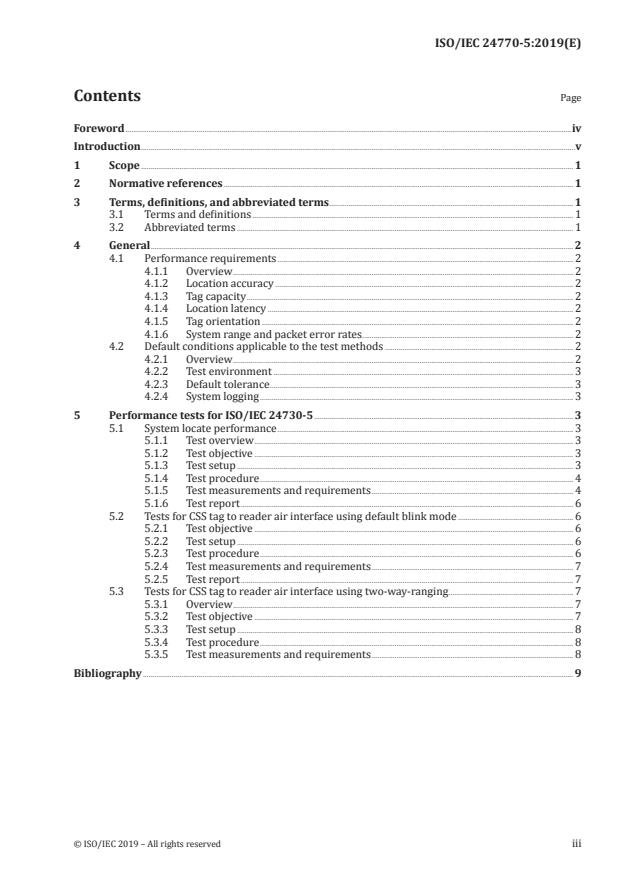
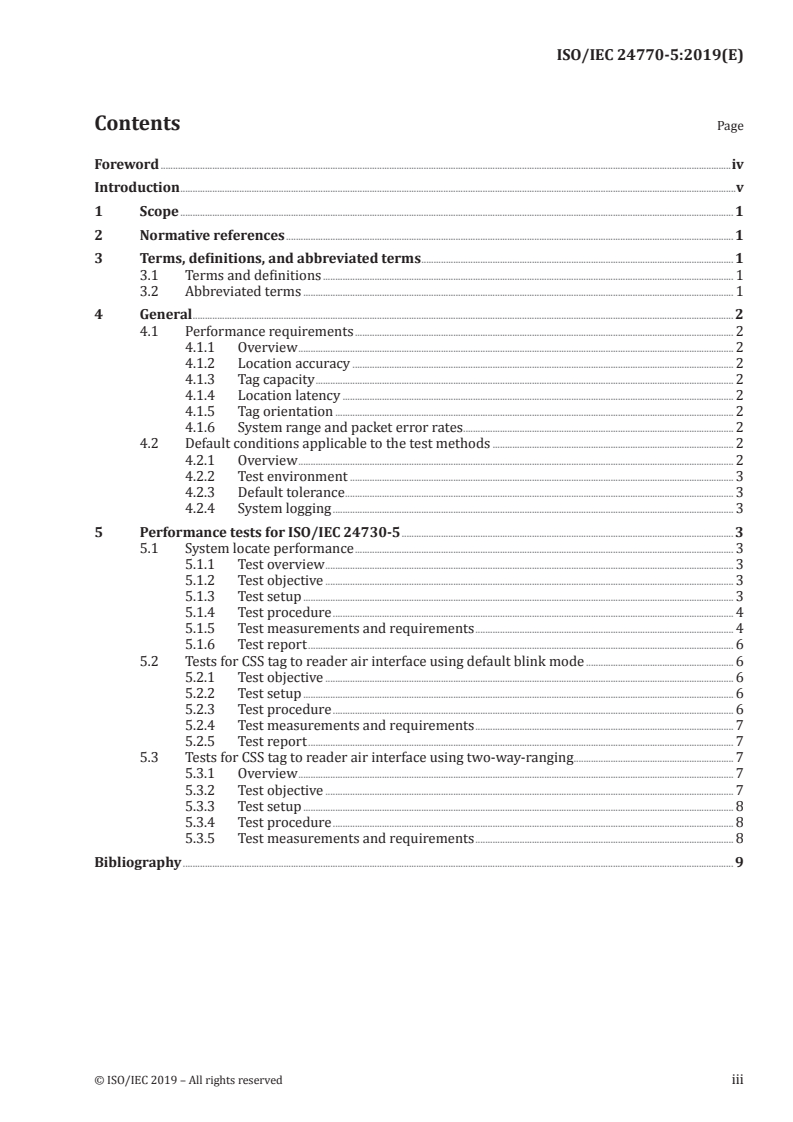
Contents Page
Foreword .iv
Introduction .v
1 Scope . 1
2 Normative references . 1
3 Terms, definitions, and abbreviated terms . 1
3.1 Terms and definitions . 1
3.2 Abbreviated terms . 1
4 General . 2
4.1 Performance requirements . 2
4.1.1 Overview . 2
4.1.2 Location accuracy . 2
4.1.3 Tag capacity . 2
4.1.4 Location latency . 2
4.1.5 Tag orientation . 2
4.1.6 System range and packet error rates . 2
4.2 Default conditions applicable to the test methods . 2
4.2.1 Overview . 2
4.2.2 Test environment . 3
4.2.3 Default tolerance . 3
4.2.4 System logging . 3
5 Performance tests for ISO/IEC 24730-5 . 3
5.1 System locate performance . 3
5.1.1 Test overview . 3
5.1.2 Test objective . 3
5.1.3 Test setup . 3
5.1.4 Test procedure . 4
5.1.5 Test measurements and requirements . 4
5.1.6 Test report . 6
5.2 Tests for CSS tag to reader air interface using default blink mode . 6
5.2.1 Test objective . 6
5.2.2 Test setup . 6
5.2.3 Test procedure . 6
5.2.4 Test measurements and requirements . 7
5.2.5 Test report . 7
5.3 Tests for CSS tag to reader air interface using two-way-ranging . 7
5.3.1 Overview . 7
5.3.2 Test objective . 7
5.3.3 Test setup . 8
5.3.4 Test procedure . 8
5.3.5 Test measurements and requirements . 8
Bibliography . 9
© ISO/IEC 2019 – All rights reserved iii
Foreword
ISO (the International Organization for Standardization) and IEC (the International Electrotechnical
Commission) form the specialized system for worldwide standardization. National bodies that
are members of ISO or IEC participate in the development of International Standards through
technical committees established by the respective organization to deal with particular fields of
technical activity. ISO and IEC technical committees collaborate in fields of mutual interest. Other
international organizations, governmental and non-governmental, in liaison with ISO and IEC, also
take part in the work.
The procedures used to develop this document and those intended for its further maintenance are
described in the ISO/IEC Directives, Part 1. In particular, the different approval criteria needed for
the different types of document should be noted. This document was drafted in accordance with the
editorial rules of the ISO/IEC Directives, Part 2 (see www .iso .org/directives).
Attention is drawn to the possibility that some of the elements of this document may be the subject
of patent rights. ISO and IEC shall not be held responsible for identifying any or all such patent
rights. Details of any patent rights identified during the development of the document will be in the
Introduction and/or on the ISO list of patent declarations received (see www .iso .org/patents) or the IEC
list of patent declarations received (see http: //patents .iec .ch).
Any trade name used in this document is information given for the convenience of users and does not
constitute an endorsement.
For an explanation of the voluntary nature of standards, the meaning of ISO specific terms and
expressions related to conformity assessment, as well as information about ISO's adherence to the
World Trade Organization (WTO) principles in the Technical Barriers to Trade (TBT) see www .iso
.org/iso/foreword .html.
This document was prepared by Joint Technical Committee ISO/IEC JTC 1, Information technology,
Subcommittee SC 31, Automatic identification and data capture techniques.
A list of all parts in the ISO/IEC 24770 series can be found on the ISO website.
Any feedback or questions on this document should be directed to the user’s national standards body. A
complete listing of these bodies can be found at www .iso .org/members .html.
iv © ISO/IEC 2019 – All rights reserved
Introduction
ISO/IEC 24730-5 defines an air interface for real time locating systems (RTLS) devices used in asset
management applications.
This document provides test methods for measuring the performance of equipment compliant with
ISO/IEC 24730-5.
ISO/IEC 24769-5 contains all measurements required to be made on a product in order to establish
whether it conforms to ISO/IEC 24730-5.
© ISO/IEC 2019 – All rights reserved v
INTERNATIONAL STANDARD ISO/IEC 24770-5:2019(E)
Information technology — Real-time locating system
(RTLS) device performance test methods —
Part 5:
Test methods for chirp spread spectrum (CSS) air interface
1 Scope
This document defines the test methods for determining the performance characteristics of chirp
spread spectrum (CSS) real time locating system (RTLS) equipment including tags and readers which
are applicable to the selection of equipment that conforms to ISO/IEC 24730-5 for specific applications.
This document does not apply to the testing in relation to regulatory or similar requirements.
The RTLS equipment performance parameters included in this document only include the chirp spread
spectrum (CSS) radio frequencies link between tags and readers. Unlike ISO/IEC 18305, the tests in this
document apply exclusively to RTLS equipment defined in ISO/IEC 24730-5 unless specified otherwise.
2 Normative references
The following documents are referred to in the text in such a way that some or all of their content
constitutes requirements of this document. For dated references, only the edition cited applies. For
undated references, the latest edition of the referenced document (including any amendments) applies.
ISO/IEC 19762, Information technology — Automatic identification and data capture (AIDC) techniques —
Harmonized vocabulary
ISO/IEC 24730-5, Information technology — Real-time locating systems (RTLS) — Part 5: Chirp spread
spectrum (CSS) at 2,4 GHz air interface
3 Terms, definitions, and abbreviated terms
3.1 Terms and definitions
For the purposes of this document, the terms and definitions given in ISO/IEC 19762 apply.
ISO and IEC maintain terminological databases for use in standardization at the following addresses:
— ISO Online browsing platform: available at https: //www .iso .org/obp
— IEC Electropedia: available at http: //www .electropedia .org/
3.2 Abbreviated terms
CSS chirp spread spectrum
RF radio frequency
RTLS real time locating system
© ISO/IEC 2019 – All rights reserved 1
TDOA time difference of arrival
TOA time of arrival
TOF time of flight
4 General
4.1 Performance requirements
4.1.1 Overview
This document specifies a series of tests to determine the performance characteristics of RTLS
equipment relative to the ISO/IEC 24730-5 air interfaces. The results of these tests can be used to
determine the suitability of RTLS equipment for applications.
4.1.2 Location accuracy
The primary function of RTLS equipment is to locate tags within the area determined by the readers.
Location accuracy determines the primary performance criteria of an RTLS. Location accuracy can be
characterized by comparing the system's calculated location for a given set of tags to the actual location
of the tags. The system shall be able to locate tags to within the applications allowable error. In many,
but not necessarily in all applications, the Euclidean distance between the calculated location of a tag
and the actual location of a tag can be used as an error criterion. The location tests specified in this
document are confined to line-of-sight situations. Although this is not be applicable to all applications,
the complexity of all the variations of blockage and partial blockage are beyond the scope of this test.
4.1.3 Tag capacity
An RTLS shall typically locate a large number of tags. The number of tag blinks per second that can
be processed and located through the readers can be used to determine a system’s tag capacity. The
system shall be able to provide location information for an applications peak tag blink density.
4.1.4 Location latency
The latency between when the tag blink is transmitted and, when the RTL
...
INTERNATIONAL ISO/IEC
STANDARD 24770-5
First edition
2019-08
Information technology — Real-
time locating system (RTLS) device
performance test methods —
Part 5:
Test methods for chirp spread
spectrum (CSS) air interface
Reference number
©
ISO/IEC 2019
© ISO/IEC 2019
All rights reserved. Unless otherwise specified, or required in the context of its implementation, no part of this publication may
be reproduced or utilized otherwise in any form or by any means, electronic or mechanical, including photocopying, or posting
on the internet or an intranet, without prior written permission. Permission can be requested from either ISO at the address
below or ISO’s member body in the country of the requester.
ISO copyright office
CP 401 • Ch. de Blandonnet 8
CH-1214 Vernier, Geneva
Phone: +41 22 749 01 11
Fax: +41 22 749 09 47
Email: copyright@iso.org
Website: www.iso.org
Published in Switzerland
ii © ISO/IEC 2019 – All rights reserved
Contents Page
Foreword .iv
Introduction .v
1 Scope . 1
2 Normative references . 1
3 Terms, definitions, and abbreviated terms . 1
3.1 Terms and definitions . 1
3.2 Abbreviated terms . 1
4 General . 2
4.1 Performance requirements . 2
4.1.1 Overview . 2
4.1.2 Location accuracy . 2
4.1.3 Tag capacity . 2
4.1.4 Location latency . 2
4.1.5 Tag orientation . 2
4.1.6 System range and packet error rates . 2
4.2 Default conditions applicable to the test methods . 2
4.2.1 Overview . 2
4.2.2 Test environment . 3
4.2.3 Default tolerance . 3
4.2.4 System logging . 3
5 Performance tests for ISO/IEC 24730-5 . 3
5.1 System locate performance . 3
5.1.1 Test overview . 3
5.1.2 Test objective . 3
5.1.3 Test setup . 3
5.1.4 Test procedure . 4
5.1.5 Test measurements and requirements . 4
5.1.6 Test report . 6
5.2 Tests for CSS tag to reader air interface using default blink mode . 6
5.2.1 Test objective . 6
5.2.2 Test setup . 6
5.2.3 Test procedure . 6
5.2.4 Test measurements and requirements . 7
5.2.5 Test report . 7
5.3 Tests for CSS tag to reader air interface using two-way-ranging . 7
5.3.1 Overview . 7
5.3.2 Test objective . 7
5.3.3 Test setup . 8
5.3.4 Test procedure . 8
5.3.5 Test measurements and requirements . 8
Bibliography . 9
© ISO/IEC 2019 – All rights reserved iii
Foreword
ISO (the International Organization for Standardization) and IEC (the International Electrotechnical
Commission) form the specialized system for worldwide standardization. National bodies that
are members of ISO or IEC participate in the development of International Standards through
technical committees established by the respective organization to deal with particular fields of
technical activity. ISO and IEC technical committees collaborate in fields of mutual interest. Other
international organizations, governmental and non-governmental, in liaison with ISO and IEC, also
take part in the work.
The procedures used to develop this document and those intended for its further maintenance are
described in the ISO/IEC Directives, Part 1. In particular, the different approval criteria needed for
the different types of document should be noted. This document was drafted in accordance with the
editorial rules of the ISO/IEC Directives, Part 2 (see www .iso .org/directives).
Attention is drawn to the possibility that some of the elements of this document may be the subject
of patent rights. ISO and IEC shall not be held responsible for identifying any or all such patent
rights. Details of any patent rights identified during the development of the document will be in the
Introduction and/or on the ISO list of patent declarations received (see www .iso .org/patents) or the IEC
list of patent declarations received (see http: //patents .iec .ch).
Any trade name used in this document is information given for the convenience of users and does not
constitute an endorsement.
For an explanation of the voluntary nature of standards, the meaning of ISO specific terms and
expressions related to conformity assessment, as well as information about ISO's adherence to the
World Trade Organization (WTO) principles in the Technical Barriers to Trade (TBT) see www .iso
.org/iso/foreword .html.
This document was prepared by Joint Technical Committee ISO/IEC JTC 1, Information technology,
Subcommittee SC 31, Automatic identification and data capture techniques.
A list of all parts in the ISO/IEC 24770 series can be found on the ISO website.
Any feedback or questions on this document should be directed to the user’s national standards body. A
complete listing of these bodies can be found at www .iso .org/members .html.
iv © ISO/IEC 2019 – All rights reserved
Introduction
ISO/IEC 24730-5 defines an air interface for real time locating systems (RTLS) devices used in asset
management applications.
This document provides test methods for measuring the performance of equipment compliant with
ISO/IEC 24730-5.
ISO/IEC 24769-5 contains all measurements required to be made on a product in order to establish
whether it conforms to ISO/IEC 24730-5.
© ISO/IEC 2019 – All rights reserved v
INTERNATIONAL STANDARD ISO/IEC 24770-5:2019(E)
Information technology — Real-time locating system
(RTLS) device performance test methods —
Part 5:
Test methods for chirp spread spectrum (CSS) air interface
1 Scope
This document defines the test methods for determining the performance characteristics of chirp
spread spectrum (CSS) real time locating system (RTLS) equipment including tags and readers which
are applicable to the selection of equipment that conforms to ISO/IEC 24730-5 for specific applications.
This document does not apply to the testing in relation to regulatory or similar requirements.
The RTLS equipment performance parameters included in this document only include the chirp spread
spectrum (CSS) radio frequencies link between tags and readers. Unlike ISO/IEC 18305, the tests in this
document apply exclusively to RTLS equipment defined in ISO/IEC 24730-5 unless specified otherwise.
2 Normative references
The following documents are referred to in the text in such a way that some or all of their content
constitutes requirements of this document. For dated references, only the edition cited applies. For
undated references, the latest edition of the referenced document (including any amendments) applies.
ISO/IEC 19762, Information technology — Automatic identification and data capture (AIDC) techniques —
Harmonized vocabulary
ISO/IEC 24730-5, Information technology — Real-time locating systems (RTLS) — Part 5: Chirp spread
spectrum (CSS) at 2,4 GHz air interface
3 Terms, definitions, and abbreviated terms
3.1 Terms and definitions
For the purposes of this document, the terms and definitions given in ISO/IEC 19762 apply.
ISO and IEC maintain terminological databases for use in standardization at the following addresses:
— ISO Online browsing platform: available at https: //www .iso .org/obp
— IEC Electropedia: available at http: //www .electropedia .org/
3.2 Abbreviated terms
CSS chirp spread spectrum
RF radio frequency
RTLS real time locating system
© ISO/IEC 2019 – All rights reserved 1
TDOA time difference of arrival
TOA time of arrival
TOF time of flight
4 General
4.1 Performance requirements
4.1.1 Overview
This document specifies a series of tests to determine the performance characteristics of RTLS
equipment relative to the ISO/IEC 24730-5 air interfaces. The results of these tests can be used to
determine the suitability of RTLS equipment for applications.
4.1.2 Location accuracy
The primary function of RTLS equipment is to locate tags within the area determined by the readers.
Location accuracy determines the primary performance criteria of an RTLS. Location accuracy can be
characterized by comparing the system's calculated location for a given set of tags to the actual location
of the tags. The system shall be able to locate tags to within the applications allowable error. In many,
but not necessarily in all applications, the Euclidean distance between the calculated location of a tag
and the actual location of a tag can be used as an error criterion. The location tests specified in this
document are confined to line-of-sight situations. Although this is not be applicable to all applications,
the complexity of all the variations of blockage and partial blockage are beyond the scope of this test.
4.1.3 Tag capacity
An RTLS shall typically locate a large number of tags. The number of tag blinks per second that can
be processed and located through the readers can be used to determine a system’s tag capacity. The
system shall be able to provide location information for an applications peak tag blink density.
4.1.4 Location latency
The latency between when the tag blink is transmitted and, when the RTL
...