

ISO/IEC 15418:2016
(Main)Information technology — Automatic identification and data capture techniques — GS1 Application Identifiers and ASC MH10 Data Identifiers and maintenance
General Information
- Abstract
ISO/IEC 15418:2016 - specifies sets of Data Identifiers and Application Identifiers for the purpose of identifying encoded data, and - identifies the organizations responsible for their maintenance.
- Status
- Published
- Publication Date
- 24-Feb-2016
- Technical Committee
- ISO/IEC JTC 1/SC 31 - Automatic identification and data capture techniques
- Drafting Committee
- ISO/IEC JTC 1/SC 31/WG 2 - Data and structure
- Current Stage
- 9020 - International Standard under periodical review
- Start Date
- 15-Jul-2026
- Completion Date
- 15-Jul-2026
Buy Documents

ISO/IEC 15418:2016 - Information technology -- Automatic identification and data capture techniques -- GS1 Application Identifiers and ASC MH10 Data Identifiers and maintenance

ISO/IEC 15418:2016 - Information technology — Automatic identification and data capture techniques — GS1 Application Identifiers and ASC MH10 Data Identifiers and maintenance/25/2016
Overview
ISO/IEC 15418:2016 is an international standard focusing on information technology for automatic identification and data capture techniques. This standard defines sets of GS1 Application Identifiers (AIs) and ASC MH10 Data Identifiers (DIs). These identifiers specify how encoded data is identified and maintained, supporting efficient and consistent data interchange across industries globally. The document also designates the organizations responsible for the ongoing maintenance of these identifier systems.
Adopted by ISO and IEC, this third edition standard enhances global supply chain interoperability by establishing clear rules for encoding data content and specifying data carriers. It is essential for developers, manufacturers, and supply chain managers who implement automatic identification technologies such as barcodes, RFID, and data capture systems.
Key Topics
GS1 Application Identifiers
GS1 AIs are globally recognized codes used to define and structure data fields in automatic identification systems. These identifiers enable cross-sector and international application in supply chains. GS1 AIs consist of two or more characters, where the first two digits indicate the AI length and structure. Usage of GS1 AIs follows rules established by GS1 and is detailed in GS1 General Specifications.ASC MH10 Data Identifiers
These identifiers stem from the American National Standard MH10 and provide a universal set of data identifiers suitable for multiple alphanumeric data carriers. ASC MH10 DIs use an alphabetic character optionally preceded by numeric characters to encode information. They are maintained by the ASC MH10 Data Identifier Maintenance Committee and designed to support cross-industry data interchange integrity.Maintenance and Governance
Ongoing updates and management of GS1 AIs are handled by GS1 headquarters and member organizations worldwide, ensuring global harmonization. ASC MH10 DIs are maintained by a dedicated ANSI committee that prohibits modifications post-registration to preserve consistency, while also accepting requests for new data identifiers.User Guidance and Mapping
ISO/IEC 15418:2016 offers guidance on choosing between GS1 AIs and ASC MH10 DIs based on industry practices and system requirements. The standard recognizes that some industries may need to operate both systems simultaneously and provides publicly available mapping tables to support data interoperability between GS1 and ASC MH10 identifier sets.
Applications
Supply Chain and Logistics:
The standard is extensively applied in global supply chains for product identification, shipment tracking, and inventory management, enabling precise data capture and seamless information flow between trading partners.Retail and Manufacturing:
Manufacturers and retailers use GS1 AIs and ASC MH10 DIs to encode product information like serial numbers, expiration dates, and batch numbers, supporting automated checkout, quality control, and traceability.Healthcare and Pharmaceuticals:
Accurate data identification helps in tracking medical devices, pharmaceuticals, and patient information, improving safety, compliance, and inventory accuracy.Warehousing and Material Handling:
This standard aids automated warehousing by defining unique identifiers that streamline picking, packing, and shipment with data consistency across systems.Electronic Data Interchange (EDI):
ISO/IEC 15418:2016 supports the integration of data identifiers into electronic messaging formats such as EDIFACT, facilitating structured exchange of identification data between enterprises.
Related Standards
- ISO/IEC 19762: Harmonized vocabulary for automatic identification and data capture (AIDC) techniques
- GS1 General Specifications: Detailed rules and guidelines for GS1 data structures and application identifiers
- ANS MH10: The American National Standard for Data Application Identifiers, encompassing ASC MH10 DIs
- ISO/IEC JTC 1/SC 31: The joint ISO/IEC technical subcommittee responsible for standards development in automatic identification and data capture
Keywords: ISO/IEC 15418:2016, GS1 Application Identifiers, ASC MH10 Data Identifiers, automatic identification, data capture, supply chain, barcode standards, RFID, data interoperability, ANSI MH10, data maintenance, encoding standards
Relations
- Effective Date
- 17-Jun-2026
- Effective Date
- 20-Feb-2026
- Effective Date
- 09-Feb-2026
- Effective Date
- 09-Feb-2026
- Effective Date
- 09-Feb-2026
- Effective Date
- 13-Sep-2014
Buy Documents
ISO/IEC 15418:2016 - Information technology -- Automatic identification and data capture techniques -- GS1 Application Identifiers and ASC MH10 Data Identifiers and maintenance
ISO/IEC 15418:2016 - Information technology — Automatic identification and data capture techniques — GS1 Application Identifiers and ASC MH10 Data Identifiers and maintenance/25/2016
Get Certified
Connect with accredited certification bodies for this standard

BSI Group
BSI (British Standards Institution) is the business standards company that helps organizations make excellence a habit.

NYCE
Mexican standards and certification body.
Sponsored listings
Frequently Asked Questions
ISO/IEC 15418:2016 is a standard published by the International Organization for Standardization (ISO). Its full title is "Information technology — Automatic identification and data capture techniques — GS1 Application Identifiers and ASC MH10 Data Identifiers and maintenance". This standard covers: ISO/IEC 15418:2016 - specifies sets of Data Identifiers and Application Identifiers for the purpose of identifying encoded data, and - identifies the organizations responsible for their maintenance.
ISO/IEC 15418:2016 - specifies sets of Data Identifiers and Application Identifiers for the purpose of identifying encoded data, and - identifies the organizations responsible for their maintenance.
ISO/IEC 15418:2016 is classified under the following ICS (International Classification for Standards) categories: 35.040 - Information coding; 35.040.50 - Automatic identification and data capture techniques. The ICS classification helps identify the subject area and facilitates finding related standards.
ISO/IEC 15418:2016 has the following relationships with other standards: It is inter standard links to EN 18219:2026, EN IEC 61406-2:2024, CEN/TS 15523:2011, EN 17071:2019, CEN/TS 14631:2005, ISO/IEC 15418:2009. Understanding these relationships helps ensure you are using the most current and applicable version of the standard.
ISO/IEC 15418:2016 is available in PDF format for immediate download after purchase. The document can be added to your cart and obtained through the secure checkout process. Digital delivery ensures instant access to the complete standard document.
Standards Content (Sample)
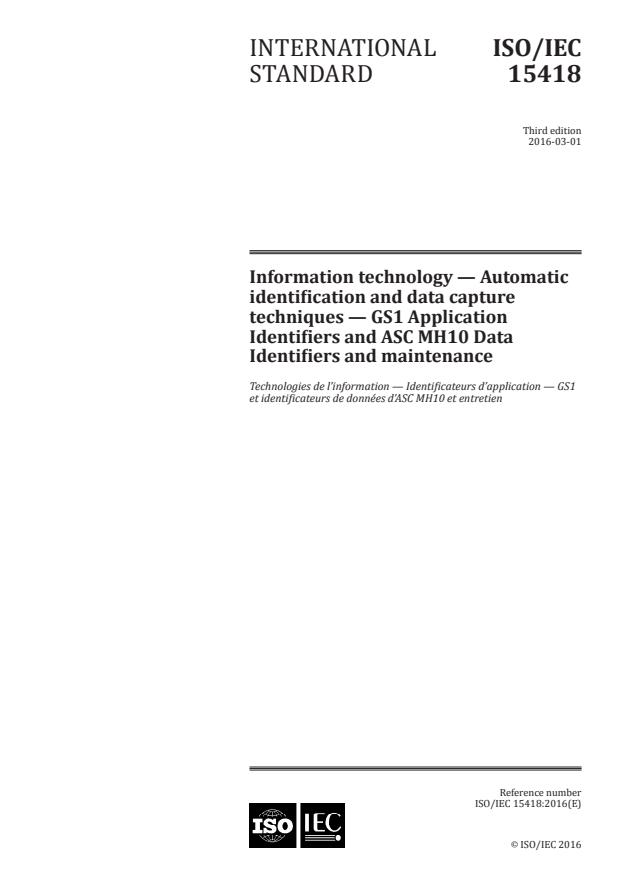
INTERNATIONAL ISO/IEC
STANDARD 15418
Third edition
2016-03-01
Information technology — Automatic
identification and data capture
techniques — GS1 Application
Identifiers and ASC MH10 Data
Identifiers and maintenance
Technologies de l’information — Identificateurs d’application — GS1
et identificateurs de données d’ASC MH10 et entretien
Reference number
©
ISO/IEC 2016
© ISO/IEC 2016, Published in Switzerland
All rights reserved. Unless otherwise specified, no part of this publication may be reproduced or utilized otherwise in any form
or by any means, electronic or mechanical, including photocopying, or posting on the internet or an intranet, without prior
written permission. Permission can be requested from either ISO at the address below or ISO’s member body in the country of
the requester.
ISO copyright office
Ch. de Blandonnet 8 • CP 401
CH-1214 Vernier, Geneva, Switzerland
Tel. +41 22 749 01 11
Fax +41 22 749 09 47
copyright@iso.org
www.iso.org
ii © ISO/IEC 2016 – All rights reserved
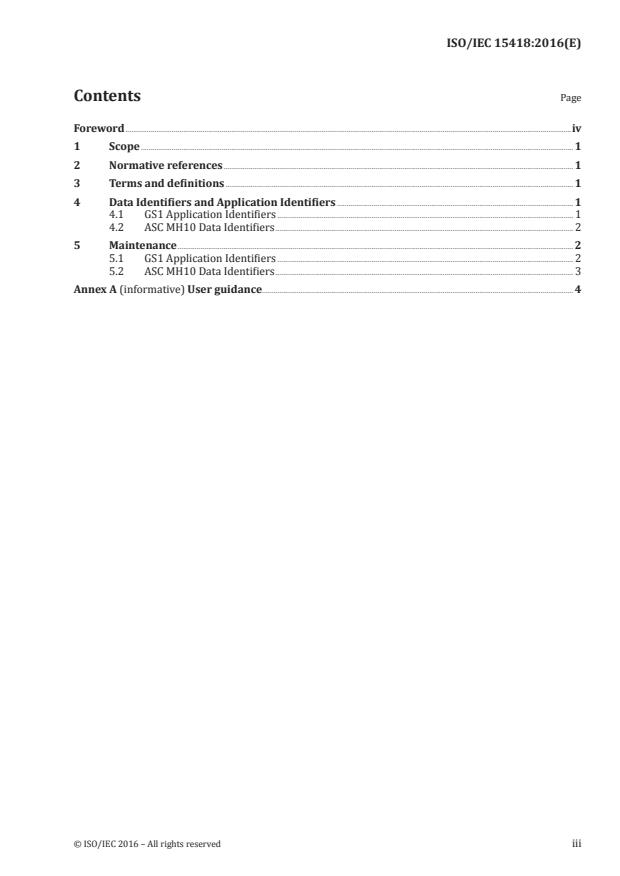
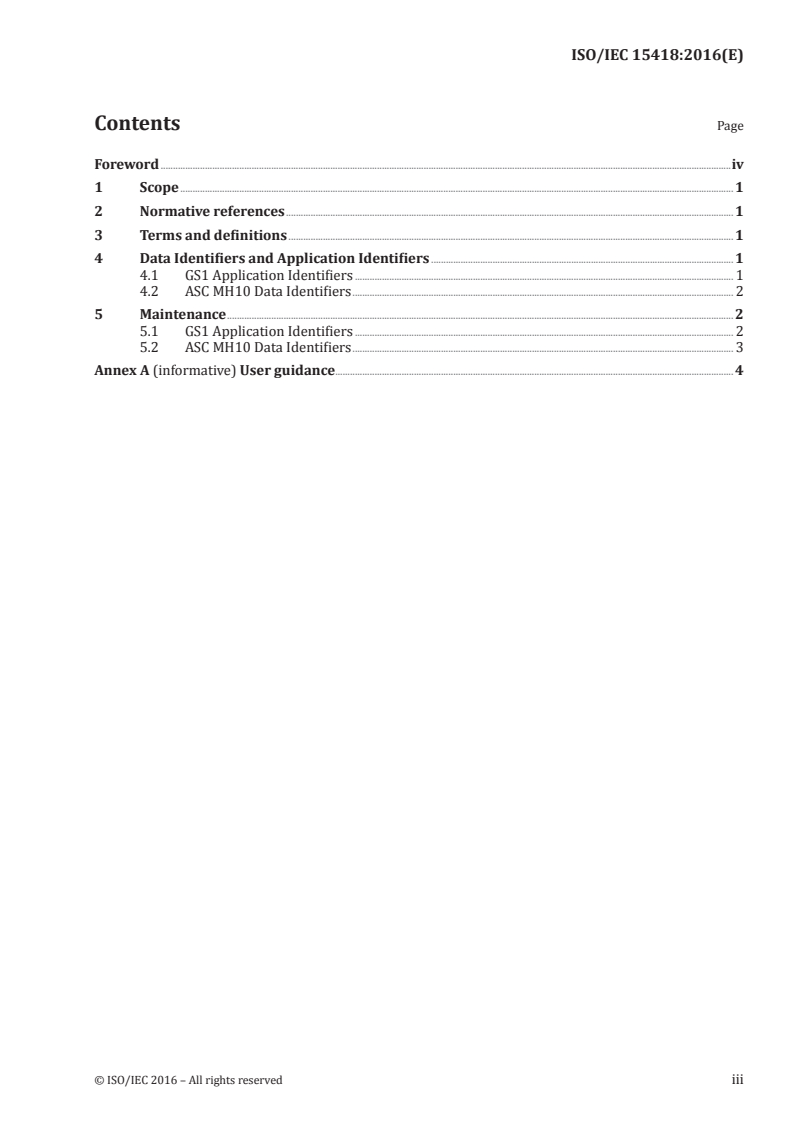
Contents Page
Foreword .iv
1 Scope . 1
2 Normative references . 1
3 Terms and definitions . 1
4 Data Identifiers and Application Identifiers . 1
4.1 GS1 Application Identifiers . 1
4.2 ASC MH10 Data Identifiers . 2
5 Maintenance . 2
5.1 GS1 Application Identifiers . 2
5.2 ASC MH10 Data Identifiers . 3
Annex A (informative) User guidance . 4
© ISO/IEC 2016 – All rights reserved iii
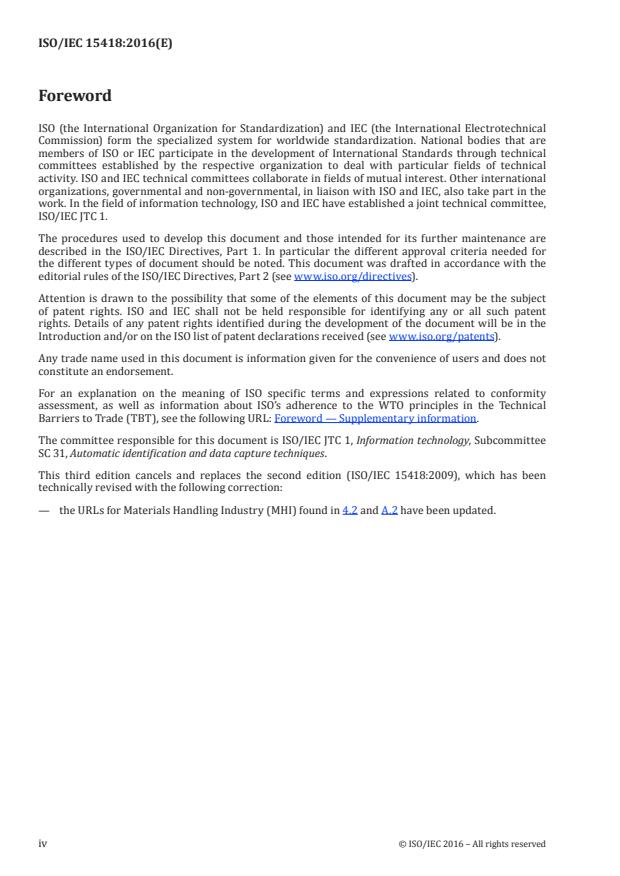
Foreword
ISO (the International Organization for Standardization) and IEC (the International Electrotechnical
Commission) form the specialized system for worldwide standardization. National bodies that are
members of ISO or IEC participate in the development of International Standards through technical
committees established by the respective organization to deal with particular fields of technical
activity. ISO and IEC technical committees collaborate in fields of mutual interest. Other international
organizations, governmental and non-governmental, in liaison with ISO and IEC, also take part in the
work. In the field of information technology, ISO and IEC have established a joint technical committee,
ISO/IEC JTC 1.
The procedures used to develop this document and those intended for its further maintenance are
described in the ISO/IEC Directives, Part 1. In particular the different approval criteria needed for
the different types of document should be noted. This document was drafted in accordance with the
editorial rules of the ISO/IEC Directives, Part 2 (see www.iso.org/directives).
Attention is drawn to the possibility that some of the elements of this document may be the subject
of patent rights. ISO and IEC shall not be held responsible for identifying any or all such patent
rights. Details of any patent rights identified during the development of the document will be in the
Introduction and/or on the ISO list of patent declarations received (see www.iso.org/patents).
Any trade name used in this document is information given for the convenience of users and does not
constitute an endorsement.
For an explanation on the meaning of ISO specific terms and expressions related to conformity
assessment, as well as information about ISO’s adherence to the WTO principles in the Technical
Barriers to Trade (TBT), see the following URL: Foreword — Supplementary information.
The committee responsible for this document is ISO/IEC JTC 1, Information technology, Subcommittee
SC 31, Automatic identification and data capture techniques.
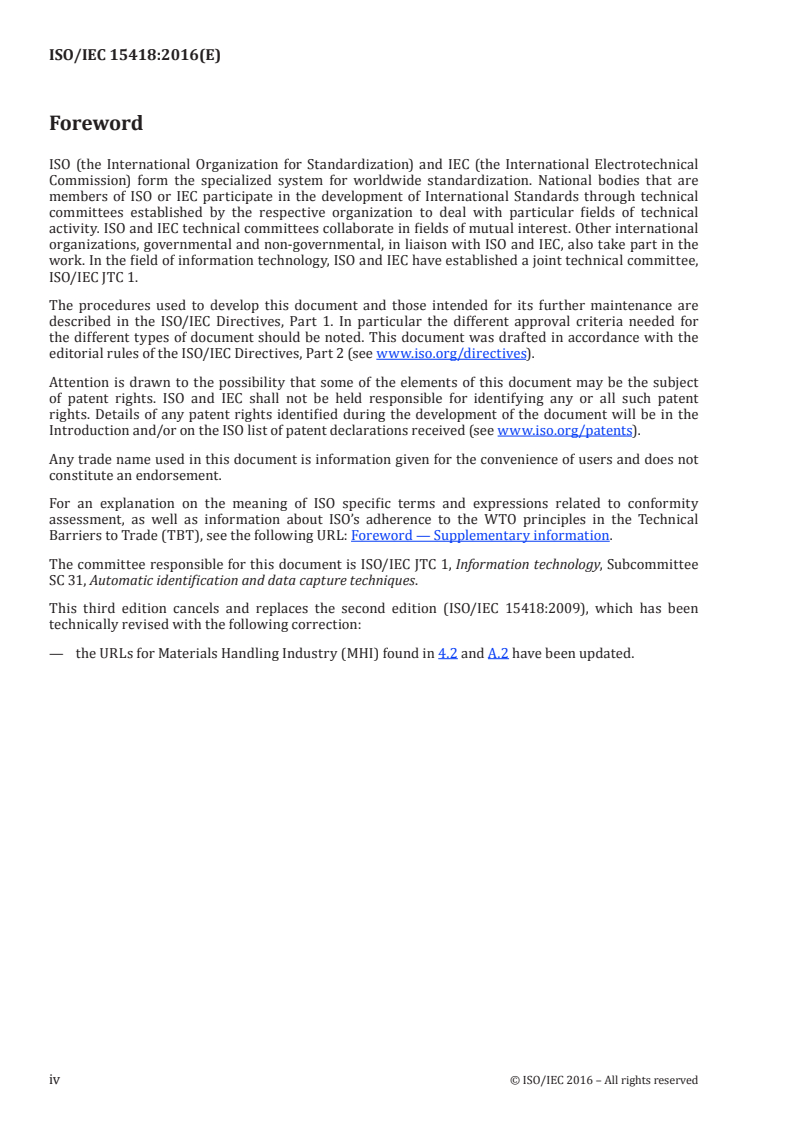
This third edition cancels and replaces the second edition (ISO/IEC 15418:2009), which has been
technically revised with the following correction:
— the URLs for Materials Handling Industry (MHI) found in 4.2 and A.2 have been updated.
iv © ISO/IEC 2016 – All rights reserved
INTERNATIONAL STANDARD ISO/IEC 15418:2016(E)
Information technology — Automatic identification and
data capture techniques — GS1 Application Identifiers and
ASC MH10 Data Identifiers and maintenance
1 Scope
This International Standard
— specifies sets of Data Identifiers and Application Identifiers for the purpose of identifying
encoded data, and
— identifies the organizations responsible for their maintenance.
2 Normative references
The following document, in whole or in part, is normatively referenced in this document and is
indispensable for its application. For dated references, only the edition cited applies. For undated
references, the latest edition of the referenced document (including any amendments) applies.
ISO/IEC 19762, Information technology — Automatic identification and data capture (AIDC) techniques —
Harmonized vocabulary
ANS MH10, Data Identifiers and Application Identifiers
GS1, General Specifications
3 Terms and definitions
For the purposes of this document, the terms and definitions given in ISO/IEC 19762 apply.
4 Data Identifiers and Application Identifiers
Where appropriate, information encoded shall be identified in accordance with one of the following
sets of identifiers:
a) GS1 Application Identifiers;
b) ASC MH10 Data Identifiers.
4.1 GS1 Application Identifiers
The GS1 item identification system and related encoding standard are complemented by the GS1-
maintained Application Identifiers, hereafter referred to
...
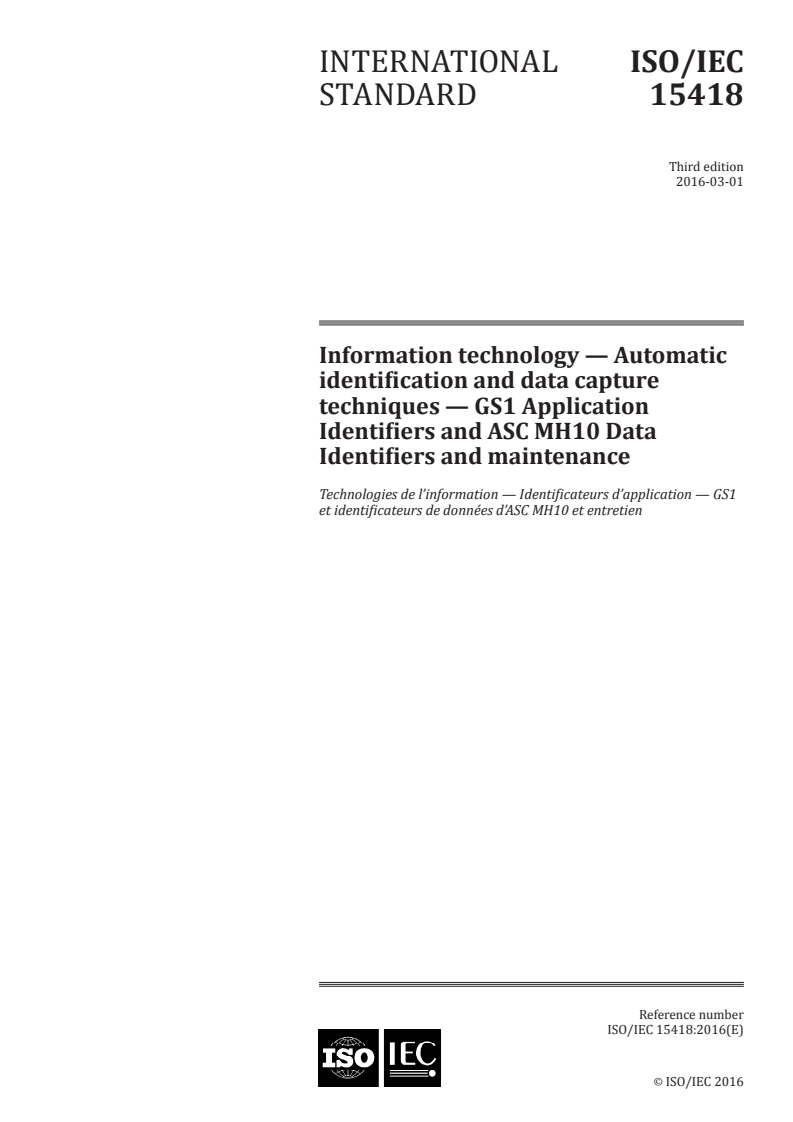
INTERNATIONAL ISO/IEC
STANDARD 15418
Third edition
2016-03-01
Information technology — Automatic
identification and data capture
techniques — GS1 Application
Identifiers and ASC MH10 Data
Identifiers and maintenance
Technologies de l’information — Identificateurs d’application — GS1
et identificateurs de données d’ASC MH10 et entretien
Reference number
©
ISO/IEC 2016
© ISO/IEC 2016, Published in Switzerland
All rights reserved. Unless otherwise specified, no part of this publication may be reproduced or utilized otherwise in any form
or by any means, electronic or mechanical, including photocopying, or posting on the internet or an intranet, without prior
written permission. Permission can be requested from either ISO at the address below or ISO’s member body in the country of
the requester.
ISO copyright office
Ch. de Blandonnet 8 • CP 401
CH-1214 Vernier, Geneva, Switzerland
Tel. +41 22 749 01 11
Fax +41 22 749 09 47
copyright@iso.org
www.iso.org
ii © ISO/IEC 2016 – All rights reserved
Contents Page
Foreword .iv
1 Scope . 1
2 Normative references . 1
3 Terms and definitions . 1
4 Data Identifiers and Application Identifiers . 1
4.1 GS1 Application Identifiers . 1
4.2 ASC MH10 Data Identifiers . 2
5 Maintenance . 2
5.1 GS1 Application Identifiers . 2
5.2 ASC MH10 Data Identifiers . 3
Annex A (informative) User guidance . 4
© ISO/IEC 2016 – All rights reserved iii
Foreword
ISO (the International Organization for Standardization) and IEC (the International Electrotechnical
Commission) form the specialized system for worldwide standardization. National bodies that are
members of ISO or IEC participate in the development of International Standards through technical
committees established by the respective organization to deal with particular fields of technical
activity. ISO and IEC technical committees collaborate in fields of mutual interest. Other international
organizations, governmental and non-governmental, in liaison with ISO and IEC, also take part in the
work. In the field of information technology, ISO and IEC have established a joint technical committee,
ISO/IEC JTC 1.
The procedures used to develop this document and those intended for its further maintenance are
described in the ISO/IEC Directives, Part 1. In particular the different approval criteria needed for
the different types of document should be noted. This document was drafted in accordance with the
editorial rules of the ISO/IEC Directives, Part 2 (see www.iso.org/directives).
Attention is drawn to the possibility that some of the elements of this document may be the subject
of patent rights. ISO and IEC shall not be held responsible for identifying any or all such patent
rights. Details of any patent rights identified during the development of the document will be in the
Introduction and/or on the ISO list of patent declarations received (see www.iso.org/patents).
Any trade name used in this document is information given for the convenience of users and does not
constitute an endorsement.
For an explanation on the meaning of ISO specific terms and expressions related to conformity
assessment, as well as information about ISO’s adherence to the WTO principles in the Technical
Barriers to Trade (TBT), see the following URL: Foreword — Supplementary information.
The committee responsible for this document is ISO/IEC JTC 1, Information technology, Subcommittee
SC 31, Automatic identification and data capture techniques.
This third edition cancels and replaces the second edition (ISO/IEC 15418:2009), which has been
technically revised with the following correction:
— the URLs for Materials Handling Industry (MHI) found in 4.2 and A.2 have been updated.
iv © ISO/IEC 2016 – All rights reserved
INTERNATIONAL STANDARD ISO/IEC 15418:2016(E)
Information technology — Automatic identification and
data capture techniques — GS1 Application Identifiers and
ASC MH10 Data Identifiers and maintenance
1 Scope
This International Standard
— specifies sets of Data Identifiers and Application Identifiers for the purpose of identifying
encoded data, and
— identifies the organizations responsible for their maintenance.
2 Normative references
The following document, in whole or in part, is normatively referenced in this document and is
indispensable for its application. For dated references, only the edition cited applies. For undated
references, the latest edition of the referenced document (including any amendments) applies.
ISO/IEC 19762, Information technology — Automatic identification and data capture (AIDC) techniques —
Harmonized vocabulary
ANS MH10, Data Identifiers and Application Identifiers
GS1, General Specifications
3 Terms and definitions
For the purposes of this document, the terms and definitions given in ISO/IEC 19762 apply.
4 Data Identifiers and Application Identifiers
Where appropriate, information encoded shall be identified in accordance with one of the following
sets of identifiers:
a) GS1 Application Identifiers;
b) ASC MH10 Data Identifiers.
4.1 GS1 Application Identifiers
The GS1 item identification system and related encoding standard are complemented by the GS1-
maintained Application Identifiers, hereafter referred to
...