

ISO/IEC 18000-4:2018
(Main)Information technology — Radio frequency identification for item management — Part 4: Parameters for air interface communications at 2,45 GHz
General Information
- Abstract
This document defines the air interface for radio frequency identification (RFID) devices operating in the 2,45 GHz industrial, scientific, and medical (ISM) band used in item management applications. This document provides a common technical specification for RFID devices that can be used by ISO committees developing RFID application standards. This document is intended to allow for compatibility and to encourage inter-operability of products for the growing RFID market in the international marketplace. This document defines the forward and return link parameters for technical attributes including, but not limited to, operating frequency, operating channel accuracy, occupied channel bandwidth, maximum equivalent isotropically radiated power (EIRP), spurious emissions, modulation, duty cycle, data coding, bit rate, bit rate accuracy, bit transmission order, and where appropriate, operating channels, frequency hop rate, hop sequence, spreading sequence, and chip rate. This document further defines the communications protocol used in the air interface. This document contains four modes. Mode 1 is an interrogator talks first with passive tag. Mode 2 is a tag talks first with battery-assisted passive tag. Mode 3 is a globally available, ubiquitous network supporting (but not limited to) the logistics and transportation industry; agnostic to any device, commercial or otherwise, requiring global availability. Mode 4 is a configurable data rate active RFID system. It provides the functions of long range objects identification and environmental sense, and it is intended to realize the low cost device and low power consumption, long range identification, fast and reliable tags access. The detailed technical differences between the modes are shown in the parameter tables.
- Status
- Published
- Publication Date
- 26-Jul-2018
- Technical Committee
- ISO/IEC JTC 1/SC 31 - Automatic identification and data capture techniques
- Drafting Committee
- ISO/IEC JTC 1/SC 31/WG 4 - Radio communications
- Current Stage
- 9093 - International Standard confirmed
- Start Date
- 12-Dec-2023
- Completion Date
- 29-Aug-2026
Buy Documents

ISO/IEC 18000-4:2018 - Information technology -- Radio frequency identification for item management
ISO/IEC 18000-4:2018 - Information technology — Radio frequency identification for item management — Part 4: Parameters for air interface communications at 2,45 GHz/27/2018
Overview
ISO/IEC 18000-4:2018 defines the air interface for radio frequency identification (RFID) devices operating in the 2.45 GHz ISM band for item management. The standard provides a common technical specification for forward and return link communications and a communications protocol intended to promote interoperability and compatibility across international RFID products and application standards. It covers passive, battery-assisted, active and configurable-rate RFID modes and includes parameter tables and protocol rules that ISO committees and industry stakeholders can adopt.
Key Topics and Technical Requirements
ISO/IEC 18000-4:2018 specifies technical attributes and protocol elements including:
- Operating frequency and operating channel accuracy
- Occupied channel bandwidth, spurious emissions and maximum EIRP (emitted power)
- Modulation, data coding, bit rate and bit rate accuracy
- Bit transmission order, CRC (cyclic redundancy check) and packet/frame structure
- Frequency hopping, hop sequence, frequency hop rate and spreading sequence where applicable
- Physical layer and data link layer definitions, including preamble, synchronous codes, and frame options
- Four modes describing different link behaviours:
- Mode 1: Interrogator-first passive backscatter (passive tags)
- Mode 2: Tag-first for battery-assisted passive tags (long-range, high-data-rate)
- Mode 3: Active RFID network for ubiquitous, global ITF networks (logistics/transport)
- Mode 4: Configurable data-rate active RFID for long-range, low-power identification and sensing
- Protocol-level items: collision arbitration, command/response formats, error handling, network discovery and topologies (Mode 3), and security/encryption options (where defined).
Practical Applications
This standard is directly applicable to:
- Supply chain and logistics: pallet, container and asset tracking in global transportation
- Inventory and item management: retail, warehouse and manufacturing stock control
- IoT and sensor-enabled assets: active tag identification and environmental sensing
- Long-range tracking and access control systems requiring 2.45 GHz operation Using ISO/IEC 18000-4 helps vendors and integrators ensure cross-vendor interoperability, predictable RF behaviour, and regulatory-compliant designs in the 2.45 GHz ISM band.
Who Should Use This Standard
- RFID device manufacturers (passive, battery-assisted, active tags)
- Reader/interrogator designers and radio subsystem engineers
- System integrators implementing logistics, warehouse, or IoT solutions
- Standards committees and product certification bodies
- Regulatory and compliance teams verifying RF parameters and emissions
Related Standards
- Other parts of the ISO/IEC 18000 series that specify alternate frequencies and item management profiles
- National and regional RF regulations for the 2.45 GHz ISM band
ISO/IEC 18000-4:2018 is a foundational reference for anyone designing or deploying 2.45 GHz RFID systems focused on interoperable, international item management solutions.
Relations
- Effective Date
- 09-Feb-2026
- Effective Date
- 05-Nov-2015
Buy Documents
ISO/IEC 18000-4:2018 - Information technology -- Radio frequency identification for item management
ISO/IEC 18000-4:2018 - Information technology — Radio frequency identification for item management — Part 4: Parameters for air interface communications at 2,45 GHz/27/2018
Get Certified
Connect with accredited certification bodies for this standard

BSI Group
BSI (British Standards Institution) is the business standards company that helps organizations make excellence a habit.

NYCE
Mexican standards and certification body.
Sponsored listings
Frequently Asked Questions
ISO/IEC 18000-4:2018 is a standard published by the International Organization for Standardization (ISO). Its full title is "Information technology — Radio frequency identification for item management — Part 4: Parameters for air interface communications at 2,45 GHz". This standard covers: This document defines the air interface for radio frequency identification (RFID) devices operating in the 2,45 GHz industrial, scientific, and medical (ISM) band used in item management applications. This document provides a common technical specification for RFID devices that can be used by ISO committees developing RFID application standards. This document is intended to allow for compatibility and to encourage inter-operability of products for the growing RFID market in the international marketplace. This document defines the forward and return link parameters for technical attributes including, but not limited to, operating frequency, operating channel accuracy, occupied channel bandwidth, maximum equivalent isotropically radiated power (EIRP), spurious emissions, modulation, duty cycle, data coding, bit rate, bit rate accuracy, bit transmission order, and where appropriate, operating channels, frequency hop rate, hop sequence, spreading sequence, and chip rate. This document further defines the communications protocol used in the air interface. This document contains four modes. Mode 1 is an interrogator talks first with passive tag. Mode 2 is a tag talks first with battery-assisted passive tag. Mode 3 is a globally available, ubiquitous network supporting (but not limited to) the logistics and transportation industry; agnostic to any device, commercial or otherwise, requiring global availability. Mode 4 is a configurable data rate active RFID system. It provides the functions of long range objects identification and environmental sense, and it is intended to realize the low cost device and low power consumption, long range identification, fast and reliable tags access. The detailed technical differences between the modes are shown in the parameter tables.
This document defines the air interface for radio frequency identification (RFID) devices operating in the 2,45 GHz industrial, scientific, and medical (ISM) band used in item management applications. This document provides a common technical specification for RFID devices that can be used by ISO committees developing RFID application standards. This document is intended to allow for compatibility and to encourage inter-operability of products for the growing RFID market in the international marketplace. This document defines the forward and return link parameters for technical attributes including, but not limited to, operating frequency, operating channel accuracy, occupied channel bandwidth, maximum equivalent isotropically radiated power (EIRP), spurious emissions, modulation, duty cycle, data coding, bit rate, bit rate accuracy, bit transmission order, and where appropriate, operating channels, frequency hop rate, hop sequence, spreading sequence, and chip rate. This document further defines the communications protocol used in the air interface. This document contains four modes. Mode 1 is an interrogator talks first with passive tag. Mode 2 is a tag talks first with battery-assisted passive tag. Mode 3 is a globally available, ubiquitous network supporting (but not limited to) the logistics and transportation industry; agnostic to any device, commercial or otherwise, requiring global availability. Mode 4 is a configurable data rate active RFID system. It provides the functions of long range objects identification and environmental sense, and it is intended to realize the low cost device and low power consumption, long range identification, fast and reliable tags access. The detailed technical differences between the modes are shown in the parameter tables.
ISO/IEC 18000-4:2018 is classified under the following ICS (International Classification for Standards) categories: 35.040 - Information coding; 35.040.50 - Automatic identification and data capture techniques. The ICS classification helps identify the subject area and facilitates finding related standards.
ISO/IEC 18000-4:2018 has the following relationships with other standards: It is inter standard links to CEN/TS 17402:2020, ISO/IEC 18000-4:2015. Understanding these relationships helps ensure you are using the most current and applicable version of the standard.
ISO/IEC 18000-4:2018 is available in PDF format for immediate download after purchase. The document can be added to your cart and obtained through the secure checkout process. Digital delivery ensures instant access to the complete standard document.
Standards Content (Sample)
INTERNATIONAL ISO/IEC
STANDARD 18000-4
Fourth edition
2018-08
Information technology — Radio
frequency identification for item
management —
Part 4:
Parameters for air interface
communications at 2,45 GHz
Technologies de l'information — Identification par radiofréquence
(RFID) pour la gestion d'objets —
Partie 4: Paramètres de communications d'une interface d'air à
2,45 GHz
Reference number
©
ISO/IEC 2018
© ISO/IEC 2018
All rights reserved. Unless otherwise specified, or required in the context of its implementation, no part of this publication may
be reproduced or utilized otherwise in any form or by any means, electronic or mechanical, including photocopying, or posting
on the internet or an intranet, without prior written permission. Permission can be requested from either ISO at the address
below or ISO’s member body in the country of the requester.
ISO copyright office
CP 401 • Ch. de Blandonnet 8
CH-1214 Vernier, Geneva
Phone: +41 22 749 01 11
Fax: +41 22 749 09 47
Email: copyright@iso.org
Website: www.iso.org
Published in Switzerland
ii © ISO/IEC 2018 – All rights reserved
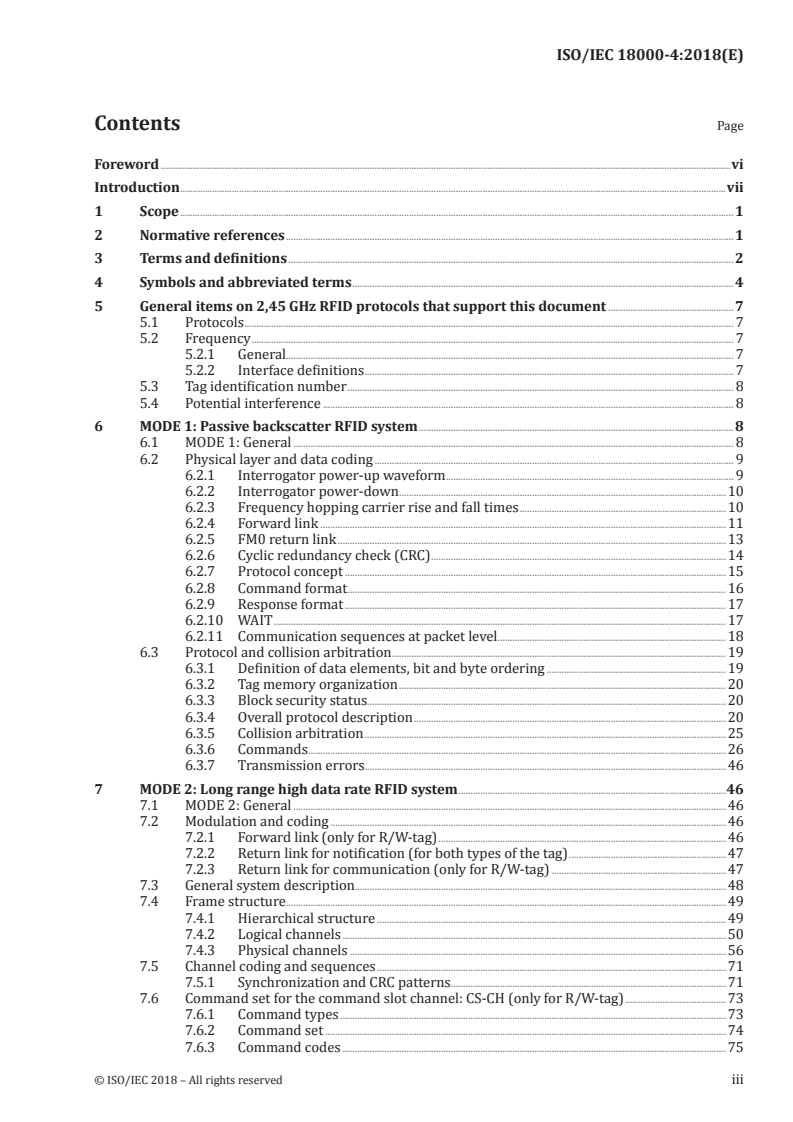
Contents Page
Foreword .vi
Introduction .vii
1 Scope . 1
2 Normative references . 1
3 Terms and definitions . 2
4 Symbols and abbreviated terms . 4
5 General items on 2,45 GHz RFID protocols that support this document .7
5.1 Protocols . 7
5.2 Frequency . 7
5.2.1 General. 7
5.2.2 Interface definitions . 7
5.3 Tag identification number . 8
5.4 Potential interference . 8
6 MODE 1: Passive backscatter RFID system . 8
6.1 MODE 1: General . 8
6.2 Physical layer and data coding . 9
6.2.1 Interrogator power-up waveform . 9
6.2.2 Interrogator power-down .10
6.2.3 Frequency hopping carrier rise and fall times .10
6.2.4 Forward link .11
6.2.5 FM0 return link .13
6.2.6 Cyclic redundancy check (CRC) .14
6.2.7 Protocol concept .15
6.2.8 Command format .16
6.2.9 Response format .17
6.2.10 WAIT .17
6.2.11 Communication sequences at packet level .18
6.3 Protocol and collision arbitration .19
6.3.1 Definition of data elements, bit and byte ordering .19
6.3.2 Tag memory organization .20
6.3.3 Block security status.20
6.3.4 Overall protocol description .20
6.3.5 Collision arbitration .25
6.3.6 Commands .26
6.3.7 Transmission errors . .46
7 MODE 2: Long range high data rate RFID system .46
7.1 MODE 2: General .46
7.2 Modulation and coding .46
7.2.1 Forward link (only for R/W-tag) .46
7.2.2 Return link for notification (for both types of the tag) .47
7.2.3 Return link for communication (only for R/W-tag) .47
7.3 General system description.48
7.4 Frame structure .49
7.4.1 Hierarchical structure .49
7.4.2 Logical channels .50
7.4.3 Physical channels .56
7.5 Channel coding and sequences .71
7.5.1 Synchronization and CRC patterns .71
7.6 Command set for the command slot channel: CS-CH (only for R/W-tag) .73
7.6.1 Command types .73
7.6.2 Command set .74
7.6.3 Command codes .75
© ISO/IEC 2018 – All rights reserved iii
8 MODE 3: Active RFID ITF network .76
8.1 General .76
8.2 Operational requirements .77
8.3 Network Physical Layer description .77
8.4 Network description .78
8.4.1 General.78
8.4.2 Network topology .78
8.5 Star topology .80
8.5.1 General.80
8.5.2 Star topology data flow .81
8.6 Trunk topology.81
8.6.1 Trunk coordinator requirements .81
8.6.2 Data flow in a trunk topology .81
8.7 Peer-to-peer topology .82
8.8 Mesh topology .82
8.8.1 Establishing a mesh network .83
8.9 Message types .86
8.9.1 Network discovery beacon (NDB) .87
8.9.2 Network status message (NSM) .92
8.9.3 Acknowledgement message .96
8.9.4 Command message .98
8.9.5 Data message .99
8.9.6 Mesh request .100
8.9.7 Mesh data .101
8.10 Network discovery .102
8.10.1 Methods of network discovery .102
8.10.2 Transmitting network discovery beacons .103
8.10.3 Connectionless network .103
8.10.4 Associated network connection (ANC) . .105
8.11 Link encryption methods .107
9 MODE 4: Configurable data rate active RFID system .108
9.1 General .108
9.2 Cryptographic suite indicators .108
9.3 Physical layer .109
9.3.1 Operating frequency .109
9.3.2 Emission spectrum density mask .109
9.3.3 Modulation and spectrum spread .109
9.3.4 TX/RX switch time .113
9.3.5 EVM .113
9.4 Data link layer .113
9.4.1 General.113
9.4.2 Preamble .113
9.4.3 Synchronous code .113
9.4.4 Data length .113
9.4.5 Frame option .114
9.4.6 Message data .114
9.4.7 CRC .118
9.5 Tag memory structure .118
9.5.1 Overview .118
9.5.2 Data organization of security section .118
9.5.3 Data organization of user section . .119
9.5.4 File definitions of user section .123
9.6 Tag state transition .126
9.6.1 Overview .126
9.6.2 Figure of tag state transition .126
9.6.3 Sense state .127
9.6.4 Ready state .128
9.6.5 Operation state .128
iv © ISO/IEC 2018 – All rights reserved
9.6.6 Sleep state .129
9.6.7 Killing state .129
9.7 Interrogator commands and tag responses .129
9.7.1 Command types .129
9.7.2 Command codes list .129
9.7.3 Ready and sleep commands .132
9.7.4 Access commands .135
9.7.5 Collection commands . .138
9.7.6 File access commands .141
9.7.7 Monitor commands .149
9.7.8 Security protocol commands .152
9.7.9 Other commands .155
9.8 Protocol operation mode .158
9.8.1 Overview .158
9.8.2 Operation process .158
9.8.3 Operation mode .161
9.9 Anti-collision method .162
9.9.1 Overview .162
9.9.2 Anti-collision process .162
9.9.3 Binary tree algorithm .162
9.10 Parameters for air interface .163
9.10.1 Parameters of physical and data link layer .163
9.10.2 Protocol parameters .165
10 Table of characteristic differences between the modes specified in this document .166
Annex A (informative) Mode 1: Memory map .167
Annex B (informative) Mode 1: CRC .173
Annex C (normative) Mode 2: Memory map .176
Annex D (informative) Mode 2: CRC .179
Annex E (normative) Mode 4: Tag state transition tables .181
Annex F (informative) Mode 4: Inventory process example .195
Annex G (informative) Mode 4: Wake-up mechanism .196
Annex H (informative) Mode 4: Typical parameters of anti-collision algorithm .199
Bibliography .200
© ISO/IEC 2018 – All rights reserved v
Foreword
ISO (the International Organization for Standardization) and IEC (the International Electrotechnical
Commission) form the specialized system for worldwide standardization. National bodies that are
members of ISO or IEC participate in the development of International Standards through technical
committees established by the respective organization to deal with particular fields of technical
activity. ISO and IEC technical committees collaborate in fields of mutual interest. Other international
organizations, governmental and non-governmental, in liaison with ISO and IEC, also take part in the
work. In the field of information technology, ISO and IEC have established a joint technical committee,
ISO/IEC JTC 1.
The procedures used to develop this document and those intended for its further maintenance are
described in the ISO/IEC Directives, Part 1. In particular the different approval criteria needed for the
different types of ISO documents should be noted. This document was drafted in accordance with the
editorial rules of the ISO/IEC Directives, Part 2 (see www .iso .org/directives).
Attention is drawn to the possibility that some of the elements of this document may be the subject of
patent rights. ISO shall not be held responsible for identifying any or all such patent rights. Details of
any patent rights identified during the development of the document will be in the Introduction and/or
on the ISO list of patent declarations received (see www .iso .org/patents).
Any trade name used in this document is information given for the convenience of users and does not
constitute an endorsement.
For an explanation on the voluntary nature of standards, the meaning of ISO specific terms and
expressions related to conformity assessment, as well as information about ISO's adherence to the
World Trade Organization (WTO) principles in the Technical Barriers to Trade (TBT) see the following
URL: www .iso .org/iso/foreword .html.
This document was prepared by Technical Committee ISO/IEC JTC 1, Information technology,
Subcommittee SC 31, Automatic identification and data capture techniques.
This fourth edition cancels and replaces the third edition (ISO/IEC 18000-4:2015), which has been
technically revised. The main changes compared to the previous edition are as follows:
— Mode 4, described in Clause 9 as "MODE 4: Configurable data rate active RFID system", has
been added.
A list of all parts in the ISO 18000 series can be found on the ISO website.
Any feedback or questions on this document should be directed to the user’s national standards body. A
complete listing of these bodies can be found at www .iso .org/members .html.
vi © ISO/IEC 2018 – All rights reserved
Introduction
This document is one of a series of International Standards and Technical Reports developed by ISO/
IEC JTC 1/SC 31 for the identification of items (item management) using radio frequency identification
(RFID) technology.
This document defines four 2,45 GHz protocols. Each of the specific physical/data link configuration
is defined in a separate subclause. The configuration descriptions include a physical layer and a data
link layer.
The International Organization for Standardization (ISO) and International Electrotechnical
Commission (IEC) draw attention to the fact that it is claimed that compliance with this document may
involve the use of patents concerning radio frequency identification technology given in all parts of this
document.
ISO and IEC take no position concerning the evidence, validity and scope of these patent rights.
The holders of these patent rights have assured the ISO and IEC that they are willing to negotiate
licences under reasonable and non-discriminatory terms and conditions with applicants throughout
the world. In this respect, the statements of the holders of these patent rights are registered with ISO
and IEC. Information may be obtained from the following companies.
Contact details
Patent holder:
Legal name iControl Inc.
Contact for licence application:
Name and department George Cavage
Address 3235 Kifer Road, Suite 260, Santa Clara, CA 94109, USA
Tel. +1 408 730 5364
Fax
E-mail gcavage@icontrol -inc .com
URL (optional) www .icontrol -inc .com
Patent holder:
Legal name Impinj, Inc.
Contact for licence application:
Name and department Stacy Jones, Impinj, Inc.
Address 701 N 34th Street, Suite 300, Seattle, WA 98103, USA
Tel. +1 206 834 1032
Fax +1 206 517 5262
E-mail stacy.jones@impinj .com
URL (optional) www .impinj .com
© ISO/IEC 2018 – All rights reserved vii
Contact details
Patent holder:
Legal name Zebra Technologies Corporation
Contact for licence application:
Name and department James O’Hagan, Director of Patents & Technology
Address 475 Half Day Road, Suite 500, Lincolnshire, IL 60069, USA
Tel. +1 (847) 793-6798
Fax +1 (847) 955-4514
E-mail johagan@zebra .com
URL (optional)
Patent holder:
Legal name Chengdu West Valley Digital Technologies, Inc.
Contact for licence application:
Name and department Jason Y. Liao
Address Room 305 Building #9, #88 Tian Chen West High-Tech
Zone, Chengdu, China
Tel. 86-28-66767921
Fax
E-mail
URL (optional) www .westv .cn
Patent holder:
Legal name Nationz Technologies Inc.
Contact for licence application:
Name and department Yang, Xianwei and Mobile Payment and RCC Department
Address China Technology Exchange Building, 66 North 4th Ring
Road West, Haidian District, Beijing
Tel. 86-10-82868162
Fax
E-mail
URL (optional) www .nationz .com .cn
Patent holder:
Legal name Shenzhen ZTE Top sky Information Technology Co., Ltd.
Contact for licence application:
Name and department Min Zhu
Address Room B, 10/F, No.3 China Academy of Science-Tech
Development Building, Gaoxin 1st Road South, High-Tech
Industrial Park, Nanshan District, Shenzhen, China
Tel.
86-0755-86079364
Fax
E-mail
URL (optional)
www .zte -v .com .cn
viii © ISO/IEC 2018 – All rights reserved
Contact details
Patent holder:
Legal name Xidian University
Contact for licence application:
Name and department Changxing Pei
Address No.2, South Taibai Road, Xi’an, Shanxi, China
Tel. 86-29-88204486
Fax
E-mail
URL (optional) www .xidian .edu .cn
Patent holder:
Legal name CEC Huada Electronic Design Co., Ltd.
Contact for licence application:
Name and department Lan Tian
Address Floor 5, Building A, Wangjing Science and Technology
Park, No.2, Lizezhonger Rd., Chaoyang District, 100102,
Beijing, China
Tel.
86-10-64365577
Fax
E-mail
URL (optional)
www .hed .com .cn
Patent holder:
Legal name China Electronics Standardization Institute
(Corresponding corporation)
CEC Huada Electronic Design Co., Ltd.
Contact for licence application:
Name and department Wang Wenfeng
Address No.1 Andingmen East Street, Beijing
Tel. 86-10-84042998
Fax
E-mail
URL (optional) www .cesi .cn
Patent holder:
Legal name Shanghai Super Electronics Technology Co., Ltd.
Contact for licence application:
Name and department Qin Zhong
Address 6/F Building 52, 1089 North Qinzhou Rd., Shanghai,
China
Tel. 86-21-61613336
Fax 86-21-6161339
E-mail qinzhong@superrfid .net
URL (optional) www .superrfid .net
© ISO/IEC 2018 – All rights reserved ix
INTERNATIONAL STANDARD ISO/IEC 18000-4:2018(E)
Information technology — Radio frequency identification
for item management —
Part 4:
Parameters for air interface communications at 2,45 GHz
1 Scope
This document defines the air interface for radio frequency identification (RFID) devices operating
in the 2,45 GHz industrial, scientific, and medical (ISM) band used in item management applications.
This document provides a common technical specification for RFID devices that can be used by
ISO committees developing RFID application standards. This document is intended to allow for
compatibility and to encourage inter-operability of products for the growing RFID market in the
international marketplace. This document defines the forward and return link parameters for technical
attributes including, but not limited to, operating frequency, operating channel accuracy, occupied
channel bandwidth, maximum equivalent isotropically radiated power (EIRP), spurious emissions,
modulation, duty cycle, data coding, bit rate, bit rate accuracy, bit transmission order, and where
appropriate, operating channels, frequency hop rate, hop sequence, spreading sequence, and chip rate.
This document further defines the communications protocol used in the air interface.
This document contains four modes. Mode 1 is an interrogator talks first with passive tag. Mode 2 is a tag
talks first with battery-assisted passive tag. Mode 3 is a globally available, ubiquitous network supporting
(but not limited to) the logistics and transportation industry; agnostic to any device, commercial or
otherwise, requiring global availability. Mode 4 is a configurable data rate active RFID system. It provides
the functions of long range objects identification and environmental sense, and it is intended to realize
the low cost device and low power consumption, long range identification, fast and reliable tags access.
The detailed technical differences between the modes are shown in the parameter tables.
2 Normative references
The following documents are referred to in the text in such a way that some or all of their content
constitutes requirements of this document. For dated references, only the edition cited applies. For
undated references, the latest edition of the referenced document (including any amendments) applies.
ISO/IEC 646, Information technology — ISO 7-bit coded character set for information interchange
ISO/IEC 7816-6, Identification cards — Integrated circuit cards — Part 6: Interindustry data elements for
interchange
ISO/IEC 15963, Information technology — Radio frequency identification for item management — Unique
identification for RF tags
ISO/IEC 19762, Information technology — Automatic identification and data capture (AIDC) techniques —
Harmonized vocabulary
ISO/IEC/TR 18047-4, Information technology — Radio frequency identification device conformance test
methods — Part 4: Test methods for air interface communications at 2,45 GHz
ISO/IEC/IEEE 8802-15-4:2018, Information technology — Telecommunications and information exchange
between systems — Local and metropolitan area networks — Specific requirements — Part 15-4: Wireless
medium access control (MAC) and physical layer (PHY) specifications for low-rate wireless personal area
networks (WPANs)
© ISO/IEC 2018 – All rights reserved 1
IEEE 802.15.4:2006, Information technology — Local and metropolitan area networks — Specific
requirements — Part 15.4: Wireless Medium Access Control (MAC) and Physical Layer (PHY) Specifications
for Low Rate Wireless Personal Area Networks (WPANs)
3 Terms and definitions
For the purposes of this document, the terms and definitions given in ISO/IEC 19762 and the
following apply.
ISO and IEC maintain terminological databases for use in standardization at the following addresses:
— IEC Electropedia: available at http: //www .electropedia .org/
— ISO Online browsing platform: available at http: //www .iso .org/obp
3.1
associated
successful negotiation of a bi-directional wireless link with a coordinator
Note 1 to entry: Associated networks require communication be maintained and monitored for a period of time.
3.2
association
service used to establish membership for a device communicating within the wireless network
described in this document
3.3
authentication
ATH
process of determining whether an entity or data is/are who or what, respectively, it claims to be
Note 1 to entry: The types of entity authentication referred to in this document are Tag authentication,
Interrogator authentication, and Tag-Interrogator mutual authentication. For data authentication, see
authenticated communications (3.4).
3.4
authenticated communications
communications in which message integrity is protected
3.5
block cipher
cryptographic function that operates on strings of fixed size
3.6
chip
smallest unit of signal after spectrum spreading
Note 1 to entry: In the spreading process, an information bit is usually represented by a number of coded signals,
wherein a coded signal is called a chip.
3.7
coordinator
full-function device (FFD) capable of relaying messages
Note 1 to entry: If a coordinator is the principal controller of a personal area network (PAN), it is called the PAN
coordinator.
3.8
data server
device data termination point
2 © ISO/IEC 2018 – All rights reserved
3.9
device
any entity that meets the ISO/IEC/IEEE 8802-15-4 medium access control (MAC), physical interface to
the wireless medium, and this document
Note 1 to entry: A device may be a reduced-function device (RFD) or a full-function device (FFD).
3.10
encryption
transformation of a message into a new representation so that privileged information is required to
recover the original representation
3.11
full-function device
FFD
device capable of operating as a coordinator
3.12
group key
key that is known only to a set of devices
3.13
hailing channel
ISO/IEC/IEEE 8802-15-4 radio channel used to broadcast the NDB
3.14
key
privileged information that may be used, for example, to protect information from disclosure to, and/or
undetectable modification by, parties that do not have access to this privileged information
3.15
keyID
numerical designator for a single key
3.16
link key
secret key that is shared between precisely two devices
3.17
mesh networking
type of network where an FFD serves as a relay for other devices
3.18
message authentication code
MAC1
code, computed over bits in a message, that an Interrogator or a Tag may use to verify the integrity of
the message
3.19
message integrity code
MIC
data whereby an entity receiving a message corroborates evidence about the true source of the
information in the message and, thereby, evidence that the message has not been modified in transit
3.20
network channel
primary ISO/IEC/IEEE 8802-15-4 radio channel between a coordinator and remote devices
3.21
packet
formatted, aggregated bits that are transmitted together in time across the physical medium
© ISO/IEC 2018 – All rights reserved 3
3.22
password
information that is used to verify identities in the tag access (3.29) process
3.23
payload data
contents of a data message that is being transmitted
3.24
reduced-function device
RFD
device that is not capable of operating as a coordinator
3.25
secure communications
communications in which message confidentiality is protected
3.26
security
degree of protection against threats identified in a security policy
Note 1 to entry: A system is secure if it is protected to the degree specified in the security policy.
3.27
server connected coordinator
SCC
network coordinator that terminates the wireless protocol described in this document and is connected
to control servers
3.28
tag
any device type associated with the device and capable of joining the network
3.29
tag access
process in which tags establish communication links with interrogators according to certain
communication protocols
4 Symbols and abbreviated terms
ACK acknowledgement
ALW always
CCITT Comité Consultatif International Téléphonique et Télégraphique
Cht Carrier high level tolerance
Clt Carrier low level tolerance
CRC cyclical redundancy check
CSI cryptographic suite identifier
CSMA carrier sense multiple access
DBPSK differential binary phase shift keying
DF dedicated file
4 © ISO/IEC 2018 – All rights reserved
DSSS direct sequence spread spectrum
EBV extensible bit vectors
EF element file
EIRP equivalent isotropic radiated power
EVM error vector magnitude
f base frequency of the bit rate of Manchester code without bit changes
bitrate
f frequency of operating field (carrier frequency)
c
FCF frame control field
FCS frame check sequence
FHSS frequency hopping spread spectrum
LSB least significant bit
M Modulation
Ma Modulation overshoot
MAC medium access control
Mb Modulation undershoot
MF main directory file
MIC message integrity code
MIN Manufacturing Identification Number
Mlt Modulation lower tolerance
MSB most significant bit
Mut Modulation upper tolerance
N total number of time-slots in access frame
NAK no-acknowledgement
NDB network discovery beacon
NEV never
NSM network status message
OID object identifier
O-QPSK offset quadrature phase shift keying
ppm parts per million
PWD password
Q parameter that controls tag access number
© ISO/IEC 2018 – All rights reserved 5
QPSK quad-phased shift keying
RFID radio frequency identification
RID interrogator identifier
RNr random number generated by interrogators
RNt random number generated by tags
RN16 16-bit random number
RN8 8-bit random number
RTLS real time locating system
SN serial number of time-slot
slot
SN serial number of successful access
success
Tbmf Manchester fall time
Tbmr Manchester rise time
Tcf carrier fall time
Tcr carrier rise time
Tcs carrier steady time
TDMA time division multiple access
Tf fall time
Tfhf carrier FHSS fall time
Tfhr carrie
...
INTERNATIONAL ISO/IEC
STANDARD 18000-4
Fourth edition
2018-08
Information technology — Radio
frequency identification for item
management —
Part 4:
Parameters for air interface
communications at 2,45 GHz
Technologies de l'information — Identification par radiofréquence
(RFID) pour la gestion d'objets —
Partie 4: Paramètres de communications d'une interface d'air à
2,45 GHz
Reference number
©
ISO/IEC 2018
© ISO/IEC 2018
All rights reserved. Unless otherwise specified, or required in the context of its implementation, no part of this publication may
be reproduced or utilized otherwise in any form or by any means, electronic or mechanical, including photocopying, or posting
on the internet or an intranet, without prior written permission. Permission can be requested from either ISO at the address
below or ISO’s member body in the country of the requester.
ISO copyright office
CP 401 • Ch. de Blandonnet 8
CH-1214 Vernier, Geneva
Phone: +41 22 749 01 11
Fax: +41 22 749 09 47
Email: copyright@iso.org
Website: www.iso.org
Published in Switzerland
ii © ISO/IEC 2018 – All rights reserved
Contents Page
Foreword .vi
Introduction .vii
1 Scope . 1
2 Normative references . 1
3 Terms and definitions . 2
4 Symbols and abbreviated terms . 4
5 General items on 2,45 GHz RFID protocols that support this document .7
5.1 Protocols . 7
5.2 Frequency . 7
5.2.1 General. 7
5.2.2 Interface definitions . 7
5.3 Tag identification number . 8
5.4 Potential interference . 8
6 MODE 1: Passive backscatter RFID system . 8
6.1 MODE 1: General . 8
6.2 Physical layer and data coding . 9
6.2.1 Interrogator power-up waveform . 9
6.2.2 Interrogator power-down .10
6.2.3 Frequency hopping carrier rise and fall times .10
6.2.4 Forward link .11
6.2.5 FM0 return link .13
6.2.6 Cyclic redundancy check (CRC) .14
6.2.7 Protocol concept .15
6.2.8 Command format .16
6.2.9 Response format .17
6.2.10 WAIT .17
6.2.11 Communication sequences at packet level .18
6.3 Protocol and collision arbitration .19
6.3.1 Definition of data elements, bit and byte ordering .19
6.3.2 Tag memory organization .20
6.3.3 Block security status.20
6.3.4 Overall protocol description .20
6.3.5 Collision arbitration .25
6.3.6 Commands .26
6.3.7 Transmission errors . .46
7 MODE 2: Long range high data rate RFID system .46
7.1 MODE 2: General .46
7.2 Modulation and coding .46
7.2.1 Forward link (only for R/W-tag) .46
7.2.2 Return link for notification (for both types of the tag) .47
7.2.3 Return link for communication (only for R/W-tag) .47
7.3 General system description.48
7.4 Frame structure .49
7.4.1 Hierarchical structure .49
7.4.2 Logical channels .50
7.4.3 Physical channels .56
7.5 Channel coding and sequences .71
7.5.1 Synchronization and CRC patterns .71
7.6 Command set for the command slot channel: CS-CH (only for R/W-tag) .73
7.6.1 Command types .73
7.6.2 Command set .74
7.6.3 Command codes .75
© ISO/IEC 2018 – All rights reserved iii
8 MODE 3: Active RFID ITF network .76
8.1 General .76
8.2 Operational requirements .77
8.3 Network Physical Layer description .77
8.4 Network description .78
8.4.1 General.78
8.4.2 Network topology .78
8.5 Star topology .80
8.5.1 General.80
8.5.2 Star topology data flow .81
8.6 Trunk topology.81
8.6.1 Trunk coordinator requirements .81
8.6.2 Data flow in a trunk topology .81
8.7 Peer-to-peer topology .82
8.8 Mesh topology .82
8.8.1 Establishing a mesh network .83
8.9 Message types .86
8.9.1 Network discovery beacon (NDB) .87
8.9.2 Network status message (NSM) .92
8.9.3 Acknowledgement message .96
8.9.4 Command message .98
8.9.5 Data message .99
8.9.6 Mesh request .100
8.9.7 Mesh data .101
8.10 Network discovery .102
8.10.1 Methods of network discovery .102
8.10.2 Transmitting network discovery beacons .103
8.10.3 Connectionless network .103
8.10.4 Associated network connection (ANC) . .105
8.11 Link encryption methods .107
9 MODE 4: Configurable data rate active RFID system .108
9.1 General .108
9.2 Cryptographic suite indicators .108
9.3 Physical layer .109
9.3.1 Operating frequency .109
9.3.2 Emission spectrum density mask .109
9.3.3 Modulation and spectrum spread .109
9.3.4 TX/RX switch time .113
9.3.5 EVM .113
9.4 Data link layer .113
9.4.1 General.113
9.4.2 Preamble .113
9.4.3 Synchronous code .113
9.4.4 Data length .113
9.4.5 Frame option .114
9.4.6 Message data .114
9.4.7 CRC .118
9.5 Tag memory structure .118
9.5.1 Overview .118
9.5.2 Data organization of security section .118
9.5.3 Data organization of user section . .119
9.5.4 File definitions of user section .123
9.6 Tag state transition .126
9.6.1 Overview .126
9.6.2 Figure of tag state transition .126
9.6.3 Sense state .127
9.6.4 Ready state .128
9.6.5 Operation state .128
iv © ISO/IEC 2018 – All rights reserved
9.6.6 Sleep state .129
9.6.7 Killing state .129
9.7 Interrogator commands and tag responses .129
9.7.1 Command types .129
9.7.2 Command codes list .129
9.7.3 Ready and sleep commands .132
9.7.4 Access commands .135
9.7.5 Collection commands . .138
9.7.6 File access commands .141
9.7.7 Monitor commands .149
9.7.8 Security protocol commands .152
9.7.9 Other commands .155
9.8 Protocol operation mode .158
9.8.1 Overview .158
9.8.2 Operation process .158
9.8.3 Operation mode .161
9.9 Anti-collision method .162
9.9.1 Overview .162
9.9.2 Anti-collision process .162
9.9.3 Binary tree algorithm .162
9.10 Parameters for air interface .163
9.10.1 Parameters of physical and data link layer .163
9.10.2 Protocol parameters .165
10 Table of characteristic differences between the modes specified in this document .166
Annex A (informative) Mode 1: Memory map .167
Annex B (informative) Mode 1: CRC .173
Annex C (normative) Mode 2: Memory map .176
Annex D (informative) Mode 2: CRC .179
Annex E (normative) Mode 4: Tag state transition tables .181
Annex F (informative) Mode 4: Inventory process example .195
Annex G (informative) Mode 4: Wake-up mechanism .196
Annex H (informative) Mode 4: Typical parameters of anti-collision algorithm .199
Bibliography .200
© ISO/IEC 2018 – All rights reserved v
Foreword
ISO (the International Organization for Standardization) and IEC (the International Electrotechnical
Commission) form the specialized system for worldwide standardization. National bodies that are
members of ISO or IEC participate in the development of International Standards through technical
committees established by the respective organization to deal with particular fields of technical
activity. ISO and IEC technical committees collaborate in fields of mutual interest. Other international
organizations, governmental and non-governmental, in liaison with ISO and IEC, also take part in the
work. In the field of information technology, ISO and IEC have established a joint technical committee,
ISO/IEC JTC 1.
The procedures used to develop this document and those intended for its further maintenance are
described in the ISO/IEC Directives, Part 1. In particular the different approval criteria needed for the
different types of ISO documents should be noted. This document was drafted in accordance with the
editorial rules of the ISO/IEC Directives, Part 2 (see www .iso .org/directives).
Attention is drawn to the possibility that some of the elements of this document may be the subject of
patent rights. ISO shall not be held responsible for identifying any or all such patent rights. Details of
any patent rights identified during the development of the document will be in the Introduction and/or
on the ISO list of patent declarations received (see www .iso .org/patents).
Any trade name used in this document is information given for the convenience of users and does not
constitute an endorsement.
For an explanation on the voluntary nature of standards, the meaning of ISO specific terms and
expressions related to conformity assessment, as well as information about ISO's adherence to the
World Trade Organization (WTO) principles in the Technical Barriers to Trade (TBT) see the following
URL: www .iso .org/iso/foreword .html.
This document was prepared by Technical Committee ISO/IEC JTC 1, Information technology,
Subcommittee SC 31, Automatic identification and data capture techniques.
This fourth edition cancels and replaces the third edition (ISO/IEC 18000-4:2015), which has been
technically revised. The main changes compared to the previous edition are as follows:
— Mode 4, described in Clause 9 as "MODE 4: Configurable data rate active RFID system", has
been added.
A list of all parts in the ISO 18000 series can be found on the ISO website.
Any feedback or questions on this document should be directed to the user’s national standards body. A
complete listing of these bodies can be found at www .iso .org/members .html.
vi © ISO/IEC 2018 – All rights reserved
Introduction
This document is one of a series of International Standards and Technical Reports developed by ISO/
IEC JTC 1/SC 31 for the identification of items (item management) using radio frequency identification
(RFID) technology.
This document defines four 2,45 GHz protocols. Each of the specific physical/data link configuration
is defined in a separate subclause. The configuration descriptions include a physical layer and a data
link layer.
The International Organization for Standardization (ISO) and International Electrotechnical
Commission (IEC) draw attention to the fact that it is claimed that compliance with this document may
involve the use of patents concerning radio frequency identification technology given in all parts of this
document.
ISO and IEC take no position concerning the evidence, validity and scope of these patent rights.
The holders of these patent rights have assured the ISO and IEC that they are willing to negotiate
licences under reasonable and non-discriminatory terms and conditions with applicants throughout
the world. In this respect, the statements of the holders of these patent rights are registered with ISO
and IEC. Information may be obtained from the following companies.
Contact details
Patent holder:
Legal name iControl Inc.
Contact for licence application:
Name and department George Cavage
Address 3235 Kifer Road, Suite 260, Santa Clara, CA 94109, USA
Tel. +1 408 730 5364
Fax
E-mail gcavage@icontrol -inc .com
URL (optional) www .icontrol -inc .com
Patent holder:
Legal name Impinj, Inc.
Contact for licence application:
Name and department Stacy Jones, Impinj, Inc.
Address 701 N 34th Street, Suite 300, Seattle, WA 98103, USA
Tel. +1 206 834 1032
Fax +1 206 517 5262
E-mail stacy.jones@impinj .com
URL (optional) www .impinj .com
© ISO/IEC 2018 – All rights reserved vii
Contact details
Patent holder:
Legal name Zebra Technologies Corporation
Contact for licence application:
Name and department James O’Hagan, Director of Patents & Technology
Address 475 Half Day Road, Suite 500, Lincolnshire, IL 60069, USA
Tel. +1 (847) 793-6798
Fax +1 (847) 955-4514
E-mail johagan@zebra .com
URL (optional)
Patent holder:
Legal name Chengdu West Valley Digital Technologies, Inc.
Contact for licence application:
Name and department Jason Y. Liao
Address Room 305 Building #9, #88 Tian Chen West High-Tech
Zone, Chengdu, China
Tel. 86-28-66767921
Fax
E-mail
URL (optional) www .westv .cn
Patent holder:
Legal name Nationz Technologies Inc.
Contact for licence application:
Name and department Yang, Xianwei and Mobile Payment and RCC Department
Address China Technology Exchange Building, 66 North 4th Ring
Road West, Haidian District, Beijing
Tel. 86-10-82868162
Fax
E-mail
URL (optional) www .nationz .com .cn
Patent holder:
Legal name Shenzhen ZTE Top sky Information Technology Co., Ltd.
Contact for licence application:
Name and department Min Zhu
Address Room B, 10/F, No.3 China Academy of Science-Tech
Development Building, Gaoxin 1st Road South, High-Tech
Industrial Park, Nanshan District, Shenzhen, China
Tel.
86-0755-86079364
Fax
E-mail
URL (optional)
www .zte -v .com .cn
viii © ISO/IEC 2018 – All rights reserved
Contact details
Patent holder:
Legal name Xidian University
Contact for licence application:
Name and department Changxing Pei
Address No.2, South Taibai Road, Xi’an, Shanxi, China
Tel. 86-29-88204486
Fax
E-mail
URL (optional) www .xidian .edu .cn
Patent holder:
Legal name CEC Huada Electronic Design Co., Ltd.
Contact for licence application:
Name and department Lan Tian
Address Floor 5, Building A, Wangjing Science and Technology
Park, No.2, Lizezhonger Rd., Chaoyang District, 100102,
Beijing, China
Tel.
86-10-64365577
Fax
E-mail
URL (optional)
www .hed .com .cn
Patent holder:
Legal name China Electronics Standardization Institute
(Corresponding corporation)
CEC Huada Electronic Design Co., Ltd.
Contact for licence application:
Name and department Wang Wenfeng
Address No.1 Andingmen East Street, Beijing
Tel. 86-10-84042998
Fax
E-mail
URL (optional) www .cesi .cn
Patent holder:
Legal name Shanghai Super Electronics Technology Co., Ltd.
Contact for licence application:
Name and department Qin Zhong
Address 6/F Building 52, 1089 North Qinzhou Rd., Shanghai,
China
Tel. 86-21-61613336
Fax 86-21-6161339
E-mail qinzhong@superrfid .net
URL (optional) www .superrfid .net
© ISO/IEC 2018 – All rights reserved ix
INTERNATIONAL STANDARD ISO/IEC 18000-4:2018(E)
Information technology — Radio frequency identification
for item management —
Part 4:
Parameters for air interface communications at 2,45 GHz
1 Scope
This document defines the air interface for radio frequency identification (RFID) devices operating
in the 2,45 GHz industrial, scientific, and medical (ISM) band used in item management applications.
This document provides a common technical specification for RFID devices that can be used by
ISO committees developing RFID application standards. This document is intended to allow for
compatibility and to encourage inter-operability of products for the growing RFID market in the
international marketplace. This document defines the forward and return link parameters for technical
attributes including, but not limited to, operating frequency, operating channel accuracy, occupied
channel bandwidth, maximum equivalent isotropically radiated power (EIRP), spurious emissions,
modulation, duty cycle, data coding, bit rate, bit rate accuracy, bit transmission order, and where
appropriate, operating channels, frequency hop rate, hop sequence, spreading sequence, and chip rate.
This document further defines the communications protocol used in the air interface.
This document contains four modes. Mode 1 is an interrogator talks first with passive tag. Mode 2 is a tag
talks first with battery-assisted passive tag. Mode 3 is a globally available, ubiquitous network supporting
(but not limited to) the logistics and transportation industry; agnostic to any device, commercial or
otherwise, requiring global availability. Mode 4 is a configurable data rate active RFID system. It provides
the functions of long range objects identification and environmental sense, and it is intended to realize
the low cost device and low power consumption, long range identification, fast and reliable tags access.
The detailed technical differences between the modes are shown in the parameter tables.
2 Normative references
The following documents are referred to in the text in such a way that some or all of their content
constitutes requirements of this document. For dated references, only the edition cited applies. For
undated references, the latest edition of the referenced document (including any amendments) applies.
ISO/IEC 646, Information technology — ISO 7-bit coded character set for information interchange
ISO/IEC 7816-6, Identification cards — Integrated circuit cards — Part 6: Interindustry data elements for
interchange
ISO/IEC 15963, Information technology — Radio frequency identification for item management — Unique
identification for RF tags
ISO/IEC 19762, Information technology — Automatic identification and data capture (AIDC) techniques —
Harmonized vocabulary
ISO/IEC/TR 18047-4, Information technology — Radio frequency identification device conformance test
methods — Part 4: Test methods for air interface communications at 2,45 GHz
ISO/IEC/IEEE 8802-15-4:2018, Information technology — Telecommunications and information exchange
between systems — Local and metropolitan area networks — Specific requirements — Part 15-4: Wireless
medium access control (MAC) and physical layer (PHY) specifications for low-rate wireless personal area
networks (WPANs)
© ISO/IEC 2018 – All rights reserved 1
IEEE 802.15.4:2006, Information technology — Local and metropolitan area networks — Specific
requirements — Part 15.4: Wireless Medium Access Control (MAC) and Physical Layer (PHY) Specifications
for Low Rate Wireless Personal Area Networks (WPANs)
3 Terms and definitions
For the purposes of this document, the terms and definitions given in ISO/IEC 19762 and the
following apply.
ISO and IEC maintain terminological databases for use in standardization at the following addresses:
— IEC Electropedia: available at http: //www .electropedia .org/
— ISO Online browsing platform: available at http: //www .iso .org/obp
3.1
associated
successful negotiation of a bi-directional wireless link with a coordinator
Note 1 to entry: Associated networks require communication be maintained and monitored for a period of time.
3.2
association
service used to establish membership for a device communicating within the wireless network
described in this document
3.3
authentication
ATH
process of determining whether an entity or data is/are who or what, respectively, it claims to be
Note 1 to entry: The types of entity authentication referred to in this document are Tag authentication,
Interrogator authentication, and Tag-Interrogator mutual authentication. For data authentication, see
authenticated communications (3.4).
3.4
authenticated communications
communications in which message integrity is protected
3.5
block cipher
cryptographic function that operates on strings of fixed size
3.6
chip
smallest unit of signal after spectrum spreading
Note 1 to entry: In the spreading process, an information bit is usually represented by a number of coded signals,
wherein a coded signal is called a chip.
3.7
coordinator
full-function device (FFD) capable of relaying messages
Note 1 to entry: If a coordinator is the principal controller of a personal area network (PAN), it is called the PAN
coordinator.
3.8
data server
device data termination point
2 © ISO/IEC 2018 – All rights reserved
3.9
device
any entity that meets the ISO/IEC/IEEE 8802-15-4 medium access control (MAC), physical interface to
the wireless medium, and this document
Note 1 to entry: A device may be a reduced-function device (RFD) or a full-function device (FFD).
3.10
encryption
transformation of a message into a new representation so that privileged information is required to
recover the original representation
3.11
full-function device
FFD
device capable of operating as a coordinator
3.12
group key
key that is known only to a set of devices
3.13
hailing channel
ISO/IEC/IEEE 8802-15-4 radio channel used to broadcast the NDB
3.14
key
privileged information that may be used, for example, to protect information from disclosure to, and/or
undetectable modification by, parties that do not have access to this privileged information
3.15
keyID
numerical designator for a single key
3.16
link key
secret key that is shared between precisely two devices
3.17
mesh networking
type of network where an FFD serves as a relay for other devices
3.18
message authentication code
MAC1
code, computed over bits in a message, that an Interrogator or a Tag may use to verify the integrity of
the message
3.19
message integrity code
MIC
data whereby an entity receiving a message corroborates evidence about the true source of the
information in the message and, thereby, evidence that the message has not been modified in transit
3.20
network channel
primary ISO/IEC/IEEE 8802-15-4 radio channel between a coordinator and remote devices
3.21
packet
formatted, aggregated bits that are transmitted together in time across the physical medium
© ISO/IEC 2018 – All rights reserved 3
3.22
password
information that is used to verify identities in the tag access (3.29) process
3.23
payload data
contents of a data message that is being transmitted
3.24
reduced-function device
RFD
device that is not capable of operating as a coordinator
3.25
secure communications
communications in which message confidentiality is protected
3.26
security
degree of protection against threats identified in a security policy
Note 1 to entry: A system is secure if it is protected to the degree specified in the security policy.
3.27
server connected coordinator
SCC
network coordinator that terminates the wireless protocol described in this document and is connected
to control servers
3.28
tag
any device type associated with the device and capable of joining the network
3.29
tag access
process in which tags establish communication links with interrogators according to certain
communication protocols
4 Symbols and abbreviated terms
ACK acknowledgement
ALW always
CCITT Comité Consultatif International Téléphonique et Télégraphique
Cht Carrier high level tolerance
Clt Carrier low level tolerance
CRC cyclical redundancy check
CSI cryptographic suite identifier
CSMA carrier sense multiple access
DBPSK differential binary phase shift keying
DF dedicated file
4 © ISO/IEC 2018 – All rights reserved
DSSS direct sequence spread spectrum
EBV extensible bit vectors
EF element file
EIRP equivalent isotropic radiated power
EVM error vector magnitude
f base frequency of the bit rate of Manchester code without bit changes
bitrate
f frequency of operating field (carrier frequency)
c
FCF frame control field
FCS frame check sequence
FHSS frequency hopping spread spectrum
LSB least significant bit
M Modulation
Ma Modulation overshoot
MAC medium access control
Mb Modulation undershoot
MF main directory file
MIC message integrity code
MIN Manufacturing Identification Number
Mlt Modulation lower tolerance
MSB most significant bit
Mut Modulation upper tolerance
N total number of time-slots in access frame
NAK no-acknowledgement
NDB network discovery beacon
NEV never
NSM network status message
OID object identifier
O-QPSK offset quadrature phase shift keying
ppm parts per million
PWD password
Q parameter that controls tag access number
© ISO/IEC 2018 – All rights reserved 5
QPSK quad-phased shift keying
RFID radio frequency identification
RID interrogator identifier
RNr random number generated by interrogators
RNt random number generated by tags
RN16 16-bit random number
RN8 8-bit random number
RTLS real time locating system
SN serial number of time-slot
slot
SN serial number of successful access
success
Tbmf Manchester fall time
Tbmr Manchester rise time
Tcf carrier fall time
Tcr carrier rise time
Tcs carrier steady time
TDMA time division multiple access
Tf fall time
Tfhf carrier FHSS fall time
Tfhr carrie
...