


ISO/IEC 18000-4:2015
(Main)Information technology — Radio frequency identification for item management — Part 4: Parameters for air interface communications at 2,45 GHz
Information technology — Radio frequency identification for item management — Part 4: Parameters for air interface communications at 2,45 GHz
ISO/IEC 18000-4:2015 defines the air interface for radio frequency identification (RFID) devices operating in the 2,45 GHz Industrial, Scientific, and Medical (ISM) band used in item management applications. It provides a common technical specification for RFID devices that can be used by ISO committees developing RFID application standards. It is intended to allow for compatibility and to encourage inter-operability of products for the growing RFID market in the international marketplace. It defines the forward and return link parameters for technical attributes including, but not limited to, operating frequency, operating channel accuracy, occupied channel bandwidth, maximum equivalent isotropically radiated power (EIRP), spurious emissions, modulation, duty cycle, data coding, bit rate, bit rate accuracy, bit transmission order, and, where appropriate, operating channels, frequency hop rate, hop sequence, spreading sequence, and chip rate. It further defines the communications protocol used in the air interface. ISO/IEC 18000-4:2015 contains the following three modes: Mode 1 is an interrogator talks first with passive tag; Mode 2 is a tag talks first with battery-assisted passive tag; Mode 3 is a globally available, ubiquitous network supporting, among others, the logistics and transportation industry; agnostic to any device, commercial or otherwise, requiring global availability. The detailed technical differences between the modes are shown in the parameter tables.
Technologies de l'information — Identification par radiofréquence (RFID) pour la gestion d'objets — Partie 4: Paramètres de communications d'une interface d'air à 2,45 GHz
General Information
- Status
- Withdrawn
- Publication Date
- 14-Feb-2015
- Withdrawal Date
- 14-Feb-2015
- Technical Committee
- ISO/IEC JTC 1/SC 31 - Automatic identification and data capture techniques
- Drafting Committee
- ISO/IEC JTC 1/SC 31/WG 4 - Radio communications
- Current Stage
- 9599 - Withdrawal of International Standard
- Start Date
- 27-Jul-2018
- Completion Date
- 12-Feb-2026
Relations
- Consolidated By
ISO 18295-2:2017 - Customer contact centres — Part 2: Requirements for clients using the services of customer contact centres - Effective Date
- 06-Jun-2022
- Effective Date
- 05-Nov-2015
- Effective Date
- 21-Jul-2012

Get Certified
Connect with accredited certification bodies for this standard

BSI Group
BSI (British Standards Institution) is the business standards company that helps organizations make excellence a habit.

NYCE
Mexican standards and certification body.
Sponsored listings
Frequently Asked Questions
ISO/IEC 18000-4:2015 is a standard published by the International Organization for Standardization (ISO). Its full title is "Information technology — Radio frequency identification for item management — Part 4: Parameters for air interface communications at 2,45 GHz". This standard covers: ISO/IEC 18000-4:2015 defines the air interface for radio frequency identification (RFID) devices operating in the 2,45 GHz Industrial, Scientific, and Medical (ISM) band used in item management applications. It provides a common technical specification for RFID devices that can be used by ISO committees developing RFID application standards. It is intended to allow for compatibility and to encourage inter-operability of products for the growing RFID market in the international marketplace. It defines the forward and return link parameters for technical attributes including, but not limited to, operating frequency, operating channel accuracy, occupied channel bandwidth, maximum equivalent isotropically radiated power (EIRP), spurious emissions, modulation, duty cycle, data coding, bit rate, bit rate accuracy, bit transmission order, and, where appropriate, operating channels, frequency hop rate, hop sequence, spreading sequence, and chip rate. It further defines the communications protocol used in the air interface. ISO/IEC 18000-4:2015 contains the following three modes: Mode 1 is an interrogator talks first with passive tag; Mode 2 is a tag talks first with battery-assisted passive tag; Mode 3 is a globally available, ubiquitous network supporting, among others, the logistics and transportation industry; agnostic to any device, commercial or otherwise, requiring global availability. The detailed technical differences between the modes are shown in the parameter tables.
ISO/IEC 18000-4:2015 defines the air interface for radio frequency identification (RFID) devices operating in the 2,45 GHz Industrial, Scientific, and Medical (ISM) band used in item management applications. It provides a common technical specification for RFID devices that can be used by ISO committees developing RFID application standards. It is intended to allow for compatibility and to encourage inter-operability of products for the growing RFID market in the international marketplace. It defines the forward and return link parameters for technical attributes including, but not limited to, operating frequency, operating channel accuracy, occupied channel bandwidth, maximum equivalent isotropically radiated power (EIRP), spurious emissions, modulation, duty cycle, data coding, bit rate, bit rate accuracy, bit transmission order, and, where appropriate, operating channels, frequency hop rate, hop sequence, spreading sequence, and chip rate. It further defines the communications protocol used in the air interface. ISO/IEC 18000-4:2015 contains the following three modes: Mode 1 is an interrogator talks first with passive tag; Mode 2 is a tag talks first with battery-assisted passive tag; Mode 3 is a globally available, ubiquitous network supporting, among others, the logistics and transportation industry; agnostic to any device, commercial or otherwise, requiring global availability. The detailed technical differences between the modes are shown in the parameter tables.
ISO/IEC 18000-4:2015 is classified under the following ICS (International Classification for Standards) categories: 35.040 - Information coding; 35.040.50 - Automatic identification and data capture techniques. The ICS classification helps identify the subject area and facilitates finding related standards.
ISO/IEC 18000-4:2015 has the following relationships with other standards: It is inter standard links to ISO 18295-2:2017, ISO/IEC 18000-4:2018, ISO/IEC 18000-4:2008. Understanding these relationships helps ensure you are using the most current and applicable version of the standard.
ISO/IEC 18000-4:2015 is available in PDF format for immediate download after purchase. The document can be added to your cart and obtained through the secure checkout process. Digital delivery ensures instant access to the complete standard document.
Standards Content (Sample)
INTERNATIONAL ISO/IEC
STANDARD 18000-4
Third edition
2015-02-01
Information technology — Radio
frequency identification for item
management —
Part 4:
Parameters for air interface
communications at 2,45 GHz
Technologies de l’information — Identification par radiofréquence
(RFID) pour la gestion d’objets —
Partie 4: Paramètres de communications d’une interface d’air à 2,45 GHz
Reference number
©
ISO/IEC 2015
© ISO/IEC 2015
All rights reserved. Unless otherwise specified, no part of this publication may be reproduced or utilized otherwise in any form
or by any means, electronic or mechanical, including photocopying, or posting on the internet or an intranet, without prior
written permission. Permission can be requested from either ISO at the address below or ISO’s member body in the country of
the requester.
ISO copyright office
Case postale 56 • CH-1211 Geneva 20
Tel. + 41 22 749 01 11
Fax + 41 22 749 09 47
E-mail copyright@iso.org
Web www.iso.org
Published in Switzerland
ii © ISO/IEC 2015 – All rights reserved
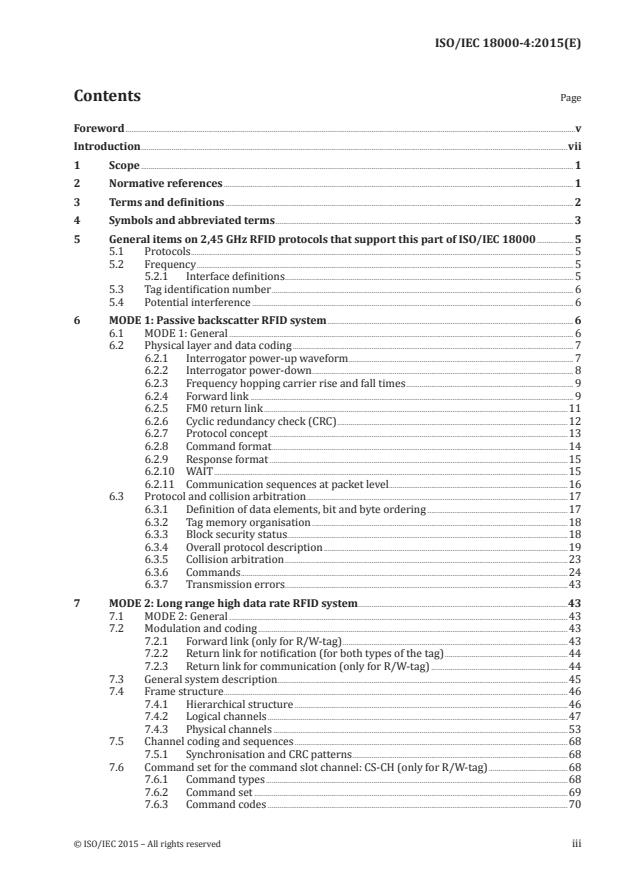
Contents Page
Foreword .v
Introduction .vii
1 Scope . 1
2 Normative references . 1
3 Terms and definitions . 2
4 Symbols and abbreviated terms . 3
5 General items on 2,45 GHz RFID protocols that support this part of ISO/IEC 18000 .5
5.1 Protocols . 5
5.2 Frequency . 5
5.2.1 Interface definitions . 5
5.3 Tag identification number . 6
5.4 Potential interference . 6
6 MODE 1: Passive backscatter RFID system . 6
6.1 MODE 1: General . 6
6.2 Physical layer and data coding . 7
6.2.1 Interrogator power-up waveform . 7
6.2.2 Interrogator power-down . 8
6.2.3 Frequency hopping carrier rise and fall times . 9
6.2.4 Forward link . 9
6.2.5 FM0 return link .11
6.2.6 Cyclic redundancy check (CRC) .12
6.2.7 Protocol concept .13
6.2.8 Command format .14
6.2.9 Response format .15
6.2.10 WAIT .15
6.2.11 Communication sequences at packet level .16
6.3 Protocol and collision arbitration .17
6.3.1 Definition of data elements, bit and byte ordering .17
6.3.2 Tag memory organisation .18
6.3.3 Block security status.18
6.3.4 Overall protocol description .19
6.3.5 Collision arbitration .23
6.3.6 Commands .24
6.3.7 Transmission errors . .43
7 MODE 2: Long range high data rate RFID system .43
7.1 MODE 2: General .43
7.2 Modulation and coding .43
7.2.1 Forward link (only for R/W-tag) .43
7.2.2 Return link for notification (for both types of the tag) .44
7.2.3 Return link for communication (only for R/W-tag) .44
7.3 General system description.45
7.4 Frame structure .46
7.4.1 Hierarchical structure .46
7.4.2 Logical channels .47
7.4.3 Physical channels .53
7.5 Channel coding and sequences .68
7.5.1 Synchronisation and CRC patterns .68
7.6 Command set for the command slot channel: CS-CH (only for R/W-tag) .68
7.6.1 Command types .68
7.6.2 Command set .69
7.6.3 Command codes .70
© ISO/IEC 2015 – All rights reserved iii
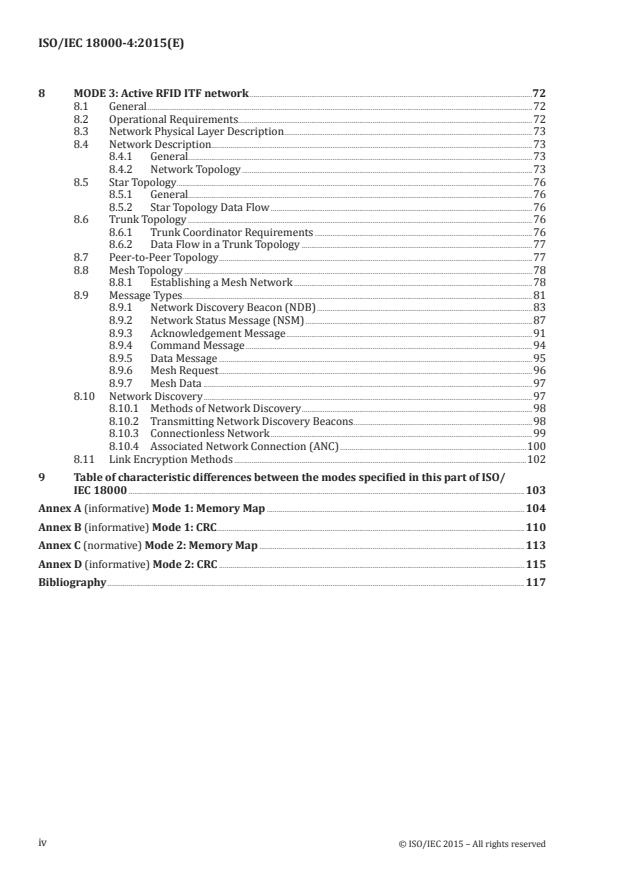
8 MODE 3: Active RFID ITF network .72
8.1 General .72
8.2 Operational Requirements.72
8.3 Network Physical Layer Description .73
8.4 Network Description.73
8.4.1 General.73
8.4.2 Network Topology .73
8.5 Star Topology .76
8.5.1 General.76
8.5.2 Star Topology Data Flow .76
8.6 Trunk Topology .76
8.6.1 Trunk Coordinator Requirements .76
8.6.2 Data Flow in a Trunk Topology .77
8.7 Peer-to-Peer Topology .77
8.8 Mesh Topology .78
8.8.1 Establishing a Mesh Network .78
8.9 Message Types . .81
8.9.1 Network Discovery Beacon (NDB) .83
8.9.2 Network Status Message (NSM) .87
8.9.3 Acknowledgement Message .91
8.9.4 Command Message .94
8.9.5 Data Message .95
8.9.6 Mesh Request .96
8.9.7 Mesh Data .97
8.10 Network Discovery .97
8.10.1 Methods of Network Discovery .98
8.10.2 Transmitting Network Discovery Beacons .98
8.10.3 Connectionless Network .99
8.10.4 Associated Network Connection (ANC) .100
8.11 Link Encryption Methods .102
9 Table of characteristic differences between the modes specified in this part of ISO/
IEC 18000 .103
Annex A (informative) Mode 1: Memory Map .104
Annex B (informative) Mode 1: CRC .110
Annex C (normative) Mode 2: Memory Map .113
Annex D (informative) Mode 2: CRC .115
Bibliography .117
iv © ISO/IEC 2015 – All rights reserved
Foreword
ISO (the International Organization for Standardization) and IEC (the International Electrotechnical
Commission) form the specialized system for worldwide standardization. National bodies that are
members of ISO or IEC participate in the development of International Standards through technical
committees established by the respective organization to deal with particular fields of technical
activity. ISO and IEC technical committees collaborate in fields of mutual interest. Other international
organizations, governmental and non-governmental, in liaison with ISO and IEC, also take part in the
work. In the field of information technology, ISO and IEC have established a joint technical committee,
ISO/IEC JTC 1.
The procedures used to develop this document and those intended for its further maintenance are
described in the ISO/IEC Directives, Part 1. In particular the different approval criteria needed for
the different types of document should be noted. This document was drafted in accordance with the
editorial rules of the ISO/IEC Directives, Part 2 (see www.iso.org/directives).
Attention is drawn to the possibility that some of the elements of this document may be the subject
of patent rights. ISO and IEC shall not be held responsible for identifying any or all such patent rights.
Details of any patent rights identified during the development of the document will be in the Introduction
and/or on the ISO list of patent declarations received (see www.iso.org/patents).
Any trade name used in this document is information given for the convenience of users and does not
constitute an endorsement.
For an explanation on the meaning of ISO specific terms and expressions related to conformity
assessment, as well as information about ISO’s adherence to the WTO principles in the Technical Barriers
to Trade (TBT) see the following URL: Foreword - Supplementary information
The committee responsible for this document is ISO/IEC JTC 1, Information technology, SC 31, Automatic
identification and data capture techniques.
This third edition cancels and replaces the second edition (ISO/IEC 18000-4:2008), of which it constitutes
a minor revision with the following changes:
— 5.1 has become Clause 5;
— 5.2 has become Clause 6;
— 5.3 has been Clause 7;
— Clause 8 has been introduced;
— Clause 6 has become Clause 9;
— Clause 1, Clause 2, Clause 3, Clause 4, Clause 5, and Clause 9 have been revised as necessary to also
cover Clause 8.
ISO/IEC 18000 consists of the following parts, under the general title Information technology — Radio
frequency identification for item management:
— Part 1: Reference architecture and definition of parameters to be standardized
— Part 2: Parameters for air interface communications below 135 kHz
— Part 3: Parameters for air interface communications at 13,56 MHz
— Part 4: Parameters for air interface communications at 2,45 GHz
— Part 6: Parameters for air interface communications at 860 MHz to 960 MHz General
— Part 61: Parameters for air interface communications at 860 MHz to 960 MHz Type A
© ISO/IEC 2015 – All rights reserved v
— Part 62: Parameters for air interface communications at 860 MHz to 960 MHz Type B
— Part 63: Parameters for air interface communications at 860 MHz to 960 MHz Type C
— Part 64: Parameters for air interface communications at 860 MHz to 960 MHz Type D
— Part 7: Parameters for active air interface communications at 433 MHz
vi © ISO/IEC 2015 – All rights reserved
Introduction
This part of ISO/IEC 18000 is one of a series of International Standards and Technical Reports developed
by ISO/IEC JTC 1/SC 31, WG 4 for the identification of items (item management) using radio frequency
identification (RFID) technology.
This part of ISO/IEC 18000 defines three 2,45 GHz protocols. Each of the specific physical/data link
configurations is defined in a separate sub-clause. The configuration descriptions include a physical
layer and a data link layer.
The International Organization for Standardization (ISO) and International Electrotechnical Commission
(IEC) draw attention to the fact that it is claimed that compliance with this document can involve the
use of patents concerning radio-frequency identification technology given in all parts of the document.
ISO and IEC take no position concerning the evidence, validity, and scope of these patent rights.
The holders of these patent rights have assured the ISO and IEC that they are willing to negotiate licences
under reasonable and non-discriminatory terms and conditions with applicants throughout the world.
In this respect, the statements of the holders of these patent rights are registered with ISO and IEC.
Information can be obtained from the following companies.
Contact details
Patent Holder: Patent Holder:
Legal Name iControl Inc Legal Name Zebra Technologies Corporation
Contact for license application: Contact for license application:
Name & Department George Cavage Name & Department James O’Hagan, Director of
Patents & Technology
Address 3235 Kifer Road, suite 260
Address 475 Half Day Road, Suite 500
Address Santa Clara, CA 94109, USA
Address Lincolnshire, IL 60069, USA
Tel. +1 408 730 5364
Tel. +1 (847) 793-6798
Fax
Fax +1 (847) 955-4514
E-mail gcavage@icontrol-inc.com
E-mail johagan@zebra.com
URL (optional) www.icontrol-inc.com
URL (optional)
Patent Holder:
Legal Name Impinj, Inc.
Contact for license application:
Name & Department Stacy Jones, Impinj, Inc.
th
Address 701 N 34 Street, Suite 300
Address Seattle. WA 98103 USA
Tel. +1 206 834 1032
Fax +1 206 517 5262
E-mail stacy.jones@impinj.com
URL (optional) www.impinj.com
© ISO/IEC 2015 – All rights reserved vii
INTERNATIONAL STANDARD ISO/IEC 18000-4:2015(E)
Information technology — Radio frequency identification
for item management —
Part 4:
Parameters for air interface communications at 2,45 GHz
1 Scope
This part of ISO/IEC 18000 defines the air interface for radio frequency identification (RFID) devices
operating in the 2,45 GHz Industrial, Scientific, and Medical (ISM) band used in item management
applications. This part of ISO/IEC 18000 provides a common technical specification for RFID devices
that can be used by ISO committees developing RFID application standards. This part of ISO/IEC 18000
is intended to allow for compatibility and to encourage inter-operability of products for the growing
RFID market in the international marketplace. This part of ISO/IEC 18000 defines the forward and
return link parameters for technical attributes including, but not limited to, operating frequency,
operating channel accuracy, occupied channel bandwidth, maximum equivalent isotropically radiated
power (EIRP), spurious emissions, modulation, duty cycle, data coding, bit rate, bit rate accuracy, bit
transmission order, and, where appropriate, operating channels, frequency hop rate, hop sequence,
spreading sequence, and chip rate. This part of ISO/IEC 18000 further defines the communications
protocol used in the air interface.
This part of ISO/IEC 18000 contains the following three modes:
— Mode 1 is an interrogator talks first with passive tag;
— Mode 2 is a tag talks first with battery-assisted passive tag;
— Mode 3 is a globally available, ubiquitous network supporting, among others, the logistics and
transportation industry; agnostic to any device, commercial or otherwise, requiring global
availability.
The detailed technical differences between the modes are shown in the parameter tables.
2 Normative references
The following documents, in whole or in part, are normatively referenced in this document and are
indispensable for its application. For dated references, only the edition cited applies. For undated
references, the latest edition of the referenced document (including any amendments) applies.
1)
ISO/IEC 7816-6:— , Identification cards — Integrated circuit cards — Part 6: Interindustry data elements
for interchange
ISO/IEC 15963, Information technology — Radio frequency identification for item management — Unique
identification for RF tags
ISO/IEC/TR 18047-4, Information technology — Radio frequency identification device conformance test
methods — Part 4: Test methods for air interface communications at 2,45 GHz
1)
ISO/IEC 19762 (all parts):— , Information technology — Automatic identification and data capture (AIDC)
techniques — Harmonized vocabulary
1) To be published
© ISO/IEC 2015 – All rights reserved 1
ISO/IEC/IEEE 8802-15-4:2010, Information technology — Telecommunications and information exchange
between systems — Local and metropolitan area networks — Specific requirements — Part 15-4: Wireless
medium access control (MAC) and physical layer (PHY) specifications for low-rate wireless personal area
networks (WPANs)
3 Terms and definitions
2)
For the purposes of this document, the terms and definitions given in ISO/IEC 19762 (all parts):— and
the following apply.
3.1
associated
has successfully negotiated a di-directional wireless link with a coordinator
Note 1 to entry: Associated networks require communication be maintained and monitored for a period of time.
3.2
association
service used to establish membership for a device communicating within the wireless network described
in this International Standard
3.3
block cipher
cryptographic function that operates on strings of fixed size
3.4
coordinator
full-function device (FFD) capable of relaying messages
Note 1 to entry: If a coordinator is the principal controller of a personal area network (PAN), it is called the
PAN coordinator.
3.5
data server
device data termination point
3.6
device
any entity that meets the ISO/IEC/IEEE 8802-15-4 medium access control (MAC), physical interface to
the wireless medium, and this protocol specification.
Note 1 to entry: A device can be a reduced-function device (RFD) or a full function device (FFD).
3.7
encryption
transformation of a message into a new representation so that privileged information is required to
recover the original representation
3.8
full-function device
FFD
device capable of operating as a coordinator
3.9
group key
key that is known only to a set of devices
2) To be published.
2 © ISO/IEC 2015 – All rights reserved
3.10
hailing channel
ISO/IEC/IEEE 8802-15-4 radio channel used to broadcast the NDB
3.11
key
privileged information that can be used, for example, to protect information from disclosure to, and/or
undetectable modification by, parties that do not have access to this privileged information
3.12
link key
secret key that is shared between precisely two devices
3.13
mesh networking
type of network where an FFD serves as a relay for other devices
3.14
message integrity code
MIC
data whereby an entity receiving a message corroborates evidence about the true source of the
information in the message and, thereby, evidence that the message has not been modified in transit
3.15
network channel
primary ISO/IEC/IEEE 8802-15-4 radio channel between a coordinator and remote devices
3.16
packet
formatted, aggregated bits that are transmitted together in time across the physical medium
3.17
payload data
contents of a data message that is being transmitted
3.18
reduced-function device
RFD
device that is not capable of operating as a coordinator
3.19
server connected coordinator
SCC
network coordinator that terminates the wireless protocol described in this International Standard and
is connected to control servers
3.20
tag
any device type associated with the device and capable of joining the network
4 Symbols and abbreviated terms
ACK acknowledgement
CCITT Comité Consultatif International Téléphonique et Télégraphique
Cht Carrier high level tolerance
Clt Carrier low level tolerance
© ISO/IEC 2015 – All rights reserved 3
CRC cyclical redundancy check
CSMA carrier sense multiple access
f base frequency of the bit rate of Manchester code without bit changes
bitrate
f frequency of operating field (carrier frequency)
c
FCF frame control field
FCS frame check sequence
FHSS Frequency Hopping Spread Spectrum
M Modulation
Ma Modulation overshoot
MAC medium access control
Mb Modulation undershoot
MIC message integrity code
MIN Manufacturing Identification Number
Mlt Modulation lower tolerance
Mut Modulation upper tolerance
NAK no-acknowledgement
NDB Network Discovery Beacon
NSM Network Status Message
QPSK quad-phased shift keying
RTLS real time locating system
Tbmf Manchester fall time
Tbmr Manchester rise time
Tcf carrier fall time
Tcr carrier rise time
Tcs carrier steady time
TDMA time division multiple access
Tf fall time
Tfhf carrier FHSS fall time
Tfhr carrier FHSS rise time
Tfhs carrier FHSS steady time
Tflb forward link bit time
Tr rise time
4 © ISO/IEC 2015 – All rights reserved
Trlb return link bit time
TTL tag talk last
5 General items on 2,45 GHz RFID protocols that support this part of
ISO/IEC 18000
5.1 Protocols
Clause 5 describes the general items of the ISO/IEC 18000-4, 2,45 GHz RFID command/data level
communication protocols. These protocols facilitate communication between compliant tag and
compliant interrogator. The timing parameters and signal characteristics for the protocols are defined
in the physical link specifications in each mode. Details of the Modes of various protocols are described
in Clauses 6, 7 and 8.
5.2 Frequency
This part of ISO/IEC 18000 is intended to address RFID devices operating in the 2 450 MHz Industrial,
Scientific and Medical (ISM) frequency band.
5.2.1 Interface definitions
This part of ISO/IEC 18000 supports standard parameters and standard air interface implementations
for wireless, non-contact information system equipment for Item Management applications. Typical
applications operate at ranges greater than one meter.
5.2.1.1 RFID system definition
The radio-frequency identification (RFID) system shall include a host system and RFID equipment
(interrogator and tags). The host system runs an application program, which controls interfaces with
the RFID. The RFID equipment shall be composed of two principal components: tags and interrogators.
The tag is intended for attachment to an item, which a user wishes to manage. It is capable of storing a
tag ID number and other data regarding the tag or item and of communicating this information to the
interrogator. The interrogator is a device, which communicates to tags in its field of view. Additionally,
the interrogator can use its transmitted RF carrier to power the tag. Systems, which rely on the
transmitted interrogator carrier for powering the tag, are typically referred to as passive tag systems.
The interrogator controls the protocol, reads information from the tag, directs the tag to store data in
some cases, and ensures message delivery and validity.
5.2.1.2 Minimum features
RFID systems defined by this part of ISO/IEC 18000 provide the following minimum features:
— identify tag in range,
— read data,
— write data or handle read only systems gracefully,
— selection by group or address,
— graceful handling of multiple tags in the field of view,
— error detection.
© ISO/IEC 2015 – All rights reserved 5
5.2.1.3 Conformance
To claim conformance with this part of ISO/IEC 18000, an RFID system shall comply with one of the
physical/data link implementations described in Clause 6, 7 and 8.
The rules for RFID device conformity evaluation are given in ISO/IEC 18047-4.
5.3 Tag identification number
A tag identification number shall be included in commands directed to a specific tag unless the protocol
provides other means like TTF (Tag Talks First) protocols. This part of ISO/IEC 18000 mandates that
each tag shall include a manufacturer’s tag identification number as defined in Annex A for mode 1, in
Annex C for mode 2 and in sub-clause 8.5.1 for mode 3.
A separate User Tag Identification is not mandatory, but is an option. When a UserTagID is used, it shall
consist of the number of bytes required by the user application. This number and other application data shall
be accessed as user data fields on the tag. These fields can be accessed via the API using the driver’s field
name resolution mechanism. The UserTagID is a user-defined tag identifier and is not necessarily unique.
5.4 Potential interference
Standards developers have a duty to ensure that no “significant interference” exists between Standardized
modes. “Significant Interference” exists if a system of one Standardized mode (working within the most
widespread regulated power emissions) is likely to impede the successful operation of a system of
another Standardized mode (working within the most widespread regulated power emissions), in likely
expected operating situations.
Marginal measurable interference that does not impede operation in likely expected operating situations,
or that could be avoided by simple and inexpensive design improvement, shall not be considered cause
to reject a mode.
— Therefore, TTF modes are clearly identified as such in this part of ISO/IEC 18000.
— Therefore, installers of RFID systems are advised that they should make best efforts to be a good
neighbour in installing any systems, bearing in mind that there may be other systems sharing the
same bandwidth and are advised to take precautions to minimise interference to other systems.
Installers are equally advised to be prepared to handle interference within the bandwidth from
other users up to transmission powers permitted by local regulations.
6 MODE 1: Passive backscatter RFID system
6.1 MODE 1: General
The FHSS backscatter option or the narrow band operation RFID system shall include an interrogator
that runs the FHSS backscatter option 1 RFID protocol or in narrow band operation, as well as one or
more tags within the interrogation zone.
When placed in the RF field of an interrogator, the tag shall begin to power up. If the field is adequate,
the tag shall execute a power-on reset and shall be ready to receive commands. Each command shall
begin with a preamble and start delimiters that, taken together, enable the tag to perform clock and data
recovery on the incoming signal. Data to and from the tag is checked for errors using a Cyclic Redundancy
Code (CRC). Therefore, CRC fields are present in all interrogator interrogations and in all tag responses.
Additional data protection is provided by Manchester encoding on the forward (interrogator to tag link)
and FM0 encoding on the return (tag to interrogator) link.
By using the FHSS backscatter option 1 RFID command set or in narrow band operation, the interrogator
can execute a number of functions on tags in its field. For example, the interrogator can send a command
sequence, which allows it to identify multiple tags simultaneously in its RF field. Alternately, it can select
6 © ISO/IEC 2015 – All rights reserved
a subset of the tags in the field based on tag memory contents. It can also read data stored on a tag in its
field, as well as write or lock data to such a tag.
The description of the RFID tag command set in the following clause shall provide detail regarding the
command field and return data/acknowledgement fields, if any. In addition, it shall cover additional
high-level elements of the FHSS backscatter option RFID protocol, including how the multiple item
identification algorithm works and byte ordering requirements. The more general aspects of the
protocol (preambles, CRC-16, etc.) are covered in detail in 6.2.7.
This portion of the International Standard describes a passive backscatter RFID system that supports
the following system capabilities:
System protocol
— Identify and communicate with multiple tags in the field
— Select a subgroup of tags to identify or communicate with based on information that the user has
stored in the tag
— Read from and write or rewrite data many times to individual tags
— User controlled permanent lock memory
Data integrity protection
— Manchester bit-wise encoding and CRC-16 packet-level protection is applied to the forward link
(interrogator-to-tag) data.
— FM0 bit-wise encoding and CRC-16 packet-level protection is applied to the return link (tag-to-
interrogator) data.
In this RFID system, interrogators both power and communicate with the tags that are within their range.
Tags receive data as on-off key amplitude modulation of the power/data signal from the interrogator.
During the time that the tag communicates back to the interrogator, the interrogator broadcasts a steady
radio frequency power level, and the tag modulates the impedance of its radio frequency load attached
to the tag antenna terminals. The interrogator then receives the data back from the tag as a variation in
reflection of its transmitted power.
6.2 Physical layer and data coding
6.2.1 Interrogator power-up waveform
The interrogator power-up waveform shall comply with the mask specified in Figure 1 and Table 1.
© ISO/IEC 2015 – All rights reserved 7
Figure 1 — Interrogator power-up waveform
Table 1 — Interrogator power-up waveform parameter values
Parameter Min Max
Tcs 400 µs
Tcr 0 µs 30 µs
Cht 3 %
Clt 1 %
6.2.2 Interrogator power-down
Once the carrier level has dropped below the ripple limit Cht, power down shall be monotonic and of
duration Tcf, as specified in Figure 2 and Table 2.
Figure 2 — Interrogator power-down waveform
Table 2 — Interrogator power-down timings
Parameter Min Max
Tcf 1 µs 500 µs
Cht 3%
Clt 1%
8 © ISO/IEC 2015 – All rights reserved
6.2.3 Frequency hopping carrier rise and fall times
When the interrogator operates in the frequency hopping spread spectrum mode (FHSS), the carrier
rise and fall times shall conform to the characteristics specified in Figure 3 and Table 3.
Figure 3 — FHSS carrier rise and fall characteristics
Table 3 — FHSS carrier rise and fall parameters
Parameter Min Max
Tfhr 15 µs
Tfhs 400 µs
Tfhf 15 µs
NOTE The numbers in Table 3 are an example for current FCC regulations only.
6.2.4 Forward link
6.2.4.1 Carrier modulation
The data transmission from the interrogator to the tag is achieved by modulation of the carrier (ASK).
The data coding is performed by generating pulses that create a Manchester coding.
© ISO/IEC 2015 – All rights reserved 9
Figure 4 — Example of 40 kbit/s signal
Table 4 — Parameter for 99 % Modulation
Parameter Minimum Nominal Maximum
M = (A-B)/(A + B) 90 99 100
Ma 0 0,03 (A-B)
Mb 0 0,03 (A-B)
Tr 0 µs 1,8 µs 0,1 / f
bitrate
Tf 0 µs 1,8 µs 0,1 / f
bitrate
6.2.4.2 Bit coding of forward link fields
Data is Manchester encoded as per Figure 5.
Figure 5 — Forward link bit coding
10 © ISO/IEC 2015 – All rights reserved
6.2.5 FM0 return link
6.2.5.1 General
The tag transmits information to the interrogator by modulating the incident energy and reflecting it
back to the interrogator (backscatter).
6.2.5.2 Modulation
The tag switches its reflectivity between two states. The “space” state is the normal condition in which
the tag is powered by the interrogator and able to receive and decode the forward link. The “mark”
state” is the alternative condition created by changing the antenna configuration or termination.
6.2.5.3 Data rate
The return link data rate is derived from the forward link data rate and is typically 40 kbit/s. For
details see Table 5.
6.2.5.4 Data coding
Data is coded using the FM0 technique, also known as Bi-Phase Space.
One symbol period Trlb is allocated to each bit to be sent. In FM0 encoding, data transitions occur at all
bit boundaries. In addition, data transitions occur at the mid-bit of logic 0 being sent.
Table 5 — Return link parameters
Data rate Trlb Tolerance
30 - 40 kbit/s 25 µs - 33 µs ± 15 %
Coding of data is MSB first. Figure 6 illustrates the coding for the 8 bits of ‘B1’.
Figure 6 — Tag to interrogator data coding
© ISO/IEC 2015 – All rights reserved 11
6.2.5.5 Message format
A Return Link Message consists of n data bits preceded by the Preamble and followed by the tag data.
The data bits are sent MSB first.
The Preamble enables the interrogator to lock to the tag data clock and begin decoding of the message.
It consists of 16 bits as shown in Table 6. There are multiple code violations (sequence not conforming to
FM0 rules) that act as a frame marker for the transition from Preamble to Data.
6.2.5.6 Return preamble
The return preamble is a sequence of backscatter modulation specified in Table 6.
Table 6 — Return preamble
00 00 01 01 01 01 01 01 01 01 00 01 10 11 00 01
Data ‘0’ is represented by the tag’s modulator being in the high impedance state, Data ‘1’ is represented
by the tag’s modulator switching to the low impedance state, thereby causing a change in the incident
energy to be back-scattered.
The tag shall execute backscatter, a half-bit 1 and half-bit 0 sent by the tag defined as follows in Figure 7.
NOTE 1 = low impedance (backscatter), 0 = high impedance (no backscatter).
Figure 7 — Return link preamble
6.2.6 Cyclic redundancy check (CRC)
When sending a command to the tag, the interrogator shall attach an inverted CRC to the message packet.
On receiving a command from the interrogator, the tag shall verify that the checksum or the CRC value
is valid. If it is invalid, it shall discard the frame, shall not respond and shall not take any other action.
The 16 bits CRC applies for both communication directions: From interrogator to tag and from tag to
interrogator.
16 12 5
The polynomial used to calculate the CRC is X + X + X + 1. The 16-bit register shall be preloaded
with ‘FFFF’. The resulting CRC value shall be inverted, attached to the end of the packet and transmitted.
The most significant byte shall be transmitted first. The most significant bit of each byte shall be
transmitted first.
At the tag, the incoming CRC bits are inverted and then clocked into the register. After the LSB bit is
clocked into the tag, the 16 bit CRC register should contain all zeros.
The 16 bit CRC shall be calculated on all data bits up to, but not including, the first CRC bit.
12 © ISO/IEC 2015 – All rights reserved
On receiving of a response from the tag, it is recommended that the interrogator verifies that the CRC
value is valid. If it is invalid, appropriate remedial action is the responsibility of the interrogator designer.
Table 7 — CRC 16 bits and bytes transmission rules
MSByte LSByte
MSB LSB MSB LSB
CRC 16 (8 bits) CRC 16 (8 bits)
↑ first transmitted bit of the inverted CRC
6.2.7 Protocol concept
Data is encoded and presented in slightly different ways in the constituent fields. For interrog
...
Questions, Comments and Discussion
Ask us and Technical Secretary will try to provide an answer. You can facilitate discussion about the standard in here.
Loading comments...