

ISO/IEC 15961-3:2019
(Main)Information technology — Data protocol for radio frequency identification (RFID) for item management — Part 3: RFID data constructs
General Information
- Abstract
This document specifies rules and code structures associated with the data constructs for RFID for item management. In particular, it: — defines the application family identifier (AFI), including the range of code values that are available to use for RFID for item management; — defines the data format, including the range of code values that are available to use for RFID for item management; — describes the Object Identifier structure used for RFID for item management; — specifies the function of the Object Identifier for the Unique Item Identifier (UII); — specifies the function of the Object Identifier for other item attendant data. NOTE Conventionally in International Standards, long numbers are separated by a space character as a "thousands separator". This convention has not been followed in this document because the arcs of an Object Identifier are defined by a space separator (according to ISO/IEC 8824 and ISO/IEC 8825). As the correct representation of these arcs is vital to this document, all numeric values have no space separators except to denote a node between two arcs of an Object Identifier. For additional clarity, Object Identifiers are presented in bold text.
- Status
- Published
- Publication Date
- 04-Feb-2019
- Technical Committee
- ISO/IEC JTC 1/SC 31 - Automatic identification and data capture techniques
- Drafting Committee
- ISO/IEC JTC 1/SC 31/WG 4 - Radio communications
- Current Stage
- 9093 - International Standard confirmed
- Start Date
- 25-Jun-2024
- Completion Date
- 29-Aug-2026
Overview
ISO/IEC 15961-3:2019 specifies the data constructs and rules used in the data protocol for radio frequency identification (RFID) for item management. It defines the structures and code assignments that ensure consistent encoding and decoding of application data on RFID tags, enabling interoperability across different systems and manufacturers. Key elements include the Application Family Identifier (AFI), data formats and their code ranges, and the Object Identifier (OID) structure used for the Unique Item Identifier (UII) and other item-attendant data.
Key Topics
- Application Family Identifier (AFI)
- Defines the AFI mechanism and the ranges/assignment rules used to select classes of RFID tags relevant to applications.
- Covers AFI assignment, self-assignment and an AFI extension mechanism.
- Data format and DSFID
- Specifies how data formats are identified on tags, including Data Storage Format Identifier (DSFID) construction and extension.
- Describes data format assignment by the Registration Authority and rules for self-assigned formats (e.g., data formats 29 and 30).
- Object Identifiers (OID)
- Describes the hierarchical OID structure used to name Objects on tags, including Root-OID and Relative-OID usage.
- Specifies OID function for the Unique Item Identifier (UII) and for other item-attendant data.
- Discusses use of OIDs in open and closed application environments.
- Conformance for encoders and decoders
- Encoders/decoders claiming conformance must access the data-constructs register and support recognition of valid AFIs, data formats, DSFIDs, Root-OIDs, Tag Data Profiles and Packed Objects.
- Declarations of conformance can be for all registrations up to a date or specific registrations.
Applications and Who Uses It
ISO/IEC 15961-3 is practical for:
- RFID equipment manufacturers (tags, interrogators) implementing standard-compliant encoding/decoding.
- System integrators and software vendors building middleware, tag-encoding tools, and supply-chain solutions.
- Manufacturers and retailers using RFID for inventory, asset tracking, and item-level traceability.
- Standards bodies and Registration Authorities maintaining data-constructs registers and assigning AFI/data format codes.
Benefits include reliable tag data interoperability, consistent UII handling, and a common basis for application-level RFID data dictionaries.
Related Standards (if applicable)
- ISO/IEC 15961-1 - transfer of data to/from applications (commands/responses)
- ISO/IEC 15961-2 - registration of RFID data constructs (Registration Authority procedures)
- ISO/IEC 15961-4 - sensor and battery data transfer for RFID
- ISO/IEC 15962 - data encoding rules and logical memory functions for RFID
- ISO/IEC 18000, ISO/IEC 9834-1, ISO/IEC 8824/8825 - referenced protocols and OID handling
Keywords: ISO/IEC 15961-3:2019, RFID data constructs, AFI, data format, Object Identifier, UII, RFID for item management, DSFID, conformance, Registration Authority.
Relations
- Effective Date
- 15-Apr-2008
Get Certified
Connect with accredited certification bodies for this standard

BSI Group
BSI (British Standards Institution) is the business standards company that helps organizations make excellence a habit.

NYCE
Mexican standards and certification body.
Sponsored listings
Frequently Asked Questions
ISO/IEC 15961-3:2019 is a standard published by the International Organization for Standardization (ISO). Its full title is "Information technology — Data protocol for radio frequency identification (RFID) for item management — Part 3: RFID data constructs". This standard covers: This document specifies rules and code structures associated with the data constructs for RFID for item management. In particular, it: — defines the application family identifier (AFI), including the range of code values that are available to use for RFID for item management; — defines the data format, including the range of code values that are available to use for RFID for item management; — describes the Object Identifier structure used for RFID for item management; — specifies the function of the Object Identifier for the Unique Item Identifier (UII); — specifies the function of the Object Identifier for other item attendant data. NOTE Conventionally in International Standards, long numbers are separated by a space character as a "thousands separator". This convention has not been followed in this document because the arcs of an Object Identifier are defined by a space separator (according to ISO/IEC 8824 and ISO/IEC 8825). As the correct representation of these arcs is vital to this document, all numeric values have no space separators except to denote a node between two arcs of an Object Identifier. For additional clarity, Object Identifiers are presented in bold text.
This document specifies rules and code structures associated with the data constructs for RFID for item management. In particular, it: — defines the application family identifier (AFI), including the range of code values that are available to use for RFID for item management; — defines the data format, including the range of code values that are available to use for RFID for item management; — describes the Object Identifier structure used for RFID for item management; — specifies the function of the Object Identifier for the Unique Item Identifier (UII); — specifies the function of the Object Identifier for other item attendant data. NOTE Conventionally in International Standards, long numbers are separated by a space character as a "thousands separator". This convention has not been followed in this document because the arcs of an Object Identifier are defined by a space separator (according to ISO/IEC 8824 and ISO/IEC 8825). As the correct representation of these arcs is vital to this document, all numeric values have no space separators except to denote a node between two arcs of an Object Identifier. For additional clarity, Object Identifiers are presented in bold text.
ISO/IEC 15961-3:2019 is classified under the following ICS (International Classification for Standards) categories: 35.040 - Information coding; 35.040.50 - Automatic identification and data capture techniques. The ICS classification helps identify the subject area and facilitates finding related standards.
ISO/IEC 15961-3:2019 has the following relationships with other standards: It is inter standard links to ISO/IEC 15961:2004. Understanding these relationships helps ensure you are using the most current and applicable version of the standard.
ISO/IEC 15961-3:2019 is available in PDF format for immediate download after purchase. The document can be added to your cart and obtained through the secure checkout process. Digital delivery ensures instant access to the complete standard document.
Standards Content (Sample)
INTERNATIONAL ISO/IEC
STANDARD 15961-3
First edition
2019-02
Information technology — Data
protocol for radio frequency
identification (RFID) for item
management —
Part 3:
RFID data constructs
Technologies de l'information — Protocole de données relatif à
l'identification par radiofréquence (RFID) pour la gestion d'objets —
Partie 3: Constructions de données RFID
Reference number
©
ISO/IEC 2019
© ISO/IEC 2019
All rights reserved. Unless otherwise specified, or required in the context of its implementation, no part of this publication may
be reproduced or utilized otherwise in any form or by any means, electronic or mechanical, including photocopying, or posting
on the internet or an intranet, without prior written permission. Permission can be requested from either ISO at the address
below or ISO’s member body in the country of the requester.
ISO copyright office
CP 401 • Ch. de Blandonnet 8
CH-1214 Vernier, Geneva
Phone: +41 22 749 01 11
Fax: +41 22 749 09 47
Email: copyright@iso.org
Website: www.iso.org
Published in Switzerland
ii © ISO/IEC 2019 – All rights reserved
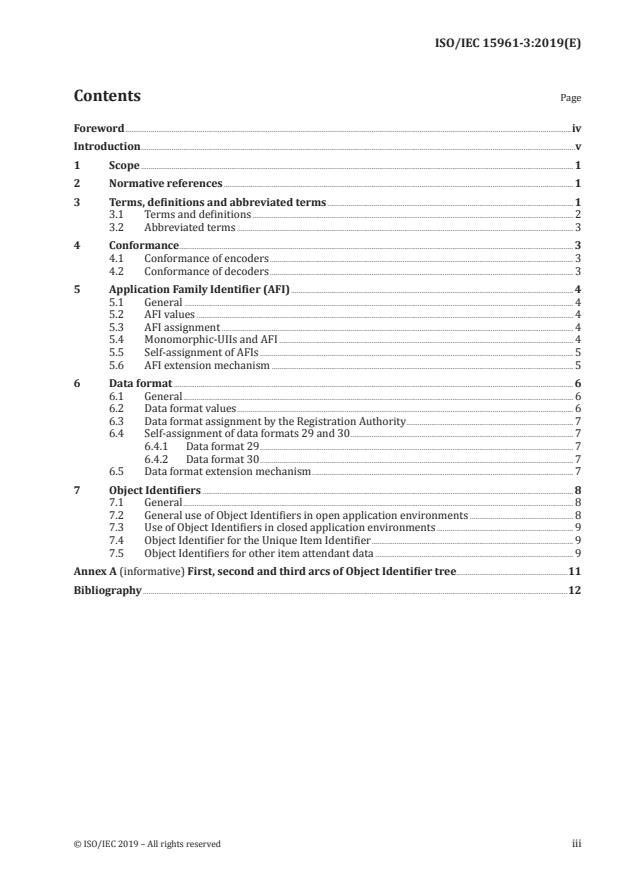
Contents Page
Foreword .iv
Introduction .v
1 Scope . 1
2 Normative references . 1
3 Terms, definitions and abbreviated terms . 1
3.1 Terms and definitions . 2
3.2 Abbreviated terms . 3
4 Conformance . 3
4.1 Conformance of encoders . 3
4.2 Conformance of decoders . 3
5 Application Family Identifier (AFI) . 4
5.1 General . 4
5.2 AFI values . 4
5.3 AFI assignment . 4
5.4 Monomorphic-UIIs and AFI . 4
5.5 Self-assignment of AFIs . 5
5.6 AFI extension mechanism . 5
6 Data format . 6
6.1 General . 6
6.2 Data format values . 6
6.3 Data format assignment by the Registration Authority . 7
6.4 Self-assignment of data formats 29 and 30 . 7
6.4.1 Data format 29 . 7
6.4.2 Data format 30 . 7
6.5 Data format extension mechanism . 7
7 Object Identifiers . 8
7.1 General . 8
7.2 General use of Object Identifiers in open application environments . 8
7.3 Use of Object Identifiers in closed application environments . 9
7.4 Object Identifier for the Unique Item Identifier . 9
7.5 Object Identifiers for other item attendant data . 9
Annex A (informative) First, second and third arcs of Object Identifier tree.11
Bibliography .12
© ISO/IEC 2019 – All rights reserved iii
Foreword
ISO (the International Organization for Standardization) and IEC (the International Electrotechnical
Commission) form the specialized system for worldwide standardization. National bodies that
are members of ISO or IEC participate in the development of International Standards through
technical committees established by the respective organization to deal with particular fields of
technical activity. ISO and IEC technical committees collaborate in fields of mutual interest. Other
international organizations, governmental and non-governmental, in liaison with ISO and IEC, also
take part in the work.
The procedures used to develop this document and those intended for its further maintenance are
described in the ISO/IEC Directives, Part 1. In particular, the different approval criteria needed for
the different types of document should be noted. This document was drafted in accordance with the
editorial rules of the ISO/IEC Directives, Part 2 (see www .iso .org/directives).
Attention is drawn to the possibility that some of the elements of this document may be the subject
of patent rights. ISO and IEC shall not be held responsible for identifying any or all such patent
rights. Details of any patent rights identified during the development of the document will be in the
Introduction and/or on the ISO list of patent declarations received (see www .iso .org/patents) or the IEC
list of patent declarations received (see http: //patents .iec .ch).
Any trade name used in this document is information given for the convenience of users and does not
constitute an endorsement.
For an explanation of the voluntary nature of standards, the meaning of ISO specific terms and
expressions related to conformity assessment, as well as information about ISO's adherence to the
World Trade Organization (WTO) principles in the Technical Barriers to Trade (TBT) see www .iso
.org/iso/foreword .html.
This document was prepared by Joint Technical Committee ISO/IEC JTC 1, Information technology,
Subcommittee SC 31, Automatic identification and data capture techniques.
This first edition of ISO/IEC 15961-3, together with ISO/IEC 15961-1, ISO/IEC 15961-2 and ISO/
IEC 15961-4, cancels and replaces ISO/IEC 15961:2004, which has been technically revised.
A list of all parts in the ISO/IEC 15961 series can be found on the ISO website.
Any feedback or questions on this document should be directed to the user’s national standards body. A
complete listing of these bodies can be found at www .iso .org/members .html.
iv © ISO/IEC 2019 – All rights reserved
Introduction
The technology of radio frequency identification (RFID) is based on non-contact electronic
communication across an air interface. The structure of the bits stored on the memory of the RFID
tag is invisible and accessible between the RFID tag and the interrogator only by the use of the
appropriate air interface protocol, as specified in the appropriate part of ISO/IEC 18000. The transfer
of data between the application and the interrogator in open systems requires data to be presented in
a consistent manner on any RFID tag that is part of that open system. Application commands from the
application and responses from the interrogator also require being processed in a standard way. This
is not only to allow equipment to be interoperable, but in the special case of the data carrier, for the
data to be encoded on the RFID tag in one system implementation for it to be read at a later time in a
completely different and unknown system implementation. The data bits stored on each RFID tag must
be formatted in such a way as to be reliably read at the point of use if the RFID tag is to fulfil its basic
objective.
Manufacturers of RFID equipment (interrogators, RFID tags, etc.) and the users of RFID technology
require a standard-based data protocol for RFID for item management. ISO/IEC 15961 and ISO/
IEC 15962 specify this data protocol, which is independent of any of the air interface standards defined
in ISO/IEC 18000. As such, the data protocol is a consistent component in the RFID system that may
independently evolve to include additional air interface protocols. The International Standards that
comprise the data protocol are as follows:
— ISO/IEC 15961-1 , which defines the transfer of data to and from the application, supported by
appropriate application commands and responses;
— ISO/IEC 15961-2 , which defines the registration procedure of RFID data constructs to ensure that
the data protocol supports new applications, in a relatively straightforward manner, as they adopt
RFID technology. This can be achieved by the Registration Authority publishing regular updates of
RFID data constructs that have been assigned, and as a means of incorporating these updates into
the processes of ISO/IEC 15961-1;
— this document (ISO/IEC 15961-3), which defines the data constructs and the rules that govern
their use;
— ISO/IEC 15961-4, which defines the transfer of data associated with sensors and batteries to and
from the application, supported by appropriate application commands and responses;
— ISO/IEC 15962, which specifies the overall process and the methodologies developed to format the
application data into a structure to store on the RFID tag.
© ISO/IEC 2019 – All rights reserved v
INTERNATIONAL STANDARD ISO/IEC 15961-3:2019(E)
Information technology — Data protocol for radio
frequency identification (RFID) for item management —
Part 3:
RFID data constructs
1 Scope
This document specifies rules and code structures associated with the data constructs for RFID for
item management. In particular, it:
— defines the application family identifier (AFI), including the range of code values that are available
to use for RFID for item management;
— defines the data format, including the range of code values that are available to use for RFID for item
management;
— describes the Object Identifier structure used for RFID for item management;
— specifies the function of the Object Identifier for the Unique Item Identifier (UII);
— specifies the function of the Object Identifier for other item attendant data.
NOTE Conventionally in International Standards, long numbers are separated by a space character as a
“thousands separator”. This convention has not been followed in this document because the arcs of an Object
Identifier are defined by a space separator (according to ISO/IEC 8824 and ISO/IEC 8825). As the correct
representation of these arcs is vital to this document, all numeric values have no space separators except to
denote a node between two arcs of an Object Identifier. For additional clarity, Object Identifiers are presented in
bold text.
2 Normative references
The following documents are referred to in the text in such a way that some or all of their content
constitutes requirements of this document. For dated references, only the edition cited applies. For
undated references, the latest edition of the referenced document (including any amendments) applies.
ISO/IEC 9834-1, Information technology — Procedures for the operation of object identifier registration
authorities: General procedures and top arcs of the international object identifier tree — Part 1
1)
ISO/IEC 15961-2 ,Information technology — Radio frequency identification (RFID) for item management:
Data protocol — Part 2: Registration of RFID data constructs
ISO/IEC 15962, Information technology — Radio frequency identification (RFID) for item management —
Data protocol: data encoding rules and logical memory functions
3 Terms, definitions and abbreviated terms
For the purposes of this document, the following terms, definitions and abbreviated terms apply.
1) Under preparation. Stage at the time of publication: ISO/IEC/FDIS 15961-2:2018.
© ISO/IEC 2019 – All rights reserved 1
3.1 Terms and definitions
3.1.1
Application Family Identifier
mechanism used in the data protocol and the air interface protocol to select a class of RFID tags relevant
to an application, or aspect of an application, and to ignore further communications with other classes
of RFID tags with different identifiers
3.1.2
arc
specific branch of a hierarchical Object Identifier tree
Note 1 to entry: The top three arcs of Object Identifiers relevant to RFID, compliant with ISO/IEC 9834-1, are
defined in Annex A.
3.1.3
data format
mechanism used in the data protocol to identify how Object Identifiers are encoded on the RFID tag,
and (where possible) identify a particular data dictionary for the set of relevant Object Identifiers for a
specific application
3.1.4
Object
well-defined piece of information, definition or specification which requires a name in order to identify
its use in an instance of communication
3.1.5
Object Identifier
value (distinguishable from all other such values) which is associated with an Object
3.1.6
Relative-OID
Object Identifier comprising the remaining arc or arcs positioned after a common Root-OID (for the
first and subsequent arcs)
Note 1 to entry: The common Root-OID is often implied by other data constructs and not encoded in the RFID tag.
3.1.7
Root-OID
particular Object Identifier that constitutes the first, second and subsequent common arcs of a set of
Object Identifiers (hence the common root)
Note 1 to entry: The Root-OID followed immediately by the Relative-OID equates to the complete Object Identifier.
3.1.8
Unique Item Identifier
mechanism that uniquely identifies a specific entity (e.g. a product, transport unit, returnable asset)
during its life within a particular domain and scope of a code system
Note 1 to entry: When used with this data protocol, the particular Object Identifier that defines the Unique Item
Identifier relies on the fact that each instance of its Object is required to be unique and unambiguous with respect
to all other related Objects.
2 © ISO/IEC 2019 – All rights reserved
3.2 Abbreviated terms
AFI Application Family Identifier
DSFID Data Storage Format Identifier
OID Object Identifier
RA Registration Authority
UII Unique Item Identifier
4 Conformance
4.1 Conformance of encoders
In addition to the conformance requirements for encoders as defined in ISO/IEC 15962, an encoder
claiming conformance to this document shall access the data constructs register and provide the
necessary additional encoding rules are defined by the particular data construct(s). These include:
— the recognition of a valid AFI;
— the recognition of a valid data format, including the capability to construct the DSFID, or extended
DSFID if appropriate;
— the recognition of the common Root-OID for data to be encoded so that only the Relative-OID is
encoded;
— the use of relevant tables for encoding as defined by the data format and registration of the data
constructs, including Packed Objects, Tag Data Profiles and encoding that is declared in the data
constructs register;
— the recognition of AFIs associated with Monomorphic-UIIs that require explicitly defined
encoding rules.
Declarations of conformance shall be based on one of the following:
— for all registrations up to a particular publication date of the data constructs register;
— for one or more specific registrations, in which case the declaration shall refer to the specific
registration(s).
4.2 Conformance of decoders
In addition to the conformance requirements for decoders as defined in ISO/IEC 15962, a decoder
claiming conformance to this document shall access the data constructs register and provide the
necessary additional encoding rules are defined by the particular data construct(s). These include:
— the recognition of a valid AFI;
— the recognition of a valid data format, including the capability to de-construct the DSFID, or extended
DSFID if appropriate;
— the recognition of the common Root-OID for data to be pre-pended to the Relative-OID that is
encoded;
— the use of relevant tables for decoding as defined by the data format and registration of the data
constructs, including Packed Objects, Tag Data Profiles and encoding that is declared in the data
constructs register;
© ISO/IEC 2019 – All rights reserved 3
— the recognition of AFIs associated with Monomorphic-UIIs that require explicitly defined
decoding rules.
Declarations of conformance shall be based on one of the following:
— for all registrations up to a particular publication date of the data constructs register;
— for one or more specific registrations, in which case the declaration shall refer to the specific
registration(s).
5 Application Family Identifier (AFI)
5.1 General
The Application Family Identifier (AFI) is a data protocol mechanism that enables selective addressing
of RFID tags to achieve an efficient use of radio communications. The AFI is generally supported by a
mechanism at the air interface, enabling the use of the AFI in application commands defined in ISO/
IEC 15961-1 to be converted into air interface commands. Such commands maintain communication
with RFID tags with the selected AFI and generally ignore RFID tags with different encoded AFIs.
The value of the AFI for RFID for item management can be stored on the RFID tag in some form, or can
be determined by the air interface services if these are sufficiently specific. It is a single byte value,
although provisions are made below for an extension mechanism in case the set of single byte AFIs
becomes fully utilised.
5.2 AFI values
The AFI is encoded as a byte value, with possible extensions to multiple bytes to meet future application
needs. The commands and responses of ISO/IEC 15961-1 require the AFI to be represented as decimal
values, whereas the processes of ISO/IEC 15962 and the air interface protocols (ISO/IEC 18000) require
the AFI to be represented as hexadecimal values. Both forms are used in Table 1.
For compatibility with other RFID protocols and standards, the AFIs assigned in accordance with ISO/
IEC 15961-2 are restricted to:
— AFIs 0 to 15 (00 to 0F );
16 16
— AFIs 144 to 206 (90 to CE ).
16 16
5.3 AFI assignment
AFIs in the range 144 to 206 (90 to CE ) shall be assigned in accordance with ISO/IEC 15961-2. The RA
16 16
is also responsible for assigning AFIs in the range 1 to 15 (01 to 0F ) for closed system applications.
16 16
Details of assigned AFIs, together with the other data constructs associated
...