

ISO 12193:2004
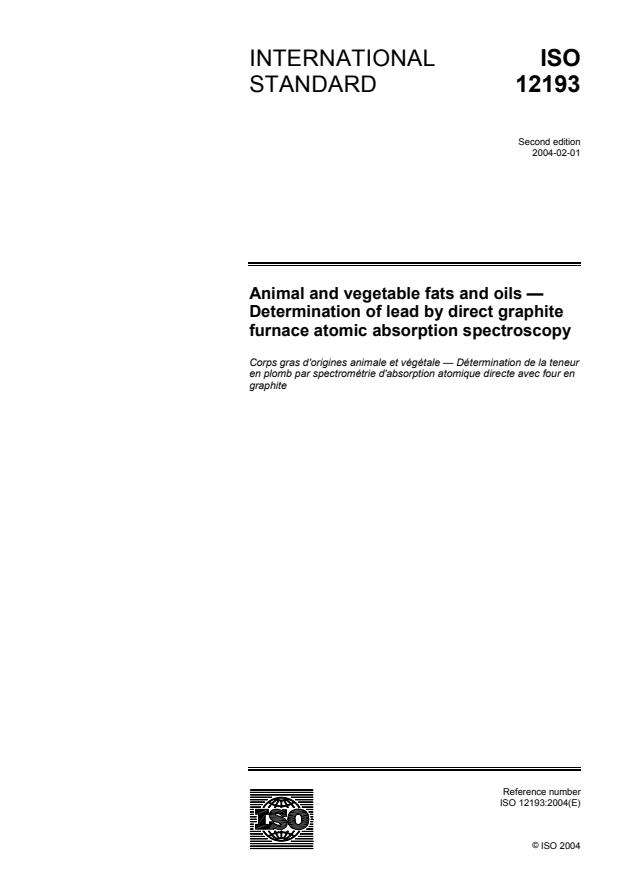
(Main)Animal and vegetable fats and oils — Determination of lead by direct graphite furnace atomic absorption spectroscopy
General Information
- Abstract
ISO 12193:2004 specifies a method for the determination of trace amounts (greater than 0,001 mg/kg) of lead in all types of crude or refined edible oils and fats.
- Status
- Published
- Publication Date
- 13-Jan-2004
- Technical Committee
- ISO/TC 34/SC 11 - Animal and vegetable fats and oils
- Drafting Committee
- ISO/TC 34/SC 11 - Animal and vegetable fats and oils
- Current Stage
- 9093 - International Standard confirmed
- Start Date
- 22-Sep-2023
- Completion Date
- 29-Aug-2026
Buy Documents

ISO 12193:2004 - Animal and vegetable fats and oils — Determination of lead by direct graphite furnace atomic absorption spectroscopy Released:1/14/2004
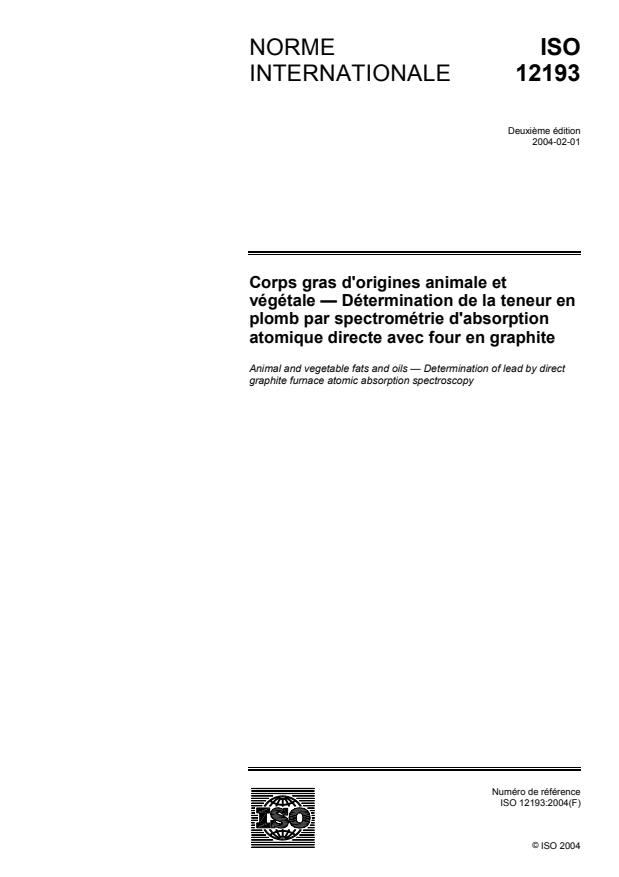

ISO 12193:2004 - Corps gras d'origines animale et végétale — Détermination de la teneur en plomb par spectrométrie d'absorption atomique directe avec four en graphite Released:8/9/2004
Overview
ISO 12193:2004 defines a validated analytical method for the determination of trace amounts of lead (Pb) in all types of crude or refined edible animal and vegetable fats and oils. The method uses direct graphite furnace atomic absorption spectroscopy (GFAAS / graphite furnace AAS) and is applicable for concentrations greater than 0.001 mg/kg (LOD) with a limit of determination of 0.01 mg/kg (LOQ). The procedure includes sample preparation, instrument settings, calibration and result reporting tailored for oil and fat matrices.
Key topics and technical requirements
- Principle: Atomize oil/fat samples in a graphite furnace and measure absorbance at 283.3 nm against organometallic lead standards.
- Sample preparation:
- Use metal‑free containers and store samples in polyethylene bottles.
- Typical test portion: 5.0 g sample mixed with 5.0 g matrix modifier.
- Matrix modifier: 2% lecithin solution in cyclohexane (analytical grade).
- Preheat samples in an oven at 60 °C prior to analysis.
- Standards & calibration:
- Use organometallic lead stock dissolved in blank oil; prepare working standards (e.g., 0.02, 0.05, 0.10 mg/kg) by dilution in blank oil.
- Construct a calibration curve corrected for blank.
- Instrumentation:
- GFAAS with background correction (deuterium or Zeeman) and appropriate hollow‑cathode or ED‑lamp for Pb.
- Argon gas of minimum 99.99% purity.
- Option to use pyrolytic-coated tubes and pyrolytic platform for improved sensitivity (platform improves accuracy and sensitivity roughly twofold).
- Injection volume: 20 µl.
- Recommended temperature programming and gas flow profiles are specified for uncoated and pyro-coated tubes.
- Quality and performance:
- Limit of detection: 0.001 mg/kg; limit of determination: 0.01 mg/kg.
- Interlaboratory study shows negligible bias in the 0.01–0.10 mg/kg range; repeatability and reproducibility limits are provided.
Practical applications
- Routine food safety testing for lead contamination in edible oils (olive oil, soybean oil, cocoa butter, etc.).
- Quality control in oil refining and processing plants to verify compliance with regulatory limits.
- Regulatory and national food laboratories performing trace metal surveillance and compliance testing.
- Method reference for laboratories implementing GFAAS procedures for trace lead measurement in lipid matrices.
Who should use this standard
- Food and beverage analytical laboratories
- Oil and fat producers and refiners (QC/QA teams)
- Regulatory authorities and inspection labs
- Accredited testing laboratories seeking validated procedures for lead in fats and oils
Related standards
- ISO 5555:2001 - Sampling of animal and vegetable fats and oils (recommended sampling guidance).
- ISO 5725 (referenced) - Precision of measurement methods (used for interlaboratory evaluation).
Keywords: ISO 12193, lead determination, graphite furnace atomic absorption spectroscopy, GFAAS, edible oils, trace lead, matrix modifier, limit of detection, oil testing.
Relations
- Effective Date
- 12-Feb-2026
- Effective Date
- 15-Apr-2008
Buy Documents
ISO 12193:2004 - Animal and vegetable fats and oils — Determination of lead by direct graphite furnace atomic absorption spectroscopy Released:1/14/2004
ISO 12193:2004 - Corps gras d'origines animale et végétale — Détermination de la teneur en plomb par spectrométrie d'absorption atomique directe avec four en graphite Released:8/9/2004
Get Certified
Connect with accredited certification bodies for this standard

BSI Group
BSI (British Standards Institution) is the business standards company that helps organizations make excellence a habit.

Bureau Veritas
Bureau Veritas is a world leader in laboratory testing, inspection and certification services.

DNV
DNV is an independent assurance and risk management provider.
Sponsored listings
Frequently Asked Questions
ISO 12193:2004 is a standard published by the International Organization for Standardization (ISO). Its full title is "Animal and vegetable fats and oils — Determination of lead by direct graphite furnace atomic absorption spectroscopy". This standard covers: ISO 12193:2004 specifies a method for the determination of trace amounts (greater than 0,001 mg/kg) of lead in all types of crude or refined edible oils and fats.
ISO 12193:2004 specifies a method for the determination of trace amounts (greater than 0,001 mg/kg) of lead in all types of crude or refined edible oils and fats.
ISO 12193:2004 is classified under the following ICS (International Classification for Standards) categories: 67.200.10 - Animal and vegetable fats and oils. The ICS classification helps identify the subject area and facilitates finding related standards.
ISO 12193:2004 has the following relationships with other standards: It is inter standard links to EN ISO 12193:2004, ISO 12193:1994. Understanding these relationships helps ensure you are using the most current and applicable version of the standard.
ISO 12193:2004 is available in PDF format for immediate download after purchase. The document can be added to your cart and obtained through the secure checkout process. Digital delivery ensures instant access to the complete standard document.
Standards Content (Sample)
INTERNATIONAL ISO
STANDARD 12193
Second edition
2004-02-01
Animal and vegetable fats and oils —
Determination of lead by direct graphite
furnace atomic absorption spectroscopy
Corps gras d'origines animale et végétale — Détermination de la teneur
en plomb par spectrométrie d'absorption atomique directe avec four en
graphite
Reference number
©
ISO 2004
PDF disclaimer
This PDF file may contain embedded typefaces. In accordance with Adobe's licensing policy, this file may be printed or viewed but
shall not be edited unless the typefaces which are embedded are licensed to and installed on the computer performing the editing. In
downloading this file, parties accept therein the responsibility of not infringing Adobe's licensing policy. The ISO Central Secretariat
accepts no liability in this area.
Adobe is a trademark of Adobe Systems Incorporated.
Details of the software products used to create this PDF file can be found in the General Info relative to the file; the PDF-creation
parameters were optimized for printing. Every care has been taken to ensure that the file is suitable for use by ISO member bodies. In
the unlikely event that a problem relating to it is found, please inform the Central Secretariat at the address given below.
© ISO 2004
All rights reserved. Unless otherwise specified, no part of this publication may be reproduced or utilized in any form or by any means,
electronic or mechanical, including photocopying and microfilm, without permission in writing from either ISO at the address below or
ISO's member body in the country of the requester.
ISO copyright office
Case postale 56 • CH-1211 Geneva 20
Tel. + 41 22 749 01 11
Fax + 41 22 749 09 47
E-mail copyright@iso.org
Web www.iso.org
Published in Switzerland
ii © ISO 2004 – All rights reserved
Foreword
ISO (the International Organization for Standardization) is a worldwide federation of national standards bodies
(ISO member bodies). The work of preparing International Standards is normally carried out through ISO
technical committees. Each member body interested in a subject for which a technical committee has been
established has the right to be represented on that committee. International organizations, governmental and
non-governmental, in liaison with ISO, also take part in the work. ISO collaborates closely with the
International Electrotechnical Commission (IEC) on all matters of electrotechnical standardization.
International Standards are drafted in accordance with the rules given in the ISO/IEC Directives, Part 2.
The main task of technical committees is to prepare International Standards. Draft International Standards
adopted by the technical committees are circulated to the member bodies for voting. Publication as an
International Standard requires approval by at least 75 % of the member bodies casting a vote.
Attention is drawn to the possibility that some of the elements of this document may be the subject of patent
rights. ISO shall not be held responsible for identifying any or all such patent rights.
ISO 12193 was prepared by Technical Committee ISO/TC 34, Food products, Subcommittee SC 11, Animal
and vegetable fats and oils.
This second edition cancels and replaces the first edition (ISO 12193:1994), which has been technically
revised.
INTERNATIONAL STANDARD ISO 12193:2004(E)
Animal and vegetable fats and oils — Determination of lead by
direct graphite furnace atomic absorption spectroscopy
1 Scope
This International Standard specifies a method for the determination of trace amounts (> 0,001 mg/kg) of lead
in all types of crude or refined edible oils and fats.
2 Principle
The oil or fat is atomized in a graphite furnace, with or without a platform, connected to an atomic absorption
spectrometer which has been previously calibrated using standard solutions of an organo compound of lead.
The metal content is measured from the observed absorbance at a wavelength of 283,3 nm.
3 Reagents
Use only reagents of recognized analytical grade, unless otherwise specified, and distilled or demineralized
water or water of equivalent purity.
3.1 Cyclohexane, analytical grade.
3.2 Lecithin, containing 2 % phosphorus.
3.3 Matrix modifier: 2 % (by mass/volume) lecithin solution prepared by dissolving 2 g of lecithin (3.2) in
100 ml of cyclohexane (3.1).
3.4 Blank oil, refined.
Any edible oil is suitable, stored in a metal-free polyethylene bottle. The lead content of the oil shall not be
greater than 0,001 mg/kg.
3.5 Lead standard stock solution, c(Pb) = 10 mg/kg.
This is prepared by appropriate dilution of an organometallic standard with the blank oil (3.4).
1)
NOTE A suitable standard is available from the following companies:
Continental Oil Company, Ponca City, Oklahoma, USA (Conostan, 5 000 mg/kg);
Merck KGaA, Darmstadt, Germany [Certipur 115051, lead standard dissolved in oil, c(Pb) = 1 g/kg] in standard oil;
VWR International [Certipur 1.15051, lead standard dissolved in oil, c(Pb) = 1 g/kg] in standard oil;
VWR International [Specpure ALFA019527.AD, lead, Organic AAS standard solution, Specpure, c(Pb) = 1 000 mg/g].
1) These are examples of suitable products available commercially. This information is given for the convenience of
users of this International Standard and does not constitute an endorsement by ISO of these products.
3.6 Lead standard working solutions: c(Pb) = 0,02 mg/kg, 0,05 mg/kg and 0,100 mg/kg, prepared daily
by diluting the 10 mg/kg stock solution (3.5) with blank oil (3.4).
3.7 Argon, of minimum purity 99,99 %.
4 Apparatus
4.1 Polyethylene or polypropylene capped bottles, 20 ml, metal free.
The polyethylene or polypropylene capped bottles are made metal free in the following way. Clean the bottles
thoroughly with warm nitric acid, rinse with distilled water and dry the bottles in a drying oven at about 80 °C.
4.2 Micropipettor, 20 µl.
4.3 Pipettor tips.
4.4 Electric oven, regulated at 60 °C ± 2 °C.
4.5 Atomic absorption spectrometer, equipped with either “peak height” mode and printer, or “area”
mode and pen-recorder (full-scale response in 0,2 s), together with the appropriate electrode-less discharge
lamp (or hollow cathode lamp) and deuterium or Zeeman background corrector.
4.6 Graphite furnace atomizer, placed in the atomic absorption spectrometer (4.5), equipped with a
control unit for temperature programming.
4.7 Graphite tube, normal (uncoated) or coated (pyrolytic).
4.8 Pyrolytic platform, in combination with uncoated or pyrolytically coated graphite tube.
Both atomization with and without the platform may be used. The accuracy and the sensitivity with the
platform is twice as good as without the platform.
5 Sampling
Laboratory samples of at least 1,5 g shall be stored in metal-free bottles (4.1).
It is important that the laboratory receive a sample that is truly representative and has not been damaged or
changed during transport or storage.
Sampling is not part of the method specified in this International Standard. A recommended sampling method
is given in ISO 5555.
6 Procedure
6.1 Treatment of samples, blanks and standards
6.1.1 Place all samples and standard working solutions (3.6) in the oven (4.4) set at 60 °C.
6.1.2 Shake samples vigorously.
6.1.3 Weigh 5,0 g of sample into a 20 ml
...
NORME ISO
INTERNATIONALE 12193
Deuxième édition
2004-02-01
Corps gras d'origines animale et
végétale — Détermination de la teneur en
plomb par spectrométrie d'absorption
atomique directe avec four en graphite
Animal and vegetable fats and oils — Determination of lead by direct
graphite furnace atomic absorption spectroscopy
Numéro de référence
©
ISO 2004
PDF – Exonération de responsabilité
Le présent fichier PDF peut contenir des polices de caractères intégrées. Conformément aux conditions de licence d'Adobe, ce fichier
peut être imprimé ou visualisé, mais ne doit pas être modifié à moins que l'ordinateur employé à cet effet ne bénéficie d'une licence
autorisant l'utilisation de ces polices et que celles-ci y soient installées. Lors du téléchargement de ce fichier, les parties concernées
acceptent de fait la responsabilité de ne pas enfreindre les conditions de licence d'Adobe. Le Secrétariat central de l'ISO décline toute
responsabilité en la matière.
Adobe est une marque déposée d'Adobe Systems Incorporated.
Les détails relatifs aux produits logiciels utilisés pour la création du présent fichier PDF sont disponibles dans la rubrique General Info
du fichier; les paramètres de création PDF ont été optimisés pour l'impression. Toutes les mesures ont été prises pour garantir
l'exploitation de ce fichier par les comités membres de l'ISO. Dans le cas peu probable où surviendrait un problème d'utilisation,
veuillez en informer le Secrétariat central à l'adresse donnée ci-dessous.
© ISO 2004
Droits de reproduction réservés. Sauf prescription différente, aucune partie de cette publication ne peut être reproduite ni utilisée sous
quelque forme que ce soit et par aucun procédé, électronique ou mécanique, y compris la photocopie et les microfilms, sans l'accord écrit
de l'ISO à l'adresse ci-après ou du comité membre de l'ISO dans le pays du demandeur.
ISO copyright office
Case postale 56 • CH-1211 Geneva 20
Tel. + 41 22 749 01 11
Fax. + 41 22 749 09 47
E-mail copyright@iso.org
Web www.iso.org
Publié en Suisse
ii © ISO 2004 – Tous droits réservés
Avant-propos
L'ISO (Organisation internationale de normalisation) est une fédération mondiale d'organismes nationaux de
normalisation (comités membres de l'ISO). L'élaboration des Normes internationales est en général confiée
aux comités techniques de l'ISO. Chaque comité membre intéressé par une étude a le droit de faire partie du
comité technique créé à cet effet. Les organisations internationales, gouvernementales et non
gouvernementales, en liaison avec l'ISO participent également aux travaux. L'ISO collabore étroitement avec
la Commission électrotechnique internationale (CEI) en ce qui concerne la normalisation électrotechnique.
Les Normes internationales sont rédigées conformément aux règles données dans les Directives ISO/CEI,
Partie 2.
La tâche principale des comités techniques est d'élaborer les Normes internationales. Les projets de Normes
internationales adoptés par les comités techniques sont soumis aux comités membres pour vote. Leur
publication comme Normes internationales requiert l'approbation de 75 % au moins des comités membres
votants.
L'attention est appelée sur le fait que certains des éléments du présent document peuvent faire l'objet de
droits de propriété intellectuelle ou de droits analogues. L'ISO ne saurait être tenue pour responsable de ne
pas avoir identifié de tels droits de propriété et averti de leur existence.
L'ISO 12193 a été élaborée par le comité technique ISO/TC 34, Produits alimentaires, sous-comité SC 11,
Corps gras d'origines animale et végétale.
Cette deuxième édition annule et remplace la première édition (ISO 12193:1994), qui a fait l'objet d'une
révision technique.
NORME INTERNATIONALE ISO 12193:2004(F)
Corps gras d'origines animale et végétale — Détermination de
la teneur en plomb par spectrométrie d'absorption atomique
directe avec four en graphite
1 Domaine d'application
La présente Norme internationale spécifie une méthode de détermination des traces de plomb
(> 0,001 mg/kg) dans tous les types de corps gras alimentaires bruts ou raffinés.
2 Principe
Atomisation du corps gras dans un four en graphite adapté, avec ou sans plate-forme, relié à un spectromètre
d'absorption atomique, préalablement étalonné à l'aide de solutions étalons d'un composé organique de
plomb, et mesurage de la teneur en métal à partir de l'absorption à la longueur d'onde de 283,3 nm.
3 Réactifs
Sauf spécification contraire, utiliser exclusivement des réactifs de qualité analytique reconnue et de l'eau
distillée ou déminéralisée ou une eau de pureté équivalente.
3.1 Cyclohexane, de qualité analytique.
3.2 Lécithine, contenant 2 % de phosphore.
3.3 Modificateur de matrice: préparer une solution de lécithine à 2 % (par masse/volume) en dissolvant
2 g de lécithine (3.2) dans 100 ml de cyclohexane (3.1).
3.4 Huile témoin, raffinée.
Toute huile alimentaire est adaptée, à conserver dans un flacon en polyéthylène exempt de métal. La teneur
en plomb de l'huile ne doit pas être supérieure à 0,001 mg/kg.
3.5 Solution étalon mère, c(Pb) = 10 mg/kg.
Cette solution est préparée par dilution appropriée d'un étalon organométallique avec l'huile témoin (3.4).
1)
NOTE Un étalon approprié est disponible auprès des sociétés suivantes:
la Continental Oil Company à Ponca City en Oklahoma, États-Unis (Conostan, 5 000 mg/kg);
Merck KGaA à Darmstadt (Allemagne) [Certipur 1.15051, étalon de plomb dissout dans l'huile, c(Pb) = 1 g/kg] dans
l'huile étalon;
1) Ce ne sont que des exemples de produits disponibles dans le commerce. Cette information est indiquée aux
utilisateurs de la présente Norme internationale à titre indicatif et ne correspond pas à un cautionnement de ces produits
de la part de l’ISO.
VWR International [Certipur 1.15051, étalon de plomb dissout dans l'huile, c(Pb) = 1 g/kg] dans l'huile étalon;
VWR International [Specpure ALFA019527.AD, plomb, solution organique étalon pour spectroscopie d'absorption
atomique, Specture, c(Pb) = 1 000 mg/g].
3.6 Solutions étalons de travail : c(Pb) 0,02 mg/kg, 0,05 mg/kg et 0,100 mg/kg préparées chaque jour en
diluant la solution mère à 10 mg/kg (3.5) avec l'huile témoin (3.4).
3.7 Argon, ayant une pureté minimale de 99,99 %.
4 Appareillage
4.1 Flacons et bouchons en polyéthylène ou en polypropylène, de 20 ml, exempts de métal.
Les flacons et les bouchons en polyéthylène ou en polypropylène sont rendus exempts de métal de la façon
suivante: nettoyer soigneusement les flacons avec une solution d'acide nitrique chaude, les rincer avec de
l'eau distillée puis les sécher à l'étuve à environ 80 °C.
4.2 Micropipette, de 20 µl.
4.3 Embouts de micropipette.
4.4 Four électrique, réglé à 60 °C ± 2 °C.
4.5 Spectromètre d'absorption atomique, doté soit d'une imprimante en mode «hauteur de pic», soit d'un
enregistreur à stylet en mode «continu» (réponse en pleine échelle en 0,2 s), ainsi que d'une lampe à
excitation haute fréquence EDL appropriée (ou d'une lampe à cathode creuse) et d'un correcteur de fond au
deutérium (ou d'un spectromètre d'absorption atomique avec effet Zeeman).
4.6 Atomiseur à four en graphite, placé dans le spectromètre d'absorption atomique (4.5) et doté d'une
unité de commande pour la programmation de la température.
4.7 Tube en graphite, normal (non revêtu) ou à revêtement (pyrolytique).
4.8 Plate-forme pyrolytique, adaptée à un tube en graphite à revêtement pyrolytique ou non revêtu.
L'atomisation peut être réalisée avec ou sans la plate-forme. L'exactitude et la sensibilité sont deux fois plus
élevées avec la plate-forme que sans la plate-forme.
5 Échantillonnage
Les échantillons de laboratoire, d'au moins 1,5 g, doivent être conservés dans des flacons exempts de métal
(4.1).
Il est important que le laboratoire reçoive un échantillon réellement représentatif, n'ayant pas été endommagé
ni modifié lors du transport et de l'entreposage.
L'échantillonnage ne fait pas partie de la méthode spécifiée dans la présente Norme internationale. Une
méthode d'échantillonnage recommandée est donnée dans l'ISO 5555.
2 © ISO 2004 – Tous droits réservés
6 Mode opératoire
6.1 Traitement des échantillons, des huiles
...