

ISO 3657:2023
(Main)Animal and vegetable fats and oils — Determination of saponification value
General Information
- Abstract
This document specifies a method for the determination of the saponification value of animal and vegetable fats and oils. The saponification value is a measure of the free and esterified acids present in fats and fatty acids. The method is applicable to refined and crude vegetable and animal fats. If mineral acids are present, the results given by this method are not interpretable unless the mineral acids are determined separately. The saponification value can also be calculated from fatty acid data obtained by gas chromatography analysis as given in Annex B. For this calculation, it is necessary to be sure that the sample does not contain major impurities or is thermally degraded.
- Status
- Published
- Publication Date
- 03-Jul-2023
- Technical Committee
- ISO/TC 34/SC 11 - Animal and vegetable fats and oils
- Drafting Committee
- ISO/TC 34/SC 11 - Animal and vegetable fats and oils
- Current Stage
- 6060 - International Standard published
- Start Date
- 04-Jul-2023
- Due Date
- 07-Dec-2023
- Completion Date
- 04-Jul-2023
Buy Documents

ISO 3657:2023 - Animal and vegetable fats and oils — Determination of saponification value Released:4. 07. 2023

ISO 3657:2023 - Corps gras d'origines animale et végétale — Détermination de l'indice de saponification/14/2023
Overview
ISO 3657:2023 - "Animal and vegetable fats and oils - Determination of saponification value" specifies a standardized analytical method to determine the saponification value of animal and vegetable fats and oils. The saponification value is expressed as mg KOH/g fat and measures the amount of potassium hydroxide required to saponify 1 g of sample, reflecting the presence of free and esterified acids. The method applies to both refined and crude fats and oils and includes an option to calculate saponification value from fatty acid composition (see Annex B).
Key topics and technical requirements
- Principle: Reflux saponification with an excess of ethanolic KOH followed by titration of the excess with standard HCl.
- Reagents & indicators: 95% ethanol, ethanolic KOH (0.5 mol/L), standard HCl (0.5 mol/L), alkali blue 6B or phenolphthalein (phenolphthalein is CMR - use only if no alternative).
- Apparatus: reflux condenser, 250 mL alkali-resistant conical flask, burette or automatic burette, precision balance, heating device (no naked flame).
- Procedure highlights: weigh an appropriate test portion (guidance provided based on expected saponification value), reflux with 25.0 mL ethanolic KOH for 1 hour (2 hours for high melting point fats), then titrate; perform a blank and calculate saponification value per the standard formula.
- Limitations: Results are not interpretable if mineral acids are present unless those are determined separately. Calculation from GC fatty acid data (Annex B) is allowed only when samples are free of major impurities or thermal degradation.
- Precision and reproducibility: ISO 3657:2023 includes precision data from interlaboratory studies (Annex A) and guidance on repeatability and reproducibility limits.
- Reporting: Test report must identify sample, sampling method, filtration, indicator used, details of any deviations, results (mg KOH/g), and date.
Applications and users
- Quality control laboratories in edible oil, animal fat, biodiesel feedstock, soap and oleochemical production.
- Regulatory and conformity testing where saponification value is required for specification, product identity, or adulteration detection.
- R&D and formulation teams needing a standardized measure of average molecular weight/chain length of triglycerides.
- Analytical service providers offering oil/fat characterization using titrimetric and GC-based approaches (Annex B).
Related standards
- ISO 661 - Preparation of test sample (referenced for sample preparation).
- ISO 5555 - Recommended sampling method for fats and oils (sampling guidance).
- ISO 5725 - Methods for evaluating precision of measurement methods (used to evaluate interlaboratory precision).
ISO 3657:2023 provides a clear, reproducible method for measuring saponification value to support quality control, regulatory compliance, and product characterization in industries handling animal and vegetable fats and oils.
Relations
- Effective Date
- 12-Feb-2026
- Effective Date
- 11-Jun-2022
Buy Documents
ISO 3657:2023 - Animal and vegetable fats and oils — Determination of saponification value Released:4. 07. 2023
ISO 3657:2023 - Corps gras d'origines animale et végétale — Détermination de l'indice de saponification/14/2023
Get Certified
Connect with accredited certification bodies for this standard

BSI Group
BSI (British Standards Institution) is the business standards company that helps organizations make excellence a habit.

Bureau Veritas
Bureau Veritas is a world leader in laboratory testing, inspection and certification services.

DNV
DNV is an independent assurance and risk management provider.
Sponsored listings
Frequently Asked Questions
ISO 3657:2023 is a standard published by the International Organization for Standardization (ISO). Its full title is "Animal and vegetable fats and oils — Determination of saponification value". This standard covers: This document specifies a method for the determination of the saponification value of animal and vegetable fats and oils. The saponification value is a measure of the free and esterified acids present in fats and fatty acids. The method is applicable to refined and crude vegetable and animal fats. If mineral acids are present, the results given by this method are not interpretable unless the mineral acids are determined separately. The saponification value can also be calculated from fatty acid data obtained by gas chromatography analysis as given in Annex B. For this calculation, it is necessary to be sure that the sample does not contain major impurities or is thermally degraded.
This document specifies a method for the determination of the saponification value of animal and vegetable fats and oils. The saponification value is a measure of the free and esterified acids present in fats and fatty acids. The method is applicable to refined and crude vegetable and animal fats. If mineral acids are present, the results given by this method are not interpretable unless the mineral acids are determined separately. The saponification value can also be calculated from fatty acid data obtained by gas chromatography analysis as given in Annex B. For this calculation, it is necessary to be sure that the sample does not contain major impurities or is thermally degraded.
ISO 3657:2023 is classified under the following ICS (International Classification for Standards) categories: 67.200.10 - Animal and vegetable fats and oils. The ICS classification helps identify the subject area and facilitates finding related standards.
ISO 3657:2023 has the following relationships with other standards: It is inter standard links to EN ISO 3657:2023, ISO 3657:2020. Understanding these relationships helps ensure you are using the most current and applicable version of the standard.
ISO 3657:2023 is available in PDF format for immediate download after purchase. The document can be added to your cart and obtained through the secure checkout process. Digital delivery ensures instant access to the complete standard document.
Standards Content (Sample)
INTERNATIONAL ISO
STANDARD 3657
Sixth edition
2023-07
Animal and vegetable fats and oils —
Determination of saponification value
Corps gras d'origines animale et végétale — Détermination de l'indice
de saponification
Reference number
© ISO 2023
All rights reserved. Unless otherwise specified, or required in the context of its implementation, no part of this publication may
be reproduced or utilized otherwise in any form or by any means, electronic or mechanical, including photocopying, or posting on
the internet or an intranet, without prior written permission. Permission can be requested from either ISO at the address below
or ISO’s member body in the country of the requester.
ISO copyright office
CP 401 • Ch. de Blandonnet 8
CH-1214 Vernier, Geneva
Phone: +41 22 749 01 11
Email: copyright@iso.org
Website: www.iso.org
Published in Switzerland
ii
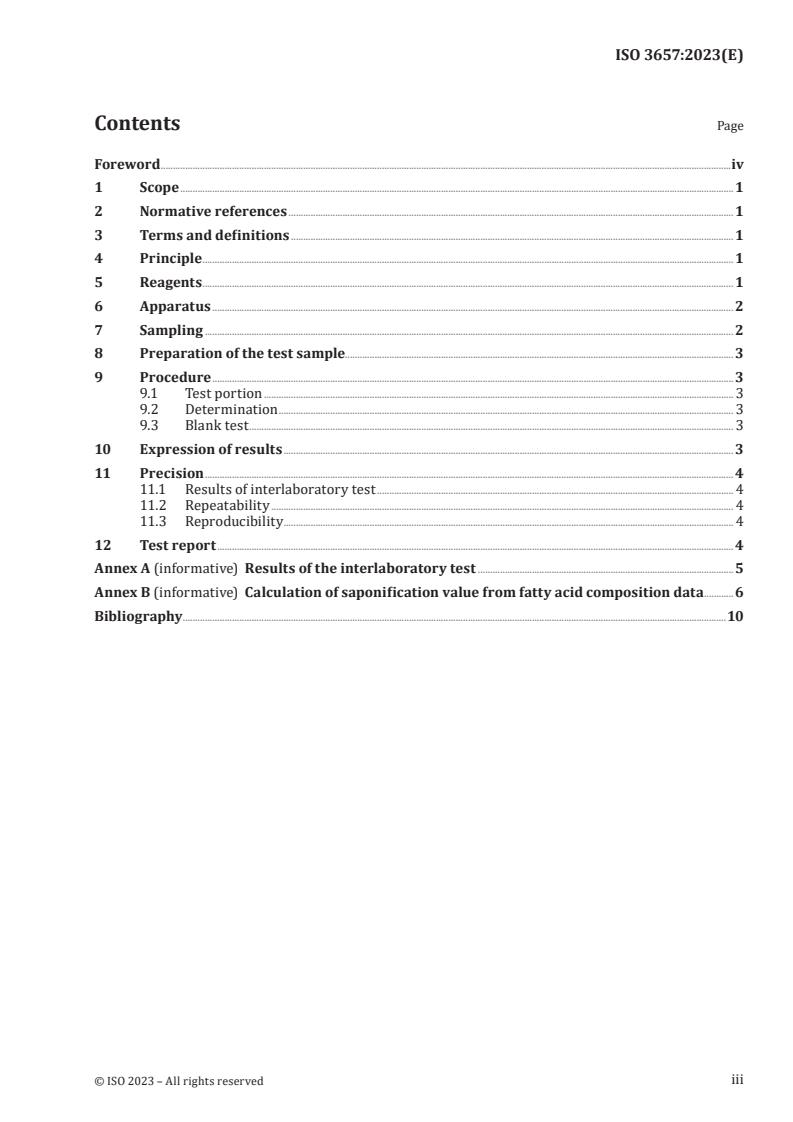
Contents Page
Foreword .iv
1 Scope . 1
2 Normative references . 1
3 Terms and definitions . 1
4 Principle . 1
5 Reagents . 1
6 Apparatus . 2
7 Sampling . 2
8 Preparation of the test sample. 3
9 Procedure .3
9.1 Test portion . 3
9.2 Determination . 3
9.3 Blank test . 3
10 Expression of results . 3
11 Precision . 4
11.1 Results of interlaboratory test . 4
11.2 Repeatability . 4
11.3 Reproducibility . 4
12 Test report . 4
Annex A (informative) Results of the interlaboratory test . 5
Annex B (informative) Calculation of saponification value from fatty acid composition data .6
Bibliography .10
iii
Foreword
ISO (the International Organization for Standardization) is a worldwide federation of national standards
bodies (ISO member bodies). The work of preparing International Standards is normally carried out
through ISO technical committees. Each member body interested in a subject for which a technical
committee has been established has the right to be represented on that committee. International
organizations, governmental and non-governmental, in liaison with ISO, also take part in the work.
ISO collaborates closely with the International Electrotechnical Commission (IEC) on all matters of
electrotechnical standardization.
The procedures used to develop this document and those intended for its further maintenance are
described in the ISO/IEC Directives, Part 1. In particular, the different approval criteria needed for the
different types of ISO document should be noted. This document was drafted in accordance with the
editorial rules of the ISO/IEC Directives, Part 2 (see www.iso.org/directives).
ISO draws attention to the possibility that the implementation of this document may involve the use
of (a) patent(s). ISO takes no position concerning the evidence, validity or applicability of any claimed
patent rights in respect thereof. As of the date of publication of this document, ISO had not received
notice of (a) patent(s) which may be required to implement this document. However, implementers are
cautioned that this may not represent the latest information, which may be obtained from the patent
database available at www.iso.org/patents. ISO shall not be held responsible for identifying any or all
such patent rights.
Any trade name used in this document is information given for the convenience of users and does not
constitute an endorsement.
For an explanation of the voluntary nature of standards, the meaning of ISO specific terms and
expressions related to conformity assessment, as well as information about ISO’s adherence to
the World Trade Organization (WTO) principles in the Technical Barriers to Trade (TBT), see
www.iso.org/iso/foreword.html.
This document was prepared by Technical Committee ISO/TC 34, Food products, Subcommittee SC 11,
Animal and vegetable fats and oils, in collaboration with the European Committee for Standardization
(CEN) Technical Committee CEN/TC 307, Oilseeds, vegetable and animal fats and oils and their by-products
— Methods of sampling and analysis, in accordance with the Agreement on technical cooperation
between ISO and CEN (Vienna Agreement).
This sixth edition cancels and replaces the fifth edition (ISO 3657:2020), which has been technically
revised.
The main changes are as follows:
— errors in the calculations of the mean relative molecular mass (C16 TAG molecular weight) in B.7.4
and saponification value in B.7.5 have been corrected;
— incorrect values for the repeatability limit as well as the reproducibility limit values in Table A.1
have been corrected.
Any feedback or questions on this document should be directed to the user’s national standards body. A
complete listing of these bodies can be found at www.iso.org/members.html.
iv
INTERNATIONAL STANDARD ISO 3657:2023(E)
Animal and vegetable fats and oils — Determination of
saponification value
1 Scope
This document specifies a method for the determination of the saponification value of animal and
vegetable fats and oils. The saponification value is a measure of the free and esterified acids present in
fats and fatty acids.
The method is applicable to refined and crude vegetable and animal fats.
If mineral acids are present, the results given by this method are not interpretable unless the mineral
acids are determined separately.
The saponification value can also be calculated from fatty acid data obtained by gas chromatography
analysis as given in Annex B. For this calculation, it is necessary to be sure that the sample does not
contain major impurities or is thermally degraded.
2 Normative references
The following documents are referred to in the text in such a way that some or all of their content
constitutes requirements of this document. For dated references, only the edition cited applies. For
undated references, the latest edition of the referenced document (including any amendments) applies.
ISO 661, Animal and vegetable fats and oils — Preparation of test sample
3 Terms and definitions
For the purposes of this document, the following terms and definitions apply.
ISO and IEC maintain terminology databases for use in standardization at the following addresses:
— ISO Online browsing platform: available at https:// www .iso .org/ obp
— IEC Electropedia: available at https:// www .electropedia .org/
3.1
saponification value
I
s
number of milligrams of potassium hydroxide required for the saponification of 1 g of the product
tested
4 Principle
The test sample is saponified by boiling under reflux with an excess of ethanolic potassium hydroxide,
followed by titration of the excess potassium hydroxide with standard volumetric hydrochloric acid
solution.
5 Reagents
Use only reagents of recognized analytical grade, and distilled or demineralized water of equivalent
purity.
5.1 Ethanol, volume fraction φ = 95 %.
5.2 Potassium hydroxide, c(KOH) = 0,5 mol/l solution in ethanol.
This solution shall be colourless or straw yellow. A stable colourless solution can be prepared by either
of the following procedures:
a) Reflux 1 l of ethanol (5.1) with 8 g of potassium hydroxide and 5 g of aluminium pellets for 1 h, then
distil immediately. Dissolve the required amount of potassium hydroxide (approximately 35 g) in
the distillate. Allow to stand for several days, then decant the clear supernatant liquid from the
precipitated potassium carbonate into a brown-glass stock bottle.
b) Add 4 g of aluminium tert-butylate to 1 l of ethanol and allow the mixture to stand for several
days. Decant the supernatant liquid and dissolve in it the required amount of potassium hydroxide.
Allow to stand for several days, and then decant the clear supernatant liquid from the precipitated
potassium carbonate into a brown-glass stock bottle.
5.3 Hydrochloric acid, standard volumetric solution, c(HCl) = 0,5 mol/l.
5.4 Alkali blue 6B solution, ρ = 2,5 g/100 ml in ethanol (5.1).
5.5 Phenolphthalein solution, ρ = 0,1 g/100 ml in ethanol (5.1).
Phenolphthalein is classified as CMR substance and should only be used when no alternative is available.
5.6 Boiling aids.
6 Apparatus
Usual laboratory apparatus and, in particular, the following shall be used.
6.1 Conical flask, of 250 ml capacity, made of alkali-resistant glass and having a ground neck.
6.2 Reflux condenser, with a ground glass joint that fits the conical flask (6.1).
6.3 Heating device (e.g. a water-bath, electric hot-plate or other suitable apparatus). A naked flame
is not suit
...
NORME ISO
INTERNATIONALE 3657
Sixième édition
2023-07
Corps gras d'origines animale et
végétale — Détermination de l'indice
de saponification
Animal and vegetable fats and oils — Determination of saponification
value
Numéro de référence
DOCUMENT PROTÉGÉ PAR COPYRIGHT
© ISO 2023
Tous droits réservés. Sauf prescription différente ou nécessité dans le contexte de sa mise en œuvre, aucune partie de cette
publication ne peut être reproduite ni utilisée sous quelque forme que ce soit et par aucun procédé, électronique ou mécanique,
y compris la photocopie, ou la diffusion sur l’internet ou sur un intranet, sans autorisation écrite préalable. Une autorisation peut
être demandée à l’ISO à l’adresse ci-après ou au comité membre de l’ISO dans le pays du demandeur.
ISO copyright office
Case postale 401 • Ch. de Blandonnet 8
CH-1214 Vernier, Genève
Tél.: +41 22 749 01 11
E-mail: copyright@iso.org
Web: www.iso.org
Publié en Suisse
ii
Sommaire Page
Avant-propos .iv
1 Domaine d’application . 1
2 Références normatives .1
3 Termes et définitions . 1
4 Principe. 1
5 Réactifs . 2
6 Appareillage . 2
7 Échantillonnage .3
8 Préparation de l’échantillon pour essai . 3
9 Mode opératoire . 3
9.1 Prise d'essai . 3
9.2 Dosage . 3
9.3 Essai à blanc . 3
10 Expression des résultats . 4
11 Fidélité . 4
11.1 Résultats de l’essai interlaboratoires . 4
11.2 Répétabilité . 4
11.3 Reproductibilité . . 4
12 Rapport d’essai . 4
Annexe A (informative) Résultats de l’essai interlaboratoires . 6
Annexe B (informative) Calcul de l'indice de saponification à partir des données relatives
à la composition en acides gras .7
Bibliographie .11
iii
Avant-propos
L'ISO (Organisation internationale de normalisation) est une fédération mondiale d'organismes
nationaux de normalisation (comités membres de l'ISO). L'élaboration des Normes internationales est
en général confiée aux comités techniques de l'ISO. Chaque comité membre intéressé par une étude
a le droit de faire partie du comité technique créé à cet effet. Les organisations internationales,
gouvernementales et non gouvernementales, en liaison avec l'ISO, participent également aux travaux.
L'ISO collabore étroitement avec la Commission électrotechnique internationale (IEC) en ce qui
concerne la normalisation électrotechnique.
Les procédures utilisées pour élaborer le présent document et celles destinées à sa mise à jour sont
décrites dans les Directives ISO/IEC, Partie 1. Il convient, en particulier, de prendre note des différents
critères d'approbation requis pour les différents types de documents ISO. Le présent document
a été rédigé conformément aux règles de rédaction données dans les Directives ISO/IEC, Partie 2
(voir www.iso.org/directives).
L’ISO attire l’attention sur le fait que la mise en application du présent document peut entraîner
l’utilisation d’un ou de plusieurs brevets. L’ISO ne prend pas position quant à la preuve, à la validité
et à l’applicabilité de tout droit de brevet revendiqué à cet égard. À la date de publication du présent
document, l’ISO n’avait pas reçu notification qu’un ou plusieurs brevets pouvaient être nécessaires à sa
mise en application. Toutefois, il y a lieu d’avertir les responsables de la mise en application du présent
document que des informations plus récentes sont susceptibles de figurer dans la base de données de
brevets, disponible à l'adresse www.iso.org/brevets. L’ISO ne saurait être tenue pour responsable de ne
pas avoir identifié de tels droits de brevet.
Les appellations commerciales éventuellement mentionnées dans le présent document sont données
pour information, par souci de commodité, à l'intention des utilisateurs et ne sauraient constituer un
engagement.
Pour une explication de la nature volontaire des normes, la signification des termes et expressions
spécifiques de l'ISO liés à l'évaluation de la conformité, ou pour toute information au sujet de l'adhésion
de l'ISO aux principes de l’Organisation mondiale du commerce (OMC) concernant les obstacles
techniques au commerce (OTC), voir www.iso.org/iso/fr/avant-propos.html.
Le présent document a été élaboré par le comité technique ISO/TC 34, Produits alimentaires, SC 11, Corps
gras d’origines animale et végétale, en collaboration avec le comité technique CEN/TC 307, Oléagineux,
corps gras d’origines végétale et animale et leurs co-produits - Méthodes d’échantillonnage et d’analyse du
Comité européen de normalisation (CEN), conformément à l'Accord de coopération technique entre
l'ISO et le CEN (Accord de Vienne).
Cette sixième édition annule et remplace la cinquième édition (ISO 3657:2020) qui a fait l'objet d'une
révision technique.
Les principales modifications sont les suivantes:
— les erreurs de calcul de la masse molaire relative moyenne (poids moléculaire des TAG en C16)
en B.7.4 et l’indice de saponification en B.7.5 ont été corrigés;
— les valeurs incorrectes données dans le Tableau A.1 pour les limites de répétabilité et les limites de
reproductibilité ont été corrigées.
Il convient que l’utilisateur adresse tout retour d’information ou toute question concernant le présent
document à l’organisme national de normalisation de son pays. Une liste exhaustive desdits organismes
se trouve à l’adresse www.iso.org/members.html.
iv
NORME INTERNATIONALE ISO 3657:2023(F)
Corps gras d'origines animale et végétale — Détermination
de l'indice de saponification
1 Domaine d’application
Le présent document spécifie une méthode de détermination de l'indice de saponification des corps
gras d’origines animale et végétale. L'indice de saponification est une caractéristique des acides gras
libres et estérifiés présents dans les corps gras et acides gras.
La méthode est applicable aux corps gras d'origines végétale et animale raffinés et bruts.
En présence d'acides minéraux, les résultats donnés par cette méthode ne sont plus interprétables si
l'on ne dose pas séparément l'acidité minérale.
L’indice de saponification peut également être calculé à partir des données de composition en acides
gras obtenues par chromatographie en phase gazeuse, selon l’Annexe B. Pour effectuer ce calcul, il
est nécessaire de s’assurer que l’échantillon ne contient aucune impureté importante et qu’il n’est pas
dégradé thermiquement.
2 Références normatives
Les documents suivants sont cités dans le texte de sorte qu’ils constituent, pour tout ou partie de leur
contenu, des exigences du présent document. Pour les références datées, seule l’édition citée s’applique.
Pour les références non datées, la dernière édition du document de référence s'applique (y compris les
éventuels amendements).
ISO 661, Corps gras d'origines animale et végétale — Préparation de l'échantillon pour essai
3 Termes et définitions
Pour les besoins du présent document, les termes et définitions suivants s'appliquent.
L'ISO et l'IEC tiennent à jour des bases de données terminologiques destinées à être utilisées en
normalisation, consultables aux adresses suivantes:
— ISO Online browsing platform: disponible à l'adresse https:// www .iso .org/ obp
— IEC Electropedia: disponible à l'adresse https:// www .electropedia .org/
3.1
indice de saponification
I
s
nombre de milligrammes d’hydroxyde de potassium nécessaires pour saponifier 1 g du produit soumis
à l’essai
4 Principe
Saponification de l’échantillon pour essai par ébullition à reflux en présence d’un excès d’une solution
éthanolique d'hydroxyde de potassium, puis titrage de l'excès d'hydroxyde de potassium par une
solution titrée d'acide chlorhydrique.
5 Réactifs
Utiliser uniquement des réactifs de qualité analytique reconnue et de l'eau distillée ou déminéralisée de
pureté équivalente.
5.1 Éthanol, ayant une fraction volumique φ = 95 %.
5.2 Hydroxyde de potassium, c(KOH) = 0,5 mol/l dans l'éthanol.
Cette solution doit être incolore ou jaune paille. Une solution stable et incolore peut être obtenue selon
l'un des modes opératoires suivants:
a) Faire bouillir à reflux 1 l d'éthanol (5.1) avec 8 g d'hydroxyde de potassium et 5 g de copeaux
d'aluminium pendant 1 h, puis distiller immédiatement. Dissoudre dans le distillat la quantité
requise d’hydroxyde de potassium (environ 35 g). Laisser reposer pendant plusieurs jours, puis
décanter le liquide clair surnageant dans un flacon en verre brun pour le séparer du carbonate de
potassium précipité.
b) Ajouter 4 g de tert-butylate d'aluminium à 1 l d'éthanol et laisser le mélange reposer pendant
plusieurs jours. Décanter le liquide surnageant et dissoudre dans ce liquide la quantité requise
d'hydroxyde de potassium. Laisser reposer pendant plusieurs jours, puis décanter le liquide clair
surnageant dans un flacon en verre brun pour le séparer du carbonate de potassium précipité.
5.3 Acide chlorhydrique, solution titrée, c(HCl) = 0,5 mol/l.
5.4 Bleu alcalin 6B en solution, ρ = 2,5 g/100 ml dans l’éthanol (5.1).
5.5 Phénolphtaléine en solution, ρ = 0,1 g/100 ml dans l’éthanol (5.1).
La phénolphtaléine est classée en tant que substance CMR et il convient de ne l’utiliser que lorsqu’il n’y
a pas d’alternative.
5.6 Régulateurs d'ébullition.
6 Appareillage
Utiliser du matériel courant de laboratoire et, en particulier, ce qui suit.
6.1 Fiole conique, de capacité 250 ml, en verre résistant aux alcalis, à col rodé.
6.2 Réfrigérant à reflux, avec rodage en verre adaptable à la fiole conique (6.1).
6.3 Dispositif de chauffage (par exemple bain d'eau, plaque électrique chauffante ou tout autre
appareil approprié). Flamme nue inadaptée.
6.4 Burette, de capacité 50 ml, graduations tous les 0,1 ml ou burette automatique.
6.5 Pipette, de capacité 25 ml, ou pipette automatique.
6.6 Balance analytique, précision de lecture de
...