

ISO/TS 16465:2024
(Main)Animal and vegetable fats and oils — Determination of phthalates in vegetable oils
General Information
- Abstract
This document specifies two methods for the quantitative determination of phthalates in vegetable oils by gas chromatography-mass spectrometry (GC-MS): — Part A for the determination of di-2-ethylhexyl phthalate (DEHP). — Part B for the determination of eight phthalates: dimethyl phthalate (DMP), diethyl phthalate (DEP), di-isobutyl phthalate (DIBP), dibutyl phthalate (DBP), benzylbutyl phthalate (BBP), di-2-ethylhexyl phthalate (DEHP), di-isononyl phthalate (DINP), di-isodecyl phthalate (DIDP). Both methods are applicable for all vegetable oils, including crude, refined and virgin.
- Status
- Published
- Publication Date
- 30-Jan-2024
- Technical Committee
- ISO/TC 34/SC 11 - Animal and vegetable fats and oils
- Drafting Committee
- ISO/TC 34/SC 11 - Animal and vegetable fats and oils
- Current Stage
- 6060 - International Standard published
- Start Date
- 31-Jan-2024
- Due Date
- 07-Jul-2024
- Completion Date
- 31-Jan-2024
Buy Documents
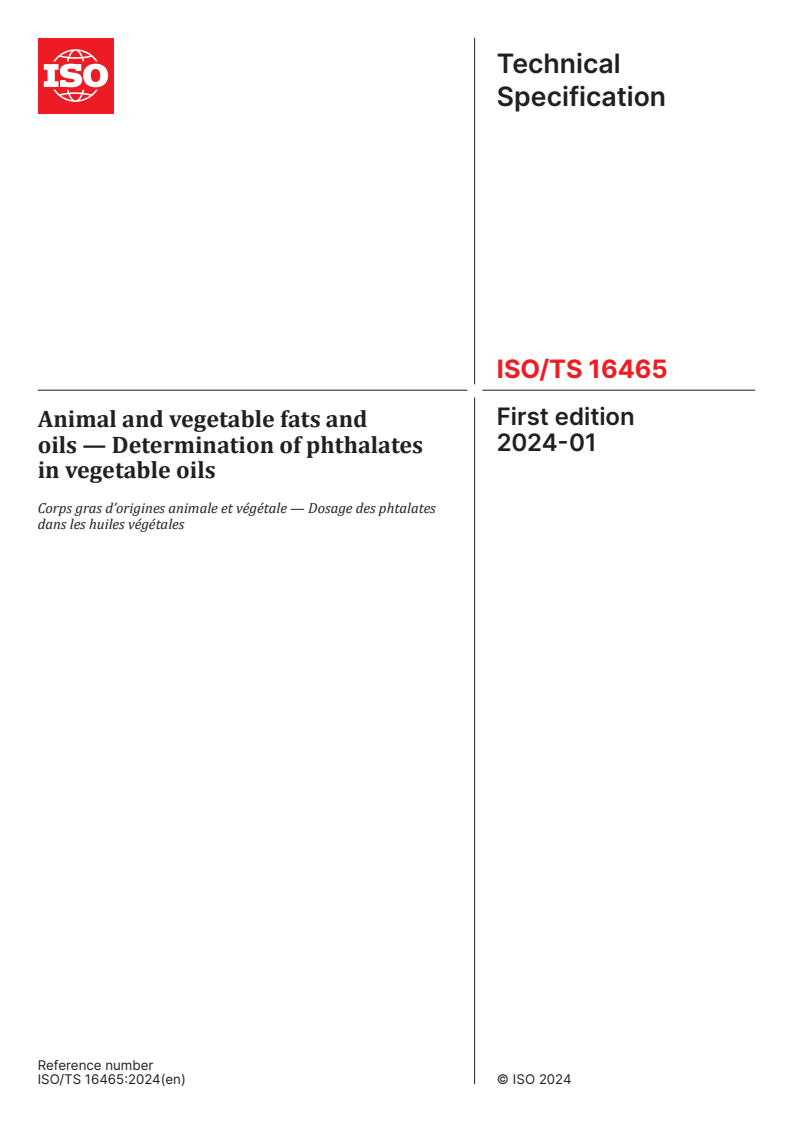
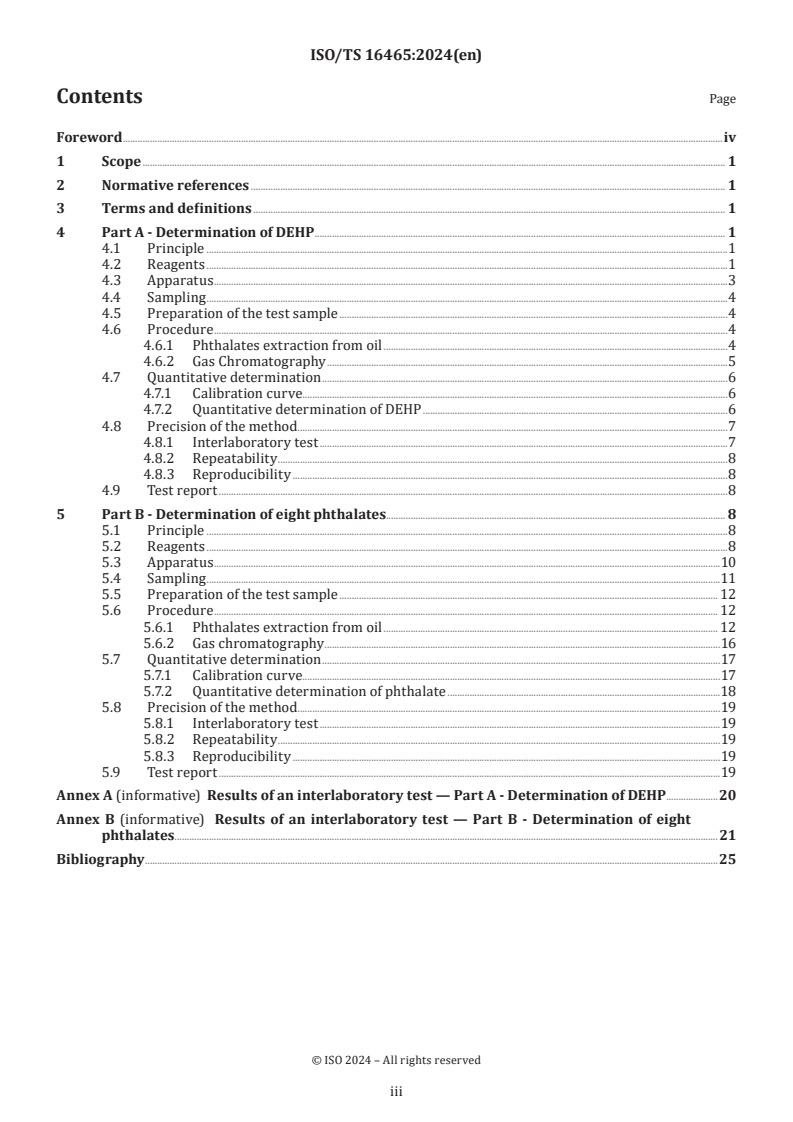
ISO/TS 16465:2024 - Animal and vegetable fats and oils — Determination of phthalates in vegetable oils Released:31. 01. 2024
ISO/TS 16465:2024 - Corps gras d’origines animale et végétale — Dosage des phtalates dans les huiles végétales/12/2024
REDLINE ISO/TS 16465:2024 - Corps gras d’origines animale et végétale — Dosage des phtalates dans les huiles végétales/12/2024
Overview
ISO/TS 16465:2024 specifies validated laboratory methods for the quantitative determination of phthalates in vegetable oils using gas chromatography–mass spectrometry (GC‑MS). The Technical Specification is published by ISO and is split into two parts:
- Part A – targeted determination of di‑2‑ethylhexyl phthalate (DEHP).
- Part B – determination of eight phthalates: DMP, DEP, DIBP, DBP, BBP, DEHP, DINP, DIDP.
Both methods apply to all vegetable oils (crude, refined and virgin) and cover sample preparation, extraction, clean‑up, instrumental analysis, calibration and method performance characteristics.
Key topics and technical requirements
- Analytical principle: extraction with acetonitrile, dispersive solid‑phase extraction (dispersive‑SPE) clean‑up using PSA (primary secondary amine) and C18 sorbents, concentration of the extract and GC‑MS analysis (SIM mode).
- Target analytes: DEHP (Part A) and a panel of eight phthalates (Part B): DMP, DEP, DIBP, DBP, BBP, DEHP, DINP, DIDP.
- Reagents and standards: toluene, acetonitrile, n‑hexane, n‑dodecane, PSA and C18 sorbents; use of a deuterated internal standard (DEHP‑d4) and a defined calibration series.
- Instrumentation: capillary GC with MS detector (electron ionization at 70 eV), single ion monitoring (SIM), and high‑temperature capillary columns suitable for phthalate analysis.
- Apparatus and cleanliness: strict glassware cleaning (e.g., 550 °C for 6 h), centrifugation, micro‑syringes and optional automated evaporator for concentration steps.
- Quality and validation: procedures for calibration curves, quantitative calculation, and documented precision data (interlaboratory tests, repeatability and reproducibility).
- Sampling and sample handling: analyse aliquots supplied in glass bottles; recommended lid contact materials include PTFE, aluminium or rubber - avoid plastic contact materials.
Applications and users
ISO/TS 16465:2024 supports:
- Food and edible oil testing laboratories performing compliance and contamination testing for phthalates in vegetable oils.
- Oil producers and refiners for in‑house quality control and supplier verification.
- Regulatory authorities and food safety agencies monitoring phthalate residues in edible fats and oils.
- Research institutions studying phthalate migration, exposure or processing impacts.
- Contract testing and environmental labs when assessing phthalate contamination from packaging or processing.
Keywords: ISO/TS 16465:2024, phthalates in vegetable oils, DEHP determination, GC‑MS phthalate analysis, dispersive solid‑phase extraction, PSA C18 cleanup.
Related standards
- ISO 661 - Preparation of test sample for animal and vegetable fats and oils (normative reference).
- Recommended sampling guidance referenced: ISO 5555 (sampling of vegetable oils).
Buy Documents
ISO/TS 16465:2024 - Animal and vegetable fats and oils — Determination of phthalates in vegetable oils Released:31. 01. 2024
ISO/TS 16465:2024 - Corps gras d’origines animale et végétale — Dosage des phtalates dans les huiles végétales/12/2024
REDLINE ISO/TS 16465:2024 - Corps gras d’origines animale et végétale — Dosage des phtalates dans les huiles végétales/12/2024
Get Certified
Connect with accredited certification bodies for this standard

BSI Group
BSI (British Standards Institution) is the business standards company that helps organizations make excellence a habit.

Bureau Veritas
Bureau Veritas is a world leader in laboratory testing, inspection and certification services.

DNV
DNV is an independent assurance and risk management provider.
Sponsored listings
Frequently Asked Questions
ISO/TS 16465:2024 is a technical specification published by the International Organization for Standardization (ISO). Its full title is "Animal and vegetable fats and oils — Determination of phthalates in vegetable oils". This standard covers: This document specifies two methods for the quantitative determination of phthalates in vegetable oils by gas chromatography-mass spectrometry (GC-MS): — Part A for the determination of di-2-ethylhexyl phthalate (DEHP). — Part B for the determination of eight phthalates: dimethyl phthalate (DMP), diethyl phthalate (DEP), di-isobutyl phthalate (DIBP), dibutyl phthalate (DBP), benzylbutyl phthalate (BBP), di-2-ethylhexyl phthalate (DEHP), di-isononyl phthalate (DINP), di-isodecyl phthalate (DIDP). Both methods are applicable for all vegetable oils, including crude, refined and virgin.
This document specifies two methods for the quantitative determination of phthalates in vegetable oils by gas chromatography-mass spectrometry (GC-MS): — Part A for the determination of di-2-ethylhexyl phthalate (DEHP). — Part B for the determination of eight phthalates: dimethyl phthalate (DMP), diethyl phthalate (DEP), di-isobutyl phthalate (DIBP), dibutyl phthalate (DBP), benzylbutyl phthalate (BBP), di-2-ethylhexyl phthalate (DEHP), di-isononyl phthalate (DINP), di-isodecyl phthalate (DIDP). Both methods are applicable for all vegetable oils, including crude, refined and virgin.
ISO/TS 16465:2024 is classified under the following ICS (International Classification for Standards) categories: 67.200.10 - Animal and vegetable fats and oils. The ICS classification helps identify the subject area and facilitates finding related standards.
ISO/TS 16465:2024 is available in PDF format for immediate download after purchase. The document can be added to your cart and obtained through the secure checkout process. Digital delivery ensures instant access to the complete standard document.
Standards Content (Sample)
Technical
Specification
ISO/TS 16465
First edition
Animal and vegetable fats and
2024-01
oils — Determination of phthalates
in vegetable oils
Corps gras d’origines animale et végétale — Dosage des phtalates
dans les huiles végétales
Reference number
© ISO 2024
All rights reserved. Unless otherwise specified, or required in the context of its implementation, no part of this publication may
be reproduced or utilized otherwise in any form or by any means, electronic or mechanical, including photocopying, or posting on
the internet or an intranet, without prior written permission. Permission can be requested from either ISO at the address below
or ISO’s member body in the country of the requester.
ISO copyright office
CP 401 • Ch. de Blandonnet 8
CH-1214 Vernier, Geneva
Phone: +41 22 749 01 11
Email: copyright@iso.org
Website: www.iso.org
Published in Switzerland
ii
Contents Page
Foreword .iv
1 Scope . 1
2 Normative references . 1
3 Terms and definitions . 1
4 Part A - Determination of DEHP . 1
4.1 Principle .1
4.2 Reagents .1
4.3 Apparatus .3
4.4 Sampling .4
4.5 Preparation of the test sample .4
4.6 Procedure .4
4.6.1 Phthalates extraction from oil .4
4.6.2 Gas Chromatography .5
4.7 Quantitative determination .6
4.7.1 Calibration curve.6
4.7.2 Quantitative determination of DEHP .6
4.8 Precision of the method.7
4.8.1 Interlaboratory test .7
4.8.2 Repeatability .8
4.8.3 Reproducibility .8
4.9 Test report .8
5 Part B - Determination of eight phthalates. 8
5.1 Principle .8
5.2 Reagents .8
5.3 Apparatus .10
5.4 Sampling .11
5.5 Preparation of the test sample . 12
5.6 Procedure . 12
5.6.1 Phthalates extraction from oil . 12
5.6.2 Gas chromatography .16
5.7 Quantitative determination .17
5.7.1 Calibration curve.17
5.7.2 Quantitative determination of phthalate .18
5.8 Precision of the method.19
5.8.1 Interlaboratory test .19
5.8.2 Repeatability .19
5.8.3 Reproducibility .19
5.9 Test report .19
Annex A (informative) Results of an interlaboratory test — Part A - Determination of DEHP .20
Annex B (informative) Results of an interlaboratory test — Part B - Determination of eight
phthalates . .21
Bibliography .25
iii
Foreword
ISO (the International Organization for Standardization) is a worldwide federation of national standards
bodies (ISO member bodies). The work of preparing International Standards is normally carried out through
ISO technical committees. Each member body interested in a subject for which a technical committee
has been established has the right to be represented on that committee. International organizations,
governmental and non-governmental, in liaison with ISO, also take part in the work. ISO collaborates closely
with the International Electrotechnical Commission (IEC) on all matters of electrotechnical standardization.
The procedures used to develop this document and those intended for its further maintenance are described
in the ISO/IEC Directives, Part 1. In particular, the different approval criteria needed for the different types
of ISO document should be noted. This document was drafted in accordance with the editorial rules of the
ISO/IEC Directives, Part 2 (see www.iso.org/directives).
ISO draws attention to the possibility that the implementation of this document may involve the use of (a)
patent(s). ISO takes no position concerning the evidence, validity or applicability of any claimed patent
rights in respect thereof. As of the date of publication of this document, ISO had not received notice of (a)
patent(s) which may be required to implement this document. However, implementers are cautioned that
this may not represent the latest information, which may be obtained from the patent database available at
www.iso.org/patents. ISO shall not be held responsible for identifying any or all such patent rights.
Any trade name used in this document is information given for the convenience of users and does not
constitute an endorsement.
For an explanation of the voluntary nature of standards, the meaning of ISO specific terms and expressions
related to conformity assessment, as well as information about ISO's adherence to the World Trade
Organization (WTO) principles in the Technical Barriers to Trade (TBT), see www.iso.org/iso/foreword.html.
This document was prepared by Technical Committee ISO/TC 34, Food products, Subcommittee SC 11, Animal
and vegetable fats and oils.
Any feedback or questions on this document should be directed to the user’s national standards body. A
complete listing of these bodies can be found at www.iso.org/members.html.
iv
Technical Specification ISO/TS 16465:2024(en)
Animal and vegetable fats and oils — Determination of
phthalates in vegetable oils
1 Scope
This document specifies two methods for the quantitative determination of phthalates in vegetable oils by
gas chromatography-mass spectrometry (GC-MS):
— Part A for the determination of di-2-ethylhexyl phthalate (DEHP).
— Part B for the determination of eight phthalates: dimethyl phthalate (DMP), diethyl phthalate (DEP),
di-isobutyl phthalate (DIBP), dibutyl phthalate (DBP), benzylbutyl phthalate (BBP), di-2-ethylhexyl
phthalate (DEHP), di-isononyl phthalate (DINP), di-isodecyl phthalate (DIDP).
Both methods are applicable for all vegetable oils, including crude, refined and virgin.
2 Normative references
The following documents are referred to in the text in such a way that some or all of their content constitutes
requirements of this document. For dated references, only the edition cited applies. For undated references,
the latest edition of the referenced document (including any amendments) applies.
ISO 661, Animal and vegetable fats and oils — Preparation of test sample
3 Terms and definitions
For the purposes of this document, the following terms and definitions apply.
ISO and IEC maintain terminology databases for use in standardization at the following addresses:
— ISO Online browsing platform: available at https:// www .iso .org/ obp
— IEC Electropedia: available at https:// www .electropedia .org/
4 Part A - Determination of DEHP
4.1 Principle
Phthalates are first extracted from oil with acetonitrile followed by dispersive-solid-phase extraction
clean-up (dispersive SPE), which is done to remove organic acids, excess water and other components using
a combination of primary secondary amine (PSA) sorbent and C18 bonded phase. Finally, the extract is
concentrated and analysed by gas chromatography-mass spectrometry (GC-MS).
4.2 Reagents
WARNING — Attention is drawn to national regulations that specify the handling of hazardous
substances, and users' obligations thereunder. Technical, organizational and personal safety
measures shall be followed.
Unless otherwise specified, use only reagents of recognized analytical grade.
4.2.1 Toluene, purity 99 % min.
4.2.2 Acetonitrile, trace organic analysis grade, purity 99 % min.
4.2.3 n-Hexane, trace organic analysis grade, purity 99 % min.
1)
4.2.4 Chromabond adsorbent Diamino (PSA), Chromabond adsorbent C18 .
NOTE These powders can be sources of contamination. To remove the contaminants, the powders can be purified
using Soxhlet extraction by extracting twice with 200 ml of n-hexane during a six-hour period.
4.2.5 n-Dodecane, purity 99 % min.
4.2.6 Standards
Table 1 provides the CAS number of phtalates.
Table 1 — CAS number of phthalates
2) ®
Phthalates Synonym CAS Registry Number
di-2-ethylhexyl phthalate DEHP 117-81-7
deuterated di-2-ethylhexyl phthalate DEHP-d4 93951-87-2
4.2.6.1 Solution of DEHP-d4 internal standard, mass concentration ρ = 50 µg/ml.
As an example, in a volumetric flask of 100 ml, weigh to the nearest mg, approximately 50 mg of DEHP-d4
and dilute to 100 ml of toluene and then proceed with a second dilution of this mixture of 10 ml → 100 ml
with toluene.
4.2.6.2 DEHP calibration solutions
As an example, in a volumetric flask of 100 ml, weigh to the nearest mg, approximately 50 mg of DEHP and
dilute to 100 ml of toluene (SM= 500 µg/ml). Then prepare:
— 20 µl of SM and dilute to 10 ml of acetonitrile: SF1 = 1 µg/ml
— 200 µl of SM and dilute to 10 ml of acetonitrile: SF2 = 10 µg/ml
— 2 ml of SM and dilute to 10 ml of acetonitrile: SF3 = 100 µg/ml
Then prepare a calibration range in acetonitrile following Table 2, using glass syringes washed 10 times
with toluene and five times with related solutions.
1) Chromabond sorbent C18 ref 730611 and Chromabond sorbent Diamino (PSA) ref 730611 from Macherey Nagel
(www .mn -net .com) have proved to be free of phthalate contamination. This information is given for the convenience of
users of this document and does not constitute an endorsement by ISO of these products. ®
2) CAS Registry Number is a trademark of the American Chemical Society (ACS). This information is given for the
convenience of users of this document and does not constitute an endorsement by ISO of the product named. Equivalent
products may be used if they can be shown to lead to the same results.
Table 2 — Example of preparation for DEHP calibration
Volume (µl) [Concentration] Solution of
[Concentration]
Volume of
DEHP-d4 DEHP-d4 Total
DEHP
acetoni-
internal volume
C
cal-dph
C trile to be
SF1 SF2 SF3 SM
cal-ph
standard (µl)
µg/ml added (µl)
µg/ml
(µl)
G0 0 - - - - 4 80 920 1 000
G1 0,02 20 - - - 4 80 900 1 000
G2 0,05 50 - - 4 80 870 1 000
G3 0,1 - 10 - - 4 80 910 1 000
G4 0,5 - 50 - - 4 80 870 1 000
G5 1 - - 10 - 4 80 910 1 000
G6 2 - - 20 - 4 80 900 1 000
G7 5 - - - 10 4 80 910 1 000
G8 10 - - - 20 4 80 900 1 000
Depending on the apparatus used, it is not possible to be linear from G0 to G8. In this case, it is necessary to
increase the volume of acetonitrile of recovery in order to be linear over the greatest possible range while
being able to see the level G1.
4.3 Apparatus
Glassware used for the determination shall be thoroughly cleaned at 550 °C during 6 h, such as Pasteur
pipette, vial, conical glass sample vial, 10 ml and 15 ml capacity.
4.3.1 Conical glass sample vials, 10 ml capacity.
4.3.2 Conical glass sample vials, 15 ml capacity.
4.3.3 Glass syringe, 10 µl, 20 µl, 50 µl, 100 µl, 250 µl and 500 µl capacity.
4.3.4 Automatic evaporator, for 10 ml tube (optional), recommended operating conditions: temperature
of the water bath = 40 °C, nitrogen pressure = 5 psi.
4.3.5 Conical glass sample vials, 2 ml capacity.
4.3.6 Gas chromatograph, suitable for use with capillary column, equipped with an injector split-splitless
or equivalent device, a temperature-programmable oven and mass detector with electron ionization source
(ionization energy of 70 eV) and SIM (single ion monitoring) mode.
4.3.7 Data acquisition system, with the possibility of manual integration.
4.3.8 Capillary column, capable of being programmed up to 400 °C ("high temperature" type) for which
the following characteristics are advised: 95 % dimethyl/5 % diphenyl polysiloxane stationary phase,
length of 15 m, internal diameter of 0,25 mm, film thickness of 0,1 µm or length of 30 m, internal diameter of
0,25 mm, 0,25 µm film thickness.
4.3.9 Microsyringe, 5 µl to 10 µl capacity, suitable for split less injection in gas chromatography.
4.3.10 Analytical balance, reading accuracy 0,001 g.
4.3.11 Pasteur pipette, in glass.
4.3.12 Centrifuge, capable of attaining at least 3 000 min−1, suitable for 10 ml tubes.
4.3.13 Pipettes, capable of pipetting volumes up to 10 ml.
4.4 Sampling
A representative sample should have been sent to the laboratory. It should not have been damaged or
changed during transport or storage.
Sampling is not part of the method specified in this document. A recommended sampling method is given in
[1]
ISO 5555.
Analyse only sample aliquots packaged in glass bottles with suitable lids (the sample contact material from
the lid should be, for example, polytetrafluoroethylene (PTFE), aluminium, rubber but not plastic nor soft
seal) to avoid further contamination. Plastic packaging is not suitable.
Due to the presence of phthalates in the environment, the analysis of these compounds requires precautions
throughout the analysis:
— avoid contact with plastic material,
— test the solvents/materials used for phthalates,
— a blank sample should be analysed every four samples,
— glassware that cannot be baked needs to be rinsed with a suitable solvent (acetone),
— avoid contamination from the septum of the injection vials.
4.5 Preparation of the test sample
Prepare the test sample in accordance with ISO 661.
4.6 Procedure
4.6.1 Phthalates extraction from oil
Weigh to the nearest mg, in a conical glass sample vial of 10 ml, 1 g of oil and add 40 µl of DEHP-d4 solution
at 50 µg/ml (4.2.6.1). Shake with a vortex for 15 s.
Add 6 ml of acetonitrile and shake with a vortex for 1 min (or 5 min with an automatic vortex).
Centrifuge the conical glass for 2 min at 3 000 rpm.
Transfer the upper layer in a conical glass of 15 ml containing 400 mg of C18 (4.2.4) and 400 mg of PSA
(4.2.4).
Shake with a vortex for 1 min.
Transfer the upper layer in a conical glass of 10 ml.
Add 50 µl of n-dodecane.
Evaporate acetonitrile at 40 °C to reach 500 µl ± 50 µl.
There remains a droplet of fat at the bottom of the tube from the dodecane.
Shake with a vortex for 15 s (or 2 min with an automatic vortex).
Centrifuge the conical glass for 2 min at 3 000 rpm.
Transfer the solvent layer avoiding the fat droplet in an injection vial and inject into GC-MS.
In order to measure the level of contamination of the laboratory, prepare a blank sample. For blank sample,
add only 40 µl of DEHP-d4 internal standard solution (4.2.6.1) in a conical glass sample vial of 10 ml and
follow the same procedure as for classic sample. (Values of 0,05 mg/kg for DEHP should not be exceeded).
In order to avoid contamination from the septum of the vial (DMP), use a septum with polytetrafluoroethylene
(PTFE), otherwise a small piece of aluminium sheet between the cork and the vial can be used.
NOTE Depending on the apparatus used, the concentration of the extract can be modified and adapted according
to the system.
4.6.2 Gas Chromatography
4.6.2.1 Gas chromatography setup
Install the column (4.3.8) in the gas chromatograph (4.3.6) and check the working conditions by injecting the
solvent, acetonitrile. The baseline should be straight with a small positive drift. If the drift is high, proceed
to condition the column, for a negative drift check the connections of the column.
If the column is used for the first time, it is necessary to condition the column by heating it in the column
oven using a temperature gradient up to 370 °C (depending on the oven temperature chosen for the analysis)
in 4 h, maintain the temperature for 2 h.
4.6.2.2 Working conditions for gas chromatography analysis
The working conditions as shown in Table 3 and Table 4 have proved to be adapted to the analysis.
These conditions can be adjusted in accordance with the characteristics of the gas chromatograph and the
mass detector apparatus and the column.
Table 3 — GC conditions
Column DB5 HT (15 m – 0,25 mm – 0,10 µm film thickness or 30 m – 0,25 mm – 0,25 µm film
thickness)
Injector Liner, tapered, deactivated liner with glass wool
Injection port temperature 350 °C
Injection temperature Splitless in pressure pulse (12 psi) for 1 min
program
1 min after the injection, split at 150 ml/min
3 min after the injection, split at 20 ml/min
Injection volume 1,0 µl
Oven temperature 50 °C for 1 min, ramp at 15 °C/min to 100 °C, ramp at 40 °C/min to 290 °C, ramp at 60 °C/
min to 350 °C, hold for 2 min
Carrier gas Helium/hydrogen constant flow rate, 1,2 ml/min
Syringe solvent clean-up Acetonitrile
Table 4 — MS conditions
Ion source temperature 300 °C
Quadrupole temperature 150 °C
Transfer line temperature 325 °C
Phthalates Quantifier ion Qualifier ion Qualifier ion Qualifier ion
Parameters for SIM mode DEHP 149 167 279 132
DEHP d4 153 171 283 136
Check that the volume of acetonitrile when injected at 350 °C is not greater than the volume of the liner.
4.7 Quantitative determination
4.7.1 Calibration curve
The calibration curve of DEHP is of type y = a * x
A C
ph cal-ph
=a*
A C
dph cal-dph
The calibration curve is determined as follows:
AC *
ph cal-dph
a=
AC *
dphcal-ph
where
a is the slope;
A is the peak area of DEHP in the calibration solution;
ph
A is the peak area of the DEHP-d4 internal standard in the calibration solution;
dph
C
is the concentration of the DEHP-d4 internal standard in the calibration solution, in micrograms
cal-dph
per millilitres (see Table 2);
C
is the concentration of DEHP in the calibration solution, in micrograms per millilitres (see Table 2).
cal-ph
4.7.2 Quantitative determination of DEHP
AV ** C
ph dphdph
C = - C
ph blank
AM ** a
dph
where
a is the slope;
A is the peak area of DEHP;
ph
A is the peak area of the DEHP-d4 internal standard;
dph
C is the concentration of the DEHP-d4 internal standard solution, in micrograms per millilitres;
dph
V is the volume of the DEHP-d4 internal standard solution, in millilitres;
dph
C is the concentration of DEHP, in milligrams per kilogram;
ph
C is the concentration of DEHP in the blank, in milligrams per kilogram (see 4.6.1);
blank
M is the mass of the test portion, in grams.
If the volumes of the internal standard solution indicated in this method are respected, and if the same
solution of DEHP-d4 internal standard is used both for the calibration solutions and for the sample
preparation, the following simplified calculation formulae can be used for the determination of the
calibration curve and the quantification of phthalate:
4.7.2.1 Calibration curve
The calibration curve for DEHP is of type y = a * x
A
ph 40
=am**
cal-ph
A 80
dph
The calibration curve is determined as follows:
A *2
ph
a=
Am *
dphcal-ph
where
a is the slope from the calibration, using the same DEHP-d4 internal standard solution for the
samples and for the calibration;
A is the peak area of DEHP in the calibration solution;
ph
A is the peak area of the DEHP-d4 internal standard in the calibration solution;
dph
m
is the mass of DEHP in the solution calibration, in micrograms.
cal-ph
NOTE The coefficient of 2 is added in the formula to consider the ratio of the amount of internal standard between
the calibration solutions and the samples (80 µl of the internal standard solution for the calibration and 40 µl of the
internal standard solution for the samples).
4.7.2.2 Quantitative determination of DEHP
A
ph
C = - C
ph blank
AM ** a
dph
where
C is the concentration of DEHP, in milligrams per kilogram;
ph
a is the slope from the calibration, using the same DEHP-d4 internal standard solution for the
samples and for the calibration;
A is the peak area of the DEHP;
ph
A is the peak area of the DEHP-d4 internal standard;
dph
M is the mass of the test portion, in grams;
C is the concentration of DEHP in the blank, in milligrams per kilogram (see 4.6.1).
blank
4.8 Precision of the method
4.8.1 Interlaboratory test
Details of the test and the precision of the method are summarized in Annex A. The values derived from this
interlaboratory test will possibly not be applicable to concentration ranges and matrices other than those
given.
4.8.2 Repeatability
The absolute difference between two independent single test results, obtained with the same method on
identical test material in the same laboratory by the same operator using the same equipment within a short
interval of time, shall in not more than 5 % of cases exceed the value of r given in Table A.1.
4.8.3 Reproducibility
The absolute difference between two single test results, obtained with the same method on identical test
material in different laboratories by different operators using different equipment, shall in not more than
5 % of cases exceed the value of R given in Table A.1.
4.9 Test report
The test report shall contain at least the following information:
a) all information necessary for the complete identification of the sample;
b) the sampling method used, if known;
c) the test method used, with reference to this document, i.e. ISO/TS 16465:2024;
d) all operating details not specified in this document, or regarded as optional, together with details of any
incidents occurred when performing the method, which can have influenced the test result(s);
e) the test result obtained;
f) if the repeatability has been checked, the final quoted result obtained.
5 Part B - Determination of eight phthalates
5.1 Principle
Phthalates are first extracted from oil with acetonitrile followed by dispersive-solid-phase extraction
clean-up (dispersive SPE) which is done to remove organic acids, excess water and other components
using a combination of primary secondary amine (PSA) sorbent and C18 bonded phase. Finally, the extract
is concentrated and analysed by gas chromatography-mass spectrometry (GC-MS). For refined oil, the
acetonitrile extract is directly concentrated without using the dispersive-SPE purification step.
5.2 Reagents
WARNING — Attention is drawn to national regulations that specify the handling of hazardous
substances, and users' obligations thereunder. Technical, organizational and personal safety
measures shall be followed.
Unless otherwise specified, use only reagents of recognized analytical grade.
5.2.1 Toluene, purity 99 % min.
5.2.2 Acetonitrile, trace organic analysis grade, purity 99 % min.
5.2.3 n-Hexane, trace organic analysis grade, purity 99 % min.
3)
5.2.4 Chromabond adsorbent Diamino (PSA), Chromabond adsorbent C18 .
3) Chromabond sorbent C18 ref 730611 and Chromabond sorbent Diamino ref 730611 from Macherey Nagel
(www .mn -net .com) have proved to be free of phthalate contamination. This information is given for the convenience of
users of this document and does not constitute an endorsement by ISO of these products.
...
Spécification
technique
ISO/TS 16465
Première édition
Corps gras d’origines animale et
2024-01
végétale — Dosage des phtalates
dans les huiles végétales
Animal and vegetable fats and oils — Determination of
phthalates in vegetable oils
Numéro de référence
DOCUMENT PROTÉGÉ PAR COPYRIGHT
© ISO 2024
Tous droits réservés. Sauf prescription différente ou nécessité dans le contexte de sa mise en œuvre, aucune partie de cette
publication ne peut être reproduite ni utilisée sous quelque forme que ce soit et par aucun procédé, électronique ou mécanique,
y compris la photocopie, ou la diffusion sur l’internet ou sur un intranet, sans autorisation écrite préalable. Une autorisation peut
être demandée à l’ISO à l’adresse ci-après ou au comité membre de l’ISO dans le pays du demandeur.
ISO copyright office
Case postale 401 • Ch. de Blandonnet 8
CH-1214 Vernier, Genève
Tél.: +41 22 749 01 11
E-mail: copyright@iso.org
Web: www.iso.org
Publié en Suisse
ii
Sommaire Page
Avant-propos .iv
1 Domaine d’application . 1
2 Références normatives . 1
3 Termes et définitions . 1
4 Partie A - Dosage du DEHP . 1
4.1 Principe .1
4.2 Réactifs .1
4.3 Appareillage .3
4.4 Échantillonnage .4
4.5 Préparation de l’échantillon pour essai .4
4.6 Mode opératoire .4
4.6.1 Extraction des phtalates de l’huile .4
4.6.2 Chromatographie en phase gazeuse .5
4.7 Quantification . . .6
4.7.1 Droite d’étalonnage .6
4.7.2 Quantification du DEHP .6
4.8 Fidélité de la méthode .8
4.8.1 Essai interlaboratoires .8
4.8.2 Répétabilité .8
4.8.3 Reproductibilité .8
4.9 Rapport d’essai .8
5 Partie B - Dosage de huit phtalates . 8
5.1 Principe .8
5.2 Réactifs .8
5.3 Appareillage .11
5.4 Échantillonnage . 12
5.5 Préparation de l’échantillon pour essai . 12
5.6 Mode opératoire . 12
5.6.1 Extraction des phtalates de l’huile . 12
5.6.2 Chromatographie en phase gazeuse .17
5.7 Quantification . . .19
5.7.1 Droite d’étalonnage .19
5.7.2 Quantification de chaque phtalate .19
5.8 Fidélité de la méthode . 20
5.8.1 Essai interlaboratoires . 20
5.8.2 Répétabilité . 20
5.8.3 Reproductibilité .21
5.9 Rapport d’essai .21
Annexe A (informative) Résultats de l’essai interlaboratoires — Partie A - Dosage du DEHP .22
Annexe B (informative) Résultats d’un essai interlaboratoires — Partie B - Dosage de huit
phtalates .23
Bibliographie .27
iii
Avant-propos
L'ISO (Organisation internationale de normalisation) est une fédération mondiale d'organismes nationaux
de normalisation (comités membres de l'ISO). L'élaboration des Normes internationales est en général
confiée aux comités techniques de l'ISO. Chaque comité membre intéressé par une étude a le droit de faire
partie du comité technique créé à cet effet. Les organisations internationales, gouvernementales et non
gouvernementales, en liaison avec l'ISO participent également aux travaux. L'ISO collabore étroitement avec
la Commission électrotechnique internationale (IEC) en ce qui concerne la normalisation électrotechnique.
Les procédures utilisées pour élaborer le présent document et celles destinées à sa mise à jour sont
décrites dans les Directives ISO/IEC, Partie 1. Il convient, en particulier, de prendre note des différents
critères d'approbation requis pour les différents types de documents ISO. Le présent document a
été rédigé conformément aux règles de rédaction données dans les Directives ISO/IEC, Partie 2 (voir
www.iso.org/directives).
L’ISO attire l’attention sur le fait que la mise en application du présent document peut entraîner l’utilisation
d’un ou de plusieurs brevets. L’ISO ne prend pas position quant à la preuve, à la validité et à l’applicabilité de
tout droit de brevet revendiqué à cet égard. À la date de publication du présent document, l’ISO n'avait pas
reçu notification qu’un ou plusieurs brevets pouvaient être nécessaires à sa mise en application. Toutefois,
il y a lieu d’avertir les responsables de la mise en application du présent document que des informations
plus récentes sont susceptibles de figurer dans la base de données de brevets, disponible à l'adresse
www.iso.org/brevets. L’ISO ne saurait être tenue pour responsable de ne pas avoir identifié tout ou partie de
tels droits de propriété.
Les appellations commerciales éventuellement mentionnées dans le présent document sont données pour
information, par souci de commodité, à l’intention des utilisateurs et ne sauraient constituer un engagement.
Pour une explication de la nature volontaire des normes, la signification des termes et expressions
spécifiques de l'ISO liés à l'évaluation de la conformité, ou pour toute information au sujet de l'adhésion de
l'ISO aux principes de l’Organisation mondiale du commerce (OMC) concernant les obstacles techniques au
commerce (OTC), voir www.iso.org/avant-propos.
Le présent document a été élaboré par le comité technique ISO/TC 34, Produits alimentaires, sous-
comité SC 11, Corps gras d’origines animale et végétale.
Il convient que l’utilisateur adresse tout retour d’information ou toute question concernant le présent
document à l’organisme national de normalisation de son pays. Une liste exhaustive desdits organismes se
trouve à l’adresse www.iso.org/fr/members.html.
iv
Spécification technique ISO/TS 16465:2024(fr)
Corps gras d’origines animale et végétale — Dosage des
phtalates dans les huiles végétales
1 Domaine d’application
Le présent document spécifie deux méthodes de quantification des phtalates dans les huiles végétales par
chromatographie en phase gazeuse couplée à la spectrométrie de masse (CG-SM):
— Partie A pour le dosage du phtalate de di-2-éthylhexyle (DEHP);
— Partie B pour le dosage de huit phtalates: phtalate de diméthyle (DMP), phtalate de diéthyle (DEP),
phtalate de di-isobutyle (DIBP), phtalate de dibutyle (DBP), phtalate de benzylbutyle (BBP), phtalate de
di-2-éthylhexyle (DEHP), phtalate de di-isononyle (DINP), phtalate de di-isodécyle (DIDP).
Les deux méthodes sont applicables aux huiles végétales, qu’il s’agisse d’huile brute, raffinée ou vierge.
2 Références normatives
Les documents suivants sont cités dans le texte de sorte qu’ils constituent, pour tout ou partie de leur
contenu, des exigences du présent document. Pour les références datées, seule l’édition citée s’applique. Pour
les références non datées, la dernière édition du document de référence s’applique (y compris les éventuels
amendements).
ISO 661, Corps gras d'origines animale et végétale — Préparation de l'échantillon pour essai
3 Termes et définitions
Pour les besoins du présent document, les termes et définitions suivants s’appliquent.
L’ISO et l’IEC tiennent à jour des bases de données terminologiques destinées à être utilisées en normalisation,
consultables aux adresses suivantes:
— ISO Online browsing platform: disponible à l’adresse https:// www .iso .org/ obp
— IEC Electropedia: disponible à l’adresse https:// www .electropedia .org/
4 Partie A - Dosage du DEHP
4.1 Principe
Les phtalates sont d’abord extraits de l’huile avec de l’acétonitrile, puis purifiés par extraction en phase solide
dispersive (SPE dispersive), qui est effectuée pour éliminer les acides organiques, l’excès d’eau et d’autres
composés en utilisant une combinaison d’adsorbants composée d’amines primaires et secondaires (PSA) et
de phase greffée C18. Enfin, l’extrait est concentré et analysé par chromatographie en phase gazeuse couplée
à la spectrométrie de masse (CG-SM).
4.2 Réactifs
AVERTISSEMENT — L’attention des lecteurs est attirée sur la règlementation nationale qui
spécifie la manipulation des substances dangereuses, ainsi que sur les obligations sous-jacentes
des utilisateurs. Les mesures de sécurité sur les plans technique, organisationnel et du personnel
doivent être suivies.
Sauf spécification contraire, utiliser uniquement des réactifs de qualité analytique reconnue.
4.2.1 Toluène, pureté 99 % min.
4.2.2 Acétonitrile, qualité pour analyse des composés organiques à l’état de traces, pureté 99 % min.
4.2.3 n-Hexane, qualité pour analyse des composés organiques à l’état de traces, pureté 99 % min.
1)
4.2.4 Adsorbant Chromabond Diamino (PSA), adsorbant Chromabond C18 .
NOTE Ces poudres peuvent être des sources de contamination. Pour éliminer les contaminants, les poudres
peuvent être purifiées par extraction au Soxhlet en procédant à deux extractions successives avec 200 ml de n-hexane
pendant six heures.
4.2.5 n-Dodécane, pureté 99 % min.
4.2.6 Étalons
Le Tableau 1 fournit le numéro CAS de phtalates.
Tableau 1 — Numéro CAS de phtalates
®2)
Phtalates Synonyme Numéro d’enregistrement CAS
phtalate de di-2-éthylhexyle DEHP 117-81-7
phtalate de di-2-éthylhexyle deutéré DEHP-d4 93951-87-2
4.2.6.1 Solution d’étalon interne de DEHP-d4, concentration massique ρ = 50 µg/ml.
À titre d’exemple, dans une fiole jaugée de 100 ml, peser au mg près, environ 50 mg de DEHP-d4 et diluer
à 100 ml avec du toluène, puis procéder à une seconde dilution de ce mélange à raison de 10 ml → 100 ml
avec du toluène.
4.2.6.2 Solutions d’étalonnage de DEHP
À titre d’exemple, dans une fiole jaugée de 100 ml, peser au mg près, environ 50 mg de DEHP et diluer
à 100 ml avec du toluène (solution mère (SM) = 500 µg/ml). Préparer ensuite:
— 20 µl de SM et diluer à 10 ml avec de l’acétonitrile: solution fille SF1 = 1 µg/ml;
— 200 µl de SM et diluer à 10 ml avec de l’acétonitrile: solution fille SF2 = 10 µg/ml;
— 2 ml de SM et diluer à 10 ml avec de l’acétonitrile: solution fille SF3 = 100 µg/ml.
Préparer ensuite une gamme de solutions d’étalonnage à l’acétonitrile selon le Tableau 2, en utilisant des
seringues en verre rincées 10 fois avec du toluène puis cinq fois avec les solutions concernées.
1) L’adsorbant Chromabond C18 réf. 730611 et l’adsorbant Chromabond Diamino (PSA) réf. 730611 de Macherey Nagel
(www .mn -net .com) se sont révélés exempts de contamination par les phtalates. Cette information est donnée à l'intention
des utilisateurs du présent document et ne signifie nullement que l'ISO approuve ou recommande l'emploi exclusif des
produits ainsi désignés.
2) Le numéro de registre du CAS® est une marque commerciale de l’American Chemical Society (ACS). Cette information
est donnée à l’intention des utilisateurs du présent document et ne signifie nullement que l’ISO approuve l’emploi du
produit ainsi désigné. Des produits équivalents peuvent être utilisés s’il est démontré qu’ils aboutissent aux mêmes
résultats.
Tableau 2 — Exemple de préparation pour l’étalonnage du DEHP
Volume (µl) [Concentration] Solution
[Concentration]
Volume d’acé-
DEHP-d4 d’étalon Volume
DEHP
tonitrile à
interne de total
C
cal-dph
C ajouter
SF1 SF2 SF3 SM
cal-ph
DEHP-d4 (µl)
µg/ml (µl)
µg/ml
(µl)
G0 0 - - - - 4 80 920 1 000
G1 0,02 20 - - - 4 80 900 1 000
G2 0,05 50 - - 4 80 870 1 000
G3 0,1 - 10 - - 4 80 910 1 000
G4 0,5 - 50 - - 4 80 870 1 000
G5 1 - - 10 - 4 80 910 1 000
G6 2 - - 20 - 4 80 900 1 000
G7 5 - - - 10 4 80 910 1 000
G8 10 - - - 20 4 80 900 1 000
Selon l’appareillage utilisé, il n’est pas possible d’être linéaire de G0 à G8. Dans ce cas, il est nécessaire
d’augmenter le volume d’acétonitrile de récupération afin d’être linéaire sur la plus grande plage possible
tout en étant capable de voir le niveau G1.
4.3 Appareillage
La verrerie utilisée pour le dosage, telle que les pipettes Pasteur, les flacons, les flacons coniques en verre
pour échantillons de 10 ml et 15 ml, doit être soigneusement nettoyée via un traitement thermique à 550 °C
pendant 6 h.
4.3.1 Flacons coniques en verre pour échantillons, de 10 ml.
4.3.2 Flacons coniques en verre pour échantillons, de 15 ml.
4.3.3 Seringues en verre, de 10 µl, 20 µl, 50 µl, 100 µl, 250 µl et 500 µl.
4.3.4 Évaporateur automatique, pour tube de 10 ml (facultatif), conditions opératoires recommandées:
température du bain-marie = 40 °C, pression d’azote = 5 psi.
4.3.5 Flacons coniques en verre pour échantillons, de 2 ml.
4.3.6 Chromatographe en phase gazeuse, adapté à une utilisation avec colonne capillaire, équipé d’un
injecteur «split-splitless» ou d’un dispositif équivalent, d’un four à température programmable et d’un
détecteur de masse avec source d’ionisation électronique (énergie d’ionisation de 70 eV) et mode SIM
(détection sélective d’ion).
4.3.7 Système d’acquisition de données, avec possibilité d’intégration manuelle.
4.3.8 Colonne capillaire, pouvant être portée à 400 °C (type «haute température») pour laquelle
les caractéristiques suivantes sont conseillées: phase stationnaire de 95 % diméthyle/5 % diphényle
polysiloxane, longueur de 15 m, diamètre intérieur de 0,25 mm, épaisseur de film de 0,1 µm ou longueur
de 30 m, diamètre intérieur de 0,25 mm, épaisseur de film de 0,25 µm.
4.3.9 Microseringue, de 5 µl à 10 µl, adaptée à l’injection de type «splitless» en chromatographie en phase
gazeuse.
4.3.10 Balance analytique, d’une exactitude de 0,001 g.
4.3.11 Pipette Pasteur, en verre.
4.3.12 Centrifugeuse, capable d’atteindre au moins 3 000 min−1, adaptée aux tubes de 10 ml.
4.3.13 Pipettes, capables de pipetter des volumes jusqu’à 10 ml.
4.4 Échantillonnage
Il convient que le laboratoire ait reçu un échantillon représentatif. Il convient qu’il n’ait été ni endommagé ni
modifié lors du transport ou du stockage.
L’échantillonnage ne fait pas partie de la méthode spécifiée dans le présent document. Une méthode
[1]
d’échantillonnage recommandée est donnée dans l’ISO 5555 .
Analyser uniquement des aliquotes de l’échantillon conditionnées dans des flacons en verre munis de
couvercles appropriés (il convient que le matériau du couvercle qui est en contact avec l’échantillon soit, par
exemple, du polytétrafluoroéthylène (PTFE), de l’aluminium, du caoutchouc mais ne soit pas du plastique
ni un joint souple) afin d’éviter toute contamination supplémentaire. Les conditionnements en plastique ne
conviennent pas.
En raison de la présence de phtalates dans l’environnement, l’analyse de ces composés nécessite de prendre
des précautions tout au long de l’analyse:
— éviter tout contact avec les matières plastiques;
— soumettre à essai les solvants/matériaux utilisés quant à la présence de phtalates;
— il convient d’analyser un échantillon à blanc tous les quatre échantillons;
— la verrerie qui ne peut pas être portée à haute température doit être rincée avec un solvant approprié
(acétone);
— éviter toute contamination par le septum des flacons d’injection.
4.5 Préparation de l’échantillon pour essai
Préparer l’échantillon pour essai conformément à l’ISO 661.
4.6 Mode opératoire
4.6.1 Extraction des phtalates de l’huile
Peser, au mg près, 1 g d’huile dans un flacon conique en verre pour échantillon de 10 ml et ajouter 40 µl de
solution de DEHP-d4 à 50 µg/ml (4.2.6.1). Mélanger avec un agitateur de type vortex pendant 15 s.
Ajouter 6 ml d’acétonitrile et mélanger avec un agitateur de type vortex pendant 1 min (ou 5 min dans le cas
d’un agitateur de type vortex automatique).
Centrifuger le flacon conique en verre pendant 2 min à 3 000 r/min.
Transférer la phase supérieure dans un flacon conique en verre de 15 ml contenant 400 mg de C18 (4.2.4) et
400 mg de PSA (4.2.4).
Mélanger avec un agitateur de type vortex pendant 1 min.
Transférer la phase supérieure dans un flacon conique en verre de 10 ml.
Ajouter 50 µl de n-dodécane.
Évaporer l’acétonitrile à 40 °C jusqu’à obtenir un volume de 500 µl ± 50 µl.
Il reste une gouttelette de matière grasse au fond du tube provenant du dodécane.
Mélanger avec un agitateur de type vortex pendant 15 s (ou agiter pendant 2 min à l’aide d’un agitateur de
type vortex automatique).
Centrifuger le flacon conique en verre pendant 2 min à 3 000 r/min.
Transférer la phase de solvant en évitant la gouttelette de matière grasse dans un flacon d’injection et
injecter dans le CG-SM.
Afin de mesurer le niveau de contamination du laboratoire, préparer un échantillon à blanc. Pour un
échantillon à blanc, ajouter seulement 40 µl de solution d’étalon interne de DEHP-d4 (4.2.6.1) dans un flacon
conique en verre pour échantillon de 10 ml et suivre le même mode opératoire que pour un échantillon
classique. (Il convient de ne pas dépasser une valeur de 0,05 mg/kg pour le DEHP).
Afin d’éviter toute contamination par le septum du flacon (DMP), utiliser un septum en polytétrafluoroéthylène
(PTFE), ou alors un petit morceau de feuille d’aluminium peut être utilisé entre le bouchon et le flacon.
NOTE Selon l’appareillage utilisé, la concentration de l’extrait peut être modifiée et adaptée en fonction du
système.
4.6.2 Chromatographie en phase gazeuse
4.6.2.1 Réglage de l’appareillage pour la chromatographie en phase gazeuse
Placer la colonne (4.3.8) dans le chromatographe en phase gazeuse (4.3.6) et contrôler les conditions
opératoires en injectant le solvant, l’acétonitrile. Il convient que la ligne de base soit droite avec une légère
dérive positive. Si la dérive est importante, procéder au conditionnement de la colonne. En cas de dérive
négative, vérifier les raccordements de la colonne.
En cas de première utilisation de la colonne, il est nécessaire de la conditionner en la chauffant dans le four
du CG avec un gradient de température d’une durée de 4 h allant jusqu’à 370 °C (selon la température du four
choisie pour l’analyse). Maintenir la température pendant 2 h.
4.6.2.2 Conditions opératoires de CG
Les conditions opératoires indiquées dans le Tableau 3 et le Tableau 4 se sont révélées adaptées à l’analyse.
Ces conditions peuvent être ajustées en fonction des caractéristiques du chromatographe en phase gazeuse,
du spectromètre de masse et de la colonne.
Tableau 3 — Conditions de CG
Colonne DB5 HT (15 m – 0,25 mm – épaisseur de film de 0,10 µm ou 30 m – 0,25 mm –
épaisseur de film de 0,25 µm)
Injecteur Insert avec une restriction, désactivé, avec laine de verre
Température de l’injecteur 350 °C
Programme de température d’injec- Splitless en mode impulsion de pression (12 psi) pendant 1 min
tion
1 min après l’injection, mode split à 150 ml/min
3 min après l’injection, mode split à 20 ml/min
Volume d’injection 1,0 µl
Température du four 50 °C pendant 1 min, montée en température de 15 °C/min jusqu’à 100 °C,
montée en température de 40 °C/min jusqu’à 290 °C, montée en température
de 60 °C/min jusqu’à 350 °C, maintenue pendant 2 min
Gaz vecteur Débit constant d’hélium/hydrogène, 1,2 ml/min
Solvant de nettoyage de la seringue Acétonitrile
Tableau 4 — Conditions de SM
Température de la source d’ions 300 °C
Température du quadripôle 150 °C
Température de la ligne de transfert 325 °C
Ion quantifica- Ion qualifica- Ion qualifica- Ion qualifica-
Phtalates
teur teur teur teur
Paramètres du mode SIM
DEHP 149 167 279 132
DEHP-d4 153 171 283 136
Vérifier que le volume d’acétonitrile injecté à 350 °C n’est pas supérieur au volume de l’insert.
4.7 Quantification
4.7.1 Droite d’étalonnage
La droite d’étalonnage du DEHP est de type y = a * x
A C
ph cal-ph
=a*
A C
dph cal-dph
La droite d’étalonnage est déterminée de la façon suivante:
AC*
ph cal-dph
a=
AC*
dphcal-ph
où
a est la pente;
A est l’aire du pic du DEHP de la solution d’étalonnage;
ph
A est l’aire du pic de l’étalon interne de DEHP-d4 de la solution d’étalonnage;
dph
C
est la concentration de l’étalon interne de DEHP-d4 dans la solution d’étalonnage, en micro-
cal-dph
grammes par millilitre (voir Tableau 2);
C
est la concentration du DEHP dans la solution d’étalonnage, en microgrammes par millilitre
cal-ph
(voir Tableau 2).
4.7.2 Quantification du DEHP
AV**C
ph dphdph
C = - C
ph blanc
AM**a
dph
où
a est la pente;
A est l’aire du pic du DEHP;
ph
A est l’aire du pic de l’étalon interne de DEHP-d4;
dph
C est la concentration de la solution d’étalon interne de DEHP-d4, en microgrammes par millilitre;
dph
V est le volume de la solution d’étalon interne de DEHP-d4, en millilitres;
dph
C est la concentration du DEHP, en milligrammes par kilogramme;
ph
C est la concentration du DEHP dans le blanc, en milligrammes par kilogramme (voir 4.6.1);
blanc
M est la masse de la prise d’essai, en grammes.
Si les volumes de solution d’étalon interne indiqués dans la présente méthode sont respectés et si la
même solution d’étalon interne de DEHP-d4 est utilisée à la fois pour les solutions d’étalonnage et pour
la préparation de l’échantillon, les formules de calcul simplifiées suivantes peuvent être utilisées pour la
détermination de la droite d’étalonnage et la quantification du phtalate:
4.7.2.1 Droite d’étalonnage
La droite d’étalonnage du DEHP est de type y = a * x
A
ph 40
=am**
cal-ph
A 80
dph
La droite d’étalonnage est déterminée de la façon suivante:
A *2
ph
a=
Am*
dphcal-ph
où
a est la pente issue de l’étalonnage, en utilisant la même solution d’étalon interne de DEHP-d4
pour les échantillons et pour l’étalonnage;
A est l’aire du pic du DEHP de la solution d’étalonnage;
ph
A est l’aire du pic de l’étalon interne de DEHP-d4 de la solution d’étalonnage;
dph
m
est la masse du DEHP dans l’étalonnage de solution, en microgrammes.
cal-ph
NOTE Le coefficient de 2 est ajouté dans la formule pour tenir compte du rapport de la quantité d’étalon interne
entre les solutions d’étalonnage et les échantillons (80 µl de solution d’étalon interne pour l’étalonnage et 40 µl de
solution d’étalon interne pour les échantillons).
4.7.2.2 Quantification du DEHP
A
ph
C = - C
ph blanc
AM**a
dph
où
C est la concentration du DEHP, en milligrammes par kilogramme;
ph
a est la pente issue de l’étalonnage, en utilisant la même solution d’étalon interne de DEHP-d4
pour les échantillons et pour l’étalonnage;
A est l’aire du pic du DEHP;
ph
A est l’aire du pic de l’étalon interne de DEHP-d4;
dph
M est la masse de la prise d’essai, en grammes;
C est la concentration du DEHP dans le blanc, en milligrammes par kilogramme (voir 4.6.1).
blanc
4.8 Fidélité de la méthode
4.8.1 Essai interlaboratoires
Les détails concernant l’essai et la fidélité de la méthode sont récapitulés à l’Annexe A. Les valeurs issues de
cet essai interlaboratoires peuvent ne pas s’appliquer aux plages de concentrations et matrices autres que
celles données.
4.8.2 Répétabilité
La différence absolue entre deux résultats d’essai individuels indépendants, obtenus par la même méthode,
sur un matériel d’essai identique, dans le même laboratoire, par le même opérateur utilisant le même
appareillage et dans un court intervalle de temps, ne doit pas être supérieure dans plus de 5 % des cas à la
valeur de r indiquée dans le Tableau A.1.
4.8.3 Reproductibilité
La différence absolue entre deux résultats d’essai individuels, obtenus par la même méthode, sur un matériel
d’essai identique, dans des laboratoires différents, par des opérateurs différents utilisant un appareillage
différent, ne doit pas être supérieure dans plus de 5 % des cas à la valeur de R indiquée dans le Tableau A.1.
4.9 Rapport d’essai
Le rapport d’essai doit contenir au moins les informations suivantes:
a) tous les renseignements nécessaires à l’identification complète de l’échantillon;
b) la méthode d’échantillonnage utilisée, si elle est connue;
c) la méthode d’essai utilisée, avec référence au présent document, c’est-à-dire à l’ISO/TS 16465:2024;
d) tous les détails opératoires non spécifiés dans le présent document ou considérés comme facultatifs,
ainsi que les détails de tous les incidents survenus lors de la mise en œuvre de la méthode et pouvant
avoir influé sur le ou les résultats d’essai;
e) le résultat d’essai obtenu;
f) si la répétabilité a été vérifiée, le résultat final obtenu.
5 Partie B - Dosage de huit phtalates
5.1 Principe
Les phtalates sont d’abord extraits de l’huile avec de l’acétonitrile, puis purifiés par extraction en phase solide
dispersive (SPE dispersive), qui est effectuée pour éliminer les acides organiques, l’excès d’eau et d’autres
composés en utilisant une combinaison d’adsorbants composée d’amines primaires et secondaires (PSA) et
de phase greffée C18. Enfin, l’extrait est concentré et analysé par chromatographie en phase gazeuse couplée
à la spectrométrie de masse (CG-SM). Pour l’huile raffinée, l’extrait d’acétonitrile est concentré directement
sans utiliser l’étape de purification par SPE dispersive.
5.2 Réactifs
AVERTISSEMENT — L’attention des lecteurs est attirée sur la règlementation nationale qui
spécifie la manipulation des substances dangereuses, ainsi que sur les obligations sous-jacentes
des utilisateurs. Les mesures de sécurité sur les plans technique, organisationnel et du personnel
doivent être suivies.
Sauf spécification contraire, utiliser uniquement des réactifs de qualité analytique reconnue.
5.2.1 Toluène, pureté 99 % min.
5.2.2 Acétonitrile, qualité pour analyse des composés organiques à l’état de traces, pureté 99 % min.
5.2.3 n-Hexane, qualité d’analyse des composés organiques à l’état de traces, pureté 99 % min.
3)
5.2.4 Adsorbant Chromabond Diamino (PSA), adsorbant Chromabond C18
NOTE Ces poudres peuvent être des sources de contamination. Pour éliminer les contaminants, les poudres
peuvent être purifiées par extraction au Soxhlet en procédant à deux extractions successives avec 200 ml de n-hexane
pendant 6 h.
5.2.5 Éthanol absolu
5.2.6 Eau déminéralisée
5.2.7 Étalons
Les numéros CAS des étalons de phtalates et de phtalates deutérés sont respectivement indiqués dans les
Tableaux 5 et 6.
Tableau 5 — Numéro CAS de phtalates ®
Phtalates Synonyme Numéro d’enregistrement CAS
phtalate de diméthyle DMP 131-11-3
phtalate de diéthyle DEP 84-66-2
phtalate de diisobutyle DiBP 84-69-5
phtalate de dibutyle DBP 84-74-2
phtalate de benzylbutyle BBP 85-68-7
phtalate de di-2-éthylhexyle DEHP 117-81-7
phtalate de di-isononyle DINP 28553-12-0
phtalate de di-isodécyle DIDP 26761-40-0
Tableau 6 — Numéro CAS de phtalates deutérés
Numéro d’enregistre- ®
Phtalates Synonyme ment CAS de phtalates
deutérés
phtalate de diméthyle deutéré DMP-d4 93951-89-4
phtalate de diéthyle deutéré DEP-d4 93952-12-6
phtalate de diisobutyle deutéré DiBP-d4 358730-88-8
phtalate de dibutyle deutéré DBP-d4 93952-11-5
phtalate de benzylbutyle deutéré BBP-d4 93951-88-3
phtalate de di-2-éthylhexyle deutéré DEHP-d4 93951-87-2
phtalate de di-isononyle deutéré DINP-d4 1332965-90-8
phtalate de di-isodécyle deutéré DIDP-d4 1346604-79-2
3) L’adsorbant Chromabond C18 réf. 730611 et l’adsorbant Chromabond Diamino réf. 730611 de Macherey Nagel (www
.mn -net .com) se sont révélés exempts de contamination par les phtalates. Cette information est donnée à l'intention
des utilisateurs du présent document et ne signifie nullement que l'ISO approuve ou recommande l'emploi exclusif des
produits ainsi désignés.
5.2.7.1 Solution d’étalons internes de phtalates deutérés, concentration massique ρ = 50 µg/ml
À titre d’exemple, dans une fiole jaugée de 100 ml, peser au mg près, environ 50 mg de chaque phtalate
deutéré et diluer à 100 ml avec du toluène, puis procéder à une seconde dilution de ce mélange à raison de
10 ml → 100 ml avec du toluène.
5.2.7.2 Solutions d’étalonnage des phtalates
5.2.7.2.1 Phtalates légers (DMP, DEP, DIBP, DBP, BBP, DEHP)
À titre d’exemple, dans une fiole jaugée de 100 ml, peser au mg près, environ 50 mg de chaque phtalate léger
et diluer à 100 ml avec du toluène (solution mère de phtalate léger (SMPl) = 500 µg/ml). Préparer ensuite:
— 20 µl de SMPl et diluer à 10 ml avec de l’acétonitrile: solution fille de phtalate léger SFPl1 = 1 µg/ml;
— 200 µl de SMPl et diluer à 10 ml avec de l’acétonitrile: solution fille de phtalate léger SFPl2 = 10 µg/ml;
— 2 ml de SMPl et diluer à 10 ml avec de l’acétonitrile: solution fille de phtalate léger SFPl3 = 100 µg/ml.
5.2.7.2.2 Phtalates lourds (DINP, DIDP)
À titre d’exemple, dans une fiole jaugée de 100 ml, peser au mg près, environ 50 mg de chaque phtalate lourd
et diluer à 100 ml avec du toluène (solution mère de phtalate lourd (SMPL) = 500 µg/ml). Préparer ensuite:
— 200 µl de SMPL et diluer à 10 ml avec de l’acétonitrile: solution fille de phtalate lourd SFPL1 = 10 µg/ml;
— 2 ml de SMPL et diluer à 10 ml avec de l’acétonitrile: solution fille de phtalate lourd SFPL2 = 100 µg/ml.
Préparer ensuite une gamme de solutions d’étalonnage à l’acétonitrile selon le Tableau 7, en utilisant des
seringues en verre rincées 10 fois avec du toluène puis cinq fois avec les solutions concernées.
Tableau 7 — Exemple de préparation pour les phtalates légers et lourds
Phtalates légers Phtalates lourds [Concen-
Solution
tration]
[Concen- Volume (µl)
d’éta-
[Concen-
Phtalates
tration]
lons Volume
tration]
deutérés Volume
Phta-
internes d’acétonitrile
Phtalates
total
C
lates
cal-dph de phta- à ajouter
lourds
(µl)
légers
SFPl1 SFPl2 SFPl3 SMPl SFPL1 SFPL2 SMPL lates (µl)
µg/ml
C
cal-ph deutérés
C
cal-ph
(µl)
µg/ml
µg/ml
G0 0 - - - - 0 - - - 4 80 920 1 000
G1 0,02 20 - - - 0,1 10 - - 4 80 890 1 000
G2 0,05 50 - - 0,2 20 - - 4 80 850 1 000
G3 0,1 - 10 - - 0,5 50 - - 4 80 860 1 000
G4 0,5 - 50 - - 1 - 10 - 4 80 860 1 000
G5 1 - - 10 - 2 - 20 - 4 80 890 1 000
G6 2 - - 20 - 5 - 50 - 4 80 850 1 000
G7 5 - - - 10 15 - - 30 4 80 880 1 000
G8 10 - - - 20 30 - - 60 4 80 840 1 000
Selon l’appareillage utilisé, il n’est pas possible d’être linéaire de G0 à G8. Dans ce cas, il est nécessaire
d’augmenter le volume d’acétonitrile de récupération afin d’être linéaire sur la plus grande plage possible
tout en étant capable de voir le niveau G1.
5.2.8 Acide chloroperbenzoïque (CPBA), pureté ≤ 77 %.
5.2.9 Solution de CPBA, ρ = 0,2 g/ml dans de l’éthanol.
À titre d’exemple, dans une fiole jaugée de 25 ml, peser 5 g de CPBA et diluer à 25 ml avec de l’éthanol absolu.
Préparer la solution extemporanément chaque jour car la solution de CPBA dans l’éthanol n’est pas stable.
5.2.10 Solution de carbonate de sodium, ρ = 0,1 g/ml dans de l’eau.
À titre d’exemple, dans une fiole jaugée de 100 ml, peser 10 g de carbonate de sodium et diluer à 100 ml avec
de l’eau.
5.3 Appareillage
La verrerie utilisée pour le dosage, telle que les pipettes Pasteur, les flacons, les flacons coniques en verre
pour échantillons de 10 ml et 15 ml, doit être soigneusement nettoyée via un traitement thermique à 550 °C
pendant 6 h.
5.3.1 Flacons coniques en verre pour échantillons, de 10 ml.
5.3.2 Flacons coniques en verre pour échantillons, de 15 ml.
5.3.3 Seringues en verre, de 10 µl, 20 µl, 100 µl, 250 µl, et 500 µl.
5.3.4 Évaporateur automatique, pour tube de 10 ml (facultatif), conditions opératoires recommandées:
température du bain-marie = 40 °C, pression d’azote = 5 psi.
5.3.5 Flacons coniques en verre pour échantillons, de 2 ml.
5.3.6 Flacon à insert, de 100 µl.
5.3.7 Chromatographe en phase gazeuse, adapté à une utilisation avec colonne capillaire, équipé d’un
injecteur «split-splitless» ou d’un dispositif équivalent, d’un four à température programmable et d’un
détecteur de masse avec source d’ionisation électronique (énergie d’ionisation de 70 eV) et mode SIM
(détection sélective d’ion).
5.3.8 Système d’acquisition de données, avec possibilité d’intégration manuelle.
5.3.9 Colonne capillaire, pouvant être portée à 400 °C (type «haute température») pour laquelle
les caractéristiques suivantes sont conseillées: phase stationnaire de 95 % diméthyle/5 % diphényle
polysiloxane, longueur de 15 m, diamètre intérieur de 0,25 mm, épaisseur de film de 0,1 µm ou longueur
de 30 m, diamètre intérieur de 0,25 mm, épaisseur de film de 0,25 µm.
5.3.10 Microseringue, de 5 µl à 10 µl, adaptée à l’injection de type «splitless» en chromatographie en phase
gazeuse.
5.3.11 Balance analytique, d’une exactitude de 0,001 g.
5.3.12 Pipette Pasteur, en verre.
5.3.13 Centrifugeuse, capable d’atteindre au moins 3 000 min−1, adaptée aux tubes de 10 ml.
5.3.14 Pipettes, capables de pipetter des volumes jusqu’à 10 ml.
5.4 Échantillonnage
Il convient que le laboratoire ait reçu un échantillon représentatif. Il convient qu’il n’ait été ni endommagé ni
modifié lors du transport ou du stockage.
L’échantillonnage ne fait pas partie de la méthode spécifiée dans le présent document. Une méthode
[1]
d’échantillonnage recommandée est donnée dans l’ISO 5555 .
Analyser uniquement des aliquotes de l’échantillon conditionnées dans des flacons en verre munis de
couvercles appropriés (il convient que le matériau du couvercle qui est en contact avec l’échantillon soit, par
exemple, du polytétrafluoroéthylène (PTFE), de l’aluminium, du caoutchouc mais ne soit pas du plastique
ni un joint souple) afin d’éviter toute contamination supplémentaire. Les conditionnements en plastique ne
conviennent pas.
En raison de la présence de phtalates dans l’environnement, l’analyse de ces composés nécessite de prendre
des précautions tout au long de l’analyse:
— éviter tout contact avec les matières plastiques;
— soumettre à essai les solvants utilisés quant à la présence de phtalates;
— il convient d’analyser un échantillon à blanc avant d’analyser les échantillons;
— la verrerie qui ne peut pas être portée à haute température doit être rincée avec un solvant approprié
(acétone);
— éviter toute contamination par le septum des flacons d’injection.
5.5 Préparation de l’échantillon pour essai
Préparer l’échantillon pour essai conformément à l’ISO 661.
5.6 Mode opératoire
5.6.1 Extraction des phtalates de l’huile
5.6.1.1 Huile raffinée
Peser, au mg près, 1 g d’huile dans un flacon conique en verre pour échantillon de 10 ml et ajouter 40 µl de
solution de phtalates deutérés à 50 µg/ml (5.2.7.1). Mélanger avec un agitateur de type vortex pendant 15 s.
Pour la première extraction, ajouter 6 ml d’acétonitrile et mélanger avec un agitateur de type vortex
pendant 1 min (ou 5 min dans le cas d’un agitateur de type vortex automatique).
Centrifuger le flacon conique en verre pendant 2 min à 3 000 r/min.
Transférer la phase supérieure dans un flacon conique en verre pour échantillon de 15 ml.
Pour la deuxième extraction, ajouter une seconde fois 6 ml d’acétonitrile dans le flacon conique en verre
contenant l’huile et mélanger avec un agitateur de type vortex pendant 1 min (ou 5 min dans le cas d’un
agitateur de type vortex automatique).
Centrifuger le flacon conique en verre pendant 2 min à 3 000 r/min.
Transférer la phase supérieure dans le flacon conique en verre pour échantillon de 15 ml contenant la
première extraction (rassembler les deux extraits).
Évaporer l’acétonitrile à 40 °C jusqu’à obtenir un volume de 500 µl ± 50 µl.
Mélanger avec un agitateur de type vortex pendant 15 s (ou 2 min dans le cas d’un agitateur de type vortex
automatique).
Centrifuger le flacon conique en verre pendant 2 min à 3 000 r/min si une gouttelette de matière grasse est
présente au fond du tube.
Transférer la phase de solvant en évitant la gouttelette de matière grasse dans un flacon d’injection et
injecter dans le CG-SM.
Afin de mesurer le niveau de contamination du laboratoire, préparer un échantillon à blanc. Pour un
échantillon à blanc, ajouter seulement 40 µl de solution d’étalons internes de phtalates deutérés (5.2.7.1)
dans un flacon conique en verre pour échantillon de 10 ml et suivre le même mode opératoire que pour un
échantillon classique. (Il convient de ne pas dépasser une valeur de 0,05 mg/kg pour les phtalates légers et
de 0,25 mg/kg pour les phtalates lourds).
Afin d’éviter toute contamination par le septum du flacon (DMP), utiliser un septum en polytétrafluoroéthylène
(PTFE), ou alors un petit morceau de feuille d’aluminium peut être utilisé entre le bouchon et le flacon.
NOTE Selon l’appareillage utilisé, la concentration de l’extrait peut être modifiée et adaptée en fonction du
système.
5.6.1.2 Huile brute ou vierge
Peser, au mg près, 1 g d’huile dans un flacon conique en verre pour échantillon de 10 ml et ajouter 40 µl de
solution de phtalates deutérés à 50 µg/ml (5.2.7.1). Mélanger avec un agitateur de type vortex pendant 15 s.
Pour la première extraction, ajouter 6 ml d’acétonitrile et mélanger avec un agitateur de type vortex
pendant 1 min (ou 5 min dans le cas d’un agitateur de type vortex automat
...
ISO/TC 34/SC 11
Date: 2024-01
Première édition
2024-01
ISO/TC 34/SC 11
Secrétariat: BSI
Corps gras d’origines animale et végétale — Dosage des phtalates
dans les huiles végétales
Animal and vegetable fats and oils — Determination of phthalates in vegetable oils
DOCUMENT PROTÉGÉ PAR COPYRIGHT
Tous droits réservés. Sauf prescription différente ou nécessité dans le contexte de sa mise en œuvre oeuvre, aucune partie
de cette publication ne peut être reproduite ni utilisée sous quelque forme que ce soit et par aucun procédé, électronique
ou mécanique, y compris la photocopie, ou la diffusion sur l’internet ou sur un intranet, sans autorisation écrite préalable.
Une autorisation peut être demandée à l’ISO à l’adresse ci-après ou au comité membre de l’ISO dans le pays
du demandeur.
ISO copyright office
Case postaleCP 401 • • Ch. de Blandonnet 8
CH-1214 Vernier, GenèveGeneva
Tél. : +Phone: + 41 22 749 01 11
E-mail : copyright@iso.org
Web : www.iso.org
Website: www.iso.org
Publié en Suisse
iii
Sommaire Page
Avant-propos . vi
1 Domaine d’application . 1
2 Références normatives . 1
3 Termes et définitions . 1
4 Partie A - Dosage du DEHP . 1
4.1 Principe . 1
4.2 Réactifs . 2
4.3 Appareillage . 3
4.4 Échantillonnage . 4
4.5 Préparation de l’échantillon pour essai . 5
4.6 Mode opératoire . 5
4.6.1 Extraction des phtalates de l’huile . 5
4.6.2 Chromatographie en phase gazeuse . 6
4.7 Quantification . 7
4.7.1 Droite d’étalonnage . 7
4.7.2 Quantification du DEHP . 7
4.8 Fidélité de la méthode . 8
4.8.1 Essai interlaboratoires . 8
4.8.2 Répétabilité . 9
4.8.3 Reproductibilité . 9
4.9 Rapport d’essai . 9
5 Partie B - Dosage de huit phtalates . 9
5.1 Principe . 9
5.2 Réactifs . 9
5.3 Appareillage . 12
5.4 Échantillonnage . 13
5.5 Préparation de l’échantillon pour essai . 14
5.6 Mode opératoire . 14
5.6.1 Extraction des phtalates de l’huile . 14
5.6.2 Chromatographie en phase gazeuse . 21
5.7 Quantification . 23
5.7.1 Droite d’étalonnage . 23
5.7.2 Quantification de chaque phtalate . 23
5.8 Fidélité de la méthode . 25
5.8.1 Essai interlaboratoires . 25
5.8.2 Répétabilité . 26
5.8.3 Reproductibilité . 26
5.9 Rapport d’essai . 26
Annex A (informative) Résultats de l’essai interlaboratoires — Partie A - Dosage du DEHP . 27
Bibliographie . 33
Avant-propos iv
1 Domaine d’application . 1
2 Références normatives . 1
iv
3 Termes et définitions . 1
4 Partie A - Dosage du DEHP . 1
4.1 Principe . 1
4.2 Réactifs . 2
4.3 Appareillage . 3
4.4 Échantillonnage . 4
4.5 Préparation de l’échantillon pour essai . 4
4.6 Mode opératoire . 5
4.6.1 Extraction des phtalates de l’huile . 5
4.6.2 Chromatographie en phase gazeuse . 5
4.7 Quantification . 6
4.7.1 Droite d’étalonnage . 6
4.7.2 Quantification du DEHP . 7
4.8 Fidélité de la méthode . 8
4.8.1 Essai interlaboratoires . 8
4.8.2 Répétabilité . 8
4.8.3 Reproductibilité . 9
4.9 Rapport d’essai . 9
5 Partie B - Dosage de huit phtalates . 9
5.1 Principe . 9
5.2 Réactifs . 9
5.3 Appareillage . 12
5.4 Échantillonnage . 13
5.5 Préparation de l’échantillon pour essai . 14
5.6 Mode opératoire . 14
5.6.1 Extraction des phtalates de l’huile . 14
5.6.2 Chromatographie en phase gazeuse . 19
5.7 Quantification . 21
5.7.1 Droite d’étalonnage . 21
5.7.2 Quantification de chaque phtalate . 21
5.8 Fidélité de la méthode . 22
5.8.1 Essai interlaboratoires . 22
5.8.2 Répétabilité . 23
5.8.3 Reproductibilité . 23
5.9 Rapport d’essai . 23
(informative) Résultats de l’essai interlaboratoires — Partie A - Dosage du DEHP . 24
(informative) Résultats d’un essai interlaboratoires — Partie B - Dosage de huit
phtalates . 25
Bibliographie . 30
v
Avant-propos
L’ISOL'ISO (Organisation internationale de normalisation) est une fédération mondiale
d’organismesd'organismes nationaux de normalisation (comités membres de l’ISO). L’élaborationl'ISO).
L'élaboration des Normes internationales est en général confiée aux comités techniques de l’ISOl'ISO. Chaque
comité membre intéressé par une étude a le droit de faire partie du comité technique créé à cet effet. Les
organisations internationales, gouvernementales et non gouvernementales, en liaison avec l’ISOl'ISO
participent également aux travaux. L’ISOL'ISO collabore étroitement avec la Commission électrotechnique
internationale (IEC) en ce qui concerne la normalisation électrotechnique.
Les procédures utilisées pour élaborer le présent document et celles destinées à sa mise à jour sont décrites
dans les Directives ISO/IEC, Partie 1. Il convient, en particulier, de prendre note des différents critères
d’approbationd'approbation requis pour les différents types de documents ISO. Le présent document a été
rédigé conformément aux règles de rédaction données dans les Directives ISO/IEC, Partie 2
(voir www.iso.org/directives www.iso.org/directives).
L’ISO attire l’attention sur le fait que la mise en application du présent document peut entraîner l’utilisation
d’un ou de plusieurs brevets. L’ISO ne prend pas position quant à la preuve, à la validité et à l’applicabilité de
tout droit de propriétébrevet revendiqué à cet égard. À la date de publication du présent document, l’ISO
n’avaitn'avait pas reçu notification qu’un ou plusieurs brevets pouvaient être nécessaires à sa mise en
application. Toutefois, il y a lieu d’avertir les responsables de la mise en application du présent document que
des informations plus récentes sont susceptibles de figurer dans la base de données de brevets, disponible à
l’adressel'adresse www.iso.org/brevets.www.iso.org/brevets. L’ISO ne saurait être tenue pour responsable
de ne pas avoir identifié tout ou partie de tels droits de brevetspropriété.
Les appellations commerciales éventuellement mentionnées dans le présent document sont données pour
information, par souci de commodité, à l’intention des utilisateurs et ne sauraient constituer un engagement.
Pour une explication de la nature volontaire des normes, la signification des termes et expressions spécifiques
de l’ISOl'ISO liés à l’évaluationl'évaluation de la conformité, ou pour toute information au sujet de
l’adhésionl'adhésion de l’ISOl'ISO aux principes de l’Organisation mondiale du commerce (OMC) concernant
les obstacles techniques au commerce (OTC), voir www.iso.org/avant-proposwww.iso.org/avant-propos.
Le présent document a été élaboré par le comité technique ISO/TC 34, Produits alimentaires, sous--
comité SC 11, Corps gras d’origines animale et végétale.
Il convient que l’utilisateur adresse tout retour d’information ou toute question concernant le présent
document à l’organisme national de normalisation de son pays. Une liste exhaustive desdits organismes se
trouve à l’adresse www.iso.org/fr/members.html.
Field Code Changed
vi
SPÉCIFICATION TECHNIQUE ISO/TS 16465:2024(F)
Corps gras d’origines animale et végétale — Dosage des phtalates
dans les huiles végétales
1 Domaine d’application
Le présent document spécifie deux méthodes de quantification des phtalates dans les huiles végétales par
chromatographie en phase gazeuse couplée à la spectrométrie de masse (CG-SM) :):
— Partie A pour le dosage du phtalate de di-2-éthylhexyle (DEHP) ;);
— Partie B pour le dosage de huit phtalates : phtalate de diméthyle (DMP), phtalate de diéthyle (DEP),
phtalate de di-isobutyle (DIBP), phtalate de dibutyle (DBP), phtalate de benzylbutyle (BBP), phtalate de
di-2-éthylhexyle (DEHP), phtalate de di-isononyle (DINP), phtalate de di-isodécyle (DIDP).
Les deux méthodes sont applicables aux huiles végétales, qu’il s’agisse d’huile brute, raffinée ou vierge.
2 Références normatives
Les documents suivants sont cités dans le texte de sorte qu’ils constituent, pour tout ou partie de leur contenu,
des exigences du présent document. Pour les références datées, seule l’édition citée s’applique. Pour les
références non datées, la dernière édition du document de référence s’applique (y compris les éventuels
amendements).
ISO 661, Corps gras d’originesd'origines animale et végétale — Préparation de l’échantillonl'échantillon pour
essai.
3 Termes et définitions
Pour les besoins du présent document, les termes et définitions suivants s’appliquent.
L’ISO et l’IEC tiennent à jour des bases de données terminologiques destinées à être utilisées en normalisation,
consultables aux adresses suivantes ::
— ISO Online browsing platform : disponible à l’adresse https://www.iso.org/obp
— IEC Electropedia: disponible à l’adresse https://www.electropedia.org/
4 Partie A - Dosage du DEHP
4.1 Principe
Les phtalates sont d’abord extraits de l’huile avec de l’acétonitrile, puis purifiés par extraction en phase solide
dispersive (SPE dispersive), qui est effectuée pour éliminer les acides organiques, l’excès d’eau et d’autres
composés en utilisant une combinaison d’adsorbants composée d’amines primaires et secondaires (PSA) et
de phase greffée C18. Enfin, l’extrait est concentré et analysé par chromatographie en phase gazeuse couplée
à la spectrométrie de masse (CG-SM).
4.2 Réactifs
AVERTISSEMENT — L’attention des lecteurs est attirée sur la règlementation nationale qui spécifie la
manipulation des substances dangereuses, ainsi que sur les obligations sous-jacentes des utilisateurs.
Les mesures de sécurité sur les plans technique, organisationnel et du personnel doivent être suivies.
Sauf spécification contraire, utiliser uniquement des réactifs de qualité analytique reconnue.
4.2.1 Toluène, pureté 99 % min.
4.2.2 Acétonitrile, qualité pour analyse des composés organiques à l’état de traces, pureté 99 % min.
4.2.3 n-Hexane, qualité pour analyse des composés organiques à l’état de traces, pureté 99 % min.
11)
4.2.4 Adsorbant Chromabond Diamino (PSA), adsorbant Chromabond C18 .
NOTE Ces poudres peuvent être des sources de contamination. Pour éliminer les contaminants, les poudres peuvent
être purifiées par extraction au Soxhlet en procédant à deux extractions successives avec 200 ml de n--hexane pendant
six heures.
4.2.5 n-Dodécane, pureté 99 % min.
4.2.6 Étalons
Le Tableau 1Le Tableau 1 fournit le numéro CAS de phtalates.
Tableau 1 — Numéro CAS de phtalates
®22)
Phtalates Synonyme Numéro d’enregistrement CAS
phtalate de di-2-éthylhexyle DEHP 117-81-7
phtalate de di-2-éthylhexyle deutéré DEHP-d4 93951-87-2
4.2.6.1 Solution d’étalon interne de DEHP-d4, concentration massique ρ = 50 µg/ml.
1)
L’adsorbant Chromabond C18 réf. 730611 et l’adsorbant Chromabond Diamino (PSA) réf. 730611 de Macherey
Nagel (www.mn-net.com) se sont révélés exempts de contamination par les phtalates. Cette information n’est donnée
aux utilisateurs du présent document que par souci de commodité et ne signifie nullement que l’ISO approuve ou
recommande l’emploi exclusif des produits ainsi désignés.
1)
L’adsorbant Chromabond C18 réf. 730611 et l’adsorbant Chromabond Diamino (PSA) réf. 730611 de Macherey Nagel
(www.mn-net.com) se sont révélés exempts de contamination par les phtalates. Cette information est donnée à
l'intention des utilisateurs du présent document et ne signifie nullement que l'ISO approuve ou recommande l'emploi
exclusif des produits ainsi désignés.
2) ®
Le numéro de registre du CAS est une marque commerciale de l’American Chemical Society (ACS). Cette
information est donnée à l’intention des utilisateurs du présent document et ne signifie nullement que l’ISO approuve
l’emploi du produit ainsi désigné. Des produits équivalents peuvent être utilisés s’il est démontré qu’ils aboutissent aux
mêmes résultats.
2)
Le numéro de registre du CAS® est une marque commerciale de l’American Chemical Society (ACS). Cette information
est donnée à l’intention des utilisateurs du présent document et ne signifie nullement que l’ISO approuve l’emploi du
produit ainsi désigné. Des produits équivalents peuvent être utilisés s’il est démontré qu’ils aboutissent aux mêmes
résultats.
À titre d’exemple, dans une fiole jaugée de 100 ml, peser au mg près, environ 50 mg de DEHP-d4 et diluer
à 100 ml avec du toluène, puis procéder à une seconde dilution de ce mélange à raison de 10 ml → 100 ml avec
du toluène.
4.2.6.2 Solutions d’étalonnage de DEHP
À titre d’exemple, dans une fiole jaugée de 100 ml, peser au mg près, environ 50 mg de DEHP et diluer à 100 ml
avec du toluène (solution mère (SM) = 500 µg/ml). Préparer ensuite :
— 20 µl de SM et diluer à 10 ml avec de l’acétonitrile : solution fille SF1 = 1 µg/ml ;
— 200 µl de SM et diluer à 10 ml avec de l’acétonitrile : solution fille SF2 = 10 µg/ml ;
— 2 ml de SM et diluer à 10 ml avec de l’acétonitrile : solution fille SF3 = 100 µg/ml.
Préparer ensuite une gamme de solutions d’étalonnage à l’acétonitrile selon le Tableau 2, en utilisant des
seringues en verre rincées 10 fois avec du toluène puis cinq fois avec les solutions concernées.
Tableau 2 — Exemple de préparation pour l’étalonnage du DEHP
[Concentration Volume (µl) [Concentration]
Solution
Volume
] DEHP-d4
d’étalon Volume
d’acétonitrile
DEHP 𝐶𝐶
cal-dph interne de total
à ajouter
SF1 SF2 SF3 SM
DEHP-d4 (µl)
𝐶𝐶
cal-ph µg/ml
(µl)
(µl)
µg/ml
G0 0 - - - - 4 80 920 1 000
G1 0,02 20 - - - 4 80 900 1 000
G2 0,05 50 - - 4 80 870 1 000
G3 0,1 - 10 - - 4 80 910 1 000
G4 0,5 - 50 - - 4 80 870 1 000
G5 1 - - 10 - 4 80 910 1 000
G6 2 - - 20 - 4 80 900 1 000
G7 5 - - - 10 4 80 910 1 000
G8 10 - - - 20 4 80 900 1 000
Selon l’appareillage utilisé, il n’est pas possible d’être linéaire de G0 à G8. Dans ce cas, il est nécessaire
d’augmenter le volume d’acétonitrile de récupération afin d’être linéaire sur la plus grande plage possible tout
en étant capable de voir le niveau G1.
4.3 Appareillage
La verrerie utilisée pour le dosage, telle que les pipettes Pasteur, les flacons, les flacons coniques en verre pour
échantillons de 10 ml et 15 ml, doit être soigneusement nettoyée via un traitement thermique à 550 °C
pendant 6 h.
4.3.1 Flacons coniques en verre pour échantillons, de 10 ml.
4.3.2 Flacons coniques en verre pour échantillons, de 15 ml.
4.3.3 Seringues en verre, de 10 µl, 20 µl, 50 µl, 100 µl, 250 µl et 500 µl.
4.3.4 Évaporateur automatique, pour tube de 10 ml (facultatif), conditions opératoires recommandées :
température du bain-marie = 40 °C, pression d’azote = 5 psi.
4.3.5 Flacons coniques en verre pour échantillons, de 2 ml.
4.3.6 Chromatographe en phase gazeuse, adapté à une utilisation avec colonne capillaire, équipé d’un
injecteur « split-splitless » ou d’un dispositif équivalent, d’un four à température programmable et d’un
détecteur de masse avec source d’ionisation électronique (énergie d’ionisation de 70 eV) et mode SIM
(détection sélective d’ion).
4.3.7 Système d’acquisition de données, avec possibilité d’intégration manuelle.
4.3.8 Colonne capillaire, pouvant être portée à 400 °C (type « haute température ») pour laquelle les
caractéristiques suivantes sont conseillées : phase stationnaire de 95 % diméthyle/5 % diphényle
polysiloxane, longueur de 15 m, diamètre intérieur de 0,25 mm, épaisseur de film de 0,1 µm ou longueur
de 30 m, diamètre intérieur de 0,25 mm, épaisseur de film de 0,25 µm.
4.3.9 Microseringue, de 5 µl à 10 µl, adaptée à l’injection de type « splitless » en chromatographie en phase
gazeuse.
4.3.10 Balance analytique, d’une exactitude de 0,001 g.
4.3.11 Pipette Pasteur, en verre.
4.3.12 Centrifugeuse, capable d’atteindre au moins 3 000 min−1, adaptée aux tubes de 10 ml.
4.3.13 Pipettes, capables de pipetter des volumes jusqu’à 10 ml.
4.4 Échantillonnage
Il convient que le laboratoire ait reçu un échantillon représentatif. Il convient qu’il n’ait été ni endommagé ni
modifié lors du transport ou du stockage.
L’échantillonnage ne fait pas partie de la méthode spécifiée dans le présent document. Une méthode
[1]
d’échantillonnage recommandée est donnée dans l’ISO 5555 .
Analyser uniquement des aliquotes de l’échantillon conditionnées dans des flacons en verre munis de
couvercles appropriés (il convient que le matériau du couvercle qui est en contact avec l’échantillon soit, par
exemple, du polytétrafluoroéthylène (PTFE), de l’aluminium, du caoutchouc mais ne soit pas du plastique ni
un joint souple) afin d’éviter toute contamination supplémentaire. Les conditionnements en plastique ne
conviennent pas.
En raison de la présence de phtalates dans l’environnement, l’analyse de ces composés nécessite de prendre
des précautions tout au long de l’analyse :
— éviter tout contact avec les matières plastiques ;
— soumettre à essai les solvants/matériaux utilisés quant à la présence de phtalates ;
— il convient d’analyser un échantillon à blanc tous les quatre échantillons ;
— la verrerie qui ne peut pas être portée à haute température doit être rincée avec un solvant approprié
(acétone) ;);
— éviter toute contamination par le septum des flacons d’injection.
4.5 Préparation de l’échantillon pour essai
Préparer l’échantillon pour essai conformément à l’ISO 661.
4.6 Mode opératoire
4.6.1 Extraction des phtalates de l’huile
Peser, au mg près, 1 g d’huile dans un flacon conique en verre pour échantillon de 10 ml et ajouter 40 µl de
solution de DEHP-d4 à 50 µg/ml (4.2.6.1). Mélanger avec un agitateur de type vortex pendant 15 s.
Ajouter 6 ml d’acétonitrile et mélanger avec un agitateur de type vortex pendant 1 min (ou 5 min dans le cas
d’un agitateur de type vortex automatique).
Centrifuger le flacon conique en verre pendant 2 min à 3 000 trr/min.
Transférer la phase supérieure dans un flacon conique en verre de 15 ml contenant 400 mg de C18 (4.2.4) et
400 mg de PSA (4.2.4).
Mélanger avec un agitateur de type vortex pendant 1 min.
Transférer la phase supérieure dans un flacon conique en verre de 10 ml.
Ajouter 50 µl de n-dodécane.
Évaporer l’acétonitrile à 40 °C jusqu’à obtenir un volume de 500 µl ± 50 µl.
Il reste une gouttelette de matière grasse au fond du tube provenant du dodécane.
Mélanger avec un agitateur de type vortex pendant 15 s (ou agiter pendant 2 min à l’aide d’un agitateur de
type vortex automatique).
Centrifuger le flacon conique en verre pendant 2 min à 3 000 trr/min.
Transférer la phase de solvant en évitant la gouttelette de matière grasse dans un flacon d’injection et injecter
dans le CG-SM.
Afin de mesurer le niveau de contamination du laboratoire, préparer un échantillon à blanc. Pour un
échantillon à blanc, ajouter seulement 40 µl de solution d’étalon interne de DEHP-d4 (4.2.6.1) dans un flacon
conique en verre pour échantillon de 10 ml et suivre le même mode opératoire que pour un échantillon
classique. (Il convient de ne pas dépasser une valeur de 0,05 mg/kg pour le DEHP).
Afin d’éviter toute contamination par le septum du flacon (DMP), utiliser un septum en
polytétrafluoroéthylène (PTFE), ou alors un petit morceau de feuille d’aluminium peut être utilisé entre le
bouchon et le flacon.
NOTE Selon l’appareillage utilisé, la concentration de l’extrait peut être modifiée et adaptée en fonction du système.
4.6.2 Chromatographie en phase gazeuse
4.6.2.1 Réglage de l’appareillage pour la chromatographie en phase gazeuse
Placer la colonne (4.3.8) dans le chromatographe en phase gazeuse (4.3.6) et contrôler les conditions
opératoires en injectant le solvant, l’acétonitrile. Il convient que la ligne de base soit droite avec une légère
dérive positive. Si la dérive est importante, procéder au conditionnement de la colonne. En cas de dérive
négative, vérifier les raccordements de la colonne.
En cas de première utilisation de la colonne, il est nécessaire de la conditionner en la chauffant dans le four du
CG avec un gradient de température d’une durée de 4 h allant jusqu’à 370 °C (selon la température du four
choisie pour l’analyse). Maintenir la température pendant 2 h.
4.6.2.2 Conditions opératoires de CG
Les conditions opératoires indiquées dans le Tableau 3 et le Tableau 4 se sont révélées adaptées à l’analyse.
Ces conditions peuvent être ajustées en fonction des caractéristiques du chromatographe en phase gazeuse,
du spectromètre de masse et de la colonne.
Tableau 3 — Conditions de CG
Colonne DB5 HT (15 m – 0,25 mm – épaisseur de film de 0,10 µm ou 30 m –
0,25 mm – épaisseur de film de 0,25 µm)
Injecteur Insert avec une restriction, désactivé, avec laine de verre
Température de l’injecteur 350 °C
Programme de température Splitless en mode impulsion de pression (12 psi) pendant 1 min
d’injection
1 min après l’injection, mode split à 150 ml/min
3 min après l’injection, mode split à 20 ml/min
Volume d’injection 1,0 µl
Température du four 50 °C pendant 1 min, montée en température de 15 °C/min jusqu’à 100 °C,
montée en température de 40 °C/min jusqu’à 290 °C, montée en
température de 60 °C/min jusqu’à 350 °C, maintenue pendant 2 min
Gaz vecteur Débit constant d’hélium/hydrogène, 1,2 ml/min
Solvant de nettoyage de la seringue Acétonitrile
Tableau 4 — Conditions de SM
Température de la source d’ions 300 °C
Température du quadripôle 150 °C
Température de la ligne de transfert 325 °C
Ion Ion Ion Ion
Phtalates
quantificateur qualificateur qualificateur qualificateur
Paramètres du mode SIM
DEHP 149 167 279 132
DEHP-d4 153 171 283 136
Vérifier que le volume d’acétonitrile injecté à 350 °C n’est pas supérieur au volume de l’insert.
4.7 Quantification
4.7.1 Droite d’étalonnage
La droite d’étalonnage du DEHP est de type y = = a * x
𝐴𝐴 𝐶𝐶
ph cal-ph
=𝑎𝑎∗
𝐴𝐴 𝐶𝐶
dph cal-dph
La droite d’étalonnage est déterminée de la façon suivante :
𝐴𝐴 *𝐶𝐶
ph cal-dph
𝑎𝑎 =
𝐴𝐴 *𝐶𝐶
dph cal-ph
où
a est la pente ;
A est l’aire du pic du DEHP de la solution d’étalonnage ;
ph
A est l’aire du pic de l’étalon interne de DEHP-d4 de la solution d’étalonnage ;
dph
𝐶𝐶 est la concentration de l’étalon interne de DEHP-d4 dans la solution d’étalonnage,
cal-dph
en microgrammes par millilitre (voir Tableau 2) ;);
𝐶𝐶 est la concentration du DEHP dans la solution d’étalonnage, en microgrammes par millilitre
cal-ph
(voir Tableau 2).
4.7.2 Quantification du DEHP
𝐴𝐴 *𝑉𝑉 *𝐶𝐶
ph dph dph
𝐶𝐶 = ( ) - C
blanc
ph
𝐴𝐴 *𝑀𝑀*𝑎𝑎
dph
où
a est la pente ;
A est l’aire du pic du DEHP ;
ph
A est l’aire du pic de l’étalon interne de DEHP-d4 ;
dph
Cdph est la concentration de la solution d’étalon interne de DEHP-d4, en microgrammes
par millilitre ;
Vdph est le volume de la solution d’étalon interne de DEHP-d4, en millilitres ;
C est la concentration du DEHP, en milligrammes par kilogramme ;
ph
C est la concentration du DEHP dans le blanc, en milligrammes par kilogramme (voir 4.6.1) ;);
blanc
M est la masse de la prise d’essai, en grammes.
Si les volumes de solution d’étalon interne indiqués dans la présente méthode sont respectés et si la même
solution d’étalon interne de DEHP-d4 est utilisée à la fois pour les solutions d’étalonnage et pour la
préparation de l’échantillon, les formules de calcul simplifiées suivantes peuvent être utilisées pour la
détermination de la droite d’étalonnage et la quantification du phtalate :
4.7.2.1 Droite d’étalonnage
La droite d’étalonnage du DEHP est de type y = = a * x
𝐴𝐴 40
ph
=𝑎𝑎∗𝑚𝑚 ∗
cal-ph
𝐴𝐴 80
dph
La droite d’étalonnage est déterminée de la façon suivante :
𝐴𝐴 *2
ph
𝑎𝑎 =
𝐴𝐴 *𝑚𝑚
dph cal-ph
où
a est la pente issue de l’étalonnage, en utilisant la même solution d’étalon interne de DEHP--d4
pour les échantillons et pour l’étalonnage ;
Aph est l’aire du pic du DEHP de la solution d’étalonnage ;
A est l’aire du pic de l’étalon interne de DEHP-d4 de la solution d’étalonnage ;
dph
𝑚𝑚 est la masse du DEHP dans l’étalonnage de solution, en microgrammes.
cal-ph
NOTE Le coefficient de 2 est ajouté dans la formule pour tenir compte du rapport de la quantité d’étalon interne
entre les solutions d’étalonnage et les échantillons (80 µl de solution d’étalon interne pour l’étalonnage et 40 µl de
solution d’étalon interne pour les échantillons).
4.7.2.34.7.2.2 Quantification du DEHP
𝐴𝐴
ph
𝐶𝐶 = ( ) - Cblanc
ph
𝐴𝐴 *𝑀𝑀*𝑎𝑎
dph
où
Cph est la concentration du DEHP, en milligrammes par kilogramme ;
a est la pente issue de l’étalonnage, en utilisant la même solution d’étalon interne de DEHP-d4
pour les échantillons et pour l’étalonnage ;
Aph est l’aire du pic du DEHP ;
A est l’aire du pic de l’étalon interne de DEHP-d4 ;
dph
M est la masse de la prise d’essai, en grammes ;
Cblanc est la concentration du DEHP dans le blanc, en milligrammes par kilogramme (voir 4.6.1).
4.8 Fidélité de la méthode
4.8.1 Essai interlaboratoires
Les détails concernant l’essai et la fidélité de la méthode sont récapitulés à l’Annexe A. Les valeurs issues de
cet essai interlaboratoires peuvent ne pas s’appliquer aux plages de concentrations et matrices autres que
celles données.
4.8.2 Répétabilité
La différence absolue entre deux résultats d’essai individuels indépendants, obtenus par la même méthode,
sur un matériel d’essai identique, dans le même laboratoire, par le même opérateur utilisant le même
appareillage et dans un court intervalle de temps, ne doit pas être supérieure dans plus de 5 % des cas à la
valeur de r indiquée dans le Tableau A.1.
4.8.3 Reproductibilité
La différence absolue entre deux résultats d’essai individuels, obtenus par la même méthode, sur un matériel
d’essai identique, dans des laboratoires différents, par des opérateurs différents utilisant un appareillage
différent, ne doit pas être supérieure dans plus de 5 % des cas à la valeur de R indiquée dans le Tableau A.1.
4.9 Rapport d’essai
Le rapport d’essai doit contenir au moins les informations suivantes :
a) tous les renseignements nécessaires à l’identification complète de l’échantillon ;
b) la méthode d’échantillonnage utilisée, si elle est connue ;
c) la méthode d’essai utilisée, avec référence au présent document, c’est-à-dire à l’ISO/TS 16465:2024 ;
d) tous les détails opératoires non spécifiés dans le présent document ou considérés comme facultatifs, ainsi
que les détails de tous les incidents survenus lors de la mise en œuvre de la méthode et pouvant avoir
influé sur le ou les résultats d’essai ;
e) le résultat d’essai obtenu ;
f) si la répétabilité a été vérifiée, le résultat final obtenu.
5 Partie B - Dosage de huit phtalates
5.1 Principe
Les phtalates sont d’abord extraits de l’huile avec de l’acétonitrile, puis purifiés par extraction en phase solide
dispersive (SPE dispersive), qui est effectuée pour éliminer les acides organiques, l’excès d’eau et d’autres
composés en utilisant une combinaison d’adsorbants composée d’amines primaires et secondaires (PSA) et
de phase greffée C18. Enfin, l’extrait est concentré et analysé par chromatographie en phase gazeuse couplée
à la spectrométrie de masse (CG-SM). Pour l’huile raffinée, l’extrait d’acétonitrile est concentré directement
sans utiliser l’étape de purification par SPE dispersive.
5.2 Réactifs
AVERTISSEMENT — L’attention des lecteurs est attirée sur la règlementation nationale qui spécifie la
manipulation des substances dangereuses, ainsi que sur les obligations sous-jacentes des utilisateurs.
Les mesures de sécurité sur les plans technique, organisationnel et du personnel doivent être suivies.
Sauf spécification contraire, utiliser uniquement des réactifs de qualité analytique reconnue.
5.2.1 Toluène, pureté 99 % min.
5.2.2 Acétonitrile, qualité pour analyse des composés organiques à l’état de traces, pureté 99 % min.
5.2.3 n-Hexane, qualité d’analyse des composés organiques à l’état de traces, pureté 99 % min.
33)
5.2.4 Adsorbant Chromabond Diamino (PSA), adsorbant Chromabond C18
NOTE Ces poudres peuvent être des sources de contamination. Pour éliminer les contaminants, les poudres peuvent
être purifiées par extraction au Soxhlet en procédant à deux extractions successives avec 200 ml de n--hexane
pendant 6 h.
5.2.5 Éthanol absolu
5.2.6 Eau déminéralisée
5.2.7 Étalons
Les numéros CAS des étalons de phtalates et de phtalates deutérés sont respectivement indiqués dans les
Tableaux 5 et 6.
Tableau 5 — Numéro CAS de phtalates ®
Phtalates Synonyme Numéro d’enregistrement CAS
phtalate de diméthyle DMP 131-11-3
phtalate de diéthyle DEP 84-66-2
phtalate de diisobutyle DiBP 84-69-5
phtalate de dibutyle DBP 84-74-2
phtalate de benzylbutyle BBP 85-68-7
phtalate de di-2-éthylhexyle DEHP 117-81-7
phtalate de di-isononyle DINP 28553-12-0
phtalate de di-isodécyle DIDP 26761-40-0
Tableau 6 — Numéro CAS de phtalates deutérés
Numéro ®
Phtalates Synonyme d’enregistrement CAS
de phtalates deutérés
phtalate de diméthyle deutéré DMP-d4 93951-89-4
phtalate de diéthyle deutéré DEP-d4 93952-12-6
phtalate de diisobutyle deutéré DiBP-d4 358730-88-8
phtalate de dibutyle deutéré DBP-d4 93952-11-5
phtalate de benzylbutyle deutéré BBP-d4 93951-88-3
3)
L’adsorbant Chromabond C18 réf. 730611 et l’adsorbant Chromabond Diamino réf. 730611 de Macherey Nagel
(www.mn-net.com) se sont révélés exempts de contamination par les phtalates. Cette information n’est donnée aux
utilisateurs du présent document que par souci de commodité et ne signifie nullement que l’ISO approuve ou
recommande l’emploi exclusif des produits ainsi désignés.
3)
L’adsorbant Chromabond C18 réf. 730611 et l’adsorbant Chromabond Diamino réf. 730611 de Macherey Nagel
(www.mn-net.com) se sont révélés exempts de contamination par les phtalates. Cette information est donnée à
l'intention des utilisateurs du présent document et ne signifie nullement que l'ISO approuve ou recommande l'emploi
exclusif des produits ainsi désignés.
Numéro ®
Phtalates Synonyme d’enregistrement CAS
de phtalates deutérés
phtalate de di-2-éthylhexyle deutéré DEHP-d4 93951-87-2
phtalate de di-isononyle deutéré DINP-d4 1332965-90-8
phtalate de di-isodécyle deutéré DIDP-d4 1346604-79-2
5.2.7.1 Solution d’étalons internes de phtalates deutérés, concentration massique ρ = 50 µg/ml
À titre d’exemple, dans une fiole jaugée de 100 ml, peser au mg près, environ 50 mg de chaque phtalate deutéré
et diluer à 100 ml avec du toluène, puis procéder à une seconde dilution de ce mélange à raison de 10 ml →
100 ml avec du toluène.
5.2.7.2 Solutions d’étalonnage des phtalates
5.2.7.2.1 Phtalates légers (DMP, DEP, DIBP, DBP, BBP, DEHP)
À titre d’exemple, dans une fiole jaugée de 100 ml, peser au mg près, environ 50 mg de chaque phtalate léger
et diluer à 100 ml avec du toluène (solution mère de phtalate léger (SMPl) = 500 µg/ml). Préparer ensuite :
— 20 µl de SMPl et diluer à 10 ml avec de l’acétonitrile : solution fille de phtalate léger SFPl1 = 1 µg/ml ;
— 200 µl de SMPl et diluer à 10 ml avec de l’acétonitrile : solution fille de phtalate léger SFPl2 = 10 µg/ml ;
— 2 ml de SMPl et diluer à 10 ml avec de l’acétonitrile : solution fille de phtalate léger SFPl3 = 100 µg/ml.
5.2.7.2.2 Phtalates lourds (DINP, DIDP)
À titre d’exemple, dans une fiole jaugée de 100 ml, peser au mg près, environ 50 mg de chaque phtalate lourd
et diluer à 100 ml avec du toluène (solution mère de phtalate lourd (SMPL) = 500 µg/ml). Préparer ensuite :
— 200 µl de SMPL et diluer à 10 ml avec de l’acétonitrile : solution fille de phtalate lourd SFPL1 = 10 µg/ml ;
— 2 ml de SMPL et diluer à 10 ml avec de l’acétonitrile : solution fille de phtalate lourd SFPL2 = 100 µg/ml.
Préparer ensuite une gamme de solutions d’étalonnage à l’acétonitrile selon le Tableau 7, en utilisant des
seringues en verre rincées 10 fois avec du toluène puis cinq fois avec les solutions concernées.
Tableau 7 — Exemple de préparation pour les phtalates légers et lourds
Phtalates légers Phtalates lourds [Conce
Soluti
n-
on
Volume (µl)
tration
[Conce
d’étalo
Volume
n- [Concen ]
ns
d’acétonit Volum
tration] -tration] Phtalat
intern
Phtalat Phtalate rile à e total
es
es de
es s lourds
SFPl SFPl SFPl SMP SFP SFP SMP ajouter (µl)
deutér
phtala
légers
1 2 3 l L1 L2 L (µl)
𝐶𝐶
cal-ph és
tes
𝐶𝐶
cal-ph
µg/ml 𝐶𝐶
deutér
cal-dph
µg/ml
és (µl)
µg/ml
G0 0 - - - - 0 - - - 4 80 920 1 000
Phtalates légers Phtalates lourds [Conce
Soluti
n-
on
Volume (µl)
tration
[Conce
d’étalo
Volume
n- [Concen ]
ns
d’acétonit Volum
tration] -tration] Phtalat
intern
Phtalat Phtalate rile à e total
es
es de
es s lourds
ajouter (µl)
SFPl SFPl SFPl SMP SFP SFP SMP deutér
phtala
légers
1 2 3 l L1 L2 L (µl)
𝐶𝐶
cal-ph és
tes
𝐶𝐶
cal-ph
µg/ml 𝐶𝐶
deutér
cal-dph
µg/ml
és (µl)
µg/ml
G1 0,02 20 - - - 0,1 10 - - 4 80 890 1 000
G2 0,05 50 - - 0,2 20 - - 4 80 850 1 000
G3 0,1 - 10 - - 0,5 50 - - 4 80 860 1 000
G4 0,5 - 50 - - 1 - 10 - 4 80 860 1 000
G5 1 - - 10 - 2 - 20 - 4 80 890 1 000
G6 2 - - 20 - 5 - 50 - 4 80 850 1 000
G7 5 - - - 10 15 - - 30 4 80 880 1 000
G8 10 - - - 20 30 - - 60 4 80 840 1 000
Selon l’appareillage utilisé, il n’es
...