

ISO 20948:2024
(Main)Vegetable fats and oils — Determination of aflatoxins B1, B2, G1 and G2 by immunoaffinity column clean-up and high-performance liquid chromatography
General Information
- Abstract
This document specifies a method for the determination of the aflatoxins B1, B2, G1 and G2 in vegetable fats and oils, including peanut oil, sesame oil, olive oil, corn oil, sunflower oil, rapeseed oil and coconut oil, using immunoaffinity column clean-up and high-performance liquid chromatography with post-column derivatization. The limits of quantification for the aflatoxins B1, B2, G1 and G2, and for the sum of aflatoxins B1, B2, G1 and G2, are 1 μg/kg, 0,25 μg/kg, 0,5 μg/kg, 0,25 μg/kg and 1 μg/kg, respectively. The validation was carried out over the following concentration ranges: — aflatoxin B1 = 1 μg/kg to 20 μg/kg; — total aflatoxins = 2 μg/kg to 52 μg/kg.
- Status
- Published
- Publication Date
- 04-Nov-2024
- Technical Committee
- ISO/TC 34/SC 11 - Animal and vegetable fats and oils
- Drafting Committee
- ISO/TC 34/SC 11 - Animal and vegetable fats and oils
- Current Stage
- 6060 - International Standard published
- Start Date
- 05-Nov-2024
- Due Date
- 17-Nov-2024
- Completion Date
- 05-Nov-2024
Overview - ISO 20948:2024 (aflatoxins in vegetable fats and oils)
ISO 20948:2024 specifies a validated analytical method for the determination of aflatoxins B1, B2, G1 and G2 in vegetable fats and oils. The method combines immunoaffinity column (IAC) clean-up with high-performance liquid chromatography (HPLC) and post‑column derivatization for fluorescence detection. It covers common edible oils including peanut, sesame, olive, corn, sunflower, rapeseed and coconut oil and defines limits of quantification and validation ranges for reliable regulatory and quality-control testing.
Key topics and technical requirements
- Scope and sample types: edible vegetable fats and oils (peanut, sesame, olive, corn, sunflower, rapeseed, coconut).
- Analytical principle: extraction with methanol–water (55:45 v/v), IAC clean‑up, elution and HPLC‑FLD analysis after post‑column derivatization.
- Instrumentation:
- HPLC with fluorescence detector (HPLC‑FLD).
- Post‑column derivatization options: photochemical reactor or electrochemical (Kobra) cell, used with specified mobile phases.
- Immunoaffinity columns with antibodies specific for AFB1, AFB2, AFG1 and AFG2.
- Performance limits:
- Limits of quantification (LOQ): AFB1 = 1 μg/kg, AFB2 = 0.25 μg/kg, AFG1 = 0.5 μg/kg, AFG2 = 0.25 μg/kg, sum of AFs = 1 μg/kg.
- Validation ranges: AFB1: 1–20 μg/kg; total aflatoxins: 2–52 μg/kg.
- Reagents and quality control: requirements for solvent grades, PBS buffer, AF stock and working standards, and validated IAC recovery (≥80% for 5 ng AF applied).
- Safety: aflatoxins are hazardous (carcinogenic/toxic); precautions for handling and decontamination are specified.
- Documentation: analytical procedure, calibration, identification, calculation, precision and test report elements.
Practical applications and users
ISO 20948:2024 is intended for:
- Food testing laboratories performing routine aflatoxin screening and confirmatory analysis in edible oils.
- Regulatory agencies enforcing legal limits for aflatoxins and conducting market surveillance.
- Oil producers and quality‑control teams who need to verify raw material and finished‑product safety.
- Third‑party certification bodies and research labs conducting method validation or comparative studies.
Typical uses include compliance testing, supplier verification, export/import controls, and risk assessment for consumer protection.
Related standards and references
- ISO 3696 - Water for analytical laboratory use (normative reference for reagent water quality).
- The method is based on AOAC Official Method 2013.05 (as noted in the ISO introduction).
- Relevant laboratory safety and chemical handling guidance (e.g., IARC statements on aflatoxins) should be consulted when implementing the method.
Keywords: ISO 20948:2024, aflatoxins B1 B2 G1 G2, vegetable fats and oils, immunoaffinity column, HPLC-FLD, post-column derivatization, food safety, LOQ.
Get Certified
Connect with accredited certification bodies for this standard

BSI Group
BSI (British Standards Institution) is the business standards company that helps organizations make excellence a habit.

Bureau Veritas
Bureau Veritas is a world leader in laboratory testing, inspection and certification services.

DNV
DNV is an independent assurance and risk management provider.
Sponsored listings
Frequently Asked Questions
ISO 20948:2024 is a standard published by the International Organization for Standardization (ISO). Its full title is "Vegetable fats and oils — Determination of aflatoxins B1, B2, G1 and G2 by immunoaffinity column clean-up and high-performance liquid chromatography". This standard covers: This document specifies a method for the determination of the aflatoxins B1, B2, G1 and G2 in vegetable fats and oils, including peanut oil, sesame oil, olive oil, corn oil, sunflower oil, rapeseed oil and coconut oil, using immunoaffinity column clean-up and high-performance liquid chromatography with post-column derivatization. The limits of quantification for the aflatoxins B1, B2, G1 and G2, and for the sum of aflatoxins B1, B2, G1 and G2, are 1 μg/kg, 0,25 μg/kg, 0,5 μg/kg, 0,25 μg/kg and 1 μg/kg, respectively. The validation was carried out over the following concentration ranges: — aflatoxin B1 = 1 μg/kg to 20 μg/kg; — total aflatoxins = 2 μg/kg to 52 μg/kg.
This document specifies a method for the determination of the aflatoxins B1, B2, G1 and G2 in vegetable fats and oils, including peanut oil, sesame oil, olive oil, corn oil, sunflower oil, rapeseed oil and coconut oil, using immunoaffinity column clean-up and high-performance liquid chromatography with post-column derivatization. The limits of quantification for the aflatoxins B1, B2, G1 and G2, and for the sum of aflatoxins B1, B2, G1 and G2, are 1 μg/kg, 0,25 μg/kg, 0,5 μg/kg, 0,25 μg/kg and 1 μg/kg, respectively. The validation was carried out over the following concentration ranges: — aflatoxin B1 = 1 μg/kg to 20 μg/kg; — total aflatoxins = 2 μg/kg to 52 μg/kg.
ISO 20948:2024 is classified under the following ICS (International Classification for Standards) categories: 67.200.10 - Animal and vegetable fats and oils. The ICS classification helps identify the subject area and facilitates finding related standards.
ISO 20948:2024 is available in PDF format for immediate download after purchase. The document can be added to your cart and obtained through the secure checkout process. Digital delivery ensures instant access to the complete standard document.
Standards Content (Sample)
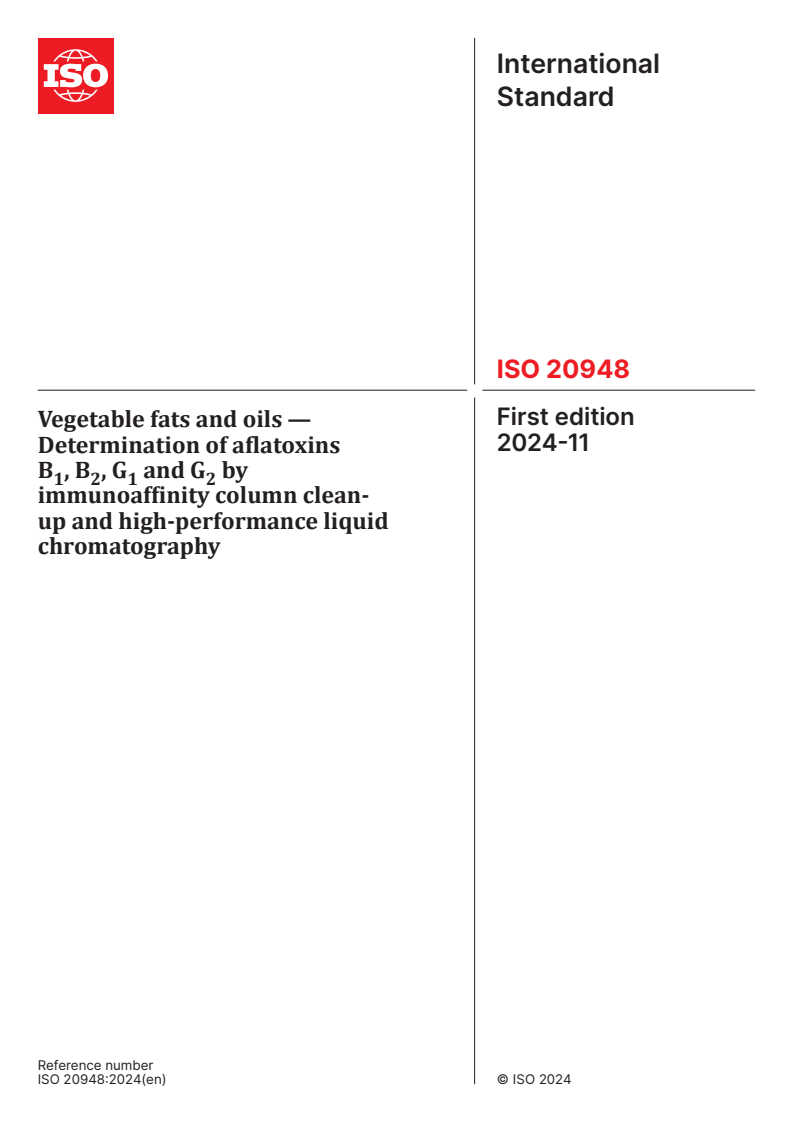
International
Standard
ISO 20948
First edition
Vegetable fats and oils —
2024-11
Determination of aflatoxins
B , B , G and G by
1 2 1 2
immunoaffinity column clean-
up and high-performance liquid
chromatography
Reference number
© ISO 2024
All rights reserved. Unless otherwise specified, or required in the context of its implementation, no part of this publication may
be reproduced or utilized otherwise in any form or by any means, electronic or mechanical, including photocopying, or posting on
the internet or an intranet, without prior written permission. Permission can be requested from either ISO at the address below
or ISO’s member body in the country of the requester.
ISO copyright office
CP 401 • Ch. de Blandonnet 8
CH-1214 Vernier, Geneva
Phone: +41 22 749 01 11
Email: copyright@iso.org
Website: www.iso.org
Published in Switzerland
ii
Contents Page
Foreword .iv
Introduction .v
1 Scope . 1
2 Normative references . 1
3 Terms and definitions . 1
4 Principle . 1
5 Reagents . 2
6 Apparatus and equipment . 3
7 Procedure . 4
7.1 Sampling .4
7.2 Sample pre-treatment .4
7.2.1 Extraction .4
7.2.2 IAC clean-up .5
7.3 Analysis .5
7.3.1 HPLC conditions .5
7.3.2 Post-column derivatization.5
7.3.3 Calibration graph .5
7.3.4 Identification .5
7.3.5 Determination .5
8 Calculations . 6
9 Precision . 6
9.1 Results of interlaboratory test .6
9.2 Repeatability .6
9.3 Reproducibility .6
10 Test report . 7
Annex A (normative) Reference standard solutions and typical chromatogram of AFs . 8
Annex B (normative) Determination of the exact concentration of AF stock standard solutions .10
Annex C (informative) Results of collaborative trial .11
Bibliography . 19
iii
Foreword
ISO (the International Organization for Standardization) is a worldwide federation of national standards
bodies (ISO member bodies). The work of preparing International Standards is normally carried out through
ISO technical committees. Each member body interested in a subject for which a technical committee
has been established has the right to be represented on that committee. International organizations,
governmental and non-governmental, in liaison with ISO, also take part in the work. ISO collaborates closely
with the International Electrotechnical Commission (IEC) on all matters of electrotechnical standardization.
The procedures used to develop this document and those intended for its further maintenance are described
in the ISO/IEC Directives, Part 1. In particular, the different approval criteria needed for the different types
of ISO document should be noted. This document was drafted in accordance with the editorial rules of the
ISO/IEC Directives, Part 2 (see www.iso.org/directives).
ISO draws attention to the possibility that the implementation of this document may involve the use of (a)
patent(s). ISO takes no position concerning the evidence, validity or applicability of any claimed patent
rights in respect thereof. As of the date of publication of this document, ISO had not received notice of (a)
patent(s) which may be required to implement this document. However, implementers are cautioned that
this may not represent the latest information, which may be obtained from the patent database available at
www.iso.org/patents. ISO shall not be held responsible for identifying any or all such patent rights.
Any trade name used in this document is information given for the convenience of users and does not
constitute an endorsement.
For an explanation of the voluntary nature of standards, the meaning of ISO specific terms and expressions
related to conformity assessment, as well as information about ISO’s adherence to the World Trade
Organization (WTO) principles in the Technical Barriers to Trade (TBT), see www.iso.org/iso/foreword.html.
This document was prepared by Technical Committee ISO/TC 34, Food products, Subcommittee SC 11, Animal
and vegetable fats and oils, in collaboration with AOAC INTERNATIONAL.
Any feedback or questions on this document should be directed to the user’s national standards body. A
complete listing of these bodies can be found at www.iso.org/members.html.
iv
Introduction
Aflatoxins (AFs) are carcinogenic toxins that can naturally contaminate oleaginous seeds and fruits, leading
to the potential risk of the consumption of edible oils contaminated by aflatoxins. Regulatory limits for
AFs in edible oils have been established in several countries. This document specifies a method for the
determination of the aflatoxins B , B , G and G in vegetable fats and oils. The method is based on AOAC
1 2 1 2
[1]
Official Method 2013.05 and the validation has been extended to include corn oil, sunflower oil, rapeseed
oil and coconut oil.
v
International Standard ISO 20948:2024(en)
Vegetable fats and oils — Determination of aflatoxins B ,
B , G and G by immunoaffinity column clean-up and high-
2 1 2
performance liquid chromatography
1 Scope
This document specifies a method for the determination of the aflatoxins B , B , G and G in vegetable
1 2 1 2
fats and oils, including peanut oil, sesame oil, olive oil, corn oil, sunflower oil, rapeseed oil and coconut oil,
using immunoaffinity column clean-up and high-performance liquid chromatography with post-column
derivatization.
The limits of quantification for the aflatoxins B , B , G and G , and for the sum of aflatoxins B , B , G and G ,
1 2 1 2 1 2 1 2
are 1 μg/kg, 0,25 μg/kg, 0,5 μg/kg, 0,25 μg/kg and 1 μg/kg, respectively.
The validation was carried out over the following concentration ranges:
— aflatoxin B = 1 μg/kg to 20 μg/kg;
— total aflatoxins = 2 μg/kg to 52 μg/kg.
2 Normative references
The following documents are referred to in the text in such a way that some or all of their content constitutes
requirements of this document. For dated references, only the edition cited applies. For undated references,
the latest edition of the referenced document (including any amendments) applies.
ISO 3696, Water for analytical laboratory use — Specification and test methods
3 Terms and definitions
No terms and definitions are listed in this document.
ISO and IEC maintain terminology databases for use in standardization at the following addresses:
— ISO Online browsing platform: available at https:// www .iso .org/ obp
— IEC Electropedia: available at https:// www .electropedia .org/
4 Principle
Test samples are extracted with methanol–water (a volume fraction of 55 + 45). After shaking and
centrifuging, the lower layer is filtered, diluted with water, and filtered through glass microfibre filter
paper. The filtrate is passed through an immunoaffinity column, and the toxins are eluted with methanol.
The toxins are subjected to high-performance liquid chromatography with fluorescence detector (HPLC-
FLD) analysis after post column derivatization.
WARNING — Aflatoxins are generally considered to be carcinogenic, neurotoxic and
[2]
immunosuppressive. Observe appropriate safety precautions for handling such compounds and
in particular avoid handling in dry form as their electrostatic nature can result in dispersion and
inhalation. Glassware can be decontaminated with 4 % sodium hypochlorite solution. Attention is
[3][4]
drawn to the statement made by the International Agency for Research on Cancer (WHO) .
5 Reagents
During the analysis, unless otherwise stated, use only reagents of recognized analytical grade and only
distilled water or water of grade 1 in accordance with ISO 3696. Solvents shall be of quality for LC analysis.
5.1 Methanol, LC grade or equivalent.
5.2 Acetonitrile, LC grade or equivalent.
5.3 Sodium chloride (NaCl).
5.4 Potassium chloride (KCl).
5.5 Hydrochloric acid, c(HCl) = 12 mol/l.
5.6 Disodium hydrogen phosphate (Na HPO ).
2 4
5.7 Potassium dihydrogen phosphate (KH PO ).
2 4
5.8 Phosphate-buffered saline (PBS) buffer, pH 7,40.
Dissolve 8 g NaCl (5.3), 1,2 g Na HPO (5.6), 0,2 g KH PO (5.7) and 0,2 g KCl (5.4) in about 990 ml of water.
2 4 2 4
Adjust the pH to 7,4 with HCl (5.5) and make up to 1 l with water. Alternatively, a PBS solution of equivalent
properties may be prepared from commercially available PBS material.
5.9 Potassium bromide (KBr).
5.10 Nitric acid, 65 %
5.11 Extraction solvent, mix 55 volume parts of methanol (5.1) and 45 volume parts of water.
5.12 Washing solution, mix 10 volume parts of methanol (5.1) and 90 volume parts of water.
5.13 Aflatoxin (AF) standards:
©1)
— aflatoxin B (AFB , C H O , CAS Registry Number 1162-65-8), purity ≥ 98 %;
1 1 17 12 6
©
— aflatoxin B (AFB , C H O , CAS RN 7220-81-7), purity ≥ 98 %;
2 2 17 14 6
©
— aflatoxin G (AFG , C H O , CAS RN 1165-39-5), purity ≥ 98 %;
1 1 17 12 7
©
— aflatoxin G (AFG , C H O , CAS RN 7241-98-7), purity ≥ 98 %.
2 2 17 14 7
All standards shall be either certified standard solutions or in a crystalline form. Store all materials at –18 °C.
5.14 AF stock standard solutions
Prepare each of the four AFs at a concentration of 10 μg/ml in acetonitrile. Weigh 1 mg of AFB , AFB , AFG
1 2 1
and AFG to the nearest 0,01 mg. Dissolve them with acetonitrile in 100 ml volumetric flasks (6.12). Store
AF stock standard solutions at −18 °C. If crystalline AFs are used to prepare the stock standard solutions,
the exact concentrations of the stock standard solutions shall be determined as described in Annex B. The
concentrations of certified standard solutions can be checked according to the method in Annex B.
1) CAS Registry Number® is a trademark of the American Chemical Society (ACS). This information is given for the
convenience of users of this document and does not constitute an endorsement by ISO of the product named. Equivalent
products may be used if they can be shown to lead to the same results.
5.15 Intermediate AF standard solution:
Prepare a 260 ng/ml aflatoxin mixture solution (combination of AFB , AFB , AFG and AFG at 100 ng/ml,
1 2 1 2
30 ng/ml, 100 ng/ml and 30 ng/ml, respectively) by adding the appropriate amount of each aflatoxin stock
standard solution to the same volumetric flask (6.12) and adjust to the volume with acetonitrile. Use the
intermediate AF standard solution as the spiking solution for recovery studies. Store the intermediate AF
standard solution at −18 °C. Equilibrate to room temperature for at least 30 min before use.
5.16 Working AF standard solution:
Prepare working standard solutions daily in separate 10 ml volumetric flasks (6.12) according to Table A.1.
Adjust to volume with methanol–water (a volume fraction of 1 + 1).
5.17 4 M nitric acid:
Dilute 13,9 ml of 65 % nitric acid (5.10) with water to a volume of 50 ml.
5.18 HPLC mobile phase solvent A:
Mix methanol (5.1), acetonitrile (5.2) and water (v: v: v = 25:17:60). Degas the solution before use if an online
system is not available on the HPLC (6.15) instrument.
5.19 HPLC mobile phase solvent B:
Mix methanol (5.1), acetonitrile (5.2) and water (v: v: v = 25:17:60). Add 120 mg of KBr (5.9) and 350 μl of
nitric acid (4 M, 5.17) in 1 l mobile phase. Degas the solution before use if an online system is not available
on the HPLC (6.15) instrument.
5.20 Sodium hypochlorite solution, concentration (NaOCl) = 4 g/100 ml.
6 Apparatus and equipment
The usual laboratory equipment and, in particular, the following shall be used.
6.1 Balance, sensitivity 0,01 g and 0,000 01 g.
6.2 Pipettes, suitable for handling volumes of 10 µl to 100 µl, 200 µl to 1 000 µl and 1 ml to 10 ml.
Automatic pipettes or 10 ml graduated glass pipettes may be used.
6.3 Vibration device, e.g. Vortex.
6.4 Rotary shaker, shaker capable of 400 r/min.
2)
6.5 Column manifold, Vicam G1104 12-position pump stand , or equivalent.
6.6 Centrifuge, suitable for relative centrifugal force of 6 000g.
6.7 Injection vials, 2 ml, suitable for LC autosampler.
6.8 Centrifuge tubes with screw caps, 50 ml.
2) These are examples of suitable products available commercially. This information is given for the convenience of
users of this document and does not constitute an endorsement by ISO of the products named. Equivalent products may
be used if they can be shown to lead to the same results.
6.9 Glass syringe, 10 ml.
6.10 Glass cylinder, 25 ml and 50 ml.
6.11 Erlenmeyer flask, 125 ml.
6.12 Volumetric flasks, 2 ml, 10 ml and 100 ml.
6.13 Filter paper.
6.13.1 Folded filter paper.
6.13.2 Glass microfibre filter paper.
6.14 Immunoaffinity column (IAC): The AF IAC contains antibodies, which are specific for aflatoxins B ,
B , G and G . The columns should have a capacity of not less than 200 ng AF and should give a recovery of
2 1 2
not less than 80 % for AFB , AFB , AFG and AFG when 5 ng of each AF is applied in 10 ml methanol–PBS; a
1 2 1 2
volume fraction of 10 + 90.
6.15 HPLC-FLD system, including an eluent reservoir, a pump, an injection system, column oven, a
fluorescence detector with variable wavelength setting and a data processor, e.g. an integrator with plotter.
6.16 Post-column derivatization systems for AFs, equipped with post-column derivatization with
photochemical reactor cell or electrochemical cell.
6.16.1 System for derivatization by photochemical reaction, e.g. photochemical reactor for enhanced
® TM 2)
detection (PriboFast KRC or PHRED ) , only to be used with mobile phase A (5.18). The photochemical
reactor is inserted between the HPLC column and the detector inlet.
® 2)
6.16.2 System for derivatization with electrochemically generated bromine, e.g. Kobra Cell , which
shall only be used with mobile phase B (5.19). The system is inserted between the HPLC column and the
detector inlet, with a current of 100 μA.
WARNING — Never flush 100 % organic solvent through the system as this can damage the membrane.
Always switch the system current source off first before switching off the HPLC pump.
6.17 Analytical reverse-phase HPLC separating column, C18, which ensures a baseline resolved
resolution of AFB , AFB , AFG and AFG peaks from all other peaks.
1 2 1 2
6.18 UV-spectrometer with quartz cuvettes.
7 Procedure
7.1 Sampling
A representative sample should be sent to the laboratory. It should not have been damaged or changed
during transport and storage.
7.2 Sample pre-treatment
7.2.1 Extraction
Weigh 5 g, weighed to the nearest 0,01 g, of test portion in a 50 ml centrifuge tube (6.8). Add 1 g NaCl (5.3)
and 25 ml extraction solvent (5.11). Vortex until sample particles and extract solvent are well mixed. Shake
at 400 r/min for 10 min. For coconut oil that can be in solid state, after the addition of 1 g NaCl (5.3) and
25 ml extraction solvent (5.11), heat the centrifuge tube in a water bath for 10 min at 40 °C to make sure
the coconut oil is in liquid state, and then vortex and shake. Centrifuge at 6 000g for 10 min. Aspirate and
discard the upper oil layer. Pass the lower aqueous methanol layer through folded filter paper (6.13.1).
Measure 15 ml extract after filtration with a 25 ml graduate cylinder and place in a 125 ml Erlenmeyer flask.
Add 30 ml water, mix, and filter through glass microfibre paper (6.13.2). Collect 30 ml filtrate (equivalent to
10 ml extract) into a 50 ml graduate cylinder and proceed immediately with IAC clean-up.
7.2.2 IAC clean-up
IACs are equilibrated at room temperature for at least 15 min before use. Remove the top cap from the
column and connect to the reservoir of the column manifold. Remove the bottom cap from the column and let
the liquid in the column pass through until it reaches 2 mm above the column packing. Add 30 ml of filtrate
into the column reservoir. Let the filtrate flow through the IAC column by gravity force until the liquid level
reaches 2 mm above the colu
...