


ISO/R 508:1966
(Main)Identification colours for pipes conveying fluids in liquid or gaseous condition in land installations and on board ships
Identification colours for pipes conveying fluids in liquid or gaseous condition in land installations and on board ships
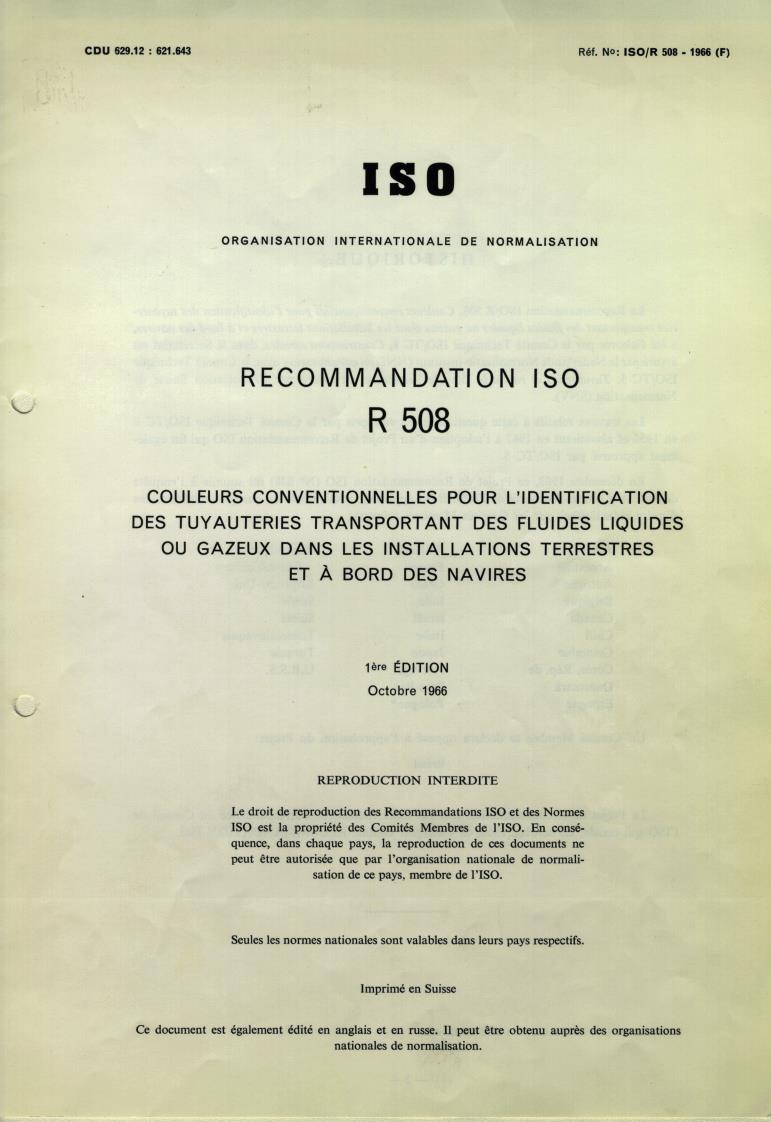
Couleurs conventionnelles pour l'identification des tuyauteries transportant des fluides liquides ou gazeux dans les installations terrestres et à bord des navires
General Information
- Status
- Withdrawn
- Publication Date
- 30-Sep-1966
- Withdrawal Date
- 30-Sep-1966
- Technical Committee
- ISO/TC 8 - Ships and marine technology
- Drafting Committee
- ISO/TC 8 - Ships and marine technology
- Current Stage
- 9599 - Withdrawal of International Standard
- Start Date
- 01-Oct-1986
- Completion Date
- 12-Feb-2026
Relations
- Effective Date
- 15-Apr-2008
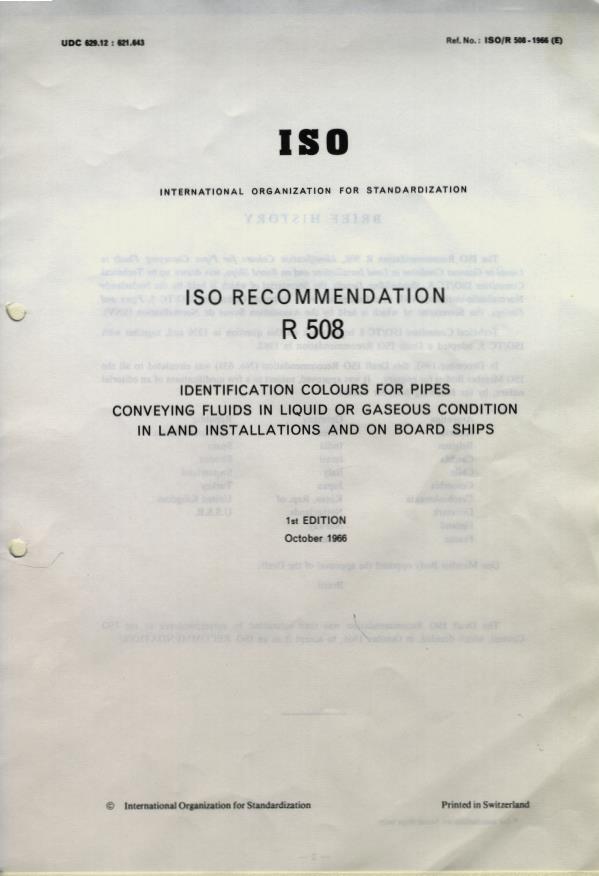
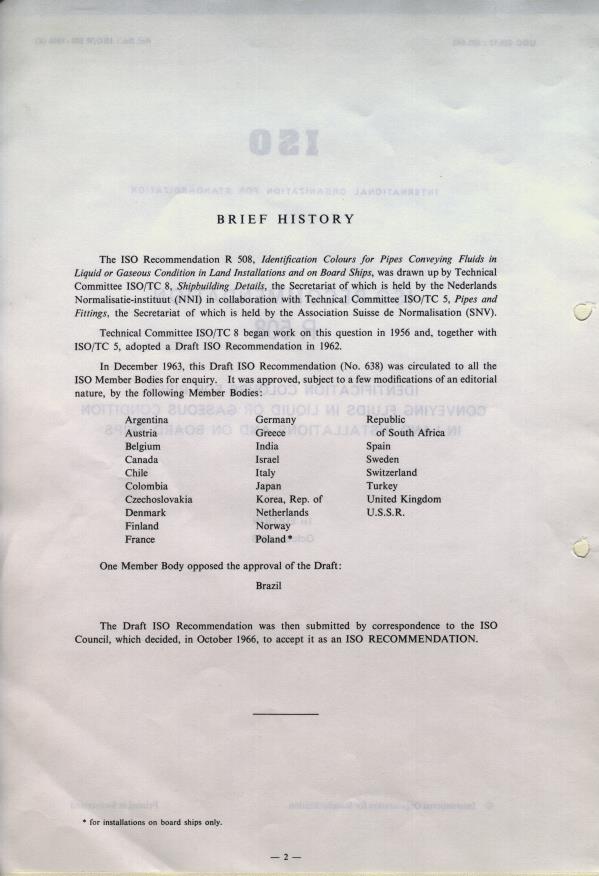
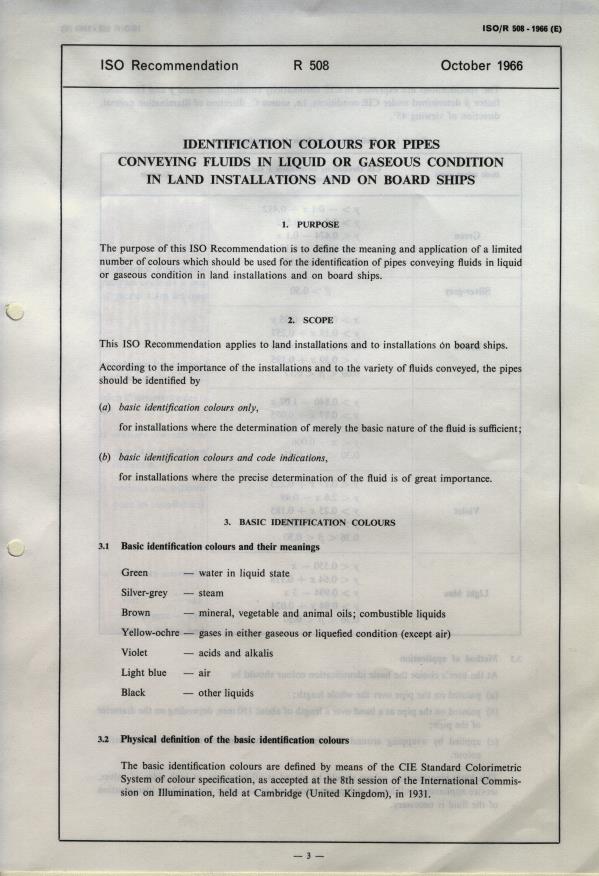
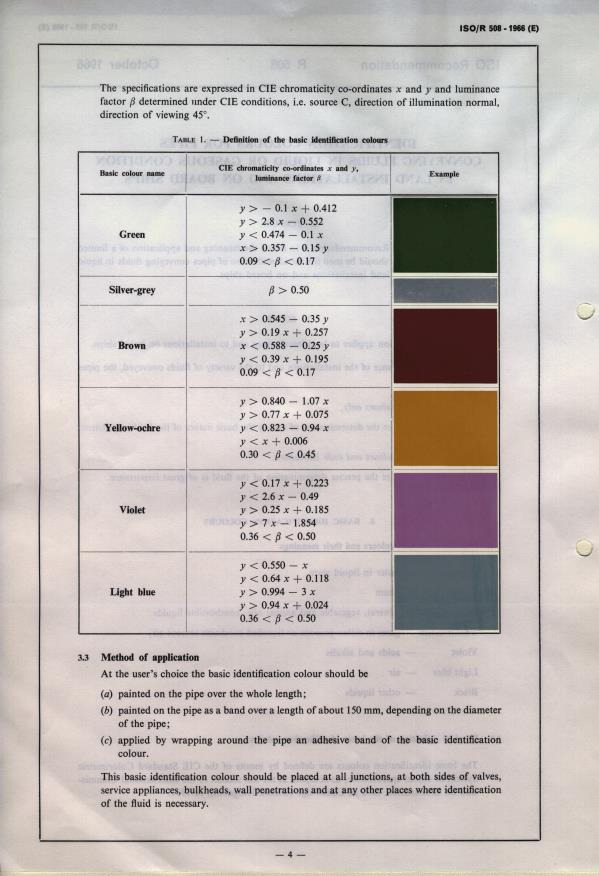
ISO/R 508:1966 - Identification colours for pipes conveying fluids in liquid or gaseous condition in land installations and on board ships
ISO/R 508:1966 - Identification colours for pipes conveying fluids in liquid or gaseous condition in land installations and on board ships Released:10/1/1966
Get Certified
Connect with accredited certification bodies for this standard

DNV
DNV is an independent assurance and risk management provider.

Lloyd's Register
Lloyd's Register is a global professional services organisation specialising in engineering and technology.

ABS Quality Evaluations Inc.
American Bureau of Shipping quality certification.
Sponsored listings
Frequently Asked Questions
ISO/R 508:1966 is a standard published by the International Organization for Standardization (ISO). Its full title is "Identification colours for pipes conveying fluids in liquid or gaseous condition in land installations and on board ships". This standard covers: Identification colours for pipes conveying fluids in liquid or gaseous condition in land installations and on board ships
Identification colours for pipes conveying fluids in liquid or gaseous condition in land installations and on board ships
ISO/R 508:1966 is classified under the following ICS (International Classification for Standards) categories: 01.070 - Colour coding; 47.020.30 - Piping systems. The ICS classification helps identify the subject area and facilitates finding related standards.
ISO/R 508:1966 has the following relationships with other standards: It is inter standard links to ISO 14726-1:1999. Understanding these relationships helps ensure you are using the most current and applicable version of the standard.
ISO/R 508:1966 is available in PDF format for immediate download after purchase. The document can be added to your cart and obtained through the secure checkout process. Digital delivery ensures instant access to the complete standard document.
Standards Content (Sample)
Ref. No. : lSO/R 50) - 1- (a)
UDC m.12 : (0I.W
il
Chile IdY Switzerland
Colombia Japan Turkey
Czechoslovakia Korea, Rep. of United Kingdom
Netherlands
Denmark
Norway
Finland
France bland *
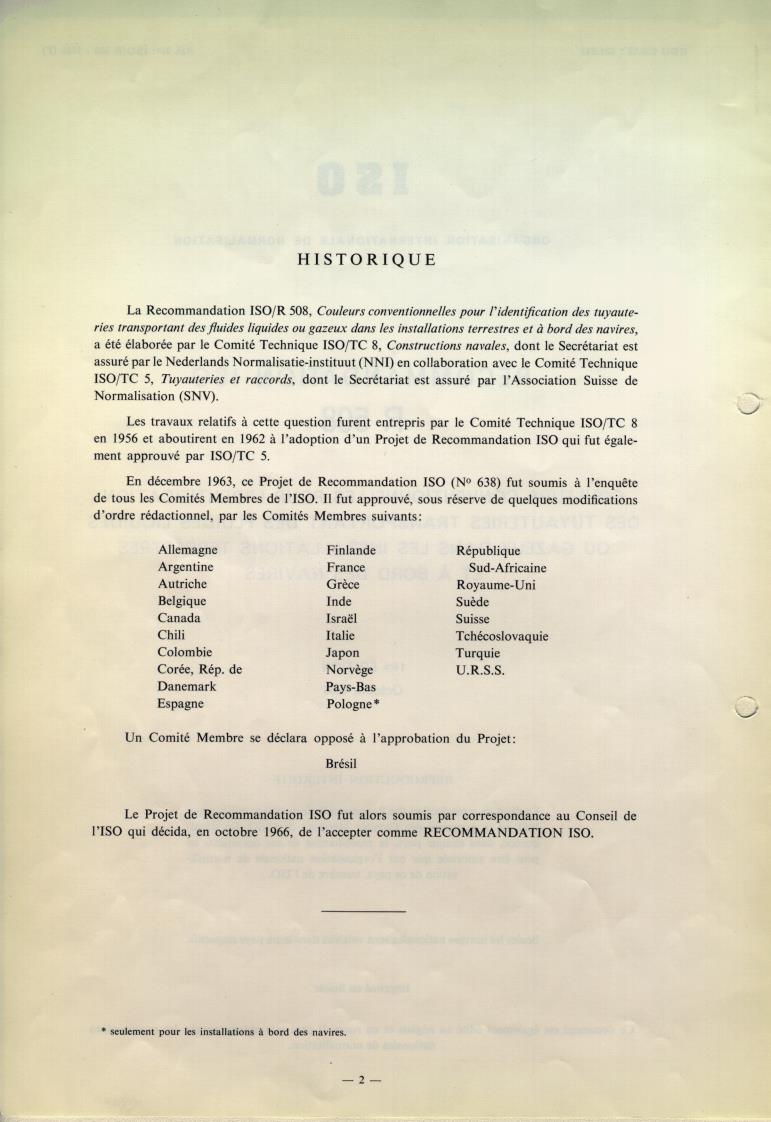
One Member Body opposed the approval of the Draft:
Brazil
The Draft IS0 Recommendation was then submitteu by correspondence to the IS0
Council, which decided, in October 1966, to accept it as an IS0 RECOMMENDATION.
October 1966
IS0 Recommendation R508
for installations where the determination of mer
(b) basic identijfcatim colours and code inktions,
installations where the precise determination of the
F
' J? r)
c'
GFCML - water in liquid gate
Silver-gre!y - steam a&.-
&OWL ;' combustibk liqujds
The specifications are expressed in CIE chromaticity co-ordinates
factor @ determined iinder
C, direction
ource
direction of viewing 45"
TABLE 1. - DeM
Euisple
y > 2.8 x - 0.552
I
Mdbod of a@doa
At the user's choice the basic identifkation colour shou
(U) painted on the pipe over the whole length;
(b) painted on the pipe as a band over a length of a
...
CDU 629.12 : 621.643 Rôf. No: lSf#/U MB - 1- (0
Qpdes les normes nationaies sont valables dans leurs pays respectifs.
Imprimé en Suisse
Ce document est également édité en anglais et en russe. ïi peut être obtenu auprès des organisations
nationales de normaii$ation.
israël
Italie
- "='y
"&%?
Colombie Turquie
Corée, Rép. de U.R.S.S.
Danemark Pays-Bas
Espagne Pologne *
Un Comité Membre se déclara upposé à l'apprc'-',ion du Projet
Brésil
Le Projet de Recommandation IS0 fut alors soumis par correspondance au Consei
1'ISO qui décida, en octobre 1966, de l'accepter comme RECOMMANDATION HO.
* snikment pour ks iaseilfcaieiu A bord des navires.
ISO/R 500 - 1968 (F)
I Recommandation IS0 R 508 Octobre 1966
COULEURS CONVENTIONNELLES POUR L'IDENTIFICATION
DES TUYAUTERIES TRANSPORTANT DES FLUIDES LIQUIDES
OU GAZEUX DANS LES INSTALLATIONS TERRESTRES
ET A BORD DES NAVIRES
dentifier les tuyauteri portant des fluides liquid
terrestres et à bord des navires.
," 1 _. .,
a) couleurs conventionnelIes~ondamentales seulement,
pour les installations où la simple détermination de la nature fondamentd
suffisante ;
U
P) couleurs conventionnelles les et indications codées.
3. COULEURS C0NvE"NELLES FONDAMENTALES
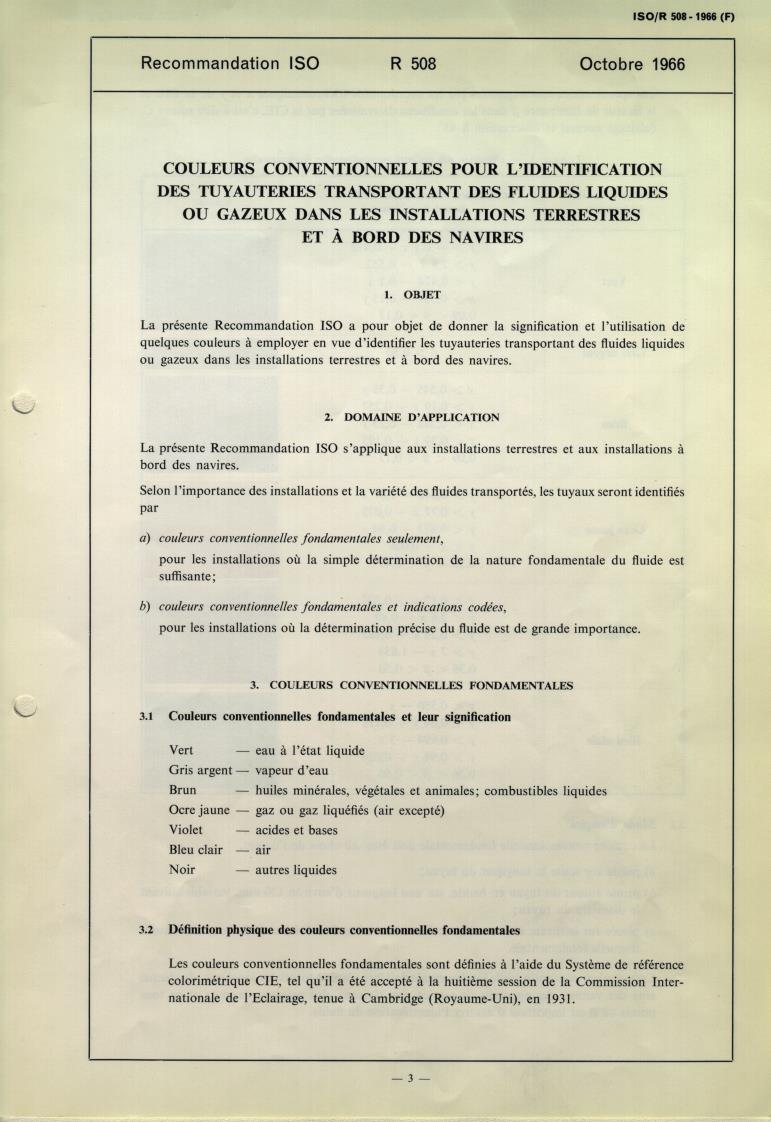
3.1 Couleurs conventionnelles fondamentales et leur signillcation
Vert
- eau à l'état liquide
Gris argent - vapeur d'eau
Brun - huiles minérales, végétales et animales; combustibles liquides
Ocre jaune - gaz ou gaz liquéfiés (air excepté)
Violet - acides et bases
Bleu clair - air
Noir - autres liquides
3.2 Définition physique des couleurs conventiodes fondamentaies
LCS couleurs conventionnelles fondamentales sont définies à l'aide du aysteme ae rererence
colorimétrique CIE, tel qu'il a été accepté à la huitième session de la Commission Inter-
nationale de 1'Eclairam. tenue à Cambridge (Royaume-Uni), en 1931.
-3-
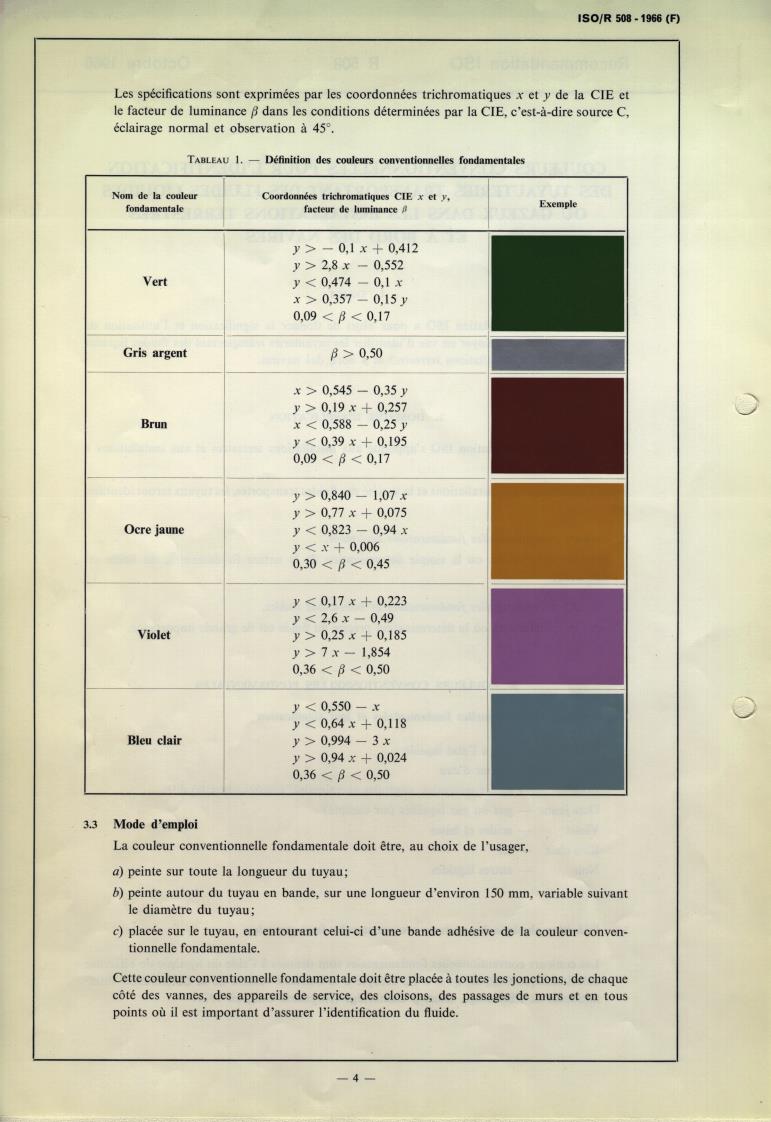
Les spécifications sont exprimées par les coordonnées trichromatiques x et y de la CIE et
le facteur de luminance ,!I dans les conditions déterminées par la CIE, c’est-à-dire source C,
II -- .&
I
II
. 3.3 Mode d’emploi
La couleur conventionnelle fondamentale doit être, au choix de l’usager,
U) peinte sur toute la longueur du tuyau;
b) peinte autour du tuyau en bande, sur une longueur d’environ 150 111111, variable suivant
le diamètre du tuyau;
c) placée sur le tuyau, en entourant celui-ci d’une bande adhésive de la couieur conven-
tionnelle fondamentale.
Cette couleur conventionnelle fondamentale doit être placée à toutes les jonctions, de chaque
côté des vannes, des appareils de service, des cloisons, des passages de murs et en tous
points où il est important d’assurer l’identification du fluide.
-4-
ISO/R SM-1986 - .
Les vannes peuvent être peintes de la couleur conventionnelle, à l’exception suivante: les
vannes d’une tuyauterie munie de la couleur de sécurité pour la lutte contre l’incendie
doivent être peintes en rouge (voir paragraphe 4.1 U)).
Exemple.
...
Questions, Comments and Discussion
Ask us and Technical Secretary will try to provide an answer. You can facilitate discussion about the standard in here.
Loading comments...