


ISO 12864:1997
(Main)Ophthalmic optics — Contact lenses — Determination of scattered light
Ophthalmic optics — Contact lenses — Determination of scattered light
Optique ophtalmique — Lentilles de contact — Détermination de la lumière diffusée
La présente Norme internationale décrit une méthode de détermination de la diffusion de la lumière par les lentilles de contact. L'existence de la présente Norme internationale ne signifie en aucune manière que l'essai de diffusion de la lumière par les lentilles de contact est une exigence.
General Information
- Status
- Withdrawn
- Publication Date
- 10-Dec-1997
- Withdrawal Date
- 10-Dec-1997
- Technical Committee
- ISO/TC 172/SC 7 - Ophthalmic optics and instruments
- Drafting Committee
- ISO/TC 172/SC 7 - Ophthalmic optics and instruments
- Current Stage
- 9599 - Withdrawal of International Standard
- Start Date
- 13-Aug-2014
- Completion Date
- 12-Feb-2026
Relations
- Consolidates
EN ISO 12864:1997 - Ophthalmic optics - Contact lenses - Determination of scattered light (ISO 12864:1997) - Effective Date
- 12-Feb-2026

ISO 12864:1997 - Ophthalmic optics -- Contact lenses -- Determination of scattered light

ISO 12864:1997 - Optique ophtalmique -- Lentilles de contact -- Détermination de la lumiere diffusée
Get Certified
Connect with accredited certification bodies for this standard

BSI Group
BSI (British Standards Institution) is the business standards company that helps organizations make excellence a habit.

TÜV Rheinland
TÜV Rheinland is a leading international provider of technical services.

TÜV SÜD
TÜV SÜD is a trusted partner of choice for safety, security and sustainability solutions.
Sponsored listings
Frequently Asked Questions
ISO 12864:1997 is a standard published by the International Organization for Standardization (ISO). Its full title is "Ophthalmic optics — Contact lenses — Determination of scattered light". This standard covers: La présente Norme internationale décrit une méthode de détermination de la diffusion de la lumière par les lentilles de contact. L'existence de la présente Norme internationale ne signifie en aucune manière que l'essai de diffusion de la lumière par les lentilles de contact est une exigence.
La présente Norme internationale décrit une méthode de détermination de la diffusion de la lumière par les lentilles de contact. L'existence de la présente Norme internationale ne signifie en aucune manière que l'essai de diffusion de la lumière par les lentilles de contact est une exigence.
ISO 12864:1997 is classified under the following ICS (International Classification for Standards) categories: 11.040.70 - Ophthalmic equipment. The ICS classification helps identify the subject area and facilitates finding related standards.
ISO 12864:1997 has the following relationships with other standards: It is inter standard links to EN ISO 12864:1997. Understanding these relationships helps ensure you are using the most current and applicable version of the standard.
ISO 12864:1997 is available in PDF format for immediate download after purchase. The document can be added to your cart and obtained through the secure checkout process. Digital delivery ensures instant access to the complete standard document.
Standards Content (Sample)
INTERNATIONAL ISO
STANDARD 12864
First edition
1997-12-15
Ophthalmic optics — Contact lenses —
Determination of scattered light
Optique ophtalmique — Lentilles de contact — Détermination de la lumière
diffusée
A
Reference number
Foreword
ISO (the International Organization for Standardization) is a worldwide federation of national standards bodies (ISO
member bodies). The work of preparing International Standards is normally carried out through ISO technical
committees. Each member body interested in a subject for which a technical committee has been established has
the right to be represented on that committee. International organizations, governmental and non-governmental, in
liaison with ISO, also take part in the work. ISO collaborates closely with the International Electrotechnical
Commission (IEC) on all matters of electrotechnical standardization.
Draft International Standards adopted by the technical committees are circulated to the member bodies for voting.
Publication as an International Standard requires approval by at least 75 % of the member bodies casting a vote.
International Standard ISO 12864 was prepared by ISO/TC 172 Optics and optical instruments, Subcommittee SC 7
Ophthalmic optics and instruments.
© ISO 1997
All rights reserved. Unless otherwise specified, no part of this publication may be reproduced
or utilized in any form or by any means, electronic or mechanical, including photocopying and
microfilm, without permission in writing from the publisher.
International Organization for Standardization
Case postale 56 • CH-1211 Genève 20 • Switzerland
Internet central@iso.ch
X.400 c=ch; a=400net; p=iso; o=isocs; s=central
Printed in Switzerland
ii
© ISO
Introduction
If light is scattered significantly when passing through a contact lens (CL), contrast is reduced and the visual
performance of the wearer is impaired. In this case, the light which is scattered at a large angle to the direction of
radiation is generally less disturbing than light which is scattered at small angles. In particular, light scattered at
small angles may cause problems for drivers when the sun is low in the sky, when it reflects off wet roads and at
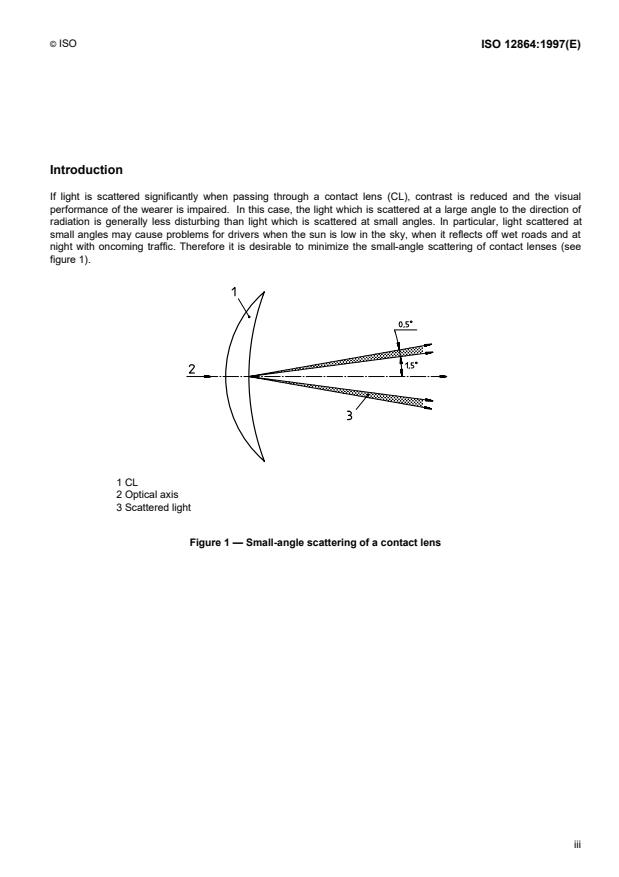
night with oncoming traffic. Therefore it is desirable to minimize the small-angle scattering of contact lenses (see
figure 1).
1CL
2 Optical axis
3 Scattered light
Figure 1 — Small-angle scattering of a contact lens
iii
INTERNATIONAL STANDARD © ISO ISO 12864:1997(E)
Ophthalmic optics — Contact lenses — Determination of scattered
light
1 Scope
This International Standard describes a method for the determination of the scattering of light by contact lenses.
The test method described is given as a reference method.
The existence of this International Standard does not imply in any way that the testing of contact lenses for light
scatter is a requirement.
2 Normative references
The following standards contain provisions which, through reference in this text, constitute provisions of this
International Standard. At the time of publication, the editions indicated were valid. All standards are subject to
revision, and parties to agreements based on this International Standard are encouraged to investigate the
possibility of applying the most recent editions of the standards indicated below. Members of IEC and ISO maintain
registers of currently valid International Standards.
ISO 8320:1986, Optics and optical instruments - Contact lenses - Vocabulary and symbols
ISO 10344:1996, Optics and optical instruments - Contact lenses - Saline solution for contact lens testing
3 Definitions
For the purposes of this International Standard, the definitions given in ISO 8320 apply, together with the following.
3.1 luminance factor, l
Ratio of the luminance of the surface element in the given direction (the scattered light, L ) to that of a perfect
s
reflecting or transmitting diffuser identically illuminated (here taken to be the illuminance, ).
E
NOTE The luminance factor is expressed using equation (1):
L cd / m
s
l = in
(1)
E lx
*
3.2 reduced luminance factor, l
Ratio of the luminance factor, l, to the transmittance, t.
NOTE The reduced luminance factor, which is the luminance factor expressed so as not to depend on the transmittance of
the contact lens, is obtained using equation (2):
L
l cd / m
s
l*== in
(2)
lx
ttE⋅
© ISO
4 Principle
The beam from a He-Ne laser is diverged (using the two lenses L and L ) onto the centre of the contact lens. The
1 2
beam is deflected according to any inherent prismatic effect at this point. A cone of scattered light is formed around
the deflected beam. The sensor S is conjugate with the centre of the lens. S, L and D / D lie along the deflected
3 1 2
beam. Apertures D , D are subs
...
NORME ISO
INTERNATIONALE 12864
Première édition
1997-12-15
Optique ophtalmique — Lentilles de
contact — Détermination de la lumière
diffusée
Ophthalmic optics — Contact lenses — Determination of scattered light
A
Numéro de référence
Avant-propos
L'ISO (Organisation internationale de normalisation) est une fédération mondiale d'organismes nationaux de
normalisation (comité membres de l'ISO). L'élaboration des Normes internationales est en général confiée aux
comités techniques de l'ISO. Chaque comité membre intéressé par une étude a le droit de faire partie du comité
technique créé à cet effet. Les organisations internationales, gouvernementales et non gouvernementales, en
liaison avec l'ISO participent également aux travaux. L'ISO collabore étroitement avec la Commission
électrotechnique internationale (CEI) en ce qui concerne la normalisation électrotechnique.
Les projets de Normes internationales adoptés par les comités techniques sont soumis aux comités membres pour
vote. Leur publication comme Normes internationales requiert l'approbation de 75 % au moins des comités
membres votants.
La Norme internationale ISO 12864 a été élaborée par l'ISO/TC 172 Optique et instruments d'optique, sous-comité
SC 7 Optique et instruments ophtalmiques.
© ISO 1997
Droits de reproduction réservés. Sauf prescription différente, aucune partie de cette publi-
cation ne peut être reproduite ni utilisée sous quelque forme que ce soit et par aucun pro-
cédé, électronique ou mécanique, y compris la photocopie et les microfilms, sans l'accord
écrit de l'éditeur.
Organisation internationale de normalisation
Case postale 56 • CH-1211 Genève 20 • Suisse
Internet central@iso.ch
X.400 c=ch; a=400net; p=iso; o=isocs; s=central
Imprimé en Suisse
ii
©
ISO ISO 12864:1997(F)
Introduction
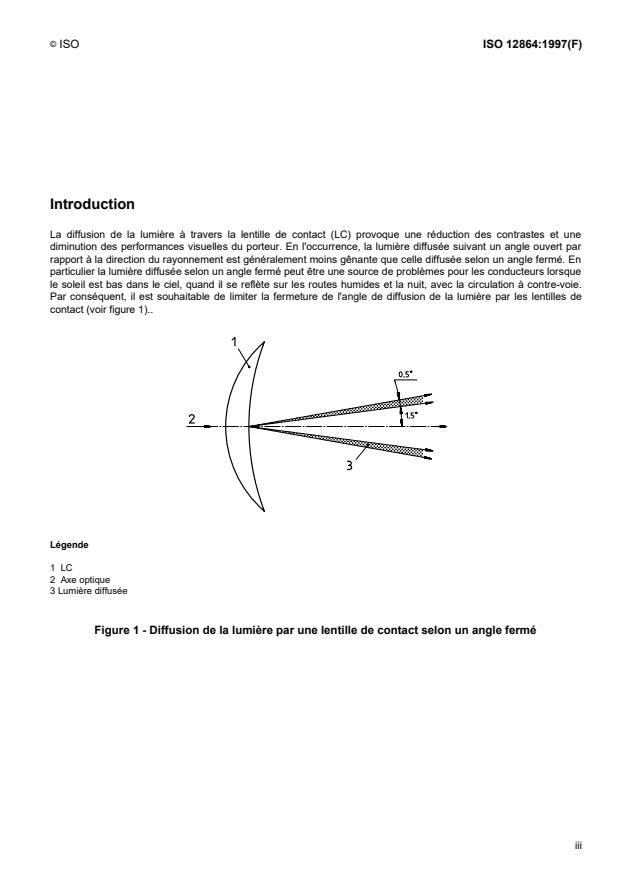
La diffusion de la lumière à travers la lentille de contact (LC) provoque une réduction des contrastes et une
diminution des performances visuelles du porteur. En l'occurrence, la lumière diffusée suivant un angle ouvert par
rapport à la direction du rayonnement est généralement moins gênante que celle diffusée selon un angle fermé. En
particulier la lumière diffusée selon un angle fermé peut être une source de problèmes pour les conducteurs lorsque
le soleil est bas dans le ciel, quand il se reflète sur les routes humides et la nuit, avec la circulation à contre-voie.
Par conséquent, il est souhaitable de limiter la fermeture de l'angle de diffusion de la lumière par les lentilles de
contact (voir figure 1).
Légende
1 LC
2 Axe optique
3 Lumière diffusée
Figure 1 - Diffusion de la lumière par une lentille de contact selon un angle fermé
iii
©
NORME INTERNATIONALE ISO ISO 12864:1997(F)
Optique ophtalmique - Lentilles de contact -
Détermination de la lumière diffusée
1 Domaine d'application
La présente Norme internationale décrit une méthode de détermination de la diffusion de la lumière par les lentilles
de contact.
L’existance de la présente Norme internationale ne signifie en aucune manière que l’essai de diffusion de la lumière
par les lentilles de contact est une exigence.
2 Références normatives
Les normes suivantes contiennent des dispositions qui, par suite de la référence qui en est faite, constituent des
dispositions valables pour la présente Norme internationale. Au moment de la publication, les éditions indiquées
étaient en vigueur. Toute norme est sujette à révision et les parties prenantes des accords fondés sur la présente
Norme internationale sont invitées à rechercher la possibilité d'appliquer les éditions les plus récentes des normes
indiquées ci-après. Les membres de la CEI et de l'ISO possèdent le registre des normes internationales en vigueur
à un moment donné.
ISO 8320 : 1986, Optique et instruments d'optique - Lentilles de contact - Vocabulaire et symboles.
ISO 10344 : 1996, Optique et instruments d'optique - Lentilles de contact - Solution saline pour les
essais des lentilles de contact.
3 Définitions
Pour les besoins de la présente Norme internationale, les définitions données dans l'ISO 8320, ainsi que les
définitions suivantes s'appliquent.
3.1 facteur de luminance, l
spécifiées> Rapport de la luminance d’un élément de surface dans la direction donnée (lumière diffusée, L ) à celle
s
d’un diffuseur à réflexion ou transmission parfaite, éclairé de manière identique (considéré ici comme éclairement,
E)
NOTE Le facteur de luminance s’exprime généralement à l'aide de l'équation suivante:
L cd / m
s
l = en . (1)
E lx
3.2 facteur de luminance réduite, l*
Rapport du facteur de luminance, l, au facteur de transmission τ.
NOTE Le facteur de luminance réduite qui est le facteur de luminance exprimé indépendamment du facteur de transmission
de la lentille de contact, est obtenu à l'aide de l'équation suivante:
©
l L
cd / m
s
l*== en . (2)
ttE⋅ lx
4 Principe
On fait diverger (par le biais de deux lentilles L et L ) le faisceau émis par un laser He-Ne jusqu'au centre de la
1 2
lentille de contact auquel le faisceau est défléchi suivant un effet prismatique inhérent. Un cône de lumière diffusée
se forme de part et d'autre du faisceau défléchi. L'axe du capteur, S, et le centre de la lentille sont conjugués. S, L
et D /D se situent sur le trajet du faisceau défléchi. Par la suite, on utilise les ouvertures D et D pour évaluer la
1 2 1 2
lumière diffusée par la cuve avec ou sans lentille.
5 Appareillage
La configuration d'essai est représentée à la figure 2.
Faire diverger pa
...
Questions, Comments and Discussion
Ask us and Technical Secretary will try to provide an answer. You can facilitate discussion about the standard in here.
Loading comments...