

ISO 16971-1:2024
(Main)Ophthalmic instruments — Optical coherence tomographs — Part 1: Optical coherence tomographs for the posterior segment of the human eye
General Information
- Abstract
This document is applicable to optical coherence tomography (OCT) instruments, systems, and methods that are intended to image and measure the biological tissue of the posterior segment of the human eye. This document specifies characteristics and minimum requirements for OCT instruments and systems. It specifies type tests and procedures to verify that a system or instrument qualifies as an OCT instrument or system in accordance with this document. NOTE In this document the term OCT refers to ophthalmic applications.
- Status
- Published
- Publication Date
- 07-Nov-2024
- Technical Committee
- ISO/TC 172/SC 7 - Ophthalmic optics and instruments
- Drafting Committee
- ISO/TC 172/SC 7 - Ophthalmic optics and instruments
- Current Stage
- 6060 - International Standard published
- Start Date
- 08-Nov-2024
- Due Date
- 14-Oct-2024
- Completion Date
- 08-Nov-2024


Overview - What ISO 16971-1:2024 covers
ISO 16971-1:2024 is the first part of an international standard that defines requirements for optical coherence tomography (OCT) instruments intended to image and measure biological tissue of the posterior segment of the human eye (for example, the retina and optic nerve head). The document specifies the characteristics and minimum performance requirements for ophthalmic OCT systems, and describes type tests and verification procedures to confirm that an instrument qualifies as an OCT system under this standard. This edition revises ISO 16971:2015 and clarifies performance parameters, image presentation, data exchange (DICOM required), and manufacturer information.
Key technical topics and requirements
- Terminology and symbols: Definitions for A-scan, B-scan, en-face images, OCTA terms, anatomy and data processing vocabulary.
- Optical and signal properties: Requirements for transverse and axial optical resolution, axial range, angular field of view, sensitivity and axial signal roll-off.
- Construction and function: Optical specifications, tolerance requirements, co-alignment of fundus images with OCT scans, and light hazard protection in line with ISO 15004 and IEC 60825.
- Analysis and presentation: Standards for presentation of structural OCT images, retinal thickness measurement, reference databases and required metadata.
- Data exchange and interoperability: Minimum data exchange requirements with DICOM (NEMA PS3/ISO 12052) mandated for interoperability.
- Recommended test methods: Measurement setups and test procedures (resolution, sensitivity, axial roll-off, co-alignment methods including en-face and line-scan techniques).
- Manufacturer information: Required documentation - warnings, maintenance, imaging parameters, acquisition modes, measurement algorithms and data-exchange details.
Practical applications - who uses ISO 16971-1:2024
- OCT device manufacturers: for design, performance specification, conformance testing, and regulatory submissions.
- Clinical engineers and biomedical test labs: to verify device performance and safety according to standard test methods.
- Regulatory authorities and notified bodies: as a reference for essential performance and safety during device approval.
- Hospitals, eye clinics and procurement teams: to compare OCT systems, ensure interoperability (DICOM), and specify minimum features.
- Researchers and developers: for consistent terminology, measurement methods and data formats when developing algorithms, OCTA methods or normative databases.
Related standards
- ISO 15004-1 / ISO 15004-2 - ophthalmic instrument requirements and light hazard protection
- IEC 60601-1 - medical electrical safety and essential performance
- IEC 60825-1 - laser safety classification and requirements
- NEMA PS3 / DICOM (ISO 12052) - medical image data exchange and interoperability
Keywords: ISO 16971-1:2024, optical coherence tomography, OCT, posterior segment, retina, ophthalmic instruments, DICOM, performance requirements, test methods, safety.
Relations
- Effective Date
- 06-Jun-2022
Get Certified
Connect with accredited certification bodies for this standard

BSI Group
BSI (British Standards Institution) is the business standards company that helps organizations make excellence a habit.

TÜV Rheinland
TÜV Rheinland is a leading international provider of technical services.

TÜV SÜD
TÜV SÜD is a trusted partner of choice for safety, security and sustainability solutions.
Sponsored listings
Frequently Asked Questions
ISO 16971-1:2024 is a standard published by the International Organization for Standardization (ISO). Its full title is "Ophthalmic instruments — Optical coherence tomographs — Part 1: Optical coherence tomographs for the posterior segment of the human eye". This standard covers: This document is applicable to optical coherence tomography (OCT) instruments, systems, and methods that are intended to image and measure the biological tissue of the posterior segment of the human eye. This document specifies characteristics and minimum requirements for OCT instruments and systems. It specifies type tests and procedures to verify that a system or instrument qualifies as an OCT instrument or system in accordance with this document. NOTE In this document the term OCT refers to ophthalmic applications.
This document is applicable to optical coherence tomography (OCT) instruments, systems, and methods that are intended to image and measure the biological tissue of the posterior segment of the human eye. This document specifies characteristics and minimum requirements for OCT instruments and systems. It specifies type tests and procedures to verify that a system or instrument qualifies as an OCT instrument or system in accordance with this document. NOTE In this document the term OCT refers to ophthalmic applications.
ISO 16971-1:2024 is classified under the following ICS (International Classification for Standards) categories: 11.040.70 - Ophthalmic equipment. The ICS classification helps identify the subject area and facilitates finding related standards.
ISO 16971-1:2024 has the following relationships with other standards: It is inter standard links to ISO 16971:2015. Understanding these relationships helps ensure you are using the most current and applicable version of the standard.
ISO 16971-1:2024 is available in PDF format for immediate download after purchase. The document can be added to your cart and obtained through the secure checkout process. Digital delivery ensures instant access to the complete standard document.
Standards Content (Sample)
International
Standard
ISO 16971-1
First edition
Ophthalmic instruments — Optical
2024-11
coherence tomographs —
Part 1:
Optical coherence tomographs
for the posterior segment of the
human eye
Instruments ophtalmiques — Tomographe à cohérence
optique —
Partie 1: Tomographe à cohérence optique du segment postérieur
de l'oeil humain
Reference number
© ISO 2024
All rights reserved. Unless otherwise specified, or required in the context of its implementation, no part of this publication may
be reproduced or utilized otherwise in any form or by any means, electronic or mechanical, including photocopying, or posting on
the internet or an intranet, without prior written permission. Permission can be requested from either ISO at the address below
or ISO’s member body in the country of the requester.
ISO copyright office
CP 401 • Ch. de Blandonnet 8
CH-1214 Vernier, Geneva
Phone: +41 22 749 01 11
Email: copyright@iso.org
Website: www.iso.org
Published in Switzerland
ii
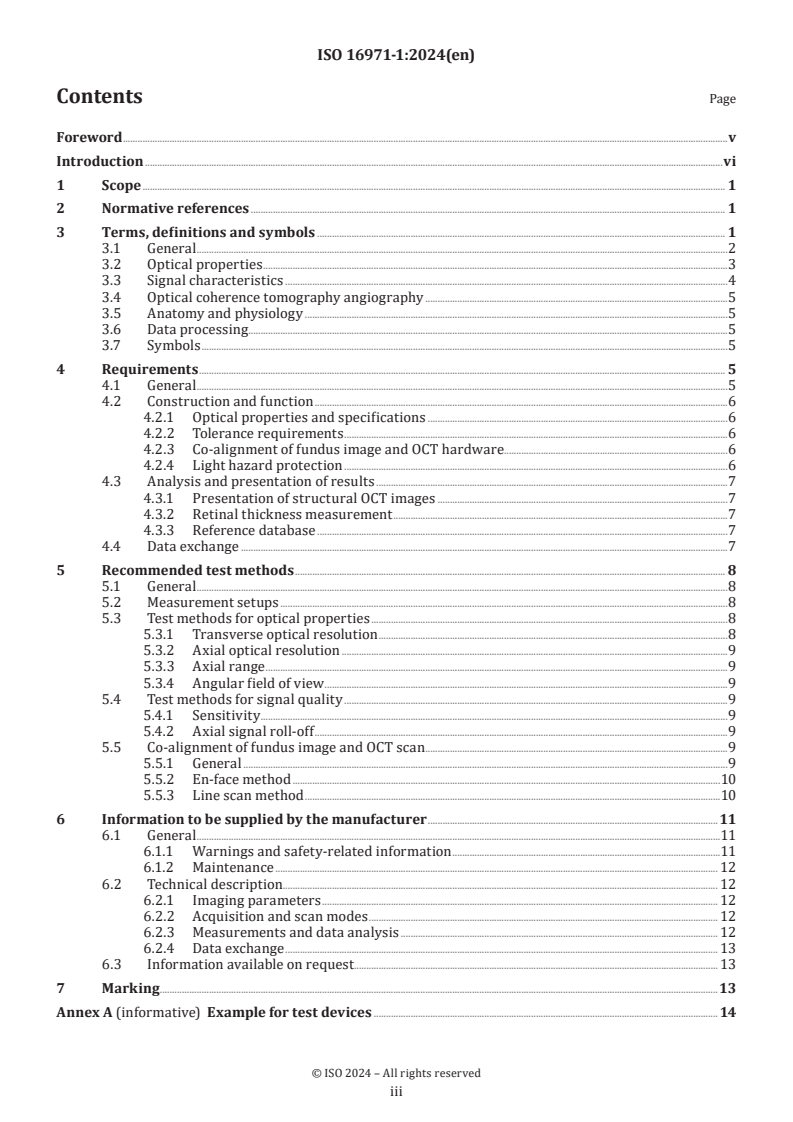
Contents Page
Foreword .v
Introduction .vi
1 Scope . 1
2 Normative references . 1
3 Terms, definitions and symbols . 1
3.1 General .2
3.2 Optical properties .3
3.3 Signal characteristics .4
3.4 Optical coherence tomography angiography .5
3.5 Anatomy and physiology .5
3.6 Data processing.5
3.7 Symbols .5
4 Requirements . 5
4.1 General .5
4.2 Construction and function .6
4.2.1 Optical properties and specifications .6
4.2.2 Tolerance requirements .6
4.2.3 Co-alignment of fundus image and OCT hardware.6
4.2.4 Light hazard protection .6
4.3 Analysis and presentation of results .7
4.3.1 Presentation of structural OCT images .7
4.3.2 Retinal thickness measurement .7
4.3.3 Reference database .7
4.4 Data exchange .7
5 Recommended test methods . 8
5.1 General .8
5.2 Measurement setups .8
5.3 Test methods for optical properties .8
5.3.1 Transverse optical resolution .8
5.3.2 Axial optical resolution .9
5.3.3 Axial range .9
5.3.4 Angular field of view .9
5.4 Test methods for signal quality .9
5.4.1 Sensitivity .9
5.4.2 Axial signal roll-off .9
5.5 Co-alignment of fundus image and OCT scan .9
5.5.1 General .9
5.5.2 En-face method .10
5.5.3 Line scan method .10
6 Information to be supplied by the manufacturer .11
6.1 General .11
6.1.1 Warnings and safety-related information .11
6.1.2 Maintenance . 12
6.2 Technical description. 12
6.2.1 Imaging parameters . 12
6.2.2 Acquisition and scan modes . 12
6.2.3 Measurements and data analysis . 12
6.2.4 Data exchange . 13
6.3 Information available on request. 13
7 Marking . .13
Annex A (informative) Example for test devices . 14
iii
Bibliography .15
iv
Foreword
ISO (the International Organization for Standardization) is a worldwide federation of national standards
bodies (ISO member bodies). The work of preparing International Standards is normally carried out through
ISO technical committees. Each member body interested in a subject for which a technical committee
has been established has the right to be represented on that committee. International organizations,
governmental and non-governmental, in liaison with ISO, also take part in the work. ISO collaborates closely
with the International Electrotechnical Commission (IEC) on all matters of electrotechnical standardization.
The procedures used to develop this document and those intended for its further maintenance are described
in the ISO/IEC Directives, Part 1. In particular, the different approval criteria needed for the different types
of ISO document should be noted. This document was drafted in accordance with the editorial rules of the
ISO/IEC Directives, Part 2 (see www.iso.org/directives).
ISO draws attention to the possibility that the implementation of this document may involve the use of (a)
patent(s). ISO takes no position concerning the evidence, validity or applicability of any claimed patent
rights in respect thereof. As of the date of publication of this document, ISO had not received notice of (a)
patent(s) which may be required to implement this document. However, implementers are cautioned that
this may not represent the latest information, which may be obtained from the patent database available at
www.iso.org/patents. ISO shall not be held responsible for identifying any or all such patent rights.
Any trade name used in this document is information given for the convenience of users and does not
constitute an endorsement.
For an explanation of the voluntary nature of standards, the meaning of ISO specific terms and expressions
related to conformity assessment, as well as information about ISO's adherence to the World Trade
Organization (WTO) principles in the Technical Barriers to Trade (TBT), see www.iso.org/iso/foreword.html.
This document was prepared by Technical Committee ISO/TC 172, Optics and photonics, Subcommittee SC 7,
Ophthalmic optics and instruments.
This first edition of ISO 16971-1 cancels and replaces the first edition (ISO 16971:2015), which has been
technically revised.
The main changes are as follows:
— revision of the dated references;
— document restructured;
— definitions added with particular emphasis on performance parameters;
— added example performance parameters;
— clarified requirements for presentation of OCT images;
— clarified minimum requirements for data exchange; DICOM required;
— test methods not mandatory anymore; added additional test methods;
— extended requirements for the information to be supplied by the manufacturer;
— deleted annex on Minimum requirements for a normative database;
— Annex A Example for test device added.
Any feedback or questions on this document should be directed to the user’s national standards body. A
complete listing of these bodies can be found at www.iso.org/members.html.
v
Introduction
st
Until the early 21 century, it was impossible to obtain clinically relevant depth-resolved information of
the inner structures of the human eye, including those of the retina. With optical coherence tomography
(OCT), eye care practitioners now have an available non-invasive method that allows the rapid generation
of high-resolution three-dimensional in vivo images of the eye. Before the first edition of ISO 16971 was
published, there were no well-defined and widely accepted requirements for either OCT instruments or the
data collected and displayed with them. Consequently, it was very difficult to compare the instruments,
their measurement results, and clinically relevant diagnostic findings based on them.
The first edition of ISO 16971 was an important first step towards defining the necessary terminology and
performance requirements for OCT instruments and to establishing standardized framework conditions for
the application of OCT technology to ophthalmic imaging.
This edition continues the task by extending the requirements of ISO 16971 and specifying a more
comprehensive set of characteristics for OCT instruments. To facilitate this, ISO 16971 has been divided
with this document serving as the first part addressing OCT instruments for the posterior segment of the
human eye.
vi
International Standard ISO 16971-1:2024(en)
Ophthalmic instruments — Optical coherence tomographs —
Part 1:
Optical coherence tomographs for the posterior segment of
the human eye
1 Scope
This document is applicable to optical coherence tomography (OCT) instruments, systems, and methods
that are intended to image and measure the biological tissue of the posterior segment of the human eye.
This document specifies characteristics and minimum requirements for OCT instruments and systems. It
specifies type tests and procedures to verify that a system or instrument qualifies as an OCT instrument or
system in accordance with this document.
NOTE In this document the term OCT refers to ophthalmic applications.
2 Normative references
The following documents are referred to in the text in such a way that some or all of their content constitutes
requirements of this document. For dated references, only the edition cited applies. For undated references,
the latest edition of the referenced document (including any amendments) applies.
ISO 15004-1, Ophthalmic instruments — Fundamental requirements and test methods — Part 1: General
requirements applicable to all ophthalmic instruments
ISO 15004-2, Ophthalmic instruments — Fundamental requirements and test methods — Part 2: Light hazard
protection
IEC 60601-1, Medical electrical equipment — Part 1: General requirements for basic safety and essential
performance
IEC 60825-1, Safety of laser products — Part 1: Equipment classification and requirements
NEMA PS3/ISO 12052, Digital Imaging and Communications in Medicine (DICOM) Standard, National Electric
Manufacturers Association, Rosslyn, VA, USA (available free at https:// www .dicomstandard .org/ ).
3 Terms, definitions and symbols
For the purposes of this document, the terms and definitions given in ISO 15004-1 and the following apply.
ISO and IEC maintain terminology databases for use in standardization at the following addresses:
— ISO Online browsing platform: available at https:// www .iso .org/ obp
— IEC Electropedia: available at https:// www .electropedia .org/
3.1 General
3.1.1
A-scan
one-dimensional axial profile of sample reflectance
Note 1 to entry: axial is the direction of incidence of the measuring beam.
Note 2 to entry: An A-scan is typically depicted either as a plot of reflectance versus depth or as a column in a B-scan
image with intensity corresponding to reflectance.
3.1.2
B-scan
two-dimensional cross-sectional measurement of sample reflectance, typically depicted on a display as
intensity as a function of depth and transverse position
Note 1 to entry: A B-scan is often constructed by transverse scanning and placing neighbouring A-scans side by side.
3.1.3
en-face OCT image
2D transverse OCT image derived from the OCT signal between transverse surfaces in an OCT volume, where
these transverse surfaces are usually derived by image processing that identifies boundaries between layers
in the tissue
Note 1 to entry: Typically, an en-face OCT images is associated with a transverse volume slab of a given layer of tissue,
e.g. retinal nerve fibre layer (RNFL), retinal pigment epithelium (RPE) or choroid.
3.1.4
manufacturer
natural or legal person with responsibility for design or manufacture of an ophthalmic instrument with the
intention of making the ophthalmic instrument available for use, under their name, whether or not such an
ophthalmic instrument is designed or manufactured by themselves or on their behalf by another person
[SOURCE: ISO 13485:2016, 3.10, modified — The word "medical device" has been replaced by "ophthalmic
instrument" and the original notes to entry have been deleted. Text has been made gender-neutral.]
3.1.5
OCT volume
three-dimensional (spatial) representation of the results of a volume scan
Note 1 to entry: An OCT cube is a subtype of an OCT volume.
3.1.6
ophthalmic instrument
device designed to have an application to the eye, and intended by its manufacturer (3.1.4) to be used in
the diagnosis, treatment, or monitoring of a patient, or for compensation or alleviation of disease, injury or
disability
[SOURCE: ISO 15004-1:2020, 3.1]
3.1.7
optical coherence tomograph
OCT instrument
medical device or system that measures, processes, and displays OCT images of target objects
3.1.8
optical coherence tomography
OCT
optical interferometric measurement technique for obtaining cross-sectional images of a target object,
using partially coherent optical radiation to determine the relative depths of backscattering structures
within the object
EXAMPLE Biological tissue of the human eye is an example of a target object.
3.1.9
standard eye
emmetropic eye that has a focal length of 17 mm in air and with retinal tissue with an index of refraction of
n = 1,33 to n = 1,39
Note 1 to entry: The manufacturer specifies the index of refraction.
3.1.10
structural OCT image
two-dimensional image representing the reflectance of the sample tissue along a surface
Note 1 to entry: Typically, the representation of results of one or multiple B-scans.
3.1.11
volume scan
three-dimensional sampling of the reflectance of the sample tissue
Note 1 to entry: Often realised as a sequence of spatially adjacent B-scans.
3.1.12
volume slab
slab
contiguous region of interest in an OCT volume, roughly in the form of a layer or slice
Note 1 to entry: A slab can follow an anatomical structure or can be plane. It can be as thick as the retina or as thin as
a single surface.
3.2 Optical properties
3.2.1
angular field of view
FOV
angular extent from which an image can be taken, expressed as the angle subtended at the exit pupil of the
eye by the maximum dimension 2r
[SOURCE: ISO 10940:2009, 3.2, modified]
Note 1 to entry: See Figure 1.
Key
1 angular field of view
2 entrance pupil of instrument/exit pupil of eye
Figure 1 — Meaning of dimension r for various formats
3.2.2
axial range
measuring range of the OCT instrument in the axial direction in tissue in a standard eye (3.1.9)
Note 1 to entry: This corresponds to the length of an A-scan.
Note 2 to entry: The axial range can be calculated by dividing the optical path length range by the assumed refractive
index of the tissue.
3.2.3
axial resolution
full width half maximum of the OCT signal of a single punctiform reflector in axial direction, given in tissue
in a standard eye
3.2.4
transverse range
transverse extent of an OCT image at the image plane in a standard eye
3.2.5
transverse optical resolution
full width at half maximum of the OCT signal of a single punctiform reflector in transverse direction, given
in tissue in a standard eye
3.3 Signal characteristics
3.3.1
axial sampling density
distance between the corresponding locations in tissue for two adjacent OCT image pixels in axial direction
3.3.2
axial signal roll-off
attenuation in OCT signal with axial depth in tissue, specified by the decrease in sensitivity at a given axial
location in the image window relative to the maximum sensitivity
3.3.3
sensitivity
ratio between irradiated optical power and minimum detectable optical power reflected back from the
sample to the system
Note 1 to entry: Sensitivity is typically expressed in decibels.
Note 2 to entry: Sensitivity of OCT instruments is not the same as the term sensitivity used to describe clinical
accuracy for clinical performance testing.
Note 3 to entry: In the OCT literature, 'sensitivity' is frequently used to denote 'maximum sensitivity.'
3.3.4
maximum sensitivity
sensitivity (3.3.3) measured at the axial depth of the greatest signal
3.3.5
minimum sensitivity
sensitivity (3.3.3) measured at the axial depth of the least signal
3.3.6
transverse sampling density
displacement of the OCT beam between neighbouring A-scans or B-scans
...