


ISO/FDIS 19725
(Main)Road vehicles — Steer-by-wire systems — System safety guidelines
Road vehicles — Steer-by-wire systems — System safety guidelines
This document specifies necessary but not sufficient safety requirements for the use of SbW systems in passenger cars and light commercial vehicles for series application. This document does not replace the full application of the ISO 26262 series of standards and their implementation in safety-related measures. This document defines requirements for manual driving where the driver holds the steering wheel. Note: Misuse of hands-free driving is not considered. This document does not contain any requirements for the use of automated lateral vehicle control functions. The requirements consider systems consisting of a road wheel actuator (RWA), hand wheel actuator (HWA), and a steering wheel for driver input. Deviating concepts need to be analysed by the user for transferability.
Véhicules routiers — Systèmes de direction électronique — Lignes directrices sur la sécurité du système
General Information
- Status
- Not Published
- Technical Committee
- ISO/TC 22/SC 33 - Vehicle dynamics and chassis components
- Drafting Committee
- ISO/TC 22/SC 33 - Vehicle dynamics and chassis components
- Current Stage
- 5020 - FDIS ballot initiated: 2 months. Proof sent to secretariat
- Start Date
- 23-Jan-2026
- Completion Date
- 23-Jan-2026
Overview
ISO/FDIS 19725, titled Road Vehicles - Steer-by-Wire Systems - System Safety Guidelines, is a forthcoming international standard developed by ISO Technical Committee ISO/TC 22/SC 33. It specifies essential safety requirements for steer-by-wire (SbW) systems to be used in passenger cars and light commercial vehicles. SbW represents a transformative technology where the mechanical connection between the steering wheel and road wheels is replaced with electrical control, enabling advanced vehicle interior designs and fostering the evolution of automated driving systems.
This standard aims to provide system safety guidelines focused primarily on manual driving scenarios where the driver holds the steering wheel. It explicitly does not address automated lateral vehicle control functions or hands-free driving misuse. ISO/FDIS 19725 complements, but does not replace, the comprehensive safety framework established by the ISO 26262 series, which addresses functional safety in road vehicles.
Key Topics
Scope and System Boundary
ISO/FDIS 19725 defines the SbW system as comprising the road wheel actuator (RWA), hand wheel actuator (HWA), and steering wheel sensor input components. The standard outlines the system boundaries and clarifies interface requirements with vehicle systems such as power supply and communication networks.Safety Goals and Requirements
The document provides necessary safety goals including maintaining steerability and vehicle lateral control even in the event of electrical faults in the SbW or supporting vehicle systems. It focuses on:- System availability and redundancy to ensure continuous and fail-safe operation.
- Controllability in the event of a first fault, ensuring the driver retains safe control.
- Minimum operating behavior requirements after faults to prevent hazardous conditions.
Fault Management and Degradation Concept
The standard introduces a degradation concept for fault states and transitions, addressing how the SbW system and vehicle operate under fault conditions, including speed limitations and operational restrictions. It also refers to diagnostic strategies such as positive diagnostic re-checks and warning symbols for driver alerts.Testing and Validation
The annexes detail normative driving maneuvers, test configurations, and procedures for assessing controllability and lateral vehicle control during degradation and transitions. This ensures that the system behaviors under fault conditions meet safety objectives.Terminology and Symbols
ISO/FDIS 19725 is grounded on ISO 26262 definitions and includes an extensive glossary of terms related to SbW, such as steerability, system integrity, feedback torque, and more, enabling clear communication and standardization.
Applications
ISO/FDIS 19725 provides critical safety guidelines for OEMs, system suppliers, and safety engineers involved in the development and production of SbW technology in road vehicles. Practical applications include:
- Designing SbW systems that comply with internationally recognized safety standards for manual driving.
- Ensuring functional safety by integrating diagnostic features and fallback mechanisms during electrical faults.
- Facilitating validation and testing protocols for vehicle lateral control and driver feedback in SbW-equipped vehicles.
- Supporting regulatory compliance for new vehicle models incorporating steer-by-wire technology.
- Informing safety-related design decisions in new vehicle architectures that remove traditional mechanical linkages in steering systems.
By adhering to ISO/FDIS 19725, manufacturers can improve vehicle safety, ensure system reliability, and foster customer confidence in advanced SbW technologies.
Related Standards
- ISO 26262 - Road Vehicles - Functional Safety: ISO/FDIS 19725 complements this core series by focusing specifically on SbW system safety aspects.
- ISO 15037-1 - Road Vehicles - Vehicle Dynamics Test Methods: Referenced for general test conditions applicable to SbW system validation.
- Various other ISO/IEC directives related to safety, system boundaries, and terminology influencing SbW system standardization.
Conclusion
ISO/FDIS 19725 sets crucial system safety guidelines for steer-by-wire steering technology in passenger and light commercial vehicles. It addresses unique safety challenges posed by the electrical decoupling in SbW systems, ensuring that manufacturers develop fail-safe, controllable, and reliable steering solutions compatible with present and near-future vehicle technologies. When integrated with the broader ISO 26262 framework, this standard significantly enhances the safe application of steer-by-wire technologies in road vehicles worldwide.
Keywords: Steer-by-wire systems, SbW safety guidelines, vehicle lateral control, road wheel actuator, hand wheel actuator, system availability, controllability, functional safety ISO 26262, automotive safety standards, passenger cars steering, light commercial vehicles steering.
ISO/FDIS 19725 - Road vehicles — Steer-by-wire systems — System safety guidelines Released:9. 01. 2026
REDLINE ISO/FDIS 19725 - Road vehicles — Steer-by-wire systems — System safety guidelines Released:9. 01. 2026
Get Certified
Connect with accredited certification bodies for this standard

TÜV Rheinland
TÜV Rheinland is a leading international provider of technical services.

TÜV SÜD
TÜV SÜD is a trusted partner of choice for safety, security and sustainability solutions.

AIAG (Automotive Industry Action Group)
American automotive industry standards and training.
Sponsored listings
Frequently Asked Questions
ISO/FDIS 19725 is a draft published by the International Organization for Standardization (ISO). Its full title is "Road vehicles — Steer-by-wire systems — System safety guidelines". This standard covers: This document specifies necessary but not sufficient safety requirements for the use of SbW systems in passenger cars and light commercial vehicles for series application. This document does not replace the full application of the ISO 26262 series of standards and their implementation in safety-related measures. This document defines requirements for manual driving where the driver holds the steering wheel. Note: Misuse of hands-free driving is not considered. This document does not contain any requirements for the use of automated lateral vehicle control functions. The requirements consider systems consisting of a road wheel actuator (RWA), hand wheel actuator (HWA), and a steering wheel for driver input. Deviating concepts need to be analysed by the user for transferability.
This document specifies necessary but not sufficient safety requirements for the use of SbW systems in passenger cars and light commercial vehicles for series application. This document does not replace the full application of the ISO 26262 series of standards and their implementation in safety-related measures. This document defines requirements for manual driving where the driver holds the steering wheel. Note: Misuse of hands-free driving is not considered. This document does not contain any requirements for the use of automated lateral vehicle control functions. The requirements consider systems consisting of a road wheel actuator (RWA), hand wheel actuator (HWA), and a steering wheel for driver input. Deviating concepts need to be analysed by the user for transferability.
ISO/FDIS 19725 is classified under the following ICS (International Classification for Standards) categories: 43.040.99 - Other road vehicle systems. The ICS classification helps identify the subject area and facilitates finding related standards.
ISO/FDIS 19725 is available in PDF format for immediate download after purchase. The document can be added to your cart and obtained through the secure checkout process. Digital delivery ensures instant access to the complete standard document.
Standards Content (Sample)
FINAL DRAFT
International
Standard
ISO/TC 22/SC 33
Road vehicles — Steer-by-wire
Secretariat: DIN
systems — System safety guidelines
Voting begins on:
Véhicules routiers — Systèmes de direction électronique — Lignes 2026-01-23
directrices sur la sécurité du système
Voting terminates on:
2026-03-20
RECIPIENTS OF THIS DRAFT ARE INVITED TO SUBMIT,
WITH THEIR COMMENTS, NOTIFICATION OF ANY
RELEVANT PATENT RIGHTS OF WHICH THEY ARE AWARE
AND TO PROVIDE SUPPOR TING DOCUMENTATION.
IN ADDITION TO THEIR EVALUATION AS
BEING ACCEPTABLE FOR INDUSTRIAL, TECHNO
LOGICAL, COMMERCIAL AND USER PURPOSES, DRAFT
INTERNATIONAL STANDARDS MAY ON OCCASION HAVE
TO BE CONSIDERED IN THE LIGHT OF THEIR POTENTIAL
TO BECOME STAN DARDS TO WHICH REFERENCE MAY BE
MADE IN NATIONAL REGULATIONS.
Reference number
FINAL DRAFT
International
Standard
ISO/TC 22/SC 33
Road vehicles — Steer-by-wire
Secretariat: DIN
systems — System safety guidelines
Voting begins on:
Véhicules routiers — Systèmes de direction électronique — Lignes
directrices sur la sécurité du système
Voting terminates on:
RECIPIENTS OF THIS DRAFT ARE INVITED TO SUBMIT,
WITH THEIR COMMENTS, NOTIFICATION OF ANY
RELEVANT PATENT RIGHTS OF WHICH THEY ARE AWARE
AND TO PROVIDE SUPPOR TING DOCUMENTATION.
© ISO 2026
IN ADDITION TO THEIR EVALUATION AS
All rights reserved. Unless otherwise specified, or required in the context of its implementation, no part of this publication may
BEING ACCEPTABLE FOR INDUSTRIAL, TECHNO
LOGICAL, COMMERCIAL AND USER PURPOSES, DRAFT
be reproduced or utilized otherwise in any form or by any means, electronic or mechanical, including photocopying, or posting on
INTERNATIONAL STANDARDS MAY ON OCCASION HAVE
the internet or an intranet, without prior written permission. Permission can be requested from either ISO at the address below
TO BE CONSIDERED IN THE LIGHT OF THEIR POTENTIAL
or ISO’s member body in the country of the requester.
TO BECOME STAN DARDS TO WHICH REFERENCE MAY BE
MADE IN NATIONAL REGULATIONS.
ISO copyright office
CP 401 • Ch. de Blandonnet 8
CH-1214 Vernier, Geneva
Phone: +41 22 749 01 11
Email: copyright@iso.org
Website: www.iso.org
Published in Switzerland Reference number
ii
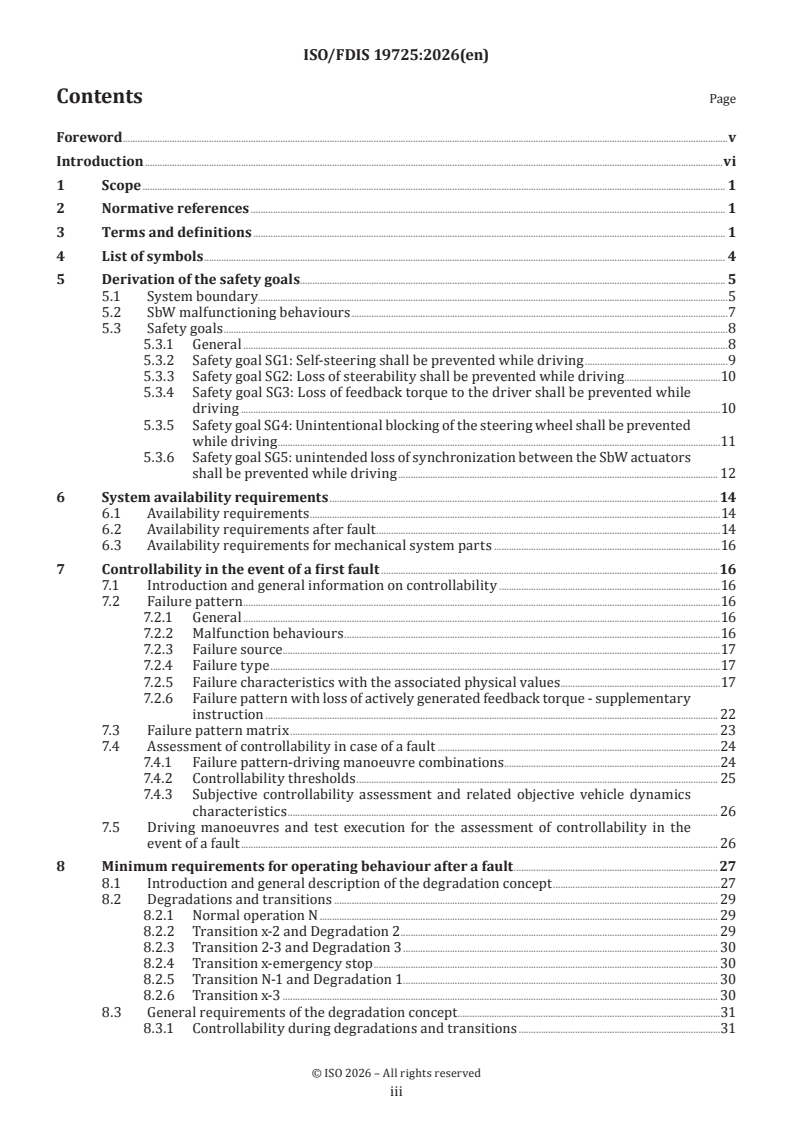
Contents Page
Foreword .v
Introduction .vi
1 Scope . 1
2 Normative references . 1
3 Terms and definitions . 1
4 List of symbols . 4
5 Derivation of the safety goals. 5
5.1 System boundary . .5
5.2 SbW malfunctioning behaviours .7
5.3 Safety goals .8
5.3.1 General .8
5.3.2 Safety goal SG1: Self-steering shall be prevented while driving .9
5.3.3 Safety goal SG2: Loss of steerability shall be prevented while driving .10
5.3.4 Safety goal SG3: Loss of feedback torque to the driver shall be prevented while
driving .10
5.3.5 Safety goal SG4: Unintentional blocking of the steering wheel shall be prevented
while driving .11
5.3.6 Safety goal SG5: unintended loss of synchronization between the SbW actuators
shall be prevented while driving . 12
6 System availability requirements . 14
6.1 Availability requirements .14
6.2 Availability requirements after fault .14
6.3 Availability requirements for mechanical system parts .16
7 Controllability in the event of a first fault .16
7.1 Introduction and general information on controllability .16
7.2 Failure pattern .16
7.2.1 General .16
7.2.2 Malfunction behaviours .16
7.2.3 Failure source .17
7.2.4 Failure type .17
7.2.5 Failure characteristics with the associated physical values .17
7.2.6 Failure pattern with loss of actively generated feedback torque - supplementary
instruction . 22
7.3 Failure pattern matrix . 23
7.4 Assessment of controllability in case of a fault .24
7.4.1 Failure pattern-driving manoeuvre combinations . .24
7.4.2 Controllability thresholds . 25
7.4.3 Subjective controllability assessment and related objective vehicle dynamics
characteristics . 26
7.5 Driving manoeuvres and test execution for the assessment of controllability in the
event of a fault . 26
8 Minimum requirements for operating behaviour after a fault .27
8.1 Introduction and general description of the degradation concept .27
8.2 Degradations and transitions . 29
8.2.1 Normal operation N . 29
8.2.2 Transition x-2 and Degradation 2 . 29
8.2.3 Transition 2-3 and Degradation 3 . 30
8.2.4 Transition x-emergency stop . 30
8.2.5 Transition N-1 and Degradation 1 . 30
8.2.6 Transition x-3 . 30
8.3 General requirements of the degradation concept.31
8.3.1 Controllability during degradations and transitions .31
iii
8.3.2 Electrical power supply system .31
8.3.3 Shortened transitions .31
8.3.4 Performance requirements for the vehicle lateral acceleration .32
8.3.5 Unrestricted continued driving before an automated speed reduction.32
8.3.6 Overriding the automated speed reduction and speed limiter . 33
8.3.7 Braking during the automated speed reduction. 33
8.4 Differentiation of vehicle systems . . 33
8.5 Minimum requirements for degradations and transitions . 33
8.5.1 General . 33
8.5.2 System integrity and speed limitations . 34
8.5.3 Requirements for ASIL capability . 40
8.5.4 Time-limited usage .41
8.5.5 Re-transitioning and its conditions .42
8.5.6 Requirements for the warning concept .45
8.5.7 Minimum requirements for lateral control and controllability of the vehicle . 46
8.6 Manoeuvre sequences and their requirements . 48
8.6.1 General explanations . 48
8.6.2 Goals of the manoeuvre sequences and associated manoeuvres . 48
8.6.3 General requirements . 50
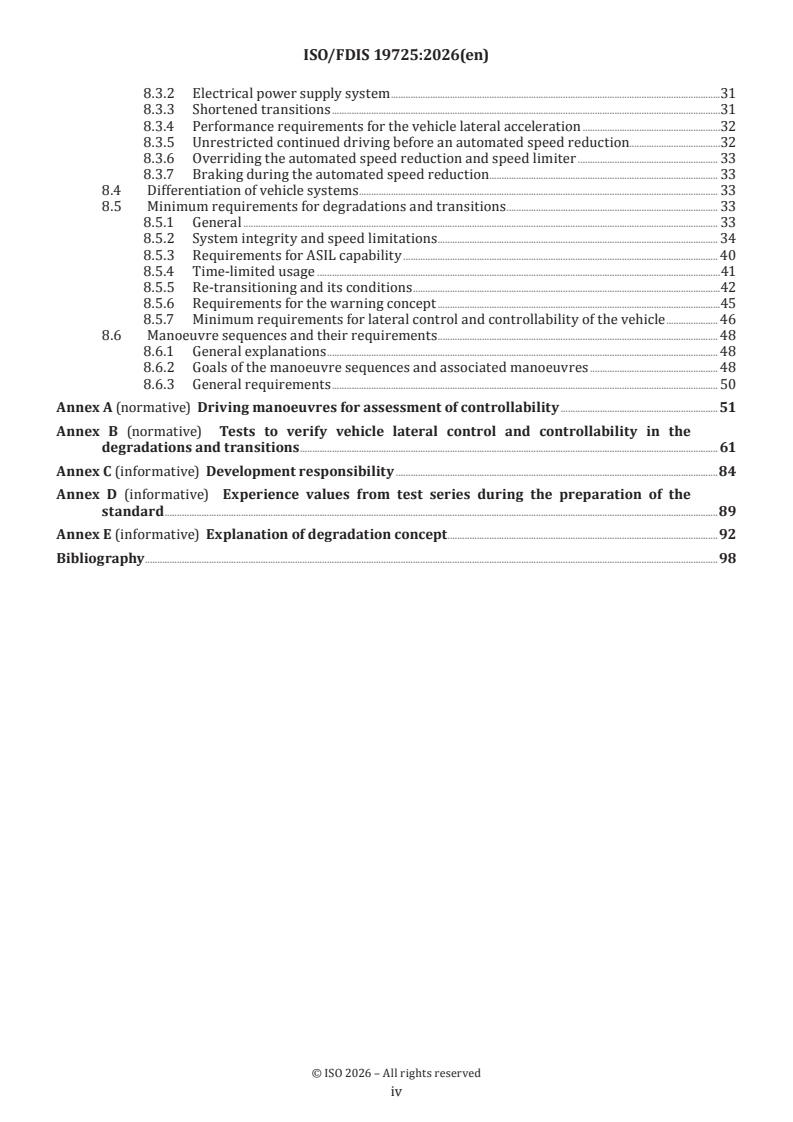
Annex A (normative) Driving manoeuvres for assessment of controllability .51
Annex B (normative) Tests to verify vehicle lateral control and controllability in the
degradations and transitions . 61
Annex C (informative) Development responsibility .84
Annex D (informative) Experience values from test series during the preparation of the
standard .89
Annex E (informative) Explanation of degradation concept .92
Bibliography .98
iv
Foreword
ISO (the International Organization for Standardization) is a worldwide federation of national standards
bodies (ISO member bodies). The work of preparing International Standards is normally carried out through
ISO technical committees. Each member body interested in a subject for which a technical committee
has been established has the right to be represented on that committee. International organizations,
governmental and non-governmental, in liaison with ISO, also take part in the work. ISO collaborates closely
with the International Electrotechnical Commission (IEC) on all matters of electrotechnical standardization.
The procedures used to develop this document and those intended for its further maintenance are described
in the ISO/IEC Directives, Part 1. In particular, the different approval criteria needed for the different types
of ISO document should be noted. This document was drafted in accordance with the editorial rules of the
ISO/IEC Directives, Part 2 (see www.iso.org/directives).
ISO draws attention to the possibility that the implementation of this document may involve the use of (a)
patent(s). ISO takes no position concerning the evidence, validity or applicability of any claimed patent
rights in respect thereof. As of the date of publication of this document, ISO had received notice of (a)
patent(s) which may be required to implement this document. However, implementers are cautioned that
this may not represent the latest information, which may be obtained from the patent database available at
www.iso.org/patents. ISO shall not be held responsible for identifying any or all such patent rights.
Any trade name used in this document is information given for the convenience of users and does not
constitute an endorsement.
For an explanation of the voluntary nature of standards, the meaning of ISO specific terms and expressions
related to conformity assessment, as well as information about ISO's adherence to the World Trade
Organization (WTO) principles in the Technical Barriers to Trade (TBT), see www.iso.org/iso/foreword.html.
This document was prepared by Technical Committee ISO/TC 22, Road vehicles, Subcommittee SC 33, Vehicle
dynamics, chassis components and driving automation systems testing.
Any feedback or questions on this document should be directed to the user’s national standards body. A
complete listing of these bodies can be found at www.iso.org/members.html.
v
Introduction
Steer-by-Wire (SbW) systems represent the next generation of technology in vehicle steering. They enable
new interior concepts and pave the way for further innovations in vehicle technology. In the context of
automated driving, mechanical decoupling between the steering wheel and the steered wheels is becoming
increasingly important. To date, there is no experience of widespread use of this technology in the market
for large-series passenger cars.
Compared to conventional steering systems, SbW technology results in additional requirements for the
safety concept of the vehicle for safe operation.
This document represents a description of a minimal set of safety aspects developed by vehicle manufacturers
and system suppliers.
This document considers:
— the description and system boundary of an SbW system,
— basic safety goals,
— general availability requirements,
— requirements for controllability in the event of a first fault, and
— requirements for the operational behaviour after a fault event.
vi
FINAL DRAFT International Standard ISO/FDIS 19725:2026(en)
Road vehicles — Steer-by-wire systems — System safety
guidelines
1 Scope
This document specifies necessary but not sufficient safety requirements for the use of SbW systems in
passenger cars and light commercial vehicles for series application.
This document does not replace the full application of the ISO 26262 series of standards and their
implementation in safety-related measures.
This document defines requirements for manual driving where the driver holds the steering wheel.
NOTE Misuse of hands-free driving is not considered.
This document does not contain any requirements for the use of automated lateral vehicle control functions.
The requirements consider systems consisting of a road wheel actuator (RWA), hand wheel actuator (HWA),
and a steering wheel for driver input. Deviating concepts need to be analysed by the user for transferability.
2 Normative references
The following documents are referred to in the text in such a way that some or all of their content constitutes
requirements of this document. For dated references, only the edition cited applies. For undated references,
the latest edition of the referenced document (including any amendments) applies.
ISO 15037-1:2019, Road vehicles — Vehicle dynamics test methods — Part 1: General conditions for passenger
cars
ISO 15037-1, Road vehicles — Vehicle dynamics test methods — Part 1: General conditions for passenger cars
ISO 26262-1, Road vehicles — Functional safety — Part 1: Vocabulary
ISO 26262-3, Road vehicles — Functional safety — Part 3: Concept phase
ISO 26262-3, Road vehicles — Functional safety — Part 3: Concept phase
3 Terms and definitions
For the purposes of this document, the terms and definitions given in ISO 26262-1, and the following apply.
ISO and IEC maintain terminology databases for use in standardization at the following addresses:
— ISO Online browsing platform: available at https:// www .iso .org/ obp
— IEC Electropedia: available at https:// www .electropedia .org/
3.1
degradation
degradation stage
DEG
operating conditions of the vehicle within the framework of the degradation concept (3.2)
Note 1 to entry: Due to the operating condition of the steering system or supporting systems, a degradation condition
can lead to restrictions in the use of the vehicle, e.g. speed limitations. Normal operation N is treated as degradation
condition in this document.
3.2
degradation concept
all operating states of the vehicle, including the operating states of the steering system and the supporting
vehicle systems after initial and subsequent faults
Note 1 to entry: Operating states include both transition and degradation states after faults, as well as the fault-free
normal operation N.
3.3
drive cycle
time span from start to end of a trip
Note 1 to entry: In this document, the term is used in the context of re-transitioning between degradation states.
3.4
expert driver
person who has above-average vehicle dynamics knowledge, skills, ability to assess controllability, capability
to conduct the vehicle tests and has regular driving experience
3.5
feedback torque
torque on the steering wheel
Note 1 to entry: An actively generated feedback torque occurs when at least one drive unit of the HWA is active. A
passively generated feedback torque occurs when no drive unit of the HWA is active and the driver performs a steering
wheel rotation. The feedback torque is used, among other things, to represent the steering feel.
3.6
hand wheel actuator
HWA
component(s) sensing the steering wheel angle and providing a feedback torque (3.5)
3.7
immobilization
process in which a stationary vehicle is secured against rolling away
3.8
lane
lateral limited area for the movement of the vehicle, within which the driving task is to be accomplished
3.9
manoeuvre
specified road test
3.10
vehicle lateral manoeuvrability
ability of the vehicle to convert the steering wheel angle request of the driver into a minimal lateral motion
reaction while driving below 10 km/h
3.11
manoeuvre sequence
MS
specific group of tests
3.12
normal driver
person who does not have special skills to drive a vehicle
Note 1 to entry: Used to distinguish from expert driver.
3.13
normal operation
N
condition of the steering system and the supporting vehicle systems without safety-critical faults
Note 1 to entry: Minor, non-safety critical deviations within the nominal application range are permissible. The
deviation of the behaviour of the steering system and the vehicle relative to the nominal behaviour is within the range
expected by the driver.
3.14
passive fallback level
〈HWA〉 operating condition at which no active feedback torque is generated
Note 1 to entry: A passive fallback of an HWA can be mechanical base friction or a damping (e.g. electromagnetic,
magneto-resistive, back EMF).
3.15
positive diagnostic re-check
diagnostic measure that confirms a previously detected fault is no longer present
3.16
road wheel actuator
RWA
component(s) for actuating the required road wheel angle on the front axle
3.17
steerability
ability of the SbW system to convert the steering wheel angle request of the driver into a design-intended
steering movement of the road wheels of the vehicle
3.18
system integrity
characteristics of the SbW system including ASIL capability to meet functional and availability requirements
Note 1 to entry: Functional requirements concern e.g. steering performance, feedback torque and synchronicity.
Availability requirements concern e.g. redundancies to maintain steering capability.
Note 2 to entry: Degradation of steering performance or loss of redundancy can reduce the ASIL capability .
3.19
test configuration
combination of the configuration of the test vehicle (see Annex B, B.2.2) and the configurations of the
respective vehicle systems (see Annex B, B.2.3) for the tests to demonstrate steerability or vehicle lateral
control and controllability in the degradations and transitions
3.20
transition
TR
change between degradation states
Note 1 to entry: A transition represents a time-limited state of a steering system and vehicle. Due to the system state
of the steering system or supporting systems, a transition can lead to restrictions in the use of the vehicle, e.g. speed
limits.
3.21
vehicle lateral control
ability of the vehicle to convert the steering wheel angle request of the driver into an expected vehicle
trajectory according to the available friction coefficient between the tire and the road surface
Note 1 to entry: A trajectory change is also realized by other vehicle systems (e.g. brake, drivetrain, powertrain etc.)
beyond the SbW system.
3.22
warning concept
technical measures to warn the driver and the environment in case of faults
3.23
warning symbol
standardized symbol for feedback to the driver of a failure or a degradation state of the SbW system
4 List of symbols
Table 1 — List of used symbols
Size Symbol Unit
Vehicle lateral acceleration a m/s
y
Vehicle longitudinal acceleration a m/s
x
Distance a m
Vehicle width B m
Lane width b m
Wheelbase L m
Pylons distance d m
Circle radius R/R m
i
Track length S m
Vehicle speed v km/h
x
Vehicle speed at the beginning of the
v km/h
x Start
manoeuvre
Vehicle speed at the end of the ma-
v km/h
x End
noeuvre
Disturbance yaw rate
°/s
Δ
Disturbance lateral acceleration Δa m/s
y
Failure duration t s
Failure
5 Derivation of the safety goals
5.1 System boundary
SbW is a steering system in which the driver's steering intention is detected by a sensor system and
transmitted exclusively electrically to the actuator system to apply the road wheel angle. The steering feel is
represented to the driver by means of an HWA.
Compared with conventional steering systems (e.g. electromechanical steering, superimposed steering),
there is no mechanical connection between the steering wheel and the steered wheels in an SbW system. This
conceptual difference results in additional safety requirements and safety-related availability requirements
for the steering system in the vehicle.
For an SbW system, steerability or vehicle lateral control shall be maintained during driving despite an
electrical fault in the SbW system or in other supporting systems in the vehicle (e.g. vehicle power supply
system, vehicle communication).
Figure 1 shows an example of the item SbW according to ISO 26262-1 with the system boundaries of the
item, the interfaces to the vehicle as well as functional elements. In addition, the control chains of the two
main functions of an SbW system are also shown:
— provide steerability and
— provide feedback torque.
Key
1 measurement of the steering wheel angle
2 actuation of feedback torque via steering wheel (steering feel including haptic warning)
3 target road wheel angle
4 measured variables of actuators
5 road wheel angle (transmission through the mechanical linkage via tie rod and steering linkage to the front
wheels)
6 visual or audible information and warnings from the SbW system
7 interaction between wheels and road
8 power supply
9 information exchange
Figure 1 — Definition of item for SbW
An SbW system with the specified functions is defined as one item according to the definition in ISO 26262-1
[1]
and ISO 26262-5 .
The item SbW can either be defined as one system or as a combination of several systems according to
[1]
ISO 26262-1 and ISO 26262-5 , see Figure 2 and Figure 3.
Key
1 steering wheel input
2 feedback torque (steering feel including haptic warning)
3 road wheel angle
[2]
Figure 2 — Option 1: Definition of system(s) SbW according to the ISO 26262 series
Key
1 steering wheel input
2 feedback torque (steering feel including haptic warning)
3 road wheel angle
4 information exchange between systems
[2]
NOTE The definition "1 item = n systems (2 ≤ n ≤ 10)" follows the requirements of the ISO 26262 series .
[2]
Figure 3 — Option 2: Definition of system(s) SbW according to the ISO 26262 series
An example of breakdown in physical system architecture(s) for both variants and for the share of
development responsibilities between OEM and supplier is given in Annex C.
5.2 SbW malfunctioning behaviours
Based on the functions of the SbW system listed in 5.1:
— provide steerability, and
— provide feedback torque,
the following SbW malfunctioning behaviours are considered:
— self-steering;
— loss of steerability;
— loss of feedback torque;
— blocking of the steering system;
— loss of synchronization between steering wheel angle and road wheel angle.
The malfunctioning behaviours are defined from driver's perspective, that means they represent a faulty
behaviour as it can be experienced by the driver:
— "self-steering" can occur if the road wheels are unintentionally moved
— due to a fault in the function "Provide steerability" (e.g. faults in the measurement, signal processing,
actuation), or
— due to a fault in the function "Provide feedback torque" (e.g. faults in the measurement, signal
processing, actuation) leading to an unintended movement of the steering wheel,
— "loss of steerability" can occur if the driver's intention is not actuated at the road wheels;
— "loss of feedback torque" can occur if no or insufficient torque is applied to the steering wheel;
— "blocking of the steering system" can occur if the forces to rotate the steering wheel are too high for the
driver;
— "loss of synchronization between steering wheel angle and road wheel angle" can occur if the road wheel
angle and steering wheel angle are misaligned, e.g. due to
— delayed road wheel angle actuation,
— misalignment at vehicle wake-up.
In addition to the above listed malfunctions, a complete analysis of all E/E malfunctions in accordance with
ISO 26262-3 as well as mechanical failures shall be conducted for a specific SbW system.
5.3 Safety goals
5.3.1 General
The following safety goals and their criticality ratings are derived from the SbW malfunctioning behaviours
listed in 5.2:
— SG1: Self-steering shall be prevented while driving.
— SG2: Loss of steerability shall be prevented while driving.
— SG3: Loss of feedback torque to the driver shall be prevented while driving.
— SG4: Unintentional blocking of the steering wheel shall be prevented while driving.
— SG5: Unintended loss of synchronization between the SbW actuators shall be prevented while driving.
Table 2 shows the allocation of the SbW malfunctioning behaviours to the safety goals:
Table 2 — Allocation of SbW malfunctions to safety goals
Function of SbW system SbW malfunction Safety goals
Provide steerability Self-steering (RWA) SG1
Loss of steerability SG2
Blocking of the steering system
(RWA)
Loss of synchronization between SG5
steering wheel angle and road wheel
angle
Provide feedback torque Self-Steering (HWA) SG1
Loss of feedback torque SG3
Blocking of the steering system SG4
(HWA)
NOTE 1 In the context of the safety goals, "while driving" means that the vehicle is in a state where the driver has
lateral and longitudinal control of the vehicle. The criticality (ASIL rating) of a safety goal violation is speed dependent.
At very low speeds (e.g. 10 km/h with a corresponding warning concept), the risk is much lower than at higher speeds
due to the significantly reduced kinetic energy.
NOTE 2 This document evaluates the criticality of the safety goals for E/E faults with Automotive Safety Integrity
[2]
Level (ASIL) according to ISO 26262 series .
NOTE 3 The SbW malfunction “blocking of the steering system” as per 5.2 can be caused by blocking of the HWA
(SG4) or blocking of the RWA (SG2).
The listed safety goals are not derived from a complete hazard analysis and risk assessment according to
[2]
ISO 26262 series but are based on the generic failure modes. Therefore, the listed safety goals represent
only a minimum set of safety goals.
This document does not relieve the user from performing a complete HARA according to ISO 26262-3 for a
specific SbW system.
5.3.2 Safety goal SG1: Self-steering shall be prevented while driving
5.3.2.1 Explanation
Self-steering is an unintended steering angle change (RWA and/or HWA) caused by a unintended force of the
RWA or an unintended torque of the HWA. The safety goal is classified as ASIL D.
EXAMPLE Possible causes for an unintended RWA force or an unintended feedback torque including failures in
the entire control path: sensors, communication, control and actuators. The type of unintended actuator control can
follow different failure patterns, e.g. wrong amplitude, overshoot, wrong direction, superimposed, oscillating.
5.3.2.2 Acceptance criteria
Faults in an SbW system which can lead to the violation of the safety goal shall be mitigated in a suitable
manner. It has to be ensured that the vehicle can be kept in the lane (see Clause 7).
5.3.2.3 Safe state vehicle
The safe state on vehicle level for the function "provide steerability" is reached when the vehicle speed is
reduced to ≤ 10 km/h with a corresponding warning.
The safe state on vehicle level for the function "Provide feedback torque" is reached when general
controllability (C0 controllability) is given or when the vehicle speed is reduced to ≤ 10 km/h with
appropriate warning.
[3]
NOTE UN Regulation No. 79 refers to the threshold of ≤ 10 km/h in the event of a fault. Depending on driving
situations, furthermore the degradation concept defines the transition of the vehicle into vehicle standstill within the
vehicle safe state.
When transitioning the vehicle to the safe state, the requirements of the degradation concept shall be met
(see Clause 8).
The safe state at vehicle level can only be reached and ensured by considering systems outside the SbW
system or considering the driver.
5.3.2.4 Safe state SbW system
The safe state on SbW system level for the function "Provide steerability" is to continue the operation
of the function until the safe state is reached at the vehicle level. Faulty components shall be isolated or
deactivated. Remaining required redundancies are to be activated or maintained.
The safe state on SbW system level for the function "Provide feedback torque" is to continue the operation of
the function until the safe state at the vehicle level is reached or internal SbW mechanism exists where the
functionality of the active feedback torque is no longer required for safety reasons. Faulty components shall
be isolated or deactivated. Remaining required redundancies shall be activated or kept active or alternative
mitigation measures shall be applied.
EXAMPLE Example mitigation measures can be increased mechanical friction or damping.
In order to prevent violation of other safety goals, following additional measures shall be considered:
— remaining redundant control and power supply channels shall be activated or kept active;
— minimum steering performance according to the degradation concept shall be ensured.
5.3.3 Safety goal SG2: Loss of steerability shall be prevented while driving
5.3.3.1 Explanation
Loss of the steerability is a failure in the SbW system that leads to the loss of the function “Provide
steerability” and cannot be sufficiently compensated by other systems for vehicle lateral control. The safety
goal is classified as ASIL D.
EXAMPLE Possible failure causes for a failure of the steerability include the entire control path: sensors,
communication, control, actuators, power supply, as well as mechanical components.
5.3.3.2 Acceptance criteria
In the event of faults in an SbW system which can lead to the violation of the safety goal shall be mitigated
in a suitable manner. It shall be ensured that the vehicle can be kept in the lane (see Clause 7). The minimum
steering performance shall be ensured in accordance with the degradation concept (see Clause 8).
5.3.3.3 Safe state vehicle
The safe state on vehicle level is reached when the vehicle speed is reduced to ≤ 10km/h with appropriate
warning.
[3]
NOTE 1 UN Regulation No. 79 refers to the threshold of ≤ 10 km/h in the event of a fault. Depending on driving
situations, furthermore the degradation concept defines the transition of the vehicle into vehicle standstill within
the vehicle safe state. The safe state with corresponding driver warning is a sufficient risk mitigation according to
[2]
ISO 26262 series . The residual risk of a loss of steerability at vehicle speeds ≤ 10km/h with corresponding driver
warning does not lead to an ASIL classification.
A minimum vehicle lateral manoeuvrability shall be ensured while continuing driving within the safe state.
If steerability or vehicle lateral control is completely lost, an automated deceleration to standstill shall be
executed as long as the automated deceleration is still operational (see Clause 8).
NOTE 2 Previous experiences indicate that drivers try to control the vehicle by more steering angle input, instead
of immediately braking. The reaction of the driver to brake the vehicle to standstill can be delayed.
When transitioning the vehicle to the safe state, the requirements of the degradation concept shall be met
(see Clause 8).
The safe state at vehicle level can only be reached and ensured by considering systems outside the SbW
system or considering the driver.
5.3.3.4 Safe state SbW system
The safe state on SbW system level for the function "Provide steerability" is to continue the operation
of the function until the safe state is reached at the vehicle level. Faulty components shall be isolated or
deactivated. Remaining required redundancies shall be activated or maintained.
5.3.4 Safety goal SG3: Loss of feedback torque to the driver shall be prevented while driving
5.3.4.1 Explanation
Loss of feedback torque is a fault in the SbW system that results in a loss of the function "Provide feedback
torque”. The safety goal is classified as minimum ASIL B. The criticality for loss of feedback torque can vary
depending on system design and characteristics of the transfer function (e.g. differences in friction, steering
ratio).
EXAMPLE Possible failure causes for a loss of the feedback torque include the entire control path: sensors,
communication, control, actuators, power supply, as well as mechanical components. The effect of faults can lead to a
partial loss or even to a complete loss of the feedback torque.
5.3.4.2 Acceptance criteria
Two aspects regarding controllability shall be considered in case of faults leading to loss of feedback torque.
Faults in an SbW system that can lead to the violation of the safety goal shall be mitigated in an appropriate
manner. It shall be ensured that the vehicle can be kept in the lane (see Clause 7).
In addition, the remaining substitute functions (e.g. redundancy, friction, damping) shall ensure
controllability of the vehicle to continue driving (see Clause 8).
5.3.4.3 Safe state vehicle
The safe state on vehicle level is reached when general controllability (C0 controllability) is given or when
the vehicle speed is reduced to ≤ 10 km/h with appropriate warning.
[3]
NOTE UN Regulation No. 79 refers to the threshold of ≤ 10 km/h in the event of a fault. Depending on driving
situations, furthermore the degradation concept defines the transition of the vehicle into vehicle standstill within the
vehicle safe state. When transitioning the vehicle to the safe state, the requirements of the degradation concept shall
be met (see Clause 8).
If the safe state cannot be achieved with general controllability, the safe state can only be reached and
ensured at the vehicle level by considering systems outside the SbW system or considering the driver.
5.3.4.4 Safe state SbW system
The safe state on SbW system level for the function "Provide feedback torque" is to continue the operation of
the function until the safe state at the vehicle level is reached or internal SbW mechanism exists where the
functionality of the active feedback torque is no longer required for safety reasons. Faulty components shall
be isolated or deactivated. Remaining required redundancies shall be activated or kept active or alternative
mitigation measures shall be applied.
EXAMPLE Example mitigation measures can be increased mechanical friction or damping.
5.3.5 Safety goal SG4: Unintentional blocking of the steering wheel shall be prevented while driving
5.3.5.1 Explanation
An unintentional excessive feedback torque acting against the driver's steering wheel rotation (high
steering resistance up to blocking of the HWA) shall be prevented. This includes both, electromechanically
and mechanically caused high steering resistance up to blocking. The safety goal is classified as ASIL D.
EXAMPLE 1 Possible electromechanical faults causing excessive feedback torque include the entire control path:
sensors, communication, control, actuators. Examples include simulation of the unintended dynamic end stop due to
an incorrect steering angle or an unintended phase short-circuit in the HWA.
EXAMPLE 2 Possible mechanical causes for excessive feedback torque include the mechanical components, e.g.
wrong mechanical end stop position leading to blocking or increased friction leading to high steering resistance.
NOTE 1 SG4 differs from SG1. Fault leading to violation of SG4 does not lead to any active steering wheel rotation.
The steering wheel rotation by the driver is inhibited or limited.
NOTE 2 SG4 differs from SG2. SG4 is not violated, in case of an intended inhibited steering wheel rotation as
additional mitigation in case of SG2 violation, e.g. blocked RWA.
...
ISO/DISFDIS 19725
ISO/TC 22/SC 33
Secretariat: DIN
Date: 2025-12-122026-01-09
Road vehicles — Steer-by-wire systems — System safety guidelines
Véhicules routiers — Systèmes de direction électronique — Lignes directrices sur la sécurité du système
DISFDIS stage
VVoottiinng bg beegiginsns o onn:: 2 2002255--0077--1515
VoVottiningg teterrminminaatetess o onn:: 2 2002255--1100--0077
ISO/DISFDIS 19725:20252026(en)
All rights reserved. Unless otherwise specified, or required in the context of its implementation, no part of this publication
may be reproduced or utilized otherwise in any form or by any means, electronic or mechanical, including photocopying,
or posting on the internet or an intranet, without prior written permission. Permission can be requested from either ISO
at the address below or ISO’s member body in the country of the requester.
ISO copyright office
CP 401 • Ch. de Blandonnet 8
CH-1214 Vernier, Geneva
Phone: + 41 22 749 01 11
E-mail: copyright@iso.org
Website: www.iso.org
Published in Switzerland
ii
ISO/DISFDIS 19725:20252026(en)
Contents
Foreword . iv
Introduction . v
1 Scope . 1
2 Normative references . 1
3 Terms and definitions . 1
4 List of symbols . 4
5 Derivation of the safety goals . 5
6 System availability requirements . 16
7 Controllability in the event of a first fault . 19
8 Minimum requirements for operating behaviour after a fault . 37
Annex A (normative) Driving manoeuvres for assessment of controllability . 64
Annex B (normative) Tests to verify vehicle lateral control and controllability in the
degradations and transitions . 77
Annex C (informative) Development responsibility . 108
Annex D (informative) Experience values from test series during the preparation of the
standard . 115
Annex E (informative) Explanation of degradation concept . 118
Bibliography . 127
iii
ISO/DISFDIS 19725:20252026(en)
Foreword
ISO (the International Organization for Standardization) is a worldwide federation of national standards
bodies (ISO member bodies). The work of preparing International Standards is normally carried out through
ISO technical committees. Each member body interested in a subject for which a technical committee has been
established has the right to be represented on that committee. International organizations, governmental and
non-governmental, in liaison with ISO, also take part in the work. ISO collaborates closely with the
International Electrotechnical Commission (IEC) on all matters of electrotechnical standardization.
The procedures used to develop this document and those intended for its further maintenance are described
in the ISO/IEC Directives, Part 1Part 1. In particular, the different approval criteria needed for the different
types of ISO documentsdocument should be noted. This document was drafted in accordance with the editorial
rules of the ISO/IEC DirectivesIEC Directives, Part 2Part 2 (see www.iso.org/directives).
Field Code Changed
Attention is drawnISO draws attention to the possibility that some of the elementsimplementation of this
document may beinvolve the subjectuse of (a) patent(s). ISO takes no position concerning the evidence,
validity or applicability of any claimed patent rights in respect thereof. As of the date of publication of this
document, ISO had received notice of (a) patent(s) which may be required to implement this document.
However, implementers are cautioned that this may not represent the latest information, which may be
obtained from the patent database available at www.iso.org/patents. ISO shall not be held responsible for
identifying any or all such patent rights. Details of any patent rights identified during the development of this
document will be in the Introduction and/or on the ISO list of patent declarations received (see ).
Any trade name used in this document is information given for the convenience of users and does not
constitute an endorsement.
For an explanation onof the voluntary nature of standards, the meaning of ISO specific terms and expressions
related to conformity assessment, as well as information about ISO's adherence to the World Trade
Organization (WTO) principles in the Technical Barriers to Trade (TBT)), see
www.iso.org/iso/foreword.htmlthe following URL: .
This document was prepared by Technical Committee ISO/TC 22, Road vehicles, Subcommittee SC 33 ", Vehicle
dynamics, chassis components and driving automation systems testing".
A list of all parts in the ISO 19725 series can be found on the ISO website.
Any feedback or questions on this document should be directed to the user’s national standards body. A
complete listing of these bodies can be found at www.iso.org/members.html.
iv
ISO/DISFDIS 19725:20252026(en)
Introduction
Steer-by-Wire (SbW) systems represent the next generation of technology in vehicle steering. They enable
new interior concepts and pave the way for further innovations in vehicle technology. In the context of
automated driving, mechanical decoupling between the steering wheel and the steered wheels is becoming
increasingly important. To date, there is no experience of widespread use of this technology in the market for
large-series passenger cars.
Compared to conventional steering systems, SbW technology results in additional requirements for the safety
concept of the vehicle for safe operation.
This document represents a description of a minimal set of safety aspects developed by vehicle manufacturers
and system suppliers.
This document considers:
— the description and system boundary of an SbW system,
— basic safety goals,
— general availability requirements,
— requirements for controllability in the event of a first fault, and
— requirements for the operational behaviour after a fault event.
v
ISO/DISFDIS 19725:20252026(en)
Road vehicles — Steer-by-wire systems — System safety guidelines
1 Scope
This document specifies necessary but not sufficient safety requirements for the use of SbW systems in
passenger cars and light commercial vehicles for series application.
This document does not replace the full application of the ISO 26262 series of standards and their
implementation in safety-related measures.
This document defines requirements for manual driving where the driver holds the steering wheel.
NOTE Misuse of hands-free driving is not considered.
This document does not contain any requirements for the use of automated lateral vehicle control functions.
The requirements consider systems consisting of a road wheel actuator (RWA), hand wheel actuator (HWA),
and a steering wheel for driver input. Deviating concepts need to be analysed by the user for transferability.
2 Normative references
The following documents are referred to in the text in such a way that some or all of their content constitutes
requirements of this document. For dated references, only the edition cited applies. For undated references,
the latest edition of the referenced document (including any amendments) applies.
ISO 15037-1:2019, Road vehicles — Vehicle dynamics test methods — Part 1: General conditions for passenger
cars
ISO 15037-1, Road vehicles — Vehicle dynamics test methods — Part 1: General conditions for passenger cars
ISO 26262-1:2018, Road vehicles — Functional safety — Part 1: Vocabulary
ISO 26262-3:2018, Road vehicles — Functional safety — Part 3: Concept phase
ISO 26262-5:20183, Road vehicles — Functional safety — Part 5: Product development at the hardware level3:
Concept phase
3 Terms and definitions
For the purposes of this document, the terms and definitions given in ISO 26262-1:2018, and the following
apply.
ISO and IEC maintain terminologicalterminology databases for use in standardization at the following
addresses:
IEC Electropedia: available at — ISO Online browsing platform: available at https://www.iso.org/obp
— IEC Electropedia: available at https://www.electropedia.org/
3.1
degradation
degradation stage
ISO/DISFDIS 19725:20252026(en)
DEG
operating conditions of the vehicle within the framework of the degradation concept (3.2)
Note 1 to entry: Due to the operating condition of the steering system or supporting systems, a degradation condition
can lead to restrictions in the use of the vehicle, e.g. speed limitations. Normal operation N is treated as degradation
condition in this document.
3.2
degradation concept
all operating states of the vehicle, including the operating states of the steering system and the supporting
vehicle systems after initial and subsequent faults
Note 1 to entry: Operating states include both transition and degradation states after faults, as well as the fault-free
normal operation N.
3.3
drive cycle
time span from start to end of a trip
Note 1 to entry: In this document, the term is used in the context of re-transitioning between degradation states.
3.4
expert driver
person who has above-average vehicle dynamics knowledge, skills, ability to assess controllability, capability
to conduct the vehicle tests and has regular driving experience
3.5
feedback torque
torque on the steering wheel
Note 1 to entry: An actively generated feedback torque occurs when at least one drive unit of the HWA is active. A
passively generated feedback torque occurs when no drive unit of the HWA is active and the driver performs a steering
wheel rotation. The feedback torque is used, among other things, to represent the steering feel.
3.6
hand wheel actuator
HWA
component(s) sensing the steering wheel angle and providing a feedback torque (3.5)
3.7
immobilization
process in which a stationary vehicle is secured against rolling away
3.8
lane
lateral limited area for the movement of the vehicle, within which the driving task is to be accomplished
3.9
manoeuvre
specified road test
3.10
vehicle lateral manoeuvrability
ability of the vehicle to convert the steering wheel angle request of the driver into a minimal lateral motion
reaction while driving below 10 km/h
ISO/DISFDIS 19725:20252026(en)
3.11
manoeuvre sequence
MS
specific group of tests
3.12
normal driver
person who does not have special skills to drive a vehicle
Note 1 to entry: Used to distinguish from expert driver.
3.13
normal operation
N
condition of the steering system and the supporting vehicle systems without safety-critical faults
Note 1 to entry: Minor, non-safety critical deviations within the nominal application range are permissible. The deviation
of the behaviour of the steering system and the vehicle relative to the nominal behaviour is within the range expected by
the driver.
3.14
passive fallback level
〈HWA〉 operating condition at which no active feedback torque is generated
Note 1 to entry: A passive fallback of an HWA couldcan be mechanical base friction or a damping (e.g. electromagnetic,
magneto-resistive, back EMF).
3.15
positive diagnostic re-check
diagnostic measure that confirms a previously detected fault is no longer present
3.16
road wheel actuator
RWA
component(s) for actuating the required road wheel angle on the front axle
3.17
steerability
ability of the SbW system to convert the steering wheel angle request of the driver into a design-intended
steering movement of the road wheels of the vehicle
3.18
system integrity
characteristics of the SbW system including ASIL capability to meet functional and availability requirements
Note 1 to entry: Functional requirements concern e.g. steering performance, feedback torque and synchronicity.
Availability requirements concern e.g. redundancies to maintain steering capability.
Note 2 to entry: Degradation of steering performance or loss of redundancy maycan reduce the ASIL capability .
3.19
test configuration
combination of the configuration of the test vehicle (see Annex B, B.2.2) and the configurations of the
respective vehicle systems (see Annex B, B.2.3) for the tests to demonstrate steerability or vehicle lateral
control and controllability in the degradations and transitions
ISO/DISFDIS 19725:20252026(en)
3.20
transition
TR
change between degradation states
Note 1 to entry: A transition represents a time-limited state of a steering system and vehicle. Due to the system state of
the steering system or supporting systems, a transition could ledcan lead to restrictions in the use of the vehicle, e.g.
speed limits.
3.21
vehicle lateral control
ability of the vehicle to convert the steering wheel angle request of the driver into an expected vehicle
trajectory according to the available friction coefficient between the tire and the road surface
Note 1 to entry: A trajectory change is also realized by other vehicle systems (e.g. brake, drivetrain, powertrain etc.)
beyond the SbW system.
3.22
warning concept
technical measures to warn the driver and the environment in case of faults
3.23
warning symbol
standardized symbol for feedback to the driver of a failure or a degradation state of the SbW system
4 List of symbols
Table 1 — List of used symbols
Size Symbol Unit
Vehicle lateral acceleration ay m/s
Vehicle longitudinal acceleration a m/s
x
Distance a m
Vehicle width B m
Lane width b m
Wheelbase L m
Pylons distance d m
Circle radius R/Ri m
Track length S m
Vehicle speed v km/h
x
Vehicle speed at the beginning of the
vx Start km/h
manoeuvre
Vehicle speed at the end of the
vx End km/h
manoeuvre
·
Disturbance yaw rate
°/s
Δ𝜓𝜓
Disturbance lateral acceleration Δay m/s
Failure duration t s
Failure
ISO/DISFDIS 19725:20252026(en)
5 Derivation of the safety goals
5.1 System boundary
SbW is a steering system in which the driver's steering intention is detected by a sensor system and
transmitted exclusively electrically to the actuator system to apply the road wheel angle. The steering feel is
represented to the driver by means of an HWA.
Compared with conventional steering systems (e.g. electromechanical steering, superimposed steering), there
is no mechanical connection between the steering wheel and the steered wheels in an SbW system. This
conceptual difference results in additional safety requirements and safety-related availability requirements
for the steering system in the vehicle.
For an SbW system, steerability or vehicle lateral control shall be maintained during driving despite an
electrical fault in the SbW system or in other supporting systems in the vehicle (e.g. vehicle power supply
system, vehicle communication).
Figure 1Figure 1 shows an example of the item SbW according to ISO 26262-1:2018 with the system
boundaries of the item, the interfaces to the vehicle as well as functional elements. In addition, the control
chains of the two main functions of an SbW system are also shown:
— provide steerability and
— provide feedback torque.
ISO/DISFDIS 19725:20252026(en)
Key
1 measurement of the steering wheel angle
2 actuation of feedback torque via steering wheel (steering feel including haptic warning)
3 target road wheel angle
4 measured variables of actuators
5 road wheel angle (transmission through the mechanical linkage via tie rod and steering linkage to the front wheels)
6 visual or audible information and warnings from the SbW system
7 interaction between wheels and road
8 power supply
9 information exchange
Figure 1 — Definition of item for SbW
ISO/DISFDIS 19725:20252026(en)
An SbW system with the specified functions is defined as one item according to the definition in ISO 26262-
[1]
1:2018 and ISO 26262-5 ISO 26262-5:2018.
The item SbW can either be defined as one system or as a combination of several systems according to ISO
[1]
26262-1 and ISO 26262-5 :2018and ISO 26262-5:2018,, see Figure 2 and Figure 3.
Key
1 steering wheel input
2 feedback torque (steering feel including haptic warning)
3 road wheel angle
[12]
Figure 2 — Option 1: Definition of system(s) SbW according to the ISO 26262 series
Field Code Changed
ISO/DISFDIS 19725:20252026(en)
Key
1 steering wheel input
2 feedback torque (steering feel including haptic warning)
3 road wheel angle
4 information exchange between systems
[12]
NOTE The definition "1 item = n systems (2 ≤ n ≤ 10)" follows the requirements of the ISO 26262 series .
Field Code Changed
[2]
Figure 3 — Option 2: Definition of system(s) SbW according to the ISO 26262 series
An example of breakdown in physical system architecture(s) for both variants and for the share of
development responsibilities between OEM and supplier is given in Annex C.
ISO/DISFDIS 19725:20252026(en)
5.2 SbW malfunctioning behaviours
Based on the functions of the SbW system listed in 5.1:
— provide steerability, and
— provide feedback torque,
the following SbW malfunctioning behaviours are considered:
— self-steering;
— loss of steerability;
— loss of feedback torque;
— blocking of the steering system;
— loss of synchronization between steering wheel angle and road wheel angle.
The malfunctioning behaviours are defined from driver's perspective, that means they represent a faulty
behaviour as it can be experienced by the driver:
— "self-steering" can occur if the road wheels are unintentionally moved
— due to a fault in the function "Provide steerability" (e.g. faults in the measurement, signal processing,
actuation)), or
— due to a fault in the function "Provide feedback torque" (e.g. faults in the measurement, signal
processing, actuation) leading to an unintended movement of the steering wheel,
— "loss of steerability" can occur if the driver's intention is not actuated at the road wheels;
— "loss of feedback torque" can occur if no or insufficient torque is applied to the steering wheel;
— "blocking of the steering system" can occur if the forces to rotate the steering wheel are too high for the
driver;
— "loss of synchronization between steering wheel angle and road wheel angle" can occur if the road wheel
angle and steering wheel angle are misaligned, e.g. due to
— delayed road wheel angle actuation,
— misalignment at vehicle wake-up.
In addition to the above listed malfunctions, a complete analysis of all E/E malfunctions in accordance with
ISO 26262-3:2018 as well as mechanical failures shall be conducted for a specific SbW system.
5.3 Safety goals
5.3.1 General
The following safety goals and their criticality ratings are derived from the SbW malfunctioning behaviours
listed in 5.2:
— SG1: Self-steering shall be prevented while driving.
ISO/DISFDIS 19725:20252026(en)
— SG2: Loss of steerability shall be prevented while driving.
— SG3: Loss of feedback torque to the driver shall be prevented while driving.
— SG4: Unintentional blocking of the steering wheel shall be prevented while driving.
— SG5: Unintended loss of synchronization between the SbW actuators shall be prevented while driving.
Table 2 shows the allocation of the SbW malfunctioning behaviours to the safety goals:
Table 2 — Allocation of SbW malfunctions to safety goals
Function of SbW system SbW malfunction Safety Goalsgoals
Provide steerability Self-Steeringsteering (RWA) SG1
Loss of steerability SG2
Blocking of the steering system
(RWA)
Loss of synchronization between SG5
steering wheel angle and road wheel
angle
Provide feedback torque Self-Steering (HWA) SG1
Loss of feedback torque SG3
Blocking of the steering system SG4
(HWA)
NOTE 1 In the context of the safety goals, "while driving" means that the vehicle is in a state where the driver has
lateral and longitudinal control of the vehicle. The criticality (ASIL rating) of a safety goal violation is speed dependent.
At very low speeds (e.g. 10 km/h with a corresponding warning concept), the risk is much lower than at higher speeds
due to the significantly reduced kinetic energy.
NOTE 2 This document evaluates the criticality of the safety goals for E/E faults with Automotive Safety Integrity Level
[12]
(ASIL) according to ISO 26262 series .
Field Code Changed
NOTE 3 The SbW malfunction “blocking of the steering system” as per chapter 5.2 can be caused by blocking of the
HWA (SG4) or blocking of the RWA (SG2)).
The listed safety goals are not derived from a complete hazard analysis and risk assessment according to ISO
[2]
26262 series but are based on the generic failure modes. Therefore, the listed safety goals represent only a
minimum set of safety goals.
This document does not relieve the user from performing a complete HARA according to ISO 26262-3:2018
for a specific SbW system.
5.3.2 Safety goal SG1: Self-steering shall be prevented while driving
5.3.2.1 Explanation
Self-steering is an unintended steering angle change (RWA and/or HWA) caused by a unintended force of the
RWA or an unintended torque of the HWA. The safety goal is classified as ASIL D.
EXAMPLE Possible causes for an unintended RWA force or an unintended feedback torque including failures in the
entire control path: sensors, communication, control and actuators. The type of unintended actuator control can follow
different failure patterns, e.g. wrong amplitude, overshoot, wrong direction, superimposed, oscillating.
ISO/DISFDIS 19725:20252026(en)
5.3.2.2 Acceptance criteria
Faults in an SbW system which maycan lead to the violation of the safety goal shall be mitigated in a suitable
manner. It has to be ensured that the vehicle can be kept in the lane. (see Clause 7).
5.3.2.3 Safe state vehicle
The safe state on vehicle level for the function "provide steerability" is reached when the vehicle speed is
reduced to ≤ 10 km/h with a corresponding warning.
The safe state on vehicle level for the function "Provide feedback torque" is reached when general
controllability (C0 controllability) is given or when the vehicle speed is reduced to ≤ 10 km/h with appropriate
warning.
[3]
NOTE UN Regulation No. 79 refers to the threshold of ≤ 10 km/h in the event of a fault. Depending on driving
situations, furthermore the degradation concept defines the transition of the vehicle into vehicle standstill within the
vehicle safe state.
When transitioning the vehicle to the safe state, the requirements of the degradation concept shall be met (see
Clause 8).
The safe state at vehicle level can only be reached and ensured by considering systems outside the SbW system
or considering the driver.
5.3.2.4 Safe state SbW system
The safe state on SbW system level for the function "Provide steerability" is to continue the operation of the
function until the safe state is reached at the vehicle level. Faulty components shall be isolated or deactivated.
Remaining required redundancies are to be activated or maintained.
The safe state on SbW system level for the function "Provide feedback torque" is to continue the operation of
the function until the safe state at the vehicle level is reached or internal SbW mechanism exists where the
functionality of the active feedback torque is no longer required for safety reasons. Faulty components shall
be isolated or deactivated. Remaining required redundancies shall be activated or kept active or alternative
mitigation measures mustshall be applied.
EXAMPLE Example mitigation measures maycan be increased mechanical friction or damping.
In order to prevent violation of other safety goals, following additional measures shall be considered:
— remaining redundant control and power supply channels shall be activated or kept active;
— minimum steering performance according to the degradation concept shall be ensured.
5.3.3 Safety goal SG2: Loss of steerability shall be prevented while driving
5.3.3.1 Explanation
Loss of the steerability is a failure in the SbW system that leads to the loss of the function “Provide steerability”
and cannot be sufficiently compensated by other systems for vehicle lateral control. The safety goal is
classified as ASIL D.
EXAMPLE Possible failure causes for a failure of the steerability include the entire control path: sensors,
communication, control, actuators, power supply, as well as mechanical components.
ISO/DISFDIS 19725:20252026(en)
5.3.3.2 Acceptance criteria
In the event of faults in an SbW system which maycan lead to the violation of the safety goal shall be mitigated
in a suitable manner. It shall be ensured that the vehicle can be kept in the lane. (see Clause 7). The minimum
steering performance shall be ensured in accordance with the degradation concept (see Clause 8).
5.3.3.3 Safe state vehicle
The safe state on vehicle level is reached when the vehicle speed is reduced to ≤ 10km/h with appropriate
warning.
[3]
NOTE 1 UN Regulation No. 79 refers to the threshold of ≤ 10 km/h in the event of a fault. Depending on driving
situations, furthermore the degradation concept defines the transition of the vehicle into vehicle standstill within the
vehicle safe state. The safe state with corresponding driver warning is a sufficient risk mitigation according to ISO 26262
[2]
series . The residual risk of a loss of steerability at vehicle speeds ≤ 10km/h with corresponding driver warning does
not lead to an ASIL classification.
A minimum vehicle lateral manoeuvrability shall be ensured while continuing driving within the safe state. If
steerability or vehicle lateral control is completely lost, an automated deceleration to standstill shall be
executed as long as the automated deceleration is still operational (see Clause 8).
NOTE 2 Previous experiences indicate that drivers try to control the vehicle by more steering angle input, instead of
immediately braking. The reaction of the driver to brake the vehicle to standstill can be delayed.
When transitioning the vehicle to the safe state, the requirements of the degradation concept shall be met (see
Clause 8).
The safe state at vehicle level can only be reached and ensured by considering systems outside the SbW system
or considering the driver.
5.3.3.4 Safe state SbW system
The safe state on SbW system level for the function "Provide steerability" is to continue the operation of the
function until the safe state is reached at the vehicle level. Faulty components shall be isolated or deactivated.
Remaining required redundancies shall be activated or maintained.
5.3.4 Safety goal SG3: Loss of feedback torque to the driver shall be prevented while driving
5.3.4.1 Explanation
Loss of feedback torque is a fault in the SbW system that results in a loss of the function "Provide feedback
torque”. The safety goal is classified as minimum ASIL B. The criticality for loss of feedback torque maycan
vary depending on system design and characteristics of the transfer function (e.g. differences in friction,
steering ratio).
EXAMPLE Possible failure causes for a loss of the feedback torque include the entire control path: sensors,
communication, control, actuators, power supply, as well as mechanical components. The effect of faults can lead to a
partial loss or even to a complete loss of the feedback torque.
5.3.4.2 Acceptance criteria
Two aspects regarding controllability shall be considered in case of faults leading to loss of feedback torque.
Faults in an SbW system that maycan lead to the violation of the safety goal shall be mitigated in an appropriate
manner. It shall be ensured that the vehicle can be kept in the lane. (see Clause 7).
ISO/DISFDIS 19725:20252026(en)
In addition, the remaining substitute functions (for example,e.g. redundancy, friction, damping) shall ensure
controllability of the vehicle to continue driving (see Clause 8).
5.3.4.3 Safe state vehicle
The safe state on vehicle level is reached when general controllability (C0 controllability) is given or when the
vehicle speed is reduced to ≤ 10 km/h with appropriate warning.
[3]
NOTE UN Regulation No. 79 refers to the threshold of ≤ 10 km/h in the event of a fault. Depending on driving
situations, furthermore the degradation concept defines the transition of the vehicle into vehicle standstill within the
vehicle safe state. When transitioning the vehicle to the safe state, the requirements of the degradation concept shall be
met (see Clause 8).
If the safe state cannot be achieved with general controllability, the safe state can only be reached and ensured
at the vehicle level by considering systems outside the SbW system or considering the driver.
5.3.4.4 Safe state SbW system
The safe state on SbW system level for the function "Provide feedback torque" is to continue the operation of
the function until the safe state at the vehicle level is reached or internal SbW mechanism exists where the
functionality of the active feedback torque is no longer required for safety reasons. Faulty components shall
be isolated or deactivated. Remaining required redundancies shall be activated or kept active or alternative
mitigation measures mustshall be applied.
EXAMPLE Example mitigation measures can be increased mechanical friction or damping.
5.3.5 Safety goal SG4: Unintentional blocking of the steering wheel shall be prevented while
driving
5.3.5.1 Explanation
An unintentional excessive feedback torque acting against the driver's steering wheel rotation (high steering
resistance up to blocking of the HWA) shall be prevented. This includes both, electromechanically and
mechanically caused high steering resistance up to blocking. The safety goal is classified as ASIL D.
EXAMPLE 1 Possible electromechanical faults causing excessive feedback torque include the entire control path:
sensors, communication, control, actuators. Examples include simulation of the unintended dynamic end stop due to an
incorrect steering angle or an unintended phase short-circuit in the HWA.
EXAMPLE 2 Possible mechanical causes for excessive feedback torque include the mechanical components, e.g.,.
wrong mechanical end stop position leading to blocking or increased friction leading to high steering resistance.
NOTE 1 SG4 differs from SG1. Fault leading to violation of SG4 does not lead to any active steering wheel rotation. The
steering wheel rotation by the driver is inhibited or limited.
NOTE 2 SG4 differs from SG2. SG4 is not violated, in case of an intended inhibited steering wheel rotation as additional
mitigation in case of SG2 violation, e.g. blocked RWA.
5.3.5.2 Acceptance criteria
Two aspects regarding controllability shall be considered in case of faults leading to unintentionally blocking
of the steering wheel.
Faults in an SbW system that maycan lead to the violation of the safety goal shall be mitigated in a suitable
manner. It shall be ensured that the vehicle can be kept in the lane. (see Clause 7).
ISO/DISFDIS 19725:20252026(en)
In addition, the remaining substitute functions (for examplee.g. redundancy, friction, damping) shall be ensure
controllability of the vehicle to continue driving (see Clause 8)).
5.3.5.3 Safe state vehicle
The safe state on vehicle level is reached when general controllability (C0 controllability) is given or when the
vehicle speed is reduced to ≤ 10 km/h with appropriate warning.
[3]
NOTE UN Regulation No. 79 refers to the threshold of ≤ 10 km/h in the event of a fault. Depending on driving
situations, furthermore the degradation concept defines the transition of the vehicle into vehicle standstill within the
vehicle safe state.
When transitioning the vehicle to the safe state, the requirements of the degradation concept shall be met (see
Clause 8).
If the safe state cannot be achieved by general controllability, the safe state can only be reached and ensured
at the vehicle level by considering systems outside the SbW system or considering the driver.
5.3.5.4 Safe state SbW system
The safe state on SbW system level for the function "Provide feedback torque" is to continue the operation of
the function until the safe state at the vehicle level is reached, or an internal SbW mechanism exists whereby
the functionality of the active feedback torque is no longer required for safety reasons. Faulty components
shall be isolated or deactivated. Remaining required redundancies shall be activated or kept active or
alternative mitigation measures mustshall be applied.
EXAMPLE Example mitigation measures can be increased mechanical friction or damping.
5.3.6 Safety goal SG5: unintended loss of synchronization between the SbW actuators shall be
prevented while driving
5.3.6.1 Explanation
An unintended and uncontrollable steering angle change or unintended and uncontrollable steering angle
deviation due to a loss of synchronization between steering wheel angle and road wheel angle shall be
prevented. The criticality of a loss of synchronization depends on the specific driving situation and the impact
on the controllability of the asynchronism by the driver. The safety goal is classified as ASIL D, because a high
asynchronism while driving couldcan potentially lead to loss of controllability or subsequentially to further
hazards like self-steering or blocking.
The user of this document can perform a detailed situation and functional analysis while performing the HARA
for a specific SbW system and differentiate the malfunctioning behaviour into several safety goals with a
corresponding ASIL rating. In this case the independency shall be demonstrated.
NOTE 1 If an SbW control concept includes functions to control the intended increase and decrease of asynchronism,
those functions can potentially reduce the vehicle controllability.
EXAMPLE Causes that can lead to loss of synchronization include:
— steering performance limitations of the RWA leading to delays at high steering dynamics;
— communication or control faults leading to delays or latencies;
— position bias between HWA and RWA due to sensor faults or mechanical offset;
— HWA and RWA position are not synchronized before vehicle launch;
ISO/DISFDIS 19725:20252026(en)
— blocking of the RWA due to external influences like road wheel hits high curb or stuck in deep ruts;
— motion of the RWA due to high external forces.
NOTE 2 Relation between SG5 and SG1: a self-steering of the RWA, which might also lead to a loss of synchronization,
is already covered by SG1.
Relation between SG5 and SG2: although SG5 is violated, a reduced level of steerability is provided, but the loss of
synchronization can still result in uncontrollable trajectory deviations.
5.3.6.2 Acceptance criteria for SG5
During the development of an SbW system, it mustshall be ensured that a potential loss of synchronization
and their compensations are controllable. Faults in an SbW system that maycan lead to the violation of the
safety goal shall be mitigated in a suitable manner. It mustshall be ensured that the vehicle can be kept in the
lane.
In case of an asynchronous position between RWA and HWA at start-up, the position between the two
actuators shall be synchronized before driving, or other safety mechanism shall ensure the controllability
when the vehicle is launched.
NOTE 1 The criticality while launching the vehicle with an asynchronous position between RWA and HWA depends
on the results of the HARA for specific SbW design and can result in a lower ASIL than ASIL D.
The user of this document shall identify faults leading to loss of synchronization of a specific SbW system.
Those faults shall be controllable by the driver and mitigated if required. It is recommended that the user of
this document prepares a test catalogue that considers the "worst case driving situations" (e.g.,. deep ruts,
curbs, performance limitations, switching between steering modes).
NOTE 2 Loss of synchronization is not considered in the assessment of controllability in the event of a first fault in
Clause 7. A potential malfunction leading to asynchronism depends on a specific SbW system design and therefore a
generic failure pattern is not defined in this document.
If an SbW control concept includes functions to control the intended increase and decrease of asynchronism,
the control strategies shall not violate other safety goals and shall be controllable by the driver.
A partial consideration of asynchronism in the SbW steering system is given in Clause 8. That clause defines
the minimum requirements for steering performance and vehicle controllability to continue driving after a
fault, depending on the actual state of degradation.
5.3.6.3 Safe state vehicle
The safe state on vehicle level is reached when the vehicle speed is reduced to ≤ 10km/h with appropriate
warning.
[3]
NOTE UN Regulation No. 79 refers to the threshold of ≤ 10 km/h in the event of a fault. Depending on driving
situations, furthermore the degradation concept defines the transition of the vehicle into vehicle standstill within the
vehicle safe state.
When transitioning the vehicle to the safe state, the requirements of the degradation concept shall be met (see
Clause 8).
The safe state at vehicle level can only be reached and ensured by considering systems outside the SbW system
or considering by the driver.
ISO/DISFDIS 19725:20252026(en)
5.3.6.4 Safe state SbW system
The safe state on SbW system level for the function "Provide steerability" is to continue the operation of the
function until the safe state is reached at the vehicle level. Faulty components shall be isolated or deactivated.
Remaining required redundancies shall be activated or kept active or alternative mitigation measures (e.g.,.
control strategies to mitigate loss of synchronization and maintain controllability) mustshall be applied.
6 System availability requirements
6.1 Availability requirements
In the context of a fail-operational SbW system, two types of availability can be distinguished.
Concerning the "safety-related availability", the system availability is meant to allow the driver to reach the
vehicle safe state in case of a fault.
In contrast, the "general availability" addresses the system availability which enhances the driver's ability to
continue driving in case of faults not reducing ASIL capability , which is further described in 8.2.5.
For the derivation of the availability the following requirements, among others, shall be met:
— Safety-related availability requirements shall be derived from the safety goals of the HARA.
NOTE 1 Classification examples can include "fail safe" and "fail operational".
— Sufficient safety-relevant availability shall be available to achieve the safe states of the safety goals. This
can be achieved via E/E redundancy, as shown in the example architectures in the Clause C.3 described.
NOTE 2 In this document, this requirement relates to safety goals SG2 and SG3.
NOTE 3 The example architectures in the Clause C.3 assume sufficient integrity of the E/E elements and their required
diagnostics.
— The required energy shall be ensured to reach the safe state considering the degradation concept. The
energy demand of the relevant vehicle systems during the transition to the safe state shall be considered.
— The system integrity (e.g.,. steering performance, feedback torque) required for steerability or lateral
vehicle control and controllability in the degradations and transitions to the safe state shall be ensured as
described in Clause 8.
When considering the safety-relevant availability of the SbW system, the availability of supporting systems
(e.g. vehicle power supply system, vehicle communication) is not specified in this document.
NOTE 4 The alignment of availability requirements for supporting systems with the availability requirements of the
SbW system is necessary.
Regarding availability at vehicle level, alternative options for vehicle lateral control are permissible and
maycan offer further potential.
NOTE 5 Alternative options for vehicle lateral control include unilateral brake intervention or rear wheel steering.
6.2 Availability requirements after fault
In the event of a fault that reduces the ASIL capability of the SbW system, the steerability and controllability
of the vehicle shall be maintained to offer the driver sufficient time to transition the vehicle to a safe state (see
Clause 5).
ISO/DISFDIS 19725:20252026(en)
The available time for continued driving should allow the driver to safely stop in the sense of safely leaving
the driving situation and reaching a safe parking position.
The following aspects shall be considered to determine the time for continued driving:
— Possible environmental conditions shall be considered which are relevant for a safe stop or for reaching a
safe parking position when determining the minimum time for continued driving. In particular, the
maximum lengths of bridges, tunnels, construction sites and the distances between highway exits shall be
considered.
NOTE 1 Justified exceptions are permitted (e.g. in the case of low state of charge in the energy storage device).
[2]
— The requirements for "Emergency Operation" acco
...
Questions, Comments and Discussion
Ask us and Technical Secretary will try to provide an answer. You can facilitate discussion about the standard in here.
Loading comments...