

ISO 22839:2013
(Main)Intelligent transport systems — Forward vehicle collision mitigation systems — Operation, performance, and verification requirements
General Information
- Abstract
ISO 22839:2013 specifies the concept of operation, minimum functionality, system requirements, system interfaces, and test methods for Forward Vehicle Collision Mitigation Systems (FVCMS). It specifies the behaviors that are required for FVCMS, and the system test criteria necessary to verify that a given implementation meets the requirements of ISO 22839:2013. Implementation choices are left to system designers, wherever possible.
- Status
- Published
- Publication Date
- 23-May-2013
- Technical Committee
- ISO/TC 204 - Intelligent transport systems
- Drafting Committee
- ISO/TC 204/WG 14 - Vehicle/roadway warning and control systems
- Current Stage
- 9093 - International Standard confirmed
- Start Date
- 15-Apr-2024
- Completion Date
- 29-Aug-2026

Overview
ISO 22839:2013 - Intelligent transport systems - Forward vehicle collision mitigation systems - Operation, performance, and verification requirements - defines requirements and test methods for Forward Vehicle Collision Mitigation Systems (FVCMS). The standard specifies the concept of operation, minimum functionality, system interfaces, performance criteria, and verification tests to show that an implementation meets the ISO 22839 requirements. Where possible, implementation choices are left to system designers. ISO 22839 aims to reduce rear‑end collision severity by enabling systems to warn drivers and automatically apply braking when a collision is imminent.
Key Topics and Requirements
- Concept of operation and functional model: State transition diagrams and functional descriptions for FVCMS operation (Active, Inactive, Off states, etc.).
- System classifications: By curve radius capability and by countermeasure types:
- Collision Warning (CW)
- Speed Reduction Braking (SRB)
- Mitigation Braking (MB)
- Minimum enabling capabilities: Differentiated requirements for light and heavy vehicles.
- Performance requirements: Detection and assessment of forward vehicles, collision types, operating speed ranges, required target detection areas and discrimination (longitudinal, lateral, overhead).
- Countermeasure criteria: Pre‑collision urgency parameters, countermeasure action points, and braking activation behavior.
- Human–machine interface: Driver warnings, controls, and responsibility allocation.
- Validation and test methods: Test target specifications, environmental conditions (lighting, temperature, visibility), detection zone testing, functional ability tests, and target discrimination tests (including curved and straight road scenarios).
- Informative annexes: Topics such as mitigation effectiveness, minimum relative speed assumptions, and relationships with ACC and FSRA systems.
Applications and Who Uses It
ISO 22839 is practical for:
- Automotive OEMs and ADAS system designers developing FVCMS or integrated driver‑assist solutions.
- Tier‑1 suppliers of sensors, braking actuators, and control algorithms.
- Test laboratories and certification bodies performing performance verification and compliance testing.
- Regulatory agencies and procurement teams specifying safety requirements for vehicles and fleets.
- System integrators assessing interoperability with adaptive cruise control (ACC) and full-speed-range ACC (FSRA).
Adopting ISO 22839 helps organizations demonstrate consistent vehicle safety, reduce collision severity, and align product development with recognized automotive standards and ADAS performance requirements.
Related Standards
- ISO 15622 - Adaptive Cruise Control (ACC) systems
- ISO 15623 - Forward Vehicle Collision Warning Systems (FVCWS)
- ISO 22179 - Full Speed Range Adaptive Cruise Control (FSRA) systems
Keywords: ISO 22839, Forward Vehicle Collision Mitigation Systems, FVCMS, ADAS, vehicle safety, automotive standards, performance requirements, test methods.
Get Certified
Connect with accredited certification bodies for this standard

BSI Group
BSI (British Standards Institution) is the business standards company that helps organizations make excellence a habit.

TÜV Rheinland
TÜV Rheinland is a leading international provider of technical services.

TÜV SÜD
TÜV SÜD is a trusted partner of choice for safety, security and sustainability solutions.
Sponsored listings
Frequently Asked Questions
ISO 22839:2013 is a standard published by the International Organization for Standardization (ISO). Its full title is "Intelligent transport systems — Forward vehicle collision mitigation systems — Operation, performance, and verification requirements". This standard covers: ISO 22839:2013 specifies the concept of operation, minimum functionality, system requirements, system interfaces, and test methods for Forward Vehicle Collision Mitigation Systems (FVCMS). It specifies the behaviors that are required for FVCMS, and the system test criteria necessary to verify that a given implementation meets the requirements of ISO 22839:2013. Implementation choices are left to system designers, wherever possible.
ISO 22839:2013 specifies the concept of operation, minimum functionality, system requirements, system interfaces, and test methods for Forward Vehicle Collision Mitigation Systems (FVCMS). It specifies the behaviors that are required for FVCMS, and the system test criteria necessary to verify that a given implementation meets the requirements of ISO 22839:2013. Implementation choices are left to system designers, wherever possible.
ISO 22839:2013 is classified under the following ICS (International Classification for Standards) categories: 35.240.60 - IT applications in transport; 43.040.99 - Other road vehicle systems. The ICS classification helps identify the subject area and facilitates finding related standards.
ISO 22839:2013 is available in PDF format for immediate download after purchase. The document can be added to your cart and obtained through the secure checkout process. Digital delivery ensures instant access to the complete standard document.
Standards Content (Sample)
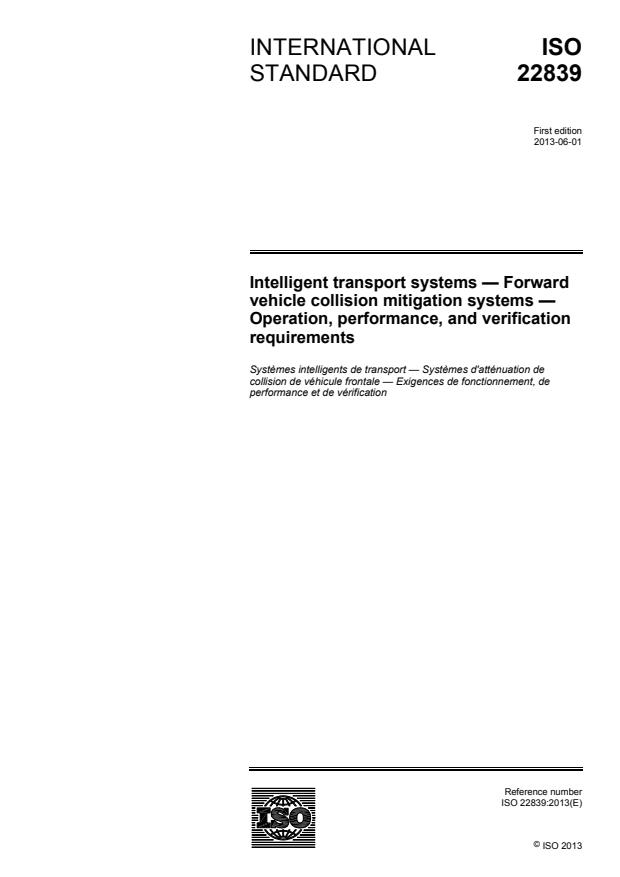
INTERNATIONAL ISO
STANDARD 22839
First edition
2013-06-01
Intelligent transport systems — Forward
vehicle collision mitigation systems —
Operation, performance, and verification
requirements
Systèmes intelligents de transport — Systèmes d'atténuation de
collision de véhicule frontale — Exigences de fonctionnement, de
performance et de vérification
Reference number
©
ISO 2013
© ISO 2013
All rights reserved. Unless otherwise specified, no part of this publication may be reproduced or utilized otherwise in any form or by any
means, electronic or mechanical, including photocopying, or posting on the internet or an intranet, without prior written permission.
Permission can be requested from either ISO at the address below or ISO’s member body in the country of the requester.
ISO copyright office
Case postale 56 CH-1211 Geneva 20
Tel. + 41 22 749 01 11
Fax + 41 22 749 09 47
E-mail copyright@iso.org
Web www.iso.org
Published in Switzerland
ii © ISO 2013 – All rights reserved
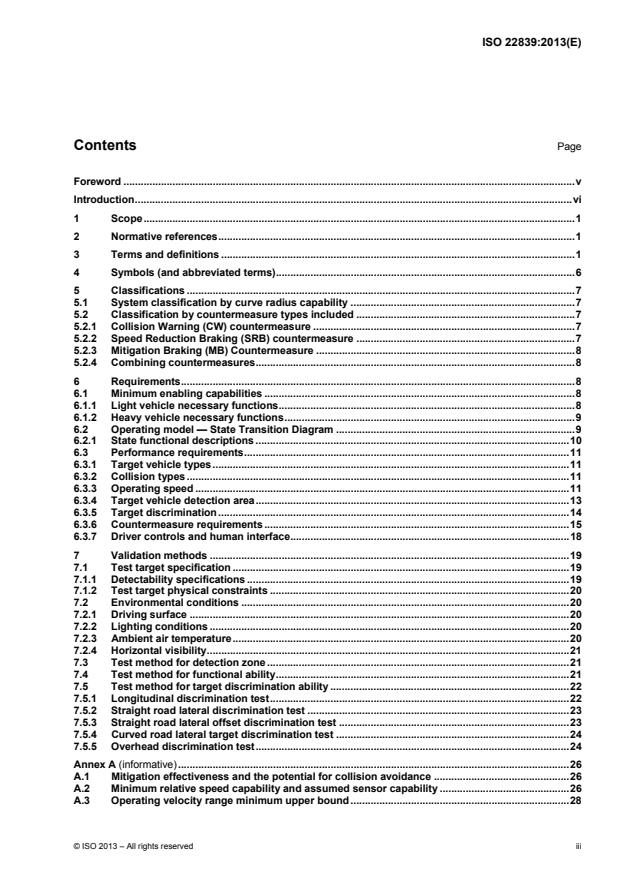
Contents Page
Foreword . v
Introduction . vi
1 Scope . 1
2 Normative references . 1
3 Terms and definitions . 1
4 Symbols (and abbreviated terms) . 6
5 Classifications . 7
5.1 System classification by curve radius capability . 7
5.2 Classification by countermeasure types included . 7
5.2.1 Collision Warning (CW) countermeasure . 7
5.2.2 Speed Reduction Braking (SRB) countermeasure . 7
5.2.3 Mitigation Braking (MB) Countermeasure . 8
5.2.4 Combining countermeasures . 8
6 Requirements . 8
6.1 Minimum enabling capabilities . 8
6.1.1 Light vehicle necessary functions . 8
6.1.2 Heavy vehicle necessary functions . 9
6.2 Operating model — State Transition Diagram . 9
6.2.1 State functional descriptions . 10
6.3 Performance requirements . 11
6.3.1 Target vehicle types . 11
6.3.2 Collision types . 11
6.3.3 Operating speed . 11
6.3.4 Target vehicle detection area . 13
6.3.5 Target discrimination . 14
6.3.6 Countermeasure requirements . 15
6.3.7 Driver controls and human interface . 18
7 Validation methods . 19
7.1 Test target specification . 19
7.1.1 Detectability specifications . 19
7.1.2 Test target physical constraints . 20
7.2 Environmental conditions . 20
7.2.1 Driving surface . 20
7.2.2 Lighting conditions . 20
7.2.3 Ambient air temperature . 20
7.2.4 Horizontal visibility . 21
7.3 Test method for detection zone . 21
7.4 Test method for functional ability . 21
7.5 Test method for target discrimination ability . 22
7.5.1 Longitudinal discrimination test . 22
7.5.2 Straight road lateral discrimination test . 23
7.5.3 Straight road lateral offset discrimination test . 23
7.5.4 Curved road lateral target discrimination test . 24
7.5.5 Overhead discrimination test . 24
Annex A (informative) . 26
A.1 Mitigation effectiveness and the potential for collision avoidance . 26
A.2 Minimum relative speed capability and assumed sensor capability . 26
A.3 Operating velocity range minimum upper bound . 28
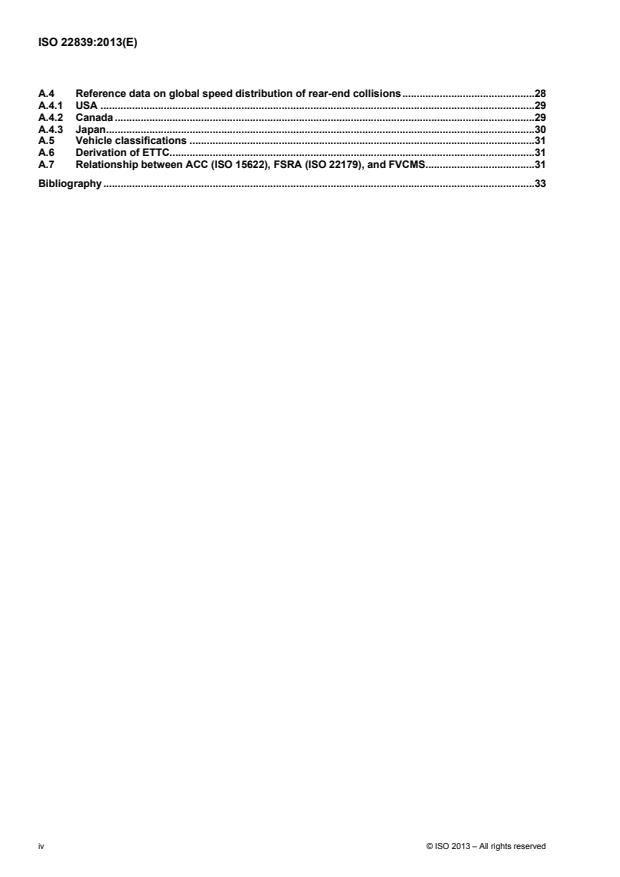
A.4 Reference data on global speed distribution of rear-end collisions .28
A.4.1 USA .29
A.4.2 Canada .29
A.4.3 Japan .30
A.5 Vehicle classifications .31
A.6 Derivation of ETTC.31
A.7 Relationship between ACC (ISO 15622), FSRA (ISO 22179), and FVCMS .31
Bibliography .33
iv © ISO 2013 – All rights reserved
Foreword
ISO (the International Organization for Standardization) is a worldwide federation of national standards bodies
(ISO member bodies). The work of preparing International Standards is normally carried out through ISO
technical committees. Each member body interested in a subject for which a technical committee has been
established has the right to be represented on that committee. International organizations, governmental and
non-governmental, in liaison with ISO, also take part in the work. ISO collaborates closely with the
International Electrotechnical Commission (IEC) on all matters of electrotechnical standardization.
The procedures used to develop this document and those intended for its further maintenance are described
in the ISO/IEC Directives, Part 1. In particular the different approval criteria needed for the different types of
ISO documents should be noted. This document was drafted in accordance with the editorial rules of the
ISO/IEC Directives, Part 2. www.iso.org/directives
Attention is drawn to the possibility that some of the elements of this document may be the subject of patent
rights. ISO shall not be held responsible for identifying any or all such patent rights. Details of any patent
rights identified during the development of the document will be in the Introduction and/or on the ISO list of
patent declarations received. www.iso.org/patents
Any trade name used in this document is information given for the convenience of users and does not
constitute an endorsement.
The committee responsible for this document is ISO/TC 204, Intelligent transport systems.
Introduction
Forward Vehicle Collision Mitigation Systems (FVCMS) reduce the severity of forward vehicle collisions that
cannot be avoided, and may reduce the likelihood of collision with forward vehicles. FVCMS require
information about range to forward vehicles, motion of forward vehicles, motion of the subject vehicle, driver
commands and driver actions. FVCMS detect vehicles ahead, determine if detected vehicles represent a
hazardous condition, and warn the driver if a hazard exists. They estimate if the driver has an adequate
opportunity to respond to the hazard. If there is inadequate time available for the driver to respond, and if
appropriate criteria are met, FVCMS determine that a collision is imminent. Based upon this assessment, the
FVCMS will activate vehicle brakes to mitigate collision severity.
Subject Vehicle
Motion
Determination
Forward Vehicle Driver Warnings
FVCMS
Sensing and and Vehicle
Action
Motion Controls
Strategy
Determination Activation
Figure 1 — Forward Vehicle Collision Mitigation Systems (FVCMS) Functional Elements
System designers and other users of this International Standard may apply it to stand-alone FVCMS or to the
integration of the FVCMS functions into other driving assistance and support systems.
vi © ISO 2013 – All rights reserved
INTERNATIONAL STANDARD ISO 22839:2013(E)
Intelligent transport systems — Forward vehicle collision
mitigation systems — Operation, performance, and verification
requirements
1 Scope
This International Standard specifies the concept of operation, minimum functionality, system requirements,
system interfaces, and test methods for Forward Vehicle Collision Mitigation Systems (FVCMS). It specifies
the behaviours that are required for FVCMS, and the system test criteria necessary to verify that a given
implementation meets the requirements of this International Standard. Implementation choices are left to
system designers, wherever possible.
FVCMS mitigate rear-end collisions. By reducing the collision energy, FVCMS reduce the degree of property
damage, personal injury, or the likelihood of fatality. They supplement crashworthiness systems such as
airbags, seatbelts and other energy-absorbing systems by reducing the impact energy that must be isolated
from the occupants. By automatically activating collision mitigation braking after a Collision Warning occurs,
FVCMS assist in slowing the vehicle when a collision is likely. While collision avoidance is not required, this
International Standard permits collision avoidance to be attempted by a system that conforms to FVCMS.
Responsibility for the safe operation of the vehicle remains with the driver.
With the exceptions of single-track vehicles and trucks with dual or triple trailers, FVCMS are for use on road
vehicles intended for public and non-public roadways. These systems are not intended for off-road use.
2 Normative references
The following documents, in whole or in part, are normatively referenced in this document and are
indispensable for its application. For dated references, only the edition cited applies. For undated references,
the latest edition of the referenced document (including any amendments) applies.
ISO 15622, Intelligent transport systems — Adaptive Cruise Control systems — Performance requirements
and test procedures
ISO 15623, Transport information and control systems — Forward vehicle collision warning systems —
Performance requirements and test procedures
ISO 22179, Intelligent transport systems — Full speed range adaptive cruise control (FSRA) systems —
Performance requirements and test procedures
3 Terms and definitions
For the purposes of this document, the following terms and definitions apply.
3.1
adaptive cruise control
ACC
enhancement to conventional cruise control systems which allows the subject vehicle to follow a forward
vehicle at an appropriate distance by controlling the engine and/or power train and optionally the brake
Note 1 to entry: See ISO 15622.
3.2
adjacent lane
lane of travel sharing one lane boundary with the lane in which the subject vehicle is traveling, and having the
same direction of travel as the subject vehicle
3.3
articulated vehicle
any road vehicle with more than two wheels that is configured for normal road use with at least two segments,
and for which each adjacent pair of segments is connected by a joint, and for which propulsion is provided by
at least one segment
3.4
brakes
components which generate the forces opposing the movement of the vehicle
EXAMPLES Friction brakes (when the forces are generated by friction between two parts of the vehicle moving
relative to one another); electrical brakes (when the forces are generated by electro-magnetic action between two parts of
the vehicle moving relatively but not in contact with one another); fluid brakes (when the forces are generated by the
action of a fluid situated between two parts of the vehicle moving relatively to one another); or engine brakes (when the
forces are derived from an artificial increase in the braking action, transmitted to the wheels, of the engine).
3.5
braking distance
distance the vehicle will travel from the point where its brakes are applied to where it comes to a complete
stop
3.6
clearance
x (t)
c
distance x (t) from the target vehicle trailing surface to the subject vehicle leading surface
c
x (t)
c
3.7
Collision Warning
CW
information that FVCMS gives to the driver to indicate the need for urgent action to avoid a collision
Note 1 to entry: This warning is issued to warn the driver of the need to perform an emergency manoeuvre in order to
avoid a collision.
3.8
conventional cruise control
system capable of maintaining the speed of a vehicle as set by the driver
3.9
countermeasure action point
CAP
value of pre-collision urgency parameter (PUP), relative to an expected collision, for which FVCMS initiates a
countermeasure
3.10
driver disengage
driver initiated transition from FVCMS Active or Inactive state to FVCMS Off state
2 © ISO 2013 – All rights reserved
3.11
enhanced time to collision
ETTC
time that it will take a subject vehicle to collide with the target vehicle assuming the relative acceleration
between the subject vehicle (SV) and target vehicle (TV) remains constant, as given in the following equation:
2
()vv ()vv 2*(aa)*x
TV SV TV SV TV SV c
ETTC
()aa
TV SV
3.12
forward adjacent vehicle
vehicle not in the path of the subject vehicle (SV), and entirely ahead of a line touching the SV front bumper at
only one point and perpendicular to the longitudinal axis of the SV
3.13
forward ranging sensor
component which detects objects in at least part of the region entirely ahead of the front bumper
3.14
forward vehicle
FV
vehicle in front of the subject vehicle (SV), which is moving in the same direction and traveling in the same
path, or which is oriented in the same direction if it is not moving
3.15
forward vehicle collision
collision between the subject vehicle (SV) and a forward vehicle (FV)
3.16
Forward Vehicle Collision Mitigation Systems
FVCMS
vehicle systems meeting the requirements of ISO 22839 that assess the likelihood of a collision between the
front of the subject vehicle (SV) and the rear of a target vehicle (TV), and when such a collision is very likely,
activates the brakes automatically to reduce the relative speed at which the SV and TV may collide
3.17
Forward Vehicle Collision Warning Systems
FVCWS
systems capable of warning the driver of a potential collision with another vehicle in the forward path of the
subject vehicle, excluding conditions where the subject and forward vehicle are not in the same direction of
travel
Note 1 to entry: See ISO 15623.
3.18
heavy vehicle
any single vehicle or combination of vehicles defined as Category 1-2 or Category 2 in the United Nations
Economic and Social Council World Forum for Harmonization of Vehicle Regulations (WP.29)
TRANS/WP.29/1045
3.19
jerk
third derivative with respect to time of the position of an object, equivalently the rate of change of the
acceleration of an object, considered a measure of the harshness of vehicle motion
3.20
lateral offset
lateral distance between the longitudinal centerlines of a subject vehicle (SV) and a target vehicle (TV),
measured as a percentage of the width of the SV, such that if the centers of the two vehicles are aligned, the
value is zero
3.21
light vehicle
any single vehicle or combination of vehicles defined as Category 1-1 in the United Nations Economic and
Social Council World Forum for Harmonization of Vehicle Regulations (WP.29) TRANS/WP.29/1045
3.22
mitigation braking
MB
FVCMS countermeasure that responds to the detection of a very likely rear-end collision by automatically
activating braking to quickly reduce the relative velocity, within the minimum requirements
3.23
minimum countermeasure action point
MCAP
value of PUP, relative to an expected collision, for which initiation of a specific countermeasure shall be
required
3.24
minimum FVCMS deceleration
minimum FVCMS deceleration that the system must achieve while mitigation braking (MB) is active,
measured on smooth, dry, clean pavement
3.25
minimum velocity
V
min
minimum subject vehicle (SV) speed for which FVCMS must be capable of activating a countermeasure
3.26
override
driver initiated suppression of an MB, SRB, or CW countermeasure
3.27
pre-collision urgency parameter
PUP
real-time parameter that signifies the urgency of a potential future collision
3.28
rear-end collision
forward vehicle collision in which the front of the subject vehicle strikes the rear of the forward vehicle
3.29
relative velocity
v (t)
r
difference in longitudinal velocity between the subject vehicle (SV) and the target vehicle (TV), v (t), given by
r
the equation with a positive value signifying that the target vehicle is moving faster than the subject vehicle,
and therefore the clearance is increasing with time
vt()v ()t v ()t
rTV SV
4 © ISO 2013 – All rights reserved
3.30
required deceleration
minimum deceleration that, if constant, would enable the subject vehicle to match the velocity of the target
vehicle without contacting the target vehicle and thus prevent a collision
3.31
single track vehicle
vehicle that leaves a single ground track as it moves forward
Note 1 to entry: Single track vehicles usually have little to no lateral stability when stationary but develop it when moving
forward or controlled.
3.32
speed reduction braking
SRB
FVCMS countermeasure that reduces the subject vehicle speed by activating the brakes allowing the driver
time to analyse and respond to a potential collision, which may have the additional effect of drawing driver
attention to hazards ahead of the subject vehicle (SV)
3.33
subject vehicle
SV
vehicle equipped with FVCMS as defined herein
3.34
target vehicle
TV
forward vehicle that is within the effective range of the subject vehicle (SV)’s forward ranging sensor
3.35
time gap
value calculated from vehicle speed and clearance by: Time Gap = Clearance / Vehicle Speed
3.36
time to collision
TTC
time that it will take a subject vehicle to collide with the target vehicle assuming the relative velocity remains
constant, as given in the following equation:
x
c
TTC
r
3.37
truck-tractor
heavy single-chassis vehicle providing propulsion, control, and crew (driver) accommodation, with the primary
purpose of controlling and transporting one or more separate load-carrying trailers
3.38
unit truck
heavy single-chassis vehicle providing its own propulsion, control, and crew (driver) accommodation, with a
significant cargo or other payload section
3.39
warning braking
WB
action in which FVCMS respond to detection of a possible rear-end collision by automatically activating the
brake to provide a warning to the driver
4 Symbols (and abbreviated terms)
a Acceleration of the TV
TV
a Acceleration of the SV
SV
ABS Anti-lock Brake System
ACC Adaptive Cruise Control
CAP Countermeasure Action Point
CTT Coefficient for Test Target
CW Collision Warning
D Deceleration of target vehicle
TV
D Deceleration of subject vehicle
SV
d Maximum detectable distance
max
d Minimum detectable distance for a laterally offset vehicle
d Minimum distance with distance measuring
d Minimum detectable distance without distance measuring
h Upper limit of detectable zone, from ground
h Lower limit of detectable zone, from ground
ESC Electronic Stability Control
ETTC Enhanced Time to Collision
FV Forward Vehicle
FVCWS Forward Vehicle Collision Warning Systems
FVCMS Forward Vehicle Collision Mitigation Systems
MB Mitigation Braking
MCAP Minimum Countermeasure Action Point for Mitigation Braking
MB
MCAP Minimum Countermeasure Action Point for Speed Reduction Braking
SRB
MCAP Minimum Countermeasure Action Point for Collision Warning
CW
PUP Pre-collision Urgency Parameter
RCS Radar Cross Section
RSC Roll Stability Control
SRB Speed Reduction Braking
SV Subject Vehicle
TTC Time to Collision
TV Target Vehicle
V Minimum SV path velocity for FVCMS operation
min
v (t) Subject vehicle path velocity
SV
v (t) Relative path velocity between SV and TV
r
v (t) Target vehicle path velocity
TV
V Maximum SV path velocity for FVCMS operation
max
WB Warning Braking
W Width of subject vehicle
v
6 © ISO 2013 – All rights reserved
W Width of lane
l
x (t) Distance between SV and TV
c
5 Classifications
This Clause provides introductory information that explains the different classifications of FVCMS that are
covered by this International Standard. This Clause is not intended to define requirements. All requirements of
this International Standard appear in Clauses 6 and 7.
5.1 System classification by curve radius capability
Systems are classified according to curve radius capability as shown in Table 1.
Table 1 — System classifications
Class Horizontal curve radius capability
I curve radius greater than or equal to 500 m
II curve radius greater than or equal to 250 m
III curve radius greater than or equal to 125 m
Class I systems shall have the capability to detect forward obstacle vehicles in the subject vehicle’s trajectory
along curves of radii down to 500 meters.
Class II systems shall have the capability to detect forward obstacle vehicles in the subject vehicle’s trajectory
along curves of radii down to 250 meters.
Class III systems shall have the capability to detect forward obstacle vehicles in the subject vehicle’s trajectory
along curves of radii down to 125 meters.
5.2 Classification by countermeasure types included
FVCMS may be classified based on the countermeasures that are provided. Classification is based on the
minimum countermeasures and on additional countermeasures that may be provided. Each countermeasure
has an associated minimum countermeasure action point (MCAP). FVCMS activate a countermeasure when
the pre-collision urgency parameter (PUP) is at least equal to the minimum countermeasure action point for
that countermeasure.
5.2.1 Collision Warning (CW) countermeasure
Collision Warning is a warning based on some combination of audible, visual and tactile or haptic sensory
modes, meeting the requirements of ISO 15623 for the operation range of FVCMS as depicted in Figure 4.
A Collision Warning countermeasure shall occur no later than the initiation of SRB or MB.
5.2.2 Speed Reduction Braking (SRB) countermeasure
Speed reduction braking is an automatic braking function, intended to reduce subject vehicle velocity. SRB
affords the driver an improved opportunity to apply manual emergency braking, to make an emergency lane
change, or to determine that no hazard is present and to disengage SRB. Any of these actions could prevent
MB from activating. To assist the occupants to prepare for this braking event, SRB actuation is preceded by a
Collision Warning countermeasure.
SRB will not be initiated if MB is active.
5.2.3 Mitigation Braking (MB) Countermeasure
Mitigation braking is automatic braking applied when a collision appears unavoidable. MB will be initiated if the
PUP is at least equal to the threshold value, MCAP .
MB
The activation of the mitigation braking countermeasure will result in an impact that is less damaging than it
would be if the SV and a TV collided without any mitigation. In some scenarios it may also lead to
automatically avoiding the collision. The peak acceleration and the jerk are limited by the design and condition
of vehicle systems, and by available traction. To assist the occupants to prepare for this braking event, MB
actuation will be preceded by a Collision Warning countermeasure, and optionally by the activation of SRB.
5.2.4 Combining countermeasures
The possible configurations for FVCMS are presented in Table 2 below. Each row represents a distinct
system Type. Any combinations which are not identified in this Table are not within the scope of this
International Standard. For each Type, the row indicates which countermeasures are required. A “1” indicates
that the countermeasure is required, and a “0” indicates that the countermeasure shall not be included.
Table 2 — Permissible system configurations
Type MB SRB CW
1 0 1 1
2 1 0 1
3 1 1 1
6 Requirements
6.1 Minimum enabling capabilities
The definition of FVCMS performance requires that the subject vehicle be equipped with at least one means
for accomplishing each of the necessary system functions. All FVCMS shall provide CW in accordance with
ISO 15623 for the operation range of FVCMS as depicted in Figure 4.
6.1.1 Light vehicle necessary functions
Light vehicles equipped with FVCMS shall be capable of fulfilling the following functions:
detect the presence of forward vehicles;
determine the range and closing velocity between the SV and the detected forward vehicles;
determine the subject vehicle velocity;
initiate appropriate FVCMS countermeasures when the lateral offset is less than 20 %, even if part of the
TV is occluded from SV sensors;
provide driver warnings in accordance with the FVCWS requirements;
activate and modulate the brakes whether or not the driver is already braking;
control the brake light;
8 © ISO 2013 – All rights reserved
enhance driver control based on brakes with a yaw stability capability and a capability to manage
longitudinal wheel slip, e.g. an ESC or RSC system combined if necessary with an ABS capability;
generate at least the minimum required FVCMS deceleration during an MB event for Type 2 and 3
systems;
have the capability to provide the SRB braking profile for Type 1 or Type 3 systems;
after MB or SRB has been initiated, permit the driver to increase the deceleration to any higher value up
to the maximum possible vehicle deceleration.
6.1.2 Heavy vehicle necessary functions
Heavy vehicles equipped with FVCMS shall fulfil the same functions as light vehicles, but with the following
added function:
FVCMS countermeasures shall not lead to jack-knifing (the folding, at the linkage between cab and trailer,
of an articulated vehicle until the cab and trailer form a “V” shape).
6.2 Operating model — State Transition Diagram
The FVCMS shall function according to the State Transition Diagram of Figure 2. Specific implementation,
beyond what is illustrated below, of the state transitions is left to the manufacturer.
SV Speed => V SV Speed <=V
min max
Gear Selector is in Drive or another
Forward Gear, and no failure detected
FVCMS ACTIVE
6.2.1.3
Failure Detected
Ignition On
SRB CW
(automatic recovery
(Type 1 and
possible)
3 Only)
FVCMS OFF
FVCMS INACTIVE
6.2.1.1
6.2.1.2
Override
(for SRI)
MB
SV Speed < V
Ignition Off, or Fail min
(Type 2 and
SV Speed >V
Self-test max
3 Only)
Gear Selector is in a
gear not used for
forward driving
Fail Self-test or Ignition Off
Figure 2 — FVCMS State Transition Diagram
The FVCMS may optionally function according to the State Transition Diagram of Figure 3. Specific
implementation, beyond what is illustrated below, of the state transitions is left to the manufacturer.
SV Speed => V SV Speed <=V
min max
Gear Selector is in Drive or another
Forward Gear, and no failure detected
Ignition On or (optional)
FVCMS ACTIVE
DriverTurn On
6.2.1.3
Failure Detected
CW
SRB (Type
(automatic recovery
1 and 3
possible)
Only)
FVCMS OFF
FVCMS INACTIVE
6.2.1.1
6.2.1.2
Override
(MB Optional)
MB (Type 2
SV Speed < V
Ignition Off, or Fail min
and 3 Only)
SV Speed >V
Self-test, or max
Gear Selector is in a
(optional) Driver
gear not used for
Disengage
forward driving
Fail Self-test, Ignition Off or Driver
Disengage
Figure 3 — FVCMS State Transition Diagram including optional features
6.2.1 State functional descriptions
The FVCMS state descriptions address the functional requirements of FVCMS, identifying which functions
shall be performed in each state.
6.2.1.1 FVCMS Off
No countermeasures are performed in the FVCMS Off state. Upon turning the ignition to the off position,
FVCMS shall transition to the FVCMS Off state. Whenever the self-test function determines that FVCMS are
not able to deliver adequate performance, or when the driver manually disengages the FVCMS (optional), it
shall transition to the FVCMS Off state. FVCMS may be in the FVCMS Off state when the vehicle is on.
6.2.1.2 FVCMS Inactive
In the FVCMS Inactive state, FVCMS shall monitor vehicle speed and gear status and determine if it is
appropriate to activate the system.
FVCMS shall enter the FVCMS Inactive state from the FVCMS Off state if the ignition cycle has been
completed and the engine is running. FVCMS shall enter this state from the Active state if the conditions for
activating are not met. For example, if the vehicle speed drops below V , Reverse gear is selected, or Park
min
is selected. Based on the results of a diagnostic self-test, function of all or some of the countermeasures may
be restored. If a manufacturer defined failure mode is encountered for which an automatic recovery (optional)
is possible, the FVCMS shall transition from FVCMS Active state to FVCMS Inactive state. Once the recovery
occurs the system may transition back to FVCMS Active state. Finally, if the driver manually engages FVCMS
(optional), then it shall transition from the FVCMS Off state to the FVCMS Inactive state.
6.2.1.3 FVCMS Active
The FVCMS when Active shall monitor for triggering conditions resulting in the selection of appropriate
countermeasures, and decide to activate or optionally override countermeasures.
If a system failure occurs or there is an inability to perform a countermeasure, FVCMS shall transfer to the
FVCMS Inactive state if automatic recovery from the failure is possible. If the system fails a self-test
10 © ISO 2013 – All rights reserved
(automatic recovery without driver intervention is not possible) FVCMS shall transfer to the FVCMS Off state.
Means of notification of these failures to the driver is left up to the manufacturer.
FVCMS shall enter this state if gear select is in Drive or any forward motion selection and the vehicle speed is
greater than or equal to V and less than V .
min max
6.3 Performance requirements
The requirements of this Subclause are applicable to driving conducted on clean, smooth, dry pavement.
6.3.1 Target vehicle types
FVCMS shall provide countermeasure actions when needed based on detected licensable motor vehicles
intended for use on public roads, i.e. motorcycles, cars, light trucks, buses, motor coaches, and other heavy
vehicles. FVCMS may optionally detect smaller targets, such as pedestrians and human-powered cycles.
6.3.2 Collision types
FVCMS shall function in rear-end collision scenarios with respect to all target vehicles.
6.3.3 Operating speed
The operating speed and relative speed constraints are shown in Figure 4. Regions coloured pink (the shaded
zone above the diagonal line) represent conditional operation conditions; regions coloured green (the shaded
zones below the diagonal line) are May–operate cases; and regions coloured grey are must-operate
conditions. The upper limits on maximum speed for operation, both for the subject vehicle and the target
vehicle, are left to the manufacturer.
6.3.3.1 Subject vehicle
FVCMS shall initiate countermeasures (as defined in 6.3.6.4.1 for MB and 6.3.6.5.1 for SRB) if conditions are
met and if the subject vehicle speed is between V and V .
min max
6.3.3.1.1 Minimum subject vehicle speed (V )
min
All FVCMS shall have V of 8,4 m/s (30 km/h) or less.
min
FVCMS shall enter the Inactive state if the subject vehicle speed drops below V and mitigation braking is
min
not in process. The value of V shall be declared in the owner's manual.
min
Figure 4 — Operation range of FVCMS
6.3.3.1.2 Maximum subject vehicle speed (V )
max
All FVCMS shall have V of 27,8 m/s (100 km/h) or greater or the maximum vehicle speed in case it is below
max
27,8 m/s.
The value of V shall be declared in the owner's manual if it is less than the speed capability of the car.
max
6.3.3.2 Target vehicle
6.3.3.2.1 Minimum target vehicle speed
The minimum target vehicle speed shall not be greater than 4,2 m/s for any subject vehicle speed.
The minimum target vehicle speed for initial FVCMS detection shall be determined by the SV manufacturer.
FVCMS shall function for any target vehicle speed within the detection range constraints of 6.3.4 and remain
functional while the target vehicle reduces its speed to 0 m/s.
FVCMS shall also meet the relative velocity requirements of 6.3.3.3.
6.3.3.2.2 Maximum target vehicle speed
FVCMS shall function for target vehicles moving at any speed up to V less the minimum relative velocity
max
(as defined in 6.3.3.3) consistent with the operation range of FVCMS depicted in Figure 4.
12 © ISO 2013 – All rights reserved
6.3.3.2.3 Maximum lateral offset (lateral discrimination)
FVCMS shall function when the lateral offset is 20 % or lower in either direction. FVCMS may function for
lateral offsets greater than 20 % at the discretion of the manufacturer.
6.3.3.2.4 Maximum lateral speed
When there is a lateral offset, FVCMS shall function for relative vehicle lateral speeds of less than 0,2 m/s.
FVCMS may function for relative vehicle lateral speeds greater than 0,2 m/s at the discretion of the
manufacturer.
6.3.3.3 Relative velocity
FVCMS shall function for any relative velocity condition when the SV is closing in on the TV and the relative
velocity v(t) is between −4,2 m/s (−15 km/h) and −20 m/s (−72 km/h). Manufacturers may extend the
r
operating zone beyond these limits at their discretion.
If the required deceleration exceeds the minimum required deceleration for MB due to a deceleration of a
target vehicle, then the subject vehicle is permitted to apply SRB or MB in the conditional operation zone of
Figure 4. If the ETTC is less than 4 s, then the system is permitted to apply SRB in the conditional operation
zone.
6.3.4 Target vehicle detection area
FVCMS shall monitor the area ahead of the SV whenever it is in the Active state. Sensor type(s) and
mounting location(s) are left up to the manufacturer. The width of the detection range for horizontal curve
radius shall be extended in relation to the curve’s radius as per ISO 15623.
6.3.4.1 Minimum detection area
The minimum detection area shall be as defined in Figure 5, and Tables 3 and 4.
h
d
h
d
d
d
max
W W
L V
Figure 5 — Minimum detection area
6.3.4.2 Detection range
Table 3 — Detection range
Distance Formula or value Meaning
d shall be the distance at which PUP =MCAP The maximum detectable distance.
max CW
d Shall be less than or equal to 10 m for Class I May The minimum detection distance for a forward
be less than or equal to 7,5 m for Class II May be vehicle with a lateral offset of less than 20 %.
less than or equal to 5 m for Class III Class as defined in ISO 15623.
d Shall at least be the distance at which The system minimum distance with distance
PUP>=MCAP measuring capability.
MB
d Shall be less than or equal to 2 m The minimum distance at which target vehicle
presence can be determined without distance
measuring capability.
where MCAP and MCAP are design parameters for actual systems.
CW MB
The values of these parameters are determined by the vehicle manufacturer.
6.3.4.3 Detection width and detection height
Table 4 — Detection width and detection height requirements
Distance Minimum detection width Minimum detection height
d W (lane width) meters h (lower detection height from ground) = 0,2 m
max L 1
and h (upper detection height from ground) =
1,1 m
d W (subject vehicle width) meters h (lower detection height from ground) = 0,2 m
2 V 1
and h (upper detection height from ground) =
1,1 m
d not specified not specified
d not specified not specified
6.3.5 Target discrimination
6.3.5.1 Longitudinal discrimination
If two or more forward vehicles are detected, FVCMS shall base countermeasure actions on the one with the
value of PUP indicating the greatest probability of collision.
6.3.5.2 Lateral discrimination
If one forward vehicle is in the subject vehicle path and a forward adjacent vehicle is present, the system shall
base warnings and mitigation braking on the vehicle in the subject vehicle path.
6.3.5.3 Overhead discrimination
The FVCMS shall not initiate MB, SRB, or CW countermeasures based on the detection of overhead targets
at a height greater than 4,5 m above the roadway.
14 © ISO 2013 – All rights reserved
6.3.6 Countermeasure requirements
6.3.6.1 Provision of MB or SRB
All FVCMS shall provide MB or SRB.
6.3.6.2 Provision of CW
All FVCMS shall provide CW.
6.3.6.3 Brake light control
If FVCMS applies automatic service braking, the brake lights shall be illuminated. The brake lights shall be
illuminated within 350 ms after FVCMS initiates the automatic service brake. To prevent irritating brake light
flickering, the brake light may remain on for a reasonable time after the FVCMS initiated braking has ended.
6.3.6.4 Mitigation braking requirements
The following requirements represent minimum functionality as defined for FVCMS operation. Manufacturers
may exceed this minimum functionality at their discretion.
6.3.6.4.1 Initiation of mitigation braking
6.3.6.4.1.1 Light vehicles
MB shall not be initiated for TTC or ETTC above 3,0 s to achieve the deceleration requirement of 6.3.6.4.2.
6.3.6.4.1.2 Heavy vehicles
MB shall not be initiated for TTC or ETTC above 4,0 s to achieve the deceleration requirement of 6.3.6.4.2.
6.3.6.4.2 Minimum deceleration in mitigation braking
6.3.6.4.2.1 Light vehicles
FVCMS shall generate a deceleration at least 5,0 m/s (0,51 g) for a duration chosen to achieve a speed
reduction of at least 2,0 m/s. FVCMS with both MB and SRB combined (Type 3) shall generate a minimum
speed reduction of at least 4,0 m/s. This requirement does not constrain the time when mitigation braking is
activated.
6.3.6.4.2.2 Heavy vehicles
FVCMS shall generate a deceleration at least 3,3 m/s (0,34 g) for a duration chosen to achieve a speed
reduction of at least 1,0 m/s. This requirement does not constrain the time when mitigation braking is
activated.
6.3.6.4.3 Driver-commanded enhancement of mitigation braking
FVCMS shall allow a driver-initiated increase in braking force unless the SV is already braking at its maximum
capability.
6.3.6.4.4 Termination of mitigation braking
FVCMS may deactivate mitigation braking if the PUP becomes less than MCAP . If such deactivation is
mb
implemented, and the PUP changes quickly in response to SV and TV relative position or path velocity
changes, the manufacturer may prevent chattering, e.g. by introducing hysteresis into the deactivation control.
© ISO
...