


ISO/TS 17187:2013
(Main)Intelligent transport systems — Electronic information exchange to facilitate the movement of freight and its intermodal transfer — Governance rules to sustain electronic information exchange methods
Intelligent transport systems — Electronic information exchange to facilitate the movement of freight and its intermodal transfer — Governance rules to sustain electronic information exchange methods
ISO/TS 17187:2013 provides governance rules to be used for executing an organized process for business entities to connect to one another electronically for the conduct of electronic trade in a secure and open environment through a standardized framework for information exchange. This standardized framework includes the processes and process tools that will ease connections between trading partners, provide full visibility, and reduce the time goods spend in transit. Additionally, the application of these rules and attendant standards and technology applications are expected to allow business entities to engage their legacy systems without the cost of upgrades.
Systèmes intelligents de transport — Échange d'informations électroniques pour faciliter le mouvement du fret et son transfert intermodal — Règles de gouvernance pour soutenir les méthodes d'échange d'informations électroniques
General Information
- Status
- Withdrawn
- Publication Date
- 25-Nov-2013
- Withdrawal Date
- 25-Nov-2013
- Technical Committee
- ISO/TC 204 - Intelligent transport systems
- Drafting Committee
- ISO/TC 204/WG 7 - General fleet management and commercial/freight
- Current Stage
- 9599 - Withdrawal of International Standard
- Start Date
- 06-Dec-2019
- Completion Date
- 12-Feb-2026
Relations
- Effective Date
- 27-Jan-2018

ISO/TS 17187:2013 - Intelligent transport systems -- Electronic information exchange to facilitate the movement of freight and its intermodal transfer -- Governance rules to sustain electronic information exchange methods
Get Certified
Connect with accredited certification bodies for this standard

BSI Group
BSI (British Standards Institution) is the business standards company that helps organizations make excellence a habit.

Great Wall Tianjin Quality Assurance Center
Established 1993, first batch to receive national accreditation with IAF recognition.
Hong Kong Quality Assurance Agency (HKQAA)
Hong Kong's leading certification body.
Sponsored listings
Frequently Asked Questions
ISO/TS 17187:2013 is a technical specification published by the International Organization for Standardization (ISO). Its full title is "Intelligent transport systems — Electronic information exchange to facilitate the movement of freight and its intermodal transfer — Governance rules to sustain electronic information exchange methods". This standard covers: ISO/TS 17187:2013 provides governance rules to be used for executing an organized process for business entities to connect to one another electronically for the conduct of electronic trade in a secure and open environment through a standardized framework for information exchange. This standardized framework includes the processes and process tools that will ease connections between trading partners, provide full visibility, and reduce the time goods spend in transit. Additionally, the application of these rules and attendant standards and technology applications are expected to allow business entities to engage their legacy systems without the cost of upgrades.
ISO/TS 17187:2013 provides governance rules to be used for executing an organized process for business entities to connect to one another electronically for the conduct of electronic trade in a secure and open environment through a standardized framework for information exchange. This standardized framework includes the processes and process tools that will ease connections between trading partners, provide full visibility, and reduce the time goods spend in transit. Additionally, the application of these rules and attendant standards and technology applications are expected to allow business entities to engage their legacy systems without the cost of upgrades.
ISO/TS 17187:2013 is classified under the following ICS (International Classification for Standards) categories: 03.220.01 - Transport in general; 35.240.60 - IT applications in transport. The ICS classification helps identify the subject area and facilitates finding related standards.
ISO/TS 17187:2013 has the following relationships with other standards: It is inter standard links to ISO/TS 17187:2019. Understanding these relationships helps ensure you are using the most current and applicable version of the standard.
ISO/TS 17187:2013 is available in PDF format for immediate download after purchase. The document can be added to your cart and obtained through the secure checkout process. Digital delivery ensures instant access to the complete standard document.
Standards Content (Sample)
TECHNICAL ISO/TS
SPECIFICATION 17187
First edition
2013-12-01
Intelligent transport systems —
Electronic information exchange to
facilitate the movement of freight and
its intermodal transfer — Governance
rules to sustain electronic information
exchange methods
Systèmes intelligents de transport — Échange d’informations
électroniques pour faciliter le mouvement du fret et son transfert
intermodal — Règles de gouvernance pour soutenir les méthodes
d’échange d’informations électroniques
Reference number
©
ISO 2013
© ISO 2013
All rights reserved. Unless otherwise specified, no part of this publication may be reproduced or utilized otherwise in any form
or by any means, electronic or mechanical, including photocopying, or posting on the internet or an intranet, without prior
written permission. Permission can be requested from either ISO at the address below or ISO’s member body in the country of
the requester.
ISO copyright office
Case postale 56 • CH-1211 Geneva 20
Tel. + 41 22 749 01 11
Fax + 41 22 749 09 47
E-mail copyright@iso.org
Web www.iso.org
Published in Switzerland
ii © ISO 2013 – All rights reserved
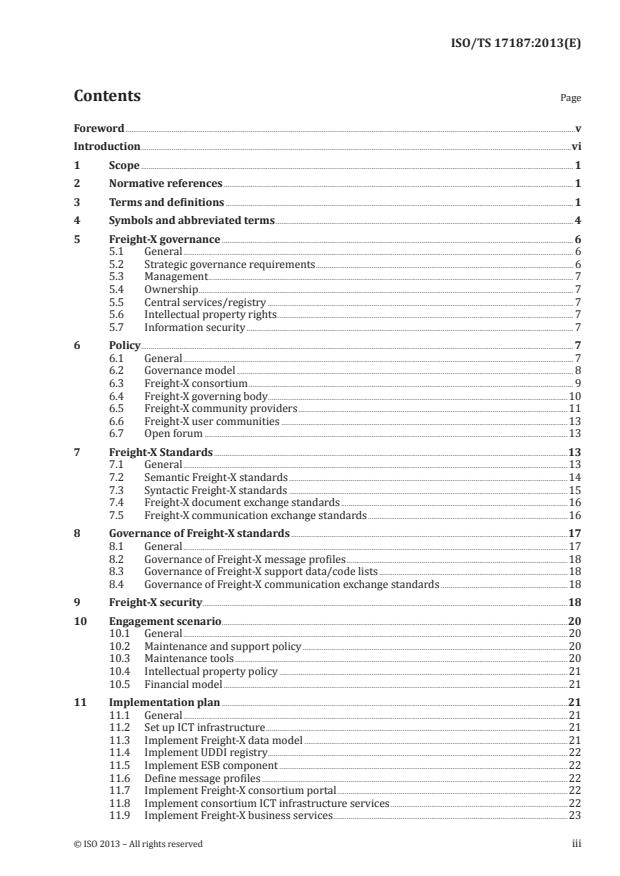
Contents Page
Foreword .v
Introduction .vi
1 Scope . 1
2 Normative references . 1
3 Terms and definitions . 1
4 Symbols and abbreviated terms . 4
5 Freight-X governance . 6
5.1 General . 6
5.2 Strategic governance requirements . 6
5.3 Management . 7
5.4 Ownership . 7
5.5 Central services/registry . 7
5.6 Intellectual property rights . 7
5.7 Information security . 7
6 Policy . 7
6.1 General . 7
6.2 Governance model . 8
6.3 Freight-X consortium . 9
6.4 Freight-X governing body .10
6.5 Freight-X community providers .11
6.6 Freight-X user communities .13
6.7 Open forum .13
7 Freight-X Standards .13
7.1 General .13
7.2 Semantic Freight-X standards .14
7.3 Syntactic Freight-X standards .15
7.4 Freight-X document exchange standards .16
7.5 Freight-X communication exchange standards .16
8 Governance of Freight-X standards .17
8.1 General .17
8.2 Governance of Freight-X message profiles .18
8.3 Governance of Freight-X support data/code lists .18
8.4 Governance of Freight-X communication exchange standards .18
9 Freight-X security .18
10 Engagement scenario .20
10.1 General .20
10.2 Maintenance and support policy .20
10.3 Maintenance tools .20
10.4 Intellectual property policy .21
10.5 Financial model .21
11 Implementation plan .21
11.1 General .21
11.2 Set up ICT infrastructure .21
11.3 Implement Freight-X data model .21
11.4 Implement UDDI registry.22
11.5 Implement ESB component .22
11.6 Define message profiles .22
11.7 Implement Freight-X consortium portal .22
11.8 Implement consortium ICT infrastructure services .22
11.9 Implement Freight-X business services .23
Annex A (informative) International freight UBL documents .24
Annex B (informative) Intermodal freight UBL documents.26
Annex C (informative) Code lists and code list schemas .27
Bibliography .29
iv © ISO 2013 – All rights reserved
Foreword
ISO (the International Organization for Standardization) is a worldwide federation of national standards
bodies (ISO member bodies). The work of preparing International Standards is normally carried out
through ISO technical committees. Each member body interested in a subject for which a technical
committee has been established has the right to be represented on that committee. International
organizations, governmental and non-governmental, in liaison with ISO, also take part in the work.
ISO collaborates closely with the International Electrotechnical Commission (IEC) on all matters of
electrotechnical standardization.
The procedures used to develop this document and those intended for its further maintenance are
described in the ISO/IEC Directives, Part 1. In particular the different approval criteria needed for the
different types of ISO documents should be noted. This document was drafted in accordance with the
editorial rules of the ISO/IEC Directives, Part 2 (see www.iso.org/directives).
Attention is drawn to the possibility that some of the elements of this document may be the subject of
patent rights. ISO shall not be held responsible for identifying any or all such patent rights. Details of
any patent rights identified during the development of the document will be in the Introduction and/or
on the ISO list of patent declarations received (see www.iso.org/patents).
Any trade name used in this document is information given for the convenience of users and does not
constitute an endorsement.
For an explanation on the meaning of ISO specific terms and expressions related to conformity
assessment, as well as information about ISO’s adherence to the WTO principles in the Technical Barriers
to Trade (TBT) see the following URL: Foreword - Supplementary information
The committee responsible for this document is ISO/TC 204, Intelligent transport systems.
Introduction
Electronic commerce offers new opportunities to improve the efficiency of business operations and to reduce
costs associated with trade procedures, providing increased competitive advantages to the commercial
actors ready to embrace new methods of work and trade. Emerging electronic commerce platforms and
the use of the Internet provide users with a combination of technologies to communicate data, to contract
electronically, as well as to manage new business processes leading to new business models.
Improved information sharing among supply chain partners is one of the key business objectives which
enable the participants to improve their operational efficiency and optimize their enterprise resource
allocations. Due to the existence of heterogeneous IT environments among supply chain partners, it is
a challenge for the implementer to seamlessly integrate information from multiple data sources and in
different data formats. Each data source is typically designed for a single, stand-alone purpose within an
enterprise, not to be part of an integrated data collection. Thus, these disparate data repositories tend to
be silos, independent of one another, and not working well together. Business entities wishing to engage
with other business partners to facilitate certain standards of practice for information interchange
will need to abide by certain rules, otherwise the efficiencies sought using the methodologies in this
Technical Specification will be diminished.
Within this context, and within this Technical Specification, “governance” is defined as “rules, processes,
and behaviour that affect the way in which powers are exercised…particularly as regards openness,
participation, accountability, effectiveness, and coherence”. As discussed in 5.2.5 of ISO/TS 24533, there
needs to be a governance process to tie loose ends together and allow the supply chain partners to keep
their data exchange standards viable and effective. Governance is key to this process of maintaining
the structures that allow for a high degree of supply chain productivity and for holding together the
community partnerships that make such an arrangement economically advantageous. A governance
specification is critical to making the process described herein effective. There is an expectation that a
Technical Specification on governance will provide the guidance that will keep the supply chain standards
viable and useful for the community of users wishing to maximize their returns on investment.
Rules of governance are intended to maintain standards harmony and to be approved through
international consensus by the International Standards Organization (ISO TC204) as umbrella guidance
for the members who will adopt the methodologies of this Technical Specification and keep the necessary
standards relevant to their purpose.
A governance model that is elevated to an International Technical Specification means those investing
in the implementation of the methodologies and standards activities have some assurance of continuity,
thereby promoting greater adoption and further leveraging investments, and use of the standards. The
vision expressed by this Technical Specification is to allow trading business partners to operate in a
seamless manner to get goods to the marketplace meeting the highest level of performance standards.
vi © ISO 2013 – All rights reserved
TECHNICAL SPECIFICATION ISO/TS 17187:2013(E)
Intelligent transport systems — Electronic information
exchange to facilitate the movement of freight and its
intermodal transfer — Governance rules to sustain
electronic information exchange methods
1 Scope
This Technical Specification provides governance rules to be used for executing an organized process
for business entities to connect to one another electronically for the conduct of electronic trade in a
secure and open environment through a standardized framework for information exchange. This
standardized framework includes the processes and process tools that will ease connections between
trading partners, provide full visibility, and reduce the time goods spend in transit. Additionally, the
application of these rules and attendant standards and technology applications are expected to allow
business entities to engage their legacy systems without the cost of upgrades.
The processes and process tools include web services technologies to improve the operating efficiency,
safety, and security of freight movement. These technologies are used for sharing information between
supply chain partners in a commonly understood manner by capturing it only once and sharing it many
times, and giving all partners the same view of the data.
A service-oriented architecture leverages the web services functionality and necessitates the
requirement for data exchange standards. These tools hinge on the successful definition and adoption
of data standards published in open and accessible forums. The advantages of using information
technology tools are undeniable and their use is now widespread across industry. The freight transport
and logistics industry is no exception with all businesses using e-business to some extent.
This Technical Specification does not address liability of any kind as this is considered within the domain
of each participating party.
2 Normative references
The following documents, in whole or in part, are normatively referenced in this document and are
indispensable for its application. For dated references, only the edition cited applies. For undated
references, the latest edition of the referenced document (including any amendments) applies.
ISO/TS 24533, Intelligent transport systems — Electronic information exchange to facilitate the movement
of freight and its intermodal transfer — Road transport information exchange methodology
3 Terms and definitions
For the purposes of this document, the terms and definitions given in ISO/TS 24533:2012 and the
following apply.
3.1
bill of lading
document which evidences a contract of the carriage and the taking over or loading of the goods by the
carrier, and by which the carrier undertakes to deliver the goods against surrender of the document
[SOURCE: ISO/TS 24533:2012]
Note 1 to entry: A provision in the document that the goods are to be delivered to the order of a named person, or
to order, or to bearer, constitutes such an undertaking. The document has the following functions:
1) a receipt for goods, signed by a duly authorized person on behalf of the carriers;
2) a document of title to the goods described therein;
3) an evidence of the terms and conditions of carriage agreed upon between the two parties.
3.2
carrier
person or organization, who owns and/or operates a transport means, engaged in the transportation of
passengers or property by land, rail, air, or water
[SOURCE: ISO/TS 24533:2012]
3.3
consignee
receiver
person or company to whom goods are shipped
[SOURCE: ISO/TS 24533:2012]
3.4
consignor
shipper
party which, by contract with a carrier, consigns or sends goods with the carrier, or has them
conveyed by him
[SOURCE: ISO/TS 24533:2012]
3.5
customs broker
party who is licensed to enter and clear goods through customs
Note 1 to entry: The responsibilities of a broker include preparing the entry form and filing it; advising the
importer on duties to be paid; advancing duties and other costs; and arranging for delivery to the importer.
3.6
forwarding instructions
document issued to a forwarder, giving instructions regarding the action to be taken for the forwarding
of goods described therein
Note 1 to entry: Forwarding instructions are used by any party who gives instructions for the transportation
services required for a consignment of goods to any party who is contracted to provide the transportation
services. The parties who issue this document are commonly referred to as the shipper or consignor, while the
parties who receive this document are forwarders, carriers and shipping agents. This document can also be
issued by a forwarder or shipping agent in its capacity as a shipper. This document can be used to arrange for
the transportation (1) of different types of goods or cargoes; (2) whether containerized or non-containerized; (3)
through different modes of transport including multi-modal; and (4) from any origin to any destination.
3.7
freight forwarder
party arranging the carriage of goods including connected services and/or associated formalities on
behalf of a consignor or consignee
[SOURCE: ISO/TS 24533:2012]
3.8
Freight-X
Freight information-eXchange
consolidated global exchange of freight information
Note 1 to entry: Some examples include the “Electronic Freight Management” (EFM) program in the US as well as
the “eFreight” program and its affiliates in Europe.
2 © ISO 2013 – All rights reserved
3.9
Freight-X communities
Freight-X participants
Freight-X user communities
communities of organizations who have formally agreed to collaborate to operate using the principles
defined in this Technical Specification by joining a Freight-X consortium
3.10
Freight-X community provider
organization who implement mechanisms for managing demand and supply of available Freight-X
services supporting freight transportation management operations
3.11
Freight-X consortium
organizations who have formally agreed to form a formal association which has established rules
and governance procedures to collaborate to operate using the principles defined in this Technical
Specification
3.12
Freight-X community provider agreement
formal agreement by Freight-X community provider in respect of representation rights, access to specifications
and services, data and document provision, specification, management, and access and maintenance
3.13
Freight-X governance
Freight-X governing body
system through which national and international freight communities’ demand for and supply of
electronic business services to support freight operations is directed and controlled
3.14
Freight-X message profile
specification of how one or more Freight-X business processes are executed by specifying the Freight-X
business rules governing its business collaborations and the information content (message profile) of
the electronic business transactions exchanged
3.15
Freight-X service
web service created specifically to address business processes related to electronic freight management
Note 1 to entry: Examples include receive order, confirm booking, and obtain status.
3.16
Freight-X specifications
explicit set of requirements to be satisfied by Freight-X
3.17
friends of the shipment
collection of parties whose role in a particular shipment has been established and documented in the
Freight-X registry enabling access to the shipment information
3.18
level of service
measure to determine the effectiveness of elements of the Freight-X transportation infrastructure
3.19
logistic service provider
party providing logistic services such as warehousing, repacking products, distribution, and assembly
(i.e. third party logistic provider, container freight station)
3.20
message profile
content of the electronic business transactions exchanged described with an aim to function as part of
a formal agreement
3.21
packing list
document stating the distribution of goods in individual packages, such as shipping document issued
by shipper to carrier, customs and consignee serving the purposes of identifying detail information of
package count, products count, measurement of each package, and weight of each package
3.22
small and medium-size enterprise
any entity engaged in an economic activity, irrespective of its legal form, that is characterized by number
of employees, annual turnover, and/or annual balance sheet which falls below established limits
Note 1 to entry: Within European Union, fewer than 250 persons, annual turnover not exceeding 50 million euros
and annual balance not exceeding 43 million euros. (Commission recommendation of 6 May 2003 concerning
the definition of micro, small, and medium-sized enterprise.) Reference: http://eur-lex.europa.eu/LexUriServ/
LexUriServ.do?uri=OJ:L:2003:124:0036:0041:EN:PDF
3.23
terminal operator
party with operational responsibilities at origin or destination nodes for freight transport journeys (i.e.
overseeing the unloading of goods, checking the quantity of goods against the manifest, transferring of
the goods, checking documents, authorizing a carrier to pick up goods)
3.24
transport service buyer
party who gives instructions for the transportation services required for a consignment of goods
3.25
transport service provider
party who is contracted to provide the transportation services (i.e. freight forwarder)
3.26
transport status document
document issued on individual specific request or through an agreed status reporting procedure by a
freight forwarder (also known as the transport service provider) to communicate to the consignee or
consignor (also known as the transport service buyer) or notify party the status of shipments that are
currently under the freight forwarder’s management
3.27
waybill
document issued by the party who provides the physical transportation services to the party who gives
instructions for the transportation services (i.e. shipper, consignor)
Note 1 to entry: A waybill states the details of the transportation, charges, and terms and conditions under which
the transportation service is provided. Unlike a bill of lading, a waybill is not negotiable and cannot be assigned
to a third party transport document describing a shipment. It is issued by the party who undertakes to provide
transportation services or undertakes to arrange for their provision to the party who gives instructions for the
transportation services (i.e. shipper, consignor). It states the instructions for the beneficiary and can contain the
details of the transportation, charges, and terms and conditions under which the transportation service is provided.
4 Symbols and abbreviated terms
ABIE Aggregate business information entity
ACC Aggregate core component
4 © ISO 2013 – All rights reserved
APEC Asia Pacific Economic Cooperation
ASBIE Association business information entity
ASCC Association core component
BBIE Basic business information entity
BCC Basic core component
BIE Business information entity
CCT Core component type
CCTS Core Components Technical Specification
CEN European Committee for Standardization
ebXML Electronic Business Extensible Markup Language
EDI Electronic Data Interchange
EFM Electronic Freight Management
ESB Enterprise Service Bus
FOS Friends of the Shipment
ICT Information and Computer Technologies
IMOD-PRO Intermodal Freight Process
INAT-PRO International Freight Process
INCOTERMS International Commercial Terms
ITS Intelligent Transport Systems
MIME Multipurpose Internet Mail Extensions
Neal-Net Northeast Asia Logistics Information Service Network
OASIS Organization for the Advancement of Structured Information Standards
OASIS UBL TC Organization for the Advancement of Structured Information Standards – Universal Busi-
ness Language Technical Committee
RAND Reasonable and non-discriminatory (license)
RBAC Role-based Access Control
SME Small and Medium-sized Enterprise
SOA Service Oriented Architecture
SOAP Service Oriented Architecture Protocol
TDED Trade Data Elements Directory
UBL Universal Business Language
UDDI Universal Description Discovery and Integration
UN/CEFACT United Nations Centre for Trade Facilitation and Electronic Business
UNECE United Nations Economic Commission for Europe
WSDL Web Service Description Language
XML Extensible Markup Language
XSD XML Schema Definition (language)
5 Freight-X governance
5.1 General
Governance of FREIGHT-X is defined as the system through which the national and international freight
communities’ demand for and supply of electronic business services to support freight operations
(referred to as Freight-X) is directed and controlled.
Governance involves directing and evaluating the implementation and operations of Freight-X
communities among collaborating organizations and monitoring its employment to achieve planned
business objectives. It includes the strategy and policies for using Freight-X among those collaborating
communities. For example, governance controls would ensure that changes to Freight-X Profiles are
minimal, reached by consensus, and driven by strong business needs.
5.2 Strategic governance requirements
Strategic governance requirements include the following:
— a standardized governance model for all Freight-X implementations based on collaborative levels of
responsibilities;
— a recommended implementation process within a community of users, identifying the relationships
between all parties to the governance model and the cooperation needed between them to realize
the full benefits of adoption. Full benefits will be realized when Freight-X best practices are adopted
by all supply chain partners. It is critical that partners serving multiple shippers, like forwarders
and brokers and logistics firms adopt Freight-X and perpetuate it with partners in other supply
chains to further spread the benefits;
— each Freight-X community to adopt Freight-X profiles (and related standards) that not only promote
integration with other services but also capture “data coherence” and “semantic consistency” of the
information between these services. A Freight-X profile should:
— identify core set of information bundles,
— identify “how” you communicate the information bundles to your partners,
— include generic rules and procedures for refining a tool for use within your organization, and
— can include code lists and message schemas;
— to keep the Freight-X standards in a form that will not be altered without the user community’s
consent. This will also ensure the proper operation and utilization of the standard set of messages
for all future adopters;
— a standards-based coherence model that can also be used to pre-qualify incoming participants and
set required levels of engagement as dictated by the governance model;
— the Freight-X governance model can be promoted as an international trade facilitation framework
standard (similar to initiatives such as “single window”, which is the implementation of a single
window system that enables international (cross-border) traders to submit regulatory documents
at a single location and/or single entity).
6 © ISO 2013 – All rights reserved
5.3 Management
This open community model covers the policies, systems, and procedures laid down to guide the
development and operations of Freight-X communities.
5.4 Ownership
Freight-X shall, to the extent possible, be implemented using an open-source solution and shall not rely on
any third-party, proprietary solution that requires purchase of software licenses by the deploying party.
5.5 Central services/registry
For the Freight-X communities to interoperate, a single master registry identifying the various Freight-X
communities in operation is essential and shall be given strong consideration by the governing body.
This central service could also be expanded to include publication of specifications, code lists, and other
supporting materials.
The registry is vital to the establishment of the Freight-X governance model. Members of the Freight-
X consortium shall post their available web services and necessary instructions on the registry for
viewing to all other participants of Freight-X. Participants shall be able to view the services available
and from which company, then proceed to download the necessary services to begin electronically
communicating with the other participants/trading partners.
5.6 Intellectual property rights
The intellectual property of the Freight-X solution shall be offered on a nonexclusive, worldwide, non-sub
licensable, perpetual patent license on fair, reasonable, and non-discriminatory terms without payment
of royalties or fees to make, have made, use, market, import, offer to sell, and sell, and to otherwise
directly or indirectly distribute licensed products that implement the Freight-X specifications. These
are the terms for open standards and would be most likely to encourage wider adoption.
5.7 Information security
Only authorized parties involved in the consignment can access certain shipment records. The rules
as to who can access the data and what data they can access, is determined by the shipment owner on
a permission basis. The term, “Friends of the Shipment” (FOS) was coined in a United States electronic
freight demonstration test that took place with Limited Brands Inc. Under this rule, a partner will not be
privy to information that they do not have a need to know or that is business sensitive or might be used
against a competitor.
6 Policy
6.1 General
The policy for operating under these rules in this Technical Specification is that all business entities
wishing to engage with other business partners to facilitate electronic trade using the tools described
herein shall follow certain standards of practice for information interchange and shall include the major
recognized freight transport data standards, such as EDIFACT and GS1, but also include the OASIS-UBL
transport data standards for information exchange based on the OASIS Universal Business Language
(UBL). It shall not be required for all participating business entities to incorporate UBL standards into
their core operation but if not totally adopted some manner of translation might need to be incorporated
to allow the standards to operate as the common language between business entities.
NOTE These rules of governance are intended to be approved through international consensus by the
International Standards Organization (ISO TC204) as initial guidance for the members who will ultimately
form the governing body. These rules can be used between international partners, or purely between domestic
partners, and are subject to change by the members that form the consortium.
The value of implementing a governance model is twofold; keeping the standard aligned to prevent
runaway customization from happening (as it did with EDI), and to assist users to get full benefit out of
Freight-X by promoting involvement among a larger group. It is expected that participation with users in
one or two supply chains can reap benefits of 5 %–10 % but a community of users could realize benefits
on the order of three or four times greater.
6.2 Governance model
This model has been inspired by other initiatives, including ISO/IEC DTR 38502, Governance of IT –
Framework and model, but reflects the uniqueness of the Freight-X approach to create an open community
where interoperability is achieved through common specification and not point-to-point arrangements.
The guiding principle for the “Freight-X governance model” is that a variety of solutions to support
supply chain communities exist, and will continue to exist, into the future. In addition, privately operated
supply chain communities exist within and across borders. Freight-X does not replace these solutions; it
complements them and aims to coordinate information exchange between different communities.
To satisfy these requirements, several potential governance models were considered. The recommended
model is based on communities operating their own solutions and registering these with a common
central service. As a result, the proposed governance model for the Freight-X approach is built around
two levels of governance:
— Global coordination - providing governance over all common components, standards and registries
of accredited Freight-X solutions; managed by the Freight-X consortium and shown in Figure 1.
— Community coordination - providing governance over the implementation and use of Freight-X
services within a common community. These communities can be based around a single supply
chain (e.g. DEMDACO), a logistics community (e.g. Freightgate), or a service provider (e.g. SAIC),
depicted as Freight-X community providers in Figure 1.
8 © ISO 2013 – All rights reserved
1)
Figure 1 — Freight-X governance model (based on ISO framework)
To execute this model and the two levels of governance mentioned above involves the actions and
interactions of four entities.
a) Freight-X consortium;
b) Freight-X governing body;
c) Freight-X community providers;
d) Freight-X user communities.
Figure 1 depicts the relationships among the various parties operating with the governance model.
Below is an explanation of each group and their role.
6.3 Freight-X consortium
The Freight-X consortium is a non-profit legal entity that will own the Freight-X “brand”. It shall have the
authority to issue license agreements for Freight-X services that shall enable organizations to become
Freight-X community providers. The composition of the Freight-X consortium shall include transportation
stakeholders and other interested parties willing to share in the expenses of the organization.
Constitutionally, the “Freight-X consortium” shall be an “open community” based on the following policies:
— Membership criteria: Membership criteria should be no more restrictive than necessary to ensure
an efficient process.
1) ISO/IEC DTR 38502 Governance of IT – Framework and Model
— Costs of participation: To the extent possible while still spreading costs fairly and accomplishing
objectives, dues required to participate in all meaningful activities should be made acceptable to all
classes of stakeholders and users.
— Member acceptance: All applicants that meet the established criteria should be automatically
admitted in any category to which they choose to apply.
— Governance: The board or other governing body should not be controlled in the long term by the founders,
although founding members will typically hold the initial seats. The board should also represent all
classes of stakeholders, regardless of whether each class can afford a top-level membership.
— Technical participation: All members of eligible classes shall be entitled to participate equally in
technical and other activities.
— Transparency: At a minimum, all standards shall be posted for public comment prior to adoption.
Some consortia make all of the minutes and other proceedings of their working groups public from
the beginning of a technical process.
— Adoption: All standards shall be available for implementation by non-members as well as members
on a non-discriminatory basis.
NOTE Candidate Freight-X stakeholder organizations could include those involved in e-Freight, World
Customs Organization (WCO), International Air Transport Association (IATA), International Federation of Freight
Forwarders Association (FIATA), and regional freight forwarder associations.
The Freight-X consortium shall establish the “Freight-X governing body” as the accountable entity for
ensuring that their interests, as well as those of the participating communities, obtain value from their
investment in Freight-X while managing its risk. The agreed level of authority and boundaries on the
scope of the “Freight-X governing body” shall be documented in the form of a charter or terms of reference.
6.4 Freight-X governing body
The “Freight-X governing body”, with its supporting resources (secretariat) shall be an elected body
responsible for achieving the overall objectives of the Freight-X, while taking into account in its decisions
the legitimate expectations and interests of its consortium. It shall act to guide the adoption and use
of Freight-X through policy making, strategy formulation, supervision of the Freight-X community
providers, and accountability to the Freight-X consortium. The governing body shall address policy
making and strategy topics such as
— consortium commitment to the Freight-X user communities,
— certification agreements for Freight-X community providers, including terms and conditions of
registration and accreditation, and
— future requirements or new functionality for Freight-X:
— adoption;
— development and maintenance;
— support.
Within the context of its operation, the “Freight-X governing body” functions shall include: development,
support, and monitoring.
6.4.1 Development and maintenance
This function shall include the development and maintenance of the documents, specifications, and
implementation guides. Typical categories of changes could include
— modifications to existing specifications,
10 © ISO 2013 – All rights reserved
— addition of new specifications,
— modifications to existing support data (e. g. business rules, code lists), and
— addition of new support data (e. g. business rules, code lists).
Development and maintenance tasks should be project-driven. Specific tasks shall be nominated through
the Freight-X consortium with project teams appointed from its members.
6.4.2 Support
Support covers the secretariat functions, publication of documents, specifications and implementation
guides for community providers. It also includes the provision of statements in respect to the strategies
and policies affecting the data model, such as upgrades or new services. Services can include websites,
registries, and repositories.
The recommendation is that one member of the consortium shall volunteer to function as the “secretariat,”
providing most (or all) administrative and other services, either without charge, or for payments derived
from the fees of other members, as agreed by the majority of the members of the consortium.
6.4.3 Monitoring
2)
Monitoring is the on-going reporting and assessment of the Freight-X service performance against
expected outcomes as well as reporting of Freight-X communities’ conformance with established criteria.
Regarding supervision of
...
Questions, Comments and Discussion
Ask us and Technical Secretary will try to provide an answer. You can facilitate discussion about the standard in here.
Loading comments...