

ISO 21219-25:2024
(Main)Intelligent transport systems — Traffic and travel information (TTI) via transport protocol experts group, generation 2 (TPEG2) — Part 25: Electromobility charging infrastructure (TPEG2-EMI)
General Information
- Abstract
This document specifies the "electromobility information" (EMI) TPEG application. The EMI application has been specifically designed to support information about charging infrastructure for electric vehicles (not just cars), the location of e-charging points and their suitability for the respective vehicle (e.g. connector type, charging modality). As electric vehicles will occupy a “charging space” for longer a time than other vehicles, information on availability/waiting time and reservation options are accounted for, as they are highly relevant for enabling a user of an electric vehicle to optimally plan their route/trip. The standardized delivery, via TPEG technology, of electromobility information has the following benefits to an end user of this TPEG service: a) identification of suitable charging units for vehicles, thus preventing unnecessary travel to find a fitting unit (also has environmental benefits); b) verification of the real-time availability of charging units; c) possibility of planning ahead and reserving a spot in a charging park, thus optimizing trip planning; d) possibility of selecting a financially attractive charging point in a charging park where the operator has billing agreements with the user’s electromobility provider. In addition to these end-user benefits, electromobility providers and charging park operators also benefit from a standardized TPEG format as it facilitates harmonization of the electromobility information with the data formats used for the exchange of information between management systems of electromobility providers and charge park operators and related specifications (e.g. Open Charge Alliance,[1] eMobility ICT Interoperability Innovation (eMI3),[2] etc.). The EMI application, as an add-on service component next to traffic information, for example, is laid out to support large numbers of charge parks with only modest bandwidth requirements.
- Status
- Published
- Publication Date
- 12-Dec-2024
- Technical Committee
- ISO/TC 204 - Intelligent transport systems
- Drafting Committee
- ISO/TC 204 - Intelligent transport systems
- Current Stage
- 6060 - International Standard published
- Start Date
- 13-Dec-2024
- Due Date
- 28-Jan-2025
- Completion Date
- 13-Dec-2024
Buy Documents


ISO 21219-25:2024 - Intelligent transport systems — Traffic and travel information (TTI) via transport protocol experts group, generation 2 (TPEG2) — Part 25: Electromobility charging infrastructure (TPEG2-EMI) Released:12/13/2024
Overview
ISO 21219-25:2024 - TPEG2-EMI specifies the Electromobility Information (EMI) application for TPEG2 (Traffic and Travel Information via Transport Protocol Experts Group, generation 2). The standard defines how information about electric vehicle (EV) charging infrastructure is encoded, delivered and processed over TPEG, covering charging parks, stations and individual charging points. Its goal is to enable interoperable, bandwidth-efficient distribution of static and dynamic charging data (connector types, charging modalities, availability, pricing and reservation options) to support route and trip planning for all electric vehicles.
Key topics and technical requirements
- Message and data model: formal EMI message structure and named message components (e.g., EMIMessage, ChargingParkLocation, ChargingStationInformation, ChargingParkAvailabilityVector).
- Datatypes and lookup tables: standard datatypes for connector types, pricing information, availability states and more, plus tables (emi001..emi012) for billing models, payment methods, facility types, plug types, reservability, etc.
- Static vs dynamic data: separation and encoding of permanent charging park metadata (location, operator, connector types) and real‑time status (availability, waiting times, reservation responses).
- Reservation and response handling: mechanisms to request and receive reservation status for charging points.
- Representation formats: normative support for TPEG binary and tpegML encodings (Annex A and Annex B).
- Operational constraints: application identification, version signalling, ordered components and extension rules to ensure compatibility and modest bandwidth use.
- Interoperability considerations: alignment with electromobility data exchange ecosystems to facilitate harmonization with operator management systems.
Practical applications and benefits
- For end users (drivers, fleet managers, navigation app users):
- Identify suitable charging units (connector and power compatibility) and avoid unnecessary detours.
- Check real‑time availability and waiting times to optimize routing and charging stops.
- Make or confirm reservations at charging parks, improving trip predictability.
- Compare pricing and billing options, including operator billing agreements.
- For service providers and operators:
- Standardized data exchange between electromobility providers, charging park operators and TTI service providers.
- Efficient broadcast of large charging networks with modest bandwidth, suitable for in‑vehicle systems and mobile apps.
- Improved inter‑system interoperability with billing and roaming platforms.
Who should use this standard
- Navigation and TTI service providers, telematics vendors, map and routing platforms
- Electromobility providers, charge park operators, mobility service operators (MSPs)
- ITS integrators, OEMs, and software developers building EV charging discovery, reservation and routing features
Related standards and references
- ISO 21219 series (TPEG/TTI family)
- TPEG application encodings (TPEG‑Binary, tpegML) - normative annexes in the standard
- Electromobility exchange specifications (Open Charge Alliance, eMI3) - referenced for harmonization with operator systems
Keywords: ISO 21219-25:2024, TPEG2-EMI, electromobility charging infrastructure, EV charging availability, charging point reservation, connector type, TPEG, traffic and travel information.
Relations
- Effective Date
- 06-Jun-2022
Buy Documents
ISO 21219-25:2024 - Intelligent transport systems — Traffic and travel information (TTI) via transport protocol experts group, generation 2 (TPEG2) — Part 25: Electromobility charging infrastructure (TPEG2-EMI) Released:12/13/2024
Get Certified
Connect with accredited certification bodies for this standard

BSI Group
BSI (British Standards Institution) is the business standards company that helps organizations make excellence a habit.

Great Wall Tianjin Quality Assurance Center
Established 1993, first batch to receive national accreditation with IAF recognition.
Hong Kong Quality Assurance Agency (HKQAA)
Hong Kong's leading certification body.
Sponsored listings
Frequently Asked Questions
ISO 21219-25:2024 is a standard published by the International Organization for Standardization (ISO). Its full title is "Intelligent transport systems — Traffic and travel information (TTI) via transport protocol experts group, generation 2 (TPEG2) — Part 25: Electromobility charging infrastructure (TPEG2-EMI)". This standard covers: This document specifies the "electromobility information" (EMI) TPEG application. The EMI application has been specifically designed to support information about charging infrastructure for electric vehicles (not just cars), the location of e-charging points and their suitability for the respective vehicle (e.g. connector type, charging modality). As electric vehicles will occupy a “charging space” for longer a time than other vehicles, information on availability/waiting time and reservation options are accounted for, as they are highly relevant for enabling a user of an electric vehicle to optimally plan their route/trip. The standardized delivery, via TPEG technology, of electromobility information has the following benefits to an end user of this TPEG service: a) identification of suitable charging units for vehicles, thus preventing unnecessary travel to find a fitting unit (also has environmental benefits); b) verification of the real-time availability of charging units; c) possibility of planning ahead and reserving a spot in a charging park, thus optimizing trip planning; d) possibility of selecting a financially attractive charging point in a charging park where the operator has billing agreements with the user’s electromobility provider. In addition to these end-user benefits, electromobility providers and charging park operators also benefit from a standardized TPEG format as it facilitates harmonization of the electromobility information with the data formats used for the exchange of information between management systems of electromobility providers and charge park operators and related specifications (e.g. Open Charge Alliance,[1] eMobility ICT Interoperability Innovation (eMI3),[2] etc.). The EMI application, as an add-on service component next to traffic information, for example, is laid out to support large numbers of charge parks with only modest bandwidth requirements.
This document specifies the "electromobility information" (EMI) TPEG application. The EMI application has been specifically designed to support information about charging infrastructure for electric vehicles (not just cars), the location of e-charging points and their suitability for the respective vehicle (e.g. connector type, charging modality). As electric vehicles will occupy a “charging space” for longer a time than other vehicles, information on availability/waiting time and reservation options are accounted for, as they are highly relevant for enabling a user of an electric vehicle to optimally plan their route/trip. The standardized delivery, via TPEG technology, of electromobility information has the following benefits to an end user of this TPEG service: a) identification of suitable charging units for vehicles, thus preventing unnecessary travel to find a fitting unit (also has environmental benefits); b) verification of the real-time availability of charging units; c) possibility of planning ahead and reserving a spot in a charging park, thus optimizing trip planning; d) possibility of selecting a financially attractive charging point in a charging park where the operator has billing agreements with the user’s electromobility provider. In addition to these end-user benefits, electromobility providers and charging park operators also benefit from a standardized TPEG format as it facilitates harmonization of the electromobility information with the data formats used for the exchange of information between management systems of electromobility providers and charge park operators and related specifications (e.g. Open Charge Alliance,[1] eMobility ICT Interoperability Innovation (eMI3),[2] etc.). The EMI application, as an add-on service component next to traffic information, for example, is laid out to support large numbers of charge parks with only modest bandwidth requirements.
ISO 21219-25:2024 is classified under the following ICS (International Classification for Standards) categories: 03.220.01 - Transport in general; 35.240.60 - IT applications in transport. The ICS classification helps identify the subject area and facilitates finding related standards.
ISO 21219-25:2024 has the following relationships with other standards: It is inter standard links to ISO/TS 21219-25:2017. Understanding these relationships helps ensure you are using the most current and applicable version of the standard.
ISO 21219-25:2024 is available in PDF format for immediate download after purchase. The document can be added to your cart and obtained through the secure checkout process. Digital delivery ensures instant access to the complete standard document.
Standards Content (Sample)
International
Standard
ISO 21219-25
First edition
Intelligent transport systems —
2024-12
Traffic and travel information (TTI)
via transport protocol experts
group, generation 2 (TPEG2) —
Part 25:
Electromobility charging
infrastructure (TPEG2-EMI)
Systèmes intelligents de transport — Informations sur le trafic
et le tourisme via le groupe expert du protocole de transport,
génération 2 (TPEG2) —
Partie 25: Infrastructure pour l'alimentation en électromobilité
(TPEG2-EMI)
Reference number
© ISO 2024
All rights reserved. Unless otherwise specified, or required in the context of its implementation, no part of this publication may
be reproduced or utilized otherwise in any form or by any means, electronic or mechanical, including photocopying, or posting on
the internet or an intranet, without prior written permission. Permission can be requested from either ISO at the address below
or ISO’s member body in the country of the requester.
ISO copyright office
CP 401 • Ch. de Blandonnet 8
CH-1214 Vernier, Geneva
Phone: +41 22 749 01 11
Email: copyright@iso.org
Website: www.iso.org
Published in Switzerland
ii
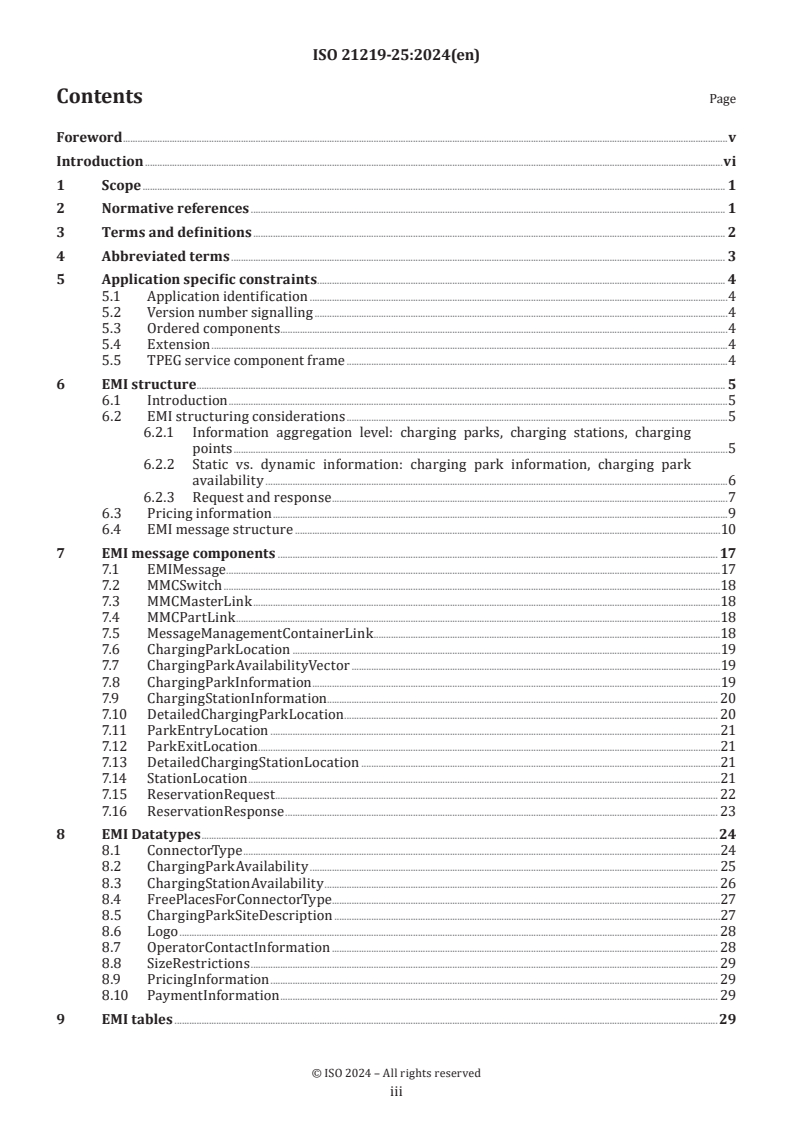
Contents Page
Foreword .v
Introduction .vi
1 Scope . 1
2 Normative references . 1
3 Terms and definitions . 2
4 Abbreviated terms . 3
5 Application specific constraints . . 4
5.1 Application identification .4
5.2 Version number signalling .4
5.3 Ordered components . .4
5.4 Extension .4
5.5 TPEG service component frame .4
6 EMI structure . . 5
6.1 Introduction .5
6.2 EMI structuring considerations .5
6.2.1 Information aggregation level: charging parks, charging stations, charging
points .5
6.2.2 Static vs. dynamic information: charging park information, charging park
availability .6
6.2.3 Request and response .7
6.3 Pricing information .9
6.4 EMI message structure .10
7 EMI message components . 17
7.1 EMIMessage . .17
7.2 MMCSwitch .18
7.3 MMCMasterLink .18
7.4 MMCPartLink .18
7.5 MessageManagementContainerLink .18
7.6 ChargingParkLocation .19
7.7 ChargingParkAvailabilityVector .19
7.8 ChargingParkInformation .19
7.9 ChargingStationInformation. 20
7.10 DetailedChargingParkLocation . 20
7.11 ParkEntryLocation .21
7.12 ParkExitLocation .21
7.13 DetailedChargingStationLocation .21
7.14 StationLocation .21
7.15 ReservationRequest . 22
7.16 ReservationResponse . 23
8 EMI Datatypes .24
8.1 ConnectorType .24
8.2 ChargingParkAvailability . 25
8.3 ChargingStationAvailability . 26
8.4 FreePlacesForConnectorType.27
8.5 ChargingParkSiteDescription .27
8.6 Logo . 28
8.7 OperatorContactInformation . 28
8.8 SizeRestrictions . 29
8.9 PricingInformation . 29
8.10 PaymentInformation . 29
9 EMI tables .29
iii
9.1 emi001:BillingModel . 29
9.2 emi003:Qualifier . 30
9.3 emi004:PaymentMethodType . . 30
9.4 emi005:FacilityType .31
9.5 emi006:AssociatedServiceType .31
9.6 emi007:UserType .31
9.7 emi008:StationType .32
9.8 emi009:VehicleType .32
9.9 emi010:Reservability . 33
9.10 emi011:ContactType . . 33
9.11 emi012:PlugType. 33
Annex A (normative) TPEG application, TPEG-Binary Representation .35
Annex B (normative) TPEG application, tpegML representation.50
Bibliography .65
iv
Foreword
ISO (the International Organization for Standardization) is a worldwide federation of national standards
bodies (ISO member bodies). The work of preparing International Standards is normally carried out through
ISO technical committees. Each member body interested in a subject for which a technical committee
has been established has the right to be represented on that committee. International organizations,
governmental and non-governmental, in liaison with ISO, also take part in the work. ISO collaborates closely
with the International Electrotechnical Commission (IEC) on all matters of electrotechnical standardization.
The procedures used to develop this document and those intended for its further maintenance are described
in the ISO/IEC Directives, Part 1. In particular, the different approval criteria needed for the different types
of ISO document should be noted. This document was drafted in accordance with the editorial rules of the
ISO/IEC Directives, Part 2 (see www.iso.org/directives).
ISO draws attention to the possibility that the implementation of this document may involve the use of (a)
patent(s). ISO takes no position concerning the evidence, validity or applicability of any claimed patent
rights in respect thereof. As of the date of publication of this document, ISO had not received notice of (a)
patent(s) which may be required to implement this document. However, implementers are cautioned that
this may not represent the latest information, which may be obtained from the patent database available at
www.iso.org/patents. ISO shall not be held responsible for identifying any or all such patent rights.
Any trade name used in this document is information given for the convenience of users and does not
constitute an endorsement.
For an explanation of the voluntary nature of standards, the meaning of ISO specific terms and expressions
related to conformity assessment, as well as information about ISO's adherence to the World Trade
Organization (WTO) principles in the Technical Barriers to Trade (TBT), see www.iso.org/iso/foreword.html.
This document was prepared by Technical Committee ISO/TC 204, Intelligent transport systems.
This first edition cancels and replaces the first edition (ISO/TS 21219-25:2017), which has been technically
revised.
The main changes are as follows:
— the document has been changed from a Technical Specification to an International Standard.
A list of all parts in the ISO 21219 series can be found on the ISO website.
Any feedback or questions on this document should be directed to the user’s national standards body. A
complete listing of these bodies can be found at www.iso.org/members.html.
v
Introduction
0.1 History
TPEG technology was originally proposed by the European Broadcasting Union (EBU) Broadcast
Management Committee, who established the B/TPEG project group in the autumn of 1997 with a brief to
develop, as soon as possible, a new protocol for broadcasting traffic and travel-related information in the
multimedia environment. TPEG technology, its applications and service features were designed to enable
travel-related messages to be coded, decoded, filtered and understood by humans (visually and/or audibly
in the user’s language) and by agent systems. Originally, a byte-oriented data stream format, which can be
carried on almost any digital bearer with an appropriate adaptation layer, was developed. Hierarchically
structured TPEG messages from service providers to end-users were designed to transfer information from
the service provider database to an end-user’s equipment.
One year later, in December 1998, the B/TPEG group produced its first EBU specifications. Two documents
were released. Part 2 (TPEG-SSF, which became ISO/TS 18234-2) described the syntax, semantics and
framing structure which was used for all TPEG applications. Meanwhile, Part 4 (TPEG-RTM, which became
ISO/TS 18234-4) described the first application for road traffic messages.
Subsequently, in March 1999, CEN/TC 278, in conjunction with ISO/TC 204, established a group comprising
members of the former EBU B/TPEG and this working group continued development work. Further parts
were developed to make the initial set of four parts, enabling the implementation of a consistent service.
Part 3 (TPEG-SNI, ISO/TS 18234-3) described the service and network information application used by all
service implementations to ensure appropriate referencing from one service source to another.
Part 1 (TPEG-INV, later ISO/TS 18234-1) completed the series by describing the other parts and their
relationship; it also contained the application IDs used within the other parts. Additionally, Part 5, the
public transport information application (TPEG-PTI, later ISO/TS 18234-5), was developed. The so-called
TPEG-LOC location referencing method, which enabled both map-based TPEG-decoders and non-map-based
ones to deliver either map-based location referencing or human readable text information, was issued as
ISO/TS 18234-6 to be used in association with the other applications of parts of the ISO 18234 series to
provide location referencing.
The ISO 18234 series has become known as TPEG Generation 1.
0.2 TPEG Generation 2
When the Traveller Information Services Association (TISA), derived from former forums, was inaugurated
in December 2007, TPEG development was taken over by TISA and continued in the TPEG applications
working group.
It was about this time that the (then) new Unified Modelling Language (UML) was seen as having major
advantages for the development of new TPEG applications in communities who would not necessarily have
binary physical format skills required to extend the original TPEG TS work. It was also realized that the XML
format for TPEG described within the ISO 24530 series (now superseded) had a greater significance than
previously foreseen, especially in the content-generation segment, and that keeping two physical formats in
synchronism, in different standards series, would be rather difficult.
As a result, TISA set about the development of a new TPEG structure that would be UML-based. This has
subsequently become known as TPEG Generation 2.
TPEG2 is embodied in the ISO 21219 series and it comprises many parts that cover introduction, rules, toolkit
and application components. TPEG2 is built around UML modelling and has a core of rules that contain the
modelling strategy covered in ISO 21219-2, ISO 21219-3 and ISO 21219-4 and the conversion to two current
physical formats: binary (see Annex A) and XML (see Annex B); others could be added in the future. TISA
uses an automated tool to convert from the agreed UML model XMI file directly into an MS Word document
file, to minimize drafting errors; this file forms the annex for each physical format.
TPEG2 has a three-container conceptual structure: message management (ISO 21219-6), application
(several parts) and location referencing (ISO/TS 21219-7). This structure has flexible capability and can
vi
accommodate many differing use cases that have been proposed within the TTI sector and wider for
hierarchical message content.
TPEG2 also has many location referencing options as required by the service provider community, any of
which may be delivered by vectoring data included in the location referencing container.
The following classification provides a helpful grouping of the different TPEG2 parts according to their
intended purpose. Note that the list below is potentially incomplete, as there is the possibility that new
TPEG2 parts will be introduced after the publication of this document.
— Toolkit parts: TPEG2-INV (ISO 21219-1), TPEG2-UML (ISO 21219-2), TPEG2-UBCR (ISO 21219-3),
TPEG2-UXCR (ISO 21219-4), TPEG2-SFW (ISO 21219-5), TPEG2-MMC (ISO 21219-6), TPEG2-LRC
(ISO/TS 21219-7).
— Special applications: TPEG2-SNI (ISO 21219-9), TPEG2-CAI (ISO 21219-10), TPEG2-LTE (ISO/TS 21219-24).
— Location referencing: TPEG2-OLR (ISO/TS 21219-22), TPEG2-GLR (ISO/TS 21219-21), TPEG2-TLR
(ISO 17572-2), TPEG2-DLR (ISO 17572-3).
— Applications: TPEG2-PKI (ISO 21219-14), TPEG2-TEC (ISO 21219-15), TPEG2-FPI (ISO 21219-16),
TPEG2-SPI (ISO 21219-17), TPEG2-TFP (ISO 21219-18), TPEG2-WEA (ISO 21219-19), TPEG2-RMR
(ISO/TS 21219-23), TPEG2-EMI (ISO 21219-25 – this document), TPEG2-VLI (ISO/TS 21219-26).
TPEG2 has been developed to be broadly (but not totally) backward compatible with TPEG1 to assist in
transitions from earlier implementations, while not hindering the TPEG2 innovative approach and being
able to support many new features, such as dealing with applications with both long-term, unchanging
content and highly dynamic content, such as parking information.
This document is based on the TISA specification technical/editorial version reference:
SP22004_2.0_001
vii
International Standard ISO 21219-25:2024(en)
Intelligent transport systems — Traffic and travel information
(TTI) via transport protocol experts group, generation 2
(TPEG2) —
Part 25:
Electromobility charging infrastructure (TPEG2-EMI)
1 Scope
This document specifies the "electromobility information" (EMI) TPEG application. The EMI application has
been specifically designed to support information about charging infrastructure for electric vehicles (not
just cars), the location of e-charging points and their suitability for the respective vehicle (e.g. connector
type, charging modality). As electric vehicles will occupy a “charging space” for longer a time than other
vehicles, information on availability/waiting time and reservation options are accounted for, as they are
highly relevant for enabling a user of an electric vehicle to optimally plan their route/trip.
The standardized delivery, via TPEG technology, of electromobility information has the following benefits to
an end user of this TPEG service:
a) identification of suitable charging units for vehicles, thus preventing unnecessary travel to find a fitting
unit (also has environmental benefits);
b) verification of the real-time availability of charging units;
c) possibility of planning ahead and reserving a spot in a charging park, thus optimizing trip planning;
d) possibility of selecting a financially attractive charging point in a charging park where the operator has
billing agreements with the user’s electromobility provider.
In addition to these end-user benefits, electromobility providers and charging park operators also benefit
from a standardized TPEG format as it facilitates harmonization of the electromobility information with
the data formats used for the exchange of information between management systems of electromobility
[1]
providers and charge park operators and related specifications (e.g. Open Charge Alliance, eMobility ICT
3 [2]
Interoperability Innovation (eMI ), etc.).
The EMI application, as an add-on service component next to traffic information, for example, is laid out to
support large numbers of charge parks with only modest bandwidth requirements.
2 Normative references
The following documents are referred to in the text in such a way that some or all of their content constitutes
requirements of this document. For dated references, only the edition cited applies. For undated references,
the latest edition of the referenced document (including any amendments) applies.
ISO 21219-1, Intelligent transport systems — Traffic and travel information (TTI) via transport protocol experts
group, generation 2 (TPEG2) — Part 1: Introduction, numbering and versions (TPEG2-INV)
ISO 21219-9, Intelligent transport systems — Traffic and travel information (TTI) via transport protocol experts
group, generation 2 (TPEG2) — Part 9: Service and network information (TPEG2-SNI)
ISO 21219-14, Intelligent transport systems — Traffic and travel information (TTI) via transport protocol
experts group, generation 2 (TPEG2) — Part 14: Parking information (TPEG2-PKI)
ISO 21219-15, Intelligent transport systems — Traffic and travel information (TTI) via transport protocol
experts group, generation 2 (TPEG2) — Part 15: Traffic event compact (TPEG2-TEC)
3 Terms and definitions
For the purposes of this document, the following terms and definitions apply.
ISO and IEC maintain terminology databases for use in standardization at the following addresses:
— ISO Online browsing platform: available at https:// www .iso .org/ obp
— IEC Electropedia: available at https:// www .electropedia .org/
3.1
electric vehicle
EV
vehicle that is (partly) electrically powered and operated
Note 1 to entry: With respect to the TPEG requirements, electric vehicles such as e-bikes are considered in addition to
electric cars.
Note 2 to entry: Electric vehicle (EV) batteries can typically be charged at any regular power socket. If fast charging
is required (e.g. during longer journeys), higher demands on the technical infrastructure are made. Specific sockets
and high-power connector cables have been developed to allow a simple and secure usage of boost charging stations.
It is necessary for the end user to know which options are supported by a charging station. EVs can have an “identity”
for electronic readout, e.g. by means of a certificate. Other information which can be communicated by an EV to the
infrastructure can also be relevant for the execution and planning of charging orders. The current battery charge
condition, the power requirements during the charging procedure and the cruising range are parameters that can
be relevant for the planning of charging orders. The vehicle and charging station can communicate via the connector
cable, but other mechanisms are also possible, e.g. using the back-end system of the EV-manufacturer to which an EV
is connected (via mobile data connection).
Note 3 to entry: Electromobility information (EMI) also covers the requirements for hybrid (partly electrically
powered) vehicles.
3.2
charging park
grouping of multiple physical charging stations which technically and/or logically belong together and are
being operated together
Note 1 to entry: A commercially operated car park or in a city district where publicly operated charging stations are
grouped together.
Note 2 to entry: Charging parks are being operated by charging park operators.
3.3
charging station
physical unit (typically a column or cabinet-like structure) containing and managing one or more charging
points offering the end user the possibility to authorize (typically by means of a card reader) and activate
one of the charging points at the charging station, hook up the vehicle, and start the charging procedure
3.4
charging point
unit in a charging station at which an electric vehicle can be supplied with power
Note 1 to entry: A charging station may provide multiple charging points, which again may contain multiple sockets
to support more than one charging connector type. In general, as soon as one socket at a charging point is in use, the
charging point is occupied. Typically, a parking space is provided for each charging point at the charging station.
3.5
energy provider
business partner supplying energy to charging parks and their operators
Note 1 to entry: This includes all relevant energy suppliers, i.e. local solar power generators as well as traditional
major companies in the power industry sector.
3.6
electromobility provider
EM provider
business partner for end users who charge their electric vehicles
Note 1 to entry: Typically, an end user has a contract with an electromobility provider (EM provider), the details of
which are connected to an (RF) ID-card [having an (internationally) unique card number] that is used for authorization
and billing. The EM provider ensures that their customers can charge their vehicles in as many charging parks as
possible and bills the customer according to the respective contract.
3.7
charging park operator
entity which manages one or more charging parks
Note 1 to entry: The charging park operator maintains the charging site(s) and is a business partner to the energy
provider and the electromobility provider (EM provider). Typically, a charging park operator bills the end user based
on “roaming agreements” with multiple EM providers.
3.8
EVSE ID
electric vehicle supply equipment identity
globally unique identifier which identifies a specific charging point
[16]
Note 1 to entry: If a charging station has multiple charging points, multiple EVSE IDs are used. See also DIN SPEC 91286.
3.9
Reference-English “word”
word which enables information to be transmitted as a concept, thereby letting the receiver device choose
the best possible representation of the given concept in the context of the other parts of the message
Note 1 to entry: This approach means that devices can present concepts in any language or even as graphical icons, for
example. For further explanation, see ISO 21219-2.
Note 2 to entry: [SOURCE: ISO 21219-9:2023, 3.10]
4 Abbreviated terms
For the purposes of this document, the abbreviated terms in ISO 21219-1, ISO 21219-9, ISO 21219-14,
ISO 21219-15, and the following shall apply.
ADC application data container
EM provider electromobility provider
EV electric vehicle
EVSE ID electric vehicle supply equipment identity
MMC message management container
RF radio frequency
5 Application specific constraints
5.1 Application identification
The word "application" is used in the TPEG specifications to describe specific subsets of the TPEG structure.
An application defines a limited vocabulary for a certain type of messages, for example, parking information
or road traffic information. Each TPEG application is assigned a unique number, called the application
identity (AID). An AID is defined in ISO 21219-1 whenever a new application is developed.
The AID number is used within the TPEG2-SNI application (ISO 21219-9) to indicate how to process TPEG
content. It facilitates the routing of information to the appropriate application decoder.
5.2 Version number signalling
Version numbering is used to track the separate versions of an application through its development and
deployment. The differences between these versions could have an impact on client devices.
The version numbering principle is defined in ISO 21219-1.
Table 1 shows the current version numbers for signalling EMI within the SNI application.
Table 1 — Current version numbers for signalling of EMI
Major version number 2
Minor version number 0
5.3 Ordered components
TPEG2-EMI requires a fixed order of TPEG components. The order for the EMI message component is shown
in Figure 1. The first component shall be the message management container (MMC). This shall be the only
component if the message is a cancellation message. Otherwise, the MMC component shall be followed by one
or more application data container (ADC) component(s) which includes the application-specific information.
Figure 1 — Composition of TPEG messages
5.4 Extension
Although it is necessary to maintain a fixed component order, this does not prevent the extension of a
TPEG2-EMI message generally. In case of future extensions, new components may be inserted, or existing
components may be replaced by new ones without losing backward compatibility. This requires that a TEC
decoder shall be able to detect and skip unknown components.
5.5 TPEG service component frame
TPEG2-EMI (this document) makes use of the "service component frame with dataCRC and messageCount"
according to ISO 21219-5.
6 EMI structure
6.1 Introduction
This clause specifies the main structure of EMI and its capabilities.
The EMI design is based on a distinction between information with a generally static reference-style nature
with an expected low refresh rate and information of a more dynamic nature status with a high expected
refresh rate. The binary format and XML format of the TPEG2-EMI application for use in transmission shall
be in accordance with Annexes A and B, respectively.
6.2 EMI structuring considerations
6.2.1 Information aggregation level: charging parks, charging stations, charging points
EMI (see structure in Figure 2) is required to provide an end user with enough information to find a suitable
and available charging point at which to charge their electric vehicle. The number of charging points within
a TPEG service can become too high to transmit all descriptive data as part of the general service. Therefore,
in EMI, information is aggregated either at charging park or charging station level. This approach supports
efficient use of the transmission channel.
From an end user point of view, it is generally sufficient to obtain information at the level of a charging
station: the physical location of a charging station is sufficient information to satisfy the user need. The user
does not need to know which physical charging point at a charging station would be available, for example.
Key
a
Charging park.
b
Charging station.
c
Charging point.
Figure 2 — EMI structure
Detailed information on a specific charging point can become relevant to an end user wanting to make a
reservation at a specific charging station. Therefore, in addition to the information provisioning on charging
parks and charging stations, EMI supports a request and response session, to allow a reservation for a
specific charging point at a given charging station or in a charging park (see 6.2.3).
6.2.2 Static vs. dynamic information: charging park information, charging park availability
An EMI service provider needs to be able to provide a TPEG client with a large amount of data at a relatively
low transmission data rate. The typical TPEG concept, in which a single TPEG message equates with a single
content item, cannot be applied for EMI, as it would take too much time to provide clients without any pre-
existing information (e.g. transit users) with useable data. Some form of transmission at high repetition
rates for minimum content, augmented with low repetition rate for additional detailed content is therefore
required.
Moreover, EMI contains both information that is generally static (typically descriptive information on charging
parks, see Figure 3) and information that is potentially updated frequently (such as the availability information,
see Figure 4). EMI also needs to consider this information quality to support different repetition rates.
Figure 3 — Static information (example)
Figure 4 — Dynamic information (example)
EMI has been designed to allow service providers to arrange their transmissions flexibly, depending on the
volume of data to be transmitted and the available data rate. A TPEG message may contain partial or complete
content for a charging park or charging station. A service provider may choose to aggregate descriptive
information at the level of a charging park in case only a limited data rate is available. This typically static
information shall be combined with location information.
The availability information for charging parks or charging stations (typically highly dynamic information)
is contained in separate data structures, which have been kept limited and compact to enable transmission
with a higher refresh rate than the descriptive information. TPEG messages containing availability
information shall not contain location information. Based on respective ID keys, the TPEG client can
recombine the availability information with the other information for charging parks and charging stations.
6.2.3 Request and response
EMI supports a request and response session, to request the reservation of a charging point that matches the
end user’s requirements and the vehicle‘s attributes and to convey the required parameters to a reservation
service (typically offered by an EM provider).
A sample EMI request message is shown in Figure 5. In the EMI request, either the charging station needs
to be referenced directly or, alternatively, a location needs to be referenced where an available charging
station can be found nearby. One of three options for this location referencing shall be included in the
request message:
— internal TPEG reference (parkID_Key and optionally stationID_Key); or
— external reference (stationExternalID, e.g. EVSE ID); or
— coordinates of a point (longitude, latitude) and optionally parkOperator and/or providerExternalID.
Figure 5 — Reservation request (example)
A sample EMI response message is shown in Figure 6. Use of the reservationConfirmed attribute indicates
whether or not the reservation request is confirmed. In the case where the request is not confirmed, the
reservationFreeText can be used to give additional information. In the case where the request is confirmed
it is recommended to use venueExternalID (to address either a charging station or a charging point) and
reservationID to unambiguously identify the reservation.
Figure 6 — Reservation response (example)
6.3 Pricing information
The pricing and billing models in the current electromobility market place are very different from fuel
pricing/billing and currently also differ very much from one to the other. This is mainly caused by the
multiple business actors in the domain, and is related to charging procedures, their relationships and
business models.
The end user typically has a business relationship with an EM provider, by means of a contract, based on
which the end user is billed. This contract is somewhat comparable to a mobile phone contract and can take
many different forms, e.g. prepaid (possibly differentiating rates based on vehicle type or amount of power
used, etc.), flat rate or other.
The charging park operator or infrastructure provider in such cases typically requires an end user to
identify/authorize themselves by means of the customer card issued by their EM provider. The charging park
operator does not bill the end user, but rather gets paid by the EM provider based on “roaming agreements”
(such “roaming” allows end users to make use of the charging infrastructure regardless of the actual
provider on-site). The infrastructure and power provider have business relationships with the EM provider
(typically more than one), in which wholesale prices (rather than end user prices) are set. The wholesale
agreements on pricing are transparent to the end user, but for the user, only the contract with the respective
EM provider counts.
Hence, for the end user, the most important thing is to know is that with the customer card from their
EM provider, they can identify and authorize themselves at a charging station, they can use that charging
station, and they can be billed.
Moreover, the charging park operator is oblivious to the agreements an end user made with their EM
provider and hence cannot make any reasonable assumption as to which costs will arise for an end user, as
these can differ from one user to another. To make things even more complicated, at some charging parks
the charging park operator will offer charging possibilities independent of any EM provider and will bill
these in other ways. For example, in such cases, the following billing models can occur (non-exhaustive list):
— billing based on usage (e.g. per hour, etc.);
— billing combined with parking fee;
— “buying costumers” can charge for free or obtain a price reduction;
— charging dependent on maximum current (“slow” vs. “fast” charging).
TPEG EMI should support all of the different billing models, which are flexible, but incompatible with one
another. It is very difficult to support all of the different options in a single, fixed data structure. Moreover,
doing so has a high risk that another, unforeseen billing model will be invented in the future by a provider,
which cannot be covered by such a data structure.
Therefore, EMI only refers to a “Price”, to give end users an indication (e.g. of maximum or minimum price),
to distinguish between normal and premium offers and to allow comparison of charging parks. Additional
information (e.g. on special offers), can be given as free text.
6.4 EMI message structure
The structure of the top-level EMI message is illustrated in Figure 7, Figure 8 and Figure 9. Annex A and
Annex B specify respectively the binary format and XML format of the TPEG2-EMI application for use in
transmission.
Figure 7 — Main structure of an EMI message
Figure 8 — Structure of ChargingParkInformation
...