

ISO 17438-5:2025
(Main)Intelligent transport systems — Indoor navigation for personal and vehicle ITS stations — Part 5: Requirements and message specification for central ITS station (C-ITS-S) based positioning
General Information
- Abstract
This document defines detailed use cases, requirements and message specifications for supporting central ITS station based indoor positioning to provide indoor navigation functionality between a personal/vehicle (P/V) ITS station and the central ITS station. This document is only applicable to the core flow for the central ITS station based indoor positioning. The following issues which are adjunctive but essential for commercial navigation services are beyond the scope of this document: — authorized and authenticated access of users and services, including security; — payment; — preparation of indoor data which are necessary for indoor navigation; — low-level communication protocols required to transfer and share data from and to a roadside ITS station or a central ITS station; — other issues dependent on implementation of an instance of indoor navigation.
- Status
- Published
- Publication Date
- 24-Sep-2025
- Technical Committee
- ISO/TC 204 - Intelligent transport systems
- Drafting Committee
- ISO/TC 204 - Intelligent transport systems
- Current Stage
- 6060 - International Standard published
- Start Date
- 25-Sep-2025
- Due Date
- 28-Mar-2026
- Completion Date
- 25-Sep-2025
Buy Documents


ISO 17438-5:2025 - Intelligent transport systems — Indoor navigation for personal and vehicle ITS stations — Part 5: Requirements and message specification for central ITS station (C-ITS-S) based positioning Released:9/25/2025
Overview
ISO 17438-5:2025 - "Intelligent transport systems - Indoor navigation for personal and vehicle ITS stations - Part 5" specifies requirements and message structures to support central ITS station (C-ITS-S) based (server‑based) indoor positioning. It focuses on the core flow between a personal/vehicle ITS station (P/V‑ITS‑S) and a C‑ITS‑S for delivering indoor navigation functionality. The document defines use cases, message flows (notably get-positions and candidate-positions), ASN.1 data types and an ASN.1 module (Annex A and Annex B), and conformance rules for mandatory/optional/conditional fields.
Key topics and requirements
- Purpose: Enable server-based indoor positioning where the C‑ITS‑S computes a device’s position on request - useful because GNSS signals are generally unavailable indoors.
- Use case: UC - Server based positioning (ISO 17438-1 reference); pre‑conditions include bi‑directional communication and appropriate access permission for the P/V‑ITS‑S.
- Message flow:
- get-positions: P/V‑ITS‑S sends scanned resources (e.g., Wi‑Fi, BLE, cellular measurements) to the C‑ITS‑S.
- candidate-positions: C‑ITS‑S returns calculated possible positions; the P/V‑ITS‑S selects the most likely position for navigation.
- Message and data model:
- Definitions use ASN.1 conventions; normative data types and code lists are in Annex A and ASN.1 schema in Annex B.
- Fields are categorized as mandatory, optional or conditional; implementations must respect multiplicity and conformance rules.
- Scope limits: The standard intentionally excludes authorization/security, payment, indoor map/data preparation, and low‑level transport protocols - it addresses only the core application‑level flow for C‑ITS‑S based positioning.
Applications and who uses it
- Primary users:
- ITS architects and system integrators designing server-based indoor positioning services.
- Developers of C‑ITS‑S platforms and P/V‑ITS‑S client applications (mobile apps, vehicle systems, robots).
- Location service providers, airports, malls, public transport hubs and facility managers integrating indoor navigation into ITS ecosystems.
- Practical applications:
- Vehicle and pedestrian indoor navigation inside terminals, parking garages, and large venues.
- Fleet management and indoor routing for service robots or logistics vehicles.
- Interoperable positioning services where centralized computations simplify client devices and protect indoor reference datasets.
Related standards
- ISO 17438-1: General information and use case definition for indoor navigation.
- ISO 17438-4 (references): Definitions for server-based/indoor positioning concepts.
- ISO 13184-2: Related ITS guidance protocol references.
Keywords: ISO 17438-5:2025, indoor navigation, central ITS station, C-ITS-S, server-based positioning, get-positions, candidate-positions, ASN.1, P/V‑ITS‑S, ITS station.
Buy Documents
ISO 17438-5:2025 - Intelligent transport systems — Indoor navigation for personal and vehicle ITS stations — Part 5: Requirements and message specification for central ITS station (C-ITS-S) based positioning Released:9/25/2025
Get Certified
Connect with accredited certification bodies for this standard

BSI Group
BSI (British Standards Institution) is the business standards company that helps organizations make excellence a habit.

Great Wall Tianjin Quality Assurance Center
Established 1993, first batch to receive national accreditation with IAF recognition.
Hong Kong Quality Assurance Agency (HKQAA)
Hong Kong's leading certification body.
Sponsored listings
Frequently Asked Questions
ISO 17438-5:2025 is a standard published by the International Organization for Standardization (ISO). Its full title is "Intelligent transport systems — Indoor navigation for personal and vehicle ITS stations — Part 5: Requirements and message specification for central ITS station (C-ITS-S) based positioning". This standard covers: This document defines detailed use cases, requirements and message specifications for supporting central ITS station based indoor positioning to provide indoor navigation functionality between a personal/vehicle (P/V) ITS station and the central ITS station. This document is only applicable to the core flow for the central ITS station based indoor positioning. The following issues which are adjunctive but essential for commercial navigation services are beyond the scope of this document: — authorized and authenticated access of users and services, including security; — payment; — preparation of indoor data which are necessary for indoor navigation; — low-level communication protocols required to transfer and share data from and to a roadside ITS station or a central ITS station; — other issues dependent on implementation of an instance of indoor navigation.
This document defines detailed use cases, requirements and message specifications for supporting central ITS station based indoor positioning to provide indoor navigation functionality between a personal/vehicle (P/V) ITS station and the central ITS station. This document is only applicable to the core flow for the central ITS station based indoor positioning. The following issues which are adjunctive but essential for commercial navigation services are beyond the scope of this document: — authorized and authenticated access of users and services, including security; — payment; — preparation of indoor data which are necessary for indoor navigation; — low-level communication protocols required to transfer and share data from and to a roadside ITS station or a central ITS station; — other issues dependent on implementation of an instance of indoor navigation.
ISO 17438-5:2025 is classified under the following ICS (International Classification for Standards) categories: 03.220.01 - Transport in general; 35.240.60 - IT applications in transport. The ICS classification helps identify the subject area and facilitates finding related standards.
ISO 17438-5:2025 is available in PDF format for immediate download after purchase. The document can be added to your cart and obtained through the secure checkout process. Digital delivery ensures instant access to the complete standard document.
Standards Content (Sample)
International
Standard
ISO 17438-5
First edition
Intelligent transport systems —
2025-09
Indoor navigation for personal and
vehicle ITS stations —
Part 5:
Requirements and message
specification for central ITS station
(C-ITS-S) based positioning
Systèmes de transport intelligents — Navigation intérieure pour
les stations ITS personnelles et de véhicules —
Partie 5: Exigences et spécification de message pour le
positionnement basé sur la station ITS centrale (C-ITS-S)
Reference number
© ISO 2025
All rights reserved. Unless otherwise specified, or required in the context of its implementation, no part of this publication may
be reproduced or utilized otherwise in any form or by any means, electronic or mechanical, including photocopying, or posting on
the internet or an intranet, without prior written permission. Permission can be requested from either ISO at the address below
or ISO’s member body in the country of the requester.
ISO copyright office
CP 401 • Ch. de Blandonnet 8
CH-1214 Vernier, Geneva
Phone: +41 22 749 01 11
Email: copyright@iso.org
Website: www.iso.org
Published in Switzerland
ii
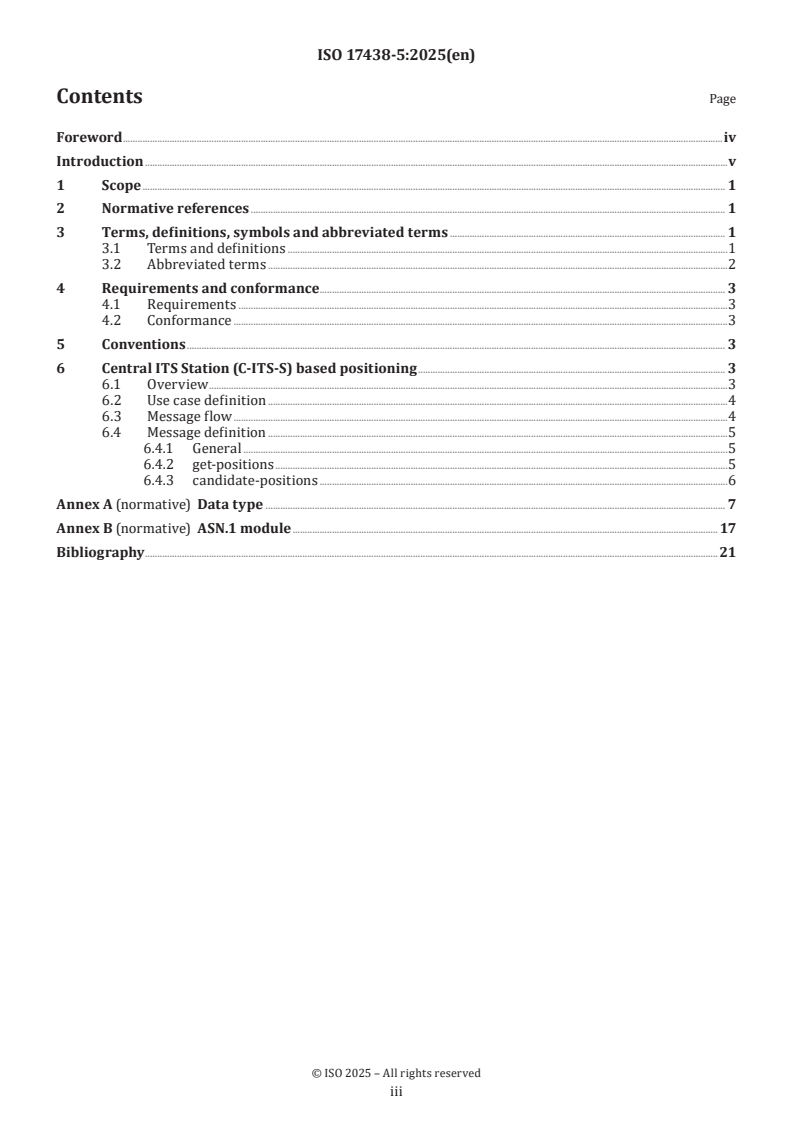
Contents Page
Foreword .iv
Introduction .v
1 Scope . 1
2 Normative references . 1
3 Terms, definitions, symbols and abbreviated terms . 1
3.1 Terms and definitions .1
3.2 Abbreviated terms .2
4 Requirements and conformance . . 3
4.1 Requirements .3
4.2 Conformance .3
5 Conventions . 3
6 Central ITS Station (C-ITS-S) based positioning . 3
6.1 Overview .3
6.2 Use case definition .4
6.3 Message flow .4
6.4 Message definition .5
6.4.1 General .5
6.4.2 get-positions .5
6.4.3 candidate-positions .6
Annex A (normative) Data type . 7
Annex B (normative) ASN.1 module . 17
Bibliography .21
iii
Foreword
ISO (the International Organization for Standardization) is a worldwide federation of national standards
bodies (ISO member bodies). The work of preparing International Standards is normally carried out through
ISO technical committees. Each member body interested in a subject for which a technical committee
has been established has the right to be represented on that committee. International organizations,
governmental and non-governmental, in liaison with ISO, also take part in the work. ISO collaborates closely
with the International Electrotechnical Commission (IEC) on all matters of electrotechnical standardization.
The procedures used to develop this document and those intended for its further maintenance are described
in the ISO/IEC Directives, Part 1. In particular, the different approval criteria needed for the different types
of ISO document should be noted. This document was drafted in accordance with the editorial rules of the
ISO/IEC Directives, Part 2 (see www.iso.org/directives).
ISO draws attention to the possibility that the implementation of this document may involve the use of (a)
patent(s). ISO takes no position concerning the evidence, validity or applicability of any claimed patent
rights in respect thereof. As of the date of publication of this document, ISO had not received notice of (a)
patent(s) which may be required to implement this document. However, implementers are cautioned that
this may not represent the latest information, which may be obtained from the patent database available at
www.iso.org/patents. ISO shall not be held responsible for identifying any or all such patent rights.
Any trade name used in this document is information given for the convenience of users and does not
constitute an endorsement.
For an explanation of the voluntary nature of standards, the meaning of ISO specific terms and expressions
related to conformity assessment, as well as information about ISO's adherence to the World Trade
Organization (WTO) principles in the Technical Barriers to Trade (TBT), see www.iso.org/iso/foreword.html.
This document was prepared by Technical Committee ISO/TC 204, Intelligent transport systems.
A list of all parts in the ISO 17438 series can be found on the ISO website.
Any feedback or questions on this document should be directed to the user’s national standards body. A
complete listing of these bodies can be found at www.iso.org/members.html.
iv
Introduction
With the spread of nomadic and mobile devices such as smart phones and the rapid expansion of indoor
spaces, many of the services and facilities related to the transport system have become accessible to
indoor spaces. Consequently, navigation in indoor space is considered an increasingly critical functionality
for variety of applications, including indoor navigation for vehicles and public-area mobile robots in the
transport industry.
The ISO 17438 series are intended to be used by designers, developers and providers of indoor navigation
services. The ISO 17438 series define requirements, data model, and encoding format of indoor positioning
reference data for supporting indoor navigation in intelligent transport systems. When implemented, this
document will:
a) provide developers and designers with concepts and appropriate information to implement the central
ITS station (C-ITS-S) based positioning
b) provide developers and designers with interoperable ways to use the central ITS station (C-ITS-S) based
positioning for indoor navigation;
c) enable users to be provided with indoor navigation;
d) provide developers and designers with an extendable base for indoor navigation.
The objective of this document is to define requirements and message specification for central ITS station
(C-ITS-S) based positioning required for indoor navigation functionality for ITS applications, as a part of the
ISO 17438 series.
v
International Standard ISO 17438-5:2025(en)
Intelligent transport systems — Indoor navigation for
personal and vehicle ITS stations —
Part 5:
Requirements and message specification for central ITS
station (C-ITS-S) based positioning
1 Scope
This document defines detailed use cases, requirements and message specifications for supporting central
ITS station based indoor positioning to provide indoor navigation functionality between a personal/vehicle
(P/V) ITS station and the central ITS station.
This document is only applicable to the core flow for the central ITS station based indoor positioning. The
following issues which are adjunctive but essential for commercial navigation services are beyond the scope
of this document:
— authorized and authenticated access of users and services, including security;
— payment;
— preparation of indoor data which are necessary for indoor navigation;
— low-level communication protocols required to transfer and share data from and to a roadside ITS station
or a central ITS station;
— other issues dependent on implementation of an instance of indoor navigation.
2 Normative references
The following documents are referred to in the text in such a way that some or all of their content constitutes
requirements of this document. For dated references, only the edition cited applies. For undated references,
the latest edition of the referenced document (including any amendments) applies.
ISO 13184-2, Intelligent transport systems (ITS) — Guidance protocol via personal ITS station for advisory
safety systems — Part 2: Road guidance protocol (RGP) requirements and specification
ISO 17438-1, Intelligent transport systems — Indoor navigation for personal and vehicle ITS station — Part 1:
General information and use case definition
3 Terms, definitions, symbols and abbreviated terms
3.1 Terms and definitions
For the purposes of this document, the terms and definitions given in ISO 13184-2, ISO 17438-1 and the
following apply.
ISO and IEC maintain terminological databases for use in standardization at the following addresses:
— ISO Online browsing platform: available at https:// www .iso .org/ obp
— IEC Electropedia: available at https:// www .electropedia .org/
3.1.1
server-based indoor positioning
indoor positioning executed at a central ITS station (C-ITS-S)
[SOURCE: ISO 17438-4:2019, 3.1.9]
3.1.2
indoor positioning infrastructure
infrastructure used to determine locations of personal/vehicle ITS stations (P/V-ITS-S) in an indoor space
EXAMPLE Wi-Fi, Bluetooth, etc.
[SOURCE: ISO 17438-4:2019, 3.1.11]
3.1.3
indoor positioning reference
information to support indoor positioning
Note 1 to entry: Detailed specifications and contents of indoor positioning references depend on the specific indoor
positioning technologies.
EXAMPLE 1 A good example of an indoor positioning reference is information about indoor positioning
infrastructure.
EXAMPLE 2 For Wi-Fi based positioning, the indoor positioning infrastructure information includes the Wi-Fi APs
information, such as location, SSID, and RSSI values of APs.
[SOURCE: ISO 17438-4:2019, 3.1.12]
3.2 Abbreviated terms
AP Access Point
ASN Abstract Syntax Notation
BLE Bluetooth Low Energy
BS Base Station
ITS Intelligent Transport Systems
ITS-S ITS Station
P/V-ITS-S Personal/Vehicle ITS Station
C-ITS-S Central ITS Station
CID Cell IDentifier
LTE Long Term Evolution
M/O Mandatory/Optional
MCC Mobile Country Code
MNC Mobile Network Code
MO Maximum Occurrence
PCI Physical Cell Identifier
RSSI Received Signal Strength Indicator
SSID Service Set IDentifier
UUID Universally Unique IDentifier
4 Requirements and conformance
4.1 Requirements
This document defines use cases and message interfaces between a P/V-ITS-S and a C-ITS-S for supporting
server-based positioning in indoor navigation functionality.
In the definitions of messages and data types, there are mandatory, optional or conditional fields. Mandatory
fields shall be provided, and conditions for conditional fields shall be satisfied. These are the requirements
embedded in the definition of messages for supporting server-based positioning.
Specific encoding of each message and data types can be adapted for implementation. There may be
additional requirements for specific encoding.
4.2 Conformance
For the purpose of conformance to the server-based indoor positioning for which messages are defined in
Clause 6, multiplicity of the elements in a message should be observed through their implementations.
5 Conventions
This document is based on the conventions of ASN.1 (Abstract Syntax Notation dot One) formats.
6 Central ITS Station (C-ITS-S) based positioning
6.1 Overview
The GNSS signal which is generally used to calculate the positions of mobile devices outdoor cannot be
acquired in indoor space. Therefore, for positioning in indoor spaces, other positioning technologies are
needed. For indoor positioning, various technologies and infrastructures can be used and information
for supporting the indoor positioning should be constructed in advance according to the types of indoor
positioning. The indoor positioning references are shared between a P/V-ITS-S and a C-ITS-S, according to
the architecture of the indoor navigation implemented.
Indoor positioning can be categorized into two groups, depending on where it runs:
a) client-based indoor positioning; and
b) server-based indoor positioning.
In the client-based indoor positioning architecture, the positioning, i.e. the calculation of a P/V-ITS-S, is
executed in the P/V-ITS-S. Therefore, the P/V-ITS-S needs to obtain the indoor positioning references from a
C-ITS-S, which normally maintains them.
In the server-based indoor positioning architecture, a C-ITS-S calculates the position of a P/V-ITS-S
dependent on the request for positioning from the P/V-ITS-S. Therefore, the P/V-ITS-S does not need to obtain
the indoor positioning references from a C-ITS-S. A C-ITS-S maintains the indoor positioning references for
calculating positions of P/V-ITS-S on requests.
This document defines the specification, requirements and messages for server(C-ITS-S) based positioning.
The messages for server-based positioning are exchanged between P/V-ITS-Ss and a C-ITS-S according to
application level communication profiles.
6.2 Use case definition
Table 1 defines the use case for the C-ITS-S based positioning. The use case is defined as UC 1.6 Server-based
indoor positioning in ISO 17438-1.
Table 1 — Definition of C-ITS-S (Server) based positioning
Use case name UC — Server based positioning
Description A Server, C-ITS-S determines and returns the current positions of a P/V-ITS-S upon a request
from the P/V-ITS-S.
Pre-condition a) Bi-directional communication between the P/V-ITS-S and the C-ITS-S shall be available.
b) The P/V-ITS-S shall have appropriate permission to access the C-ITS-S.
c) It is not critical that the P/V-ITS-S knows whether it is inside of an indoor space or not.
Processing flows In order for a P/V-ITS-S to determine the current position for indoor navigation:
a) The P/V-ITS-S scans and acquires the resources required for determining the position.
b) The P/V-ITS-S sends the acquired resources to the C-ITS-S.
c) The C-ITS-S determines candidate positions of the P/V-ITS-S using the received resource
information.
d) The C-ITS-S sends the best candidate positions to the P/V-ITS-S.
e) The P/V-ITS-S selects the most likely current position to use for indoor navigation.
Note 1) Refer to the “get-Positions” message in 6.4.2 for the detailed structure and contents of
the resource.
Related Message
Message name Exe Message description
flows definition
b) get-positions P/V Sends the scanned and acquired resources 6.4.2
which can be used for determining the posi-
tion to the C-ITS-S.
d) candidates-positions C Sends the calculated possible positions to the 6.4.3
P/V-ITS-S.
6.3 Message flow
This section defines message flow of the use case in 6.1. Figure 1 below shows a sketch of the message flow
and each messages, get-position and candidate-positions, is defined with a description in the following
sub-clauses, 6.4.2 and 6.4.3. The implementation of the message flow defined in this document meets the
requirements and the conditions on the base communication architecture and the environments as specified
in ISO/TS 17429 and ISO 17423.
Figure 1 — Message flow
6.4 Message definition
6.4.1 General
This subclause defines messages used in the definition of the use case in 6.1. The definitions in this subclause
show the structure and composition of each message. The descriptions of structure and composition include
the name, data type, mandatory or optional and maximum number of occurrences in each field in the
message. Specific encoding of each message can use several forms. The schema of messages is described
using ASN.1. The message definitions shall use data types and code lists defined in Annex A. The whole
normative ASN.1 schema for this document shall be as defined in Annex B.
6.4.2 get-positions
Table 2 defines the “get-positions” message used when a P/V-ITS-S wants to determine its current position
using server-based positioning. A P/V-ITS-S sends the scanned resources which can be used for calculating
the positions to the C-ITS-S using this message.
Table 2 — Definition of get-positions
Name get-positions
Executor P/V-ITS-S
Message
Send scanned resource which can be used for determining
Description
P/V-ITS-S’s position to the C-ITS-S.
Parameters
Name Type M/O MO Description
description regarding the P/V-ITS-S which
pvITSSInfo PVITSSInfo M 1
requested server-based positioning
TTabablele 2 2 ((ccoonnttiinnueuedd))
a
identifier of an indoor space in which the
spaceIdentifier IA5String O 1 P/V-ITS-S might be. This additional informa-
tion helps narrow the search area.
previous locations of the P/V-ITS-S. This ad-
previousPositions Location O N ditional information provides more accurate
b
server-based positioning
observations of positioning resources, such
observations ResourceObservation M N as WiFi, BLE, etc., which can be used for
c
server-based positioning
note IA5String O 1 additional description about this request
Note
a
How to construct an identifier of an indoor space, i.e. the composition of an indoor space identifier, is out of the
scope of this document.
b
See ISO 17438-4:2019, Annex A for the definition.
c
See Annex A of this document for the definition.
ASN.1 Schema
get-positions ::= SEQUENCE {
pvITSSInfo PVITSSInfo,
spaceIdentifier IA5String OPTIONAL,
previousPositions SEQUENCE OF Location OPTIONAL,
observations SEQUENCE OF ResourceObservation,
note IA5String OPTIONAL,
...
}
6.4.3 candidate-positions
Table 3 defines the “candidate-positions” message that is used when a C-ITS-S sends the candidate positions
of the P/V-ITS-S which are calculated using by the resources contained in the “get-positions” message.
Table 3 — Definition of candidate-positions
Name candidate-positions
Message Executor C-ITS-S
Description Send the candidate positions to the P/V-ITS-S.
Parameters
Name Type M/O MO Description
b
resultStatus ResultStatus M 1 Result code .
candidate positions calculated based on the pa-
c
a
rameters given from the P/V-ITS-S
candidatePositions Location O N
(see Annex A for detailed definition).
Note
a
This field shall be given if resultStatus is SUCCESS and there are candidate positions.
b
See ISO 17438-4:2019, Annex B for the definition.
c
See ISO 17438-4:2019, Annex A for the definition.
ASN.1 Schema
candidate-positions ::= SEQUENCE {
resultStatus ResultStatus,
candidatePositions SEQUENCE OF Location OPTIONAL,
...
}
Annex A
(normative)
Data type
A.1 PVITSSInfo
Data type PVITSSInfo describes a P/V-ITS-S which requested C-ITS-S based positioning, as shown in
Table A.1.
Table A.1 — Data dictionary of PVITSSInfo
Type Name PVITSSInfo
Attributes
Name Type M/O MO Description
a
pv-its-s-id IA5String M 1 Identifier of a P/V-ITS-S which request the server-based
positioning
note IA5String O 1 additional description about the P/V-ITS-S
Note
a
How to construct an identifier of a P/V-ITS-S is out of the scope of this document.
ASN.1 Schema
PVITSSInfo ::= SEQUENCE {
pv-its-s-id IA5String,
note IA5String OPTIONAL,
...
}
A.2 ResourceObservation
Data type ResourceObservation contains observations of several positioning resources, for example WiFi
observation, BLE observation, etc. See Table A.2.
Table A.2 — Data dictionary of ResourceObservation
Type Name ResourceObservation
Attributes
Name Type M/O MO Description
WiFi observations which can be used for
a
wifi WiFiObservation C 1
b
server-based positioning
BLE observations which can be used for
a
ble BLEObservation C 1
c
server-based positioning
LTE observations which can be used for
a
lte LTEObservation C 1
d
server-based positioning
LTE-NR observations which can be used for
a
lteNR LTENRObservation C 1
e
server-based positioning
UWB observations which can be used for
a
uwb UWBObseration C 1
f
server-based positioning
accelerometer observations which can be
a
acc AcceleratorObservation C 1
g
used for server-based positioning
TTabablele A A.22 ((ccoonnttiinnueuedd))
gyroscope observations which can be used
a
gyro GyroObservation C 1
h
for server-based positioning
geo-magnetometer observations which can
a
geomag GeomagObservation C 1
i
be used for server-based positioning
barometer observations which can be used
a
baro BarometerObservation C 1
j
for server-based positioning
camera observations (images) which can be
a
cam CameraObservation C 1
k
used for server-based positioning
Note
a
One or more fields shall be given.
b
See Annex A.3 of this document for the definition.
c
See Annex A.4 of this document for the definition.
d
See Annex A.5 of this document for the definition.
e
See Annex A.6 of this document for the definition.
f
See Annex A.7 of this document for the definition.
g
See Annex A.8 of this document for the definition.
h
...