

ISO 25110:2025
(Main)Electronic fee collection — Interface definition for on-board account using an integrated circuit card (ICC)
General Information
- Abstract
This document specifies the data transfer models between roadside equipment (RSE) and integrated circuit cards (ICCs) and the interface descriptions between the RSE and on-board equipment (OBE) for on-board accounts using an ICC. It also provides examples of interface definitions and transactions deployed in several countries. This document covers: — data transfer models between the RSE and ICC which correspond to the categorized operational requirements and the data transfer mechanism for each model; — the interface definition between the RSE and OBE based on each data transfer model; — the interface definition for each model; — the functional configuration; — RSE command definitions for ICC access; — the data format and data element definitions of RSE commands; — a transaction example for each model (Annex B).
- Status
- Published
- Publication Date
- 07-Apr-2025
- Technical Committee
- ISO/TC 204 - Intelligent transport systems
- Drafting Committee
- ISO/TC 204/WG 5 - Fee and toll collection
- Current Stage
- 6060 - International Standard published
- Start Date
- 08-Apr-2025
- Due Date
- 04-Jun-2026
- Completion Date
- 08-Apr-2025


Overview
ISO 25110:2025 - Electronic fee collection: Interface definition for on‑board account using an integrated circuit card (ICC) - defines the interface and data transfer models for on‑board accounts that use ICCs as the payment medium. The standard focuses on the mid‑layer interface between roadside equipment (RSE) and on‑board equipment (OBE) to access the ICC, and provides functional configurations, RSE command definitions, data formats and element definitions, and transaction examples (Annex B). This is the second edition (2025), updating the 2017 edition and aligning terminology with ISO 17573‑2:2025.
Key topics and requirements
- Data transfer models: Specifies three models to meet operational requirements:
- Transparent type - direct transfer of ICC APDU command/response via the OBE (Bridge‑1).
- Caching type - EFC data read into the OBE’s secure application module (SAM) and served to the RSE (Bridge‑2).
- Buffering type - non‑sensitive EFC data cached in OBE buffer memory for later transfer.
- Interface definitions: Detailed interface behaviours between RSE and OBE for each model, including functional configuration and command/response flows.
- RSE command and APDU formats: Defines RSE commands for ICC access, data element formats and how APDUs are encapsulated and transported.
- Security and functional mapping: Outlines where sensitive operations should be performed (e.g., in ICC or SAM) and delineates responsibilities among RSE, OBE and ICC.
- Practical transaction examples: Annex B provides deployed examples to aid implementation and interoperability testing.
- Normative references: Aligns with ISO/IEC 7816‑4 (ICC organization and commands), ISO 14906 (DSRC application interface), and ISO 17573‑2 (vocabulary).
Applications and who should use it
ISO 25110:2025 is intended for:
- Toll road operators and system integrators implementing on‑board account electronic fee collection (EFC) using ICCs.
- OBE and RSE manufacturers building DSRC-capable units and ICC access bridges.
- Payment system architects and transport authorities planning interoperable on‑board payment solutions (including mobile ICC implementations).
- Test labs and certification bodies verifying compliance and interoperability.
Practical uses include designing OBE architectures (transparent/caching/buffering), defining RSE‑to‑ICC command sets, and selecting an implementation example as a “toolbox” to meet regional operational requirements.
Related standards
- ISO/IEC 7816‑4 - Identification cards: organization, security and commands for interchange
- ISO 14906 - Electronic fee collection: DSRC application interface definition
- ISO 17573‑2:2025 - EFC system architecture vocabulary
Keywords: ISO 25110:2025, electronic fee collection, on‑board account, integrated circuit card (ICC), RSE, OBE, data transfer models, transparent type, caching type, buffering type, APDU, DSRC, SAM.
Relations
- Effective Date
- 08-Jun-2024
Get Certified
Connect with accredited certification bodies for this standard

BSI Group
BSI (British Standards Institution) is the business standards company that helps organizations make excellence a habit.

Great Wall Tianjin Quality Assurance Center
Established 1993, first batch to receive national accreditation with IAF recognition.
Hong Kong Quality Assurance Agency (HKQAA)
Hong Kong's leading certification body.
Sponsored listings
Frequently Asked Questions
ISO 25110:2025 is a standard published by the International Organization for Standardization (ISO). Its full title is "Electronic fee collection — Interface definition for on-board account using an integrated circuit card (ICC)". This standard covers: This document specifies the data transfer models between roadside equipment (RSE) and integrated circuit cards (ICCs) and the interface descriptions between the RSE and on-board equipment (OBE) for on-board accounts using an ICC. It also provides examples of interface definitions and transactions deployed in several countries. This document covers: — data transfer models between the RSE and ICC which correspond to the categorized operational requirements and the data transfer mechanism for each model; — the interface definition between the RSE and OBE based on each data transfer model; — the interface definition for each model; — the functional configuration; — RSE command definitions for ICC access; — the data format and data element definitions of RSE commands; — a transaction example for each model (Annex B).
This document specifies the data transfer models between roadside equipment (RSE) and integrated circuit cards (ICCs) and the interface descriptions between the RSE and on-board equipment (OBE) for on-board accounts using an ICC. It also provides examples of interface definitions and transactions deployed in several countries. This document covers: — data transfer models between the RSE and ICC which correspond to the categorized operational requirements and the data transfer mechanism for each model; — the interface definition between the RSE and OBE based on each data transfer model; — the interface definition for each model; — the functional configuration; — RSE command definitions for ICC access; — the data format and data element definitions of RSE commands; — a transaction example for each model (Annex B).
ISO 25110:2025 is classified under the following ICS (International Classification for Standards) categories: 03.220.01 - Transport in general; 35.240.60 - IT applications in transport. The ICS classification helps identify the subject area and facilitates finding related standards.
ISO 25110:2025 has the following relationships with other standards: It is inter standard links to ISO 25110:2017. Understanding these relationships helps ensure you are using the most current and applicable version of the standard.
ISO 25110:2025 is available in PDF format for immediate download after purchase. The document can be added to your cart and obtained through the secure checkout process. Digital delivery ensures instant access to the complete standard document.
Standards Content (Sample)
International
Standard
ISO 25110
Second edition
Electronic fee collection — Interface
2025-04
definition for on-board account
using an integrated circuit card (ICC)
Perception de télépéage — Définition d’interface pour compte
embarqué utilisant une carte à circuit(s) intégré(s)
Reference number
© ISO 2025
All rights reserved. Unless otherwise specified, or required in the context of its implementation, no part of this publication may
be reproduced or utilized otherwise in any form or by any means, electronic or mechanical, including photocopying, or posting on
the internet or an intranet, without prior written permission. Permission can be requested from either ISO at the address below
or ISO’s member body in the country of the requester.
ISO copyright office
CP 401 • Ch. de Blandonnet 8
CH-1214 Vernier, Geneva
Phone: +41 22 749 01 11
Email: copyright@iso.org
Website: www.iso.org
Published in Switzerland
ii
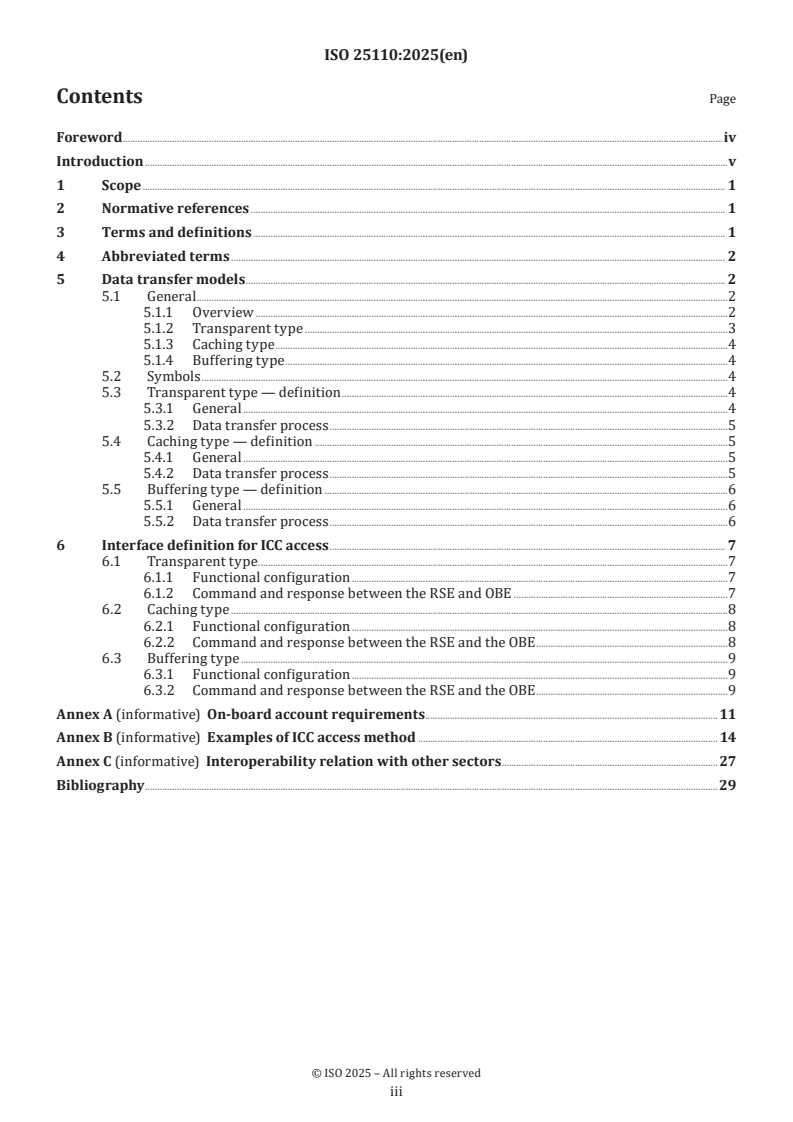
Contents Page
Foreword .iv
Introduction .v
1 Scope . 1
2 Normative references . 1
3 Terms and definitions . 1
4 Abbreviated terms . 2
5 Data transfer models . 2
5.1 General .2
5.1.1 Overview .2
5.1.2 Transparent type .3
5.1.3 Caching type .4
5.1.4 Buffering type .4
5.2 Symbols .4
5.3 Transparent type — definition .4
5.3.1 General .4
5.3.2 Data transfer process .5
5.4 Caching type — definition .5
5.4.1 General .5
5.4.2 Data transfer process .5
5.5 Buffering type — definition .6
5.5.1 General .6
5.5.2 Data transfer process .6
6 Interface definition for ICC access . 7
6.1 Transparent type .7
6.1.1 Functional configuration .7
6.1.2 Command and response between the RSE and OBE .7
6.2 Caching type .8
6.2.1 Functional configuration .8
6.2.2 Command and response between the RSE and the OBE .8
6.3 Buffering type .9
6.3.1 Functional configuration .9
6.3.2 Command and response between the RSE and the OBE .9
Annex A (informative) On-board account requirements .11
Annex B (informative) Examples of ICC access method . 14
Annex C (informative) Interoperability relation with other sectors .27
Bibliography .29
iii
Foreword
ISO (the International Organization for Standardization) is a worldwide federation of national standards
bodies (ISO member bodies). The work of preparing International Standards is normally carried out through
ISO technical committees. Each member body interested in a subject for which a technical committee
has been established has the right to be represented on that committee. International organizations,
governmental and non-governmental, in liaison with ISO, also take part in the work. ISO collaborates closely
with the International Electrotechnical Commission (IEC) on all matters of electrotechnical standardization.
The procedures used to develop this document and those intended for its further maintenance are described
in the ISO/IEC Directives, Part 1. In particular, the different approval criteria needed for the different types
of ISO document should be noted. This document was drafted in accordance with the editorial rules of the
ISO/IEC Directives, Part 2 (see www.iso.org/directives).
ISO draws attention to the possibility that the implementation of this document may involve the use of (a)
patent(s). ISO takes no position concerning the evidence, validity or applicability of any claimed patent
rights in respect thereof. As of the date of publication of this document, ISO had not received notice of (a)
patent(s) which may be required to implement this document. However, implementers are cautioned that
this may not represent the latest information, which may be obtained from the patent database available at
www.iso.org/patents. ISO shall not be held responsible for identifying any or all such patent rights.
Any trade name used in this document is information given for the convenience of users and does not
constitute an endorsement.
For an explanation of the voluntary nature of standards, the meaning of ISO specific terms and expressions
related to conformity assessment, as well as information about ISO's adherence to the World Trade
Organization (WTO) principles in the Technical Barriers to Trade (TBT), see www.iso.org/iso/foreword.html.
This document was prepared by Technical Committee ISO/TC 204, Intelligent transport systems.
This second edition cancels and replaces the first edition (ISO 25110:2017), which has been technically
revised.
The main changes are as follows:
— Clause 3 has been updated and ISO 17573-2 has been made the primary source for terms and definitions;
— in Clause 6, a provision related to the EFC functions invoked by roadside equipment to instruct the
on-board equipment has been changed from a recommendation to a requirement for conformance to
ISO 14906.
Any feedback or questions on this document should be directed to the user’s national standards body. A
complete listing of these bodies can be found at www.iso.org/members.html.
iv
Introduction
0.1 Background and motivation
Two payment systems currently exist for dealing with electronic fee collection (EFC):
1) the central account system, which uses a one-piece on-board unit (OBU), and
2) the on-board account system, which uses a payment media such as the integrated circuit card (ICC)
inserted in an element of on-board equipment (OBE).
ICCs are widely used for public transport cards such as subway and bus payment means, and electronic
money cards are used for general purpose payments, as well as for credit cards and banking cards. In the
future, ICCs are expected to also be used for EFC payment means, providing convenience and flexibility; see
Figure 1.
Figure 1 — Motivation for on-board accounts using ICCs
Currently, relevant descriptions in existing EFC-related standards are focused on the central account system,
which is comparatively simple and gives more feasibility for EFC interoperability than the on-board account
system, which is complex and has more items to be settled.
Figure 2 shows the basic model of EFC, in which the OBE is used as a communication means and the ICC
carries the payment means.
v
Figure 2 — The basic model of EFC
Considering the widespread use of transport cards or electronic money cards, a new International Standard
for an on-board account system using ICCs is required. Furthermore, the rapid development in certain
regions of the use of state-of-the-art mobile phones integrated with ICC functions as a payment means for
public transport or retail shopping (a “mobile electronic purse”), makes standardization on this theme
essential when considering future EFC payment methods.
0.2 Objective and use
The objective of this document is to classify data transfer models based on operational requirements and to
define a specific ICC access interface for on-board accounts using ICCs. Furthermore, this document provides
practical examples of transactions in Annex B, for consideration and easy adoption by toll road operators.
This document provides a common technical platform for on-board accounts using ICCs to deal with various
operational requirements, along with practical examples of on-board accounts used or planned in several
countries.
Each toll road operator can establish their own specification by selecting one example in the models of this
document (like a toolbox) to meet their requirements.
Figure 3 shows the principle of an on-board account architecture and the scope of this document. The
descriptions in this document focus on the interface (I/F) between the RSE and OBE to access the ICC.
Figure 3 — Principle of an on-board account architecture and scope of this document
vi
International Standard ISO 25110:2025(en)
Electronic fee collection — Interface definition for on-board
account using an integrated circuit card (ICC)
1 Scope
This document specifies the data transfer models between roadside equipment (RSE) and integrated circuit
cards (ICCs) and the interface descriptions between the RSE and on-board equipment (OBE) for on-board
accounts using an ICC. It also provides examples of interface definitions and transactions deployed in several
countries.
This document covers:
— data transfer models between the RSE and ICC which correspond to the categorized operational
requirements and the data transfer mechanism for each model;
— the interface definition between the RSE and OBE based on each data transfer model;
— the interface definition for each model;
— the functional configuration;
— RSE command definitions for ICC access;
— the data format and data element definitions of RSE commands;
— a transaction example for each model (Annex B).
2 Normative references
The following documents are referred to in the text in such a way that some or all of their content constitutes
requirements of this document. For dated references, only the edition cited applies. For undated references,
the latest edition of the referenced document (including any amendments) applies.
ISO/IEC 7816-4, Identification cards — Integrated circuit cards — Part 4: Organization, security and commands
for interchange
ISO 14906, Electronic fee collection — Application interface definition for dedicated short-range communication
1)
ISO 17573-2:2025 , Electronic fee collection — System architecture for vehicle related tolling — Part 2:
Vocabulary
3 Terms and definitions
2)
For the purposes of this document, the terms and definitions given in ISO 17573-2:2025 and the following apply.
ISO and IEC maintain terminology databases for use in standardization at the following addresses:
— ISO Online browsing platform: available at https:// www .iso .org/ obp
— IEC Electropedia: available at https:// www .electropedia .org/
1) Under preparation. Stage at the time of publication: ISO/DIS 17573-2:2025.
2) Under preparation. Stage at the time of publication: ISO/DIS 17573-2:2025.
3.1
Element
dedicated short-range communication (DSRC) directory containing application information in the form of
attributes
[SOURCE: ISO 14906:2022, 3.8]
4 Abbreviated terms
For the purposes of this document, the following abbreviated terms apply unless otherwise specified.
AID application identifier
APDU application protocol data unit
ASN.1 Abstract Syntax Notation One
ATR answer to reset
ATS answer to select
BST beacon service table
CPU central processing unit
DSRC dedicated short-range communication
EAL evaluation assurance level
EFC electronic fee collection
EID Element identifier
EVENT-RT EVENT-Report
IC integrated circuit(s)
ICC integrated circuit(s) card (IC card)
I/F interface
IFMS interoperable fare management system
MAC medium access control
OBE on-board equipment
SAM secure application module
5 Data transfer models
5.1 General
5.1.1 Overview
There are three types of data transfer models that can be used by on-board accounts using ICC to cope with
the operational requirements described in Annex A.
The data transfer models are as follows:
— the transparent type;
— the caching type;
— the buffering type.
Figure 4 shows the layer structure of the RSE, OBE and ICC, where the mid-layer of application interfaces is
the focus of this document.
NOTE Subjects covered by existing standards for physical and other protocol layers both between the RSE and
OBE, and between OBE and ICC are outside the scope of this document.
There are two types of virtual bridges contained in an OBE. The first type is Bridge-1, in which an RSE
command sent from the RSE is decomposed and the ICC access command contained in the application
protocol data unit (APDU) part of the RSE command is transferred to the ICC I/F to access the ICC. The
second type is Bridge-2, in which an RSE command sent from the RSU is transformed to ICC access command
and transferred to the ICC I/F to access the ICC.
Bridge-1 corresponds to the transparent type and the buffering type defined in this document, whereas
Bridge-2 corresponds to the caching type.
Figure 4 — Application interfaces of RSE, OBE and ICC
5.1.2 Transparent type
The ICC command data are transferred directly from the RSE to the ICC through the OBE. The OBE
temporarily stores the ICC command data and response data in the buffer memory. See Figure 5.
Key
CPU central processing unit
Figure 5 — Generic structure of transparent type
5.1.3 Caching type
The EFC-related data are read out from the ICC at the presentation and stored in the secure application
module (SAM) of the OBE. In the DSRC communication, the EFC-related data in the SAM is transferred to the
RSE. See Figure 6.
Figure 6 — Generic structure of caching type
5.1.4 Buffering type
The EFC-related data, which are limited to non-sensitive data, are read from the ICC at the presentation
and stored in the buffer memory in the OBE. In the DSRC communication, the EFC-related data in the buffer
memory is transferred to the RSE. See Figure 7.
Figure 7 — Generic structure of buffering type
5.2 Symbols
In the data transfer mechanism of each model, the symbols given in Figure 8 are applied.
Figure 8 — Definition of symbols
5.3 Transparent type — definition
5.3.1 General
In this model, the maximum vehicle speed is limited by the data transfer rate between the ICC and OBE so
that the vehicle has to stop or pass slowly beneath an RSE antenna when a conventional contact ICC is used.
The key feature of this type is that the OBE is simplified by eliminating the secure memory inside of the OBE
and by using high transfer rate ICCs.
5.3.2 Data transfer process
In this model, data exchanges between the RSE and ICC are processed directly after establishing DSRC
communication and when authentication between the RSE and OBE is completed. Mutual authentication
between the ICC and RSE is processed directly before the application data are exchanged and value data are
accessed.
In the reading sequence, the “Read command” is sent from the RSE to the ICC through the OBE to read out
the data set stored in the ICC. In the “Read response”, the data set stored in the ICC is transferred from
the ICC to the RSE through the OBE. In the writing sequence, the same procedure is processed. In case of
prepaid payment, the “Debit command” is sent from the RSE and the same procedure is processed, as shown
in Figure 9.
NOTE Debit command is used in case of prepaid payment.
Figure 9 — Data transfer process of transparent type
5.4 Caching type — definition
5.4.1 General
In this model, the OBE reads out datasets from the ICC and stores them in a secure memory inside the OBE,
upon insertion and completion of the authentication. The key feature of this type is that a high data exchange
rate between the RSE and OBE is achieved even when using ICC with a slow data rate. With this caching
type, maximum vehicle speed is enhanced up to DSRC communication performance, regardless of the data
transfer rate of the ICC.
5.4.2 Data transfer process
In this model, read out data from the ICC is stored in a secure memory, such as a SAM, inside the OBE to
ensure information security.
This type can cope with high vehicle speed by processing between the RSE and OBE at a high data exchange
rate, regardless of the type of ICC. See Figure 10.
Figure 10 — Data transfer process of caching type
5.5 Buffering type — definition
5.5.1 General
This model shares features with both the transparent and caching type. However, in the buffering type,
datasets stored in the ICC are limited to non-sensitive data to avoid tampering or disclosure of sensitive
data. In the buffering type, the data transfer method is the same as in the caching type and datasets of
the ICC are read out and stored in a buffer memory inside the OBE when the ICC is inserted into the OBE.
Datasets stored in the buffer memory are transferred to the RSE during the DSRC read sequence. In case
of writing, RSE datasets are transferred to the OBE and stored in the buffer memory of the OBE and then
transferred to the ICC.
5.5.2 Data transfer process
The key feature of this type is to be able to eliminate the SAM in the OBE and to use even low speed ICC. See
Figure 11.
Figure 11 — Data transfer process of buffering type
6 Interface definition for ICC access
6.1 Transparent type
6.1.1 Functional configuration
The functional configuration of the transparent type is shown in Figure 12. RSE commands containing ICC
access commands are sent in its ADPU to execute the ICC “Read” or “Write” command, or both commands
directly.
The command definition between the OBE and ICC shall conform to ISO/IEC 7816-4.
Figure 12 — Functional configuration of transparent type
6.1.2 Command and response between the RSE and OBE
The transfer channel defined by ISO 14906 shall be used as a basic RSE command to access ICC from
RSE directly with the channelId designated in the Action Parameter as Channel ID = ICC(3). Refer to
Tables 1 and 2.
Table 1 — TRANSFER_CHANNEL.request
Parameter ASN.1 Type Value Remarks
Element Identifier Dsrc-EID 0
EID
Action Type INTEGER(0.127,.) 8
Transfer channel
Acces
...