

ISO/TR 6029-1:2024
(Main)Intelligent transport systems — Seamless positioning for multimodal transportation in ITS stations — Part 1: General information and use case definition
General Information
- Abstract
This document describes use cases related to seamless positioning systems for multimodal transportation in ITS stations. The use cases define the effectiveness of the seamless positioning concept model based on the P-ITS-S to conclude basic PVT service results using available sensors when mobility is moving indoor and outdoor in a network on/off situation. Use cases are provided for each stage in different environments, e.g. indoor, outdoor, tunnel and out-of-network area when travelling starts or ends. Within the use cases, the nomadic device implements a personal ITS station (P-ITS-S) to achieve compatibility with other ITS stations as referenced in this document. The main purpose of this document is to describe the overall concept model, which specifies: — the concept model and actors for each domain; — the relationship of actors under the material domain; — the message sequence diagrams for each domain; and — the data transmission list for each actor to provide a seamless indoor and outdoor positioning system through sensor data fusion. In addition, this document provides: — basic principles used in its drafting; and — a gap analysis, consisting of a formal study of: — the status of seamless positioning technology and implementations, — how seamless positioning technology intends to evolve, and — how to close the gap between current and future technology and implementations. — This document compares desired and actual outcomes and pinpoints opportunities for improvement.
- Status
- Published
- Publication Date
- 04-Dec-2024
- Technical Committee
- ISO/TC 204 - Intelligent transport systems
- Drafting Committee
- ISO/TC 204 - Intelligent transport systems
- Current Stage
- 6060 - International Standard published
- Start Date
- 05-Dec-2024
- Completion Date
- 05-Dec-2024

Overview
ISO/TR 6029-1:2024 is a Technical Report from ISO that defines the concept model and use cases for seamless positioning for multimodal transportation in ITS stations. It describes how a nomadic device implementing a personal ITS station (P-ITS-S) interoperates with vehicle (V-ITS-S) and roadside (R-ITS-S) stations to deliver continuous PVT (position, velocity, time) services across indoor, outdoor, tunnel and out-of-network areas. The report focuses on message flows, actor relationships, sensor-data fusion and a gap analysis of current versus target seamless positioning capabilities.
Key topics and requirements
- Use case definitions for multiple environments: indoor, outdoor, tunnels, entrance/exit points, shadow zones and distorted network areas.
- Domains and actors: roles of P-ITS-S (nomadic device), mobility domain (vehicles/e-mobility), and infrastructure domain (roadside, access points).
- Concept model: overall architecture for seamless positioning, actor relationships and interoperability rules.
- Message sequence diagrams: domain-specific information flows and registration/search sequences to support positioning exchanges.
- Data transmission lists: the sensor and message payloads each actor should exchange to enable sensor fusion and PVT determination.
- Sensor fusion emphasis: use of available sensors (GNSS, RSSI, inertial, map data) to maintain positioning when GNSS or networks are unavailable.
- Gap analysis & KPIs: assessment of current technology, future evolution, market applicability, benefits and recommended actions to close gaps.
- Basic principles: extensibility, standardized message formats and compatibility with existing ITS messaging practices.
Practical applications and users
Who will use ISO/TR 6029-1:2024:
- ITS implementers and system integrators building indoor/outdoor positioning for transit hubs, stations and multimodal terminals.
- Device manufacturers (nomadic devices, vehicle telematics, roadside units) designing P-ITS-S, V-ITS-S and R-ITS-S compatibility.
- Mobility service providers (public transit operators, e-mobility, delivery robots, autonomous vehicle platforms) requiring robust location continuity.
- Urban planners, infrastructure owners and standards architects assessing interoperability, privacy and resilience of positioning services.
Practical benefits include improved passenger routing, safer handover between transport modes, robust navigation in GNSS-denied areas and enhanced support for accessibility and autonomous mobility.
Related standards
- ISO/TS 21184 (GTDM) - standardized message formats for ITS data exchange.
- IEC 61162, NMEA 0183 - examples of existing message formats referenced for simplification and interoperability.
For full normative content, diagrams and the complete gap analysis consult the ISO publication ISO/TR 6029-1:2024.
Get Certified
Connect with accredited certification bodies for this standard

BSI Group
BSI (British Standards Institution) is the business standards company that helps organizations make excellence a habit.

Great Wall Tianjin Quality Assurance Center
Established 1993, first batch to receive national accreditation with IAF recognition.
Hong Kong Quality Assurance Agency (HKQAA)
Hong Kong's leading certification body.
Sponsored listings
Frequently Asked Questions
ISO/TR 6029-1:2024 is a technical report published by the International Organization for Standardization (ISO). Its full title is "Intelligent transport systems — Seamless positioning for multimodal transportation in ITS stations — Part 1: General information and use case definition". This standard covers: This document describes use cases related to seamless positioning systems for multimodal transportation in ITS stations. The use cases define the effectiveness of the seamless positioning concept model based on the P-ITS-S to conclude basic PVT service results using available sensors when mobility is moving indoor and outdoor in a network on/off situation. Use cases are provided for each stage in different environments, e.g. indoor, outdoor, tunnel and out-of-network area when travelling starts or ends. Within the use cases, the nomadic device implements a personal ITS station (P-ITS-S) to achieve compatibility with other ITS stations as referenced in this document. The main purpose of this document is to describe the overall concept model, which specifies: — the concept model and actors for each domain; — the relationship of actors under the material domain; — the message sequence diagrams for each domain; and — the data transmission list for each actor to provide a seamless indoor and outdoor positioning system through sensor data fusion. In addition, this document provides: — basic principles used in its drafting; and — a gap analysis, consisting of a formal study of: — the status of seamless positioning technology and implementations, — how seamless positioning technology intends to evolve, and — how to close the gap between current and future technology and implementations. — This document compares desired and actual outcomes and pinpoints opportunities for improvement.
This document describes use cases related to seamless positioning systems for multimodal transportation in ITS stations. The use cases define the effectiveness of the seamless positioning concept model based on the P-ITS-S to conclude basic PVT service results using available sensors when mobility is moving indoor and outdoor in a network on/off situation. Use cases are provided for each stage in different environments, e.g. indoor, outdoor, tunnel and out-of-network area when travelling starts or ends. Within the use cases, the nomadic device implements a personal ITS station (P-ITS-S) to achieve compatibility with other ITS stations as referenced in this document. The main purpose of this document is to describe the overall concept model, which specifies: — the concept model and actors for each domain; — the relationship of actors under the material domain; — the message sequence diagrams for each domain; and — the data transmission list for each actor to provide a seamless indoor and outdoor positioning system through sensor data fusion. In addition, this document provides: — basic principles used in its drafting; and — a gap analysis, consisting of a formal study of: — the status of seamless positioning technology and implementations, — how seamless positioning technology intends to evolve, and — how to close the gap between current and future technology and implementations. — This document compares desired and actual outcomes and pinpoints opportunities for improvement.
ISO/TR 6029-1:2024 is classified under the following ICS (International Classification for Standards) categories: 03.220.01 - Transport in general; 35.240.60 - IT applications in transport. The ICS classification helps identify the subject area and facilitates finding related standards.
ISO/TR 6029-1:2024 is available in PDF format for immediate download after purchase. The document can be added to your cart and obtained through the secure checkout process. Digital delivery ensures instant access to the complete standard document.
Standards Content (Sample)
Technical
Report
ISO/TR 6029-1
First edition
Intelligent transport systems —
2024-12
Seamless positioning for
multimodal transportation in ITS
stations —
Part 1:
General information and use case
definition
Systèmes de transport intelligents — Positionnement homogène
pour le transport multimodal dans les stations ITS —
Partie 1: Informations générales et définition de cas d'utilisation
Reference number
© ISO 2024
All rights reserved. Unless otherwise specified, or required in the context of its implementation, no part of this publication may
be reproduced or utilized otherwise in any form or by any means, electronic or mechanical, including photocopying, or posting on
the internet or an intranet, without prior written permission. Permission can be requested from either ISO at the address below
or ISO’s member body in the country of the requester.
ISO copyright office
CP 401 • Ch. de Blandonnet 8
CH-1214 Vernier, Geneva
Phone: +41 22 749 01 11
Email: copyright@iso.org
Website: www.iso.org
Published in Switzerland
ii
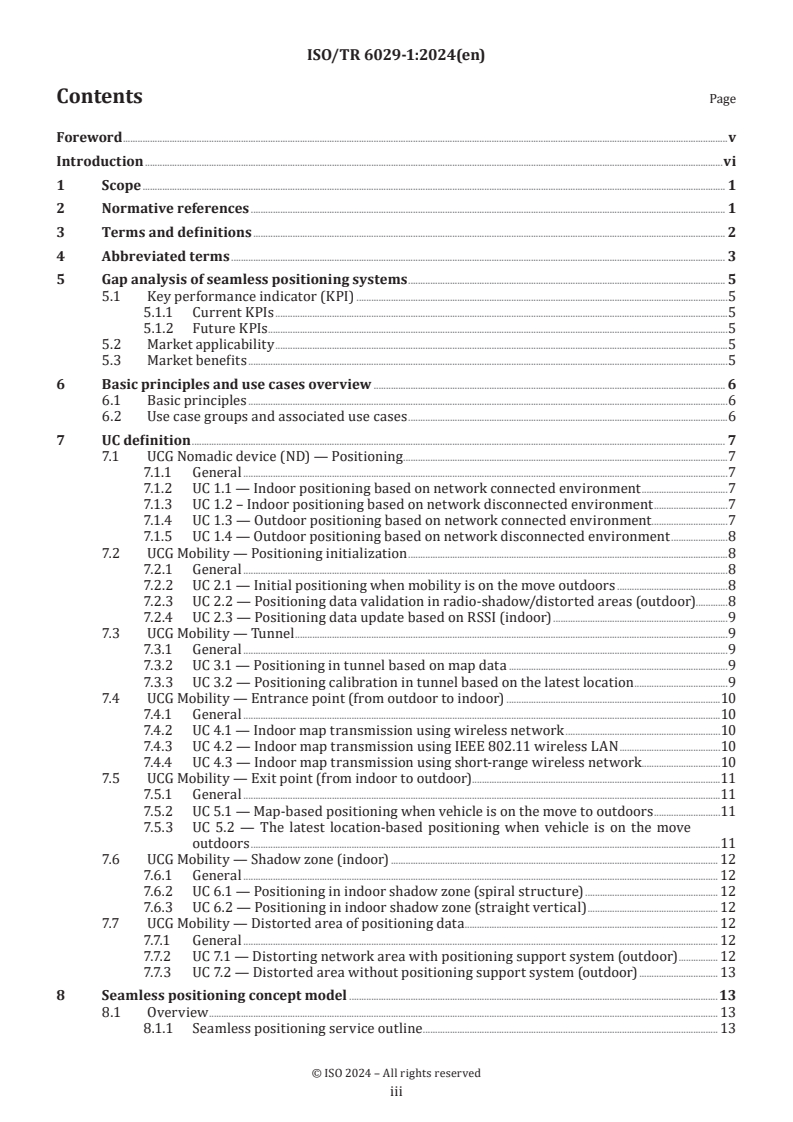
Contents Page
Foreword .v
Introduction .vi
1 Scope . 1
2 Normative references . 1
3 Terms and definitions . 2
4 Abbreviated terms . 3
5 Gap analysis of seamless positioning systems . 5
5.1 Key performance indicator (KPI) .5
5.1.1 Current KPIs .5
5.1.2 Future KPIs . .5
5.2 Market applicability .5
5.3 Market benefits .5
6 Basic principles and use cases overview . 6
6.1 Basic principles .6
6.2 Use case groups and associated use cases .6
7 UC definition . 7
7.1 UCG Nomadic device (ND) — Positioning .7
7.1.1 General .7
7.1.2 UC 1.1 — Indoor positioning based on network connected environment .7
7.1.3 UC 1.2 – Indoor positioning based on network disconnected environment .7
7.1.4 UC 1.3 — Outdoor positioning based on network connected environment .7
7.1.5 UC 1.4 — Outdoor positioning based on network disconnected environment .8
7.2 UCG Mobility — Positioning initialization .8
7.2.1 General .8
7.2.2 UC 2.1 — Initial positioning when mobility is on the move outdoors .8
7.2.3 UC 2.2 — Positioning data validation in radio-shadow/distorted areas (outdoor).8
7.2.4 UC 2.3 — Positioning data update based on RSSI (indoor) .9
7.3 UCG Mobility — Tunnel .9
7.3.1 General .9
7.3.2 UC 3.1 — Positioning in tunnel based on map data .9
7.3.3 UC 3.2 — Positioning calibration in tunnel based on the latest location .9
7.4 UCG Mobility — Entrance point (from outdoor to indoor) .10
7.4.1 General .10
7.4.2 UC 4.1 — Indoor map transmission using wireless network .10
7.4.3 UC 4.2 — Indoor map transmission using IEEE 802.11 wireless LAN .10
7.4.4 UC 4.3 — Indoor map transmission using short-range wireless network .10
7.5 UCG Mobility — Exit point (from indoor to outdoor).11
7.5.1 General .11
7.5.2 UC 5.1 — Map-based positioning when vehicle is on the move to outdoors .11
7.5.3 UC 5.2 — The latest location-based positioning when vehicle is on the move
outdoors .11
7.6 UCG Mobility — Shadow zone (indoor) . 12
7.6.1 General . 12
7.6.2 UC 6.1 — Positioning in indoor shadow zone (spiral structure) . 12
7.6.3 UC 6.2 — Positioning in indoor shadow zone (straight vertical) . 12
7.7 UCG Mobility — Distorted area of positioning data . 12
7.7.1 General . 12
7.7.2 UC 7.1 — Distorting network area with positioning support system (outdoor) . 12
7.7.3 UC 7.2 — Distorted area without positioning support system (outdoor) . 13
8 Seamless positioning concept model .13
8.1 Overview . 13
8.1.1 Seamless positioning service outline . 13
iii
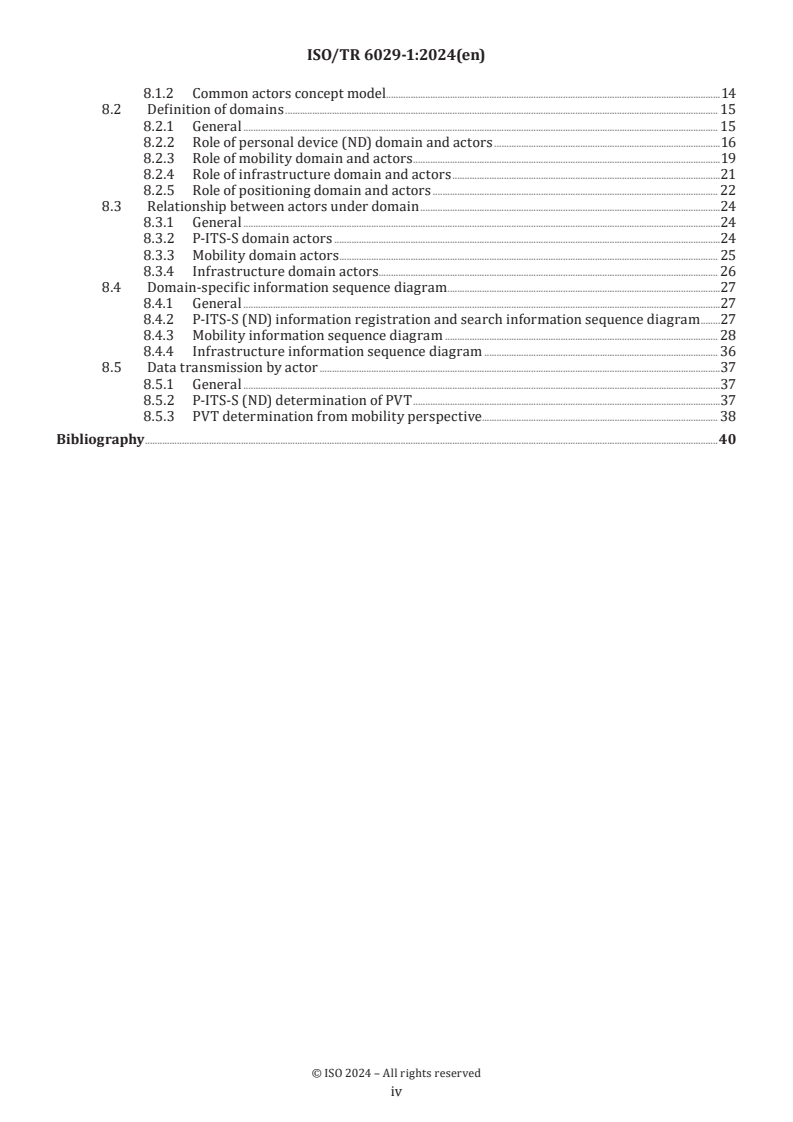
8.1.2 Common actors concept model .14
8.2 Definition of domains . 15
8.2.1 General . 15
8.2.2 Role of personal device (ND) domain and actors .16
8.2.3 Role of mobility domain and actors .19
8.2.4 Role of infrastructure domain and actors .21
8.2.5 Role of positioning domain and actors . 22
8.3 Relationship between actors under domain .24
8.3.1 General .24
8.3.2 P-ITS-S domain actors .24
8.3.3 Mobility domain actors . 25
8.3.4 Infrastructure domain actors. 26
8.4 Domain-specific information sequence diagram .27
8.4.1 General .27
8.4.2 P-ITS-S (ND) information registration and search information sequence diagram .27
8.4.3 Mobility information sequence diagram . 28
8.4.4 Infrastructure information sequence diagram . 36
8.5 Data transmission by actor .37
8.5.1 General .37
8.5.2 P-ITS-S (ND) determination of PVT .37
8.5.3 PVT determination from mobility perspective. 38
Bibliography .40
iv
Foreword
ISO (the International Organization for Standardization) is a worldwide federation of national standards
bodies (ISO member bodies). The work of preparing International Standards is normally carried out through
ISO technical committees. Each member body interested in a subject for which a technical committee
has been established has the right to be represented on that committee. International organizations,
governmental and non-governmental, in liaison with ISO, also take part in the work. ISO collaborates closely
with the International Electrotechnical Commission (IEC) on all matters of electrotechnical standardization.
The procedures used to develop this document and those intended for its further maintenance are described
in the ISO/IEC Directives, Part 1. In particular, the different approval criteria needed for the different types
of ISO document should be noted. This document was drafted in accordance with the editorial rules of the
ISO/IEC Directives, Part 2 (see www.iso.org/directives).
ISO draws attention to the possibility that the implementation of this document may involve the use of (a)
patent(s). ISO takes no position concerning the evidence, validity or applicability of any claimed patent
rights in respect thereof. As of the date of publication of this document, ISO had not received notice of (a)
patent(s) which may be required to implement this document. However, implementers are cautioned that
this may not represent the latest information, which may be obtained from the patent database available at
www.iso.org/patents. ISO shall not be held responsible for identifying any or all such patent rights.
Any trade name used in this document is information given for the convenience of users and does not
constitute an endorsement.
For an explanation of the voluntary nature of standards, the meaning of ISO specific terms and expressions
related to conformity assessment, as well as information about ISO's adherence to the World Trade
Organization (WTO) principles in the Technical Barriers to Trade (TBT), see www.iso.org/iso/foreword.html.
This document was prepared by Technical Committee ISO/TC 204, Intelligent transport systems.
A list of all parts in the ISO 6029 series can be found on the ISO website.
Any feedback or questions on this document should be directed to the user’s national standards body. A
complete listing of these bodies can be found at www.iso.org/members.html.
v
Introduction
As new forms of mobility service (e.g. e-mobility, delivery robot, autonomous driving) are emerging in the
intelligent transport systems industry, the nomadic device is acquiring an indispensable role.
One use of nomadic devices is in positioning systems, in which mobility service platforms use the position
data gathered via the nomadic devices of passengers. Current positioning systems rely on Global Navigation
Satellite System (GNSS) technology. The functionality of such systems is occasionally constrained by
network interference, a GNSS-denied environment or data loss. A seamless positioning system enables
interoperability between ITS domains for the provision of a seamless location-based service.
The main objective of the seamless positioning system described in the ISO 6029 series is to support the
development of a robust and ubiquitous indoor and outdoor seamless positioning solution for a mobile user
(e.g. multimodal transportation) so that anyone can benefit from mobility services, regardless of location,
environment and disability.
The seamless positioning system consists of three domains:
— nomadic device [e.g. personal intelligent transport system station (P-ITS-S)],
— mobility [e.g. vehicle intelligent transport system station (V-ITS-S)], and
— infrastructure [e.g. roadside intelligent transport system station (R-ITS-S)].
The system integrates multiple data from different domains and provides positioning data [e.g. position,
velocity, time (PVT service implemented in the ITS-S)] in a seamless manner.
Figure 1 shows the seamless positioning system described in the ISO 6029 series.
vi
Key
1 exchange of data between P-ITS-S and mobility containing mobility/personal data and network environment
2 exchange of data between P-ITS-S and infrastructure containing personal data and infrastructure information
3 exchange of data between mobility end and sensor-fusion positioning application
4 exchange of data between infrastructure end and sensor-fusion positioning application
5 exchange of data between P-ITS-S and sensor-fusion positioning application
6 seamless positioning calculation
7 positioning exchange use cases
8 positioning domain of all devices in P-ITS, V-ITS and R-ITS domain
a
The P-ITS domain is represented by ITS-compliant nomadic devices carried by human beings.
b
The V-ITS domain is represented by ITS-compliant vehicles.
c
The R-ITS domain is represented by ITS-compliant roadside infrastructure devices.
d
Outcome is the integrated position, velocity and time service provision.
Figure 1 — Seamless positioning system
The objective of the seamless positioning system is based on:
— extensibility, e.g. artificial intelligence, block-chain, sensor-fusion technology;
[6]
— simplification, e.g. standardized message format based on ISO/TS 21184 (GTDM), IEC 61162 and NMEA
[7]
0183;
— reliability, e.g. system reliability, data precision, fast first to fix, dilution correction factors;
vii
— application, e.g. the ISO 17438 series, autonomous driving features, location-based service, safety-related
industry.
viii
Technical Report ISO/TR 6029-1:2024(en)
Intelligent transport systems — Seamless positioning for
multimodal transportation in ITS stations —
Part 1:
General information and use case definition
1 Scope
This document describes use cases related to seamless positioning systems for multimodal transportation
in ITS stations. The use cases define the effectiveness of the seamless positioning concept model based on
the P-ITS-S to conclude basic PVT service results using available sensors when mobility is moving indoor
and outdoor in a network on/off situation. Use cases are provided for each stage in different environments,
e.g. indoor, outdoor, tunnel and out-of-network area when travelling starts or ends. Within the use cases, the
nomadic device implements a personal ITS station (P-ITS-S) to achieve compatibility with other ITS stations
as referenced in this document.
The main purpose of this document is to describe the overall concept model, which specifies:
— the concept model and actors for each domain;
— the relationship of actors under the material domain;
— the message sequence diagrams for each domain; and
— the data transmission list for each actor to provide a seamless indoor and outdoor positioning system
through sensor data fusion.
In addition, this document provides:
— basic principles used in its drafting; and
— a gap analysis, consisting of a formal study of:
— the status of seamless positioning technology and implementations,
— how seamless positioning technology intends to evolve, and
— how to close the gap between current and future technology and implementations.
This document compares desired and actual outcomes and pinpoints opportunities for improvement.
2 Normative references
The following documents are referred to in the text in such a way that some or all of their content constitutes
requirements of this document. For dated references, only the edition cited applies. For undated references,
the latest edition of the referenced document (including any amendments) applies.
ISO 21177, Intelligent transport systems — ITS station security services for secure session establishment and
authentication between trusted devices
ISO 21217, Intelligent transport systems — Station and communication architecture
ISO/TS 21184, Cooperative intelligent transport systems (C-ITS) — Global transport data management (GTDM)
framework
ISO/TS 21176, Cooperative intelligent transport systems (C-ITS) — Position, velocity and time functionality in
the ITS station
3 Terms and definitions
For the purposes of this document, the terms and definitions given in ISO 21217, ISO 21177, ISO/TS 21184,
ISO/TS 21176 and the following apply.
ISO and IEC maintain terminology databases for use in standardization at the following addresses:
— ISO Online browsing platform: available at https:// www .iso .org/ obp
— IEC Electropedia: available at https:// www .electropedia .org/
3.1
infrastructure communication
I-COMM
infrastructure (R/C-ITS-S) data exchange
3.2
infrastructure location profile handler
I-LPH
infrastructure location-based positioning data profile function
3.3
infrastructure floor profile handler
I-FPH
infrastructure triangulation measurement-based positioning data profile function
3.4
motion
change in the position of an object over time, represented by change of coordinate values with respect to a
particular reference frame
[SOURCE: ISO 19116:2019, 3.18, modified — the Example has been removed.]
3.5
motion positioning station gateway
M-PSG
ITS-based positioning device
3.6
motion registration information
M-RI
motion-based registration information
3.8
motion status profile handler
M-SPH
motion detection and status profile function
3.9
multimodal
involving several modes, modalities, or maxima
3.10
personal floor profile handler
P-FPH
P-ITS-S-based altitude positioning data profile function
3.11
personal location profile handler
P-LPH
P-ITS-S-based positioning data profile function
3.12
personal registration information
P-RI
user profile-based registration information
3.13
personal status profile handler
P-SPH
P-ITS-S-based motion activity profile function
3.14
positioning
POS
moving object position data
3.15
positioning accuracy profile handler
POS-APH
positioning data precision profile function
3.16
positioning fusion profile handler
POS-FPH
positioning data fusion profile function
3.17
positioning status profile handler
POS-SPH
positioning data status profile function
3.18
positioning velocity profile handler
POS-MPH
positioning data-based velocity profile function
4 Abbreviated terms
BP basic principle
GLONASS Russian global navigation satellite system
GNSS global navigation satellite system
GPS global positioning system
GW gateway
I-COMM infrastructure communication
IEEE Institute of Electrical Engineers
I-FPH infrastructure floor profile handler
IMU inertial measurement unit
I-LPH infrastructure location profile handler
ITS intelligent transport system
KPI key performance indicator
LaaS logistics as a service
M-PSG motion positioning station gateway
M-RI motion registration information
M-SPH motion status profile handler
MaaS mobility as a service
MAC media access control
ND nomadic device
P-FPH personal floor profile handler
P-ITS-S personal intelligent transport system station
P-LPH personal location profile handler
P-RI personal registration information
P-SPH personal status profile handler
POS positioning
POS-APH positioning accuracy profile handler
POS-FPH positioning fusion profile handler
POS-SPH positioning status profile handler
POS-MPH positioning velocity profile handler
PVT position, velocity, time
RFID radio-frequency identification
R-ITS-S roadside intelligent transport system station
RSSI received signal strength indicator
TaaS transportation as a service
TTFF time to first fix
UWB ultra-wide band
V-ITS-S vehicle intelligent transport system station
5 Gap analysis of seamless positioning systems
5.1 Key performance indicator (KPI)
5.1.1 Current KPIs
[5]
The applicable KPIs for the ISO 6029 series are based on SAE J2945/7.
5.1.2 Future KPIs
The future KPIs are based on the tiers that are listed in the performance requirements of SAE J2945/7. Since
the seamless positioning system operates based on network data, future KPI development considers the
data attributes. Table 1 defines the KPIs for the ISO 6029 series.
Table 1 — Future KPI
Properties KPI Measure Notes
(unit)
time latency ms Measure of delay to retrieve positioning data from other posi-
tioning handler.
packet delivery time ms Measure of positioning data propagation and transmission time
between positioning handlers.
TTFF ms Measure of the first position fixed time. This is required for posi-
tion initialization.
accuracy position cm, m Measure of the level of positioning data accuracy. The level of
accuracy varies for various sources of positioning data.
time ms Measure of time accuracy for data received.
throughput coordinate data bit/s Data throughput is sorted by the data source. The KPI is deter-
mined by the amount of data processing per second.
RSSI data bit/s
IMU data bit/s
image sensor data Mbit/s
5.2 Market applicability
The following is a list of prospective areas where the ISO 6029 series is applicable.
— Logistics (e.g. LaaS, last mile delivery).
— Autonomous driving technology (e.g. indoor driving, passing tunnel, basement).
— Multimodal transit service (e.g. bus, taxi, subway, shared mobility, MaaS, TaaS).
— Disabled and elderly person pick-up service (e.g. where person needs to be picked up directly from the
facility).
5.3 Market benefits
ISO 6029 series benefits all mobility-related areas with respect to service quality and efficiency:
— efficiency (e.g. less driving, less energy consumption, short-cut routing etc);
— time saving (e.g. delivery, transfer, wait time, etc);
— expansion of the driving territory of an autonomous vehicle (e.g. parking lot, basement, tunnel, etc).
6 Basic principles and use cases overview
6.1 Basic principles
Basic principles (BPs) have been established for the development of this document.
— BP1: Seamless positioning use cases describe the positioning data handover process between positioning
data handlers.
— BP2: Seamless positioning use cases of the same subject are combined in one seamless positioning use
case group.
— BP3: Seamless positioning use cases are described from a P-ITS-S and V-ITS-S point of view.
— BP4: Dataset and data exchange within seamless positioning systems are developed to provide flawless
and continuous positioning data in a stable manner.
— BP5: All communication messages are compatible with ISO/TS 21184.
— BP6: All data definitions are compatible with ISO/TS 21184.
— BP7: All security-related statements are compatible with ISO 21177.
— BP8: All access control policy-related statements are compatible with ISO 21177 and ISO/TS 21184.
— BP9: The gap analysis addresses current versus future performance of seamless positioning systems.
6.2 Use case groups and associated use cases
Table 2 provides an overview of the main use case groups and associated use cases.
Table 2 — Use case groups (UCG) and associated use cases (UC)
# UCG name UC name reference
1 Nomadic device (ND) — UC 1.1 — Indoor positioning based on network connected environment
Positioning
UC 1.2 — Indoor positioning based on network disconnected environment
UC 1.3 — Outdoor positioning based on network connected environment
UC 1.4 — Outdoor positioning based on network disconnected environment
2 Mobility — Positioning UC 2.1 — Initial positioning when mobility is on the move outdoors
initialization
UC 2.2 — Positioning data validation in radio-shadow/distorted areas (outdoor)
UC 2.3 — Positioning data update based on RSSI (indoor)
3 Mobility — Tunnel UC 3.1 — Positioning in tunnel based on map data
UC 3.2 — Positioning calibration in tunnel based on the latest location
4 Mobility — Entrance point UC 4.1 — Indoor positioning using wireless communication network
(from outdoor to indoor)
UC 4.2 — Indoor positioning using IEEE 802.11 wireless LAN
UC 4.3 — Indoor positioning using short-range wireless network
5 Mobility — Exit point (from UC 5.1 — Map-based positioning when vehicle is on the move to outdoors
indoor to outdoor)
UC 5.2 — The latest location-based positioning when vehicle is on the move out-
doors
6 Mobility — Shadow zone UC 6.1 — Positioning in indoor shadow zone (spiral structure)
(indoor)
UC 6.2 — Positioning in indoor shadow zone (straight vertical)
7 Mobility — Distorted area UC 7.1 — Distorted area with positioning support system (outdoor)
of positioning data
UC 7.2 — Distorted area without positioning support system (outdoor)
7 UC definition
7.1 UCG Nomadic device (ND) — Positioning
7.1.1 General
This UCG defines the use cases based on network availability of the nomadic device (ND) and the PVT service
as a result using the internal sensors.
7.1.2 UC 1.1 — Indoor positioning based on network connected environment
Table 3 specifies UC 1.1 — Indoor positioning based on network connected environment.
Table 3 — UC 1.1 — Indoor positioning based on network connected environment
Item Description
Title UC 1.1 — Indoor positioning based on network connected environment
Goal to retrieve positioning data in a seamless manner in a connected area
Actor P-ITS-S (ND)
Input request for indoor positioning
Output indoor positioning data
Function indoor positioning data containing information from infrastructure access point data (e.g.
IEEE 802.11 wireless LAN, Bluetooth, RFID, etc)
Classification mandatory
7.1.3 UC 1.2 – Indoor positioning based on network disconnected environment
Table 4 specifies UC 1.2 — Indoor positioning based on network disconnected environment.
Table 4 — UC 1.2 — Indoor positioning based on network disconnected environment
Item Description
Title UC 1.2 — Indoor positioning based on network disconnected environment
Goal to retrieve positioning data in a seamless manner in a disconnected area
Actor P-ITS-S (ND)
Input request for indoor positioning
Output indoor positioning data
Function indoor positioning data are gathered using dead reckoning method based on the latest positioning
data
Classification mandatory
7.1.4 UC 1.3 — Outdoor positioning based on network connected environment
Table 5 specifies UC 1.3 — Outdoor positioning based on network connected environment.
Table 5 — UC 1.3 — Outdoor positioning based on network connected environment
Item Description
Title UC 1.3 — Outdoor positioning based on network connected environment
Goal to retrieve positioning data with satellite-based positioning system
Actor P-ITS-S (ND)
Input request for outdoor positioning
Output outdoor positioning data
Function outdoor positioning data are gathered with satellite positioning information (e.g. GNSS, GPS,
GLONASS, BeiDou, Galileo, etc)
Classification mandatory
7.1.5 UC 1.4 — Outdoor positioning based on network disconnected environment
Table 6 specifies UC 1.4 — Outdoor positioning based on network disconnected environment.
Table 6 — UC 1.4 — Outdoor positioning based on network disconnected environment
Item Description
Title UC 1.4 — Outdoor positioning based on network disconnected environment
Goal to retrieve positioning data in a seamless manner in network disconnected outdoor
Actor P-ITS-S (ND)
Input request for outdoor positioning in network disconnected outdoor
Output outdoor positioning data
Function outdoor positioning data are calculated using dead-reckoning method from the latest positioning
data
Classification mandatory
7.2 UCG Mobility — Positioning initialization
7.2.1 General
This UCG defines the use cases based on the positioning initialization process by network condition.
7.2.2 UC 2.1 — Initial positioning when mobility is on the move outdoors
Table 7 specifies UC 2.1 — Initial positioning when mobility is on the move outdoors.
Table 7 — UC 2.1 — Initial positioning when mobility is on the move outdoors
Item Description
Title UC 2.1 — Initial positioning when mobility is on the move outdoors
Goal to initialize mobility’s position
Actor M-PSG
Input request for outdoor positioning initialization
Output initialized outdoor position data
Function retrieve mobility’s initial position before making the move using satellite positioning information
Classification mandatory
7.2.3 UC 2.2 — Positioning data validation in radio-shadow/distorted areas (outdoor)
Table 8 specifies UC 2.2 — Positioning data validation in radio-shadow/distorted areas (outdoor).
Table 8 — UC 2.2 — Positioning data validation in radio-shadow/distorted network area (outdoor)
Item Description
Title UC 2.2 — Positioning data validation in radio-shadow/distorted network area (outdoor)
Goal to validate positioning data which was gathered in radio-shadow/distorted network areas
Actor M-PSG
Input request for outdoor position validation
Output outdoor position data validation result
Function validate positioning data which was gathered from radio-shadow/network distorted areas
Classification mandatory
7.2.4 UC 2.3 — Positioning data update based on RSSI (indoor)
Table 9 specifies UC 2.3 — Positioning data update based on RSSI (indoor).
Table 9 — UC 2.3 – Positioning data update based on RSSI (indoor)
Item Description
Title UC 2.3 — Positioning data update based on RSSI (indoor)
Goal to retrieve indoor positioning data with RSSI
Actor M-PSG
Input request for indoor positioning data
Output indoor positioning data
Function retrieve indoor positioning data based on RSSI
Classification mandatory
7.3 UCG Mobility — Tunnel
7.3.1 General
This UCG defines the use cases where the mobility is passing through a tunnel. The methodology differs
according to the available data. Use cases are specified based on the positioning methodology.
7.3.2 UC 3.1 — Positioning in tunnel based on map data
Table 10 specifies UC 3.1 — Positioning in tunnel based on map data.
Table 10 — UC 3.1 — Positioning in tunnel based on map data
Item Description
Title UC 3.1 — Positioning in tunnel based on map data
Goal to retrieve positioning data while in tunnel with map data
Actor M-PSG
Input request for vehicle’s positioning data which was gathered while passing the tunnel
Output positioning data
Function retrieve positioning data while passing the tunnel with dead-reckoning and map-matching meth-
ods.
Classification mandatory
7.3.3 UC 3.2 — Positioning calibration in tunnel based on the latest location
Table 11 specifies UC 3.2 — Positioning calibration in tunnel based on the latest location.
Table 11 — UC 3.2 — Positioning calibration in tunnel based on the latest location
Item Description
Title UC 3.2 — Positioning calibration in tunnel based on the latest location
Goal to calibrate positioning data while in tunnel with the latest location information
Actor M-PSG
Input request for calibrated vehicle’s positioning data
Output calibrated positioning data
Function retrieve referencing positioning data and gather IMU data while passing a tunnel and then calibrate
gathered data to determine its position
Classification mandatory
7.4 UCG Mobility — Entrance point (from outdoor to indoor)
7.4.1 General
This UCG defines the use cases where the mobility makes an entrance from the outdoor to indoor. The
process differs depending on the available source.
7.4.2 UC 4.1 — Indoor map transmission using wireless network
Table 12 specifies UC 4.1 — Indoor map transmission using wireless network.
Table 12 — UC 4.1 — Indoor map transmission using wireless network
Item Description
Title UC 4.1 — Indoor positioning using wireless communication network
Goal to receive indoor map data and initiate indoor positioning through wireless communication net-
work
Actor M-PSG
Input request for indoor map data through wireless communication network
Output indoor positioning
Function retrieve indoor map data and start indoor positioning using wireless communication network
Classification mandatory
7.4.3 UC 4.2 — Indoor map transmission using IEEE 802.11 wireless LAN
Table 13 specifies UC 4.2 — Indoor map transmission using IEEE 802.11 wireless LAN.
Table 13 — UC 4.2 – Indoor map transmission using IEEE 802.11 wireless LAN
Item Description
Title UC 4.2 — Indoor positioning using IEEE 802.11 wireless LAN
Goal to receive indoor map data and initiate indoor positioning through IEEE 802.11 wireless LAN
Actor M-PSG
Input request for indoor map data through IEEE 802.11 wireless LAN network
Output indoor positioning
Function retrieve indoor map data and start indoor positioning using IEEE 802.11 wireless LAN network
Classification mandatory
7.4.4 UC 4.3 — Indoor map transmission using short-range wireless network
Table 14 specifies UC 4.3 — Indoor map transmission using short-range wireless network.
Table 14 — UC 4.3 — Indoor map transmission using short-range wireless network
Item Description
Title UC 4.3 — Indoor positioning using short-range wireless network
Goal to receive indoor map data and initiate indoor positioning through short-range wireless network
Actor M-PSG
Input request for indoor map data through short-range wireless network
Output indoor positioning
Function retrieve indoor map data and start indoor positioning using short-range wireless network
Classification mandatory
7.5 UCG Mobility — Exit point (from indoor to outdoor)
7.5.1 General
This UCG defines the use cases where the mobility makes an exit from the indoor to outdoor. The process
differs depending on the available source.
7.5.2 UC 5.1 — Map-based positioning when vehicle is on the move to outdoors
Table 15 specifies UC 5.1 — Map-based positioning when vehicle is on the move to outdoors.
Table 15 — UC 5.1 — Map-based positioning when vehicle is on the move to outdoors
Item Description
Title UC 5.1 — Map-based positioning when vehicle is on the move to outdoors
Goal to position the vehicle position with map-matching platform
Actor M-PSG
Input request for outdoor map-matched positioning data
Output outdoor positioning
Function switch to outdoor positioning with map-matching feature
Classification mandatory
7.5.3 UC 5.2 — The latest location-based positioning when vehicle is on the move outdoors
Table 16 specifies UC 5.2 — The latest location-based positioning when vehicle is on the move outdoors.
Table 16 — UC 5.2 — The latest location-based positioning when vehicle is on the move outdoors
Item Description
Title UC 5.2 — The latest location-based positioning when vehicle is on the move outdoors
Goal to locate vehicle position with dead reckoning data based on the latest position information
Actor M-PSG
Input request for outdoor positioning with dead-reckoning data
Output outdoor positioning
Function switch to outdoor positioning with dead-reckoning data
Classification mandatory
7.6 UCG Mobility — Shadow zone (indoor)
7.6.1 General
This UCG specifies the use cases where the mobility travels floor to floor within a building. The positioning
process differs depending on the available source.
7.6.2 UC 6.1 — Positioning in indoor shadow zone (spiral structure)
Table 17 specifies UC 6.1 — Positioning in indoor shadow zone (spiral structure).
Table 17 — UC 6.1 – Positioning in indoor shadow zone (spiral structure)
Item Description
Title UC 6.1 — Positioning in indoor shadow zone (spiral structure)
Goal positioning a mobility travelling floor to floor in spiral manner
Actor M-PSG
Input request for positioning using dead-reckoning and elevation sensor
Output indoor positioning floor to floor
Function when the mobility makes a move floor to floor in spiral manner, dead-reckoning and elevation data
are being used to determine its position
Classification mandatory
7.6.3 UC 6.2 — Positioning in indoor shadow zone (straight vertical)
Table 18 specifies the UC 6.2 — Positioning in indoor shadow zone (straight vertical).
Table 18 — UC 6.2 — Positioning in indoor shadow zone (straight vertical)
Item Description
Title UC 6.2 — Positioning in indoor shadow zone (straight vertical)
Goal positioning a mobility travelling floor to floor in straight vertical manner
Actor M-PSG
Input request for positioning using elevation sensor
Output indoor positioning floor to floor
Function when the mobility makes a move floor to floor in a straight vertical manner, elevation sensor data
are used to determine its position then switch to applicable indoor positioning method
Classification mandatory
7.7 UCG Mobility — Distorted area of positioning data
7.7.1 General
This UCG specifies the use cases where the mobility travels through a distorting network area (network
noise). The positioning process differs depending on the available source.
7.7.2 UC 7.1 — Distorting network area with positioning support system (outdoor)
Table 19 specifies the UC 7.1 — Distorting network area with positioning support system (outdoor).
Table 19 — UC 7.1 — Distorting network area with positioning support system (outdoor)
Item Description
Title UC 7.1 — Distorting network area with positioning support system (outdoor)
Goal to retrieve positioning data with the aiding from A-GPS
Actor M-PSG
Input request for positioning data
Output outdoor positioning data with A-GPS
Function switch to A-GPS positioning data while travelli
...