

ISO/TR 11065:1992
(Main)Industrial automation glossary
General Information
- Abstract
Defines more than 550 terms relevant to automation in an industrial manufacturing environment. All the terms and definitions have been obtained from the previous approved ISO publications listed in each case as the source.
- Status
- Published
- Publication Date
- 08-Sep-1992
- Current Stage
- 6060 - International Standard published
- Start Date
- 09-Sep-1992
- Completion Date
- 29-Aug-2026
Overview
ISO/TR 11065:1992 - Industrial automation glossary is a Technical Report (type 3) published by ISO/TC 184 (Industrial automation systems and integration, SC5). It provides a harmonized glossary of more than 550 terms used in industrial automation and manufacturing environments. The entries are bilingual (English/French) and compiled from previously approved ISO publications (sources listed in Annex A). As a type 3 Technical Report, it offers a “state of the art” terminology guide rather than a prescriptive International Standard.
Key topics
The glossary covers terminology across the range of industrial automation, including but not limited to:
- Control and programming: absolute programming, absolute coordinates, absolute vector
- Sensing and measurement: absolute position sensor, accuracy, absolute error, acceleration
- Actuation and hardware: actuator, active devices, active output
- Analog and digital interfaces: analog input channel, analog output channel amplifier, analog representation
- Communications and data transmission: abbreviated address calling, anisochronous transmission
- Control strategies: adaptive control, active accommodation (sensor-in-the-loop adjustments)
Each term entry includes a concise definition and cites the ISO source document. Terms printed in italics in a definition refer to other glossary entries, ensuring consistent cross-referencing.
Applications
ISO/TR 11065 is practical for anyone needing consistent, standardized terminology in industrial automation:
- Systems engineers and integrators - for clear specifications and interface definitions when designing PLC, DCS, robot or CIM systems
- Manufacturers and suppliers - to align product documentation, datasheets and user manuals with accepted ISO vocabulary
- Technical authors and trainers - to standardize teaching materials, course content and operator manuals
- Procurement and quality teams - to reduce ambiguity in contracts, requirements and compliance checks
- Standards committees and researchers - as a reference when drafting or harmonizing new standards in automation and control
Using a common glossary reduces misinterpretation across disciplines (mechanical, electrical, software, control, communications) and supports interoperability and system integration.
Related standards
- Developed by ISO/TC 184 (Industrial automation systems and integration) with liaison to the IEC on electrotechnical terms.
- Term sources are previous ISO publications listed in Annex A of ISO/TR 11065.
- Intended as a companion reference to other ISO/IEC standards covering control systems, communications, robotics and manufacturing automation.
Keywords: ISO TR 11065, industrial automation glossary, automation terminology, ISO glossary, manufacturing automation terms, control systems vocabulary, robot programming terms.
Get Certified
Connect with accredited certification bodies for this standard

DVS-ZERT GmbH
German welding certification society.
CARES (UK Certification Authority for Reinforcing Steels)
UK certification for reinforcing steels and construction.
EWF/IIW (European/International Welding Federation)
International welding personnel certification.
Sponsored listings
Frequently Asked Questions
ISO/TR 11065:1992 is a technical report published by the International Organization for Standardization (ISO). Its full title is "Industrial automation glossary". This standard covers: Defines more than 550 terms relevant to automation in an industrial manufacturing environment. All the terms and definitions have been obtained from the previous approved ISO publications listed in each case as the source.
Defines more than 550 terms relevant to automation in an industrial manufacturing environment. All the terms and definitions have been obtained from the previous approved ISO publications listed in each case as the source.
ISO/TR 11065:1992 is classified under the following ICS (International Classification for Standards) categories: 01.040.25 - Manufacturing engineering (Vocabularies); 25.040.01 - Industrial automation systems in general. The ICS classification helps identify the subject area and facilitates finding related standards.
ISO/TR 11065:1992 is available in PDF format for immediate download after purchase. The document can be added to your cart and obtained through the secure checkout process. Digital delivery ensures instant access to the complete standard document.
Standards Content (Sample)
ISOITR
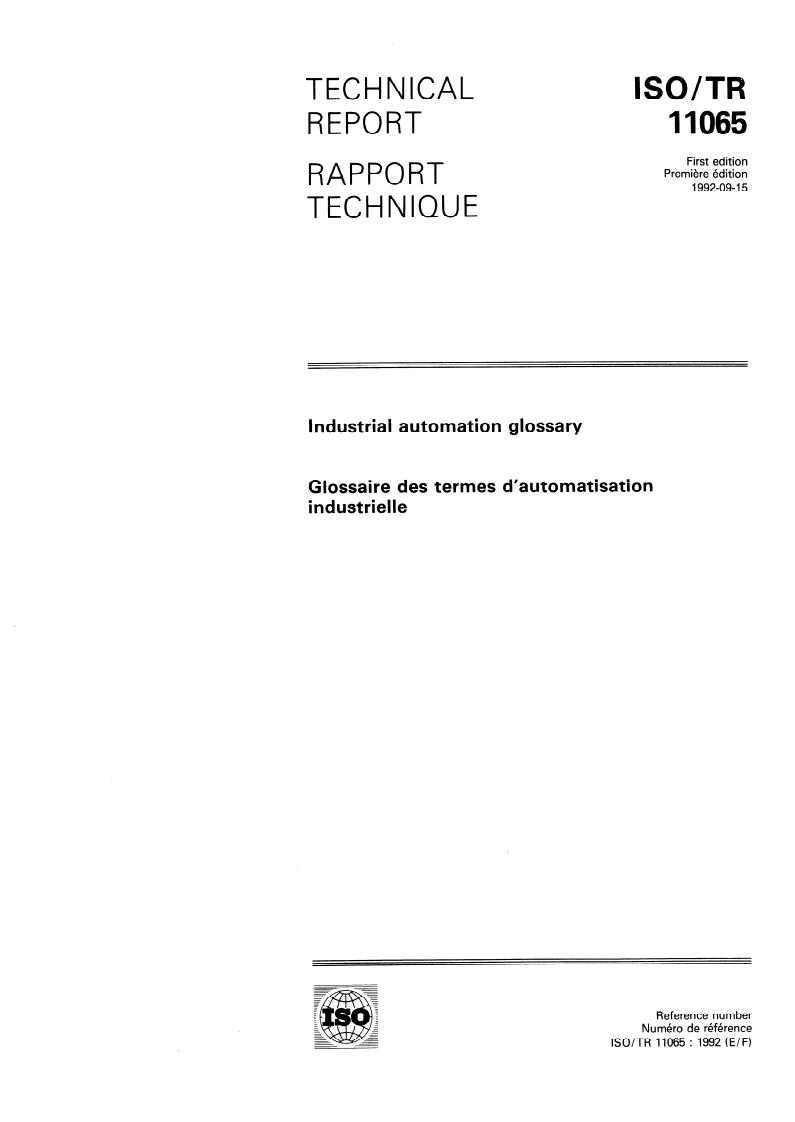
TECHNICAL
REPORT
First edition
Premiere Edition
RAPPORT
1992009- 15
TECHNIQUE
Industrial automation glossary
Glossaire des termes d’automatisation
industrielle
Reference number
Numero de reference
ISO/TR 11065 : 1992 WF)
ISO/TR 11065 : 1992 (E/F)
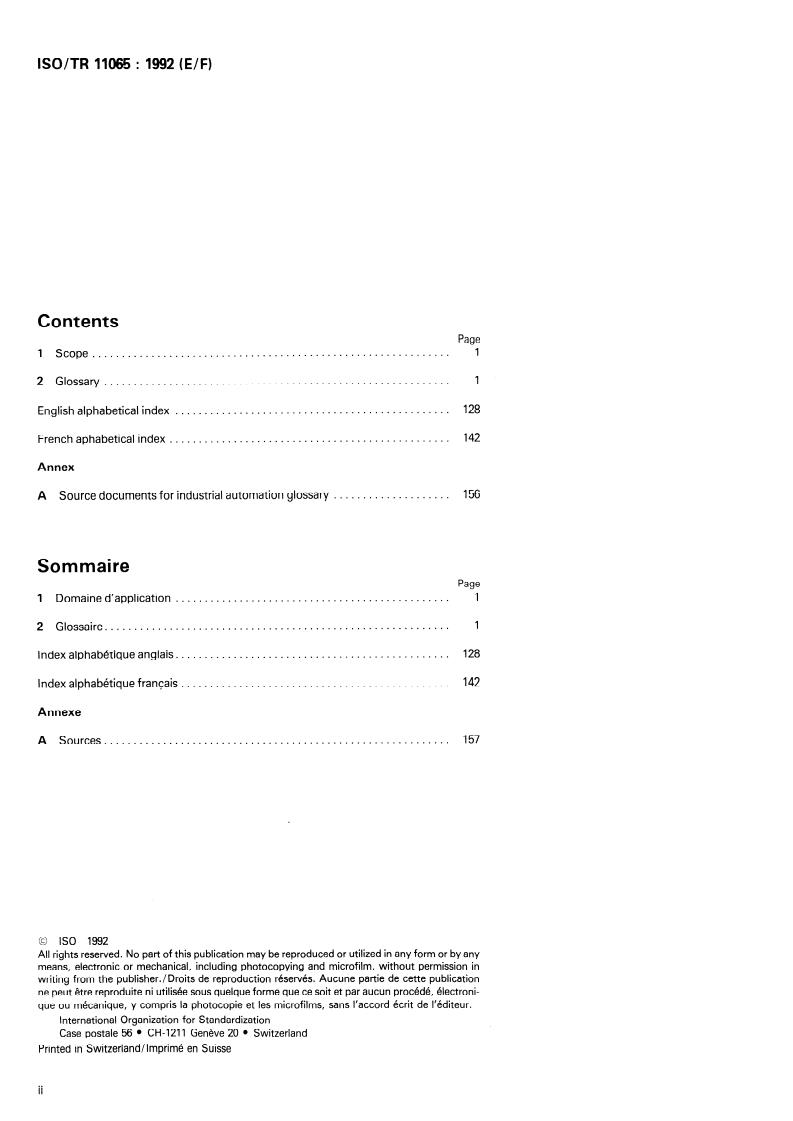
Contents
Page
1 Scope. 1
. . . . . . . . . .I . . . . . 1
2 Glossary.
. . . . . . . . . . . . . . . . . 128
English alphabetical index . . . . . . . . . . . . . . . . . . . . . . . . . . . . .
................. 142
French aphabetical index . . . . . . . . . . . . . . . . . . . . . . . . . . . . . .
Annex
................. 156
A Source documents for industrial automation glossary . .
Sommaire
Page
1 Domaine d’application . . . . . . . . . . . . . . . . . . . . . . . . . . . . . . . . . . . . . . . . . . . . . . .
2 Glossaire. 1
Index alphabetique anglais. . . . . . . . . . . . . . . . . . . . . . . . . . . . . . . . . . . . . . . . . . . . . .
Index alphabetique francais . . . . . . . . . . . . . . . . . . . . . . . . . . . . . . . . . . . . . . . . . . . . . . 142
Annexe
A Sources. 157
0 ISO 1992
All rights reserved. No patt of this publication may be reproduced or utilized in any form or by any
means, electronie or mechanical, including photocopying and microfilm, without Permission in
writing from the publisher./Droits de reproduction reserves. Aucune Partie de cette publication
ne peut etre reproduite ni utilisee sous quelque forme que ce soit et par aucun procede, electroni-
que ou mecanique, y compris Ia photocopie et les microfilms, sans I’accord ecrit de I’editeur.
International Organization for Standardization
Case postale 56 l CH-1211 Geneve 20 l Switzerland
Printed in Switzerland/ Imprime en Suisse
ii
ISO/TR 11065 : 1992 (E/F)
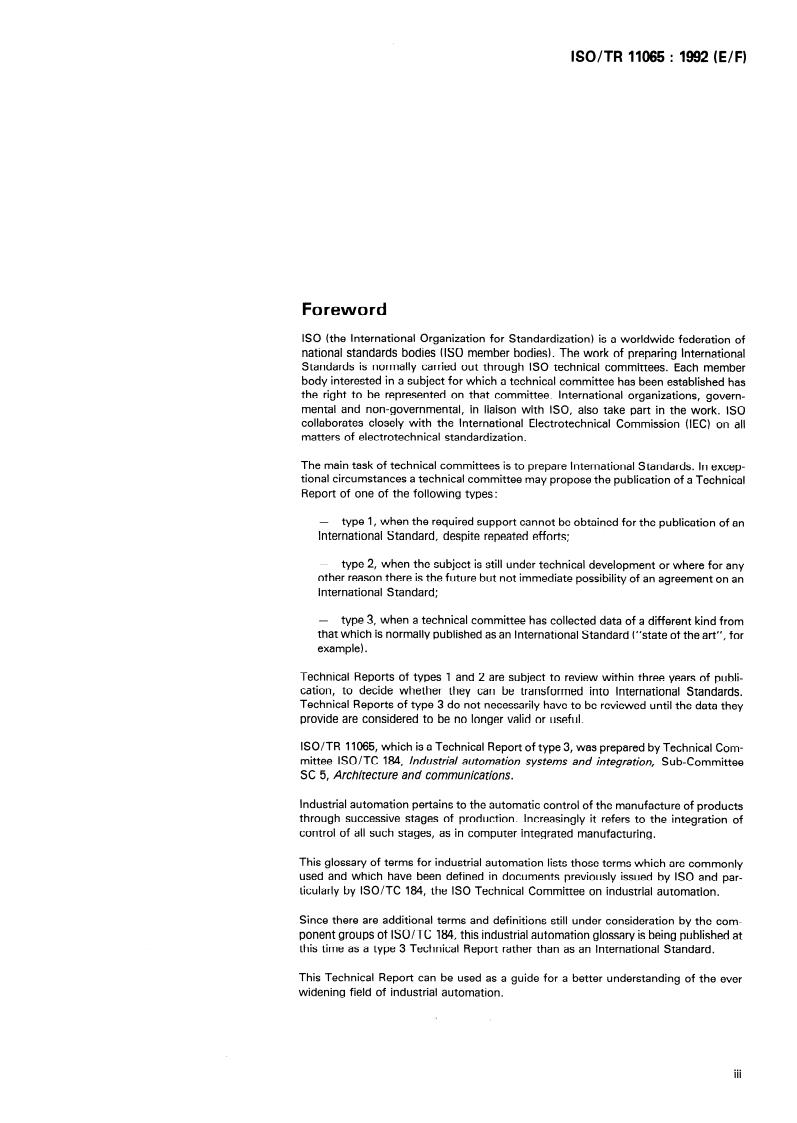
Foreword
ISO (the International Organization for Standardization) is a worldwide federation of
national Standards bodies (ISO member bedies). The work of preparing International
Standards is normally carried out through ISO technical committees. Esch member
body interested in a subject for which a technical committee has been established has
the right to be represented on that committee. International organizations, govern-
mental and non-governmental, in liaison with ISO, also take part in the work. ISO
collaborates closely with the International Electrotechnical Commission (IEC) on all
matters of electrotechnical standardization.
The main task of technical committees is to prepare International Standards. In excep-
tional circumstances a technical committee may propose the publication of a Technical
Report of one of the following types:
-
type 1, when the required support cannot be obtained for the publication of an
International Standard, despite repeated efforts;
-
type 2, when the subject is still under technical development or where for any
other reason there is the future but not immediate possibility of an agreement on an
International Standard;
-
type 3, when a technical committee has collected data of a different kind from
that which is normally published as an International Standard (“state of the art”, for
example).
Technical Reports of types 1 and 2 are subject to review within three years of publi-
cation, to decide whether they tan be transformed into International Standards.
Technical Reports of type 3 do not necessarily have to be reviewed until the data they
provide are considered to be no longer valid or useful.
ISO/TR 11065, which is a Technical Report of type 3, was prepared by Technical Com-
mittee ISO/TC 184, Industrial automation Systems and integration, Sub-Committee
SC 5, Architecture and communications.
Industrial automation pertains to the automatic control of the manufacture of products
through successive stages of production. Increasingly it refers to the integration of
control of all such stages, as in Computer integrated manufacturing.
This glossary of terms for industrial automation lists those terms which are commonly
used and which have been defined in documents previously issued by ISO and par-
ticularly by ISO/TC 184, the ISO Technical Committee on industrial automation.
Since there are additional terms and definitions still under consideration by the com-
ponent groups of ISO/TC 184, this industrial automation glossary is being published at
this time as a type 3 Technical Report rather than as an International Standard.
This Technical Report tan be used as a guide for a better understanding of the ever
wide ning field of industrial automation.
. . .
Ill
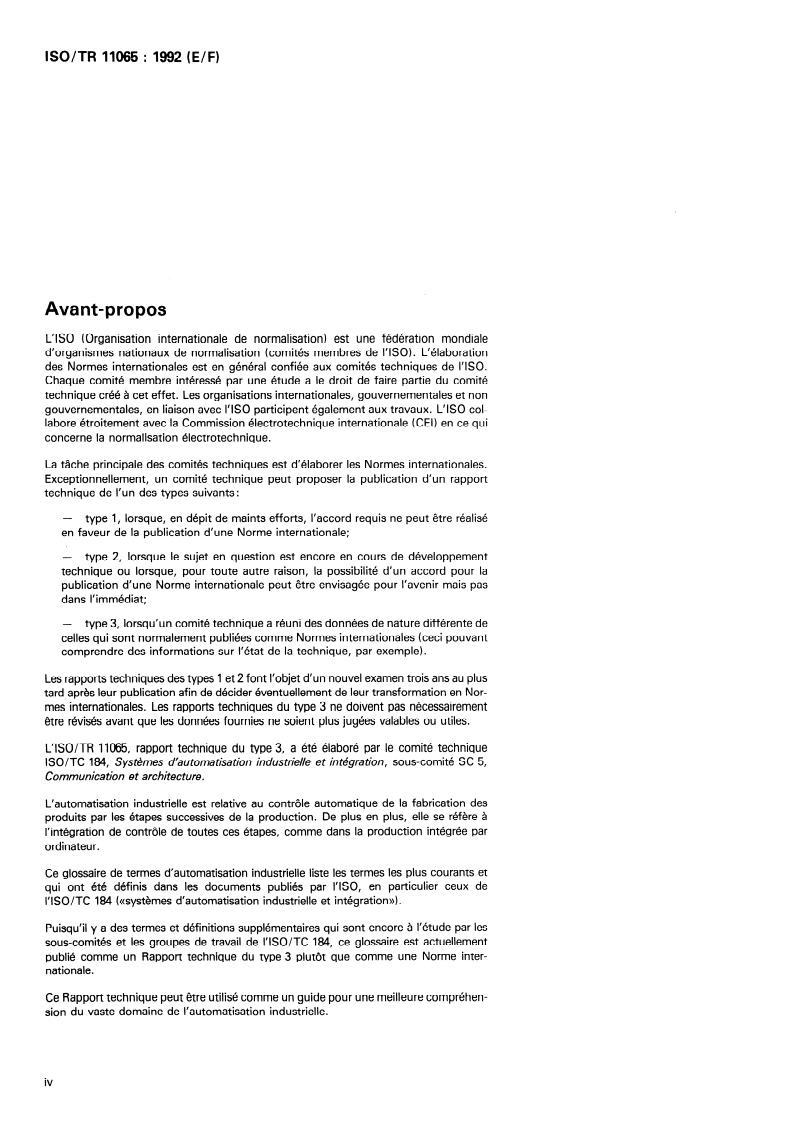
Avant-propos
L’ISO (Organisation internationale de normalisation) est une federation mondiale
d’organismes nationaux de normalisation (comites membres de I’ISO). L’elaboration
des Normes internationales est en general confiee aux comites techniques de I’ISO.
Chaque comite membre interesse par une etude a Ie droit de faire Partie du comite
technique cr& a cet effet. Les organisations internationales, gouvernementales et non
gouvernementales, en liaison avec I’ISO participent egalement aux travaux. L’ISO col-
labore etroitement avec Ia Commission electrotechnique internationale (GEI) en ce qui
concerne Ia normalisation electrotechnique.
La tache principale des comites techniques est d’elaborer les Normes internationales.
Exceptionnellement, un comite technique peut proposer Ia publication d’un rapport
technique de I’un des types suivants:
1, lorsque, en depit de maints efforts, I’accord requis ne peut etre realise
tYPe
en faveur de Ia publ cation d’ ‘une Norme internationale;
-
type 2, lorsque Ie Sujet en question est encore en cours de developpement
technique ou lorsque, pour toute autre raison, Ia possibilite d’un accord pour Ia
publication d’une Norme internationale peut etre envisagee pour I’avenir mais pas
dans I’immediat;
-
type 3, lorsqu’un comite technique a reuni des donnees de nature differente de
celles qui sont normalement publiees comme Normes internationales (ceci pouvant
comprendre des informations sur I’etat de Ia technique, par exemple).
Les rapports techniques des types 1 et 2 font I’objet d’un nouvel examen trois ans au plus
tard apres leur publication afin de decider eventuellement de leur transformation en Nor-
mes internationales. Les rapports techniques du type 3 ne doivent pas necessairement
etre revises avant que les donnees fournies ne soient plus jugees valables ou utiles.
L’ISO/TR 11065, rapport technique du type 3, a etc elabore par Ie comite technique
ISO/TC 184, Syst&mes d’automatisation industrielle et intkgration, sous-comite SC 5,
Communica tion et architecture .
L’automatisation industrielle est relative au controle automatique de Ia fabrication des
produits par les etapes successives de Ia production. De plus en plus, elle se refere a
I’integration de controle de toutes ces etapes, comme dans Ia production integree par
ordinateur.
Ce glossaire de termes d’automatisation industrielle liste les termes les plus courants et
qui ont etc definis dans les documents publies par I’ISO, en particulier ceux de
I’ISO/TC 184 ksystemes d’automatisation industrielle et integration»).
Puisqu’il y a des termes et definitions supplementaires qui sont encore a I’etude par les
sous-comites et les groupes de travail de I’ISO/TC 184, ce glossaire est actuellement
public comme un Rapport technique du type 3 plutot que comme une Norme inter-
nationale.
apport technique peut etre utilise comme un guide pour une meilleure CO mprehen-
Ce R
sion du vaste domaine de l’automatisation industrielle.
TECHNICAL REPORT
ISO/TR 11065: 1992 (E/F)
RAPPORT TECHNIQUE
Industrial automation Glossaire des termes
glossary d’automatisation
industrielle
1 Domaine d’application
1 Scope
Le prbsent Rapport technique definit les termes relatifs a I’auto-
This Technical Report defines terms relevant to automation in
matisation industrielle mise en ceuvre dans un environnement *
an industrial manufacturing environment.
manufacturier.
NOTES NOTES
1 All of the terms and definitions contained in this Technical Report 1 Tous les termes et definitions contenus dans Ie present Rapport
have been obtained from the previously approved ISO publications technique ont et6 extraits de documents ISO deja approuves cites
listed in each case as the Source. Numbers shown asIN[following each comme Source. Le numero indique\NI a Ia Suite de chaque definition se
definition refer to the list of Source documents provided in annex A. refere a Ia liste des sources donnee dans I’annexe A.
2 A term printed in italic typeface in a definition or example has the
2 Un terme imprime en italique dans une definition ou un exemple a Ia
meaning given to it in another entry of the vocabulary. However, the
signification qui lui est donnee dans un autre article du vocabulaire.
term is only printed in italic typeface the first time it occurs in each
Cependant, Ie terme n’est imprime en italique que lorsqu’il apparait
entry.
pour Ia premiere fois dans chaque article.
2 Glossaire
2 Glossary
Noir les pages suivantes.)
(See following pages.)
ISO/TR 11065 : 1992 (E/F)
abbreviated address calling: -Cal1 irgg that enables a user to employ an address
having fewer C~ZCIIWCICS than the full address when initiating a call. NOTE -
Networks may allow a User to designate a given number of abbreviated address
Codes. The allocation of abbreviated address Codes to a destination or group
of destinations may be changed as required by means of a suitable procedure.
absolute co-ordinates: The absolute distances or angles that specify the
Position of a Point with respect to the datum of a Co-Ordinate System.
12 I
absolute coordinate: One of the coordinates that identify the position of an
addt-cswblc yoilzt with respect to the origin of a specified coordinate
System.
19 I
absolute error: The algebraic result of subtracting a true, specified or
theoretically correct value from the computed, observed, measured or achieved
value .
12 I
absolute instruction: A disylay cormaud using absoh/c coordinates.
19 I
absolute position Sensor: A SCVZSOT that gives directly the Co-Ordinate
Position of an element of a machine.
-
12 I
absolute programming: Programming using wal-ds indicating absolute dintem iom
(absolute co-ordinates).
12 I
absolute vector: A vector whose Start and end points are specified in
absolrr u coordhales.
19 I
acceleration: Rate of Change of the veloci ty at the point under consideration
per unit of time.
11 I
accuracy: A qualitative assessment of freedom from error or of the degree of
conformity to a desired value, a high assessment corresponding to a small
error.
12 I
active accommdation: Type of control in which the combination of Sensor
control commands, and robot motion is used to achieve alteration of
Outputs,
a robot's preprogrammed motions in response to sensed inputs (e.g, used to
or to perform forte feedback tasks
stop a robot when forces resch set levels,
like insertions, door opening and edge tracing).
11 I
ISO/TR 11065 : 1992 (E/F)
nukkotation ableg6e: Nmzhvta / ion permettant 3 l’usager qui demande une
communication de composer une ndwpa plus courte. NOTE - Les rkeaux peuvent
autoriser les usagers a faire enregistrer un certain nombre d’adresses
abregees, une procedure appropriee permettant de modifier ultkieurement,
l’adresse abregee attribuee a chaque destination ou groupe
selon les besoins,
de destinations.
18 1
coordonn6es absolues: Distances ou angles qui donnent la position d’un point
par rapport 2 un Systeme fixe de coordonnees.
.
12 I
coordonke absolue: L’une des coordonnees qui determine une positiou
tid~-~~ss&k par rapport 5 l’origine d’un Systeme de coordonnees defini.
19 I
erreur absolue: XC;SU~ 10 t algebrique obtenu en soustrayant une Valeur vraie,
prescrite ou theorique de la Valeur calculee, observee, mesuree ou r6alis6e
correspondante.
12 I
commande absolue: Comzaride d ‘a~j’ficlzage utilisant des coor-dorzrzees absohes.
19 I
capteur absolu: Ccrp tew qui donne directement la position des coordonn6es
d’un element de machine.
12 I
programmation absolue: Programmation utilisant des nto t s de d imerzs i 011s
absohres (coordonnees absolues).
I 2
vecteur absolu: Vecteur dont l’origine et l’extremite sont determinees par
des cooJ-doIlrlt!es O~SO~UCS.
I 9
accelkation: Modification de la vitesse du point considk6 par unit6 de
temps .
.
I 1
exactitude: Evaluation qualitative de Pimportance d%ne erreur, une
evaluation satisfaisante correspondant 2 une erreur faible.
I 2
accomodation active: Type de commande dans lequel sont integres des signaux
issus de capteurs, des donnees de commande et des mouvements du robot, pour
en reaction 5 des donnees issues de
en modifier les mouvements programmes,
capteurs (par exemples : arreter un robot quand les forces (2 exercer)
atteignent un niveau pr6d6termin6, ou executer des taches avec r6action de
forte, comme les insertions, l’ouverture de Porte ou un suivi de bord).
I 1
power supply independent of the value
active devices: Devices which require a
of input Signals,
i 11 I
active output: Output the power of which in all possible states sf the device
is derived from supply power,
itions: Conditions observed during operaticn,
I 11 l
ion of t obot (CL a motor
actuz&or: A power mechanism used to effect
tic ener 0 effect tion of
which converts electrixal, hydraulic or pne
the robot) Q
1% i
adaptive contro%s w control scheme that adjusts t contra1 System par
from conditions detected during the process,
11 f
A COUIW~ SYSW~TI that adjusts the response from conditions detected during
the werk, *
12 1
address (in numerical contrsl): .A C~I~P- ar grou of charactersp at the
beginning of a WOY-~~ that identifies t ng in the werd,
i2 l
addtess block formt: w b/o~k qf~m~t in whick eac bvor-d contains an ~MVIXLL
12 I
ation block fo t: .A fabtc in tf i Okl ib % Oifk *f~1'!12u t in which eac IVO B' n
address %
contains an LMVMW.
12 1
in%: y point of a evice that tan b
field: 8n a dispiav SIII+IC~', or other pattern sf light used
w .
to indicate the area in which the presence of a
a given time.
ali gnmen% ffunction characte r: ah .e C~~~XIC t c i- ” Q " used as th ve uddr- css character
for a sequence number word that indicates a br' 0ck in a CO011 drol t aye after
whi ch are recorded the &ra ssary for mach ,ining t .o ced or
lommenced,
rec
12 i
ali se: JI specified ~OSC sf the twchanIca/ i~m~-ja~~ COOI’~~ICI~C
SJLUCHI in relation to the basc coor-dinate SJLUC~L
l1 I
ISO/TR 11065 : 1992 (E/F)
Element necessitant une alimentation independamment de la
composan% actif:
Valeur des signaux d'entree.
1 11 I
sortie active: Sortie d@endant uniquement de l'alimentation quel que soit
l'etat dans lequel se trouve le composant.
l 11 I
cunditions effectives de fonctionnement: Conditions d'utilisation telles que
Von peut ies constater en Service.
I 11 I
capabl
actionneur: Organe de puissance e d'e ngendrer un mouvemen t du robot
forme
(par exempl e 1 un moteur qui trans Vene rgie electri raul i que ou
gue, hyd
pneumatique en mouvement du robo .
t)
I 1
comande adaptative: Procede de commande qui ajuste les parametres du Systeme
de commande 2 partir des conditions detectees Pendant le processus.
11 l
commande adaptativ S~S Z~IW de corzalla/tde qui ajuste sa reponse en fonction
des conditions detectees en cours de travail.
12 I
addresse (en c ommnde numkique) : Caracthe ou groupe de caracteres, place au
debut d'u.n UIOI et servant 5 identifier les donmfes qui suivent dans le met.
12 I
formt de bloc 5 adresse: FOWIU f de b20c dans lequel chaque FilOt camporte une
u d I- c s s c .
12 I
formst de bloc 5 tabulation et adresse: Format de bloc & tabulatiou dans
lequel chaque IUOI camporte une adresse.
12 I
position adressable: Toute Position d'un appareil pouvant etre determinee par
des coordonnees.
19 I
champ de visee: Cercle ou autre motif lumineux utilise sur une surlace de
\?isuaIisatiorz pour indiquer la Zone dans laquelle la presence d%n yhotostyle
peut &re d6tectee.
19 I
caractke fonction subdivision de programm: Cc?r-ac t Cr-~7 «:» utilise comme
caractke dknl-c~sc pour le numko de s6quence qui indique, dans une barjde dc
le bl~c apres lequel sont enregistrees les donrzkes permettant 5
c OIt~72CI 11 dc t
lbsinage de commencer ou de recommencer.
12 I
pose de r6fkance: Pose spkifiee du systkne de coordonnees de Z’imet-face
.
m?~~~iyr~c par rapport au sys tkm de coordowees de Ia base.
11 I
ISO/TR 11065 : 1992 (E/F)
ambien% temperature: Temperature of the environment in which the apparatus is
working.
I l-2 l
amplification: Ratio between the output Signal variations and the control
Signal variations (for analogue devices only).
I 11 I
amplifier: 1) See IEC Rublication No. 50(37), 37.30.070. NOTE - Energy may be
fluid power as weil as electric energy.
1 11 I
analog data: Dato represented by a physical quantity that is considered to be
continuously variable and whose magnitude is made directly proportional to
the data or to a suitable function of the data.
17 I
analog input banne1 amplifier: An amplifier attached to one or more WIUZO~
i riyu t cI7n1rrtc I s, that adapts the a12aLog* s igna 1 level to the iqxlt range of
the succeeding armlog- to-digi tot totwerter.
I 10 I
analog input channel (in process control): The artalog da /a path between the
connector and the anulogto-digi tal conver ter in the analog*- irlptr t SU~,SJU tem.
NOTE - This path may include a filter, an analog signal* mrrltipleser, and one
or more amplifiers.
I 10 I
analog output channel amplifier: An amplifier attached to one or more nrta~og*
that adäpts the output Signal range of the digital-to-analog
OL~U,W~ channels,
COWUMI- to the Signal level necessary to control the techical PI-OMSS.
NOTE - If there is a common digital-to-analog converter in the Subsystem, the
amplifier performs the function of a Sample-and-hoZd device.
I 10 I
analog representation: A representation of the value of a variable by a
physical quantity that is considered to be continuously variable, the
magnitude of the physical quantity being made directly proportional to the
variable or to a suitable function of the variable.
17 I
analogue amplifier: Amp 2 i f ier the output of which is continuously variable
with the applied control signal.
I 11 I
anisochronous transmission: A dnta t1-arzsmissiorz process in which there is
always an integral number of unit intervals between any two significant
instants in the Same group; between two significant instants located in
different groups, there is not always an integral number of unit intervals.
NOTE - In data transmission the group is a block or a Character.
18 l
ISO/TR 11065 : 1992 (E/F)
tempkature ambiante: Temperature du milieu ambiant dans lequel l’appareil
est en Service.
I 11 I
Rappart entre la Variation du Signal de sortie et la Variation
amplification:
du Signal de commande (pour elements analogiques seulement).
l 11 I
amplificateur: NOTE - L’energie consideree peut etre g’origine fluide aussi
bien qu’electrique. 1) Voir Publication CE1 50(37), n 37-30-070.
I 11 I
donnee analogique: DOW& reprkentee par une grandeur physique considkee
comme variant de faqon continue, et dont la Valeur est directement
proportionnelle a la donnee ou 2 une fonction appropriee de cette donnee.
17 I
amplificateur d'entree analogique: Amplificateur place sur une ou plusieurs
voies n’c1lti-C;~~ unalogiquc, et servant a adapter le niveau des sigrzau.x*
unu Log i qrw s In la plage d’entree du converl isseui- arzalogique-rrumei8r:que
installe 5 sa Suite.
I 10 I
voie d'entree analogique (en c ommande de processus): Voie de donn4es
cum 1 og i yw s Gtablie entre le connecteur et le convertissew
urialogiyw- ~wmhique employk dans un sorrssys thne d ‘enwke* analogique. NOTE
- Cette voie peut comporter un filtre, un rtzul t iyl exeur de s ignaux analogiques
et un ou plusieurs amplificateurs.
I 10 I
amplificateur de sortie analogique: Amplificateur place sur une ou plusieurs
voies dc sei- 1 iFk arialogique, et servant 2 adapter la gamme des signaux de
sortie du ~~nv~v~ t isscwr wm4riqtrc analogiqrre au niveau des signaux qui
commandent le yrocessus techrtique. NOTE - Si le sous-Systeme dispose d’un
convertisseur numeriqueanalogique commun a plusieurs voies, Pamplificateur
joue le r6le d’un ~~chaii t i I 1 oii~ieui~ 0 1 oqi4eur.
1 10 I
Representation de la Valeur d%ne variable par une
reprkentation analogique:
grandeur physique consideree corcune continue, dont la Valeur est directement
proportionnelle 2 la Valeur de la variable ou d’une fonction appropriee de
cette variable.
17 1
amplificateur analogique: Amp2 i ( fica teur pour lequel le niveau de sortie est
variable, de facon continue en fonction du niveau des signaux de commande.
I 11 I
transmission anisochrone: Transmission telle que, entre deux instants
il y a toujours un nombre entier
significatifs d’un meme groupe,
d’intervalles unitaires; entre deux instants significatifs places dans des
groupes differents, il n’y a pas toujours un nombre entier d’intervalles
le groupe est un 610~ ou un
unitaires. NOTE - En t i-ansmiss iorz de dorwtfes,
Cnr~uc 1 cw.
18 I
ISO/TR 11065 : 1992 (E/F)
ammering: The process of responding to a calling Station to complete the
establishment of a corrnection between data stations.
18 I
Device for insulating machine vibrations from the
anti-vibration munting:
structure upon which it is mounted.
I 11 I
argment (in numerical control): Dutu which qualifies a ComtuIld.
12 I
am (primary axes): An interconnected set of links and powered joints
comprising members of longitudinal shape which supports, positions and
orientates the WI%YI and/or an elld effector.
11 I
articulated structure: Set of links and joints which constitutes the ~171 and
the w i s t .
11 1
asynchronous transmission: Data transmission in which the time of occurrence
of the Start of each charucter, or block of characters, is arbitrary; once
started, the time of occurrence of each Signal representing a bit within the
Character, or block, has the Same relationship to significant instants of a
fixed time base.
18 1
attained pose: The pose achieved by the robot in response to the cornnurtd
pose.
11 I
automatic: Pertaining to a yr-ocess or device that, under specified
conditions, functions without human intervention,
4 1
automatic ammering: Amwer hg in which the called da tu t emimzi eqlr iym 17 t
(DTE) automatically responds to the calling Signal. NOTE - The cal1 may be
established whether or not the called DTE is attended.
8 l
Cullirjg in which the elements of
automatic calling (in a data network): the
sdutiou sigrml are entered into the datu rzetwork contiguously at the full
dutu signuIIirlg rate. NOTE - The selection Signal is generated by the datu
t 4 rmi /ICI 1 e qu i yrricri t . A limit may be imposed by the design criteria of the
network to prevent more than a permitted number of unsuccessful cal1 attempts
-
to the Same-uddress within a specified period of time.
18 I
automatic control: Control method which operates without human intervention.
I 11 I
ISO/TR 11065 : 1992 (E/F)
r&onse: Suite donnee a Pappel d%ne statioir de domkes, ayant pour effet
d'etablir une COI~IWX ion entre des stations.
I 8
mntage antivibratoire: Dispositif empechant les vibrations d'une machine de
se communiquer 5 la structure sur laquelle elle est montee.
I 11
argummt (en conmande numkique): Dorzhe qui qualifie une comnaIlde.
12 I
bras (axes principaux): Ensemble d'articulations et/ou de coulisses
motorisees, reliees entre elles et format une Chaine qui Porte, positionne et
oriente le po i,qric I et/ou' un t e mi 110 I.
11 I
structure articulee: Ensemble constitue d'articulations et/ou coulisses qui
constitue le br-us et le yoipicI.
,
I 1-I
transmission aqthmique: hmtsmi s s i 011 de dorlrh~~- dans laquelle le s igtra 1 64
d~;p~ / de chaque CU I-W I C 1.4 ou b IOC de caractkes survient 5 un instant
quelconque, mais 06, aprk ce dknarrage, chacun des elements de Signal du
caractere ou du bloc survient en relation de Phase constante avec les
instants significatifs d'une base de temps fixe. NOTE - Les informaticiens de
langue francaise emploient couramment, dans ce Sens, le terme «transmission
asynchrone», alors que les specialistes des telecommunications preferent le
terme &ransmission arythmique».
18 I
pose atteinte: I~CISC atteinte par le robot en reponse 21 la pose commandee.
11 I
automatique (adjectif): Qui, dans des conditions determinees, fonctionne ou
se deroule sans intervention humaine.
14 I
reponse automatique: R&IO~Y effectuee automatiquement par le ter^mirmI de
~OIUI~%S appele. NOTE - La communication sera etablie que le terminal de
donnees soit ou non surveille par un Operateur.
18 I
num6 rotation automtique: kF?li? i’ 0 I Cl 1 i 011 dans laque lle les 6 lernen .ts du s igriai
sont introdui ts consecu tivement dans le rheu
dc 3 C; I c c t i 0 11 u de dottm!es a la
cadence maximale permise par le dA!Ct birzuir-c. NOTE - Le signal de &lection
est produit par le ~tw~hd [ie dom4es appelant. Les specifications du reseau
peuvent prevoir la limitation du nombre de tentatives d'appel infructueuses
vers une meme udl-cssc pour un laps de temps defini.
18 I
rkjulation automatique: Methode de regulation qui ne necessite pas
d'intervention humaine.
I 11 I
ISO/TR 11065 : 1992 (E/F)
CYC~ of operations which, once started, repeats
automatic cycle:
indefinitely until stopped.
automatic mode: The oyerntij?g mode in which the robot control System tan
operate in accordance with the task program.
11 I
automatic mode of Operation: The mode of Operation of a wmer i cal 1~
colrl r-d Zed machine in which it operates in accordance with the control data
until stopped by the pi-ogrant or the Operator.
12 I
automation: The implementation of yrocesses by automatic means.
14 1
axis: A direction in which a part of a robot tan move in a linear or rotary
mode. The number of axes is normally the number of guided and mutually
independently driven links. Note - Axis is also used to describe a mechanism
of a robot.
11 I
A direction in which a part of a machine tan move in a linear or rotary
mode.
12 I
backward channel: A cha/7rze I associated with the forward cI?ameI, used for
but with a direction of transmission
supervisory or CI*I*O~' ~012troP sigrtals,
opposite to that of the forward channel in which user information is being
In case of simultaneous transfer of information in both
transferred. NOTE -
directions, this definition applies with respect to the data sow-ce under
consideration.
18 I
base: A platform or structure to which is attached the origin of the first
member of the articrrlated struct~.ue.
11 I
base coordinate System: A coordinate System referenced to the base of the
robot.
11 I
base msunting surface: The connection surface between the robot and its
periphery upon which is defined the base coordhate System.
11 1
basic mode link control: Control of da ta 2 hks by use of the ~017 t rol
* charactei- set for information
characters of the ISO/CCITT 7 bi t
interchange. NOTE - ISO Standard 646 and CCITT Recommendation V.3; ISO
Standard 1745, Basic Mode Control Procedures.
18 I
ISO/TR 11065: 1992 (E/F)
cycle automatique: Suite d'actions qui, une fois commencee, se repete
indefiniment jusqu'a ce qu’elle soit arretee.
l 11 I
mode automatique: Mode oykratoi r*e dans lequel le Systeme de cornrnande du robot
peut fonctionner conformement au Programme d'une titche.
11 I
fonctionnement automatique: Mode operatoire d%ne machine 5 ComnaMde
11 rrrni; r i qri e dans lequel les opkations se deroulent conformement aux dowkes
d*c~llr*c;~~ jusqu’a ce quelles soient arretees par le programe ou par
l'opkateur.
12 I
automatisation: Mise en oeuvre de moyens automatiques pour la realisation
d'un ysoccss~~s.
14 I
axe: Direction dans laquelle une Partie du robot peut-etre anim6e d'un
mouvement lineaire ou angulaire. Le nombre d'axes est normalement le nombre
d'elements guid& et ani& de facon independante. Note - <> est
egalement utilise pour decrire une mechanisme du robot.
11 I
ax Une direction dans laquelle une Partie de la machine peut bouger dans un
mode lingaire ou rotatif.
12 I
voie de retour: Voie de trammissio de dorhes associee 2 une voie d’al Ie]
et employee pour des sigrzaux de Surveillance ou de traitemerzt d’err-eurs, mais
dans laquelle le sens de transmission est oppose au sens de transfert des
i jl+Jo IVILI t i 011 s de l'usager . NOTE - En cas de transfert simultane de
Pinformation dans les deux Sens, ces notions woie d'allerm et woie de
retour» sont relatives 5 l'extr6mit6 considk6e comme source de donnkes.
18 I
base: Plateforme ou structure 5 laquelle est li6e l'orgine du Premier el6ment
de la strr~tcm~ articdt?e.
11 I
systhe de coordonn6es de la base: Systeme de coordonnees, rapporte ?i la base
du robot.
11 I
surface de fixation de la base: Surface reliant le robot a sa pkipherie, et
de coordorwfes de la base.
sur laquelle est d6fini le s~st4nw
11 I
gestion de liaison en tie de base: Gestion de liaisorl dt! dowwfes utilisant
les carac t 41~s du cornnaude de jeu de carac tkres ISO/CCITT a 7 elements pour
Norme ISO 646 et Avis V.3 du CCITT; Norme
l'echange d’ h/‘o rmat iom. NOTE -
ISO 1745, Procedures de commande en mode de base.
18 I
lSO/TR 14065 : 1992 (E,‘F)
bearer: Continuous longitudinal member underneath the top deck or between the
which provides space for the entry of fork lift forks
top and bottom decks!
and pallet truck fingers.
13 I
berarer chord deptho E.stance between the uppermost Point of the notch and the
top of the stringer [bearer].
13 l
bearet foot: Short bottom part of notched stringer [bearer] between notches
and stringer [bearer] ends
13 I
behind tape reader System btr (abbreviation): A feature of a mrmvicnl
co~trol System that tan accept control data from a ~017trol taye, or
alternatively from a CO~~~~IAZU~ or other Source.
12 I
Esch char-actoj- of a biraarv clnaractu set, Exarryile: T (true)
binary character:
"
Y (yes) or N (no).
or F (false),
16 l
* yosi tiorz in a werd in a bimry mmzt im,
bit position: A rharactu
I 7 I
blinkingz .AII intentional periodic change in the intensity of one or more
d i sp 10 v 6~ 1 4m IY I s or s ~~TICI? f s .
19 I
block: Short column (commonly rectangular or circular in section) underneath
the top deck assembly or between the top and bottom deck assemblies which
provides space for the entry sf fork lift forks and pallet truck fingerse
13 l
mmd procedure used for determining
block check: That part of the e I-TOI-
that a data * block is structured according to given rules,
18 l
block delete: A facility that enables the operator to cause the COULV~~
SVSIC~ to omit the execution of a block of data when the first C~IW~C~CZI~ is a
k0 qq
b
/
12 I
block diagram: A diagram of a System, a Cortry~~t4~-p or a device in which the
principal-Parts arc Eepresented-by suitably annatated geometrical figures to
show both the basic functions of the Parts and their relationships.
14 1
block formst: Thea arrangement of the WOB-ds*, chamctus and dezta in a i~/oc--k.
12 1
ISO/TR 11065 : 1992 (E/F)
chevron: Element continu longitudinal sous le planeher supkieur, ou entre le
planeher superieur et le planeher inferieur, qui cree un espace pour le
passage des fourches de chariot elevateur et de transpalette.
13 I
&aisseur utile du chevron entaillk kpaisseur du chevron au niveau de
l’entaille.
13 I
Partie inferieure d’un chevron entaille, situee entre deux
pied de chevron:
entailles ou entre l’entaille et l’extremite du chevron.
syst&w avec evitement du lecteur de bande BTR (abrkiation): Systeme de
COI~~~IUI~&~ ~lrk~ iqrle qui fonctionne 3 partir d*une bmde de comxu~de, d*un
ordi IICI t cw ou de toute autre Source.
12 I
bit ~2s: LWn ou l’autre des C~UW t b-es d%n
jeu de cm-ach*es binaire.
Exemple: V (vrai ) ou F (faux), 0 (oui) ou N (non).
16 I
position binaire : Posi I iou de caructhe dans un nzot en rjotat ion binaire.
17 I
clignotement: Modification volontaire et periodique de l’intensite d’un ou de
plusieurs s I 6rw11 I s gr-cryi~ i qrres ou d’un ou plusieurs scgmeI? t S.
19 I
d& Element tourt (generalement de section rectangulaire ou circulaire) sous
l’assemblage du planeher supkieur, ou entre les ässemblages du planeher
superieur et du planeher infkieur, qui cree un espace pour le passage des
fourches de chariot elevateur et de transpalette.
13 I
controYe par bloc: Partie de la procedure de trai temeru des eri-ecrrs utilisee
pour verifier que la structure de chaque bloc de dorzrGes est tonforme aux
regles etablies.
18 I
annulation de bloc: Facilite qui permet a l’operateur de faire omettre, par
le SJLY 1 i1171~ de cor~r~londe, l’execution de blocs de donnkes dont le Premier
C- 0 I- CI (3 I In i- c es t + .
12 I
sch&m fonctionnel: Schema d’un Systeme, d'un ordinateu ou d*un appareil
dont les Parties principales sont representees a l’aide de figures
geometriques annotees de maniere a indiquer leurs fonctions essentielles
respectives.
14 I
formst de bloc: Disposition des mots*, car-actkr-es et dowtkes dans un bloc.
12 I
ISO/TR 11065: 1992 (E/F)
block formst specification: A specification identifying the block fo~'~m and
consisting of the three following Parts: format classification general,
expressed in a coded form; detailed format classification, expressed in a
coded form; itemized data for the format- contents and machine specifications.
12 I
bottom deck: Flat, horizontal mass-distributing surface, either slatted or
solid.
13 I
box pallet: Pallet, with or without a lid, having a superstructure of at
least three fixed, removable or collapsible vertical sides, solid, slatted or
mesh, which generally permits stacking.
13 I
bridge input circuit (in process control): An analog* if2ylIt circuit in which
the sensing component of the technical process is in one branch of the bridge
circuit and the reference components are in another branch.
I 10 I
burst transmission: Dom tramnzissiou at a specific data signallhg rate
during controlled intermittent intervals.
18 I
cal1 control procedure: The implementation of a set of JII-O~OCO~S necessary to
establish and release a call.
18 I
call-accepted Signal: A cal1 control Signal that is sent by the called da0
t 4 wti IM 1 CC~I iyw/l t to indicate that it accepts the incoming call.
18 1
call-not-accepted Signal: A cal1 control sigrzal sent by the called da0
termimd cqu iprrzerz/ to indicate that it does not accept the incoming call.
18 I
calling: The process of transmitting selectior? Signals in Order to establish
a COI~~WC~ iort between data s tat ions.
18 I
cancel: A corrmmd that cancels a previously commanded jhc I iorl.
12 I
canned cycle: A pre-set series of operations which direct machine axis
movement or Cause spindle Operation to complete such actions as boring,
drilling, tapping or combinations thereof.
12 I
captive pallet: Pallet whose use cycle remains within a Single firm or a
closed distribution System.
13 I
ISO/TR11065:1992(E/F)
spkification du formt de bloc: Specification permettant d’identifier le
fo~r~~~t dc bloc et comprenant les trois Parties suivantes: - symbolisation
generale I exprim& sous une forme codee; - symbolisation detaillee, exprimee
caracteristiques detaillees et specifications de la
sous une forme codee; -
machine.
12 I
planeher infkieur: Surface plane horizontale, pleine ou a claire-voie,
repartissant la Charge (au sel).
13 I
box-palette: Palette, munie ou non d’un couvercle, comportant une
superstructure faite d’au moins trois parois verticales, pleines ou a
repliables ou demontables, qui permettent g6neralement le
clai re-voie, fixes,
gerbage.
13 I
entree en pcmt: Circuit d ‘eft t r’1e* maIogique dans lequel une branche du pont
set utilis&e pour la detection et l’autre pour fournir la Valeur de
reference.
1’10 I
transmission par rafales: Trarzsrtzi SS ion de dorznees effectuee par intermittence
durant des intervalles de temps appropries.
a un d46i I birruire determine,
18 I
ication: Mise en oeuvre de l’ensemble des
procedure de gestion de commun
p~wo(des necessaires pour etablir et liberer une communication.
18 I
Signal de Service emis par le t er-minal de
Signal d'acceptation d'appel:
dorlhcs appele pour indiquer qu’i.1 est dispos6 a recevoir la communication.
18 I
Signal de refus d'appel: Signal de Service emis par le temirzal de dorwkes
appele pour indiquer qu’il n’est pas dispose a recevoir la communication.
18 I
ndrotation: kmission des s iguau de sklec t iou destink a etablir une
communication entre des s tat iom de dorlrz4es.
annulation: 01dw qui annule une fom t iou precedemment commandee.
2 I
Suite pr&etablie d’opkations qui commande le mouvement d’une
cycle ca^bl&
axe de la machine ou commande l’execution par la brache d’operations telles
que percage, alesage, taraudage ou leurs combinaisons.
12 I
Palette dont l’utilisation est limitee a une seule
palette captive:
entreprise ou a un Systeme de distribution ferm&
13 I
ISO/TR 11065 : 1992 (E/F)
chamfer: Bevel on the top edges of the bottom deck or bottom boards to
facilitate the passage of finger-wheels of a pallet truck. It may also be
applied to the bottom edges of the top deck.
13 I
Character: A member of a set of elements that is used for the representation,
organization, or control of daru.
16 l
on demand, connects two or more dnra
circuit switching: A process that,
~CIVW'M~ C~O~~WII IS and permits the exclusive use sf a da da c i V-CU i t between
them until the COIJMC~~~~ is released.
18 I
clearance distance: The distance between the tool and the workpiece when the
Change is made from rapid approach to feed movement to avoid tool breakage.
12 I
clipping: Removing those disylay elemerlts that lie outside a given boundary.
19 1
clock pulse: A periodic sigmd used for synchronization or for measuring
intervals of time.
15 I
clockwise [righthand]: Directiorz of rotcttiorl of the hands sf a clock.
I 11 I
clockwise arc: A circular path that is described by the reference Point of a
tool that rotates in a negative angular direction (as defined in ISO 841)
about the centre of the path.
12 l
closed circuit: Circuit in which return fluid is directed to the pump inlet,
1 11 I
closed loop control System: An automatic contr-01 ~j~t4~2 incorporating power
amplification and fecdbmk that Causes the value sf an OL+M variable to
correspond closely‘to the value of an inyrit quantity.
12 I
closed position: Valve Position in which the inlet supply is not connected to
an outlet.
I 11 I
Position of the valve member in which the ,flow ~tez/~ between iule I and
orrdet yom~ is closed.
I 11 I
chanfrein: Coupe en biseau sur les aretes supkieures du planches inferieuk,
ou des elements de planeher, pour faciliter le passage des galets des
11 peut aussi s’appliquer aux aretes inferieures du planeher
transpalettes.
supkieur.
13 I
caractke: Element d’un ensemble employe pour constituer, representer ou
gerer des dolllk7s.
16 l
commutation de circuit: Etablissement sur demande d’une liaison entre
plusieurs t 4 i-rtri IICII~.Y de dow4es leur permettant l’utilisation exclusive d’un
(3 i wlt i I dc ~OUII&S jusqu’a sa liberation.
18 I
distance de skurit6: Distance entre l’outil et la piece au moment du
changement de la vitesse rapide en vitesse d’avance pour eviter une rupture
de l’outil.
12 I
d6coupage: Suppression des el k/nerz/s grayhiqrres qui se trouvent a l’exterieur
d’une limite donnee.
19 I
Signal d'horloge: SiXwzI periodique utilise pour la synchronisation ou pour
la mesure du temps.
15 I
dextrogyre: SWY & ro / cI / ion des aiguilles d’une montre.
I 11 I
arc dans le sens d'horloge: Trajectoire circulaire decrite par le Point de
reference d’un outil dans la direction des angles negatifs (definie dans
I’ISO 841) par rapport au centre de la trajectoire.
12 I
circuit fem6: Circuit dans lequel le fluide fait retour a la pompe.
I 11 I
syst&e de c ommnde en chazne fem6e: SVS Grtze de comzande automatique
comprenant une amplification de puissanke et une retroac t iorl qui permet a la
Valeur d’une grandeur de sortie d%tre asservie a la Valeur d’une grandeur
d ’ CP 11 I I- c; c .
12 l
position ferm6e: Position d’un distr-ibr&wr pour laquelle l’ot-ifice
’
L/ ‘CI / iirzcrl t cr t i oll n’est relie d aucun ori f’i c’e d’utilisation.
.
I 11 1
Position ferme Position de l’obturateur dans laquelle il n’y a pas de
communication entre les orifices d ‘en t Ge et de sort ie.
I 11 I
ISO/TR 11065:1!392(E/F)
closed user graupo A group of specified users of a dato 17etrvoi+ that is
assigned a facility which permits them to communicate with each other but
precludes communication with all other users of the Service or Services.
NOTES 1 A user do /cr ter-n-tir~d eqrripwwt may belong to more than one closed
user group. 2 See figure 2.
I 8
closed user group with outgoing access: A closed LLSXV- ~I-oL!~ that has a user
to whom a facility is assigned which enables that user to communicate with
II~IWOP~ transmission Service where appropriate, that
other users of a &UU
has users having a data t~‘~~lir~aI eqrripmeu t connected to any other switched
network to which interworking facilities are available, or both. NOTE - See
figure 2.
18 I
code-independent data communication: A mode of dato cormtur~'cat iou that uses a
cllcrr*nrtcr*-oriented pr-OIOCO~ that does not depend on the char-acter SH or C-O~C
used by the dmo SOIOYC.
18 I
code-transparent data commun ication: A mode of da /U COMIZIWI~CQ~~OII that uses a
bi t-oriented pl-otocd that does not depend on the bit sequence structure used
by the dO t u s 011 I- c c .
18 I
coded decimal notation (deprecated): A birmrv-coded r~~mtiorr in which each of
the de c ha 1 di g i ts is represented by a b imzr~ mmeral. Example: In the
binary-coded decimal notation that uses the weights 8-4-2-1, the number
"twenty three" is represented by 0010 0011 (compare its representation 10111
in the y 11 I' ~7 b i rm r-y rl wie r-a t i OII s y s t em) .
17 I
coding scheme: A collection of rules that maps the elements of one set on to
the elements of a second set. NOTES 1 The elements may be characters or
2 The first set is the coded set and the second is the
ch i-m t e i* 3’ t r i iig s .
codc CP I ci~~ciz t sc t . 3 An element of the code element set may be related to more
than one element of the coded set but the reverse is not true.
16 I
coil impedance: Complex ratio of coil voltage to coil current at specified
conditions. It is important to note that the coil impedance may vary with
Signal frequency, amplitude and other operating conditions, for example, due
to back e.m.f. generated by the moving armature.
I 11 I
collar: Detachable frame with solid, slatted or mesh sides' which may be
fitted to a pallet or to another collar to retain the load.
13 1
Drawing using a combination of gr+aylt i cal, CU~UWCZV and
combination diagram:
-
yictorial sv17zbols with interconnecting lines.
I
I 11 I
---------------
...