

IEC/DTS 63526
(Main)Gap Analysis on Standards Related to City Information Modelling and Urban Digital Twins
- Abstract
The Technical Specification provides gap analysis on standards related to City Information Modelling and Urban Digital Twins. This Technical Specification: • defines concepts of City Information Modelling and Urban Digital Twins; • collects the case studies how cities are using City Information Modelling and Digital Twin technologies; • identifies the standards being used; • scopes out the requirements for new standards and for possible revision of existing standards; and provides recommendations for Standard Development Organizations (SDOs).
- Status
- Not Published
- Technical Committee
- ISO/IEC JTC 1 - Information technology
- Drafting Committee
- ISO/IEC JTC 1 - Information technology
- Current Stage
- 5020 - Proof sent to secretariat or FDIS ballot initiated: 8 weeks - 50 Approval
- Start Date
- 09-Oct-2026
- Due Date
- 09-Oct-2026
- Completion Date
- 09-Oct-2026

IEC/DTS 63526 is a Technical Specification from IEC, prepared with ISO/IEC JTC 1, on gap analysis for standards related to City Information Modelling (CIM) and Urban Digital Twins (UDT). It defines the main concepts, reviews how cities are using CIM and UDT, identifies standards already in use, and points to gaps that may require new standards or revisions for Standard Development Organizations (SDOs) and project teams.
What does IEC/DTS 63526 specify?
IEC/DTS 63526 specifies a standards gap analysis for CIM, UDT and similar initiatives. It covers the concepts behind these technologies, a global survey of real city projects, the standards used in practice, and recommendations for future standards work.
The document is organized into seven clauses, with Clause 1 on scope, Clause 2 on normative references, Clause 3 on terms and abbreviations, Clause 4 on the relationship between CIM, UDT and related initiatives, Clause 5 on the global survey, Clause 6 on standards use and gaps, and Clause 7 on conclusions and recommendations. It also has three informative annexes.
| Annex | What it covers |
|---|---|
| Annex A | Informative global survey on CIM, UDT and similar initiatives, including the questionnaire and participant notes |
| Annex B | Informative list of projects included in the survey and background of respondents |
| Annex C | Informative list of standards adopted by CIM, UDT and similar initiative projects |
In practice, this structure matters because the document is not a requirements standard for one product or system. It is a survey-based review that helps readers see where current standards already support city-scale digital modelling, and where the gaps remain.
What are the key requirements of IEC/DTS 63526?
IEC/DTS 63526 is mainly a gap-analysis document, so its key outputs are analytical and advisory rather than prescriptive. Its core task is to turn current practice into a map of what standards exist, what is missing, and what SDOs should do next.
1) It defines the scope around CIM, UDT and similar initiatives
Clause 1 states that IEC/DTS 63526 defines CIM and UDT concepts, collects city case studies, identifies standards in use, and scopes out needs for new standards or revisions. For readers, that means the document is meant to support standards planning, not to prescribe a single implementation method.
2) It relies on companion use-case documents
Clause 2 makes IEC SRD 63273-1:2023 and IEC SRD 63273-2:2024 normative references. These provide the high-level and use-case analysis base that this Technical Specification builds on, so implementers should read them together.
3) It explains how CIM and UDT relate, and why federation matters
Clause 4 shows that CIM comes from BIM at urban scale, while UDT comes from digital twin technology applied to cities. It also explains that many cities will not build one all-encompassing model, but multiple linked twins, so federation, interoperability, and secure data sharing are practical concerns.
4) It treats metaverse and citiverse developments as relevant to city modelling
Clause 4.5 links CIM and UDT to metaverse-style virtual worlds and notes that current software is often not interoperable. For practitioners, this means immersive 3D and virtual-world tools may already be part of city modelling work, but standards are needed if those tools must connect cleanly with each other and with real-world data.
5) It reports a global survey of current practice
Clause 5 is based on a global online survey, with 33 valid responses from 12 countries. It summarizes the sectors of use, the types of data handled, the organizations involved, and the technologies in use. In practice, this gives standards bodies evidence about where CIM and UDT are already mature and where they are still experimental.
6) It highlights interoperability, IoT, AI and data issues
Clause 5 and Clause 6 show that CIM and UDT projects commonly work with geospatial, urban infrastructure, environmental and IoT data, while interoperability remains a major challenge. The document also notes growing interest in AI, metaverse and citiverse applications. For users, this means the standards gap is not only about geometry or maps - it also covers data exchange, semantics, security and emerging tools.
7) It identifies the standards currently used in practice
Clause 6 and Annex C show that current projects draw on a mix of ISO, IEC, OGC, W3C, EU and national standards. That matters because CIM and UDT implementations usually combine standards from several domains rather than relying on one standard family.
8) It ends with recommendations for future standards work
Clause 7 recommends a unified reference architecture, better semantic and technical interoperability, attention to AI and citiverse, more vertical application-specific standards, stronger guidance for simulation and modelling, cross-border coordination, stakeholder capacity building, and faster standardization processes. For buyers and project leaders, this is the most useful part when deciding whether a current solution is likely to fit a city-scale program or whether additional standardization work will be needed.
What terms does IEC/DTS 63526 define?
- City information modelling (CIM) - development of digital representations and simulations of a city using large amounts of geospatial data, often with real-time inputs, to improve city planning and management.
- Urban digital twin (UDT) - digital twin technologies applied at urban scale to transform how cities are planned, built and managed.
- Digital twin (DTw) - a digital representation of a target entity with data connections that keep the physical and digital states aligned at an appropriate rate.
- Building information modelling (BIM) - the use of a shared digital representation of a built object to support design, construction and operation decisions.
- Geographic information system (GIS) - an information system for data about phenomena associated with location on Earth.
- Internet of things (IoT) - interconnected entities, people, systems and information resources that process and react to information from the physical and virtual world.
- Standard Development Organizations (SDOs) - the organizations that develop and maintain standards, and that are explicitly addressed in the recommendations.
- Artificial intelligence (AI) - the capability of an engineered system to acquire, process and apply knowledge and skills.
Who uses IEC/DTS 63526?
IEC/DTS 63526 is used by SDOs, city administrations, researchers, commercial CIM/UDT solution providers, consultants, planners and digital transformation teams. The survey behind the document also shows participation from universities, public-private partnerships, government agencies and city projects.
In practice, these users use the document to compare standards families, plan interoperable city platforms, select relevant companion standards, and identify where local or sector-specific extensions are still needed. It is especially relevant where a project must connect BIM, GIS, IoT, data governance and 3D visualization.
Which standards are used with IEC/DTS 63526?
IEC/DTS 63526 is intended to be used with:
- IEC SRD 63273-1:2023 - provides the high-level analysis of CIM use cases.
- IEC SRD 63273-2:2024 - provides the detailed use-case analysis for CIM.
These two documents supply the use-case foundation for the gap analysis in IEC/DTS 63526.
What does the IEC/DTS 63526 document contain?
IEC/DTS 63526 contains a narrative analysis of CIM, UDT and related initiatives, a global survey summary, and a standards-gap assessment. Clause 4 explains origins, overlap, federation challenges, and links to the metaverse.
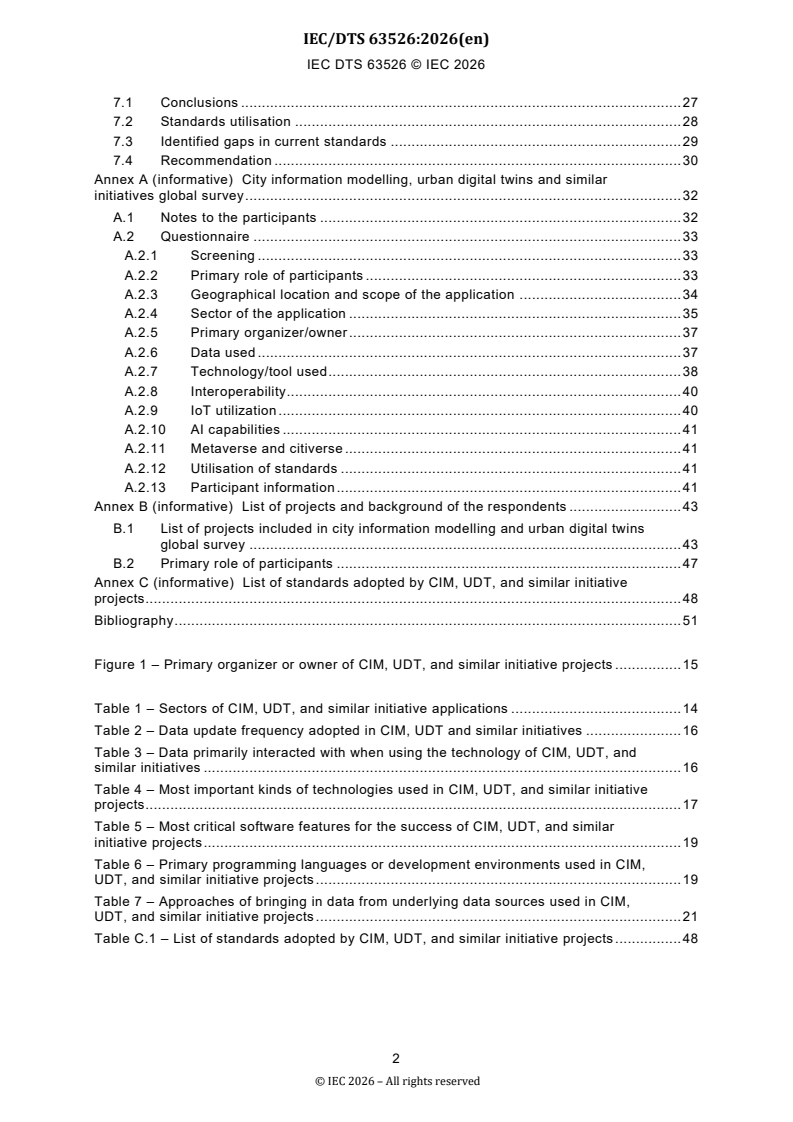
Clause 5 reports the survey results and uses Tables 1 to 7 and Figure 1 to summarize sectors, owners, data update frequency, data types, technologies, software features, programming languages and data-integration approaches. Annex A gives the questionnaire and participant notes, Annex B lists the surveyed projects and respondent background, and Annex C lists standards already adopted in real projects.
The document therefore serves as a practical map of the current CIM/UDT standards landscape. It is useful when a team needs to understand what is already standardized, what is still fragmented, and where future standardization work is being directed.
Get Certified
Connect with accredited certification bodies for this standard

BSI Group
BSI (British Standards Institution) is the business standards company that helps organizations make excellence a habit.

Bureau Veritas
Bureau Veritas is a world leader in laboratory testing, inspection and certification services.

DNV
DNV is an independent assurance and risk management provider.
Sponsored listings
Frequently Asked Questions
IEC/DTS 63526 is a draft published by the International Organization for Standardization (ISO). Its full title is "Gap Analysis on Standards Related to City Information Modelling and Urban Digital Twins". This standard covers: The Technical Specification provides gap analysis on standards related to City Information Modelling and Urban Digital Twins. This Technical Specification: • defines concepts of City Information Modelling and Urban Digital Twins; • collects the case studies how cities are using City Information Modelling and Digital Twin technologies; • identifies the standards being used; • scopes out the requirements for new standards and for possible revision of existing standards; and provides recommendations for Standard Development Organizations (SDOs).
The Technical Specification provides gap analysis on standards related to City Information Modelling and Urban Digital Twins. This Technical Specification: • defines concepts of City Information Modelling and Urban Digital Twins; • collects the case studies how cities are using City Information Modelling and Digital Twin technologies; • identifies the standards being used; • scopes out the requirements for new standards and for possible revision of existing standards; and provides recommendations for Standard Development Organizations (SDOs).
IEC/DTS 63526 is classified under the following ICS (International Classification for Standards) categories: 13.020.20 - Environmental economics. Sustainability; 35.240.01 - Application of information technology in general. The ICS classification helps identify the subject area and facilitates finding related standards.
IEC/DTS 63526 is available in PDF format for immediate download after purchase. The document can be added to your cart and obtained through the secure checkout process. Digital delivery ensures instant access to the complete standard document.
Standards Content (Sample)
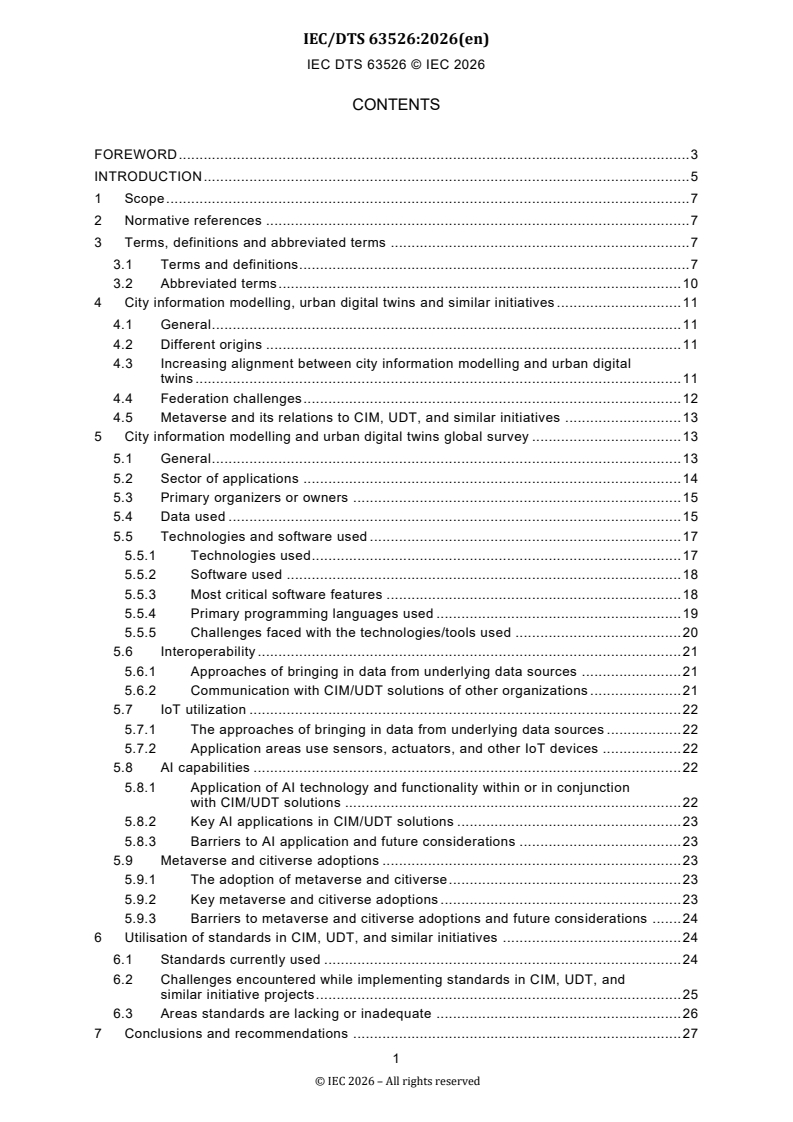
Contents
- 1 Scope
- 2 Normative references
- 3 Terms, definitions and abbreviated terms
- 3.1 Terms and definitions
- 3.1.1 artificial intelligence
- 3.1.2 big data
- 3.1.3 building information modelling
- 3.1.4 case study
- 3.1.5 city information modelling
- 3.1.6 cloud computing
- 3.1.7 concern
- 3.1.8 digital transformation
- 3.1.9 digital twin
- 3.1.10 environment
- 3.1.11 geographic information system
- 3.1.12 Internet of things
- 3.1.13 stakeholder
- 3.1.14 urban digital twin
- 3.1.15 use case
- 3.2 Abbreviated terms
- 4 City information modelling, urban digital twins and similar initiatives
- 4.1 General
- 4.2 Different origins
- 4.3 Increasing alignment between city information modelling and urban digital twins
- 4.4 Federation challenges
- 4.5 Metaverse and its relations to CIM, UDT, and similar initiatives
- 5 City information modelling and urban digital twins global survey
- 5.1 General
- 31 March 2025, gathering 42 completed responses, of which 33 were valid (9 were excluded
- 5.2 Sector of applications
- 5.3 Primary organizers or owners
- 5.4 Data used
- 5.5 Technologies and software used
- 5.6 Interoperability
- 5.7 IoT utilization
- 5.8 AI capabilities
- 5.9 Metaverse and citiverse adoptions
- 6 Utilisation of standards in CIM, UDT, and similar initiatives
- 6.1 Standards currently used
- 6.2 Challenges encountered while implementing standards in CIM, UDT, and similar
- 6.3 Areas standards are lacking or inadequate
- 7 Conclusions and recommendations
- 7.1 Conclusions
- 7.2 Standards utilisation
- 7.3 Identified gaps in current standards
- 7.4 Recommendation
- 1 Information Technology, was established in October 2023. With the recent
- Annex A
- Annex B
- Annex C
- Bibliography
INTRODUCTION The development and delivery of smart cities involve many different systems, types of data, and sets of information. This complexity, and the dynamic interaction between the large numbers of stakeholders and city systems, make planning and managing cities a great challenge. Without a tangible operational model to combine cross-sector data and information, the holistic, cross-boundary planning of regions, cities, districts and neighbourhoods remains constrained. Therefore, it is important to use new and effective tools to enable the delivery of better services for citizens and to make the urban environment more liveable, inclusive, safe, resilient, and sustainable.
City information modelling (CIM) and urban digital twins (UDT) are two developing technologies for smart cities that aim to provide such tools. Sometimes, other terms are used for UDT, such as city digital twins, spatial digital twins, local digital twins, etc. City information modelling applies building information modelling at the urban scale, while urban digital twins and similar initiatives apply digital twin (DTw) technology to cities. These all provide solutions for data processing, urban analysis, design, simulation, and modelling. They connect all the stakeholders and actors to collaboratively deliver the vision of smart cities and communities: a sustainable, inclusive, healthy, prosperous, and participative society. They provide solutions for smart cities and communities based on open standards and a multiscale database covering different time frames that integrates a wide range of data sources, presenting the full range of smart urban features, systems, and processes. The customers and users of such intelligent technology solutions include, but are not limited to, local government, the public sector, businesses, academia, investors, and citizens.
Work on both CIM and UDT is still at an early stage. They face common challenges and questions for their future development, which include the data silos, the usability and usefulness of applications for stakeholders, integration, openness, regulation, and the development of the necessary skills and education. Models, data, and software are important components for both CIM and UDT, and it is essential that both address the issues of data collection, data interoperability, data management, and security. Moreover, there are many similar initiatives, such as local digital twins and citiverse. We still lack unified standards to help manage these. Standards are essential to ensure that data can freely circulate between various systems that comprise a city or community. Interoperability between software or platform interfaces, federation/linkages among digital twins/CIM platforms covering different city systems and issues, benchmarks for data quality, cloud computing, data analytics, geospatial and 3D modelling, privacy protection, and data security are all areas where International Standards can play a significant role and useful part.
CIM and UDT are increasingly being deployed to augment the visibility and control of critical infrastructures, such as water, electricity, gas, and telecommunications. Increasing regulatory control can extend to these systems, where CIM and UDT standards can play a significant role in mapping relevant standards as a framework for their secure operation and management. Both CIM and UDT products and services are in use today, from piloting to city and state-wide coverage. Standards are essential to support data exchanges to share and visualise data for informed design and decision making, and for increased investment and accelerated use on a national and global scale.
Before the standard work, a gap analysis of standards related to CIM and UDT is essential. Therefore, this document aims to examine the most up-to-date practice of how cities are using CIM and UDT technologies and scope out their needs in standards by collecting multiple case studies from the front-line practitioners from different regions in the world, covering diverse aspects of city management.
IEC/DTS 63526:2026(en)
Furthermore, this document tackles numerous sustainable development goals (SDGs). Specifically, it addresses SDG 6 (clean water and sanitation), SDG 7 (affordable and clean energy), SDG 9 (industry, infrastructure and innovation), SDG 11 (sustainable cities and communities), and SDG 13 (climate action). This is achieved through the application of the digital transformation strategy by CIM and UDT for enhanced urban planning and city management. The broad scope of the project encompasses areas such as water management, energy efficiency, community development, and climate action initiatives. The digital transformation strategy does not only include technological integration but also cultural change and process innovation.
IEC/DTS 63526:2026(en)
1 Scope
This document, which is a Technical Specification, provides gap analysis on standards related to city information modelling and urban digital twins. This document:
- defines concepts of city information modelling and urban digital twins,
- collects the case studies of how cities are using city information modelling and digital twin technologies,
- identifies the standards being used,
- scopes out the requirements for new standards and for possible revision of existing standards, and provides recommendations for Standard Development Organizations (SDOs).
2 Normative references
The following documents are referred to in the text in such a way that some or all of their content constitutes requirements of this document. For dated references, only the edition cited applies. For undated references, the latest edition of the referenced document (including any amendments) applies.
IEC SRD 63273-1:2023, Smart city use case collection and analysis - City information modelling - Part 1: High-level analysis IEC SRD 63273-2:2024, Smart city use case collection and analysis - City information modelling - Part 2: Use case analysis
3 Terms, definitions and abbreviated terms
For the purposes of this document, the terms, definitions and abbreviated terms given in IEC SRD 63273-1:2023 and IEC SRD 63273-2:2024 and the following apply. ISO and IEC maintain terminological databases for use in standardization at the following addresses:
- IEC Electropedia: available at https://www.electropedia.org/
- ISO Online browsing platform: available at https://www.iso.org/obp/ui
3.1 Terms and definitions
3.1.1 artificial intelligence
AI capability of an engineered system to acquire, process and apply knowledge and skills Note 1 to entry: Knowledge are facts, information, and skills acquired through experience or education. [SOURCE: IEC 60050-171:2019, 171-09-17, modified – The definition has been adapted to an engineered system and simplified. The note to entry has been added.]
IEC/DTS 63526:2026(en)
3.1.2 big data
extensive datasets – primarily in the data characteristics of volume, variety, velocity, and/or variability – that require a scalable technology for efficient storage, manipulation, management, and analysis Note 1 to entry: Big data is commonly used in many different ways, for example as the name of the scalable technology used to handle big data extensive datasets.
[SOURCE: ISO/IEC 20546:2019, 3.1.2]
3.1.3 building information modelling
BIM use of a shared digital representation of a built object (including buildings, bridges, roads, process plants, etc.) to facilitate design, construction and operation processes to form a reliable basis for decisions Note 1 to entry: The acronym BIM also stands for the shared digital representation of the physical and functional characteristics of any construction works.
Note 2 to entry: See ISO 29481-1:2025.
3.1.4 case study
detailed examination of how a specific subject is solved or implemented in its specific real-world context
3.1.5 city information modelling
CIM development of digital representations and simulations of a city made up of large quantities of geospatial data, often including real-time data, which enable better city planning and management Note 1 to entry: The geospatial data is provided using an integration of building information modelling (BIM) and geographic information systems (GIS).
Note 2 to entry: The real-time data is obtained through extensive use of IoT sensors within the city. Note 3 to entry: City information modelling involves handling large amounts of big data, which is generally brought together using cloud computing.
Note 4 to entry: Artificial intelligence is often used to generate and evaluate different scenarios using city information modelling data to help manage the city better.
[SOURCE: IEC SRD 63273-1:2023, 3.1.1]
3.1.6 cloud computing
paradigm for enabling network access to a scalable and elastic pool of shareable physical or virtual resources with self-service provisioning and administration on-demand Note 1 to entry: Examples of resources include servers, operating systems, networks, software, applications, and storage equipment.
[SOURCE: ISO/IEC 17788:2014, 3.2.5]
IEC/DTS 63526:2026(en)
3.1.7 concern
matter of relevance or importance to a stakeholder Note 1 to entry: Concerns can be identified with regards to an entity of interest or independently, such as with regards to environment, scenario, situation or use case of that entity. Note 2 to entry: In this document, interest in an entity is intended to encompass interest in that entity’s environment, life cycle, architecture, requirements, design, implementation and operation. Such interests are captured via aspects, concerns and stakeholder perspectives.
Note 3 to entry: The identification of a concern is often the result of prior knowledge, experience and praxis in the domain to which the concern applies.
[SOURCE: ISO/IEC/IEEE 42010:2022, 3.10, modified – Note 4 to entry has been removed.]
3.1.8 digital transformation
process of profound and radical change through digital technologies (including big data, blockchain, cloud computing, internet of things, artificial intelligence, analytics, cognitive solutions, etc.) that orients an organization in a new direction and takes it to an entirely different level of effectiveness, which is based on analytics of data [SOURCE: ISO/IEC TS 30105-9:2023, 3.4]
3.1.9 digital twin
DTw digital representation of a target entity with data connections that enable convergence between the physical and digital states at an appropriate rate of synchronization Note 1 to entry: Digital twin has some or all of the capabilities of connection, integration, analysis, simulation, visualization, optimization, collaboration, etc.
Note 2 to entry: Digital twin can provide an integrated view throughout the life cycle of the target entity. [SOURCE: ISO/IEC 30173:2023, 3.1.1]
3.1.10 environment
context of surrounding things, conditions, or influences upon an entity Note 1 to entry: The environment of an entity of interest includes external entities that can have various influences upon an entity, such as developmental, technological, business, operational, organizational, political, economic, legal, regulatory, ecological and social influences as well as external physical effects such as electromagnetic radiation, charged particles, gravitational effects, and electric and magnetic fields. Note 2 to entry: A label attached as a qualifier to the term environment identifies a particular context within another context, such as development environment, test environment, and operational environment. [SOURCE: ISO/IEC/IEEE 42010:2022,3.13]
3.1.11 geographic information system
GIS information system dealing with information concerning phenomena associated with location relative to the earth [SOURCE: ISO 19101-1:2014, 4.1.20]
IEC/DTS 63526:2026(en)
3.1.12 Internet of things
IoT infrastructure of interconnected entities, people, systems and information resources together with services which processes and reacts to information from the physical world and virtual world [SOURCE: ISO/IEC 20924:2024, 3.2.8]
3.1.13 stakeholder
role, position, individual, organization, or classes thereof, having an interest, right, share, or claim, in an entity of interest [SOURCE: ISO/IEC/IEEE 42010:2022, 3.17, modified – The example has been removed.]
3.1.14 urban digital twin
UDT digital twin technologies applied at the urban scale deployed to enable the transformation of how cities are planned, built and managed in order to deliver better services to make the urban environment more liveable, inclusive, safe, resilient and sustainable
3.1.15 use case
specification of a set of actions performed by a system, which yields an observable result that is, typically, of value for one or more actors or other stakeholders of the system [SOURCE: ISO/IEC 19505-2:2012, 16.3.6]
3.2 Abbreviated terms
3D three dimensional AI artificial intelligence AR augmented reality BIM building information modelling CIM city information modelling DLT distributed ledger technology DTw digital twin GIS geographic information system EU European Union IoT Internet of Things JWG Joint Working Group NeRF neural radiance fields SDOs standard development organizations TS Technical Specification UDT urban digital twins VR virtual reality XR extended reality
IEC/DTS 63526:2026(en)
4 City information modelling, urban digital twins and similar initiatives
4.1 General
City information modelling (CIM) and urban digital twins (UDT), also called city digital twin, local digital twin, etc., are two emerging and closely linked technologies for smart cities. Both provide intelligent solutions for the development of smart cities. While they have different origins, they have many overlaps, even though they have some differences with each other.
4.2 Different origins
CIM has arisen from building information modelling (BIM) as foundational data in the modelling and development of city data management. BIM describes an approach to the construction and ongoing management of built environment assets (buildings, roads, dams, etc.) that uses data and 3D geometry modelling to improve the design, construction, and overall performance of those assets during their entire life cycle, and therefore to generate significant savings and productivity returns. It uses an integrated suite of technologies and processes, centred around a component-based 3D representation of each element of the built environment asset. CIM takes BIM one step further by aggregating data from individual buildings or campuses to allow new neighbourhoods to be better designed and existing ones to be better managed. The concept of digital twins (DTw) originated in mechanical engineering and the finite element method. Digital twin traces its origins to product development and discrete simulations of physical objects. It emerged from manufacturing and single asset prototyping, such as those conducted by National Aeronautics and Space Administration and Formula One racing cars. These digital twins facilitated rapid prototyping and testing, and this groundwork formed the initial modelling concepts. The application of digital twins provides an accurate representation of complex objects while enabling interaction between them. They look the same, behave the same, and the digital twin can provide simulations and predictions. That relationship requires modelling, for example, modelling a digital twin of a motor vehicle onto the digital twin of the racetrack. It is this expansion of the modelling environment for relationship contextualization that led to the move towards UDT, topics explored in depth in 4.3. Moving outside of an isolated digital twin object, we can examine how an object bears relevance to the digital twinning of the environment in which it operates, and the impact and influences of the contextual environment on the object. Therefore, this expansion of the modelling environment for the purposes of relationship contextualization caused the move towards the UDT. UDT is the digital twin at the urban scale. UDT can be seen in their composition as discrete ecosystems that can be linked, which reflects the origins of technology within product and facility twinning. It acts as a distributed ecosystem that is looking to be interconnected and interoperable.
4.3 Increasing alignment between city information modelling and urban digital twins
Even though there are different origins, both CIM and UDT share overlaps in aims, scope, functions, data, technology support, and benefits.
- Aims: Both CIM and UDT aim to enable better urban planning and city management (maintenance, monitoring, and modelling the city and urban environment) by using data and smart technologies.
- Scope: Their scope includes but is not limited to a) data integration; b) geo-visualisation; c) synchronisation; d) simulation; e) data exchange; and required data security.
- Functions: Both CIM and UDT comprehensibly model city infrastructure digitally, trace the physical object in the city, monitor and simulate the object in virtual spaces, progress through physical to digital transformation activities, and monitor the interaction between the digital and physical worlds.
- Data: Both CIM and UDT integrate multiple data from different sources and involve different formats and different levels (micro, meso, and macro).
IEC/DTS 63526:2026(en)
- Technology support: Both CIM and UDT are reliant on developing technologies, such as cyber security (middleware and access control), GIS, IoT, metadata, big data, quantum and cloud computing, machine learning, artificial intelligence (AI), and automation.
- Benefits: Both CIM and UDT provide highly efficient, multi-functional and integrated management tools for all the stakeholders in cities. They respond to a vast spectrum of needs, values and uses in diverse areas such as urban planning, property management, maintenance of heritage and disaster management.
4.4 Federation challenges
Many cities use digital twin technology to help manage different city systems or deal with specific city challenges, rather than attempting to model the city as a whole or develop a single city digital twin covering every aspect of the city.
In any city, it is common to find many detailed digital twins already being developed by different stakeholders to deal with specific systems and challenges. These generally use different standards and approaches but can often be very mature and can provide a good foundation for using digital twin technologies to help manage cities.
Many cities are also starting their CIM/UDT journey by developing digital twins that focus on tackling specific city challenges, such as transport management. In fact, for some purposes, simple models can provide quick and useful results. For instance, when modelling traffic flows to understand the impact of road closures, digital twins based on simple 2D maps with data related to a limited set of issues is likely to be sufficient. By developing single-purpose digital twins in a city, there will be immediate benefit for the effort and resources expended, and the use of digital twin technology in the city can grow organically. For these cities, the challenge is how to link together many different digital twins, or models of different aspects of the city, to enable a federated city digital twin to allow the city to be managed as a whole.
...