

ISO/IEC 25005-1:2026
(Main)Information technology — Data use in smart cities — Part 1: Framework
- Abstract
This document provides a framework for data use in smart cities, based on five dimensions: data availability (data are available); data quality assurance (data are useful); ease of data use (data are easy to use); data use security (data are used securely); data-enabled innovation (data are used for enabling intelligent applications and services). This framework is intended to facilitate effective, sustainable, comprehensive and innovative use of data as citywide strategic resources and assets.
- Status
- Published
- Publication Date
- 14-Jul-2026
- Technical Committee
- ISO/IEC JTC 1 - Information technology
- Drafting Committee
- ISO/IEC JTC 1/WG 11 - Smart cities
- Current Stage
- 6060 - International Standard published
- Start Date
- 15-Jul-2026
- Due Date
- 23-Apr-2027
- Completion Date
- 15-Jul-2026

ISO/IEC 25005-1:2026 is an International Standard published by ISO/IEC for data use in smart cities. It specifies a framework for using city data across five dimensions - data availability, data quality assurance, ease of data use, data use security and data-enabled innovation - for people who plan, design, implement and manage smart city services.
What does ISO/IEC 25005-1:2026 specify?
ISO/IEC 25005-1:2026 specifies a framework for data use in smart cities and organizes it into clauses 1 to 6, plus one informative annex. The framework is intended to support effective, sustainable, comprehensive and innovative use of data as citywide strategic resources and assets.
The document is the first part of the ISO/IEC 25005 series. The foreword says the series has three parts, and Figure 1 shows the relationship between this part, ISO/IEC TR 25005-2 and ISO/IEC TS 25005-3.
Annex A is informative and gives examples of the sub-characteristics of considerations concerning data use in smart cities.
What are the key requirements of ISO/IEC 25005-1:2026?
ISO/IEC 25005-1:2026 does not prescribe a test method or product specification. Its core role is to define the framework, the guiding principles and the sub-characteristics that a smart city data use program should consider.
Clause 5.1 presents the general framework. It groups the considerations into five dimensions and says the framework includes 28 sub-characteristics in total. In practice, this gives city teams a structured checklist for planning, governance and assessment.
Clause 5.2 sets eight guiding principles for developing the framework. Together, they explain what the document expects city data work to optimize.
- Citizen-centric data value realization awareness - city data work should improve services and outcomes for citizens, not only internal processes.
- Awareness of data as strategic resources and assets for citywide use - data should be managed across its lifecycle as a city asset.
- By design and default empowered data use - availability, trust, connectivity, responsibility and intelligent services should be built in from the start.
- Availability enabled data use - data should be available when needed in line with regulatory requirements and agreements, including copyright and ownership.
- Trustworthiness enabled data use - data should be useful and trustworthy when used.
- Connectivity enabled data use - data should be easy to use and interoperable across domains and systems.
- Responsibility enabled data use - data should be used in ways that are secure, fair, ethical, inclusive, sustainable, transparent and accountable.
- Intelligent services enabled data use - data should support prediction, analysis and action for smart city services.
Clause 6 turns those principles into tables of sub-characteristics. Each table gives practical aspects to consider in a city program.
- Clause 6.2, data availability - includes network infrastructure accessibility, inclusiveness, data accessibility, coverage of data use in city administration data resources holdings, contribution of government in data use, government-enterprise cooperation on data opening and use, government-citizen cooperation on data opening and use, and data laws, regulations and policies. In practice, this is about whether authorized users can actually reach and use the data they need.
- Clause 6.3, data quality assurance - includes completeness, authenticity, reliability, timeliness, accuracy, consistency and traceability. This helps teams decide whether the data is fit for its intended purpose before it is shared or used in services.
- Clause 6.4, ease of data use - includes data sharing schemes, data opening schemes, interoperability, linkability, user experience of convenience and user satisfaction. This matters when different departments, platforms or stakeholders must work with the same data.
- Clause 6.5, data use security - includes data use authentication control schemes, data use security and privacy control schemes, data monitoring and early warning schemes, and personal data operation schemes. This is the part that supports secure access, privacy handling and controlled use.
- Clause 6.6, data-enabled innovation - includes data-enabled monitoring applications, data-enabled early warning and prediction applications, and data-enabled intelligent decision-making applications. This shows how data should support real-time monitoring, prediction and decision support in smart cities.
What terms does ISO/IEC 25005-1:2026 define?
ISO/IEC 25005-1:2026 defines the main terms used in the framework so readers can apply the same meanings across the document.
- data use - handling or dealing with data for a specific purpose; in smart cities it includes the activities that realize data value along the data value chain.
- data availability - the property of being accessible and usable upon demand by an authorized entity.
- data quality assurance - assurance of data quality, including completeness, authenticity, reliability, timeliness, accuracy, consistency and traceability.
- data use security - the extent to which data can be used by specified users to achieve specified goals with effectiveness, efficiency, inclusiveness, safety and security in a specified context of use.
- data-enabled innovation - the extent to which data are used to support monitoring, early warning, prediction and intelligent decision-making in a specified context.
- AI - artificial intelligence.
- ICT - information communication technology.
Who uses ISO/IEC 25005-1:2026?
ISO/IEC 25005-1:2026 is used by people who plan, govern and implement smart city data work. That includes city authorities, public data managers, smart city program teams, ICT teams, data architects, service designers, and organizations that open, share or integrate city data.
It is also relevant to enterprises and other stakeholders that participate in citywide data use, because the framework is built around multi-stakeholder interests. In practice, they use it to choose data considerations for planning, deployment, design, implementation and management.
What does the ISO/IEC 25005-1:2026 document contain?
ISO/IEC 25005-1:2026 contains a short framework document with a clear internal structure. Figure 1 shows the relationship in the ISO/IEC 25005 series, and Figure 2 shows the general framework for data use in smart cities.
Clauses 3 and 4 provide the terms, definitions and abbreviated terms used throughout the standard. Clauses 5 and 6 provide the framework, the development principles and the tables of sub-characteristics for each of the five dimensions.
The tables in Clause 6 are the main technical content. They give the considerations that matter for citywide data use planning, governance, design and assessment. Annex A adds practical examples from different countries and use cases, which helps readers understand how the framework can be applied in real smart city settings.
Get Certified
Connect with accredited certification bodies for this standard

BSI Group
BSI (British Standards Institution) is the business standards company that helps organizations make excellence a habit.

Bureau Veritas
Bureau Veritas is a world leader in laboratory testing, inspection and certification services.

DNV
DNV is an independent assurance and risk management provider.
Sponsored listings
Frequently Asked Questions
ISO/IEC 25005-1:2026 is a standard published by the International Organization for Standardization (ISO). Its full title is "Information technology — Data use in smart cities — Part 1: Framework". This standard covers: This document provides a framework for data use in smart cities, based on five dimensions: data availability (data are available); data quality assurance (data are useful); ease of data use (data are easy to use); data use security (data are used securely); data-enabled innovation (data are used for enabling intelligent applications and services). This framework is intended to facilitate effective, sustainable, comprehensive and innovative use of data as citywide strategic resources and assets.
This document provides a framework for data use in smart cities, based on five dimensions: data availability (data are available); data quality assurance (data are useful); ease of data use (data are easy to use); data use security (data are used securely); data-enabled innovation (data are used for enabling intelligent applications and services). This framework is intended to facilitate effective, sustainable, comprehensive and innovative use of data as citywide strategic resources and assets.
ISO/IEC 25005-1:2026 is classified under the following ICS (International Classification for Standards) categories: 13.020.20 - Environmental economics. Sustainability; 35.240.01 - Application of information technology in general. The ICS classification helps identify the subject area and facilitates finding related standards.
ISO/IEC 25005-1:2026 is available in PDF format for immediate download after purchase. The document can be added to your cart and obtained through the secure checkout process. Digital delivery ensures instant access to the complete standard document.
Standards Content (Sample)
International
Standard
ISO/IEC 25005-1
First edition
Information technology — Data use
2026-07
in smart cities —
Part 1:
Framework
Technologies de l'information — Utilisation des données dans les
villes intelligentes —
Partie 1: Cadre général
Reference number
© ISO/IEC 2026
All rights reserved. Unless otherwise specified, or required in the context of its implementation, no part of this publication may
be reproduced or utilized otherwise in any form or by any means, electronic or mechanical, including photocopying, or posting on
the internet or an intranet, without prior written permission. Permission can be requested from either ISO at the address below
or ISO’s member body in the country of the requester.
ISO copyright office
CP 401 • Ch. de Blandonnet 8
CH-1214 Vernier, Geneva
Phone: +41 22 749 01 11
Email: copyright@iso.org
Website: www.iso.org
Published in Switzerland
© ISO/IEC 2026 – All rights reserved
ii
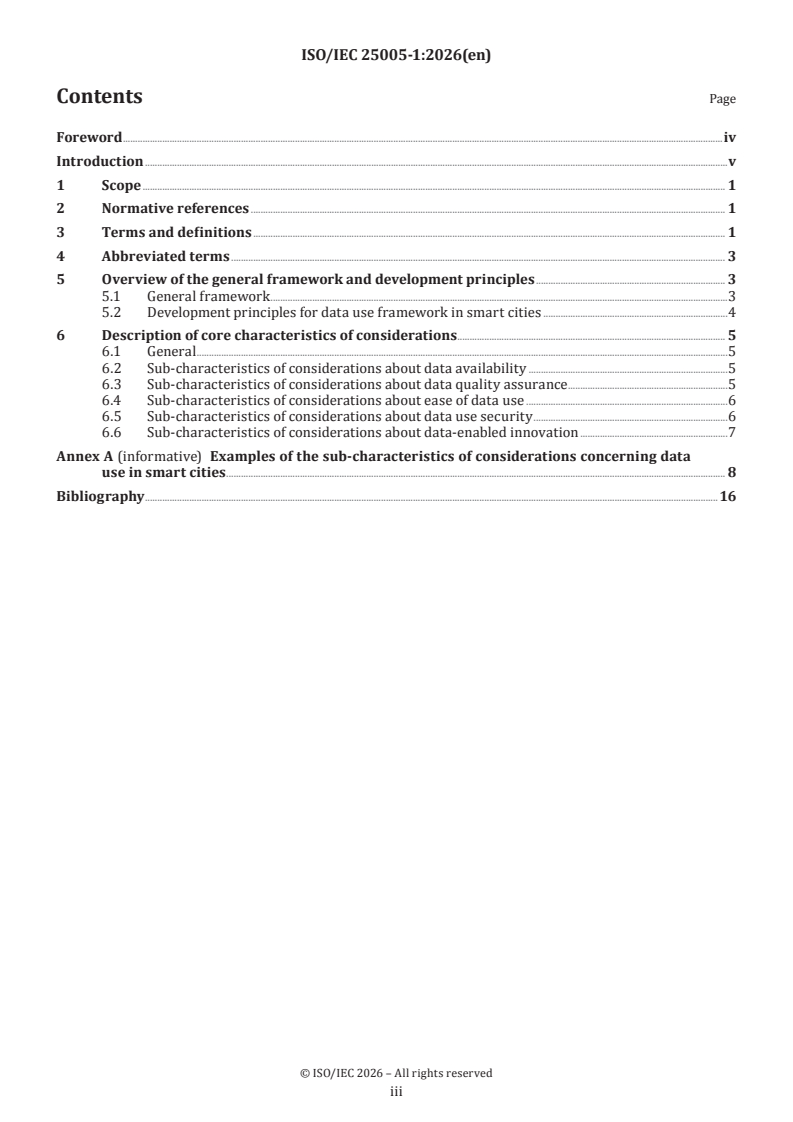
Contents Page
Foreword .iv
Introduction .v
1 Scope . 1
2 Normative references . 1
3 Terms and definitions . 1
4 Abbreviated terms . 3
5 Overview of the general framework and development principles . 3
5.1 General framework .3
5.2 Development principles for data use framework in smart cities .4
6 Description of core characteristics of considerations . 5
6.1 General .5
6.2 Sub-characteristics of considerations about data availability .5
6.3 Sub-characteristics of considerations about data quality assurance .5
6.4 Sub-characteristics of considerations about ease of data use .6
6.5 Sub-characteristics of considerations about data use security .6
6.6 Sub-characteristics of considerations about data-enabled innovation .7
Annex A (informative) Examples of the sub-characteristics of considerations concerning data
use in smart cities . 8
Bibliography .16
© ISO/IEC 2026 – All rights reserved
iii
Foreword
ISO (the International Organization for Standardization) and IEC (the International Electrotechnical
Commission) form the specialized system for worldwide standardization. National bodies that are
members of ISO or IEC participate in the development of International Standards through technical
committees established by the respective organization to deal with particular fields of technical activity.
ISO and IEC technical committees collaborate in fields of mutual interest. Other international organizations,
governmental and non-governmental, in liaison with ISO and IEC, also take part in the work.
The procedures used to develop this document and those intended for its further maintenance are described
in the ISO/IEC Directives, Part 1. In particular, the different approval criteria needed for the different types
of document should be noted. This document was drafted in accordance with the editorial rules of the ISO/
IEC Directives, Part 2 (see www.iso.org/directives or www.iec.ch/members_experts/refdocs).
ISO and IEC draw attention to the possibility that the implementation of this document may involve the
use of (a) patent(s). ISO and IEC take no position concerning the evidence, validity or applicability of any
claimed patent rights in respect thereof. As of the date of publication of this document, ISO and IEC had not
received notice of (a) patent(s) which may be required to implement this document. However, implementers
are cautioned that this may not represent the latest information, which may be obtained from the patent
database available at www.iso.org/patents and https://patents.iec.ch. ISO and IEC shall not be held
responsible for identifying any or all such patent rights.
Any trade name used in this document is information given for the convenience of users and does not
constitute an endorsement.
For an explanation of the voluntary nature of standards, the meaning of ISO specific terms and expressions
related to conformity assessment, as well as information about ISO's adherence to the World Trade
Organization (WTO) principles in the Technical Barriers to Trade (TBT) see www.iso.org/iso/foreword.html.
In the IEC, see www.iec.ch/understanding-standards.
This document was prepared by Joint Technical Committee ISO/IEC JTC 1, Information technology.
A list of all parts in the ISO/IEC 25005 series can be found on the ISO and IEC websites.
Any feedback or questions on this document should be directed to the user’s national standards
body. A complete listing of these bodies can be found at www.iso.org/members.html and
www.iec.ch/national-committees.
© ISO/IEC 2026 – All rights reserved
iv
Introduction
This document provides an integrated framework for data use that supports the multidimensional use of
data as citywide strategic resources and assets. It aims to facilitate evidence-based decision making and
enable data-based, data-driven and data-enabled smart cities development and applications.
Data use involves activities enabling data value realization for specific purposes in smart cities along the
data value chain. This document is intended to assist in identifying problem-solving strategies and solutions
for data use, data applications and data services citywide, including but not limited to data being not
available when needed, data being not trusted when used, data not being easily used when available, data
not being used securely and data value not being realized when in use.
This document provides a framework for data use in smart cities across five dimensions:
— data availability (ensuring data are accessible);
— data quality assurance (ensuring data are useful);
— ease of data use (ensuring data are easy to use);
— data use security (ensuring data are used securely);
— data-enabled innovation (ensuring data are used for enabling intelligent applications and services).
This document enhances the total capabilities of data use to support data-based, data-driven and data-
enabled citywide information communication technology (ICT), big data and artificial intelligence (AI)
applications and smart cities services. It is intended to fill the gaps in standards development for better
collaboration and harmonization of sustainable data use considerations for smart cities from different
standards development organizations (SDOs), to satisfy the maximized needs of multiple stakeholders from
many views and various dimensions, e.g. effective, sustainable, comprehensive and innovative use of data as
strategic resources and assets citywide.
This document can be used for citywide data use planning, deployment of design, implementation and
management in smart cities development and applications.
The ISO/IEC 25005 series consists of three parts. This document provides foundations for standards
collaboration on data use citywide and provides basic principles and core characteristics of considerations
concerning the other parts in the series.
Figure 1 provides the relations among this document, ISO/IEC TR 25005-2 and ISO/IEC TS 25005-3,
describing guiding principles for data use in smart cities, core characteristics of considerations of data use
in smart cities which are the basis for data use in smart cities standard series.
© ISO/IEC 2026 – All rights reserved
v
Figure 1 — ISO/IEC 25005 series
© ISO/IEC 2026 – All rights reserved
vi
International Standard ISO/IEC 25005-1:2026(en)
Information technology — Data use in smart cities —
Part 1:
Framework
1 Scope
This document provides a framework for data use in smart cities, based on five dimensions:
— data availability (data are available);
— data quality assurance (data are useful);
— ease of data use (data are easy to use);
— data use security (data are used securely);
— data-enabled innovation (data are used for enabling intelligent applications and services).
This framework is intended to facilitate effective, sustainable, comprehensive and innovative use of data as
citywide strategic resources and assets.
2 Normative references
There are no normative references in this document.
3 Terms and definitions
For the purposes of this document, the following terms and definitions apply.
ISO and IEC maintain terminology databases for use in standardization at the following addresses:
— ISO Online browsing platform: available at https:// www .iso .org/ obp
— IEC Electropedia: available at https:// www .electropedia .org/
3.1
data availability
property of being accessible and usable upon demand by an authorized entity
[SOURCE: ISO 37166:2022, 3.2]
3.2
data exchange
representation, transmission, reception, storage, and retrieval of data
[SOURCE: ISO/IEC 20944-1:2013, 3.21.13.1, modified — The preferred term “data interchange” has been
removed; Note 1 to entry has been deleted.]
3.3
data-enabled innovation
extent to which data are used by specified users to achieve specified goals with data-enabled monitoring
applications, data-enabled early warning and prediction applications, data-enabled intelligent decision-
making applications in a specified context of use
© ISO/IEC 2026 – All rights reserved
3.4
data quality
degree to which a set of inherent characteristics of data fulfils requirements
[SOURCE: ISO 8000-2:2022, 3.8.1, modified — Note 1 to entry has been deleted.]
3.5
data quality assurance
assurance of data quality (3.4)
Note 1 to entry: The quality requirements include completeness, authenticity, reliability, timeliness, accuracy,
consistency, and traceability.
3.6
data security
preservation of data to guarantee availability, confidentiality and data integrity
[SOURCE: ISO/IEC 29182-2:2013, 2.6.6]
3.7
data sharing
access to or processing of the same data by more than one authorized entity
Note 1 to entry: Use of the data can be synchronous or asynchronous.
Note 2 to entry: Data can be shared, for example, (i) by allowing access to, or the execution of operations over, the
original dataset, or (ii) by giving a copy of the data to the interested entity.
Note 3 to entry: The way in which data is shared fundamentally influences the available controls and the statements
needed in a data sharing agreement.
[SOURCE: ISO/IEC 23751:2022, 3.7]
3.8
data use
handling or dealing with data for a specific purpose
Note 1 to entry: In smart cities, data use refers to activities enabling data value realization along with data value-chain,
including data availability, data quality assurance, ease of data use, data use security, and data-enabled innovation
from citywide multi-stakeholder’s interests.
[SOURCE: ISO/IEC 5207:2024, 3.30, modified — Note 1 to entry has been changed.]
3.9
data use security
extent to which data can be used by specified users to achieve specified goals with effectiveness, efficiency,
inclusiveness, safety and security in a specified context of use
3.10
data value
importance that stakeholders attach to data and which is related to the perception of actual or potential
benefit
Note 1 to entry: Data value ranges from immediate operational enhancements to long-term strategic gains for urban
development and citizen’s quality of life.
[SOURCE: ISO 16439:2014, 3.75, modified — The preferred term has been expanded from “value” to “data
value ”; in the definition, “funding institutions, politicians, the public, users, staff” has been deleted and
“libraries” has been replaced by “data”, Note 1 to entry has been changed.]
© ISO/IEC 2026 – All rights reserved
3.11
smart city
city where improvements in quality of life, services, sustainability and resilience are facilitated by the
effective integration of many and various types of physical systems, digital systems and social systems and
the transformative use of data and technology
[SOURCE: IEC 60050-831:2025, 01-19, modified — Notes 1 and 2 to entry have been deleted.]
4 Abbreviated terms
AI artificial intelligence
ERAC electrical regulatory authorities council
ICT information communication technology
SDO standards development organization
UAS uncrewed aircraft system
5 Overview of the general framework and development principles
5.1 General framework
A general framework for comprehensive use of data in smart cities is shown in Figure 2. The core
characteristics of considerations are categorized into five dimensions, with 28 sub-characteristics of
considerations from various demands for data-based value support, data-driven value support, data-enabled
value support. The five dimensions are data availability, data quality assurance, ease of data use, data use
security and data-enabled innovation.
© ISO/IEC 2026 – All rights reserved
Figure 2 — General framework for data use in smart cities
5.2 Development principles for data use framework in smart cities
When determining core characteristics and sub-characteristics of considerations and building the data use
framework in smart cities, the following eight guiding principles are considered:
a) Citizen-centric data value realization awareness: Ensure that citizens considerations are taken into
consideration as a whole to improve total quality of city service and to produce improved results in
smart cities.
b) Awareness of data as strategic resources and assets for citywide use: Ensure that data are managed and
used as strategic resources and assets throughout their lifecycle to support citywide public interests.
c) By design and default empowered data use: Ensure data availability, data trust, data connectivity and
data responsibility and intelligent services are deployed in the development of smart city to support
data-based, data-driven and data-enabled innovation and data services citywide.
© ISO/IEC 2026 – All rights reserved
d) Availability enabled data use: Ensure that data are available when needed in accordance with regulatory
requirements and agreements in smart cities, and data copyright and ownership should be included in
regulatory requirements and agreements.
e) Trustworthiness enabled data use: Ensure that data are useful and trustworthy when in use to enable
trustworthiness in business and service in smart cities.
f) Connectivity enabled data use: Ensure that data are easy to use and interoperable to enable connected
services across domains and systems in smart cities.
g) Responsibility enabled data use: Ensure that data are used responsibly to enable secure, fair, ethical,
inclusive, sustainable, transparent and accountable services across time, space, events, scenarios in
smart cities.
h) Intelligent services enabled data use: Ensure that data are used for enabling intelligent predictions and
actions, e.g. the smart activities such as data use planning and design, data analysis and application.
6 Description of core characteristics of considerations
6.1 General
In this document, tables are used to define core characteristics of considerations. Each table defines the
relevant sub-characteristics of considerations. The examples include both positive and negative use of data
in different scenarios from different countries, see Annex A.
6.2 Sub-characteristics of considerations about data availability
Sub-characteristics of considerations concerning data availability are shown in Table 1.
Table 1 — Sub-characteristics of considerations about data availability
Sub-characteristics of
Description
considerations
Extent to which products, systems, services, environments and facilities can be used
Network infrastructure
by people from a population with the widest range of characteristics and capabili-
accessibility
ties to achieve a specified goal in a specified context of use in associated with data.
Ability of ICT and smart cities associated with data that is designed to benefit to all
Inclusiveness
population segments, including persons with disabilities.
Data accessibility Degree to which data is easy to use by all people, including those with disabilities.
Coverage of data use in city Ability of ICT and smart cities infrastructure that covers many types of data demands
administration data resources from various types of stakeholders including scalability of data volume, various types
holdings of data across time, space, event, subjects and domains.
Benefits that a city derives from empowering the city community through city data
Contribution of government in
and delivering integrated citizen-centric services are magnified the more citizens
data use
and businesses engage with city services through digital channels.
Government-enterprise coopera- Impact of government-enterprise cooperation on developing public information infra-
tion on data opening and use structure, providing innovation services and promoting efficient urban governance.
Government-citizen
cooperation on data opening Impact of government-citizen cooperation on improving citizen services.
and use
Activities include formulation and enforcement of data related laws, regulations
Data laws, regulations and
and policies in a jurisdiction on data governance, data opening, data use, security
policies
protection, data copyright and ownership.
6.3 Sub-characteristics of considerations about data quality assurance
Sub-characteristics of considerations concerning data quality assurance are shown in Table 2.
© ISO/IEC 2026 – All rights reserved
Table 2 — Sub-characteristics of considerations about data quality assurance
Sub-characteristics of
Description
considerations
Degree to which data supports all the specified contents that are specified by the user for
Completeness
an intended purpose.
Authenticity Property of data that is what it claims to be.
Property of data that can be proven to be true under given conditions or consistent with
Reliability
intended behaviour and results.
Timeliness Degree to which data represent reality from the required point in time.
Accuracy Measure of closeness of the data values accepted as being true.
Degree of uniformity, standardization and freedom from contradiction among the documents,
Consistency or parts of a system or component, in terms of data provenance, data traceability, data integ-
rity, data reliability, data authenticity, no matter where the data are stored.
Discernible association among two or more logical entities, such as data provenance, data
Traceability
authenticity, data reliability, data integrity, data consistency.
6.4 Sub-characteristics of considerations about ease of data use
Sub-characteristics of considerations concerning ease of data use are shown in Table 3.
Table 3 — Sub-characteristics of considerations about ease of data use
Sub-characteristics of
Description
considerations
Systematic plan or arrangement for a task or activity to accurately share data for specific
Data sharing schemes
purposes with agreed conditions.
Systematic plan or arrangement for a task or activity to open data for maximized realization
Data opening schemes
of data value without compromise of any stakeholder’s interests.
Ability of two or more systems or applications to exchange information and to mutually
Interoperability use the information that has been exchanged, in terms of ease of data use in cities; multiple
stakeholders’ considerations about interoperability should be included.
Property for a dataset that it is possible to associate (by linking) a record concerning a data
Linkability
principal with a record concerning the same data principal in a separate dataset.
Users’ perceptions and responses that result from the use or anticipated use (or both) of a
system, product or service.
NOTE 1 Users’ perceptions and responses include the users’ emotions, beliefs, preferences,
perceptions, comfort, behaviours and accomplishments that occur before, during and after
User experience of
use.
convenience
NOTE 2 User experience is a consequence of brand image, presentation, functionality,
system performance, interactive behaviour and assistive capabilities of a system, product
or service. It also results from the user’s internal and physical state resulting from prior
experiences, attitudes, skills, abilities and personality, and from the context of use.
Performance measure giving the ratio between the information demand and the satisfaction
expressed by the information user with the information service provided.
This requires professionalism, convenience, timeliness and efficiency of data-based, da-
User satisfaction
ta-driven and data-enabled services obtained by users (including government, enterprises,
citizens, etc.), which is the users’ feedback on the use of the platform, so as to facilitate the
continuous improvement of the platform in smart cities.
6.5 Sub-characteristics of considerations about data use security
Sub-characteristics of considerations concerning data use security are shown in Table 4.
© ISO/IEC 2026 – All rights reserved
Table 4 — Sub-characteristics of considerations about data use security
Sub-characteristics of
Description
considerations
Systematic control plan or arrangement for a task or activity for verifying the identity
Data use authentication
of a user, process or device, often as a prerequisite to allowing access to data resources
control schemes
in an information system.
Systematic control plan or arrangement for a task or activity to protect security and
Data use security and
privacy of data use to meet regulatory and technical requirements, social and ethical
privacy control schemes
considerations.
Systematic plan or arrangement of protocols, processes and technologies based on the
Data monitoring and early
public warning policy to deliver and alert messages in a developing emergency situation
warning schemes
to people at risk and to first responders.
Personal data operation Systematic plan or arrangement relating to the protection of natural persons with regard
schemes to the processing of personal data and the free movement of personal data.
6.6 Sub-characteristics of considerations about data-enabled innovation
Sub-characteristics of considerations concerning data-enabled innovation are shown in Table 5.
Table 5 — Sub-characteristics of considerations about data-enabled innovation
Sub-characteristics of
Description
considerations
Data-enabled monitoring Data are used for enabling real-time statistics, analysis and report on the status of
applications smart cities development and applications.
Data-enabled early warning Data are used for enabling the prediction and early warning of abnormal conditions
and prediction applications of smart cities development and applications.
Data-enabled intelligent Data are used for enabling to interpret data, information and knowledge; to identify
decision-making applications and adapt to changes; and to improve prediction and action for cities.
© ISO/IEC 2026 – All rights reserved
Annex A
(informative)
Examples of the sub-characteristics of considerations concerning
data use in smart cities
A.1 Overview
This annex provides examples of the sub-characteristics of considerations about data use in smart cities
adopted from ISO/IEC TR 25005-2:2025. These examples are collected by ISO/IEC JTC 1 and provided by
various countries around the world, e.g. China, Canada, the United States of America, Australia, the Republic
of Korea, Japan, etc. The examples of sub-characteristics of considerations concerning data use in smart
cities are shown in Clause A.2, Clause A.3, Clause A.4, Clause A.5 and Clause A.6.
A.2 Examples of sub-characteristics of considerations about data availability
Table A.1 provides examples of sub-characteristics of considerations about data availability in practice.
Table A.1 — Examples of sub-characteristic
...