

ISO/IEC 14496-22:2026
(Main)Information technology — Coding of audio-visual objects — Part 22: Open font format
- Abstract
This document specifies the Open Font Format (OFF) specification, including the TrueType and Compact Font Format (CFF) outline formats. Many references to both TrueType and PostScript exist throughout this document, as Open Font Format fonts combine the two technologies. The document defines data structures for various font tables and provides the necessary details for developers to build a font rendering and text layout/shaping engines in compliance with this document.
- Status
- Published
- Publication Date
- 15-Jul-2026
- Current Stage
- 6060 - International Standard published
- Start Date
- 16-Jul-2026
- Due Date
- 11-Aug-2026
- Completion Date
- 16-Jul-2026

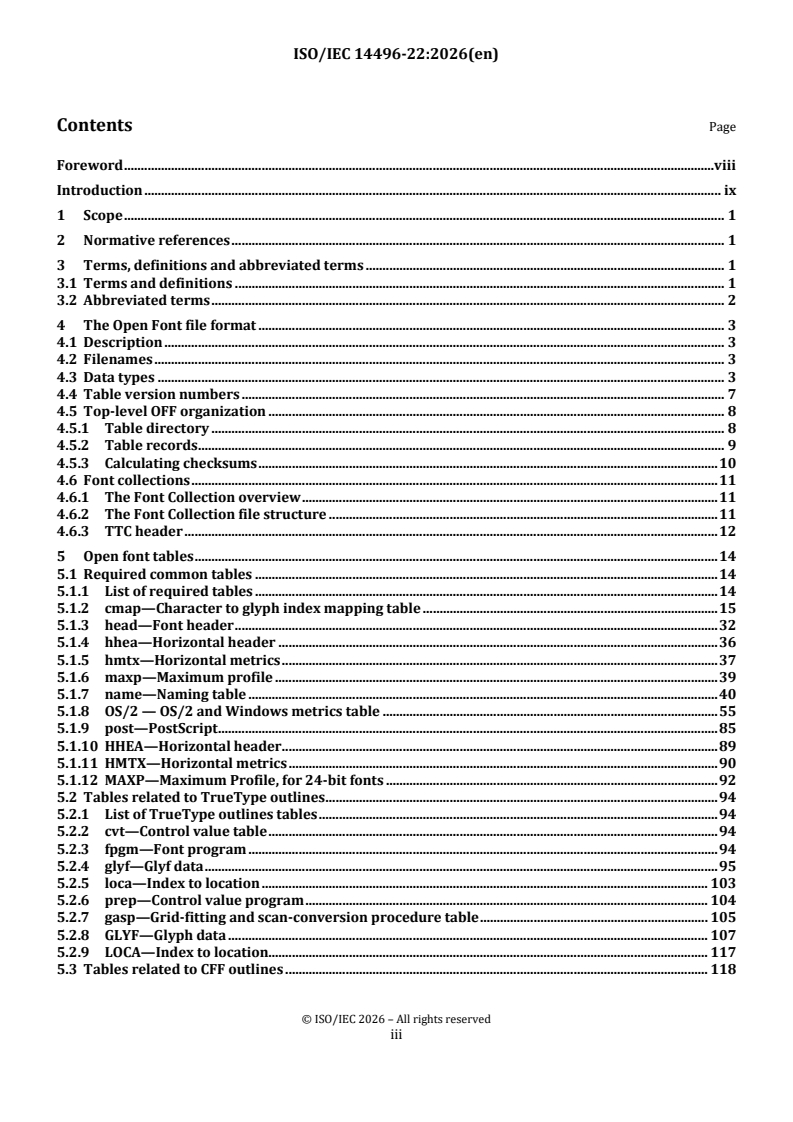
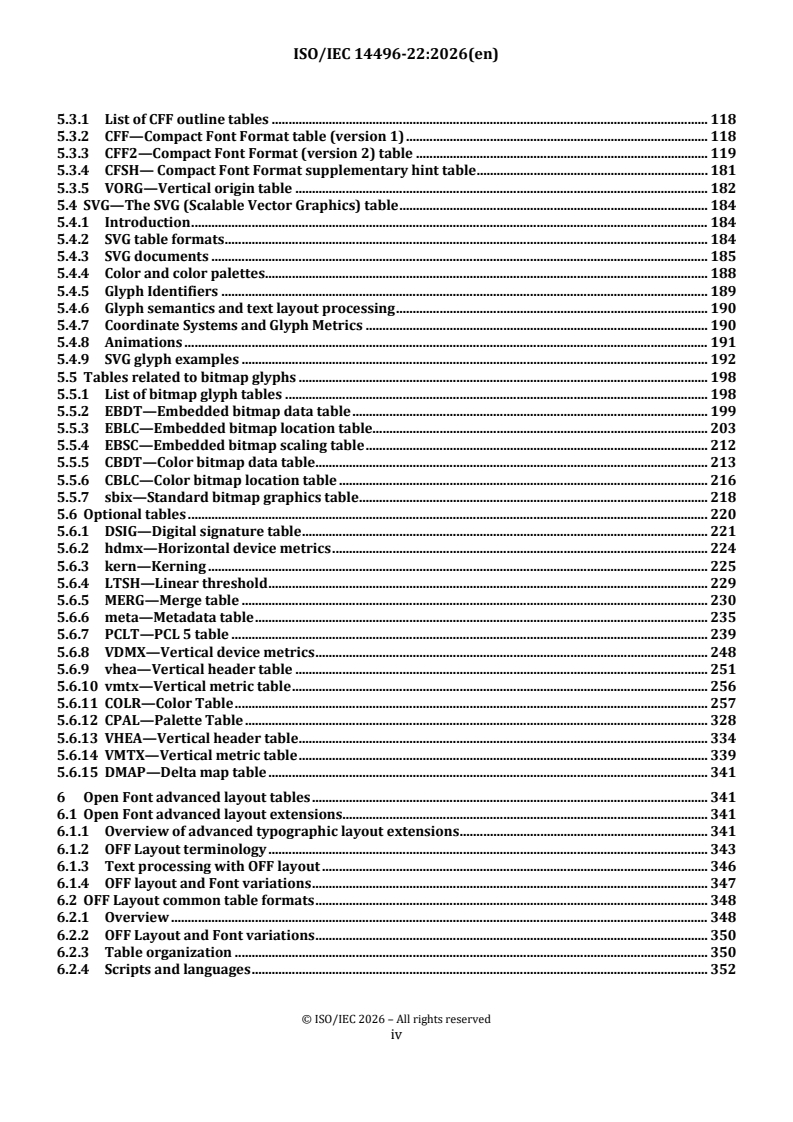
ISO/IEC 14496-22:2026 is an International Standard published by ISO that specifies the Open Font Format (OFF), including the TrueType and Compact Font Format (CFF) outline formats. It defines the font tables, data structures and layout data needed to build OFF-compliant font rendering and text layout/shaping engines for digital typography.
What does ISO/IEC 14496-22:2026 specify?
ISO/IEC 14496-22:2026 specifies the OFF file format for font data, including TrueType outlines, CFF and CFF2 outlines, color and bitmap glyph data, SVG glyph descriptions, advanced layout data and font variations. It is organized so implementers can parse the file structure, map characters to glyphs, read font metrics, and process layout data consistently.
The document is arranged in nine main clauses plus four informative annexes:
| Annex | What it covers |
|---|---|
| Annex A | IBM font family classifications |
| Annex B | Earlier versions of OS/2 - OS/2 and Windows metrics |
| Annex C | OFF Mirroring Pairs List |
| Annex D | Comparison of 'glyf', 'CFF ' and 'CFF2' tables |
Clause 4 describes the Open Font file format, clause 5 covers the font tables, clause 6 covers OFF advanced layout tables, clause 7 covers OFF font variations, and clauses 8 and 9 give recommendations for OFF fonts and general recommendations.
The standard focuses on font data and layout metadata. The introduction says that detailed shaping algorithms for individual scripts, and complete block-level layout, are outside its scope and are handled by other specifications or applications.
What are the key requirements of ISO/IEC 14496-22:2026?
ISO/IEC 14496-22:2026 gives the rules for how an OFF font is structured, how characters map to glyphs, how glyphs are described, and how layout and variation data are encoded. For implementers, the practical effect is that a renderer or font editor must interpret the same tables, tags and metrics in the same way as other compliant software.
File structure and basic encoding
Clause 4.3 defines the data types used in OFF files and states that all OFF fonts use big-endian byte order. That matters because every parser must read multi-byte values in network byte order or the file will be misread.
Clause 4.2 allows the extensions .OTF, .TTF, .OTC and .TTC, with .OTC and .TTC used for font collection files. In practice, this helps software recognize whether it should expect a single font or a collection of fonts in one file.
Clause 4.4 defines table version number types and the font-level sfntVersion in the table directory. That lets software check table formats and handle compatibility correctly.
Clause 4.5 defines the top-level OFF organization, including the table directory, table records and checksum calculation. This is the foundation for validating that the font tables are present and intact.
Clause 4.6 defines font collections. For users, this is what enables one file to carry multiple related fonts while sharing common data.
Character mapping, naming and metrics
Clause 5.1.2 defines the 'cmap' table, including platform IDs, encoding IDs and subtable formats. For Unicode fonts on Windows, the standard distinguishes BMP-only mapping from full-repertoire mapping, and it uses a format 14 subtable for Unicode variation sequences. That matters because the wrong 'cmap' choice can leave characters unmapped or variation sequences unsupported.
Clause 5.1.7 defines the 'name' table, including the family, subfamily, full name, PostScript name and typographic family strings. It also gives the guidance that name IDs 16 and 17 are used for extended typographic families and that name IDs 21 and 22 support WWS naming. In practice, this is what makes fonts sort correctly in menus and behave predictably across platforms.
Clause 5.1.8 defines the OS/2 - OS/2 and Windows metrics table. Important fields include width, weight, script coverage, line metrics and style bits such as ITALIC, BOLD, USE_TYPO_METRICS, WWS and OBLIQUE. These fields affect line spacing, style matching and how applications classify the font.
Glyph outlines and rendering data
Clause 5.1.6 defines maxp, which records the number of glyphs and the maxima needed for instruction processing. Clause 5.1.5 defines horizontal metrics, and clause 5.1.3 defines the font header. Together, these tables tell a renderer how many glyphs exist and how to place them.
Clause 5.2 covers TrueType outline tables such as 'cvt ', 'fpgm', 'glyf', 'loca', 'prep' and 'gasp'. These are the tables that carry TrueType outlines, hinting data and scan-conversion behavior, so they are the core data for TrueType font rendering.
Clause 5.3 covers CFF and CFF2 outline tables. The document states that a CFF2 font uses one CharString per glyph, that glyph 0 is the .notdef glyph, and that CFF2 metrics are handled through the OFF metrics tables. That matters for fonts that use PostScript-style outlines rather than TrueType outlines.
Clause 5.4 defines the SVG table for glyphs drawn as SVG documents. Clause 5.5 defines bitmap glyph tables such as EBDT, EBLC, EBSC, CBDT, CBLC and sbix. Together, these clauses let a font carry outlines, bitmaps, color glyphs or SVG artwork, depending on the intended rendering behavior.
Layout and variation behavior
Clause 6 defines OFF advanced layout tables, including BASE, GDEF, GPOS, GSUB, JSTF and MATH. These tables carry script, language, substitution, positioning, justification and math layout data, which are the parts applications need for correct text shaping.
Clause 7 defines OFF font variations, including the variation space, normalization, interpolation, tuple variation stores, item variation stores and the variation tables avar, cvar, fvar, gvar, HVAR, MVAR, STAT, VVAR and VARC. In practice, this is the machinery behind variable fonts, where one font file can produce multiple instances along design axes.
Clauses 8 and 9 give recommendations on table ordering, style bits, baseline distances, embedded bitmaps, CJK fonts, stroke reduction in variable fonts and optical size variants. These are guidance for better interoperability and presentation quality rather than the core file structure.
What terms does ISO/IEC 14496-22:2026 define?
- OFF - Open Font Format, the font file format specified by the standard.
- CFF - Compact Font Format, a PostScript-style outline format used in OFF fonts.
- CFF2 - Compact Font Format version 2, used for variable and modern CFF-based fonts in OFF.
- TTC - TrueType collection, a collection file that can hold multiple fonts and shared data.
- UVS - Unicode variation sequence, a character-plus-variation-selector sequence mapped through the 'cmap' table.
- WWS - Weight/Width/Slope, the naming model used for family grouping and related name IDs.
- PPM, PPEM - pixels per em, the screen or device size unit used in font rendering.
- UCS - universal character set, the character repertoire referenced by ISO/IEC 10646.
Who uses ISO/IEC 14496-22:2026?
ISO/IEC 14496-22:2026 is used by font foundries, type designers, font tool developers, rendering-engine developers and text layout or shaping-library developers. These users need it to build, test and exchange fonts that behave consistently across platforms.
It is also used by application developers who need to display text, choose fonts, handle variable fonts, support multilingual scripts or render color glyphs. Quality managers and technical buyers use it to check whether a supplied font package includes the expected tables, naming data, metrics and layout features.
Platform teams and compatibility testers use it when validating font collections, Unicode coverage, style linking and metadata for menu display or document interchange.
What changed in ISO/IEC 14496-22:2026 from the previous edition?
ISO/IEC 14496-22:2026 is the fifth edition and cancels and replaces ISO/IEC 14496-22:2019. It also incorporates ISO/IEC 14496-22:2019/Amd.1:2020 and ISO/IEC 14496-22:2019/Amd.2:2023.
The foreword states that the main changes are:
- new technology clauses were added
- many existing clauses, subclauses, tables, figures and annexes were editorially revised
Which standards are used with ISO/IEC 14496-22:2026?
- ISO/IEC 10646 - provides the Universal Coded Character Set used for character encoding in OFF.
- The Unicode Standard, Version 15.1.0 - provides the Unicode repertoire and text semantics that OFF is primarily designed to support.
- ISO/IEC 15948 - provides the PNG functional specification, used where bitmap image content is carried in the font environment.
- IEC 61966-2-1/Amd 1:2003 - provides the sRGB default RGB colour space used for colour management.
- TrueType Instruction Set - defines the TrueType hinting instructions used by TrueType outline data.
- Scalable Vector Graphics (SVG) 1.1 (Second edition) - defines the SVG language used by the SVG table.
What does the ISO/IEC 14496-22:2026 document contain?
ISO/IEC 14496-22:2026 contains detailed definitions for the OFF file structure, including the table directory, table records, checksums and font collections. It then gives table-by-table descriptions for character mapping, headers, metrics, naming, TrueType outlines, CFF/CFF2 outlines, SVG glyphs, bitmap glyphs and optional metadata and device-metric tables.
The document also includes advanced layout formats, layout tag registries, and the data structures used for variable fonts, including interpolation examples and the associated variation stores. Some clauses provide worked examples, such as CFF2 operand encoding, CFF2 variation data, SVG glyph record organization and naming examples for font families.
Figures and tables are used throughout to show horizontal and vertical metrics, glyph placement, bitmap metrics, and the relationships between glyph data tables. Annex D gives a comparison of the 'glyf', 'CFF ' and 'CFF2' table approaches, which helps readers choose or implement the right outline format.
Relations
- Effective Date
- 19-Aug-2023
- Effective Date
- 19-Aug-2023
- Effective Date
- 19-Aug-2023
Get Certified
Connect with accredited certification bodies for this standard

BSI Group
BSI (British Standards Institution) is the business standards company that helps organizations make excellence a habit.

NYCE
Mexican standards and certification body.
Sponsored listings
Frequently Asked Questions
ISO/IEC 14496-22:2026 is a standard published by the International Organization for Standardization (ISO). Its full title is "Information technology — Coding of audio-visual objects — Part 22: Open font format". This standard covers: This document specifies the Open Font Format (OFF) specification, including the TrueType and Compact Font Format (CFF) outline formats. Many references to both TrueType and PostScript exist throughout this document, as Open Font Format fonts combine the two technologies. The document defines data structures for various font tables and provides the necessary details for developers to build a font rendering and text layout/shaping engines in compliance with this document.
This document specifies the Open Font Format (OFF) specification, including the TrueType and Compact Font Format (CFF) outline formats. Many references to both TrueType and PostScript exist throughout this document, as Open Font Format fonts combine the two technologies. The document defines data structures for various font tables and provides the necessary details for developers to build a font rendering and text layout/shaping engines in compliance with this document.
ISO/IEC 14496-22:2026 is classified under the following ICS (International Classification for Standards) categories: 35.040.40 - Coding of audio, video, multimedia and hypermedia information. The ICS classification helps identify the subject area and facilitates finding related standards.
ISO/IEC 14496-22:2026 has the following relationships with other standards: It is inter standard links to ISO/IEC 14496-22:2019/Amd 1:2020, ISO/IEC 14496-22:2019/Amd 2:2023, ISO/IEC 14496-22:2019. Understanding these relationships helps ensure you are using the most current and applicable version of the standard.
ISO/IEC 14496-22:2026 is available in PDF format for immediate download after purchase. The document can be added to your cart and obtained through the secure checkout process. Digital delivery ensures instant access to the complete standard document.
Standards Content (Sample)
International
Standard
ISO/IEC 14496-22
Fifth edition
Information technology — Coding of
2026-07
audio-visual objects —
Part 22:
Open font format
Technologies de l'information — Codage des objets
audiovisuels —
Partie 22: Format de police de caractères ouvert
Reference number
© ISO/IEC 2026
All rights reserved. Unless otherwise specified, or required in the context of its implementation, no part of this publication may
be reproduced or utilized otherwise in any form or by any means, electronic or mechanical, including photocopying, or posting on
the internet or an intranet, without prior written permission. Permission can be requested from either ISO at the address below
or ISO’s member body in the country of the requester.
ISO copyright office
CP 401 • Ch. de Blandonnet 8
CH-1214 Vernier, Geneva
Phone: +41 22 749 01 11
Email: copyright@iso.org
Website: www.iso.org
Published in Switzerland
© ISO/IEC 2026 – All rights reserved
ii
Contents Page
Foreword .viii
Introduction . ix
1 Scope . 1
2 Normative references . 1
3 Terms, definitions and abbreviated terms . 1
3.1 Terms and definitions . 1
3.2 Abbreviated terms . 2
4 The Open Font file format . 3
4.1 Description . 3
4.2 Filenames . 3
4.3 Data types . 3
4.4 Table version numbers . 7
4.5 Top-level OFF organization . 8
4.5.1 Table directory . 8
4.5.2 Table records. 9
4.5.3 Calculating checksums . 10
4.6 Font collections . 11
4.6.1 The Font Collection overview . 11
4.6.2 The Font Collection file structure . 11
4.6.3 TTC header . 12
5 Open font tables . 14
5.1 Required common tables . 14
5.1.1 List of required tables . 14
5.1.2 cmap—Character to glyph index mapping table . 15
5.1.3 head—Font header . 32
5.1.4 hhea—Horizontal header . 36
5.1.5 hmtx—Horizontal metrics . 37
5.1.6 maxp—Maximum profile . 39
5.1.7 name—Naming table . 40
5.1.8 OS/2 — OS/2 and Windows metrics table . 55
5.1.9 post—PostScript . 85
5.1.10 HHEA—Horizontal header . 89
5.1.11 HMTX—Horizontal metrics . 90
5.1.12 MAXP—Maximum Profile, for 24-bit fonts . 92
5.2 Tables related to TrueType outlines . 94
5.2.1 List of TrueType outlines tables . 94
5.2.2 cvt—Control value table . 94
5.2.3 fpgm—Font program . 94
5.2.4 glyf—Glyf data . 95
5.2.5 loca—Index to location . 103
5.2.6 prep—Control value program . 104
5.2.7 gasp—Grid-fitting and scan-conversion procedure table . 105
5.2.8 GLYF—Glyph data . 107
5.2.9 LOCA—Index to location. 117
5.3 Tables related to CFF outlines . 118
© ISO/IEC 2026 – All rights reserved
iii
5.3.1 List of CFF outline tables . 118
5.3.2 CFF—Compact Font Format table (version 1) . 118
5.3.3 CFF2—Compact Font Format (version 2) table . 119
5.3.4 CFSH— Compact Font Format supplementary hint table . 181
5.3.5 VORG—Vertical origin table . 182
5.4 SVG—The SVG (Scalable Vector Graphics) table . 184
5.4.1 Introduction . 184
5.4.2 SVG table formats . 184
5.4.3 SVG documents . 185
5.4.4 Color and color palettes . 188
5.4.5 Glyph Identifiers . 189
5.4.6 Glyph semantics and text layout processing . 190
5.4.7 Coordinate Systems and Glyph Metrics . 190
5.4.8 Animations . 191
5.4.9 SVG glyph examples . 192
5.5 Tables related to bitmap glyphs . 198
5.5.1 List of bitmap glyph tables . 198
5.5.2 EBDT—Embedded bitmap data table . 199
5.5.3 EBLC—Embedded bitmap location table. 203
5.5.4 EBSC—Embedded bitmap scaling table . 212
5.5.5 CBDT—Color bitmap data table . 213
5.5.6 CBLC—Color bitmap location table . 216
5.5.7 sbix—Standard bitmap graphics table . 218
5.6 Optional tables . 220
5.6.1 DSIG—Digital signature table . 221
5.6.2 hdmx—Horizontal device metrics . 224
5.6.3 kern—Kerning . 225
5.6.4 LTSH—Linear threshold . 229
5.6.5 MERG—Merge table . 230
5.6.6 meta—Metadata table . 235
5.6.7 PCLT—PCL 5 table . 239
5.6.8 VDMX—Vertical device metrics . 248
5.6.9 vhea—Vertical header table . 251
5.6.10 vmtx—Vertical metric table . 256
5.6.11 COLR—Color Table . 257
5.6.12 CPAL—Palette Table . 328
5.6.13 VHEA—Vertical header table . 334
5.6.14 VMTX—Vertical metric table . 339
5.6.15 DMAP—Delta map table . 341
6 Open Font advanced layout tables . 341
6.1 Open Font advanced layout extensions. 341
6.1.1 Overview of advanced typographic layout extensions . 341
6.1.2 OFF Layout terminology . 343
6.1.3 Text processing with OFF layout . 346
6.1.4 OFF layout and Font variations . 347
6.2 OFF Layout common table formats . 348
6.2.1 Overview . 348
6.2.2 OFF Layout and Font variations . 350
6.2.3 Table organization . 350
6.2.4 Scripts and languages . 352
© ISO/IEC 2026 – All rights reserved
iv
6.2.5 Features and lookups . 355
6.2.6 Coverage table . 362
6.2.7 Class definition table . 364
6.2.8 Common formats for contextual lookup subtables . 367
6.2.9 Device and VariationIndex tables . 384
6.2.10 Conditions and Condition Sets . 387
6.2.11 Feature variations . 394
6.2.12 Common table examples . 399
6.3 Advanced typographic tables . 408
6.3.1 BASE—Baseline table . 408
6.3.2 GDEF—The glyph definition table . 432
6.3.3 GPOS—The glyph positioning table . 448
6.3.4 GSUB—The glyph substitution table . 513
6.3.5 JSTF—The justification table . 551
6.3.6 MATH—The mathematical typesetting table . 565
6.4 Layout tag registry . 586
6.4.1 Overview . 586
6.4.2 Scripts tags . 586
6.4.3 Language tags . 593
6.4.4 Feature tags . 623
6.4.5 Baseline tags . 708
7 OFF font variations . 713
7.1 Font variations overview . 713
7.1.1 General. 713
7.1.2 Terminology . 716
7.1.3 Variation space, default instances and adjustment deltas. 718
7.1.4 Coordinate scales and normalization . 722
7.1.5 Variation data . 727
7.1.6 Variation data tables and miscellaneous requirements . 737
7.1.7 Algorithm for interpolation of instance values . 739
7.1.8 Interpolation example . 743
7.1.9 Dynamic generation of static instance fonts . 749
7.2 Font variations common table formats . 750
7.2.1 Overview . 750
7.2.2 Tuple variation store . 751
7.2.3 Item variation stores . 761
7.2.4 Design-variation axis tag registry . 771
7.3 Font variations tables . 778
7.3.1 avar—Axis variations table . 778
7.3.2 cvar—CVT variations table . 783
7.3.3 fvar—Font variations table . 785
7.3.4 gvar—Glyph variations table . 795
7.3.5 HVAR—Horizontal metrics variations table . 807
7.3.6 MVAR—Metrics variations table . 809
7.3.7 STAT—Style attributes table . 815
7.3.8 VVAR—Vertical metrics variations table . 831
7.3.9 GVAR—Glyph variations table . 833
7.3.10 VARC—Variable Composite Glyph Descriptions. 844
8 Recommendations for OFF fonts . 852
8.1 Byte ordering . 852
© ISO/IEC 2026 – All rights reserved
v
8.2 Mixing outline formats . 852
8.3 Filenames . 853
8.4 Table alignment and length . 853
8.5 Glyph 0: the .notdef glyph. 853
8.6 'BASE' table . 854
8.7 'cmap' table . 854
8.8 'cvt ' table . 854
8.9 'fpgm' table . 855
8.10 'glyf' table . 855
8.11 'hdmx' table . 855
8.12 'head' table . 855
8.13 'hhea' table . 855
8.14 'hmtx' table . 855
8.15 'kern' table . 856
8.16 'loca' table . 856
8.17 'LTSH' table . 856
8.18 'maxp' table . 856
8.19 'name' table . 857
8.20 'OS/2' table . 859
8.21 'post' table . 860
8.22 'prep' table . 860
8.23 'VDMX' table . 860
8.24 TrueType Collections . 860
9 General recommendations . 861
9.1 Optimized table ordering . 861
9.2 Non-standard (Symbol) fonts . 861
9.3 Baseline to baseline distances . 861
9.4 Style bits . 863
9.5 Drop-out control . 863
9.6 Embedded bitmaps . 863
9.7 OFF CJK font guidelines . 863
9.8 Stroke reduction in variable fonts . 864
9.9 Families with optical size variants . 864
Annex A (informative) IBM font family classifications . 865
A.1 General . 865
A.2 Class ID=0 No Classification. 865
A.3 Class ID=1 Oldstyle Serifs . 865
A.4 Class ID=2 Transitional Serifs . 867
A.5 Class ID=3 Modern Serifs . 867
A.6 Class ID=4 Clarendon Serifs. 868
A.7 Class ID=5 Slab Serifs . 869
A.8 Class ID=6 (reserved for future use) . 870
A.9 Class ID=7 Freeform Serifs. 871
A.10 Class ID=8 Sans Serifs . 871
A.11 Class ID=9 Ornamentals . 873
A.12 Class ID=10 Scripts . 874
A.13 Class ID=11 (reserved for future use) . 875
A.14 Class ID=12 Symbolic . 875
A.15 Class ID=13 Reserved . 876
A.16 Class ID=14 Reserved . 876
© ISO/IEC 2026 – All rights reserved
vi
Annex B (informative) Earlier versions of OS/2 – OS/2 and Windows metrics . 877
B.1 OS/2 - OS/2 and Windows metrics (version 0) . 877
B.2 OS/2 - OS/2 and Windows metrics (version 1) . 897
B.3 OS/2 - OS/2 and Windows metrics (version 2) . 922
B.4 OS/2 - OS/2 and Windows metrics (version 3) . 944
B.5 OS/2 - OS/2 and Windows metrics (version 4) . 967
Annex C (informative) OFF Mirroring Pairs List . 992
Annex D (informative) Comparison of 'glyf', 'CFF ' and 'CFF2' tables . 999
Bibliography . 1001
© ISO/IEC 2026 – All rights reserved
vii
Foreword
ISO (the International Organization for Standardization) and IEC (the International Electrotechnical
Commission) form the specialized system for worldwide standardization. National bodies that are members
of ISO or IEC participate in the development of International Standards through technical committees
established by the respective organization to deal with particular fields of technical activity. ISO and IEC
technical committees collaborate in fields of mutual interest. Other international organizations,
governmental and non-governmental, in liaison with ISO and IEC, also take part in the work.
The procedures used to develop this document and those intended for its further maintenance are described
in the ISO/IEC Directives, Part 1. In particular, the different approval criteria needed for the different types
of document should be noted. This document was drafted in accordance with the editorial rules of the
ISO/IEC Directives, Part 2 (see www.iso.org/directives or www.iec.ch/members_experts/refdocs).
ISO and IEC draw attention to the possibility that the implementation of this document may involve the use
of (a) patent(s). ISO and IEC take no position concerning the evidence, validity or applicability of any claimed
patent rights in respect thereof. As of the date of publication of this document, ISO and IEC had received
notice of (a) patent(s) which may be required to implement this document. However, implementers are
cautioned that this may not represent the latest information, which may be obtained from the patent
database available at www.iso.org/patents and https://patents.iec.ch. ISO and IEC shall not be held
responsible for identifying any or all such patent rights.
Any trade name used in this document is information given for the convenience of users and does not
constitute an endorsement.
For an explanation of the voluntary nature of standards, the meaning of ISO specific terms and expressions
related to conformity assessment, as well as information about ISO's adherence to the World Trade
Organization (WTO) principles in the Technical Barriers to Trade (TBT) see
www.iso.org/iso/foreword.html. In the IEC, see www.iec.ch/understanding-standards.
This document was prepared by Joint Technical Committee ISO/IEC JTC 1, Information technology,
Subcommittee SC 29, Coding of audio, picture, multimedia and hypermedia information.
This fifth edition cancels and replaces the fourth edition (ISO/IEC 14496-22:2019), which has been
technically revised. It also incorporates the Amendments ISO/IEC 14496-22:2019/Amd.1:2020
and ISO/IEC 14496-22:2019/Amd.2:2023.
The main changes compared to the previous edition are as follows:
— new technology clauses were added;
— many existing clauses, subclauses, tables, figures and annexes were editorially revised.
A list of all parts in the ISO/IEC 14496 series can be found on the ISO and IEC websites.
Any feedback or questions on this document should be directed to the user’s national standards body.
A complete listing of these bodies can be found at www.iso.org/members.html and www.iec.ch/
national-committees.
© ISO/IEC 2026 – All rights reserved
viii
Introduction
Multimedia applications require a broad range of media-related standards. In addition to the typical audio
and video applications, multimedia presentations include scalable 2D graphics and text supporting all
languages of the world. Faithful reproduction of scalable multimedia content requires additional
components including scalable font technology. The Open Font Format is a widely supported format for font
data with a rich set of capabilities for digital typography. It is based on the OpenType® font format, which
was originally developed as an extension of the TrueType™ font format, using the same 'sfnt' container
structure, and maintaining compatibility for fonts created following the original TrueType specification. But
several additional capabilities are also supported, including the following:
Glyph outline data can use the CFF or CFF version 2 (“CFF2”) formats, as well as the TrueType glyph
format.
Multicolour glyph presentation is supported using embedded colour bitmaps or SVG documents, or
using 2D graphic compositions defined in the font using a binary format that combines outline-
format glyphs with various graphics operations.
All Unicode® characters can be supported, including supplementary-plane characters, as well as
Unicode variation sequences.
Advanced Open Font Layout tables provide the advanced typographic capabilities needed for high-
quality typography as well as for international text using the wide variety of scripts supported in The
Unicode Standard®.
The mathematical typesetting table allows a font to include data required for layout of complex, math
formulas.
Open Font collection files enable multiple fonts that share common data to be housed within a single
file, allowing for de-duplication of data. This is especially useful, for example, for sets of CJK (Chinese,
Japanese, Korean) fonts of the same design that share most glyphs in common but that vary with
locale-specific glyphs for certain characters.
Font variations (“variable fonts”) enable glyph outlines or other font data to be variable based on one
or more design-axis parameters. Whereas a collection file can contain multiple discrete, static font
resources, a variable font can provide continuous variation in design along each of its axes. This can
provide great flexibility for content authors and designers while also allowing the font data for an
entire font family to be represented in an efficient format.
This specification is intended to be used in conjunction with other specifications described below:
While various legacy character encoding standards are supported, it is primarily designed for use
with The Unicode Standard, which provides the universal encoding for written characters and
symbols, as well as specifications for how text in different scripts is to be represented.
OpenType® is the registered trademark of a product supplied by Microsoft. This information is given for the
convenience of users of this document and does not constitute an endorsement by ISO or IEC of this product.
TrueType™ is the trademark of a product supplied by Apple Inc. This information is given for the convenience of users
of this document and does not constitute an endorsement by ISO or IEC of this product.
© ISO/IEC 2026 – All rights reserved
ix
This specification defines Advanced Open Font Layout tables and low-level glyph substitution and
positioning operations needed for high-quality typography and for correct display of Unicode text in
various scripts. (See 6.1.1.) The OpenType Layout feature registry defines various features that
represent specific typographic capabilities that can be supported in a font, and that are used to
activate those capabilities in a given font. Many features expose optional capabilities that authors
and typographers can choose to use at their discretion; for example, small cap forms, or kerning. But
many other features are used to activate capabilities that are required for correct display of text; for
example, required ligatures for Arabic script, or positioning of mark glyphs. Many scripts supported
in Unicode have complex structural behaviors that require non-trivial operations, implemented in
applications or in text layout and “shaping” libraries, to derive a correct sequence of positioned
glyphs for presentation of an underlying Unicode string. The feature registry will include features
that can be used in those operations. However, complete specification of shaping algorithms for
different scripts is beyond the scope of this specification. Such algorithms can be proprietary,
“closed-source” implementations in particular applications; or they can be defined in vendor-specific
specifications or in other industry specifications.
Support for mathematical text involving complex formulas requires a content format to describe text
semantics combined with layout and presentation capabilities. This specification defines the font-
specific data that would be needed for presentation. In this way, the Open Font Format can be used to
implement presentation capabilities for other document format specifications, such as TEX or
MathML. Certain features can be defined in the Advanced Open Font Layout feature tag registry to
support math layout operations.
Text layout involves operations within individual lines of text but also control over arrangement of
lines into larger blocks within a page or similar context. This specification defines certain data that is
used in block-level layout, such as default line metrics (ascent, descent, leading). Also, certain
features can be defined in the Advanced Open Font Layout feature tag registry to support layout of
text blocks for either horizontal or vertical layout orientation. Compl
...