


ISO/TR 21506:2018
(Main)Project, programme and portfolio management - Vocabulary
Project, programme and portfolio management - Vocabulary
This document defines terms used in the field of project, programme and portfolio management. It can be used by any type of organization, including public or private, and any size or sector, as well as any type of project, programme or portfolio in terms of complexity, size or duration.
Gestion de projet, programme et portefeuille — Vocabulaire
General Information
- Status
- Published
- Publication Date
- 02-Dec-2018
- Technical Committee
- ISO/TC 258 - Project, programme and portfolio management
- Drafting Committee
- ISO/TC 258 - Project, programme and portfolio management
- Current Stage
- 9599 - Withdrawal of International Standard
- Start Date
- 09-Nov-2024
- Completion Date
- 13-Dec-2025
Relations
- Consolidated By
ISO 10545-4:2019 - Ceramic tiles - Part 4: Determination of modulus of rupture and breaking strength - Effective Date
- 06-Jun-2022
- Effective Date
- 30-Sep-2023
Overview
ISO/TR 21506:2018 is an internationally recognized technical report that provides a standardized vocabulary for project, programme, and portfolio management. Developed by ISO Technical Committee ISO/TC 258, this document establishes clear and consistent definitions of key terms used across all types of organizations, sectors, and project complexities. By aligning terminology, ISO/TR 21506:2018 facilitates effective communication, understanding, and collaboration among project stakeholders globally.
This comprehensive vocabulary is essential for professionals involved in managing projects, programmes, and portfolios to ensure clarity, reduce ambiguities, and improve decision-making processes. It complements related ISO management standards and aligns with international lexicographic best practices.
Key Topics
ISO/TR 21506:2018 covers a wide array of terms fundamental to project management disciplines, including:
Project and Programme Management Terms
- Project: A temporary endeavour to produce agreed deliverables.
- Programme: A coordinated set of programme components managed to realize benefits.
- Portfolio: A collection of projects, programmes, or other related work grouped to meet strategic objectives.
Planning and Control Concepts
- Work Breakdown Structure (WBS): Hierarchical decomposition of project work.
- Budget at Completion: Forecasted total cost for completing work packages or activities.
- Baseline: Reference for monitoring and controlling performance against plans.
Performance Measurement and Reporting
- Earned Value Management: Integrates scope, cost, and schedule to assess progress.
- Cost Variance and Schedule Variance: Indicators for evaluating project performance.
- Progress Report: Regular status documentation of work accomplished.
Governance and Organizational Roles
- Governance: Principles and framework directing organizational activities.
- Sponsor, Project Manager, Programme Manager, Portfolio Manager: Key roles with defined responsibilities.
Risk and Change Management
- Risk: An uncertain event with potential positive (opportunity) or negative (threat) impacts.
- Change Request and Change Register: Tools for documenting and controlling alterations.
- Risk Response and Risk Tolerance: Strategies and thresholds guiding risk handling.
Quality and Resource Management
- Quality Control and Quality Assurance: Processes to ensure conformity and prevent deficiencies.
- Resource Breakdown Structure: Representation of personnel, materials, equipment allocated to projects.
Applications
ISO/TR 21506:2018 serves diverse practical purposes across industries and organizational types:
Standardizing Communication: Offers a unified project management language crucial for multinational teams, consultants, and clients to avoid misunderstandings and ensure consistent terminology.
Supporting Training and Certification: Forms the basis for educational materials and certifications in project, programme, and portfolio management.
Improving Governance and Decision Making: Assists executives and sponsors in understanding roles, responsibilities, and terminology to make informed decisions and better oversee project outcomes.
Enhancing Documentation and Reporting: Guides the preparation of project plans, business cases, progress updates, and risk assessments with clear definitions.
Facilitating Organizational Process Development: Helps organizations establish or align their project management frameworks and standards with international best practices.
Assisting Standard Developers: Provides a reliable glossary for professionals developing related national or organizational standards in project management.
Related Standards
ISO/TR 21506:2018 complements and aligns with several important ISO standards that collectively support project, programme, and portfolio management best practices:
- ISO 21500:2012 - Guidance on project management principles and processes.
- ISO 21503:2017 - Guidance on programme management.
- ISO 21504:2015 - Guidance on portfolio management.
- ISO 21505:2017 - Governance of projects, programmes, and portfolios.
- ISO 21508:2018 - Project risk management.
- ISO 21511:2018 - Work breakdown structures for project management.
Additionally, it adheres to terminology development principles in ISO 704:2009 and integrates with existing ISO lexicons like ISO 860:2007.
Adopting the ISO/TR 21506:2018 vocabulary ensures organizations benefit from a harmonized understanding of core project management concepts, foster productive stakeholder collaboration, and enhance the likelihood of project and programme success. This standard is indispensable for organizations striving for excellence in managing complex initiatives within today’s dynamic business environments.


Frequently Asked Questions
ISO/TR 21506:2018 is a technical report published by the International Organization for Standardization (ISO). Its full title is "Project, programme and portfolio management - Vocabulary". This standard covers: This document defines terms used in the field of project, programme and portfolio management. It can be used by any type of organization, including public or private, and any size or sector, as well as any type of project, programme or portfolio in terms of complexity, size or duration.
This document defines terms used in the field of project, programme and portfolio management. It can be used by any type of organization, including public or private, and any size or sector, as well as any type of project, programme or portfolio in terms of complexity, size or duration.
ISO/TR 21506:2018 is classified under the following ICS (International Classification for Standards) categories: 01.040.03 - Services. Company organization, management and quality. Administration. Transport. Sociology. (Vocabularies); 03.100.40 - Research and development. The ICS classification helps identify the subject area and facilitates finding related standards.
ISO/TR 21506:2018 has the following relationships with other standards: It is inter standard links to ISO 10545-4:2019, ISO 21506:2024. Understanding these relationships helps ensure you are using the most current and applicable version of the standard.
ISO/TR 21506:2018 is available in PDF format for immediate download after purchase. The document can be added to your cart and obtained through the secure checkout process. Digital delivery ensures instant access to the complete standard document.
Standards Content (Sample)
TECHNICAL ISO/TR
REPORT 21506
First edition
2018-11
Project, programme and portfolio
management — Vocabulary
Gestion de projet, programme et portefeuille — Vocabulaire
Reference number
©
ISO 2018
© ISO 2018
All rights reserved. Unless otherwise specified, or required in the context of its implementation, no part of this publication may
be reproduced or utilized otherwise in any form or by any means, electronic or mechanical, including photocopying, or posting
on the internet or an intranet, without prior written permission. Permission can be requested from either ISO at the address
below or ISO’s member body in the country of the requester.
ISO copyright office
CP 401 • Ch. de Blandonnet 8
CH-1214 Vernier, Geneva
Phone: +41 22 749 01 11
Fax: +41 22 749 09 47
Email: copyright@iso.org
Website: www.iso.org
Published in Switzerland
ii © ISO 2018 – All rights reserved
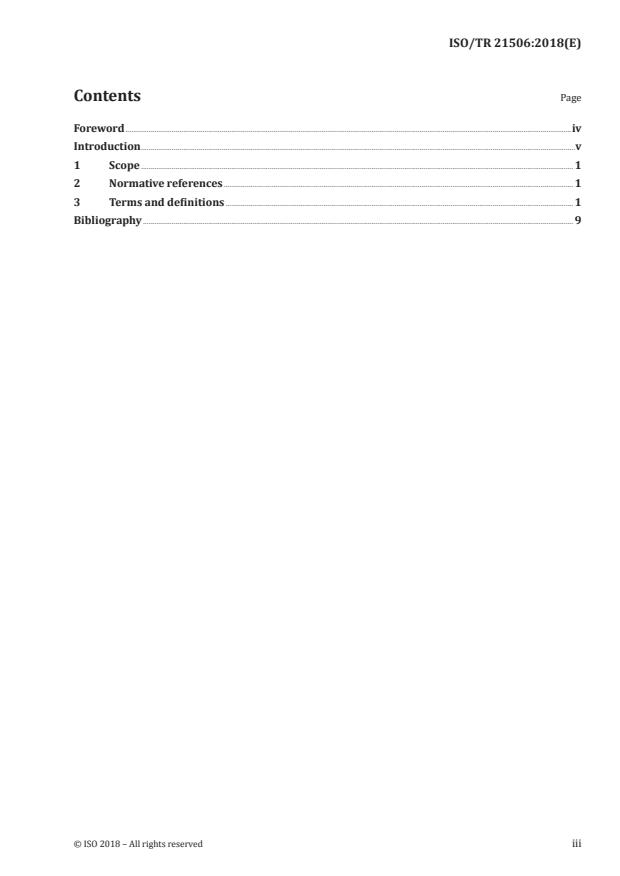
Contents Page
Foreword .iv
Introduction .v
1 Scope . 1
2 Normative references . 1
3 Terms and definitions . 1
Bibliography . 9
Foreword
ISO (the International Organization for Standardization) is a worldwide federation of national standards
bodies (ISO member bodies). The work of preparing International Standards is normally carried out
through ISO technical committees. Each member body interested in a subject for which a technical
committee has been established has the right to be represented on that committee. International
organizations, governmental and non-governmental, in liaison with ISO, also take part in the work.
ISO collaborates closely with the International Electrotechnical Commission (IEC) on all matters of
electrotechnical standardization.
The procedures used to develop this document and those intended for its further maintenance are
described in the ISO/IEC Directives, Part 1. In particular, the different approval criteria needed for the
different types of ISO documents should be noted. This document was drafted in accordance with the
editorial rules of the ISO/IEC Directives, Part 2 (see www .iso .org/directives).
Attention is drawn to the possibility that some of the elements of this document may be the subject of
patent rights. ISO shall not be held responsible for identifying any or all such patent rights. Details of
any patent rights identified during the development of the document will be in the Introduction and/or
on the ISO list of patent declarations received (see www .iso .org/patents).
Any trade name used in this document is information given for the convenience of users and does not
constitute an endorsement.
For an explanation of the voluntary nature of standards, the meaning of ISO specific terms and
expressions related to conformity assessment, as well as information about ISO’s adherence to the
World Trade Organization (WTO) principles in the Technical Barriers to Trade (TBT) see www .iso
.org/iso/foreword .html.
This document was prepared by Technical Committee ISO/TC 258, Project, programme and portfolio
management.
Any feedback or questions on this document should be directed to the user’s national standards body. A
complete listing of these bodies can be found at www .iso .org/members .html.
iv © ISO 2018 – All rights reserved
Introduction
This document provides guidance to people involved in project, programme and portfolio management.
It describes terms that are used in documents authored by Technical Committee ISO/TC 258, Project,
programme and portfolio management, and that meet any of the following criteria, in that they are:
— specific terms used in project, programme and portfolio management;
— part of common language, but used with a specific and exclusive meaning in the context;
— found in ISO recognized dictionaries, but do not have an adequate definition that fits the usage for
the context.
This document includes the definition used by most project management organizations, most of the
time. A term may have a different meaning within an organization that is not consistent with this
document.
While the individual glossaries for governance and portfolio, programme and project management
standards provide clarity in terms, a common vocabulary reveals that a term may be understood
within the context in which the term is used. The context may be categorized as “activity sectors”,
“management discipline” and “subject areas”, as illustrated in Figure 1.
Figure 1 — How a term derives meaning in context
The target audience of this document includes, but is not limited to, the following:
a) executive managers and people involved in sponsoring projects, programmes or portfolios;
b) people managing projects, programmes or portfolios;
c) people involved in the management or performance of project management offices;
d) developers of national or organizational standards.
This document complements the terms and definitions included in ISO 21500:2012, ISO 21503:2017,
ISO 21504:2015, ISO 21505:2017, ISO 21508:2018 and ISO 21511:2018.
It is aligned with ISO 704:2009, ISO 860:2007, ISO 1087-1:2000, ISO 1951:2007, ISO 10241-1:2011,
ISO 10241-2:2012, ISO 12615:2004, ISO 15188:2001.
TECHNICAL REPORT ISO/TR 21506:2018(E)
Project, programme and portfolio management —
Vocabulary
1 Scope
This document defines terms used in the field of project, programme and portfolio management. It can
be used by any type of organization, including public or private, and any size or sector, as well as any
type of project, programme or portfolio in terms of complexity, size or duration.
2 Normative references
There are no normative references in this document.
3 Terms and definitions
ISO and IEC maintain terminological databases for use in standardization at the following addresses:
— ISO Online browsing platform: available at https: //www .iso .org/obp
— IEC Electropedia: available at http: //www .electropedia .org/
3.1
100 % rule
concept concerning the entire work required to be accomplished to achieve a project (3.59) or
programme (3.50) scope captured in the work breakdown structure (3.87)
Note 1 to entry: The 100 % rule applies to the parent and child elements. The child level of decomposition of a
work breakdown structure element represents 100 % of the work applicable to the parent level.
3.2
activity
identified piece of work that is required to be undertaken to complete a project (3.59) or programme (3.50)
Note 1 to entry: It may also be considered a work element.
3.3
actual cost
actual cost of work performed
cost incurred for work performed
3.4
application area
category of projects (3.59) that generally have a common focus related to a product, customer or sector
3.5
baseline
reference basis for comparison against which performance is monitored and controlled
3.6
benefit
created advantage, value or other positive effect
3.7
budget at completion
total forecasted cost for accomplishing the work related to a work package (3.90), activity (3.2) or
control account (3.14)
3.8
business case
documented justification to support decision making about the commitment to a project (3.59),
programme (3.50) or portfolio (3.42)
3.9
change register
record of all identified project (3.59) changes and their attributes
3.10
change request
documentation that defines a proposed alteration to a project (3.59)
3.11
communication plan
documented description and communication needs of stakeholders (3.79)
3.12
configuration management
application of procedures to control, correlate and maintain documentation, specifications and physical
attributes
3.13
control
comparison of actual performance with planned performance, analysing variances and taking
appropriate corrective and preventive action as needed
3.14
control account
management control point where scope, budget, actual cost (3.3) and schedule of a project (3.59) or
programme (3.50), work package (3.90) or activity (3.2) are integrated
3.15
corrective action
direction and activity (3.2) for modifying the performance of work to bring performance in line
with a plan
3.16
cost variance
measure of cost performance on a project (3.59)
3.17
crashing
schedule compression technique to shorten the duration of an activity (3.2), a group of activities or a
project (3.59) by increasing the expenditure of resources
3.18
critical path
sequence of activities (3.2) that determine the earliest possible completion date for a project (3.59)
or phase
3.19
deliverable
unique and verifiable, tangible or intangible outcome of a planned activity (3.2)
2 © ISO 2018 – All rights reserved
3.20
earned value
budgeted cost of work performed
value of completed work expressed in terms of the budget assigned to that work
3.21
earned value management
method that integrates project (3.59) or programme (3.50) scope, actual cost (3.3), budget and schedule
for assessment of progress and performance
3.22
estimate at completion
forecasted total cost to accomplish the work on a project (3.59), programme (3.50), work package (3.90)
or activity (3.2)
3.23
estimate to complete
forecasted cost of the work remaining on a project (3.59), programme (3.50), work package (3.90) or
activity (3.2)
3.24
functional breakdown structure
decomposition of the f
...
Questions, Comments and Discussion
Ask us and Technical Secretary will try to provide an answer. You can facilitate discussion about the standard in here.
Loading comments...