

ISO 21062:2020
(Main)Corrosion of metals and alloys — Determination of the corrosion rates of embedded steel reinforcement in concrete exposed to simulated marine environments
General Information
- Abstract
This document specifies the apparatus, materials, specimen preparation, procedures, results and reports for comparing the corrosion rates of steel reinforcement bars in concrete in simulated marine and coastal environments. This document is not applicable to galvanized steel reinforcement. It gives guidelines for material selection in corrosion design. In order to illustrate the methodology, Annex A provides examples of experimental results.
- Status
- Published
- Publication Date
- 13-May-2020
- Technical Committee
- ISO/TC 156 - Corrosion of metals and alloys
- Current Stage
- 9093 - International Standard confirmed
- Start Date
- 03-Sep-2025
- Completion Date
- 29-Aug-2026
Buy Documents


ISO 21062:2020 - Corrosion of metals and alloys -- Determination of the corrosion rates of embedded steel reinforcement in concrete exposed to simulated marine environments
ISO 21062:2020 - Corrosion of metals and alloys — Determination of the corrosion rates of embedded steel reinforcement in concrete exposed to simulated marine environments/14/2020
Overview
ISO 21062:2020 - Corrosion of metals and alloys - specifies a laboratory method to determine and compare corrosion rates of steel reinforcement bars embedded in concrete exposed to simulated marine and coastal environments. The standard defines apparatus, materials, specimen preparation, test cycles, data recording, result calculation and reporting. It is intended for selection and comparison of corrosion‑resistant reinforcing steels and is not applicable to galvanized steel reinforcement. Annex A provides illustrative experimental results.
Key topics and technical requirements
Simulation chamber and environment
- Salt spray/mist system producing fine droplets; salt solution 3 % ± 0.2 % NaCl, initial pH 7 ± 0.5.
- Controlled temperature range ≈ 5 °C to 30 °C.
- Forced drying/ventilation system to restore environmental control.
- Typical cycle: spray 60 min every 12 h, then ventilate 2 h.
Test materials and specimen geometry
- Reinforcing bars: 16 mm diameter; benchmark bar (0#) recommended B400DWR, length 395 mm ± 2 mm.
- Test bars: numbered 1#, 2#, 3#, same length as benchmark.
- Concrete: B30 (per ISO 22965‑1/2); cement recommended CEM II/A (42.5) per EN 197‑1.
- Industrial salt added to concrete at 2.5 % of cement; recommended NaCl ≥ 94.5 %.
- Specimens: 100 × 100 × 400 mm; protective concrete cover recommended 15 mm.
- Reinforcing bar ends coated with epoxy per ISO 3673‑1, coating length 25 mm ± 1 mm.
Preparation, testing and measurement
- Reinforcing steel cleaning procedures (degreasing, acid immersion, rinse, solvent soak).
- 28‑day curing of specimens (ISO 1920‑3); initial performance tests for mechanical and chemical properties per ISO 6935‑2.
- Mass, dimension and strength measurements before and after exposure; removal of concrete (breaking of specimens) to extract bars.
- Results expressed as mass loss rates, ratios vs. benchmark, and average rates for comparison.
Applications and users
- Applies to corrosion testing, material selection and durability design for marine and coastal reinforced concrete structures.
- Primary users:
- Corrosion engineers and materials scientists
- Structural and civil engineers specifying reinforcement for coastal infrastructure
- Testing laboratories and quality control facilities
- Reinforcing steel manufacturers and product developers
- Asset owners and infrastructure managers assessing durability and service life
Related standards
- ISO 1920‑3, ISO 1920‑4 (concrete specimen making and strength)
- ISO 6935‑2 (steel for reinforcement)
- ISO 3673‑1 (epoxy resins)
- ISO 8407:2009 (removal of corrosion products)
- ISO 22965‑1/2 (concrete specification)
- EN 197‑1 (cement)
ISO 21062:2020 provides a reproducible, comparative laboratory method to quantify corrosion rates of embedded steel reinforcement under simulated marine exposure - a practical tool for durability design and material selection.
Buy Documents
ISO 21062:2020 - Corrosion of metals and alloys -- Determination of the corrosion rates of embedded steel reinforcement in concrete exposed to simulated marine environments
ISO 21062:2020 - Corrosion of metals and alloys — Determination of the corrosion rates of embedded steel reinforcement in concrete exposed to simulated marine environments/14/2020
Get Certified
Connect with accredited certification bodies for this standard

Element Materials Technology
Materials testing and product certification.

Inštitut za kovinske materiale in tehnologije
Institute of Metals and Technology. Materials testing, metallurgical analysis, NDT.
Sponsored listings
Frequently Asked Questions
ISO 21062:2020 is a standard published by the International Organization for Standardization (ISO). Its full title is "Corrosion of metals and alloys — Determination of the corrosion rates of embedded steel reinforcement in concrete exposed to simulated marine environments". This standard covers: This document specifies the apparatus, materials, specimen preparation, procedures, results and reports for comparing the corrosion rates of steel reinforcement bars in concrete in simulated marine and coastal environments. This document is not applicable to galvanized steel reinforcement. It gives guidelines for material selection in corrosion design. In order to illustrate the methodology, Annex A provides examples of experimental results.
This document specifies the apparatus, materials, specimen preparation, procedures, results and reports for comparing the corrosion rates of steel reinforcement bars in concrete in simulated marine and coastal environments. This document is not applicable to galvanized steel reinforcement. It gives guidelines for material selection in corrosion design. In order to illustrate the methodology, Annex A provides examples of experimental results.
ISO 21062:2020 is classified under the following ICS (International Classification for Standards) categories: 77.060 - Corrosion of metals. The ICS classification helps identify the subject area and facilitates finding related standards.
ISO 21062:2020 is available in PDF format for immediate download after purchase. The document can be added to your cart and obtained through the secure checkout process. Digital delivery ensures instant access to the complete standard document.
Standards Content (Sample)
INTERNATIONAL ISO
STANDARD 21062
First edition
2020-05
Corrosion of metals and alloys —
Determination of the corrosion rates
of embedded steel reinforcement in
concrete exposed to simulated marine
environments
Corrosion des métaux et alliages — Détermination des vitesses de
corrosion de l'acier encastrés simulée de l'armature dans le béton
exposé à l'environnement marin
Reference number
©
ISO 2020
© ISO 2020
All rights reserved. Unless otherwise specified, or required in the context of its implementation, no part of this publication may
be reproduced or utilized otherwise in any form or by any means, electronic or mechanical, including photocopying, or posting
on the internet or an intranet, without prior written permission. Permission can be requested from either ISO at the address
below or ISO’s member body in the country of the requester.
ISO copyright office
CP 401 • Ch. de Blandonnet 8
CH-1214 Vernier, Geneva
Phone: +41 22 749 01 11
Fax: +41 22 749 09 47
Email: copyright@iso.org
Website: www.iso.org
Published in Switzerland
ii © ISO 2020 – All rights reserved
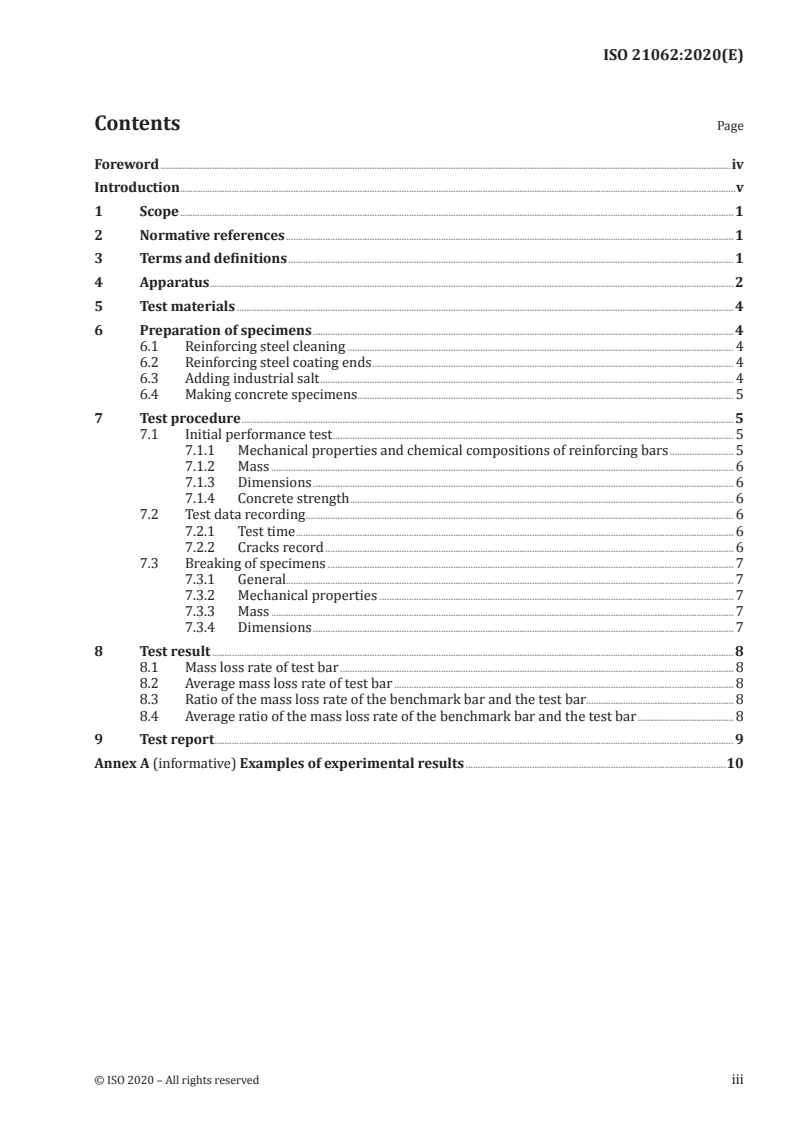
Contents Page
Foreword .iv
Introduction .v
1 Scope . 1
2 Normative references . 1
3 Terms and definitions . 1
4 Apparatus . 2
5 Test materials . 4
6 Preparation of specimens . 4
6.1 Reinforcing steel cleaning . 4
6.2 Reinforcing steel coating ends . 4
6.3 Adding industrial salt . 4
6.4 Making concrete specimens. 5
7 Test procedure . 5
7.1 Initial performance test . 5
7.1.1 Mechanical properties and chemical compositions of reinforcing bars . 5
7.1.2 Mass . 6
7.1.3 Dimensions . 6
7.1.4 Concrete strength . 6
7.2 Test data recording . 6
7.2.1 Test time . 6
7.2.2 Cracks record . 6
7.3 Breaking of specimens . 7
7.3.1 General. 7
7.3.2 Mechanical properties . 7
7.3.3 Mass . 7
7.3.4 Dimensions . 7
8 Test result . 8
8.1 Mass loss rate of test bar . 8
8.2 Average mass loss rate of test bar . 8
8.3 Ratio of the mass loss rate of the benchmark bar and the test bar. 8
8.4 Average ratio of the mass loss rate of the benchmark bar and the test bar . 8
9 Test report . 9
Annex A (informative) Examples of experimental results .10
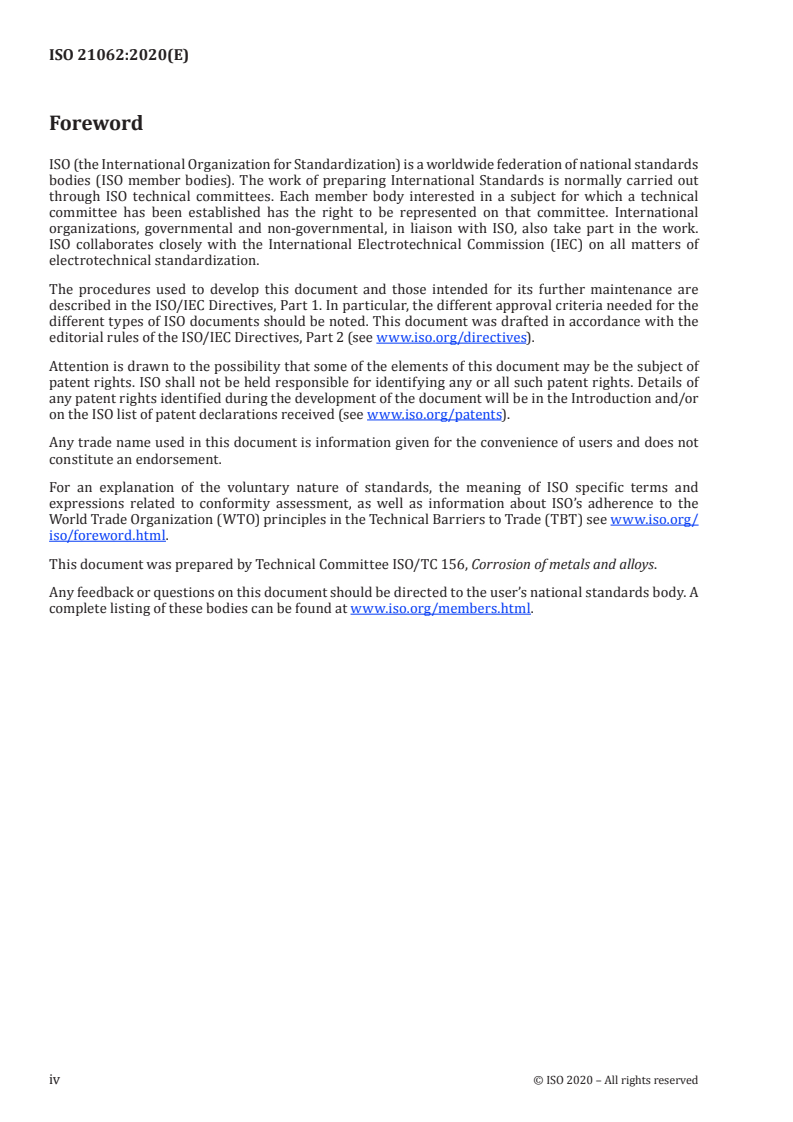
Foreword
ISO (the International Organization for Standardization) is a worldwide federation of national standards
bodies (ISO member bodies). The work of preparing International Standards is normally carried out
through ISO technical committees. Each member body interested in a subject for which a technical
committee has been established has the right to be represented on that committee. International
organizations, governmental and non-governmental, in liaison with ISO, also take part in the work.
ISO collaborates closely with the International Electrotechnical Commission (IEC) on all matters of
electrotechnical standardization.
The procedures used to develop this document and those intended for its further maintenance are
described in the ISO/IEC Directives, Part 1. In particular, the different approval criteria needed for the
different types of ISO documents should be noted. This document was drafted in accordance with the
editorial rules of the ISO/IEC Directives, Part 2 (see www .iso .org/ directives).
Attention is drawn to the possibility that some of the elements of this document may be the subject of
patent rights. ISO shall not be held responsible for identifying any or all such patent rights. Details of
any patent rights identified during the development of the document will be in the Introduction and/or
on the ISO list of patent declarations received (see www .iso .org/ patents).
Any trade name used in this document is information given for the convenience of users and does not
constitute an endorsement.
For an explanation of the voluntary nature of standards, the meaning of ISO specific terms and
expressions related to conformity assessment, as well as information about ISO’s adherence to the
World Trade Organization (WTO) principles in the Technical Barriers to Trade (TBT) see www .iso .org/
iso/ foreword .html.
This document was prepared by Technical Committee ISO/TC 156, Corrosion of metals and alloys.
Any feedback or questions on this document should be directed to the user’s national standards body. A
complete listing of these bodies can be found at www .iso .org/ members .html.
iv © ISO 2020 – All rights reserved
Introduction
Structurally deficient concrete is caused by deterioration due to corrosion, mainly induced by chlorides
from de-icing salts and marine exposure. The structural durability of concrete has become an issue of
common concern to engineering.
The high humidity and high salt spray characteristics of the marine environment need higher durability
structures. More specific requirements for the corrosion-resistant properties of reinforced steel bars,
as well as the corresponding testing technology requirements, have been put forward.
In consideration of engineering practices, corrosion properties could be predicted on the basis of
testing the corrosion rate via the comparative test of the steel bar specimen and a reference steel bar
specimen. This document is consistent with the actual conditions of concrete structure exposure and
can provide support for the development and selection of corrosion-resistant steel.
INTERNATIONAL STANDARD ISO 21062:2020(E)
Corrosion of metals and alloys — Determination of the
corrosion rates of embedded steel reinforcement in
concrete exposed to simulated marine environments
WARNING — This document does not purport to address all of the safety concerns, if any,
associated with its use. It is the responsibility of the user of this document to establish
appropriate safety and health practices.
1 Scope
This document specifies the apparatus, materials, specimen preparation, procedures, results and
reports for comparing the corrosion rates of steel reinforcement bars in concrete in simulated marine
and coastal environments.
This document is not applicable to galvanized steel reinforcement. It gives guidelines for material
selection in corrosion design.
In order to illustrate the methodology, Annex A provides examples of experimental results.
2 Normative references
The following documents are referred to in the text in such a way that some or all of their content
constitutes requirements of this document. For dated references, only the edition cited applies. For
undated references, the latest edition of the referenced document (including any amendments) applies.
ISO 1920-3, Testing of concrete — Part 3: Making and curing test specimens
ISO 1920-4, Testing of concrete — Part 4: Strength of hardened concrete
ISO 3673-1, Plastics — Epoxy resins — Part 1: Designation
ISO 6935-2, Steel for the reinforcement of concrete — Part 2: Ribbed bars
ISO 8407:2009, Corrosion of metals and alloys — Removal of corrosion products from corrosion test
specimens
ISO 22965-1, Concrete — Part 1: Methods of specifying and guidance for the specifier
ISO 22965-2, Concrete — Part 2: Specification of
...
INTERNATIONAL ISO
STANDARD 21062
First edition
2020-05
Corrosion of metals and alloys —
Determination of the corrosion rates
of embedded steel reinforcement in
concrete exposed to simulated marine
environments
Corrosion des métaux et alliages — Détermination des vitesses de
corrosion de l'acier encastrés simulée de l'armature dans le béton
exposé à l'environnement marin
Reference number
©
ISO 2020
© ISO 2020
All rights reserved. Unless otherwise specified, or required in the context of its implementation, no part of this publication may
be reproduced or utilized otherwise in any form or by any means, electronic or mechanical, including photocopying, or posting
on the internet or an intranet, without prior written permission. Permission can be requested from either ISO at the address
below or ISO’s member body in the country of the requester.
ISO copyright office
CP 401 • Ch. de Blandonnet 8
CH-1214 Vernier, Geneva
Phone: +41 22 749 01 11
Fax: +41 22 749 09 47
Email: copyright@iso.org
Website: www.iso.org
Published in Switzerland
ii © ISO 2020 – All rights reserved
Contents Page
Foreword .iv
Introduction .v
1 Scope . 1
2 Normative references . 1
3 Terms and definitions . 1
4 Apparatus . 2
5 Test materials . 4
6 Preparation of specimens . 4
6.1 Reinforcing steel cleaning . 4
6.2 Reinforcing steel coating ends . 4
6.3 Adding industrial salt . 4
6.4 Making concrete specimens. 5
7 Test procedure . 5
7.1 Initial performance test . 5
7.1.1 Mechanical properties and chemical compositions of reinforcing bars . 5
7.1.2 Mass . 6
7.1.3 Dimensions . 6
7.1.4 Concrete strength . 6
7.2 Test data recording . 6
7.2.1 Test time . 6
7.2.2 Cracks record . 6
7.3 Breaking of specimens . 7
7.3.1 General. 7
7.3.2 Mechanical properties . 7
7.3.3 Mass . 7
7.3.4 Dimensions . 7
8 Test result . 8
8.1 Mass loss rate of test bar . 8
8.2 Average mass loss rate of test bar . 8
8.3 Ratio of the mass loss rate of the benchmark bar and the test bar. 8
8.4 Average ratio of the mass loss rate of the benchmark bar and the test bar . 8
9 Test report . 9
Annex A (informative) Examples of experimental results .10
Foreword
ISO (the International Organization for Standardization) is a worldwide federation of national standards
bodies (ISO member bodies). The work of preparing International Standards is normally carried out
through ISO technical committees. Each member body interested in a subject for which a technical
committee has been established has the right to be represented on that committee. International
organizations, governmental and non-governmental, in liaison with ISO, also take part in the work.
ISO collaborates closely with the International Electrotechnical Commission (IEC) on all matters of
electrotechnical standardization.
The procedures used to develop this document and those intended for its further maintenance are
described in the ISO/IEC Directives, Part 1. In particular, the different approval criteria needed for the
different types of ISO documents should be noted. This document was drafted in accordance with the
editorial rules of the ISO/IEC Directives, Part 2 (see www .iso .org/ directives).
Attention is drawn to the possibility that some of the elements of this document may be the subject of
patent rights. ISO shall not be held responsible for identifying any or all such patent rights. Details of
any patent rights identified during the development of the document will be in the Introduction and/or
on the ISO list of patent declarations received (see www .iso .org/ patents).
Any trade name used in this document is information given for the convenience of users and does not
constitute an endorsement.
For an explanation of the voluntary nature of standards, the meaning of ISO specific terms and
expressions related to conformity assessment, as well as information about ISO’s adherence to the
World Trade Organization (WTO) principles in the Technical Barriers to Trade (TBT) see www .iso .org/
iso/ foreword .html.
This document was prepared by Technical Committee ISO/TC 156, Corrosion of metals and alloys.
Any feedback or questions on this document should be directed to the user’s national standards body. A
complete listing of these bodies can be found at www .iso .org/ members .html.
iv © ISO 2020 – All rights reserved
Introduction
Structurally deficient concrete is caused by deterioration due to corrosion, mainly induced by chlorides
from de-icing salts and marine exposure. The structural durability of concrete has become an issue of
common concern to engineering.
The high humidity and high salt spray characteristics of the marine environment need higher durability
structures. More specific requirements for the corrosion-resistant properties of reinforced steel bars,
as well as the corresponding testing technology requirements, have been put forward.
In consideration of engineering practices, corrosion properties could be predicted on the basis of
testing the corrosion rate via the comparative test of the steel bar specimen and a reference steel bar
specimen. This document is consistent with the actual conditions of concrete structure exposure and
can provide support for the development and selection of corrosion-resistant steel.
INTERNATIONAL STANDARD ISO 21062:2020(E)
Corrosion of metals and alloys — Determination of the
corrosion rates of embedded steel reinforcement in
concrete exposed to simulated marine environments
WARNING — This document does not purport to address all of the safety concerns, if any,
associated with its use. It is the responsibility of the user of this document to establish
appropriate safety and health practices.
1 Scope
This document specifies the apparatus, materials, specimen preparation, procedures, results and
reports for comparing the corrosion rates of steel reinforcement bars in concrete in simulated marine
and coastal environments.
This document is not applicable to galvanized steel reinforcement. It gives guidelines for material
selection in corrosion design.
In order to illustrate the methodology, Annex A provides examples of experimental results.
2 Normative references
The following documents are referred to in the text in such a way that some or all of their content
constitutes requirements of this document. For dated references, only the edition cited applies. For
undated references, the latest edition of the referenced document (including any amendments) applies.
ISO 1920-3, Testing of concrete — Part 3: Making and curing test specimens
ISO 1920-4, Testing of concrete — Part 4: Strength of hardened concrete
ISO 3673-1, Plastics — Epoxy resins — Part 1: Designation
ISO 6935-2, Steel for the reinforcement of concrete — Part 2: Ribbed bars
ISO 8407:2009, Corrosion of metals and alloys — Removal of corrosion products from corrosion test
specimens
ISO 22965-1, Concrete — Part 1: Methods of specifying and guidance for the specifier
ISO 22965-2, Concrete — Part 2: Specification of
...