

ISO/IEC 24760-1:2025
(Main)Information security, cybersecurity and privacy protection — A framework for identity management — Part 1: Core concepts and terminology
General Information
- Abstract
This document: defines terms for identity management and specifies core concepts of identity and identity management, and their relationships; is applicable to any information system where information relating to identity is processed or stored; is considered to be a horizontal document for the following reasons: it applies concepts such as distinguishing the term “identity” from the term “identifier” on the implementation of systems for the management of identity information and on the requirements for the implementation and operation of a framework for identity management, it provides an important contribution to assess identity management systems with regard to their privacy-friendliness and their ability to assure the relevant attributes of an identity, and consequently it provides a foundation and a common understanding for any other standard addressing identity, identity information, and identity management.
- Status
- Published
- Publication Date
- 15-Sep-2025
- Current Stage
- 6060 - International Standard published
- Start Date
- 16-Sep-2025
- Due Date
- 17-Jul-2026
- Completion Date
- 16-Sep-2025
Buy Documents
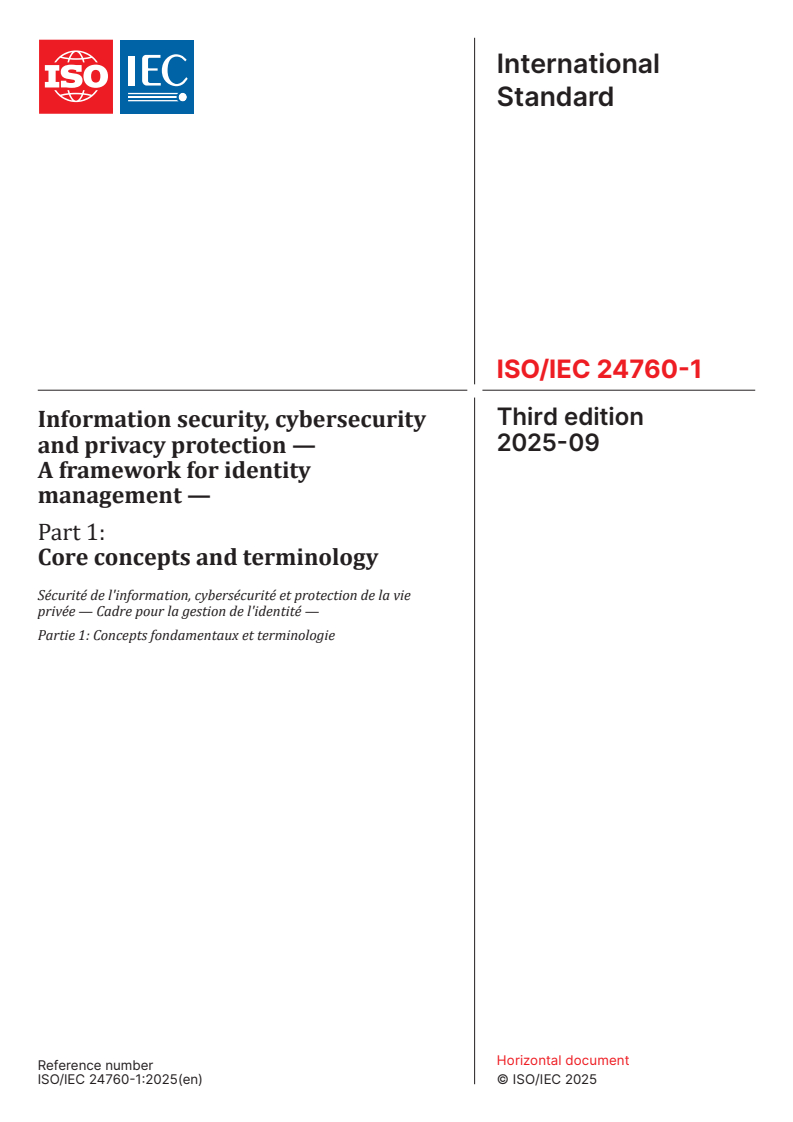

ISO/IEC 24760-1:2025 - Information security, cybersecurity and privacy protection — A framework for identity management — Part 1: Core concepts and terminology Released:16. 09. 2025
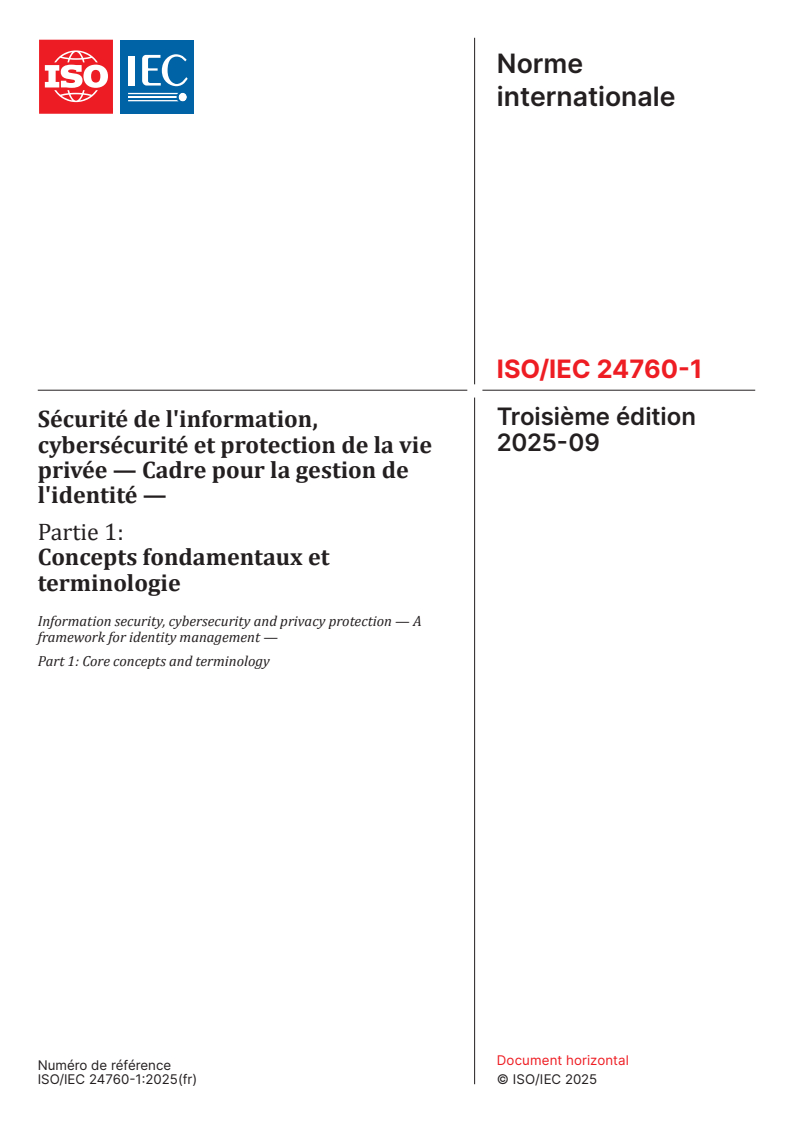
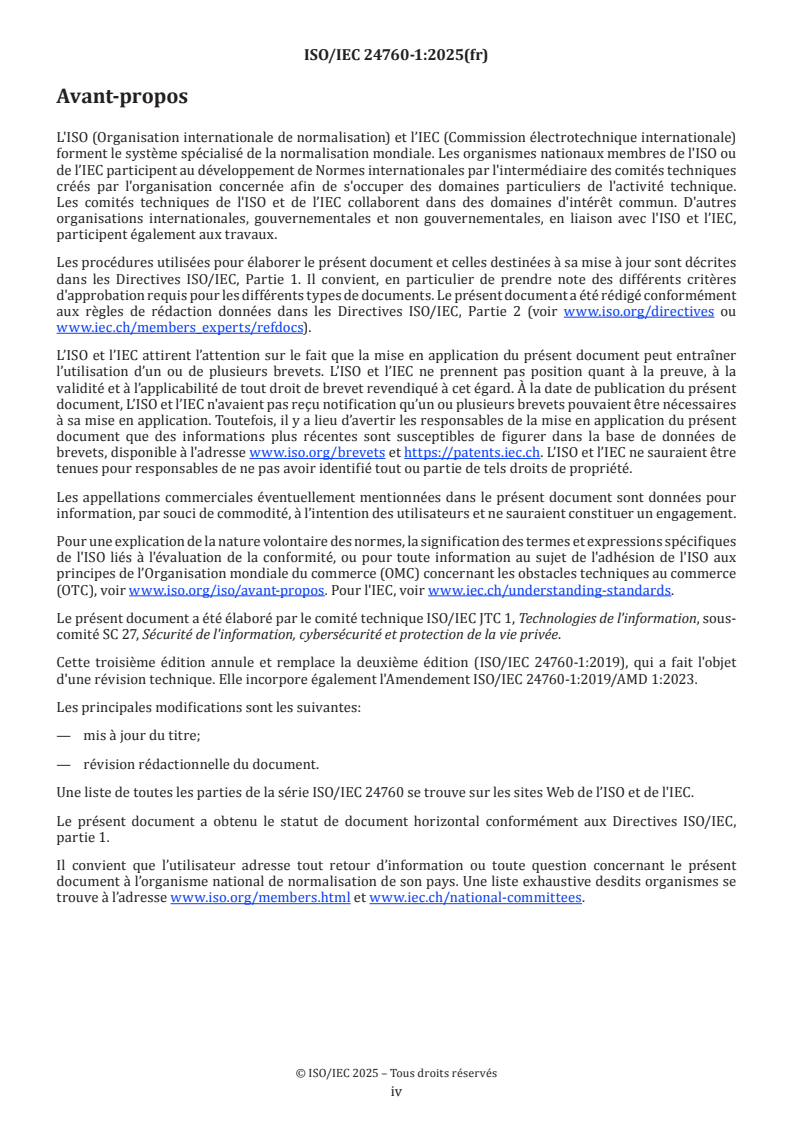
ISO/IEC 24760-1:2025 - Sécurité de l'information, cybersécurité et protection de la vie privée — Cadre pour la gestion de l'identité — Partie 1: Concepts fondamentaux et terminologie
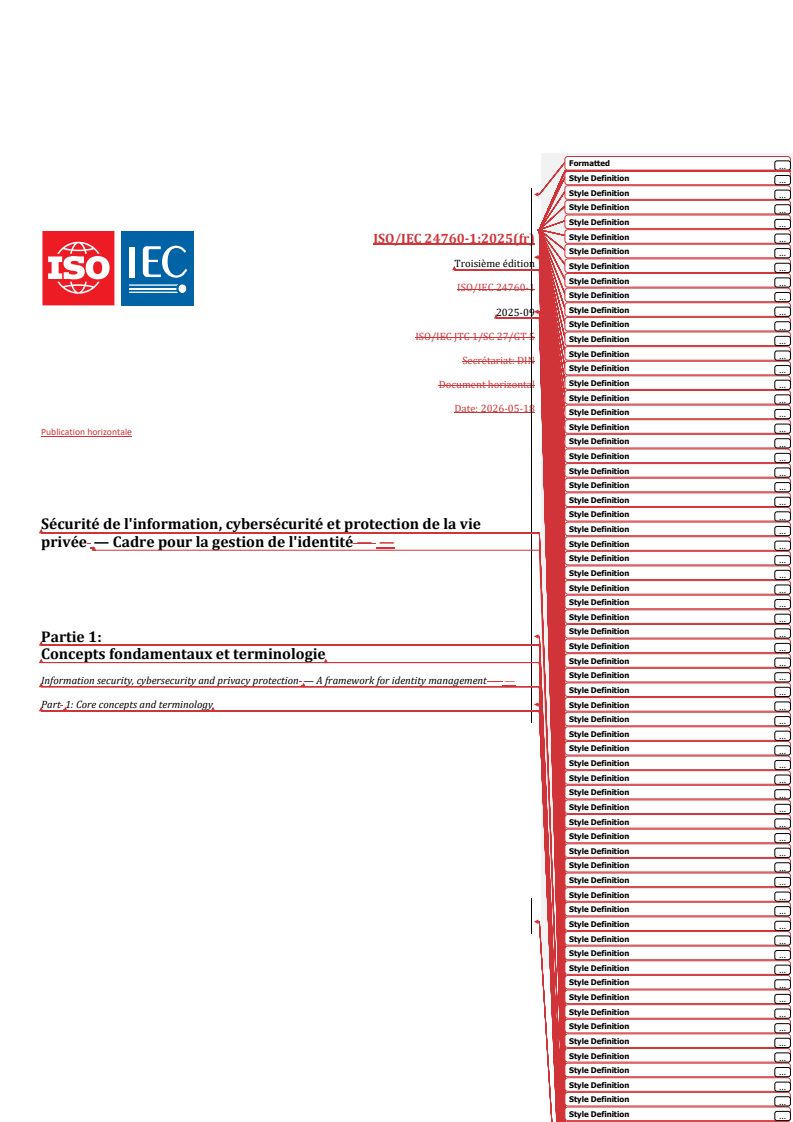
REDLINE ISO/IEC 24760-1:2025 - Sécurité de l'information, cybersécurité et protection de la vie privée — Cadre pour la gestion de l'identité — Partie 1: Concepts fondamentaux et terminologie
Overview
ISO/IEC 24760-1:2025 is an international standard developed by ISO and IEC to provide a unified framework and terminology for identity management in information security, cybersecurity, and privacy protection contexts. This foundational document defines the core concepts and terms related to identity, identifiers, credentials, and identity management processes. Its purpose is to create a common understanding across various industries and sectors, ensuring consistency in the interpretation and implementation of identity management systems.
This standard is applicable to any information system where identity-related data is processed or stored. By clarifying terms such as "identity," "identifier," and "attribute," the document supports robust identity management, privacy protection, and regulatory compliance. As a horizontal standard, ISO/IEC 24760-1:2025 forms the basis for other standards dealing with identity and identity information.
Key Topics
- Core Terminology: Clearly defines critical terms including entity, identity, identifier, attribute, credential, authentication, principal, and domain, supporting consistent communication and implementation.
- Identity and Identifier Distinction: Explains the difference between identity (a set of attributes relating to an entity) and identifier (a unique characteristic within a domain), which is fundamental in developing identity management systems.
- Identity Lifecycle: Outlines processes such as identification, enrolment, verification, registration, authentication, and management of identity information.
- Identity Management Systems: Describes mechanisms, policies, and procedures for maintaining identity and associated metadata across systems and domains.
- Privacy and Security Principles: Covers selective disclosure, minimal disclosure, pseudonym usage, and privacy protection requirements in identity management.
- Federation and Interoperability: Discusses the concept of identity federation for cross-domain identity management and trust establishment.
Applications
ISO/IEC 24760-1:2025 has broad applicability across multiple domains and industries where secure and private management of identity information is essential:
- Information Security Programs: Lays down the vocabulary and baseline concepts for developing secure identity management frameworks.
- Cybersecurity Initiatives: Assists organizations in building resilient authentication and authorization mechanisms, reducing security risks.
- Privacy Compliance: Supports adherence to privacy regulations by detailing privacy-friendly identity management features such as selective and minimal disclosure.
- System Architecture: Guides IT architects and system designers in the development and evaluation of technical solutions for identity registration, proofing, authentication, and federation.
- Digital Services: Facilitates trusted access control and user management in cloud services, online platforms, and digital government solutions.
- Interoperability and Standardization: Acts as the reference point for integrating different identity management systems and aligning with other international standards.
Related Standards
- ISO/IEC 24760-2 – Reference architecture and requirements for identity management, which complements the core concepts by specifying the technical architecture.
- ISO/IEC 29100 – Privacy framework, providing a high-level privacy standard that interfaces with identity management systems.
- ISO/IEC 29101 – Privacy architecture framework, relevant for designing privacy-enhanced identity systems.
- ISO/IEC 29115 – Entity authentication assurance framework, detailing assurance levels for identity verification.
- ISO/IEC 29146 – A standard that addresses governance of identity management.
Conclusion
ISO/IEC 24760-1:2025 is a cornerstone standard that ensures a common language and understanding for identity management across information security, cybersecurity, and privacy protection landscapes. By applying its framework, organizations can enhance the security, privacy, and effectiveness of their identity management systems, while supporting regulatory compliance and interoperability with global standards. For professionals seeking to implement, evaluate, or audit identity systems, this standard offers essential guidance and a solid conceptual foundation.
Relations
- Effective Date
- 08-Apr-2026
- Effective Date
- 22-Jul-2023
- Effective Date
- 22-Jul-2023
Buy Documents
ISO/IEC 24760-1:2025 - Information security, cybersecurity and privacy protection — A framework for identity management — Part 1: Core concepts and terminology Released:16. 09. 2025
ISO/IEC 24760-1:2025 - Sécurité de l'information, cybersécurité et protection de la vie privée — Cadre pour la gestion de l'identité — Partie 1: Concepts fondamentaux et terminologie
REDLINE ISO/IEC 24760-1:2025 - Sécurité de l'information, cybersécurité et protection de la vie privée — Cadre pour la gestion de l'identité — Partie 1: Concepts fondamentaux et terminologie
Get Certified
Connect with accredited certification bodies for this standard

BSI Group
BSI (British Standards Institution) is the business standards company that helps organizations make excellence a habit.

Bureau Veritas
Bureau Veritas is a world leader in laboratory testing, inspection and certification services.

DNV
DNV is an independent assurance and risk management provider.
Sponsored listings
Frequently Asked Questions
ISO/IEC 24760-1:2025 is a standard published by the International Organization for Standardization (ISO). Its full title is "Information security, cybersecurity and privacy protection — A framework for identity management — Part 1: Core concepts and terminology". This standard covers: This document: defines terms for identity management and specifies core concepts of identity and identity management, and their relationships; is applicable to any information system where information relating to identity is processed or stored; is considered to be a horizontal document for the following reasons: it applies concepts such as distinguishing the term “identity” from the term “identifier” on the implementation of systems for the management of identity information and on the requirements for the implementation and operation of a framework for identity management, it provides an important contribution to assess identity management systems with regard to their privacy-friendliness and their ability to assure the relevant attributes of an identity, and consequently it provides a foundation and a common understanding for any other standard addressing identity, identity information, and identity management.
This document: defines terms for identity management and specifies core concepts of identity and identity management, and their relationships; is applicable to any information system where information relating to identity is processed or stored; is considered to be a horizontal document for the following reasons: it applies concepts such as distinguishing the term “identity” from the term “identifier” on the implementation of systems for the management of identity information and on the requirements for the implementation and operation of a framework for identity management, it provides an important contribution to assess identity management systems with regard to their privacy-friendliness and their ability to assure the relevant attributes of an identity, and consequently it provides a foundation and a common understanding for any other standard addressing identity, identity information, and identity management.
ISO/IEC 24760-1:2025 is classified under the following ICS (International Classification for Standards) categories: 01.040.35 - Information technology (Vocabularies); 35.030 - IT Security. The ICS classification helps identify the subject area and facilitates finding related standards.
ISO/IEC 24760-1:2025 has the following relationships with other standards: It is inter standard links to EN ISO/IEC 29146:2026, ISO/IEC 24760-1:2019, ISO/IEC 24760-1:2019/Amd 1:2023. Understanding these relationships helps ensure you are using the most current and applicable version of the standard.
ISO/IEC 24760-1:2025 is available in PDF format for immediate download after purchase. The document can be added to your cart and obtained through the secure checkout process. Digital delivery ensures instant access to the complete standard document.
Standards Content (Sample)
International
Standard
ISO/IEC 24760-1
Third edition
Information security, cybersecurity
2025-09
and privacy protection —
A framework for identity
management —
Part 1:
Core concepts and terminology
Sécurité de l'information, cybersécurité et protection de la vie
privée — Cadre pour la gestion de l'identité —
Partie 1: Concepts fondamentaux et terminologie
Horizontal document
Reference number
© ISO/IEC 2025
All rights reserved. Unless otherwise specified, or required in the context of its implementation, no part of this publication may
be reproduced or utilized otherwise in any form or by any means, electronic or mechanical, including photocopying, or posting on
the internet or an intranet, without prior written permission. Permission can be requested from either ISO at the address below
or ISO’s member body in the country of the requester.
ISO copyright office
CP 401 • Ch. de Blandonnet 8
CH-1214 Vernier, Geneva
Phone: +41 22 749 01 11
Email: copyright@iso.org
Website: www.iso.org
Published in Switzerland
© ISO/IEC 2025 – All rights reserved
ii
Contents Page
Foreword .iv
Introduction .v
1 Scope . 1
2 Normative references . 1
3 Terms and definitions . 1
3.1 General terms .1
3.2 Identification .3
3.3 Authenticating identity information .3
3.4 Management of identity .6
3.5 Federation .8
3.6 Privacy protection .8
4 Symbols and abbreviated terms. 9
5 Identity . 9
5.1 General .9
5.2 Identity information .10
5.3 Identifier .11
5.4 Credential .11
5.4.1 General .11
5.4.2 Authenticator. 12
5.4.3 Credential management . 13
6 Attributes .13
6.1 General . 13
6.2 Types of attributes . 13
6.3 Domain of origin .14
7 Managing identity information .15
7.1 General . 15
7.2 Identity lifecycle . 15
8 Identification . 17
8.1 General .17
8.2 Verification . .18
8.3 Enrolment .18
8.4 Registration .18
8.5 Identity proofing .19
8.5.1 General .19
8.5.2 Identity evidence .19
9 Authentication .20
10 Maintenance .20
11 Implementation aspects .20
12 Privacy .21
Bibliography .22
Index of terms . .24
© ISO/IEC 2025 – All rights reserved
iii
Foreword
ISO (the International Organization for Standardization) and IEC (the International Electrotechnical
Commission) form the specialized system for worldwide standardization. National bodies that are
members of ISO or IEC participate in the development of International Standards through technical
committees established by the respective organization to deal with particular fields of technical activity.
ISO and IEC technical committees collaborate in fields of mutual interest. Other international organizations,
governmental and non-governmental, in liaison with ISO and IEC, also take part in the work.
The procedures used to develop this document and those intended for its further maintenance are described
in the ISO/IEC Directives, Part 1. In particular, the different approval criteria needed for the different types
of document should be noted. This document was drafted in accordance with the editorial rules of the ISO/
IEC Directives, Part 2 (see www.iso.org/directives or www.iec.ch/members_experts/refdocs).
ISO and IEC draw attention to the possibility that the implementation of this document may involve the
use of (a) patent(s). ISO and IEC take no position concerning the evidence, validity or applicability of any
claimed patent rights in respect thereof. As of the date of publication of this document, ISO and IEC had not
received notice of (a) patent(s) which may be required to implement this document. However, implementers
are cautioned that this may not represent the latest information, which may be obtained from the patent
database available at www.iso.org/patents and https://patents.iec.ch. ISO and IEC shall not be held
responsible for identifying any or all such patent rights.
Any trade name used in this document is information given for the convenience of users and does not
constitute an endorsement.
For an explanation of the voluntary nature of standards, the meaning of ISO specific terms and expressions
related to conformity assessment, as well as information about ISO's adherence to the World Trade
Organization (WTO) principles in the Technical Barriers to Trade (TBT) see www.iso.org/iso/foreword.html.
In the IEC, see www.iec.ch/understanding-standards.
This document was prepared by Technical Committee ISO/IEC JTC 1, Information technology, Subcommittee
SC 27, Information security, cybersecurity and privacy protection.
This third edition cancels and replaces the second edition (ISO/IEC 24760-1:2019), which has been
technically revised. It also incorporates the Amendment ISO/IEC 24760-1:2019/Amd 1:2023.
The main changes are as follows:
— title has been updated;
— the document has been editorially revised.
A list of all parts in the ISO/IEC 24760 series can be found on the ISO website.
This document has been given the status of a horizontal document in accordance with the ISO/IEC
Directives, Part 1.
Any feedback or questions on this document should be directed to the user’s national standards
body. A complete listing of these bodies can be found at www.iso.org/members.html and
www.iec.ch/national-committees.
© ISO/IEC 2025 – All rights reserved
iv
Introduction
Data processing systems commonly gather a range of information on their users, be it a person, piece of
equipment, or piece of software connected to them, and make decisions based on the gathered information.
Such identity-based decisions can concern access to applications or other resources.
To address the need to efficiently and effectively implement systems that make identity-based decisions, the
ISO/IEC 24760 series specifies a framework for the issuance, administration, and use of data that serves to
characterize individuals, organizations or information technology components which operate on behalf of
individuals or organizations.
For many organizations, the proper management of identity information is crucial for maintaining security
within organizational processes. For individuals, correct identity management is important for protecting
privacy.
The ISO/IEC 24760 series specifies fundamental concepts and operational structures for identity
management and provides a framework on which information systems can meet business, contractual,
regulatory, and legal obligations.
This document specifies the terminology and concepts for identity management, in order to promote a
common understanding in the field of identity management.
This document is intended to provide a foundation for the terminology and concepts in other international
standards related to identity information processing including other parts of the ISO/IEC 24760 series,
ISO/IEC 29100, ISO/IEC 29101, ISO/IEC 29115, and ISO/IEC 29146.
© ISO/IEC 2025 – All rights reserved
v
International Standard ISO/IEC 24760-1:2025(en)
Information security, cybersecurity and privacy protection —
A framework for identity management —
Part 1:
Core concepts and terminology
1 Scope
This document:
— defines terms for identity management and specifies core concepts of identity and identity management,
and their relationships;
— is applicable to any information system where information relating to identity is processed or stored;
— is considered to be a horizontal document for the following reasons:
— it applies concepts such as distinguishing the term “identity” from the term “identifier” on the
implementation of systems for the management of identity information and on the requirements for
the implementation and operation of a framework for identity management,
— it provides an important contribution to assess identity management systems with regard to their
privacy-friendliness and their ability to assure the relevant attributes of an identity, and consequently
it provides a foundation and a common understanding for any other standard addressing identity,
identity information, and identity management.
2 Normative references
The following documents are referred to in the text in such a way that some or all of their content constitutes
requirements of this document. For dated references, only the edition cited applies. For undated references,
the latest edition of the referenced document (including any amendments) applies.
ISO/IEC 24760-2, Information security, cybersecurity and privacy protection — A framework for identity
management — Part 2: Reference architecture and requirements
3 Terms and definitions
For the purposes of this document, the following terms and definitions apply.
ISO and IEC maintain terminology databases for use in standardization at the following addresses:
— ISO Online browsing platform: available at https:// www .iso .org/ obp
— IEC Electropedia: available at https:// www .electropedia .org/
3.1 General terms
3.1.1
entity
item relevant for the purpose of operation of a domain (3.2.3) that has recognizably distinct existence
Note 1 to entry: An entity can have a physical or a logical embodiment.
© ISO/IEC 2025 – All rights reserved
EXAMPLE A person, an organization, a device, a group of such items, a human subscriber to a telecom service, a
SIM card, a passport, a network interface card, a software application, a service or a website.
3.1.2
identity
partial identity
set of attributes (3.1.3) related to an entity (3.1.1)
Note 1 to entry: An entity can have more than one identity.
Note 2 to entry: Several entities can have the same identity.
Note 3 to entry: ITU-T X1252 specifies the distinguishing use of an identity. In this document, the term identifier (3.1.4)
implies this aspect.
3.1.3
attribute
characteristic or property of an entity (3.1.1)
EXAMPLE An entity type, address information, telephone number, a privilege, a MAC address, a domain name are
possible attributes.
3.1.4
identifier
attribute (3.1.3) or set of attributes that uniquely characterizes an identity (3.1.2) in a domain (3.2.3)
Note 1 to entry: An identifier can be a specifically created attribute with a value assigned to be unique within the domain.
EXAMPLE A name of a club with a club-membership number, a health insurance card number together with a
name of the insurance company, an email address, or a universal unique identifier (UUID) can all be used as identifiers.
In a voter’s register, the combination of attributes name, address and date of birth is sufficient to unambiguously
distinguish a voter.
3.1.5
domain of origin
domain (3.2.3) where an attribute (3.1.3) value was created or its value has been (re)assigned
Note 1 to entry: The domain of origin can be provided as meta data for an attribute.
Note 2 to entry: The domain of origin typically specifies the meaning and format of the attribute value. Such
specification can be based on international standards.
Note 3 to entry: An attribute can contain an explicit value that references the domain of origin, e.g. an ISO country
code for a passport number as reference to the issuing country that is the domain of origin of identity information
(3.2.4) in the passport.
Note 4 to entry: Operationally, a domain of origin can be available as an authoritative source for an attribute
(sometimes known as the attribute authority). An authoritative source can be operated outside the actual domain of
origin. Multiple authoritative sources can exist for the same domain of origin.
EXAMPLE The domain of origin of a club-membership number is the specific club that assigned the number.
3.1.6
reference identifier
RI
identifier (3.1.4) in a domain (3.2.3) that is intended to remain the same for the duration an entity (3.1.1) is
known in the domain and is not associated with another entity for a period specified in a policy after the
entity ceases to be known in that domain
Note 1 to entry: A reference identifier persists at least for the existence of the entity in a domain and can exist longer
than the entity, e.g. for archival purposes.
Note 2 to entry: A reference identifier for an entity can change during the lifetime of an entity, at which point the old
reference identifier is no longer applicable for that entity.
© ISO/IEC 2025 – All rights reserved
EXAMPLE A driver license number that stays the same for an individual driver’s driving life is a persistent
identifier, which references additional identity information (3.2.4) and that is a reference identifier. An IP address is
not a reference identifier as it can be assigned to other entities.
3.1.7
principal
subject
entity (3.1.1) of which identity information (3.2.4) is stored and managed by an identity management system (3.4.8)
Note 1 to entry: Typically, in a context of privacy protection or where a principal is seen as having agency a principal
refers to a person.
3.2 Identification
3.2.1
identification
process of recognizing an entity (3.1.1) in a particular domain (3.2.3) as distinct from other entities
Note 1 to entry: The process of identification applies verification to claimed or observed attributes.
Note 2 to entry: Identification typically is part of the interactions between an entity and the services in a domain and
to access resources. Identification can occur multiple times while the entity is known in the domain.
3.2.2
verification
process of establishing that identity information (3.2.4) associated with a particular entity (3.1.1) is correct
Note 1 to entry: Verification typically involves determining which attributes are needed to recognize an entity in a
domain (3.2.3), checking that these required attributes are present, that they have the correct syntax, and exist within
a defined validity period and pertain to the entity.
3.2.3
domain
domain of applicability
context
environment where an entity (3.1.1) can use a set of attributes (3.1.3) for identification (3.2.1) and other
purposes
Note 1 to entry: In general, the domain of an identity (3.1.2) is well defined in relation to the particular set of attributes.
Note 2 to entry: ITU-T X1252 uses the term context; this document prefers the term domain.
EXAMPLE An IT system deployed by an organization that allows users to login is the domain for the user’s login name.
3.2.4
identity information
set of values of attributes (3.1.3) optionally with any associated metadata in an identity (3.1.2)
Note 1 to entry: In an information and communication technology system, an identity is present as identity information.
3.3 Authenticating identity information
3.3.1
authentication
formalized process of verification (3.2.2) that, if successful, results in an authenticated identity (3.3.2) for an
entity (3.1.1)
Note 1 to entry: The authentication process involves tests by a verifier of one or more identity attributes provided by
an entity to determine, with the required level of assurance, their correctness.
Note 2 to entry: Authentication typically involves the use of a policy to specify a required level of assurance for the
result of a successful completion.
© ISO/IEC 2025 – All rights reserved
3.3.2
authenticated identity
identity information (3.2.4) for an entity (3.1.1) created to record the result of authentication (3.3.1)
Note 1 to entry: An authenticated identity typically contains information obtained in the authentication process, e.g.
the level of assurance attained.
Note 2 to entry: The existence of an authenticated identity in a particular domain denotes that an entity has been
recognized in that domain.
Note 3 to entry: An authenticated identity typically has a lifespan restricted by an authentication policy.
3.3.3
identity information authority
IIA
entity (3.1.1) related to a particular domain (3.2.3) that can make provable statements on the validity and/or
correctness of one or more attribute (3.1.3) values in an identity (3.1.2)
Note 1 to entry: An identity information authority is typically associated with the domain, for instance the domain of
origin (3.1.5), in which the attributes, which the IIA can make assertions on, have a particular significance.
Note 2 to entry: The activity of an identity information authority can be subject to a policy on privacy protection.
Note 3 to entry: An entity can combine the functions of identity information provider (3.3.4) and identity information
authority.
3.3.4
identity information provider
IIP
identity provider
entity (3.1.1) that makes available identity information (3.2.4)
Note 1 to entry: Typical operations performed by an identity information provider are to create and maintain identity
information for entities known in a particular domain. An identity information provider and an identity information
authority (3.3.3) can be the same entity.
3.3.5
credential
representation of an identity (3.1.2) for use in authentication (3.3.1)
Note 1 to entry: As described in 5.4, customary embodiments of a credential are very diverse. To accommodate this
wide range, the definition adopted in this document is very generic.
Note 2 to entry: A credential is typically made to facilitate data authentication of the identity information (3.2.4)
pertaining to the identity it represents. Data authentication is typically used in authorization.
Note 3 to entry: The identity information represented by a credential can, for example, be printed on human-readable
media, or stored within a physical token. Typically, such information can be presented in a manner designed to
reinforce its perceived validity.
EXAMPLE A credential can be a username, username with a password, a PIN, a smartcard, a token, a fingerprint,
a passport, etc.
3.3.6
verifier
entity (3.1.1) that performs verification (3.2.2)
Note 1 to entry: A verifier can be the same as, or act on behalf of, the entity that controls identification of entities for a
particular domain.
© ISO/IEC 2025 – All rights reserved
3.3.7
relying party
RP
entity (3.1.1) that relies on the verification (3.2.2) of identity information (3.2.4) for a particular entity
Note 1 to entry: A relying party is exposed to risk caused by incorrect identity information. Typically, it has a trust
relationship with one or more identity information authorities (3.3.3).
3.3.8
identity assertion
statement by an identity information authority (3.3.3) used by a relying party (3.3.7) for authentication (3.3.1)
Note 1 to entry: An identity assertion can be the cryptographic proof of a successful authentication, created with
algorithms and keys agreed between parties, e.g. in an identity federation.
3.3.9
authentication factor
distinguishing feature of an authenticator to characterize its use in authentication (3.3.1)
Note 1 to entry: Four different authentication factors can be recognized:
— cognition factor, any credential (3.3.5) that is formed by something that the principal (3.1.7) knows and can
reproduce (exclusively): a personal secret (3.3.13);
— possession factor, any credential that is formed by something that the principal possesses, e.g. an authenticator;
— inherent factor, any credential that is formed by a description of something that is inherent to the physical existence
of the principal, e.g. a biometric characteristic such as fingerprint, facial image, or 1, iris pattern;
— behaviour factor, any credential that is formed by a description of something that the principal typically does, e.g.
a behaviour pattern.
3.3.10
multi-factor authentication
authentication (3.3.1) in which multiple authenticators (3.3.11) are used of two or more authentication
factors (3.3.9)
Note 1 to entry: If two or more authenticators are being used in authentication that have the same authentication
factor, they should have been issued by different credential issuers (3.4.10).
Note 2 to entry: Using multiple authenticators that differ in authentication factor can enhance the security of the
authentication as that could prompt the principal (3.1.7) to act differently with each of them.
1)
[SOURCE: ISO/IEC 19790:2012, 3.74, modified — definition and notes to entry have been updated to align
with the context of this document.]
3.3.11
authenticator
representation of an entity (3.1.1) to demonstrate it is known in a domain of origin (3.1.5)
EXAMPLE One-time password (OTP) generator token, transaction authentication number (TAN) generator token,
an electronic (identity) card or a mobile phone application with one or more of these functions.
Note 1 to entry: An authenticator can have a physical form, which can be under exclusive operational control of a
principal (3.1.7).
Note 2 to entry: As a physical device an authenticator can provide a cryptographically strong identifier for the
principal, which can be a pseudonym or ephemeral (3.6.4).
Note 3 to entry: An authenticator is intended to be used by the principal to provide input on its behalf during
authentication (3.3.1) functioning as a possession factor.
1) Cancelled and replaced by ISO/IEC 19790:2025.
© ISO/IEC 2025 – All rights reserved
Note 4 to entry: An authenticator can be provided to a principal by a credential issuer (3.4.10) which is unrelated to
the domain of origin. Upon enrolment in a domain of origin of a principal who has such a third-party authenticator, the
(pseudonymous) identifier of the authenticator is typically recorded as attribute for the principal.
Note 5 to entry: An authenticator can either be unconnected, or connected through a computer interface, e.g. a USB
port, or can be integrated with a user device, e.g. as application in a smart phone. As a mobile application it could use a
secure element in the phone to protect cryptographic secrets or a personal secret (3.3.13).
Note 6 to entry: While under operational control of the principal, an authenticator can also be under secure, remote
functional control of its issuer, e.g. to update functional parameters or refresh cryptographic keys.
3.3.12
one-time password
OTP
single-use value randomly generated for use in authentication (3.3.1)
Note 1 to entry: An authenticator may be configured to generate a one-time password, typically after its operator has
entered a personal secret (3.3.13).
3.3.13
personal secret
knowledge exclusive to a principal (3.1.7) that can be validated in a domain of origin (3.1.5) where the
principal is known
EXAMPLE A password, PIN, selecting pictures from a presented randomized grid with a type of content pre-
arranged with the credential issuer (3.4.10).
Note 1 to entry: Each different type of personal secret has an establishment procedure implemented by the credential
issuer to provide an associated identity information authority (3.3.3) with the information required for future
validation.
Note 2 to entry: Each different type of personal secret has a verification (3.2.2) procedure implemented by the identity
information authority associated with the credential issuer to verify that knowledge based on securely stored
information.
Note 3 to entry: In general, data communication during the process to establish or validate a personal secret as a
credential (3.3.5) is cryptographically protected, e.g. with HTTPS.
3.4 Management of identity
3.4.1
identity management
IDM
processes and policies involved in managing the lifecycle and value, type and optional metadata of attributes
(3.1.3) in identities (3.1.2) known in a particular domain (3.2.3)
Note 1 to entry: In general, identity management is involved in interactions between parties where identity information
(3.2.4) is processed.
Note 2 to entry: Processes and policies in identity management support the functions of an identity information
authority (3.3.3) where applicable, in particular to handle the interaction between an entity for which an identity is
managed and the identity information authority.
3.4.2
identity proofing
initial entity authentication
verification (3.2.2) based on identity evidence (3.4.4) aimed at achieving a specific level of assurance
Note 1 to entry: Identity proofing is typically performed as part of enrolment (3.4.3). Identity evidence can also be
needed during maintenance of registered identity information, e.g. recovery of a user account.
Note 2 to entry: Typically, identity proofing involves a verification of provided identity information and can include
uniqueness checks, possibly based on biometric techniques.
© ISO/IEC 2025 – All rights reserved
Note 3 to entry: Verification for identity proofing is usually based on an enrolment policy that includes specification of
the verification criteria of the identity evidence to be provided by the entity.
Note 4 to entry: The verified identity information (3.2.4) obtained when performing identity proofing can be included
in the registration and can serve to facilitate future identification of the entity (3.1.1).
3.4.3
enrolment
process to make an entity (3.1.1) known within a particular domain (3.2.3)
Note 1 to entry: Enrolment typically comprises the collection and validation of identity information (3.2.4) for
identification of an entity and the collection of the identity information (3.2.4) required for identity registration (3.4.6),
followed by identity registration itself.
3.4.4
identity evidence
evidence of identity
information that can support validating identity information (3.2.4)
Note 1 to entry: Identity evidence is the presented and gathered information related to an entity that provides the
attributes (3.1.3) needed for a successful identification or authentication (3.3.1) at a specific (high) level of assurance.
3.4.5
identity register
IMS register
repository of identities (3.1.2)
Note 1 to entry: A typical identity register is indexed by a reference identifier.
Note 2 to entry: The identity information authority (3.3.3) in a particular domain (3.2.3) typically uses its own identity
register. However, an identity register can be shared between related domains, e.g. within the same commercial entity.
Note 3 to entry: The reliability of the identity information (3.2.4) in an identity register is determined by the identity
proofing policies used during enrolment (3.4.3).
3.4.6
identity registration
registration
process of recording an entity’s (3.1.1)identity information (3.2.4) in an identity register (3.4.5)
3.4.7
identity management system
mechanism comprising of policies, procedures, technology and other resources for maintaining identity
information (3.2.4) including associated metadata
Note 1 to entry: An identity management system is typically used for identification (3.2.1) or authentication (3.3.1)
of entities. It can be deployed to support other automated decisions based on identity information for an entity
recognized in the domain for the identity management system.
3.4.8
registration authority
RA
entity (3.1.1) related to a particular domain (3.2.3) responsible for enrolment (3.4.3), identity proofing (3.4.2)
and identity registration (3.4.6)
3.4.9
credential issuer
entity (3.1.1) responsible for provisioning of a credential (3.3.5) to a principal (3.1.7) in a specific domain (3.2.3)
Note 1 to entry: A credential provisioned by a credential issuer can have a physical form, e.g. a membership (smart) card.
Note 2 to entry: The issuance of a credential for a principal can be recorded as an attribute (3.1.3) for the principal, e.g.
by recording the unique number of the token issued.
© ISO/IEC 2025 – All rights reserved
Note 3 to entry: A credential provisioned by an issuer can be a username and password. A credential in the form of a
smart card or similar security device, can be configured to validate a password off-line.
3.4.10
entity authentication assurance
assertion that the reliability of identity information (3.2.4) pertains to a particular entity
3.4.11
level of assurance
description of the strength of entity authentication assurance
Note 1 to entry: ISO/IEC 29115:2013 specifies multiple levels of assurance.
3.4.12
principal’s personal identity management system
PPI
mobile identity
identity management system (3.4.8) holding identity information (3.2.4) for a single principal (3.1.7), operated
by, or under exclusive control of, this principal
Note 1 to entry: The term “mobile identity” has been used, among other concepts, to refer to a PPI, e.g. as implemented
on a mobile phone or as a dedicated processing token.
Note 2 to entry: An authenticator can be configured to operate as private IMS for its principal. In that case, some
attributes in the identity are exclusively stored in the authenticator, while an external identity information provider
(3.3.4) may be used for additional attributes, and an external identity information authority may be used to provide
(additional) cryptographic assertions on the contained identity information.
3.5 Federation
3.5.1
identity federation
agreement between two or more domains (3.2.3) specifying how identity information (3.2.4) will be
exchanged and managed for cross-domain identification (3.2.1) purposes
Note 1 to entry: Establishing an identity federation typically includes an agreement on the use of common protocols
and procedures for privacy control, data protection and auditing. The federation agreement can specify the use of
standardized data formats and cryptographic techniques.
Note 2 to entry: The federation agreement can be the basis for identity authorities in each of the domains of
applicability to mutually recognize credentials for authorization.
3.6 Privacy protection
3.6.1
selective disclosure
principle of identity management (3.4.1) that gives a person a measure of control over the identity information
(3.2.4) that can be transferred to a third party, e.g. during authentication (3.3.1)
Note 1 to entry: In jurisdictions where certain types of legal entities are granted the right of privacy protection, the
term "person" should be interpreted to include such entities, otherwise the term "person" is used in relation to a single
human individual.
3.6.2
minimal disclosure
principle of identity management (3.4.1) to restrict the request or transfer of identity information (3.2.4) to a
third party to the minimum information strictly required for a particular purpose
Note 1 to entry: The principle of proportionality is related to minimal disclosure in so far as the effort of control
intervention is reasonable in relation to the activity.
© ISO/IEC 2025 – All rights reserved
3.6.3
pseudonym
identifier (3.1.4) that contains the minimal identity information (3.2.4) sufficient to allow a verifier (3.3.6) to
establish it as a link to a known identity (3.1.2)
Note 1 to entry: A pseudonym can be used to reduce privacy risks that are associated with the use of identifiers with
fixed or known values.
Note 2 to entry: A pseudonym can be an identifier with a value chosen by the person or assigned randomly.
Note 3 to entry: In jurisdictions where certain types of legal entities are granted the right of privacy protection, the
term "person" should be interpreted to include such entities, otherwise the term "person" is used in relation to a single
human individual.
3.6.4
ephemeral identifier
identifier (3.1.4) with a restricted validity period
Note 1 to entry: Typically, an ephemeral identifier is provided to a subject as a cryptographic credential to represent
an authenticated identity (3.3.2).
Note 2 to entry: Typically, an ephemeral identifier can only be verified in the domain (3.2.3) that created it, possibly
also in domains federated with this domain.
4 Symbols and abbreviated terms
HTTPS Hypertext transport protocol, secured
MAC Media access control
ICT Information and communication technology
URI Uniform resource identifier
5 Identity
5.1 General
An identity represents an entity in an ICT system as data to be stored or processed. The (business) purposes
of a particular domain of application served by an ICT system determine which of the attributes pertaining
to an entity shall be used in its identity. A persistently stored identity is the basis for identification of a
principal. If a persistent identity is not an identifier, identification can require additional information from
the principal.
An identity can, in part or fully, be represented by a credential issued to the principal. If an identity is
represented by such a credential, an identifier for the credential can be included in the registered identity.
This document considers any set of attributes that describe a particular entity as an identity for the entity.
In some domains, the persistently stored identity information for different entities can be the same. In this
case, additional information is used in identification to recognize an entity as distinct, where needed. In
[15]
other standards, e.g. ITU-T X1252, the explicit purpose of an identity is the capability of the identity
information to distinguish entities from each other to the extent relevant for applications in a domain (“in
context”).
An entity can have multiple identities, each identity relating to at least one domain. An entity can have
multiple identities relating to the same domain. Some identities of an entity cannot be unique in any domain.
NOTE 1 The term entity is taken in a broad sense. It represents a physical person, a moral or legal person
(institution, company), an object (information, a system, a device), or a group of these individual entities.
© ISO/IEC 2025 – All rights reserved
NOTE 2 A human is an entity in this document and has a single, whole existence. It can be described by many
different attributes. Different sets of these attributes form different identities for the same human entity.
If an identity is not unique in a particular domain, it can serve to distinguish a group of entities in that
domain that share one or more characteristics from other entities that do not have such a characteristic.
The identity of an entity serves to make known relevant information of the entity in its interactions with the
services and access of resources provided by a domain. A domain specifies the type and range of permissible
values of attributes to be used for identification or other purposes.
NOTE 3 In some cases the term “partial identity” can be used to refer to a particular set of attributes taken from a
larger set of attributes, which in contrast can be referred to as the full identity — all available attributes — of an entity
in a domain. The preferred term in this document is identity.
A domain should deploy an identity management system conforming to the ISO/IEC 24760 series to manage
the identity information of the entities it intends to recognize.
5.2 Identity information
Information pertaining to a particular entity in a domain is called identity information.
If given identity information sufficiently distinguishes an entity from others in the context of a given use
case, then this identity information is a distinguishing identity.
If the combination of values contained in identity information is unique in the domain, then this identity
information is an identifier of the entity.
When a new identity is created for an entity in a domain, an identity information provider for the domain
can create values for required attributes of the new identity. The new attributes can consist of:
— any information required to facilitate the interaction between the domain and the entity for which the
identity is created;
— any information required for future identification of the entity, including description of aspects of the
physical existence of the entity;
— any information required for future authentication of the entity’s identity; or
— one or more reference identifiers.
The new identity information can be derived from identity information for the entity created in the current
or another domain. Deriving information can involve copying, collating, or
...
Norme
internationale
ISO/IEC 24760-1
Troisième édition
Sécurité de l'information,
2025-09
cybersécurité et protection de la vie
privée — Cadre pour la gestion de
l'identité —
Partie 1:
Concepts fondamentaux et
terminologie
Information security, cybersecurity and privacy protection — A
framework for identity management —
Part 1: Core concepts and terminology
Document horizontal
Numéro de référence
DOCUMENT PROTÉGÉ PAR COPYRIGHT
© ISO/IEC 2025
Tous droits réservés. Sauf prescription différente ou nécessité dans le contexte de sa mise en œuvre, aucune partie de cette
publication ne peut être reproduite ni utilisée sous quelque forme que ce soit et par aucun procédé, électronique ou mécanique,
y compris la photocopie, ou la diffusion sur l’internet ou sur un intranet, sans autorisation écrite préalable. Une autorisation peut
être demandée à l’ISO à l’adresse ci-après ou au comité membre de l’ISO dans le pays du demandeur.
ISO copyright office
Case postale 401 • Ch. de Blandonnet 8
CH-1214 Vernier, Genève
Tél.: +41 22 749 01 11
E-mail: copyright@iso.org
Web: www.iso.org
Publié en Suisse
© ISO/IEC 2025 – Tous droits réservés
ii
Sommaire Page
Avant-propos .iv
Introduction .v
1 Domaine d'application . 1
2 Références normatives . 1
3 Termes et définitions . 1
3.1 Termes généraux .2
3.2 Identification .3
3.3 Authentification des informations d'identité .4
3.4 Gestion de l'identité .7
3.5 Fédération .9
3.6 Protection de la vie privée .9
4 Symboles et abréviations .10
5 Identité . 10
5.1 Généralités .10
5.2 informations d'identité .11
5.3 Identifiant . 12
5.4 Justificatif d'identité . 12
5.4.1 Généralités . 12
5.4.2 Authentifiant . 13
5.4.3 Gestion des justificatifs d'identité .14
6 Attributs . 14
6.1 Généralités .14
6.2 Types d'attributs . 15
6.3 Domaine d'origine.16
7 Gestion des informations d'identité .16
7.1 Généralités .16
7.2 Cycle de vie de l'identité .17
8 Identification .18
8.1 Généralités .18
8.2 Vérification . .19
8.3 Inscription . 20
8.4 Enregistrement . 20
8.5 Vérification de l'identité .21
8.5.1 Généralités .21
8.5.2 Preuve d'identité .21
9 Authentification . .22
10 Maintenance .22
11 Aspects relatifs à la mise en œuvre .22
12 Protection de la vie privée .23
Bibliographie .24
Index des termes .26
© ISO/IEC 2025 – Tous droits réservés
iii
Avant-propos
L'ISO (Organisation internationale de normalisation) et l’IEC (Commission électrotechnique internationale)
forment le système spécialisé de la normalisation mondiale. Les organismes nationaux membres de l'ISO ou
de l’IEC participent au développement de Normes internationales par l'intermédiaire des comités techniques
créés par l'organisation concernée afin de s'occuper des domaines particuliers de l'activité technique.
Les comités techniques de l'ISO et de l’IEC collaborent dans des domaines d'intérêt commun. D'autres
organisations internationales, gouvernementales et non gouvernementales, en liaison avec l'ISO et l’IEC,
participent également aux travaux.
Les procédures utilisées pour élaborer le présent document et celles destinées à sa mise à jour sont décrites
dans les Directives ISO/IEC, Partie 1. Il convient, en particulier de prendre note des différents critères
d'approbation requis pour les différents types de documents. Le présent document a été rédigé conformément
aux règles de rédaction données dans les Directives ISO/IEC, Partie 2 (voir www.iso.org/directives ou
www.iec.ch/members_experts/refdocs).
L’ISO et l’IEC attirent l’attention sur le fait que la mise en application du présent document peut entraîner
l’utilisation d’un ou de plusieurs brevets. L’ISO et l’IEC ne prennent pas position quant à la preuve, à la
validité et à l’applicabilité de tout droit de brevet revendiqué à cet égard. À la date de publication du présent
document, L’ISO et l’IEC n'avaient pas reçu notification qu’un ou plusieurs brevets pouvaient être nécessaires
à sa mise en application. Toutefois, il y a lieu d’avertir les responsables de la mise en application du présent
document que des informations plus récentes sont susceptibles de figurer dans la base de données de
brevets, disponible à l'adresse www.iso.org/brevets et https://patents.iec.ch. L’ISO et l’IEC ne sauraient être
tenues pour responsables de ne pas avoir identifié tout ou partie de tels droits de propriété.
Les appellations commerciales éventuellement mentionnées dans le présent document sont données pour
information, par souci de commodité, à l’intention des utilisateurs et ne sauraient constituer un engagement.
Pour une explication de la nature volontaire des normes, la signification des termes et expressions spécifiques
de l'ISO liés à l'évaluation de la conformité, ou pour toute information au sujet de l'adhésion de l'ISO aux
principes de l’Organisation mondiale du commerce (OMC) concernant les obstacles techniques au commerce
(OTC), voir www.iso.org/iso/avant-propos. Pour l'IEC, voir www.iec.ch/understanding-standards.
Le présent document a été élaboré par le comité technique ISO/IEC JTC 1, Technologies de l'information, sous-
comité SC 27, Sécurité de l'information, cybersécurité et protection de la vie privée.
Cette troisième édition annule et remplace la deuxième édition (ISO/IEC 24760-1:2019), qui a fait l'objet
d'une révision technique. Elle incorpore également l'Amendement ISO/IEC 24760-1:2019/AMD 1:2023.
Les principales modifications sont les suivantes:
— mis à jour du titre;
— révision rédactionnelle du document.
Une liste de toutes les parties de la série ISO/IEC 24760 se trouve sur les sites Web de l’ISO et de l'IEC.
Le présent document a obtenu le statut de document horizontal conformément aux Directives ISO/IEC,
partie 1.
Il convient que l’utilisateur adresse tout retour d’information ou toute question concernant le présent
document à l’organisme national de normalisation de son pays. Une liste exhaustive desdits organismes se
trouve à l’adresse www.iso.org/members.html et www.iec.ch/national-committees.
© ISO/IEC 2025 – Tous droits réservés
iv
Introduction
Les systèmes de traitement des données recueillent généralement une gamme d'informations sur leurs
utilisateurs, qu'il s'agisse d'une personne, d'un équipement ou d'un logiciel qui leur est relié, et prennent des
décisions sur la base des informations recueillies. Ces décisions fondées sur l'identité peuvent concerner
l'accès aux applications ou autres ressources.
Pour répondre à la nécessité de mettre en œuvre de manière efficace et efficiente des systèmes qui prennent
des décisions fondées sur l'identité, la série ISO/IEC 24760 spécifie un cadre pour l'émission, l'administration
et l'utilisation de données qui servent à caractériser des individus, des organismes ou des composants de
technologie de l'information qui agissent pour le compte d'individus ou d'organismes.
Pour de nombreux organismes, la gestion correcte des informations d'identité est essentielle au maintien de
la sécurité au sein des processus organisationnels. Pour les individus, une gestion correcte de l'identité est
importante pour la protection de la vie privée.
La série ISO/IEC 24760 spécifie les concepts fondamentaux et les structures opérationnelles pour la gestion
de l'identité et fournit un cadre sur lequel les systèmes d'information peuvent satisfaire aux obligations
métier, contractuelles, réglementaires et légales.
Le présent document spécifie la terminologie et les concepts de gestion de l'identité, afin de promouvoir une
compréhension commune dans le domaine de la gestion de l'identité.
Le présent document vise à fournir une base pour la terminologie et les concepts d'autres normes
internationales relatives au traitement de l'information d'identité, y compris d'autres parties de la série de
l'ISO/IEC 24760, de l'ISO/IEC 29100, de l'ISO/IEC 29101, de l'ISO/IEC 29115 et de l'ISO/IEC 29146.
© ISO/IEC 2025 – Tous droits réservés
v
Norme internationale ISO/IEC 24760-1:2025(fr)
Sécurité de l'information, cybersécurité et protection de la vie
privée — Cadre pour la gestion de l'identité —
Partie 1:
Concepts fondamentaux et terminologie
1 Domaine d'application
Le présent document:
— définit les termes de gestion de l'identité et spécifie les concepts de base de l'identité et de la gestion de
l'identité, ainsi que leurs relations;
— est applicable à tout système d'information dans lequel les informations relatives à l'identité sont traitées
ou stockées;
— est considéré comme un document horizontal pour les raisons suivantes:
— il applique des concepts tels que la distinction entre le terme “identité” et le terme “identificateur”
concernant la mise en œuvre de systèmes de gestion des informations d'identité et les exigences
relatives à la mise en œuvre et au fonctionnement d'un cadre de gestion de l'identité;
— il apporte une contribution importante à l'évaluation des systèmes de gestion de l'identité en ce qui
concerne leur protection de la vie privée et leur capacité à assurer les attributs pertinents d'une
identité, et par conséquent il fournit une base et une compréhension commune pour toute autre
norme traitant de l'identité, des informations d'identité et de la gestion de l'identité.
2 Références normatives
Les documents suivants sont cités dans le texte de sorte qu’ils constituent, pour tout ou partie de leur
contenu, des exigences du présent document. Pour les références datées, seule l’édition citée s’applique. Pour
les références non datées, la dernière édition du document de référence s'applique (y compris les éventuels
amendements).
ISO/IEC 24760-2, Sécurité de l'information, cybersécurité et protection de la vie privée — Cadre pour la gestion
de l'identité — Partie 2: Architecture de référence et exigences
3 Termes et définitions
Pour les besoins du présent document, les termes et définitions suivants s’appliquent.
L’ISO et l’IEC tiennent à jour des bases de données terminologiques destinées à être utilisées en normalisation,
consultables aux adresses suivantes:
— ISO Online browsing platform: disponible à l’adresse https:// www .iso .org/ obp
— IEC Electropedia: disponible à l’adresse https:// www .electropedia .org/
© ISO/IEC 2025 – Tous droits réservés
3.1 Termes généraux
3.1.1
entité
élément pertinent aux fins de fonctionnement d'un domaine (3.2.3) et qui possède une existence
manifestement distincte
Note 1 à l'article: Une entité peut avoir une matérialisation physique ou logique.
EXEMPLE Une personne, une organisation, un dispositif, un groupe d'éléments de cette nature, un abonné
humain à un service de télécommunications, une carte SIM, un passeport, une carte d'interface réseau, une application
logicielle, un service ou un site Web.
3.1.2
identité
identité partielle
ensemble d'attributs (3.1.3) associés à une entité (3.1.1)
Note 1 à l'article: Une entité peut avoir plusieurs identités.
Note 2 à l'article: Plusieurs entités peuvent avoir la même identité.
Note 3 à l'article: La Recommandation UIT-T X1252 spécifie l'utilisation distinctive d'une identité. Dans le présent
document, le terme identificateur (3.1.4) sous-entend cet aspect.
3.1.3
attribut
caractéristique ou propriété d'une entité (3.1.1)
EXEMPLE Un type d'entité, une adresse, un numéro de téléphone, un privilège, une adresse MAC, un nom de
domaine sont des attributs possibles.
3.1.4
identificateur
attribut (3.1.3) ou ensemble d'attributs qui caractérisent de façon unique une identité (3.1.2) dans un
domaine (3.2.3)
Note 1 à l'article: Un identificateur peut être un attribut spécialement créé avec une valeur attribuée de façon à être
unique à l'intérieur du domaine.
EXEMPLE Un nom de club avec un numéro d'adhésion au club, un numéro de carte d'assurance santé associé
au nom de la compagnie d'assurance, une adresse de messagerie électronique ou un identificateur unique universel
(UUID) peuvent tous être utilisés comme identificateurs. Sur des listes électorales, l'association des attributs nom,
adresse et date de naissance est suffisante pour identifier de façon sûre un électeur.
3.1.5
domaine d'origine
domaine (3.2.3) où une valeur d'attribut (3.1.3) a été créée ou a été (ré)affectée
Note 1 à l'article: Le domaine d'origine peut être fourni en tant que métadonnée pour un attribut.
Note 2 à l'article: Le domaine d'origine spécifie généralement la signification et le format de la valeur d'attribut. Cette
spécification peut être basée sur des normes internationales.
Note 3 à l'article: Un attribut peut contenir une valeur explicite qui fait référence au domaine d'origine, par exemple un
code pays ISO pour un numéro de passeport comme référence au pays de délivrance qui est le domaine d'origine des
informations d'identité (3.2.4) contenues dans le passeport.
Note 4 à l'article: Sur le plan opérationnel, un domaine d'origine peut être disponible en tant que source autorisée pour
un attribut (parfois appelée “autorité d'attribut”). Une source autorisée peut être exploitée en dehors du domaine
d'origine effectif. Plusieurs sources autorisées peuvent exister pour le même domaine d'origine.
EXEMPLE Le domaine d'origine d'un numéro d'adhésion à un club est le club spécifique qui a attribué le numéro.
© ISO/IEC 2025 – Tous droits réservés
3.1.6
identificateur de référence
RI
identificateur (3.1.4) d'un domaine (3.2.3) qui est destiné à rester le même pendant la durée au cours de
laquelle une entité (3.1.1) est connue dans le domaine et qui, une fois que l'entité cesse d'être connue dans ce
domaine, n'est pas associé à une autre entité pendant une période spécifiée dans une police
Note 1 à l'article: Un identificateur de référence persiste au moins pendant l'existence de l'entité dans un domaine et
peut exister plus longtemps que l'entité, par exemple à des fins d'archivage.
Note 2 à l'article: Un identificateur de référence pour une entité peut changer pendant la durée de vie de l'entité, suite
à quoi l'ancien identificateur de référence ne s'applique plus pour cette entité.
EXEMPLE Un numéro de permis de conduire qui reste le même pendant toute la vie d'une personne physique est
un identificateur persistant, qui fait référence à des informations d'identité (3.2.4) supplémentaires et qui constitue
un identificateur de référence. Une adresse IP n'est pas un identificateur de référence car elle peut être attribuée à
d'autres entités.
3.1.7
mandant
sujet
entité (3.1.1) dont les informations d'identité (3.2.4) sont stockées et gérées par un système de gestion de
l'identité (3.4.8)
Note 1 à l'article: En général, dans un contexte de protection de la vie privée ou lorsqu'un mandant est perçu comme
disposant d'une capacité d'agir, le terme “mandant” fait référence à une personne.
3.2 Identification
3.2.1
identification
processus de reconnaissance du caractère distinct d'une entité (3.1.1) par rapport à d'autres entités dans un
domaine (3.2.3) particulier
Note 1 à l'article: Le processus d'identification applique une vérification aux attributs déclarés ou observés.
Note 2 à l'article: L'identification fait généralement partie des interactions entre une entité et les services d'un domaine
et d'accès aux ressources. L'identification peut se produire plusieurs fois, même si l'entité est connue dans le domaine.
3.2.2
vérification
processus visant à établir que des informations d'identité (3.2.4) associées à une entité (3.1.1) particulière
sont correctes
Note 1 à l'article: La vérification implique généralement de déterminer quels attributs sont nécessaires pour
reconnaître une entité dans un domaine (3.2.3), de vérifier que ces attributs requis sont présents, que leur syntaxe est
correcte, et qu'ils existent pendant une période de validité définie et se rapportent à l'entité.
3.2.3
domaine
domaine d'applicabilité
contexte
environnement dans lequel une entité (3.1.1) peut utiliser un ensemble d'attributs (3.1.3) à des fins
d'identification (3.2.1) et à d'autres fins
Note 1 à l'article: En général, le domaine d'une identité (3.1.2) est bien défini par rapport à l'ensemble particulier
d'attributs.
Note 2 à l'article: La Recommandation UIT-T X1252 utilise le terme “contexte”; le présent document préfère le terme
“domaine”.
EXEMPLE Un système IT déployé par une organisation et qui permet aux utilisateurs de se connecter constitue le
domaine pour le nom de connexion de l'utilisateur.
© ISO/IEC 2025 – Tous droits réservés
3.2.4
informations d'identité
ensemble de valeurs d'attributs (3.1.3) facultativement accompagné de toute métadonnée associée à
l'intérieur d'une identité (3.1.2)
Note 1 à l'article: Dans un système de technologies de l'information et de la communication, une identité se présente
sous la forme d'informations d'identité.
3.3 Authentification des informations d'identité
3.3.1
authentification
processus formalisé de vérification (3.2.2) qui, en cas de succès, se traduit par une identité authentifiée (3.3.2)
pour une entité (3.1.1)
Note 1 à l'article: Le processus d'authentification implique le contrôle, par un vérificateur, d'un ou de plusieurs
attributs d'identité fournis par une entité, afin d'en déterminer la validité avec le niveau de garantie requis.
Note 2 à l'article: L'authentification implique généralement l'utilisation d'une politique spécifiant le niveau de garantie
requis pour le résultat d'une procédure réussie.
3.3.2
identité authentifiée
informations d'identité (3.2.4) pour une entité (3.1.1) créées afin d'enregistrer le résultat de l'authentification
(3.3.1)
Note 1 à l'article: Une identité authentifiée contient généralement des informations obtenues lors du processus
d'authentification, par exemple: le niveau d'assurance atteint.
Note 2 à l'article: L'existence d'une identité authentifiée dans un domaine particulier indique qu'une identité a été
reconnue dans ce domaine.
Note 3 à l'article: Une identité authentifiée possède généralement une durée de vie limitée par une politique
d'authentification.
3.3.3
autorité gestionnaire des informations d'identité
IIA
entité (3.1.1) associée à un domaine (3.2.3) particulier qui peut produire des déclarations démontrables
relatives à la validité et/ou à l'exactitude d'une ou plusieurs valeurs d'attribut (3.1.3) dans une identité (3.1.2)
Note 1 à l'article: Une autorité gestionnaire des informations d'identité est généralement associée au domaine, par
exemple le domaine d'origine (3.1.5), dans lequel les attributs, sur lesquels l'IIA peut formuler des affirmations, ont une
importance particulière.
Note 2 à l'article: L'activité d'une autorité gestionnaire des informations d'identité peut être soumise à une politique
relative à la protection de la vie privée.
Note 3 à l'article: Une entité peut combiner les fonctions de fournisseur d'informations d'identité (3.3.4) et d'autorité
gestionnaire des informations d'identité.
3.3.4
fournisseur d'informations d'identité
IIP
fournisseur d'identité
entité (3.1.1) qui met à disposition des informations d'identité (3.2.4)
Note 1 à l'article: Les opérations types effectuées par un fournisseur d'informations d'identité sont la création
et le maintien à jour d'informations d'identité pour les entités connues dans un domaine donné. Un fournisseur
d'informations d'identité et une autorité gestionnaire des informations d'identité (3.3.3) peuvent être la même entité.
© ISO/IEC 2025 – Tous droits réservés
3.3.5
justificatif d'identité
représentation d'une identité (3.1.2) destinée à être utilisée dans le cadre d'une authentification (3.3.1)
Note 1 à l'article: Tel que décrit au paragraphe 5.4, les matérialisations habituelles d'un justificatif d'identité sont très
variées. Afin de tenir compte de ce large éventail, la définition adoptée dans le présent document est très générique.
Note 2 à l'article: Un justificatif d'identité est généralement produit afin de faciliter l'authentification de données
des informations d'identité (3.2.4) se rapportant à l'identité qu'il représente. L'authentification des données est
généralement utilisée dans l'autorisation.
Note 3 à l'article: Les informations d'identité représentées par un justificatif d'identité peuvent, par exemple, être
imprimées sur un support lisible par l'homme, ou être stockées dans un jeton physique. Généralement, ces informations
peuvent être présentées de façon à renforcer leur validité perçue.
EXEMPLE Un justificatif d'identité peut être un nom d'utilisateur, un nom d'utilisateur avec un mot de passe, un
numéro d'identification personnel, une carte à puce, un jeton, une empreinte digitale, un passeport, etc.
3.3.6
vérificateur
entité (3.1.1) qui effectue une vérification (3.2.2)
Note 1 à l'article: Un vérificateur peut être le même que, ou agir pour le compte de, l'entité qui contrôle l'identification
des entités pour un domaine particulier.
3.3.7
partie utilisatrice
RP
entité (3.1.1) qui se fonde sur la vérification (3.2.2) des informations d'identité (3.2.4) pour une entité
particulière
Note 1 à l'article: Une partie utilisatrice est exposée au risque lié à des informations d'identité incorrectes.
Généralement, une relation de confiance la lie à une ou plusieurs autorités gestionnaires des informations d'identité
(3.3.3).
3.3.8
affirmation d'identité
déclaration d'une autorité gestionnaire des informations d'identité (3.3.3) utilisée par une partie utilisatrice
(3.3.7) à des fins d'authentification (3.3.1)
Note 1 à l'article: Une affirmation d'identité peut être la preuve cryptographique d'une authentification réussie, créée
avec des algorithmes et des clés convenues entre les parties, par exemple dans une fédération d'identité.
3.3.9
facteur d'authentification
caractéristique distinctive d'un authentifiant pour caractériser son utilisation dans l'authentification (3.3.1)
Note 1 à l'article: Quatre facteurs d'authentification différents peuvent être reconnus:
— facteur cognitif, tout justificatif d'identité (3.3.5) formé par quelque chose que le mandat (3.1.7) connaît et peut
reproduire (exclusivement): un secret personnel (3.3.13);
— facteur de possession, tout justificatif d'identité formé par quelque chose que possède le mandant, par exemple un
authentifiant;
— facteur inhérent, tout justificatif d'identité formé par une description de quelque chose inhérent à l'existence
physique du mandant, par exemple une caractéristique biométrique telle qu'une empreinte digitale, une image
faciale ou un motif de l'iris;
— facteur comportemental, tout justificatif d'identité formé par une description de quelque chose que le mandant fait
généralement, par exemple un modèle de comportement.
© ISO/IEC 2025 – Tous droits réservés
3.3.10
authentification multifactorielle
authentification (3.3.1) dans laquelle plusieurs authentifiants (3.3.11) sont utilisés pour deux ou plusieurs
facteurs d'authentification (3.3.9)
Note 1 à l'article: Si deux authentifiants ou plus sont utilisés dans l'authentification ayant le même facteur
d'authentification, il convient qu'ils aient été émis par différents émetteurs de justificatif d'identité (3.4.10).
Note 2 à l'article: L'utilisation de plusieurs authentifiants différents en termes de facteur d'authentification peut
améliorer la sécurité de l'authentification car cela pourrait amener le mandant (3.1.7) à agir différemment avec chacun
d'eux.
1)
[SOURCE: ISO/IEC 19790:2012, 3.74, modifié — la définition et les notes à l'article ont été mises à jour pour
s'aligner sur le contexte du présent document.]
3.3.11
authentifiant
représentation d'une entité (3.1.1) pour démontrer qu'elle est connue dans un domaine d'origine (3.1.5)
EXEMPLE Un jeton générateur de mot de passe à usage unique (OTP), un jeton générateur de numéro
d'authentification de transaction (TAN), une carte électronique (d'identité) ou une application pour téléphone mobile
offrant une ou plusieurs de ces fonctions.
Note 1 à l'article: Un authentifiant peut avoir une forme physique, qui peut être sous le contrôle opérationnel exclusif
d'un mandant (3.1.7).
Note 2 à l'article: En tant que dispositif physique, un authentifiant peut fournir un identifiant cryptographiquement
fort pour le mandant, qui peut être un pseudonyme ou un identificateur éphémère (3.6.4).
Note 3 à l'article: Un authentifiant est destiné à être utilisé par le mandant pour fournir des données d'entrée pour son
compte pendant l'authentification (3.3.1) fonctionnant comme un facteur de possession.
Note 4 à l'article: Un authentifiant peut être fourni à un mandant par un émetteur de justificatif d'identité (3.4.10)
qui n'est pas lié au domaine d'origine. Lors de l'inscription dans un domaine d'origine d'un mandant possédant un
tel authentifiant tiers, l'identifiant (pseudonyme) de l'authentifiant est généralement enregistré comme attribut du
mandant.
Note 5 à l'article: Un authentifiant peut soit être non connecté, soit connecté par l'intermédiaire d'une interface
informatique, par exemple un port USB, ou peut être intégré à un dispositif utilisateur, par exemple en tant
qu'application dans un téléphone intelligent. En tant qu'application mobile, il peut utiliser un élément sécurisé dans le
téléphone pour protéger les secrets cryptographiques ou un secret personnel (3.3.13).
Note 6 à l'article: Tout en étant sous le contrôle opérationnel du mandant, un authentifiant peut également être sous
le contrôle sécurisé et à distance de son émetteur, par exemple pour mettre à jour les paramètres fonctionnels ou
actualiser les clés cryptographiques.
3.3.12
mot de passe à usage unique
OTP
valeur à usage unique générée au hasard pour être utilisée dans l'authentification (3.3.1)
Note 1 à l'article: Un authentifiant peut être configuré pour générer un mot de passe ponctuel, généralement après que
son opérateur a saisi un secret personnel (3.3.13).
3.3.13
secret personnel
connaissance exclusive à un mandant (3.1.7) qui peut être validée dans un domaine d'origine (3.1.5) où le
mandant est connu
EXEMPLE Mot de passe, numéro d'identification personnel, sélection d'images à partir d'une grille aléatoire
présentée avec un type de contenu préétabli avec l'émetteur de justificatifs (3.4.10).
1) Annulée et remplacée par l'ISO/IEC 19790:2025.
© ISO/IEC 2025 – Tous droits réservés
Note 1 à l'article: Chaque type différent de secret personnel a une procédure d'établissement mise en œuvre par
l'émetteur de justificatifs d'identité pour fournir une autorité gestionnaire des informations d'identité associée (3.3.3)
avec les informations requises pour la validation ultérieure.
Note 2 à l'article: Chaque type différent de secret personnel comporte une procédure de vérification (3.2.2) mise
en œuvre par l'autorité gestionnaire des informations d'identité associée à l'émetteur du justificatif d'identité pour
vérifier ces connaissances basées sur des informations stockées de manière sécurisée.
Note 3 à l'article: En général, la communication de données pendant le processus d'établissement ou de validation d'un
secret personnel en tant que justificatif d'identité (3.3.5) est cryptographiquement protégée, par exemple avec HTTPS.
3.4 Gestion de l'identité
3.4.1
gestion de l'identité
IDM
processus et politiques impliqués dans la gestion du cycle de vie et de la valeur, du type et des métadonnées
facultatives d'attributs (3.1.3) d'identités (3.1.2) connues dans un domaine particulier (3.2.3)
Note 1 à l'article: En général, la gestion de l'identité est impliquée dans les interactions entre les parties où des
informations d'identité (3.2.4) sont traitées.
Note 2 à l'article: Les processus et politiques en matière de gestion de l'identité soutiennent les fonctions d'une autorité
gestionnaire des informations d'identité (3.3.3) le cas échéant, particulièrement pour gérer l'interaction entre une entité
pour laquelle une identité est gérée et l'autorité gestionnaire des informations d'identité.
3.4.2
vérification de l'identité
authentification initiale de l'entité
vérification (3.2.2) fondée sur une preuve d'identité (3.4.4) destinée à atteindre un niveau d'assurance
spécifique
Note 1 à l'article: La vérification de l'identité est généralement réalisée dans le cadre de l'inscription (3.4.3). Une preuve
d'identité peut également être nécessaire lors de la maintenance des informations d'identité enregistrées, par exemple
la récupération d'un compte utilisateur
Note 2 à l'article: En général, la vérification de l'identité implique une vérification des informations d'identité fournies
et peut inclure des contrôles de l'unicité, éventuellement fondés sur des techniques biométriques.
Note 3 à l'article: La vérification à des fins de vérification de l'identité se fonde généralement sur une politique
d'inscription qui inclut la spécification des critères de vérification des preuves d'identité à fournir par l'entité.
Note 4 à l'article: Les informations d'identité (3.2.4) vérifiées obtenues lors de la vérification de l'identité peuvent être
incluses dans l'inscription et peuvent servir à faciliter une identification future de l'entité (3.1.1).
3.4.3
inscription
processus destiné à faire connaître une entité (3.1.1) dans un domaine (3.2.3) particulier
Note 1 à l'article: L'inscription comprend généralement la collecte et la validation d'informations d'identité (3.2.4) à
des fins d'identification d'une entité et la collecte des informations d'identité (3.2.4) requises pour l'enregistrement de
l'identité (3.4.6), suivies par l'enregistrement de l'identité lui-même.
3.4.4
preuve d'identité
preuve de l'identité
informations qui peuvent soutenir la validation d'informations d'identité (3.2.4)
Note 1 à l'article: Les preuves d'identité sont les informations présentées et recueillies relatives à une entité qui
fournissent les attributs (3.1.3) nécessaires à l'identification ou à l'authentification (3.3.1) réussies à un niveau
d'assurance (élevé) spécifique.
© ISO/IEC 2025 – Tous droits réservés
3.4.5
registre d'identités
registre IMS
référentiel des identités (3.1.2)
Note 1 à l'article: Un registre d'identités type est indexé par un identificateur de référence.
Note 2 à l'article: L'autorité gestionnaire des informations d'identité (3.3.3) dans un domaine (3.2.3) particulier utilise
généralement son propre registre d'identités. Toutefois, un registre d'identités peut être partagé entre des domaines
liés, par exemple au sein de la même entité commerciale.
Note 3 à l'article: La fiabilité des informations d'identité (3.2.4) d'un registre d'identités est déterminée par les
politiques de vérification de l'identité utilisées lors de l'inscription (3.4.3).
3.4.6
enregistrement de l'identité
enregistrement
processus d'enregistrement des informations d'identité (3.2.4) d'une entité (3.1.1) dans un registre d'identités
(3.4.5)
3.4.7
système de gestion de l'identité
mécanisme composé de politiques, procédures, technologies et autres ressources destinées au maintien à
jour d'informations d'identité (3.2.4), y compris les métadonnées associées
Note 1 à l'article: Un système de gestion de l'identité est généralement utilisé pour l'identification (3.2.1) ou
l'authentification (3.3.1) d'entités. Il peut être déployé pour soutenir d'autres décisions automatisées basées sur les
informations d'identité pour une entité reconnue dans le domaine pour le système de gestion de l'identité.
3.4.8
autorité d'enregistrement
RA
entité (3.1.1) associée à un domaine (3.2.3) particulier, responsable de l'inscription (3.4.3), de la vérification
de l'identité (3.4.2) et de l'enregistrement de l'identité (3.4.6)
3.4.9
émetteur de justificatif d'identité
entité (3.1.1) responsable de la fourniture d'un justificatif d'identité (3.3.5) à un mandant (3.1.7) dans un
domaine (3.2.3) spécifique
Note 1 à l'article: Un justificatif d'identité fourni par un émetteur de justificatif d'identité peut avoir une forme
physique, par exemple une carte d'adhésion (à puce).
Note 2 à l'article: La délivrance d'un justificatif d'identité pour un mandant peut être enregistrée en tant qu'attribut
(3.1.3) pour le sujet, par exemple en enregistrant le numéro unique du jeton émis
Note 3 à l'article: Un justificatif d'identité fourni par un émetteur peut être un nom d'utilisateur et un mot de passe. Un
justificatif d'identité sous la forme d'une carte à puce ou d'un dispositif de sécurité comparable peut être configuré de
façon à valider un mot de passe hors ligne.
3.4.10
garantie d'authentification de l'entité
affirmation selon laquelle la fiabilité des informations d'identité (3.2.4) concerne une entité particulière
3.4.11
niveau de garantie
description de la force de la garantie d'authentification de l'entité
Note 1 à l'article: L'ISO/IEC 29115:2013 spécifie plusieurs niveaux de garantie.
© ISO/IEC 2025 – Tous droits réservés
3.4.12
système de gestion de l'identité personnelle du mandant
PPI
identité mobile
système de gestion de l'identité (3.4.8) contenant des informations d'identité (3.2.4) pour un seul mandant
(3.1.7), exploité par ce mandant ou sous son contrôle exclusif
Note 1 à l'article: Le terme “identité mobile” a été utilisé, entre autres concepts, pour faire référence à un PPI, par
exemple tel qu'il est mis en œuvre sur un téléphone mobile ou sous la forme d'un jeton de traitement dédié.
Note 2 à l'article: Un authentifiant peut être configuré pour fonctionner comme un IMS privé pour son mandant.
Dans ce cas, certains attributs de l'identité sont exclusivement stockés dans l'authentifiant, tandis qu'un fournisseur
externe d'informations d'identité (3.3.4) peut être utilisé pour des attributs supplémentaires, et une autorité
externe gestionnaire des informations d'identité peut être utilisée pour fournir des assertions cryptographiques
(additionnelles) sur les informations d'identité contenues.
3.5 Fédération
3.5.1
fédération d'identité
accord entre deux domaines (3.2.3) ou plus, spécifiant comment les informations d'identité (3.2.4) seront
échangées et gérées à des fins d'identification (3.2.1) inter-domaines
Note 1 à l'article: La mise en place d'une fédération d'identité inclut généralement un accord relatif à l'utilisation de
procédures et de protocoles communs en matière de contrôle de la vie privée, de protection des données et d'audit.
L'accord de fédération peut spécifier l'utilisation de formats de données normalisés et de techniques cryptographiques.
Note 2 à l'article: L'accord de fédération peut constituer la base qui permet une reconnaissance mutuelle, par les
autorités gestionnaires d'identité de chacun des domaines d'applicabilité, des justificatifs d'identité destinés à
l'autorisation.
3.6 Protection de la vie privée
3.6.1
divulgation sélective
principe de la gestion de l'identité (3.4.1) qui confère à une personne un certain contrôle sur les informations
d'identité (3.2.4) qui peuvent être transmises à un tiers, par exemple lors de l'authentification (3.3.1)
Note 1 à l'article: Dans les juridictions où certains types d'entités juridiques bénéficient du droit à la protection de
la vie privée, il convient d'interpréter le terme “personne” comme incluant ces entités, sinon le terme “personne” est
utilisé en relation avec un individu humain unique.
3.6.2
divulgation minimale
principe de la gestion de l'identité (3.4.1) destiné à limiter la demande d'informations d'identité (3.2.4) ou leur
transfert à un tiers aux seules informations strictement requises pour une fin spécifique
Note 1 à l'article: Le principe de proportionnalité est lié à la divulgation minimale dans la mesure où l'effort de contrôle
de l'intervention est raisonnable par rapport à l'activité.
3.6.3
pseudonyme
identificateur (3.1.4) qui contient les informations d'identité (3.2.4) minimales suffisantes pour permettre à
un vérificateur (3.3.6) de les établir comme lien avec une identité (3.1.2) connue
Note 1 à l'article: Un pseudonyme peut être utilisé pour réduire les risques en matière de protection de la vie privée
associés à l'utilisation d'identificateurs possédant des valeurs fixes ou connues.
Note 2 à l'article: Un pseudonyme peut être un identificateur ayant une valeur choisie par la personne ou attribuée de
façon aléatoire.
© ISO/IEC 2025 – Tous droits réservés
-------
...
Formatted
...
Style Definition
...
Style Definition
...
Style Definition
...
Style Definition
...
Style Definition
...
Style Definition
...
Troisième édition
Style Definition
...
Style Definition
...
ISO/IEC 24760-1
Style Definition
...
Style Definition
2025-09 .
Style Definition
...
ISO/IEC JTC 1/SC 27/GT 5
Style Definition
...
Style Definition
...
Secrétariat: DIN
Style Definition
...
Style Definition
Document horizontal .
Style Definition
...
Date: 2026-05-18
Style Definition
...
Style Definition
...
Publication horizontale
Style Definition
...
Style Definition
...
Style Definition
...
Style Definition
...
Style Definition
...
Style Definition
...
Sécurité de l'information, cybersécurité et protection de la vie
Style Definition
...
privée — Cadre pour la gestion de l'identité — — Style Definition
...
Style Definition
...
Style Definition
...
Style Definition
...
Style Definition
...
Style Definition
...
Style Definition
...
Partie 1:
Style Definition
...
Concepts fondamentaux et terminologie
Style Definition
...
Style Definition
...
Information security, cybersecurity and privacy protection — A framework for identity management — —
Style Definition
...
Part 1: Core concepts and terminology Style Definition
...
Style Definition
...
Style Definition
...
Style Definition
...
Style Definition
...
Style Definition
...
Style Definition
...
Style Definition
...
Style Definition
...
Style Definition
...
Style Definition
...
Style Definition
...
Style Definition
...
Style Definition
...
Style Definition
...
Style Definition
...
Style Definition
...
Style Definition
...
Style Definition
...
Style Definition
...
Style Definition
...
Style Definition
...
Style Definition
...
Style Definition
...
Style Definition
...
Style Definition
...
Style Definition
...
Style Definition
...
Style Definition
...
ISO/IEC FDIS 24760-1:2024(E2025(fr) Formatted: Font: Bold
Formatted: Font: Bold
Formatted: Font: Bold
Formatted: HeaderCentered
© ISO/IEC 2025
Formatted: French (Switzerland)
Tous droits réservés. Sauf prescription différente ou nécessité dans le contexte de sa mise en œuvreoeuvre, aucune partie
Formatted: French (Switzerland)
de cette publication ne peut être reproduite ni utilisée sous quelque forme que ce soit et par aucun procédé, électronique
Formatted: Right: 1.5 cm, Gutter: 0 cm, Header distance
ou mécanique, y compris la photocopie, ou la diffusion sur l'internetl’internet ou sur un intranet, sans autorisation écrite
from edge: 1.27 cm, Footer distance from edge: 0.5 cm
préalable. Une autorisation peut être demandée à l'ISOl’ISO à l'adressel’adresse ci-après ou au comité membre de
Formatted: French (Switzerland)
l'ISOl’ISO dans le pays du demandeur.
Formatted: French (Switzerland)
ISO Copyright Office copyright office
Formatted: French (Switzerland)
Case postaleCP 401 • Ch. de Blandonnet 8
Formatted: French (Switzerland)
CH-1214 Vernier, Genève Geneva
Formatted: French (Switzerland)
Tél.:Phone: + 41 22 749 01 11
Formatted: French (Switzerland)
E-mail: copyright@iso.org
Formatted: French (Switzerland)
Formatted: zzCopyright address, Adjust space between Latin
Web: www.iso.org
and Asian text, Adjust space between Asian text and numbers
E-mail: copyright@iso.org
Website: www.iso.org
Publié en Suisse. Formatted: Adjust space between Latin and Asian text,
Adjust space between Asian text and numbers
Formatted: French (Switzerland)
Formatted: FooterPageRomanNumber
ii © ISO 2024 – Tous droits réservés
© ISO/IEC 2025 – Tous droits réservés
ii
Formatted: HeaderCentered, Left, Space After: 0 pt, Line
spacing: single, Tab stops: Not at 0.71 cm
Formatted: Adjust space between Latin and Asian text,
Sommaire
Adjust space between Asian text and numbers, Tab stops: Not
at 0.71 cm
Avant-propos . v
Introduction . vii
1 Domaine d'application . 1
2 Références normatives . 1
3 Termes et définitions . 1
3.1 Termes généraux . 2
3.2 Identification . 3
3.3 Authentification des informations d'identité . 4
3.4 Gestion de l'identité . 8
3.5 Fédération . 11
3.6 Protection de la vie privée . 11
4 Symboles et abréviations . 12
5 Identité . 12
5.1 Généralités . 12
5.2 informations d'identité . 13
5.3 Identifiant . 14
5.4 Justificatif d'identité . 14
6 Attributs . 17
6.1 Généralités . 17
6.2 Types d'attributs . 17
6.3 Domaine d'origine . 19
7 Gestion des informations d'identité . 19
7.1 Généralités . 19
7.2 Cycle de vie de l'identité . 20
8 Identification . 22
8.1 Généralités . 22
8.2 Vérification . 23
8.3 Inscription . 24
8.4 Enregistrement . 24
8.5 Vérification de l'identité. 25
9 Authentification. 26
10 Maintenance . 26
11 Aspects relatifs à la mise en œuvre . 27
12 Protection de la vie privée . 27
Bibliographie . 29
Index des termes . 32
Formatted: Font: 10 pt, French (Switzerland)
Avant-propos . iv
Formatted: Font: 10 pt, French (Switzerland)
Introduction . vi Formatted: FooterCentered, Left, Space Before: 0 pt, Tab
stops: Not at 17.2 cm
1 Domaine d'application . 1
Formatted: Font: 11 pt
2 Références normatives . 1
Formatted: Font: 11 pt, French (Switzerland)
Formatted: FooterPageRomanNumber, Left, Space After: 0
3 Termes et définitions . 1
pt, Tab stops: Not at 17.2 cm
© ISO/IEC 2025 – Tous droits réservés
iii
ISO/IEC FDIS 24760-1:2024(E2025(fr) Formatted: Font: Bold
Formatted: Font: Bold
Formatted: Font: Bold
3.1 Termes généraux . 2
Formatted: HeaderCentered
3.2 Identification . 4
3.3 Authentification des informations d'identité . 5
3.4 Gestion de l'identité . 9
3.5 Fédération . 11
3.6 Protection de la vie privée . 11
4 Symboles et abréviations . 12
5 Identité . 12
5.1 Généralités . 12
5.2 informations d'identité . 13
5.3 Identifiant . 14
5.4 Justificatif d'identité . 15
6 Attributs . 18
6.1 Généralités . 18
6.2 Types d'attributs . 18
6.3 Domaine d'origine . 19
7 Gestion des informations d'identité . 20
7.1 Généralités . 20
7.2 Cycle de vie de l'identité . 20
8 Identification . 22
8.1 Généralités . 22
8.2 Vérification . 23
8.3 Inscription . 24
8.4 Enregistrement . 25
8.5 Vérification de l'identité. 25
9 Authentification. 26
10 Maintenance . 27
11 Aspects relatifs à la mise en œuvre . 27
12 Protection de la vie privée . 28
Bibliographie . 29
Index des termes . 31
Formatted: French (Switzerland)
Formatted: FooterPageRomanNumber
iv © ISO 2024 – Tous droits réservés
© ISO/IEC 2025 – Tous droits réservés
iv
Formatted: HeaderCentered, Left, Space After: 0 pt, Line
spacing: single, Tab stops: Not at 0.71 cm
Formatted: French (Switzerland)
Avant-propos
Formatted: Adjust space between Latin and Asian text,
Adjust space between Asian text and numbers
L'ISO (Organisation internationale de normalisation) et l'IECl’IEC (Commission électrotechnique
Formatted
internationale) forment le système spécialisé de la normalisation mondiale. Les organismes nationaux
...
membres de l'ISO ou de l'IECl’IEC participent au développement de Normes internationales par
l'intermédiaire des comités techniques créés par l'organisation concernée afin de s'occuper des domaines
particuliers de l'activité technique. Les comités techniques de l'ISO et de l'IECl’IEC collaborent dans des
domaines d'intérêt commun. D'autres organismes internationaux, gouvernementauxorganisations
internationales, gouvernementales et non gouvernementauxgouvernementales, en liaison avec l'ISO et
l'IECl’IEC, participent également aux travaux.
Les procédures utilisées pour élaborer le présent document et celles destinées à sa mise à jour sont décrites
dans les Directives ISO/IEC, Partie 1. Il convient, en particulier, de prendre note des différents critères Formatted
...
d'approbation requis pour les différents types de documents. Le présent document a été rédigé conformément
aux règles de rédaction données dans les Directives ISO/IEC, Partie 2 (voir
Formatted: French (Switzerland)
www.iso.org/directiveswww.iso.org/directives ou
www.iec.ch/members_experts/refdocswww.iec.ch/members_experts/refdocs).
Formatted: French (Switzerland)
L'ISOL’ISO et l’IEC attire l'attentionattirent l’attention sur le fait que la mise en application du présent Formatted
...
document peut entraîner l'utilisation d'unl’utilisation d’un ou de plusieurs brevets. L'ISOL’ISO et l’IEC ne
Formatted: Adjust space between Latin and Asian text,
Adjust space between Asian text and numbers
prendprennent pas position quant à la preuve, à la validité et à l'applicabilitél’applicabilité de tout droit de
propriétébrevet revendiqué à cet égard. À la date de publication du présent document, l'ISOL’ISO et l’IEC
n'avaient pas reçu notification qu'unqu’un ou plusieurs brevets pouvaient être nécessaires à sa mise en
application. Toutefois, il y a lieu d'avertird’avertir les responsables de la mise en application du présent
document que des informations plus récentes sont susceptibles de figurer dans la base de données de brevets,
disponible aux adresses www.iso.org/brevetsà l'adresse www.iso.org/brevets et Formatted: French (Switzerland)
https://patents.iec.chhttps://patents.iec.ch. L'ISOL’ISO et l'IECl’IEC ne sauraient être tenues pour
Formatted
...
responsables de ne pas avoir identifié tout ou partie de tels droits de propriété et averti de leur existence.
Formatted
Les appellations commerciales éventuellement mentionnées dans le présent document sont données pour .
information, par souci de commodité, à l'intentionl’intention des utilisateurs et ne sauraient constituer un Formatted: French (Switzerland)
engagement.
Formatted: French (Switzerland)
Formatted: French (Switzerland)
Pour une explication de la nature volontaire des normes, la signification des termes et expressions spécifiques
Formatted
...
de l'ISO liés à l'évaluation de la conformité, ou pour toute information au sujet de l'adhésion de l'ISO aux
Formatted
...
principes de l'Organisationl’Organisation mondiale du commerce (OMC) concernant les obstacles techniques
au commerce (OTC), voir www.iso.org/avant-propos. www.iso.org/iso/avant-propos. Pour l'IEC, voir Formatted: French (Switzerland)
www.iec.ch/understanding-standardswww.iec.ch/understanding-standards.
Formatted: French (Switzerland)
Formatted: No bullets or numbering, Adjust space between
Le présent document a été élaboré par le comité technique ISO/IEC JTC 1, Technologies de l'information, sous-
Latin and Asian text, Adjust space between Asian text and
numbers, Tab stops: Not at 0.7 cm + 1.4 cm + 2.1 cm +
comité SC 27, Sécurité de l'information, cybersécurité et protection de la vie privée.
2.8 cm + 3.5 cm + 4.2 cm + 4.9 cm + 5.6 cm + 6.3 cm +
7 cm
Cette troisième édition annule et remplace la deuxième édition (ISO/IEC 24760-1:2019), qui a fait l'objet
Formatted: French (Switzerland)
d'une révision technique. Elle incorpore également l'Amendement ISO/IEC 24760-1:2019/AMD 1:2023.
Formatted
...
Formatted: Adjust space between Latin and Asian text,
Les principales modifications sont les suivantes:
Adjust space between Asian text and numbers
Formatted: Font: 10 pt, French (Switzerland)
— mis à jour du titre;
Formatted: Font: 10 pt, French (Switzerland)
— révision rédactionnelle du document.
Formatted: FooterCentered, Left, Space Before: 0 pt, Tab
stops: Not at 17.2 cm
Une liste de toutes les parties de la série ISO/IEC 24760 peut être consultéese trouve sur le site webles sites
Formatted: Font: 11 pt
Web de l'ISOl’ISO et de l'IEC.
Formatted: Font: 11 pt, French (Switzerland)
Formatted: FooterPageRomanNumber, Left, Space After: 0
pt, Tab stops: Not at 17.2 cm
© ISO/IEC 2025 – Tous droits réservés
v
ISO/IEC FDIS 24760-1:2024(E2025(fr) Formatted: Font: Bold
Formatted: Font: Bold
Formatted: Font: Bold
Le présent document a obtenu le statut de document horizontal conformément aux Directives ISO/IEC,
Formatted: HeaderCentered
partie 1.
Il convient que l'utilisateurl’utilisateur adresse tout retour d'informationd’information ou toute question Formatted: French (Switzerland)
concernant le présent document à l'organismel’organisme national de normalisation de son pays. Une liste
Formatted: French (Switzerland)
exhaustive desdits organismes se trouve aux adresses www.iso.org/fr/members.htmlà l’adresse
Formatted: French (Switzerland)
www.iso.org/members.html et www.iec.ch/national-committeeswww.iec.ch/national-committees.
Formatted: French (Switzerland)
Formatted: French (Switzerland)
Formatted: French (Switzerland)
Formatted: Adjust space between Latin and Asian text,
Adjust space between Asian text and numbers
Formatted: French (Switzerland)
Formatted: FooterPageRomanNumber
vi © ISO 2024 – Tous droits réservés
© ISO/IEC 2025 – Tous droits réservés
vi
Formatted: HeaderCentered, Left, Space After: 0 pt, Line
spacing: single, Tab stops: Not at 0.71 cm
Formatted: Line spacing: single, Adjust space between Latin
Introduction
and Asian text, Adjust space between Asian text and numbers,
Tab stops: Not at 0.71 cm
Les systèmes de traitement des données recueillent généralement une gamme d'informations sur leurs
Formatted: Adjust space between Latin and Asian text,
utilisateurs, qu'il s'agisse d'une personne, d'un équipement ou d'un logiciel qui leur est relié, et prennent des Adjust space between Asian text and numbers
décisions sur la base des informations recueillies. Ces décisions fondées sur l'identité peuvent concerner
l'accès aux applications ou autres ressources.
Pour répondre à la nécessité de mettre en œuvre de manière efficace et efficiente des systèmes qui prennent
Formatted: Default Paragraph Font, French (Switzerland)
des décisions fondées sur l'identité, la série ISO/IEC 24760 spécifie un cadre pour l'émission, l'administration
Formatted: French (Switzerland)
et l'utilisation de données qui servent à caractériser des individus, des organismes ou des composants de
Formatted: Default Paragraph Font, French (Switzerland)
technologie de l'information qui agissent pour le compte d'individus ou d'organismes.
Formatted: French (Switzerland)
Pour de nombreux organismes, la gestion correcte des informations d'identité est essentielle au maintien de
Formatted: Default Paragraph Font, French (Switzerland)
la sécurité au sein des processus organisationnels. Pour les individus, une gestion correcte de l'identité est
Formatted: French (Switzerland)
importante pour la protection de la vie privée.
Formatted: Default Paragraph Font, French (Switzerland)
Formatted: French (Switzerland)
La série ISO/IEC 24760 spécifie les concepts fondamentaux et les structures opérationnelles pour la gestion
de l'identité et fournit un cadre sur lequel les systèmes d'information peuvent satisfaire aux obligations Formatted: Default Paragraph Font, French (Switzerland)
métier, contractuelles, réglementaires et légales.
Formatted: Default Paragraph Font, French (Switzerland)
Formatted: French (Switzerland)
Le présent document spécifie la terminologie et les concepts de gestion de l'identité, afin de promouvoir une
Formatted: Default Paragraph Font, French (Switzerland)
compréhension commune dans le domaine de la gestion de l'identité.
Formatted: French (Switzerland)
Le présent document vise à fournir une base pour la terminologie et les concepts d'autres normes Formatted: Default Paragraph Font, French (Switzerland)
internationales relatives au traitement de l'information d'identité, y compris d'autres parties de la série de
Formatted: French (Switzerland)
l'ISO/IEC 24760, de l'ISO/IEC 29100, de l'ISO/IEC 29101, de l'ISO/IEC 29115 et de l'ISO/IEC 29146.
Formatted: Default Paragraph Font, French (Switzerland)
Formatted: French (Switzerland)
Formatted: Default Paragraph Font, French (Switzerland)
Formatted: French (Switzerland)
Formatted: Default Paragraph Font, French (Switzerland)
Formatted: French (Switzerland)
Formatted: Default Paragraph Font, French (Switzerland)
Formatted: French (Switzerland)
Formatted: Default Paragraph Font, French (Switzerland)
Formatted: French (Switzerland)
Formatted: Default Paragraph Font, French (Switzerland)
Formatted: French (Switzerland)
Formatted: Default Paragraph Font, French (Switzerland)
Formatted: French (Switzerland)
Formatted: Default Paragraph Font, French (Switzerland)
Formatted: French (Switzerland)
Formatted: Default Paragraph Font, French (Switzerland)
Formatted: French (Switzerland)
Formatted: Font: 10 pt, French (Switzerland)
Formatted: Font: 10 pt, French (Switzerland)
Formatted: FooterCentered, Left, Space Before: 0 pt, Tab
stops: Not at 17.2 cm
Formatted: Font: 11 pt
Formatted: Font: 11 pt, French (Switzerland)
Formatted: FooterPageRomanNumber, Left, Space After: 0
pt, Tab stops: Not at 17.2 cm
© ISO/IEC 2025 – Tous droits réservés
vii
Norme internationale ISO/IEC 24760-1:2025(fr)
Sécurité de l'information, cybersécurité et protection de la vie privée
— Cadre pour la gestion de l'identité — Partie 1: Concepts
fondamentaux et terminologie
Formatted: Right: 1.5 cm, Gutter: 0 cm, Header distance
from edge: 1.27 cm, Footer distance from edge: 0.5 cm
Sécurité de l'information, cybersécurité et protection de la vie
privée — Cadre pour la gestion de l'identité —
Formatted: Adjust space between Latin and Asian text,
Partie 1:
Adjust space between Asian text and numbers
Formatted: French (Switzerland)
Concepts fondamentaux et terminologie
Formatted: French (Switzerland)
1 Domaine d'application
Formatted: Adjust space between Latin and Asian text,
Adjust space between Asian text and numbers, Tab stops: Not
at 0.7 cm + 1.4 cm + 2.1 cm + 2.8 cm + 3.5 cm + 4.2
Le présent document:
cm + 4.9 cm + 5.6 cm + 6.3 cm + 7 cm
Formatted: French (Switzerland)
— — définit les termes de gestion de l'identité et spécifie les concepts de base de l'identité et de la gestion
Formatted: French (Switzerland)
de l'identité, ainsi que leurs relations;
Formatted: French (Switzerland)
— — est applicable à tout système d'information dans lequel les informations relatives à l'identité sont
Formatted: French (Switzerland)
traitées ou stockées;
Formatted: French (Switzerland)
Formatted: Adjust space between Latin and Asian text,
— — est considéré comme un document horizontal pour les raisons suivantes:
Adjust space between Asian text and numbers
Formatted: French (Switzerland)
— il applique des concepts tels que la distinction entre le terme "“identité"” et le terme
Formatted: French (Switzerland)
"“identificateur"” concernant la mise en œuvre de systèmes de gestion des informations d'identité
Formatted: French (Switzerland)
et les exigences relatives à la mise en œuvre et au fonctionnement d'un cadre de gestion de
l'identité;
Formatted: French (Switzerland)
Formatted: Default Paragraph Font, French (Switzerland)
— il apporte une contribution importante à l'évaluation des systèmes de gestion de l'identité en
Formatted: French (Switzerland)
ce qui concerne leur protection de la vie privée et leur capacité à assurer les attributs pertinents
Formatted: Default Paragraph Font, French (Switzerland)
d'une identité, et par conséquent il fournit une base et une compréhension commune pour toute
Formatted: Default Paragraph Font, French (Switzerland)
autre norme traitant de l'identité, des informations d'identité et de la gestion de l'identité.
Formatted: French (Switzerland)
2 Références normatives
Formatted: Default Paragraph Font, French (Switzerland)
Formatted: Default Paragraph Font, French (Switzerland)
Les documents suivants sont cités dans le texte de sorte qu'ilsqu’ils constituent, pour tout ou partie de leur
Formatted: Adjust space between Latin and Asian text,
contenu, des exigences du présent document. Pour les références datées, seule l'éditionl’édition citée
Adjust space between Asian text and numbers, Tab stops: Not
s'appliques’applique. Pour les références non datées, la dernière édition du document de référence s'applique at 0.7 cm + 1.4 cm + 2.1 cm + 2.8 cm + 3.5 cm + 4.2
cm + 4.9 cm + 5.6 cm + 6.3 cm + 7 cm
(y compris les éventuels amendements).
Formatted: Default Paragraph Font, French (Switzerland)
ISO/IEC 24760--2, Sécurité de l'information, cybersécurité et protection de la vie privée — Cadre pour la Formatted: French (Switzerland)
gestion de l'identité — Partie 2: Architecture de référence et exigences
Formatted: Adjust space between Latin and Asian text,
Adjust space between Asian text and numbers
3 Termes et définitions
Formatted: French (Switzerland)
Formatted: French (Switzerland)
Pour les besoins du présent document, les termes et définitions suivants s'appliquents’appliquent.
Formatted: Font: 11 pt
Formatted: Footer, Left, Space After: 0 pt, Tab stops: Not
at 17.2 cm
© ISO/IEC 2025 – Tous droits réservés
ISO/IEC FDIS 24760-1:2024(E) Formatted
...
2025(fr) Formatted: Font: Bold
Formatted: HeaderCentered
L'ISOL’ISO et l'IECl’IEC tiennent à jour des bases de données terminologiques destinées à être utilisées en Formatted
...
normalisation, consultables aux adresses suivantes:
Formatted: Adjust space between Latin and Asian text,
Adjust space between Asian text and numbers
— — ISO Online browsing platform: disponible à l’adresse
Formatted: French (Switzerland)
https://www.iso.org/obphttps://www.iso.org/obp
Formatted: Adjust space between Latin and Asian text,
Adjust space between Asian text and numbers, Tab stops: Not
at 0.7 cm + 1.4 cm + 2.1 cm + 2.8 cm + 3.5 cm + 4.2
— — IEC Electropedia: disponible à l'adressel’adresse
cm + 4.9 cm + 5.6 cm + 6.3 cm + 7 cm
https://www.electropedia.org/https://www.electropedia.org/
Formatted: French (Switzerland)
3.1 Termes généraux Formatted
...
Formatted: French (Switzerland)
3.1.1 3.1.1
Formatted
...
entité
Formatted
...
élément pertinent aux fins de fonctionnement d'un domaine (3.2.3)(3.2.3) et qui possède une existence
Formatted: French (Switzerland)
manifestement distincte
Formatted: French (Switzerland)
Note 1 à l’article: l'article: Une entité peut avoir une matérialisation physique ou logique.
Formatted
...
Formatted
...
EXEMPLE Une personne, une organisation, un dispositif, un groupe d'éléments de cette nature, un abonné humain
à un service de télécommunications, une carte SIM, un passeport, une carte d'interface réseau, une application logicielle,
un service ou un site Web.
3.1.2 3.1.2
Formatted
...
identité
identité partielle
Formatted: French (Switzerland)
ensemble d'attributs (3.1.3)(3.1.3) associés à une entité (3.1.1)(3.1.1)
Formatted: French (Switzerland)
Formatted: French (Switzerland)
Note 1 à l’article: l'article: Une entité peut avoir plusieurs identités.
Formatted
...
Note 2 à l’article: l'article: Plusieurs entités peuvent avoir la même identité.
Formatted
...
Formatted
...
Note 3 à l’article: l'article: La Recommandation UIT-T X1252 spécifie l'utilisation distinctive d'une identité. Dans le
Formatted
...
présent document, le terme identificateur (3.1.4)(3.1.4) sous-entend cet aspect.
Formatted: French (Switzerland)
3.1.3 3.1.3
Formatted
...
attribut
Formatted: French (Switzerland)
caractéristique ou propriété d'une entité (3.1.1)(3.1.1)
Formatted: French (Switzerland)
EXEMPLE Un type d'entité, une adresse, un numéro de téléphone, un privilège, une adresse MAC, un nom de Formatted
...
domaine sont des attributs possibles.
Formatted
...
Formatted: French (Switzerland)
3.1.4 3.1.4
Formatted: French (Switzerland)
identificateur
attribut (3.1.3)(3.1.3) ou ensemble d'attributs qui caractérisent de façon unique une identité (3.1.2)(3.1.2) Formatted: French (Switzerland)
dans un domaine (3.2.3)(3.2.3)
Formatted: French (Switzerland)
Formatted
...
Note 1 à l’article: l'article: Un identificateur peut être un attribut spécialement créé avec une valeur attribuée de façon à
Formatted
...
être unique à l'intérieur du domaine.
Formatted: FooterPageNumber
2 © ISO 2024 – Tous droits réservés
© ISO/IEC 2025 – Tous droits réservés
Formatted: Font: Bold
Formatted: HeaderCentered, Left
EXEMPLE Un nom de club avec un numéro d'adhésion au club, un numéro de carte d'assurance santé associé au
nom de la compagnie d'assurance, une adresse de messagerie électronique ou un identificateur unique universel (UUID)
peuvent tous être utilisés comme identificateurs. Sur des listes électorales, l'association des attributs nom, adresse et
date de naissance est suffisante pour identifier de façon sûre un électeur.
3.1.5 3.1.5
Formatted: TermNum3, No page break before, Adjust space
between Latin and Asian text, Adjust space between Asian text
domaine d'origine
and numbers
domaine (3.2.3)(3.2.3) où une valeur d'attribut (3.1.3)(3.1.3) a été créée ou a été (ré)affectée
Formatted: Adjust space between Latin and Asian text,
Adjust space between Asian text and numbers
Note 1 à l’article: l'article: Le domaine d'origine peut être fourni en tant que métadonnée pour un attribut.
Formatted: French (Switzerland)
Note 2 à l’article: l'article: Le domaine d'origine spécifie généralement la signification et le format de la valeur d'attribut.
Formatted: French (Switzerland)
Cette spécification peut être basée sur des normes internationales.
Formatted: French (Switzerland)
Formatted
Note 3 à l’article: l'article: Un attribut peut contenir une valeur explicite qui fait référence au domaine d'origine, par .
exemple un code pays ISO pour un numéro de passeport comme référence au pays de délivrance qui est le domaine Formatted: Adjust space between Latin and Asian text,
Adjust space between Asian text and numbers, Tab stops: Not
d'origine des informations d'identité (3.2.4)(3.2.4) contenues dans le passeport.
at 0.7 cm + 1.4 cm + 2.1 cm + 2.8 cm + 3.5 cm + 4.2
cm + 4.9 cm + 5.6 cm + 6.3 cm + 7 cm
Note 4 à l’article: l'article: Sur le plan opérationnel, un domaine d'origine peut être disponible en tant que source
Formatted
autorisée pour un attribut (parfois appelée "“autorité d'attribut").”). Une source autorisée peut être exploitée en dehors .
du domaine d'origine effectif. Plusieurs sources autorisées peuvent exister pour le même domaine d'origine. Formatted
...
Formatted: French (Switzerland)
EXEMPLE Le domaine d'origine d'un numéro d'adhésion à un club est le club spécifique qui a attribué le numéro.
Formatted
...
3.1.6 3.1.6
Formatted: TermNum3, Adjust space between Latin and
Asian text, Adjust space between Asian text and numbers
identificateur de référence
RI
Formatted: French (Switzerland)
identificateur (3.1.4)(3.1.4) d'un domaine (3.2.3)(3.2.3) qui est destiné à rester le même pendant la durée au
Formatted: French (Switzerland)
cours de laquelle une entité (3.1.1)(3.1.1) est connue dans le domaine et qui, une fois que l'entité cesse d'être
Formatted: French (Switzerland)
connue dans ce domaine, n'est pas associé à une autre entité pendant une période spécifiée dans une police
Formatted: French (Switzerland)
Note 1 à l’article: l'article: Un identificateur de référence persiste au moins pendant l'existence de l'entité dans un
Formatted
...
domaine et peut exister plus longtemps que l'entité, par exemple à des fins d'archivage.
Formatted
...
Note 2 à l’article: l'article: Un identificateur de référence pour une entité peut changer pendant la durée de vie de l'entité, Formatted
...
suite à quoi l'ancien identificateur de référence ne s'applique plus pour cette entité.
Formatted: French (Switzerland)
Formatted
...
EXEMPLE Un numéro de permis de conduire qui reste le même pendant toute la vie d'une personne physique est
Formatted: Regular, Font: Bold, French (Switzerland)
un identificateur persistant, qui fait référence à des informations d'identité (3.2.4)(3.2.4) supplémentaires et qui constitue
un identificateur de référence. Une adresse IP n'est pas un identificateur de référence car elle peut être attribuée à
Formatted: French (Switzerland)
d'autres entités.
Formatted: French (Switzerland)
Formatted: French (Switzerland)
3.1.7 3.1.7
Formatted: French (Switzerland)
mandant
sujet Formatted
...
entité (3.1.1)(3.1.1) dont les informations d'identité (3.2.4)(3.2.4) sont stockées et gérées par un système de
Formatted
...
gestion de l'identité (3.4.8)(3.4.8)
Formatted
...
Formatted
...
Note 1 à l’article: l'article: En général, dans un contexte de protection de la vie privée ou lorsqu'un mandant est perçu
Formatted: French (Switzerland)
comme disposant d'une capacité d'agir, le terme "“mandant"” fait référence à une personne.
Formatted: French (Switzerland)
3.2 Identification
Formatted
...
Formatted: Font: 10 pt, French (Switzerland)
3.2.1 3.2.1
Formatted: Font: 10 pt, French (Switzerland)
identification
processus de reconnaissance du caractère distinct d'une entité (3.1.1)(3.1.1) par rapport à d'autres entités
Formatted
...
dans un domaine (3.2.3) particulier (3.2.3)
Formatted: Font: 11 pt
Formatted
...
© ISO/IEC 2025 – Tous droits réservés
ISO/IEC FDIS 24760-1:2024(E) Formatted
...
2025(fr) Formatted: Font: Bold
Formatted: HeaderCentered
Note 1 à l’article: l'article: Le processus d'identification applique une vérification aux attributs déclarés ou observés.
Formatted
...
Formatted: Adjust space between Latin and Asian text,
Note 2 à l’article: l'article: L'identification fait généralement partie des interactions entre une entité et les services d'un
Adjust space between Asian text and numbers, Tab stops: Not
domaine et d'accès aux ressources. L'identification peut se produire plusieurs fois, même si l'entité est connue dans le at 0.7 cm + 1.4 cm + 2.1 cm + 2.8 cm + 3.5 cm + 4.2
cm + 4.9 cm + 5.6 cm + 6.3 cm + 7 cm
domaine.
Formatted
...
3.2.2 3.2.2
Formatted: TermNum3, Adjust space between Latin and
vérification
Asian text, Adjust space between Asian text and numbers
processus visant à établir que des informations d'identité (3.2.4)(3.2.4) associées à une entité (3.1.1)(3.1.1)
Formatted: French (Switzerland)
particulière sont correctes
Formatted: French (Switzerland)
Formatted: French (Switzerland)
Note 1 à l’article: l'article: La vérification implique généralement de déterminer quels attributs sont nécessaires pour
reconnaître une entité dans un domaine (3.2.3),(3.2.3), de vérifier que ces attributs requis sont présents, que leur syntaxe Formatted
...
est correcte, et qu'ils existent pendant une période de validité définie et se rapportent à l'entité.
Formatted
...
Formatted: French (Switzerland)
3.2.3 3.2.3
Formatted
domaine .
domaine d'applicabilité
contexte
environnement dans lequel une entité (3.1.1)(3.1.1) peut utiliser un ensemble d'attributs (3.1.3)(3.1.3) à des Formatted: French (Switzerland)
fins d'identification (3.2.1)(3.2.1) et à d'autres fins
Formatted: French (Switzerland)
Formatted: French (Switzerland)
Note 1 à l’article: l'article: En général, le domaine d'une identité (3.1.2)(3.1.2) est bien défini par rapport à l'ensemble
Formatted: French (Switzerland)
particulier d'attributs.
Formatted
...
Note 2 à l’article: l'article: La Recommandation UIT-T X1252 utilise le terme "“contexte";”; le présent document préfère
Formatted: French (Switzerland)
le terme "“domaine".”.
Formatted
...
Formatted
EXEMPLE Un système IT déployé par une organisation et qui permet aux utilisateurs de se connecter constitue le
...
domaine pour le nom de connexion de l'utilisateur.
3.2.4 3.2.4 Formatted
...
informations d'identité
Formatted: French (Switzerland)
ensemble de valeurs d'attributs (3.1.3)(3.1.3) facultativement accompagné de toute métadonnée associée à
Formatted: French (Switzerland)
l'intérieur d'une identité (3.1.2)(3.1.2)
Formatted: French (Switzerland)
Formatted
Note 1 à l’article: l'article: Dans un système de technologies de l'information et de la communication, une identité se .
présente sous la forme d'informations d'identité.
Formatted
...
Formatted
...
3.3 Authentification des informations d'identité
Formatted
...
Formatted: French (Switzerland)
3.3.1 3.3.1
authentification
Formatted: French (Switzerland)
processus formalisé de vérification (3.2.2)(3.2.2) qui, en cas de succès, se traduit par une identité authentifiée
Formatted: French (Switzerland)
(3.3.2)(3.3.2) pour une entité (3.1.1)(3.1.1)
Formatted: French (Switzerland)
Formatted
...
Note 1 à l’article: l'article: Le processus d'authentification implique le contrôle, par un vérificateur, d'un ou de plusieurs
attributs d'identité fournis par une entité, afin d'en déterminer la validité avec le niveau de garantie requis. Formatted
...
Formatted: FooterPageNumber
4 © ISO 2024 – Tous droits réservés
© ISO/IEC 2025 – Tous droits réservés
...
Formatted
...
Formatted
...
Note 2 à l’article: l'article: L'authentification implique généralement l'utilisation d'une politique spécifiant le niveau de
Formatted
...
garantie requis pour le résultat d'une procédure réussie.
3.3.2 3.3.2
Formatted
...
identité authentifiée
informations d'identité (3.2.4)(3.2.4) pour une entité (3.1.1)(3.1.1) créées afin d'enregistrer le résultat de Formatted
...
l'authentification (3.3.1)(3.3.1)
Formatted
...
Formatted
...
Note 1 à l’article: l'article: Une identité authentifiée contient généralement des informations obtenues lors du processus
Formatted
...
d'authentification, par exemple: le niveau d'assurance atteint.
Formatted
...
Note 2 à l’article: l'article: L'existence d'une identité authentifiée dans un domaine particulier indique qu'une identité a
Formatted
...
été reconnue dans ce domaine.
Formatted
...
Formatted
Note 3 à l’article: l'article: Une identité authentifiée possède généralement une durée de vie limitée par une politique
...
d'authentification.
Formatted
...
Formatted
...
3.3.3 3.3.3
Formatted
...
autorité gestionnaire des informations d'identité
Formatted
IIA .
entité (3.1.1)(3.1.1) associée à un domaine (3.2.3)(3.2.3) particulier qui peut produire des déclarations Formatted
...
démontrables relatives à la validité et/ou à l'exactitude d'une ou plusieurs valeurs d'attribut (3.1.3)(3.1.3)
Formatted
...
dans une identité (3.1.2)(3.1.2)
Formatted
...
Formatted
...
Note 1 à l’article: l'article: Une autorité gestionnaire des informations d'identité est généralement associée au domaine,
Formatted
par exemple le domaine d'origine (3.1.5),(3.1.5), dans lequel les attributs, sur lesquels l'IIA peut formuler des affirm
...