

ISO 18369-2:2017
(Main)Ophthalmic optics — Contact lenses — Part 2: Tolerances
General Information
- Abstract
ISO 18369-2:2017 specifies the tolerance limits of the principal optical and physical parameters of rigid corneal, rigid scleral and soft contact lenses at the time of manufacture. These tolerances might not apply to other purposes, for example, shelf-life studies.
- Status
- Published
- Publication Date
- 22-Aug-2017
- Technical Committee
- ISO/TC 172/SC 7 - Ophthalmic optics and instruments
- Drafting Committee
- ISO/TC 172/SC 7/WG 9 - Contact lenses
- Current Stage
- 9093 - International Standard confirmed
- Start Date
- 26-May-2023
- Completion Date
- 29-Aug-2026
Buy Documents

ISO 18369-2:2017 - Ophthalmic optics -- Contact lenses

ISO 18369-2:2017 - Ophthalmic optics — Contact lenses — Part 2: Tolerances/23/2017
ISO 18369-2:2017 - Optique ophtalmique -- Lentilles de contact
ISO 18369-2:2017 - Optique ophtalmique — Lentilles de contact — Partie 2: Tolérances/23/2017
Overview
ISO 18369-2:2017 - Ophthalmic optics: Contact lenses - Part 2: Tolerances defines the manufacturing tolerance limits for the principal optical, dimensional and material properties of rigid corneal, rigid scleral and soft contact lenses. The standard applies to lenses “at the time of manufacture” and supplements measurement and material test methods referenced in ISO 18369-3 and ISO 18369-4. Note: these tolerances may not apply for other purposes (for example, shelf-life studies).
Key topics and requirements
- Scope and test conditioning
- Specifies that lenses shall be equilibrated in standard saline or packaging solution prior to testing (unless otherwise indicated in the referenced test methods).
- Conformance methods
- Recognizes three conformance approaches: 100% inspection, acceptance sampling and statistical estimation of performance (supplier data or third‑party audits can be used).
- Dimensional tolerances
- Rigid lenses: back optic zone radius, optic zone diameter, total diameter, centre thickness, bifocal segment height, fenestration/truncation limits (e.g., back optic zone radius tolerances can be as tight as ±0.025 mm for some rigid lenses; total diameter tolerances typically ±0.10 to ±0.25 mm).
- Soft lenses: back optic zone radius/equivalent posterior radius ±0.20 mm; sagitta ±0.05 mm; total diameter ±0.20 mm; centre thickness tolerance based on nominal thickness (formulas provided).
- Optical tolerances
- Label back‑vertex power tolerances vary with power magnitude (e.g., rigid lenses ±0.12 D to ±0.50 D depending on dioptric range; soft lenses ±0.25 D to ±1.00 D depending on power).
- Cylinder power and axis tolerances (axis ±5°; cylinder power bands have defined tolerances).
- Material and physical properties
- Spectral transmittance in the visible: ±5% absolute.
- Ultraviolet transmittance classification: Class 1 and Class 2 limits are defined for UVB/UVA when UV absorption is claimed.
- Oxygen permeability (Dk): ±20%; water content ±2% absolute; refractive index tolerances for rigid lenses.
- Finish and defects
- Lenses must be free of inclusions/surface imperfections that interfere with function; fenestrations and edge finish examined at ≥7× magnification.
- Manufacturer deviations
- Deviations from the standard tolerances are permitted where supported by clinical data (ISO 11980) and risk assessment (ISO 14971).
Applications - who uses this standard
- Contact lens manufacturers (design validation, production tolerancing, quality control)
- Test laboratories and third‑party auditors (conformance testing to ISO 18369-3 / -4 methods)
- Regulatory and compliance teams (device filing and labeling claims, UV or aspherical design claims)
- Suppliers and contract manufacturers (specification control and acceptance criteria)
- Eye care researchers and clinicians (understanding manufacturing variability and clinical implications)
Related standards
- ISO 18369-1 (Vocabulary, classification, labelling)
- ISO 18369-3 (Measurement methods)
- ISO 18369-4 (Physicochemical properties)
- ISO 11980 (Clinical investigation guidance), ISO 14971 (Risk management), ISO 14534 (Fundamental requirements)
Keywords: ISO 18369-2, contact lens tolerances, ophthalmic optics standard, contact lens manufacturing, Dk oxygen permeability, UV transmittance, soft contact lens tolerances, rigid contact lens tolerances.
Relations
- Effective Date
- 25-Aug-2026
- Effective Date
- 15-Apr-2026
- Consolidates
EN ISO 18369-2:2017 - Ophthalmic optics - Contact lenses - Part 2: Tolerances (ISO 18369-2:2017) - Effective Date
- 12-Feb-2026
- Effective Date
- 29-Mar-2014
Buy Documents
ISO 18369-2:2017 - Ophthalmic optics -- Contact lenses
ISO 18369-2:2017 - Ophthalmic optics — Contact lenses — Part 2: Tolerances/23/2017
ISO 18369-2:2017 - Optique ophtalmique -- Lentilles de contact
ISO 18369-2:2017 - Optique ophtalmique — Lentilles de contact — Partie 2: Tolérances/23/2017
Get Certified
Connect with accredited certification bodies for this standard

BSI Group
BSI (British Standards Institution) is the business standards company that helps organizations make excellence a habit.

TÜV Rheinland
TÜV Rheinland is a leading international provider of technical services.

TÜV SÜD
TÜV SÜD is a trusted partner of choice for safety, security and sustainability solutions.
Sponsored listings
Frequently Asked Questions
ISO 18369-2:2017 is a standard published by the International Organization for Standardization (ISO). Its full title is "Ophthalmic optics — Contact lenses — Part 2: Tolerances". This standard covers: ISO 18369-2:2017 specifies the tolerance limits of the principal optical and physical parameters of rigid corneal, rigid scleral and soft contact lenses at the time of manufacture. These tolerances might not apply to other purposes, for example, shelf-life studies.
ISO 18369-2:2017 specifies the tolerance limits of the principal optical and physical parameters of rigid corneal, rigid scleral and soft contact lenses at the time of manufacture. These tolerances might not apply to other purposes, for example, shelf-life studies.
ISO 18369-2:2017 is classified under the following ICS (International Classification for Standards) categories: 11.040.70 - Ophthalmic equipment. The ICS classification helps identify the subject area and facilitates finding related standards.
ISO 18369-2:2017 has the following relationships with other standards: It is inter standard links to EN ISO 11981:2017, EN ISO 11987:2026, EN ISO 18369-2:2017, ISO 18369-2:2012. Understanding these relationships helps ensure you are using the most current and applicable version of the standard.
ISO 18369-2:2017 is available in PDF format for immediate download after purchase. The document can be added to your cart and obtained through the secure checkout process. Digital delivery ensures instant access to the complete standard document.
Standards Content (Sample)
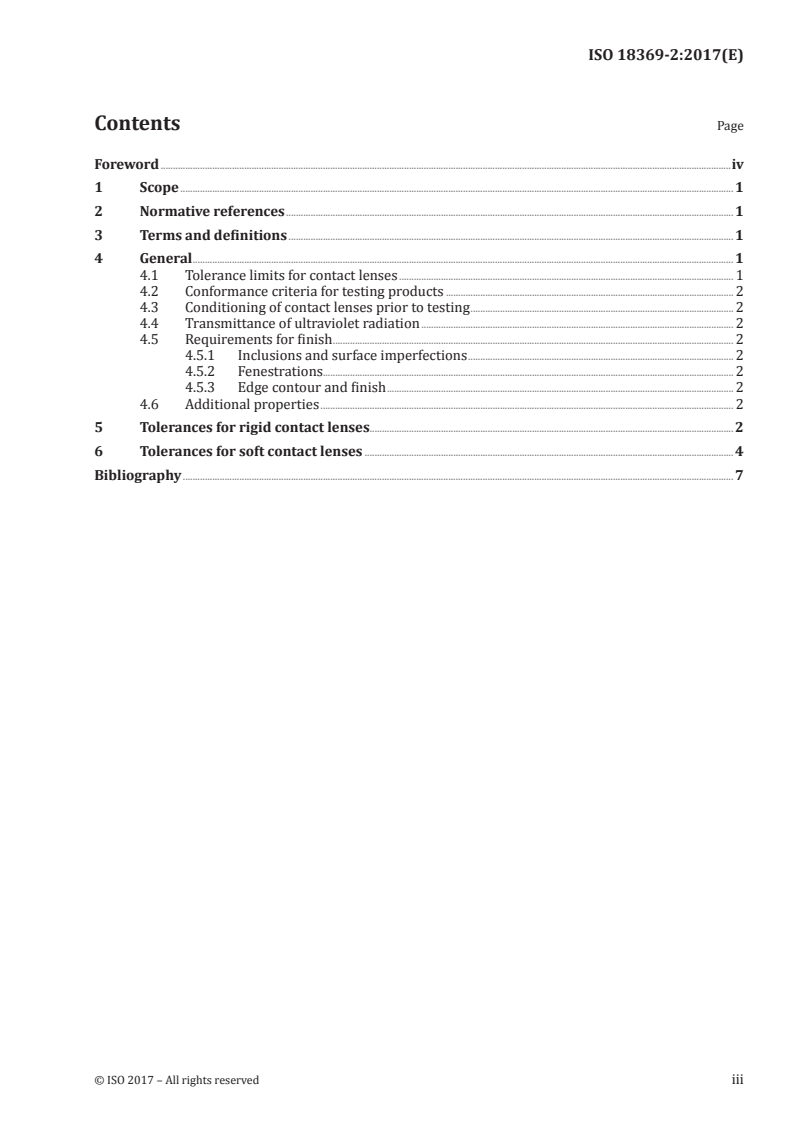
INTERNATIONAL ISO
STANDARD 18369-2
Third edition
2017-08
Ophthalmic optics — Contact lenses —
Part 2:
Tolerances
Optique ophtalmique — Lentilles de contact —
Partie 2: Tolérances
Reference number
©
ISO 2017
© ISO 2017, Published in Switzerland
All rights reserved. Unless otherwise specified, no part of this publication may be reproduced or utilized otherwise in any form
or by any means, electronic or mechanical, including photocopying, or posting on the internet or an intranet, without prior
written permission. Permission can be requested from either ISO at the address below or ISO’s member body in the country of
the requester.
ISO copyright office
Ch. de Blandonnet 8 • CP 401
CH-1214 Vernier, Geneva, Switzerland
Tel. +41 22 749 01 11
Fax +41 22 749 09 47
copyright@iso.org
www.iso.org
ii © ISO 2017 – All rights reserved
Contents Page
Foreword .iv
1 Scope . 1
2 Normative references . 1
3 Terms and definitions . 1
4 General . 1
4.1 Tolerance limits for contact lenses . 1
4.2 Conformance criteria for testing products . 2
4.3 Conditioning of contact lenses prior to testing . 2
4.4 Transmittance of ultraviolet radiation . 2
4.5 Requirements for finish . 2
4.5.1 Inclusions and surface imperfections . 2
4.5.2 Fenestrations. 2
4.5.3 Edge contour and finish . 2
4.6 Additional properties . 2
5 Tolerances for rigid contact lenses. 2
6 Tolerances for soft contact lenses . 4
Bibliography . 7
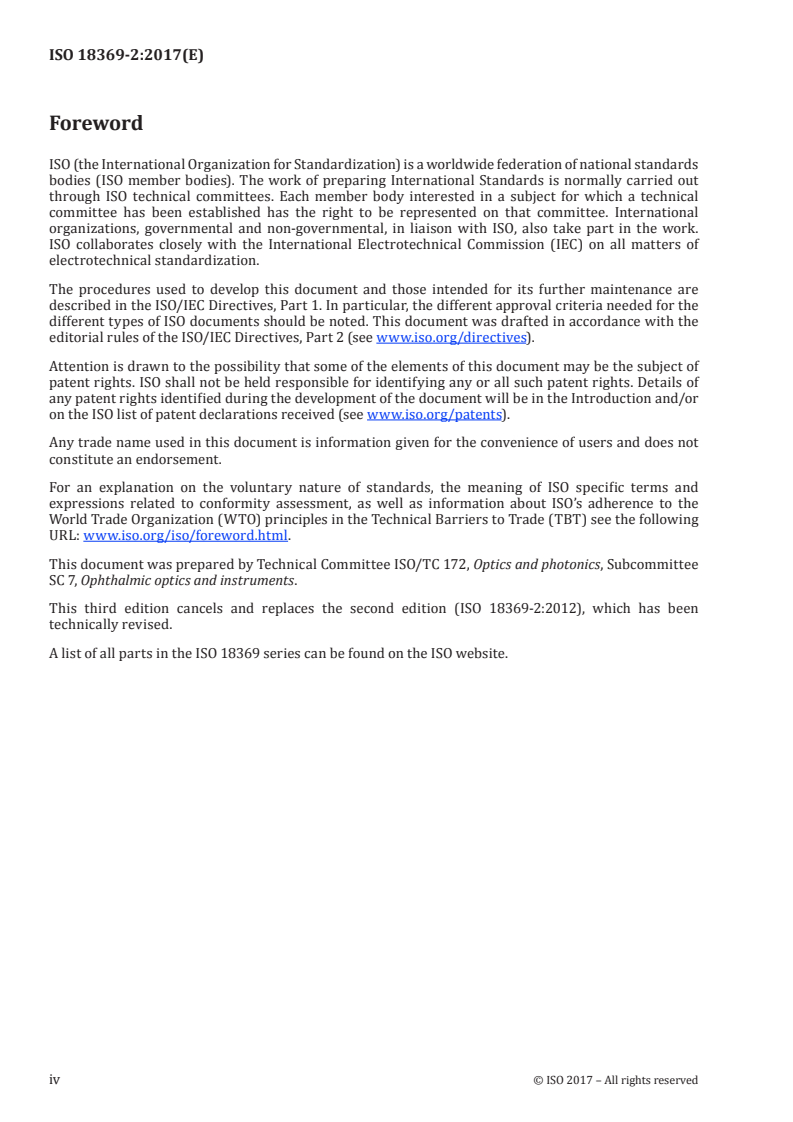
Foreword
ISO (the International Organization for Standardization) is a worldwide federation of national standards
bodies (ISO member bodies). The work of preparing International Standards is normally carried out
through ISO technical committees. Each member body interested in a subject for which a technical
committee has been established has the right to be represented on that committee. International
organizations, governmental and non-governmental, in liaison with ISO, also take part in the work.
ISO collaborates closely with the International Electrotechnical Commission (IEC) on all matters of
electrotechnical standardization.
The procedures used to develop this document and those intended for its further maintenance are
described in the ISO/IEC Directives, Part 1. In particular, the different approval criteria needed for the
different types of ISO documents should be noted. This document was drafted in accordance with the
editorial rules of the ISO/IEC Directives, Part 2 (see www .iso .org/ directives).
Attention is drawn to the possibility that some of the elements of this document may be the subject of
patent rights. ISO shall not be held responsible for identifying any or all such patent rights. Details of
any patent rights identified during the development of the document will be in the Introduction and/or
on the ISO list of patent declarations received (see www .iso .org/ patents).
Any trade name used in this document is information given for the convenience of users and does not
constitute an endorsement.
For an explanation on the voluntary nature of standards, the meaning of ISO specific terms and
expressions related to conformity assessment, as well as information about ISO’s adherence to the
World Trade Organization (WTO) principles in the Technical Barriers to Trade (TBT) see the following
URL: w w w . i s o .org/ iso/ foreword .html.
This document was prepared by Technical Committee ISO/TC 172, Optics and photonics, Subcommittee
SC 7, Ophthalmic optics and instruments.
This third edition cancels and replaces the second edition (ISO 18369-2:2012), which has been
technically revised.
A list of all parts in the ISO 18369 series can be found on the ISO website.
iv © ISO 2017 – All rights reserved
INTERNATIONAL STANDARD ISO 18369-2:2017(E)
Ophthalmic optics — Contact lenses —
Part 2:
Tolerances
1 Scope
This document specifies the tolerance limits of the principal optical and physical parameters of rigid
corneal, rigid scleral and soft contact lenses at the time of manufacture.
These tolerances might not apply to other purposes, for example, shelf-life studies.
2 Normative references
The following documents are referred to in the text in such a way that some or all of their content
constitutes requirements of this document. For dated references, only the edition cited applies. For
undated references, the latest edition of the referenced document (including any amendments) applies.
ISO 18369-1, Ophthalmic optics — Contact lenses — Part 1: Vocabulary, classification systems and
recommendations for labelling specifications
ISO 18369-3:2017, Ophthalmic optics — Contact lenses — Part 3: Measurement methods
ISO 18369-4:2017, Ophthalmic optics — Contact lenses — Part 4: Physicochemical properties of contact
lens materials
3 Terms and definitions
For the purposes of this document, the terms and definitions given in ISO 18369-1 apply.
ISO and IEC maintain terminological databases for use in standardization at the following addresses:
— IEC Electropedia: available at http:// www .electropedia .org/
— ISO Online browsing platform: available at http:// www .iso .org/ obp
4 General
4.1 Tolerance limits for contact lenses
When tested as described in ISO 18369-3, the dimensional and optical properties for contact lenses
shall be as specified within the appropriate tolerance limits given in Table 1, Table 2 and Table 3.
When tested as described in ISO 18369-4, the material properties for contact lenses shall be as specified,
within the appropriate tolerance limits given in Table 4.
4.2 Conformance criteria for testing products
There are three meaningful methods to determine the conformance of contact lens parameters to
specified tolerances:
a) 100 % inspection — a method to determine conformance to a specified value, including tolerances
based on evaluation of each item in the popu
...
INTERNATIONAL ISO
STANDARD 18369-2
Third edition
2017-08
Ophthalmic optics — Contact lenses —
Part 2:
Tolerances
Optique ophtalmique — Lentilles de contact —
Partie 2: Tolérances
Reference number
©
ISO 2017
© ISO 2017, Published in Switzerland
All rights reserved. Unless otherwise specified, no part of this publication may be reproduced or utilized otherwise in any form
or by any means, electronic or mechanical, including photocopying, or posting on the internet or an intranet, without prior
written permission. Permission can be requested from either ISO at the address below or ISO’s member body in the country of
the requester.
ISO copyright office
Ch. de Blandonnet 8 • CP 401
CH-1214 Vernier, Geneva, Switzerland
Tel. +41 22 749 01 11
Fax +41 22 749 09 47
copyright@iso.org
www.iso.org
ii © ISO 2017 – All rights reserved
Contents Page
Foreword .iv
1 Scope . 1
2 Normative references . 1
3 Terms and definitions . 1
4 General . 1
4.1 Tolerance limits for contact lenses . 1
4.2 Conformance criteria for testing products . 2
4.3 Conditioning of contact lenses prior to testing . 2
4.4 Transmittance of ultraviolet radiation . 2
4.5 Requirements for finish . 2
4.5.1 Inclusions and surface imperfections . 2
4.5.2 Fenestrations. 2
4.5.3 Edge contour and finish . 2
4.6 Additional properties . 2
5 Tolerances for rigid contact lenses. 2
6 Tolerances for soft contact lenses . 4
Bibliography . 7
Foreword
ISO (the International Organization for Standardization) is a worldwide federation of national standards
bodies (ISO member bodies). The work of preparing International Standards is normally carried out
through ISO technical committees. Each member body interested in a subject for which a technical
committee has been established has the right to be represented on that committee. International
organizations, governmental and non-governmental, in liaison with ISO, also take part in the work.
ISO collaborates closely with the International Electrotechnical Commission (IEC) on all matters of
electrotechnical standardization.
The procedures used to develop this document and those intended for its further maintenance are
described in the ISO/IEC Directives, Part 1. In particular, the different approval criteria needed for the
different types of ISO documents should be noted. This document was drafted in accordance with the
editorial rules of the ISO/IEC Directives, Part 2 (see www .iso .org/ directives).
Attention is drawn to the possibility that some of the elements of this document may be the subject of
patent rights. ISO shall not be held responsible for identifying any or all such patent rights. Details of
any patent rights identified during the development of the document will be in the Introduction and/or
on the ISO list of patent declarations received (see www .iso .org/ patents).
Any trade name used in this document is information given for the convenience of users and does not
constitute an endorsement.
For an explanation on the voluntary nature of standards, the meaning of ISO specific terms and
expressions related to conformity assessment, as well as information about ISO’s adherence to the
World Trade Organization (WTO) principles in the Technical Barriers to Trade (TBT) see the following
URL: w w w . i s o .org/ iso/ foreword .html.
This document was prepared by Technical Committee ISO/TC 172, Optics and photonics, Subcommittee
SC 7, Ophthalmic optics and instruments.
This third edition cancels and replaces the second edition (ISO 18369-2:2012), which has been
technically revised.
A list of all parts in the ISO 18369 series can be found on the ISO website.
iv © ISO 2017 – All rights reserved
INTERNATIONAL STANDARD ISO 18369-2:2017(E)
Ophthalmic optics — Contact lenses —
Part 2:
Tolerances
1 Scope
This document specifies the tolerance limits of the principal optical and physical parameters of rigid
corneal, rigid scleral and soft contact lenses at the time of manufacture.
These tolerances might not apply to other purposes, for example, shelf-life studies.
2 Normative references
The following documents are referred to in the text in such a way that some or all of their content
constitutes requirements of this document. For dated references, only the edition cited applies. For
undated references, the latest edition of the referenced document (including any amendments) applies.
ISO 18369-1, Ophthalmic optics — Contact lenses — Part 1: Vocabulary, classification systems and
recommendations for labelling specifications
ISO 18369-3:2017, Ophthalmic optics — Contact lenses — Part 3: Measurement methods
ISO 18369-4:2017, Ophthalmic optics — Contact lenses — Part 4: Physicochemical properties of contact
lens materials
3 Terms and definitions
For the purposes of this document, the terms and definitions given in ISO 18369-1 apply.
ISO and IEC maintain terminological databases for use in standardization at the following addresses:
— IEC Electropedia: available at http:// www .electropedia .org/
— ISO Online browsing platform: available at http:// www .iso .org/ obp
4 General
4.1 Tolerance limits for contact lenses
When tested as described in ISO 18369-3, the dimensional and optical properties for contact lenses
shall be as specified within the appropriate tolerance limits given in Table 1, Table 2 and Table 3.
When tested as described in ISO 18369-4, the material properties for contact lenses shall be as specified,
within the appropriate tolerance limits given in Table 4.
4.2 Conformance criteria for testing products
There are three meaningful methods to determine the conformance of contact lens parameters to
specified tolerances:
a) 100 % inspection — a method to determine conformance to a specified value, including tolerances
based on evaluation of each item in the popu
...
NORME ISO
INTERNATIONALE 18369-2
Troisième édition
2017-08
Optique ophtalmique — Lentilles de
contact —
Partie 2:
Tolérances
Ophthalmic optics — Contact lenses —
Part 2: Tolerances
Numéro de référence
©
ISO 2017
DOCUMENT PROTÉGÉ PAR COPYRIGHT
© ISO 2017, Publié en Suisse
Droits de reproduction réservés. Sauf indication contraire, aucune partie de cette publication ne peut être reproduite ni utilisée
sous quelque forme que ce soit et par aucun procédé, électronique ou mécanique, y compris la photocopie, l’affichage sur
l’internet ou sur un Intranet, sans autorisation écrite préalable. Les demandes d’autorisation peuvent être adressées à l’ISO à
l’adresse ci-après ou au comité membre de l’ISO dans le pays du demandeur.
ISO copyright office
Ch. de Blandonnet 8 • CP 401
CH-1214 Vernier, Geneva, Switzerland
Tel. +41 22 749 01 11
Fax +41 22 749 09 47
copyright@iso.org
www.iso.org
ii © ISO 2017 – Tous droits réservés
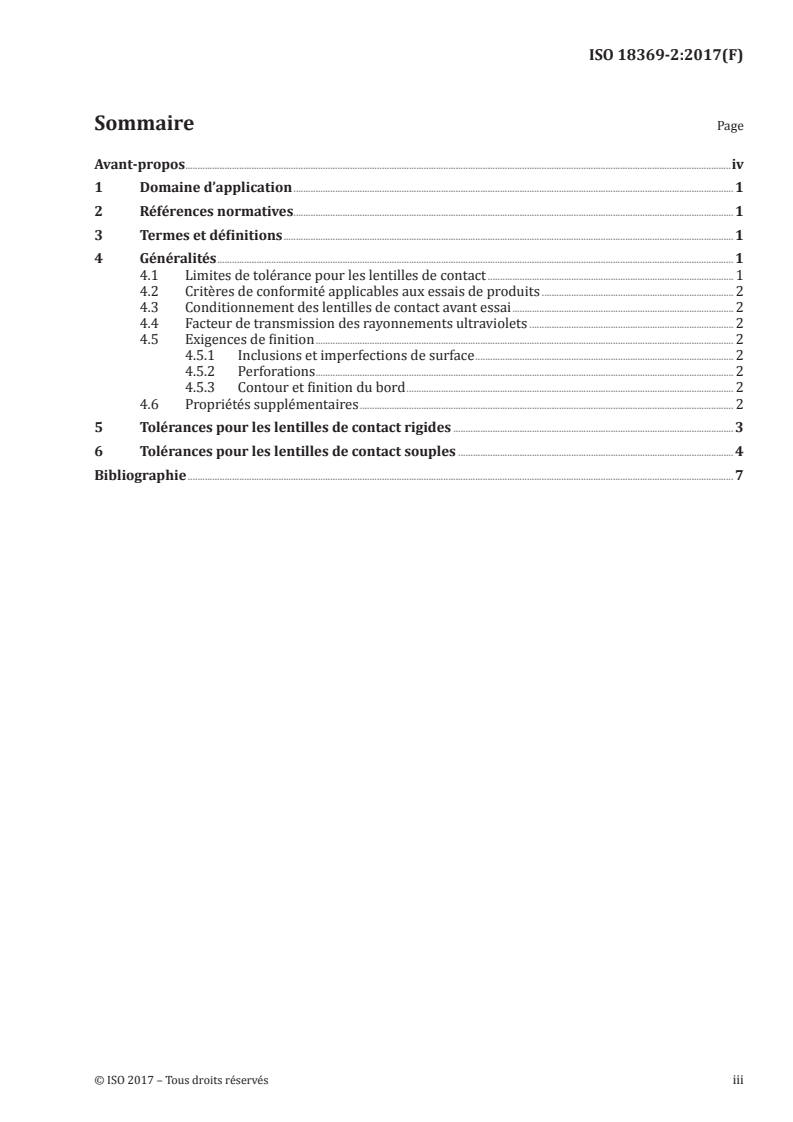
Sommaire Page
Avant-propos .iv
1 Domaine d’application . 1
2 Références normatives . 1
3 Termes et définitions . 1
4 Généralités . 1
4.1 Limites de tolérance pour les lentilles de contact . 1
4.2 Critères de conformité applicables aux essais de produits . 2
4.3 Conditionnement des lentilles de contact avant essai . 2
4.4 Facteur de transmission des rayonnements ultraviolets . 2
4.5 Exigences de finition . 2
4.5.1 Inclusions et imperfections de surface . 2
4.5.2 Perforations . 2
4.5.3 Contour et finition du bord . 2
4.6 Propriétés supplémentaires . 2
5 Tolérances pour les lentilles de contact rigides . 3
6 Tolérances pour les lentilles de contact souples . 4
Bibliographie . 7
Avant-propos
L’ISO (Organisation internationale de normalisation) est une fédération mondiale d’organismes
nationaux de normalisation (comités membres de l’ISO). L’élaboration des Normes internationales est
en général confiée aux comités techniques de l’ISO. Chaque comité membre intéressé par une étude
a le droit de faire partie du comité technique créé à cet effet. Les organisations internationales,
gouvernementales et non gouvernementales, en liaison avec l’ISO participent également aux travaux.
L’ISO collabore étroitement avec la Commission électrotechnique internationale (IEC) en ce qui
concerne la normalisation électrotechnique.
Les procédures utilisées pour élaborer le présent document et celles destinées à sa mise à jour sont
décrites dans les Directives ISO/IEC, Partie 1. Il convient, en particulier de prendre note des différents
critères d’approbation requis pour les différents types de documents ISO. Le présent document a été
rédigé conformément aux règles de rédaction données dans les Directives ISO/IEC, Partie 2 (voir www
.iso .org/ directives).
L’attention est appelée sur le fait que certains des éléments du présent document peuvent faire l’objet de
droits de propriété intellectuelle ou de droits analogues. L’ISO ne saurait être tenue pour responsable
de ne pas avoir identifié de tels droits de propriété et averti de leur existence. Les détails concernant
les références aux droits de propriété intellectuelle ou autres droits analogues identifiés lors de
l’élaboration du document sont indiqués dans l’Introduction et/ou dans la liste des déclarations de
brevets reçues par l’ISO (voir www .iso .org/ brevets).
Les appellations commerciales éventuellement mentionnées dans le présent document sont données
pour information, par souci de commodité, à l’intention des utilisateurs et ne sauraient constituer un
engagement.
Pour une explication de la nature volontaire des normes, la signification des termes et expressions
spécifiques de l’ISO liés à l’évaluation de la conformité, ou pour toute information au sujet de l’adhésion
de l’ISO aux principes de l’Organisation mondiale du commerce (OMC) concernant les obstacles
techniques au commerce (OTC), voir le lien suivant: w w w . i s o .org/ iso/ fr/ avant -propos .html
Le comité chargé de l’élaboration du présent document est l’ISO/TC 172, Optique et photonique, sous-
comité SC 7, Optique et instruments ophtalmiques.
Cette troisième édition annule et remplace la deuxième édition (ISO 18369-2:2012), qui a fait l’objet
d’une révision technique.
Une liste de toutes les parties de la série ISO 18369 se trouve sur le site web de l’ISO.
iv © ISO 2017 – Tous droits réservés
NORME INTERNATIONALE ISO 18369-2:2017(F)
Optique ophtalmique — Lentilles de contact —
Partie 2:
Tolérances
1 Domaine d’application
Le présent document spécifie les limites de tolérance des principaux paramètres optiques et physiques
des lentilles de contact cornéennes rigides, sclérales rigides et souples au moment de leur fabrication.
Ces tolérances peuvent ne pas s’appliquer à d’autres fins, par exemple, à des études de durée de
conservation.
2 Références normatives
Les documents suivants cités dans le texte constituent, pour tout ou partie de leur contenu, des
exigences du présent document. Pour les références datées, seule l’édition citée s’applique. Pour les
références non datées, la dernière édition du document de référence s’applique (y compris les éventuels
amendements).
ISO 18369-1, Optique ophtalmique — Lentilles de contact — Partie 1: Vocabulaire, système de classification
et recommandations pour l’étiquetage des spécifications
ISO 18369-3:2017, Optique ophtalmique — Lentilles de contact — Partie 3: Méthodes de mesure
ISO 18369-4:2017, Optique ophtalmique — Lentilles de contact — Partie 4: Propriétés physicochimiques
des matériaux des lentilles de contact
3 Termes et définitions
Pour les besoins du présent document, les termes et définitions donnés dans l’ISO 18369-1 s’appliquent.
L’ISO et l’IEC tiennent à jour des bases de données terminologiques destinées à être utilisées en
normalisation, consultables aux adresses suivantes:
— IEC Electropedia: disponible à l’adresse http:// www .electropedia .org/ .
— ISO Online browsing platform: disponible à l’adresse http:// www .iso .org/ obp.
4 Généralités
4.1 Limites de tolérance pour les lentilles de contact
Lorsqu’elles sont soumises à essai conformément à l’ISO 18369-3, les propriétés dimensionnelles et
optiques des lentilles de contact doivent être conformes aux limites de tolérance appropriées indiquées
dans les Tableaux 1, 2 et 3.
Lorsqu’elles sont soumises à essai conformément à l’ISO 18369-4, les propriétés des matériaux des
lentilles de contact doivent être conformes aux limites de tolérance appropriées indiquées dans le
Tableau 4.
4.2 Critères de conformité applicables aux essais de produits
Il existe trois méthodes significatives pour déterminer la conformité des paramètres des lentilles de
contact aux tolérances spécifiées:
a) inspection à 100 % – méthode permettant de déterminer la conformité à une valeur spécifiée, y
compris les tolérances, basée sur l’évaluation de chaque unité du groupe à évaluer;
b) échantillonnage pour acceptation – méthode attribuant un niveau de conformité spécifié à un
produit (par exemple, niveau de qualité acceptable et qualité limite);
c) évaluation statistique des performances – évaluation de processus où un échantillon représentatif
est déterminé et u
...
NORME ISO
INTERNATIONALE 18369-2
Troisième édition
2017-08
Optique ophtalmique — Lentilles de
contact —
Partie 2:
Tolérances
Ophthalmic optics — Contact lenses —
Part 2: Tolerances
Numéro de référence
©
ISO 2017
DOCUMENT PROTÉGÉ PAR COPYRIGHT
© ISO 2017, Publié en Suisse
Droits de reproduction réservés. Sauf indication contraire, aucune partie de cette publication ne peut être reproduite ni utilisée
sous quelque forme que ce soit et par aucun procédé, électronique ou mécanique, y compris la photocopie, l’affichage sur
l’internet ou sur un Intranet, sans autorisation écrite préalable. Les demandes d’autorisation peuvent être adressées à l’ISO à
l’adresse ci-après ou au comité membre de l’ISO dans le pays du demandeur.
ISO copyright office
Ch. de Blandonnet 8 • CP 401
CH-1214 Vernier, Geneva, Switzerland
Tel. +41 22 749 01 11
Fax +41 22 749 09 47
copyright@iso.org
www.iso.org
ii © ISO 2017 – Tous droits réservés
Sommaire Page
Avant-propos .iv
1 Domaine d’application . 1
2 Références normatives . 1
3 Termes et définitions . 1
4 Généralités . 1
4.1 Limites de tolérance pour les lentilles de contact . 1
4.2 Critères de conformité applicables aux essais de produits . 2
4.3 Conditionnement des lentilles de contact avant essai . 2
4.4 Facteur de transmission des rayonnements ultraviolets . 2
4.5 Exigences de finition . 2
4.5.1 Inclusions et imperfections de surface . 2
4.5.2 Perforations . 2
4.5.3 Contour et finition du bord . 2
4.6 Propriétés supplémentaires . 2
5 Tolérances pour les lentilles de contact rigides . 3
6 Tolérances pour les lentilles de contact souples . 4
Bibliographie . 7
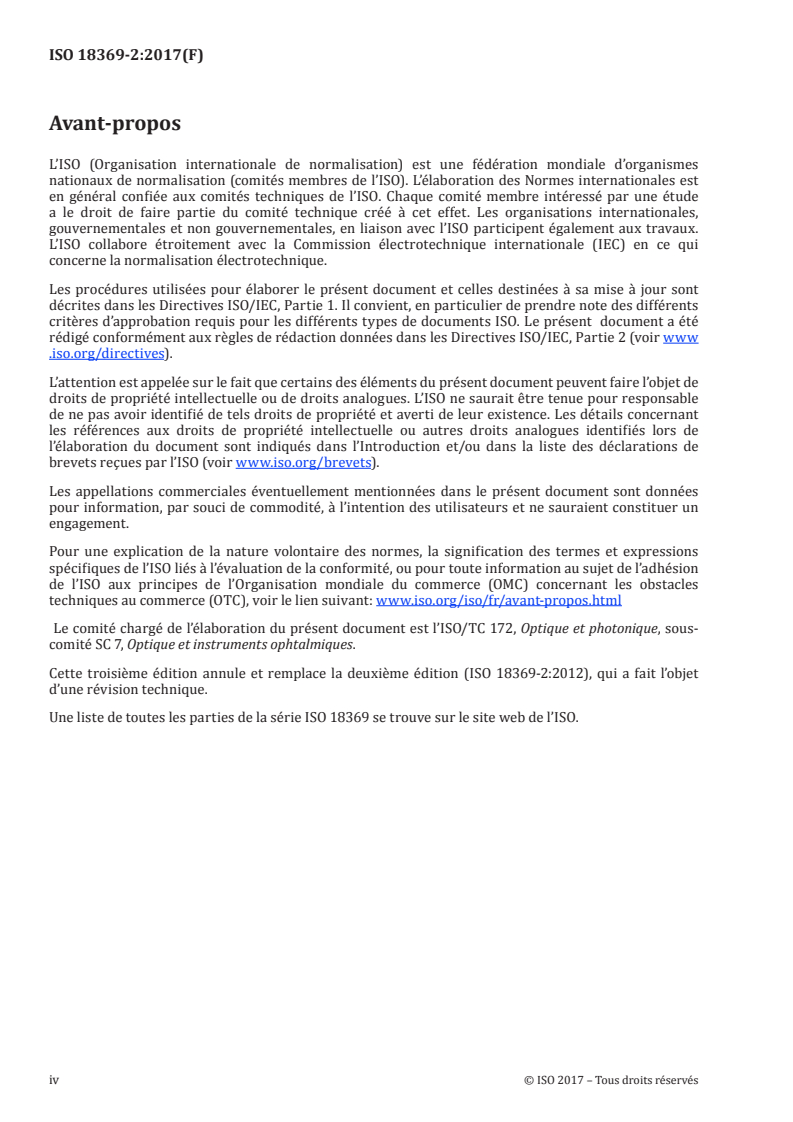
Avant-propos
L’ISO (Organisation internationale de normalisation) est une fédération mondiale d’organismes
nationaux de normalisation (comités membres de l’ISO). L’élaboration des Normes internationales est
en général confiée aux comités techniques de l’ISO. Chaque comité membre intéressé par une étude
a le droit de faire partie du comité technique créé à cet effet. Les organisations internationales,
gouvernementales et non gouvernementales, en liaison avec l’ISO participent également aux travaux.
L’ISO collabore étroitement avec la Commission électrotechnique internationale (IEC) en ce qui
concerne la normalisation électrotechnique.
Les procédures utilisées pour élaborer le présent document et celles destinées à sa mise à jour sont
décrites dans les Directives ISO/IEC, Partie 1. Il convient, en particulier de prendre note des différents
critères d’approbation requis pour les différents types de documents ISO. Le présent document a été
rédigé conformément aux règles de rédaction données dans les Directives ISO/IEC, Partie 2 (voir www
.iso .org/ directives).
L’attention est appelée sur le fait que certains des éléments du présent document peuvent faire l’objet de
droits de propriété intellectuelle ou de droits analogues. L’ISO ne saurait être tenue pour responsable
de ne pas avoir identifié de tels droits de propriété et averti de leur existence. Les détails concernant
les références aux droits de propriété intellectuelle ou autres droits analogues identifiés lors de
l’élaboration du document sont indiqués dans l’Introduction et/ou dans la liste des déclarations de
brevets reçues par l’ISO (voir www .iso .org/ brevets).
Les appellations commerciales éventuellement mentionnées dans le présent document sont données
pour information, par souci de commodité, à l’intention des utilisateurs et ne sauraient constituer un
engagement.
Pour une explication de la nature volontaire des normes, la signification des termes et expressions
spécifiques de l’ISO liés à l’évaluation de la conformité, ou pour toute information au sujet de l’adhésion
de l’ISO aux principes de l’Organisation mondiale du commerce (OMC) concernant les obstacles
techniques au commerce (OTC), voir le lien suivant: w w w . i s o .org/ iso/ fr/ avant -propos .html
Le comité chargé de l’élaboration du présent document est l’ISO/TC 172, Optique et photonique, sous-
comité SC 7, Optique et instruments ophtalmiques.
Cette troisième édition annule et remplace la deuxième édition (ISO 18369-2:2012), qui a fait l’objet
d’une révision technique.
Une liste de toutes les parties de la série ISO 18369 se trouve sur le site web de l’ISO.
iv © ISO 2017 – Tous droits réservés
NORME INTERNATIONALE ISO 18369-2:2017(F)
Optique ophtalmique — Lentilles de contact —
Partie 2:
Tolérances
1 Domaine d’application
Le présent document spécifie les limites de tolérance des principaux paramètres optiques et physiques
des lentilles de contact cornéennes rigides, sclérales rigides et souples au moment de leur fabrication.
Ces tolérances peuvent ne pas s’appliquer à d’autres fins, par exemple, à des études de durée de
conservation.
2 Références normatives
Les documents suivants cités dans le texte constituent, pour tout ou partie de leur contenu, des
exigences du présent document. Pour les références datées, seule l’édition citée s’applique. Pour les
références non datées, la dernière édition du document de référence s’applique (y compris les éventuels
amendements).
ISO 18369-1, Optique ophtalmique — Lentilles de contact — Partie 1: Vocabulaire, système de classification
et recommandations pour l’étiquetage des spécifications
ISO 18369-3:2017, Optique ophtalmique — Lentilles de contact — Partie 3: Méthodes de mesure
ISO 18369-4:2017, Optique ophtalmique — Lentilles de contact — Partie 4: Propriétés physicochimiques
des matériaux des lentilles de contact
3 Termes et définitions
Pour les besoins du présent document, les termes et définitions donnés dans l’ISO 18369-1 s’appliquent.
L’ISO et l’IEC tiennent à jour des bases de données terminologiques destinées à être utilisées en
normalisation, consultables aux adresses suivantes:
— IEC Electropedia: disponible à l’adresse http:// www .electropedia .org/ .
— ISO Online browsing platform: disponible à l’adresse http:// www .iso .org/ obp.
4 Généralités
4.1 Limites de tolérance pour les lentilles de contact
Lorsqu’elles sont soumises à essai conformément à l’ISO 18369-3, les propriétés dimensionnelles et
optiques des lentilles de contact doivent être conformes aux limites de tolérance appropriées indiquées
dans les Tableaux 1, 2 et 3.
Lorsqu’elles sont soumises à essai conformément à l’ISO 18369-4, les propriétés des matériaux des
lentilles de contact doivent être conformes aux limites de tolérance appropriées indiquées dans le
Tableau 4.
4.2 Critères de conformité applicables aux essais de produits
Il existe trois méthodes significatives pour déterminer la conformité des paramètres des lentilles de
contact aux tolérances spécifiées:
a) inspection à 100 % – méthode permettant de déterminer la conformité à une valeur spécifiée, y
compris les tolérances, basée sur l’évaluation de chaque unité du groupe à évaluer;
b) échantillonnage pour acceptation – méthode attribuant un niveau de conformité spécifié à un
produit (par exemple, niveau de qualité acceptable et qualité limite);
c) évaluation statistique des performances – évaluation de processus où un échantillon représentatif
est déterminé et u
...