

ISO 11979-4:2026
(Main)Ophthalmic implants — Intraocular lenses — Part 4: Labelling and information
General Information
- Abstract
This document specifies the labelling requirements for intraocular lenses (IOLs) and the information to be provided within or on the packaging. NOTE This document attempts to harmonize the recognized labelling requirements for IOLs throughout the world. However, there can be additional national requirements.
- Status
- Published
- Publication Date
- 17-Feb-2026
- Technical Committee
- ISO/TC 172/SC 7 - Ophthalmic optics and instruments
- Drafting Committee
- ISO/TC 172/SC 7 - Ophthalmic optics and instruments
- Current Stage
- 6060 - International Standard published
- Start Date
- 18-Feb-2026
- Due Date
- 11-Nov-2025
- Completion Date
- 18-Feb-2026
Buy Documents
ISO 11979-4:2026 - Ophthalmic implants — Intraocular lenses — Part 4: Labelling and information
ISO 11979-4:2026 - Implants ophtalmiques — Lentilles intraoculaires — Partie 4: Étiquetage et informations
Overview
ISO 11979-4:2026 sets the international standard for labelling and information requirements for intraocular lenses (IOLs), which are medical devices implanted to replace the natural lens of the eye. The document outlines the essential information that must appear on or within the packaging of IOLs, including labelling content, instructions for use, self-adhesive labels, and patient information materials. The goal is to harmonize labelling practices globally, while accommodating national variations.
This standard is vital for manufacturers of ophthalmic implants, healthcare providers, regulatory authorities, and supply chain partners concerned with device traceability, safety, and regulatory compliance in ophthalmology.
Key Topics
Labelling Requirements
- Mandatory information for primary and secondary packaging of IOLs
- Use of recognized symbols (per ISO 15223-1) to simplify and clarify packaging
Instructions for Use
- Minimum elements required, such as device description, technical and optical data, sterilization method, handling instructions, contraindications, adverse events, warnings, and clinical investigation summary (if available)
- Instructions may be provided electronically, subject to national regulations
Self-Adhesive Labels
- When supplied, must provide details including manufacturer, product model, batch/serial number, UDI code, and key device specifications such as dioptric power and dimensions
Patient Information Materials
- Patient information leaflets (PILs) and implant cards are required for effective communication and device traceability
- Leaflets must be written for patient comprehension, including use, warnings, and expected outcomes
- Implant cards enable traceability in cases of recall and post-implantation follow-up
Special Considerations for SVIOLs
- Simultaneous vision intraocular lenses have unique labelling needs, such as the inclusion of defocus curves and base/addition powers, reflecting ISO 11979-7 requirements
Applications
ISO 11979-4:2026 applies to stakeholders involved in the life cycle of intraocular lenses, from development and manufacture to clinical use:
Manufacturers
- Ensure labelling aligns with global regulatory expectations, improving market access
- Enhance patient safety through clear, standardized information on packaging and documentation
Healthcare Providers
- Access comprehensive and reliable IOL information for patient counseling, surgical planning, and post-operative care
- Utilize patient implant cards and leaflets for accurate record-keeping and patient education
Regulators and Auditors
- Reference a global benchmark for assessing compliance in labelling and documentation of ophthalmic implants
Patients
- Receive standardized, understandable information about implanted devices and aftercare
Digital documentation is increasingly accepted, as provided for under this standard, supporting modern supply chain and information management practices.
Related Standards
- ISO 11979-1: Vocabulary for ophthalmic implants and intraocular lenses
- ISO 11979-2: Optical properties and test methods for IOLs
- ISO 11979-3: Mechanical properties and test methods for IOLs
- ISO 11979-7: Clinical investigations of intraocular lenses for aphakia correction
- ISO 13485: Quality management systems for medical devices
- ISO 15223-1: Symbols to be used with medical device information supplied by the manufacturer
- ISO 20417: Information to be supplied by medical device manufacturers
ISO 11979-4:2026 is a critical reference for anyone working with intraocular lenses, ensuring harmonized, high-quality labelling practices that promote safety, traceability, and regulatory compliance in global ophthalmic care.
Relations
- Effective Date
- 12-Feb-2026
- Effective Date
- 26-Nov-2022
- Revises
ISO 11979-4:2008 - Ophthalmic implants — Intraocular lenses — Part 4: Labelling and information - Effective Date
- 26-Nov-2022
Buy Documents
ISO 11979-4:2026 - Ophthalmic implants — Intraocular lenses — Part 4: Labelling and information
ISO 11979-4:2026 - Implants ophtalmiques — Lentilles intraoculaires — Partie 4: Étiquetage et informations
Get Certified
Connect with accredited certification bodies for this standard

BSI Group
BSI (British Standards Institution) is the business standards company that helps organizations make excellence a habit.

TÜV Rheinland
TÜV Rheinland is a leading international provider of technical services.

TÜV SÜD
TÜV SÜD is a trusted partner of choice for safety, security and sustainability solutions.
Sponsored listings
Frequently Asked Questions
ISO 11979-4:2026 is a standard published by the International Organization for Standardization (ISO). Its full title is "Ophthalmic implants — Intraocular lenses — Part 4: Labelling and information". This standard covers: This document specifies the labelling requirements for intraocular lenses (IOLs) and the information to be provided within or on the packaging. NOTE This document attempts to harmonize the recognized labelling requirements for IOLs throughout the world. However, there can be additional national requirements.
This document specifies the labelling requirements for intraocular lenses (IOLs) and the information to be provided within or on the packaging. NOTE This document attempts to harmonize the recognized labelling requirements for IOLs throughout the world. However, there can be additional national requirements.
ISO 11979-4:2026 is classified under the following ICS (International Classification for Standards) categories: 11.040.70 - Ophthalmic equipment. The ICS classification helps identify the subject area and facilitates finding related standards.
ISO 11979-4:2026 has the following relationships with other standards: It is inter standard links to EN ISO 11979-4:2026, ISO 11979-4:2008/Amd 1:2012, ISO 11979-4:2008. Understanding these relationships helps ensure you are using the most current and applicable version of the standard.
ISO 11979-4:2026 is available in PDF format for immediate download after purchase. The document can be added to your cart and obtained through the secure checkout process. Digital delivery ensures instant access to the complete standard document.
Standards Content (Sample)
International
Standard
ISO 11979-4
Third edition
Ophthalmic implants — Intraocular
2026-02
lenses —
Part 4:
Labelling and information
Implants ophtalmiques — Lentilles intraoculaires —
Partie 4: Étiquetage et informations
Reference number
© ISO 2026
All rights reserved. Unless otherwise specified, or required in the context of its implementation, no part of this publication may
be reproduced or utilized otherwise in any form or by any means, electronic or mechanical, including photocopying, or posting on
the internet or an intranet, without prior written permission. Permission can be requested from either ISO at the address below
or ISO’s member body in the country of the requester.
ISO copyright office
CP 401 • Ch. de Blandonnet 8
CH-1214 Vernier, Geneva
Phone: +41 22 749 01 11
Email: copyright@iso.org
Website: www.iso.org
Published in Switzerland
ii
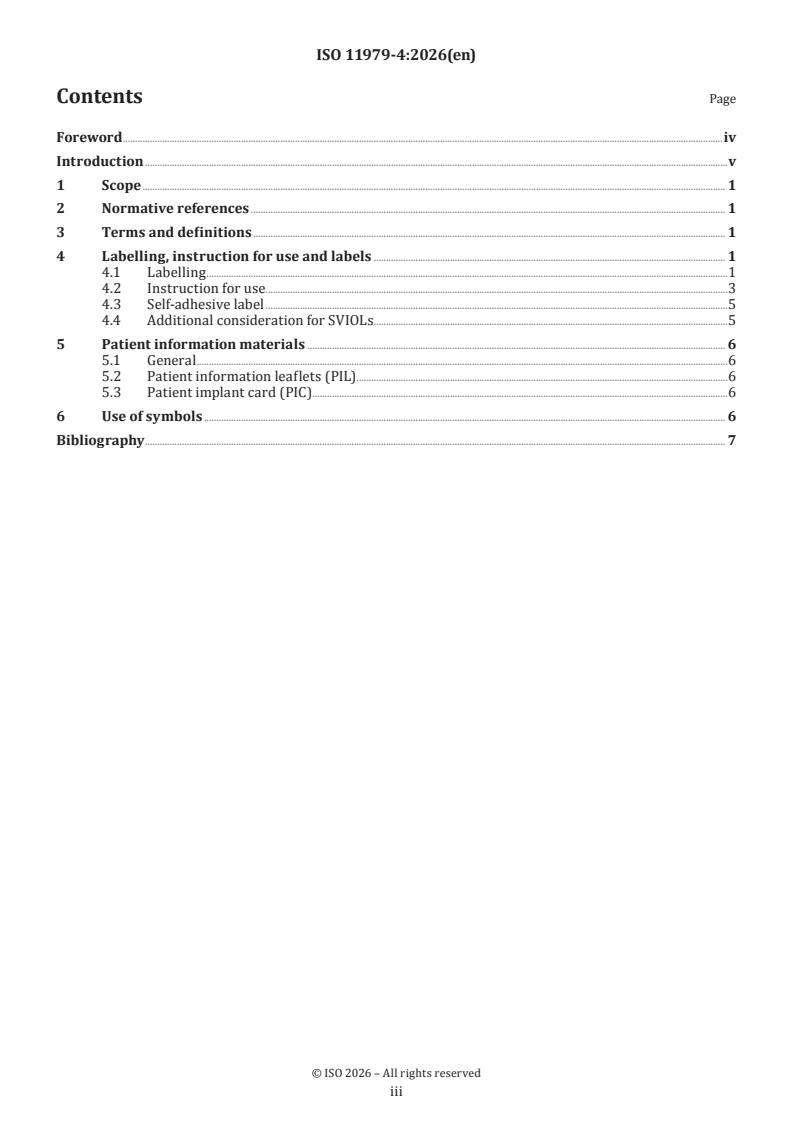
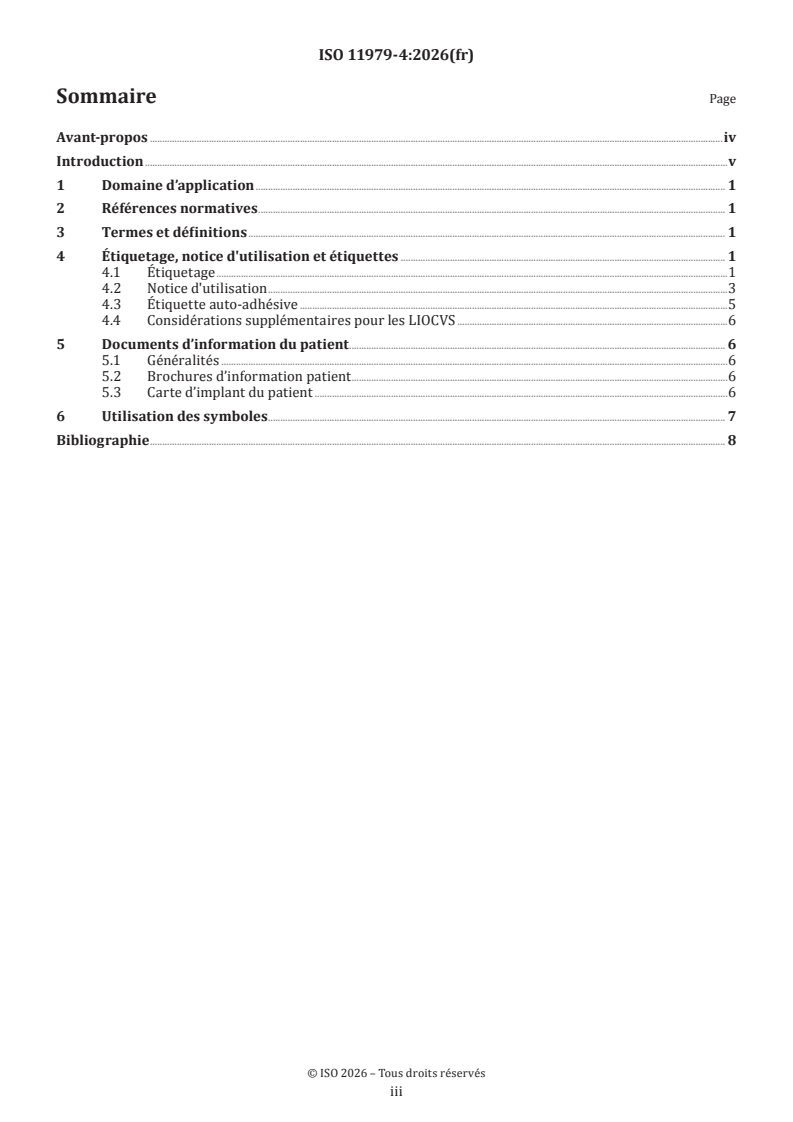
Contents Page
Foreword .iv
Introduction .v
1 Scope . 1
2 Normative references . 1
3 Terms and definitions . 1
4 Labelling, instruction for use and labels . 1
4.1 Labelling .1
4.2 Instruction for use . .3
4.3 Self-adhesive label .5
4.4 Additional consideration for SVIOLs .5
5 Patient information materials . 6
5.1 General .6
5.2 Patient information leaflets (PIL) . .6
5.3 Patient implant card (PIC) .6
6 Use of symbols . 6
Bibliography . 7
iii
Foreword
ISO (the International Organization for Standardization) is a worldwide federation of national standards
bodies (ISO member bodies). The work of preparing International Standards is normally carried out through
ISO technical committees. Each member body interested in a subject for which a technical committee
has been established has the right to be represented on that committee. International organizations,
governmental and non-governmental, in liaison with ISO, also take part in the work. ISO collaborates closely
with the International Electrotechnical Commission (IEC) on all matters of electrotechnical standardization.
The procedures used to develop this document and those intended for its further maintenance are described
in the ISO/IEC Directives, Part 1. In particular, the different approval criteria needed for the different types
of ISO documents should be noted. This document was drafted in accordance with the editorial rules of the
ISO/IEC Directives, Part 2 (see www.iso.org/directives).
ISO draws attention to the possibility that the implementation of this document may involve the use of (a)
patent(s). ISO takes no position concerning the evidence, validity or applicability of any claimed patent
rights in respect thereof. As of the date of publication of this document, ISO had not received notice of (a)
patent(s) which may be required to implement this document. However, implementers are cautioned that
this may not represent the latest information, which may be obtained from the patent database available at
www.iso.org/patents. ISO shall not be held responsible for identifying any or all such patent rights.
Any trade name used in this document is information given for the convenience of users and does not
constitute an endorsement.
For an explanation of the voluntary nature of standards, the meaning of ISO specific terms and expressions
related to conformity assessment, as well as information about ISO's adherence to the World Trade
Organization (WTO) principles in the Technical Barriers to Trade (TBT), see www.iso.org/iso/foreword.html.
This document was prepared by Technical Committee ISO/TC 172, Optics and photonics, Subcommittee
SC 7, Ophthalmic optics and instruments, in collaboration with the European Committee for Standardization
(CEN) Technical Committee CEN/TC 170, Ophthalmic optics, in accordance with the Agreement on technical
cooperation between ISO and CEN (Vienna Agreement).
This third edition cancels and replaces the second edition (ISO 11979-4:2008), which has been technically
revised. It also incorporates the Amendment ISO 11979-4:2008/Amd.1:2012.
The main changes are as follows:
— normative references have been updated and retired standards have been removed or replaced;
— Table 1 has been updated with additional information to be included in the packaging; e.g. expiration
date on primary package;
— new categories and clinical requirements for SVIOLs were published in ISO 11979-7. ISO 11979-4 is
updated to reflect these changes also in labelling;
— information can be provided electronically if national regulations allow.
A list of all parts in the ISO 11979 series can be found on the ISO website.
Any feedback or questions on this document should be directed to the user’s national standards body. A
complete listing of these bodies can be found at www.iso.org/members.html.
iv
Introduction
[5]
Labelling requirements for medical devices in general are given in ISO 20417 . However, in order to ensure
correct and necessary information to the ophthalmic surgeon, additional specific information is required
for intraocular lenses. Such information concerns technical and optical data as well as information about the
materials used.
v
International Standard ISO 11979-4:2026(en)
Ophthalmic implants — Intraocular lenses —
Part 4:
Labelling and information
1 Scope
This document specifies the labelling requirements for intraocular lenses (IOLs) and the information to be
provided within or on the packaging.
NOTE This document attempts to harmonize the recognized labelling requirements for IOLs throughout the
world. However, there can be additional national requirements.
2 Normative references
The following documents are referred to in the text in such a way that some or all of their content constitutes
requirements of this document. For dated references, only the edition cited applies. For undated references,
the latest edition of the referenced document (including any amendments) applies.
ISO 11979-1, Ophthalmic implants — Intraocular lenses — Part 1: Vocabulary
ISO 11979-7, Ophthalmic implants — Intraocular lenses — Part 7: Clinical investigations of intraocular lenses
for the correction of aphakia
3 Terms and definitions
For the purposes of this document, the terms and definitions given in ISO 11979-1 apply.
ISO and IEC maintain terminology databases for use in standardization at the following addresses:
— ISO Online browsing platform: available at https:// www .iso .org/ obp
— IEC Electropedia: available at https:// www .electropedia .org/
4 Labelling, instruction for use and labels
4.1 Labelling
Table 1 lists the minimal information that shall be included with the labelling of IOLs and the location on the
packaging where labelling shall be presented. It further lists information that shall be given in applicable
cases.
The information may be supplied electronically where regulations allow.
Table 1 — Information included with the packaging of IOLs
a
Primary package ,
Protective
Item Information additional wrap- Comments
packaging
ping(s), or both
Name or trade name of the The manufacturer's logotype may be
1 X X
b
manufacturer added.
For instance, the address identical to
Address of the manufacturer
[3]
2 X the approval certificate, ISO 13485
and country of manufacture
certificate.
Trade name, model designa-
3 X X
tion of the product, or both
Example for primary package: “IOL”
Example for protective packaging:
Details strictly necessary for
“contains one monofocal posterior
4 the user to identify the device X X
chamber IOL prel
...
Norme
internationale
ISO 11979-4
Troisième édition
Implants ophtalmiques — Lentilles
2026-02
intraoculaires —
Partie 4:
Étiquetage et informations
Ophthalmic implants — Intraocular lenses —
Part 4: Labelling and information
Numéro de référence
DOCUMENT PROTÉGÉ PAR COPYRIGHT
© ISO 2026
Tous droits réservés. Sauf prescription différente ou nécessité dans le contexte de sa mise en œuvre, aucune partie de cette
publication ne peut être reproduite ni utilisée sous quelque forme que ce soit et par aucun procédé, électronique ou mécanique,
y compris la photocopie, ou la diffusion sur l’internet ou sur un intranet, sans autorisation écrite préalable. Une autorisation peut
être demandée à l’ISO à l’adresse ci-après ou au comité membre de l’ISO dans le pays du demandeur.
ISO copyright office
Case postale 401 • Ch. de Blandonnet 8
CH-1214 Vernier, Genève
Tél.: +41 22 749 01 11
E-mail: copyright@iso.org
Web: www.iso.org
Publié en Suisse
ii
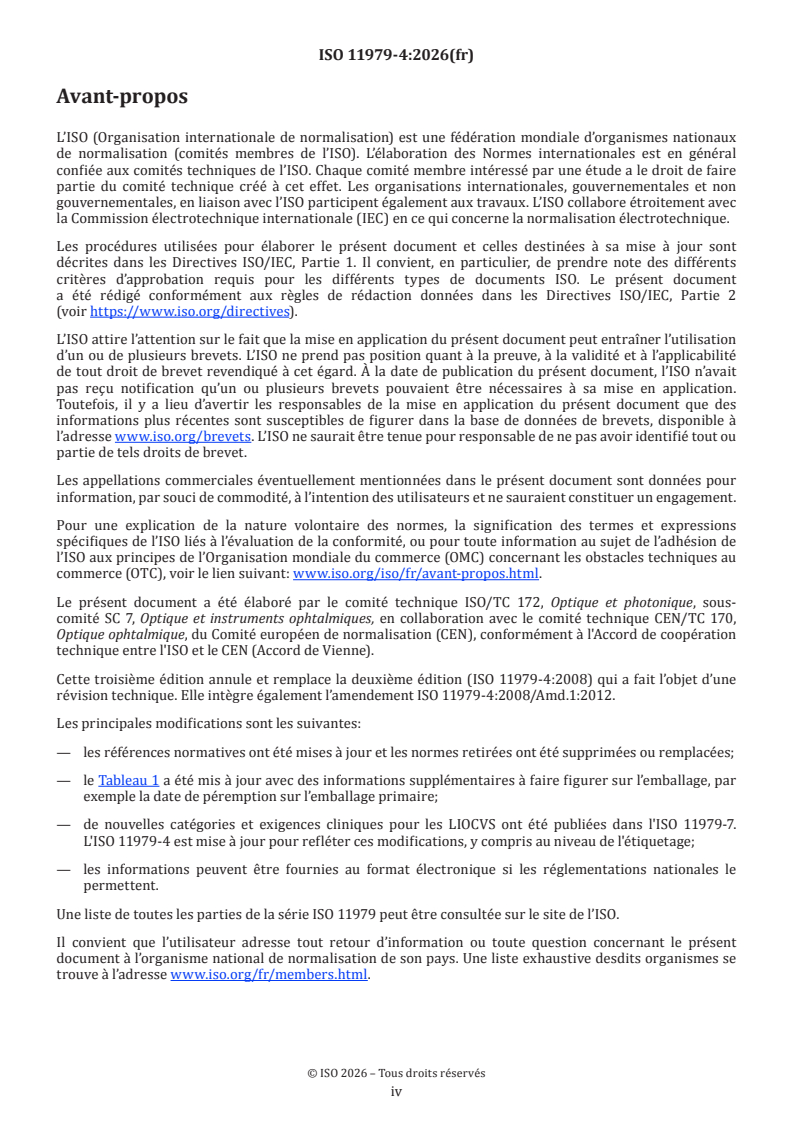
Sommaire Page
Avant-propos .iv
Introduction .v
1 Domaine d’application . 1
2 Références normatives . 1
3 Termes et définitions . 1
4 Étiquetage, notice d'utilisation et étiquettes . 1
4.1 Étiquetage .1
4.2 Notice d'utilisation .3
4.3 Étiquette auto-adhésive .5
4.4 Considérations supplémentaires pour les LIOCVS .6
5 Documents d’information du patient . 6
5.1 Généralités .6
5.2 Brochures d’information patient .6
5.3 Carte d’implant du patient .6
6 Utilisation des symboles . 7
Bibliographie . 8
iii
Avant-propos
L’ISO (Organisation internationale de normalisation) est une fédération mondiale d’organismes nationaux
de normalisation (comités membres de l’ISO). L’élaboration des Normes internationales est en général
confiée aux comités techniques de l’ISO. Chaque comité membre intéressé par une étude a le droit de faire
partie du comité technique créé à cet effet. Les organisations internationales, gouvernementales et non
gouvernementales, en liaison avec l’ISO participent également aux travaux. L’ISO collabore étroitement avec
la Commission électrotechnique internationale (IEC) en ce qui concerne la normalisation électrotechnique.
Les procédures utilisées pour élaborer le présent document et celles destinées à sa mise à jour sont
décrites dans les Directives ISO/IEC, Partie 1. Il convient, en particulier, de prendre note des différents
critères d’approbation requis pour les différents types de documents ISO. Le présent document
a été rédigé conformément aux règles de rédaction données dans les Directives ISO/IEC, Partie 2
(voir https://www.iso.org/directives).
L’ISO attire l’attention sur le fait que la mise en application du présent document peut entraîner l’utilisation
d’un ou de plusieurs brevets. L’ISO ne prend pas position quant à la preuve, à la validité et à l’applicabilité
de tout droit de brevet revendiqué à cet égard. À la date de publication du présent document, l’ISO n’avait
pas reçu notification qu’un ou plusieurs brevets pouvaient être nécessaires à sa mise en application.
Toutefois, il y a lieu d’avertir les responsables de la mise en application du présent document que des
informations plus récentes sont susceptibles de figurer dans la base de données de brevets, disponible à
l’adresse www.iso.org/brevets. L’ISO ne saurait être tenue pour responsable de ne pas avoir identifié tout ou
partie de tels droits de brevet.
Les appellations commerciales éventuellement mentionnées dans le présent document sont données pour
information, par souci de commodité, à l’intention des utilisateurs et ne sauraient constituer un engagement.
Pour une explication de la nature volontaire des normes, la signification des termes et expressions
spécifiques de l’ISO liés à l’évaluation de la conformité, ou pour toute information au sujet de l’adhésion de
l’ISO aux principes de l’Organisation mondiale du commerce (OMC) concernant les obstacles techniques au
commerce (OTC), voir le lien suivant: www.iso.org/iso/fr/avant-propos.html.
Le présent document a été élaboré par le comité technique ISO/TC 172, Optique et photonique, sous-
comité SC 7, Optique et instruments ophtalmiques, en collaboration avec le comité technique CEN/TC 170,
Optique ophtalmique, du Comité européen de normalisation (CEN), conformément à l'Accord de coopération
technique entre l'ISO et le CEN (Accord de Vienne).
Cette troisième édition annule et remplace la deuxième édition (ISO 11979-4:2008) qui a fait l’objet d’une
révision technique. Elle intègre également l’amendement ISO 11979-4:2008/Amd.1:2012.
Les principales modifications sont les suivantes:
— les références normatives ont été mises à jour et les normes retirées ont été supprimées ou remplacées;
— le Tableau 1 a été mis à jour avec des informations supplémentaires à faire figurer sur l’emballage, par
exemple la date de péremption sur l’emballage primaire;
— de nouvelles catégories et exigences cliniques pour les LIOCVS ont été publiées dans l'ISO 11979-7.
L'ISO 11979-4 est mise à jour pour refléter ces modifications, y compris au niveau de l'étiquetage;
— les informations peuvent être fournies au format électronique si les réglementations nationales le
permettent.
Une liste de toutes les parties de la série ISO 11979 peut être consultée sur le site de l’ISO.
Il convient que l’utilisateur adresse tout retour d’information ou toute question concernant le présent
document à l’organisme national de normalisation de son pays. Une liste exhaustive desdits organismes se
trouve à l’adresse www.iso.org/fr/members.html.
iv
Introduction
[5]
Les exigences relatives à l'étiquetage des dispositifs médicaux en général figurent dans l’ISO 20417 .
Cependant, afin de garantir que le chirurgien ophtalmique dispose d'informations correctes et suffisantes,
des informations supplémentaires spécifiques sont nécessaires pour les lentilles intraoculaires. Il s’agit de
données techniques et optiques ainsi que des données sur les matériaux utilisés.
v
Norme internationale ISO 11979-4:2026(fr)
Implants ophtalmiques — Lentilles intraoculaires —
Partie 4:
Étiquetage et informations
1 Domaine d’application
Le présent document spécifie les exigences relatives à l'étiquetage des lentilles intraoculaires (LIO) ainsi que
les informations à fournir dans leur emballage ou sur celui-ci.
NOTE Le présent document vise à harmoniser les exigences d'étiquetage reconnues pour les LIO sur le plan
mondial. Cependant, des exigences nationales complémentaires peuvent exister.
2 Références normatives
Les documents suivants sont cités dans le texte de sorte qu’ils constituent, pour tout ou partie de leur
contenu, des exigences du présent document. Pour les références datées, seule l’édition citée s’applique. Pour
les références non datées, la dernière édition du document de référence s'applique (y compris les éventuels
amendements).
ISO 11979-1, Implants ophtalmiques — Lentilles intraoculaires — Partie 1: Vocabulaire
ISO 11979-7, Implants ophtalmiques — Lentilles intraoculaires — Partie 7: Investigations cliniques de lentilles
intraoculaires pour la correction de l'aphakie
3 Termes et définitions
Pour les besoins du présent document, les termes et définitions de l’ISO 11979-1 s’appliquent.
L’ISO et l’IEC tiennent à jour des bases de données terminologiques destinées à être utilisées en normalisation,
consultables aux adresses suivantes:
— ISO Online browsing platform: disponible à l’adresse https:// www .iso .org/ obp
— IEC Electropedia: disponible à l'adresse https:// www .electropedia .org/
4 Étiquetage, notice d'utilisation et étiquettes
4.1 Étiquetage
Le Tableau 1 présente la liste minimale d'informations devant accompagner l'étiquetage des LIO ainsi que
l'endroit où ces informations doivent apparaître sur l'emballage. Il indique également les informations qui
doivent être fournies dans des cas donnés.
Les informations peuvent être fournies au format électronique si la réglementation le permet.
Tableau 1 — Informations incluses avec l'emballage des LIO
Emballage primai-
Emballage
a
re , emballage(s)
Point Informations de protec- Commentaires
complémentaire(s),
tion
ou les deux
Nom ou appellation commer-
1 X X Le logo du fabricant peut être ajouté.
b
ciale du fabricant
Par exemple, la même adresse que sur
Adresse du fabricant et pays
2 X le certificat d'approbation, le certifi-
de fabrication
[3]
cat ISO 13485
Appellation commerciale,
3 désignation du modèle du X X
produit ou les deux
Exemple pour l'emballage primaire:
«LIO»
Détails strictement néces-
Exemple pour l'emballage de protec-
saires pour permettre à l’utili-
4 X X tion: «contient une LIO monofocale
sateur d’identifier le dispositif
de chambre postérieure préchargée
et le contenu de l’emballage
dans un injecteur à usage unique.»
Des symboles peuvent être utilisés.
Code de lot ou numéro de
5 X X Des symboles peuvent être utilisés.
série
6 Mention «STÉRILE» X X Des symboles peuvent être utilisés.
Identification de la couche
d’emballage stérile si le sys-
7 X Des symboles peuvent être utilisés.
tème d’emballage comporte
plusieurs couches d’emballage
8 Méthode de stérilisation X Des symboles peuvent être utilisés.
9 Mention «Ne pas restériliser». X Des symboles peuvent être utilisés.
La mention «Ne pas utiliser si
l'emballage est endommagé et
10 X Des symboles peuvent être utilisés.
consulter la notice d'utilisa-
tion».
11 Mention «À usage unique». X Des symboles peuvent être utilisés.
Date de péremption (année,
12 mois et jour; X X Des symboles peuvent être utilisés.
format: AAAA MM-JJ)
Date de fabrication (année,
13 mois et jour; X X Des symboles peuven
...