

ISO 20743:2021
(Main)Textiles — Determination of antibacterial activity of textile products
General Information
- Abstract
This document specifies quantitative test methods to determine the antibacterial activity of all antibacterial textile products including nonwovens. This document is applicable to all textile products, including cloth, wadding, thread and material for clothing, bedclothes, home furnishings and miscellaneous goods, regardless of the type of antibacterial agent used (organic, inorganic, natural or man-made) or the method of application (built-in, after-treatment or grafting). This document covers three inoculation methods for the determination of antibacterial activity: a) absorption method (an evaluation method in which the test bacterial suspension is inoculated directly onto specimens); b) transfer method (an evaluation method in which test bacteria are placed on an agar plate and transferred onto specimens); c) printing method (an evaluation method in which test bacteria are placed on a filter and printed onto specimens). NOTE Based on the intended application and on the environment in which the textile product is to be used, and also on the surface properties of the textile properties, the user can select the most suitable inoculation method. This document also specifies the colony plate count method and the adenosine triphosphate (ATP) luminescence method for measuring the enumeration of bacteria.
- Status
- Published
- Publication Date
- 07-Jun-2021
- Technical Committee
- ISO/TC 38 - Textiles
- Drafting Committee
- ISO/TC 38/WG 23 - Biological properties of textiles
- Current Stage
- 9060 - Close of review
- Completion Date
- 02-Dec-2031
Buy Documents


ISO 20743:2021 - Textiles -- Determination of antibacterial activity of textile products
ISO 20743:2021 - Textiles — Determination of antibacterial activity of textile products/8/2021



ISO 20743:2021 - Textiles -- Détermination de l'activité antibactérienne des produits textiles
ISO 20743:2021 - Textiles — Détermination de l'activité antibactérienne des produits textiles/8/2021
Overview - ISO 20743:2021 (Textiles - Determination of antibacterial activity of textile products)
ISO 20743:2021 defines quantitative test methods for determining the antibacterial activity of textile products and nonwovens. The standard applies to all textile forms - cloth, wadding, thread and materials for clothing, bedclothes, home furnishings and miscellaneous goods - regardless of the type of antibacterial agent (organic, inorganic, natural or man-made) or application method (built-in, after‑treatment or grafting). It provides laboratory procedures and measurement options so manufacturers, testing laboratories and regulators can generate objective, comparable data on antibacterial performance.
Key topics and technical requirements
- Scope and applicability: Covers all antibacterial textile products and common product forms.
- Three inoculation methods:
- Absorption method - inoculum applied directly onto specimens.
- Transfer method - bacteria placed on agar and transferred onto specimens.
- Printing method - bacteria applied via a filter and “printed” onto specimens.
Users select the most suitable method based on intended use, environment and surface properties.
- Quantitative enumeration methods:
- Colony plate count (plate count) method - CFU-based enumeration (Annex C).
- Adenosine triphosphate (ATP) luminescence method - rapid ATP-based measurement (Annex D).
- Supporting content: Procedures for strain handling and storage (Clause 7, Annex A), safety precautions, required apparatus, reagents and media, and example test workflows (Annex E).
- Judgement and reporting: Guidelines for evaluating antibacterial efficacy and preparing test reports (Clauses 9–10).
Practical applications and who uses it
ISO 20743:2021 is used by:
- Textile manufacturers and finishers to validate and optimize antibacterial treatments during R&D and production.
- Independent testing laboratories for performance verification and certification testing.
- Quality assurance and procurement teams to compare product claims and ensure batch consistency.
- Regulatory bodies and spec writers looking for reproducible, standardized test evidence for market surveillance or procurement specifications.
Benefits include producing reproducible, comparable quantitative data for product development, marketing claims, regulatory compliance and quality control.
Related standards
- ISO 20645 - Qualitative method for antibacterial activity (historical/complimentary reference).
- ISO 6330 - Domestic washing and drying procedures referenced for sample conditioning and laundering effects.
Keywords: ISO 20743:2021, antibacterial activity, textiles, antibacterial test methods, absorption method, transfer method, printing method, colony plate count, ATP luminescence, textile testing.
Relations
- Consolidates
EN ISO 20743:2021 - Textiles - Determination of antibacterial activity of textile products (ISO 20743:2021) - Effective Date
- 12-Feb-2026
- Effective Date
- 06-Jun-2022
- Effective Date
- 23-Apr-2020
Buy Documents
ISO 20743:2021 - Textiles -- Determination of antibacterial activity of textile products
ISO 20743:2021 - Textiles — Determination of antibacterial activity of textile products/8/2021
ISO 20743:2021 - Textiles -- Détermination de l'activité antibactérienne des produits textiles
ISO 20743:2021 - Textiles — Détermination de l'activité antibactérienne des produits textiles/8/2021
Get Certified
Connect with accredited certification bodies for this standard

Control Union Certifications
Global certification for agriculture and sustainability.

Hohenstein Institut
Textile testing and certification.

Bureau Veritas Bangladesh
Bureau Veritas certification services in Bangladesh.
Sponsored listings
Frequently Asked Questions
ISO 20743:2021 is a standard published by the International Organization for Standardization (ISO). Its full title is "Textiles — Determination of antibacterial activity of textile products". This standard covers: This document specifies quantitative test methods to determine the antibacterial activity of all antibacterial textile products including nonwovens. This document is applicable to all textile products, including cloth, wadding, thread and material for clothing, bedclothes, home furnishings and miscellaneous goods, regardless of the type of antibacterial agent used (organic, inorganic, natural or man-made) or the method of application (built-in, after-treatment or grafting). This document covers three inoculation methods for the determination of antibacterial activity: a) absorption method (an evaluation method in which the test bacterial suspension is inoculated directly onto specimens); b) transfer method (an evaluation method in which test bacteria are placed on an agar plate and transferred onto specimens); c) printing method (an evaluation method in which test bacteria are placed on a filter and printed onto specimens). NOTE Based on the intended application and on the environment in which the textile product is to be used, and also on the surface properties of the textile properties, the user can select the most suitable inoculation method. This document also specifies the colony plate count method and the adenosine triphosphate (ATP) luminescence method for measuring the enumeration of bacteria.
This document specifies quantitative test methods to determine the antibacterial activity of all antibacterial textile products including nonwovens. This document is applicable to all textile products, including cloth, wadding, thread and material for clothing, bedclothes, home furnishings and miscellaneous goods, regardless of the type of antibacterial agent used (organic, inorganic, natural or man-made) or the method of application (built-in, after-treatment or grafting). This document covers three inoculation methods for the determination of antibacterial activity: a) absorption method (an evaluation method in which the test bacterial suspension is inoculated directly onto specimens); b) transfer method (an evaluation method in which test bacteria are placed on an agar plate and transferred onto specimens); c) printing method (an evaluation method in which test bacteria are placed on a filter and printed onto specimens). NOTE Based on the intended application and on the environment in which the textile product is to be used, and also on the surface properties of the textile properties, the user can select the most suitable inoculation method. This document also specifies the colony plate count method and the adenosine triphosphate (ATP) luminescence method for measuring the enumeration of bacteria.
ISO 20743:2021 is classified under the following ICS (International Classification for Standards) categories: 07.100.99 - Other standards related to microbiology; 59.080.01 - Textiles in general. The ICS classification helps identify the subject area and facilitates finding related standards.
ISO 20743:2021 has the following relationships with other standards: It is inter standard links to EN ISO 20743:2021, ISO 15653:2018, ISO 20743:2013. Understanding these relationships helps ensure you are using the most current and applicable version of the standard.
ISO 20743:2021 is available in PDF format for immediate download after purchase. The document can be added to your cart and obtained through the secure checkout process. Digital delivery ensures instant access to the complete standard document.
Standards Content (Sample)
INTERNATIONAL ISO
STANDARD 20743
Third edition
2021-06
Textiles — Determination of
antibacterial activity of textile
products
Textiles — Détermination de l'activité antibactérienne des produits
textiles
Reference number
©
ISO 2021
© ISO 2021
All rights reserved. Unless otherwise specified, or required in the context of its implementation, no part of this publication may
be reproduced or utilized otherwise in any form or by any means, electronic or mechanical, including photocopying, or posting
on the internet or an intranet, without prior written permission. Permission can be requested from either ISO at the address
below or ISO’s member body in the country of the requester.
ISO copyright office
CP 401 • Ch. de Blandonnet 8
CH-1214 Vernier, Geneva
Phone: +41 22 749 01 11
Email: copyright@iso.org
Website: www.iso.org
Published in Switzerland
ii © ISO 2021 – All rights reserved
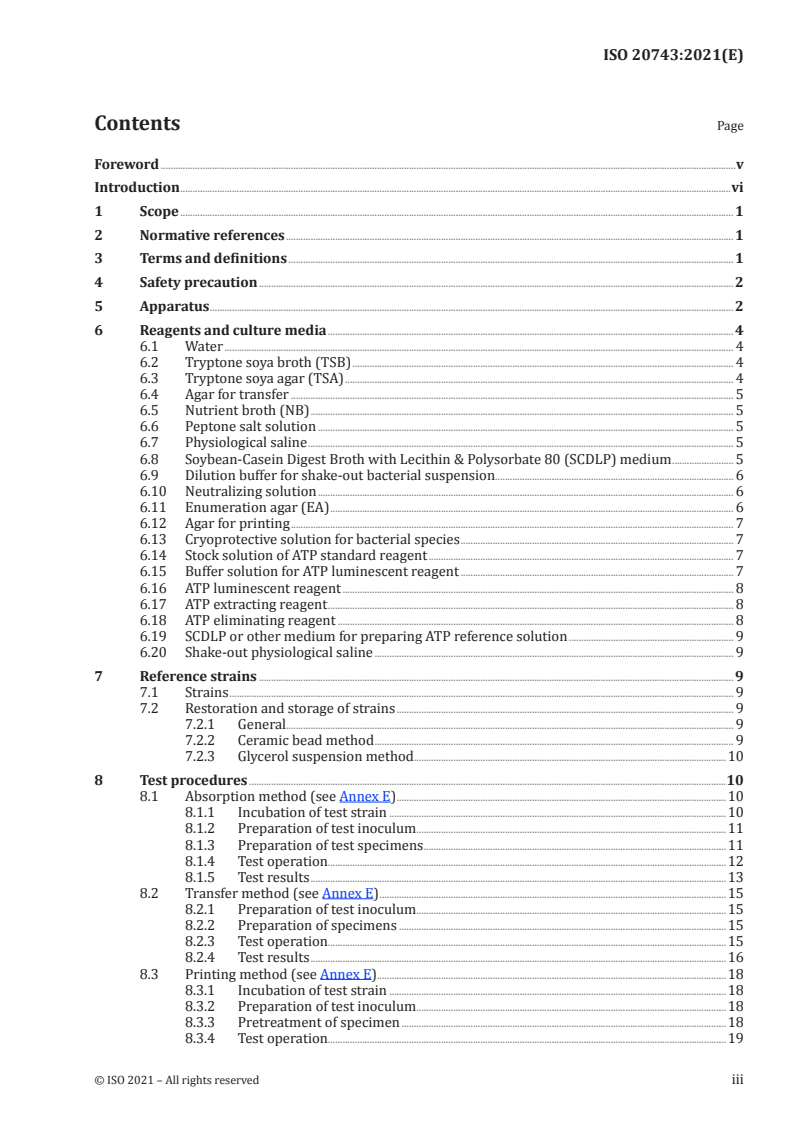
Contents Page
Foreword .v
Introduction .vi
1 Scope . 1
2 Normative references . 1
3 Terms and definitions . 1
4 Safety precaution . 2
5 Apparatus . 2
6 Reagents and culture media . 4
6.1 Water . 4
6.2 Tryptone soya broth (TSB) . 4
6.3 Tryptone soya agar (TSA) . 4
6.4 Agar for transfer . 5
6.5 Nutrient broth (NB) . 5
6.6 Peptone salt solution . 5
6.7 Physiological saline . 5
6.8 Soybean-Casein Digest Broth with Lecithin & Polysorbate 80 (SCDLP) medium . 5
6.9 Dilution buffer for shake-out bacterial suspension. 6
6.10 Neutralizing solution . 6
6.11 Enumeration agar (EA) . 6
6.12 Agar for printing . 7
6.13 Cryoprotective solution for bacterial species . 7
6.14 Stock solution of ATP standard reagent . 7
6.15 Buffer solution for ATP luminescent reagent . 7
6.16 ATP luminescent reagent . 8
6.17 ATP extracting reagent . 8
6.18 ATP eliminating reagent . 8
6.19 SCDLP or other medium for preparing ATP reference solution . 9
6.20 Shake-out physiological saline . 9
7 Reference strains . 9
7.1 Strains . 9
7.2 Restoration and storage of strains . 9
7.2.1 General. 9
7.2.2 Ceramic bead method . 9
7.2.3 Glycerol suspension method.10
8 Test procedures .10
8.1 Absorption method (see Annex E) .10
8.1.1 Incubation of test strain .10
8.1.2 Preparation of test inoculum .11
8.1.3 Preparation of test specimens .11
8.1.4 Test operation.12
8.1.5 Test results .13
8.2 Transfer method (see Annex E) .15
8.2.1 Preparation of test inoculum .15
8.2.2 Preparation of specimens .15
8.2.3 Test operation.15
8.2.4 Test results .16
8.3 Printing method (see Annex E) .18
8.3.1 Incubation of test strain .18
8.3.2 Preparation of test inoculum .18
8.3.3 Pretreatment of specimen .18
8.3.4 Test operation.19
8.3.5 Test results .21
9 Judgement of antibacterial efficacy .22
10 Test report .22
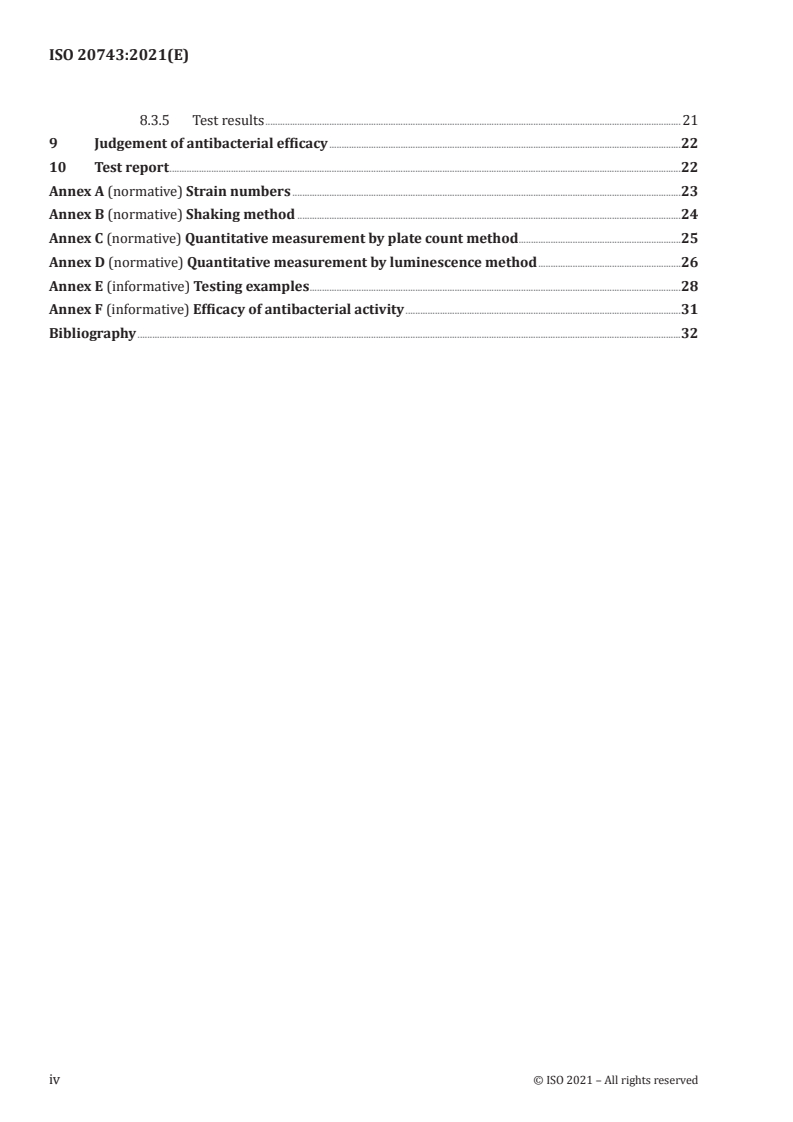
Annex A (normative) Strain numbers .23
Annex B (normative) Shaking method .24
Annex C (normative) Quantitative measurement by plate count method .25
Annex D (normative) Quantitative measurement by luminescence method .26
Annex E (informative) Testing examples .28
Annex F (informative) Efficacy of antibacterial activity .31
Bibliography .32
iv © ISO 2021 – All rights reserved
Foreword
ISO (the International Organization for Standardization) is a worldwide federation of national standards
bodies (ISO member bodies). The work of preparing International Standards is normally carried out
through ISO technical committees. Each member body interested in a subject for which a technical
committee has been established has the right to be represented on that committee. International
organizations, governmental and non-governmental, in liaison with ISO, also take part in the work.
ISO collaborates closely with the International Electrotechnical Commission (IEC) on all matters of
electrotechnical standardization.
The procedures used to develop this document and those intended for its further maintenance are
described in the ISO/IEC Directives, Part 1. In particular, the different approval criteria needed for the
different types of ISO documents should be noted. This document was drafted in accordance with the
editorial rules of the ISO/IEC Directives, Part 2 (see www .iso .org/ directives).
Attention is drawn to the possibility that some of the elements of this document may be the subject of
patent rights. ISO shall not be held responsible for identifying any or all such patent rights. Details of
any patent rights identified during the development of the document will be in the Introduction and/or
on the ISO list of patent declarations received (see www .iso .org/ patents).
Any trade name used in this document is information given for the convenience of users and does not
constitute an endorsement.
For an explanation of the voluntary nature of standards, the meaning of ISO specific terms and
expressions related to conformity assessment, as well as information about ISO's adherence to the
World Trade Organization (WTO) principles in the Technical Barriers to Trade (TBT), see www .iso .org/
iso/ foreword .html.
This document was prepared by Technical Committee ISO/TC 38, Textiles, in collaboration with the
European Committee for Standardization (CEN) Technical Committee CEN/TC 248, Textiles and textile
products, in accordance with the Agreement on technical cooperation between ISO and CEN (Vienna
Agreement).
This third edition cancels and replaces the second edition (ISO 20743:2013), which has been technically
revised.
The main changes compared to the previous edition are as follows:
— Clause 2 has been updated;
— some NOTEs have been changed to regular text;
— Annex F has been updated.
Any feedback or questions on this document should be directed to the user’s national standards body. A
complete listing of these bodies can be found at www .iso .org/ members .html.
Introduction
Specialty products of antibacterial-treated textiles have been introduced in the market and are
expanding year by year in various applications. These textiles meet the consumer's requirement to seek
prevention of, and protection from, the negative effects caused by bacteria, which in turn secures the
quality of life.
This established a substantial need for an International Standard which covers test methods to
determine the antibacterial activity for antibacterial textile products.
A qualitative test method for antibacterial activity was developed as ISO 20645. At the time, there
were no testing standards for the quantitative method which gives more objective information for the
antibacterial activity of the textile products.
Although there are 6 ways for the combination of inoculation methods and quantitative measurements
to execute this test, the choice of the ways depends on the user's availability and consensus between
the concerned parties.
vi © ISO 2021 – All rights reserved
INTERNATIONAL STANDARD ISO 20743:2021(E)
Textiles — Determination of antibacterial activity of textile
products
1 Scope
This document specifies quantitative test methods to determine the antibacterial activity of all
antibacterial textile products including nonwovens.
This document is applicable to all textile products, including cloth, wadding, thread and material for
clothing, bedclothes, home furnishings and miscellaneous goods, regardless of the type of antibacterial
agent used (organic, inorganic, natural or man-made) or the method of application (built-in, after-
treatment or grafting).
This document covers three inoculation methods for the determination of antibacterial activity:
a) absorption method (an evaluation method in which the test bacterial suspension is inoculated
directly onto specimens);
b) transfer method (an evaluation method in which test bacteria are placed on an agar plate and
transferred onto specimens);
c) printing method (an evaluation method in which test bacteria are placed on a filter and printed
onto specimens).
NOTE Based on the intended application and on the environment in which the textile product is to be used,
and also on the surface properties of the textile properties, the user can select the most suitable inoculation
method.
This document also specifies the colony plate count method and the adenosine triphosphate (ATP)
luminescence method for measuring the enumeration of bacteria.
2 Normative references
The following documents are referred to in the text in such a way that some or all of their content
constitutes requirements of this document. For dated references, only the edition cited applies. For
undated references, the latest edition of the referenced document (including any amendments) applies.
ISO 6330, Textiles — Domestic washing and drying procedures for textile testing
3 Terms and definitions
For the purposes of this document, the following terms and definitions apply.
ISO and IEC maintain terminological databases for use in standardization at the following addresses:
— ISO Online browsing platform: available at https:// www .iso .org/ obp
— IEC Electropedia: available at http:// www .electropedia .org/
3.1
control fabric
fabric used to validate the growth condition of test bacteria and validate the test
Note 1 to entry: The same fabric as the fabric to be tested but without antibacterial treatment or a 100 % cotton
fabric without fluorescent brighteners or other finish can be used.
3.2
antibacterial agent
product designed to prevent or mitigate the growth of bacteria, to reduce the number of bacteria or to
kill bacteria
3.3
antibacterial finish
treatment designed to prevent or mitigate the growth of bacteria, to reduce the number of bacteria or
to kill bacteria
3.4
antibacterial activity
activity of an antibacterial finish (3.3) used to prevent or mitigate the growth of bacteria, to reduce the
number of bacteria or to kill bacteria
3.5
plate count method
method in which the number of bacteria present after incubation is calculated by counting the number
of colonies according to a ten-time dilution method
Note 1 to entry: The results are expressed in “CFU (Colony Forming Unit)”.
3.6
luminescence method
method in which the amount of ATP contained in bacterial cells is measured
Note 1 to entry: The results are expressed in “moles of ATP”.
3.7
neutralizer
chemical agents used to inactivate, neutralize or quench the antibacterial properties of antibacterial
agents (3.2)
4 Safety precaution
The test methods specified in this document require the use of bacteria.
These tests should be carried out by persons with training and experience in the use of microbiological
techniques.
Appropriate safety precautions should be observed with due consideration given to country-specific
regulations.
5 Apparatus
Usual laboratory apparatus and, in particular, the following.
5.1 Spectrophotometer, capable of measuring at a 620 nm to 660 nm wavelength, or McFarland’s
nephelometer.
5.2 Incubator, capable of maintaining a constant temperature of 37 °C ± 2 °C.
5.3 Water baths, one capable of maintaining a constant temperature of 46 °C ± 2 °C and another
capable of maintaining a temperature of 70 °C to 90 °C.
5.4 Mixer, producing a vortex shaking action.
2 © ISO 2021 – All rights reserved
5.5 Stomacher, capable of speeds of 6 blows per second to 8 blows per second, with the corresponding
disposable containers.
5.6 Clean bench, for microbial test.
5.7 Washing machine, in accordance with the specifications of ISO 6330.
5.8 Humidity chamber, tropical chamber or other container capable of maintaining a high-humidity
more than 70 % RH atmospheric condition.
−12 −7
5.9 Luminescence photometer, capable of measuring ATP of 10 mol/l to 10 mol/l at 300 nm to
650 nm with a luminescence-measuring reagent.
5.10 Printing apparatus, capable of applying a 4 N load to a test specimen and rotating the specimen
180° in one direction for a period of 3,0 s.
5.11 Refrigerator, capable of maintaining a temperature of between 2 °C and 8 °C.
5.12 Freezers, one adjustable to a temperature below −70 °C and another to a temperature below
−20 °C.
5.13 Balance, with the resolution of 0,01 g or better and 0,1 mg or better
5.14 Filtering apparatus, consisting of an upper container equipped with a membrane filter and a
lower container equipped with a suction opening.
5.15 Pipette, having the most suitable volume for each use, with a tip made of glass or plastic, and with
a tolerance of 0,5 % or less.
5.16 Vials, 30 ml glass bottles, with screw openings, polytetrafluoroethylene or silicone packing and
caps made of polypropylene, polycarbonate or another suitable material.
5.17 Petri dishes, that have been sterilized, made of glass or plastic, in diameter sizes of 90 mm to
100 mm or 55 mm to 60 mm.
5.18 Glass rod, with a diameter of approximately 18 mm.
5.19 Anti-bumping granules (glass beads), with a diameter of 3 mm to 4 mm.
5.20 Erlenmeyer flask, of capacity 100 ml.
5.21 Cutting template, made of a sterilizable material (stainless steel or glass) one with a diameter of
38 mm ± 1 mm and the other with the diameter 60 mm ± 1 mm.
5.22 Disposable plastic bags, sterile bags suitable for containing food products, to be used for one of
the shaking methods of the specimens.
5.23 Tweezers, made of a material which can be sterilized.
5.24 Stainless-steel cylinder, with a mass of 200 g ± 10 g and a diameter of 35 mm ± 1 mm.
5.25 Metal wire basket, for autoclaving.
5.26 Aluminium foil.
5.27 Reciprocal incubation shaker.
5.28 Autoclave, capable of sterilizing at 121 °C ± 2 °C and 103 kPa ± 5 kPa.
5.29 pH meter, with a glass electrode detector.
6 Reagents and culture media
Reagents used in tests shall be of analytical quality and/or suited for microbiological purposes.
Dehydrated products available on the commercial market are recommended for use in preparing the
culture media. The manufacturer’s instructions for the preparation of these products should be strictly
followed.
6.1 Water
Water used in tests shall be analytical-grade water for microbiological media preparation, which is
freshly distilled and/or ion-exchanged and/or ultra-filtered and/or filtered with reverse osmosis (RO).
It shall be free from all toxic or bacteria inhibitory substances.
6.2 Tryptone soya broth (TSB)
Tryptone, pancreatic digest of casein 17 g
Soya peptone, papain digest of soya 3 g
Sodium chloride (NaCl) 5 g
Glucose 2,5 g
Dipotassium hydrogen phosphate 2,5 g
Water 1 000 ml
Mix well and adjust pH, 7,2 ± 0,2
then sterilize by autoclave (5.28).
6.3 Tryptone soya agar (TSA)
Tryptone, pancreatic digest of casein 15 g
Soya peptone, papain digest of soya 5 g
Sodium chloride (NaCl) 5 g
Agar 15 g
Water 1 000 ml
Mix well and adjust pH, 7,2 ± 0,2
then sterilize by autoclave (5.28).
4 © ISO 2021 – All rights reserved
6.4 Agar for transfer
Tryptone, pancreatic digest of casein 0,75 g
Soya peptone, papain digest of soya 0,25 g
Sodium chloride (NaCl) 5 g
Agar 15 g
Water 1 000 ml
Mix well and adjust pH, 7,2 ± 0,2
then sterilize by autoclave (5.28).
6.5 Nutrient broth (NB)
Beef extract 3 g
Peptone 5 g
Water 1 000 ml
Mix well and adjust pH, 6,9 ± 0,2
then sterilize by autoclave (5.28).
6.6 Peptone salt solution
Peptone, pancreatic digest of casein 1 g
Sodium chloride (NaCl) 8,5 g
Water 1 000 ml
Mix well and adjust pH, 6,9 ± 0,2
then sterilize by autoclave (5.28).
6.7 Physiological saline
Sodium chloride (NaCl) 8,5 g
Water 1 000 ml
Mix well, then sterilize by autoclave
(5.28).
6.8 Soybean-Casein Digest Broth with Lecithin & Polysorbate 80 (SCDLP) medium
Peptone, digest of casein 17 g
Peptone, digest of soybean 3 g
Sodium chloride (NaCl) 5 g
Dipotassium hydrogenphosphate 2,5 g
Glucose 2,5 g
Lecithin 1 g
Polysorbate 80 7 g
Water 1 000 ml
Mix well and adjust pH, 7,2 ± 0,2
then sterilize by autoclave (5.28).
If the neutralizing power is insufficient, the content of polysorbate 80 or lecithin may be adjusted or
another neutralizing agent may be added. The use of any unspecified neutralizer shall be recorded
along with the name and concentration.
6.9 Dilution buffer for shake-out bacterial suspension
This buffer solution consists of 0,005 mol/l sodium dihydrogenphosphate containing 0,037 % sucrose.
pH 7,2 ± 0,2
6.10 Neutralizing solution
The composition of the standard neutralizing solution shall be as follows.
Polysorbate 80 30 g
Egg-yolk lecithin 3 g
Histidine hydrochloride 1 g
Meat or casein peptone 1 g
Sodium chloride (NaCl) 4,3 g
Monopotassium phosphate 3,6 g
Disodium phosphate dihydrate 7,2 g
Water 1 000 ml
Mix well and sterilize by autoclave (5.28).
If the neutralizing power is insufficient, the content of polysorbate 80 or lecithin may be adjusted or
another neutralizing agent may be added. The use of any unspecified neutralizer shall be recorded
along with the name and concentration.
6.11 Enumeration agar (EA)
Dehydrated yeast extract 2,5 g
Casein tryptone 5,0 g
Glucose 1,0 g
Agar 12 g to 18 g (depending on the gel strength of the product)
Water 1 000 ml
Mix well and adjust pH, 7,2 ± 0,2
then sterilize by autoclave (5.28).
6 © ISO 2021 – All rights reserved
6.12 Agar for printing
Agar 20 g
Water 1 000 ml
Mix well and sterilize by autoclave (5.28).
6.13 Cryoprotective solution for bacterial species
For freezing, a cryoprotective solution containing 150 g/l of glycerol or 100 g/l of dimethylsulfoxide
shall be used and prepared as follows
TSB (6.2) or NB (6.5): 1 000 ml
Add,
Glycerol: 150 g
or
dimethylsulfoxide: 100 g
Mix well and sterilize by autoclave (5.28).
For solutions containing glycerol, sterilize the mixed solution by autoclave (5.28). For solutions
containing dimethylsulfoxide, sterilize the mixed solution by using 0,22 µm membrane filter.
Any commercially available product can be used as long as it is a cryoprotective solution or preserving
system that contains glycerol or dimethylsulfoxide and allows preservation of the strains in the same
manner as the specified solutions.
6.14 Stock solution of ATP standard reagent
−4
The concentration of ATP standard reagent is 1 × 10 mol/l which is obtained by the following mixing.
Adenosine-disodium 60,5 mg
5’-triphosphate trihydrate
Water 1 000 ml (final volume)
After preparation, the solution shall be placed in a tightly sealed container and cryopreserved at a
temperature of −20 °C or lower. The solution shall be used no later than 6 months from the date of
preparation.
The suitable amount of adenosine-disodium 5’-triphosphate trihydrate can be calculated from the ATP
content of each commercial product.
6.15 Buffer solution for ATP luminescent reagent
N-[Tris (hydroxymethyl) methyl] 1 117 mg
glycine
Ethylenediamine disodium 183 mg
tetraacetate dihydrate
Magnesium acetate tetrahydrate 808 mg
DL-dithiothreitol 6,7 mg
Dextrin 25 000 mg
Sucrose 925 mg
Water 250 ml (final volume)
pH 7,5 ± 0,2
6.16 ATP luminescent reagent
Luciferase (EC: 1.13.12.7) 16,0 mg
D-luciferin 12,6 mg
Bovine serum albumin 56 mg
Buffer solution (6.15) 30 ml
Once fully dissolved, let sit at room temperature for 15 min before use. Use within 3 h of preparation.
When a different ATP luminescent reagent is used, its composition shall be recorded.
6.17 ATP extracting reagent
N-[Tris (hydroxymethyl) methyl] glycine 45 mg
10 % aqueous benzalkonium chloride 0,2 ml
Water 9,8 ml
pH 12,0 ± 0,5
When a different ATP extraction reagent is used, its composition shall be recorded.
6.18 ATP eliminating reagent
−13
An agent to reduce the ATP in NB (6.5) to less than 10 mol/l within 15 min.
Use within 8 h of preparation.
Apyrase (EC: 3.6.1.5) 4,6 international units/ml
Adenosine phosphate deaminase 46 international units/ml
(EC: 3.5.4.6 or EC 3.5.4.17)
Sucrose 37 mg
Bovine serum albumin 20 mg
0,05 mol/l buffer solution of 10 ml
2-morpholinoethanesulfonicacid,
monohydrate
pH 6,0 ± 0,5
When a different eliminating reagent is used, its composition shall be recorded.
NOTE Commercially available reagent.
8 © ISO 2021 – All rights reserved
6.19 SCDLP or other medium for preparing ATP reference solution
SCDLP (6.8) or other medium 10 ml
ATP eliminating agent (6.18) 1 ml
After mixing, maintain at 30 °C to 37 °C for 1 h to prevent microbiological contamination.
Next, transfer to a hot-water bath at 70 °C to 90 °C for 1 h and cool down to room temperature.
Preserve the solution under refrigeration and use within 24 h.
An ATP reference solution should be prepared if the addition of neutralizing agents causes the ATP
−11
content in the shake-out solution to exceed 10 mol/l.
6.20 Shake-out physiological saline
Sodium chloride (NaCl) 8,5 g
Polysorbate 80 2,0 g
Water 1 000 ml
Mix well and sterilize by autoclave (5.28).
7 Reference strains
7.1 Strains
The following strains shall be used in all antibacterial activity tests. The strain numbers shall be as
described in Annex A.
— Staphylococcus aureus
— Klebsiella pneumoniae
7.2 Restoration and storage of strains
7.2.1 General
The strains shall be restored and stored in accordance with the supplier’s recommendations.
Alternatively, thepreservation method as described in EN 12353 can also be used.
7.2.2 Ceramic bead method
From a sample of the freeze-dried bacterial strain and following the recommendations supplied with
the culture, resuspend it in 5 ml of TSB (6.2). Take sample of the suspension and isolate it in a Petri dish
(5.17) containing TSA (6.3). Incubate the cultures for 18 h to 24 h at 37 °C ± 2 °C.
After incubation, use the culture isolated in the Petri dish to verify the purity of the strain.
After verification, prepare the stock cultures.
Sample 0,7 ml of the broth culture and spread it over the surface of the Petri dish containing the TSA.
Incubate the culture on plates for 18 h to 24 h at 37 °C ± 2 °C.
Add 10 ml of cryoprotective solution (6.13) to the surface of the TSA plate culture and resuspend the
cells in the solution using a sterile glass spreader. Sample the suspended cells from the surface of the
agar, dilute them in 100 ml of cryoprotective solution and incubate for 30 min at 20 °C.
Using a pipette (5.15), sample 1 ml of the suspension and transfer it to a cryogenic vial (5.16) containing
the beads (5.19). Shake the vial in order to spread the suspended cells around the beads.
— Where a cryoprotective solution containing dimethylsulfoxide is used, do not let it stand longer
than 1 min at ambient temperature.
— Where a cryoprotective solution containing glycerol is used, let it stand for 30 min at 20 °C.
— Withdraw the excess cryoprotective solution with a sterile pipette. Place the cryogenic vials in a
freezer (5.12) set at −70 °C or lower.
−6 −7
Prepare 10 and 10 dilutions of the suspension using the serial dilution method. Take a 1,0 ml sample
of each dilution and transfer it to separate Petri dishes. Add 12 ml to 15 ml of nutritive solution, cooled
down to 45 °C ± 1 °C. Incubate for 18 h to 24 h under the conditions specified for the strain. Enumerate
the plate cultures and confirm that the suspension contains less than 5 × 10 CFU/ml.
Store the cryogenic vials in a freezer at a temperature below −70 °C.
7.2.3 Glycerol suspension method
Inoculate a 15 ml culture tube containing 5 ml of appropriate medium with a freshly grown isolated
colony. Incubate, usually, for 5 h to overnight at 37 °C until the bacteria culture seems to reach the late
logarithm or stationary phase in the growth curve.
For each strain to be stored below −70 °C, for the archives, prepare a sterile, labelled cryogenic vial.
Place 225 μl of sterile 80 % glycerol in a cryogenic vial. Add 1,0 ml of the bacterial culture (frozen stock
shall be 15 % glycerol). Mix well using the vortex mixer (5.4) and store in a tube at −70 °C or lower.
For each strain to be stored at −20 °C, as liquid glycerol working stock, pipette equal volumes of
80 % glycerol and bacterial culture into a labelled polypropylene tube. Mix the contents well to avoid
formation of ice crystals that will decrease the viability of the cells. Place the tube in a freezer at −20 °C.
Check the viability of the cells after 1 week if possible.
To recover a strain from the glycerol stock stored below −70 °C, use a sterile toothpick to scrape pieces
of the solid substance, then streak the cells onto the appropriate medium. The frozen stock shall not be
thawed because each freeze–thaw cycle will result in a 50 % loss in cell viability.
To use the −20 °C working stock, pipette 50 μl to 100 μl as inoculum for a 5 ml overnight culture.
8 Test procedures
8.1 Absorption method (see Annex E)
8.1.1 Incubation of test strain
8.1.1.1 Obtain the strain preserved as stock culture using an inoculating loop, streak onto the plate of
EA (6.11) or TSA (6.3) and incubate at 37 °C ± 2 °C for 24 h to 48 h.
The plate is kept at 5 °C to 10 °C and should be used within 1 week from the date of preparation.
10 © ISO 2021 – All rights reserved
8.1.1.2 Pour 20 ml of NB (6.5) or TSB (6.2) into a 100 ml Erlenmeyer flask. Apply an inoculating loop
to pick one colony up from the incubation as specified in 8.1.1.1 and inoculate it in the broth. Incubate
under the following conditions:
Temperature: 37 °C ± 2 °C
−1
Rate of shaking: 110 min and 3 cm width by reciprocal incubation shaker (5.27)
Incubation time: 18 h to 24 h
8.1.1.3 Pour 20 ml of NB (6.5) or TSB (6.2) into a 100 ml Erlenmeyer flask. Add 0,4 ml of the inoculum
8 8
from the incubation as specified in 8.1.1.2 that contains 1 × 10 CFU/ml to 3 × 10 CFU/ml in bacteria
−6 −6
concentration or an ATP concentration of 1 × 10 mol/l to 3 × 10 mol/l to the flask and incubate under
the following conditions:
Temperature: 37 °C ± 2 °C
−1
Rate of shaking: 110 min and 3 cm width by reciprocal incubation shaker (5.27)
Incubation time: 3 h ± 1 h
7 −7
Target CFU or ATP concentration after incubation: 10 CFU/ml or 10 mol/l.
The prepared inoculum shall be preserved by ice-cooling and used within 8 h.
8.1.2 Preparation of test inoculum
5 5
Adjust the bacteria to a concentration of 1 × 10 CFU/ml to 3 × 10 CFU/ml by a spectrophotometer or
McFarland’s nephelometer (5.1);
or
−9 −9
adjust the ATP to a concentration of 1 × 10 mol/l to 3 × 10 mol/l by the luminescence method using
NB (6.5) or TSB (6.2) after it has been diluted 20 times with water at room temperature.
The prepared inoculum shall be preserved by ice-cooling and used within 4 h.
8.1.3 Preparation of test specimens
8.1.3.1 Mass and shape of test specimens
8.1.3.1.1 Obtain test specimens with a mass of 0,40 g ± 0,05 g and cut to a suitable size for test
specimens.
8.1.3.1.2 Obtain six test specimens of the antibacterial testing sample and six test specimens of the
control fabric or untreated fabric if available.
Three of the control specimens and three of the antibacterial testing specimens are used for zero time,
immediately after inoculation. The remaining six specimens are used for the contact time after 18 h to
24 h incubation.
8.1.3.2 Setting the test specimen
Place each of the test specimens in separate vials by selecting the following method appropriate to the
nature of the test sample.
a) If specimens tend to curl easily, or if it contains wadding or down, place a glass rod (5.18) onto the
specimen in the vial. Alternatively, lace up both ends of the specimen with thread.
b) If the specimen is yarn, arrange the yarn in a bundle and place a glass rod onto the specimen in the
vial.
c) If the specimen is from a carpet or a similar construction, cut the pile and place a glass rod onto the
specimen in the vial.
When necessary, test samples may be washed in accordance with ISO 6330 or another suitable method,
and after the final washing, the samples are rinsed with water to eliminate the washing detergent. The
use of an unspecified method shall be recorded.
8.1.3.3 Sterilization
8.1.3.3.1 General
When contamination is suspected or was found, sterilize test specimens by autoclave (5.28) according
to the following procedure.
8.1.3.3.2 Procedure
8.1.3.3.2.1 Wrap the opening of vials containing specimens with aluminium foil (5.26).
8.1.3.3.2.2 Place the wrapped vials in a metal wire basket (5.25) for autoclaving.
8.1.3.3.2.3 Wrap the vial caps with aluminium foil and place them in the wire basket.
8.1.3.3.2.4 Sterilize the caps and the vials containing the test specimens by autoclave for 15 min to
20 min.
8.1.3.3.2.5 After sterilization, remove the aluminium foil and allow the specimens in the vials to dry
for 60 min or more by placing them on a clean bench (5.6) or any other place where there is no risk of
airborne contamination.
8.1.3.3.2.6 Cap the vials securely.
When autoclaving is not possible, sterilization may be accomplished by ethylene oxide gas, γ -ray or
another suitable method. The use of alternative methods shall be recorded.
8.1.4 Test operation
8.1.4.1 Inoculation of test specimens
Accurately pipette 0,2 ml of the inoculum prepared in 8.1.2 at several points on each test specimen
prepared in 8.1.3.2 to ensure that no inoculum touches the surface of the vial and cap the vials.
8.1.4.2 Shake-out after inoculation
Immediately after the inoculation of 8.1.4.1, add 20 ml of SCDLP medium (6.8) or the neutralizing
solution (6.10) or the shake-out physiological saline (6.20) into each of the six vials in which a control
specimen and an antibacterial testing specimen have been placed, cap the vials and shake out as
specified in Annex B by hand or mixer (5.4) or stomacher (5.5) by transferring specimen a sterile bag
(5.22).
8.1.4.3 Incubation
Incubate the six vials (three control specimens, three testing specimens) at 37 °C ± 2 °C for 18 h to 24 h.
12 © ISO 2021 – All rights reserved
8.1.4.4 Shake-out after incubation
After the incubation of 8.1.4.3, add 20 ml of SCDLP medium (6.8) or of the neutralizing solution (6.10) or
the shake-out physiological saline (6.20) to each of the six vials, cap the vials and shake out as specified
in Annex B by hand or mixer (5.4) or stomacher (5.5) by transferring the specimen in a sterile bag
(5.22).
8.1.4.5 Calculation of number of bacteria or amount of ATP
8.1.4.5.1 General
Obtain the number of bacteria or amount of the ATP as specified in 8.1.4.2 and 8.1.4.4 from the bacteria
concentration or the ATP concentration obtained by the quantitative measurement methods in Annex C
or Annex D according to Formulae (1) and (2).
NOTE ATP measuring device measures both living bacteria and dead bacteria.
8.1.4.5.2 Number of bacteria
Mc=× 20 (1)
B
where
M is the number of bacteria per specimen;
c is the bacteria concentration obtained in Annex C;
B
20 is the volume of the shake-out solution, in millilitres (ml).
8.1.4.5.3 Amount of ATP
Mc'=× 20 (2)
ATP'
where
M’ is the amount of ATP per specimen;
c ' is the ATP concentration obtained in Annex D;
ATP
20 is the volume of the shake-out solution, in millilitres (ml).
8.1.5 Test results
8.1.5.1 Judgement of test effectiveness with the control specimen
When the conditions of a), b) and c) or a), b) and d) are satisfied, the test is judged to be effective. When
the test is judged to be ineffective, a retest shall be carried out.
5 5
a) The test inoculum of 8.1.2 shall be 1 × 10 CFU/ml to 3 × 10 CFU/ml or the ATP concentration shall
−9 −9
be 1 × 10 mol/l to 3 × 10 mol/l.
b) The difference in common logarithm in extremes of the number of bacteria, or the amount of ATP
for the three control specimens immediately after inoculation and after incubation, respectively,
shall be less than one.
c) The growth value obtained according to the following formula shall be equal or more than 1,0 in
the plate count method.
d) The growth value obtained according to Formula (3) shall be equal or more than 0,5 in the
luminescence method.
FC=−lg lgC (3)
t 0
where
F is the growth value on the control specimen;
lg C is the common logarithm of arithmetic average of the numbers of bacteria, or the amount of
t
ATP, obtained from three control specimens after an 18 h to 24 h incubation;
lg C is the common logarithm of arithmetic average of the numbers of bacteria, or the amount of
ATP, obtained from three control specimens immediately after inoculation.
8.1.5.2 Calculation of antibacterial activity value
When the condition in the next paragraph is satisfied, the test is judged to be effective. When the test is
judged to be ineffective, a retest shall be carried out.
The difference in common logarithm in extreme of the number of bacteria, or the amount of ATP for the
three antibacterial testing specimens immediately after inoculation and after incubation, respectively,
shall be less than two.
To validate the test, it is necessary that the difference in logarithm of extremes for the specimens of
the treated sample is less than 2 after inoculation and incubation. To repeat the testing because the
neutralizer is not effective, it is necessary to know from the manufacturer how to neutralize the
antibacterial agent.
When the test has been judged to be effective, obtain the antibacterial activity value according to
Formula (4), in case of C > T , substitute C for T .
0 0 0 0
AC=−lg lgCT−− lg lgTF=− G (4)
() ()
tt00
where
A is the antibacterial activity value;
F
is the growth value on the control specimen FC=−lg lgC ;
()
t 0
G is the growth value on the antibacterial testing specimen GT=−lg lgT ;
()
t 0
lg T is the common logarithm of arithmetic average of the numbers of bacteria, or the amount of
t
ATP, obtained from three antibacterial testing specimens after an 18 h to 24 h incubation;
lg T is the common logarithm of arithmetic average of the numbers of bacteria, or the amount
of ATP, obtained from three antibacterial testing specimens immediately after inoculation.
14 © ISO 2021 – All rights reserved
8.2 Transfer method (see Annex E)
8.2.1 Preparation of test inoculum
8.2.1.1 Incubation of test strain
Obtain the strain preserved as stock culture using an inoculating loop, streak onto the plate of TSA
(6.3) and incubate at 37 °C ± 2 °C for 18 h to 24 h. After incubation, extract a colony from the plate
...
INTERNATIONAL ISO
STANDARD 20743
Third edition
2021-06
Textiles — Determination of
antibacterial activity of textile
products
Textiles — Détermination de l'activité antibactérienne des produits
textiles
Reference number
©
ISO 2021
© ISO 2021
All rights reserved. Unless otherwise specified, or required in the context of its implementation, no part of this publication may
be reproduced or utilized otherwise in any form or by any means, electronic or mechanical, including photocopying, or posting
on the internet or an intranet, without prior written permission. Permission can be requested from either ISO at the address
below or ISO’s member body in the country of the requester.
ISO copyright office
CP 401 • Ch. de Blandonnet 8
CH-1214 Vernier, Geneva
Phone: +41 22 749 01 11
Email: copyright@iso.org
Website: www.iso.org
Published in Switzerland
ii © ISO 2021 – All rights reserved
Contents Page
Foreword .v
Introduction .vi
1 Scope . 1
2 Normative references . 1
3 Terms and definitions . 1
4 Safety precaution . 2
5 Apparatus . 2
6 Reagents and culture media . 4
6.1 Water . 4
6.2 Tryptone soya broth (TSB) . 4
6.3 Tryptone soya agar (TSA) . 4
6.4 Agar for transfer . 5
6.5 Nutrient broth (NB) . 5
6.6 Peptone salt solution . 5
6.7 Physiological saline . 5
6.8 Soybean-Casein Digest Broth with Lecithin & Polysorbate 80 (SCDLP) medium . 5
6.9 Dilution buffer for shake-out bacterial suspension. 6
6.10 Neutralizing solution . 6
6.11 Enumeration agar (EA) . 6
6.12 Agar for printing . 7
6.13 Cryoprotective solution for bacterial species . 7
6.14 Stock solution of ATP standard reagent . 7
6.15 Buffer solution for ATP luminescent reagent . 7
6.16 ATP luminescent reagent . 8
6.17 ATP extracting reagent . 8
6.18 ATP eliminating reagent . 8
6.19 SCDLP or other medium for preparing ATP reference solution . 9
6.20 Shake-out physiological saline . 9
7 Reference strains . 9
7.1 Strains . 9
7.2 Restoration and storage of strains . 9
7.2.1 General. 9
7.2.2 Ceramic bead method . 9
7.2.3 Glycerol suspension method.10
8 Test procedures .10
8.1 Absorption method (see Annex E) .10
8.1.1 Incubation of test strain .10
8.1.2 Preparation of test inoculum .11
8.1.3 Preparation of test specimens .11
8.1.4 Test operation.12
8.1.5 Test results .13
8.2 Transfer method (see Annex E) .15
8.2.1 Preparation of test inoculum .15
8.2.2 Preparation of specimens .15
8.2.3 Test operation.15
8.2.4 Test results .16
8.3 Printing method (see Annex E) .18
8.3.1 Incubation of test strain .18
8.3.2 Preparation of test inoculum .18
8.3.3 Pretreatment of specimen .18
8.3.4 Test operation.19
8.3.5 Test results .21
9 Judgement of antibacterial efficacy .22
10 Test report .22
Annex A (normative) Strain numbers .23
Annex B (normative) Shaking method .24
Annex C (normative) Quantitative measurement by plate count method .25
Annex D (normative) Quantitative measurement by luminescence method .26
Annex E (informative) Testing examples .28
Annex F (informative) Efficacy of antibacterial activity .31
Bibliography .32
iv © ISO 2021 – All rights reserved
Foreword
ISO (the International Organization for Standardization) is a worldwide federation of national standards
bodies (ISO member bodies). The work of preparing International Standards is normally carried out
through ISO technical committees. Each member body interested in a subject for which a technical
committee has been established has the right to be represented on that committee. International
organizations, governmental and non-governmental, in liaison with ISO, also take part in the work.
ISO collaborates closely with the International Electrotechnical Commission (IEC) on all matters of
electrotechnical standardization.
The procedures used to develop this document and those intended for its further maintenance are
described in the ISO/IEC Directives, Part 1. In particular, the different approval criteria needed for the
different types of ISO documents should be noted. This document was drafted in accordance with the
editorial rules of the ISO/IEC Directives, Part 2 (see www .iso .org/ directives).
Attention is drawn to the possibility that some of the elements of this document may be the subject of
patent rights. ISO shall not be held responsible for identifying any or all such patent rights. Details of
any patent rights identified during the development of the document will be in the Introduction and/or
on the ISO list of patent declarations received (see www .iso .org/ patents).
Any trade name used in this document is information given for the convenience of users and does not
constitute an endorsement.
For an explanation of the voluntary nature of standards, the meaning of ISO specific terms and
expressions related to conformity assessment, as well as information about ISO's adherence to the
World Trade Organization (WTO) principles in the Technical Barriers to Trade (TBT), see www .iso .org/
iso/ foreword .html.
This document was prepared by Technical Committee ISO/TC 38, Textiles, in collaboration with the
European Committee for Standardization (CEN) Technical Committee CEN/TC 248, Textiles and textile
products, in accordance with the Agreement on technical cooperation between ISO and CEN (Vienna
Agreement).
This third edition cancels and replaces the second edition (ISO 20743:2013), which has been technically
revised.
The main changes compared to the previous edition are as follows:
— Clause 2 has been updated;
— some NOTEs have been changed to regular text;
— Annex F has been updated.
Any feedback or questions on this document should be directed to the user’s national standards body. A
complete listing of these bodies can be found at www .iso .org/ members .html.
Introduction
Specialty products of antibacterial-treated textiles have been introduced in the market and are
expanding year by year in various applications. These textiles meet the consumer's requirement to seek
prevention of, and protection from, the negative effects caused by bacteria, which in turn secures the
quality of life.
This established a substantial need for an International Standard which covers test methods to
determine the antibacterial activity for antibacterial textile products.
A qualitative test method for antibacterial activity was developed as ISO 20645. At the time, there
were no testing standards for the quantitative method which gives more objective information for the
antibacterial activity of the textile products.
Although there are 6 ways for the combination of inoculation methods and quantitative measurements
to execute this test, the choice of the ways depends on the user's availability and consensus between
the concerned parties.
vi © ISO 2021 – All rights reserved
INTERNATIONAL STANDARD ISO 20743:2021(E)
Textiles — Determination of antibacterial activity of textile
products
1 Scope
This document specifies quantitative test methods to determine the antibacterial activity of all
antibacterial textile products including nonwovens.
This document is applicable to all textile products, including cloth, wadding, thread and material for
clothing, bedclothes, home furnishings and miscellaneous goods, regardless of the type of antibacterial
agent used (organic, inorganic, natural or man-made) or the method of application (built-in, after-
treatment or grafting).
This document covers three inoculation methods for the determination of antibacterial activity:
a) absorption method (an evaluation method in which the test bacterial suspension is inoculated
directly onto specimens);
b) transfer method (an evaluation method in which test bacteria are placed on an agar plate and
transferred onto specimens);
c) printing method (an evaluation method in which test bacteria are placed on a filter and printed
onto specimens).
NOTE Based on the intended application and on the environment in which the textile product is to be used,
and also on the surface properties of the textile properties, the user can select the most suitable inoculation
method.
This document also specifies the colony plate count method and the adenosine triphosphate (ATP)
luminescence method for measuring the enumeration of bacteria.
2 Normative references
The following documents are referred to in the text in such a way that some or all of their content
constitutes requirements of this document. For dated references, only the edition cited applies. For
undated references, the latest edition of the referenced document (including any amendments) applies.
ISO 6330, Textiles — Domestic washing and drying procedures for textile testing
3 Terms and definitions
For the purposes of this document, the following terms and definitions apply.
ISO and IEC maintain terminological databases for use in standardization at the following addresses:
— ISO Online browsing platform: available at https:// www .iso .org/ obp
— IEC Electropedia: available at http:// www .electropedia .org/
3.1
control fabric
fabric used to validate the growth condition of test bacteria and validate the test
Note 1 to entry: The same fabric as the fabric to be tested but without antibacterial treatment or a 100 % cotton
fabric without fluorescent brighteners or other finish can be used.
3.2
antibacterial agent
product designed to prevent or mitigate the growth of bacteria, to reduce the number of bacteria or to
kill bacteria
3.3
antibacterial finish
treatment designed to prevent or mitigate the growth of bacteria, to reduce the number of bacteria or
to kill bacteria
3.4
antibacterial activity
activity of an antibacterial finish (3.3) used to prevent or mitigate the growth of bacteria, to reduce the
number of bacteria or to kill bacteria
3.5
plate count method
method in which the number of bacteria present after incubation is calculated by counting the number
of colonies according to a ten-time dilution method
Note 1 to entry: The results are expressed in “CFU (Colony Forming Unit)”.
3.6
luminescence method
method in which the amount of ATP contained in bacterial cells is measured
Note 1 to entry: The results are expressed in “moles of ATP”.
3.7
neutralizer
chemical agents used to inactivate, neutralize or quench the antibacterial properties of antibacterial
agents (3.2)
4 Safety precaution
The test methods specified in this document require the use of bacteria.
These tests should be carried out by persons with training and experience in the use of microbiological
techniques.
Appropriate safety precautions should be observed with due consideration given to country-specific
regulations.
5 Apparatus
Usual laboratory apparatus and, in particular, the following.
5.1 Spectrophotometer, capable of measuring at a 620 nm to 660 nm wavelength, or McFarland’s
nephelometer.
5.2 Incubator, capable of maintaining a constant temperature of 37 °C ± 2 °C.
5.3 Water baths, one capable of maintaining a constant temperature of 46 °C ± 2 °C and another
capable of maintaining a temperature of 70 °C to 90 °C.
5.4 Mixer, producing a vortex shaking action.
2 © ISO 2021 – All rights reserved
5.5 Stomacher, capable of speeds of 6 blows per second to 8 blows per second, with the corresponding
disposable containers.
5.6 Clean bench, for microbial test.
5.7 Washing machine, in accordance with the specifications of ISO 6330.
5.8 Humidity chamber, tropical chamber or other container capable of maintaining a high-humidity
more than 70 % RH atmospheric condition.
−12 −7
5.9 Luminescence photometer, capable of measuring ATP of 10 mol/l to 10 mol/l at 300 nm to
650 nm with a luminescence-measuring reagent.
5.10 Printing apparatus, capable of applying a 4 N load to a test specimen and rotating the specimen
180° in one direction for a period of 3,0 s.
5.11 Refrigerator, capable of maintaining a temperature of between 2 °C and 8 °C.
5.12 Freezers, one adjustable to a temperature below −70 °C and another to a temperature below
−20 °C.
5.13 Balance, with the resolution of 0,01 g or better and 0,1 mg or better
5.14 Filtering apparatus, consisting of an upper container equipped with a membrane filter and a
lower container equipped with a suction opening.
5.15 Pipette, having the most suitable volume for each use, with a tip made of glass or plastic, and with
a tolerance of 0,5 % or less.
5.16 Vials, 30 ml glass bottles, with screw openings, polytetrafluoroethylene or silicone packing and
caps made of polypropylene, polycarbonate or another suitable material.
5.17 Petri dishes, that have been sterilized, made of glass or plastic, in diameter sizes of 90 mm to
100 mm or 55 mm to 60 mm.
5.18 Glass rod, with a diameter of approximately 18 mm.
5.19 Anti-bumping granules (glass beads), with a diameter of 3 mm to 4 mm.
5.20 Erlenmeyer flask, of capacity 100 ml.
5.21 Cutting template, made of a sterilizable material (stainless steel or glass) one with a diameter of
38 mm ± 1 mm and the other with the diameter 60 mm ± 1 mm.
5.22 Disposable plastic bags, sterile bags suitable for containing food products, to be used for one of
the shaking methods of the specimens.
5.23 Tweezers, made of a material which can be sterilized.
5.24 Stainless-steel cylinder, with a mass of 200 g ± 10 g and a diameter of 35 mm ± 1 mm.
5.25 Metal wire basket, for autoclaving.
5.26 Aluminium foil.
5.27 Reciprocal incubation shaker.
5.28 Autoclave, capable of sterilizing at 121 °C ± 2 °C and 103 kPa ± 5 kPa.
5.29 pH meter, with a glass electrode detector.
6 Reagents and culture media
Reagents used in tests shall be of analytical quality and/or suited for microbiological purposes.
Dehydrated products available on the commercial market are recommended for use in preparing the
culture media. The manufacturer’s instructions for the preparation of these products should be strictly
followed.
6.1 Water
Water used in tests shall be analytical-grade water for microbiological media preparation, which is
freshly distilled and/or ion-exchanged and/or ultra-filtered and/or filtered with reverse osmosis (RO).
It shall be free from all toxic or bacteria inhibitory substances.
6.2 Tryptone soya broth (TSB)
Tryptone, pancreatic digest of casein 17 g
Soya peptone, papain digest of soya 3 g
Sodium chloride (NaCl) 5 g
Glucose 2,5 g
Dipotassium hydrogen phosphate 2,5 g
Water 1 000 ml
Mix well and adjust pH, 7,2 ± 0,2
then sterilize by autoclave (5.28).
6.3 Tryptone soya agar (TSA)
Tryptone, pancreatic digest of casein 15 g
Soya peptone, papain digest of soya 5 g
Sodium chloride (NaCl) 5 g
Agar 15 g
Water 1 000 ml
Mix well and adjust pH, 7,2 ± 0,2
then sterilize by autoclave (5.28).
4 © ISO 2021 – All rights reserved
6.4 Agar for transfer
Tryptone, pancreatic digest of casein 0,75 g
Soya peptone, papain digest of soya 0,25 g
Sodium chloride (NaCl) 5 g
Agar 15 g
Water 1 000 ml
Mix well and adjust pH, 7,2 ± 0,2
then sterilize by autoclave (5.28).
6.5 Nutrient broth (NB)
Beef extract 3 g
Peptone 5 g
Water 1 000 ml
Mix well and adjust pH, 6,9 ± 0,2
then sterilize by autoclave (5.28).
6.6 Peptone salt solution
Peptone, pancreatic digest of casein 1 g
Sodium chloride (NaCl) 8,5 g
Water 1 000 ml
Mix well and adjust pH, 6,9 ± 0,2
then sterilize by autoclave (5.28).
6.7 Physiological saline
Sodium chloride (NaCl) 8,5 g
Water 1 000 ml
Mix well, then sterilize by autoclave
(5.28).
6.8 Soybean-Casein Digest Broth with Lecithin & Polysorbate 80 (SCDLP) medium
Peptone, digest of casein 17 g
Peptone, digest of soybean 3 g
Sodium chloride (NaCl) 5 g
Dipotassium hydrogenphosphate 2,5 g
Glucose 2,5 g
Lecithin 1 g
Polysorbate 80 7 g
Water 1 000 ml
Mix well and adjust pH, 7,2 ± 0,2
then sterilize by autoclave (5.28).
If the neutralizing power is insufficient, the content of polysorbate 80 or lecithin may be adjusted or
another neutralizing agent may be added. The use of any unspecified neutralizer shall be recorded
along with the name and concentration.
6.9 Dilution buffer for shake-out bacterial suspension
This buffer solution consists of 0,005 mol/l sodium dihydrogenphosphate containing 0,037 % sucrose.
pH 7,2 ± 0,2
6.10 Neutralizing solution
The composition of the standard neutralizing solution shall be as follows.
Polysorbate 80 30 g
Egg-yolk lecithin 3 g
Histidine hydrochloride 1 g
Meat or casein peptone 1 g
Sodium chloride (NaCl) 4,3 g
Monopotassium phosphate 3,6 g
Disodium phosphate dihydrate 7,2 g
Water 1 000 ml
Mix well and sterilize by autoclave (5.28).
If the neutralizing power is insufficient, the content of polysorbate 80 or lecithin may be adjusted or
another neutralizing agent may be added. The use of any unspecified neutralizer shall be recorded
along with the name and concentration.
6.11 Enumeration agar (EA)
Dehydrated yeast extract 2,5 g
Casein tryptone 5,0 g
Glucose 1,0 g
Agar 12 g to 18 g (depending on the gel strength of the product)
Water 1 000 ml
Mix well and adjust pH, 7,2 ± 0,2
then sterilize by autoclave (5.28).
6 © ISO 2021 – All rights reserved
6.12 Agar for printing
Agar 20 g
Water 1 000 ml
Mix well and sterilize by autoclave (5.28).
6.13 Cryoprotective solution for bacterial species
For freezing, a cryoprotective solution containing 150 g/l of glycerol or 100 g/l of dimethylsulfoxide
shall be used and prepared as follows
TSB (6.2) or NB (6.5): 1 000 ml
Add,
Glycerol: 150 g
or
dimethylsulfoxide: 100 g
Mix well and sterilize by autoclave (5.28).
For solutions containing glycerol, sterilize the mixed solution by autoclave (5.28). For solutions
containing dimethylsulfoxide, sterilize the mixed solution by using 0,22 µm membrane filter.
Any commercially available product can be used as long as it is a cryoprotective solution or preserving
system that contains glycerol or dimethylsulfoxide and allows preservation of the strains in the same
manner as the specified solutions.
6.14 Stock solution of ATP standard reagent
−4
The concentration of ATP standard reagent is 1 × 10 mol/l which is obtained by the following mixing.
Adenosine-disodium 60,5 mg
5’-triphosphate trihydrate
Water 1 000 ml (final volume)
After preparation, the solution shall be placed in a tightly sealed container and cryopreserved at a
temperature of −20 °C or lower. The solution shall be used no later than 6 months from the date of
preparation.
The suitable amount of adenosine-disodium 5’-triphosphate trihydrate can be calculated from the ATP
content of each commercial product.
6.15 Buffer solution for ATP luminescent reagent
N-[Tris (hydroxymethyl) methyl] 1 117 mg
glycine
Ethylenediamine disodium 183 mg
tetraacetate dihydrate
Magnesium acetate tetrahydrate 808 mg
DL-dithiothreitol 6,7 mg
Dextrin 25 000 mg
Sucrose 925 mg
Water 250 ml (final volume)
pH 7,5 ± 0,2
6.16 ATP luminescent reagent
Luciferase (EC: 1.13.12.7) 16,0 mg
D-luciferin 12,6 mg
Bovine serum albumin 56 mg
Buffer solution (6.15) 30 ml
Once fully dissolved, let sit at room temperature for 15 min before use. Use within 3 h of preparation.
When a different ATP luminescent reagent is used, its composition shall be recorded.
6.17 ATP extracting reagent
N-[Tris (hydroxymethyl) methyl] glycine 45 mg
10 % aqueous benzalkonium chloride 0,2 ml
Water 9,8 ml
pH 12,0 ± 0,5
When a different ATP extraction reagent is used, its composition shall be recorded.
6.18 ATP eliminating reagent
−13
An agent to reduce the ATP in NB (6.5) to less than 10 mol/l within 15 min.
Use within 8 h of preparation.
Apyrase (EC: 3.6.1.5) 4,6 international units/ml
Adenosine phosphate deaminase 46 international units/ml
(EC: 3.5.4.6 or EC 3.5.4.17)
Sucrose 37 mg
Bovine serum albumin 20 mg
0,05 mol/l buffer solution of 10 ml
2-morpholinoethanesulfonicacid,
monohydrate
pH 6,0 ± 0,5
When a different eliminating reagent is used, its composition shall be recorded.
NOTE Commercially available reagent.
8 © ISO 2021 – All rights reserved
6.19 SCDLP or other medium for preparing ATP reference solution
SCDLP (6.8) or other medium 10 ml
ATP eliminating agent (6.18) 1 ml
After mixing, maintain at 30 °C to 37 °C for 1 h to prevent microbiological contamination.
Next, transfer to a hot-water bath at 70 °C to 90 °C for 1 h and cool down to room temperature.
Preserve the solution under refrigeration and use within 24 h.
An ATP reference solution should be prepared if the addition of neutralizing agents causes the ATP
−11
content in the shake-out solution to exceed 10 mol/l.
6.20 Shake-out physiological saline
Sodium chloride (NaCl) 8,5 g
Polysorbate 80 2,0 g
Water 1 000 ml
Mix well and sterilize by autoclave (5.28).
7 Reference strains
7.1 Strains
The following strains shall be used in all antibacterial activity tests. The strain numbers shall be as
described in Annex A.
— Staphylococcus aureus
— Klebsiella pneumoniae
7.2 Restoration and storage of strains
7.2.1 General
The strains shall be restored and stored in accordance with the supplier’s recommendations.
Alternatively, thepreservation method as described in EN 12353 can also be used.
7.2.2 Ceramic bead method
From a sample of the freeze-dried bacterial strain and following the recommendations supplied with
the culture, resuspend it in 5 ml of TSB (6.2). Take sample of the suspension and isolate it in a Petri dish
(5.17) containing TSA (6.3). Incubate the cultures for 18 h to 24 h at 37 °C ± 2 °C.
After incubation, use the culture isolated in the Petri dish to verify the purity of the strain.
After verification, prepare the stock cultures.
Sample 0,7 ml of the broth culture and spread it over the surface of the Petri dish containing the TSA.
Incubate the culture on plates for 18 h to 24 h at 37 °C ± 2 °C.
Add 10 ml of cryoprotective solution (6.13) to the surface of the TSA plate culture and resuspend the
cells in the solution using a sterile glass spreader. Sample the suspended cells from the surface of the
agar, dilute them in 100 ml of cryoprotective solution and incubate for 30 min at 20 °C.
Using a pipette (5.15), sample 1 ml of the suspension and transfer it to a cryogenic vial (5.16) containing
the beads (5.19). Shake the vial in order to spread the suspended cells around the beads.
— Where a cryoprotective solution containing dimethylsulfoxide is used, do not let it stand longer
than 1 min at ambient temperature.
— Where a cryoprotective solution containing glycerol is used, let it stand for 30 min at 20 °C.
— Withdraw the excess cryoprotective solution with a sterile pipette. Place the cryogenic vials in a
freezer (5.12) set at −70 °C or lower.
−6 −7
Prepare 10 and 10 dilutions of the suspension using the serial dilution method. Take a 1,0 ml sample
of each dilution and transfer it to separate Petri dishes. Add 12 ml to 15 ml of nutritive solution, cooled
down to 45 °C ± 1 °C. Incubate for 18 h to 24 h under the conditions specified for the strain. Enumerate
the plate cultures and confirm that the suspension contains less than 5 × 10 CFU/ml.
Store the cryogenic vials in a freezer at a temperature below −70 °C.
7.2.3 Glycerol suspension method
Inoculate a 15 ml culture tube containing 5 ml of appropriate medium with a freshly grown isolated
colony. Incubate, usually, for 5 h to overnight at 37 °C until the bacteria culture seems to reach the late
logarithm or stationary phase in the growth curve.
For each strain to be stored below −70 °C, for the archives, prepare a sterile, labelled cryogenic vial.
Place 225 μl of sterile 80 % glycerol in a cryogenic vial. Add 1,0 ml of the bacterial culture (frozen stock
shall be 15 % glycerol). Mix well using the vortex mixer (5.4) and store in a tube at −70 °C or lower.
For each strain to be stored at −20 °C, as liquid glycerol working stock, pipette equal volumes of
80 % glycerol and bacterial culture into a labelled polypropylene tube. Mix the contents well to avoid
formation of ice crystals that will decrease the viability of the cells. Place the tube in a freezer at −20 °C.
Check the viability of the cells after 1 week if possible.
To recover a strain from the glycerol stock stored below −70 °C, use a sterile toothpick to scrape pieces
of the solid substance, then streak the cells onto the appropriate medium. The frozen stock shall not be
thawed because each freeze–thaw cycle will result in a 50 % loss in cell viability.
To use the −20 °C working stock, pipette 50 μl to 100 μl as inoculum for a 5 ml overnight culture.
8 Test procedures
8.1 Absorption method (see Annex E)
8.1.1 Incubation of test strain
8.1.1.1 Obtain the strain preserved as stock culture using an inoculating loop, streak onto the plate of
EA (6.11) or TSA (6.3) and incubate at 37 °C ± 2 °C for 24 h to 48 h.
The plate is kept at 5 °C to 10 °C and should be used within 1 week from the date of preparation.
10 © ISO 2021 – All rights reserved
8.1.1.2 Pour 20 ml of NB (6.5) or TSB (6.2) into a 100 ml Erlenmeyer flask. Apply an inoculating loop
to pick one colony up from the incubation as specified in 8.1.1.1 and inoculate it in the broth. Incubate
under the following conditions:
Temperature: 37 °C ± 2 °C
−1
Rate of shaking: 110 min and 3 cm width by reciprocal incubation shaker (5.27)
Incubation time: 18 h to 24 h
8.1.1.3 Pour 20 ml of NB (6.5) or TSB (6.2) into a 100 ml Erlenmeyer flask. Add 0,4 ml of the inoculum
8 8
from the incubation as specified in 8.1.1.2 that contains 1 × 10 CFU/ml to 3 × 10 CFU/ml in bacteria
−6 −6
concentration or an ATP concentration of 1 × 10 mol/l to 3 × 10 mol/l to the flask and incubate under
the following conditions:
Temperature: 37 °C ± 2 °C
−1
Rate of shaking: 110 min and 3 cm width by reciprocal incubation shaker (5.27)
Incubation time: 3 h ± 1 h
7 −7
Target CFU or ATP concentration after incubation: 10 CFU/ml or 10 mol/l.
The prepared inoculum shall be preserved by ice-cooling and used within 8 h.
8.1.2 Preparation of test inoculum
5 5
Adjust the bacteria to a concentration of 1 × 10 CFU/ml to 3 × 10 CFU/ml by a spectrophotometer or
McFarland’s nephelometer (5.1);
or
−9 −9
adjust the ATP to a concentration of 1 × 10 mol/l to 3 × 10 mol/l by the luminescence method using
NB (6.5) or TSB (6.2) after it has been diluted 20 times with water at room temperature.
The prepared inoculum shall be preserved by ice-cooling and used within 4 h.
8.1.3 Preparation of test specimens
8.1.3.1 Mass and shape of test specimens
8.1.3.1.1 Obtain test specimens with a mass of 0,40 g ± 0,05 g and cut to a suitable size for test
specimens.
8.1.3.1.2 Obtain six test specimens of the antibacterial testing sample and six test specimens of the
control fabric or untreated fabric if available.
Three of the control specimens and three of the antibacterial testing specimens are used for zero time,
immediately after inoculation. The remaining six specimens are used for the contact time after 18 h to
24 h incubation.
8.1.3.2 Setting the test specimen
Place each of the test specimens in separate vials by selecting the following method appropriate to the
nature of the test sample.
a) If specimens tend to curl easily, or if it contains wadding or down, place a glass rod (5.18) onto the
specimen in the vial. Alternatively, lace up both ends of the specimen with thread.
b) If the specimen is yarn, arrange the yarn in a bundle and place a glass rod onto the specimen in the
vial.
c) If the specimen is from a carpet or a similar construction, cut the pile and place a glass rod onto the
specimen in the vial.
When necessary, test samples may be washed in accordance with ISO 6330 or another suitable method,
and after the final washing, the samples are rinsed with water to eliminate the washing detergent. The
use of an unspecified method shall be recorded.
8.1.3.3 Sterilization
8.1.3.3.1 General
When contamination is suspected or was found, sterilize test specimens by autoclave (5.28) according
to the following procedure.
8.1.3.3.2 Procedure
8.1.3.3.2.1 Wrap the opening of vials containing specimens with aluminium foil (5.26).
8.1.3.3.2.2 Place the wrapped vials in a metal wire basket (5.25) for autoclaving.
8.1.3.3.2.3 Wrap the vial caps with aluminium foil and place them in the wire basket.
8.1.3.3.2.4 Sterilize the caps and the vials containing the test specimens by autoclave for 15 min to
20 min.
8.1.3.3.2.5 After sterilization, remove the aluminium foil and allow the specimens in the vials to dry
for 60 min or more by placing them on a clean bench (5.6) or any other place where there is no risk of
airborne contamination.
8.1.3.3.2.6 Cap the vials securely.
When autoclaving is not possible, sterilization may be accomplished by ethylene oxide gas, γ -ray or
another suitable method. The use of alternative methods shall be recorded.
8.1.4 Test operation
8.1.4.1 Inoculation of test specimens
Accurately pipette 0,2 ml of the inoculum prepared in 8.1.2 at several points on each test specimen
prepared in 8.1.3.2 to ensure that no inoculum touches the surface of the vial and cap the vials.
8.1.4.2 Shake-out after inoculation
Immediately after the inoculation of 8.1.4.1, add 20 ml of SCDLP medium (6.8) or the neutralizing
solution (6.10) or the shake-out physiological saline (6.20) into each of the six vials in which a control
specimen and an antibacterial testing specimen have been placed, cap the vials and shake out as
specified in Annex B by hand or mixer (5.4) or stomacher (5.5) by transferring specimen a sterile bag
(5.22).
8.1.4.3 Incubation
Incubate the six vials (three control specimens, three testing specimens) at 37 °C ± 2 °C for 18 h to 24 h.
12 © ISO 2021 – All rights reserved
8.1.4.4 Shake-out after incubation
After the incubation of 8.1.4.3, add 20 ml of SCDLP medium (6.8) or of the neutralizing solution (6.10) or
the shake-out physiological saline (6.20) to each of the six vials, cap the vials and shake out as specified
in Annex B by hand or mixer (5.4) or stomacher (5.5) by transferring the specimen in a sterile bag
(5.22).
8.1.4.5 Calculation of number of bacteria or amount of ATP
8.1.4.5.1 General
Obtain the number of bacteria or amount of the ATP as specified in 8.1.4.2 and 8.1.4.4 from the bacteria
concentration or the ATP concentration obtained by the quantitative measurement methods in Annex C
or Annex D according to Formulae (1) and (2).
NOTE ATP measuring device measures both living bacteria and dead bacteria.
8.1.4.5.2 Number of bacteria
Mc=× 20 (1)
B
where
M is the number of bacteria per specimen;
c is the bacteria concentration obtained in Annex C;
B
20 is the volume of the shake-out solution, in millilitres (ml).
8.1.4.5.3 Amount of ATP
Mc'=× 20 (2)
ATP'
where
M’ is the amount of ATP per specimen;
c ' is the ATP concentration obtained in Annex D;
ATP
20 is the volume of the shake-out solution, in millilitres (ml).
8.1.5 Test results
8.1.5.1 Judgement of test effectiveness with the control specimen
When the conditions of a), b) and c) or a), b) and d) are satisfied, the test is judged to be effective. When
the test is judged to be ineffective, a retest shall be carried out.
5 5
a) The test inoculum of 8.1.2 shall be 1 × 10 CFU/ml to 3 × 10 CFU/ml or the ATP concentration shall
−9 −9
be 1 × 10 mol/l to 3 × 10 mol/l.
b) The difference in common logarithm in extremes of the number of bacteria, or the amount of ATP
for the three control specimens immediately after inoculation and after incubation, respectively,
shall be less than one.
c) The growth value obtained according to the following formula shall be equal or more than 1,0 in
the plate count method.
d) The growth value obtained according to Formula (3) shall be equal or more than 0,5 in the
luminescence method.
FC=−lg lgC (3)
t 0
where
F is the growth value on the control specimen;
lg C is the common logarithm of arithmetic average of the numbers of bacteria, or the amount of
t
ATP, obtained from three control specimens after an 18 h to 24 h incubation;
lg C is the common logarithm of arithmetic average of the numbers of bacteria, or the amount of
ATP, obtained from three control specimens immediately after inoculation.
8.1.5.2 Calculation of antibacterial activity value
When the condition in the next paragraph is satisfied, the test is judged to be effective. When the test is
judged to be ineffective, a retest shall be carried out.
The difference in common logarithm in extreme of the number of bacteria, or the amount of ATP for the
three antibacterial testing specimens immediately after inoculation and after incubation, respectively,
shall be less than two.
To validate the test, it is necessary that the difference in logarithm of extremes for the specimens of
the treated sample is less than 2 after inoculation and incubation. To repeat the testing because the
neutralizer is not effective, it is necessary to know from the manufacturer how to neutralize the
antibacterial agent.
When the test has been judged to be effective, obtain the antibacterial activity value according to
Formula (4), in case of C > T , substitute C for T .
0 0 0 0
AC=−lg lgCT−− lg lgTF=− G (4)
() ()
tt00
where
A is the antibacterial activity value;
F
is the growth value on the control specimen FC=−lg lgC ;
()
t 0
G is the growth value on the antibacterial testing specimen GT=−lg lgT ;
()
t 0
lg T is the common logarithm of arithmetic average of the numbers of bacteria, or the amount of
t
ATP, obtained from three antibacterial testing specimens after an 18 h to 24 h incubation;
lg T is the common logarithm of arithmetic average of the numbers of bacteria, or the amount
of ATP, obtained from three antibacterial testing specimens immediately after inoculation.
14 © ISO 2021 – All rights reserved
8.2 Transfer method (see Annex E)
8.2.1 Preparation of test inoculum
8.2.1.1 Incubation of test strain
Obtain the strain preserved as stock culture using an inoculating loop, streak onto the plate of TSA
(6.3) and incubate at 37 °C ± 2 °C for 18 h to 24 h. After incubation, extract a colony from the plate
...
NORME ISO
INTERNATIONALE 20743
Troisième édition
2021-06
Textiles — Détermination de l'activité
antibactérienne des produits textiles
Textiles — Determination of antibacterial activity of textile products
Numéro de référence
©
ISO 2021
DOCUMENT PROTÉGÉ PAR COPYRIGHT
© ISO 2021
Tous droits réservés. Sauf prescription différente ou nécessité dans le contexte de sa mise en œuvre, aucune partie de cette
publication ne peut être reproduite ni utilisée sous quelque forme que ce soit et par aucun procédé, électronique ou mécanique,
y compris la photocopie, ou la diffusion sur l’internet ou sur un intranet, sans autorisation écrite préalable. Une autorisation peut
être demandée à l’ISO à l’adresse ci-après ou au comité membre de l’ISO dans le pays du demandeur.
ISO copyright office
Case postale 401 • Ch. de Blandonnet 8
CH-1214 Vernier, Genève
Tél.: +41 22 749 01 11
E-mail: copyright@iso.org
Web: www.iso.org
Publié en Suisse
ii © ISO 2021 – Tous droits réservés
Sommaire Page
Avant-propos .v
Introduction .vi
1 Domaine d’application . 1
2 Références normatives . 1
3 Termes et définitions . 1
4 Mesures de sécurité . 2
5 Appareillage . 2
6 Réactifs et milieux de culture . 4
6.1 Eau . 4
6.2 Bouillon tryptone soja (TSB) . 4
6.3 Gélose tryptone soja (TSA) . 5
6.4 Gélose pour transfert . 5
6.5 Bouillon nutritif . 5
6.6 Eau peptonée saline . 5
6.7 Solution physiologique saline . 5
6.8 Milieu de culture aux digestats de caséine et de soja avec lécithine et
polysorbate 80 (SCDLP) . 6
6.9 Tampon de dilution pour la suspension bactérienne d’extraction . 6
6.10 Solution neutralisante . 6
6.11 Gélose de dénombrement . 7
6.12 Gélose pour impression . . 7
6.13 Solution cryoprotectrice pour espèces bactériennes . 7
6.14 Solution mère du réactif standard d’ATP . 7
6.15 Solution tampon pour le réactif luminescent à l’ATP . 8
6.16 Réactif luminescent à l’ATP . 8
6.17 Réactif d’extraction de l’ATP . 8
6.18 Réactif d’élimination de l’ATP . 8
6.19 Milieu SCDLP ou autre milieu pour la préparation de la solution de référence d’ATP . 9
6.20 Solution physiologique saline d’extraction. 9
7 Souches de référence . 9
7.1 Souches . 9
7.2 Reconstitution et conservation des souches .10
7.2.1 Généralités .10
7.2.2 Méthode des billes en céramique .10
7.2.3 Méthode par suspension de glycérol .10
8 Modes opératoires d’essai .11
8.1 Méthode par absorption (voir Annexe E) .11
8.1.1 Incubation de la souche d’essai .11
8.1.2 Préparation de l’inoculum d’essai .12
8.1.3 Préparation des éprouvettes .12
8.1.4 Réalisation de l’essai.13
8.1.5 Résultats d’essai .14
8.2 Méthode par transfert (voir Annexe E) .15
8.2.1 Préparation de l’inoculum d’essai .15
8.2.2 Préparation des éprouvettes .16
8.2.3 Réalisation de l’essai.16
8.2.4 Résultats d’essai .17
8.3 Méthode par impression (voir Annexe E).19
8.3.1 Incubation de la souche d’essai .19
8.3.2 Préparation de l’inoculum d’essai .19
8.3.3 Prétraitement de l’éprouvette .19
8.3.4 Réalisation de l’essai.20
8.3.5 Résultats d’essai .22
9 Jugement de l’efficacité de l’activité antibactérienne .23
10 Rapport d’essai .23
Annexe A (normative) Numéros de souches .24
Annexe B (normative) Méthode d’agitation .25
Annexe C (normative) Mesurage quantitatif avec la méthode par comptage sur plaque.26
Annexe D (normative) Mesurage quantitatif avec la méthode par luminescence .27
Annexe E (informative) Exemples d’essais .29
Annexe F (informative) Efficacité de l’activité antibactérienne .32
Bibliographie .33
iv © ISO 2021 – Tous droits réservés
Avant-propos
L’ISO (Organisation internationale de normalisation) est une fédération mondiale d’organismes
nationaux de normalisation (comités membres de l’ISO). L’élaboration des Normes internationales est
en général confiée aux comités techniques de l’ISO. Chaque comité membre intéressé par une étude
a le droit de faire partie du comité technique créé à cet effet. Les organisations internationales,
gouvernementales et non gouvernementales, en liaison avec l’ISO participent également aux travaux.
L’ISO collabore étroitement avec la Commission électrotechnique internationale (IEC) en ce qui
concerne la normalisation électrotechnique.
Les procédures utilisées pour élaborer le présent document et celles destinées à sa mise à jour sont
décrites dans les Directives ISO/IEC, Partie 1. Il convient, en particulier de prendre note des différents
critères d’approbation requis pour les différents types de documents ISO. Le présent document a été
rédigé conformément aux règles de rédaction données dans les Directives ISO/IEC, Partie 2 (voir www
.iso .org/ directives).
L’attention est appelée sur le fait que certains des éléments du présent document peuvent faire l’objet de
droits de propriété intellectuelle ou de droits analogues. L’ISO ne saurait être tenue pour responsable
de ne pas avoir identifié de tels droits de propriété et averti de leur existence. Les détails concernant
les références aux droits de propriété intellectuelle ou autres droits analogues identifiés lors de
l’élaboration du document sont indiqués dans l’Introduction et/ou dans la liste des déclarations de
brevets reçues par l’ISO (voir www .iso .org/ brevets).
Les appellations commerciales éventuellement mentionnées dans le présent document sont données
pour information, par souci de commodité, à l’intention des utilisateurs et ne sauraient constituer un
engagement.
Pour une explication de la nature volontaire des normes, la signification des termes et expressions
spécifiques de l’ISO liés à l’évaluation de la conformité, ou pour toute information au sujet de l’adhésion
de l’ISO aux principes de l’Organisation mondiale du commerce (OMC) concernant les obstacles
techniques au commerce (OTC), voir le lien suivant: www .iso .org/ iso/ fr/ avant -propos.
Le présent document a été élaboré par le comité technique ISO/TC 38, Textiles, en collaboration avec le
comité technique CEN/TC 248, Textiles et produits textiles, du Comité européen de normalisation (CEN),
conformément à l’Accord de coopération technique entre l’ISO et le CEN (Accord de Vienne).
Cette troisième édition annule et remplace la deuxième édition (ISO 20743:2013), qui a fait l’objet d’une
révision technique.
Les principales modifications par rapport à l’édition précédente sont les suivantes:
— mise à jour de l’Article 2;
— intégration de certaines notes au corps du texte;
— mise à jour de l’Annexe F.
Il convient que l’utilisateur adresse tout retour d’information ou toute question concernant le présent
document à l’organisme national de normalisation de son pays. Une liste exhaustive desdits organismes
se trouve à l’adresse www .iso .org/ fr/ members .html.
Introduction
Des produits textiles antibactériens spécialisés ont été introduits sur le marché et leur utilisation
s’étend chaque année à diverses applications. Ces textiles satisfont aux exigences des consommateurs
en matière de prévention et de protection contre les effets négatifs des bactéries, ce qui contribue à
garantir une certaine qualité de vie.
Il en résulte un besoin réel de disposer d’une Norme internationale traitant de méthodes d’essai visant
à déterminer l’activité antibactérienne des produits textiles antibactériens.
Une méthode d’essai qualitative pour l’activité antibactérienne a été élaborée dans le cadre de
l’ISO 20645. Il n’existait alors pas de norme d’essai pour la méthode quantitative, qui donne des
informations plus objectives concernant l’activité antibactérienne des produits textiles.
Bien qu’il existe six manières de combiner les méthodes d’ensemencement et de mesurage quantitatif
pour réaliser cet essai, le choix de ces manières dépend des pratiques des utilisateurs et résulte d’un
consensus entre les parties intéressées.
vi © ISO 2021 – Tous droits réservés
NORME INTERNATIONALE ISO 20743:2021(F)
Textiles — Détermination de l'activité antibactérienne des
produits textiles
1 Domaine d’application
Le présent document spécifie des méthodes d’essai quantitatives permettant de déterminer l’activité
antibactérienne de tous les produits textiles antibactériens, y compris les nontissés.
Le présent document s’applique à tous les produits textiles, y compris l’étoffe, le rembourrage, le fil et
les matériaux utilisés pour les vêtements, la literie, l’ameublement et divers articles, quel que soit le
type d’agent antibactérien utilisé (organique, inorganique, naturel ou synthétique) ou quelle que soit la
méthode d’application (intégration, post-traitement ou greffage).
Le présent document traite de trois méthodes d’ensemencement pour la détermination de l’activité
antibactérienne:
a) la méthode par absorption (méthode d’évaluation dans laquelle la suspension bactérienne d’essai
est ensemencée directement sur des éprouvettes);
b) la méthode par transfert (méthode d’évaluation dans laquelle les bactéries d’essai sont placées sur
une boîte de milieu gélosé et transférées sur des éprouvettes);
c) la méthode par impression (méthode d’évaluation dans laquelle les bactéries d’essai sont placées
sur un filtre et imprimées sur des éprouvettes).
NOTE En tenant compte de l’application prévue et de l’environnement dans lequel le produit textile est
destiné à être utilisé, et également des propriétés de surface du textile, l’utilisateur peut choisir la méthode
d’ensemencement la plus adaptée.
Le présent document spécifie également la méthode par comptage sur plaque et la méthode par
luminescence de l’adénosine triphosphate (ATP) pour le dénombrement des bactéries.
2 Références normatives
Les documents suivants sont cités dans le texte de sorte qu’ils constituent, pour tout ou partie de leur
contenu, des exigences du présent document. Pour les références datées, seule l’édition citée s’applique.
Pour les références non datées, la dernière édition du document de référence s'applique (y compris les
éventuels amendements).
ISO 6330, Textiles — Méthodes de lavage et de séchage domestiques en vue des essais des textiles
3 Termes et définitions
Pour les besoins du présent document, les termes et définitions suivants s’appliquent.
L’ISO et l’IEC tiennent à jour des bases de données terminologiques destinées à être utilisées en
normalisation, consultables aux adresses suivantes:
— ISO Online browsing platform: disponible à l’adresse https:// www .iso .org/ obp
— IEC Electropedia: disponible à l’adresse http:// www .electropedia .org/
3.1
étoffe témoin
étoffe utilisée pour valider les conditions de croissance des bactéries d’essai et valider l’essai
Note 1 à l'article: Il est possible d’utiliser une étoffe identique à celle devant être soumise à essai, mais n’ayant
subi aucun traitement antibactérien, ou une étoffe de coton 100 % sans azurage optique ni autre apprêt.
3.2
agent antibactérien
produit conçu pour empêcher ou atténuer la croissance des bactéries, pour réduire le nombre de
bactéries ou pour tuer les bactéries
3.3
apprêt antibactérien
traitement conçu pour empêcher ou atténuer la croissance des bactéries, pour réduire le nombre de
bactéries ou pour tuer les bactéries
3.4
activité antibactérienne
activité d’un apprêt antibactérien (3.3) dont l’utilisation vise à empêcher ou à atténuer la croissance des
bactéries, à réduire le nombre de bactéries ou à tuer les bactéries
3.5
méthode par comptage sur plaque
méthode dans laquelle le nombre de bactéries présentes après incubation est calculé en comptant le
nombre de colonies selon une méthode de dilution au dixième
Note 1 à l'article: Les résultats sont exprimés en UFC (unité formant colonie).
3.6
méthode par luminescence
méthode par laquelle la quantité d’ATP présente dans les cellules bactériennes est mesurée
Note 1 à l'article: Les résultats sont exprimés en moles d’ATP.
3.7
neutralisant
agent chimique utilisé pour désactiver, neutraliser ou atténuer les propriétés antibactériennes des
agents antibactériens (3.2)
4 Mesures de sécurité
Les méthodes d’essai spécifiées dans le présent document impliquent l’utilisation de bactéries.
Il convient que ces essais soient réalisés par des personnes formées et expérimentées dans la mise en
œuvre des techniques microbiologiques.
Il convient d’observer les mesures de sécurité appropriées en prenant en considération la réglementation
propre à chaque pays.
5 Appareillage
Matériel courant de laboratoire et, en particulier, ce qui suit.
5.1 Spectrophotomètre, permettant de mesurer à une longueur d’onde comprise entre 620 nm
et 660 nm, ou néphélomètre de McFarland.
5.2 Incubateur, pouvant maintenir une température constante de (37 ± 2) °C.
2 © ISO 2021 – Tous droits réservés
5.3 Bains-marie, pouvant l’un maintenir une température constante de (46 ± 2) °C et l’autre une
température comprise entre 70 °C et 90 °C.
5.4 Agitateur, produisant une agitation de type vortex.
5.5 Machine stomacher, pouvant atteindre des vitesses comprises entre 6 coups par seconde
et 8 coups par seconde, munie des sacs jetables correspondants.
5.6 Paillasse propre, pour l’essai microbien.
5.7 Machine à laver, conforme aux spécifications de l’ISO 6330.
5.8 Chambre d’humidité, chambre tropicale ou autre enceinte pouvant maintenir des conditions
atmosphériques d’humidité élevée, supérieures à 70 % HR (humidité relative).
5.9 Photomètre de luminescence, permettant de mesurer l’ATP à une concentration comprise
−12 −7
entre 10 mol/l et 10 mol/l à une longueur d’onde comprise entre 300 nm et 650 nm avec un réactif
de mesurage de la luminescence.
5.10 Appareil d’impression, permettant d’appliquer une charge de 4 N sur une éprouvette et de faire
tourner cette éprouvette de 180° dans un sens pendant 3,0 s.
5.11 Réfrigérateur, pouvant maintenir une température comprise entre 2 °C et 8 °C.
5.12 Congélateurs, pouvant être réglés l’un à une température inférieure à −70 °C et l’autre à une
température inférieure à −20 °C.
5.13 Balance, de résolution égale à 0,01 g ou supérieure ainsi qu’à 0,1 mg ou supérieure.
5.14 Appareil de filtration, constitué d’un récipient supérieur muni d’une membrane filtrante et d’un
récipient inférieur muni d’un orifice d’aspiration.
5.15 Pipette, présentant le volume le mieux adapté pour chaque utilisation, munie d’un embout en
verre ou en matière plastique et ayant une tolérance inférieure ou égale à 0,5 %.
5.16 Flacons, contenants en verre d’une capacité de 30 ml, à ouverture vissée, munis d’un joint en
polytétrafluoroéthylène (PTFE) ou en silicone et d’un couvercle en polypropylène, en polycarbonate ou
autre matériau approprié.
5.17 Boîtes de Petri, en verre ou en matière plastique, stérilisées et dont le diamètre est compris
entre 90 mm et 100 mm ou entre 55 mm et 60 mm.
5.18 Tige en verre, de 18 mm de diamètre environ.
5.19 Régulateurs d’ébullition (billes en verre), dont le diamètre est compris entre 3 mm et 4 mm.
5.20 Fiole Erlenmeyer, d’une capacité de 100 ml.
5.21 Gabarits de découpage, en matériau stérilisable (acier inoxydable ou verre), l’un de (38 ± 1) mm
de diamètre et l’autre de (60 ± 1) mm de diamètre.
5.22 Sachets plastiques jetables, sacs stériles appropriés pour une utilisation alimentaire, à utiliser
pour l’une des méthodes d’agitation des éprouvettes.
5.23 Brucelles, en matériau stérilisable.
5.24 Cylindre en acier inoxydable, d’une masse de (200 ± 10) g et d’un diamètre de (35 ± 1) mm.
5.25 Corbeille en fil métallique, pour l’autoclavage.
5.26 Feuille d’aluminium.
5.27 Agitateur-incubateur à agitation va-et-vient.
5.28 Autoclave, permettant d’effectuer une stérilisation à (121 ± 2) °C et à (103 ± 5) kPa.
5.29 pH-mètre, à électrode de verre.
6 Réactifs et milieux de culture
Les réactifs utilisés lors des essais doivent être de qualité analytique et/ou adaptés à des fins
microbiologiques.
Les produits déshydratés disponibles dans le commerce sont préconisés pour la préparation des milieux
de culture. Il convient de suivre rigoureusement les instructions du fabricant relatives à la préparation
de ces produits.
6.1 Eau
L’eau utilisée lors des essais doit être de qualité analytique pour la préparation des milieux
microbiologiques; cette eau est fraîchement distillée et/ou déionisée et/ou ultrafiltrée et/ou filtrée par
osmose inverse. Elle doit être exempte de toute substance toxique ou inhibitrice de bactéries.
6.2 Bouillon tryptone soja (TSB)
Tryptone, digestat pancréatique de caséine 17 g
Peptone de soja, digestion papaïnique de soja 3 g
Chlorure de sodium (NaCl) 5 g
Glucose 2,5 g
Hydrogénophosphate de potassium 2,5 g
Eau 1 000 ml
Bien mélanger et ajuster le pH, 7,2 ± 0,2
et stériliser par autoclavage (5.28).
4 © ISO 2021 – Tous droits réservés
6.3 Gélose tryptone soja (TSA)
Tryptone, digestat pancréatique de caséine 15 g
Peptone de soja, digestion papaïnique de soja 5 g
Chlorure de sodium (NaCl) 5 g
Agar-agar 15 g
Eau 1 000 ml
Bien mélanger et ajuster le pH, 7,2 ± 0,2
et stériliser par autoclavage (5.28).
6.4 Gélose pour transfert
Tryptone, digestat pancréatique de caséine 0,75 g
Peptone de soja, digestion papaïnique de soja 0,25 g
Chlorure de sodium (NaCl) 5 g
Agar-agar 15 g
Eau 1 000 ml
Bien mélanger et ajuster le pH, 7,2 ± 0,2
et stériliser par autoclavage (5.28).
6.5 Bouillon nutritif
Extrait de bœuf 3 g
Peptone 5 g
Eau 1 000 ml
Bien mélanger et ajuster le pH, 6,9 ± 0,2
et stériliser par autoclavage (5.28).
6.6 Eau peptonée saline
Peptone, digestat pancréatique de caséine 1 g
Chlorure de sodium (NaCl) 8,5 g
Eau 1 000 ml
Bien mélanger et ajuster le pH, 6,9 ± 0,2
et stériliser par autoclavage (5.28).
6.7 Solution physiologique saline
Chlorure de sodium (NaCl) 8,5 g
Eau 1 000 ml
Bien mélanger et stériliser par autoclavage (5.28).
6.8 Milieu de culture aux digestats de caséine et de soja avec lécithine et polysorbate 80
(SCDLP)
Peptone, digestat de caséine 17 g
Peptone, digestat de soja 3 g
Chlorure de sodium (NaCl) 5 g
Hydrogénophosphate de potassium 2,5 g
Glucose 2,5 g
Lécithine 1 g
Polysorbate 80 7 g
Eau 1 000 ml
Bien mélanger et ajuster le pH, 7,2 ± 0,2
et stériliser par autoclavage (5.28).
Si le pouvoir neutralisant est insuffisant, la teneur en monooléate de polyoxyéthylène (20) sorbitane –
ou polysorbate 80 – ou en lécithine peut être ajustée ou un autre agent de neutralisation peut être
ajouté. Toute utilisation d’un neutralisant non spécifié doit être consignée, en indiquant son nom et sa
concentration.
6.9 Tampon de dilution pour la suspension bactérienne d’extraction
Solution tampon à 0,005 mol/l de dihydrogénophosphate de sodium contenant 0,037 % de saccharose.
pH 7,2 ± 0,2
6.10 Solution neutralisante
La composition de la solution neutralisante standard doit être la suivante.
Polysorbate 80 30 g
Lécithine de jaune d’œuf 3 g
Chlorhydrate d’histidine 1 g
Peptone de viande ou de caséine 1 g
Chlorure de sodium (NaCl) 4,3 g
Phosphate monopotassique 3,6 g
Phosphate disodique dihydraté 7,2 g
Eau 1 000 ml
Bien mélanger et stériliser par autoclavage (5.28).
Si le pouvoir neutralisant est insuffisant, la teneur en monooléate de polyoxyéthylène (20) sorbitane –
ou polysorbate 80 – ou en lécithine peut être ajustée ou un autre agent de neutralisation peut être
ajouté. Toute utilisation d’un neutralisant non spécifié doit être consignée, en indiquant son nom et sa
concentration.
6 © ISO 2021 – Tous droits réservés
6.11 Gélose de dénombrement
Extrait de levure déshydraté 2,5 g
Peptone trypsique de caséine 5,0 g
Glucose 1,0 g
Agar-agar 12 g à 18 g (en fonction du pouvoir
gélifiant du produit)
Eau 1 000 ml
Bien mélanger et ajuster le pH, 7,2 ± 0,2
et stériliser par autoclavage (5.28).
6.12 Gélose pour impression
Agar-agar 20 g
Eau 1 000 ml
Bien mélanger et stériliser par autoclavage (5.28).
6.13 Solution cryoprotectrice pour espèces bactériennes
Pour la congélation, une solution cryoprotectrice contenant 150 g/l de glycérol ou 100 g/l de
diméthylsulfoxyde doit être utilisée. Elle est préparée comme suit.
TSB (6.2) ou bouillon nutritif (6.5): 1 000 ml
Ajouter du
glycérol: 150 g
ou
diméthylsulfoxyde: 100 g
Bien mélanger et stériliser par autoclavage (5.28).
Pour les solutions contenant du glycérol, stériliser la solution mélangée par autoclavage (5.28). Pour les
solutions contenant du diméthylsulfoxyde, stériliser la solution mélangée en utilisant une membrane
filtrante de porosité 0,22 µm.
Tout produit disponible dans le commerce peut être utilisé, à condition qu’il s’agisse d’une solution
cryoprotectrice ou d’un système de conservation contenant du glycérol ou du diméthylsulfoxyde et
permettant la conservation des souches de la même manière que les solutions spécifiées.
6.14 Solution mère du réactif standard d’ATP
−4
La concentration du réactif standard d’ATP est de 1 × 10 mol/l, que l’on obtient par le mélange suivant.
Adénosine 5’-triphosphate 60,5 mg
disodique trihydraté
Eau 1 000 ml (volume final)
Après préparation, la solution doit être placée dans un récipient fermé hermétiquement et cryoconservée
à une température inférieure ou égale à −20 °C. La solution doit être utilisée dans les six mois suivant la
date de préparation.
La quantité adéquate d’adénosine 5’-triphosphate disodique trihydraté peut être calculée à partir de la
teneur en ATP de chaque produit commercial.
6.15 Solution tampon pour le réactif luminescent à l’ATP
N-[Tris (hydroxyméthyl) méthyl] 1 117 mg
glycine
Sel disodique de l’acide 183 mg
éthylènediaminetétraacétique dihydraté
Acétate de magnésium tétrahydraté 808 mg
DL-Dithio-1,4 thréitol 6,7 mg
Dextrine 25 000 mg
Saccharose 925 mg
Eau 250 ml (volume final)
pH 7,5 ± 0,2
6.16 Réactif luminescent à l’ATP
Luciférase (EC 1.13.12.7) 16,0 mg
D-Luciférine 12,6 mg
Albumine sérique bovine 56 mg
Solution tampon (6.15) 30 ml
Après dissolution totale, laisser reposer 15 min à température ambiante avant utilisation. Utiliser le
produit dans les 3 h suivant sa préparation.
Lorsqu’un réactif luminescent à l’ATP différent est utilisé, sa composition doit être consignée.
6.17 Réactif d’extraction de l’ATP
N-[Tris (hydroxyméthyl) méthyl] glycine 45 mg
Solution aqueuse à 10 % de chlorure de benzalkonium 0,2 ml
Eau 9,8 ml
pH 12,0 ± 0,5
Lorsqu’un réactif d’extraction de l’ATP différent est utilisé, sa composition doit être consignée.
6.18 Réactif d’élimination de l’ATP
−13
Agent permettant de réduire la teneur en ATP dans le bouillon nutritif (6.5) à moins de 10 mol/l
en 15 min.
Utiliser le produit dans les 8 h suivant sa préparation.
8 © ISO 2021 – Tous droits réservés
Apyrase (EC 3.6.1.5) 4,6 unités internationales/ml
Adénosine-phosphate-désaminase 46 unités internationales/ml
(EC 3.5.4.6 ou EC 3.5.4.17)
Saccharose 37 mg
Albumine sérique bovine 20 mg
Solution tampon à 0,05 mol/l 10 ml
d’acide 2-morpholino éthanesulfonique
monohydraté
pH 6,0 ± 0,5
Lorsqu’un réactif d’élimination de l’ATP différent est utilisé, sa composition doit être consignée.
NOTE Réactif disponible dans le commerce.
6.19 Milieu SCDLP ou autre milieu pour la préparation de la solution de référence d’ATP
Milieu SCDLP (6.8) ou autre milieu 10 ml
Réactif d’élimination de l’ATP (6.18) 1 ml
Après mélange, maintenir à une température comprise entre 30 °C et 37 °C pendant 1 h afin d’éviter une
contamination microbiologique.
Ensuite, transférer dans un bain-marie chauffé à une température comprise entre 70 °C et 90 °C
pendant 1 h et laisser refroidir à température ambiante.
Conserver la solution au réfrigérateur et l’utiliser dans les 24 h.
Il convient de préparer une solution de référence d’ATP si l’ajout d’agents neutralisants entraîne un
−11
dépassement au-delà de 10 mol/l de la teneur en ATP dans la solution d’extraction.
6.20 Solution physiologique saline d’extraction
Chlorure de sodium (NaCl) 8,5 g
Polysorbate 80 2,0 g
Eau 1 000 ml
Bien mélanger et stériliser par autoclavage (5.28).
7 Souches de référence
7.1 Souches
Les souches suivantes doivent être utilisées dans tous les essais d’activité antibactérienne. Les numéros
de souche doivent correspondre à ceux décrits à l’Annexe A.
— Staphylococcus aureus
— Klebsiella pneumoniae
7.2 Reconstitution et conservation des souches
7.2.1 Généralités
Les souches doivent être reconstituées et conservées conformément aux recommandations du
fournisseur.
Il est également possible de recourir à la méthode de conservation décrite dans l’EN 12353.
7.2.2 Méthode des billes en céramique
Remettre en suspension, dans 5 ml de TSB (6.2), un échantillon de la souche bactérienne lyophilisée,
en suivant les recommandations fournies avec la culture. Prélever un échantillon de la suspension et
l’isoler dans une boîte de Petri (5.17) contenant de la TSA (6.3). Incuber les cultures pendant 18 h à 24 h
à (37 ± 2) °C.
Après incubation, utiliser la culture isolée dans la boîte de Petri pour vérifier la pureté de la souche.
Après vérification, préparer les cultures mères.
Prélever 0,7 ml du bouillon de culture et l’étaler sur la surface de la boîte de Petri contenant la TSA.
Incuber les cultures sur des plaques pendant 18 h à 24 h à (37 ± 2) °C.
Ajouter 10 ml de solution cryoprotectrice (6.13) sur la surface de la culture sur plaque avec TSA et
remettre en suspension les cellules en se servant d’un étaleur en verre stérilisé. Prélever les cellules en
suspension de la surface de la gélose, les diluer dans 100 ml de solution cryoprotectrice et les incuber
pendant 30 min à 20 °C.
À l’aide d’une pipette (5.15), prélever 1 ml de la suspension et le transférer dans un flacon
cryogénique (5.16) contenant les billes (5.19). Agiter le flacon afin de répandre les cellules en suspension
autour des billes.
— Lors de l’utilisation d’une solution cryoprotectrice contenant du diméthylsulfoxyde, ne pas laisser
reposer au-delà de 1 min à température ambiante.
— Lors de l’utilisation d’une solution cryoprotectrice contenant du glycérol, laisser reposer
pendant 30 min à 20 °C.
— Retirer l’excès de solution cryoprotectrice avec une pipette stérile. Placer les flacons cryogéniques
dans un congélateur (5.12) réglé à une température égale ou inférieure à −70 °C.
−6 −7
Préparer des dilutions à 10 et 10 de la suspension en utilisant la méthode de dilution en série.
Prélever un échantillon de 1,0 ml de chaque dilution et le transférer dans des boîtes de Petri séparées.
Ajouter 12 ml à 15 ml de solution nutritive, refroidie à (45 ± 1) °C. Incuber pendant 18 h à 24 h dans les
conditions spécifiées pour la souche. Dénombrer les cultures sur plaque et confirmer que la suspension
contient moins de 5 × 10 UFC/ml.
Conserver les flacons cryogéniques dans un congélateur à une température inférieure à −70 °C.
7.2.3 Méthode par suspension de glycérol
Ensemencer un tube à culture de 15 ml contenant 5 ml de milieu approprié avec une colonie isolée
fraîchement cultivée. Incuber, pour une durée généralement comprise entre 5 h et toute une nuit, à 37 °C
jusqu’à ce que la culture de bactéries ait l’air de se trouver en phase logarithmique tardive ou en phase
stationnaire sur la courbe de croissance.
Pour chaque souche à conserver à une température inférieure à −70 °C, préparer pour les archives
un flacon cryogénique stérile étiqueté. Introduire 225 μl de glycérol stérile à 80 % dans le flacon
cryogénique. Ajouter 1,0 ml de culture bactérienne (la solution mère congelée doit être du glycérol
à 15 %). Bien mélanger à l’aide d’un agitateur de type vortex (5.4) et conserver dans un tube à une
température égale ou inférieure à −70 °C.
10 © ISO 2021 – Tous droits réservés
Pour chaque souche à conserver à −20 °C, en tant que solution mère de travail de glycérol liquide, pipeter
des volumes équivalents de glycérol à 80 % et de culture bactérienne dans un tube en polypropylène
étiqueté. Bien mélanger le contenu afin d’éviter la formation de cristaux de glace qui diminueraient la
viabilité des cellules. Placer le tube dans un congélateur à −20 °C. Si possible, vérifier la viabilité des
cellules après une semaine.
Pour récupérer une souche à partir de la solution mère de glycérol conservée à une température
inférieure à −70 °C, utiliser un cure-dent stérile pour gratter des morceaux de la substance solide et
ensemencer en stries les cellules sur le milieu approprié. La solution mère congelée ne doit pas être
dégelée, car chaque cycle de gel-dégel entraînera une perte de viabilité des cellules de 50 %.
Pour utiliser la solution mère de travail à −20 °C, pipeter entre 50 μl et 100 μl comme inoculum pour
une culture de 5 ml pendant une nuit.
8 Modes opératoires d’essai
8.1 Méthode par absorption (voir Annexe E)
8.1.1 Incubation de la souche d’essai
8.1.1.1 Prélever la souche conservée sous forme de culture mère à l’aide d’une anse d’inoculation,
ensemencer en stries sur la boîte de gélose de dénombrement (6.11) ou de TSA (6.3) et incuber
à (37 ± 2) °C pendant 24 h à 48 h.
La boîte est maintenue à une température comprise entre 5 °C et 10 °C et il convient de l’utiliser dans la
semaine suivant sa préparation.
8.1.1.2 Verser 20 ml du bouillon nutritif (6.5) ou de TSB (6.2) dans une fiole Erlenmeyer de
capacité 100 ml. À l’aide d’une anse d’inoculation, recueillir une colonie à partir de l’incubation spécifiée
en 8.1.1.1 et l’ensemencer dans le bouillon. Incuber dans les conditions suivantes:
Température: (37 ± 2) °C
−1
Vitesse d’agitation: 110 min et 3 cm d’amplitude avec l’agitateur-incubateur à agitation va-et-vient
(5.27)
Durée d’incubation: 18 h à 24 h
8.1.1.3 Verser 20 ml du bouillon nutritif (6.5) ou de TSB (6.2) dans une fiole Erlenmeyer de
capacité 100 ml. Y ajouter 0,4 ml de l’inoculum provenant de l’incubation spécifiée en 8.1.1.2 présentant
8 8
une concentration en bactéries comprise entre 1 × 10 UFC/ml et 3 × 10 UFC/ml ou une concentration
−6 −6
en ATP comprise entre 1 × 10 mol/l et 3 × 10 mol/l et incuber dans les conditions suivantes:
Température: (37 ± 2) °C
−1
Vitesse d’agitation: 110 min et 3 cm d’amplitude avec l’agitateur-incubateur à agitation va-et-vient
(5.27)
Durée d’incubation: (3 ± 1) h
7 −7
UFC ou concentration en ATP cible après incubation: 10 UFC/ml ou 10 mol/l.
L’inoculum préparé doit être conservé sur glace et utilisé dans les 8 h.
8.1.2 Préparation de l’inoculum d’essai
5 5
Ajuster la concentration en bactéries à une valeur comprise entre 1 × 10 UFC/ml et 3 × 10 UFC/ml à
l’aide d’un spectrophotomètre ou d’un néphélomètre de McFarland (5.1);
ou
−9 −9
ajuster la concentration en ATP à une valeur comprise entre 1 × 10 mol/l et 3 × 10 mol/l à l’aide de la
méthode par luminescence, en utilisant le bouillon nutritif (6.5) ou le TSB (6.2) après l’avoir dilué 20 fois
avec de l’eau à température ambiante.
L’inoculum préparé doit être conservé sur glace et utilisé dans les 4 h.
8.1.3 Préparation des éprouvettes
8.1.3.1 Masse et forme des éprouvettes
8.1.3.1.1 Préparer des éprouvettes d’une masse de (0,40 ± 0,05) g et les découper à une taille adaptée
pour des éprouvettes.
8.1.3.1.2 Préparer six éprouvettes à partir de l’échantillon soumis à essai antibactérien et six
éprouvettes à partir d’étoffe témoin ou d’étoffe non traitée, si disponible.
Trois des éprouvettes témoins et trois des éprouvettes soumises à essai antibactérien sont utilisées
pour un temps zéro immédiatement après ensemencement. Les six éprouvettes restantes sont utilisées
pour le temps de contact, après une période d’incubation comprise entre 18 h et 24 h.
8.1.3.2 Montage des éprouvettes
Placer chacune des éprouvettes dans des flacons individuels en choisissant la méthode adaptée, selon la
nature de l’échantillon pour essai.
a) Si les éprouvettes ont tendance à s’enrouler facilement ou si elles contiennent du rembourrage ou
du duvet, introduire une tige en verre (5.18) sur l’éprouvette présente dans le flacon. Autrement,
attacher les deux extrémités de l’éprouvette avec du fil.
b) Si l’éprouvette est du fil, disposer celui-ci en petite échevette et introduire une tige en verre sur
l’éprouvette présente dans le flacon.
c) Si l’éprouvette provient d’une moquette ou d’un produit de structure similaire, couper le velours et
introduire une tige en verre sur l’éprouvette présente dans le flacon.
Lorsque cela est nécessaire, les échantillons pour essai peuvent être lavés conformément à l’ISO 6330
ou par une autre méthode appropriée et, après le lavage final, les échantillons sont rincés avec de l’eau
afin d’éliminer le détergent de lavage. Toute utilisation d’une méthode non spécifiée doit être consignée.
8.1.3.3 Stérilisation
8.1.3.3.1 Généralités
Lorsqu’une contamination est présente ou suspectée, stériliser les éprouvettes par autoclavage (5.28)
selon le mode opératoire suivant.
8.1.3.3.2 Mode opératoire
8.1.3.3.2.1 Envelopper l’ouverture des flacons contenant les éprouvettes avec une feuille
d’aluminium (5.26).
12 © ISO 2021 – Tous droits réservés
8.1.3.3.2.2 Placer les flacons enveloppés dans une corbeille en fil métallique (5.25) pour autoclavage.
8.1.3.3.2.3 Envelopper les couvercles des flacons d’une feuille d’aluminium et les placer dans la
corbeille en fil métallique.
8.1.3.3.2.4 Stériliser les couvercles et les flacons contenant les éprouvettes par autoclavage
pendant 15 min à 20 min.
8.1.3.3.2.5 Après stérilisation, retirer la feuille d’aluminium et laisser sécher les éprouvettes dans les
flacons pendant une durée égale ou supérieure à 60 min, en les plaçant sur une paillasse propre (5.6) ou
à tout autre endroit où il n’existe aucun risque de contamination aérienne.
8.1.3.3.2.6 Fermer hermétiquement les flacons.
Lorsqu’il n’est pas possible de passer à l’autoclave, la stérilisation peut être réalisée par un traitement
à l’oxyde d’éthylène gazeux, aux rayons gamma ou par une autre méthode appropriée. Toute utilisation
d’autres méthodes doit être consignée.
8.1.4 Réalisation de l’essai
8.1.4.1 Ensemencement des éprouvettes
Pipeter avec exactitude 0,2 ml de l’inoculum préparé en 8.1.2 en plusieurs endroits sur chaque
éprouvette préparée en 8.1.3.2, afin de s’assurer que l’inoculum ne touche pas la surface du flacon, et
fermer les flacons.
8.1.4.2 Extraction après ensemencement
Immédiatement après l’ensemencement décrit en 8.1.4.1, introduire 20 ml du milieu de culture
SCDLP (6.8) ou de solution neutralisante (6.10) ou de solution physiologique saline d’extraction (6.20)
dans chacun des six flacons dans lesquels ont été placés une éprouvette témoin et une éprouvette
soumise à essai antibactérien. Fermer les flacons et procéder à l’extraction de la manière spécifiée à
l’Annexe B, manuellement ou à l’aide d’un agitateur (5.4) ou d’une machine stomacher (5.5) en plaçant
l’éprouvette dans un sac stérile (5.22).
8.1.4.3 Incubation
Incuber les six flacons (trois éprouvettes témoins, trois éprouvettes soumises à essai) à (37 ± 2) °C
pendant 18 h à 24 h.
8.1.4.4 Extraction après incubation
Après l’incubation décrite en 8.1.4.3, introduire 20 ml du milieu de culture SCDLP (6.8) ou de
...
NORME ISO
INTERNATIONALE 20743
Troisième édition
2021-06
Textiles — Détermination de l'activité
antibactérienne des produits textiles
Textiles — Determination of antibacterial activity of textile products
Numéro de référence
©
ISO 2021
DOCUMENT PROTÉGÉ PAR COPYRIGHT
© ISO 2021
Tous droits réservés. Sauf prescription différente ou nécessité dans le contexte de sa mise en œuvre, aucune partie de cette
publication ne peut être reproduite ni utilisée sous quelque forme que ce soit et par aucun procédé, électronique ou mécanique,
y compris la photocopie, ou la diffusion sur l’internet ou sur un intranet, sans autorisation écrite préalable. Une autorisation peut
être demandée à l’ISO à l’adresse ci-après ou au comité membre de l’ISO dans le pays du demandeur.
ISO copyright office
Case postale 401 • Ch. de Blandonnet 8
CH-1214 Vernier, Genève
Tél.: +41 22 749 01 11
E-mail: copyright@iso.org
Web: www.iso.org
Publié en Suisse
ii © ISO 2021 – Tous droits réservés
Sommaire Page
Avant-propos .v
Introduction .vi
1 Domaine d’application . 1
2 Références normatives . 1
3 Termes et définitions . 1
4 Mesures de sécurité . 2
5 Appareillage . 2
6 Réactifs et milieux de culture . 4
6.1 Eau . 4
6.2 Bouillon tryptone soja (TSB) . 4
6.3 Gélose tryptone soja (TSA) . 5
6.4 Gélose pour transfert . 5
6.5 Bouillon nutritif . 5
6.6 Eau peptonée saline . 5
6.7 Solution physiologique saline . 5
6.8 Milieu de culture aux digestats de caséine et de soja avec lécithine et
polysorbate 80 (SCDLP) . 6
6.9 Tampon de dilution pour la suspension bactérienne d’extraction . 6
6.10 Solution neutralisante . 6
6.11 Gélose de dénombrement . 7
6.12 Gélose pour impression . . 7
6.13 Solution cryoprotectrice pour espèces bactériennes . 7
6.14 Solution mère du réactif standard d’ATP . 7
6.15 Solution tampon pour le réactif luminescent à l’ATP . 8
6.16 Réactif luminescent à l’ATP . 8
6.17 Réactif d’extraction de l’ATP . 8
6.18 Réactif d’élimination de l’ATP . 8
6.19 Milieu SCDLP ou autre milieu pour la préparation de la solution de référence d’ATP . 9
6.20 Solution physiologique saline d’extraction. 9
7 Souches de référence . 9
7.1 Souches . 9
7.2 Reconstitution et conservation des souches .10
7.2.1 Généralités .10
7.2.2 Méthode des billes en céramique .10
7.2.3 Méthode par suspension de glycérol .10
8 Modes opératoires d’essai .11
8.1 Méthode par absorption (voir Annexe E) .11
8.1.1 Incubation de la souche d’essai .11
8.1.2 Préparation de l’inoculum d’essai .12
8.1.3 Préparation des éprouvettes .12
8.1.4 Réalisation de l’essai.13
8.1.5 Résultats d’essai .14
8.2 Méthode par transfert (voir Annexe E) .15
8.2.1 Préparation de l’inoculum d’essai .15
8.2.2 Préparation des éprouvettes .16
8.2.3 Réalisation de l’essai.16
8.2.4 Résultats d’essai .17
8.3 Méthode par impression (voir Annexe E).19
8.3.1 Incubation de la souche d’essai .19
8.3.2 Préparation de l’inoculum d’essai .19
8.3.3 Prétraitement de l’éprouvette .19
8.3.4 Réalisation de l’essai.20
8.3.5 Résultats d’essai .22
9 Jugement de l’efficacité de l’activité antibactérienne .23
10 Rapport d’essai .23
Annexe A (normative) Numéros de souches .24
Annexe B (normative) Méthode d’agitation .25
Annexe C (normative) Mesurage quantitatif avec la méthode par comptage sur plaque.26
Annexe D (normative) Mesurage quantitatif avec la méthode par luminescence .27
Annexe E (informative) Exemples d’essais .29
Annexe F (informative) Efficacité de l’activité antibactérienne .32
Bibliographie .33
iv © ISO 2021 – Tous droits réservés
Avant-propos
L’ISO (Organisation internationale de normalisation) est une fédération mondiale d’organismes
nationaux de normalisation (comités membres de l’ISO). L’élaboration des Normes internationales est
en général confiée aux comités techniques de l’ISO. Chaque comité membre intéressé par une étude
a le droit de faire partie du comité technique créé à cet effet. Les organisations internationales,
gouvernementales et non gouvernementales, en liaison avec l’ISO participent également aux travaux.
L’ISO collabore étroitement avec la Commission électrotechnique internationale (IEC) en ce qui
concerne la normalisation électrotechnique.
Les procédures utilisées pour élaborer le présent document et celles destinées à sa mise à jour sont
décrites dans les Directives ISO/IEC, Partie 1. Il convient, en particulier de prendre note des différents
critères d’approbation requis pour les différents types de documents ISO. Le présent document a été
rédigé conformément aux règles de rédaction données dans les Directives ISO/IEC, Partie 2 (voir www
.iso .org/ directives).
L’attention est appelée sur le fait que certains des éléments du présent document peuvent faire l’objet de
droits de propriété intellectuelle ou de droits analogues. L’ISO ne saurait être tenue pour responsable
de ne pas avoir identifié de tels droits de propriété et averti de leur existence. Les détails concernant
les références aux droits de propriété intellectuelle ou autres droits analogues identifiés lors de
l’élaboration du document sont indiqués dans l’Introduction et/ou dans la liste des déclarations de
brevets reçues par l’ISO (voir www .iso .org/ brevets).
Les appellations commerciales éventuellement mentionnées dans le présent document sont données
pour information, par souci de commodité, à l’intention des utilisateurs et ne sauraient constituer un
engagement.
Pour une explication de la nature volontaire des normes, la signification des termes et expressions
spécifiques de l’ISO liés à l’évaluation de la conformité, ou pour toute information au sujet de l’adhésion
de l’ISO aux principes de l’Organisation mondiale du commerce (OMC) concernant les obstacles
techniques au commerce (OTC), voir le lien suivant: www .iso .org/ iso/ fr/ avant -propos.
Le présent document a été élaboré par le comité technique ISO/TC 38, Textiles, en collaboration avec le
comité technique CEN/TC 248, Textiles et produits textiles, du Comité européen de normalisation (CEN),
conformément à l’Accord de coopération technique entre l’ISO et le CEN (Accord de Vienne).
Cette troisième édition annule et remplace la deuxième édition (ISO 20743:2013), qui a fait l’objet d’une
révision technique.
Les principales modifications par rapport à l’édition précédente sont les suivantes:
— mise à jour de l’Article 2;
— intégration de certaines notes au corps du texte;
— mise à jour de l’Annexe F.
Il convient que l’utilisateur adresse tout retour d’information ou toute question concernant le présent
document à l’organisme national de normalisation de son pays. Une liste exhaustive desdits organismes
se trouve à l’adresse www .iso .org/ fr/ members .html.
Introduction
Des produits textiles antibactériens spécialisés ont été introduits sur le marché et leur utilisation
s’étend chaque année à diverses applications. Ces textiles satisfont aux exigences des consommateurs
en matière de prévention et de protection contre les effets négatifs des bactéries, ce qui contribue à
garantir une certaine qualité de vie.
Il en résulte un besoin réel de disposer d’une Norme internationale traitant de méthodes d’essai visant
à déterminer l’activité antibactérienne des produits textiles antibactériens.
Une méthode d’essai qualitative pour l’activité antibactérienne a été élaborée dans le cadre de
l’ISO 20645. Il n’existait alors pas de norme d’essai pour la méthode quantitative, qui donne des
informations plus objectives concernant l’activité antibactérienne des produits textiles.
Bien qu’il existe six manières de combiner les méthodes d’ensemencement et de mesurage quantitatif
pour réaliser cet essai, le choix de ces manières dépend des pratiques des utilisateurs et résulte d’un
consensus entre les parties intéressées.
vi © ISO 2021 – Tous droits réservés
NORME INTERNATIONALE ISO 20743:2021(F)
Textiles — Détermination de l'activité antibactérienne des
produits textiles
1 Domaine d’application
Le présent document spécifie des méthodes d’essai quantitatives permettant de déterminer l’activité
antibactérienne de tous les produits textiles antibactériens, y compris les nontissés.
Le présent document s’applique à tous les produits textiles, y compris l’étoffe, le rembourrage, le fil et
les matériaux utilisés pour les vêtements, la literie, l’ameublement et divers articles, quel que soit le
type d’agent antibactérien utilisé (organique, inorganique, naturel ou synthétique) ou quelle que soit la
méthode d’application (intégration, post-traitement ou greffage).
Le présent document traite de trois méthodes d’ensemencement pour la détermination de l’activité
antibactérienne:
a) la méthode par absorption (méthode d’évaluation dans laquelle la suspension bactérienne d’essai
est ensemencée directement sur des éprouvettes);
b) la méthode par transfert (méthode d’évaluation dans laquelle les bactéries d’essai sont placées sur
une boîte de milieu gélosé et transférées sur des éprouvettes);
c) la méthode par impression (méthode d’évaluation dans laquelle les bactéries d’essai sont placées
sur un filtre et imprimées sur des éprouvettes).
NOTE En tenant compte de l’application prévue et de l’environnement dans lequel le produit textile est
destiné à être utilisé, et également des propriétés de surface du textile, l’utilisateur peut choisir la méthode
d’ensemencement la plus adaptée.
Le présent document spécifie également la méthode par comptage sur plaque et la méthode par
luminescence de l’adénosine triphosphate (ATP) pour le dénombrement des bactéries.
2 Références normatives
Les documents suivants sont cités dans le texte de sorte qu’ils constituent, pour tout ou partie de leur
contenu, des exigences du présent document. Pour les références datées, seule l’édition citée s’applique.
Pour les références non datées, la dernière édition du document de référence s'applique (y compris les
éventuels amendements).
ISO 6330, Textiles — Méthodes de lavage et de séchage domestiques en vue des essais des textiles
3 Termes et définitions
Pour les besoins du présent document, les termes et définitions suivants s’appliquent.
L’ISO et l’IEC tiennent à jour des bases de données terminologiques destinées à être utilisées en
normalisation, consultables aux adresses suivantes:
— ISO Online browsing platform: disponible à l’adresse https:// www .iso .org/ obp
— IEC Electropedia: disponible à l’adresse http:// www .electropedia .org/
3.1
étoffe témoin
étoffe utilisée pour valider les conditions de croissance des bactéries d’essai et valider l’essai
Note 1 à l'article: Il est possible d’utiliser une étoffe identique à celle devant être soumise à essai, mais n’ayant
subi aucun traitement antibactérien, ou une étoffe de coton 100 % sans azurage optique ni autre apprêt.
3.2
agent antibactérien
produit conçu pour empêcher ou atténuer la croissance des bactéries, pour réduire le nombre de
bactéries ou pour tuer les bactéries
3.3
apprêt antibactérien
traitement conçu pour empêcher ou atténuer la croissance des bactéries, pour réduire le nombre de
bactéries ou pour tuer les bactéries
3.4
activité antibactérienne
activité d’un apprêt antibactérien (3.3) dont l’utilisation vise à empêcher ou à atténuer la croissance des
bactéries, à réduire le nombre de bactéries ou à tuer les bactéries
3.5
méthode par comptage sur plaque
méthode dans laquelle le nombre de bactéries présentes après incubation est calculé en comptant le
nombre de colonies selon une méthode de dilution au dixième
Note 1 à l'article: Les résultats sont exprimés en UFC (unité formant colonie).
3.6
méthode par luminescence
méthode par laquelle la quantité d’ATP présente dans les cellules bactériennes est mesurée
Note 1 à l'article: Les résultats sont exprimés en moles d’ATP.
3.7
neutralisant
agent chimique utilisé pour désactiver, neutraliser ou atténuer les propriétés antibactériennes des
agents antibactériens (3.2)
4 Mesures de sécurité
Les méthodes d’essai spécifiées dans le présent document impliquent l’utilisation de bactéries.
Il convient que ces essais soient réalisés par des personnes formées et expérimentées dans la mise en
œuvre des techniques microbiologiques.
Il convient d’observer les mesures de sécurité appropriées en prenant en considération la réglementation
propre à chaque pays.
5 Appareillage
Matériel courant de laboratoire et, en particulier, ce qui suit.
5.1 Spectrophotomètre, permettant de mesurer à une longueur d’onde comprise entre 620 nm
et 660 nm, ou néphélomètre de McFarland.
5.2 Incubateur, pouvant maintenir une température constante de (37 ± 2) °C.
2 © ISO 2021 – Tous droits réservés
5.3 Bains-marie, pouvant l’un maintenir une température constante de (46 ± 2) °C et l’autre une
température comprise entre 70 °C et 90 °C.
5.4 Agitateur, produisant une agitation de type vortex.
5.5 Machine stomacher, pouvant atteindre des vitesses comprises entre 6 coups par seconde
et 8 coups par seconde, munie des sacs jetables correspondants.
5.6 Paillasse propre, pour l’essai microbien.
5.7 Machine à laver, conforme aux spécifications de l’ISO 6330.
5.8 Chambre d’humidité, chambre tropicale ou autre enceinte pouvant maintenir des conditions
atmosphériques d’humidité élevée, supérieures à 70 % HR (humidité relative).
5.9 Photomètre de luminescence, permettant de mesurer l’ATP à une concentration comprise
−12 −7
entre 10 mol/l et 10 mol/l à une longueur d’onde comprise entre 300 nm et 650 nm avec un réactif
de mesurage de la luminescence.
5.10 Appareil d’impression, permettant d’appliquer une charge de 4 N sur une éprouvette et de faire
tourner cette éprouvette de 180° dans un sens pendant 3,0 s.
5.11 Réfrigérateur, pouvant maintenir une température comprise entre 2 °C et 8 °C.
5.12 Congélateurs, pouvant être réglés l’un à une température inférieure à −70 °C et l’autre à une
température inférieure à −20 °C.
5.13 Balance, de résolution égale à 0,01 g ou supérieure ainsi qu’à 0,1 mg ou supérieure.
5.14 Appareil de filtration, constitué d’un récipient supérieur muni d’une membrane filtrante et d’un
récipient inférieur muni d’un orifice d’aspiration.
5.15 Pipette, présentant le volume le mieux adapté pour chaque utilisation, munie d’un embout en
verre ou en matière plastique et ayant une tolérance inférieure ou égale à 0,5 %.
5.16 Flacons, contenants en verre d’une capacité de 30 ml, à ouverture vissée, munis d’un joint en
polytétrafluoroéthylène (PTFE) ou en silicone et d’un couvercle en polypropylène, en polycarbonate ou
autre matériau approprié.
5.17 Boîtes de Petri, en verre ou en matière plastique, stérilisées et dont le diamètre est compris
entre 90 mm et 100 mm ou entre 55 mm et 60 mm.
5.18 Tige en verre, de 18 mm de diamètre environ.
5.19 Régulateurs d’ébullition (billes en verre), dont le diamètre est compris entre 3 mm et 4 mm.
5.20 Fiole Erlenmeyer, d’une capacité de 100 ml.
5.21 Gabarits de découpage, en matériau stérilisable (acier inoxydable ou verre), l’un de (38 ± 1) mm
de diamètre et l’autre de (60 ± 1) mm de diamètre.
5.22 Sachets plastiques jetables, sacs stériles appropriés pour une utilisation alimentaire, à utiliser
pour l’une des méthodes d’agitation des éprouvettes.
5.23 Brucelles, en matériau stérilisable.
5.24 Cylindre en acier inoxydable, d’une masse de (200 ± 10) g et d’un diamètre de (35 ± 1) mm.
5.25 Corbeille en fil métallique, pour l’autoclavage.
5.26 Feuille d’aluminium.
5.27 Agitateur-incubateur à agitation va-et-vient.
5.28 Autoclave, permettant d’effectuer une stérilisation à (121 ± 2) °C et à (103 ± 5) kPa.
5.29 pH-mètre, à électrode de verre.
6 Réactifs et milieux de culture
Les réactifs utilisés lors des essais doivent être de qualité analytique et/ou adaptés à des fins
microbiologiques.
Les produits déshydratés disponibles dans le commerce sont préconisés pour la préparation des milieux
de culture. Il convient de suivre rigoureusement les instructions du fabricant relatives à la préparation
de ces produits.
6.1 Eau
L’eau utilisée lors des essais doit être de qualité analytique pour la préparation des milieux
microbiologiques; cette eau est fraîchement distillée et/ou déionisée et/ou ultrafiltrée et/ou filtrée par
osmose inverse. Elle doit être exempte de toute substance toxique ou inhibitrice de bactéries.
6.2 Bouillon tryptone soja (TSB)
Tryptone, digestat pancréatique de caséine 17 g
Peptone de soja, digestion papaïnique de soja 3 g
Chlorure de sodium (NaCl) 5 g
Glucose 2,5 g
Hydrogénophosphate de potassium 2,5 g
Eau 1 000 ml
Bien mélanger et ajuster le pH, 7,2 ± 0,2
et stériliser par autoclavage (5.28).
4 © ISO 2021 – Tous droits réservés
6.3 Gélose tryptone soja (TSA)
Tryptone, digestat pancréatique de caséine 15 g
Peptone de soja, digestion papaïnique de soja 5 g
Chlorure de sodium (NaCl) 5 g
Agar-agar 15 g
Eau 1 000 ml
Bien mélanger et ajuster le pH, 7,2 ± 0,2
et stériliser par autoclavage (5.28).
6.4 Gélose pour transfert
Tryptone, digestat pancréatique de caséine 0,75 g
Peptone de soja, digestion papaïnique de soja 0,25 g
Chlorure de sodium (NaCl) 5 g
Agar-agar 15 g
Eau 1 000 ml
Bien mélanger et ajuster le pH, 7,2 ± 0,2
et stériliser par autoclavage (5.28).
6.5 Bouillon nutritif
Extrait de bœuf 3 g
Peptone 5 g
Eau 1 000 ml
Bien mélanger et ajuster le pH, 6,9 ± 0,2
et stériliser par autoclavage (5.28).
6.6 Eau peptonée saline
Peptone, digestat pancréatique de caséine 1 g
Chlorure de sodium (NaCl) 8,5 g
Eau 1 000 ml
Bien mélanger et ajuster le pH, 6,9 ± 0,2
et stériliser par autoclavage (5.28).
6.7 Solution physiologique saline
Chlorure de sodium (NaCl) 8,5 g
Eau 1 000 ml
Bien mélanger et stériliser par autoclavage (5.28).
6.8 Milieu de culture aux digestats de caséine et de soja avec lécithine et polysorbate 80
(SCDLP)
Peptone, digestat de caséine 17 g
Peptone, digestat de soja 3 g
Chlorure de sodium (NaCl) 5 g
Hydrogénophosphate de potassium 2,5 g
Glucose 2,5 g
Lécithine 1 g
Polysorbate 80 7 g
Eau 1 000 ml
Bien mélanger et ajuster le pH, 7,2 ± 0,2
et stériliser par autoclavage (5.28).
Si le pouvoir neutralisant est insuffisant, la teneur en monooléate de polyoxyéthylène (20) sorbitane –
ou polysorbate 80 – ou en lécithine peut être ajustée ou un autre agent de neutralisation peut être
ajouté. Toute utilisation d’un neutralisant non spécifié doit être consignée, en indiquant son nom et sa
concentration.
6.9 Tampon de dilution pour la suspension bactérienne d’extraction
Solution tampon à 0,005 mol/l de dihydrogénophosphate de sodium contenant 0,037 % de saccharose.
pH 7,2 ± 0,2
6.10 Solution neutralisante
La composition de la solution neutralisante standard doit être la suivante.
Polysorbate 80 30 g
Lécithine de jaune d’œuf 3 g
Chlorhydrate d’histidine 1 g
Peptone de viande ou de caséine 1 g
Chlorure de sodium (NaCl) 4,3 g
Phosphate monopotassique 3,6 g
Phosphate disodique dihydraté 7,2 g
Eau 1 000 ml
Bien mélanger et stériliser par autoclavage (5.28).
Si le pouvoir neutralisant est insuffisant, la teneur en monooléate de polyoxyéthylène (20) sorbitane –
ou polysorbate 80 – ou en lécithine peut être ajustée ou un autre agent de neutralisation peut être
ajouté. Toute utilisation d’un neutralisant non spécifié doit être consignée, en indiquant son nom et sa
concentration.
6 © ISO 2021 – Tous droits réservés
6.11 Gélose de dénombrement
Extrait de levure déshydraté 2,5 g
Peptone trypsique de caséine 5,0 g
Glucose 1,0 g
Agar-agar 12 g à 18 g (en fonction du pouvoir
gélifiant du produit)
Eau 1 000 ml
Bien mélanger et ajuster le pH, 7,2 ± 0,2
et stériliser par autoclavage (5.28).
6.12 Gélose pour impression
Agar-agar 20 g
Eau 1 000 ml
Bien mélanger et stériliser par autoclavage (5.28).
6.13 Solution cryoprotectrice pour espèces bactériennes
Pour la congélation, une solution cryoprotectrice contenant 150 g/l de glycérol ou 100 g/l de
diméthylsulfoxyde doit être utilisée. Elle est préparée comme suit.
TSB (6.2) ou bouillon nutritif (6.5): 1 000 ml
Ajouter du
glycérol: 150 g
ou
diméthylsulfoxyde: 100 g
Bien mélanger et stériliser par autoclavage (5.28).
Pour les solutions contenant du glycérol, stériliser la solution mélangée par autoclavage (5.28). Pour les
solutions contenant du diméthylsulfoxyde, stériliser la solution mélangée en utilisant une membrane
filtrante de porosité 0,22 µm.
Tout produit disponible dans le commerce peut être utilisé, à condition qu’il s’agisse d’une solution
cryoprotectrice ou d’un système de conservation contenant du glycérol ou du diméthylsulfoxyde et
permettant la conservation des souches de la même manière que les solutions spécifiées.
6.14 Solution mère du réactif standard d’ATP
−4
La concentration du réactif standard d’ATP est de 1 × 10 mol/l, que l’on obtient par le mélange suivant.
Adénosine 5’-triphosphate 60,5 mg
disodique trihydraté
Eau 1 000 ml (volume final)
Après préparation, la solution doit être placée dans un récipient fermé hermétiquement et cryoconservée
à une température inférieure ou égale à −20 °C. La solution doit être utilisée dans les six mois suivant la
date de préparation.
La quantité adéquate d’adénosine 5’-triphosphate disodique trihydraté peut être calculée à partir de la
teneur en ATP de chaque produit commercial.
6.15 Solution tampon pour le réactif luminescent à l’ATP
N-[Tris (hydroxyméthyl) méthyl] 1 117 mg
glycine
Sel disodique de l’acide 183 mg
éthylènediaminetétraacétique dihydraté
Acétate de magnésium tétrahydraté 808 mg
DL-Dithio-1,4 thréitol 6,7 mg
Dextrine 25 000 mg
Saccharose 925 mg
Eau 250 ml (volume final)
pH 7,5 ± 0,2
6.16 Réactif luminescent à l’ATP
Luciférase (EC 1.13.12.7) 16,0 mg
D-Luciférine 12,6 mg
Albumine sérique bovine 56 mg
Solution tampon (6.15) 30 ml
Après dissolution totale, laisser reposer 15 min à température ambiante avant utilisation. Utiliser le
produit dans les 3 h suivant sa préparation.
Lorsqu’un réactif luminescent à l’ATP différent est utilisé, sa composition doit être consignée.
6.17 Réactif d’extraction de l’ATP
N-[Tris (hydroxyméthyl) méthyl] glycine 45 mg
Solution aqueuse à 10 % de chlorure de benzalkonium 0,2 ml
Eau 9,8 ml
pH 12,0 ± 0,5
Lorsqu’un réactif d’extraction de l’ATP différent est utilisé, sa composition doit être consignée.
6.18 Réactif d’élimination de l’ATP
−13
Agent permettant de réduire la teneur en ATP dans le bouillon nutritif (6.5) à moins de 10 mol/l
en 15 min.
Utiliser le produit dans les 8 h suivant sa préparation.
8 © ISO 2021 – Tous droits réservés
Apyrase (EC 3.6.1.5) 4,6 unités internationales/ml
Adénosine-phosphate-désaminase 46 unités internationales/ml
(EC 3.5.4.6 ou EC 3.5.4.17)
Saccharose 37 mg
Albumine sérique bovine 20 mg
Solution tampon à 0,05 mol/l 10 ml
d’acide 2-morpholino éthanesulfonique
monohydraté
pH 6,0 ± 0,5
Lorsqu’un réactif d’élimination de l’ATP différent est utilisé, sa composition doit être consignée.
NOTE Réactif disponible dans le commerce.
6.19 Milieu SCDLP ou autre milieu pour la préparation de la solution de référence d’ATP
Milieu SCDLP (6.8) ou autre milieu 10 ml
Réactif d’élimination de l’ATP (6.18) 1 ml
Après mélange, maintenir à une température comprise entre 30 °C et 37 °C pendant 1 h afin d’éviter une
contamination microbiologique.
Ensuite, transférer dans un bain-marie chauffé à une température comprise entre 70 °C et 90 °C
pendant 1 h et laisser refroidir à température ambiante.
Conserver la solution au réfrigérateur et l’utiliser dans les 24 h.
Il convient de préparer une solution de référence d’ATP si l’ajout d’agents neutralisants entraîne un
−11
dépassement au-delà de 10 mol/l de la teneur en ATP dans la solution d’extraction.
6.20 Solution physiologique saline d’extraction
Chlorure de sodium (NaCl) 8,5 g
Polysorbate 80 2,0 g
Eau 1 000 ml
Bien mélanger et stériliser par autoclavage (5.28).
7 Souches de référence
7.1 Souches
Les souches suivantes doivent être utilisées dans tous les essais d’activité antibactérienne. Les numéros
de souche doivent correspondre à ceux décrits à l’Annexe A.
— Staphylococcus aureus
— Klebsiella pneumoniae
7.2 Reconstitution et conservation des souches
7.2.1 Généralités
Les souches doivent être reconstituées et conservées conformément aux recommandations du
fournisseur.
Il est également possible de recourir à la méthode de conservation décrite dans l’EN 12353.
7.2.2 Méthode des billes en céramique
Remettre en suspension, dans 5 ml de TSB (6.2), un échantillon de la souche bactérienne lyophilisée,
en suivant les recommandations fournies avec la culture. Prélever un échantillon de la suspension et
l’isoler dans une boîte de Petri (5.17) contenant de la TSA (6.3). Incuber les cultures pendant 18 h à 24 h
à (37 ± 2) °C.
Après incubation, utiliser la culture isolée dans la boîte de Petri pour vérifier la pureté de la souche.
Après vérification, préparer les cultures mères.
Prélever 0,7 ml du bouillon de culture et l’étaler sur la surface de la boîte de Petri contenant la TSA.
Incuber les cultures sur des plaques pendant 18 h à 24 h à (37 ± 2) °C.
Ajouter 10 ml de solution cryoprotectrice (6.13) sur la surface de la culture sur plaque avec TSA et
remettre en suspension les cellules en se servant d’un étaleur en verre stérilisé. Prélever les cellules en
suspension de la surface de la gélose, les diluer dans 100 ml de solution cryoprotectrice et les incuber
pendant 30 min à 20 °C.
À l’aide d’une pipette (5.15), prélever 1 ml de la suspension et le transférer dans un flacon
cryogénique (5.16) contenant les billes (5.19). Agiter le flacon afin de répandre les cellules en suspension
autour des billes.
— Lors de l’utilisation d’une solution cryoprotectrice contenant du diméthylsulfoxyde, ne pas laisser
reposer au-delà de 1 min à température ambiante.
— Lors de l’utilisation d’une solution cryoprotectrice contenant du glycérol, laisser reposer
pendant 30 min à 20 °C.
— Retirer l’excès de solution cryoprotectrice avec une pipette stérile. Placer les flacons cryogéniques
dans un congélateur (5.12) réglé à une température égale ou inférieure à −70 °C.
−6 −7
Préparer des dilutions à 10 et 10 de la suspension en utilisant la méthode de dilution en série.
Prélever un échantillon de 1,0 ml de chaque dilution et le transférer dans des boîtes de Petri séparées.
Ajouter 12 ml à 15 ml de solution nutritive, refroidie à (45 ± 1) °C. Incuber pendant 18 h à 24 h dans les
conditions spécifiées pour la souche. Dénombrer les cultures sur plaque et confirmer que la suspension
contient moins de 5 × 10 UFC/ml.
Conserver les flacons cryogéniques dans un congélateur à une température inférieure à −70 °C.
7.2.3 Méthode par suspension de glycérol
Ensemencer un tube à culture de 15 ml contenant 5 ml de milieu approprié avec une colonie isolée
fraîchement cultivée. Incuber, pour une durée généralement comprise entre 5 h et toute une nuit, à 37 °C
jusqu’à ce que la culture de bactéries ait l’air de se trouver en phase logarithmique tardive ou en phase
stationnaire sur la courbe de croissance.
Pour chaque souche à conserver à une température inférieure à −70 °C, préparer pour les archives
un flacon cryogénique stérile étiqueté. Introduire 225 μl de glycérol stérile à 80 % dans le flacon
cryogénique. Ajouter 1,0 ml de culture bactérienne (la solution mère congelée doit être du glycérol
à 15 %). Bien mélanger à l’aide d’un agitateur de type vortex (5.4) et conserver dans un tube à une
température égale ou inférieure à −70 °C.
10 © ISO 2021 – Tous droits réservés
Pour chaque souche à conserver à −20 °C, en tant que solution mère de travail de glycérol liquide, pipeter
des volumes équivalents de glycérol à 80 % et de culture bactérienne dans un tube en polypropylène
étiqueté. Bien mélanger le contenu afin d’éviter la formation de cristaux de glace qui diminueraient la
viabilité des cellules. Placer le tube dans un congélateur à −20 °C. Si possible, vérifier la viabilité des
cellules après une semaine.
Pour récupérer une souche à partir de la solution mère de glycérol conservée à une température
inférieure à −70 °C, utiliser un cure-dent stérile pour gratter des morceaux de la substance solide et
ensemencer en stries les cellules sur le milieu approprié. La solution mère congelée ne doit pas être
dégelée, car chaque cycle de gel-dégel entraînera une perte de viabilité des cellules de 50 %.
Pour utiliser la solution mère de travail à −20 °C, pipeter entre 50 μl et 100 μl comme inoculum pour
une culture de 5 ml pendant une nuit.
8 Modes opératoires d’essai
8.1 Méthode par absorption (voir Annexe E)
8.1.1 Incubation de la souche d’essai
8.1.1.1 Prélever la souche conservée sous forme de culture mère à l’aide d’une anse d’inoculation,
ensemencer en stries sur la boîte de gélose de dénombrement (6.11) ou de TSA (6.3) et incuber
à (37 ± 2) °C pendant 24 h à 48 h.
La boîte est maintenue à une température comprise entre 5 °C et 10 °C et il convient de l’utiliser dans la
semaine suivant sa préparation.
8.1.1.2 Verser 20 ml du bouillon nutritif (6.5) ou de TSB (6.2) dans une fiole Erlenmeyer de
capacité 100 ml. À l’aide d’une anse d’inoculation, recueillir une colonie à partir de l’incubation spécifiée
en 8.1.1.1 et l’ensemencer dans le bouillon. Incuber dans les conditions suivantes:
Température: (37 ± 2) °C
−1
Vitesse d’agitation: 110 min et 3 cm d’amplitude avec l’agitateur-incubateur à agitation va-et-vient
(5.27)
Durée d’incubation: 18 h à 24 h
8.1.1.3 Verser 20 ml du bouillon nutritif (6.5) ou de TSB (6.2) dans une fiole Erlenmeyer de
capacité 100 ml. Y ajouter 0,4 ml de l’inoculum provenant de l’incubation spécifiée en 8.1.1.2 présentant
8 8
une concentration en bactéries comprise entre 1 × 10 UFC/ml et 3 × 10 UFC/ml ou une concentration
−6 −6
en ATP comprise entre 1 × 10 mol/l et 3 × 10 mol/l et incuber dans les conditions suivantes:
Température: (37 ± 2) °C
−1
Vitesse d’agitation: 110 min et 3 cm d’amplitude avec l’agitateur-incubateur à agitation va-et-vient
(5.27)
Durée d’incubation: (3 ± 1) h
7 −7
UFC ou concentration en ATP cible après incubation: 10 UFC/ml ou 10 mol/l.
L’inoculum préparé doit être conservé sur glace et utilisé dans les 8 h.
8.1.2 Préparation de l’inoculum d’essai
5 5
Ajuster la concentration en bactéries à une valeur comprise entre 1 × 10 UFC/ml et 3 × 10 UFC/ml à
l’aide d’un spectrophotomètre ou d’un néphélomètre de McFarland (5.1);
ou
−9 −9
ajuster la concentration en ATP à une valeur comprise entre 1 × 10 mol/l et 3 × 10 mol/l à l’aide de la
méthode par luminescence, en utilisant le bouillon nutritif (6.5) ou le TSB (6.2) après l’avoir dilué 20 fois
avec de l’eau à température ambiante.
L’inoculum préparé doit être conservé sur glace et utilisé dans les 4 h.
8.1.3 Préparation des éprouvettes
8.1.3.1 Masse et forme des éprouvettes
8.1.3.1.1 Préparer des éprouvettes d’une masse de (0,40 ± 0,05) g et les découper à une taille adaptée
pour des éprouvettes.
8.1.3.1.2 Préparer six éprouvettes à partir de l’échantillon soumis à essai antibactérien et six
éprouvettes à partir d’étoffe témoin ou d’étoffe non traitée, si disponible.
Trois des éprouvettes témoins et trois des éprouvettes soumises à essai antibactérien sont utilisées
pour un temps zéro immédiatement après ensemencement. Les six éprouvettes restantes sont utilisées
pour le temps de contact, après une période d’incubation comprise entre 18 h et 24 h.
8.1.3.2 Montage des éprouvettes
Placer chacune des éprouvettes dans des flacons individuels en choisissant la méthode adaptée, selon la
nature de l’échantillon pour essai.
a) Si les éprouvettes ont tendance à s’enrouler facilement ou si elles contiennent du rembourrage ou
du duvet, introduire une tige en verre (5.18) sur l’éprouvette présente dans le flacon. Autrement,
attacher les deux extrémités de l’éprouvette avec du fil.
b) Si l’éprouvette est du fil, disposer celui-ci en petite échevette et introduire une tige en verre sur
l’éprouvette présente dans le flacon.
c) Si l’éprouvette provient d’une moquette ou d’un produit de structure similaire, couper le velours et
introduire une tige en verre sur l’éprouvette présente dans le flacon.
Lorsque cela est nécessaire, les échantillons pour essai peuvent être lavés conformément à l’ISO 6330
ou par une autre méthode appropriée et, après le lavage final, les échantillons sont rincés avec de l’eau
afin d’éliminer le détergent de lavage. Toute utilisation d’une méthode non spécifiée doit être consignée.
8.1.3.3 Stérilisation
8.1.3.3.1 Généralités
Lorsqu’une contamination est présente ou suspectée, stériliser les éprouvettes par autoclavage (5.28)
selon le mode opératoire suivant.
8.1.3.3.2 Mode opératoire
8.1.3.3.2.1 Envelopper l’ouverture des flacons contenant les éprouvettes avec une feuille
d’aluminium (5.26).
12 © ISO 2021 – Tous droits réservés
8.1.3.3.2.2 Placer les flacons enveloppés dans une corbeille en fil métallique (5.25) pour autoclavage.
8.1.3.3.2.3 Envelopper les couvercles des flacons d’une feuille d’aluminium et les placer dans la
corbeille en fil métallique.
8.1.3.3.2.4 Stériliser les couvercles et les flacons contenant les éprouvettes par autoclavage
pendant 15 min à 20 min.
8.1.3.3.2.5 Après stérilisation, retirer la feuille d’aluminium et laisser sécher les éprouvettes dans les
flacons pendant une durée égale ou supérieure à 60 min, en les plaçant sur une paillasse propre (5.6) ou
à tout autre endroit où il n’existe aucun risque de contamination aérienne.
8.1.3.3.2.6 Fermer hermétiquement les flacons.
Lorsqu’il n’est pas possible de passer à l’autoclave, la stérilisation peut être réalisée par un traitement
à l’oxyde d’éthylène gazeux, aux rayons gamma ou par une autre méthode appropriée. Toute utilisation
d’autres méthodes doit être consignée.
8.1.4 Réalisation de l’essai
8.1.4.1 Ensemencement des éprouvettes
Pipeter avec exactitude 0,2 ml de l’inoculum préparé en 8.1.2 en plusieurs endroits sur chaque
éprouvette préparée en 8.1.3.2, afin de s’assurer que l’inoculum ne touche pas la surface du flacon, et
fermer les flacons.
8.1.4.2 Extraction après ensemencement
Immédiatement après l’ensemencement décrit en 8.1.4.1, introduire 20 ml du milieu de culture
SCDLP (6.8) ou de solution neutralisante (6.10) ou de solution physiologique saline d’extraction (6.20)
dans chacun des six flacons dans lesquels ont été placés une éprouvette témoin et une éprouvette
soumise à essai antibactérien. Fermer les flacons et procéder à l’extraction de la manière spécifiée à
l’Annexe B, manuellement ou à l’aide d’un agitateur (5.4) ou d’une machine stomacher (5.5) en plaçant
l’éprouvette dans un sac stérile (5.22).
8.1.4.3 Incubation
Incuber les six flacons (trois éprouvettes témoins, trois éprouvettes soumises à essai) à (37 ± 2) °C
pendant 18 h à 24 h.
8.1.4.4 Extraction après incubation
Après l’incubation décrite en 8.1.4.3, introduire 20 ml du milieu de culture SCDLP (6.8) ou de
...