

ISO 6385:2016
(Main)Ergonomics principles in the design of work systems
General Information
- Abstract
ISO 6385:2016 establishes the fundamental principles of ergonomics as basic guidelines for the design of work systems and defines relevant basic terms. It describes an integrated approach to the design of work systems, where ergonomists will cooperate with others involved in the design, with attention to the human, the social and the technical requirements in a balanced manner during the design process. Users of this International Standard will include executives, managers, workers (and their representatives, when appropriate) and professionals, such as ergonomists, project managers and designers who are involved in the design or redesign of work systems. Those who use this International Standard can find a general knowledge of ergonomics (human factors), engineering, design, quality and project management helpful. The term "work system" in this International Standard is used to indicate a large variety of working situations, including permanent and flexible work places. The intention of this International Standard is to assist in the improvement, (re)design or change of work systems. Work systems involve combinations of workers and equipment, within a given space and environment, and the interactions between these components within a work organization. Work systems vary in complexity and characteristics, for example, the use of temporary work systems. Some examples of work systems in different areas are the following: - production, e.g. machine operator and machine, worker and assembly line; - transportation, e.g. driver and car or lorry, personnel in an airport; - support, e.g. maintenance technician with work equipment; - commercial, e.g. office worker with workstation, mobile worker with a tablet computer, cook in a restaurant kitchen; - other areas like health care, teaching and training. The observance of ergonomic principles applies to all phases throughout the life cycle of the work system from conception through development, realization and implementation, utilization, maintenance and support to decommissioning. The systems approach in this International Standard gives guidance to the users of this International Standard in existing and new situations. The definitions and ergonomic principles specified in this International Standard apply to the design of optimal working conditions with regard to human well-being, safety and health, including the development of existing skills and the acquisition of new ones, while taking into account technological and economic effectiveness and efficiency. The principles in this International Standard are applicable to many other human activities, e.g. in the design of products for domestic and leisure activities. A more general description of the principles in this International Standard can be found in ISO 26800.
- Status
- Published
- Publication Date
- 13-Sep-2016
- Technical Committee
- ISO/TC 159/SC 1 - General ergonomics principles
- Drafting Committee
- ISO/TC 159/SC 1/WG 1 - Principles of ergonomics and ergonomic design
- Current Stage
- 9093 - International Standard confirmed
- Start Date
- 10-Dec-2021
- Completion Date
- 29-Aug-2026
Buy Documents

ISO 6385:2016 - Ergonomics principles in the design of work systems

ISO 6385:2016 - Ergonomics principles in the design of work systems/14/2016

ISO 6385:2016 - Principes ergonomiques de la conception des systèmes de travail
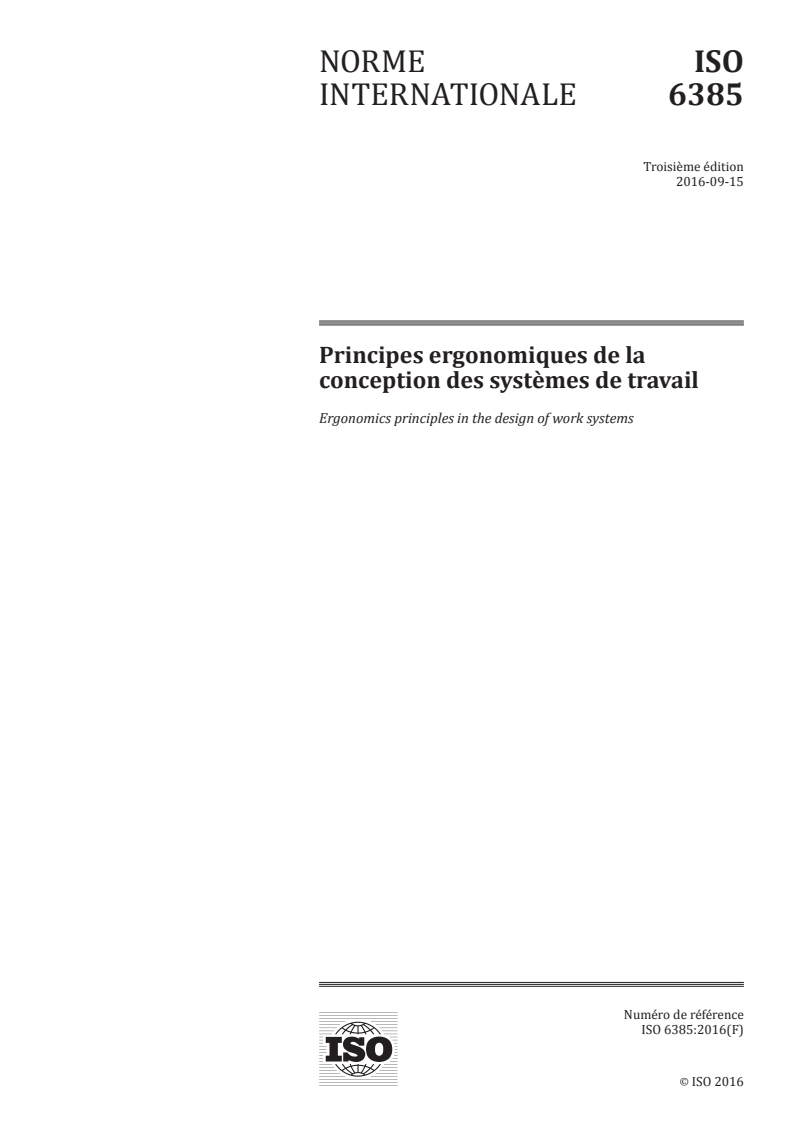

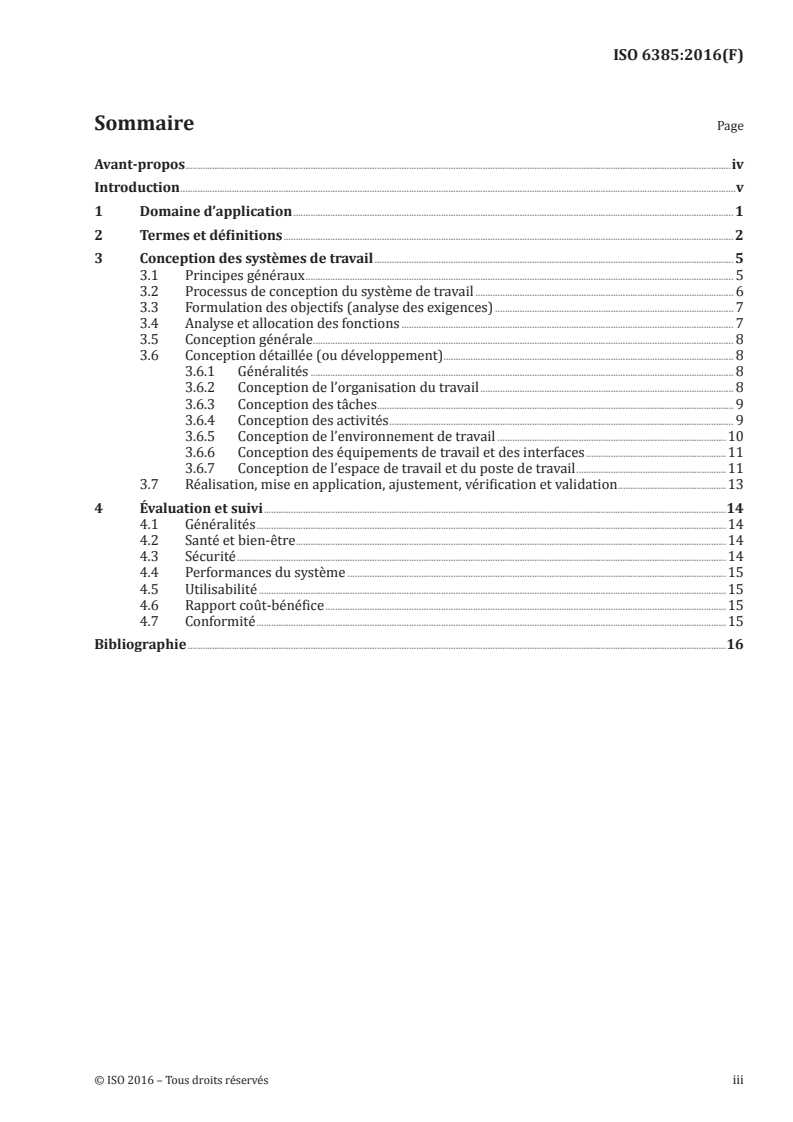
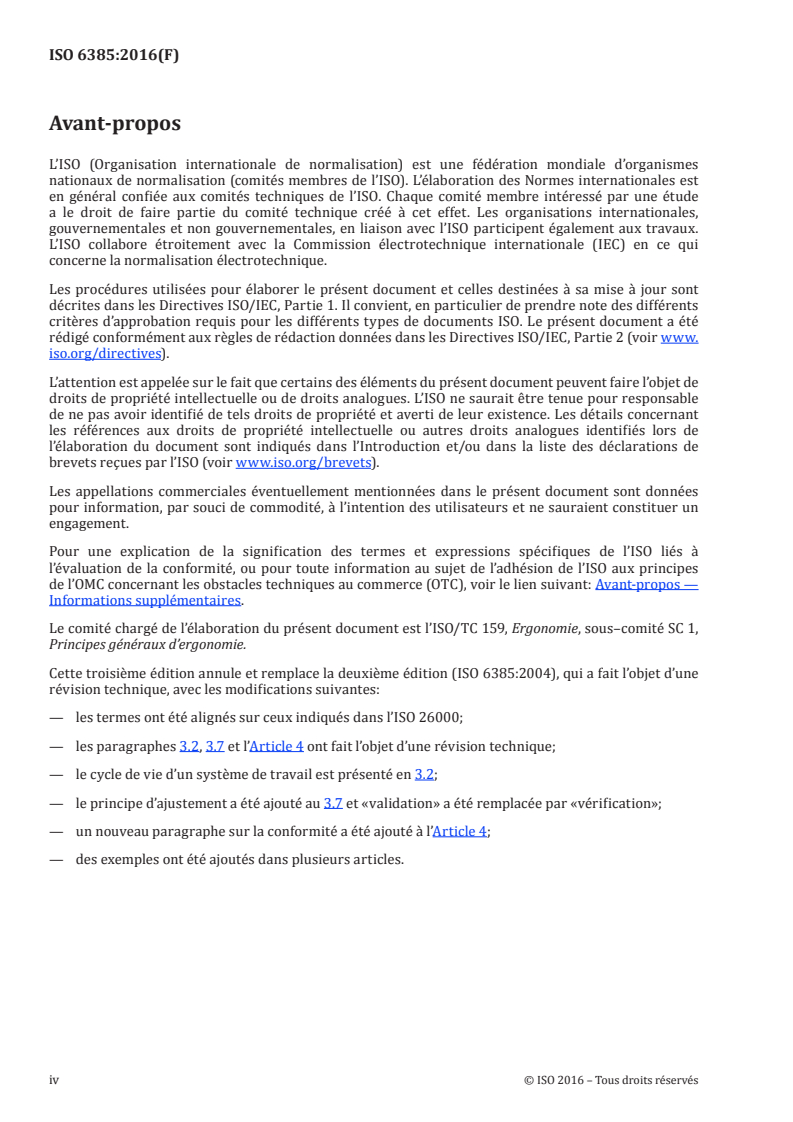
ISO 6385:2016 - Principes ergonomiques de la conception des systèmes de travail/14/2016
Overview
ISO 6385:2016 - "Ergonomics principles in the design of work systems" - sets out the fundamental ergonomic principles and core terminology for designing, redesigning and evaluating work systems. It describes a systems-based, human-centred approach that balances human, social and technical requirements across the entire life cycle of a work system (from conception and development through implementation, use, maintenance and decommissioning). The standard is the core ergonomic reference for workplace design, workstation layout, human–machine interaction and organizational design.
Key topics and technical requirements
ISO 6385:2016 frames practical requirements rather than prescriptive measurements. Key topics covered include:
- Definitions and core terms (work system, worker, work equipment, workspace, usability, accessibility, work task, workstation).
- Design process and systems approach (Clause 3): goal formulation, requirements analysis, allocation of functions between people and equipment, concept design and detailed design.
- Detailed design areas (Clause 3.6): work organization, work tasks, jobs, work environment, work equipment and interfaces, workspace and workstations.
- Realization and verification (Clause 3.7): implementation, adjustment and validation of design decisions with the principle of adjustment in use.
- Evaluation and monitoring (Clause 4): ongoing assessment of health and well‑being, safety, system performance, usability, cost–benefit and conformance.
- Human-centred design and usability: integrating human factors and usability principles (references such as ISO 9241-210) to optimize performance and satisfaction.
- Life-cycle orientation: ergonomics applied across all phases to sustain safety, health and efficiency over time.
Practical applications
ISO 6385 is applicable across a wide range of sectors and working situations:
- Production and manufacturing (operator–machine systems, assembly lines)
- Transportation (drivers, airport personnel)
- Commercial and office environments (workstations, mobile workers)
- Support and maintenance tasks (technicians with tools)
- Healthcare, teaching and other service sectors
The standard guides the (re)design of permanent and temporary work systems, workstation layout, human–machine interfaces, and organizational arrangements to improve worker well‑being, safety and performance while considering economic and technical effectiveness.
Who should use this standard
- Ergonomists and human factors professionals
- Designers and product developers
- Project managers and systems engineers
- Executives, operations and safety managers
- Workers and worker representatives involved in design or redesign decisions
Related standards
- ISO 26800 - General principles on ergonomics
- ISO 9241-210 - Human-centred design for interactive systems
- (Referenced) OHSAS 18001 - occupational health and safety management guidance
Using ISO 6385:2016 helps organizations embed ergonomic principles into workplace design processes, improving usability, reducing work strain and supporting sustainable, safe work systems.
Relations
- Effective Date
- 09-Feb-2026
- Effective Date
- 09-Feb-2026
- Effective Date
- 09-Feb-2026
- Effective Date
- 12-Feb-2026
- Effective Date
- 13-Apr-2013
Buy Documents
ISO 6385:2016 - Ergonomics principles in the design of work systems
ISO 6385:2016 - Ergonomics principles in the design of work systems/14/2016
ISO 6385:2016 - Principes ergonomiques de la conception des systèmes de travail
ISO 6385:2016 - Principes ergonomiques de la conception des systèmes de travail/14/2016
Get Certified
Connect with accredited certification bodies for this standard

CIS Institut d.o.o.
Personal Protective Equipment (PPE) certification body. Notified Body NB-2890 for EU Regulation 2016/425 PPE.

Kiwa BDA Testing
Building and construction product certification.
Kmetijski inštitut Slovenije
Agricultural Institute of Slovenia. Soil testing, plant health, agricultural product analysis.
Sponsored listings
Frequently Asked Questions
ISO 6385:2016 is a standard published by the International Organization for Standardization (ISO). Its full title is "Ergonomics principles in the design of work systems". This standard covers: ISO 6385:2016 establishes the fundamental principles of ergonomics as basic guidelines for the design of work systems and defines relevant basic terms. It describes an integrated approach to the design of work systems, where ergonomists will cooperate with others involved in the design, with attention to the human, the social and the technical requirements in a balanced manner during the design process. Users of this International Standard will include executives, managers, workers (and their representatives, when appropriate) and professionals, such as ergonomists, project managers and designers who are involved in the design or redesign of work systems. Those who use this International Standard can find a general knowledge of ergonomics (human factors), engineering, design, quality and project management helpful. The term "work system" in this International Standard is used to indicate a large variety of working situations, including permanent and flexible work places. The intention of this International Standard is to assist in the improvement, (re)design or change of work systems. Work systems involve combinations of workers and equipment, within a given space and environment, and the interactions between these components within a work organization. Work systems vary in complexity and characteristics, for example, the use of temporary work systems. Some examples of work systems in different areas are the following: - production, e.g. machine operator and machine, worker and assembly line; - transportation, e.g. driver and car or lorry, personnel in an airport; - support, e.g. maintenance technician with work equipment; - commercial, e.g. office worker with workstation, mobile worker with a tablet computer, cook in a restaurant kitchen; - other areas like health care, teaching and training. The observance of ergonomic principles applies to all phases throughout the life cycle of the work system from conception through development, realization and implementation, utilization, maintenance and support to decommissioning. The systems approach in this International Standard gives guidance to the users of this International Standard in existing and new situations. The definitions and ergonomic principles specified in this International Standard apply to the design of optimal working conditions with regard to human well-being, safety and health, including the development of existing skills and the acquisition of new ones, while taking into account technological and economic effectiveness and efficiency. The principles in this International Standard are applicable to many other human activities, e.g. in the design of products for domestic and leisure activities. A more general description of the principles in this International Standard can be found in ISO 26800.
ISO 6385:2016 establishes the fundamental principles of ergonomics as basic guidelines for the design of work systems and defines relevant basic terms. It describes an integrated approach to the design of work systems, where ergonomists will cooperate with others involved in the design, with attention to the human, the social and the technical requirements in a balanced manner during the design process. Users of this International Standard will include executives, managers, workers (and their representatives, when appropriate) and professionals, such as ergonomists, project managers and designers who are involved in the design or redesign of work systems. Those who use this International Standard can find a general knowledge of ergonomics (human factors), engineering, design, quality and project management helpful. The term "work system" in this International Standard is used to indicate a large variety of working situations, including permanent and flexible work places. The intention of this International Standard is to assist in the improvement, (re)design or change of work systems. Work systems involve combinations of workers and equipment, within a given space and environment, and the interactions between these components within a work organization. Work systems vary in complexity and characteristics, for example, the use of temporary work systems. Some examples of work systems in different areas are the following: - production, e.g. machine operator and machine, worker and assembly line; - transportation, e.g. driver and car or lorry, personnel in an airport; - support, e.g. maintenance technician with work equipment; - commercial, e.g. office worker with workstation, mobile worker with a tablet computer, cook in a restaurant kitchen; - other areas like health care, teaching and training. The observance of ergonomic principles applies to all phases throughout the life cycle of the work system from conception through development, realization and implementation, utilization, maintenance and support to decommissioning. The systems approach in this International Standard gives guidance to the users of this International Standard in existing and new situations. The definitions and ergonomic principles specified in this International Standard apply to the design of optimal working conditions with regard to human well-being, safety and health, including the development of existing skills and the acquisition of new ones, while taking into account technological and economic effectiveness and efficiency. The principles in this International Standard are applicable to many other human activities, e.g. in the design of products for domestic and leisure activities. A more general description of the principles in this International Standard can be found in ISO 26800.
ISO 6385:2016 is classified under the following ICS (International Classification for Standards) categories: 13.180 - Ergonomics. The ICS classification helps identify the subject area and facilitates finding related standards.
ISO 6385:2016 has the following relationships with other standards: It is inter standard links to EN ISO 16090-1:2018, EN ISO 19932-1:2025, EN ISO 10075-2:2024, EN ISO 6385:2016, ISO 6385:2004. Understanding these relationships helps ensure you are using the most current and applicable version of the standard.
ISO 6385:2016 is available in PDF format for immediate download after purchase. The document can be added to your cart and obtained through the secure checkout process. Digital delivery ensures instant access to the complete standard document.
Standards Content (Sample)
INTERNATIONAL ISO
STANDARD 6385
Third edition
2016-09-15
Ergonomics principles in the design of
work systems
Principes ergonomiques de la conception des systèmes de travail
Reference number
©
ISO 2016
© ISO 2016, Published in Switzerland
All rights reserved. Unless otherwise specified, no part of this publication may be reproduced or utilized otherwise in any form
or by any means, electronic or mechanical, including photocopying, or posting on the internet or an intranet, without prior
written permission. Permission can be requested from either ISO at the address below or ISO’s member body in the country of
the requester.
ISO copyright office
Ch. de Blandonnet 8 • CP 401
CH-1214 Vernier, Geneva, Switzerland
Tel. +41 22 749 01 11
Fax +41 22 749 09 47
copyright@iso.org
www.iso.org
ii © ISO 2016 – All rights reserved
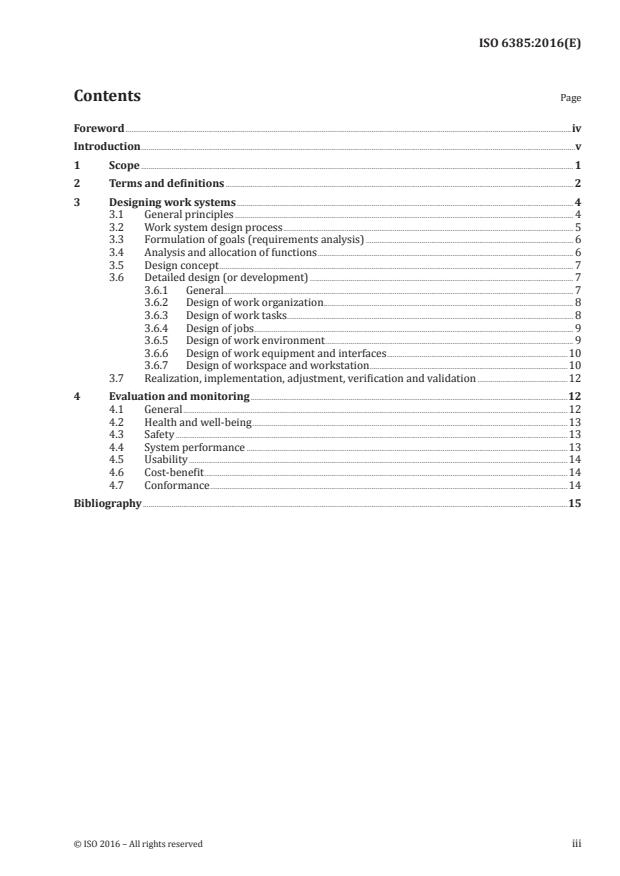
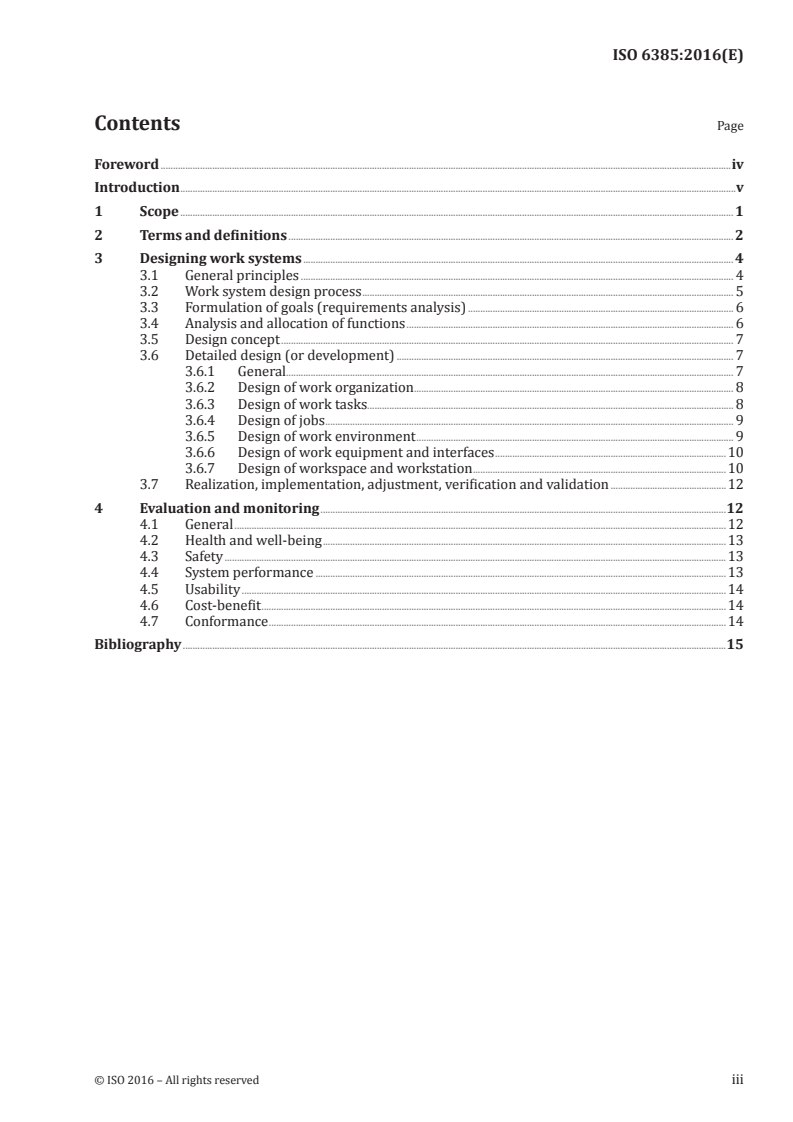
Contents Page
Foreword .iv
Introduction .v
1 Scope . 1
2 Terms and definitions . 2
3 Designing work systems . 4
3.1 General principles . 4
3.2 Work system design process . 5
3.3 Formulation of goals (requirements analysis) . 6
3.4 Analysis and allocation of functions . 6
3.5 Design concept . 7
3.6 Detailed design (or development) . 7
3.6.1 General. 7
3.6.2 Design of work organization. 8
3.6.3 Design of work tasks . . . 8
3.6.4 Design of jobs . 9
3.6.5 Design of work environment . 9
3.6.6 Design of work equipment and interfaces .10
3.6.7 Design of workspace and workstation .10
3.7 Realization, implementation, adjustment, verification and validation .12
4 Evaluation and monitoring .12
4.1 General .12
4.2 Health and well-being .13
4.3 Safety .13
4.4 System performance .13
4.5 Usability .14
4.6 Cost-benefit .14
4.7 Conformance .14
Bibliography .15
Foreword
ISO (the International Organization for Standardization) is a worldwide federation of national standards
bodies (ISO member bodies). The work of preparing International Standards is normally carried out
through ISO technical committees. Each member body interested in a subject for which a technical
committee has been established has the right to be represented on that committee. International
organizations, governmental and non-governmental, in liaison with ISO, also take part in the work.
ISO collaborates closely with the International Electrotechnical Commission (IEC) on all matters of
electrotechnical standardization.
The procedures used to develop this document and those intended for its further maintenance are
described in the ISO/IEC Directives, Part 1. In particular the different approval criteria needed for the
different types of ISO documents should be noted. This document was drafted in accordance with the
editorial rules of the ISO/IEC Directives, Part 2 (see www.iso.org/directives).
Attention is drawn to the possibility that some of the elements of this document may be the subject of
patent rights. ISO shall not be held responsible for identifying any or all such patent rights. Details of
any patent rights identified during the development of the document will be in the Introduction and/or
on the ISO list of patent declarations received (see www.iso.org/patents).
Any trade name used in this document is information given for the convenience of users and does not
constitute an endorsement.
For an explanation on the meaning of ISO specific terms and expressions related to conformity
assessment, as well as information about ISO’s adherence to the WTO principles in the Technical
Barriers to Trade (TBT) see the following URL: Foreword - Supplementary information.
The committee responsible for this document is ISO/TC 159, Ergonomics, Subcommittee SC 1, General
ergonomic principles.
This third edition cancels and replaces the second edition (ISO 6385:2004), which has been technically
revised with the following changes:
— terms were aligned with the terms given in ISO 26000;
— 3.2, 3.7 and Clause 4 have been technically revised;
— life cycle of a work system was introduced in 3.2;
— principle of adjustment was added to 3.7 and validation replaced by verification;
— new subclause on conformity was added to Clause 4;
— examples were added in several clauses.
iv © ISO 2016 – All rights reserved
Introduction
Technological, economic, organizational and human factors affect the work behaviour and well-being of
people as part of a work system. Applying ergonomic knowledge in the light of practical experience in
the design of a work system is intended to satisfy human requirements.
This International Standard provides a basic ergonomic framework for professionals and other people
who deal with the issues of ergonomics, work systems and working situations. The provisions of this
International Standard will also apply to the design of products for use in work systems.
Following the principles and requirements described in this International Standard will support
management in making better decisions, for instance related to the sustainability of investments in
work system innovation.
In the design of work systems in accordance with this International Standard, the body of knowledge
in the field of ergonomics is taken into account. Ergonomic evaluations of existing or new work systems
will show the need for, and encourage attention to, the role of the worker within those systems.
ISO 26800 provides a general starting point for thought on ergonomics and determines the essential
general principles and concepts. This International Standard presents these in the context of the design
and evaluation of work systems.
This International Standard is also valuable in the application of management systems such as
OHSAS 18001. Besides guidelines for processes, it also offers guidance for achieving good human
performance.
INTERNATIONAL STANDARD ISO 6385:2016(E)
Ergonomics principles in the design of work systems
1 Scope
This International Standard establishes the fundamental principles of ergonomics as basic guidelines
for the design of work systems and defines relevant basic terms. It describes an integrated approach
to the design of work systems, where ergonomists will cooperate with others involved in the design,
with attention to the human, the social and the technical requirements in a balanced manner during the
design process.
Users of this International Standard will include executives, managers, workers (and their
representatives, when appropriate) and professionals, such as ergonomists, project managers and
designers who are involved in the design or redesign of work systems. Those who use this International
Standard can find a general knowledge of ergonomics (human factors), engineering, design, quality and
project management helpful.
The term “work system” in this International Standard is used to indicate a large variety of working
situations, including permanent and flexible work places. The intention of this International Standard is
to assist in the improvement, (re)design or change of work systems. Work systems involve combinations
of workers and equipment, within a given space and environment, and the interactions between these
components within a work organization. Work systems vary in complexity and characteristics, for
example, the use of temporary work systems. Some examples of work systems in different areas are the
following:
— production, e.g. machine operator and machine, worker and assembly line;
— transportation, e.g. driver and car or lorry, personnel in an airport;
— support, e.g. maintenance technician with work equipment;
— commercial, e.g. office worker with workstation, mobile worker with a tablet computer, cook in a
restaurant kitchen;
— other areas like health care, teaching and training.
The observance of ergonomic principles applies to all phases throughout the life cycle of the work system
from conception through development, realization and implementation, utilization, maintenance and
support to decommissioning.
The systems approach in this International Standard gives guidance to the users of this International
Standard in existing and new situations.
The definitions and ergonomic principles specified in this International Standard apply to the design
of optimal working conditions with regard to human well-being, safety and health, including the
development of existing skills and the acquisition of new ones, while taking into account technological
and economic effectiveness and efficiency.
The principles in this International Standard are applicable to many other human activities, e.g. in the
design of products for domestic and leisure activities. A more general description of the principles in
this International Standard can be found in ISO 26800.
NOTE 1 This International Standard is considered to be the core ergonomic standard for work systems from
which many others on specific issues are derived.
Note 2 Although elements of the system can be the same, this International Standard is not intended to be
applied to systems used in a non-work context (e.g. the use of a vehicle for private purposes).
2 Terms and definitions
For the purposes of this document, the following terms and definitions apply.
2.1
well-being
sustainable internal state resulting from satisfaction of the physical and cognitive
needs of the worker (2.4) during his/her activity
Note 1 to entry: Well-being can contribute to the quality of working life.
2.2
work system
system comprising one or more workers (2.4) and work equipment (2.6) acting together to perform
the system function (2.21), in the workspace (2.9), in the work environment (2.8), under the conditions
imposed by the work tasks (2.17)
2.3
ergonomics
human factors
scientific discipline concerned with the understanding of interactions among human and other elements
of a system, and the profession that applies theory, principles, data and methods to design in order to
optimize human well-being (2.1) and overall system performance
[SOURCE: ISO 26800:2011, 2.2]
2.4
worker
person performing one or more activities to achieve a goal within a work system (2.2)
[SOURCE: ISO 26800:2011, 2.11, modified — synonym “operator” omitted]
2.5
work organization
interacting work systems (2.2) acting to produce a specific overall outcome
Note 1 to entry: The process of work organization includes coherent actions in relation to establishing the
form and mode of organization to be adopted (e.g. individual or collective work, teams working separately
or interdependently, etc.). It is also necessary to define and allocate resources and determine the means and
channels of communication. All these actions lead to the definition and assignment of prescribed tasks to the
operators involved.
2.6
work equipment
tools, including hardware and software, machines, vehicles, devices, furniture, installations and other
components used in the work system (2.2)
2.7
work process
sequence in time and space of the interaction of workers (2.4), work equipment (2.6), materials, energy
and information within a work system (2.2)
2.8
work environment
physical, chemical, biological, organizational, social and cultural factors surrounding a worker (2.4)
2.9
workspace
volume allocated to one or more persons in the work system (2.2) to complete the work task (2.17)
2 © ISO 2016 – All rights reserved
2.10
external work load
work stress
external conditions and demands in a work system (2.2) which influence a person’s physical and/or
mental internal load
Note 1 to entry: In some countries, “external work load” is referred to as “work stress”.
Note 2 to entry: Compare ISO 26800:2011, 2.4.
2.11
work strain
internal response of a worker (2.4) to being exposed to external work load (2.10) depending on his/her
individual characteristics (e.g. body size, age, capacities, abilities, skills, etc.)
Note 1 to entry: In ISO 26800, “work strain” is called “internal load”.
Note 2 to entry: Compare ISO 26800:2011, 2.6.
2.12
usability
extent to which a system, product or service can be used by specified users to achieve specified goals
with effectiveness, efficiency and satisfaction in a specified context of use
Note 1 to entry: Systems, products or services are part of work systems (2.2) and used by workers (2.4) within
those systems.
Note 2 to entry: In this International Standard, the context of use is within a work system.
[SOURCE: ISO 9241-210:2010, 2.13]
2.13
human-centred design
approach to systems design and development that aims to make interactive systems more usable by
focusing on the use of the system and applying human factors/ergonomics (2.3) and usability (2.12)
knowledge and techniques
[SOURCE: ISO 9241-210:2010, 2.7, modified — Notes 1 and 2 to entry omitted]
2.14
accessibility
extent to which products, systems, services, environments and facilities can be used by people from
a population with the widest range of characteristics and capabilities to achieve a specified goal in a
specified context of use
[SOURCE: ISO 26800:2011, 2.1, modified — Notes 1 and 2 to entry omitted]
Note 1 to entry: Products, systems, services and facilities are part of work systems (2.2) and used by workers (2.4)
within those systems.
Note 2 to entry: In this International Standard, the context of use is within a work system.
2.15
allocation of functions
process of deciding whether system functions (2.21) will be implemented by humans, by equipment
and/or hardware and/or software
2.16
job
organization and sequence in time and space of an individual’s work tasks (2.17) or the combination of
all human performance by one worker (2.4) within a work system (2.2)
2.17
work task
activity or set of activities required of the worker (2.4) to achieve an intended outcome
2.18
workstation
combination and spatial arrangement of work equipment (2.6), surrounded by the work environment
(2.8) under the conditions imposed by the work tasks (2.17)
2.19
work fatigue
impairing non-pathological manifestation of work strain (2.11), completely reversible with rest
Note 1 to entry: Work fatigue can be mental, physical, local and/or general.
Note 2 to entry: Compare ISO 26800:2011, 2.5.
2.20
target population
people for whom the design is intended, specified according to the relevant characteristics
Note 1 to entry: Relevant characteristics include, for example, the skill level, intelligence or physical
characteristics, such as anthropometric dimensions, of these people. Gender and age can be related to variations
in these characteristics. In addition to these intrinsic characteristics, extrinsic factors (e.g. cultural differences)
could also be relevant.
[SOURCE: ISO 26800:2011, 2.8]
2.21
system function
broad category of activity performed by a system
3 Designing work systems
3.1 General principles
Work system design considers human beings as the main factor and an integral part of the system to be
designed, including the work process, as well as the work environment.
In the design process of work systems, the major interactions between one or more people and the
components of the work system, such as tasks, equipment, workspace and environment, shall be
considered.
These interactions create demands on the worker that together constitute the external work load. This
will result in reactions within the worker, depending on her/his individual characteristics (e.g. size,
age, capacities, abilities, skills, etc.) called work strain. Work strain will result in impairing effects (e.g.
fatigue generated by work), or facilitating effects (e.g. skill development), thus affecting the individual
characteristics of the worker in a feedback loop.
Ergonomic work system design aims at optimizing work strain, avoiding impairing effects and
promoting facilitating effects. Unimpaired human performance at the same time will often improve
system effectiveness and efficiency, thus contributing to another important goal of ergonomic work
system design.
Ergonomics shall be used in a preventive function by being employed from the beginning rather than
being used to solve problems after the design of the work system is complete. However, ergonomics can
be successfully employed in the redesign of an existing, unsatisfactory work system. Furthermore, in
a risk assessment process, the interaction between work system design and the worker’s foreseeable
behaviour should be considered in order to secure their safety and health.
4 © ISO 2016 – All rights reserved
The most important decisions that have consequences in the design are made at the beginning of
the design process. Therefore, particular attention should be paid to the application of ergonomics
principles at this stage. Ergonomic contribution to the work system design shall continue throughout
the design process. However, the level of input can vary from being fundamental and extensive during
the analysis of the system needs (“formulation of goals”) to fine-tuning when the completed system is
being implemented (“realization, implementation and verification”). Sufficient attention shall continue
to be given to the application of ergonomic principles until late in the design process in order to prevent
negative effects such as delays in projects, extra costs for adaptation, a lower design quality, and
reduced usability.
In accordance with a human-centred approach, workers should ideally be involved in and should
participate in the design of work systems during the process in an effective and efficient manner.
Workers include those responsible for constructing, maintaining, operating, and supervising, each of
which requires different considerations. In work system design, a participatory approach is essential
in order to avoid sub-optimal solutions, because the experience of workers provides an indispensable
knowledge base. The design process shall therefore, wherever possible, involve workers in all stages.
NOTE 1 Detailed information about the human-centred approach can be found in ISO 9241-210.
It is recommended that a work system be designed for a broad range of the target population (see
ISO 26800:2011, 4.2.2). In particular, the designer should consider the needs of people with special
requirements and apply ergonomic principles to ensure that work systems are accessible to them. Thus,
the need for the development of special solutions for individual workers can be minimized and the
accessibility of the work system improved.
NOTE 2 Special requirements include limitations to sensory abilities such as vision, tactile and acoustic input,
and physical abilities such as dexterity, manipulation, movement, voice, strength and endurance, cognitive
abilities such as intellect, memory, language and literacy. For further guidance, see ISO/IEC Guide 71 and
ISO/TR 22411.
In ergonomics, the variation within the target population is commonly accounted for by using the 5th
and/or 95th percentiles of important design characteristics, with the intention of accommodating at
least 90 % of the target population.
NOTE 3 In some circumstances, a different percentile range is used. For example, the 1st and 99th percentiles
are used for many safety-related applications.
In designing the work system, a variety of conditions should be considered, e.g. normal, disturbed and
degraded functioning.
The work system design process (3.2) can be divided into the following phases:
— formulation of goals (requirements analysis) (3.3);
— analysis and allocation of functions (3.4);
— design concept (3.5);
— detailed design (or development) (3.6);
— realization, implementation, adjustment, verification and validation (3.7);
— evaluation and monitoring (Clause 4).
These phases will be explained in the relevant clauses or subclauses.
3.2 Work system design process
“Designing” refers to an iterative and structured process of a number of design phases, which results in
a new design or a redesign. The work system design process should include all phases throughout the
life cycle of the work system from conception through development, realization and implementation,
utilization, maintenance and support to decommissioning. Verification should be performed in each of
these phases to confirm that the specified requirements are being fulfilled. A multidisciplinary design
team best accomplishes this process. Activities involved in the phases of the design process are analysis,
synthesis, simulation and evaluation (see EN 16710-2).
NOTE 1 A multidisciplinary design team can include engineers, operators, ergonomists, occupational health
and safety specialists, management, financial services and purchasers.
Each of the many variables described in the following subclauses is likely to influence others. Decisions
concerning, for instance, the allocation of different functions to people or equipment, the design of any
interface, and the training requirements, all interact to an extent which will make it necessary for the
system designer to evaluate alternatives before reaching the final decision.
This process of evaluating suitable alternatives is likely to be iterative until sufficient information is
gathered for each area. The marshalling and final consideration of the information is then conducted
in the following stages of the design process. It is important to ensure that appropriate methods and
techniques are applied in the realization of a new work system design.
NOTE 2 ISO 26800 lists the basic requirements for ergonomics-oriented design.
NOTE 3 See ISO/TR 16982 on usability methods supporting human-centred design.
NOTE 4 A work system can change or evolve over time and is not necessarily static and unchanging.
3.3 Formulation of goals (requirements analysis)
In the case of a new design, the analysis of system requirements will involve the acquisition of
information regarding the production or performance requirements of the work process, together with
the characteristics and limitations of the people who will be working in the new system (including user
needs) and the environment in which they will work. Where equivalent or similar systems already
exist, this will also entail the i
...
INTERNATIONAL ISO
STANDARD 6385
Third edition
2016-09-15
Ergonomics principles in the design of
work systems
Principes ergonomiques de la conception des systèmes de travail
Reference number
©
ISO 2016
© ISO 2016, Published in Switzerland
All rights reserved. Unless otherwise specified, no part of this publication may be reproduced or utilized otherwise in any form
or by any means, electronic or mechanical, including photocopying, or posting on the internet or an intranet, without prior
written permission. Permission can be requested from either ISO at the address below or ISO’s member body in the country of
the requester.
ISO copyright office
Ch. de Blandonnet 8 • CP 401
CH-1214 Vernier, Geneva, Switzerland
Tel. +41 22 749 01 11
Fax +41 22 749 09 47
copyright@iso.org
www.iso.org
ii © ISO 2016 – All rights reserved
Contents Page
Foreword .iv
Introduction .v
1 Scope . 1
2 Terms and definitions . 2
3 Designing work systems . 4
3.1 General principles . 4
3.2 Work system design process . 5
3.3 Formulation of goals (requirements analysis) . 6
3.4 Analysis and allocation of functions . 6
3.5 Design concept . 7
3.6 Detailed design (or development) . 7
3.6.1 General. 7
3.6.2 Design of work organization. 8
3.6.3 Design of work tasks . . . 8
3.6.4 Design of jobs . 9
3.6.5 Design of work environment . 9
3.6.6 Design of work equipment and interfaces .10
3.6.7 Design of workspace and workstation .10
3.7 Realization, implementation, adjustment, verification and validation .12
4 Evaluation and monitoring .12
4.1 General .12
4.2 Health and well-being .13
4.3 Safety .13
4.4 System performance .13
4.5 Usability .14
4.6 Cost-benefit .14
4.7 Conformance .14
Bibliography .15
Foreword
ISO (the International Organization for Standardization) is a worldwide federation of national standards
bodies (ISO member bodies). The work of preparing International Standards is normally carried out
through ISO technical committees. Each member body interested in a subject for which a technical
committee has been established has the right to be represented on that committee. International
organizations, governmental and non-governmental, in liaison with ISO, also take part in the work.
ISO collaborates closely with the International Electrotechnical Commission (IEC) on all matters of
electrotechnical standardization.
The procedures used to develop this document and those intended for its further maintenance are
described in the ISO/IEC Directives, Part 1. In particular the different approval criteria needed for the
different types of ISO documents should be noted. This document was drafted in accordance with the
editorial rules of the ISO/IEC Directives, Part 2 (see www.iso.org/directives).
Attention is drawn to the possibility that some of the elements of this document may be the subject of
patent rights. ISO shall not be held responsible for identifying any or all such patent rights. Details of
any patent rights identified during the development of the document will be in the Introduction and/or
on the ISO list of patent declarations received (see www.iso.org/patents).
Any trade name used in this document is information given for the convenience of users and does not
constitute an endorsement.
For an explanation on the meaning of ISO specific terms and expressions related to conformity
assessment, as well as information about ISO’s adherence to the WTO principles in the Technical
Barriers to Trade (TBT) see the following URL: Foreword - Supplementary information.
The committee responsible for this document is ISO/TC 159, Ergonomics, Subcommittee SC 1, General
ergonomic principles.
This third edition cancels and replaces the second edition (ISO 6385:2004), which has been technically
revised with the following changes:
— terms were aligned with the terms given in ISO 26000;
— 3.2, 3.7 and Clause 4 have been technically revised;
— life cycle of a work system was introduced in 3.2;
— principle of adjustment was added to 3.7 and validation replaced by verification;
— new subclause on conformity was added to Clause 4;
— examples were added in several clauses.
iv © ISO 2016 – All rights reserved
Introduction
Technological, economic, organizational and human factors affect the work behaviour and well-being of
people as part of a work system. Applying ergonomic knowledge in the light of practical experience in
the design of a work system is intended to satisfy human requirements.
This International Standard provides a basic ergonomic framework for professionals and other people
who deal with the issues of ergonomics, work systems and working situations. The provisions of this
International Standard will also apply to the design of products for use in work systems.
Following the principles and requirements described in this International Standard will support
management in making better decisions, for instance related to the sustainability of investments in
work system innovation.
In the design of work systems in accordance with this International Standard, the body of knowledge
in the field of ergonomics is taken into account. Ergonomic evaluations of existing or new work systems
will show the need for, and encourage attention to, the role of the worker within those systems.
ISO 26800 provides a general starting point for thought on ergonomics and determines the essential
general principles and concepts. This International Standard presents these in the context of the design
and evaluation of work systems.
This International Standard is also valuable in the application of management systems such as
OHSAS 18001. Besides guidelines for processes, it also offers guidance for achieving good human
performance.
INTERNATIONAL STANDARD ISO 6385:2016(E)
Ergonomics principles in the design of work systems
1 Scope
This International Standard establishes the fundamental principles of ergonomics as basic guidelines
for the design of work systems and defines relevant basic terms. It describes an integrated approach
to the design of work systems, where ergonomists will cooperate with others involved in the design,
with attention to the human, the social and the technical requirements in a balanced manner during the
design process.
Users of this International Standard will include executives, managers, workers (and their
representatives, when appropriate) and professionals, such as ergonomists, project managers and
designers who are involved in the design or redesign of work systems. Those who use this International
Standard can find a general knowledge of ergonomics (human factors), engineering, design, quality and
project management helpful.
The term “work system” in this International Standard is used to indicate a large variety of working
situations, including permanent and flexible work places. The intention of this International Standard is
to assist in the improvement, (re)design or change of work systems. Work systems involve combinations
of workers and equipment, within a given space and environment, and the interactions between these
components within a work organization. Work systems vary in complexity and characteristics, for
example, the use of temporary work systems. Some examples of work systems in different areas are the
following:
— production, e.g. machine operator and machine, worker and assembly line;
— transportation, e.g. driver and car or lorry, personnel in an airport;
— support, e.g. maintenance technician with work equipment;
— commercial, e.g. office worker with workstation, mobile worker with a tablet computer, cook in a
restaurant kitchen;
— other areas like health care, teaching and training.
The observance of ergonomic principles applies to all phases throughout the life cycle of the work system
from conception through development, realization and implementation, utilization, maintenance and
support to decommissioning.
The systems approach in this International Standard gives guidance to the users of this International
Standard in existing and new situations.
The definitions and ergonomic principles specified in this International Standard apply to the design
of optimal working conditions with regard to human well-being, safety and health, including the
development of existing skills and the acquisition of new ones, while taking into account technological
and economic effectiveness and efficiency.
The principles in this International Standard are applicable to many other human activities, e.g. in the
design of products for domestic and leisure activities. A more general description of the principles in
this International Standard can be found in ISO 26800.
NOTE 1 This International Standard is considered to be the core ergonomic standard for work systems from
which many others on specific issues are derived.
Note 2 Although elements of the system can be the same, this International Standard is not intended to be
applied to systems used in a non-work context (e.g. the use of a vehicle for private purposes).
2 Terms and definitions
For the purposes of this document, the following terms and definitions apply.
2.1
well-being
sustainable internal state resulting from satisfaction of the physical and cognitive
needs of the worker (2.4) during his/her activity
Note 1 to entry: Well-being can contribute to the quality of working life.
2.2
work system
system comprising one or more workers (2.4) and work equipment (2.6) acting together to perform
the system function (2.21), in the workspace (2.9), in the work environment (2.8), under the conditions
imposed by the work tasks (2.17)
2.3
ergonomics
human factors
scientific discipline concerned with the understanding of interactions among human and other elements
of a system, and the profession that applies theory, principles, data and methods to design in order to
optimize human well-being (2.1) and overall system performance
[SOURCE: ISO 26800:2011, 2.2]
2.4
worker
person performing one or more activities to achieve a goal within a work system (2.2)
[SOURCE: ISO 26800:2011, 2.11, modified — synonym “operator” omitted]
2.5
work organization
interacting work systems (2.2) acting to produce a specific overall outcome
Note 1 to entry: The process of work organization includes coherent actions in relation to establishing the
form and mode of organization to be adopted (e.g. individual or collective work, teams working separately
or interdependently, etc.). It is also necessary to define and allocate resources and determine the means and
channels of communication. All these actions lead to the definition and assignment of prescribed tasks to the
operators involved.
2.6
work equipment
tools, including hardware and software, machines, vehicles, devices, furniture, installations and other
components used in the work system (2.2)
2.7
work process
sequence in time and space of the interaction of workers (2.4), work equipment (2.6), materials, energy
and information within a work system (2.2)
2.8
work environment
physical, chemical, biological, organizational, social and cultural factors surrounding a worker (2.4)
2.9
workspace
volume allocated to one or more persons in the work system (2.2) to complete the work task (2.17)
2 © ISO 2016 – All rights reserved
2.10
external work load
work stress
external conditions and demands in a work system (2.2) which influence a person’s physical and/or
mental internal load
Note 1 to entry: In some countries, “external work load” is referred to as “work stress”.
Note 2 to entry: Compare ISO 26800:2011, 2.4.
2.11
work strain
internal response of a worker (2.4) to being exposed to external work load (2.10) depending on his/her
individual characteristics (e.g. body size, age, capacities, abilities, skills, etc.)
Note 1 to entry: In ISO 26800, “work strain” is called “internal load”.
Note 2 to entry: Compare ISO 26800:2011, 2.6.
2.12
usability
extent to which a system, product or service can be used by specified users to achieve specified goals
with effectiveness, efficiency and satisfaction in a specified context of use
Note 1 to entry: Systems, products or services are part of work systems (2.2) and used by workers (2.4) within
those systems.
Note 2 to entry: In this International Standard, the context of use is within a work system.
[SOURCE: ISO 9241-210:2010, 2.13]
2.13
human-centred design
approach to systems design and development that aims to make interactive systems more usable by
focusing on the use of the system and applying human factors/ergonomics (2.3) and usability (2.12)
knowledge and techniques
[SOURCE: ISO 9241-210:2010, 2.7, modified — Notes 1 and 2 to entry omitted]
2.14
accessibility
extent to which products, systems, services, environments and facilities can be used by people from
a population with the widest range of characteristics and capabilities to achieve a specified goal in a
specified context of use
[SOURCE: ISO 26800:2011, 2.1, modified — Notes 1 and 2 to entry omitted]
Note 1 to entry: Products, systems, services and facilities are part of work systems (2.2) and used by workers (2.4)
within those systems.
Note 2 to entry: In this International Standard, the context of use is within a work system.
2.15
allocation of functions
process of deciding whether system functions (2.21) will be implemented by humans, by equipment
and/or hardware and/or software
2.16
job
organization and sequence in time and space of an individual’s work tasks (2.17) or the combination of
all human performance by one worker (2.4) within a work system (2.2)
2.17
work task
activity or set of activities required of the worker (2.4) to achieve an intended outcome
2.18
workstation
combination and spatial arrangement of work equipment (2.6), surrounded by the work environment
(2.8) under the conditions imposed by the work tasks (2.17)
2.19
work fatigue
impairing non-pathological manifestation of work strain (2.11), completely reversible with rest
Note 1 to entry: Work fatigue can be mental, physical, local and/or general.
Note 2 to entry: Compare ISO 26800:2011, 2.5.
2.20
target population
people for whom the design is intended, specified according to the relevant characteristics
Note 1 to entry: Relevant characteristics include, for example, the skill level, intelligence or physical
characteristics, such as anthropometric dimensions, of these people. Gender and age can be related to variations
in these characteristics. In addition to these intrinsic characteristics, extrinsic factors (e.g. cultural differences)
could also be relevant.
[SOURCE: ISO 26800:2011, 2.8]
2.21
system function
broad category of activity performed by a system
3 Designing work systems
3.1 General principles
Work system design considers human beings as the main factor and an integral part of the system to be
designed, including the work process, as well as the work environment.
In the design process of work systems, the major interactions between one or more people and the
components of the work system, such as tasks, equipment, workspace and environment, shall be
considered.
These interactions create demands on the worker that together constitute the external work load. This
will result in reactions within the worker, depending on her/his individual characteristics (e.g. size,
age, capacities, abilities, skills, etc.) called work strain. Work strain will result in impairing effects (e.g.
fatigue generated by work), or facilitating effects (e.g. skill development), thus affecting the individual
characteristics of the worker in a feedback loop.
Ergonomic work system design aims at optimizing work strain, avoiding impairing effects and
promoting facilitating effects. Unimpaired human performance at the same time will often improve
system effectiveness and efficiency, thus contributing to another important goal of ergonomic work
system design.
Ergonomics shall be used in a preventive function by being employed from the beginning rather than
being used to solve problems after the design of the work system is complete. However, ergonomics can
be successfully employed in the redesign of an existing, unsatisfactory work system. Furthermore, in
a risk assessment process, the interaction between work system design and the worker’s foreseeable
behaviour should be considered in order to secure their safety and health.
4 © ISO 2016 – All rights reserved
The most important decisions that have consequences in the design are made at the beginning of
the design process. Therefore, particular attention should be paid to the application of ergonomics
principles at this stage. Ergonomic contribution to the work system design shall continue throughout
the design process. However, the level of input can vary from being fundamental and extensive during
the analysis of the system needs (“formulation of goals”) to fine-tuning when the completed system is
being implemented (“realization, implementation and verification”). Sufficient attention shall continue
to be given to the application of ergonomic principles until late in the design process in order to prevent
negative effects such as delays in projects, extra costs for adaptation, a lower design quality, and
reduced usability.
In accordance with a human-centred approach, workers should ideally be involved in and should
participate in the design of work systems during the process in an effective and efficient manner.
Workers include those responsible for constructing, maintaining, operating, and supervising, each of
which requires different considerations. In work system design, a participatory approach is essential
in order to avoid sub-optimal solutions, because the experience of workers provides an indispensable
knowledge base. The design process shall therefore, wherever possible, involve workers in all stages.
NOTE 1 Detailed information about the human-centred approach can be found in ISO 9241-210.
It is recommended that a work system be designed for a broad range of the target population (see
ISO 26800:2011, 4.2.2). In particular, the designer should consider the needs of people with special
requirements and apply ergonomic principles to ensure that work systems are accessible to them. Thus,
the need for the development of special solutions for individual workers can be minimized and the
accessibility of the work system improved.
NOTE 2 Special requirements include limitations to sensory abilities such as vision, tactile and acoustic input,
and physical abilities such as dexterity, manipulation, movement, voice, strength and endurance, cognitive
abilities such as intellect, memory, language and literacy. For further guidance, see ISO/IEC Guide 71 and
ISO/TR 22411.
In ergonomics, the variation within the target population is commonly accounted for by using the 5th
and/or 95th percentiles of important design characteristics, with the intention of accommodating at
least 90 % of the target population.
NOTE 3 In some circumstances, a different percentile range is used. For example, the 1st and 99th percentiles
are used for many safety-related applications.
In designing the work system, a variety of conditions should be considered, e.g. normal, disturbed and
degraded functioning.
The work system design process (3.2) can be divided into the following phases:
— formulation of goals (requirements analysis) (3.3);
— analysis and allocation of functions (3.4);
— design concept (3.5);
— detailed design (or development) (3.6);
— realization, implementation, adjustment, verification and validation (3.7);
— evaluation and monitoring (Clause 4).
These phases will be explained in the relevant clauses or subclauses.
3.2 Work system design process
“Designing” refers to an iterative and structured process of a number of design phases, which results in
a new design or a redesign. The work system design process should include all phases throughout the
life cycle of the work system from conception through development, realization and implementation,
utilization, maintenance and support to decommissioning. Verification should be performed in each of
these phases to confirm that the specified requirements are being fulfilled. A multidisciplinary design
team best accomplishes this process. Activities involved in the phases of the design process are analysis,
synthesis, simulation and evaluation (see EN 16710-2).
NOTE 1 A multidisciplinary design team can include engineers, operators, ergonomists, occupational health
and safety specialists, management, financial services and purchasers.
Each of the many variables described in the following subclauses is likely to influence others. Decisions
concerning, for instance, the allocation of different functions to people or equipment, the design of any
interface, and the training requirements, all interact to an extent which will make it necessary for the
system designer to evaluate alternatives before reaching the final decision.
This process of evaluating suitable alternatives is likely to be iterative until sufficient information is
gathered for each area. The marshalling and final consideration of the information is then conducted
in the following stages of the design process. It is important to ensure that appropriate methods and
techniques are applied in the realization of a new work system design.
NOTE 2 ISO 26800 lists the basic requirements for ergonomics-oriented design.
NOTE 3 See ISO/TR 16982 on usability methods supporting human-centred design.
NOTE 4 A work system can change or evolve over time and is not necessarily static and unchanging.
3.3 Formulation of goals (requirements analysis)
In the case of a new design, the analysis of system requirements will involve the acquisition of
information regarding the production or performance requirements of the work process, together with
the characteristics and limitations of the people who will be working in the new system (including user
needs) and the environment in which they will work. Where equivalent or similar systems already
exist, this will also entail the i
...
NORME ISO
INTERNATIONALE 6385
Troisième édition
2016-09-15
Principes ergonomiques de la
conception des systèmes de travail
Ergonomics principles in the design of work systems
Numéro de référence
©
ISO 2016
DOCUMENT PROTÉGÉ PAR COPYRIGHT
© ISO 2016, Publié en Suisse
Droits de reproduction réservés. Sauf indication contraire, aucune partie de cette publication ne peut être reproduite ni utilisée
sous quelque forme que ce soit et par aucun procédé, électronique ou mécanique, y compris la photocopie, l’affichage sur
l’internet ou sur un Intranet, sans autorisation écrite préalable. Les demandes d’autorisation peuvent être adressées à l’ISO à
l’adresse ci-après ou au comité membre de l’ISO dans le pays du demandeur.
ISO copyright office
Ch. de Blandonnet 8 • CP 401
CH-1214 Vernier, Geneva, Switzerland
Tel. +41 22 749 01 11
Fax +41 22 749 09 47
copyright@iso.org
www.iso.org
ii © ISO 2016 – Tous droits réservés
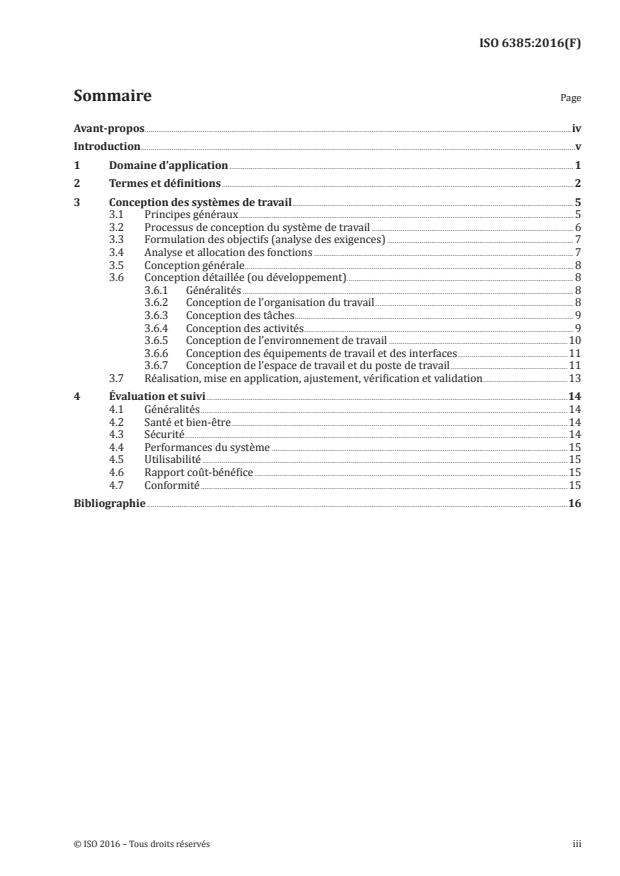
Sommaire Page
Avant-propos .iv
Introduction .v
1 Domaine d’application . 1
2 Termes et définitions . 2
3 Conception des systèmes de travail . 5
3.1 Principes généraux . 5
3.2 Processus de conception du système de travail . 6
3.3 Formulation des objectifs (analyse des exigences) . 7
3.4 Analyse et allocation des fonctions . 7
3.5 Conception générale . 8
3.6 Conception détaillée (ou développement) . 8
3.6.1 Généralités . 8
3.6.2 Conception de l’organisation du travail . 8
3.6.3 Conception des tâches . . 9
3.6.4 Conception des activités . 9
3.6.5 Conception de l’environnement de travail .10
3.6.6 Conception des équipements de travail et des interfaces .11
3.6.7 Conception de l’espace de travail et du poste de travail .11
3.7 Réalisation, mise en application, ajustement, vérification et validation .13
4 Évaluation et suivi .14
4.1 Généralités .14
4.2 Santé et bien-être .14
4.3 Sécurité .14
4.4 Performances du système .15
4.5 Utilisabilité .15
4.6 Rapport coût-bénéfice .15
4.7 Conformité .15
Bibliographie .16
Avant-propos
L’ISO (Organisation internationale de normalisation) est une fédération mondiale d’organismes
nationaux de normalisation (comités membres de l’ISO). L’élaboration des Normes internationales est
en général confiée aux comités techniques de l’ISO. Chaque comité membre intéressé par une étude
a le droit de faire partie du comité technique créé à cet effet. Les organisations internationales,
gouvernementales et non gouvernementales, en liaison avec l’ISO participent également aux travaux.
L’ISO collabore étroitement avec la Commission électrotechnique internationale (IEC) en ce qui
concerne la normalisation électrotechnique.
Les procédures utilisées pour élaborer le présent document et celles destinées à sa mise à jour sont
décrites dans les Directives ISO/IEC, Partie 1. Il convient, en particulier de prendre note des différents
critères d’approbation requis pour les différents types de documents ISO. Le présent document a été
rédigé conformément aux règles de rédaction données dans les Directives ISO/IEC, Partie 2 (voir www.
iso.org/directives).
L’attention est appelée sur le fait que certains des éléments du présent document peuvent faire l’objet de
droits de propriété intellectuelle ou de droits analogues. L’ISO ne saurait être tenue pour responsable
de ne pas avoir identifié de tels droits de propriété et averti de leur existence. Les détails concernant
les références aux droits de propriété intellectuelle ou autres droits analogues identifiés lors de
l’élaboration du document sont indiqués dans l’Introduction et/ou dans la liste des déclarations de
brevets reçues par l’ISO (voir www.iso.org/brevets).
Les appellations commerciales éventuellement mentionnées dans le présent document sont données
pour information, par souci de commodité, à l’intention des utilisateurs et ne sauraient constituer un
engagement.
Pour une explication de la signification des termes et expressions spécifiques de l’ISO liés à
l’évaluation de la conformité, ou pour toute information au sujet de l’adhésion de l’ISO aux principes
de l’OMC concernant les obstacles techniques au commerce (OTC), voir le lien suivant: Avant-propos —
Informations supplémentaires.
Le comité chargé de l’élaboration du présent document est l’ISO/TC 159, Ergonomie, sous–comité SC 1,
Principes généraux d’ergonomie.
Cette troisième édition annule et remplace la deuxième édition (ISO 6385:2004), qui a fait l’objet d’une
révision technique, avec les modifications suivantes:
— les termes ont été alignés sur ceux indiqués dans l’ISO 26000;
— les paragraphes 3.2, 3.7 et l’Article 4 ont fait l’objet d’une révision technique;
— le cycle de vie d’un système de travail est présenté en 3.2;
— le principe d’ajustement a été ajouté au 3.7 et «validation» a été remplacée par «vérification»;
— un nouveau paragraphe sur la conformité a été ajouté à l’Article 4;
— des exemples ont été ajoutés dans plusieurs articles.
iv © ISO 2016 – Tous droits réservés
Introduction
Des facteurs technologiques, économiques, organisationnels et humains influencent le comportement
et le bien-être au travail des personnes au sein du système de travail. Dans la conception d’un système
de travail, l’application des connaissances ergonomiques à la lumière des expériences de la pratique, est
prévue pour satisfaire les exigences humaines.
La présente Norme internationale fournit un cadre de base en ergonomie pour les professionnels et
autres qui traitent des sujets relatifs à l’ergonomie, aux systèmes de travail et aux situations de travail.
Les dispositions de la présente Norme internationale doivent aussi s’appliquer à la conception des
produits destinés à être utilisés dans les systèmes de travail.
Le respect des principes et des exigences énoncés dans la présente Norme internationale aidera
la direction à prendre de meilleures décisions, par exemple en ce qui concerne la durabilité des
investissements dans l’innovation des systèmes de travail.
Le corps des connaissances dans le domaine de l’ergonomie est pris en compte dans la conception des
systèmes de travail conformément à la présente Norme internationale. Les évaluations ergonomiques
des systèmes de travail existants ou nouveaux révéleront la nécessité de tenir compte du rôle du
travailleur au sein de ces systèmes, et l’encourageront.
L’ISO 26800 fournit un point de départ général pour la réflexion sur l’ergonomie et détermine les
principes et concepts généraux essentiels. La présente Norme internationale les présente dans le cadre
de la conception et de l’évaluation des systèmes de travail.
La présente Norme internationale est également utile dans la mise en œuvre de systèmes de
management, tels que OHSAS 18001. Outre les lignes directrices relatives aux processus, elle fournit
également des recommandations pour atteindre de bonnes performances humaines.
NORME INTERNATIONALE ISO 6385:2016(F)
Principes ergonomiques de la conception des systèmes
de travail
1 Domaine d’application
La présente Norme internationale établit les principes ergonomiques fondamentaux comme
lignes directrices de base pour la conception des systèmes de travail, et définit les termes de base
correspondants. Elle décrit une approche intégrée de la conception des systèmes de travail, selon
laquelle les ergonomes coopèrent avec d’autres personnes impliquées dans la conception, en prenant en
considération les exigences humaines, sociales et techniques, de façon équilibrée, durant le processus
de conception.
Les utilisateurs de la présente Norme internationale incluent les dirigeants, les travailleurs (et leurs
représentants, le cas échéant) et les professionnels tels que les ergonomes, les chefs de projet et les
concepteurs impliqués dans le processus de conception ou de correction des systèmes de travail. Les
utilisateurs peuvent trouver dans la présente Norme internationale des connaissances générales en
ergonomie (facteurs humains), ingénierie, conception, qualité et gestion de projet.
Dans la présente Norme internationale, le terme «système de travail» fait référence à une grande
variété de situations de travail, incluant les lieux de travail permanents et flexibles. L’objectif de la
présente Norme internationale est d’aider à améliorer, (re)concevoir ou modifier les systèmes de travail.
Les systèmes de travail impliquent des combinaisons de travailleurs et d’équipements, au sein d’un
espace et d’un environnement donnés, ainsi que les interactions entre ces composantes au sein d’une
organisation de travail. La complexité et les caractéristiques des systèmes de travail sont variables,
par exemple l’utilisation de systèmes de travail temporaires. Voici quelques exemples de systèmes de
travail dans différents domaines:
— production, par exemple opérateur et machine, travailleur et chaîne de montage;
— transport, par exemple conducteur et voiture ou camion, personnel dans un aéroport;
— assistance, par exemple technicien de maintenance avec son équipement de travail;
— commercial, par exemple employé de bureau avec station de travail, travailleur mobile avec sa
tablette, cuisinier dans la cuisine d’un restaurant;
— et d’autres domaines tels que les soins de santé, l’enseignement et la formation.
Le respect des principes ergonomiques s’applique à toutes les phases du cycle de vie du système de
travail, de la conception jusqu’à la mise hors service, en passant par le développement, la réalisation et
la mise en application, l’utilisation, la maintenance et l’assistance.
L’approche système incluse dans la présente Norme internationale fournit aux utilisateurs de la présente
Norme internationale des principes directeurs dans le cadre de situations existantes ou nouvelles.
Les définitions et principes ergonomiques spécifiés dans la présente Norme internationale s’appliquent
à la conception de conditions de travail optimales quant à la sécurité, à la santé et au bien-être humain,
y compris le développement de compétences existantes et l’acquisition de nouvelles, tout en tenant
compte de l’efficience et de l’efficacité technologique et économique.
Les principes de la présente Norme internationale sont applicables à un grand nombre d’autres activités
humaines, par exemple dans la conception de produits pour des activités domestiques ou de loisirs.
Une description plus générale des principes de la présente Norme internationale est donnée dans
l’ISO 26800.
NOTE 1 La présente Norme internationale est considérée comme la norme de base pour les systèmes de
travail, dans le domaine ergonomique, de laquelle sont issues de nombreuses autres normes traitant de sujets
spécifiques.
NOTE 2 Même si certains éléments du système peuvent être identiques, la présente Norme internationale n’est
pas conçue pour être appliquée aux systèmes utilisés dans un contexte autre que celui du travail (par exemple
l’utilisation d’un véhicule à des fins privées).
2 Termes et définitions
Pour les besoins du présent document, les termes et définitions suivants s’appliquent.
2.1
bien-être
état intérieur durable résultant de la satisfaction des besoins physiques et
cognitifs du travailleur (2.4) durant son activité
Note 1 à l’article: Le bien-être peut contribuer à la qualité de vie au travail.
2.2
système de travail
système constitué d’un ou de plusieurs travailleurs (2.4) et des équipements de travail (2.6),
agissant ensemble pour accomplir la fonction du système (2.21), au sein de l’espace de travail (2.9) de
l’environnement de travail (2.8), selon les conditions d’exécution des tâches (2.17) à effectuer
2.3
ergonomie
facteurs humains
discipline scientifique qui vise la compréhension fondamentale des interactions entre les humains et
les autres composants d’un système, et la profession qui applique principes théoriques, données et
méthodes en vue d’optimiser le bien-être (2.1) des personnes et la performance globale des systèmes
[SOURCE: ISO 26800:2011, 2.2]
2.4
travailleur
personne effectuant une ou plusieurs activités dans un but donné au sein d’un système de travail (2.2)
[SOURCE: ISO 26800:2011, 2.11, modifiée – synonyme «opérateur» omis]
2.5
organisation du travail
systèmes de travail (2.2) en interaction, agissant de façon à produire un résultat global spécifique
Note 1 à l’article: Le processus de l’organisation du travail inclut des actions cohérentes visant à établir la forme
et le mode d’organisation à adopter (par exemple, travail individuel ou collectif, équipes travaillant séparément
ou conjointement, etc.). Il est également nécessaire de définir et d’allouer des ressources, ainsi que de déterminer
les moyens et voies de communication. Toutes ces mesures conduisent à définir et attribuer les tâches prescrites
aux opérateurs concernés.
2.6
équipements de travail
outils, y compris matériel informatique et logiciels, machines, véhicules, appareils, meubles, installations
et autres composants utilisés dans le système de travail (2.2)
2 © ISO 2016 – Tous droits réservés
2.7
processus de travail
succession, dans le temps et l’espace, de l’action conjointe des travailleurs (2.4), des équipements de
travail (2.6), des matériaux, de l’énergie et des informations au sein d’un système de travail (2.2)
2.8
environnement de travail
ensemble des facteurs physiques, chimiques, biologiques, organisationnels, sociaux et culturels qui
entourent un travailleur (2.4)
2.9
espace de travail
volume assigné à une ou plusieurs personnes dans le système de travail (2.2) pour accomplir la tâche (2.17)
2.10
charge externe de travail
contrainte de travail
conditions et sollicitations externes qui, dans un système de travail (2.2), influencent la charge interne
physique et/ou mentale d’une personne
Note 1 à l’article: Dans certains pays, la « charge externe de travail » est appelée « stress au travail ».
Note 2 à l’article: Comparer à l’ISO 26800:2011, 2.4.
2.11
astreinte de travail
réponse interne d’un travailleur (2.4) soumis à une charge externe de travail (2.10), qui dépend des
caractéristiques personnelles de ce dernier (par exemple corpulence, âge, capacités, habiletés,
compétences, etc.)
Note 1 à l’article: Dans l’ISO 26800, l’«astreinte de travail» est appelée «charge interne».
Note 2 à l’article: Comparer à l’ISO 26800:2011, 2.6.
2.12
utilisabilité
degré selon lequel un système, un produit ou un service peut être utilisé, par des utilisateurs spécifiés,
pour atteindre des buts définis avec efficacité, efficience et satisfaction, dans un contexte d’utilisation
spécifié
Note 1 à l’article: Les systèmes, produits ou services font partie intégrante des systèmes de travail (2.2) et sont
utilisés par les travailleurs (2.4) au sein de ces systèmes.
Note 2 à l’article: Dans la présente Norme internationale, le contexte d’utilisation est au sein d’un système de
travail.
[SOURCE: ISO 9241-210:2010, 2.13]
2.13
conception centrée sur l’opérateur humain
approche de conception et de développement de systèmes ayant pour objectif d’améliorer l’utilisabilité
des systèmes interactifs en se concentrant sur l’utilisation du système concerné, et en appliquant
les connaissances et techniques existantes en matière de facteurs humains/d’ergonomie (2.3) et
d’utilisabilité (2.12)
[SOURCE: ISO 9241-210:2010, 2.7, modifiée – Notes 1 et 2 à l’article omises]
2.14
accessibilité
degré selon lequel des produits, systèmes, services, environnements et installations peuvent être
utilisés par des membres d’une population présentant le plus large éventail possible de caractéristiques
et de capacités en vue d’atteindre un objectif spécifié dans un contexte d’utilisation donné
[SOURCE: ISO 26800:2011, 2.1, modifiée – Notes 1 et 2 à l’article omises]
Note 1 à l’article: Les produits, systèmes, services et installations font partie intégrante des systèmes de travail
(2.2) et sont utilisés par les travailleurs (2.4) au sein de ces systèmes.
Note 2 à l’article: Dans la présente Norme internationale, le contexte d’utilisation est au sein d’un système de
travail.
2.15
allocation des fonctions
processus qui consiste à décider si les fonctions du système (2.21) seront exécutées par des humains, des
équipements et/ou du matériel informatique et/ou des logiciels
2.16
activité
organisation et succession dans le temps et l’espace des tâches (2.17) d’un individu ou enchaînement de
toutes les opérations d’un travailleur (2.4) au sein d’un système de travail (2.2)
2.17
tâche
opération ou ensemble d’opérations que doit effectuer le travailleur (2.4) pour obtenir un résultat prévu
2.18
poste de travail
combinaison et aménagement spatial des équipements de travail (2.6), au sein de l’environnement de
travail (2.8), selon les conditions imposées par les tâches (2.17)
2.19
fatigue
effet négatif non pathologique d’une astreinte de travail (2.11), complètement réversible au repos
Note 1 à l’article: La fatigue peut être mentale, physique, locale et/ou générale.
Note 2 à l’article: Comparer à l’ISO 26800:2011, 2.5.
2.20
population cible
ensemble des personnes auxquelles la conception est destinée, défini en fonction de critères pertinents
Note 1 à l’article: Les critères pertinents incluent par exemple le niveau de compétence, l’intelligence ou les
caractéristiques physiques des personnes, telles que les dimensions anthropométriques. Le sexe et l’âge peuvent
être liés aux variations dans ces caractéristiques. En plus de ces critères intrinsèques, des facteurs extrinsèques,
tels que les différences culturelles, peuvent également être pertinents.
[SOURCE: ISO 26800:2011, 2.8]
2.21
fonction du système
large catégorie d’actions réalisées par un système
4 © ISO 2016 – Tous droits réservés
3 Conception des systèmes de travail
3.1 Principes généraux
La conception des systèmes de travail considère les êtres humains comme le facteur principal et
comme partie intégrante du système à concevoir, y compris le processus de travail, aussi bien que
l’environnement de travail.
Le processus de conception de systèmes de travail doit prendre en considération les interactions
majeures entre une ou plusieurs personnes et les composantes du système de travail telles que les
tâches, les équipements de travail, l’espace de travail et l’environnement de travail.
Ces interactions impliquent des sollicitations pour le travailleur, lesquelles constituent la charge
externe de travail. Cette dernière engendre elle-même des réactions chez le travailleur, qui dépendent
des caractéristiques personnelles de ce dernier (par exemple taille, âge, capacités, habiletés,
compétences etc.) et que l’on nomme astreinte de travail. L’astreinte de travail a des effets négatifs (par
exemple fatigue engendrée par le travail) ou positifs (par exemple développement des compétences),
qui influencent donc les caractéristiques individuelles du travailleur sous la forme d’une boucle de
rétroaction.
La conception d’un système de travail ergonomique vise à optimiser l’astreinte de travail, à éviter les
effets négatifs et à favoriser les effets positifs. En même temps, l’intégrité des performances humaines
permettra souvent d’améliorer l’efficacité et l’efficience du système et de contribuer ainsi à la réalisation
d’un autre objectif fondamental de la conception de systèmes de travail ergonomiques.
Les principes ergonomiques doivent être utilisés de façon préventive, c’est-à-dire dès le début du
processus de conception des systèmes de travail, plutôt que pour résoudre des problèmes apparus
après l’achèvement du processus. Toutefois, il est possible d’utiliser ces principes avec succès dans le
réaménagement d’un système de travail existant et non satisfaisant. Par ailleurs, dans un processus
d’appréciation du risque, il convient de prendre en compte l’interaction entre la conception du système
de travail et le comportement prévisible du travailleur afin de garantir sa sécurité et sa santé.
Parmi les décisions lourdes de conséquences dans la conception, les plus importantes sont prises au
début du processus de conception. Il convient donc de porter une attention particulière à l’application des
principes ergonomiques durant cette phase. La mise à contribution de ces principes dans la conception
du système de travail doit en outre être continue. Cependant, leur utilisation est variable: elle peut
être, d’une part, fondamentale et généralisée durant l’analyse des besoins du système («formulation
des objectifs») et, d’autre part, affinée lorsque le système définitif est mis en œuvre («réalisation, mise
en application et vérification»). Veiller à ce que l’application des principes ergonomiques continue de
s’étendre jusqu’à la fin du processus de conception de façon à éviter les effets négatifs tels que retards
dans les projets, coûts supplémentaires liés à l’adaptation, faible qualité de conception et utilisabilité
réduite.
Selon l’approche centrée sur l’opérateur humain, il convient idéalement que les travailleurs soient
impliqués dans la conception des systèmes de travail, et il convient qu’ils participent de façon effective
et efficace au processus. Les travailleurs incluent ceux qui sont responsables de l’élaboration, de la
maintenance, de l’exploitation et de la supervision, celles-ci nécessitant des considérations différentes.
Dans la conception des systèmes de travail, l’approche participative est essentielle afin d’éviter
des solutions non optimales, car l’expérience des travailleurs fournit une base de connaissances
indispensable. Dans la mesure du possible, le processus de conception doit donc impliquer les
travailleurs à toutes les étapes.
NOTE 1 Il est possible de trouver des informations détaillées concernant l’approche centrée sur l’opérateur
humain dans l’ISO 9241-210.
Il est recommandé de concevoir un système de travail pour une large population cible (voir
l’ISO 26800:2011, 4.2.2). Il convient notamment que le concepteur prenne en considération les besoins
des personnes ayant des exigences particulières et applique les principes ergonomiques de manière à
s’assurer que les systèmes de travail leur sont accessibles. Il est ainsi possible de réduire le nombre de
solutions individuelles à développer et d’améliorer l’accessibilité du système de travail.
NOTE 2 Les exigences particulières comprennent les limitations des capacités sensorielles telles que la
vision, le toucher et l’ouïe, des capacités physiques telles que la dextérité, la manipulation, les mouvements, la
voix, la force et l’endurance, des capacités cognitives telles que l’intellect, la mémoire, le langage et le niveau
d’instruction. Pour d’autres recommandations, voir l’Guide ISO/IEC 71 et l’ISO/TR 22411.
En ergonomie, la variation au sein de la population cible est généralement représentée en utilisant
le 5ème et/ou le 95ème centiles des caractéristiques importantes de conception, avec l’intention
d’englober au moins 90 % de la population cible.
NOTE 3 Dans certains cas, une plage plus restreinte de centiles est utilisée. Par exemple, le 1er et le 99ème
centiles sont utilisés pour de nombreuses applications liées à la sécurité.
Lors de la conception du système de travail, il convient de prendre en compte diverses conditions, par
exemple fonctionnement normal, perturbé et dégradé.
Le processus de conception d’un système de travail (3.2) comporte les phases suivantes:
— formulation des objectifs (analyse des besoins) (3.3);
— analyse et allocation des fonctions (3.4);
— conception générale (3.5);
— conception détaillée (ou développement) (3.6);
— réalisation, mise en application, ajustement, vérification et validation (3.7);
— évaluation et suivi (Article 4).
Ces phases sont expliquées dans les articles ou paragraphes correspondants.
3.2 Processus de conception du système de travail
La «conception» se rapporte à un processus itératif et structuré, composé de plusieurs phases, dont
le résultat est une nouvelle conception ou la reprise d’une conception existante. Il convient que le
processus de conception du système de travail inclue toutes les phases du cycle de vie du système de
travail, de la conception jusqu’à la mise hors service, en passant par le développement, la réalisation
et la mise en application, l’utilisation, la maintenance et l’assistance. Il convient de procéder à une
vérification à chacune de ces phases pour s’assurer que les exigences spécifiées sont satisfaites. Une
équipe de conception multidisciplinaire est l’acteur privilégié pour prendre en charge ce processus. Les
activités impliquées dans les différentes phases du processus de conception sont l’analyse, la synthèse,
la simulation et l’évaluation (voir l’EN 16710-2).
NOTE 1 Une équipe de conception multidisciplinaire peut comprendre des ingénieurs, des opérateurs, des
ergonomes, des spécialistes de la santé et de la sécurité au travail, des dirigeants, des services financiers et des
acheteurs.
Chacune des nombreuses variables décrites dans les paragraphes suivants est susceptible d’influencer
les autres. Les décisions concernant, par exemple, l’allocation des différentes fonctions entre individus
et équipements, la conception de toute interface et les exigences de formation, interagissent au point
qu’il est nécessaire pour le concepteur du système d’évaluer une série d’alternatives avant d’aboutir à la
décision finale.
Cette évaluation d’alternatives adaptées est susceptible de se répéter jusqu’à ce que des informations
suffisantes soient collectées pour chaque domaine. Le tri et la prise en considération finale des
informations sont alors effectués lors des phases ultérieures du processus de conception. Il est important
6 © ISO 2016 – Tous droits réservés
de s’assurer que des méthodes et techniques appropriées sont appliquées durant la conception d’un
nouveau système de travail.
NOTE 2 L’ISO 26800 donne la liste des exigences de base pour une conception orientée ergonomie.
NOTE 3 Voir l’ISO/TR 16982 sur les méthodes d’utilisabilité pour la conception centrée sur l’opérateur humain.
NOTE 4 Un système de travail peut changer ou évoluer dans le temps et n’est pas nécessairement statique et figé.
3.3 Formulation des objectifs (analyse des exigences)
Dans le cas d’une conception nouvelle, l’analyse des exigences du système implique l’acquisition
d’informations relatives aux exigences de production ou de performance du processus de travail, ainsi
qu’aux caractéristiques et limites des personnes qui travailleront au sein de ce nouveau système (y
compris les besoins des utilisateurs) et à l’environnement dans lequel elles travailleront. Lorsque des
systèmes équivalents ou similaires existent, cela implique également l’identification d’informations
relatives aux préoccupations et problèmes ergonomiques survenus, à partir de sources existantes ou
d’études menées en conséquence. Pour cela, les méthodes et techniques ergonomiques appropriées
impliquent l’utilisation d’outils d’évaluation des conditions de travail, des observations sur place, des
entretiens, etc.
Après la collecte et l’analyse de ces informations, une liste de besoins, d’exigences et de spécifications
doit être élaborée, incluant les spéci
...
NORME ISO
INTERNATIONALE 6385
Troisième édition
2016-09-15
Principes ergonomiques de la
conception des systèmes de travail
Ergonomics principles in the design of work systems
Numéro de référence
©
ISO 2016
DOCUMENT PROTÉGÉ PAR COPYRIGHT
© ISO 2016, Publié en Suisse
Droits de reproduction réservés. Sauf indication contraire, aucune partie de cette publication ne peut être reproduite ni utilisée
sous quelque forme que ce soit et par aucun procédé, électronique ou mécanique, y compris la photocopie, l’affichage sur
l’internet ou sur un Intranet, sans autorisation écrite préalable. Les demandes d’autorisation peuvent être adressées à l’ISO à
l’adresse ci-après ou au comité membre de l’ISO dans le pays du demandeur.
ISO copyright office
Ch. de Blandonnet 8 • CP 401
CH-1214 Vernier, Geneva, Switzerland
Tel. +41 22 749 01 11
Fax +41 22 749 09 47
copyright@iso.org
www.iso.org
ii © ISO 2016 – Tous droits réservés
Sommaire Page
Avant-propos .iv
Introduction .v
1 Domaine d’application . 1
2 Termes et définitions . 2
3 Conception des systèmes de travail . 5
3.1 Principes généraux . 5
3.2 Processus de conception du système de travail . 6
3.3 Formulation des objectifs (analyse des exigences) . 7
3.4 Analyse et allocation des fonctions . 7
3.5 Conception générale . 8
3.6 Conception détaillée (ou développement) . 8
3.6.1 Généralités . 8
3.6.2 Conception de l’organisation du travail . 8
3.6.3 Conception des tâches . . 9
3.6.4 Conception des activités . 9
3.6.5 Conception de l’environnement de travail .10
3.6.6 Conception des équipements de travail et des interfaces .11
3.6.7 Conception de l’espace de travail et du poste de travail .11
3.7 Réalisation, mise en application, ajustement, vérification et validation .13
4 Évaluation et suivi .14
4.1 Généralités .14
4.2 Santé et bien-être .14
4.3 Sécurité .14
4.4 Performances du système .15
4.5 Utilisabilité .15
4.6 Rapport coût-bénéfice .15
4.7 Conformité .15
Bibliographie .16
Avant-propos
L’ISO (Organisation internationale de normalisation) est une fédération mondiale d’organismes
nationaux de normalisation (comités membres de l’ISO). L’élaboration des Normes internationales est
en général confiée aux comités techniques de l’ISO. Chaque comité membre intéressé par une étude
a le droit de faire partie du comité technique créé à cet effet. Les organisations internationales,
gouvernementales et non gouvernementales, en liaison avec l’ISO participent également aux travaux.
L’ISO collabore étroitement avec la Commission électrotechnique internationale (IEC) en ce qui
concerne la normalisation électrotechnique.
Les procédures utilisées pour élaborer le présent document et celles destinées à sa mise à jour sont
décrites dans les Directives ISO/IEC, Partie 1. Il convient, en particulier de prendre note des différents
critères d’approbation requis pour les différents types de documents ISO. Le présent document a été
rédigé conformément aux règles de rédaction données dans les Directives ISO/IEC, Partie 2 (voir www.
iso.org/directives).
L’attention est appelée sur le fait que certains des éléments du présent document peuvent faire l’objet de
droits de propriété intellectuelle ou de droits analogues. L’ISO ne saurait être tenue pour responsable
de ne pas avoir identifié de tels droits de propriété et averti de leur existence. Les détails concernant
les références aux droits de propriété intellectuelle ou autres droits analogues identifiés lors de
l’élaboration du document sont indiqués dans l’Introduction et/ou dans la liste des déclarations de
brevets reçues par l’ISO (voir www.iso.org/brevets).
Les appellations commerciales éventuellement mentionnées dans le présent document sont données
pour information, par souci de commodité, à l’intention des utilisateurs et ne sauraient constituer un
engagement.
Pour une explication de la signification des termes et expressions spécifiques de l’ISO liés à
l’évaluation de la conformité, ou pour toute information au sujet de l’adhésion de l’ISO aux principes
de l’OMC concernant les obstacles techniques au commerce (OTC), voir le lien suivant: Avant-propos —
Informations supplémentaires.
Le comité chargé de l’élaboration du présent document est l’ISO/TC 159, Ergonomie, sous–comité SC 1,
Principes généraux d’ergonomie.
Cette troisième édition annule et remplace la deuxième édition (ISO 6385:2004), qui a fait l’objet d’une
révision technique, avec les modifications suivantes:
— les termes ont été alignés sur ceux indiqués dans l’ISO 26000;
— les paragraphes 3.2, 3.7 et l’Article 4 ont fait l’objet d’une révision technique;
— le cycle de vie d’un système de travail est présenté en 3.2;
— le principe d’ajustement a été ajouté au 3.7 et «validation» a été remplacée par «vérification»;
— un nouveau paragraphe sur la conformité a été ajouté à l’Article 4;
— des exemples ont été ajoutés dans plusieurs articles.
iv © ISO 2016 – Tous droits réservés
Introduction
Des facteurs technologiques, économiques, organisationnels et humains influencent le comportement
et le bien-être au travail des personnes au sein du système de travail. Dans la conception d’un système
de travail, l’application des connaissances ergonomiques à la lumière des expériences de la pratique, est
prévue pour satisfaire les exigences humaines.
La présente Norme internationale fournit un cadre de base en ergonomie pour les professionnels et
autres qui traitent des sujets relatifs à l’ergonomie, aux systèmes de travail et aux situations de travail.
Les dispositions de la présente Norme internationale doivent aussi s’appliquer à la conception des
produits destinés à être utilisés dans les systèmes de travail.
Le respect des principes et des exigences énoncés dans la présente Norme internationale aidera
la direction à prendre de meilleures décisions, par exemple en ce qui concerne la durabilité des
investissements dans l’innovation des systèmes de travail.
Le corps des connaissances dans le domaine de l’ergonomie est pris en compte dans la conception des
systèmes de travail conformément à la présente Norme internationale. Les évaluations ergonomiques
des systèmes de travail existants ou nouveaux révéleront la nécessité de tenir compte du rôle du
travailleur au sein de ces systèmes, et l’encourageront.
L’ISO 26800 fournit un point de départ général pour la réflexion sur l’ergonomie et détermine les
principes et concepts généraux essentiels. La présente Norme internationale les présente dans le cadre
de la conception et de l’évaluation des systèmes de travail.
La présente Norme internationale est également utile dans la mise en œuvre de systèmes de
management, tels que OHSAS 18001. Outre les lignes directrices relatives aux processus, elle fournit
également des recommandations pour atteindre de bonnes performances humaines.
NORME INTERNATIONALE ISO 6385:2016(F)
Principes ergonomiques de la conception des systèmes
de travail
1 Domaine d’application
La présente Norme internationale établit les principes ergonomiques fondamentaux comme
lignes directrices de base pour la conception des systèmes de travail, et définit les termes de base
correspondants. Elle décrit une approche intégrée de la conception des systèmes de travail, selon
laquelle les ergonomes coopèrent avec d’autres personnes impliquées dans la conception, en prenant en
considération les exigences humaines, sociales et techniques, de façon équilibrée, durant le processus
de conception.
Les utilisateurs de la présente Norme internationale incluent les dirigeants, les travailleurs (et leurs
représentants, le cas échéant) et les professionnels tels que les ergonomes, les chefs de projet et les
concepteurs impliqués dans le processus de conception ou de correction des systèmes de travail. Les
utilisateurs peuvent trouver dans la présente Norme internationale des connaissances générales en
ergonomie (facteurs humains), ingénierie, conception, qualité et gestion de projet.
Dans la présente Norme internationale, le terme «système de travail» fait référence à une grande
variété de situations de travail, incluant les lieux de travail permanents et flexibles. L’objectif de la
présente Norme internationale est d’aider à améliorer, (re)concevoir ou modifier les systèmes de travail.
Les systèmes de travail impliquent des combinaisons de travailleurs et d’équipements, au sein d’un
espace et d’un environnement donnés, ainsi que les interactions entre ces composantes au sein d’une
organisation de travail. La complexité et les caractéristiques des systèmes de travail sont variables,
par exemple l’utilisation de systèmes de travail temporaires. Voici quelques exemples de systèmes de
travail dans différents domaines:
— production, par exemple opérateur et machine, travailleur et chaîne de montage;
— transport, par exemple conducteur et voiture ou camion, personnel dans un aéroport;
— assistance, par exemple technicien de maintenance avec son équipement de travail;
— commercial, par exemple employé de bureau avec station de travail, travailleur mobile avec sa
tablette, cuisinier dans la cuisine d’un restaurant;
— et d’autres domaines tels que les soins de santé, l’enseignement et la formation.
Le respect des principes ergonomiques s’applique à toutes les phases du cycle de vie du système de
travail, de la conception jusqu’à la mise hors service, en passant par le développement, la réalisation et
la mise en application, l’utilisation, la maintenance et l’assistance.
L’approche système incluse dans la présente Norme internationale fournit aux utilisateurs de la présente
Norme internationale des principes directeurs dans le cadre de situations existantes ou nouvelles.
Les définitions et principes ergonomiques spécifiés dans la présente Norme internationale s’appliquent
à la conception de conditions de travail optimales quant à la sécurité, à la santé et au bien-être humain,
y compris le développement de compétences existantes et l’acquisition de nouvelles, tout en tenant
compte de l’efficience et de l’efficacité technologique et économique.
Les principes de la présente Norme internationale sont applicables à un grand nombre d’autres activités
humaines, par exemple dans la conception de produits pour des activités domestiques ou de loisirs.
Une description plus générale des principes de la présente Norme internationale est donnée dans
l’ISO 26800.
NOTE 1 La présente Norme internationale est considérée comme la norme de base pour les systèmes de
travail, dans le domaine ergonomique, de laquelle sont issues de nombreuses autres normes traitant de sujets
spécifiques.
NOTE 2 Même si certains éléments du système peuvent être identiques, la présente Norme internationale n’est
pas conçue pour être appliquée aux systèmes utilisés dans un contexte autre que celui du travail (par exemple
l’utilisation d’un véhicule à des fins privées).
2 Termes et définitions
Pour les besoins du présent document, les termes et définitions suivants s’appliquent.
2.1
bien-être
état intérieur durable résultant de la satisfaction des besoins physiques et
cognitifs du travailleur (2.4) durant son activité
Note 1 à l’article: Le bien-être peut contribuer à la qualité de vie au travail.
2.2
système de travail
système constitué d’un ou de plusieurs travailleurs (2.4) et des équipements de travail (2.6),
agissant ensemble pour accomplir la fonction du système (2.21), au sein de l’espace de travail (2.9) de
l’environnement de travail (2.8), selon les conditions d’exécution des tâches (2.17) à effectuer
2.3
ergonomie
facteurs humains
discipline scientifique qui vise la compréhension fondamentale des interactions entre les humains et
les autres composants d’un système, et la profession qui applique principes théoriques, données et
méthodes en vue d’optimiser le bien-être (2.1) des personnes et la performance globale des systèmes
[SOURCE: ISO 26800:2011, 2.2]
2.4
travailleur
personne effectuant une ou plusieurs activités dans un but donné au sein d’un système de travail (2.2)
[SOURCE: ISO 26800:2011, 2.11, modifiée – synonyme «opérateur» omis]
2.5
organisation du travail
systèmes de travail (2.2) en interaction, agissant de façon à produire un résultat global spécifique
Note 1 à l’article: Le processus de l’organisation du travail inclut des actions cohérentes visant à établir la forme
et le mode d’organisation à adopter (par exemple, travail individuel ou collectif, équipes travaillant séparément
ou conjointement, etc.). Il est également nécessaire de définir et d’allouer des ressources, ainsi que de déterminer
les moyens et voies de communication. Toutes ces mesures conduisent à définir et attribuer les tâches prescrites
aux opérateurs concernés.
2.6
équipements de travail
outils, y compris matériel informatique et logiciels, machines, véhicules, appareils, meubles, installations
et autres composants utilisés dans le système de travail (2.2)
2 © ISO 2016 – Tous droits réservés
2.7
processus de travail
succession, dans le temps et l’espace, de l’action conjointe des travailleurs (2.4), des équipements de
travail (2.6), des matériaux, de l’énergie et des informations au sein d’un système de travail (2.2)
2.8
environnement de travail
ensemble des facteurs physiques, chimiques, biologiques, organisationnels, sociaux et culturels qui
entourent un travailleur (2.4)
2.9
espace de travail
volume assigné à une ou plusieurs personnes dans le système de travail (2.2) pour accomplir la tâche (2.17)
2.10
charge externe de travail
contrainte de travail
conditions et sollicitations externes qui, dans un système de travail (2.2), influencent la charge interne
physique et/ou mentale d’une personne
Note 1 à l’article: Dans certains pays, la « charge externe de travail » est appelée « stress au travail ».
Note 2 à l’article: Comparer à l’ISO 26800:2011, 2.4.
2.11
astreinte de travail
réponse interne d’un travailleur (2.4) soumis à une charge externe de travail (2.10), qui dépend des
caractéristiques personnelles de ce dernier (par exemple corpulence, âge, capacités, habiletés,
compétences, etc.)
Note 1 à l’article: Dans l’ISO 26800, l’«astreinte de travail» est appelée «charge interne».
Note 2 à l’article: Comparer à l’ISO 26800:2011, 2.6.
2.12
utilisabilité
degré selon lequel un système, un produit ou un service peut être utilisé, par des utilisateurs spécifiés,
pour atteindre des buts définis avec efficacité, efficience et satisfaction, dans un contexte d’utilisation
spécifié
Note 1 à l’article: Les systèmes, produits ou services font partie intégrante des systèmes de travail (2.2) et sont
utilisés par les travailleurs (2.4) au sein de ces systèmes.
Note 2 à l’article: Dans la présente Norme internationale, le contexte d’utilisation est au sein d’un système de
travail.
[SOURCE: ISO 9241-210:2010, 2.13]
2.13
conception centrée sur l’opérateur humain
approche de conception et de développement de systèmes ayant pour objectif d’améliorer l’utilisabilité
des systèmes interactifs en se concentrant sur l’utilisation du système concerné, et en appliquant
les connaissances et techniques existantes en matière de facteurs humains/d’ergonomie (2.3) et
d’utilisabilité (2.12)
[SOURCE: ISO 9241-210:2010, 2.7, modifiée – Notes 1 et 2 à l’article omises]
2.14
accessibilité
degré selon lequel des produits, systèmes, services, environnements et installations peuvent être
utilisés par des membres d’une population présentant le plus large éventail possible de caractéristiques
et de capacités en vue d’atteindre un objectif spécifié dans un contexte d’utilisation donné
[SOURCE: ISO 26800:2011, 2.1, modifiée – Notes 1 et 2 à l’article omises]
Note 1 à l’article: Les produits, systèmes, services et installations font partie intégrante des systèmes de travail
(2.2) et sont utilisés par les travailleurs (2.4) au sein de ces systèmes.
Note 2 à l’article: Dans la présente Norme internationale, le contexte d’utilisation est au sein d’un système de
travail.
2.15
allocation des fonctions
processus qui consiste à décider si les fonctions du système (2.21) seront exécutées par des humains, des
équipements et/ou du matériel informatique et/ou des logiciels
2.16
activité
organisation et succession dans le temps et l’espace des tâches (2.17) d’un individu ou enchaînement de
toutes les opérations d’un travailleur (2.4) au sein d’un système de travail (2.2)
2.17
tâche
opération ou ensemble d’opérations que doit effectuer le travailleur (2.4) pour obtenir un résultat prévu
2.18
poste de travail
combinaison et aménagement spatial des équipements de travail (2.6), au sein de l’environnement de
travail (2.8), selon les conditions imposées par les tâches (2.17)
2.19
fatigue
effet négatif non pathologique d’une astreinte de travail (2.11), complètement réversible au repos
Note 1 à l’article: La fatigue peut être mentale, physique, locale et/ou générale.
Note 2 à l’article: Comparer à l’ISO 26800:2011, 2.5.
2.20
population cible
ensemble des personnes auxquelles la conception est destinée, défini en fonction de critères pertinents
Note 1 à l’article: Les critères pertinents incluent par exemple le niveau de compétence, l’intelligence ou les
caractéristiques physiques des personnes, telles que les dimensions anthropométriques. Le sexe et l’âge peuvent
être liés aux variations dans ces caractéristiques. En plus de ces critères intrinsèques, des facteurs extrinsèques,
tels que les différences culturelles, peuvent également être pertinents.
[SOURCE: ISO 26800:2011, 2.8]
2.21
fonction du système
large catégorie d’actions réalisées par un système
4 © ISO 2016 – Tous droits réservés
3 Conception des systèmes de travail
3.1 Principes généraux
La conception des systèmes de travail considère les êtres humains comme le facteur principal et
comme partie intégrante du système à concevoir, y compris le processus de travail, aussi bien que
l’environnement de travail.
Le processus de conception de systèmes de travail doit prendre en considération les interactions
majeures entre une ou plusieurs personnes et les composantes du système de travail telles que les
tâches, les équipements de travail, l’espace de travail et l’environnement de travail.
Ces interactions impliquent des sollicitations pour le travailleur, lesquelles constituent la charge
externe de travail. Cette dernière engendre elle-même des réactions chez le travailleur, qui dépendent
des caractéristiques personnelles de ce dernier (par exemple taille, âge, capacités, habiletés,
compétences etc.) et que l’on nomme astreinte de travail. L’astreinte de travail a des effets négatifs (par
exemple fatigue engendrée par le travail) ou positifs (par exemple développement des compétences),
qui influencent donc les caractéristiques individuelles du travailleur sous la forme d’une boucle de
rétroaction.
La conception d’un système de travail ergonomique vise à optimiser l’astreinte de travail, à éviter les
effets négatifs et à favoriser les effets positifs. En même temps, l’intégrité des performances humaines
permettra souvent d’améliorer l’efficacité et l’efficience du système et de contribuer ainsi à la réalisation
d’un autre objectif fondamental de la conception de systèmes de travail ergonomiques.
Les principes ergonomiques doivent être utilisés de façon préventive, c’est-à-dire dès le début du
processus de conception des systèmes de travail, plutôt que pour résoudre des problèmes apparus
après l’achèvement du processus. Toutefois, il est possible d’utiliser ces principes avec succès dans le
réaménagement d’un système de travail existant et non satisfaisant. Par ailleurs, dans un processus
d’appréciation du risque, il convient de prendre en compte l’interaction entre la conception du système
de travail et le comportement prévisible du travailleur afin de garantir sa sécurité et sa santé.
Parmi les décisions lourdes de conséquences dans la conception, les plus importantes sont prises au
début du processus de conception. Il convient donc de porter une attention particulière à l’application des
principes ergonomiques durant cette phase. La mise à contribution de ces principes dans la conception
du système de travail doit en outre être continue. Cependant, leur utilisation est variable: elle peut
être, d’une part, fondamentale et généralisée durant l’analyse des besoins du système («formulation
des objectifs») et, d’autre part, affinée lorsque le système définitif est mis en œuvre («réalisation, mise
en application et vérification»). Veiller à ce que l’application des principes ergonomiques continue de
s’étendre jusqu’à la fin du processus de conception de façon à éviter les effets négatifs tels que retards
dans les projets, coûts supplémentaires liés à l’adaptation, faible qualité de conception et utilisabilité
réduite.
Selon l’approche centrée sur l’opérateur humain, il convient idéalement que les travailleurs soient
impliqués dans la conception des systèmes de travail, et il convient qu’ils participent de façon effective
et efficace au processus. Les travailleurs incluent ceux qui sont responsables de l’élaboration, de la
maintenance, de l’exploitation et de la supervision, celles-ci nécessitant des considérations différentes.
Dans la conception des systèmes de travail, l’approche participative est essentielle afin d’éviter
des solutions non optimales, car l’expérience des travailleurs fournit une base de connaissances
indispensable. Dans la mesure du possible, le processus de conception doit donc impliquer les
travailleurs à toutes les étapes.
NOTE 1 Il est possible de trouver des informations détaillées concernant l’approche centrée sur l’opérateur
humain dans l’ISO 9241-210.
Il est recommandé de concevoir un système de travail pour une large population cible (voir
l’ISO 26800:2011, 4.2.2). Il convient notamment que le concepteur prenne en considération les besoins
des personnes ayant des exigences particulières et applique les principes ergonomiques de manière à
s’assurer que les systèmes de travail leur sont accessibles. Il est ainsi possible de réduire le nombre de
solutions individuelles à développer et d’améliorer l’accessibilité du système de travail.
NOTE 2 Les exigences particulières comprennent les limitations des capacités sensorielles telles que la
vision, le toucher et l’ouïe, des capacités physiques telles que la dextérité, la manipulation, les mouvements, la
voix, la force et l’endurance, des capacités cognitives telles que l’intellect, la mémoire, le langage et le niveau
d’instruction. Pour d’autres recommandations, voir l’Guide ISO/IEC 71 et l’ISO/TR 22411.
En ergonomie, la variation au sein de la population cible est généralement représentée en utilisant
le 5ème et/ou le 95ème centiles des caractéristiques importantes de conception, avec l’intention
d’englober au moins 90 % de la population cible.
NOTE 3 Dans certains cas, une plage plus restreinte de centiles est utilisée. Par exemple, le 1er et le 99ème
centiles sont utilisés pour de nombreuses applications liées à la sécurité.
Lors de la conception du système de travail, il convient de prendre en compte diverses conditions, par
exemple fonctionnement normal, perturbé et dégradé.
Le processus de conception d’un système de travail (3.2) comporte les phases suivantes:
— formulation des objectifs (analyse des besoins) (3.3);
— analyse et allocation des fonctions (3.4);
— conception générale (3.5);
— conception détaillée (ou développement) (3.6);
— réalisation, mise en application, ajustement, vérification et validation (3.7);
— évaluation et suivi (Article 4).
Ces phases sont expliquées dans les articles ou paragraphes correspondants.
3.2 Processus de conception du système de travail
La «conception» se rapporte à un processus itératif et structuré, composé de plusieurs phases, dont
le résultat est une nouvelle conception ou la reprise d’une conception existante. Il convient que le
processus de conception du système de travail inclue toutes les phases du cycle de vie du système de
travail, de la conception jusqu’à la mise hors service, en passant par le développement, la réalisation
et la mise en application, l’utilisation, la maintenance et l’assistance. Il convient de procéder à une
vérification à chacune de ces phases pour s’assurer que les exigences spécifiées sont satisfaites. Une
équipe de conception multidisciplinaire est l’acteur privilégié pour prendre en charge ce processus. Les
activités impliquées dans les différentes phases du processus de conception sont l’analyse, la synthèse,
la simulation et l’évaluation (voir l’EN 16710-2).
NOTE 1 Une équipe de conception multidisciplinaire peut comprendre des ingénieurs, des opérateurs, des
ergonomes, des spécialistes de la santé et de la sécurité au travail, des dirigeants, des services financiers et des
acheteurs.
Chacune des nombreuses variables décrites dans les paragraphes suivants est susceptible d’influencer
les autres. Les décisions concernant, par exemple, l’allocation des différentes fonctions entre individus
et équipements, la conception de toute interface et les exigences de formation, interagissent au point
qu’il est nécessaire pour le concepteur du système d’évaluer une série d’alternatives avant d’aboutir à la
décision finale.
Cette évaluation d’alternatives adaptées est susceptible de se répéter jusqu’à ce que des informations
suffisantes soient collectées pour chaque domaine. Le tri et la prise en considération finale des
informations sont alors effectués lors des phases ultérieures du processus de conception. Il est important
6 © ISO 2016 – Tous droits réservés
de s’assurer que des méthodes et techniques appropriées sont appliquées durant la conception d’un
nouveau système de travail.
NOTE 2 L’ISO 26800 donne la liste des exigences de base pour une conception orientée ergonomie.
NOTE 3 Voir l’ISO/TR 16982 sur les méthodes d’utilisabilité pour la conception centrée sur l’opérateur humain.
NOTE 4 Un système de travail peut changer ou évoluer dans le temps et n’est pas nécessairement statique et figé.
3.3 Formulation des objectifs (analyse des exigences)
Dans le cas d’une conception nouvelle, l’analyse des exigences du système implique l’acquisition
d’informations relatives aux exigences de production ou de performance du processus de travail, ainsi
qu’aux caractéristiques et limites des personnes qui travailleront au sein de ce nouveau système (y
compris les besoins des utilisateurs) et à l’environnement dans lequel elles travailleront. Lorsque des
systèmes équivalents ou similaires existent, cela implique également l’identification d’informations
relatives aux préoccupations et problèmes ergonomiques survenus, à partir de sources existantes ou
d’études menées en conséquence. Pour cela, les méthodes et techniques ergonomiques appropriées
impliquent l’utilisation d’outils d’évaluation des conditions de travail, des observations sur place, des
entretiens, etc.
Après la collecte et l’analyse de ces informations, une liste de besoins, d’exigences et de spécifications
doit être élaborée, incluant les spéci
...