


ISO 10075-1:2017
(Main)Ergonomic principles related to mental workload — Part 1: General issues and concepts, terms and definitions
Ergonomic principles related to mental workload — Part 1: General issues and concepts, terms and definitions
ISO 10075-1:2017 defines terms in the field of mental workload, covering mental stress and mental strain, and short- and long-term, positive and negative consequences of mental strain. It also specifies the relations between these concepts involved. In this document, mental workload is regarded as an umbrella or generic term, referring to all the concepts and constructs mentioned in the document and does not have a specified or standardized meaning of its own within the document. This is consistent with the use of the term in ergonomics and its applications, where it can refer to mental stress, mental strain and their effects, i.e. both to the causes and the effects. In this document, the term mental workload will thus not be treated as a technical term but only as a reference to the domain of mental workload. NOTE Annex A gives additional explanations of terms and concepts. ISO 10075-1:2017 applies to the design of working conditions with respect to mental workload and is intended to promote a common usage of terminology between experts and practitioners in the field of ergonomics as well as in general. ISO 10075-1:2017 does not address methods of measurement and principles of task design, which are dealt with in ISO 10075‑2 and ISO 10075‑3.
Principes ergonomiques concernant la charge de travail mentale — Partie 1: Questions et concepts généraux, termes et définitions
ISO 10075-1:2017 définit les termes du domaine de la charge de travail mental, y compris la contrainte mentale et l'astreinte mentale, ainsi que les conséquences positives et négatives, à court terme et à long terme, de l'astreinte mentale. Il prescrit les relations entre les concepts en jeu. Dans le présent document, la charge de travail mental est considérée comme un terme générique se rapportant à tous les concepts et éléments mentionnés dans le document et n'a pas de signification propre spécifiée ou normalisée dans le document. Cela est cohérent avec l'utilisation du terme en ergonomie et ses applications, où il peut se rapporter à une contrainte mentale, à une astreinte mentale et à leurs effets, c'est-à-dire à la fois aux causes et aux effets. Dans le présent document, le terme «charge de travail mental» ne sera pas traité comme un terme technique, mais uniquement comme une référence au domaine de la charge de travail mental. NOTE L'Annexe A donne des explications additionnelles des termes et concepts. ISO 10075-1:2017 est applicable à la conception des conditions de travail eu égard à la charge de travail mental et vise à promouvoir l'usage commun d'une terminologie entre experts et praticiens dans le domaine de l'ergonomie ainsi qu'en général. ISO 10075-1:2017 ne définit ni méthodes de mesurage ni principes de conception des tâches, lesquels sont traités dans l'ISO 10075‑2 et l'ISO 10075‑3.
General Information
- Status
- Published
- Publication Date
- 14-Sep-2017
- Technical Committee
- ISO/TC 159/SC 1 - General ergonomics principles
- Drafting Committee
- ISO/TC 159/SC 1/WG 2 - Ergonomic principles related to mental work
- Current Stage
- 9093 - International Standard confirmed
- Start Date
- 06-Jan-2023
- Completion Date
- 12-Feb-2026
Relations
- Effective Date
- 12-Feb-2026
- Revises
ISO 10075:1991 - Ergonomic principles related to mental work-load — General terms and definitions - Effective Date
- 05-Jul-2014
Overview
ISO 10075-1:2017 - Ergonomic principles related to mental workload - Part 1 defines the core concepts, terms and relationships used in the domain of mental workload. The standard clarifies the distinction between mental stress (external influences affecting a person mentally) and mental strain (the immediate effect of that stress on an individual), documents short‑ and long‑term, positive and negative consequences of strain, and explains how these concepts relate. In ISO 10075-1 mental workload is treated as an umbrella term (not a technical definition) referring collectively to mental stress, strain and their effects. Annex A provides additional explanatory material.
Key topics and requirements
- Terminology and definitions: precise definitions for terms such as mental stress, mental strain, activation, learning, practice effect, competence development, mental fatigue, fatigue‑like states (monotony, reduced vigilance, mental satiation), stress response, and burnout.
- Conceptual relations: specification of how causes (mental stress) relate to individual effects (mental strain) and to short‑ vs long‑term consequences.
- Scope of application: intended for the design of working conditions and to harmonize terminology among ergonomics experts and practitioners.
- Limits: ISO 10075-1 does not prescribe measurement methods or task‑design principles (those are in ISO 10075‑2 and ISO 10075‑3). It focuses on shared vocabulary and conceptual clarity rather than metrics.
Practical applications and users
ISO 10075-1 is valuable for professionals who need a consistent conceptual framework for mental workload and its outcomes:
- Ergonomists and human factors engineers designing or evaluating work systems.
- Occupational health and safety specialists assessing psychosocial risks (e.g., mental fatigue, burnout).
- HR and organizational designers planning job demands, training and competence development.
- Researchers and consultants studying workload, vigilance, stress responses and performance.
- Standards developers and policy makers who require harmonized terminology across guidance or regulatory documents.
Practical uses include aligning assessments, improving communication between multidisciplinary teams, informing workplace risk assessments, and supporting the design of interventions that address mental strain consequences (e.g., reducing monotony or preventing burnout).
Related standards
- ISO 10075-2 / ISO 10075-3 - methods of measurement and task‑design principles for mental workload (measurement and design are handled in these parts).
- ISO 6385 - general ergonomics principles; ISO 10075-1 extends ISO 6385 for mental workload concepts.
- ISO 7933 - example of related ergonomics standards that use analogous stress/strain terminology (thermal stress).
Keywords: ISO 10075-1, mental workload, mental stress, mental strain, ergonomics, workplace design, human factors, occupational health, mental fatigue, burnout.

Get Certified
Connect with accredited certification bodies for this standard

NSF International
Global independent organization facilitating standards development and certification.

CIS Institut d.o.o.
Personal Protective Equipment (PPE) certification body. Notified Body NB-2890 for EU Regulation 2016/425 PPE.

Kiwa BDA Testing
Building and construction product certification.
Sponsored listings
Frequently Asked Questions
ISO 10075-1:2017 is a standard published by the International Organization for Standardization (ISO). Its full title is "Ergonomic principles related to mental workload — Part 1: General issues and concepts, terms and definitions". This standard covers: ISO 10075-1:2017 defines terms in the field of mental workload, covering mental stress and mental strain, and short- and long-term, positive and negative consequences of mental strain. It also specifies the relations between these concepts involved. In this document, mental workload is regarded as an umbrella or generic term, referring to all the concepts and constructs mentioned in the document and does not have a specified or standardized meaning of its own within the document. This is consistent with the use of the term in ergonomics and its applications, where it can refer to mental stress, mental strain and their effects, i.e. both to the causes and the effects. In this document, the term mental workload will thus not be treated as a technical term but only as a reference to the domain of mental workload. NOTE Annex A gives additional explanations of terms and concepts. ISO 10075-1:2017 applies to the design of working conditions with respect to mental workload and is intended to promote a common usage of terminology between experts and practitioners in the field of ergonomics as well as in general. ISO 10075-1:2017 does not address methods of measurement and principles of task design, which are dealt with in ISO 10075‑2 and ISO 10075‑3.
ISO 10075-1:2017 defines terms in the field of mental workload, covering mental stress and mental strain, and short- and long-term, positive and negative consequences of mental strain. It also specifies the relations between these concepts involved. In this document, mental workload is regarded as an umbrella or generic term, referring to all the concepts and constructs mentioned in the document and does not have a specified or standardized meaning of its own within the document. This is consistent with the use of the term in ergonomics and its applications, where it can refer to mental stress, mental strain and their effects, i.e. both to the causes and the effects. In this document, the term mental workload will thus not be treated as a technical term but only as a reference to the domain of mental workload. NOTE Annex A gives additional explanations of terms and concepts. ISO 10075-1:2017 applies to the design of working conditions with respect to mental workload and is intended to promote a common usage of terminology between experts and practitioners in the field of ergonomics as well as in general. ISO 10075-1:2017 does not address methods of measurement and principles of task design, which are dealt with in ISO 10075‑2 and ISO 10075‑3.
ISO 10075-1:2017 is classified under the following ICS (International Classification for Standards) categories: 01.040.13 - Environment. Health protection. Safety (Vocabularies); 13.180 - Ergonomics. The ICS classification helps identify the subject area and facilitates finding related standards.
ISO 10075-1:2017 has the following relationships with other standards: It is inter standard links to EN ISO 10075-1:2017, ISO 10075:1991. Understanding these relationships helps ensure you are using the most current and applicable version of the standard.
ISO 10075-1:2017 is available in PDF format for immediate download after purchase. The document can be added to your cart and obtained through the secure checkout process. Digital delivery ensures instant access to the complete standard document.
Standards Content (Sample)
INTERNATIONAL ISO
STANDARD 10075-1
First edition
2017-09
Ergonomic principles related to
mental workload —
Part 1:
General issues and concepts, terms
and definitions
Principes ergonomiques concernant la charge de travail mental —
Partie 1: Questions et concepts généraux, termes et définitions
Reference number
©
ISO 2017
© ISO 2017, Published in Switzerland
All rights reserved. Unless otherwise specified, no part of this publication may be reproduced or utilized otherwise in any form
or by any means, electronic or mechanical, including photocopying, or posting on the internet or an intranet, without prior
written permission. Permission can be requested from either ISO at the address below or ISO’s member body in the country of
the requester.
ISO copyright office
Ch. de Blandonnet 8 • CP 401
CH-1214 Vernier, Geneva, Switzerland
Tel. +41 22 749 01 11
Fax +41 22 749 09 47
copyright@iso.org
www.iso.org
ii © ISO 2017 – All rights reserved
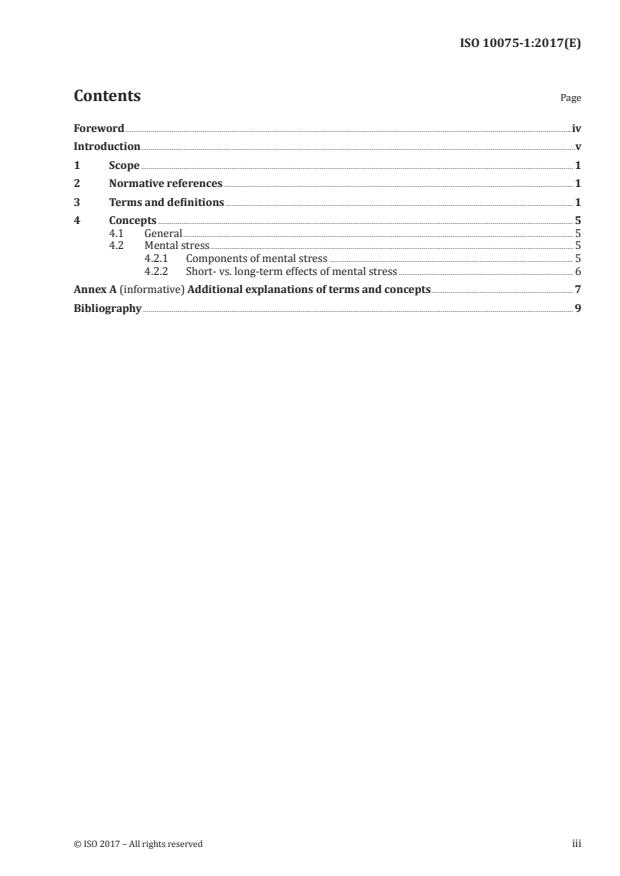
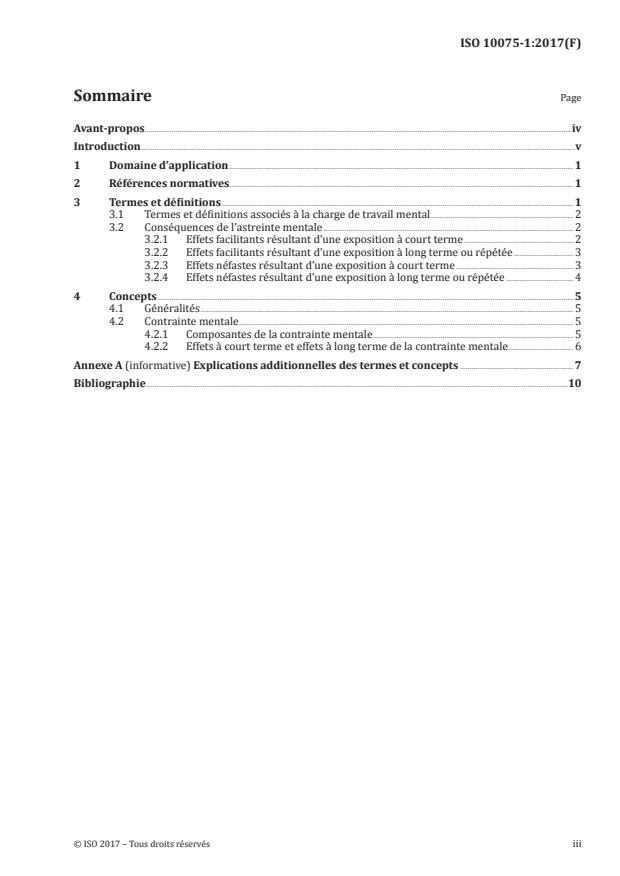
Contents Page
Foreword .iv
Introduction .v
1 Scope . 1
2 Normative references . 1
3 Terms and definitions . 1
4 Concepts . 5
4.1 General . 5
4.2 Mental stress . 5
4.2.1 Components of mental stress . 5
4.2.2 Short- vs. long-term effects of mental stress . 6
Annex A (informative) Additional explanations of terms and concepts . 7
Bibliography . 9
Foreword
ISO (the International Organization for Standardization) is a worldwide federation of national standards
bodies (ISO member bodies). The work of preparing International Standards is normally carried out
through ISO technical committees. Each member body interested in a subject for which a technical
committee has been established has the right to be represented on that committee. International
organizations, governmental and non-governmental, in liaison with ISO, also take part in the work.
ISO collaborates closely with the International Electrotechnical Commission (IEC) on all matters of
electrotechnical standardization.
The procedures used to develop this document and those intended for its further maintenance are
described in the ISO/IEC Directives, Part 1. In particular the different approval criteria needed for the
different types of ISO documents should be noted. This document was drafted in accordance with the
editorial rules of the ISO/IEC Directives, Part 2 (see www.iso.org/directives).
Attention is drawn to the possibility that some of the elements of this document may be the subject of
patent rights. ISO shall not be held responsible for identifying any or all such patent rights. Details of
any patent rights identified during the development of the document will be in the Introduction and/or
on the ISO list of patent declarations received (see www.iso.org/patents).
Any trade name used in this document is information given for the convenience of users and does not
constitute an endorsement.
For an explanation on the voluntary nature of standards, the meaning of ISO specific terms and
expressions related to conformity assessment, as well as information about ISO's adherence to the
World Trade Organization (WTO) principles in the Technical Barriers to Trade (TBT) see the following
URL: www.iso.org/iso/foreword.html.
This document was prepared by Technical Committee ISO/TC 159, Ergonomics, Subcommittee SC 1,
General ergonomics principles.
This first edition of ISO 10075-1, together with ISO 10075-2 and ISO 10075-3, cancels and replaces
ISO 10075:1991, which has been technically revised.
The main changes compared to the previous edition are as follows:
— Clause 1 has been adjusted;
— Clause 2 and the terms 3.1.2, 3.2.1.2, 3.2.1.3, 3.2.2.1, 3.2.3.2, 3.2.3.2.1, 3.2.3.2.2 and 3.2.3.3 have
been technically revised;
— the term 3.2.4.1 has been added;
— the term 3.2.3.2.3 has been corrected;
— Table A.1 has been updated;
— a linkage between ISO 10075-1 and ISO 6385 has been highlighted where applicable;
— Clause 3 has been restructured.
A list of all parts in the ISO 10075 series can be found on the ISO website.
iv © ISO 2017 – All rights reserved
Introduction
This document represents an extension of ISO 6385, with special respect to mental workload, describing
general issues, concepts and terms in more detail because of the specific consequences that have to be
taken into account in this domain.
These concepts from the field of mental workload include mental stress, mental strain and their effects.
Since there is a variety of different conceptions concerning mental workload, mental stress and mental
strain, both in colloquial as well as in scientific usage, a standardization of the relevant concepts and
terms in the field of ergonomics is required.
In this document, mental workload is considered as an umbrella term encompassing mental stress and
mental strain. Mental stress is considered as a neutral term rather than the negative outcome from
workload and other factors adopted in other approaches. In this way, it reflects a parallel with the
engineering use of the terms stress and strain. Thus, mental stress refers to the causes of mental strain,
and mental strain refers to the effects of that stress in the individual. This is consistent with the use of
the terms in other ergonomics standards, e.g. on thermal stress (see ISO 7933).
INTERNATIONAL STANDARD ISO 10075-1:2017(E)
Ergonomic principles related to mental workload —
Part 1:
General issues and concepts, terms and definitions
1 Scope
This document defines terms in the field of mental workload, covering mental stress and mental strain,
and short- and long-term, positive and negative consequences of mental strain. It also specifies the
relations between these concepts involved.
In this document, mental workload is regarded as an umbrella or generic term, referring to all the
concepts and constructs mentioned in the document and does not have a specified or standardized
meaning of its own within the document. This is consistent with the use of the term in ergonomics
and its applications, where it can refer to mental stress, mental strain and their effects, i.e. both to
the causes and the effects. In this document, the term mental workload will thus not be treated as a
technical term but only as a reference to the domain of mental workload.
NOTE Annex A gives additional explanations of terms and concepts.
This document applies to the design of working conditions with respect to mental workload and is
intended to promote a common usage of terminology between experts and practitioners in the field of
ergonomics as well as in general.
This document does not address methods of measurement and principles of task design, which are dealt
with in ISO 10075-2 and ISO 10075-3.
2 Normative references
There are no normative references in this document.
3 Terms and definitions
For the purposes of this document, the following terms and definitions apply.
ISO and IEC maintain terminological databases for use in standardization at the following addresses:
— ISO Online browsing platform: available at http://www.iso.org/obp
— IEC Electropedia: available at http://www.electropedia.org/
3.1 Terms and definitions associated with mental workload
3.1.1
mental stress
total of all assessable influences impinging upon a human being from external sources and affecting
that person mentally
Note 1 to entry: Since mental stress in this document refers to the total of all assessable factors impinging
upon an individual mentally, the colloquial usage of the term mental stresses (plural) is inconsistent with the
definition of mental stress in this document. The “total of all assessable influences” means that mental stress
is usually comprised of different factors contributing to this total. The combination of all these factors is the
resulting mental stress. Additional factors will change the resulting mental stress, but are not considered as new
kinds of mental stress. It is the result of the coaction of all effects that is referenced by the term mental stress. For
these reasons, a clear terminological differentiation between mental stress as the total of all impinging effects
(as defined above) and single or multiple factors as components of this mental stress is required.
Note 2 to entry: The use of “mental stress” in this document is compatible with the use of the term “work stress”
in ISO 6385, where it is synonymously used with the term “external workload”.
3.1.2
mental strain
immediate effect of mental stress (3.1.1) within the individual depending on their current condition
EXAMPLE Examples of relevant conditions can be age, gender, skills, coping strategies, fatigue, mood.
Note 1 to entry: Considerations in 3.1.1, Note 1 to entry also apply to the concept of mental strain, which refers to
the total, immediate impact within the individual resulting from mental stress.
3.2 Consequences of mental strain
NOTE The order of the following terms and definitions does not imply any functional relationships.
3.2.1 Facilitating effects resulting from short-term exposure
3.2.1.1
warming-up effect
frequent consequence of mental strain (3.1.2) which, soon after an activity has started, results in a
reduction of the effort required to perform that activity relative to the effort initially required
3.2.1.2
activation
internal state resulting in increased mental and physical activity
Note 1 to entry: Mental strain (3.1.2) can lead to different degrees of activation, depending on its duration and
intensity. There is a range in which the activation level is optimal, e.g. neither too low nor too high, ensuring best
functional efficiency.
3.2.1.3
learning
process based on (work) experiences that leads to enduring changes in behaviour or behavioural
potential, e.g. plans, attitudes and values
3.2.2 Facilitating effects resulting from long-term or repeated exposure
3.2.2.1
practice effect
enduring change in individual performance, associated with learning (3.2.1.3) processes, following
from repeated experience of the same kind of mental strain (3.1.2)
2 © ISO 2017 – All rights reserved
3.2.2.2
competence development
complex form of learning involving the acquisition, consolidation, enhancement and/or differentiation
of cognitive, emotional, social and motor skills and abilities, as strain-related consequence of an active
engagement with a task
Note 1 to entry: Competence development can have different facets, e.g. factual, methodological and/or social ones.
Note 2 to entry: Competence development is a facilitating long-term effect of the exposure to mental stress (3.1.1).
3.2.3 Impairing effects resulting from short-term exposure
NOTE Impairing effects can be distinguished by the temporal pattern of their emergence and recovery,
including the means necessary to achieve this recovery (which can require taking time for recuperation or
variation in activity). They can also be distinguished by their symptoms which can be general or more specific.
3.2.3.1
mental fatigue
temporary impairment of mental and physical functional efficiency, depending on the intensity,
duration, and temporal pattern of the preceding mental strain (3.1.2)
Note 1 to entry: In contrast to fatigue-like states (3.2.3.2) recovery from mental fatigue is achieved by rest rather
than changes in activity.
Note 2 to entry: This reduced functional efficiency becomes apparent, e.g. in feelings of tiredness, less favourable
relationships between performance and effort, type and frequency of errors. The extent of this impairment is
also determined by individual preconditions.
3.2.3.2
fatigue-like states
states within the individual as effects of mental strain (3.1.2) resulting from situations offering
little variety, which, in contrast to fatigue, quickly disappear after changes in the task and/or the
environment/situation
Note 1 to entry: As a rule common with mental fatigue (3.2.3.2), feelings of tiredness also occur in fatigue-like
states. However, they differ from mental fatigue by their transitoriness. Particularly marked interindividual
differences can be found with these fatigue-like states.
3.2.3.2.1
monotony
slowly developing state of reduced activation (3.2.1.2) which is mainly associated with drowsiness,
tiredness, decrease and fluctuations in performance, reductions in adaptability and responsiveness,
as well as an increase in variability of heart rate often associated with/facilitated by long, uniform,
repetitive task performance
EXAMPLE Monotony can be found in long, uniform, repetitive tasks or activities, e.g. assembly tasks,
data input.
Note 1 to entry: Symptoms of monotony usually develop more slowly than in the development of reduced vigilance
(3.2.3.2.2). Recovery from this state does not necessarily occur immediately after a change in the environment
or the task.
Note 2 to entry: Monotony and reduced vigilance (3.2.3.2.2) can be differentiated
...
NORME ISO
INTERNATIONALE 10075-1
Première édition
2017-09
Principes ergonomiques concernant la
charge de travail mental —
Partie 1:
Questions et concepts généraux,
termes et définitions
Ergonomic principles related to mental workload —
Part 1: General issues and concepts, terms and definitions
Numéro de référence
©
ISO 2017
DOCUMENT PROTÉGÉ PAR COPYRIGHT
© ISO 2017, Publié en Suisse
Droits de reproduction réservés. Sauf indication contraire, aucune partie de cette publication ne peut être reproduite ni utilisée
sous quelque forme que ce soit et par aucun procédé, électronique ou mécanique, y compris la photocopie, l’affichage sur
l’internet ou sur un Intranet, sans autorisation écrite préalable. Les demandes d’autorisation peuvent être adressées à l’ISO à
l’adresse ci-après ou au comité membre de l’ISO dans le pays du demandeur.
ISO copyright office
Ch. de Blandonnet 8 • CP 401
CH-1214 Vernier, Geneva, Switzerland
Tel. +41 22 749 01 11
Fax +41 22 749 09 47
copyright@iso.org
www.iso.org
ii © ISO 2017 – Tous droits réservés
Sommaire Page
Avant-propos .iv
Introduction .v
1 Domaine d’application . 1
2 Références normatives . 1
3 Termes et définitions . 1
3.1 Termes et définitions associés à la charge de travail mental . 2
3.2 Conséquences de l’astreinte mentale . 2
3.2.1 Effets facilitants résultant d’une exposition à court terme . 2
3.2.2 Effets facilitants résultant d’une exposition à long terme ou répétée . 3
3.2.3 Effets néfastes résultant d’une exposition à court terme . 3
3.2.4 Effets néfastes résultant d’une exposition à long terme ou répétée . 4
4 Concepts . 5
4.1 Généralités . 5
4.2 Contrainte mentale . 5
4.2.1 Composantes de la contrainte mentale . 5
4.2.2 Effets à court terme et effets à long terme de la contrainte mentale . 6
Annexe A (informative) Explications additionnelles des termes et concepts .7
Bibliographie .10
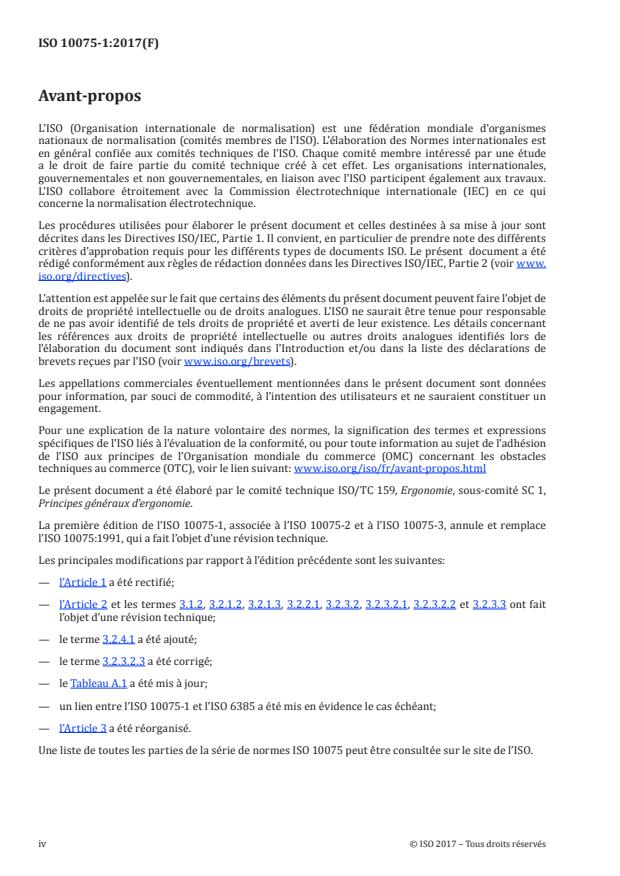
Avant-propos
L'ISO (Organisation internationale de normalisation) est une fédération mondiale d'organismes
nationaux de normalisation (comités membres de l'ISO). L'élaboration des Normes internationales est
en général confiée aux comités techniques de l'ISO. Chaque comité membre intéressé par une étude
a le droit de faire partie du comité technique créé à cet effet. Les organisations internationales,
gouvernementales et non gouvernementales, en liaison avec l'ISO participent également aux travaux.
L'ISO collabore étroitement avec la Commission électrotechnique internationale (IEC) en ce qui
concerne la normalisation électrotechnique.
Les procédures utilisées pour élaborer le présent document et celles destinées à sa mise à jour sont
décrites dans les Directives ISO/IEC, Partie 1. Il convient, en particulier de prendre note des différents
critères d'approbation requis pour les différents types de documents ISO. Le présent document a été
rédigé conformément aux règles de rédaction données dans les Directives ISO/IEC, Partie 2 (voir www.
iso.org/directives).
L'attention est appelée sur le fait que certains des éléments du présent document peuvent faire l'objet de
droits de propriété intellectuelle ou de droits analogues. L'ISO ne saurait être tenue pour responsable
de ne pas avoir identifié de tels droits de propriété et averti de leur existence. Les détails concernant
les références aux droits de propriété intellectuelle ou autres droits analogues identifiés lors de
l'élaboration du document sont indiqués dans l'Introduction et/ou dans la liste des déclarations de
brevets reçues par l'ISO (voir www.iso.org/brevets).
Les appellations commerciales éventuellement mentionnées dans le présent document sont données
pour information, par souci de commodité, à l’intention des utilisateurs et ne sauraient constituer un
engagement.
Pour une explication de la nature volontaire des normes, la signification des termes et expressions
spécifiques de l'ISO liés à l'évaluation de la conformité, ou pour toute information au sujet de l'adhésion
de l'ISO aux principes de l’Organisation mondiale du commerce (OMC) concernant les obstacles
techniques au commerce (OTC), voir le lien suivant: www.iso.org/iso/fr/avant-propos.html
Le présent document a été élaboré par le comité technique ISO/TC 159, Ergonomie, sous-comité SC 1,
Principes généraux d’ergonomie.
La première édition de l’ISO 10075-1, associée à l’ISO 10075-2 et à l’ISO 10075-3, annule et remplace
l’ISO 10075:1991, qui a fait l’objet d’une révision technique.
Les principales modifications par rapport à l’édition précédente sont les suivantes:
— l’Article 1 a été rectifié;
— l’Article 2 et les termes 3.1.2, 3.2.1.2, 3.2.1.3, 3.2.2.1, 3.2.3.2, 3.2.3.2.1, 3.2.3.2.2 et 3.2.3.3 ont fait
l’objet d’une révision technique;
— le terme 3.2.4.1 a été ajouté;
— le terme 3.2.3.2.3 a été corrigé;
— le Tableau A.1 a été mis à jour;
— un lien entre l’ISO 10075-1 et l’ISO 6385 a été mis en évidence le cas échéant;
— l’Article 3 a été réorganisé.
Une liste de toutes les parties de la série de normes ISO 10075 peut être consultée sur le site de l’ISO.
iv © ISO 2017 – Tous droits réservés
Introduction
Le présent document constitue une extension de l’ISO 6385 ayant trait spécialement à la charge de
travail mental et décrit de façon plus détaillée les questions générales, les concepts et les termes en
raison des conséquences spécifiques à prendre en compte dans ce domaine.
Ces concepts du domaine de la charge de travail mental comprennent la contrainte mentale, l’astreinte
mentale et leurs effets.
En raison de la diversité des conceptions concernant la charge de travail mental, la contrainte mentale
et l’astreinte mentale, aussi bien dans leur usage courant que scientifique, une normalisation des
concepts et des termes pertinents dans le domaine de l’ergonomie est nécessaire.
Dans le présent document, la charge de travail mental est considérée comme un terme générique
englobant la contrainte mentale et l’astreinte mentale. La contrainte mentale est considérée comme un
terme neutre plutôt que comme le résultat négatif d’une charge de travail et d’autres facteurs adoptés
dans d’autres approches. De cette manière, elle reflète un parallèle avec l’usage technique des termes
contrainte et astreinte. Ainsi, la contrainte mentale se rapporte aux causes de l’astreinte mentale, et
l’astreinte mentale se rapporte aux effets de cette contrainte sur l’individu. Cela est cohérent avec
l’utilisation des termes dans d’autres normes d’ergonomie, par exemple sur la contrainte thermique
(voir l’ISO 7933).
NORME INTERNATIONALE ISO 10075-1:2017(F)
Principes ergonomiques concernant la charge de travail
mental —
Partie 1:
Questions et concepts généraux, termes et définitions
1 Domaine d’application
Le présent document définit les termes du domaine de la charge de travail mental, y compris la
contrainte mentale et l’astreinte mentale, ainsi que les conséquences positives et négatives, à court
terme et à long terme, de l’astreinte mentale. Il prescrit les relations entre les concepts en jeu.
Dans le présent document, la charge de travail mental est considérée comme un terme générique se
rapportant à tous les concepts et éléments mentionnés dans le document et n’a pas de signification
propre spécifiée ou normalisée dans le document. Cela est cohérent avec l’utilisation du terme en
ergonomie et ses applications, où il peut se rapporter à une contrainte mentale, à une astreinte mentale
et à leurs effets, c’est-à-dire à la fois aux causes et aux effets. Dans le présent document, le terme
«charge de travail mental» ne sera pas traité comme un terme technique, mais uniquement comme une
référence au domaine de la charge de travail mental.
NOTE L’Annexe A donne des explications additionnelles des termes et concepts.
Le présent document est applicable à la conception des conditions de travail eu égard à la charge de
travail mental et vise à promouvoir l’usage commun d’une terminologie entre experts et praticiens dans
le domaine de l’ergonomie ainsi qu’en général.
Le présent document ne définit ni méthodes de mesurage ni principes de conception des tâches, lesquels
sont traités dans l’ISO 10075-2 et l’ISO 10075-3.
2 Références normatives
Le présent document ne contient aucune référence normative.
3 Termes et définitions
Pour les besoins du présent document, les termes et définitions suivants s’appliquent.
L’ISO et l’IEC tiennent à jour des bases de données terminologiques destinées à être utilisées en
normalisation, consultables aux adresses suivantes:
— ISO Online browsing platform: disponible à l’adresse http://www.iso.org/obp
— IEC Electropedia: disponible à l’adresse http://www.electropedia.org/
3.1 Termes et définitions associés à la charge de travail mental
3.1.1
contrainte mentale
ensemble des facteurs identifiables issus de sources externes exercés sur un être humain et l’affectant
mentalement
Note 1 à l'article: Étant donné que, dans le présent document, la contrainte mentale se rapporte à l’ensemble
des facteurs identifiables exerçant une influence mentale sur un individu, l’usage courant du terme «contraintes
mentales» (pluriel) est incohérent avec la définition de la contrainte mentale donnée dans le présent document.
L’ensemble des influences identifiables signifie que la contrainte mentale est généralement composée de
différents facteurs contribuant à cet ensemble. La combinaison de tous ces facteurs est la contrainte mentale
résultante. Des facteurs supplémentaires modifieront la contrainte mentale résultante, mais ne sont pas
considérés comme de nouveaux types de contrainte mentale. Le résultat de l’action conjointe de tous les effets
est désigné par le terme «contrainte mentale». Pour ces raisons, il est nécessaire de faire une nette distinction
terminologique entre la contrainte mentale en tant qu’ensemble de tous les effets exercés (telle que définie ci-
dessus) et les facteurs individuels ou multiples en tant que composantes de cette contrainte mentale.
Note 2 à l'article: L’utilisation du «contrainte mentale» dans le présent document est compatible avec l’utilisation
du terme «contrainte de travail» dans l’ISO 6385 où le terme «charge externe de travail» est utilisé comme
synonyme.
3.1.2
astreinte mentale
effet immédiat de la contrainte mentale (3.1.1) chez l’individu selon son état présent
EXEMPLE Les exemples de conditions pertinentes peuvent être l’âge, le sexe, le savoir-faire, les stratégies de
réaction, la fatigue, l’humeur.
Note 1 à l'article: Les considérations du 3.1.1, Note 1 à l’article, s’appliquent également au concept d’astreinte
mentale, qui se rapporte à l’impact total immédiat de la contrainte mentale chez l’individu.
3.2 Conséquences de l’astreinte mentale
NOTE L’ordre des termes et définitions suivants n’implique aucune relation fonctionnelle.
3.2.1 Effets facilitants résultant d’une exposition à court terme
3.2.1.1
effet d’échauffement
conséquence fréquente de l’astreinte mentale (3.1.2) qui provoque, dès le début d’une activité, une
réduction de l’effort requis pour effectuer cette activité par rapport à l’effort requis initialement
3.2.1.2
activation
état interne se traduisant par une activité mentale et physique accrue
Note 1 à l'article: L’astreinte mentale (3.1.2) peut créer différents degrés d’activation selon sa durée et son
intensité. Il existe une plage dans laquelle le niveau d’activation est optimal, c’est-à-dire ni trop faible ni trop
élevé, garantissant la meilleure efficacité fonctionnelle.
3.2.1.3
apprentissage
processus basé sur des expériences (de travail) qui conduit à des changements durables du
comportement ou du potentiel comportemental, par exemple plans, attitudes et valeurs
2 © ISO 2017 – Tous droits réservés
3.2.2 Effets facilitants résultant d’une exposition à long terme ou répétée
3.2.2.1
effet d’entraînement
modification persistante des performances individuelles, associée à des processus d’apprentissage
(3.2.1.3), à la suite d’une expérience répétée du même type d’astreinte mentale (3.1.2)
3.2.2.2
développement des compétences
forme complexe d’apprentissage (3.2.1.3) impliquant l’acquisition, la consolidation, l’amélioration et/ou
la différenciation de compétences et capacités cognitives, affectives, sociales et motrices, en tant que
conséquence liée à une astreinte d’une participation active à une tâche
Note 1 à l'article: Le développement des compétences peut avoir différentes facettes, par exemple factuelle,
méthodologique et/ou sociale.
Note 2 à l'article: Le développement des compétences est un effet facilitant à long terme de l’exposition à une
contrainte mentale (3.1.1).
3.2.3 Effets néfastes résultant d’une exposition à court terme
NOTE Les effets néfastes peuvent être différenciés selon leur profil temporel d’émergence et de récupération,
y compris les moyens nécessaires pour obtenir cette récupération (qui peut demander soit un temps de repos,
soit un changement d’activité). Ils peuvent également être différenciés par leurs symptômes qui peuvent être
généraux ou plus spécifiques.
3.2.3.1
fatigue mentale
altération temporaire de l’efficacité fonctionnelle mentale et physique, dépendant de l’intensité, de la
durée et du schéma temporel de l’astreinte mentale (3.1.2) précédente
Note 1 à l'article: Contrairement aux états similaires à la fatigue, le rétablissement suite à une fatigue mentale est
obtenu plutôt par le repos que par un changement d’activité.
Note 2 à l'article: Cette moindre efficacité fonctionnelle se manifeste, par exemple, par une impression de fatigue,
une moins bonne relation entre performance et effort, la nature et la fréquence des erreurs. L’étendue de cette
altération est également déterminée par les préconditions individuelles.
3.2.3.2
états similaires à la fatigue
états de l’individu tels que les effets de l’astreinte mentale (3.1.2) résultant de situations offrant peu de
variété, qui contrairement à la fatigue, disparaissent rapidement après des changements de la tâche
et/ou de l’environnement/situation
Note 1 à l'article: En règle générale, comme pour la fatigue mentale, des impressions de fatigue physique
apparaissent également dans les états similaires à la fatigue. Ils diffèrent cependant de la fatigue mentale par leur
aspect passager. Ces états similaires à la fatigue peuvent présenter des différences particulièrement marquées
d’un individu à l’autre.
3.2.3.2.1
monotonie
état d’activation (3.2.1.2) réduite à évolution lente, qui est principalement associé à une somnolence, une
lassitude physique, une diminution et une fluctuation des performances, une réduction de l’adaptabilité
et de la réactivité ainsi qu’une plus grande variabilité de la fréquence cardiaque souvent associées
à/facilitées par la réalisation de tâches longues, uniformes et répétitives
EXEMPLE La monotonie peut apparaître au cours de tâches ou activités longues, uniformes, répétitives, par
exemple les tâches d’assemblage, la saisie de données.
Note 1 à l'article: Les symptômes de la monotonie se développent généralement plus lentement que dans le
cas d’une hypovigilance. La récupération de cet état ne se produit pas nécessairement dès un changement de
l’environnement ou de la tâche.
----------
...
Questions, Comments and Discussion
Ask us and Technical Secretary will try to provide an answer. You can facilitate discussion about the standard in here.
Loading comments...