

ISO 14624-2:2023
(Main)Space systems — Safety and compatibility of materials — Part 2: Determination of flammability of electrical-wire insulation and accessory materials
General Information
- Abstract
This document specifies two test methods for determining the flammability of electrical-wire insulation and accessory materials by exposure to an external ignition source in a static environment (test A) and in a gas-flow environment (test B). These tests determine if a wire insulation material, when exposed to a standard ignition source, will self-extinguish and not transfer burning debris which can ignite adjacent materials.
- Status
- Published
- Publication Date
- 09-Oct-2023
- Technical Committee
- ISO/TC 20/SC 14 - Space systems and operations
- Drafting Committee
- ISO/TC 20/SC 14 - Space systems and operations
- Current Stage
- 6060 - International Standard published
- Start Date
- 10-Oct-2023
- Due Date
- 20-May-2023
- Completion Date
- 10-Oct-2023
Overview
ISO 14624-2:2023 - "Space systems - Safety and compatibility of materials - Part 2" defines standardized methods to assess the flammability of electrical-wire insulation and accessory materials used in spacecraft and related systems. The standard specifies two complementary test methods: Test A (static environment) and Test B (gas-flow environment). Both methods evaluate whether an insulated-wire assembly, when exposed to a defined ignition source, will self‑extinguish and avoid transfer of burning debris that could ignite adjacent materials.
Key topics and technical requirements
- Two test methods
- Test A (static): Exposes a representative wire specimen to a chemical ignitor in a still atmosphere to determine burn length and transfer risk.
- Test B (gas‑flow): Evaluates flammability under flowing-gas conditions to simulate pressurized or flowing environments.
- Pass/fail criteria
- A specimen is considered self‑extinguishing if burn length does not exceed 150 mm on a standard specimen; failure of any single replicate constitutes failure of the material under that test condition.
- Tests also check for transfer of burning debris (paper ignition under the specimen is a common indicator).
- Specimen definition and preparation
- Standard test specimen: representative wire segment (document cites 1.2 m length with an active length of 300 mm); wire configuration and insulation thickness must represent worst‑case use.
- Environmental controls
- Ambient conditions specified (e.g., oxygen concentration 20.9% ± 0.2%, pressure 101.4 kPa ± 5 kPa, temperature 23 °C ± 5 °C).
- Worst‑case configurations (oxygen, pressure, temperature) should be considered when selecting test conditions.
- Ignition source and reproducibility
- Use of a validated chemical ignitor (requirements and example preparation given; see Annex A).
- Requirements for accuracy, test reporting, and Good Laboratory Practice (GLP) to ensure repeatability.
Practical applications and users
- Who uses it: aerospace and satellite manufacturers, harness and cable suppliers, materials engineers, test laboratories, regulatory and safety compliance teams.
- Why it matters:
- Ensures spacecraft wiring systems meet safety and compatibility criteria for in‑flight environments.
- Guides selection of insulation materials and accessory components to minimize fire risk, burn propagation, and risk of secondary ignition.
- Supports procurement specifications, qualification testing, and design reviews for spacecraft electrical systems.
Related standards
- This document is part of the ISO 14624 series on space system material safety and references ISO 14624‑1:2023 terminology and related test definitions.
- Conforms with ISO/IEC editorial and development practices for consistency across electrotechnical and space-system standards.
Keywords: ISO 14624-2:2023, flammability testing, electrical‑wire insulation, space systems safety, wire insulation flammability test, test A static, test B gas‑flow, chemical ignitor, self‑extinguish, burn length.
Relations
- Effective Date
- 06-Jun-2022
Get Certified
Connect with accredited certification bodies for this standard

BUREAU VERITAS Certification Germany
Bureau Veritas certification in Germany.

Element Materials Technology
Materials testing and product certification.

AQMS Ltd.
AQMS provides ISO certification to SMEs across the UK.
Sponsored listings
Frequently Asked Questions
ISO 14624-2:2023 is a standard published by the International Organization for Standardization (ISO). Its full title is "Space systems — Safety and compatibility of materials — Part 2: Determination of flammability of electrical-wire insulation and accessory materials". This standard covers: This document specifies two test methods for determining the flammability of electrical-wire insulation and accessory materials by exposure to an external ignition source in a static environment (test A) and in a gas-flow environment (test B). These tests determine if a wire insulation material, when exposed to a standard ignition source, will self-extinguish and not transfer burning debris which can ignite adjacent materials.
This document specifies two test methods for determining the flammability of electrical-wire insulation and accessory materials by exposure to an external ignition source in a static environment (test A) and in a gas-flow environment (test B). These tests determine if a wire insulation material, when exposed to a standard ignition source, will self-extinguish and not transfer burning debris which can ignite adjacent materials.
ISO 14624-2:2023 is classified under the following ICS (International Classification for Standards) categories: 13.220.40 - Ignitability and burning behaviour of materials and products; 49.025.01 - Materials for aerospace construction in general; 49.140 - Space systems and operations. The ICS classification helps identify the subject area and facilitates finding related standards.
ISO 14624-2:2023 has the following relationships with other standards: It is inter standard links to ISO 14624-2:2003. Understanding these relationships helps ensure you are using the most current and applicable version of the standard.
ISO 14624-2:2023 is available in PDF format for immediate download after purchase. The document can be added to your cart and obtained through the secure checkout process. Digital delivery ensures instant access to the complete standard document.
Standards Content (Sample)
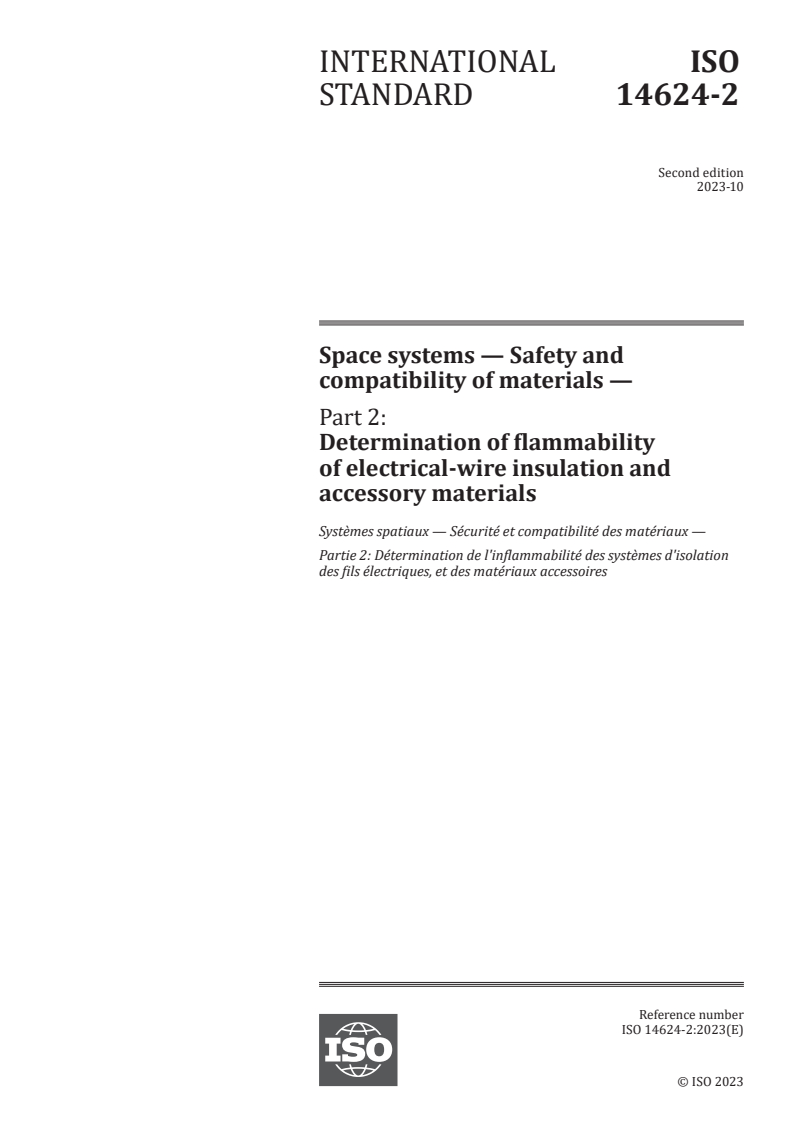
INTERNATIONAL ISO
STANDARD 14624-2
Second edition
2023-10
Space systems — Safety and
compatibility of materials —
Part 2:
Determination of flammability
of electrical-wire insulation and
accessory materials
Systèmes spatiaux — Sécurité et compatibilité des matériaux —
Partie 2: Détermination de l'inflammabilité des systèmes d'isolation
des fils électriques, et des matériaux accessoires
Reference number
© ISO 2023
All rights reserved. Unless otherwise specified, or required in the context of its implementation, no part of this publication may
be reproduced or utilized otherwise in any form or by any means, electronic or mechanical, including photocopying, or posting on
the internet or an intranet, without prior written permission. Permission can be requested from either ISO at the address below
or ISO’s member body in the country of the requester.
ISO copyright office
CP 401 • Ch. de Blandonnet 8
CH-1214 Vernier, Geneva
Phone: +41 22 749 01 11
Email: copyright@iso.org
Website: www.iso.org
Published in Switzerland
ii
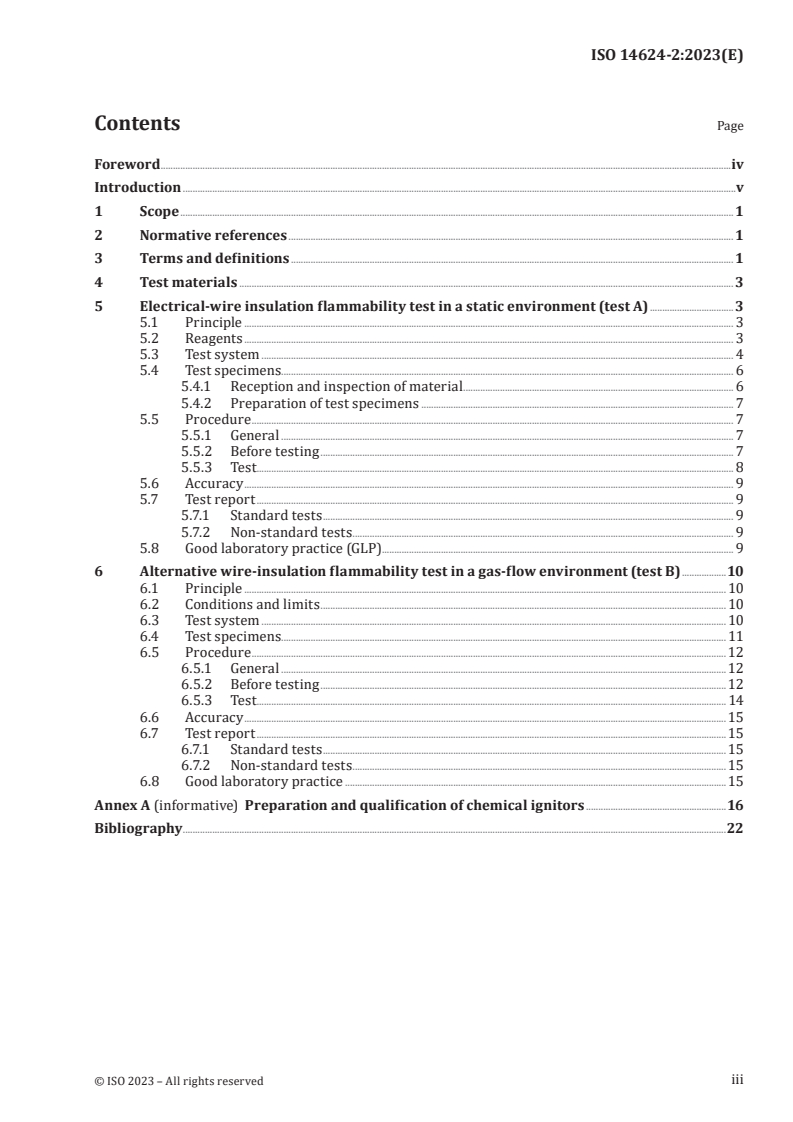
Contents Page
Foreword .iv
Introduction .v
1 Scope . 1
2 Normative references . 1
3 Terms and definitions . 1
4 Test materials . 3
5 Electrical-wire insulation flammability test in a static environment (test A) .3
5.1 Principle . 3
5.2 Reagents . 3
5.3 Test system . 4
5.4 Test specimens. 6
5.4.1 Reception and inspection of material . 6
5.4.2 Preparation of test specimens . 7
5.5 Procedure . 7
5.5.1 General . 7
5.5.2 Before testing . 7
5.5.3 Test . . . 8
5.6 Accuracy . 9
5.7 Test report . 9
5.7.1 Standard tests . 9
5.7.2 Non-standard tests . 9
5.8 Good laboratory practice (GLP) . . 9
6 Alternative wire-insulation flammability test in a gas-flow environment (test B) .10
6.1 Principle . 10
6.2 Conditions and limits . 10
6.3 Test system . 10
6.4 Test specimens. 11
6.5 Procedure .12
6.5.1 General .12
6.5.2 Before testing .12
6.5.3 Test . . . 14
6.6 Accuracy . 15
6.7 Test report . 15
6.7.1 Standard tests . 15
6.7.2 Non-standard tests . 15
6.8 Good laboratory practice .15
Annex A (informative) Preparation and qualification of chemical ignitors .16
Bibliography .22
iii
Foreword
ISO (the International Organization for Standardization) is a worldwide federation of national standards
bodies (ISO member bodies). The work of preparing International Standards is normally carried out
through ISO technical committees. Each member body interested in a subject for which a technical
committee has been established has the right to be represented on that committee. International
organizations, governmental and non-governmental, in liaison with ISO, also take part in the work.
ISO collaborates closely with the International Electrotechnical Commission (IEC) on all matters of
electrotechnical standardization.
The procedures used to develop this document and those intended for its further maintenance are
described in the ISO/IEC Directives, Part 1. In particular, the different approval criteria needed for the
different types of ISO document should be noted. This document was drafted in accordance with the
editorial rules of the ISO/IEC Directives, Part 2 (see www.iso.org/directives).
ISO draws attention to the possibility that the implementation of this document may involve the use
of (a) patent(s). ISO takes no position concerning the evidence, validity or applicability of any claimed
patent rights in respect thereof. As of the date of publication of this document, ISO had not received
notice of (a) patent(s) which may be required to implement this document. However, implementers are
cautioned that this may not represent the latest information, which may be obtained from the patent
database available at www.iso.org/patents. ISO shall not be held responsible for identifying any or all
such patent rights.
Any trade name used in this document is information given for the convenience of users and does not
constitute an endorsement.
For an explanation of the voluntary nature of standards, the meaning of ISO specific terms and
expressions related to conformity assessment, as well as information about ISO's adherence to
the World Trade Organization (WTO) principles in the Technical Barriers to Trade (TBT), see
www.iso.org/iso/foreword.html.
This document was prepared by Technical Committee ISO/TC20, Aircraft and space vehicles,
Subcommittee SC 14, Space systems and operations.
This second edition cancels and replaces the first edition (ISO 14624-2:2003), which has been
technically revised.
The main changes are as follows:
— updated 6.3.5 "Resistance meter";
— updated the Bibliography.
A list of all parts in the ISO 14624 series can be found on the ISO website.
Any feedback or questions on this document should be directed to the user’s national standards body. A
complete listing of these bodies can be found at www.iso.org/members.html.
iv
Introduction
In this document, the following verbal forms are used:
— “shall” indicates a requirement;
— “should” indicates a recommendation;
— “may” indicates a permission;
— “can” indicates a possibility or a capability.
Recommended criteria are, while not mandatory, considered to be of primary importance in providing
serviceable economical and practical designs. Deviations from the recommended criteria may be made
only after careful consideration, extensive testing and thorough service evaluation have shown an
alternative method to be satisfactory.
v
INTERNATIONAL STANDARD ISO 14624-2:2023(E)
Space systems — Safety and compatibility of materials —
Part 2:
Determination of flammability of electrical-wire insulation
and accessory materials
1 Scope
This document specifies two test methods for determining the flammability of electrical-wire insulation
and accessory materials by exposure to an external ignition source in a static environment (test A) and
in a gas-flow environment (test B). These tests determine if a wire insulation material, when exposed
to a standard ignition source, will self-extinguish and not transfer burning debris which can ignite
adjacent materials.
2 Normative references
There are no normative references in this document.
3 Terms and definitions
For the purposes of this document, the following terms and definitions apply.
ISO and IEC maintain terminology databases for use in standardization at the following addresses:
— ISO Online browsing platform: available at https:// www .iso .org/ obp
— IEC Electropedia: available at https:// www .electropedia .org/
3.1
ambient conditions
test environment with an oxygen concentration of 20,9 % ± 0,2 %, a pressure of 101,4 kPa ± 5 kPa, and
a temperature of 23 °C ± 5 °C
[SOURCE: ISO 14624-1:2023, 3.1]
3.2
burn length
distance from the ignition location (point directly above the igniter) to the farthest evidence of
flame consumption damage or flame attachment point to the test specimen’s insulation material as
determined by visual observation, visual/physical post-test examination, video of burn, and/or other
means
Note 1 to entry: See Table 1 and Figure 2. The burn length distance includes areas of partial or complete
combustion, charring or embrittlement, but does not include heat affected areas which can have been damaged
only by the heat of the flames emanating from sample consumption below. Heat affected areas appear as sooted,
stained, warped or discoloured, or areas where the material has shrunk or melted away from the heat. In some
cases, the flame can propagate beyond the farthest evidence of damage to the test specimen.
Table 1 — Burn length assessment characteristics and techniques summary
Burn length / Burn length
Heat affected damage area
Flame consumption damage determination techniques
Complete combustion Sooted Visual observation
Partial combustion Stained Visual post-test examination
Charring Warped Physical post-test examination
Embrittlement Melted away from heat Video of burn
Furthest flame attachment point Shrunk away from heat Other means
3.3
burn propagation time
time that elapses from ignition of the specimen until vertical flame propagation stops
[SOURCE: ISO 14624-1:2023, 3.3]
3.4
chemical ignitor
ignitor validated to strict specifications in order to produce a flame that meets all the requirements for
an ignition source
Note 1 to entry: The requirements for the ignition source are specified in 5.3.3. See Annex A for one method of
producing a chemical ignitor.
[SOURCE: ISO 14624-1:2023, 3.4, modified — In note 1 to entry, the cross-reference to 6.3 has been
replaced by 5.3.3.]
3.5
good laboratory practice
GLP
practice which involves the testing of standard reference materials to verify data accuracy and
repeatability
Note 1 to entry: In addition, the test facility shall successfully demonstrate the ability to obtain repeatable data
when testing a selected material. The authority having jurisdiction shall choose appropriate GLP materials and
shall determine the frequency of testing these materials for its test facilities.
[SOURCE: ISO 14624-1:2023, 3.5]
3.6
self-extinguish
phenomenon in which the burn length (3.2) on a standard test specimen (3.7) does not exceed 150 mm
[SOURCE: ISO 14624-1:2023, 3.7]
3.7
standard test specimen
representative part of a wire with insulation materials, taken from a quantity of material or fabricated
per required preparation method, with a length of 1,2 m and an active length of 300 mm
Note 1 to entry: See 5.3.2.1 to 5.3.2.3.
Note 2 to entry: Wire configuration and end use application should be considered in determining what constitutes
a representative test specimen. Features such as wire conductor size, number of conductors, insulation materials,
insulation thickness can impact flammability.
3.8
transfer of burning debris
movement of any material from a burning specimen with sufficient energy to ignite adjacent material
Note 1 to entry: The sheet of paper below the test specimen is specified in 5.3.8.
[SOURCE: ISO 14624-1:2023, 3.10, modified — In note 1 to entry, the cross-reference to 6.8 has been
replaced by 5.3.8.]
3.9
worst-case test configuration
test configuration that simulates worst-case anticipated use conditions including wire configuration,
test pressure, test temperature, and oxygen concentration
Note 1 to entry: Worst-case represents the cumulative effect of multiple factors that increase the probability
that a wire is flammable; wire configuration, increased oxygen concentration, increased pressure, increased
temperature, etc. Furthermore, oxygen concentration (volume fraction) is typically the primary driver of
flammability and should be prioritized over pressure when examining for worst-case conditions.
4 Test materials
As a minimum, all materials used in testing shall meet or exceed user specifications (see 6.3.2 for
minimum material requirements).
Material and configured-system characteristics can be significantly compromised by sources of
contamination, such as exposure to solvents, cleaning agents, abnormal temperatures, variations in
humidity, environmental pollutants, particulates and handling. It is important that exposure of test
specimen(s) to these and other contamination sources be sufficiently controlled to minimize variation
in test results.
5 Electrical-wire insulation flammability test in a static environment (test A)
5.1 Principle
The purpose of this test (test A) is to determine if a wire configuration’s insulation system, when
exposed to an external ignition source, will self-extinguish and will not ignite adjacent materials by
the transfer of burning debris (see 5.3.2.1 to 5.3.2.3 for additional guidance). An insulation system is
determined to be flammable if the burn length of any one of the five standard test specimen replicate
samples is greater than 150 mm at an internal wire temperature of 125 °C or at the maximum operating
temperature of the configuration. In addition, the ignited specimens shall not ignite the paper (produce
flaming combustion) below the test samples, which indicates that the transfer of burning debris has
sufficient energy to ignite adjacent materials. If, during a test, the paper used as an indication of the
transfer of burning debris ignites because of burning debris, subsequent burns during the same wire
test should be conducted without paper to eliminate burning paper interference.
Failure of any one specimen constitutes failure of the material in the test environment.
Test specimens shall be tested in the worst-case test configuration. If the worst-case oxygen
concentration is uncertain, determination of the maximum oxygen concentration is recommended.
5.2 Reagents
5.2.1 Test gases. The test atmosphere shall consist of a mixture of oxygen and nitrogen, mixed
thoroughly before testing a specimen. These gases can be premixed before introduction of the mixture
into the test chamber, or the oxygen and nitrogen can be introduced separately into the test chamber,
and then mixed inside the test chamber with a test specimen.
Oxygen gases used in test gas mixtures shall be verified to have a minimum purity of 99,5 % and
1)
moisture <7 µl/l . Nitrogen gases used in test gas mixtures shall be verified to have a minimum purity
of 99,9 % and moisture <11,5 µl/l. Pre and post-test gases are analysed for CO and CO and post test
results reported. Also, the gas mixture shall be verified for conformity with the specification (including
accuracy) for oxygen concentration to within + 1 % −0 %.
1) 1 µl/l = 1 part per million (ppm). The use of “ppm” is deprecated.
5.3 Test system
5.3.1 Test chamber, large enough so that complete combustion of the specimen can occur with no
more than a 5 % relative depletion of oxygen concentration. In addition, the test chamber shall not
interfere chemically or physically with the test. The free space above and below the test fixture shall be
at least 200 mm.
5.3.2 Measuring devices, properly calibrated.
5.3.3 Chemical ignition source, meeting the following specifications in ambient conditions:
a) temperature: 1 100 °C ± 90 °C measured using a 0,81 mm (0,5 mm diameter) exposed tip type K
thermocouple;
b) burning duration: 25 s ± 5 s;
c) maximum visible flame height: 65 mm ± 6,5 mm.
Annex A provides a procedure for preparing, certifying and storing chemical ignitors.
NOTE This test method and the corresponding ignition source were designed to evaluate materials for use
in spacecraft habitable environments with typical oxygen concentration ranges (19 % to 50 % volume fraction
of oxygen). When evaluating environments outside of these typical ranges the standard ignition source can not
be adequate. In these cases, alternative ignition mechanisms can be utilized but test data is reported as a non
ISO 14624-1 standard.
5.3.4 AC power supply, capable of providing 15 A (root mean square), connected to a bare 0,81 mm
nickel-chromium wire (5.3.5) to initiate the igniter.
5.3.5 Bare nickel-chromium wire 0,81 mm (0,5 mm diameter), with a nominal resistivity
of 2 Ω⋅m to 2,5 Ω⋅m and of sufficient length to wrap three equally spaced turns around the chemical
igniter.
5.3.6 Suitable specimen holder, capable of supporting the centre third of the wire or wire bundle
from one top corner of the fixture to the opposite bottom corner of the fixture at an angle of 15° ± 2° to
the vertical (see Figure 1).
5.3.7 Scale, attached to one side of the specimen holder, for measurement of the burn length.
5.3.8 Sheet of paper, mounted horizontally approximately 200 mm below the specimen, but
50 mm above the bottom of the test chamber, centred directly below the specimen. The paper shall
be supported by a non-flammable, non-conducting screen material. The paper shall have the following
characteristics:
a) dimensions: (200 mm ± 50 mm) × (300 mm ± 50 mm);
2 2
b) surface density: between 200 g/m and 300 g/m ;
c) type: chemical wood processed;
d) colour: uniformly white;
e) condition: clean, free from dirt spots, oil spots and foreign matter (lint, fuzz, etc.), free
from holes, tears, cuts, folds and scuff marks, and containing no splices.
The sheet of paper is used to assess if burning debris from the specimen could cause ignition of adjacent
materials.
5.3.9 DC power supply, capable of providing a regulated DC current (150 A maximum) to the
conductor of the test specimen at the level required to reach the specified internal wire temperature.
Key
1 specimen
2 scale
3 insulating ceramic-fibre thread
4 ceramic insulator
5 ignitor
Figure 1 — Standard test specimen holder and specimen configuration
Key
1 specimen
2 igniter
3 igniter coil
Figure 2 — 15° surface ignition igniter position and ignition point
5.4 Test specimens
5.4.1 Reception and inspection of material
5.4.1.1 Receive and visually inspect the test wires: when received, the wires shall be accompanied by
proper identification. Any flaws shall be noted. Wire specimens should have been cleaned and dried to
the end-use specifications prior to receipt at the test facility.
5.4.1.2 If required, prepare specimens to the proper dimensions.
5.4.1.3 If specimens are received with obvious contamination, clean them. All cleaning methods shall
be approved by the test requester prior to use. Surface contamination shall be removed by washing with
deionized water and mild detergent, rinsing with deionized water and drying with filtered nitrogen
gas.
5.4.1.4 After preparation and/or cleaning at the test facility, inspect the specimens and note any
flaws and any residual contamination. If the flaws result from specimen preparation at the test facility,
new specimens shall be prepared. Specimens shall be weighed and individually identified.
5.4.2 Preparation of test specimens
5.4.2.1 Single wire: To prepare a standard test specimen, cut a single conductor to a length of 1,2 m
and remove 10 mm of insulation from each end of the wire using an appropriate wire stripper. Attach
appropriate non-insulated crimp spade lugs to the ends of the wire.
5.4.2.2 Multiple wire bundle: To prepare an optional variation of the standard test specimen using
a multiwire configuration, cut out six additional wires of length 430 mm. Place the active conductor on
the perimeter of the multiwire configuration. Lace the active conductor and the six additional wires
tightly together using appropriate non-flammable wire ties placed 80 mm apart (see Figure 3).
5.4.2.3 Other configurations: wire, wire bundles, cables and/or electrical harnesses including other
features (i.e. cable clamps, sleeving, splices, end terminations etc.). Duplicates of actual-use electrical
harnesses and accessories, with or without connections, may be used in lieu of the specimen described
in 5.3.2.2. The active conductor(s) shall be identified by the test requester. Mating connections shall be
supplied where applicable.
Dimensions in millimetres
Key
1 active conductor
2 wire bundle
3 wire tie
a
Typical distance.
Figure 3 — Optional wire bundle configuration
5.5 Procedure
5.5.1 General
This test method shall be performed per the procedure specified in 5.5.2 and 5.5.3.
WARNING — Burning of materials can produce smoke and toxic gases and residues, which can
affect the health of operators. Clear test area of smoke and fumes by suitable means. Ensure
appropriate safety precautions are taken at all times.
5.5.2 Before testing
5.5.2.1 Before testing, observe the surfaces of the test specimens and record any pertinent
observations, such as imperfections, discolorations. Also, record all pertinent information (including
pressure, specimen identification, insulation thickness, pre-test mass, and wire gauge and
configuration). Photograph all typical pretest specimens.
5.5.2.2 Determine the amount of current required to obtain the internal wire temperature specified
for the test. This is done by mounting the specimen in the test fixture with the power supply attached
to the conductor. Maintain the test fixture in a draft-free environment at ambient temperature. Insert
microthermocouple probes (0,18 mm) so that the microthermocouples are in contact with the active
conductor. Perform wire temperature measurements in at least three locations: in the middle of the
wire and at approximately 30 mm from centre in both directions. Raise electrical current until the test
temperature of the wire is attained (as measured at the three locations).
Maintain temperature until stable to within ±3 °C for 5 min. Do not exceed test temperature of the wire.
Record the voltage drop and current that produce the required temperature. This determination need
only be made once for each wire having the same insulation material and insulation thickness, the same
gauge and the same manufacturer.
5.5.2.3 After the wire current has been determined, mount a new 1, 2 m length of wire (3.10) as
described in 5.3.6, and arrange the excess lengths of wire to be clear of any flames which could come
from the specimen holder area. Place the ignitor 8 mm ± 3 mm below the diagonally mounted test
specimen and 3 mm ± 1 mm to the right of the lower attached corner of the test specimen, as shown
in Figure 1 and Figure 2. Measurements made from the top point of the igniter surface to the sample
surface. Place the ignitor perpendicular to and centred in the plane of the specimen (see Figure 1).
Place the test fixture in the test chamber. Connect the ends of the conductor to the power supply and a
voltmeter. Finally, mount the paper horizontally 200 mm and centred directly below the specimen. Hold
the paper in place by a non-flammable, non-conducting screen material.
5.5.2.4 Video record all specimens during testing.
5.5.3 Test
5.5.3.1 Before ignition of chemical ignitor
Test five replicate test specimens.
Subject the test specimen to vacuum for no less than 1 min, but no more than 3 min before introduction
of the proper test atmosphere.
If vacuum exposure damages the test material, purging of the test chamber or gas supplementation can
be used to achieve the required test atmosphere.
Expose the test specimen to the proper test atmosphere for a minimum of 3 min before ign
...