

ISO 6742-2:2023
(Main)Cycles — Lighting and retro-reflective devices — Part 2: Retro-reflective devices
General Information
- Abstract
This document is applicable to retro-reflective devices used on cycles intended to be used on public roads and, especially, bicycles complying with ISO 4210[1] and ISO 8098[2]. This part of ISO 6742 specifies photometric and physical requirements of retro-reflective devices.
- Status
- Published
- Publication Date
- 31-Aug-2023
- Technical Committee
- ISO/TC 149/SC 1 - Cycles and major sub-assemblies
- Drafting Committee
- ISO/TC 149/SC 1 - Cycles and major sub-assemblies
- Current Stage
- 6060 - International Standard published
- Start Date
- 01-Sep-2023
- Due Date
- 10-Feb-2024
- Completion Date
- 31-Aug-2023

Overview - ISO 6742-2:2023 (Retro‑reflective devices for cycles)
ISO 6742-2:2023 is the fourth edition of the ISO standard that specifies photometric and physical requirements for retro‑reflective devices used on cycles, especially bicycles intended for use on public roads and complying with ISO 4210 and ISO 8098. The standard covers reflectors, wide‑angle and conventional types, retro‑reflective tyres, retro‑reflective spokes or spoke cases, and pedal reflectors, and sets out test methods, colourimetry and marking requirements to verify performance and durability.
Key topics and technical requirements
- Scope and device types: Defines terms and classifications for conventional, wide‑angle and high‑value reflectors, retro‑reflective tyres, spokes/spoke cases and pedal reflectors.
- Photometrical requirements: Divides requirements into Group A and Group B to accommodate differing national regulations; includes tables of minimum luminous intensity coefficients for each device type and test point.
- Colorimetric requirements: Specifies visual inspection and instrumental methods (trichromatic coordinates) consistent with CIE references to verify colour of retro‑reflective surfaces.
- Physical and environmental tests:
- Temperature resistance, moisture resistance
- Resistance to fuels and lubricating oils
- Impact testing (for certain reflector groups)
- Corrosion considerations (references ISO 9227 salt‑spray tests)
- Photometric test procedures: Details instrumentation arrangement - source of illumination, receiver/observer, observation distance, illuminance at the reflector, orientation and test area - and separate methods for tyres and spoke assemblies.
- Testing order and sample submission: Provides a chronological order of tests and required sample treatments (see Clause 4.2 and Table 2).
- Marking and documentation: Requirements for marking devices to support identification and conformity assessment.
- Annexes and updates: Includes Annex A with an alternative Group B test method using negative pressure; this edition updates terminology (adds “pedal reflector”), angle units (degrees), and other technical clarifications.
Practical applications - who uses this standard
- Bicycle and accessory manufacturers - design and validate reflectors, tyres, spoke cases and pedals to meet legal and market safety requirements.
- Testing and certification laboratories - implement the photometric, colourimetric and physical test methods for product approval and quality control.
- Regulators and procurement officers - reference ISO 6742-2:2023 when specifying minimum visibility and durability requirements for cycles used on public roads.
- Product designers and engineers - use the standard to inform optical design, material selection and mounting methods that ensure compliance and road safety.
Related standards and references
- ISO 4210 (bicycle safety requirements)
- ISO 8098 (children’s bicycles)
- ISO 9227 (salt spray corrosion tests)
- CIE 15 and CIE 1931 (colourimetry)
- UN/ECE Regulation No.150 (retro‑reflective device symbols/terminology)
Keywords: ISO 6742-2:2023, retro‑reflective devices, cycle reflectors, photometric requirements, retro‑reflective tyres, bicycle safety standard.
Relations
- Effective Date
- 01-Jul-2026
- Effective Date
- 06-Jun-2022
- Revises
ISO 6742-2:2015 - Cycles — Lighting and retro-reflective devices — Part 2: Retro-reflective devices - Effective Date
- 06-Jun-2022
Get Certified
Connect with accredited certification bodies for this standard

TÜV Rheinland
TÜV Rheinland is a leading international provider of technical services.

TÜV SÜD
TÜV SÜD is a trusted partner of choice for safety, security and sustainability solutions.

DEKRA Certification Inc.
DEKRA US certification services.
Sponsored listings
Frequently Asked Questions
ISO 6742-2:2023 is a standard published by the International Organization for Standardization (ISO). Its full title is "Cycles — Lighting and retro-reflective devices — Part 2: Retro-reflective devices". This standard covers: This document is applicable to retro-reflective devices used on cycles intended to be used on public roads and, especially, bicycles complying with ISO 4210[1] and ISO 8098[2]. This part of ISO 6742 specifies photometric and physical requirements of retro-reflective devices.
This document is applicable to retro-reflective devices used on cycles intended to be used on public roads and, especially, bicycles complying with ISO 4210[1] and ISO 8098[2]. This part of ISO 6742 specifies photometric and physical requirements of retro-reflective devices.
ISO 6742-2:2023 is classified under the following ICS (International Classification for Standards) categories: 43.150 - Cycles. The ICS classification helps identify the subject area and facilitates finding related standards.
ISO 6742-2:2023 has the following relationships with other standards: It is inter standard links to EN 17860-2:2024+A1:2026, ISO 6742-2:2015/Amd 1:2018, ISO 6742-2:2015. Understanding these relationships helps ensure you are using the most current and applicable version of the standard.
ISO 6742-2:2023 is available in PDF format for immediate download after purchase. The document can be added to your cart and obtained through the secure checkout process. Digital delivery ensures instant access to the complete standard document.
Standards Content (Sample)
INTERNATIONAL ISO
STANDARD 6742-2
Fourth edition
2023-08
Cycles — Lighting and retro-reflective
devices —
Part 2:
Retro-reflective devices
Cycles — Éclairage et dispositifs rétroréfléchissants —
Partie 2: Dispositifs rétroréfléchissants
Reference number
© ISO 2023
All rights reserved. Unless otherwise specified, or required in the context of its implementation, no part of this publication may
be reproduced or utilized otherwise in any form or by any means, electronic or mechanical, including photocopying, or posting on
the internet or an intranet, without prior written permission. Permission can be requested from either ISO at the address below
or ISO’s member body in the country of the requester.
ISO copyright office
CP 401 • Ch. de Blandonnet 8
CH-1214 Vernier, Geneva
Phone: +41 22 749 01 11
Email: copyright@iso.org
Website: www.iso.org
Published in Switzerland
ii
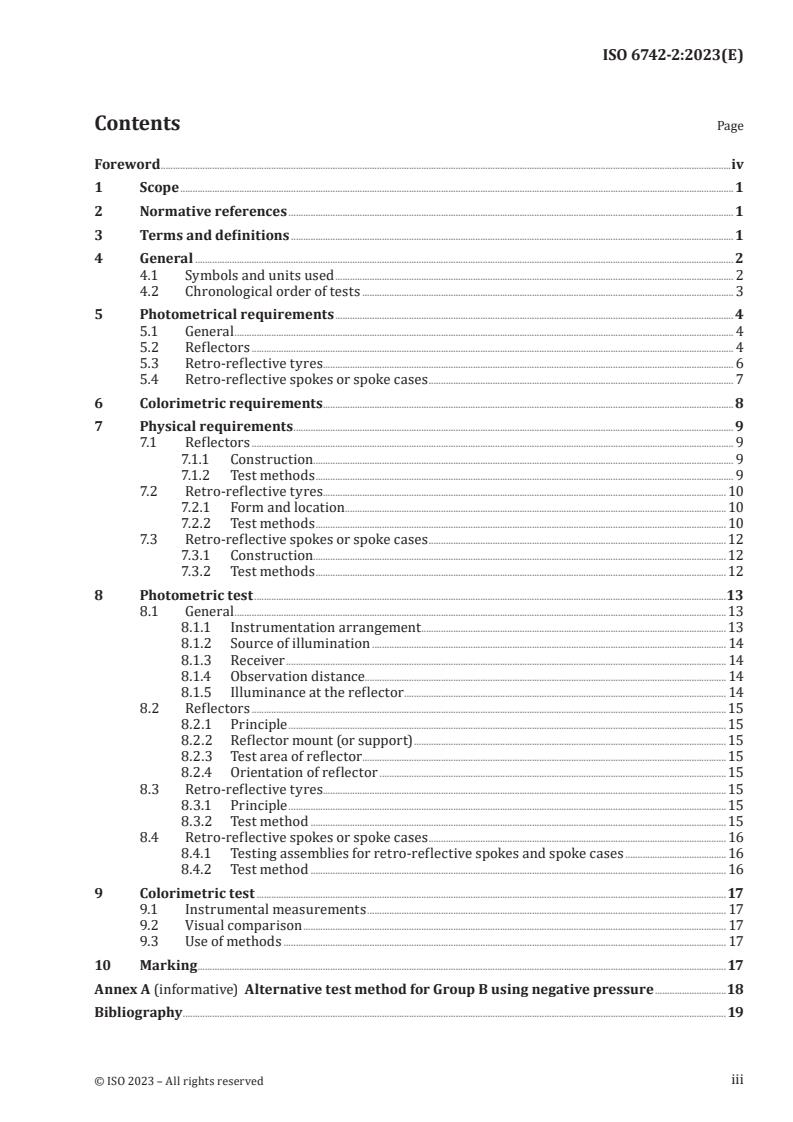
Contents Page
Foreword .iv
1 Scope . 1
2 Normative references . 1
3 Terms and definitions . 1
4 General . 2
4.1 Symbols and units used . 2
4.2 Chronological order of tests . 3
5 Photometrical requirements . 4
5.1 General . 4
5.2 Reflectors . 4
5.3 Retro-reflective tyres. 6
5.4 Retro-reflective spokes or spoke cases . 7
6 Colorimetric requirements . .8
7 Physical requirements . 9
7.1 Reflectors . 9
7.1.1 Construction. 9
7.1.2 Test methods . 9
7.2 Retro-reflective tyres. 10
7.2.1 Form and location . . 10
7.2.2 Test methods . 10
7.3 Retro-reflective spokes or spoke cases .12
7.3.1 Construction. 12
7.3.2 Test methods . 12
8 Photometric test .13
8.1 General .13
8.1.1 Instrumentation arrangement . 13
8.1.2 Source of illumination . 14
8.1.3 Receiver . 14
8.1.4 Observation distance. 14
8.1.5 Illuminance at the reflector . 14
8.2 Reflectors . 15
8.2.1 Principle . 15
8.2.2 Reflector mount (or support) . 15
8.2.3 Test area of reflector . .15
8.2.4 Orientation of reflector .15
8.3 Retro-reflective tyres.15
8.3.1 Principle .15
8.3.2 Test method . 15
8.4 Retro-reflective spokes or spoke cases . 16
8.4.1 Testing assemblies for retro-reflective spokes and spoke cases . 16
8.4.2 Test method . 16
9 Colorimetric test .17
9.1 Instrumental measurements . 17
9.2 Visual comparison . 17
9.3 Use of methods . 17
10 Marking . .17
Annex A (informative) Alternative test method for Group B using negative pressure .18
Bibliography .19
iii
Foreword
ISO (the International Organization for Standardization) is a worldwide federation of national standards
bodies (ISO member bodies). The work of preparing International Standards is normally carried out
through ISO technical committees. Each member body interested in a subject for which a technical
committee has been established has the right to be represented on that committee. International
organizations, governmental and non-governmental, in liaison with ISO, also take part in the work.
ISO collaborates closely with the International Electrotechnical Commission (IEC) on all matters of
electrotechnical standardization.
The procedures used to develop this document and those intended for its further maintenance are
described in the ISO/IEC Directives, Part 1. In particular, the different approval criteria needed for the
different types of ISO document should be noted. This document was drafted in accordance with the
editorial rules of the ISO/IEC Directives, Part 2 (see www.iso.org/directives).
ISO draws attention to the possibility that the implementation of this document may involve the use
of (a) patent(s). ISO takes no position concerning the evidence, validity or applicability of any claimed
patent rights in respect thereof. As of the date of publication of this document, ISO had not received
notice of (a) patent(s) which may be required to implement this document. However, implementers are
cautioned that this may not represent the latest information, which may be obtained from the patent
database available at www.iso.org/patents. ISO shall not be held responsible for identifying any or all
such patent rights.
Any trade name used in this document is information given for the convenience of users and does not
constitute an endorsement.
For an explanation of the voluntary nature of standards, the meaning of ISO specific terms and
expressions related to conformity assessment, as well as information about ISO's adherence to
the World Trade Organization (WTO) principles in the Technical Barriers to Trade (TBT), see
www.iso.org/iso/foreword.html.
This document was prepared by Technical Committee ISO/TC 149, Cycles, Subcommittee SC 1, Cycles
and major sub-assemblies.
This fourth edition cancels and replaces the third edition (ISO 6742-2:2015) which has been technically
revised. It also incorporates the Amendment ISO 6742-2:2015/Amd:2018.
The main changes are as follows:
— terms and definitions: “pedal reflector” was added;
— change all angle units to degrees;
— addition of 7.1.2.4 b);
— improvement of 8.2.4;
— addition of Annex A.
A list of all parts in the ISO 6742 series can be found on the ISO website.
Any feedback or questions on this document should be directed to the user’s national standards body. A
complete listing of these bodies can be found at www.iso.org/members.html.
iv
INTERNATIONAL STANDARD ISO 6742-2:2023(E)
Cycles — Lighting and retro-reflective devices —
Part 2:
Retro-reflective devices
1 Scope
This document is applicable to retro-reflective devices used on cycles intended to be used on public
[1] [2]
roads and, especially, bicycles complying with ISO 4210 and ISO 8098 .
This part of ISO 6742 specifies photometric and physical requirements of retro-reflective devices.
2 Normative references
The following documents are referred to in the text in such a way that some or all of their content
constitutes requirements of this document. For dated references, only the edition cited applies. For
undated references, the latest edition of the referenced document (including any amendments) applies.
ISO 9227, Corrosion tests in artificial atmospheres — Salt spray tests
CIE 15, Colorimetry: official recommendations of the International Commission on Illumination
CIE 1931, XYZ colour space of the International Commission on Illumination
3 Terms and definitions
For the purposes of this document, the following terms and definitions apply.
ISO and IEC maintain terminological databases for use in standardization at the following addresses:
— ISO Online browsing platform: available at https:// www .iso .org/ obp
— IEC Electropedia: available at https:// www .electropedia .org/
3.1
retro-reflective device
reflector
assembly ready for use and comprising one or more retro-reflecting optical units
3.2
wide angle reflector
device providing retro-reflection through horizontal entrance angles of not less than 50° on either side
of the reference axis
3.3
conventional reflector
device providing retro-reflection through entrance angles of not less than 20° on either side of the
reference axis
3.4
high values reflector
red retro-reflective device (3.1) with high values of reflection e.g. dedicated to be mounted on luggage
carrier
3.5
retro-reflective spoke
spoke with retro-reflective surface
3.6
retro-reflective spoke case
device, e.g. cylinder, with retro-reflective surface with or without a gap, providing a secured mounting
on a spoke
3.7
retro-reflective tyre
tyre ready for use and comprising retro-reflecting annuli moulded on to each sidewall of the tyre
3.8
pedal reflector
reflector located on the pedal
4 General
4.1 Symbols and units used
Symbols are shown in Figure 1. Their meaning and units used are given in Table 1.
Figure 1 — Symbols
[3]
NOTE The following symbols are in accordance with UN/ECE Regulation No.150 concerning retro-
reflective devices.
Table 1 — Meaning and units of symbols used
Symbol Meaning Unit
C Reference centre —
NC Reference axis —
R Receiver, observer or measuring device —
r
C Centre of receiver —
r
S Source of illumination —
e
C Centre of source of illumination —
s
a
D Distance from centre C to centre C m
e s
a
D' Distance from centre C to centre C m
e r
D Mean diameter of retro-reflective annulus on retro-reflective tyres mm
α Observation angle degree (°)
Entrance angle. With respect to line C C which always considered to be horizontal,
s
this angle is prefixed with signs – (left), + (right), + (up) or – (down), according to
β the position of the source S in relation to the axis NC, as seen when looking to- degree (°)
e
wards the retro-reflective device. For any direction defined by two angles, vertical
and horizontal, the vertical angle is always given first.
γ Angular subtense of measuring device R , as seen from point C degree (°)
r
δ Angular subtense of the source S , as seen from point C degree (°)
e
Rotation angle. This angle is positive when the rotation is clockwise as seen when
ε looking towards the illuminated surface. If reflecting device is marked “TOP”, the degree (°)
position thus indicated is taken as origin.
a
D and D' are generally very nearly the same and under normal conditions of observation it may be as-
e e
sumed that D = D' . Furthermore, the effective distances may be used when a collimated system is used in order
e e
to obtain an artificially increased measuring distance.
4.2 Chronological order of tests
The applicant shall submit for approval samples which shall be tested in the chronological order
indicated in Table 2.
Table 2 — Chronological order of tests
Sample
Number of paragraph Tests for retro-reflective devices
a b c d e f
7.1.2.2 Temperature resistance test X X X X X X
Colorimetry: visual inspection
Clause 6 X X X X X X
Trichromatic coordinates in case of doubt
Clause 5 Photometry only at V = H = 0° X X X X X X
Clause 5 Photometry at all test points X X
7.1.2.4 Moisture resistance test X X
7.1.2.5 Resistance to fuels X X
7.1.2.6 Resistance to lubricating oils X X
Colorimetry: visual inspection
Clause 6 X X
Trichromatic coordinates in case of doubt
Clause 5 Photometry only at V = H = 0° X X
Impact test
7.1.2.3 (only for wide angle reflector and conventional reflector X X
of Group B)
Colorimetry: visual inspection
Clause 6 X X
Trichromatic coordinates in case of doubt
TTaabbllee 22 ((ccoonnttiinnueuedd))
Sample
Number of paragraph Tests for retro-reflective devices
a b c d e f
Clause 5 Photometry only at V = H = 0° X X
5 Photometrical requirements
5.1 General
In order to follow different requirements in different countries, the photometrical requirements are
divided into 2 groups: Group A and Group B, see Table 3.
Table 3 — Tables link with groups
Classification Type Colour Group A Group B
Conventional reflector Table 4 Table 5
Front White
Wide angle reflector Table 6 Table 7
Conventional reflector Table 4 Table 5
Rear Wide angle reflector Red Table 6 Table 7
High value reflector Table 10
Conventional reflector Table 4 Table 5
White or
Wide angle reflector Table 6 Table 7
yellow
Retro-reflective tyre Table 11 Table 12
Side
Retro-reflective spoke White Table 13
Retro-reflective spoke
White Table 14
case
Pedal Pedal reflector Yellow Table 8 Table 9
NOTE Groups A or B are chosen according to national regulations.
5.2 Reflectors
When tested by the method given in Clause 8, the coefficients of luminous intensity, C , values for
IL
reflectors shall not be less than those specified in Tables 4, 5, 6, 7, 8, 9 or 10.
Tables 4 to 7 applies to front, side and rear reflectors.
Tables 8 and 9 applies to pedal reflectors.
Table 10 applies to high values reflectors. High values reflectors are only applicable in Group A.
Table 4 — C for conventional reflectors (Group A)
IL
C in mcd/lx
IL
Entrance angle, β
Observation
vertical V 0° ±10° ±5°
Colour
angle, α
horizontal H 0° 0° ±20°
0,33° 1 200 800 400
White
1,50° 20 11,2 10
0,33° 750 500 250
Yellow
1,50° 12,5 7 6,25
0,33° 300 200 100
Red
1,50° 5 2,8 2,5
Table 5 — C for conventional reflectors (Group B)
IL
C in mcd/lx
IL
Entrance angle, β
Observation
vertical V 0° ±10° 0°
Colour
angle, α
horizontal H 0° 0° ±20°
0,20° 2 500 1 650 850
White
1,50° 26 18 11
0,20° 1 560 1 030 530
Yellow
1,50° 16 11 7
0,20° 625 410 210
Red
1,50° 7 5 3
Table 6 — C for wide angle reflectors (Group A)
IL
C in mcd/lx
IL
Entrance angle, β
Observation
vertical V 0° ±10° 0° 0° 0° 0°
Colour
angle, α
horizontal H 0° 0° ±20° ±30° ±40° ±50°
0,33° 1 800 1 200 610 540 470 400
White
1,50° 34 24 15 15 15 15
0,33° 1 125 750 380 335 290 250
Yellow
1,50° 21 15 10 10 10 10
0,33° 450 300 150 135 115 100
Red
1,50° 9 6 4 4 4 4
Table 7 — C for wide angle reflectors (Group B)
IL
C in mcd/lx
IL
Entrance angle, β
Observation
vertical V 0° ±10° 0° 0° 0° 0°
Colour
angle, α
horizontal H 0° 0° ±20° ±30° ±40° ±50°
0,20° 2 500 1 650 850 750 650 550
White
1,50° 26 18 11 11 11 11
0,20° 1 560 1 030 530 465 405 340
Yellow
1,50° 16 11 7 7 7 7
0,20° 625 410 210 185 160 135
Red
1,50° 7 5 3 3 3 3
Table 8 — C for pedal reflectors (Group A)
IL
C in mcd/lx
IL
Entrance angle, β
Observation
vertical V 0° ±10° ±5°
Colour
angle, α
horizontal H 0° 0° ±20°
0,33° 300 200 100
Yellow
1,50° 12 9 6
Table 9 — C for pedal reflectors (Group B)
IL
C in mcd/lx
IL
Entrance angle, β
Observation
Colour vertical V 0° ±10° 0°
angle, α
horizontal H 0° 0° ±20°
0,20° 450 350 175
Yellow
1,50° 16,5 11,5 7,5
Table 10 — C for high values reflectors (Group A)
IL
C in mcd/lx
IL
Entrance angle, β
Observation
vertical V 0° ±10° ±5°
Colour
angle, α
horizontal H 0° 0° ±20°
0,33° 1 000 700 400
Red
1,50° 30 20 10
5.3 Retro-reflective tyres
When tested by the method given in Clause 8, the C values for a retro-reflective tyre shall not be
IL
less than those specified in Table 11 and Table 12. In case where D is less than 420 mm the minimum
photometric value for each observation and entrance angle shall be equal to the value for D = 420 mm.
Table 11 — C for retro-reflective tyres (Group A)
IL
C in mcd/lx
IL
Entrance angle, β
Observation
Colour
angle, α
horizontal H 5° 20° 40° 50°
Either 0,33° 1,60 D 1,40 D 0,47 D 0,15 D
White
or
1,50° 0,11 D 0,10 D 0,065 D 0,020 D
White/Yellow
Table 12 — C for retro-reflective tyres (Group B)
IL
C in mcd/lx
IL
Entrance angle, β
Observation
Colour
angle, α
horizontal H −4° 20° 40° 50°
Either 0,20° 1,21 D 1,06 D 0,70 D 0,21 D
White
or
1,50° 0,121 D 0,106 D 0,070 D 0,021 D
White/Yellow
5.4 Retro-reflective spokes or spoke cases
Retro-reflective spokes or spoke cases are only applicable in Group A.
When tested by the method given in Clause
...