

ISO 11243:2023
(Main)Cycles — Luggage carriers for bicycles — Requirements and test methods
General Information
- Abstract
This document specifies safety and performance requirements for the design and testing of both non cycle specific luggage carriers intended for mounting (with or without tools) and cycle specific luggage carriers mounted on complete cycles. It applies to luggage carriers intended to be positioned above and adjacent to the wheels of cycles. This document lays down guidelines for instructions on the use and care of such luggage carriers. This document does not apply to removable luggage (for example, handlebar bags or baskets that are not permanently attached). Toy carrier intended to be mounted on bicycles for young children in the scope of ISO 8098 are not covered by this document.
- Status
- Published
- Publication Date
- 31-Aug-2023
- Technical Committee
- ISO/TC 149/SC 1 - Cycles and major sub-assemblies
- Drafting Committee
- ISO/TC 149/SC 1/WG 16 - Revision of ISO 11243:2016
- Current Stage
- 9092 - International Standard to be revised
- Start Date
- 28-Aug-2025
- Completion Date
- 29-Aug-2026
Buy Documents

ISO 11243:2023 - Cycles — Luggage carriers for bicycles — Requirements and test methods Released:1. 09. 2023
ISO 11243:2023 - Cycles — Porte-bagages pour bicyclettes — Exigences et méthodes d'essai/6/2023
Overview
ISO 11243:2023 - "Cycles - Luggage carriers for bicycles - Requirements and test methods" is the third edition international standard that defines safety and performance requirements and test methods for bicycle luggage carriers. It covers both non cycle specific luggage carriers (sold as accessories) and cycle specific carriers (designed to mount on a particular bicycle). The scope includes carriers positioned above or adjacent to wheels and provides guidance for instructions on use and care. Removable bags/baskets and toy carriers covered by ISO 8098 are excluded.
Key topics and technical requirements
ISO 11243:2023 organizes requirements and test methods across design, manufacturing and verification stages. Major technical topics include:
- Definitions and classifications - cycle-specific vs. non cycle-specific, platform length/height, carrier types (rear, front, frame-mounted, seat-post mounted, low-load front).
- Load capacity restrictions - maximum permissible loads for different carrier types (see standard for tables and limits).
- Dynamic load tests - vertical and lateral dynamic tests and alternative test procedures to verify fatigue resistance and durability under repeated loading.
- Static load tests - vertical, lateral and longitudinal static strength tests to confirm structural integrity.
- Drop impact test - for carriers made of plastics or combined metal/plastics to assess impact resistance.
- Safety-related checks - crack detection, sharp edges, exposed protrusions, and security of fasteners (screw security and minimum failure torque).
- Child-seat compatibility - additional requirements and test methods when a rear carrier is intended to accept a child seat.
- Provision for lighting, marking, durability of markings, and instruction/manual requirements for safe installation, use and maintenance.
- Test reporting and annexes - prescriptive test set-ups, alternative methods and example configurations provided in normative/informative annexes.
Practical applications - who uses this standard
ISO 11243:2023 is essential for:
- Bicycle and accessory manufacturers designing or certifying luggage carriers.
- Product designers and R&D teams validating structural performance and rider safety.
- Independent testing laboratories performing standardized dynamic/static/load and impact tests.
- Quality assurance and compliance teams for production inspections and certification.
- Retailers, importers and regulatory bodies verifying conformity to international safety expectations.
- Bicycle OEMs fitting carriers to complete cycles and documenting user instructions.
Related standards
- ISO 4210 series (terms and safety-related definitions referenced)
- ISO 8098 (toy carriers - excluded from ISO 11243)
- ISO/TS 4210-10:2020 (EPAC terminology referenced)
ISO 11243:2023 provides a practical framework to design, test and document bicycle luggage carriers for safe, reliable real‑world use. Keywords: ISO 11243:2023, luggage carriers for bicycles, test methods, bicycle carrier requirements, dynamic load test, static load test, child seat compatible carriers.
Relations
- Consolidates
EN ISO 11243:2023 - Cycles - Luggage carriers for bicycles - Requirements and test methods (ISO 11243:2023) - Effective Date
- 12-Feb-2026
- Consolidates
ISO 19085-10:2018 - Woodworking machines — Safety — Part 10: Building site saws (contractor saws) - Effective Date
- 06-Jun-2022
- Effective Date
- 30-Jun-2018
Buy Documents
ISO 11243:2023 - Cycles — Luggage carriers for bicycles — Requirements and test methods Released:1. 09. 2023
ISO 11243:2023 - Cycles — Porte-bagages pour bicyclettes — Exigences et méthodes d'essai/6/2023
Get Certified
Connect with accredited certification bodies for this standard

TÜV Rheinland
TÜV Rheinland is a leading international provider of technical services.

TÜV SÜD
TÜV SÜD is a trusted partner of choice for safety, security and sustainability solutions.

DEKRA Certification Inc.
DEKRA US certification services.
Sponsored listings
Frequently Asked Questions
ISO 11243:2023 is a standard published by the International Organization for Standardization (ISO). Its full title is "Cycles — Luggage carriers for bicycles — Requirements and test methods". This standard covers: This document specifies safety and performance requirements for the design and testing of both non cycle specific luggage carriers intended for mounting (with or without tools) and cycle specific luggage carriers mounted on complete cycles. It applies to luggage carriers intended to be positioned above and adjacent to the wheels of cycles. This document lays down guidelines for instructions on the use and care of such luggage carriers. This document does not apply to removable luggage (for example, handlebar bags or baskets that are not permanently attached). Toy carrier intended to be mounted on bicycles for young children in the scope of ISO 8098 are not covered by this document.
This document specifies safety and performance requirements for the design and testing of both non cycle specific luggage carriers intended for mounting (with or without tools) and cycle specific luggage carriers mounted on complete cycles. It applies to luggage carriers intended to be positioned above and adjacent to the wheels of cycles. This document lays down guidelines for instructions on the use and care of such luggage carriers. This document does not apply to removable luggage (for example, handlebar bags or baskets that are not permanently attached). Toy carrier intended to be mounted on bicycles for young children in the scope of ISO 8098 are not covered by this document.
ISO 11243:2023 is classified under the following ICS (International Classification for Standards) categories: 43.150 - Cycles. The ICS classification helps identify the subject area and facilitates finding related standards.
ISO 11243:2023 has the following relationships with other standards: It is inter standard links to EN ISO 11243:2023, ISO 19085-10:2018, ISO 11243:2016. Understanding these relationships helps ensure you are using the most current and applicable version of the standard.
ISO 11243:2023 is available in PDF format for immediate download after purchase. The document can be added to your cart and obtained through the secure checkout process. Digital delivery ensures instant access to the complete standard document.
Standards Content (Sample)
INTERNATIONAL ISO
STANDARD 11243
Third edition
2023-09
Cycles — Luggage carriers for bicycles
— Requirements and test methods
Cycles — Porte-bagages pour bicyclettes — Exigences et méthodes
d'essai
Reference number
© ISO 2023
All rights reserved. Unless otherwise specified, or required in the context of its implementation, no part of this publication may
be reproduced or utilized otherwise in any form or by any means, electronic or mechanical, including photocopying, or posting on
the internet or an intranet, without prior written permission. Permission can be requested from either ISO at the address below
or ISO’s member body in the country of the requester.
ISO copyright office
CP 401 • Ch. de Blandonnet 8
CH-1214 Vernier, Geneva
Phone: +41 22 749 01 11
Email: copyright@iso.org
Website: www.iso.org
Published in Switzerland
ii
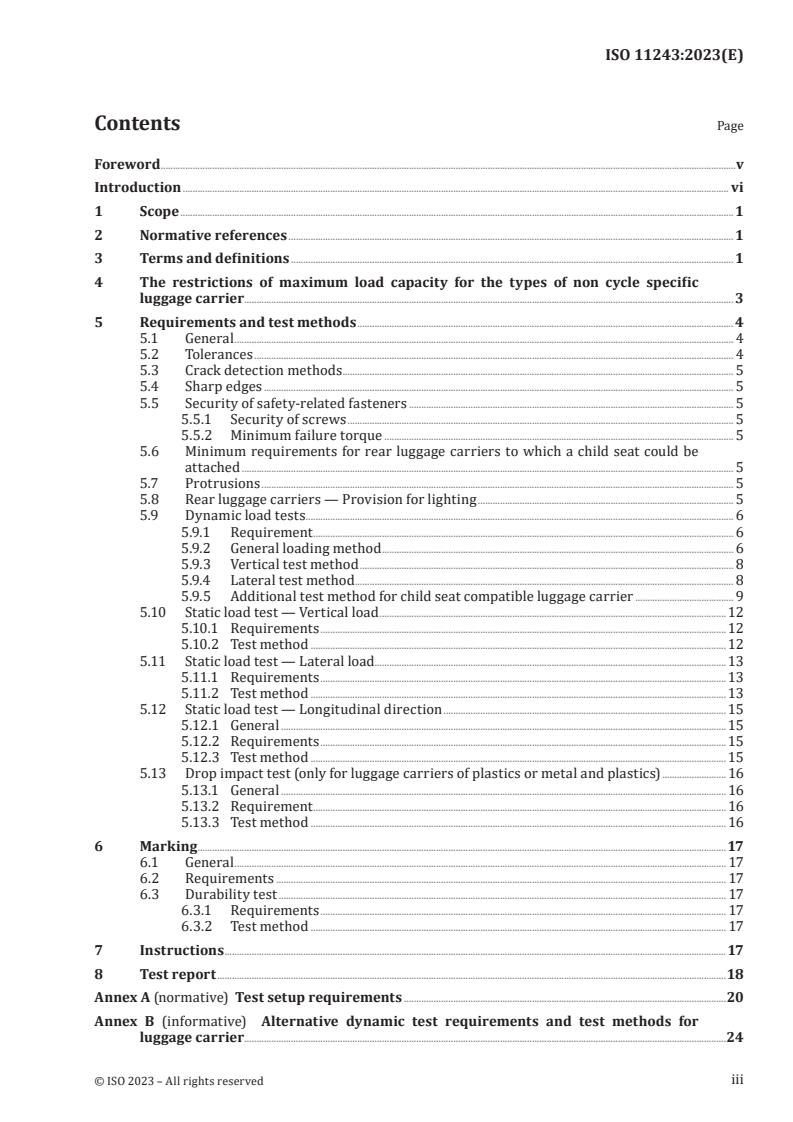
Contents Page
Foreword .v
Introduction . vi
1 Scope . 1
2 Normative references . 1
3 Terms and definitions . 1
4 The restrictions of maximum load capacity for the types of non cycle specific
luggage carrier . 3
5 Requirements and test methods . 4
5.1 General . 4
5.2 Tolerances . 4
5.3 Crack detection methods . . 5
5.4 Sharp edges . 5
5.5 Security of safety-related fasteners . 5
5.5.1 Security of screws . 5
5.5.2 Minimum failure torque . 5
5.6 Minimum requirements for rear luggage carriers to which a child seat could be
attached . 5
5.7 Protrusions . 5
5.8 Rear luggage carriers — Provision for lighting . 5
5.9 Dynamic load tests . . 6
5.9.1 Requirement . 6
5.9.2 General loading method . 6
5.9.3 Vertical test method . 8
5.9.4 Lateral test method . 8
5.9.5 Additional test method for child seat compatible luggage carrier . 9
5.10 Static load test — Vertical load .12
5.10.1 Requirements .12
5.10.2 Test method . 12
5.11 Static load test — Lateral load.13
5.11.1 Requirements .13
5.11.2 Test method . 13
5.12 Static load test — Longitudinal direction . 15
5.12.1 General .15
5.12.2 Requirements .15
5.12.3 Test method . 15
5.13 Drop impact test (only for luggage carriers of plastics or metal and plastics) . 16
5.13.1 General . 16
5.13.2 Requirement . 16
5.13.3 Test method . 16
6 Marking . .17
6.1 General . 17
6.2 Requirements . 17
6.3 Durability test . 17
6.3.1 Requirements . 17
6.3.2 Test method . 17
7 Instructions .17
8 Test report .18
Annex A (normative) Test setup requirements .20
Annex B (informative) Alternative dynamic test requirements and test methods for
luggage carrier .24
iii
Annex C (informative) Examples of luggage carrier configurations .27
Annex D (informative) Test method for child seat compatible luggage carrier option 1 .29
Bibliography .31
iv
Foreword
ISO (the International Organization for Standardization) is a worldwide federation of national standards
bodies (ISO member bodies). The work of preparing International Standards is normally carried out
through ISO technical committees. Each member body interested in a subject for which a technical
committee has been established has the right to be represented on that committee. International
organizations, governmental and non-governmental, in liaison with ISO, also take part in the work.
ISO collaborates closely with the International Electrotechnical Commission (IEC) on all matters of
electrotechnical standardization.
The procedures used to develop this document and those intended for its further maintenance are
described in the ISO/IEC Directives, Part 1. In particular, the different approval criteria needed for the
different types of ISO documents should be noted. This document was drafted in accordance with the
editorial rules of the ISO/IEC Directives, Part 2 (see www.iso.org/directives).
Attention is drawn to the possibility that some of the elements of this document may be the subject of
patent rights. ISO shall not be held responsible for identifying any or all such patent rights. Details of
any patent rights identified during the development of the document will be in the Introduction and/or
on the ISO list of patent declarations received (see www.iso.org/patents).
Any trade name used in this document is information given for the convenience of users and does not
constitute an endorsement.
For an explanation of the voluntary nature of standards, the meaning of ISO specific terms and
expressions related to conformity assessment, as well as information about ISO's adherence to
the World Trade Organization (WTO) principles in the Technical Barriers to Trade (TBT), see
www.iso.org/iso/foreword.html.
This document was prepared by Technical Committee ISO/TC 149, Cycles, Subcommittee SC 1, Cycles
and major sub-assemblies, in collaboration with the European Committee for Standardization (CEN)
Technical Committee CEN/TC 333, Cycles, in accordance with the Agreement on technical cooperation
between ISO and CEN (Vienna Agreement).
This third edition cancels and replaces the second edition (ISO 11243:2016), which has been technically
revised.
The main changes are as follows:
— change of Scope;
— the following terms and definitions; “cycle specific luggage carrier”, “non cycle specific luggage
carrier”, “exposed protrusion” were added;
— improvement of Clause 3 and Clause 4;
— improvement of 5.1 and 5.5.2;
— addition of 5.6;
— improvement of 5.9, 5.10 and 5.11;
— addition of 5.12;
— improvement of 5.13;
— improvement of Clause 6, Clause 7 and Clause 8;
— deletion of some annexes and addition of some annexes with changes in the text.
Any feedback or questions on this document should be directed to the user’s national standards body. A
complete listing of these bodies can be found at www.iso.org/members.html.
v
Introduction
This document has been developed in response to demand throughout the world, and the aim has
been to ensure that luggage carrier manufactured in conformity with it will be as safe as is practically
possible. The tests have been designed to ensure the strength and durability of the luggage carrier,
demanding high quality throughout and consideration of safety aspects from the design stage onwards.
The scope has been limited to safety considerations and has specifically avoided standardization of
components.
vi
INTERNATIONAL STANDARD ISO 11243:2023(E)
Cycles — Luggage carriers for bicycles — Requirements
and test methods
1 Scope
This document specifies safety and performance requirements for the design and testing of both non
cycle specific luggage carriers intended for mounting (with or without tools) and cycle specific luggage
carriers mounted on complete cycles. It applies to luggage carriers intended to be positioned above and
adjacent to the wheels of cycles. This document lays down guidelines for instructions on the use and
care of such luggage carriers.
This document does not apply to removable luggage (for example, handlebar bags or baskets that are
not permanently attached).
Toy carrier intended to be mounted on bicycles for young children in the scope of ISO 8098 are not
covered by this document.
2 Normative references
There are no normative references in this document.
3 Terms and definitions
For the purposes of this document, the following terms and definitions apply.
ISO and IEC maintain terminological databases for use in standardization at the following addresses:
— ISO Online browsing platform: available at https:// www .iso .org/ obp
— IEC Electropedia: available at https:// www .electropedia .org/
3.1
luggage carrier
device, including containers such as baskets, that is mounted and permanently attached above and/
or adjacent to the rear wheel(s) (in the case of a rear luggage carrier) or front wheel(s) (in the case of a
front luggage carrier) of a cycle and that is designed for carrying luggage or children in child seats
3.2
cycle specific luggage carrier
luggage carrier that is removable, designed to be mounted on a specific cycle
3.3
non cycle specific luggage carrier
luggage carrier sold as a separate accessory intended to be mounted on a wide range of suitable cycles
3.4
luggage carrier platform
flat part of the luggage carrier (3.1) upon which loads may be placed or fixed, or the flat top rail from
which panniers may be hung, or the bottom part of a container
Note 1 to entry: The bottom part of a container, for example a basket.
3.5
luggage carrier platform length
L
maximum overall length of the luggage carrier platform (3.4)
3.6
visible crack
crack which results from a test, wherein that crack is visible to the naked eye
[SOURCE: ISO 4210-1:2023, 3.2.11]
3.7
fracture
unintentional separation into two or more parts
[SOURCE: ISO 4210-1:2023, 3.2.4]
3.8
exposed protrusion
protrusion which, through its location and rigidity, could present a hazard to the rider either through
heavy contact with it in normal use or should the rider fall onto it in an accident
[SOURCE: ISO 4210-1:2023, 3.2.3]
3.9
toy carrier
luggage carrier with a part intended for containing a maximum mass of 1 kg and not intended to carry
luggage
3.10
permanently attached luggage carrier
luggage carrier (3.1) which is permanently attached
Note 1 to entry: For example, luggage carrier welded to the frame.
3.11
normal rear luggage carrier
rear luggage carrier supported by fixings to the bicycle frame close to the rear wheel axle
3.12
frame-mounted beam luggage carrier
rear luggage carrier that is structurally a cantilever, fixed to the bicycle frame in front and/or above the
rear wheel
Note 1 to entry: It may also be fixed to the seat post, in addition to the frame, but receives no support from the
bicycle frame near to the axle of the rear wheel.
3.13
seat-post mounted beam luggage carrier
rear luggage carrier that is structurally a cantilever, fixed to the seat post of the bicycle without
additional fixings to the frame
3.14
above wheel front luggage carrier
front luggage carrier with a platform upon which loads can be placed above the front wheel
3.15
low-load front luggage carrier
front luggage carrier that is exclusively designed for carrying a pair of panniers, where the “platform”
is a pair of rails (from which the panniers hang), one each side of the wheel and not more than 200 mm
above the lower points of attachment of the luggage carrier near to the axle of the front wheel
3.16
front mounted container
container such as a basket that is mounted and permanently attached above the front wheel of a bicycle
and that is exclusively designed for carrying luggage
3.17
maximum load capacity
maximum load that can be carried
Note 1 to entry: The restrictions of maximum load capacity are defined in Table 1.
3.18
electrically power assisted cycle
EPAC
cycle, equipped with pedals and an auxiliary electric motor, which cannot be propelled exclusively by
means of this auxiliary electric motor, except in the walk assistance mode
[SOURCE: ISO/TS 4210-10:2020, 3.2]
3.19
platform height
height measured from wheel axis to the luggage carrier platform
4 The restrictions of maximum load capacity for the types of non cycle specific
luggage carrier
Manufacturers of non cycle specific luggage carrier shall take into consideration any restrictions laid
down in Table 1.
For cycle specific luggage carrier, the manufacturer is responsible for determining the maximum load
capacity.
For designs exceeding the capacity restrictions, a risk assessment should be performed by the
manufacturer in particular addressing the effect of the higher load capacity and to identify suitable
measures to address the identified risks.
In Table 1, the maximum limit (if any) for the load capacity is indicated for each type of non cycle
specific luggage carrier that falls within the scope of this document. The applicable requirements and
test methods differ according to the type and maximum load capacity.
Table 1 — The restrictions of maximum load capacity for the types of non cycle specific luggage
carrier
Rear Front
Beam carriers
Low-load
Type of lug-
Normal rear Above wheel
Seat
front Front mounted
Frame-mount-
gage carrier
luggage car- front lug-
post-mounted
luggage container
ed beam lug-
rier gage carrier
beam luggage
carrier
gage carrier
carrier
Restriction of
maximum load
no limit 10 27 10 18 10
capacity,
kg
NOTE Maximum load capacity does not include the battery mass if so equipped.
NOTE Examples of luggage carrier configurations are shown in Annex C.
5 Requirements and test methods
5.1 General
The fatigue tests shall be done on the same sample and fasteners. Static tests and the additional tests
on child seat compatible luggage carriers can be conducted on a new test sample, but if only one test
sample is available, it is permissible to conduct all of the tests on the same sample with the sequence of
testing in the order: dynamic load tests, static tests.
When more than one test is conducted on the same sample, the test sequence shall be clearly recorded
in the test report or record of testing.
If the luggage carrier is made of plastics or metal and plastics, it shall be submitted to the tests in 5.13
after being tested according to 5.9, 5.10, 5.11 and 5.12.
In the strength tests, all components shall be in the fully-finished condition.
The luggage carrier shall be tested using the connecting interface position(s) and type(s) according to
the luggage carrier manufacturer's specifications.
When the manufacturer allows more than one mounting configuration the stiffest and weakest
configuration shall be tested. The stiffness is determined by measuring the largest and smallest
displacement of the each configuration according the method described in 5.11.
The luggage carrier shall be tested with all accessories provided (e.g. lock, pumps, etc.).
For luggage carrier intended to be fitted on an electrically power assisted cycle (EPAC) and designed
to include a battery, the test shall be performed with the maximum battery load [see Clause 7 q)] in
addition to the mass defined in Clause 4.
For maximum load capacity under 27 kg, the user shall be warned that the product is not suitable for
the transportation of a child seat. See Clause 6.2 e).
Permanently attached luggage carriers are not within the scope of this document. However,
manufacturers should take into consideration and apply all clauses of this document except 5.8, 5.13,
6.2 c) and 6.2 e) as a basis of safety requirements.
5.2 Tolerances
Unless stated otherwise, accuracy tolerances based on the nominal values shall be as follows.
Forces 0/+5 %
Masses ±1 %
Dimensions ±1 mm
Angles ±1°
Time duration ±5 s
Temperatures ±2 °C
Frequencies and linear stroke ±5 %
Torque wrenches shall have a maximum permissible relative deviation of ±6 %
Note Unilateral tolerance such as 0/+5 % allows variation to occur in only one direction. The minimum
applied force shall be the standard force plus the maximum permissible error of the equipment. Typically, the
equipment is set at half the tolerance (+2,5 %).
5.3 Crack detection methods
Standardized methods may be used to emphasize the presence of cracks where visible cracks are
specified as criteria of failure in tests specified in this document.
NOTE For example, suitable dye-penetrant methods are specified in ISO 3452-1 and ISO 3452-2.
5.4 Sharp edges
Exposed edges that could come into contact with the rider's or a transported person’s hands, legs, etc.,
during normal riding or normal handling and normal maintenance shall be neither sharp nor designed
such that injuries can arise when the bicycle is used correctly. Spring ends shall be rounded or fitted
with protective caps.
5.5 Security of safety-related fasteners
5.5.1 Security of screws
Any screws used in the internal assembly of the luggage carrier shall be provided with suitable locking
devices, for example, lock-washers, lock-nuts, stiff nuts or thread locking compound.
5.5.2 Minimum failure torque
The minimum failure torque of screws for the fastening of the luggage carrier to the cycle shall be at
least 20 % greater than the manufacturer's maximum recommended tightening torque.
NOTE For example, mechanical and physical properties of bolts are specified in ISO 898-1.
5.6 Minimum requirements for rear luggage carriers to which a child seat could be
attached
Except for luggage carriers using a manufacturer-specific child seat mounting system, a luggage carrier
platform maximum width of 175 mm is recommended for rear luggage carriers to which a child seat
could be attached. And the maximum load capacity of the rear luggage carrier shall be at least 27 kg.
NOTE Some child seats can have other additional attaching requirements.
5.7 Protrusions
This requirement is intended to address the hazards associated with the users of bicycles falling on
projections or rigid components on a bicycle, possibly causing internal injury or skin puncture.
A screw thread that is an exposed protrusion shall be limited to a protrusion length of one major
diameter of the screw beyond the internally threaded mating part.
5.8 Rear luggage carriers — Provision for lighting
The rear aspect of any rear luggage carrier not equipped with an integral rear lamp and reflector can
be equipped with a bracket or brackets, either as an integral part or separate accessory (or accessories)
to allow the fitting of a rear lamp and reflector.
When this requirement is satisfied by the provision of separate accessories, these accessories should be
included when the luggage carrier is sold.
5.9 Dynamic load tests
5.9.1 Requirement
When tested by the methods described in 5.9.3, 5.9.4 and 5.9.5, there shall be no fractures or visible
cracks in any part of the luggage carrier or fasteners and the specifically designed mounting points of
the luggage carrier. The loading methods for 5.9.3 and 5.9.4 are shown in 5.9.2.
NOTE Alternative dynamic test requirements and test methods are given in Annex B.
5.9.2 General loading method
The mounting method for the dynamic load test of cycle specific luggage carriers and non cycle specific
luggage carriers differ. The mounting requirement are given in Annex A.
Attach a specified weight with a mass equal to the maximum load capacity stated by the manufacturer.
The specified weight (maximum load capacity given by the manufacturer) shall be applied in the middle
of the platform = L/2 and W/2 this is illustrated in Figure 1. Tolerance ±5 mm on the position of the
weight. The clamping shall not deform the tube or the platform:
— For luggage carriers with a platform, a weight or weights shall be evenly distributed on more than
70 % area of the top surface of the luggage carrier platform;
— The centre of gravity of this weight shall coincide with this position and also lie within h = 40 mm of
the centreline of the top of the platform;
— Luggage carriers that are suitable for mounting side bags, that side bags can be filled with the balls
that have a typical diameter of 40 mm and 24 g (e.g. squash balls) until reaching the load capacity,
other dimension and mass can be used to obtain a good matching between mass and volume. The
mass shall be evenly distributed;
— The total width of the weight shall not exceed the luggage carrier platform width by more than
100 mm. A weight or weights shall be attached in the best possible way to prevent movement. The
attachments for the weight are not included in the test weight;
— Front-mounted containers or baskets can be filled with balls that have a typical diameter of 40 mm
and 24 g mass (e.g. squash balls), until reaching the load capacity other dimension and mass can be
used to obtain a good matching between mass and volume. The load is secured by a film to avoid
moving during dynamic test.
— For low-load front luggage carriers and low-load rear luggage carriers with special attachments
according to the manufacturer specification, separate weights shall be attached on each side with
no connecting bar. Each weight shall equal half the rated capacity. This can be arranged with a
balanced pair of weights. Each weight clamped around each top rail.
Key
L luggage carrier platform length
W luggage carrier platform width
m weight with a mass, m
h height of the centre of gravity of the mass
Figure 1 — Weight position
If the luggage carrier is equipped with brackets for the fastening of lamps and reflectors an additional
weight with a mass of (200 ± 10) g shall be attached to the bracket(s) during the test. The centre of
gravity of this weight shall be located 20 mm to the rear of th
...
NORME ISO
INTERNATIONALE 11243
Troisième édition
2023-09
Cycles — Porte-bagages pour
bicyclettes — Exigences et méthodes
d'essai
Cycles — Luggage carriers for bicycles — Requirements and test
methods
Numéro de référence
DOCUMENT PROTÉGÉ PAR COPYRIGHT
© ISO 2023
Tous droits réservés. Sauf prescription différente ou nécessité dans le contexte de sa mise en œuvre, aucune partie de cette
publication ne peut être reproduite ni utilisée sous quelque forme que ce soit et par aucun procédé, électronique ou mécanique,
y compris la photocopie, ou la diffusion sur l’internet ou sur un intranet, sans autorisation écrite préalable. Une autorisation peut
être demandée à l’ISO à l’adresse ci-après ou au comité membre de l’ISO dans le pays du demandeur.
ISO copyright office
Case postale 401 • Ch. de Blandonnet 8
CH-1214 Vernier, Genève
Tél.: +41 22 749 01 11
E-mail: copyright@iso.org
Web: www.iso.org
Publié en Suisse
ii
Sommaire Page
Avant-propos .v
Introduction .vii
1 Domaine d'application .1
2 Références normatives .1
3 Termes et définitions . 1
4 Restrictions de la capacité de charge maximale pour les types de porte-bagages
non spécifiques à un cycle . 3
5 Exigences et méthodes d’essai . 4
5.1 Généralités . 4
5.2 Tolérances . 4
5.3 Méthodes de détection des fissures . 5
5.4 Saillies . 5
5.5 Sécurité des fixations de sécurité . 5
5.5.1 Sécurité des vis . 5
5.5.2 Couple de rupture minimum . 5
5.6 Exigences minimales pour les porte-bagages arrière auxquels un siège pour
enfant peut être fixé . 5
5.7 Saillies . 6
5.8 Porte-bagages arrière – Dispositions relative à l’éclairage . 6
5.9 Essais de charge dynamique . 6
5.9.1 Exigence . 6
5.9.2 Méthode d’essai général . 6
5.9.3 Méthode d’essai vertical . 8
5.9.4 Méthode d’essai latéral . 8
5.9.5 Méthode d'essai supplémentaire pour les porte-bagages compatibles avec
les sièges pour enfant . 9
5.10 Essai de charge statique — Charge verticale . 13
5.10.1 Exigences .13
5.10.2 Méthode d’essai .13
5.11 Essai de charge statique — Charge latérale . 14
5.11.1 Exigences . 14
5.11.2 Méthode d’essai . 14
5.12 Essai de charge statique — Direction longitudinale . 16
5.12.1 Généralités . 16
5.12.2 Exigences . 16
5.12.3 Méthode d’essai . 16
5.13 Test d'impact de chute (uniquement pour les porte-bagages en plastique ou
en métal et plastique) . 18
5.13.1 Généralités . 18
5.13.2 Exigences . 18
5.13.3 Méthode d’essai . 18
6 Marquage .18
6.1 Généralités . 18
6.2 Exigences . 18
6.3 Essai de durabilité . 19
6.3.1 Exigences . 19
6.3.2 Méthode d’essai . 19
7 Instructions .19
8 Rapport d’essai .20
Annexe A (normative) Exigences de configurations d’essai .21
iii
Annexe B (informative) Exigences et méthodes d'essai dynamiques alternatives pour
les porte-bagages .25
Annexe C (informative) Exemples de configurations de porte-bagages .28
Annexe D (informative) Méthode d'essai pour porte-bagages compatible avec les sièges
pour enfant (option 1) .30
Bibliographie .32
iv
Avant-propos
L'ISO (Organisation internationale de normalisation) est une fédération mondiale d'organismes
nationaux de normalisation (comités membres de l'ISO). L'élaboration des Normes internationales est
en général confiée aux comités techniques de l'ISO. Chaque comité membre intéressé par une étude
a le droit de faire partie du comité technique créé à cet effet. Les organisations internationales,
gouvernementales et non gouvernementales, en liaison avec l'ISO participent également aux travaux.
L'ISO collabore étroitement avec la Commission électrotechnique internationale (IEC) en ce qui
concerne la normalisation électrotechnique.
Les procédures utilisées pour élaborer le présent document et celles destinées à sa mise à jour sont
décrites dans les Directives ISO/IEC, Partie 1. Il convient, en particulier de prendre note des différents
critères d'approbation requis pour les différents types de documents ISO. Le présent document
a été rédigé conformément aux règles de rédaction données dans les Directives ISO/IEC, Partie 2
(voir www.iso.org/directives).
L'attention est appelée sur le fait que certains des éléments du présent document peuvent faire l'objet de
droits de propriété intellectuelle ou de droits analogues. L'ISO ne saurait être tenue pour responsable
de ne pas avoir identifié de tels droits de propriété et averti de leur existence. Les détails concernant
les références aux droits de propriété intellectuelle ou autres droits analogues identifiés lors de
l'élaboration du document sont indiqués dans l'Introduction et/ou dans la liste des déclarations de
brevets reçues par l'ISO (voir www.iso.org/brevets).
Les appellations commerciales éventuellement mentionnées dans le présent document sont données
pour information, par souci de commodité, à l’intention des utilisateurs et ne sauraient constituer un
engagement.
Pour une explication de la nature volontaire des normes, la signification des termes et expressions
spécifiques de l'ISO liés à l'évaluation de la conformité, ou pour toute information au sujet de l'adhésion
de l'ISO aux principes de l’Organisation mondiale du commerce (OMC) concernant les obstacles
techniques au commerce (OTC), voir www.iso.org/avant-propos.
Le présent document a été élaboré par le comité technique ISO/TC 149, Cycles, sous-comité SC 1, Cycles et
ses principaux sous-ensembles, en collaboration avec le comité technique CEN/TC 333, Cycles, du Comité
européen de normalisation (CEN), conformément à l’accord de coopération technique entre l’ISO et le
CEN (Accord de Vienne).
Cette troisième édition annule et remplace la deuxième édition (ISO 11243:2016), qui a fait l’objet d’une
révision technique.
Les principales modifications sont les suivantes:
— modification du champ d'application;
— ajout des termes et définitions suivants: «porte-bagages spécifique à un cycle», «porte-bagages non
spécifique à un cycle», «saillie exposée»;
— amélioration de l’Article 3 et de l’Article 4;
— amélioration des 5.1 et 5.5.2;
— ajout du 5.6;
— amélioration des 5.9, 5.10 et 5.11;
— ajout de 5.12;
— amélioration du 5.13;
— amélioration des Articles 6, 7 et 8;
v
— suppression de certaines annexes et ajout de certaines annexes avec des changements dans le texte.
Il convient que l’utilisateur adresse tout retour d’information ou toute question concernant le présent
document à l’organisme national de normalisation de son pays. Une liste exhaustive desdits organismes
se trouve à l’adresse www.iso.org/fr/members.html.
vi
Introduction
Le présent document a été développé en réponse à la demande dans le monde entier, et l'objectif a
été de veiller que les porte-bagages fabriqués en conformité avec ce document soient aussi sûrs que
pratiquement possible. Les essais ont été conçus pour assurer la solidité et la durabilité du porte-
bagages, exigeant une haute qualité et l'examen des aspects de sécurité à partir et tout au long de la
conception.
Le domaine d’application a été restreint aux questions de sécurité et a spécifiquement évité la
normalisation des composants.
vii
NORME INTERNATIONALE ISO 11243:2023(F)
Cycles — Porte-bagages pour bicyclettes — Exigences et
méthodes d'essai
1 Domaine d'application
Le présent document spécifie les exigences de sécurité et de performance pour la conception et les
essais de porte-bagages non spécifiques aux cycles et destinés à être montés (avec ou sans outils), et de
porte-bagages spécifiques aux cycles montés sur des cycles complets. Il s’applique aux porte-bagages
destinés à être positionnés au-dessus et à côté des roues de cycles. Ce document établit des lignes
directrices pour les instructions relatives à l'utilisation et à l'entretien de ces porte-bagages.
Le présent document ne concerne pas les bagages amovibles (par exemple des sacs de guidon ou des
paniers qui ne sont pas fixés en permanence).
Les porte-bagages jouet destinés à être montés sur les bicyclettes pour jeunes enfants entrant dans le
domaine d’application de la norme ISO 8098 ne sont pas couverts par le présent document.
2 Références normatives
Il n’y a pas de référence normative dans le présent document.
3 Termes et définitions
Pour les besoins du présent document, les termes et définitions suivants s'appliquent.
L’ISO et l’IEC tiennent à jour des bases de données terminologiques destinées à être utilisées en
normalisation, consultables aux adresses suivantes:
— ISO Online browsing platform: disponible à l’adresse https:// www .iso .org/ obp
— IEC Electropedia: disponible à l’adresse https:// www .electropedia .org/
3.1
porte-bagages
dispositif, y compris des conteneurs tels que des paniers, monté et fixé de façon permanente au-dessus
et/ou à côté de la (des) roue(s) arrière (dans le cas d'un porte-bagages arrière) ou de la (des) roue(s)
avant (dans le cas d'un porte-bagages avant) d'un cycle et qui est conçu pour le transport de bagages ou
d’enfants dans des sièges pour enfants
3.2
porte-bagages spécifique à un cycle
porte-bagages amovible, conçu pour être monté sur un cycle spécifique
3.3
porte-bagages non spécifique à un cycle
porte-bagages vendu comme un accessoire séparé, destiné à être monté sur une large gamme de cycles
appropriés
3.4
plate-forme du porte-bagages
partie plate du porte-bagages (3.1) sur laquelle les charges peuvent être placés ou fixés, ou le rail
supérieur plat à partir duquel des sacoches peuvent être suspendues, ou la partie inférieure d'un
conteneur
Note 1 à l'article: La partie inférieure d'un conteneur, par exemple un panier.
3.5
longueur de la plate-forme du porte-bagages
L
longueur hors tout maximale de la plate-forme porte-bagages (3.4)
3.6
fissure visible
fissure apparue à la suite d’un essai et qui peut être vue à l'œil nu
[SOURCE: ISO 4210-1:2023, 3.2.11]
3.7
fracture
séparation involontaire en deux ou plusieurs parties
[SOURCE: ISO 4210-1:2023, 3.2.4]
3.8
saillie à découvert
saillie qui, par son emplacement et sa rigidité, pourrait présenter un danger pour le cycliste soit par un
contact important avec celle-ci durant l’utilisation normale, soit si le cycliste tombe dessus lors d’un
accident
[SOURCE: ISO 4210-1:2023, 3.2.3]
3.9
porte-jouet
porte-bagages avec une partie destinée à contenir une masse maximum de 1 kg, et non destiné à
transporter des bagages
3.10
porte-bagages fixé en permanence
porte-bagages (3.1) qui est fixé de façon permanente
Note 1 à l'article: Par exemple, un porte-bagages soudé au cadre.
3.11
porte-bagages arrière normal
porte-bagages arrière supporté par des fixations au cadre de la bicyclette à proximité de l'axe de roue
arrière
3.12
porte-bagages monté sur le cadre
porte-bagages arrière qui est structurellement en porte-à-faux, fixé au cadre de la bicyclette à l'avant
et/ou au-dessus de la roue arrière
Note 1 à l'article: Il peut également être fixé sur la tige de selle, en plus du cadre, mais ne reçoit pas l'appui du
cadre de la bicyclette à proximité de l'axe de la roue arrière.
3.13
porte-bagages monté sur la tige de selle
porte-bagages arrière qui est structurellement en porte-à-faux, fixé sur la tige de selle de la bicyclette
sans fixations supplémentaires au cadre
3.14
porte-bagages au-dessus de la roue avant
porte-bagages avant avec une plate-forme sur laquelle les charges peuvent être placées au-dessus de la
roue avant
3.15
porte-bagages avant à faible charge
porte-bagages avant qui est exclusivement conçu pour transporter une paire de sacoches, où la “plate-
forme” est une paire de rails (à partir de laquelle les sacoches pendent), une de chaque côté de la roue et
pas à plus de 200 mm au-dessus des points inférieurs de fixation du porte-bagages près de l'essieu de la
roue avant
3.16
conteneur avant
conteneur tel un panier qui est monté et fixé en permanence au-dessus de la roue avant d'une bicyclette
et qui est exclusivement conçu pour le transport des bagages
3.17
capacité de charge maximale
charge maximale pouvant être transportée
Note 1 à l'article: Les restrictions de la capacité de charge maximale sont définies dans le Tableau 1.
3.18
bicyclette à assistance électrique
EPAC
cycle équipé de pédales et d’un moteur électrique auxiliaire et qui ne peut pas être propulsé
exclusivement au moyen de ce moteur électrique auxiliaire, excepté en mode d'assistance à la marche
[SOURCE: ISO/TS 4210-10:2020, 3.2]
3.19
hauteur de plate-forme
hauteur mesurée de l'axe des roues à la plate-forme du porte-bagages (3.4)
4 Restrictions de la capacité de charge maximale pour les types de porte-
bagages non spécifiques à un cycle
Les fabricants de porte-bagages non spécifiques à un cycle doivent tenir compte de toutes les
restrictions énoncées dans le Tableau 1.
Pour les porte-bagages spécifiques à un cycle, le fabricant est responsable de la détermination de la
capacité de charge maximale.
Pour les conceptions dépassant les restrictions de capacité, il est recommandé que le fabricant effectue
une évaluation des risques, notamment en ce qui concerne l'effet de la capacité de charge plus élevée et
l'identification des mesures appropriées pour faire face aux risques identifiés.
Dans le Tableau 1, la limite maximale (lorsqu’elle existe) pour la capacité de charge est indiquée pour
chaque type de porte-bagages non spécifique à un cycle couvert par le domaine d’application du présent
document. Les exigences applicables et les méthodes d'essai diffèrent selon le type et la capacité de
charge maximale.
Tableau 1 — Restrictions de la capacité de charge maximale pour les types de porte-bagages
non spécifiques à un cycle
Arrière Avant
Porte-bagages à poutre
Porte- Porte- Porte-
Type de porte-
Porte- Porte-
bagages bagages au- bagages Conteneurs
bagages
bagages bagages
arrière nor- dessus de la avant à faible avant
monté sur la monté sur le
mal roue avant charge
tige de selle cadre
Restriction de
capacité de charge
aucune limite 10 27 10 18 10
maximale
kg
NOTE La capacité de charge maximale ne comprend pas la masse de la batterie si celle-ci est présente.
NOTE Des exemples de configurations de porte-bagages figurent à l'Annexe C.
5 Exigences et méthodes d’essai
5.1 Généralités
Les essais de fatigue doivent être effectués sur le même échantillon et les mêmes fixations. Des essais
statiques et des essais supplémentaires sur les porte-bagages compatibles avec les sièges pour enfants
peuvent être effectués sur un nouvel échantillon, mais si un seul échantillon est disponible, il est permis
d'effectuer tous les essais sur le même échantillon avec la séquence d’essais dans l'ordre: essais de
charge dynamique, essais statiques.
Lorsque plus d'un essai est effectué sur le même échantillon, la séquence d'essai doit être clairement
consignée dans le rapport d'essai ou le procès-verbal d'essai.
Si le porte-bagages est en plastique ou en métal et en plastique, il doit être soumis aux essais de 5.13,
après avoir été testé conformément à 5.9, 5.10, 5.11 et 5.12.
Pour les essais de résistance, tous les composants doivent être dans l'état entièrement fini.
Le porte-bagages doit être essayé en utilisant la position de l'interface(s) de fixation et le(s) type(s)
selon les spécifications du fabricant du porte-bagages.
Lorsque le fabricant autorise plus d'une configuration de montage, la configuration la plus rigide et la
plus faible doivent être testées. La rigidité est déterminée en mesurant le plus grand et le plus petit
déplacement de chaque configuration selon la méthode décrite en 5.11.
Le porte-bagages doit être essayé avec tous les accessoires fournis (par exemple cadenas, pompes, etc.).
Pour les porte-bagages destinés à être montés sur un cycle à assistance électrique (EPAC) et conçu pour
inclure une batterie, l’essai doit être effectué avec la masse maximale de la batterie [voir Article 7 q)],
en plus de la masse définie à l'Article 4.
Pour une capacité de charge maximale inférieure à 27 kg, l’utilisateur doit être averti que le produit ne
convient pas au transport d'un siège pour enfant. Voir 6.2 e).
Les porte-bagages fixés en permanence ne relèvent pas du champ d’application du présent document.
Toutefois, il est recommandé que les fabricants prennent en considération et appliquent toutes les
clauses de ce document, à l'exception de 5.8, 5.13, 6.2 c) et 6.2 e), comme base des exigences de sécurité.
5.2 Tolérances
Sauf indication contraire, les tolérances de précision basées sur les valeurs nominales sont les suivantes.
Forces 0/+5 %
Masses ±1 %
Dimensions ±1 mm
Angles ±1°
Durée ±5 s
Températures ±2 °C
Fréquences et courses linéaires ±5 %
Les clés dynamométriques doivent avoir un écart relatif maximal admissible de ±6 %.
NOTE Une tolérance unilatérale telle que 0/+5 % permet une variation dans une seule direction. La force
minimale appliquée doit être la force standard plus l’erreur maximale admissible de l’équipement. En règle
générale, l’équipement est réglé à la moitié de la tolérance (+2,5 %).
5.3 Méthodes de détection des fissures
Des méthodes normalisées peuvent être utilisées pour mettre en évidence la présence de fissures
lorsque des fissures visibles sont spécifiées comme critères d’échec dans les essais spécifiés dans le
présent document.
NOTE Par exemple, des méthodes appropriées de ressuage sont spécifiées dans l’ISO 3452-1 et l’ISO 3452-2.
5.4 Saillies
Les arêtes exposées qui pourraient entrer en contact du cycliste ou entre des mains d'une personne
transportée, jambes, etc., lors de la conduite normale ou de la manipulation normale et de l’entretien
normal ne doivent être ni aiguës ni conçues de façon que l’on puisse se blesser lors d’une utilisation
correcte de la bicyclette. Les extrémités des ressorts doivent être arrondies ou protégées.
5.5 Sécurité des fixations de sécurité
5.5.1 Sécurité des vis
Les éventuelles vis utilisées pour l'assemblage du porte-bagages ou pour fixer le porte-bagages, doivent
être munies d'un élément de blocage approprié, tel qu’une rondelle de blocage, un contre-écrou, un
écrou auto freiné ou un composé de blocage du filetage.
5.5.2 Couple de rupture minimum
Le couple de rupture minimum de vis pour la fixation du porte-bagages au cycle doit être supérieur d'au
moins 20 % au couple de serrage maximal recommandé par le fabricant.
NOTE Par exemple, les propriétés mécaniques et physiques des boulons sont spécifiées dans l’ISO 898-1.
5.6 Exigences minimales pour les porte-bagages arrière auxquels un siège pour enfant
peut être fixé
À l'exception des porte-bagages utilisant un système de fixation de siège pour enfant spécifique au
fabricant, une largeur maximale de 175 mm est recommandée pour les porte-bagages arrière sur
lesquels un siège pour enfant peut être fixé. La capacité de charge maximale du porte-bagages arrière
doit être d'au moins 27 kg.
NOTE Certains sièges pour enfant peuvent avoir d'autres exigences de fixation supplémentaires.
5.7 Saillies
Cette exigence vise à répondre aux risques associés aux utilisateurs de bicyclettes tombant sur des
saillies ou des composants rigides d’une bicyclette, pouvant provoquer des blessures internes ou
perforation de la peau.
Tout filetage constituant une saillie à découvert doit être limité à une hauteur équivalente au diamètre
extérieur de la vis à la sortie du taraudage correspondant.
5.8 Porte-bagages arrière – Dispositions relative à l’éclairage
L'aspect arrière de tout porte-bagages arrière non muni d'un feu arrière intégré et réflecteur peut être
équipé d'un support ou supports, soit en tant que partie intégrante ou accessoire séparé (ou accessoires)
afin de permettre l'installation d'un feu arrière et le réflecteur.
Lorsque cette exigence est satisfaite par la fourniture d'accessoires séparés, ces accessoires doivent
être inclus lors de la vente du porte-bagages.
5.9 Essais de charge dynamique
5.9.1 Exigence
Suite aux essais effectués selon les méthodes décrites en 5.9.3, 5.9.4 et 5.9.5, il ne doit y avoir aucune
fracture ou fissure visible dans aucune partie du porte-bagages ou des fixations, ainsi que des points
de montage spécifiquement conçus du porte-bagages. Les méthodes de charge pour 5.9.3 et 5.9.4 sont
décrits en 5.9.2.
NOTE Des exigences et des méthodes d'essai dynamiques alternatives sont données dans l'Annexe B.
5.9.2 Méthode d’essai général
La méthode de montage pour l'essai de charge dynamique des porte-bagages spécifiques à un cycle et
des porte-bagages non spécifiques à un cycle diffère. Les exigences de montage sont indiquées dans
l'Annexe A.
Fixer un poids spécifié d’une masse égale à la capacité de charge maximale indiquée par le fabricant.
Le poids spécifié (capacité de charge maximale donnée par le fabricant) doit être appliqué au milieu de
la plate-forme = L/2 et W/2, comme illustré en Figure 1. Tolérance ±5 mm sur la position du poids. Le
serrage ne doit pas déformer le tube ou la plate-forme:
— Pour les porte-bagages avec plate-forme, un poids ou des poids doivent être répartis uniformément
sur plus de 70 % de la surface supérieure de la plate-forme du porte-bagage.
— Le centre de gravité de ce poids doit coïncider avec cette position et se trouver également à moins
de h = 40 mm de l'axe du sommet de la plate-forme.
— Les porte-bagages permettant de monter des sacs latéraux, ces derniers pouvant être remplis de
balles d’un diamètre typique de 40 mm et d’une masse de 24 g (par exemple des balles de squash)
jusqu'à ce qu’ils atteignent leur capacité de charge, d'autres dimensions et poids peuvent être utilisées
pour obtenir une bonne adéquation entre la masse et le volume. La masse doit être uniformément
répartie.
— La largeur totale du poids ne doit pas dépasser de plus de 100 mm la largeur de la plate-forme du
porte-bagages. Le ou les poids doivent être fixés de la meilleure façon possible pour éviter tout
mouvement. Les fixations du poids ne sont pas comprises dans le poids d'essai.
— Des conteneurs avant ou des paniers montés à l'avant peuvent être remplis de balles d’un diamètre
typique de 40 mm et d’une masse de 24 g (par exemple des balles de squash) jusqu'à ce qu’ils
atteignent leur capacité de charge, d'autres dimensions et masse peuvent être utilisées pour obtenir
une bonne adéquation entre la masse et le volume. La charge est fixée par un film pour éviter qu’elle
ne se déplace pendant le test dynamique.
— Pour les porte-charge avant à faible charge et les porte-charge arrière à faible charge avec des
dispositifs de fixation spéciaux spécifiés par le fabricant, des poids séparés doivent être fixés de
chaque côté sans barre de liaison. Chaque poids doit être égal à la moitié de la capacité nominale.
Une solution peut être d’utiliser une paire symétrique de poids. Chaque poids est serré autour de
chaque rail supérieur.
Légende
L longueur de la plate-forme du porte-bagages
W largeur de la plate-forme du porte-bagages
m poids d’une masse, m
h hauteur du centre de gravité de la masse
Figure 1 — Position du poids
Si le porte-bagages est équipé de supports pour la fixation de feux arrière et de réflecteurs, un poids
supplémentaire d’une masse de (200 ± 10) g doit être fixée au(x) support(s) durant l’essai. Le centre de
gravité de ce poids doit être situé à 20 mm à l'arrière de la surface verticale de montage.
NOTE Un bloc de dimensions tel que représenté à la Figure 2 et d’une masse totale de 200 g est approprié à
cet effet.
Dimensions en millimètres
Figure 2 — Exemple de dimensions de bloc d'essai pour l'essai de la lampe et de son support
5.9.3 Méthode d’essai vertical
Communiquer au porte-bagages un mouvement sinusoïdal vertical correspondant à chaque ensemble
de conditions (voir Figure A.2, Figure A.3 et Tableau 2).
Si la fréquence propre du porte-bagages correspond à la fréquence d’essai, et qu’une résonance se
produit, la fréquence doit être réduite de 10 % e
...