

ISO 6742-4:2023
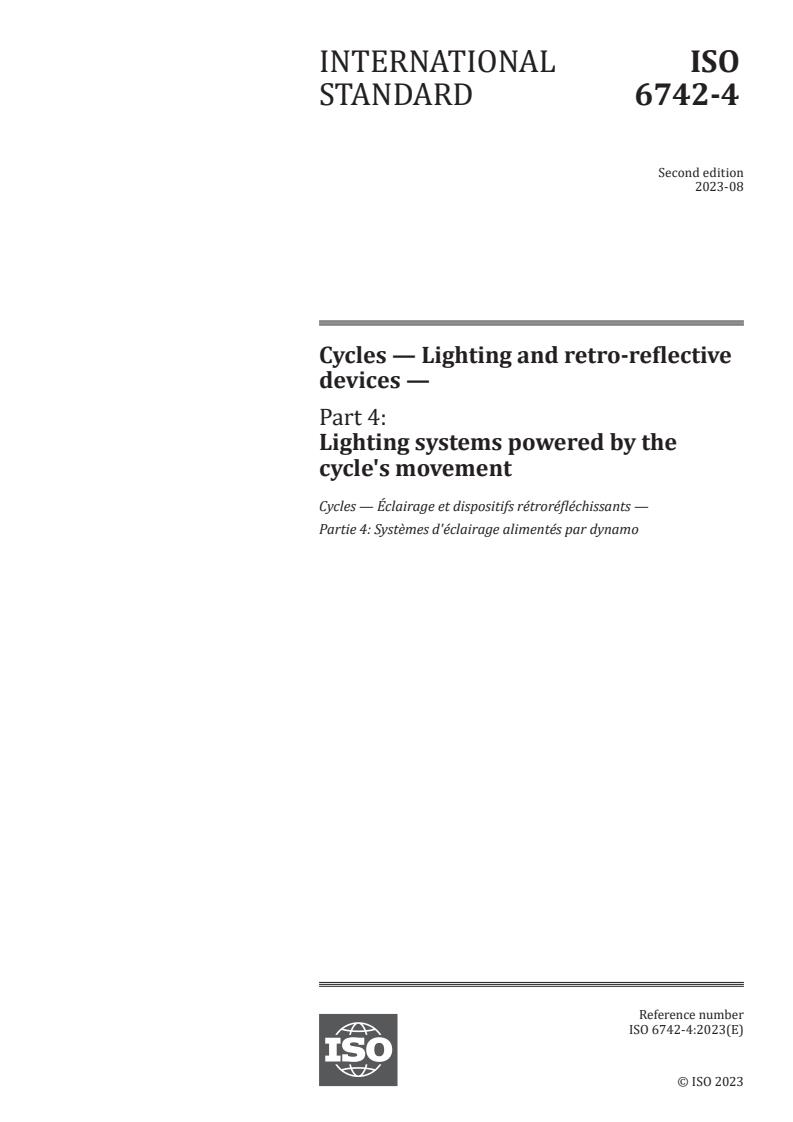
(Main)Cycles — Lighting and retro-reflective devices — Part 4: Lighting systems powered by the cycle's movement
General Information
- Abstract
This document is applicable to lighting systems used on cycles intended to be used on public roads and, especially, bicycles complying with ISO 4210[1] and ISO 8098[2]. This document specifies requirements and test methods for the performance of lighting systems powered by the cycle’s movement. It applies to lighting and light signalling devices complying with ISO 6742‑1. Lighting systems include lighting and light signalling devices and power supplied by cycle's movement such as generator.
- Status
- Published
- Publication Date
- 31-Aug-2023
- Technical Committee
- ISO/TC 149/SC 1 - Cycles and major sub-assemblies
- Drafting Committee
- ISO/TC 149/SC 1 - Cycles and major sub-assemblies
- Current Stage
- 6060 - International Standard published
- Start Date
- 01-Sep-2023
- Due Date
- 10-Feb-2024
- Completion Date
- 31-Aug-2023
Overview
ISO 6742-4:2023 - Cycles: Lighting systems powered by the cycle’s movement specifies performance requirements and test methods for cycle lighting systems that derive power from the bicycle’s movement (e.g., dynamos/generators). It applies to cycles intended for use on public roads - especially bicycles complying with ISO 4210 and ISO 8098 - and to lighting and signalling devices conforming to ISO 6742‑1. The standard covers both interchangeable (“open”) and integrated (“closed”) lamp‑and‑power combinations.
Key topics and technical requirements
- Scope & system types: Defines open systems (interchangeable lamps and generators) and closed systems (integrated or manufacturer‑specified combinations).
- General durability tests: Mandatory corrosion (see Clause 7.1 / ISO 9227 salt spray) and water‑resistance tests (Clause 7.2 / IEC 60529 IP concepts).
- Front and rear lamp requirements: Front lamps must meet photometric and electrical criteria from ISO 6742‑1 and pass open/closed system tests; rear lamps have separate power and photometric limits.
- Generator types: Distinguishes frictional‑drive and positive‑drive generators and sets electrical/efficiency characteristics and test regimes (Clause 5.4 and 7.5).
- Electrical performance and protections:
- Lighting evaluation at the specified test voltage; voltage‑limiting measures only activate above test voltage.
- Nominal lamp voltage must match system voltage or use appropriate electronic ballast.
- Limits on power consumption (e.g., front lamp consumption requirement and rear lamp ≤ 0.6 W at test voltage).
- Stand/parking light behaviour: Integrated capacitors are allowed but must meet charging characteristics and generator voltage reduction limits (specified % reductions at 15 s, 30 s, 60 s, 90 s, 120 s). Stand lights must emit visible light for at least 240 s.
- Test methods & verification: Includes power measurement, high‑speed endurance, and specific tests for frictional and positive drive generators (Clauses 7.3–7.6). Annex A covers electronic loads for LED generator measurement; Annex B covers efficiency calculations; Annex C provides load verification guidance.
- Marking & instructions: Manufacturer marking, durability tests and user instructions are specified.
Applications and who uses this standard
- Bicycle manufacturers and OEMs designing hub or bottle dynamos and integrated lighting systems.
- Lighting component suppliers and LED lamp designers validating compatibility in open systems.
- Test laboratories performing conformity, photometric and electrical endurance testing.
- Product certification bodies, procurement teams, and regulators requiring compliance for road‑use bicycles.
- Safety engineers and fleet managers specifying robust, road‑legal bicycle lighting.
Related standards
- ISO 6742‑1:2023 - Lighting and light signalling devices (photometric/electrical requirements)
- ISO 6742‑3:2023 - Installation and use of lighting and retro‑reflective devices
- ISO 4210, ISO 8098 - Bicycle structural and safety requirements
- ISO 9227, IEC 60529 - Corrosion and ingress protection test references
Keywords: ISO 6742-4:2023, cycle lighting standard, bicycle dynamo, generator testing, open system, closed system, LED generator, corrosion resistance, water resistance, photometric performance.
Relations
- Effective Date
- 06-Jun-2022
Get Certified
Connect with accredited certification bodies for this standard

TÜV Rheinland
TÜV Rheinland is a leading international provider of technical services.

TÜV SÜD
TÜV SÜD is a trusted partner of choice for safety, security and sustainability solutions.

DEKRA Certification Inc.
DEKRA US certification services.
Sponsored listings
Frequently Asked Questions
ISO 6742-4:2023 is a standard published by the International Organization for Standardization (ISO). Its full title is "Cycles — Lighting and retro-reflective devices — Part 4: Lighting systems powered by the cycle's movement". This standard covers: This document is applicable to lighting systems used on cycles intended to be used on public roads and, especially, bicycles complying with ISO 4210[1] and ISO 8098[2]. This document specifies requirements and test methods for the performance of lighting systems powered by the cycle’s movement. It applies to lighting and light signalling devices complying with ISO 6742‑1. Lighting systems include lighting and light signalling devices and power supplied by cycle's movement such as generator.
This document is applicable to lighting systems used on cycles intended to be used on public roads and, especially, bicycles complying with ISO 4210[1] and ISO 8098[2]. This document specifies requirements and test methods for the performance of lighting systems powered by the cycle’s movement. It applies to lighting and light signalling devices complying with ISO 6742‑1. Lighting systems include lighting and light signalling devices and power supplied by cycle's movement such as generator.
ISO 6742-4:2023 is classified under the following ICS (International Classification for Standards) categories: 43.150 - Cycles. The ICS classification helps identify the subject area and facilitates finding related standards.
ISO 6742-4:2023 has the following relationships with other standards: It is inter standard links to ISO 6742-4:2015. Understanding these relationships helps ensure you are using the most current and applicable version of the standard.
ISO 6742-4:2023 is available in PDF format for immediate download after purchase. The document can be added to your cart and obtained through the secure checkout process. Digital delivery ensures instant access to the complete standard document.
Standards Content (Sample)
INTERNATIONAL ISO
STANDARD 6742-4
Second edition
2023-08
Cycles — Lighting and retro-reflective
devices —
Part 4:
Lighting systems powered by the
cycle's movement
Cycles — Éclairage et dispositifs rétroréfléchissants —
Partie 4: Systèmes d'éclairage alimentés par dynamo
Reference number
© ISO 2023
All rights reserved. Unless otherwise specified, or required in the context of its implementation, no part of this publication may
be reproduced or utilized otherwise in any form or by any means, electronic or mechanical, including photocopying, or posting on
the internet or an intranet, without prior written permission. Permission can be requested from either ISO at the address below
or ISO’s member body in the country of the requester.
ISO copyright office
CP 401 • Ch. de Blandonnet 8
CH-1214 Vernier, Geneva
Phone: +41 22 749 01 11
Email: copyright@iso.org
Website: www.iso.org
Published in Switzerland
ii
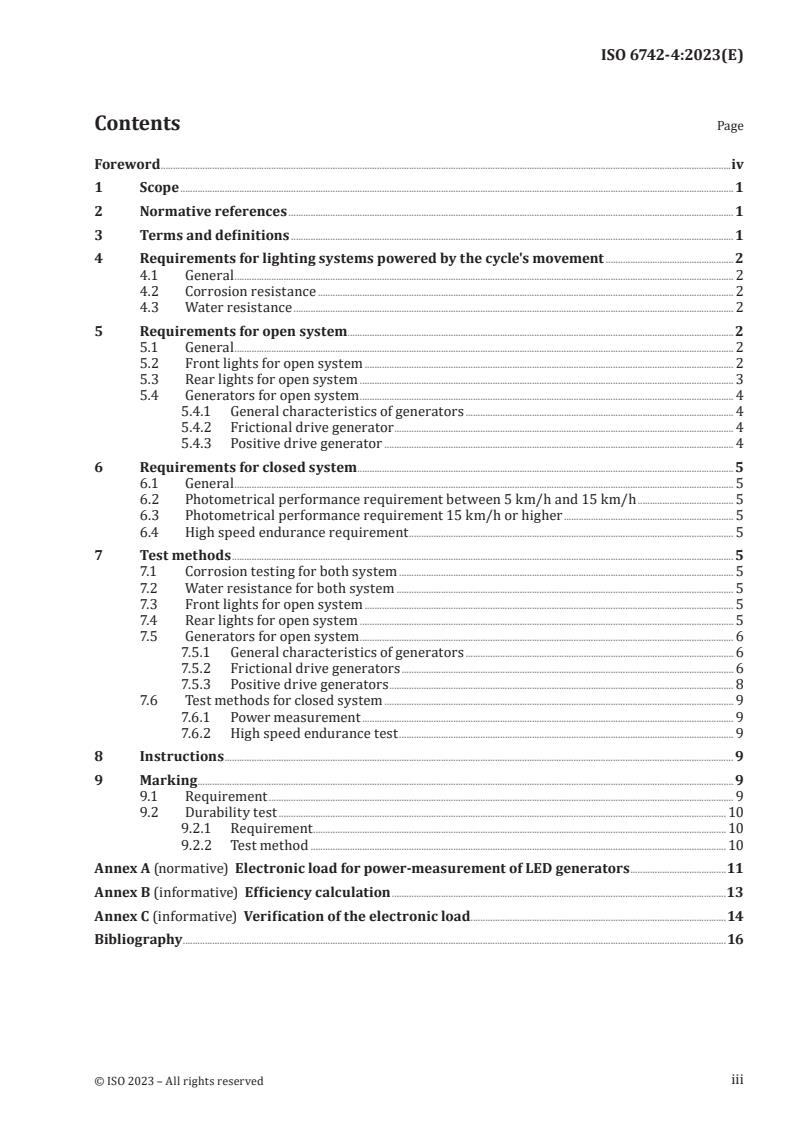
Contents Page
Foreword .iv
1 Scope . 1
2 Normative references . 1
3 Terms and definitions . 1
4 Requirements for lighting systems powered by the cycle's movement .2
4.1 General . 2
4.2 Corrosion resistance . 2
4.3 Water resistance . 2
5 Requirements for open system . .2
5.1 General . 2
5.2 Front lights for open system . 2
5.3 Rear lights for open system . 3
5.4 Generators for open system . 4
5.4.1 General characteristics of generators . 4
5.4.2 Frictional drive generator . 4
5.4.3 Positive drive generator . 4
6 Requirements for closed system .5
6.1 General . 5
6.2 Photometrical performance requirement between 5 km/h and 15 km/h . 5
6.3 Photometrical performance requirement 15 km/h or higher . 5
6.4 High speed endurance requirement . 5
7 Test methods . 5
7.1 Corrosion testing for both system . 5
7.2 Water resistance for both system . 5
7.3 Front lights for open system . 5
7.4 Rear lights for open system . 5
7.5 Generators for open system . 6
7.5.1 General characteristics of generators . 6
7.5.2 Frictional drive generators . 6
7.5.3 Positive drive generators . 8
7.6 Test methods for closed system . 9
7.6.1 Power measurement . 9
7.6.2 High speed endurance test . 9
8 Instructions . 9
9 Marking . . 9
9.1 Requirement . 9
9.2 Durability test . 10
9.2.1 Requirement . 10
9.2.2 Test method . 10
Annex A (normative) Electronic load for power-measurement of LED generators .11
Annex B (informative) Efficiency calculation .13
Annex C (informative) Verification of the electronic load .14
Bibliography .16
iii
Foreword
ISO (the International Organization for Standardization) is a worldwide federation of national standards
bodies (ISO member bodies). The work of preparing International Standards is normally carried out
through ISO technical committees. Each member body interested in a subject for which a technical
committee has been established has the right to be represented on that committee. International
organizations, governmental and non-governmental, in liaison with ISO, also take part in the work.
ISO collaborates closely with the International Electrotechnical Commission (IEC) on all matters of
electrotechnical standardization.
The procedures used to develop this document and those intended for its further maintenance are
described in the ISO/IEC Directives, Part 1. In particular, the different approval criteria needed for the
different types of ISO document should be noted. This document was drafted in accordance with the
editorial rules of the ISO/IEC Directives, Part 2 (see www.iso.org/directives).
ISO draws attention to the possibility that the implementation of this document may involve the use
of (a) patent(s). ISO takes no position concerning the evidence, validity or applicability of any claimed
patent rights in respect thereof. As of the date of publication of this document, ISO had not received
notice of (a) patent(s) which may be required to implement this document. However, implementers are
cautioned that this may not represent the latest information, which may be obtained from the patent
database available at www.iso.org/patents. ISO shall not be held responsible for identifying any or all
such patent rights.
Any trade name used in this document is information given for the convenience of users and does not
constitute an endorsement.
For an explanation of the voluntary nature of standards, the meaning of ISO specific terms and
expressions related to conformity assessment, as well as information about ISO's adherence to
the World Trade Organization (WTO) principles in the Technical Barriers to Trade (TBT), see
www.iso.org/iso/foreword.html.
This document was prepared by Technical Committee ISO/TC 149, Cycles, Subcommittee SC 1, Cycles
and major sub-assemblies.
This second edition cancels and replaces the first edition (ISO 6742-4:2015), which has been technically
revised.
The main changes are as follows:
— terms and definitions: “open system” and “closed system” were added;
— overall structure changes to clarify requirements and test methods;
— addition of “6 V/3 W with electric load” positive drive generators;
— changes in generator characteristic requirements;
— clarify test methods and improvement of requirements for open systems;
— changes in closed system requirements and test methods;
— improvement of Clause 8;
— improvement of Clause 9;
— improvement of Annex A;
— improvement of Annex B;
— improvement of Annex C.
A list of all parts in the ISO 6742 series can be found on the ISO website.
iv
Any feedback or questions on this document should be directed to the user’s national standards body. A
complete listing of these bodies can be found at www.iso.org/members.html.
v
INTERNATIONAL STANDARD ISO 6742-4:2023(E)
Cycles — Lighting and retro-reflective devices —
Part 4:
Lighting systems powered by the cycle's movement
1 Scope
This document is applicable to lighting systems used on cycles intended to be used on public roads and,
[1] [2]
especially, bicycles complying with ISO 4210 and ISO 8098 .
This document specifies requirements and test methods for the performance of lighting systems
powered by the cycle’s movement. It applies to lighting and light signalling devices complying with
ISO 6742-1. Lighting systems include lighting and light signalling devices and power supplied by cycle's
movement such as generator.
2 Normative references
The following documents are referred to in the text in such a way that some or all of their content
constitutes requirements of this document. For dated references, only the edition cited applies. For
undated references, the latest edition of the referenced document (including any amendments) applies.
ISO 6742-1:2023, Cycles — Lighting and retro-reflective devices — Part 1: Lighting and light signalling
devices
ISO 6742-3:2023, Cycles — Lighting and retro-reflective devices — Part 3: Installation and use of lighting
and retro-reflective devices
ISO 9227, Corrosion tests in artificial atmospheres — Salt spray tests
IEC 60529, Degrees of protection provided by enclosures (IP Code)
3 Terms and definitions
For the purposes of this document, the terms and definitions given in ISO 6742-1 and the following
apply.
ISO and IEC maintain terminological databases for use in standardization at the following addresses:
— ISO Online browsing platform: available at https:// www .iso .org/ obp
— IEC Electropedia: available at https:// www .electropedia .org/
3.1
frictional drive generator
generator for which the rotor or stator is linked to a pulley which press against the driving wheel over
a swivel bearing through force
3.2
positive drive generator
generator which is not concerned by the definition of frictional drive generator (3.1)
3.3
open system
system of lamp and power source (i.e. generator or battery) combinations which are interchangeable if
they meet the requirements
[3]
Note 1 to entry: The requirements are specified in this document or ISO 6742-5 .
3.4
closed system
system in which lamp and power source (i.e. generator or battery) are integrated, or in which the
combination is specified by the manufacturer.
4 Requirements for lighting systems powered by the cycle's movement
4.1 General
There are two types of lighting systems powered by the cycle's movement: open systems and closed
systems, and they shall meet the respective requirements shown in Table 1.
The requirements shall be met by the maximum and minimum wheel diameters of the cycle intended
for use.
Table 1 — lighting systems powered by the cycle’s movement
Light system Requirement Test method
Both system 4.2 7.1
4.3 7.2
Open system Front lamp 5.2 7.3
Rear lamp 5.3 7.4
Generators 5.4 7.5
Closed system 6 7.6
4.2 Corrosion resistance
All functions of the lighting system shall work after testing in accordance with the test method
described in 7.1.
4.3 Water resistance
All functions of the lighting system shall work after testing in accordance with the test method
described in 7.2.
5 Requirements for open system
5.1 General
The complete system shall be designed as open system which requires compatibility between lamps
and generators.
5.2 Front lights for open system
Front lights for open system (lamps emitting light to the front) shall correspond with the requirements
of ISO 6742-1:2023, 4.2, 4.5, 4.6 and 4.9, when tested in accordance with 7.3.
Voltage limiting resources shall only become effective above the test voltage. Here, the value of the DC
voltage, U, corresponds with the root mean square of the AC voltage, U .
rms
Furthermore:
— the nominal voltage of the light source shall be equal to the system voltage or the light source shall
be powered via an appropriate electronic ballast;
— the lighting effect shall be deployed at 3 U at the latest;
rms
— the lighting evaluation shall be performed at test voltage;
— the power consumption shall be 110 % or less of the nominal value;
— the power consumption shall be 2,4 W or less at the test voltage;
— electronic ballasts in these units shall have the corresponding electrical rating.
Head lamps with integrated capacitor to power the light while halting shall be built so that the load
of the entire equipment on the supply system is not substantially higher than that intended for
this equipment according to ISO 6742-1:2023, 4.8. The entire equipment shall fulfil the necessary
requirements at test voltage, where, based on a discharged capacitor, a charging time of 120 s using test
voltage is permissible and the reduction of the generator voltage through the charging of the capacitor
shall correspond with the following conditions:
a) not exceeding 60 % after 15 s;
b) not exceeding 37 % after 30 s;
c) not exceeding 15 % after 60 s;
d) not exceeding 5 % after 90 s;
e) not exceeding 1,5 % after 120 s.
Any stand light shall
...