

ISO 18189:2016
(Main)Ophthalmic optics — Contact lenses and contact lens care products — Cytotoxicity testing of contact lenses in combination with lens care solution to evaluate lens/solution interactions
General Information
- Abstract
Iso 18189:2016 describes an in vitro test method to assess the potential cytotoxic effects that may arise due to interaction of contact lenses with contact lens care solutions. NOTE The potential of a contact lens or a contact lens care solution to cause cytotoxicity by itself can be evaluated in accordance with general guidance in ISO 10993‑5.
- Status
- Published
- Publication Date
- 29-May-2016
- Technical Committee
- ISO/TC 172/SC 7 - Ophthalmic optics and instruments
- Drafting Committee
- ISO/TC 172/SC 7/WG 9 - Contact lenses
- Current Stage
- 9093 - International Standard confirmed
- Start Date
- 07-Apr-2022
- Completion Date
- 29-Aug-2026
Buy Documents
ISO 18189:2016 - Ophthalmic optics -- Contact lenses and contact lens care products -- Cytotoxicity testing of contact lenses in combination with lens care solution to evaluate lens/solution interactions
ISO 18189:2016 - Ophthalmic optics — Contact lenses and contact lens care products — Cytotoxicity testing of contact lenses in combination with lens care solution to evaluate lens/solution interactions/30/2016
Overview
ISO 18189:2016 - "Ophthalmic optics - Contact lenses and contact lens care products - Cytotoxicity testing of contact lenses in combination with lens care solution" - specifies an in vitro test method to assess potential cytotoxic effects from interactions between contact lenses and lens care solutions. The standard focuses on direct-contact testing to detect lens-mediated release or concentration of solution ingredients (e.g., preservatives) that could harm ocular cells. (Note: standalone cytotoxicity of a lens or solution is covered by ISO 10993‑5.)
Key topics and requirements
- Test principle: direct-contact cytotoxicity using contact lenses pre‑soaked in the lens care solution and placed onto a confluent monolayer of L‑929 cells.
- Sample preparation: lenses are incubated in ~10 ml of the care solution (or DPBS for lens controls) for 24 h ± 2 h at room temperature with gentle agitation; lenses may be cut (pinwheel) before testing.
- Cell system and culture: L‑929 fibroblast cells (ATCC NCTC clone 929), seeded to form subconfluent monolayers in Minimal Essential Medium (MEM) with 5% serum; incubations at 37 °C ± 1 °C and 5% ± 1% CO2.
- Controls and acceptance criteria:
- Positive control: latex (1 cm × 1 cm), expected grade ≥ 3 in all four replicates.
- Negative control: high density polyethylene (HDPE, 0.5 mm thick, 1 cm × 1 cm), expected grade ≤ 1.
- Lens control: lens soaked in DPBS, expected grade ≤ 1.
- Test validity requires these control criteria be met.
- Endpoint and scoring: after 24 h ± 2 h contact, remove specimens, stain with Trypan Blue, and assess cell morphology and zone of lysis. Reactivity grades range 0 (none) to 4 (severe); grades > 2 indicate cytotoxic effect.
- Measurement guidance: Annex A describes measuring the zone of cell lysis and plate layout.
Applications and users
ISO 18189 is used by:
- Contact lens and lens care solution manufacturers for product development and compatibility testing.
- Biocompatibility and analytical laboratories performing preclinical in vitro testing.
- Regulatory and quality assurance teams preparing safety dossiers and ensuring compliance with ophthalmic device safety expectations.
- R&D teams evaluating interactions across conventional and silicone hydrogel lens materials with representative multipurpose solutions.
Practical benefits include early identification of adverse lens/solution interactions, reduced risk in clinical testing, and support for regulatory submissions.
Related standards
- ISO 10993‑5 - Biological evaluation of medical devices - Tests for in vitro cytotoxicity (general guidance).
- ISO 18369‑1 - Contact lens vocabulary, classification, and labelling (referenced for terms and definitions).
Keywords: ISO 18189, cytotoxicity testing, contact lenses, lens care solutions, in vitro test, L‑929 cells, ISO 10993‑5.
Buy Documents
ISO 18189:2016 - Ophthalmic optics -- Contact lenses and contact lens care products -- Cytotoxicity testing of contact lenses in combination with lens care solution to evaluate lens/solution interactions
ISO 18189:2016 - Ophthalmic optics — Contact lenses and contact lens care products — Cytotoxicity testing of contact lenses in combination with lens care solution to evaluate lens/solution interactions/30/2016
Get Certified
Connect with accredited certification bodies for this standard

BSI Group
BSI (British Standards Institution) is the business standards company that helps organizations make excellence a habit.

TÜV Rheinland
TÜV Rheinland is a leading international provider of technical services.

TÜV SÜD
TÜV SÜD is a trusted partner of choice for safety, security and sustainability solutions.
Sponsored listings
Frequently Asked Questions
ISO 18189:2016 is a standard published by the International Organization for Standardization (ISO). Its full title is "Ophthalmic optics — Contact lenses and contact lens care products — Cytotoxicity testing of contact lenses in combination with lens care solution to evaluate lens/solution interactions". This standard covers: Iso 18189:2016 describes an in vitro test method to assess the potential cytotoxic effects that may arise due to interaction of contact lenses with contact lens care solutions. NOTE The potential of a contact lens or a contact lens care solution to cause cytotoxicity by itself can be evaluated in accordance with general guidance in ISO 10993‑5.
Iso 18189:2016 describes an in vitro test method to assess the potential cytotoxic effects that may arise due to interaction of contact lenses with contact lens care solutions. NOTE The potential of a contact lens or a contact lens care solution to cause cytotoxicity by itself can be evaluated in accordance with general guidance in ISO 10993‑5.
ISO 18189:2016 is classified under the following ICS (International Classification for Standards) categories: 11.040.70 - Ophthalmic equipment. The ICS classification helps identify the subject area and facilitates finding related standards.
ISO 18189:2016 is available in PDF format for immediate download after purchase. The document can be added to your cart and obtained through the secure checkout process. Digital delivery ensures instant access to the complete standard document.
Standards Content (Sample)
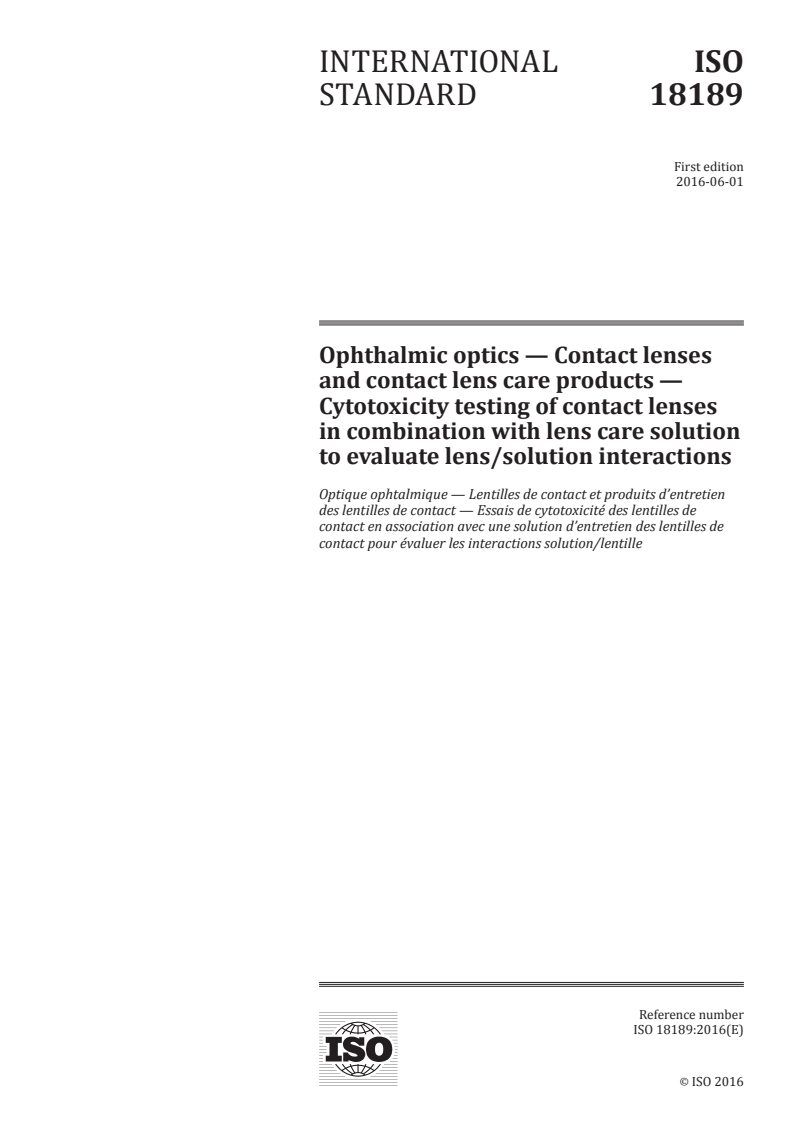
INTERNATIONAL ISO
STANDARD 18189
First edition
2016-06-01
Ophthalmic optics — Contact lenses
and contact lens care products —
Cytotoxicity testing of contact lenses
in combination with lens care solution
to evaluate lens/solution interactions
Optique ophtalmique — Lentilles de contact et produits d’entretien
des lentilles de contact — Essais de cytotoxicité des lentilles de
contact en association avec une solution d’entretien des lentilles de
contact pour évaluer les interactions solution/lentille
Reference number
©
ISO 2016
© ISO 2016, Published in Switzerland
All rights reserved. Unless otherwise specified, no part of this publication may be reproduced or utilized otherwise in any form
or by any means, electronic or mechanical, including photocopying, or posting on the internet or an intranet, without prior
written permission. Permission can be requested from either ISO at the address below or ISO’s member body in the country of
the requester.
ISO copyright office
Ch. de Blandonnet 8 • CP 401
CH-1214 Vernier, Geneva, Switzerland
Tel. +41 22 749 01 11
Fax +41 22 749 09 47
copyright@iso.org
www.iso.org
ii © ISO 2016 – All rights reserved
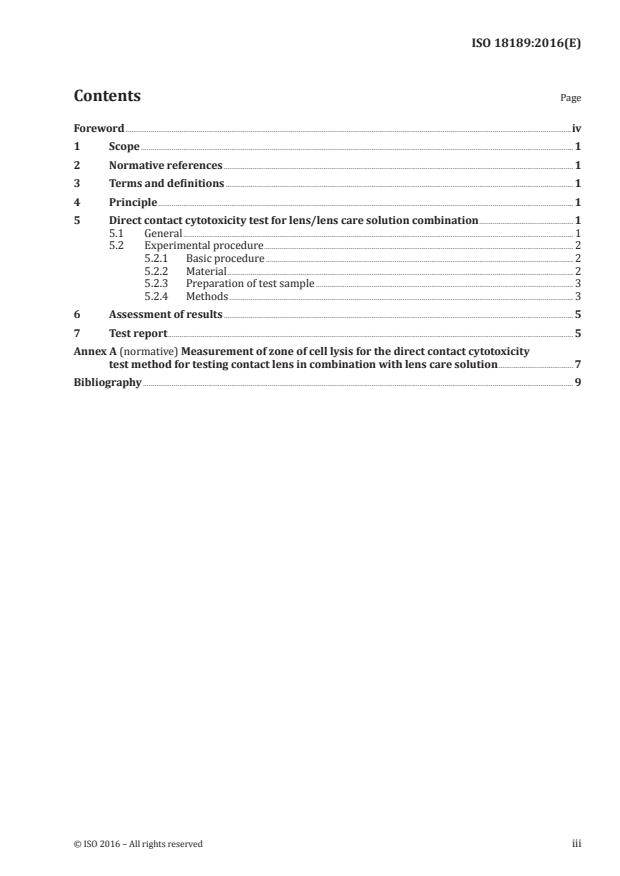
Contents Page
Foreword .iv
1 Scope . 1
2 Normative references . 1
3 Terms and definitions . 1
4 Principle . 1
5 Direct contact cytotoxicity test for lens/lens care solution combination .1
5.1 General . 1
5.2 Experimental procedure . 2
5.2.1 Basic procedure . 2
5.2.2 Material . 2
5.2.3 Preparation of test sample . 3
5.2.4 Methods . 3
6 Assessment of results . 5
7 Test report . 5
Annex A (normative) Measurement of zone of cell lysis for the direct contact cytotoxicity
test method for testing contact lens in combination with lens care solution .7
Bibliography . 9
Foreword
ISO (the International Organization for Standardization) is a worldwide federation of national standards
bodies (ISO member bodies). The work of preparing International Standards is normally carried out
through ISO technical committees. Each member body interested in a subject for which a technical
committee has been established has the right to be represented on that committee. International
organizations, governmental and non-governmental, in liaison with ISO, also take part in the work.
ISO collaborates closely with the International Electrotechnical Commission (IEC) on all matters of
electrotechnical standardization.
The procedures used to develop this document and those intended for its further maintenance are
described in the ISO/IEC Directives, Part 1. In particular the different approval criteria needed for the
different types of ISO documents should be noted. This document was drafted in accordance with the
editorial rules of the ISO/IEC Directives, Part 2 (see www.iso.org/directives).
Attention is drawn to the possibility that some of the elements of this document may be the subject of
patent rights. ISO shall not be held responsible for identifying any or all such patent rights. Details of
any patent rights identified during the development of the document will be in the Introduction and/or
on the ISO list of patent declarations received (see www.iso.org/patents).
Any trade name used in this document is information given for the convenience of users and does not
constitute an endorsement.
For an explanation on the meaning of ISO specific terms and expressions related to conformity assessment,
as well as information about ISO’s adherence to the World Trade Organization (WTO) principles in the
Technical Barriers to Trade (TBT) see the following URL: www.iso.org/iso/foreword.html.
The committee responsible for this document is ISO/TC 172, Optics and photonics, Subcommittee SC 7,
Ophthalmic optics and instruments.
iv © ISO 2016 – All rights reserved
INTERNATIONAL STANDARD ISO 18189:2016(E)
Ophthalmic optics — Contact lenses and contact lens
care products — Cytotoxicity testing of contact lenses
in combination with lens care solution to evaluate lens/
solution interactions
1 Scope
This International Standard describes an in vitro test method to assess the potential cytotoxic effects
that may arise due to interaction of contact lenses with contact lens care solutions.
NOTE The potential of a contact lens or a contact lens care solution to cause cytotoxicity by itself can be
evaluated in accordance with general guidance in ISO 10993-5.
2 Normative references
The following documents, in whole or in part, are normatively referenced in this document and are
indispensable for its application. For dated references, only the edition cited applies. For undated
references, the latest edition of the referenced document (including any amendments) applies.
ISO 18369-1, Ophthalmic optics — Contact lenses — Part 1: Vocabulary, classification system and
recommendations for labelling specifications
3 Terms and definitions
For the purposes of this document, the terms and definitions given in ISO 18369-1 and the following apply.
3.1
room temperature
temperature defined as 18 °C to 25 °C
4 Principle
The chemicals in a lens care solution can cause cytotoxic effects by direct contact with ocular tissues
or by indirect contact through contact lenses. Uptake of the care product preservative or other
solution ingredients by the lens and subsequent release of these chemicals in the ocular environment
can compromise ocular biocompatibility. The potential interactions between a lens care product and
various contact lens materials should be taken into account in designing the tests to fully evaluate the
cytotoxicity potential of a new contact lens or a lens care product.
5 Direct contact cytotoxicity test for lens/lens care solution combination
5.1 General
The following protocol describes the test method for evaluating potential cytotoxic effects of contact
lenses exposed to contact lens care solution. The cytotoxicity can result from contact lens/lens care
solution interactions.
With the exception of daily disposable contact lenses, the potential interaction of a new contact lens
with marketed representative multipurpose solutions to produce cytotoxicity shall be evaluated.
For evaluating a new contact lens care solution, the potential interaction of new contact lens care
solution with representative contact lenses to produce cytotoxicity shall be evaluated.
5.2 Experimental procedure
5.2.1 Basic procedure
The test contact lens is incubated in ~10 ml of contact lens care solution in a sterile compatible container
2+
for 24 h ± 2 h at room temperature. Similarly, a Dulbecco’s Phosphate Buffered Saline with Ca and
2+
Mg (DBPS)-treated control lens (“Lens Control”) is prepared by incubating the contact lens in ~10 ml
of DPBS in the same type of container for 24 h ± 2 h at room temperature.
For the purpose of this International Standard, a compatible container refers to a container in which
there is little to no uptake of the disinfecting agent and/or preservative. Rinsing of the container with
the contact lens care product may be used to reduce uptake by the container.
Following the 24 h ± 2 h soak period, the lenses may be cut in a pinwheel fashion (3 to 4 cuts
approximately 1/3 to 1/2 into the lens) and immediately used for cytotoxicity testing. If the lens is
not cut, it shall be placed on the cells in a concave manner. Each lens is placed in the centre on the cell
surface in a 60 mm diameter tissue culture plate containing subconfluent monolayer of L-929 cells in
1,6 ml Minimal Essential Medium (MEM) supplemented with 5 % fetal bovine serum (FBS).
Similarly, negative and positive controls are placed in the designated 60 mm diameter tissue culture
plates containing subconfluent monolayer of L-929 cells in 1,6 ml MEM supplemented with 5 % FBS.
The tissue culture plates are incubated at 37 °C ± 1 °C in 5 % ± 1 % CO for 24 h ± 2 h.
Following incubation, the lenses and the controls are removed from each plate and the cells are stained
with Trypan Blue to facilitate observation of dead or damaged cells. The cytotoxicity is assessed by
evaluating the cells macroscopically and microscopically (100×) for any abnormal cell morphology and
lysis around the test article and controls to determine the zone of lysis (if any).
5.2.2 Material
5.2.2.1 Cell line
L-929 cells [NCTC clone 929: CCL 1, American Type Culture Collection (ATCC), Manassas, VA, USA;
ECACC No. 88102702 or equivalent, European Collection of Cell Cultures, Salisbury, Wiltshire SP4 0JG,
UK]. Cell cultures shall be free of mycoplasma.
The passage number of the cells for testing should be 10 – 30.
5.2.2.2 Technical equipment
5.2.2.2.1 Incubator, 37 °C ± 1 °C, humidified, 5 % ± 1 % CO /air.
5.2.2.2.2 Laminar flow cabinet, standard: “biological hazard”.
5.2.2.2.3 Water bath, 37 °C.
5.2.2.2.4 Inverse phase contrast microscope.
5.2.2.2.5 Laboratory burner.
5.2.2.2.6 Centrifuge.
2 © ISO 2016 – All rights reserved
5.2.2.2.7 Laboratory balance.
5.2.2.2.8 Cell counter or hemocytometer.
5.2.2.2.9 Tissue culture flasks and 60 mm diameter tissue culture plat
...
INTERNATIONAL ISO
STANDARD 18189
First edition
2016-06-01
Ophthalmic optics — Contact lenses
and contact lens care products —
Cytotoxicity testing of contact lenses
in combination with lens care solution
to evaluate lens/solution interactions
Optique ophtalmique — Lentilles de contact et produits d’entretien
des lentilles de contact — Essais de cytotoxicité des lentilles de
contact en association avec une solution d’entretien des lentilles de
contact pour évaluer les interactions solution/lentille
Reference number
©
ISO 2016
© ISO 2016, Published in Switzerland
All rights reserved. Unless otherwise specified, no part of this publication may be reproduced or utilized otherwise in any form
or by any means, electronic or mechanical, including photocopying, or posting on the internet or an intranet, without prior
written permission. Permission can be requested from either ISO at the address below or ISO’s member body in the country of
the requester.
ISO copyright office
Ch. de Blandonnet 8 • CP 401
CH-1214 Vernier, Geneva, Switzerland
Tel. +41 22 749 01 11
Fax +41 22 749 09 47
copyright@iso.org
www.iso.org
ii © ISO 2016 – All rights reserved
Contents Page
Foreword .iv
1 Scope . 1
2 Normative references . 1
3 Terms and definitions . 1
4 Principle . 1
5 Direct contact cytotoxicity test for lens/lens care solution combination .1
5.1 General . 1
5.2 Experimental procedure . 2
5.2.1 Basic procedure . 2
5.2.2 Material . 2
5.2.3 Preparation of test sample . 3
5.2.4 Methods . 3
6 Assessment of results . 5
7 Test report . 5
Annex A (normative) Measurement of zone of cell lysis for the direct contact cytotoxicity
test method for testing contact lens in combination with lens care solution .7
Bibliography . 9
Foreword
ISO (the International Organization for Standardization) is a worldwide federation of national standards
bodies (ISO member bodies). The work of preparing International Standards is normally carried out
through ISO technical committees. Each member body interested in a subject for which a technical
committee has been established has the right to be represented on that committee. International
organizations, governmental and non-governmental, in liaison with ISO, also take part in the work.
ISO collaborates closely with the International Electrotechnical Commission (IEC) on all matters of
electrotechnical standardization.
The procedures used to develop this document and those intended for its further maintenance are
described in the ISO/IEC Directives, Part 1. In particular the different approval criteria needed for the
different types of ISO documents should be noted. This document was drafted in accordance with the
editorial rules of the ISO/IEC Directives, Part 2 (see www.iso.org/directives).
Attention is drawn to the possibility that some of the elements of this document may be the subject of
patent rights. ISO shall not be held responsible for identifying any or all such patent rights. Details of
any patent rights identified during the development of the document will be in the Introduction and/or
on the ISO list of patent declarations received (see www.iso.org/patents).
Any trade name used in this document is information given for the convenience of users and does not
constitute an endorsement.
For an explanation on the meaning of ISO specific terms and expressions related to conformity assessment,
as well as information about ISO’s adherence to the World Trade Organization (WTO) principles in the
Technical Barriers to Trade (TBT) see the following URL: www.iso.org/iso/foreword.html.
The committee responsible for this document is ISO/TC 172, Optics and photonics, Subcommittee SC 7,
Ophthalmic optics and instruments.
iv © ISO 2016 – All rights reserved
INTERNATIONAL STANDARD ISO 18189:2016(E)
Ophthalmic optics — Contact lenses and contact lens
care products — Cytotoxicity testing of contact lenses
in combination with lens care solution to evaluate lens/
solution interactions
1 Scope
This International Standard describes an in vitro test method to assess the potential cytotoxic effects
that may arise due to interaction of contact lenses with contact lens care solutions.
NOTE The potential of a contact lens or a contact lens care solution to cause cytotoxicity by itself can be
evaluated in accordance with general guidance in ISO 10993-5.
2 Normative references
The following documents, in whole or in part, are normatively referenced in this document and are
indispensable for its application. For dated references, only the edition cited applies. For undated
references, the latest edition of the referenced document (including any amendments) applies.
ISO 18369-1, Ophthalmic optics — Contact lenses — Part 1: Vocabulary, classification system and
recommendations for labelling specifications
3 Terms and definitions
For the purposes of this document, the terms and definitions given in ISO 18369-1 and the following apply.
3.1
room temperature
temperature defined as 18 °C to 25 °C
4 Principle
The chemicals in a lens care solution can cause cytotoxic effects by direct contact with ocular tissues
or by indirect contact through contact lenses. Uptake of the care product preservative or other
solution ingredients by the lens and subsequent release of these chemicals in the ocular environment
can compromise ocular biocompatibility. The potential interactions between a lens care product and
various contact lens materials should be taken into account in designing the tests to fully evaluate the
cytotoxicity potential of a new contact lens or a lens care product.
5 Direct contact cytotoxicity test for lens/lens care solution combination
5.1 General
The following protocol describes the test method for evaluating potential cytotoxic effects of contact
lenses exposed to contact lens care solution. The cytotoxicity can result from contact lens/lens care
solution interactions.
With the exception of daily disposable contact lenses, the potential interaction of a new contact lens
with marketed representative multipurpose solutions to produce cytotoxicity shall be evaluated.
For evaluating a new contact lens care solution, the potential interaction of new contact lens care
solution with representative contact lenses to produce cytotoxicity shall be evaluated.
5.2 Experimental procedure
5.2.1 Basic procedure
The test contact lens is incubated in ~10 ml of contact lens care solution in a sterile compatible container
2+
for 24 h ± 2 h at room temperature. Similarly, a Dulbecco’s Phosphate Buffered Saline with Ca and
2+
Mg (DBPS)-treated control lens (“Lens Control”) is prepared by incubating the contact lens in ~10 ml
of DPBS in the same type of container for 24 h ± 2 h at room temperature.
For the purpose of this International Standard, a compatible container refers to a container in which
there is little to no uptake of the disinfecting agent and/or preservative. Rinsing of the container with
the contact lens care product may be used to reduce uptake by the container.
Following the 24 h ± 2 h soak period, the lenses may be cut in a pinwheel fashion (3 to 4 cuts
approximately 1/3 to 1/2 into the lens) and immediately used for cytotoxicity testing. If the lens is
not cut, it shall be placed on the cells in a concave manner. Each lens is placed in the centre on the cell
surface in a 60 mm diameter tissue culture plate containing subconfluent monolayer of L-929 cells in
1,6 ml Minimal Essential Medium (MEM) supplemented with 5 % fetal bovine serum (FBS).
Similarly, negative and positive controls are placed in the designated 60 mm diameter tissue culture
plates containing subconfluent monolayer of L-929 cells in 1,6 ml MEM supplemented with 5 % FBS.
The tissue culture plates are incubated at 37 °C ± 1 °C in 5 % ± 1 % CO for 24 h ± 2 h.
Following incubation, the lenses and the controls are removed from each plate and the cells are stained
with Trypan Blue to facilitate observation of dead or damaged cells. The cytotoxicity is assessed by
evaluating the cells macroscopically and microscopically (100×) for any abnormal cell morphology and
lysis around the test article and controls to determine the zone of lysis (if any).
5.2.2 Material
5.2.2.1 Cell line
L-929 cells [NCTC clone 929: CCL 1, American Type Culture Collection (ATCC), Manassas, VA, USA;
ECACC No. 88102702 or equivalent, European Collection of Cell Cultures, Salisbury, Wiltshire SP4 0JG,
UK]. Cell cultures shall be free of mycoplasma.
The passage number of the cells for testing should be 10 – 30.
5.2.2.2 Technical equipment
5.2.2.2.1 Incubator, 37 °C ± 1 °C, humidified, 5 % ± 1 % CO /air.
5.2.2.2.2 Laminar flow cabinet, standard: “biological hazard”.
5.2.2.2.3 Water bath, 37 °C.
5.2.2.2.4 Inverse phase contrast microscope.
5.2.2.2.5 Laboratory burner.
5.2.2.2.6 Centrifuge.
2 © ISO 2016 – All rights reserved
5.2.2.2.7 Laboratory balance.
5.2.2.2.8 Cell counter or hemocytometer.
5.2.2.2.9 Tissue culture flasks and 60 mm diameter tissue culture plat
...