

ISO 25902-2:2010
(Main)Titanium pipes and tubes — Non-destructive testing — Part 2: Ultrasonic testing for the detection of longitudinal imperfections
General Information
- Abstract
ISO 25902-2:2010 specifies an ultrasonic testing method for detecting longitudinal imperfections in titanium seamless tubes or welded tubes. ISO 25902-2:2010 also applies to titanium alloy tubes.
- Status
- Published
- Publication Date
- 17-Feb-2010
- Technical Committee
- ISO/TC 79/SC 11 - Titanium
- Drafting Committee
- ISO/TC 79/SC 11 - Titanium
- Current Stage
- 9020 - International Standard under periodical review
- Start Date
- 15-Jul-2026
- Completion Date
- 15-Jul-2026

Overview
ISO 25902-2:2010 is an international standard that specifies the ultrasonic testing method for detecting longitudinal imperfections in titanium pipes and tubes. Applicable to both seamless and welded titanium tubes-including titanium alloy variants-this standard ensures a reliable non-destructive testing (NDT) process focused on identifying defects without causing damage. The standard is essential for industries requiring secure, high-quality titanium tubing, such as aerospace, chemical processing, and heat exchanger applications.
Key features include:
- Use of ultrasonic angle beam techniques with rotating transducers or tubes
- Application to tubes with dimension ranges from 10 mm to 150 mm outside diameter and thicknesses from 0.3 mm to 10 mm
- Requirement for specially fabricated reference tubes and reflectors to calibrate testing sensitivity
- Qualification and certification of testing personnel in accordance with ISO 9712
This standard plays a critical role in quality assurance, allowing manufacturers and users to detect longitudinal flaws early and maintain the integrity and safety of titanium tubing systems.
Key Topics
Ultrasonic Testing Method
- Employs immersion-based ultrasonic systems using angle beam techniques for precise detection.
- Tests are performed by rotating either the ultrasonic transducer or the tube for full surface coverage.
- Sensitivity is calibrated with rectangular notch reference reflectors of specified dimensions.
Reference Tubes and Reflectors
- Reference tubes must match tested materials in grade, dimensions, surface finish, heat treatment, and acoustic properties.
- Rectangular notches act as calibration reflectors; their depths range from 0.08 mm upwards to simulate imperfections.
- Fabrication methods include electric-discharge machining and mechanical processes.
Testing Personnel and Qualification
- Operators shall be trained and certified under ISO 9712 or an equivalent qualification system.
- Testing must be supervised by competent personnel nominated by the manufacturer.
- Level 3 NDT individuals must authorize operators, ensuring reliability and expertise.
Test Equipment Requirements
- Ultrasonic instruments need amplitude linearity verification per ISO 18175.
- Transducers must comply with ISO 10375 performance criteria.
- Systems must include tube feeding and rotation devices, as well as automatic alarms and data recording capabilities to ensure thorough inspection.
Acceptance and Reporting
- Tubes are accepted only if no signal exceeds the amplitude from reference reflectors.
- Testing sensitivity must be confirmed every 4 hours during continuous operations.
- Comprehensive reports include test dates, personnel, equipment used, testing conditions, and detailed results.
Applications
ISO 25902-2:2010 is vital for industries utilizing titanium tubes with strict safety, durability, and performance requirements, including:
- Aerospace: Ensuring defect-free titanium pipes used in critical aircraft systems.
- Chemical and Petrochemical Plants: Detecting flaws in titanium tubes that handle corrosive or high-temperature fluids.
- Heat Exchangers: Maintaining high-quality tubing to prevent leaks and operational failures.
- Medical Equipment: Verifying integrity of titanium alloy tubes used in specialized devices.
Using this standard helps manufacturers and users avoid costly failures and maintain compliance with regulatory and quality expectations linked to titanium tubing.
Related Standards
- ISO 9712 – Qualification and certification of personnel in non-destructive testing.
- ISO 10375 – Characterization of ultrasonic search units and sound fields.
- ISO 18175 – Performance assessment of ultrasonic testing instruments.
- ISO 25902-1 – Eddy-current examination of titanium pipes and tubes, complementing ultrasonic inspection with surface flaw detection.
- ISO 5577 – Ultrasonic inspection vocabulary for consistent terminology.
- ISO 12710 – Evaluating electronic characteristics of ultrasonic test devices.
By adhering to ISO 25902-2:2010, organizations can implement a robust ultrasonic testing protocol for titanium tubes, enhancing product quality and safety while ensuring compliance with internationally recognized standards for non-destructive testing processes.
Get Certified
Connect with accredited certification bodies for this standard

Element Materials Technology
Materials testing and product certification.

Inštitut za kovinske materiale in tehnologije
Institute of Metals and Technology. Materials testing, metallurgical analysis, NDT.
Sponsored listings
Frequently Asked Questions
ISO 25902-2:2010 is a standard published by the International Organization for Standardization (ISO). Its full title is "Titanium pipes and tubes — Non-destructive testing — Part 2: Ultrasonic testing for the detection of longitudinal imperfections". This standard covers: ISO 25902-2:2010 specifies an ultrasonic testing method for detecting longitudinal imperfections in titanium seamless tubes or welded tubes. ISO 25902-2:2010 also applies to titanium alloy tubes.
ISO 25902-2:2010 specifies an ultrasonic testing method for detecting longitudinal imperfections in titanium seamless tubes or welded tubes. ISO 25902-2:2010 also applies to titanium alloy tubes.
ISO 25902-2:2010 is classified under the following ICS (International Classification for Standards) categories: 77.040.20 - Non-destructive testing of metals; 77.150.50 - Titanium products. The ICS classification helps identify the subject area and facilitates finding related standards.
ISO 25902-2:2010 is available in PDF format for immediate download after purchase. The document can be added to your cart and obtained through the secure checkout process. Digital delivery ensures instant access to the complete standard document.
Standards Content (Sample)
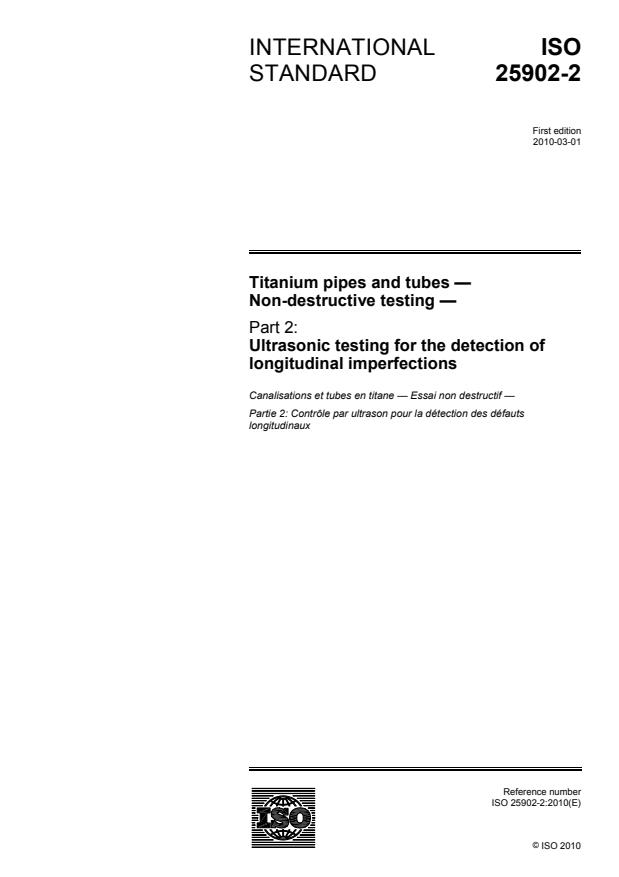
INTERNATIONAL ISO
STANDARD 25902-2
First edition
2010-03-01
Titanium pipes and tubes —
Non-destructive testing —
Part 2:
Ultrasonic testing for the detection of
longitudinal imperfections
Canalisations et tubes en titane — Essai non destructif —
Partie 2: Contrôle par ultrason pour la détection des défauts
longitudinaux
Reference number
©
ISO 2010
PDF disclaimer
This PDF file may contain embedded typefaces. In accordance with Adobe's licensing policy, this file may be printed or viewed but
shall not be edited unless the typefaces which are embedded are licensed to and installed on the computer performing the editing. In
downloading this file, parties accept therein the responsibility of not infringing Adobe's licensing policy. The ISO Central Secretariat
accepts no liability in this area.
Adobe is a trademark of Adobe Systems Incorporated.
Details of the software products used to create this PDF file can be found in the General Info relative to the file; the PDF-creation
parameters were optimized for printing. Every care has been taken to ensure that the file is suitable for use by ISO member bodies. In
the unlikely event that a problem relating to it is found, please inform the Central Secretariat at the address given below.
© ISO 2010
All rights reserved. Unless otherwise specified, no part of this publication may be reproduced or utilized in any form or by any means,
electronic or mechanical, including photocopying and microfilm, without permission in writing from either ISO at the address below or
ISO's member body in the country of the requester.
ISO copyright office
Case postale 56 • CH-1211 Geneva 20
Tel. + 41 22 749 01 11
Fax + 41 22 749 09 47
E-mail copyright@iso.org
Web www.iso.org
Published in Switzerland
ii © ISO 2010 – All rights reserved
Foreword
ISO (the International Organization for Standardization) is a worldwide federation of national standards bodies
(ISO member bodies). The work of preparing International Standards is normally carried out through ISO
technical committees. Each member body interested in a subject for which a technical committee has been
established has the right to be represented on that committee. International organizations, governmental and
non-governmental, in liaison with ISO, also take part in the work. ISO collaborates closely with the
International Electrotechnical Commission (IEC) on all matters of electrotechnical standardization.
International Standards are drafted in accordance with the rules given in the ISO/IEC Directives, Part 2.
The main task of technical committees is to prepare International Standards. Draft International Standards
adopted by the technical committees are circulated to the member bodies for voting. Publication as an
International Standard requires approval by at least 75 % of the member bodies casting a vote.
Attention is drawn to the possibility that some of the elements of this document may be the subject of patent
rights. ISO shall not be held responsible for identifying any or all such patent rights.
ISO 25902-2 was prepared by Technical Committee ISO/TC 79, Light metals and their alloys, Subcommittee
SC 11, Titanium.
ISO 25902 consists of the following parts, under the general title Titanium pipes and tubes — Non-destructive
testing:
⎯ Part 1: Eddy-current examination
⎯ Part 2: Ultrasonic testing for the detection of longitudinal imperfections
INTERNATIONAL STANDARD ISO 25902-2:2010(E)
Titanium pipes and tubes — Non-destructive testing —
Part 2:
Ultrasonic testing for the detection of longitudinal
imperfections
1 Scope
This part of ISO 25902 specifies an ultrasonic testing method for detecting longitudinal imperfections in
titanium seamless tubes or welded tubes.
This part of ISO 25902 also applies to titanium alloy tubes.
In this part of ISO 25902
a) the minimum wall thickness is 0,3 mm,
b) only rectangular notches are permitted as reference reflectors, and
c) the minimum notch depth is 0,08 mm.
2 Normative references
The following referenced documents are indispensable for the application of this document. For dated
references, only the edition cited applies. For undated references, the latest edition of the referenced
document (including any amendments) applies.
ISO 9712, Non-destructive testing — Qualification and certification of personnel
ISO 10375, Non-destructive testing — Ultrasonic inspection — Characterization of search unit and sound field
ISO 18175, Non-destructive testing — Evaluating performance characteristics of ultrasonic pulse-echo testing
systems without the use of electronic measurement instruments
3 General
3.1 Applicable dimension range
The range of the applicable dimensions of a tube shall be 10 mm to 150 mm outside diameter and 0,3 mm to
10 mm thickness. The ratio of thickness to outside diameter shall be less than or equal to 0,2 (20 %).
3.2 Testing technique
The test shall be carried out using an ultrasonic angle beam technique, effected by rotating the ultrasonic
transducer or the tube.
The ultrasonic testing system shall be an immersion technique (including a local immersion technique).
3.3 Personnel
This test shall be carried out by suitably trained operators qualified in accordance with ISO 9712 or equivalent
and supervised by competent personnel nominated by the manufacturer. In the case of third-party inspection,
this shall be agreed between the purchaser and manufacturer.
Non-destructive testing (NDT) operators shall be authorized by a level 3 NDT individual approved by the
employer.
4 Apparatus
4.1 Ultrasonic system, composed of an ultrasonic instrument, at least one ultrasonic transducer, a
tube-feeding device, a rotary device for transducers or tubes, and an automatic alarm and recording system.
The performance of the transducer shall comply with ISO 10375.
The whole test system, i.e. instrument, transducer, tube-feeding device, automatic alarm and recording
system, shall be capable of detecting the required reference reflector with a sufficient signal-to-noise ratio.
4.2 Ultrasonic instrument, whose amplitude linearity shall be measured in accordance with ISO 18175.
...