

ISO 8130-11:2019
(Main)Coating powders — Part 11: Inclined-plane flow test
General Information
- Abstract
This document specifies a comparative method for determining the flow characteristic of a fused thermosetting coating powder down a plane inclined at a set angle to the horizontal. The aim of the test method described in this document gives an indication of the degree of melt flow that can occur during the curing of the coating powder. This characteristic contributes to the surface appearance and to the degree of coverage over sharp edges. The test is a comparative method for checking for batch to batch variation in the behaviour of a given coating powder. Correlation between the results from coating powders of differing composition is not to be expected. This method is not suitable for coating powders which have gel times of less than 1 min at the test temperature when characterised according to ISO 8130‑6. This method is also not suitable for textured powders.
- Status
- Published
- Publication Date
- 31-Mar-2019
- Technical Committee
- ISO/TC 35/SC 9 - General test methods for paints and varnishes
- Drafting Committee
- ISO/TC 35/SC 9/WG 16 - Coating powders
- Current Stage
- 9093 - International Standard confirmed
- Start Date
- 03-Jan-2025
- Completion Date
- 29-Aug-2026
Buy Documents
ISO 8130-11:2019 - Coating powders — Part 11: Inclined-plane flow test/1/2019
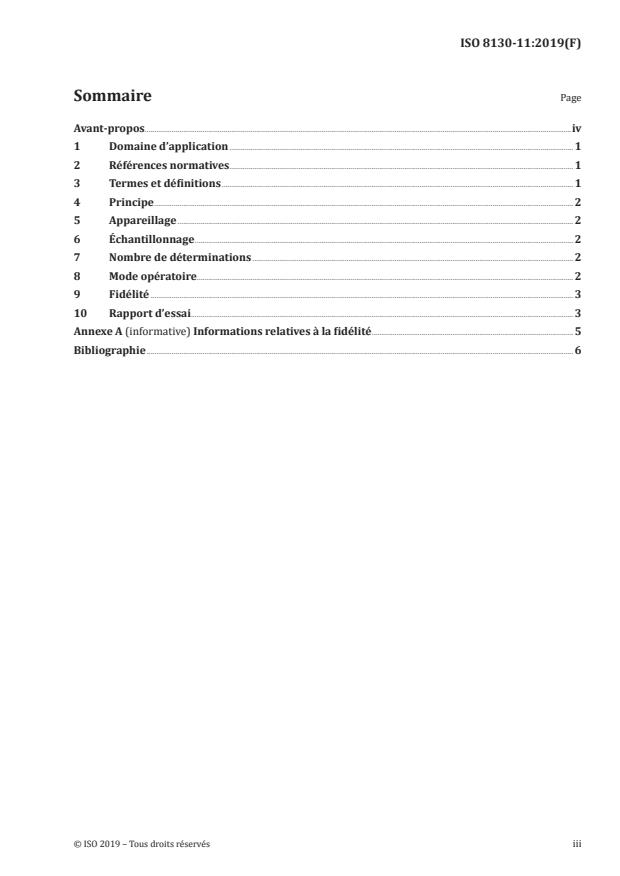
ISO 8130-11:2019 - Poudres pour revêtement — Partie 11: Essai d'écoulement sur plan incliné/1/2019
Overview
ISO 8130-11:2019 defines a standardized inclined-plane flow test for coating powders, focusing on thermosetting powders. Developed by the International Organization for Standardization (ISO), this method provides a comparative approach to measure the melt flow capability of a fused coating powder when heated, as it moves down a plane set at a specific angle. This property is crucial in understanding the surface finish and edge coverage during the curing process for powder coatings. The standard helps manufacturers and quality laboratories monitor and compare batch-to-batch variations, ensuring consistent performance for industrial powder coating applications.
Key Topics
- Comparative Melt Flow Assessment: The test measures how far a pressed pellet of coating powder flows down an inclined plate under controlled temperatures, providing an indication of the powder’s melt flow behavior during curing.
- Surface Appearance and Edge Coverage: The flow characteristic measured correlates with the finished coating’s surface smoothness and its effectiveness in covering sharp edges.
- Quality Control: The primary value of the test is in comparing different batches of the same coating powder. It is not suitable for cross-comparing powders of different chemical compositions.
- Limitations: This method is unsuitable for coating powders with gel times under one minute (according to ISO 8130-6) and for textured powders, as these may not flow predictably and would not yield meaningful comparative data.
- Test Report Requirements: The standard prescribes detailed documentation, including test conditions, substrate information, sample mass, temperature, and any deviations, to ensure reproducibility and traceability.
Applications
The inclined-plane flow test plays a critical role in several practical scenarios:
- Routine Batch Testing: Manufacturers use this ISO test method to consistently assess production batches for variations, helping to maintain high-quality powder coating standards.
- Process Optimization: Insights from flow measurements allow technical teams to fine-tune curing conditions and powder formulation, optimizing surface finish and coverage.
- Troubleshooting: Variations in flow behavior can highlight material inconsistencies early, supporting root cause analysis in case of production defects.
- Specification Compliance: The method is used to verify that powders meet required performance criteria tied to their intended application, especially in sectors like automotive or appliance coatings where surface aesthetics and durability are critical.
Related Standards
Several ISO standards complement or are referenced within ISO 8130-11:2019:
- ISO 8130-2: Coating powders - Determination of density by gas comparison pyknometer (referee method)
- ISO 8130-3: Coating powders - Determination of density by liquid displacement pyknometer
- ISO 8130-6: Coating powders - Determination of gel time of thermosetting powders (relevant for exclusion criteria)
- ISO 8130-14: Coating powders - Vocabulary, defining terms used in this series
- ISO 15528: Sampling methods for paints, varnishes, and related raw materials
Implementing these standards ensures robust, reproducible results and helps organizations align with global best practices for powder coating evaluation and quality control.
Keywords: ISO 8130-11, coating powders, inclined-plane flow test, melt flow, powder coating quality, thermosetting powders, batch consistency, powder coatings testing, surface finish standards, ISO standards for coatings.
Relations
- Consolidates
EN ISO 8130-11:2019 - Coating powders - Part 11: Inclined-plane flow test (ISO 8130-11:2019) - Effective Date
- 12-Feb-2026
- Effective Date
- 06-Jun-2022
- Effective Date
- 04-Nov-2015
Buy Documents
ISO 8130-11:2019 - Coating powders — Part 11: Inclined-plane flow test/1/2019
ISO 8130-11:2019 - Poudres pour revêtement — Partie 11: Essai d'écoulement sur plan incliné/1/2019
Frequently Asked Questions
ISO 8130-11:2019 is a standard published by the International Organization for Standardization (ISO). Its full title is "Coating powders — Part 11: Inclined-plane flow test". This standard covers: This document specifies a comparative method for determining the flow characteristic of a fused thermosetting coating powder down a plane inclined at a set angle to the horizontal. The aim of the test method described in this document gives an indication of the degree of melt flow that can occur during the curing of the coating powder. This characteristic contributes to the surface appearance and to the degree of coverage over sharp edges. The test is a comparative method for checking for batch to batch variation in the behaviour of a given coating powder. Correlation between the results from coating powders of differing composition is not to be expected. This method is not suitable for coating powders which have gel times of less than 1 min at the test temperature when characterised according to ISO 8130‑6. This method is also not suitable for textured powders.
This document specifies a comparative method for determining the flow characteristic of a fused thermosetting coating powder down a plane inclined at a set angle to the horizontal. The aim of the test method described in this document gives an indication of the degree of melt flow that can occur during the curing of the coating powder. This characteristic contributes to the surface appearance and to the degree of coverage over sharp edges. The test is a comparative method for checking for batch to batch variation in the behaviour of a given coating powder. Correlation between the results from coating powders of differing composition is not to be expected. This method is not suitable for coating powders which have gel times of less than 1 min at the test temperature when characterised according to ISO 8130‑6. This method is also not suitable for textured powders.
ISO 8130-11:2019 is classified under the following ICS (International Classification for Standards) categories: 87.040 - Paints and varnishes. The ICS classification helps identify the subject area and facilitates finding related standards.
ISO 8130-11:2019 has the following relationships with other standards: It is inter standard links to EN ISO 8130-11:2019, ISO 7396-1:2016, ISO 8130-11:1997. Understanding these relationships helps ensure you are using the most current and applicable version of the standard.
ISO 8130-11:2019 is available in PDF format for immediate download after purchase. The document can be added to your cart and obtained through the secure checkout process. Digital delivery ensures instant access to the complete standard document.
Standards Content (Sample)
INTERNATIONAL ISO
STANDARD 8130-11
Second edition
2019-04
Coating powders —
Part 11:
Inclined-plane flow test
Poudres pour revêtement —
Partie 11: Essai d'écoulement sur plan incliné
Reference number
©
ISO 2019
© ISO 2019
All rights reserved. Unless otherwise specified, or required in the context of its implementation, no part of this publication may
be reproduced or utilized otherwise in any form or by any means, electronic or mechanical, including photocopying, or posting
on the internet or an intranet, without prior written permission. Permission can be requested from either ISO at the address
below or ISO’s member body in the country of the requester.
ISO copyright office
CP 401 • Ch. de Blandonnet 8
CH-1214 Vernier, Geneva
Phone: +41 22 749 01 11
Fax: +41 22 749 09 47
Email: copyright@iso.org
Website: www.iso.org
Published in Switzerland
ii © ISO 2019 – All rights reserved
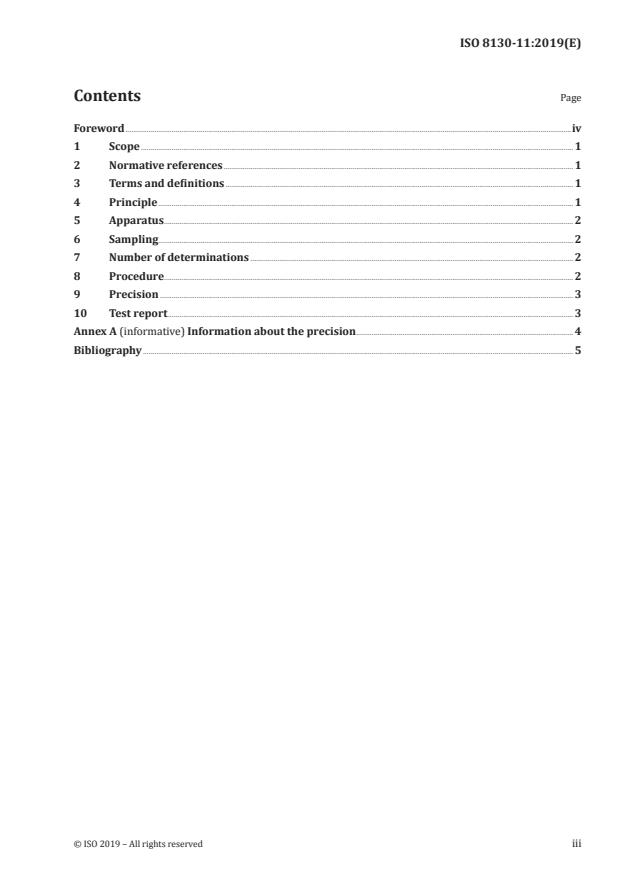
Contents Page
Foreword .iv
1 Scope . 1
2 Normative references . 1
3 Terms and definitions . 1
4 Principle . 1
5 Apparatus . 2
6 Sampling . 2
7 Number of determinations . 2
8 Procedure. 2
9 Precision . 3
10 Test report . 3
Annex A (informative) Information about the precision . 4
Bibliography . 5
Foreword
ISO (the International Organization for Standardization) is a worldwide federation of national standards
bodies (ISO member bodies). The work of preparing International Standards is normally carried out
through ISO technical committees. Each member body interested in a subject for which a technical
committee has been established has the right to be represented on that committee. International
organizations, governmental and non-governmental, in liaison with ISO, also take part in the work.
ISO collaborates closely with the International Electrotechnical Commission (IEC) on all matters of
electrotechnical standardization.
The procedures used to develop this document and those intended for its further maintenance are
described in the ISO/IEC Directives, Part 1. In particular, the different approval criteria needed for the
different types of ISO documents should be noted. This document was drafted in accordance with the
editorial rules of the ISO/IEC Directives, Part 2 (see www .iso .org/directives).
Attention is drawn to the possibility that some of the elements of this document may be the subject of
patent rights. ISO shall not be held responsible for identifying any or all such patent rights. Details of
any patent rights identified during the development of the document will be in the Introduction and/or
on the ISO list of patent declarations received (see www .iso .org/patents).
Any trade name used in this document is information given for the convenience of users and does not
constitute an endorsement.
For an explanation of the voluntary nature of standards, the meaning of ISO specific terms and
expressions related to conformity assessment, as well as information about ISO's adherence to the
World Trade Organization (WTO) principles in the Technical Barriers to Trade (TBT) see www .iso
.org/iso/foreword .html.
This document was prepared by Technical Committee ISO/TC 35, Paints and varnishes, Subcommittee
SC 9, General test methods for paints and varnishes.
This second edition cancels and replaces the first edition (ISO 8130-11:1997), which has been technically
revised.
The main changes compared to the previous edition are as follows:
— a “Terms and definitions” clause has been added;
— the procedure has been revised;
— information on the results of a round robin test has been added;
— the text has been editorially revised and the normative references have been updated.
A list of all the parts in the ISO 8130 series can be found on the ISO website.
Any feedback or questions on this document should be directed to the user’s national standards body. A
complete listing of these bodies can be found at www .iso .org/members .html.
iv © ISO 2019 – All rights reserved
INTERNATIONAL STANDARD ISO 8130-11:2019(E)
Coating powders —
Part 11:
Inclined-plane flow test
1 Scope
This document specifies a comparative method for determining the flow characteristic of a fused
thermosetting coating powder down a plane inclined at a set angle to the horizontal.
The aim of the test method described in this document gives an indication of the degree of melt flow
that can occur during the curing of the coating powder. This characteristic contributes to the surface
appearance and to th
...
INTERNATIONAL ISO
STANDARD 8130-11
Second edition
2019-04
Coating powders —
Part 11:
Inclined-plane flow test
Poudres pour revêtement —
Partie 11: Essai d'écoulement sur plan incliné
Reference number
©
ISO 2019
© ISO 2019
All rights reserved. Unless otherwise specified, or required in the context of its implementation, no part of this publication may
be reproduced or utilized otherwise in any form or by any means, electronic or mechanical, including photocopying, or posting
on the internet or an intranet, without prior written permission. Permission can be requested from either ISO at the address
below or ISO’s member body in the country of the requester.
ISO copyright office
CP 401 • Ch. de Blandonnet 8
CH-1214 Vernier, Geneva
Phone: +41 22 749 01 11
Fax: +41 22 749 09 47
Email: copyright@iso.org
Website: www.iso.org
Published in Switzerland
ii © ISO 2019 – All rights reserved
Contents Page
Foreword .iv
1 Scope . 1
2 Normative references . 1
3 Terms and definitions . 1
4 Principle . 1
5 Apparatus . 2
6 Sampling . 2
7 Number of determinations . 2
8 Procedure. 2
9 Precision . 3
10 Test report . 3
Annex A (informative) Information about the precision . 4
Bibliography . 5
Foreword
ISO (the International Organization for Standardization) is a worldwide federation of national standards
bodies (ISO member bodies). The work of preparing International Standards is normally carried out
through ISO technical committees. Each member body interested in a subject for which a technical
committee has been established has the right to be represented on that committee. International
organizations, governmental and non-governmental, in liaison with ISO, also take part in the work.
ISO collaborates closely with the International Electrotechnical Commission (IEC) on all matters of
electrotechnical standardization.
The procedures used to develop this document and those intended for its further maintenance are
described in the ISO/IEC Directives, Part 1. In particular, the different approval criteria needed for the
different types of ISO documents should be noted. This document was drafted in accordance with the
editorial rules of the ISO/IEC Directives, Part 2 (see www .iso .org/directives).
Attention is drawn to the possibility that some of the elements of this document may be the subject of
patent rights. ISO shall not be held responsible for identifying any or all such patent rights. Details of
any patent rights identified during the development of the document will be in the Introduction and/or
on the ISO list of patent declarations received (see www .iso .org/patents).
Any trade name used in this document is information given for the convenience of users and does not
constitute an endorsement.
For an explanation of the voluntary nature of standards, the meaning of ISO specific terms and
expressions related to conformity assessment, as well as information about ISO's adherence to the
World Trade Organization (WTO) principles in the Technical Barriers to Trade (TBT) see www .iso
.org/iso/foreword .html.
This document was prepared by Technical Committee ISO/TC 35, Paints and varnishes, Subcommittee
SC 9, General test methods for paints and varnishes.
This second edition cancels and replaces the first edition (ISO 8130-11:1997), which has been technically
revised.
The main changes compared to the previous edition are as follows:
— a “Terms and definitions” clause has been added;
— the procedure has been revised;
— information on the results of a round robin test has been added;
— the text has been editorially revised and the normative references have been updated.
A list of all the parts in the ISO 8130 series can be found on the ISO website.
Any feedback or questions on this document should be directed to the user’s national standards body. A
complete listing of these bodies can be found at www .iso .org/members .html.
iv © ISO 2019 – All rights reserved
INTERNATIONAL STANDARD ISO 8130-11:2019(E)
Coating powders —
Part 11:
Inclined-plane flow test
1 Scope
This document specifies a comparative method for determining the flow characteristic of a fused
thermosetting coating powder down a plane inclined at a set angle to the horizontal.
The aim of the test method described in this document gives an indication of the degree of melt flow
that can occur during the curing of the coating powder. This characteristic contributes to the surface
appearance and to th
...
NORME ISO
INTERNATIONALE 8130-11
Deuxième édition
2019-04
Poudres pour revêtement —
Partie 11:
Essai d'écoulement sur plan incliné
Coating powders —
Part 11: Inclined-plane flow test
Numéro de référence
©
ISO 2019
DOCUMENT PROTÉGÉ PAR COPYRIGHT
© ISO 2019
Tous droits réservés. Sauf prescription différente ou nécessité dans le contexte de sa mise en œuvre, aucune partie de cette
publication ne peut être reproduite ni utilisée sous quelque forme que ce soit et par aucun procédé, électronique ou mécanique,
y compris la photocopie, ou la diffusion sur l’internet ou sur un intranet, sans autorisation écrite préalable. Une autorisation peut
être demandée à l’ISO à l’adresse ci-après ou au comité membre de l’ISO dans le pays du demandeur.
ISO copyright office
Case postale 401 • Ch. de Blandonnet 8
CH-1214 Vernier, Genève
Tél.: +41 22 749 01 11
Fax: +41 22 749 09 47
E-mail: copyright@iso.org
Web: www.iso.org
Publié en Suisse
ii © ISO 2019 – Tous droits réservés
Sommaire Page
Avant-propos .iv
1 Domaine d’application . 1
2 Références normatives . 1
3 Termes et définitions . 1
4 Principe . 2
5 Appareillage . 2
6 Échantillonnage . 2
7 Nombre de déterminations . 2
8 Mode opératoire. 2
9 Fidélité . 3
10 Rapport d’essai . 3
Annexe A (informative) Informations relatives à la fidélité . 5
Bibliographie . 6
Avant-propos
L’ISO (Organisation internationale de normalisation) est une fédération mondiale d’organismes
nationaux de normalisation (comités membres de l’ISO). L’élaboration des Normes internationales est
en général confiée aux comités techniques de l’ISO. Chaque comité membre intéressé par une étude
a le droit de faire partie du comité technique créé à cet effet. Les organisations internationales,
gouvernementales et non gouvernementales, en liaison avec l’ISO participent également aux travaux.
L’ISO collabore étroitement avec la Commission électrotechnique internationale (IEC) en ce qui
concerne la normalisation électrotechnique.
Les procédures utilisées pour élaborer le présent document et celles destinées à sa mise à jour sont
décrites dans les Directives ISO/IEC, Partie 1. Il convient, en particulier de prendre note des différents
critères d’approbation requis pour les différents types de documents ISO. Le présent document a été
rédigé conformément aux règles de rédaction données dans les Directives ISO/IEC, Partie 2 (voir www
.iso .org/directives).
L’attention est attirée sur le fait que certains des éléments du présent document peuvent faire l’objet de
droits de propriété intellectuelle ou de droits analogues. L’ISO ne saurait être tenue pour responsable
de ne pas avoir identifié de tels droits de propriété et averti de leur existence. Les détails concernant
les références aux droits de propriété intellectuelle ou autres droits analogues identifiés lors de
l’élaboration du document sont indiqués dans l’Introduction et/ou dans la liste des déclarations de
brevets reçues par l’ISO (voir www .iso .org/brevets).
Les appellations commerciales éventuellement mentionnées dans le présent document sont données
pour information, par souci de commodité, à l’intention des utilisateurs et ne sauraient constituer un
engagement.
Pour une explication de la nature volontaire des normes, la signification des termes et expressions
spécifiques de l’ISO liés à l’évaluation de la conformité, ou pour toute information au sujet de l’adhésion
de l’ISO aux principes de l’Organisation mondiale du commerce (OMC) concernant les obstacles
techniques au commerce (OTC), voir le lien suivant: www .iso .org/iso/fr/avant -propos.
Le présent document a été élaboré par le comité technique ISO/TC 35, Peintures et vernis, sous-comité
SC 9, Méthodes générales d’essais des peintures et vernis.
Cette deuxième édition annule et remplace la première édition (ISO 8130-11:1997), qui a fait l’objet
d’une révision technique.
Les principales modifications par rapport à l’édition précédente sont les suivantes:
— ajout d’un article « Termes et définitions »;
— le mode opératoire a fait l’objet d’une révision;
— ajout d’informations relatives aux résultats d’un essai interlaboratoires;
— le texte a fait l’objet d’une révision d’ordre rédactionnel et les références normatives ont été
actualisées.
Une liste de toutes les parties de la série ISO 8130 se trouve sur le site web de l’ISO.
Il convient que l’utilisateur adresse tout retour d’information ou toute question concernant le présent
document à l’organisme national de normalisation de son pays. Une liste exhaustive desdits organismes
se trouve à l’adresse www .iso .org/members .html.
iv © ISO 2019 – Tous droits réservés
NORME INTERNATIONALE ISO 8130-11:2019(F)
Poudres pour revêtement —
Partie 11:
Essai d'écoulement sur plan incliné
1 Domaine d’application
Le présent document spécifie une méthode comparative visant à déterminer les caractéristiques
d’écoulement d’une poudre pour revêtement thermodurcissable en fusion le long d’un plan incliné, selon
un angle donné par rapport à l’horizontale.
L’objectif de la méthode d’essai décrite dans le présent document est de fournir une indication du
degré de fluidité pouvant se présenter au cours du durcissement de la poudre pour revêtement. Cette
caractéristique concourt à l’aspect de surface et au degré de recouvrement des arêtes vives.
Cet essai est une méthode comparative permettant de contrôler les variations d’un lot à l’autre dans
le comportement d’une poudre pour revêtement donnée. Il ne faut pas s’attendre à observer une
corrélation entre les résultats de poudres pour revêtement de différentes compositions.
La
...
NORME ISO
INTERNATIONALE 8130-11
Deuxième édition
2019-04
Poudres pour revêtement —
Partie 11:
Essai d'écoulement sur plan incliné
Coating powders —
Part 11: Inclined-plane flow test
Numéro de référence
©
ISO 2019
DOCUMENT PROTÉGÉ PAR COPYRIGHT
© ISO 2019
Tous droits réservés. Sauf prescription différente ou nécessité dans le contexte de sa mise en œuvre, aucune partie de cette
publication ne peut être reproduite ni utilisée sous quelque forme que ce soit et par aucun procédé, électronique ou mécanique,
y compris la photocopie, ou la diffusion sur l’internet ou sur un intranet, sans autorisation écrite préalable. Une autorisation peut
être demandée à l’ISO à l’adresse ci-après ou au comité membre de l’ISO dans le pays du demandeur.
ISO copyright office
Case postale 401 • Ch. de Blandonnet 8
CH-1214 Vernier, Genève
Tél.: +41 22 749 01 11
Fax: +41 22 749 09 47
E-mail: copyright@iso.org
Web: www.iso.org
Publié en Suisse
ii © ISO 2019 – Tous droits réservés
Sommaire Page
Avant-propos .iv
1 Domaine d’application . 1
2 Références normatives . 1
3 Termes et définitions . 1
4 Principe . 2
5 Appareillage . 2
6 Échantillonnage . 2
7 Nombre de déterminations . 2
8 Mode opératoire. 2
9 Fidélité . 3
10 Rapport d’essai . 3
Annexe A (informative) Informations relatives à la fidélité . 5
Bibliographie . 6
Avant-propos
L’ISO (Organisation internationale de normalisation) est une fédération mondiale d’organismes
nationaux de normalisation (comités membres de l’ISO). L’élaboration des Normes internationales est
en général confiée aux comités techniques de l’ISO. Chaque comité membre intéressé par une étude
a le droit de faire partie du comité technique créé à cet effet. Les organisations internationales,
gouvernementales et non gouvernementales, en liaison avec l’ISO participent également aux travaux.
L’ISO collabore étroitement avec la Commission électrotechnique internationale (IEC) en ce qui
concerne la normalisation électrotechnique.
Les procédures utilisées pour élaborer le présent document et celles destinées à sa mise à jour sont
décrites dans les Directives ISO/IEC, Partie 1. Il convient, en particulier de prendre note des différents
critères d’approbation requis pour les différents types de documents ISO. Le présent document a été
rédigé conformément aux règles de rédaction données dans les Directives ISO/IEC, Partie 2 (voir www
.iso .org/directives).
L’attention est attirée sur le fait que certains des éléments du présent document peuvent faire l’objet de
droits de propriété intellectuelle ou de droits analogues. L’ISO ne saurait être tenue pour responsable
de ne pas avoir identifié de tels droits de propriété et averti de leur existence. Les détails concernant
les références aux droits de propriété intellectuelle ou autres droits analogues identifiés lors de
l’élaboration du document sont indiqués dans l’Introduction et/ou dans la liste des déclarations de
brevets reçues par l’ISO (voir www .iso .org/brevets).
Les appellations commerciales éventuellement mentionnées dans le présent document sont données
pour information, par souci de commodité, à l’intention des utilisateurs et ne sauraient constituer un
engagement.
Pour une explication de la nature volontaire des normes, la signification des termes et expressions
spécifiques de l’ISO liés à l’évaluation de la conformité, ou pour toute information au sujet de l’adhésion
de l’ISO aux principes de l’Organisation mondiale du commerce (OMC) concernant les obstacles
techniques au commerce (OTC), voir le lien suivant: www .iso .org/iso/fr/avant -propos.
Le présent document a été élaboré par le comité technique ISO/TC 35, Peintures et vernis, sous-comité
SC 9, Méthodes générales d’essais des peintures et vernis.
Cette deuxième édition annule et remplace la première édition (ISO 8130-11:1997), qui a fait l’objet
d’une révision technique.
Les principales modifications par rapport à l’édition précédente sont les suivantes:
— ajout d’un article « Termes et définitions »;
— le mode opératoire a fait l’objet d’une révision;
— ajout d’informations relatives aux résultats d’un essai interlaboratoires;
— le texte a fait l’objet d’une révision d’ordre rédactionnel et les références normatives ont été
actualisées.
Une liste de toutes les parties de la série ISO 8130 se trouve sur le site web de l’ISO.
Il convient que l’utilisateur adresse tout retour d’information ou toute question concernant le présent
document à l’organisme national de normalisation de son pays. Une liste exhaustive desdits organismes
se trouve à l’adresse www .iso .org/members .html.
iv © ISO 2019 – Tous droits réservés
NORME INTERNATIONALE ISO 8130-11:2019(F)
Poudres pour revêtement —
Partie 11:
Essai d'écoulement sur plan incliné
1 Domaine d’application
Le présent document spécifie une méthode comparative visant à déterminer les caractéristiques
d’écoulement d’une poudre pour revêtement thermodurcissable en fusion le long d’un plan incliné, selon
un angle donné par rapport à l’horizontale.
L’objectif de la méthode d’essai décrite dans le présent document est de fournir une indication du
degré de fluidité pouvant se présenter au cours du durcissement de la poudre pour revêtement. Cette
caractéristique concourt à l’aspect de surface et au degré de recouvrement des arêtes vives.
Cet essai est une méthode comparative permettant de contrôler les variations d’un lot à l’autre dans
le comportement d’une poudre pour revêtement donnée. Il ne faut pas s’attendre à observer une
corrélation entre les résultats de poudres pour revêtement de différentes compositions.
La
...