

ISO/TS 19392-6:2026
(Main)Paints and varnishes — Coating systems for wind-turbine rotor blades — Part 6: Determination and evaluation of ice adhesion using centrifuge
General Information
- Abstract
This document specifies a method to measure ice adhesion from artificial ice on test substrates by using a centrifuge. Basic ice types are defined and test parameters for the ice removal are described to achieve reproducibility of test results for ice adhesion measurements for rotor blade coatings. This document does not intend to provide fixed test parameter to account for the diversity of relevant icing scenarios in this field of application. NOTE In practice, ice adhesion can be determined by two different measurement principles, the centrifugal test (covered in this document) and the shear test, which differ in dynamic and quasistatic shear rates. This test method can be used to test the adhesion of dynamic ice on the coating system of a wind turbine rotor blade under operation.
- Status
- Published
- Publication Date
- 15-Feb-2026
- Technical Committee
- ISO/TC 35/SC 9 - General test methods for paints and varnishes
- Drafting Committee
- ISO/TC 35/SC 9/WG 32 - Coating materials for wind-turbine rotor blades
- Current Stage
- 6060 - International Standard published
- Start Date
- 16-Feb-2026
- Due Date
- 14-Dec-2025
- Completion Date
- 16-Feb-2026


Overview
ISO/TS 19392-6:2026 is a technical specification developed by the International Organization for Standardization (ISO) that defines a standardized method for evaluating the ice adhesion of coating systems on wind-turbine rotor blades using a centrifuge. Effective icephobic coatings are essential for wind turbines operating in cold and humid environments, where ice formation can drastically reduce efficiency and present operational hazards. This document sets out procedures to measure the strength with which artificial ice adheres to coated test substrates, supporting comparative evaluation and reproducibility in testing rotor blade coatings.
By focusing on the centrifuge test method, ISO/TS 19392-6:2026 provides a consistent approach to assessing dynamic ice adhesion under controlled laboratory conditions, aiding in the development of high-performance anti-icing and de-icing solutions for wind energy applications.
Key Topics
- Artificial Ice Formation: The standard covers both “static ice” (ice formed in-place from liquid water) and “impact ice” (ice formed by supercooled droplets at high velocity), reflecting real-world icing scenarios.
- Centrifuge Testing Procedure: Describes how to prepare coated test panels, form artificial ice under controlled conditions, and use a centrifuge to measure the force required to remove ice.
- Sample Preparation & Conditioning: Outlines crucial steps for preparing and conditioning substrates, ensuring test consistency, and noting relevant details such as substrate material, coating thickness, and surface roughness.
- Test and Evaluation Parameters: Defines parameters for centrifuge speed, ice formation area, test temperature, and cycle repetitions to enhance reproducibility.
- Data Reporting: Establishes requirements for test reporting, including documenting test conditions, equipment used, and results for full traceability.
Applications
ISO/TS 19392-6:2026 serves a variety of stakeholders in the wind energy sector and coatings industry:
- Wind Turbine Manufacturers: Allows for standardized performance verification and quality assurance of rotor blade coatings designed to minimize ice adhesion.
- Coating Developers and Suppliers: Supports the R&D of advanced icephobic and anti-icing coatings, providing a consistent methodology for benchmarking and certification.
- Testing Laboratories: Offers a reproducible and recognized test protocol for assessing the performance of new or existing coatings under laboratory conditions simulating operational environments.
- Asset Operators and Maintenance Organizations: Facilitates the selection and application of optimal coating systems, improving turbine reliability and operational safety in cold climates.
- Regulatory and Certification Bodies: Ensures compliance with international practices and supports product approval processes in the renewable energy sector.
Related Standards
Adopting or referencing ISO/TS 19392-6:2026 may require consideration of several related standards, including:
- ISO 1513: Paints and varnishes - Examination and preparation of test samples
- ISO 2808: Paints and varnishes - Determination of film thickness
- ISO 4618: Paints and varnishes - Vocabulary
- ISO 15528: Paints, varnishes and raw materials for paints and varnishes - Sampling
- ISO 21920-2: Geometrical product specifications (GPS) - Surface texture: Profile - Part 2: Terms, definitions and surface texture parameters
- SAE ARP 5905A: Calibration and Acceptance of Icing Wind Tunnels
Practical Value
Implementing the methods outlined in ISO/TS 19392-6:2026 supports the development of durable and effective wind turbine coatings, enhances operational reliability in harsh environments, and standardizes the evaluation of icephobic properties globally. Utilizing centrifuge-based ice adhesion testing, as opposed to alternative methods like the shear test, enables the simulation of dynamic operating conditions on rotor blades. This ensures that coating systems meet performance expectations, contributing to energy yield optimization and reducing risks associated with ice accumulation.
Relations
- Effective Date
- 12-Feb-2026
- Effective Date
- 15-Jun-2024
Frequently Asked Questions
ISO/TS 19392-6:2026 is a technical specification published by the International Organization for Standardization (ISO). Its full title is "Paints and varnishes — Coating systems for wind-turbine rotor blades — Part 6: Determination and evaluation of ice adhesion using centrifuge". This standard covers: This document specifies a method to measure ice adhesion from artificial ice on test substrates by using a centrifuge. Basic ice types are defined and test parameters for the ice removal are described to achieve reproducibility of test results for ice adhesion measurements for rotor blade coatings. This document does not intend to provide fixed test parameter to account for the diversity of relevant icing scenarios in this field of application. NOTE In practice, ice adhesion can be determined by two different measurement principles, the centrifugal test (covered in this document) and the shear test, which differ in dynamic and quasistatic shear rates. This test method can be used to test the adhesion of dynamic ice on the coating system of a wind turbine rotor blade under operation.
This document specifies a method to measure ice adhesion from artificial ice on test substrates by using a centrifuge. Basic ice types are defined and test parameters for the ice removal are described to achieve reproducibility of test results for ice adhesion measurements for rotor blade coatings. This document does not intend to provide fixed test parameter to account for the diversity of relevant icing scenarios in this field of application. NOTE In practice, ice adhesion can be determined by two different measurement principles, the centrifugal test (covered in this document) and the shear test, which differ in dynamic and quasistatic shear rates. This test method can be used to test the adhesion of dynamic ice on the coating system of a wind turbine rotor blade under operation.
ISO/TS 19392-6:2026 is classified under the following ICS (International Classification for Standards) categories: 87.040 - Paints and varnishes. The ICS classification helps identify the subject area and facilitates finding related standards.
ISO/TS 19392-6:2026 has the following relationships with other standards: It is inter standard links to CEN ISO/TS 19392-6:2026, ISO/TS 19392-6:2023. Understanding these relationships helps ensure you are using the most current and applicable version of the standard.
ISO/TS 19392-6:2026 is available in PDF format for immediate download after purchase. The document can be added to your cart and obtained through the secure checkout process. Digital delivery ensures instant access to the complete standard document.
Standards Content (Sample)
Technical
Specification
ISO/TS 19392-6
Second edition
Paints and varnishes — Coating
2026-02
systems for wind-turbine rotor
blades —
Part 6:
Determination and evaluation of ice
adhesion using centrifuge
Peintures et vernis — Matériaux de revêtement pour pales de
turbines éoliennes —
Partie 6: Détermination et évaluation de l'adhésion de la glace à
l'aide d'une centrifugeuse
Reference number
© ISO 2026
All rights reserved. Unless otherwise specified, or required in the context of its implementation, no part of this publication may
be reproduced or utilized otherwise in any form or by any means, electronic or mechanical, including photocopying, or posting on
the internet or an intranet, without prior written permission. Permission can be requested from either ISO at the address below
or ISO’s member body in the country of the requester.
ISO copyright office
CP 401 • Ch. de Blandonnet 8
CH-1214 Vernier, Geneva
Phone: +41 22 749 01 11
Email: copyright@iso.org
Website: www.iso.org
Published in Switzerland
ii
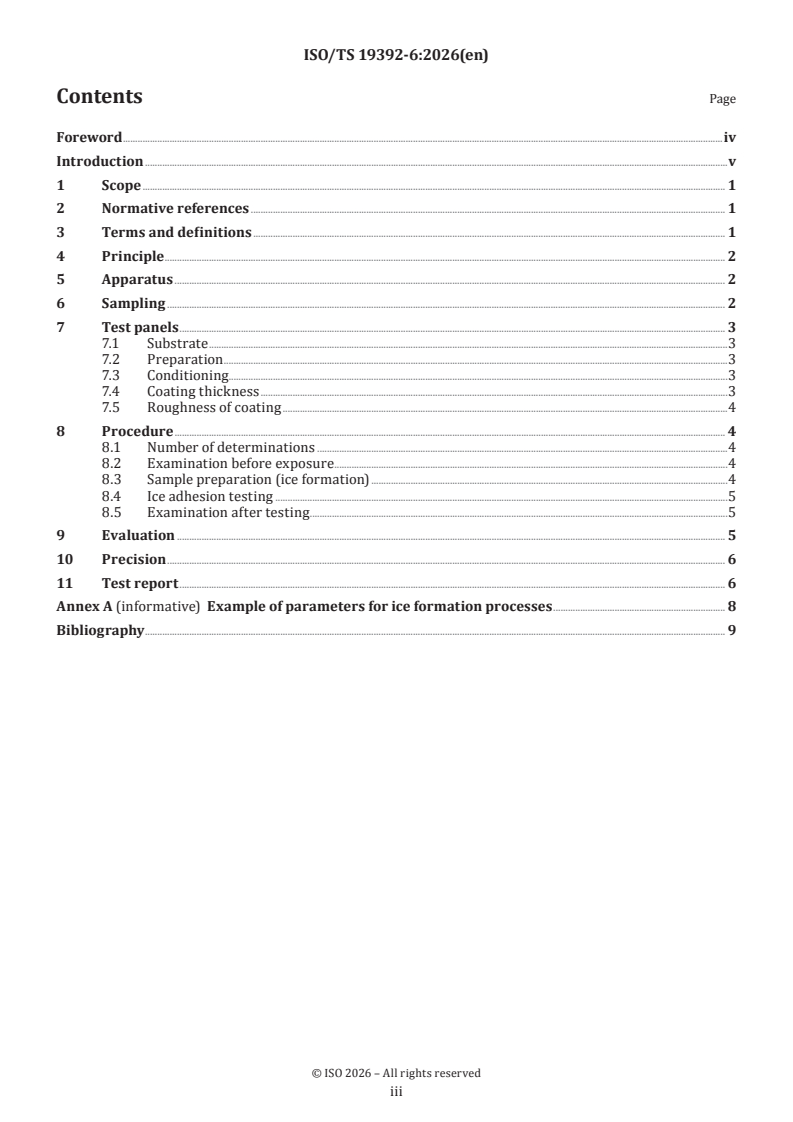
Contents Page
Foreword .iv
Introduction .v
1 Scope . 1
2 Normative references . 1
3 Terms and definitions . 1
4 Principle . 2
5 Apparatus . 2
6 Sampling . 2
7 Test panels . 3
7.1 Substrate .3
7.2 Preparation .3
7.3 Conditioning.3
7.4 Coating thickness .3
7.5 Roughness of coating .4
8 Procedure . 4
8.1 Number of determinations .4
8.2 Examination before exposure . .4
8.3 Sample preparation (ice formation) .4
8.4 Ice adhesion testing .5
8.5 Examination after testing .5
9 Evaluation . 5
10 Precision . 6
11 Test report . 6
Annex A (informative) Example of parameters for ice formation processes . 8
Bibliography . 9
iii
Foreword
ISO (the International Organization for Standardization) is a worldwide federation of national standards
bodies (ISO member bodies). The work of preparing International Standards is normally carried out through
ISO technical committees. Each member body interested in a subject for which a technical committee
has been established has the right to be represented on that committee. International organizations,
governmental and non-governmental, in liaison with ISO, also take part in the work. ISO collaborates closely
with the International Electrotechnical Commission (IEC) on all matters of electrotechnical standardization.
The procedures used to develop this document and those intended for its further maintenance are described
in the ISO/IEC Directives, Part 1. In particular, the different approval criteria needed for the different types
of ISO document should be noted. This document was drafted in accordance with the editorial rules of the
ISO/IEC Directives, Part 2 (see www.iso.org/directives).
ISO draws attention to the possibility that the implementation of this document may involve the use of (a)
patent(s). ISO takes no position concerning the evidence, validity or applicability of any claimed patent
rights in respect thereof. As of the date of publication of this document, ISO had not received notice of (a)
patent(s) which may be required to implement this document. However, implementers are cautioned that
this may not represent the latest information, which may be obtained from the patent database available at
www.iso.org/patents. ISO shall not be held responsible for identifying any or all such patent rights.
Any trade name used in this document is information given for the convenience of users and does not
constitute an endorsement.
For an explanation of the voluntary nature of standards, the meaning of ISO specific terms and expressions
related to conformity assessment, as well as information about ISO's adherence to the World Trade
Organization (WTO) principles in the Technical Barriers to Trade (TBT), see www.iso.org/iso/foreword.html.
This document was prepared by Technical Committee ISO/TC 35, Paints and varnishes, Subcommittee
SC 9, General test methods for paints and varnishes, in collaboration with the European Committee for
Standardization (CEN) Technical Committee CEN/TC 139, Paints and varnishes, in accordance with the
Agreement on technical cooperation between ISO and CEN (Vienna Agreement).
This second edition cancels and replaces the first edition (ISO/TS 19392-6:2023), which has been technically
revised.
The main changes are as follows:
— in Clause 1 a note has been added to give more information on the different methods for the determination
of ice adhesion;
— ISO 2808 has been added as a normative reference;
— in 8.3, in the seventh paragraph, considerations on the presence of mould were added;
— in 8.4, Table 1, a header and a separate column for the units were inserted;
— in Clause 9, Formula (1), ω was corrected to the angular momentum ω and the explanation of symbols
was updated;
— in Annex A an introductory sentence was added;
— in Table A.1 a separate column for the units was inserted.
A list of all parts in the ISO 19392 series can be found on the ISO website.
Any feedback or questions on this document should be directed to the user’s national standards body. A
complete listing of these bodies can be found at www.iso.org/members.html.
iv
Introduction
Ice accretion on rotor blade surfaces of wind turbines can decrease the efficiency and limit the performance
of wind turbines in cold, humid environments. Ice formation can also lead to damage of the rotor blade and
can be hazardous, if ice falls off the blade. Icephobic coatings (“icephobics”) can be applied to rotor blade
surfaces to reduce or prevent the adhesion of ice by removing ice prior to reaching a critical ice mass for the
rotor blades. They can also increase the efficiency of thermal ice protection systems.
v
Technical Specification ISO/TS 19392-6:2026(en)
Paints and varnishes — Coating systems for wind-turbine
rotor blades —
Part 6:
Determination and evaluation of ice adhesion using
centrifuge
1 Scope
This document specifies a method to measure ice adhesion from artificial ice on test substrates by using
a centrifuge. Basic ice types are defined and test parameters for the ice removal are described to achieve
reproducibility of test results for ice adhesion measurements for rotor blade coatings. This document does
not intend to provide fixed test parameter to account for the diversity of relevant icing scenarios in this field
of application.
NOTE In practice, ice adhesion can be determined by two different measurement principles, the centrifugal test
(covered in this document) and the shear test, which differ in dynamic and quasistatic shear rates.
This test method can be used to test the adhesion of dynamic ice on the coating system of a wind turbine
rotor blade under operation.
2 Normative references
The following documents are referred to in the text in such a way that some or all of their content constitutes
requirements of this document. For dated references, only the edition cited applies. For undated references,
the latest edition of the referenced document (including any amendments) applies.
ISO 1513, Paints and varnishes — Examination and preparation of test samples
ISO 2808, Paints and varnishes — Determination of film thickness
ISO 4618, Paints and varnishes — Vocabulary
ISO 15528, Paints, varnishes and raw materials for paints and varnishes — Sampling
ISO 21920-2, Geometrical product specifications (GPS) — Surface texture: Profile — Part 2: Terms, definitions
and surface texture parameters
SAE ARP 5905A, Calibration and Acceptance of Icing Wind Tunnels
3 Terms and definitions
For the purposes of this document, the terms and definitions given in ISO 4618 and the following apply.
ISO and IEC maintain te
...